




Abstract
During the World Wars, the Italian, German, UK, US and USSR governments launched national initiatives to foster wartime gardening among their non-enlisted citizens, especially women. ‘Victory gardens’ had a twofold function: enrolling the home public to the war effort and stimulating the national production of vegetables to counter food scarcity. Attending to this understudied martial practice, this paper suggests that IR and War studies should re-think what the concept of victory is and does, as well as how we study it. Rather than by the end of fighting, military victory is determined by, and operates through, a series of practices that are both martial and peaceful, military and civilian and always temporal in nature. To grasp these dynamics, victory cannot be conceptualised as a mere outcome of war, nor can research on victory only focus on the study of fighting, the battlefield or wartime. Instead, I argue for a theorisation of victory as a temporal marker. Often construed as the outcome of conflicts, victory can bring wars to an end but does not necessarily do so. Examining the social construction of victory through the example of wartime gardening, indeed, the article demonstrates that victory does not happen between wartime and peacetime but constitutes this temporal distinction while also shaping global social hierarchies that transcend war and peace.
Keywords
Introduction
‘Brother’s got his gun, gone to france, [sic] for the fray, Sister’s gone away, first of May, for the stay,
Planting crops to win the war.
Kaiser’s Bill’s afraid, Hindenburgh [sic] is dismayed, Watch that Yankee maid learn a trade, use a spade,
Soon a farmer she will be
Planting crops for liberty.
Plow away, plow away, Giddap horse, turn the ground under there, Bog crops we’re sowing, the plants are growing,
The girls are farming everywhere.
Kaiser Bill, write your will,
Food we’ll send without end to a friend
We are working, there’ll be no shirking,
And we won’t stop farming
Until food has won the war’.
Set to the tune of the well-known patriotic song ‘Over There’ by George M. Cohan, the ‘Working Song’ was particularly popular among ‘the farmerettes’ of the Woman’s Land Army of America during the First World War (Gowdy-Wygant, 2013: 55). The lyrics exemplify at least two central trends and tropes of the day: first, food, especially vegetables, was thought of as a weapon of war that was essential for victory; second, and relatedly, farming and gardening gained traction among civilians – especially women. Forgotten today by International Relations (IR) and War Studies, ‘victory gardens’ were ubiquitous around the globe during the first half of the 20th century.
According to the US National War Garden Commission, for example, in 1918, one in four households produced home-grown vegetables in the US alone, with an estimated collective output of ‘$525 million worth of food’ (Maltz, 2015: 394) cultivated across 5,285,000 war gardens (Gowdy-Wygant, 2013: 75; see also Hayden-Smith, 2014; Pack, 1919: 15) by millions of ‘soldiers of the soil’ (Hayden-Smith, 2007: 20). War gardening initiatives of comparable magnitude were present in the UK (Ginn, 2012: 296; Gowdy-Wygant, 2013: 19; Maltz, 2015: 396), Italy (Ascenzi and Brunelli, 2016), Germany (Maltz, 2015; Wolschke-Bulmahn, 1992), the Soviet Union (Charon Cardona and Markwick, 2019), as well as Canada (Mosby, 2014 see esp. 103–108), Australia, New Zealand (Gowdy-Wygant, 2013: 38) and South Africa (Gowdy-Wygant, 2013: 88; see also Pack, 1919: 22) during both the First and Second World Wars. 1
Victory gardens were not only present in sheer numbers but also central to public discourse and significant social change. According to Cecilia Gowdy-Wygant (2013), for instance, victory gardens and associated food rationing and conservation policies led to a complete reinterpretation of ‘women’s place and space, in both agriculture and in society’ (p. 62). 2 For Rose Hayden-Smith (2007: 20), wartime gardening – and especially the creation of the ‘United States School Garden Army’ – represents ‘one of the first attempts to nationalise a curriculum in the United States’, therefore marking a key milestone in the history of education. Victory gardens made such a crucial contribution to wartime food production that they still serve as an exemplar of how to build resilient food-systems in ‘moments of crisis’ (Endres and Endres, 2009; Maltz, 2015; Music et al., 2021), or how to securitise food (Hayden-Smith, 2007, 2014). 3
This article argues that, when read as subjects of IR and War Studies, victory gardens also function as a productive site from which to re-imagine what victory itself is and how to study it, as well as to explore the socio-political dynamics to which ‘military victory’ gives rise. Wartime gardening was not only a means of food production but also what I call a ‘victory practice’: a way to enlist non-conscripted citizens, mobilise the ‘home front’ (Bentley, 1998: 7) and bring the wars to a successful conclusion. In fact, war gardens served various temporal purposes. In the US, in the aftermath of the Armistice of Compiègne, for instance, ‘Liberty’ and ‘war’ gardens were promptly renamed ‘victory’ gardens to explicitly mark the end of the First World War (see Miller, 2003: 396). 4 Concomitantly, war gardening was made to be a temporary practice that enabled governments to simultaneously enlist marginalised groups to the war effort while reproducing the very conditions of their subalternity.
I develop this argument in two moves. First, I discuss the historical significance of victory gardens and mobilise them as a diagnostic tool to show that much scholarly production in IR and War Studies conflates the end of fighting with the end of war – and by extension, imagine victory as the outcome of conflict and an event that separates wartime from peacetime. This ontology of victory-as-outcome, however, does not stand up to scrutiny: feminist, anti-colonial and legal scholars alike have repeatedly shown that violence both predates and transcends periods of ‘heightened hostilities’. Similarly, historiographical work shows fighting to be an inaccurate temporal marker – for instance, there are numerous examples of active theatres of operation long after 1918 and 1945. By contrast, I show that it is through seemingly peaceful social practices like gardening – alongside, inter alia, parades, public ceremonies or the erection of monuments – that military victory is made into a periodiser and a watershed moment that can bring about peace. In fact, victory gardens and other comparable victory practices are constitutive of the very ideas of wartime and peacetime.
Second, I use victory gardens as a prognostic tool to show that there is more to these mundane victory practices than bringing war to an end. Wartime gardening, for example, facilitated the (re)production of gendered and raced hierarchies on a global scale. If we keep siloing the study of victory to different ‘levels’ or ‘phases’ of war such as tactics and peace-making, we risk missing not only some of these victory practices but also their social effects and interactions – for example, how they work across domains and popular distinctions like military/civilian or war/peacetime. Put differently, wartime gardening is an exemplary victory practice that unsettles traditional analytical approaches that examine victory from within the wartime battlefield, and that scholars of war need to be attentive to if we are to understand how, why and with what effect victory signifies the end of war and the turning point from wartime to peacetime.
Overall, the article offers a twofold contribution to IR, War Studies and adjacent disciplines engaged in the critical study of war. The first is empirical: I introduce the idea of victory practices and bring into focus wartime gardening as an example of tangible historical significance that remains currently neglected in IR. By elucidating the pivotal role that victory gardens played in the constructions of wartime and as a technology of social ordering in the first half of the 20th century, I show that victory matters well beyond the battlefield and wartime, offering a clear demonstration of ‘the emergent and generative character of war’ (Bousquet et al., 2020: 99; see also Barkawi and Brighton, 2011). The second, theoretical contribution is instead a new conceptualisation of military victory as a temporal marker. Here, I answer Lauren Wilcox’s (in Hartnett et al., 2022: 3) recent call to ‘find a different role for ‘victory’ in forms of political violence’, showing how victory shapes ‘social relations and processes’ (Barkawi, 2011: 704), the effects of which are ‘present beyond the war front and beyond wartime, in and among apparently pacific social, cultural and economic relations’ (Barkawi and Brighton, 2011: 132). In articulating this understanding of victory as a temporal marker, I not only ask scholars engaged in the critical study of warfare to re-think extant ontologies of military victory as the outcome of armed conflict but also to start attending to the mundane, socio-political dynamics to which victory gives rise. Far from being a call to abandon the analysis of fighting, other violent articulations of war, or diplomacy, the article proffers the study of victory and its mundane (temporal) politics as a much-needed, complementary endeavour.
Wartime gardening in the 20th century
Victory gardens – also known as war gardens, survival gardens, autarkic gardens or Liberty gardens (see Ascenzi and Brunelli, 2016; Bentley, 1998: 117; Gowdy-Wygant, 2013: 4, 10, 65; Hayden-Smith, 2007: 20, 26, 2014: 95; Lawson, 2014: 183; Miller, 2003: 396; Wolschke-Bulmahn, 1992: 56–57) – were gardens of all shapes, sizes and produce that punctuated both the urban and agricultural landscapes of war-torn countries in the first half of the 20th century. During both World Wars, ‘war gardens sprang up as though by magic’ and ‘[g]ardening came to be the thing’ (Pack, 1919: 18; see also Hayden-Smith, 2014: 22): from the countryside to the city, from the home to communal spaces, on windowsills, along railways, in parks, hospitals and hotels, victory gardens were virtually everywhere. 5
In the US, in 1918, there were over 5 million gardens (Gowdy-Wygant, 2013: 75; see also Hayden-Smith, 2014; Pack, 1919: 15). In 1944, these numbers had more than tripled: Americans tended between 18 and 20 million gardens, responsible for ‘40% of the total domestic vegetable supply’ (Lawson, 2014: 182). UK war gardening figures are similarly astounding. A government-led effort to improve domestic food production (Gowdy-Wygant, 2013: 19) resulted, by 1917, in the active employment of 23,000 recruits of the Women’s Land Army in regular farms and the creation of 500,000 garden allotments (Maltz, 2015: 393) – a number that rose to 800,000 the following year, producing ‘an estimated eight hundred thousand additional tons of food for the nation’ (Gowdy-Wygant, 2013: 77). Just like in the US, the UK figures for World War Two are even greater: the Ministry of Agriculture’s ‘Dig for Victory’ campaign led to an increase from 930,000 allotments in 1939 to 1,700,000 in 1943, and an even more impressive expansion from 3 to 5 million in private gardens during the same period (Ginn, 2012: 296; see also Maltz, 2015: 396). As to the British Women’s Land Army, by 1945, it counted around 77,000 recruits (Gowdy-Wygant, 2013: 6). 6
In a broader sense, victory gardens were also government-led, nationally orchestrated programmes that sought to remedy wartime-related food shortages and strictures by individualising and ‘democratising’ food production – that is, by asking every citizen to grow their own vegetables (see Maltz, 2015; Miller, 2003). As the architect of one of these campaigns put it, ‘[t]he war garden was a war-time necessity’ (Pack, 1919: 1). Indeed, while initiating a victory garden was ultimately an individual, voluntary act, the call for wartime gardening took the shape of highly institutionalised initiatives characterised by the establishment of sophisticated bureaucracies and other institutional infrastructures that, with degrees of variation from country to country, grew stronger and more complex from the First World War to the Second. In the UK, for example, the British government encouraged the cultivation of ‘urban allotment gardens on all available vacant land’ (Gowdy-Wygant, 2013: 72) through to the establishment of a new Minister of Food Control in 1916 and the launch of a ‘land campaign’ and ‘Feed the Guns’ – the UK’s first gardening-centred campaigns (Gowdy-Wygant, 2013: 71–77). Meanwhile, in 1917, the Agricultural Organization Society – an association of volunteer farmers and urbanities – received official government funding to elevate their allotment gardening effort to a national scale, the Woman Land Army inaugurated its first season and the National Federation of Women’s Institutes was founded with the aim of, inter alia, providing a national structure for the recruitment of woman farm labourers to make up for the manpower deficit engendered by the conflict (Gowdy-Wygant, 2013: 29, 73–74; see also Maltz, 2015: 393).
Inspired at least in part by the British programme, the First World War gardening initiative in the US was even more sophisticated from a bureaucratic and institutional standpoint. Indeed, the 1917–1919 gardening campaign included: the establishment of the Food Administration in 1917 (Gowdy-Wygant, 2013: 77; Maltz, 2015: 394); the creation of a National War Garden Commission (Hayden-Smith, 2007: 20, 2014: 49; Lawson, 2014: 185; Miller, 2003: 396; Wolschke-Bulmahn, 1992: 54) with the aim to, in the words of its founder, ‘arouse the patriots of America to the importance of putting all idle land to work, to teach them how to do it, and to educate them to conserve’ (Pack, 1919: 10); the introduction of the United States School Garden Army, a schooling programme funded by the War Department that sought to embed victory gardening in the national curriculum (Hayden-Smith, 2007: 20, see also 2014; Gowdy-Wygant, 2013: 87; Lawson, 2014: 186) and the launch of the Women’s Land Army of America (Gowdy-Wygant, 2013: 43–46). President Woodrow Wilson himself endorsed most of these initiatives and even offered direct support in the form of $50,000 to the School Army from the National Security and Defense Fund (Hayden-Smith, 2007: 22, 2014: 18), as well as a $4.3 million budget to state and county agencies via the Emergency Food Act (Gowdy-Wygant, 2013: 77). He also publicly launched ‘Food Will Win the War’: a campaign that included intense, multi-media propaganda, lecture series, demonstrations, parades, parties and even the organisation of ‘War Garden Days’ (see Gowdy-Wygant, 2013: 43, 64, 77–87; see also Wolschke-Bulmahn, 1992: 53).
Similarly vast and elaborate institutional apparatuses characterised the more expansive victory garden campaigns of both countries during the Second World War. In addition to reinstating the Women’s Land Army (Maltz, 2015: 397), for instance, the US inaugurated a new war gardening campaign: ‘Food Fights for Freedom’ – designed at an ad hoc National Defence Gardening Conference in Washington DC on December 19, 1941 – envisaged the implementation of ‘nine individual informational programs’ that ‘required coordination at the federal, state and local level’ and led to the establishment of a National Advisory Garden Committee that was also responsible for the organisation of an ‘annual National Victory Garden Conference’ (Lawson, 2014: 187; see also Bentley, 1998: 114–141; Gowdy-Wygant, 2013: 131–161; Hayden-Smith, 2007: 26; Miller, 2003: 396). In the UK, the Ministry of Agriculture, the Ministry of Food, the British Ministry of Information and the War Agricultural Committees led and promoted a widely successful and influential gardening campaign titled ‘Dig for Victory’ (see Gowdy-Wygant, 2013: 6, 150–161; see also Ginn, 2012). Right at the outbreak of the war, the Women’s Land Army was also reinstated (Maltz, 2015: 396).
Initiatives of comparable magnitude and complexity underpinned victory garden campaigns in Italy (see Ascenzi and Brunelli, 2016), Canada, (see Mosby, 2014) and the Soviet Union (see Charon Cardona and Markwick, 2019). While all designed at the national level, these campaigns had a markedly international component – not only in the sense that victory gardens were ubiquitous around the globe but also that international ties and influences shaped national efforts to a significant degree. As part of the British ‘land campaign’ during the First World War, for instance, the newly established Minister of Food Control distributed 5,000 copies of War Gardening: Victory Edition, ‘the American National War Garden Commission’s handbook on gardening’ (Gowdy-Wygant, 2013: 73). When setting up and organising the British Women’s Land Army, its founders leveraged transnational interpersonal ties, as well as existing networks of internationalist suffrage associations and unions (see Gowdy-Wygant, 2013: 35–38). According to Ascenzi and Brunelli (2016), the Ministry of Popular Culture in Fascist Italy ‘adopt[ed] communication and propagandistic modalities . . . put into practice in other countries, for example, in Great Britain’ (p. 507). It is within this context of heavy institutionalisation, transnational influences and international popularity that the enormous figures above have to be understood: during the first half of the 20th century, there was almost no aspect of everyday life left untouched by gardening campaigns.
Military victory in IR and War Studies
Victory gardens deserve attention not only because of this international historical significance (see also Callahan, 2017) but also because they can illuminate an ongoing ‘victory problem’ that affects IR and War Studies. As Hom and Campbell (2022a) recently noted, ‘we do not understand victory or its relationship to war and the use of force especially well’ (p. 593). And yet, victory and warfare are central concerns of both disciplines (Barkawi, 2011: 708). Disputes over its disciplinary status notwithstanding (see Barkawi and Brighton, 2011), War Studies is supposedly so devoted to the examination of war that it takes its name from it. The relationship between IR and war, in turn, has been repeatedly deemed to be close to an ‘obsession’ (Buzan and Lawson, 2014: 439; see also De Carvalho et al., 2011): one that is enshrined in mythical ‘benchmark dates’ that punctuate ‘official’ chronologies of both the discipline (International Relations) and the practice that constitutes its core object of enquiry (international relations). For example, the very international system – of which war is supposedly an effect – is said to originate out of the Thirty Years’ War in 1648, while IR ‘the discipline’ was born in 1919, as a result of victory in the First World War and with the aim of ‘solv[ing] the problem of war’ altogether (De Carvalho et al., 2011: 745).
Except, World War One did not end in 1919 – or 1918, for that matter (Homberger, 1976). As Robert Gerwarth (2016: 6) cogently puts it such a periodization only makes sense for the principal victors of the Great War, namely Britain. . . and France, for whom the cessation of hostilities on the Western Front indeed marked the beginning of a post-war era. For those living in Riga, Kiev, Smyrna, or many other places in eastern, central and south-eastern Europe in 1919, there was no peace, only continuous violence (see also Gerwarth and Horne, 2012).
In fact, discrepancies between IR-sanctioned historiographical chronologies are not limited to the First World War. For instance, several eastern European and Chinese historiographies dispute the idea that World War Two started in 1939 and ended in 1945 (see Kattago, 2009; Paine, 2012). From a postcolonial perspective, global-scale violence started around 1492 and endures ever since; classifications of recent postcolonial violence as (counter-)insurgencies, interventions or Small Wars also make little chronological sense: imperial violence is closer to ‘permanent war’, and insurgencies have no clear starting and ending points (Barkawi, 2016: 204–205). As feminist scholars have demonstrated time and again, violence is better represented as unfolding along a continuum, and not at intervals of war and peace (Cockburn, 2004; see also Yadav and Horn, 2021). To put it bluntly, the two disciplines that are most directly focused on the study of war run into theoretical and empirical problems when it comes to periodising armed conflicts and identifying how and when wars end (De Franco et al., 2019). Why?
At least in part, this problem stems from a narrow understanding of military victory which seems to be widespread across both IR and War Studies. Indeed, there is a tendency to define (explicitly or implicitly) military victory as the outcome of fighting and, in turn, to conflate military victory – or the end of ‘heightened hostilities’ – with the end of war. Ironically, such a narrow understanding of victory originates precisely out of repeated calls to clarify the meaning of military victory. Indeed, victory has been repeatedly deemed a particularly fuzzy or blurry term across traditions, paradigms and schools of thought (for example, Angstrom and Duyvesteyn, 2007; Blum, 2013; Hom and Campbell, 2022a; Hom et al., 2017; Mandel, 2006, 2007; Martel, 2011a: 513–514, 2011b: 395; O’Driscoll, 2015, 2020a, 2020b). As scholars note, victory acquires different meanings across different contexts (Blum, 2013: 394; Hom et al., 2017: 4), cultures (Mandel, 2007: 461), intellectual traditions (Martel, 2011a: 521–531) and even opposite parties in the same conflict (Bartholomees, 2008: 31–33; Martel, 2011b: 2; Hom, 2018: 75).
This lack of clarity in the meaning of victory is often attributed to its complexity, or inherent elusiveness, as an object of enquiry – a popular idea that is compellingly captured by military historian J. Boon Bartholomees’ (2008) intuition that ‘[v]ictory in war is at the most basic level an assessment, not a fact or condition. It is someone’s opinion, or amalgamation of opinions’ (p. 26). To alleviate this concern, traditional IR and War Study scholarship has offered detailed genealogies of the term (for example, Bond, 1996; Hobbs, 1979; McCormick, 1986; Strachan, 2015) or complex typologies of victory (for instance, Bartholomees, 2008; Biddle, 2004; Gray, 2002; Mandel, 2006, 2007; Martel, 2011a, 2011b). 7 In these accounts, that is, the problem with victory is conceptual, and the answer is a more nuanced theory of victory – for example, differentiating between ‘winning the war’ and ‘winning the peace’ (Mandel, 2006: 13). Michael Howard’s (1999) take on victory is a good case in point. For him, a ‘decisive victory’ has three components: first, a series of ‘operational victories’ that raise the enemy’s cost to keep fighting up to a prohibitively high point, forcing them to give up; second, the depletion of the enemy’s sources of external support; and finally, the identification of a governmental body in the defeated party ‘that is able and willing to take responsibility for enforcing the peace-terms’ (Howard, 1999: 134). While distinguishing between success in combat and achieving ‘peace’, victory is imagined, in both instances, as an outcome marked by an event-like temporality – i.e. something that ‘happens’.
If victory is the outcome of armed conflict, calls for refined and more specific typologies of victory are indeed the logical solution. The very idea of outcome, however, takes the advent of a temporal closure for granted: it emphasises the end of a process – be it fighting for military victory, or peace-building for strategic victory. In so doing, it also distracts from the process itself and the fact that the attribution of finality is not automatic but concomitantly construed – and not necessarily on a wartime battlefield (see Palestrino, 2022, in press). Put differently, to differentiate between military and strategic victory (see Mandel, 2006, 2007), or even tactical, operational, strategic and grand strategic victory (Biddle, 2004; Martel, 2011a) only displaces and magnifies the problem at hand. First, we are back to square one with chronological discrepancies and sharp differentiations between wartime and peacetime – i.e. there is hardly more clarity as to when wars end. Second, this kind of typological thinking introduces a rigid compartmentalisation of the (violent) military and the (peaceful) social as two separate domains (see Barkawi and Brighton, 2011; see also Barkawi, 2011): the study of fighting and other tactics helps us get to grips with military victory, while things ‘other-than-fighting’ get ruled out as not immediately relevant – or worse still, the province of Peace (as opposed to Conflict) Studies. As a result, the study of victory is made sharper and more accurate by reducing it to the study of fighting, diplomacy or post-war stability (see Mandel, 2006) as separate temporal phases. This separation, however, does not stand up to empirical scrutiny.
For example, even on the Western Front, the political climate in the wake of the Armistice of Compiègne, on 11 November 1918, was one of incertitude: while the fighting had indeed ceased, the Treaty of Versailles would not materialise until July 1919. In the interim, social unrest, wartime restrictions and army demobilisation timelines were not only crucial issues that belligerents had to deal with but also symptoms of a general confusion as to the status of the war (see Homberger, 1976). In the UK, the government’s strategy was precisely aimed at dispelling these doubts: military parades, river pageants, festivities and ceremonies, the erection of a monument and even public encouragements of ‘flag waving’ would ‘work up a high patriotic feeling’, stir ‘the public mood’ and convince Britons that World War One was not just on hold, but over for good (Homberger, 1976: 1429).
Once again, the First World War is not an isolated example. In a detailed examination of 20th century wartime in the US, Mary Dudziak (2012) convincingly demonstrates that war’s beginnings and endings are not about fighting, but arguments, narratives, laws, ceremonies and medals. In a recent study of 21st-century US wartime practices, Andrew R. Hom and Luke Campbell (2022a: 591) extend this argument to the War on Terror, showing that both the ideas of victory as the end of war, and of wartime as temporal exception are produced through routinary acts, such as spectator sports games, public commemorations, and national calendars. 8 Notably, this research also offers a tangible snapshot of the mundane extrications of military victory (see also Hall, 2022): victory does not happen but gets constructed daily, far from the battlefield, in the ‘peaceful’ United States, and contextually helps develop the plot of a coherent American identity or conjure up temporal imaginaries of clear-cut conflicts with clean ends. These are not tangential by-products of victory, but integral dimensions of the concept to which victory research should be attentive. In short, there is no clearly identifiable moment when war stops and peace starts, but rather a series of diffuse, routinary and even mundane social practices through which a military outcome – like the end of heightened hostilities – is turned into, or granted meaning as, a time-altering victory. If we keep thinking that victory, at different levels, is the outcome of different, separate processes, we miss some of these victory practices, as well as the interaction between them.
There are at least three broader theoretical points to these empirical illustrations. First, fighting per se does not determine victory nor mark the end of war – so much so that there is an overabundance of examples of violence in peacetime and relatively peaceful wartimes (e.g. 21st-century US). Second, the production of victories as chronological breaking points is the result of a wealth of social processes that do not abide to war/peacetime or military/civilian distinctions. It follows that typologies of ‘levels of victory’ are not only ill-suited for the study of these phenomena because they reinforce those distinctions, but also run the risk of further overshadowing the co-constitutive relationship that links war to the social (see Barkawi, 2011, 2016). Third, and relatedly, these social processes, or ‘victory practices’ – i.e. public declarations, ceremonies, monument-making and other practices through which the meaning of victory gets construed – have their own socio-political effects. Indeed, bringing wars to an end is only a part of what military victory does. As Lauren Wilcox (in Hartnett et al., 2022: 4–5) recently argued, ‘‘victory’ entails the transformation of bodily injuring and death into meaning and political power’, and its performances and enactments are also responsible for, among other things, the reproduction of a much-contested war/peace binary (see Barkawi, 2016), the sanitisation of warfare, the erasure of marginalised subjects’ lived experiences of violence and histories of colonial domination. 9 An ontology of victory as outcome, then, does not only fail to explain how wars end, but misses – as a second-order problem – the plethora of social dynamics unleashed through various victory practices.
Victory gardens are a good case in point on all three counts. Gardening is clearly different from fighting. And yet, a militarised rhetoric successfully framed gardening as a martial practice that would help win the world wars and bring them to conclusion. As the analysis below demonstrates, however, victory gardens were not only dismissed right upon the end of fighting to convince publics that these wars were over, but also worked as a technology of social ordering that reinforced gender and racial hierarchies by temporarily disrupting them. To be clear, I do not claim that gardening alone was responsible for the end of both World Wars. Rather, I mobilise victory gardens as an example of victory practices that we need to be attentive to in IR and War Studies if we want to get a better sense of how wars end, without conflating military victory with the end of fighting.
Notably, I also do not mean to dismiss extant work on military victory, nor the violence of war. Instead, I take my clue from the historiographical discrepancies above to re-think what victory is and how we should study it, opening up a complementary research agenda. In particular, I use the example of victory gardens to suggest that we theorise victory not as an outcome of war, but as a temporal marker. Broader than an ontology of victory-as-outcome, the notion of temporal marker serves a twofold function. First, it foregrounds the link between victory and time (especially the end of war) that scholars deem fundamental to victory but also naturalise and take for granted. Here, attention is called for to the temporal logics and politics underpinning military victory: far from rejecting the idea that victory might be the outcome of conflict and can bring wars to an end, an ontology of victory as a temporal marker asks to explain where, when and how victory becomes a meaningful outcome and with what socio-political effects. Second, it expands the research archive to a wealth of victory practices that, cumulatively, mark the end of war and substantiate the meaning and politics of military victory. Once the focus shifts from the end to the process, that is, it becomes clear that there are many social and political practices involved in turning a military outcome, such as the end of fighting, into the end of war. Therefore, emphasis should not be placed on fighting or peace-making as separate military/civilian domains or temporal phases. Rather, I call for empirical scrutiny of social processes such as gardening that cut across, and even blend, these realms and temporalities.
From an analytical standpoint, theorising victory as a temporal marker concomitantly entails (a) abandoning any ontological commitments to think military victory as exclusively (and automatically) the outcome of conflict, and (b) attending to the sociological configurations that victory politics give rise to, wherever and whenever they may lead us – be that to a violent wartime battlefield or to somewhere and somewhen else entirely. The remainder of this paper shows how this ontology plays out empirically through the example of victory gardens.
Winning otherwise: gardening-as-fighting, wartime and social orders
Across countries and campaigns, victory gardens were rhetorically framed as a non-kinetic martial practice on par with warfighting. Addressing the nation on April 15, 1917, for example, President Wilson told Americans that ‘[e]veryone who creates or cultivates a garden helps, and helps greatly, to solve the problem of the feeding of the nations; every housewife who practices strict economy puts herself in the ranks of those who serve the nation’ (Wilson, cited in Wolschke-Bulmahn, 1992: 53; my emphasis). Popularised by the slogan ‘Food Will Win the War’, the US war gardening campaign that ensued made this link between fighting and gardening even more explicit. In the Soviet Union, a 1942 editorial in the Communist Party newspaper made clear that ‘[d]emanding less from the state and giving more to it. . . is the path to achieve victory’ (Charon Cardona and Markwick, 2019: 51). Again, a 1942 booklet of the Italian Fascist Party asked ‘rural housewives’ to ‘diligently cooperate in the achievement of Victory. . . not only with weapons but also and mainly with the resistance on the home front’ (Ascenzi and Brunelli, 2016: 518).
Titles and mottos of organisations and institutions across the globe expressed and reiterated this idea in similarly unequivocal terms: UK and US women were not simply asked to farm and garden, but called to join the Women’s Land Army – because, as honorary director of the British WLA Lady Denman reminded her compatriots, ‘it is in the fields of Britain that the most critical battle of the present war may well be fought and won’ (Denman, cited in Gowdy-Wygant, 2013: 109; my emphasis). Mussolini himself addressed Italian women directly with the motto ‘you also, housewife, are a soldier of the fascist revolution’ (Mussolini, cited in Ascenzi and Brunelli, 2016: 513; my emphasis) asking them to fight in ‘the kitchen front’ – the same ‘kitchen front’ that gave the name to a widely popular 1939 BBC radio programme targeted at women (see Ascenzi and Brunelli, 2016: 499, esp. fn. 6). Canadians, in turn, could join ‘gardening brigades’ by ‘enlist[ing as] soldiers of the soil’ (Mosby, 2014: 105; my emphasis). American children could do so too, serving as ‘soldiers of the soil’ in the United States School Garden Army (Hayden-Smith, 2007: 20).
The martial ethos of war gardening and the specific idea of ‘gardening-as-fighting’ were also carefully cultivated at the material, symbolic and aesthetic levels. Posters, prints, leaflets, brochures, short films and exhibitions used to promote victory gardens merged this war rhetoric with a quintessentially martial aesthetic that foregrounded weapons, soldiering bodies and patriotic symbols (see, for instance, Pack, 1919: cover, 12, 14, 17, 35, 128; Dig for Victory, 2010; The Gardens of Victory (WWII film), 2015; see also Ascenzi and Brunelli, 2016: 503–504; Charon Cardona and Markwick, 2019: 54–56; Ginn, 2012: 301; Gowdy-Wygant, 2013: 20, 66–70, 84–87; Hayden-Smith, 2007: 24; Lawson, 2014: 189–192; Maltz, 2015: 393; Miller, 2003: 398; Wolschke-Bulmahn, 1992). Figure 1 is an excellent example. Arguably the most famous visual representation of any victory garden campaign, the poster was commissioned to American illustrator James Montgomery Flagg by the National War Garden Commission in 1917 and, according to the Commission’s President Charles Lathrop Pack (1919: cover), ‘was popular wherever it appeared and did much to extend the war garden movement’ (see also Wassberg, 2022). In the poster, Liberty – or Columbia 10 – is depicted in a ‘stars and stripes’ dress, ‘sow[ing] the seeds of victory’, accompanied by an invitation to ‘plant & raise your own vegetables’ as ‘[e]very garden [is] a munition plant’. Both the slogans and the flag, as well as female subjects (especially Liberty–see Gowdy-Wygant, 2013: 66, 69), are recurrent themes found in other famous posters too – alongside, for instance, weapon-shaped vegetables or gardening utensils (see below and Gowdy-Wygant, 2013: 84–85; Pack, 1919: 12, 14, 35) and armed soldiers in uniforms (e.g. Gowdy-Wygant, 2013: 45, 50).
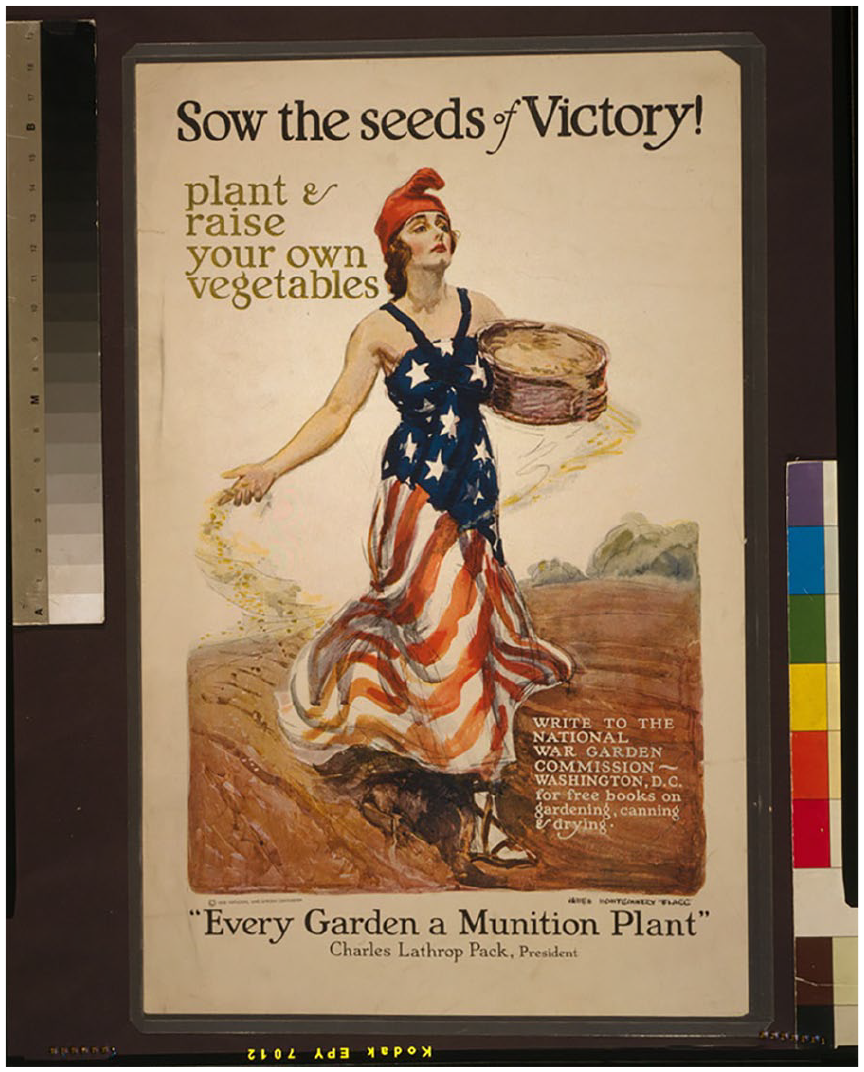
‘Sow the seeds of victory! Plant & raise your own vegetables’, Poster by James Montgomery Flagg, c1918. Repository: library of congress prints and photographs division Washington, D.C. 20540 USA.
Perhaps an even more vivid illustration of these dynamics is the use of uniforms and the award of medals for gardening duties and achievements. The quintessential symbol of military service, uniforms ‘of khaki breeches, green v-neck sweater, overcoat, and hat’ – with optional ‘[o]veralls, gloves, and Wellingtons’ – were provided 11 to the recruits of the Women’s Land Army in Britain as a ‘symbo[l] of patriotism, public acceptance of the organization, as well as political and social equality with men who wore uniforms in the armed forces’ (Gowdy-Wygant, 2013: 40). Armbands and badges analogous to official military brassards or armlets were also handed out to recruits based on terms of service (Gowdy-Wygant, 2013: 115). In the US, ‘renowned horticulturist’ and World War Two veteran Dr John Creech was awarded the Bronze Star for convincing Germans to refurbish ‘a derelict greenhouse’ of the Prisoners of War camp he was imprisoned at in Poland – an award that possibly made him ‘the only American soldier to be decorated for gardening’ (see Helphand, 2010: 12, 2015). Commemorative medals were also struck by the National War Garden Commission at the end of World War One and ‘present[ed] to the rulers of the United States, England, France, Belgium and Italy’ (Pack, 1919).
Considered alongside language, the sheer number of gardens and additional propagandistic media – such as events, pageants, radio programmes, popular songs, magazines, pamphlets, handbooks and cookbooks, photographs, poems and newspapers (Ascenzi and Brunelli, 2016; Charon Cardona and Markwick, 2019: 47, 51; Ginn, 2012; Gowdy-Wygant, 2013: 77, 87; Lawson, 2014: 192; Maltz, 2015: 499, 503–507; Wolschke-Bulmahn, 1992: 298) – medals, uniforms and other visual artefacts also reaffirm the virtual ubiquity of victory gardens, both as a discourse and a practice, in the first half of the 20th century. This hyper-pervasiveness explains why a few cultural historians have labelled victory gardens a tool ‘to accomplish. . . militarization’ (Ascenzi and Brunelli, 2016: 500) or the ultimate expression of US militarism (Hayden-Smith, 2007, 2014). However, the risk with both concepts – militarism and militarisation – is to reproduce ‘stark distinctions. . . between war and peace’ (Howell, 2018: 117) and, by extension, take part in the abovementioned erasure of the exclusionary politics of military victory problematised by Wilcox (in Hartnett et al., 2022). In her recent analysis of the ‘support the troops’ campaigns during the War on Terror, for example, Katharine M. Millar (2022: 36) has shown ‘the deeply constitutive role solidaristic violence plays in producing the political community’, precisely by moving ‘beyond the (important) dynamics of normalization and legitimation excavated by militarism scholarship’ (Millar, 2022: 36). As she shows, these types of campaigns do not only popularise militaristic mottos and rhetoric, but are also responsible for, inter alia, restructuring civil-military relations in the West, changing the requisites of political membership and belonging, as well as redefining gender roles within and without the military.
Wartime gardening campaigns should be treated analogously: more than a food production and militaristic effort, victory gardens are another non-kinetic martial practice that defies binaries like war/peace or civilian/combatant and is constitutive of social orders. Like ‘support the troops’, victory gardens had profound socio-political effects that expose a narrow focus on wartime battlefields as short-sighted. Moreover, victory gardens sit at odds with the very idea of a war/peace distinction that the ideas of militarism and militarisation presuppose. Indeed, wartime gardening (a) played a crucial role in the social construction of wartime and its spatiotemporal boundaries in both World Wars; while also (b) operating as a technology of social ordering that, via an emphasis on temporariness, simultaneously unsettled and reified gendered and racialised hierarchies at both the national and international levels. Therefore, the analysis of wartime gardening needs to conceive victory gardens as a proper victory practice. On this account, gardening might be read as just another process of which victory is the outcome. However, it also becomes clear that the martial processes employed in the social construction of victory do not necessarily unfold on a wartime battlefield, do not only bring wars to an end but also structure everyday life and are always temporal in nature.
Victory gardens and the end of war
While at least in the mind of some of their creators, victory gardens were intended to stay on a permanent basis (Hayden-Smith, 2007: 25; but, cf. Lawson, 2014: 192, 194), they did not. Indeed, victory gardens ended up being a temporary practice. ‘[W]ith the end of [First World] war’, Laura J. Lawson (2014: 186) writes, ‘also came an end to the promotion, borrowed organizational structure, and borrowed land. Interest dwindled and land was reclaimed for previous uses’ (see also, Hayden-Smith, 2007: 26; my emphasis). Notwithstanding open endorsements for post-war gardening by influential public figures – such as experts at the 1945 National Victory Gardening Conference, or President Truman in 1946 – US World War Two victory gardens faced a similar fate (see Lawson, 2014: 194–195). According to Kenneth I. Helphand (2015), this is unsurprising: ‘[s]uch gardens are necessarily temporary. There is no sure prospect of seeing them to fruition and their meaning and purpose is amplified through the displacement of war’ (p. 27; my emphasis).
There is, however, another sense in which the temporariness of victory gardens proves unsurprising – one that has less to do with these gardens being ‘war’ gardens and more with the fact that they were victory gardens. As I argued above, one key problem with extant conceptualisations of victory-as-outcome is that they miss victory’s complicity to the making of wartime and peacetime. From a temporal standpoint, that is, these approaches assume wartime as the background condition against which victory takes place. Such an assumption, however, is what Barkawi and Brighton (2011: 141) would call a ‘War/Truth’: a form of normally uncontested, assumed ‘truths’ that ‘are always subject to undoing by war’ – and the ‘facticity’ of wartime has been repeatedly undone (see, for instance, Barkawi, 2016; Dudziak, 2012; Hom and Campbell, 2022b; Palestrino, 2022). Accordingly, I have suggested we read victory not as the outcome of conflicts but as a temporal marker: a concept through which wartime is made to be exceptional and temporary, and war is made to end (see also Hom and Campbell, 2022a). On this account, the temporariness of victory gardens is not a by-product of peacetime, nor the result of ‘dwindled interests’. Instead, it is constitutive of victory and serves the specific political function to turn the end of fighting into the end of war – just like the abovementioned parades, peace declarations and monuments that the UK government mobilised ad hoc to convince the home public that World War One was over (see also Homberger, 1976).
Institutional efforts to mark victory gardens as a temporary phenomenon were ubiquitous. Besides the strictly material measures above, such as the dismantling of organisational structures or the reversal of public land to pre-war uses, the dismissal of victory gardens was also marked discursively via several symbolic moves. For example, in the 1942 edition of the United States Department of Agriculture’s Land Policy Review, an article titled ‘Gardens, Yes, But with Discretion’ suggested that victory gardens should not encroach on ornamental spaces as they were ultimately a temporary endeavour (see Lawson, 2014: 14). The markedly temporal institutional terminology that was used in the US to designate and promote wartime gardening is another example. As noted in the introduction, what were launched in 1917 as Liberty or War Gardens were renamed Victory Gardens in 1919, ‘after the war was won’ (Bentley, 1998: 117; see also Gowdy-Wygant, 2013: 4, 10, 65; Hayden-Smith, 2007: 20; Wolschke-Bulmahn, 1992: 56–57) – performatively marking the victory to which they referred. As Char Miller (2003: 396) explains, the change in terminology took place at the express request of the US government and was rationalised by the National War Garden Commission as epitomising the ‘new food needs’ brought about by the advent of peace (see Pack, 1919: 257). In Pack’s own words (cited in Miller, 2003: 396) ‘[t]he War Garden was the chrysalis. The Victory Garden is the butterfly’ – an idea that American artist Maginel Wright Enright was able to capture visually in two 1919 propagandistic posters for the Commission (Figures 2 and 3).
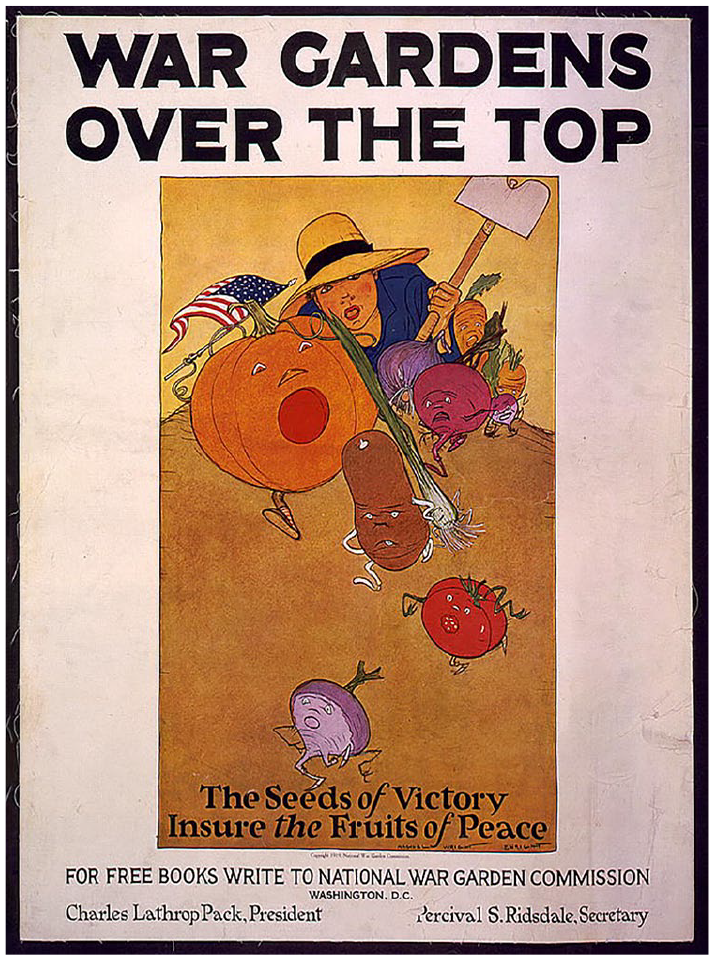
‘War Gardens over the top’, Poster by Maginel Wright Enright, 1919. Repository: library of congress prints and photographs division Washington, D.C. 20540 USA.
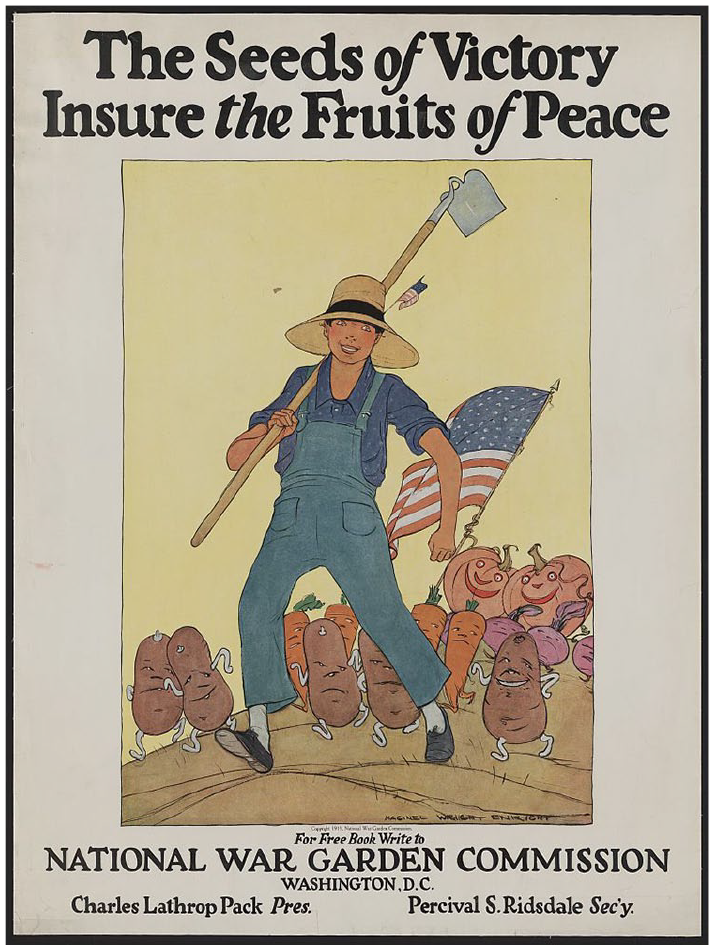
‘The seeds of victory’, Poster by Maginel Wright Enright, 1919. Repository: library of congress prints and photographs division Washington, D.C. 20540 USA.
Mimicking the gestures of a trench-warfare soldier about to run into ‘no man’s land’, the ‘farmerette’ and fellow vegetables in the ‘War Gardens over the top’ poster (Figure 2) exemplify the strenuous war effort that the First World War gardening campaign supported and enabled. From a temporal standpoint, the subjects are positioned amid the war, with hostilities still underway. By contrast, ‘the seeds of victory ensure the fruits of peace’ poster (Figure 3) shows the same woman and vegetables marching on ‘conquered’ land and proudly waving the US flag. Having fought and now victorious, our protagonists have ushered in a ‘new present’, bringing the conflict to an end – and turning War Gardens into Victory Gardens (for a complementary visual analysis of these posters see Gowdy-Wygant, 2013: 83–86). Terminology and iconography, in other words, served a temporal function: by attesting and propagandising the idea that World War One was over, they actively contributed to marking the end of the conflict.
Not limited to propagandistic material and official terminology, additional markers of the temporariness of victory gardens and their performative, time-making function – what Hom (2018, 2020) would call ‘timing function’ – can also be found in gardening practices and popular culture. As an example of the former, the British government asked recruits of the Women’s Land Army to ‘return their uniforms upon disbandment’ (see Gowdy-Wygant, 2013: 40). The United States School Garden Army’s popular tune ‘Over there’, in turn, is a clear example of the latter (see Lawson, 2005: 125). Indeed, in the song’s lyrics, the children gardeners of America ‘send the word over there’ that ‘the lads are hoeing, the girls are sowing e’rywhere, each a garden to prepare. . . ‘til it’s over, over there!’ (Lawson, 2005: 125, my emphasis). Taken together, all these examples offer additional evidence of ‘how ideas about ‘winning’. . . deeply inform the constitution of wartime, its evermore blurry border with peacetime, and its normalisation in everyday life’ (Hom and Campbell, 2022a: 593). Switching from war to victory gardens, or having gardening uniforms sent back right after Armistice Day, gardening campaigns and associated practices reinforced the idea that with victory comes the end of the war. Even in spite of pressing food needs enduring after the cessation of hostilities, that is, gardens were renamed and then promptly dismissed to convey the idea that the war was over. In short, victory gardens were literally used to end the war and corroborate the idea that wartime is finite, exceptional and momentary.
As discussed above, however, this is only a part of what victory gardens were and did – indeed, this only captures the logic of victory politics, but not necessarily the sociological configurations they gave rise to. ‘Liturgical timing practices of war’, write Hom and Campbell (2022a), ‘habituate and reify triumphant closure, and in so doing cover over the many traumas and aporia of lived wartime while instilling a cultural reflex or desire to ‘solve’ political and policy problems by exclusively martial means’ (p. 594). While invaluable, this insight does not exhaust the politics of victory. Most importantly, it falls short of exposing the very tangible dynamics of social ordering made possible by victory and its conceptual association with temporariness.
Victory gardens and social orders
As will already be apparent from the empirical record above, victory gardening was a profoundly gendered practice. Unsurprisingly, it was racialised and classed too (see, for example, Bentley, 1998; Ginn, 2012; Gowdy-Wygant, 2013; Mosby, 2014). Official narratives, however, proudly emphasised nationalistic solidarity and community building, presenting war gardens as an idealised example of how patriotism allowed ‘people [to] set aside personal and sectional interests to [instead] unite’ (Ginn, 2012: 295), advanced gender equality and even smoothed out class-based differences. As several scholars have pointed out, these ideas sit uncomfortably with both a historical archive that is filled with examples of victory gardens as vectors of sexism and racism (see, for instance, Bentley, 1998; Gowdy-Wygant, 2013), and with a wealth of evidence of post-war ‘gender [and race] relations remain[ing] largely intact’ (Ginn, 2012: 301). In this last subsection, I show that victory, and particularly its association with temporariness explored above, can explain both the official narratives of wartime gardening and their critical reappraisals in recent cultural history.
Popular appeals to grow victory gardens were formulated in explicitly universalistic terms. In the US, where ‘the cultivation of food held both gender and racial stigmas’ (Gowdy-Wygant, 2013: 2), for instance, President Wilson made sure to implore everyone to take up gardening, asking that ‘every man and every woman assume the duty of careful, provident use and expenditure as a patriotic duty’ (Wilson, cited in Gowdy-Wygant, 2013: 63). From a practical standpoint, this universal ‘call to farms’ (Gowdy-Wygant, 2013: 106) was facilitated via tailor-made propaganda material that sought to appeal to diverse audiences, for instance by including articles and cartoons ‘that featured (slightly) darker-skinned characters’ in booklets designed specifically for black Americans (Bentley, 1998: 120), creating simplified technical guidance and posters for schools (Hayden-Smith, 2007: 24; Pack, 1919: 75), as well as showcasing female-centric pictures and stories in women’s magazines and radio programmes (Gowdy-Wygant, 2013). It was precisely the martial rhetoric of victory explored in the previous two sections that underpinned and enabled the universalistic ethos of these appeals. Slogans such as ‘Every Garden a Munition Plant’ (Figure 1) popularised a ‘gardening-as-fighting’ equation that turned victory gardens into a patriotic duty, explicitly displaced othering logics onto a common enemy and, as a result, enabled the contextual elision of ‘internal’ differences. In an attempt to emphasise ‘the inherent ‘American-ness’ of gardening’ (Bentley, 1998: 120), for instance, US government statistics, amplified by media, repeatedly underscored that everyone was playing their part for victory, and even ‘African Americans were avid and accomplished victory gardeners’ (Bentley, 1998: 119). Analogously, politicians and leaders across countries sought to foster gardening by stressing that, in addition to contributing to the war effort, victory gardens also led to ‘community cohesion, cooperation, and unity’ (Bentley, 1998: 121), boosted morale (Miller, 2003: 403; see also Ginn, 2012: 303) and improved the ‘spiritual well-being of individuals, family, and nation’ (Buzan and Lawson, 2014: 187). In short, echoing war-like logics of antagonisms, the victory-framing of wartime gardening helped bring together individuals across ethnicities, ages, genders and social classes under the banner of patriotic nationalism: it encouraged them to ‘unite’, fight a common enemy and emerge victorious together, as a cohesive community.
At the same time, however, this victory-framing also worked towards the hegemonic affirmation of a logic of temporariness that made all social changes precarious, contingent on wartime and, therefore, acceptable ‘for the time being’. In his discussion of how victory gardens unsettled traditional gender roles in Canada, for example, Ian Mosby (2014) noticed that as ‘women were increasingly called upon to enter the previously ‘male’ domains of the industrial workplace and the military during the war, government policy tended to underscore that such changes were only temporary’ (p. 102; my emphasis). For Mosby, this emphasis on temporariness sought to preserve ‘the utopian goal of a normative heterosexual male-breadwinner-centred domestic sphere’ in an exceptional, war-mandated time of crises. I argue, instead, that this focus on momentariness, enabled by and through victory, underpinned a specific strategy of social ordering: via victory, gender and racialised global hierarchies could be ‘damaged’ – if not altogether shattered – in the name of patriotism because of the exceptional, temporary nature of the war. Two sets of complementary strategies lie at the heart of these dynamics.
First, appeals to patriotism and the ensuing erasure of social difference coexisted with markedly sexist and racist gardening-ancillary practices that kept ideas of masculine and racial superiority alive. ‘While propaganda promoting home front food activities embraced notions of unity and communalism’, Amy Bentley (1998) writes, ‘these ideas were at odds with actual societal practices, including community victory gardens carefully segregated by race’ (p. 7). Indeed, the counterpart to the abovementioned official statistics that emphasised African Americans’ contribution to wartime gardening, was a tendency to ‘rarely includ[e] African American women in print and radio campaigns’, or depict them in ‘supporting, subservient roles to white women’ (Gowdy-Wygant, 2013: 144). At gardening shows in Delaware and Baltimore, ‘separate prizes were awarded to ‘colored people’ in similar categories’ (Bentley, 1998: 124). In a war gardening pageant in 1918 in London, a parade celebrating the various imperial contributions to the war effort included ‘a baboon dressed in a khaki uniform’ as a representative of the South African delegation – an act that was ‘[m]et with ‘roars of laughter’’ (Gowdy-Wygant, 2013: 77).
In short, a tapestry of disparate social practices made sure that racial superiority was kept well alive. Notably, it is the victory-framing of war gardening propaganda that allows for the coexistence of these incongruities: it concurrently enlists non-white (and non-male) subjects to the war effort and instils a logic of temporal exceptionality that reaffirms their subalternity. The gendered vicissitudes surrounding the fate of the British Women’s Land Army offer another telling example: official discourse praising ‘farmerettes’ and their centrality to victory in the world wars notwithstanding, they were immediately dismissed upon ‘the end’ of both conflicts and, unlike their male counterparts, ‘did not receive wages, gratuities, . . . or employment placement assistance upon the end of their service (Gowdy-Wygant, 2013: 115) – all while satirical magazines, newspapers, and even popular songs ‘ridiculed women who dared take on agricultural labor’ (Gowdy-Wygant, 2013: 37). Tapping into a widespread understanding of victory as a time-altering event, deviation from social norms could be temporarily tolerated and even encouraged for and until victory.
Second, social change was also made precarious through a subtle reaffirmation of traditional roles – even when victory gardening was clearly asking for (some of) these roles to be re-imagined for the sake of the war effort. Existing analyses of wartime gender roles offer a very clear instantiation of this dynamic. According to Franklin Ginn (2012: 301), for example, the British Ministry of Agriculture directly asked women (and children) to garden, but did so through films in which ‘the expertise and direction. . . come from men’, posters that visually reinforced ‘traditional gender norms of the father as provider’ and handbooks that ‘advised the gardener to avoid ‘ladies’ tools’. Similarly, commenting on the US Victory Garden campaign during the Second World War, Amy Bentley (1998) notices that ‘[w]hile the media portrayed both men and women taking part in the victory garden effort, advertisements, articles, and pamphlets overwhelmingly featured men’ (p. 127). In both cases, then, the invitation to break social hierarchies coexisted with widespread attempts to simultaneously reinforce traditional gender roles.
Working in a suffused and indirect way, these tropes illuminate how gardening-as-fighting was a very specific way of inviting women to take on new social roles. Indeed, women’s participation in the war effort was carefully designed to avoid the feminisation of warfare and martiality, and instead make women more ‘manly’ for the time being. It is in this spirit that I suggest we understand readings of food as ‘a vital weapon of war’, references to the ‘home’ and the ‘kitchen’ front (see Bentley, 1998: 127) or even the martialized aesthetic of weapon-like vegetables in Figures 2 and 3 above. Victory and the masculinisation of wartime gardening served a complementary temporal function: inviting women to disrupt gender roles, but only momentarily – that is, for the sake of winning the conflict. Read in tandem with the examples above, gender tropes suggest that similar logics were at play when it comes to the contextual reinforcement and invitation to disrupt racialised hierarchies.
On this reading, it should be clear, victory’s temporal work does not stop at the reproduction of wartime and peacetime and the politics that these ideas make possible. Instead, wartime gardening campaigns offer a wealth of examples of how victory had tangible, sociological implications that extend well beyond the battlefield and wartime – both in the sense of aiding the social production of ‘war’ and ‘peace’ as disparate temporal phases, as well as working as a technology of social ordering. Victory does not only bring war to an end, as in Hom and Campbell’s (2022a) account, but it also simultaneously disrupts and reaffirms gender and racial hierarchies that transcend war and peace. By reinforcing the idea that wars have clean endings, victory strengthens these global hierarchies by disrupting them – or, creating a temporary exception that proves the rule.
Conclusion
This article has made the case for IR and War Studies to re-think what victory is and does. Attending to an empirical phenomenon that IR and War Studies have so far overlooked, the analysis of wartime gardening practices above has demonstrated that there is more to victory than separating wartime from peacetime. In fact, victory practices not only turn the end of fighting in the end of war, but also partake in the social construction of both temporal phases. They also do much more. In victory garden campaigns, for instance, victory’s temporal dynamics also operated as a technology of social ordering that made it possible for governments and media to call for the support of non-male, non-white subjects and simultaneously reinforce their subalternity. To grasp these dynamics, the article sought to call for both a different ontological theorisation of military victory and a changed approach to the study of victory. To conclude, I wish to underscore the importance and value of both.
By equating victory to the outcome of conflict and constraining its study to wartime and the battlefield, extant IR and War Studies scholarship on victory misses not only the empirical relevance of the widespread international phenomenon of wartime gardening, but also the temporal dynamics discussed above, with their profound socio-political implications. To paraphrase recent work in Critical War and Military studies, we miss how victory is yet another example of war’s ‘disruptive tendencies’ (Bousquet et al., 2020: 103) or its ‘generative powers’ (Barkawi and Brighton, 2011: 127). Indeed, this article has sought to reframe IR’s ‘victory problem’ from one of complexity and specificity to one of analytical approaches, epistemological commitments and ontological assumptions. To accept that a fuller analytical toolbox can fix the problem with victory is to accept that we already know what victory is and does – we just need to say it better. However, if we start from the assumption that war disrupts and creates both knowledge and social orders (Barkawi and Brighton, 2011) then we cannot possibly stop at more sophisticated typologies. But neither can we stop at the example of victory gardens. If ‘little in the social world goes untouched by the orders war creates’ (Barkawi and Brighton, 2011: 141), then the link between victory and these orders that this article has started to bring into focus warrants further scrutiny. What other martial practices, alongside gardening, contribute to the constitution of victory and, therefore, war/peace? Are there non-martial practices that do so too? What specific socio-political dynamics underpin them? What other social and international orders do they help reify, build anew or perhaps resist and challenge?
As I showed with the example of wartime gardening, an ontology of military victory as a temporal marker, rather than an outcome of armed conflict, calls not only for an expanded research archive that encompasses a plurality of martial practices, but also for a different analytical approach – or epistemological posture. In particular, re-thinking victory along these lines has led me to embrace an approach that is attentive to the (micro and macro) histories and sociologies that are made possible by, and therefore can be accessed through, victory. This approach can be brought to bear on other martial practices that are constitutive of military victory, including fighting and diplomacy – that is, it can be applied even to the traditional victory archive. In a recent study of the Second Italo-Ethiopian War, for example, Italo Brandimarte (2023) has shown that within and without the imperial battlefield aerial warfare operated both as a warfighting strategy and as a technology of international ordering. Entering an alternative archive of under-researched sources, Brandimarte (2023) demonstrates that aerial processes and relations underpinned ‘the martial production of racialised global orders’ (p. 526) – the effects of which obviously stretched far and wide, well beyond the battlefield and wartime. While not focused on victory, Brandimarte’s work embraces an analytical shift in the study of war and combat that is similar to that proposed here. 12 Not only does he show that war’s spatiotemporal contours are porous, but that even the most traditional martial practices that IR and War Studies have scrutinised so far can tell us something new about the social world if analysed differently. What could we learn about victory and its social politics by extending these insights to other forms of combat? And what if we applied this to diplomacy? Which sociological configurations do both sets of victory practices lead to? Addressing these questions will not only bolster our understanding of victory but also open up a complementary research agenda on the politics of victory and their sociological effects and implications.
Footnotes
Acknowledgements
I am grateful to Emanuele Sciandra for his invaluable research assistance and to Matthew Barnfield, Italo Brandimarte, Tarsis Brito, Stefano Guzzini, Kimberly Hutchings and Lauren Wilcox for insightful comments and suggestions. I would also like to thank participants to the DoingIPS ECR Workshop 2024 and the QMUL SPIR Theory Lab Seminar Series for having engaged with previous versions of this paper.
Funding
The author(s) disclosed receipt of the following financial support for the research, authorship and/or publication of this article: Part of the research for this article was supported by an HSS Student Bursary Project 2023/2024 from the Faculty of Humanities and Social Sciences at Queen Mary University of London.
