




Abstract
Support for Ukraine against Russian aggression has been strong across Europe, but it is far from uniform. An expert survey of the positions taken by political parties in 29 countries conducted mid-2023 reveals that 97 of 269 parties reject one or more of the following: providing weapons, hosting refugees, supporting Ukraine's path to European Union membership, or accepting higher energy costs. Where the perceived threat from Russia is most severe, we find the greatest levels of support for Ukraine. However, ideology appears to be far more influential. The level of a party's populist rhetoric and its European Union skepticism explain the bulk of variation in support for Ukraine despite our finding that many strongly populist and European Union-skeptical parties take moderate pro-Ukraine positions when in government.
Introduction
In the eyes of many observers, Russia's full scale invasion of Ukraine in February 2022 not only shattered the post-cold war illusion that Europe is free from war but has given Europe and the West a new sense of unity. This is all the more remarkable because it has taken place in an era of political polarization. Over the past two decades, mainstream political parties have lost support to populist parties that challenge longstanding liberal democratic values and are intensely skeptical of the European Union (EU) and of American international leadership.
How can one put these developments on the same page? How have challenger parties responded to the Ukraine government's urgent plea for military support? How have they responded to the inflow of refugees as millions have fled Ukraine? How have they balanced the costs and benefits of support for Ukraine as energy and food prices have risen due to sanctions and disrupted trade routes? How have they responded to Ukraine's overarching goal to become a member of the EU?
The simplest and, for many, the most compelling explanation for where political parties stand on Ukraine lies in vulnerability to the Russian military threat. The claim that an external threat produces collective governance is a core hypothesis of political science and is perhaps its most successful scientific contribution. The demand for security in the face of Russia's invasion can be met only by collective action within and among countries that feel threatened. As Freudlsperger and Schimmelfennig (2023: 6) observe, “Military transboundary crises potentially expose both scale deficits and community threats.” On the one hand, an external threat creates a powerful incentive for international collaboration to enhance the scale of resistance. On the other, it produces solidarity against the aggressor within threatened countries.
Our expectations concerning party positioning on support for Ukraine begin with the theory of group solidarity as a response to external threat. In international relations, this expectation is grounded in structuralist theories of alliance formation, and in comparative politics, this is the bellicist theory of state building (Kelemen and McNamara, 2022; Riker, 1964; Tilly, 1990). A functionalist theory of group solidarity is a point of departure for understanding how political actors in Europe have responded to the Russian invasion of Ukraine, but we believe that it fails to explain the wide variation among key actors that exists today. We need, in short, to be alert to the possibility that “structuralist explanations tend to overestimate the actual incidence of solidarity” (Hechter, 1987: 28).
To explain the consensus and conflict in Ukraine, we seek to understand how the response to an external threat is mediated by prior patterns of ideological contestation. Two forms of ideological contestation appear decisive: conflict over populism and the legitimacy of liberal democratic institutions, and conflict over the EU and the legitimacy of transnational European governance.
A new Chapel Hill expert survey (CHES) of the positions taken by political parties in 29 countries conducted mid-2023 (available on https://chesdata.eu/speedches) reveals overall strong support for Ukraine with a substantial tail of opposition. Of the 269 parties surveyed, 97 reject one or more of the following: providing weapons to Ukraine, hosting Ukrainian refugees, supporting Ukraine's path to EU membership, or accepting higher energy costs due to sanctions on Russia. 1 This suggests that the consolidation of the West has perhaps overshadowed, but not overridden, prior domestic conflicts.
While we cannot estimate the change in party positioning over the course of the war with the cross-sectional data at our disposal, we can seek to explain the wide variation that we detect. We lay out our expectations in the next section, beginning with the functionalist thesis that solidarity is induced by the intensity of the security threat (Gehring, 2022; Steiner et al., 2023; Tilly, 1990). In line with the postfunctionalist premise that the perception of threat is shaped by ideological divisions within society (Hooghe and Marks, 2009; Truchlewski et al., 2023), we expect populism and EU-skepticism to constrain the response to Russian aggression and support for Ukraine. We claim that these effects are conditional on whether a party participates in government, on the premise that policy purity is a luxury of opposition. There is good reason to expect that if a populist or EU-skeptic party wishes to be a member of a government coalition, it will downplay its reluctance to support Ukraine. It is governments that are primarily responsible for reacting to threats and for maintaining contractual obligations to international organizations, including NATO. Coalition governments, in particular, require compromise, and we expect that this will shape a governing populist party's response to the war.
These expectations find support in the data. Where the perceived threat from Russia is most severe, we find the greatest levels of support for Ukraine. However, ideology appears more influential. The intensity of a party's populist rhetoric and its EU-skepticism explain a larger share of variation in support for Ukraine even though many strongly populist and EU-skeptical parties take moderate Ukraine positions when in government.
We conclude our discussion by engaging two inferential challenges. First, we need to ask whether ideology is driving party positioning on Ukraine or whether party positioning on Ukraine is driving ideology. Drawing on CHES data from prior to the invasion, we gain inferential support for our claim that party ideology determines support for Ukraine.
Second, we ask whether our finding that government participation moderates opposition to support for Ukraine is spurious because only moderate parties join governing coalitions. By comparing panels of parties in and out of government before and after the invasion, we provide evidence that populist and EU-skeptic parties were induced to moderate their stance when in government.
Theory and expectations
External threat
The idea that an external threat can produce solidarity among those who are threatened is as old as the study of politics. Thucydides (460–400 BC) explains alliance formation chiefly as a response to the need for collective defense, particularly among city-states that were geographically proximate to the threat. 2
The premise that a common threat induces cohesion among those who perceive themselves as vulnerable is shared across social science. The micro-logic is expressed by Coser (1959: 95) in his classic sociological study: “Conflict with another group leads to the mobilization of the energies of group members and hence to increased cohesion of the group.” This requires that the conflict concerns the entire group and not just one segment. Coser (1959) illustrates this in the contrast between the cohesion in the United States (US) following the attack on Pearl Harbor and the social disintegration that followed the Japanese invasion of British and Dutch colonies in Southeast Asia where the native populations considered this an attack on their colonial overlords rather than themselves.
The connection between external threat and alliance formation lies at the core of realism and neorealism (Morgenthau, 1948; Waltz, 1979). These theories assume that the existential priority of survival sustains states that can be regarded as coherent units. While realists and neorealists have no theory of domestic politics, they argue that in the face of external threat, internal unity is a vital complement to external balancing. However, there is no reason to limit our understanding of the connection between external threat and internal cohesion at the borders of the state. The literature on state building reveals that conflict among states has enhanced their institutional capacities and strengthened national identities. The bellicist argument applied to contemporary Europe claims that a security threat can trigger an external security logic of polity building that could serve as an impetus for polity centralization (McNamara and Kelemen, 2022; Eilstrup-Sangiovanni, 2022; Freudlsperger and Schimmelfennig, 2022; Genschel, 2022).
The micro-foundations for these realist and comparativist arguments lie in evolutionary psychology, which suggests that external threats may “directly strengthen group identity, and this fosters trust and cooperation” (Gehring, 2022: 1490). An external threat may trigger support for symbols associated with the in-group (Tajfel and Turner, 1986) or activate anger or anxiety that can drive a “rally around the group” effect (Lambert et al., 2011; Kizilova and Norris, 2023). This may induce individuals to update, intensify, or scale up their identity as they put more value on attributes they share with other group members (Dehdari and Gehring, 2021; Gaetner and Dovidio, 2012; Onuch and Hale, 2023; Schulte-Cloos and Dražanová, 2023).
To what extent, we ask, does such a threat produce cohesion among those organizations that connect citizens to the exercise of political authority within states, i.e. political parties? Our expectation is that it does. These literatures motivate a basic expectation that applies directly to Russia's invasion of Ukraine: the greater the perceived threat, the greater the solidarity. Those who are closest to war have reason to feel most threatened. As European Commission Vice President Valdis Dombrovskis, former prime minister of Latvia, warned soon after the invasion: “If we do not support Ukraine, it's not going to stop in Ukraine. Clearly Putin is now in some kind of aggressive war mood and unfortunately it is likely that this aggression will continue in other countries” (Lynch and Moens, 2022). A recent study shows that most Europeans want deeper integration in EU security and defense, and that this preference is strongest among those who perceive external threats to their country from Russia or who are concerned about the rise of China (Mader et al., 2023; Gehring, 2022). H1 (threat thesis): The more intense the security threat from Russia, the greater the support for Ukraine.
Ideology
Our prior is that the response to an external threat is conditioned by domestic contestation (Otjes et al., 2022; Raunio and Wagner, 2020). Hence, when devising a survey assessing party support for Ukraine, we decided to include some key ideological questions, including one on party populist rhetoric and one on attitudes toward the EU. We theorize that populism and EU-skepticism capture distinct mechanisms through which ideology shapes support for Ukraine.
At its core, populism is motivated by the claim that the elite is corrupt and that legitimacy comes from the loosely defined “people.” As Vachudova (2021: 474) observes, populism is a flexible recipe for appealing to voters by promising “to defend the people against establishment elites by arguing that these elites are protecting and expanding their own privileges at the expense of ordinary citizens.” In the political appeals of many populists, the mainstream's near-unanimous defense of Ukraine is another example of how a corrupt elite is willing to sacrifice ordinary people's needs to protect the status quo.
This thin notion of populism is fleshed out in ways that add substance to populist reluctance to support Ukraine. Both TAN 3 and left-wing populists share “[d]istrust of the elite by the people . . . based on the perception that the elite not only are corrupt but also favor foreign interests” (Noury and Roland, 2020: 423). Populists tend to harbor suspicion of foreign actors (Mudde and Kaltwasser, 2013). TAN populists target immigrants, refugees, or their descendants alongside transnational influences which they accuse of being culturally harmful. They consider their ingroup, “the people,” as ethnically exclusive, and campaign on reducing the resources and rights for outgroups (Jenne, 2018; Vachudova, 2020, 2021). Left populists, on the other hand, such as Podemos in Spain and Syriza in Greece, target foreign institutions that are perceived to exploit ordinary people; they are suspicious of US-led multilateralism, militarism, and imperialism (Gomez et al., 2016; Zulianello and Larsen, 2024).
A second source of populist dissent on Ukraine draws on authoritarianism—a preference for centralized power, limited political freedoms, and opposition to political pluralism. Many TAN populists have expressed an affinity with Russian anti-liberal authoritarianism and its commitment to “defending conservative values against the liberal and ‘decadent, West’” (Havlík and Kluknavská, 2023: 98). Some TAN populists express admiration for Putin's regime “based on their shared nativism, authoritarianism, and, increasingly, illiberal politics” (Ivaldi and Zankina, 2023: 19), though others have kept their distance (Wondreys, 2023). Russia has provided financial backing and other support to TAN populist parties in many countries including Austria, Germany, Italy, France, the Czech Republic, Slovakia, and Hungary as part of an explicit strategy of dividing the West and sowing discontent with democratic institutions. For some parties, in other words, Moscow is a source of inspiration and support, not a security threat. H2 (populism thesis): The more populist a political party, the less it will support Ukraine.
There are grounds for believing that opposition to the EU has an independent effect on support for Ukraine. The EU, under the leadership of Commission President Ursula von der Leyen, has taken an active role in drumming up financial and military support for Ukraine, implementing sanctions against Russia, and facilitating housing and services for refugees (Kiel Institute for the World Economy n.d).
A strong stance in support for Ukraine is welcomed by European polity builders, but it is anathema to EU-skeptics. In the eyes of most EU-skeptics, the mobilization of the EU behind Ukraine strengthens supranationalism, undermines national sovereignty, and threatens the authenticity of the national community. Moreover, EU-skeptics conceive international support in zero-sum competition with domestic needs (Stoeckel et al., 2023; Kleider and Stoeckel, 2019; Walter, 2021). Political parties that lean in an EU-skeptical direction tend to have a nationalist conception of the good, and correspondingly oppose policies that direct national resources to international goals. Consistent with this, a recent study of the 2016 Dutch vote on the EU's association agreement with Ukraine finds a strong link between anti-EU attitudes and voting no in the referendum (Abts et al., 2023).
In sum, there are strong reasons to expect EU-skeptical parties to contest the European consensus on Ukraine. Hence, H3 (EU-skepticism thesis): The more EU-skeptical a political party, the less it will support Ukraine.
Participation in government
The tension between policy purity and government responsibility is a mainspring of the literature on political parties. We anticipate that parties exercising government responsibility will have less leeway than opposition parties in taking a contrarian view of a security threat. Moreover, even if they have ideological reservations, parties in government will feel pressure to respond in line with their international allies, their diplomatic service, and the country's military leadership. In short, governing parties are constrained in ways that opposition parties do not experience and this, we argue, inclines governing parties toward greater support of Ukraine.
In countries with proportional electoral systems, another constraint arising from coalitional politics comes strongly into play (Lijphart, 1999). Where no one party gains a majority of seats in the legislature, governments are formed among parties that must reach agreement on a common plank of policies. The result, as Pedersen (2011: 297) observes, is that “[i]n multiparty systems where no party has a majority, policy influence always comes at a cost in policy purity.” This is anticipated by party leaders as they navigate the trade-off between their ideological commitments and gaining the authority that requires participation in a government coalition. Since government coalitions are generally formed among parties that do not have starkly divergent policy positions, a party wishing to make itself “coalitionable” has an incentive to trim policies that clash with those of its potential coalition partners. Strøm and Müller (1999: 10) summarize the logic as follows: “policy pursuit may conflict with a party's ability to capture office [. . .] In order to find coalition partners, party leaders may need to dilute their policy commitments and potentially antagonize their own activists.”
There is reason to believe that this argument applies with particular force to support for Ukraine. A rejectionist stance is a potential liability for a populist or EU-skeptic party in forming or joining a government coalition. Conservative parties are most likely to consider these parties as coalition partners, yet conservative parties are precisely the parties that have been the most favorably disposed to NATO, most opposed to the Soviet Union and its successor Russia, and most supportive of a strong defense. H4 (government thesis): Participation in government induces populist and EU-skeptic parties to increase support for Ukraine.
Data and measures
To assess the views of political parties on supporting Ukraine, we conducted a CHES expert survey from April through June 2023 in 29 European countries, including all member states of the EU except Cyprus and Luxembourg—plus Iceland, Norway, Switzerland, and the United Kingdom (see online Appendix). The survey covers 269 parties and was completed by 217 political scientists specializing in political parties and European integration. Experts evaluate all parties in their country of expertise, and expert evaluations are then averaged to obtain robust values for each political party. Alongside items tapping support for Ukraine in the war and ties with Russia, experts were asked to rate each party in four areas: (a) economic left–right ideology; (b) Green/Alternative/Libertarian versus Traditional/Authoritarian/Nationalist (GAL–TAN) ideology; (c) anti-elite rhetoric; and (d) general position on European integration (Jolly et al., 2022). Core items in the CHES data have been cross-validated across several waves against party position estimates derived from manifestos, elite surveys, and measures derived from public opinion (Bakker et al., 2015; Marks and Steenbergen, 2007). Party placements on ideological scales have been shown to be cross-nationally comparable (Bakker et al., 2014, 2022).
Our inquiry here makes use of the four questions that tap support for Ukraine in the war. Experts were prompted (“Thinking about Russia's war against Ukraine, to what extent did each party support or oppose the following over the past three months?”) and then asked to evaluate on a 0 to 10 scale to what extent the party opposed or favored (a) allowing refugees in the country; (b) sending weapons and military equipment to support the Ukrainian army; (c) accepting higher energy costs due to the sanctions against Russia; and (d) offering Ukraine a pathway to EU membership.
The dependent variable is the average parties’ estimated stance on these four types of support for Ukraine. We prefer this to a factor because the outcome variable which ranges from 0 (strong opposition) to 10 (strong support) has intuitive substantive meaning. 4 This operationalization also has the advantage that the values stay the same across alternative sets of countries or parties.
To estimate the severity of the perceived security threat, we construct the variable Occupied by USSR (Soviet Union) that takes on a value of 1 for political parties in countries that were occupied by the Soviet Union during World War II as a means to partial or total annexation, and zero otherwise. 5 We also probe two alternative operationalizations. Common Border takes a value of 1 for parties in countries that share a land or maritime border with Ukraine or Russia and zero otherwise. Former Russia/USSR focuses on the countries that by virtue of prior inclusion in the Soviet Union may be particularly vulnerable to Russian revanchism.
To assess the ideology thesis, we use CHES expert placements from 2023 on populism and EU positioning. Populism estimates the salience of a party's anti-establishment and anti-elite rhetoric on a 0 to 10 scale. This is a deliberately minimal operationalization of populism. Anti-elite/establishment sentiment is a necessary feature of populist parties. Others opt for more extensive measures of populism, e.g. the POPPA dataset (Meijers and Zaslove, 2021). We note that across comparable waves of CHES and POPPA data, the correlation between the CHES measure of anti-elite rhetoric salience in this paper and POPPA's measure of anti-elite positioning is 0.87 and the correlation between the CHES anti-elite variable and the full five-item POPPA populism factor is 0.85, giving us greater confidence in our simpler measure (Polk and Rovny, 2023). EU-skepticism taps a party's general position on European integration on a seven-point scale; the order is reversed so that higher values indicate greater opposition to European integration. In Government takes a value of 1 if the party was in government during the three months prior to the survey (February to April 2023).
The analyses contain several ideological and country-level controls. Economic Left–Right and GAL–TAN tap a party's position on the economic left–right scale and its position on the socio-cultural GAL–TAN scale, respectively. In the absence of party-level data, we tap Atlanticism at the country level using ideal point data. US alliance divergence captures how closely allied a country has been with the US on foreign policy, operationalized as the absolute difference between a country's voting record in the United Nations and the US’ voting record averaged from 2016 to 2020 (Bailey et al., 2017; Voeten, 2021). 6 Liberal Democracy is the Varieties of Democracy (V-Dem) measure for a country's liberal and electoral democracy averaged from 2016 to 2021 (Coppedge et al., 2023). Russian gas dependency is the percentage of a country's gas imports that came from Russia in 2021, the year before the start of the war (European Union Agency for the Cooperation of Energy regulators, n.d.). Vote is the proportion of votes received by a party in the national election held most closely prior to the survey. All independent variables are rescaled 0 to 1, so the size and standard errors of coefficients are comparable across models. The online Appendix provides details on operationalization, with summary statistics.
We estimate multilevel linear models with country random effects. This produces separate estimates for the explained variance between and within countries, as well as the intraclass correlation (ICC) whereby an ICC of zero (or very close to zero) means that parties within countries are no more similar than parties from different countries.
Mapping support for Ukraine
We begin by mapping how political parties stand on Ukraine in aggregate. Figure 1 visualizes the distribution of the dependent variable. The distribution is negatively skewed with a much larger part of the distribution in support of Ukraine with a median of 7.4 and an average of 6.7 on the 0 to 10 scale.
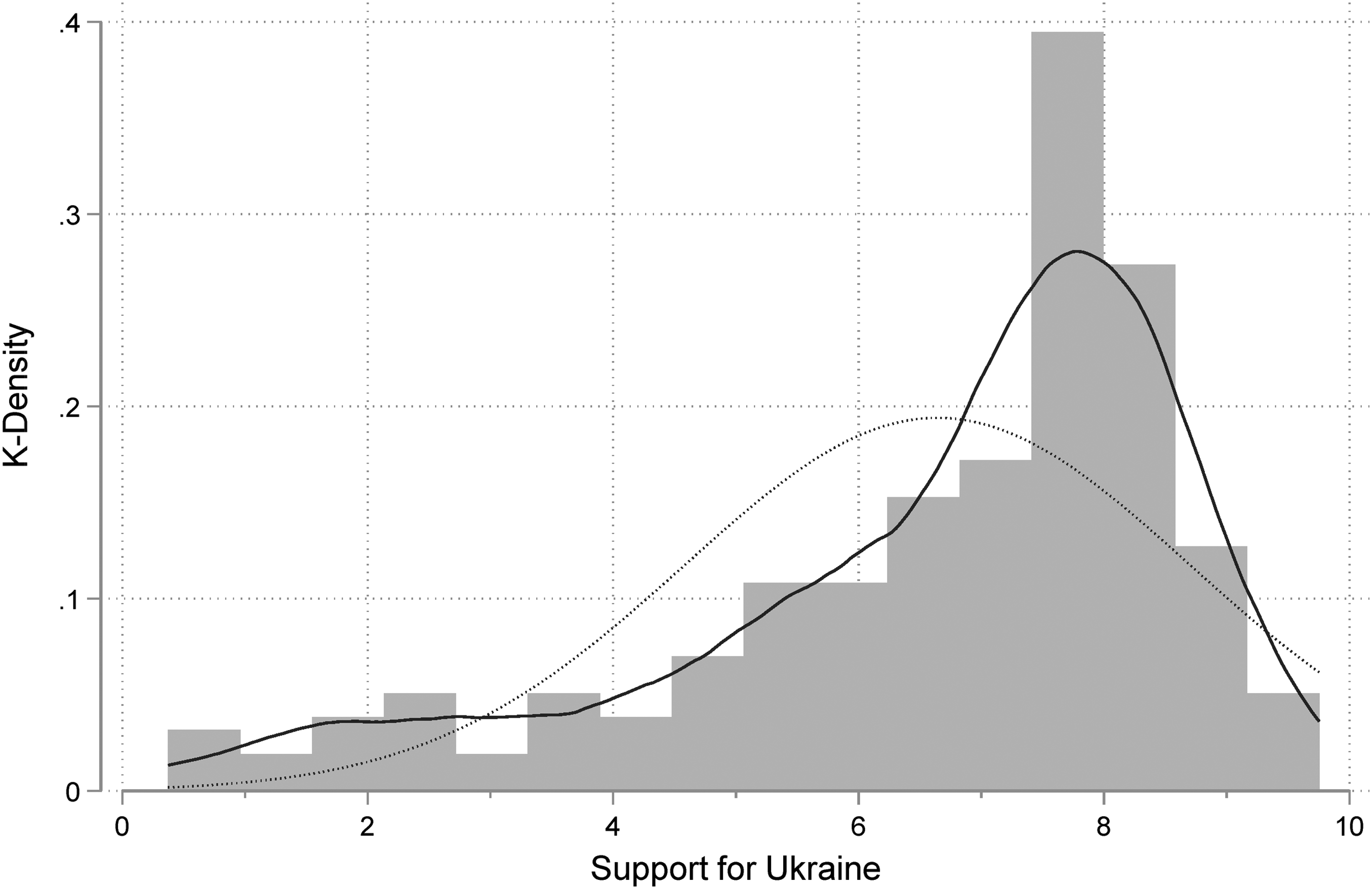
Distribution of support for Ukraine among 269 parties in 29 European countries in 2023. Note: We plot the distribution of support for Ukraine among 269 parties in 29 countries. The solid line is the k-density curve (kernel = Epanechnikov); the dotted line is the normal distribution curve. Higher values on the x-axis represent more support for Ukraine.
Support is highest for allowing refugees (mean = 7.8 and median = 8.5) and lowest for accepting higher energy costs (mean = 6.1; median = 6.8) and for EU membership for Ukraine (mean = 6.2; median = 6.7). In the online Appendix, we break down the descriptives by type of support, and Figure 2 shows the density plots by type. This reveals that the modal party position is strongly supportive of Ukraine, but that, with the partial exception of refugees, there is a small tail of strong opposition.
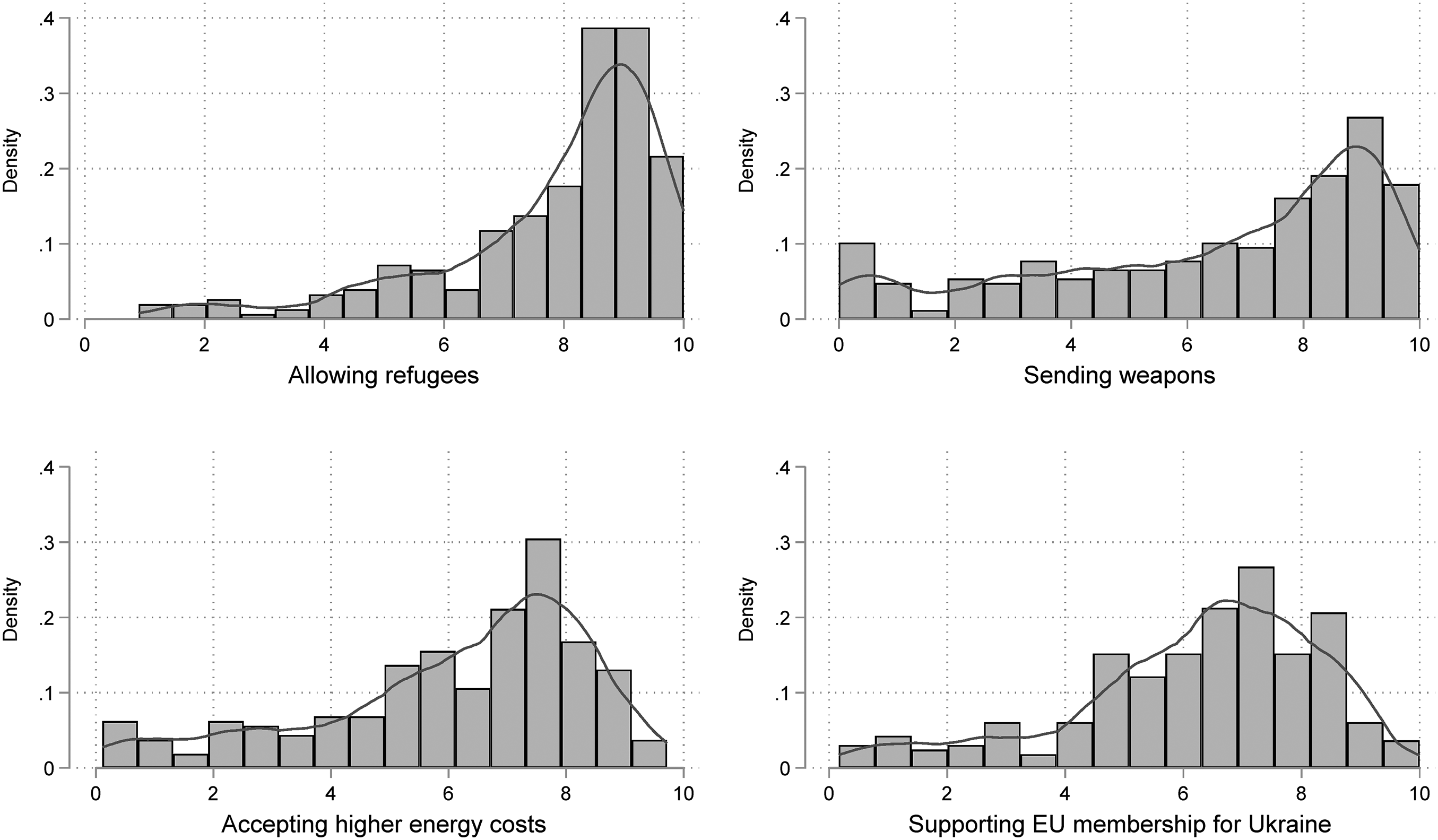
Distribution for the four kinds of support for Ukraine. Note: We plot the distribution of support among 269 parties for each of four policies with respect to Ukraine. The distributions are kernel Epanechnikov with bandwidth held constant at 0.5. Higher values on the x-axis represent more support for Ukraine.
A closer look at the structure of support reveals high correlations between the four types of aid, ranging from 0.60 (refugees and weapons) to 0.81 (weapons and energy costs; energy costs and EU membership) (see the online Appendix).
Figure 3 plots the average support by country with 95% confidence intervals indicating the range among parties in that country. In most countries, this reflects the full range in support between the two most divergent political parties. The online Appendix provides, for each country, the minimum, maximum, and median party value.
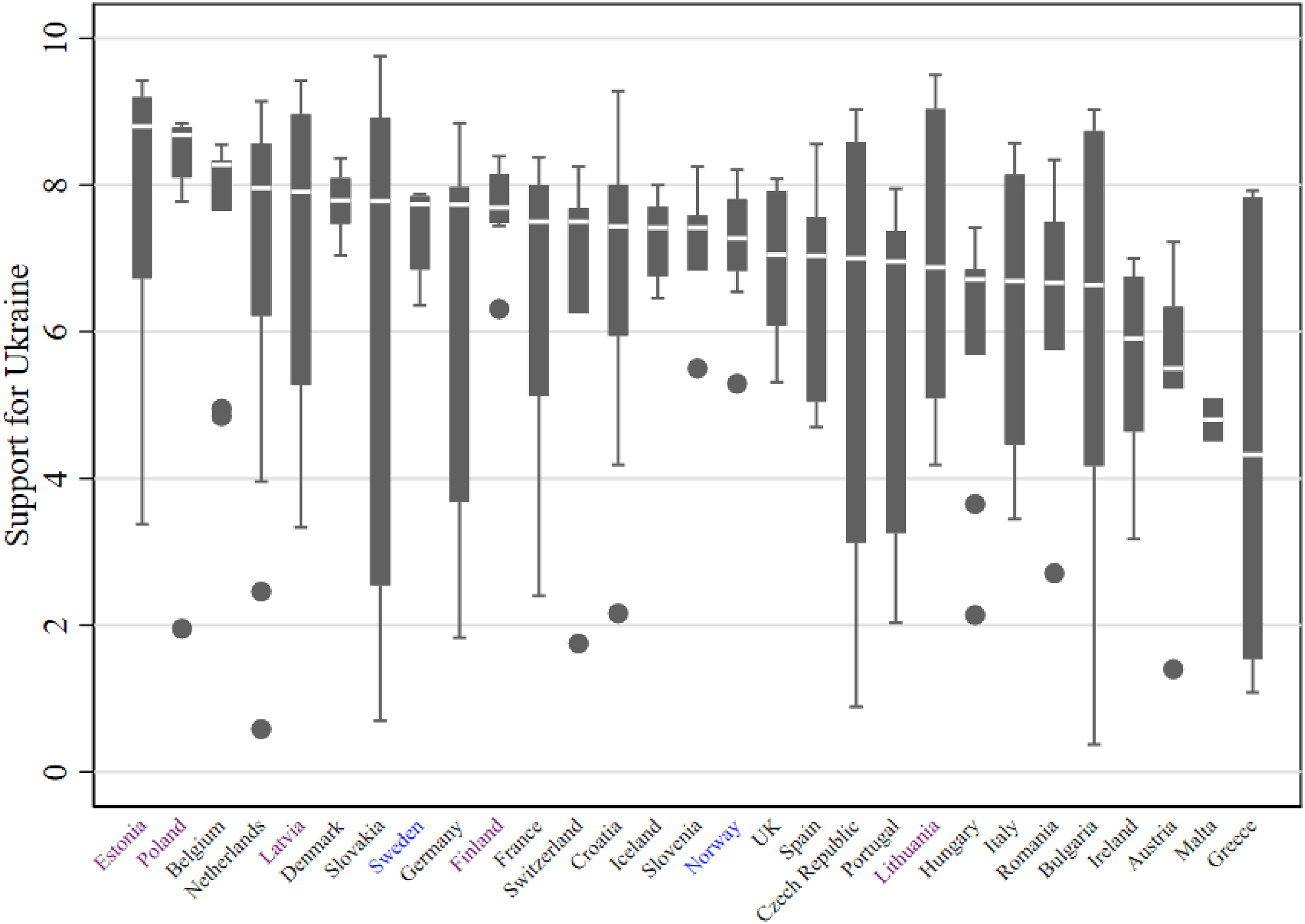
Support for Ukraine by country. Note: We plot support for Ukraine in each of 29 countries using boxplots on a 0 to 10 scale, ordered from left to right, from highest to lowest median support for Ukraine. Countries in blue have a common border with Russia, and countries in purple were occupied and partially or fully annexed by the USSR in WWII (all also share a border with Russia). Higher values on the y-axis represent more support for Ukraine.
Results
The multilevel linear model enables us to distinguish the variation explained at the level of the country (between-country effects) and the variation at the level of the party (within-country effects). An analysis-of-variance shows that 14.5% of the variance is at the country level, and we begin by assessing to what extent the security threat made salient by Russia's invasion induces political parties to take a common stance in supporting Ukraine. The dependent variable is the mean of a party's estimated stance on four types of support for Ukraine. Table 1 presents our main findings in three models. 7
Explaining party positioning on Ukraine.
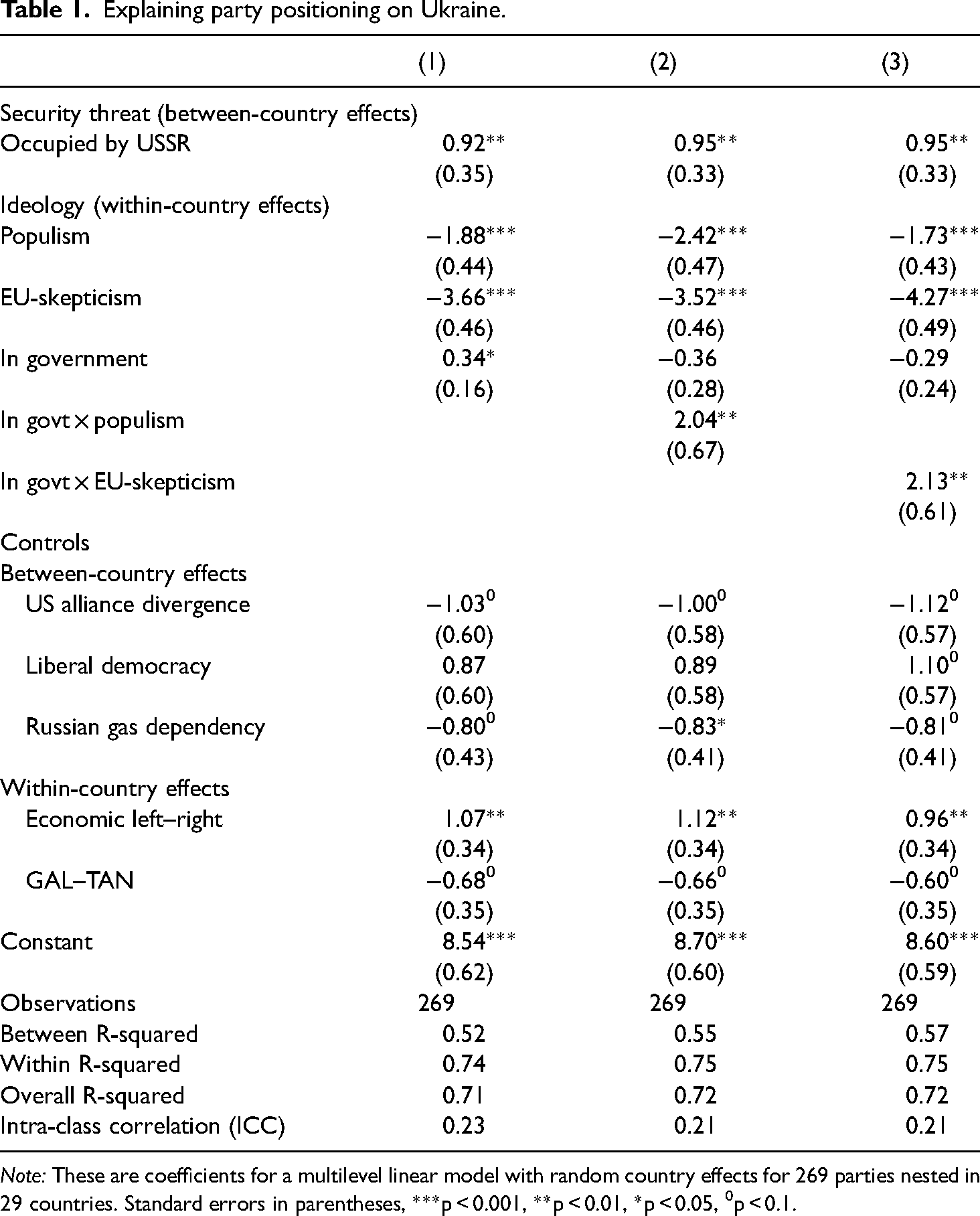
Note: These are coefficients for a multilevel linear model with random country effects for 269 parties nested in 29 countries. Standard errors in parentheses, ***p < 0.001, **p < 0.01, *p < 0.05, 0p < 0.1.
The chief take away is that a perceived security threat is a significant predictor of support for Ukraine (H1). Keeping all other variables at their means, political parties in a country that was occupied and partially or totally annexed by the USSR have a level of support 0.92 (+/−0.35) greater than those in other countries (Model 1). In line with the threat thesis, the effect is greatest on the question of supplying weapons (+1.69) and smallest for hosting refugees (+0.27) (see Online appendix). This suggests that domestic support for Ukraine is indeed shaped by experience with Soviet territorial aggression.
We test two alternative operationalizations of the threat thesis, with slightly weaker results (reported in the Online appendix). A narrower definition of threat focuses on countries that were formerly incorporated in Russia or the Soviet Union during the 20th century. Estonia, Latvia, and Lithuania were, like Ukraine, Soviet before they became independent. Though technically never part of the Soviet Union (created only in 1922), Finland was part of Russia until December 1917, and it fought off Soviet attempts at annexation during World War II (WWII) (Online appendix). One might reasonably expect these countries to feel directly threatened by Russian revanchism. However, this is balanced by the domestic Soviet legacy of large Russian-speaking minorities in Estonia, Latvia, and Lithuania (Rovny, 2014). Our analysis reveals that Former Russia/USSR countries have higher levels of support at +0.64 (+/−0.79) than other countries in the sample, but this difference falls short of statistical significance. A broader threat definition predicts that countries bordering Russia will be more susceptible to security concerns. We confirm that political parties in a country bordering Russia have support levels that are on average 0.91 (+/−0.46) greater than those in non-bordering countries. However, both alternative operationalizations of external threat are marginally weaker than the effect of occupation with annexation by the USSR. 8
H1, the threat thesis, is supported in Model (1) with a high level of statistical confidence (p < .009), yet in isolation it explains less than 3% of the overall variance (or 22% of country-level variance). A more powerful factor is party ideology, and in particular a party's stance on populism and European integration. These two variables alone explain 64% of the overall variance in support for Ukraine, and these effects are robust under controls which include positioning on the economic left–right and GAL–TAN dimensions that structure domestic party competition (H2 and H3).
These are interesting and even counter-intuitive findings because prior research attributes much of the effect of populism and EU-skepticism to their association with the basic dimensions of political contestation on economic left–right and, particularly, GAL–TAN (Hooghe and Marks, 2018; Marcos-Marne et al., 2022; Jackson and Jolly, 2021; Rooduijn and Akkerman, 2017). Importantly, we find that populism and EU-skepticism are robust in the presence of the main ideological controls.
The estimate for In Government, while in the expected positive direction, is significant at the 0.05 level (p = 0.04). Moreover, the interactive terms in Model (2) for populism and Model (3) for EU-skepticism are strongly consistent with H4, the governing thesis, applied to challenger parties on Ukraine. When in government, strongly populist or EU-skeptical political parties tend to be much less rejectionist on Ukraine. This is evident in Figure 4, which contrasts the slopes predicting support for Ukraine as a function of populism (4a) and EU-skepticism (4b) when the party participates in a government coalition or is in opposition. In each case, the slope for government participation is relatively flat compared to that for the opposition. These effects are highly significant in a contrast slope test (populism: p = .002; EU-skepticism: p = .001).
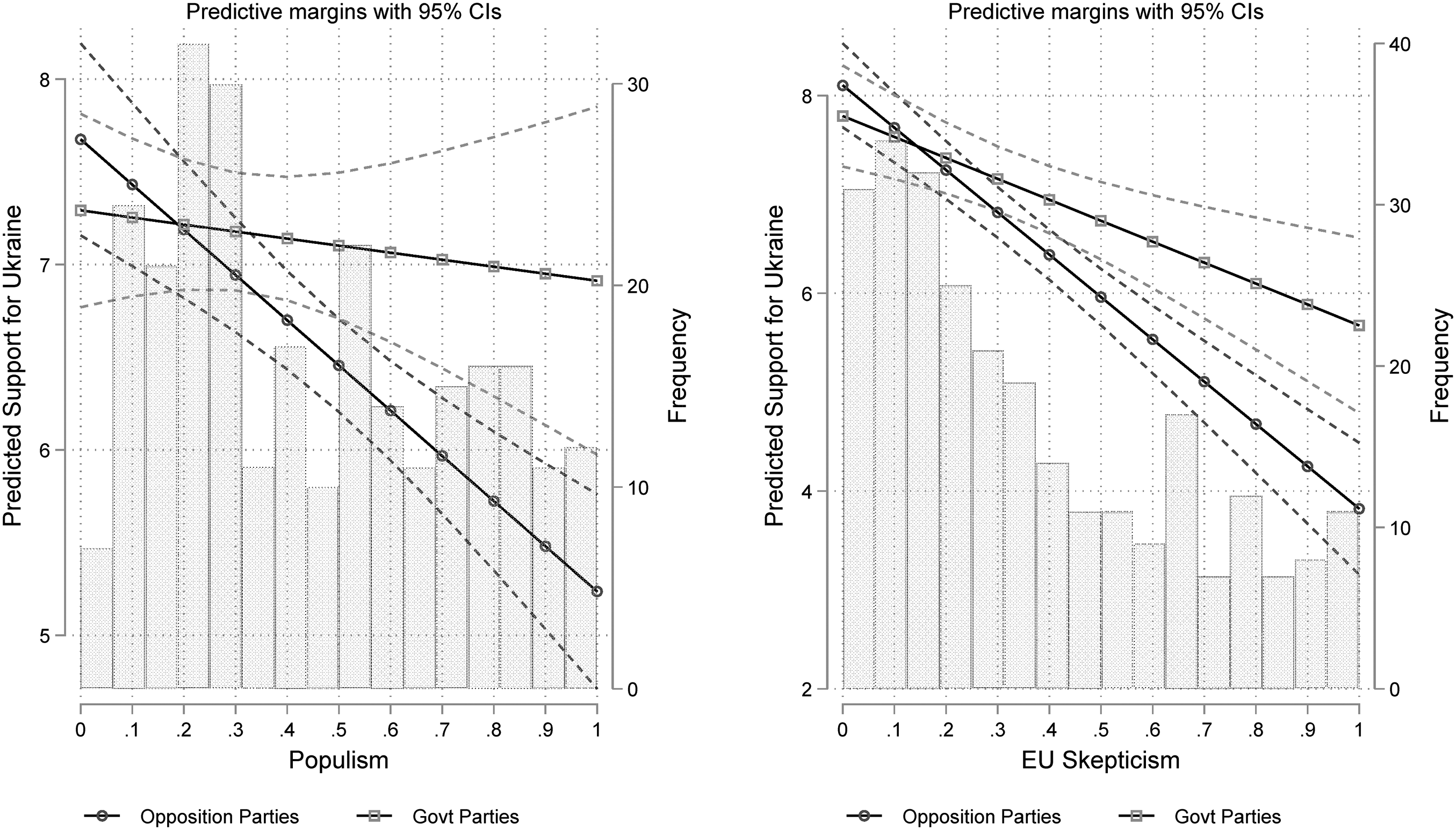
How government participation moderates populism and EU-skepticism on support for Ukraine. Note: This figure compares the predicted support for Ukraine among opposition parties and government parties at different levels of populism (left panel) or different levels of EU-skepticism (right panel) with histograms of the independent variables to display the distribution of populism and EU-skepticism. The slopes plot the relationship, under controls, between populism (EU-skepticism) and support for Ukraine, within 95% confidence intervals, for opposition and government parties. The downward slopes for opposition parties are much steeper than those for government parties, indicating that ideology has a much larger effect on the former than on the latter. N = 269 parties nested in 29 countries.
The effect of government participation can be gauged by comparing two parties at the high end of the populism scale (0.8 on the 0 to 1 scale), one in government and the other in opposition. Holding all other variables at their means, the governing populist party's support for Ukraine is on average 1.3 higher than that of the opposition populist party. The moderating effect of government participation is so pronounced that populism no longer has a statistically significant effect on a government party's support for Ukraine. The difference for two parties at 0.8 on the EU-skepticism scale is 1.4 points.
This allows us to make sense of the co-existence of real contestation within countries and the claim that the West is consolidated in support for Ukraine. Populist and EU-skeptic parties are a serious source of dissent on Ukraine when they have the luxury of opposition, but they tend to fall into line when they participate in government. This is precisely the course that the Brothers of Italy has taken under Prime Minister Meloni. Prior to office, Meloni condemned economic sanctions imposed on Russia following its annexation of Crimea and praised Putin's re-election as president in 2018 as the “unequivocal will” of the Russian people (Biancalana, 2023: 191; Farrell, 2022). In her role as Italian prime minister, Meloni has supported Ukraine down the line. In her meeting with President Biden at the end of July 2023, Meloni proclaimed her pride in Italy's support for Ukraine: “We know who our friends are in times that are tough, and I think that Western nations have shown that they can rely on each other much [more] than some have believed” (White House Press Release July 27, 2023).10
We find mixed support for factors that figure prominently in policy and journalistic analyses (Table 1). First, our results are consistent with the expectation that parties in countries that diverge more frequently from US foreign policy are less supportive of Ukraine, though this is significant only at 0.1 level. Second, while the quality of a country's liberal democracy is positively associated with a party's support for Ukraine, the association is quite weak. And finally, Russian gas dependency depresses support, consistent with a political economy reading of the conflict, though with a maximal effect size (−0.83) that is below that of the security threat (see also the Online appendix).
Party positioning on Ukraine using 2019 ideology estimates.
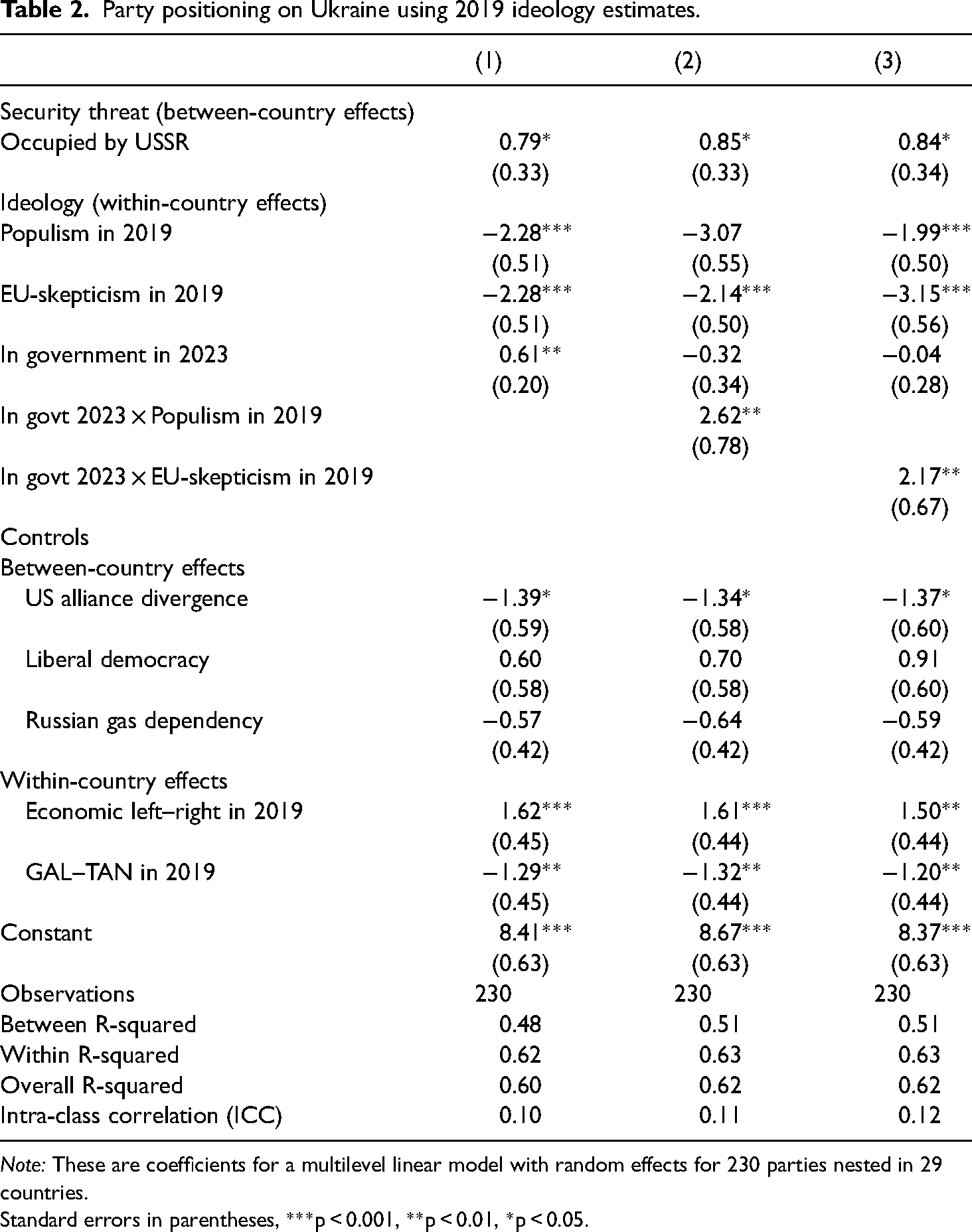
Note: These are coefficients for a multilevel linear model with random effects for 230 parties nested in 29 countries.
Standard errors in parentheses, ***p < 0.001, **p < 0.01, *p < 0.05.
Do security threats moderate ideology?
The compressing effect of government participation on the effect of populism and EU-skepticism raises the possibility that security concerns have a similar effect in countries exposed to the threat from Russia. Could political parties in countries on the frontline of the Ukrainian–Russian war be less divided by populism or EU-skepticism than those that are more distant? Are populist or EU-skeptic parties in these countries more willing to rally around the flag when the threat is at their doorstep?
To investigate this, we interact populism and EU-skepticism with Occupied by USSR. We find no heterogenous effect (see Online appendix). The slopes are nearly identical, indicating that ideology affects parties in countries on the frontline in the same way as those that are more remote. Contrast slope tests confirm this (p = 0.900 and p = 0.997 respectively) (Figure 5).
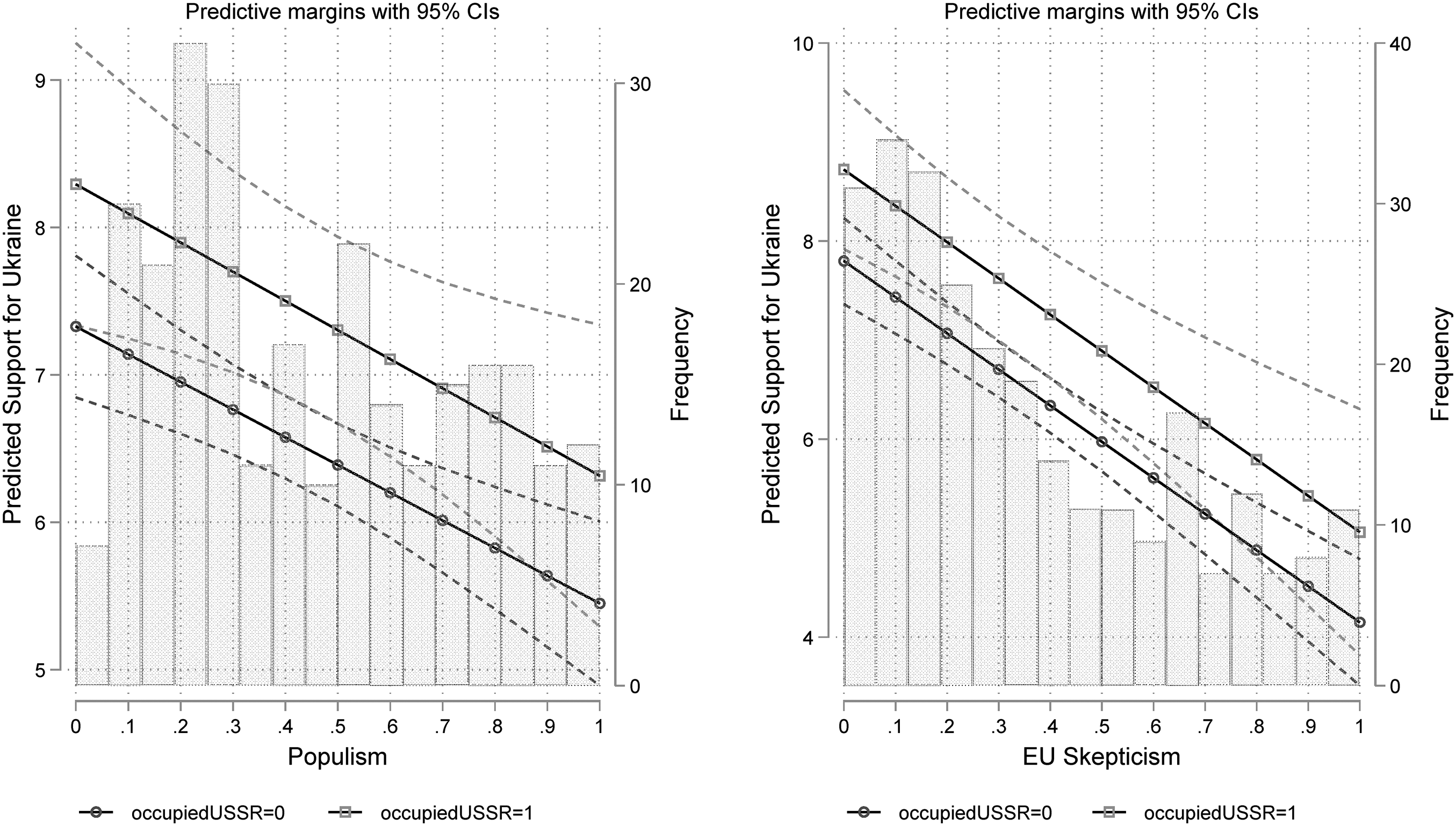
The effect of populism and EU-skepticism in countries occupied by the USSR during WWII or not. Note: This figure compares the predicted support for Ukraine among parties in countries that were occupied by the USSR and those that were not at different levels of populism (left panel) or different levels of EU-skepticism (right panel) with histograms of the independent variables to display the distribution of populism and EU-skepticism. The slopes plot the relationship, under controls, between populism (EU-skepticism) and support for Ukraine, within 95% confidence intervals, for each group of parties. In both figures the slopes run parallel, indicating that the relationship between ideology and support for Ukraine is similar in countries that were occupied and those that were not. N = 269 parties nested in 29 countries.
Checking reverse causality
We have established that populism and EU-skepticism are powerful predictors of support for Ukraine. However, cross-sectional analysis cannot adjudicate whether ideology is driving Ukraine positioning or Ukraine positioning is driving ideology. Data from the CHES on party ideology that predates the onset of the war in 2022 can be used to gain inferential traction.
The 2019 CHES wave provides information on populism, EU-skepticism, economic left–right, and GAL–TAN for 232 of the 269 political parties that we examine in 2023 (Jolly et al., 2022). Table 2 replicates the models in Table 1 with information from 2019. This produces similar estimates for the independent variables of interest, and the substantive effects of populism and EU-skepticism using 2019 observations are nearly identical to the effects using 2023 observations. In short, these results are consistent with the claim that the association between ideology and support for Ukraine reflects a party's ideological anchoring that precedes and shapes its response to the Ukraine crisis.
Is the effect of participation in government spurious?
A telling finding in the analysis so far is that participation in government dampens the effect of moderate and high levels of populism and EU-skepticism on the support for Ukraine. However, we must consider the possibility that an omitted variable explains both government participation and support for Ukraine. This concern is all the more serious because the subsets of the sample compared in Figure 4—opposition parties and government parties in 2023—are very different on the key variables of interest, i.e. populism and EU-skepticism. Hence, we need to be wary in inferring the effect of government support by comparing a set of highly populist parties in opposition to a set of weakly populist parties in government. The same applies to EU-skeptical parties. While these comparisons are made under a variety of controls, the contrasting distributions increase the likelihood that the causal inference of a government effect is spurious.
We can gain inferential leverage by comparing the following subsets of political parties: (a) parties that transitioned from government in 2019 to opposition in 2023; and (b) parties that transitioned in the reverse direction, from opposition in 2019 to government in 2023. These groups are far more similar with respect to populism and EU-skepticism than parties that were in government or in opposition both times. In the Online appendix, we compare the two-sample Kolmogorov–Smirnov test for equality of distribution functions which reveals that it is much more likely that group (a) and group (b) were randomly sampled from the same population than were the groups compared in Figure 4.
Figure 6 plots the effect of populism (6a) and EU-skepticism (6b) on support for Ukraine in the subsets of the sample, (a) and (b). The result is consistent with H4, the governing thesis: the effect of a party's populist or EU-skeptical stance on support for Ukraine is strong and downward sloping for parties that transitioned out of government, and it is severely dampened for parties that transitioned into government.
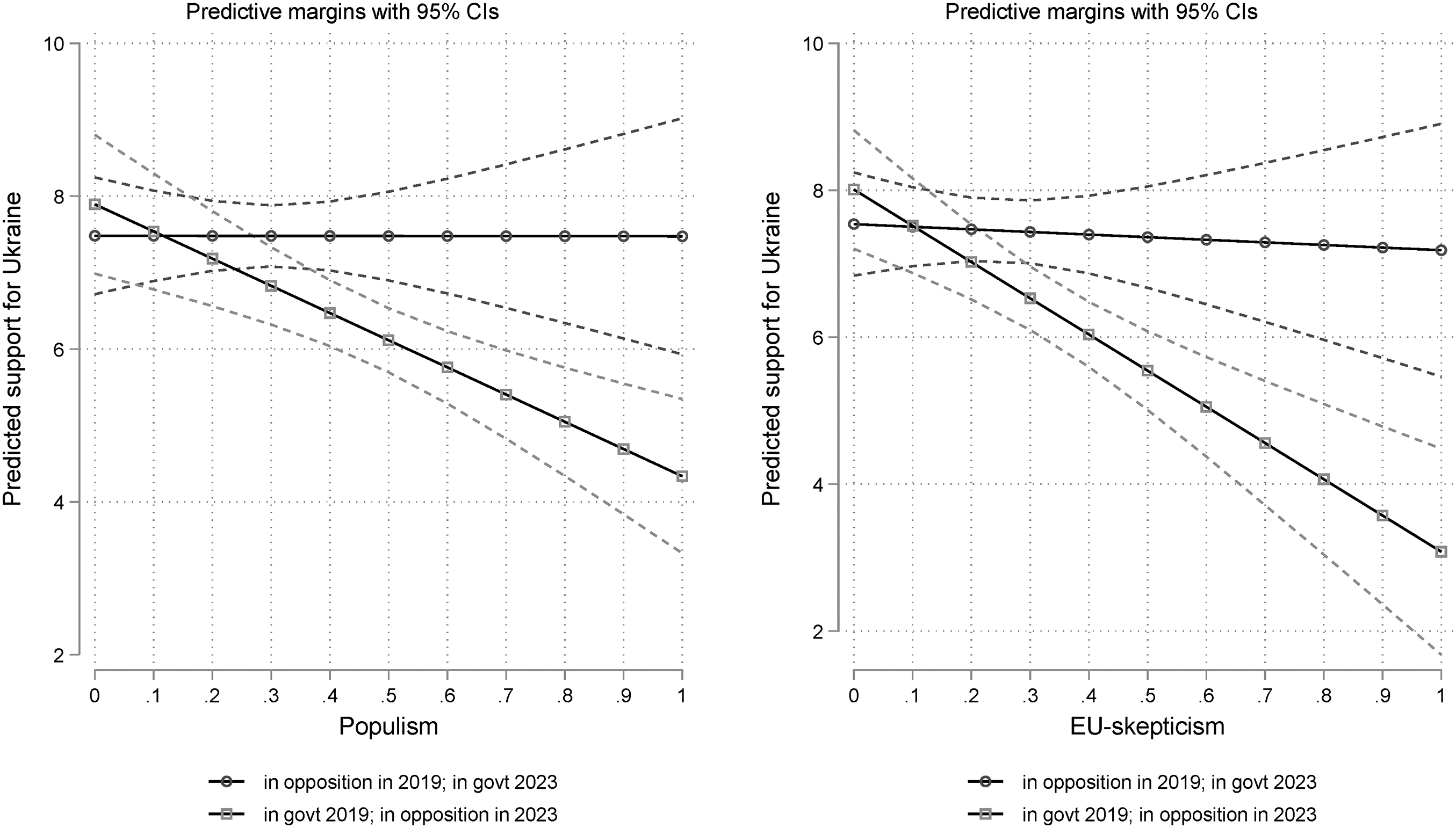
The effect of transitioning in and out of government. Note: This figure compares the predicted support for Ukraine among (a) parties that transitioned from opposition in 2019 to government in 2023; and (b) parties that transitioned from government in 2019 to opposition in 2023 at different levels of populism (left panel) or EU-skepticism (right panel). The slopes plot the relationship, under controls, between populism (EU-skepticism) and support for Ukraine, within 95% confidence intervals, for (a) and (b) parties. It shows that the downward slope for parties that transitioned from government to opposition (b) is much steeper than for parties transitioning from opposition to government (a), indicating that ideology has a much larger effect on the former than the latter. N = 269 parties nested in 29 countries.
The substantive effect of these contrasting trajectories can be grasped by comparing parties at the high end (0.8 on the 0 to 1 scale) of the populism and EU-skepticism scales. Holding all other variables at their means, a populist (Euro-skeptical) party transitioning out of government will on average be 2.4 (3.2) points less supportive of Ukraine on the 11-point scale. Across the sample, populism and EU-skepticism are strong predictors of support for Ukraine. However, for parties that have shifted into government, these variables lose their predictive power.
This analysis shows that there is an association between government participation and support for Ukraine among the select group of parties that were not excluded for one reason or another from a government coalition in 2019 or 2023. However, the data at our disposal does not allow us to exclude the possibility that, following the onset of war, the criteria of coalition formation changed so that only those populist/EU-skeptic parties that already held pro-Ukraine positions made it into government.
Conclusion
This article sets out to understand Europe's response to Russia's invasion of Ukraine expressed in the stances of political parties (for public opinion, see Mader et al., 2024; Stolle, 2023). Using expert data on the positions taken by 269 political parties in 29 countries in mid-2023, we find strong support for Ukraine, along with a substantial tail of opposition. Forty-nine (18.2%) parties oppose supporting Ukraine overall, and a further 46 parties attest only weak support (<6.5 on a 0 to 10 scale).
Perspectives based in international relations and political psychology emphasize threat perception as influential for Europe's reaction to Russia's war against Ukraine. Our analysis yields support for this expectation. We find that parties in countries that experienced Soviet annexation or are in close proximity to Russia are more likely to support Ukraine. Perceived security threat explains 22% of the variance among countries, but because the bulk of the variance is across parties within countries, this accounts for just 3% of the overall variance.
A stronger explanation draws on party ideology. We find that populism and EU-skepticism are powerful frames for party positioning on the invasion of Ukraine. Populist parties are less willing to send weapons to Ukraine, accept higher energy costs, welcome Ukraine in the EU, or even host Ukrainian refugees. This relationship between party ideology and support for Ukraine is particularly strong with respect to parties’ stance on European integration. Most pro-EU parties are pro-Ukraine; most anti-EU parties display ambivalence or opposition. Interestingly, these patterns are robust when we control for parties’ broader economic and socio-cultural ideology, which constitute the scaffolding for party brands and which, with respect to other crises such as the COVID-19 pandemic or the migration crisis, have shaped party response (Ferwerda et al., 2023; Rovny et al., 2022). The effects of populism and EU-skepticism are also much larger than the depth of foreign policy alliance with the US, the strength of a country's liberal democracy, or a country's dependence on Russian gas.
We also find a sizeable government effect: participation in government dampens the effect of populism and EU-skepticism. This suggests that the need to act, the necessity of maintaining existing alliances, and the need to compromise to enter a coalition government can constrain a party even in the presence of a contrary ideological commitment.
The data analyzed in this article were collected in late spring 2023, after the coldest months in Europe but prior to Ukraine's counter-offensive. Since then, two national elections have thrown up a test for our government hypothesis. In Poland, the EU-skeptic and populist Law and Justice (PiS) government party tempered its strong support for Ukraine during the election campaign under pressure from a more extreme TAN rival (Richter, 2023). PiS lost the election in October, and our theory predicts that in opposition, it will soften its support for Ukraine on account of its EU-skeptic and populist stance. In Slovakia, the EU-skeptic and populist Direction-Slovak Social Democracy (SMER-SSD) won the election in September 2023 and formed a coalition with two like-minded parties on the promise to stop aid to Ukraine and limit sanctions against Russia (Bayer, 2023). Here, the government hypothesis predicts moderation on account of the external constraints of alliance politics, though this expectation is tempered by the absence of pro-Ukrainian coalition partners. For populist and EU-skeptic parties, prioritizing domestic spending while cutting international commitments can have mass appeal, as the Brexit campaign demonstrated.
However, the most severe test of Western consensus—and of the argument of this paper—lies in the progress of the war itself. The prospect of a timely Russian defeat has consolidated support for Ukraine, but as the war persists, this consensus is coming under pressure. If the findings of this paper are valid, one would expect that the most intense resistance to support for Ukraine will come from populist and EU-skeptic parties in opposition. Already, in the US, most Republicans are opposed to any continuation of financial support for Ukraine, and our analysis suggests that populist and EU-skeptical parties may follow suit. Panel data on party positioning from future waves will reveal whether the findings of this paper are valid over time.
Supplemental Material
sj-docx-1-eup-10.1177_14651165241237136 - Supplemental material for The Russian threat and the consolidation of the West: How populism and EU-skepticism shape party support for Ukraine
Supplemental material, sj-docx-1-eup-10.1177_14651165241237136 for The Russian threat and the consolidation of the West: How populism and EU-skepticism shape party support for Ukraine by Liesbet Hooghe, Gary Marks, Ryan Bakker, Seth Jolly, Jonathan Polk, Jan Rovny, Marco Steenbergen and Milada Anna Vachudova in European Union Politics
Supplemental Material
sj-zip-2-eup-10.1177_14651165241237136 - Supplemental material for The Russian threat and the consolidation of the West: How populism and EU-skepticism shape party support for Ukraine
Supplemental material, sj-zip-2-eup-10.1177_14651165241237136 for The Russian threat and the consolidation of the West: How populism and EU-skepticism shape party support for Ukraine by Liesbet Hooghe, Gary Marks, Ryan Bakker, Seth Jolly, Jonathan Polk, Jan Rovny, Marco Steenbergen and Milada Anna Vachudova in European Union Politics
Footnotes
Acknowledgment
The authors appreciate the financial support from the Advanced European Research Council grant TRANSNATIONAL (#885026) and the Kenan and Burton Craige Research Foundations at the University of Chapel Hill. An earlier version was presented at the University of Gothenburg, and we thank seminar participants for feedback. Courtney Blackington and Sayman Stribl provided first-rate research assistance.
Author contributions
The authors contributed equally to the article.
Declaration of conflicting interests
The author(s) declared no potential conflicts of interest with respect to the research, authorship, and/or publication of this article.
Funding
The author(s) disclosed receipt of the following financial support for the research, authorship, and/or publication of this article: This research received funding from the Advanced European Research Council grant TRANSNATIONAL (#885026) and the Kenan and Burton Craige Research Foundations at the University of Chapel Hill.
ORCID iDs

Data availability statement
Data from a CHES speed expert survey on party positioning on support for Ukraine is publicly available at https://www.chesdata.eu/speedches.
Supplemental material
Supplemental material for this article is available online.
Notes
References
Supplementary Material
Please find the following supplemental material available below.
For Open Access articles published under a Creative Commons License, all supplemental material carries the same license as the article it is associated with.
For non-Open Access articles published, all supplemental material carries a non-exclusive license, and permission requests for re-use of supplemental material or any part of supplemental material shall be sent directly to the copyright owner as specified in the copyright notice associated with the article.
