




Abstract
This article offers insights into the nature of patriarchy as a structuring condition of global order, and – significantly – the process of change that has enabled its endurance. We are, today, witnessing the emergence of multiple challenges to the existing order and the tying of the political campaigns of these challenges to an agenda of anti-feminism (what we term ‘patriarchal backlash’). We argue that current ructions cannot be understood in a linear sense of feminist progress and regression, nor can these patriarchal challenges to the existing order be understood in isolation from one another. We propose a feminist dialectical approach to theorising patriarchy as a structuring condition of global order and as a useful methodological tool to understand change and transformation. Rather than seeing feminist movements or instances of patriarchal backlash as ‘outside agitators’ to patriarchy, we view them as necessary internal contradictions within patriarchy and the driving engine for its transformation. We propose here feminist dialectics as providing the conceptual tools to understand patriarchy’s variation over time and across space and its endurance as an ordering condition of the international.
Introduction
If the ruling class has lost its consensus, i.e. is no longer ‘leading’ but only ‘dominant’, exercising coercive force alone, this means precisely that the great masses . . . no longer believe what they used to believe previously, etc. The crisis consists precisely in the fact that the old is dying and the new cannot be born; in this interregnum a great variety of morbid symptoms appear. (Gramsci et al., 1971: 276)
International relations scholars have in recent years identified a number of significant challenges to the liberal international order, both geographically, in terms of a shift in the balance of power between West and non-Western countries, and structurally, in terms of the devolution of powers from states to sub-state and supra-state actors (Ba, 2023; Reus-Smit, 2017; Richmond et al., 2023). Scholars have variously sought to understand these shifts in terms of civilisations (Bettiza et al., 2023), culture (Reus-Smit, 2017), norms (Winston, 2018), postcoloniality (Phạm and Shilliam, 2016), political economy (Bieler and Morton, 2018), historical sociology (Zarakol, 2022) and polycrisis (Helleiner, 2024). However, less attention has been paid to the structural condition of patriarchy and changes in patriarchy as generative of both global order (Bieler and Morton, 2024) and the emerging challenges to that order. Yet, throughout the history of humankind, the hierarchical ordering of societies based on sex remains the most universal and persistent form of political order (Hudson et al., 2020). What accounts for this persistence, despite significant advances to the status of women in the 20th and 21st centuries?
We are seeing, within the various challenges to the liberal international order, expressions of hostile, misogynistic politics. The global rise of nationalist, extremist and populist movements feature misogynistic, racist and male supremacist overtones. Deniz Kandiyoti (2019) argues these are emblematic of a spreading global phenomenon of masculinist restoration in response to the decline of the existing hegemonic patriarchal order. However, rather than taking these trends as evidence of patriarchy’s decline, we adopt a feminist materialist account for these various expressions of regressive gendered politics and historicise these forces in the long durée of patriarchy.
Instead, we offer an approach that accounts for the endurance of patriarchal orders and changes to its forms over time and across contexts. We introduce feminist dialectics as a theory and a method for studying patriarchy as a key ordering principle of human societies, constitutive of the international. Our assertion is that patriarchy exists as a social relation that is both structurally conditioning of relations of production, reproduction and state-civil society and experienced individually through conditions of sex-class struggle (Bieler and Morton, 2018: 9). While patriarchy is not experienced the same by all individuals around the world, it nonetheless operates as a social force conditioning of all levels of political relations, including the international. In this sense, we follow materialists who question state-centric analyses that treat aspects of power as separate and distinguishable spheres at best interacting at moments in time, as well as Rosenberg’s (2016) critique of international relations’ (IR) reification of ‘the international’ as an ontologically distinct object of inquiry. Our feminist dialectics uses a philosophy of internal relations to make explicit a conception of patriarchy through which ‘connections are maintained and contained as aspects of a self-forming whole’ (Bieler and Morton, 2018: 9). We take the international not as an object to be interpreted, but as a heuristic to explain or interpret various phenomena (Rosenberg, 2016) and a ‘dimension of social reality which arises specifically from the co-existence within it of more than one society’ (Rosenberg, 2006: 308). This approach illuminates first, the internal relations of various forms of misogynistic and anti-gender resistance that have emerged in the 21st century (Huysmans and Nogueira, 2024), and second, what emergent transformation to global patriarchy we may anticipate. As argued by Brincat (2011), dialectics offers methodological utility for IR, given the complexity of social and political relations at the international, because ‘it focuses on particular phenomena within the totality of social relations rather than their isolation or abstraction’ (p. 680, emphasis original).
The puzzle
We witness, today, numerous challenges to international order by contrarian state and non-state actors. These include right-wing, ethnonationalist and religious extremists, all of which recruit and mobilise supporters through appeals to anti-feminism and a traditional gender order (Halilović and Veljan, 2021; Kimmel, 2018; Smith, 2019). We observe growing support for male supremacist movements online and offline and a worrying number of people opposed to gender equality, believing that women’s rights have gone too far (IPSOS, 2023; Parton, 2019). ‘Trad-wife’ movements have emerged, eschewing women’s participation in the public sphere in favour of housewifization (Chateauvert-Gagnon, 2024; Ebner, 2020), and many states are embracing populism and seeking to roll back women’s rights (Kandiyoti, 2019; Stevens, 2021). Violence against women remains ubiquitous, with new and renewed forms such as sexualised strangulation, revenge porn and technology-facilitated abuse common and visible (Henry et al., 2020) alongside an increasing tendency for this violence to be public and spectacular (Kandiyoti, 2019).
We see blatant examples of overt misogyny and patriarchal backlash, but little accounting of the causes and material implications of these phenomena, which are reduced to ‘culture wars’ in mainstream accounts. While excellent analyses have shed light on the role of gender within various challenges to the liberal international order, such as the rise of populism (Homolar and Löfflmann, 2022), in nationalist movements (Awondo et al., 2022) and authoritarianism (Kandiyoti, 2013, 2019), most accounts take these phenomena as isolated instances of anti-feminism and anti-global resistance. They have not considered the relationship of these movements to each other or to the patriarchal nature of the international order.
Given the intensity and spread of anti-feminism globally – what we refer to collectively as patriarchal ‘backlash’ 1 – we argue that we are at a historical conjuncture wherein the old patriarchal order is dying, and the new cannot be born. The existing patriarchal order faces threats not only from the progressive, emancipatory movement of feminism but also from regressive patriarchal backlash. Thus, our core aim in this article is to explain these political contestations as part of the internal relations and inherent contradictions of patriarchy, as a global gender order. We propose feminist dialectics as both theory and method to understand the dynamism of patriarchy and its resilience as an ordering principle of (global) human relations.
The first part of the article theorises patriarchy beyond the interpersonal and argues the need for structural theorising of patriarchy within international relations. We draw on Sylvia Walby’s (1989, 1990) theorisation of the shift in forms of prevailing patriarchal order from the private, interpersonal, form into the institutionalised, state-enforced public form. Her approach resists a state-centric analysis of patriarchy by highlighting the internal relations of the various sites of patriarchal power, their multiple configurations and change to those configurations over time. Thus, while the state may currently appear as the primary unit of international order, this is not necessarily a universal condition. By shifting our focus from the state as an institution of patriarchal power towards social relations, feminist dialectics provide an alternative account that demonstrates patriarchy’s conditioning of the international.
The second part of the article demonstrates the method of feminist dialectics, illuminating how the various elements of patriarchal gender relations and patriarchal violence are constitutive of international structure. By tying together insights from feminist IR on current modes of patriarchal backlash, we suggest that backlash should not be studied in isolation or as itself the emergent patriarchal order, but instead as part of the internal relations of patriarchy as the structuring condition of the international. Using feminist dialectics, we argue that the current moment of ‘stalled revolution’ and ‘patriarchal backlash’ should be read as a signal of the declining power of the old patriarchy and that we should anticipate the roll out of a new patriarchal order. In this interregnum, a variety of morbid symptoms in global patriarchy appear.
‘The main enemy’: theorising patriarchy beyond the interpersonal
Feminist dialectics offers conceptual tools necessary to understand both consistency in patriarchy as the ordering logics of human social relations over time and across contexts, while holding space in analysis for differences in forms and change to its general character. 2 Our purpose in this section is to make the argument for a return to structural theorising while preserving scope for analysis of the contingent, agential and personal.
Structural theorising is out of fashion in feminist IR (Sjoberg, 2012). Feminists have rightly been critical of the ways in which structural theorising of the international obscures and neglects the ‘low politics’ of the lives and experiences of those marginal from power (Enloe, 1989; Peterson, 1992), and as such, feminist IR scholars ‘rarely use the word “structure” and even more rarely discuss the relationship between gender and structure in global politics explicitly’ (Sjoberg, 2012: 3). Sjoberg’s work is a notable exception. She adopts the term ‘hierarchical gender relations’ as the basis for political hierarchies in the international (Sjoberg, 2013, 2017). However, contrary to Sjoberg’s argument that the hierarchical nature of gender relations is due to women’s perceived femininity and that it is femininity that is devalued, not women, we believe that there is no a priori valuing of things as feminine/masculine, existing before patriarchy. Rather, things coded feminine are devalued because of their association with women, while things coded masculine are valued because of their association with men. Thus, we argue here that it is patriarchal ordering rather than hierarchical gender ordering conditioning of social relations.
While we are cognizant of these critiques of patriarchy as a concept and are committed to a standpoint epistemology, we share with Sjoberg (2013, 2017) the conviction that gender is relevant to understanding the structure of the international system. As Johnson et al. (2022: 608) argue, the experiential and everyday lives of people are not meaningfully distinct from the abstract and elite politics of the international but are also ‘central to the production and reproduction of world order’. And the oldest and most enduring hierarchical ordering in all known human societies is the hierarchy based on sex, wherein men are systematically advantaged and women disadvantaged relative to men (Hudson et al., 2020). While gender norms are neither static nor universal, the systematic assignment of differential value on the basis of gender norms, based on perceived membership in sex categories, sees men and masculinity privileged over women, and femininity as a universal feature of human societies and constitutive of an ordering logic at all levels of global politics (Acker, 1989; Sjoberg, 2013). We argue the neglect of theorising patriarchy as structuring of the international that has left us without sufficient conceptual tools to understand both the persistence of unequal gender relations and new forms of gendered violence, such as the varieties of backlash occupying feminist IR scholars today. Without a full understanding of the dynamism of patriarchy, we have limited ability to comprehend the ways that patriarchy is both constitutive of and constituted by these ‘morbid symptoms’ and comprise a social totality, ordering of political relations at all levels of analysis.
Patriarchy is the ‘manifestation and institutionalisation of male dominance over women and children in the family and the extension of male dominance over women in society in general’ (Lerner, 1986: 239). Because patriarchy was originally conceptualised as a relationship of private domination of men over women within the domestic sphere, the social shifts that saw women gain greater roles in the public sphere have called into question the idea that patriarchy remains a prevailing ordering condition. Poststructuralist scholarship argued for specificity and critiqued the generalising totality of the concept of patriarchy (Acker, 1989; Sylvester, 2002). This has given rise to a discourse of being in an era of post-feminism and neglect (if not overt disavowal) of patriarchy as an object of enquiry in IR (Duriesmith and Meger, 2020). Graphing the macro-historical changes to patriarchy has fallen out of favour in feminist IR as scholars have been concerned with the micro, the agential and the contingent (Duriesmith and Meger, 2020). We believe the disjuncture between the general and the particular can be resolved (Bieler and Morton, 2021: 1751), however, and that there is utility in analysing patriarchy in its own right. We analyse patriarchy as conditioning of both international and domestic orders (rather than see gender relations as shaped through external forces) through the application of a philosophy of internal relations and uneven and combined development of patriarchy (Allinson and Anievas, 2009; Rosenberg, 1994) that informs our feminist dialectical method outlined below.
Sylvia Walby provides not only a useful structural account of how patriarchy operates but also a framework by which to understand multiplicity in patriarchy and changes over time. She defines patriarchy as ‘a system of interrelated social structures through which men exploit women’ (Walby, 1989: 20) across six areas, or bases, that may align or be in contradiction with one another, but upon which patriarchy is (re)enforced. These are: domestic work, paid work, the state, male violence, sexuality and other practices in civil society; the dominant base changes over time as outlined in Table 1, adapted from Walby (1989: 25).
Private and public patriarchy across the six sites (Walby, 1989).
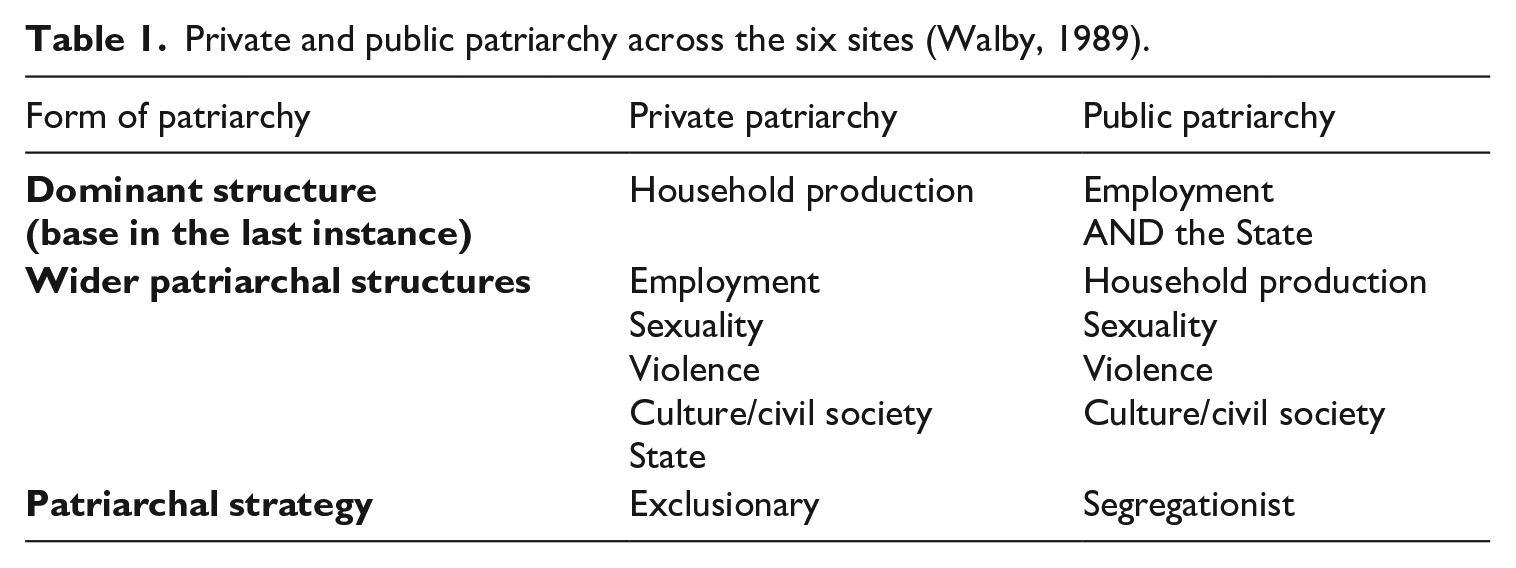
Walby’s framework considers the role of the state in crystallising the current configuration of patriarchal relations and institutionalising men’s dominance but does not take the state as itself determining of patriarchy. As such, her approach is historical and conducive to a philosophy of internal relations that leaves open the question of which site is dominant in the last instance. She understands the six sites of patriarchy as complexly related, but non-derivative. Since industrial capitalism, we have seen a shift in the primary base of patriarchy, but it is not a necessary, linear trajectory. She argues, we ‘need to separate the notion of progress in the position of women from that of changes in the form of gender inequality. That is, to distinguish analytically between changes in the degree of patriarchy from changes in its form’ (Walby, 1989: 23, emphasis added).
Walby’s theory of change to patriarchy provides us with the analytical tools to separate sites and forms of patriarchy within an ontological whole. Given that the interactions between social forces across and within the six sites can take infinite configurations, her model fits with a dialectical approach of incorporated comparison (McMichael, 1990). While non-dialectical feminist IR would perhaps locate the international in the interaction of patriarchal states (Sjoberg, 2013; Hooper, 2001; Young, 2003), our goal is not to reify units of patriarchal configurations as permanent or enduring features of the international. Nor do we seek to understand shifting sites of patriarchal forces within the state as a result of the external agitations of what happens to states (e.g. by economic or military conditions). Instead, we seek to ‘give substance to a historical process (a whole) through comparison of its parts’ which ‘does not exist independent of its parts’ (McMichael, 1990: 386). Using levels of abstraction (outlined below), we can understand patriarchal interpersonal relationships and operations of patriarchy at the national level (as a gender regime), while still recognising patriarchy as the ordering condition of the international.
Using feminist dialectics, we can develop historically grounded feminist theory attentive to macro, cross-national processes of patriarchal relations while also incorporating comparison of its constituent parts, from the personal to the institutional. It also allows us to isolate a logic of change in patriarchy’s general ordering principles and specific forms, without relying on state-centricity, individual agency or external agitators as the causal mechanism. In the remaining sections of this article, we outline feminist dialectics as a method, its unevenness and multiple forms and its internal dynamics that are generative of both contradictions (what we call morbid symptoms) and their resolution through change in its general form.
Introducing feminist dialectics: the social totality of patriarchy as internally related
We have tended in international relations to examine ‘things’ and the relations between them as if they are logically independent and analyse relations between ‘things’ ‘based on their ontological exteriority’ which then justifies an epistemology of political analysis ‘only when they enter into contact with each other’ (Bieler and Morton, 2021: 1751). Our purpose in this section is to demonstrate the utility of the method of feminist dialectics for not only analysing specific problems of patriarchal relations at different levels of analysis but also situating them within a more abstract social totality of patriarchy as an ordering condition.
While feminists have brought to our attention the multiple operations of gender in international relations at different levels of analysis, the tendency has been to carefully analyse discrete phenomena and situate these within a general patriarchal milieu but without a sufficient method for explaining how parts and whole relate. This also means that change to the specific form of patriarchal relations is attributed to external forces. The external agitator constitutive of change may be identified as a particularly patriarchal individual in power (Aggestam and True, 2021), the patriarchal strategic culture of a state (Connell, 1990; Young, 2003) or the masculinist behaviours of states (Hooper, 2001; Nicholas and Agius, 2017) and actors in the system (Zalewski and Parpart, 1998) or a general problem with masculinist culture (Hooper, 1998; Sylvester, 2002). Because of the dominance of a philosophy of external relations approach in IR, change comes to be conceived as ‘external to the thing itself, something that happened (or will happen) to it, so that its new form is treated as independent of what it was earlier . . . rather than as an essential aspect or stage of what it is’ (Ollman, 2015: 10).
We argue that feminist dialectics offers an alternative ontological understanding of patriarchy as a social totality and conditioning of global order. Dialectics is a useful method as it enables an account of ‘process, change, and the social relations that generate them’ (Brincat, 2011: 679–680) and allows for multiplicity and unevenness of its development over time. Unlike Hegelian dialectics, which would hold that patriarchal ideas are constitutive of patriarchal relations (and thus the possibility of emancipation through a teleological process of awareness-raising), feminist dialectics holds that patriarchal relations are generative of patriarchal norms. There is no a priori ideology of gender inequality, existing before patriarchy (Walby, 1989). Thus, our feminist dialectics is premised on a historical materialist account of how material interests of the dominant social class construct both the uneven distribution of power and resources between sexes and the socialisation of patriarchal ideology.
Our feminist dialectical method is informed by the philosophy of internal relations and the concept of uneven and combined development that does not reduce various constituent elements of a social phenomenon ‘to an undifferentiated uniformity’, but rather allows us to understand parts and whole together, and that enables us ‘to understand reality as a social process’ (Lukacs, 1923: 12–13, original emphasis). In Grundrisse, Marx (1973 [1857]) puts forward his method of abstraction, beginning with ‘the general, abstract determinants which obtain in more or less all forms of societies’ (p. 108) from which basis the historically specific form can be accounted for through engagement with further explanans (Altun et al., 2022). This can be done, as in other historical materialist works of IR, using McMichael’s (1990) ‘incorporated comparison’, which sees ‘specific instances of sociohistorical development [as] dialectically related to one another as constitutive moments of a broader world-historical process. The “whole” thereby crystallises via a comparative analysis of its “parts” as moments of a differentially developing, interactive “self-forming” totality’ (Anievas and Nişancıoğlu, 2015: 55). This approach challenges IR’s conventional reliance on a philosophy of externality and dichotomization of ‘the international’ and ‘the domestic’ (Rosenberg, 2016). Rather than seeing the relations between individuals or social groups at the sub-national level as distinct from ‘the international’, our approach situates the specific instances and forms of patriarchal control within a sociopolitical totality of patriarchy that is ordering of all forms of political relations – within, between and across states (Sjoberg, 2013).
In this sense, our feminist dialectics engages what Rosenberg (1994) calls ‘the international imagination’ that understands the international system not as a homogeneous social structure with linear, path-dependent development, but recognises ‘the combined and uneven development of a large number of different kinds of society’ (p. 105) within a framework of social totality. Dialectics enables us to comprehend the totality of patriarchy as a structuring condition of the international by relating parts and whole through levels of abstraction (Altun et al., 2022). It also understands change in patriarchy as driven by its internal dynamics, not as a unilinear or even a multilinear process (Rosenberg, 2016: 139).
For the tools of moving across levels of abstraction, we rely on Ollman’s (2015) five levels of abstraction, represented in the graphic below (Figure 1). These range from the most general, Level Five, ‘The Human Condition’, to the most particular, Level One ‘The Unique’.
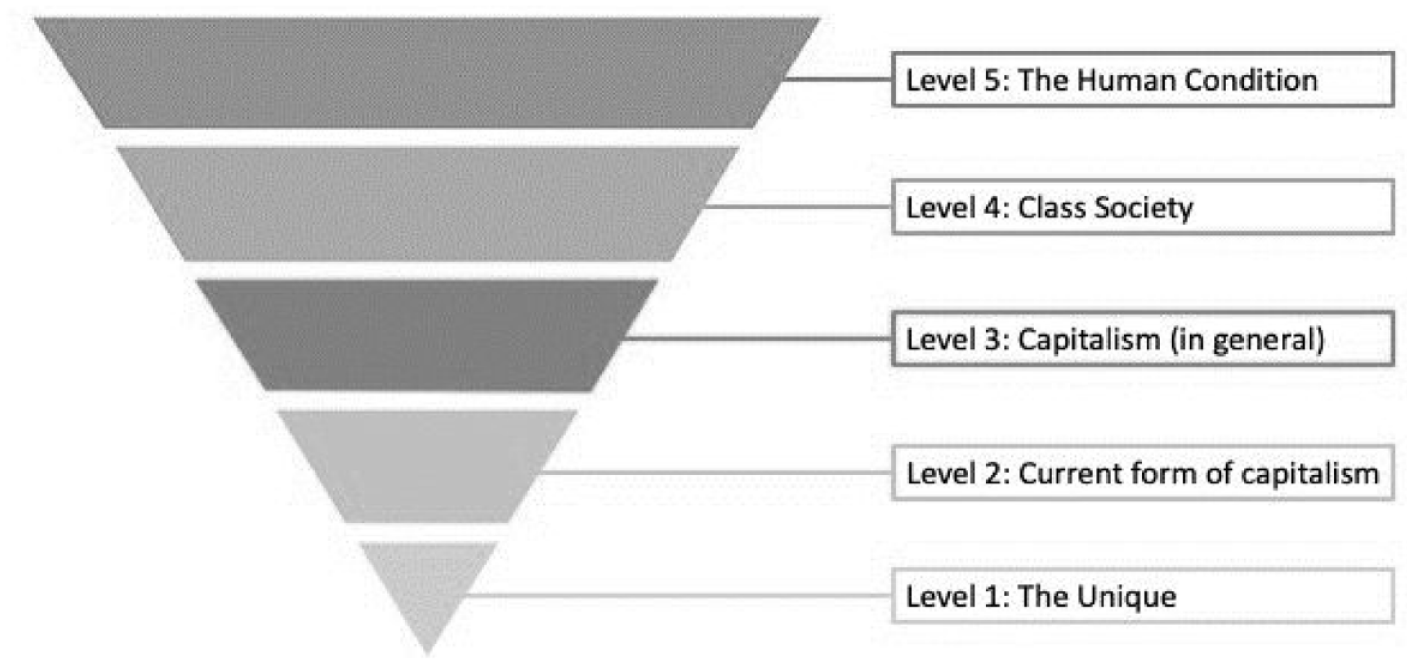
Levels of abstraction of generality in material dialectics of capitalism.
When feminists have attempted to understand patriarchy as a structure akin to capitalism, they have tended to theorise at the level analogous to capitalism (in general) but are unable to account for either variation within patriarchy or changes to it over time. We argue that patriarchy needs disaggregating (Figure 2). The level of abstraction at which patriarchy should first be understood is patriarchy as a structuring condition – with ordering logics – akin to class society; that is, sex-class society (Level 4 below). Sex-class society is the segmentation of human beings by sex and ascribing of value to those sex classes, a phenomenon found to be (near) universal to all known human societies through history (Hudson et al., 2020). Akin to class societies under Marxist theory, it is not necessarily the case that the dominating class is male and subordinate class female, but the precondition of sexual dimorphism and sex-based segmentation allows for its possibility (Delphy, 1980). Understanding sex-class society as a structuring condition enables analysis of patriarchy’s manifestations under different modes of (re)production at different times and places in history. It is at this level of abstraction that we can generalise, as Sjoberg (2012) does, about how patriarchy is ordering of the international through its specification of functions across units and distribution of capabilities. However, analysing patriarchy only at this level of abstraction does not give us the appropriate tools for understanding change in the formations of gendered political order over time, or the multiplicity and unevenness of patriarchal regimes at any given time.
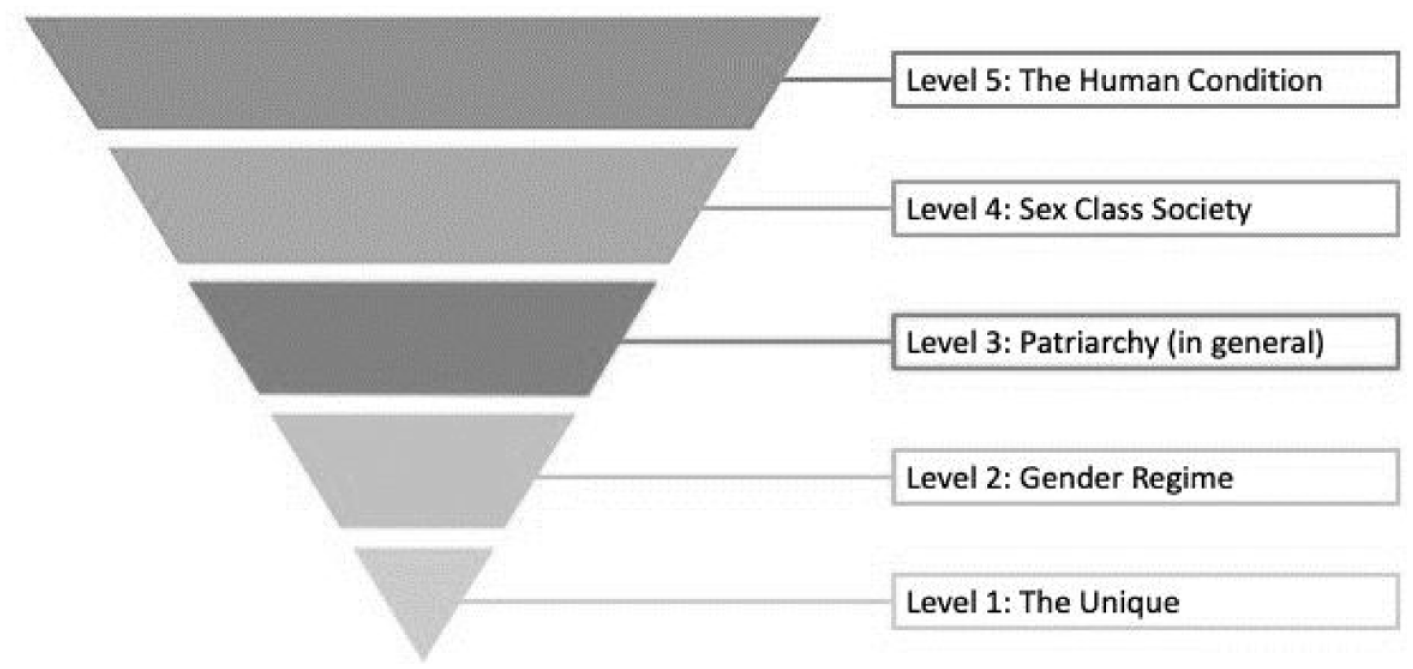
Levels of abstraction of generality in feminist dialectics of patriarchy.
The most unique parts of the patriarchal system (Level 1) may comprise individual acts that are particular expressions or forms of patriarchal power, such as individual incidents of violence (Cockburn, 2010), expressions of misogyny (Krook, 2017) or practices of brideprice (Johnston, 2023). Each may be analysed independently, but a feminist dialectic also allows us to consider its relationship to the broader structuring condition of sex-class society, patriarchy in general and the current gender regime in which each practice manifests.
From the approach of incorporated comparison, what then is the relationship between sex-class society, patriarchy and gender regimes? Sex-class society is the structuring condition that makes possible an ordering logic of differential power relations between sexes. Patriarchy (in general; Level 3 in our levels of abstraction) is the prevailing order that systematically maintains and reproduces men’s domination and women’s subordination. Patriarchy (in general) is not static but varies over time in degree and form, comprised of its constituent and conditioning parts. Thus, we have historically seen a shift in patriarchy from an order of private domination of men over women in the household and reproductive labour, upheld by fraternal relations and conjugal sex rights (MacKenzie, 2009; Moschetti, 2005), to a state-mediated public patriarchy articulated with capitalism (Walby, 1989). Today, we are seeing evidence of a further change.
While we may universalise the form of patriarchy as systemic and comprising an international order in a moment of historical specificity (Level Three), and thereby recognise the articulation of patriarchy with the institutions of the liberal international order in its current form (Enloe, 1989; MacKinnon, 1989), we can also account for differences in forms of patriarchal order within specific contexts in the same historical moment. These Walby refers to as distinct ‘gender regimes’ (Level 2). This recognition mirrors historical materialist approaches in international relations that recognise that sociohistorical development ‘is non-unitary and spatiotemporally uneven (i.e. it has never taken the form of a single society)’ and results in the co-existence of multiple entities within a social totality (Rosenberg, 2022: 270). Analyses at the level of gender regime are useful for theorising the internal relations between any given mode of production and patriarchal organisation in a particular context and demonstrating how the patriarchal ‘international’ ‘is an emergent property . . . arising from its intrinsically multiple and interactive character’ (Rosenberg, 2022: 274). Often, feminists will focus on the national/regional level, wherein we can understand a particular gender regime as patriarchal, but with distinct characteristics that articulate with cultural, national, temporal, racial and class (among others) dynamics. Gender regimes ‘therefore operate at the state-economy-society nexus and influence how gender relations are structured within the family, the employment market and state institutions’ (Chappell and Guerrina (2020: 264).
Yet, these approaches to theorising gender in international relations have tended to search for what Ollman (2003: 18) refers to as an ‘outside agitator’: ‘for something or someone that comes from outside the problem under examination, and is the cause for whatever occurs’. In analysing patriarchal gender regimes, ‘outside agitators’ have included a changing mode of production (e.g. forms of unitary systems theory that subsume patriarchy to capitalism, i.e. Engels); changing class relations; shifting cultural norms or changing state regimes. These approaches implicitly or explicitly assume that the removal of external conditions will ‘solve’ the problem of patriarchy. In contrast, a dialectical approach attributes ‘the main responsibility for all change to the inner contradictions of the system or systems in which it occurs’ (Ollman, 2015: 18).
Thus, with feminist dialectics, we seek to understand patriarchy through its internal contradictions that give rise to change in form across time and space and manifest in different gender regimes in different contexts. This approach provides the means to study the patriarchy both as a ‘thing’ (the universal ordering logic of social relations) and as a relation evolving over time (Ollman, 2015), with varying manifestations in different contexts and experienced differently as it intersects with other systems of oppression. It allows for both truisms to hold that patriarchal gender regimes produce different forms of oppression in different contexts, and that we are still living under a general order we can call patriarchy. That is, patriarchy is more than the sum of its parts but develops patterns that, in turn, exert major influence on the constituent parts, forming a sort of uneven and combined development of patriarchy in general. Adopting the dialectical method of abstraction allows us to at times focus on the particular forms of patriarchal violence, control and oppression while also understanding its (re)production within a particular gender regime, within patriarchy in general, and made possible through the structuring condition of sex-class society. Let us now demonstrate how this may be done.
Dialectical method
Dialectics is not only an epistemological approach but also as ‘a robust method for the study of change within world politics because its epistemology and ontology are fundamentally related: what we can understand about the world stems from the interconnections, contradictions and dynamism within it’ (Brincat, 2011: 681). By uncovering the multiplicity of patriarchal forms, practices and institutions in the international today, we can then understand the international as dialectically constituted through these parts, although not reducible to only these parts (Rosenberg, 2019). Analogously to historical materialism, our feminist dialectics approaches the study of the internal relations of the whole and parts of patriarchy through uncovering and tracing four kinds of relations. To exemplify, we use the phenomena of men’s violence against women and unpack the internal relations within the levels of abstraction of generality. While we could choose from any number of issues, such as the gendered division of labour, uneven political representation or global health, we have selected men’s violence against women for several reasons: first, as materialist feminists, we are cognizant of the functional role of coercion in maintaining men’s dominance, in combination with socialisation of patriarchal ideology (Brownmiller, 1975; Pateman, 1988; Walby, 1989); second, men’s violence against women is a universal phenomenon affecting women in every region, country and community in the world; and third, opposing violence against women has been a cornerstone of women’s transnational organising for over a 100 years, shaping international agreements and domestic legislation. In our feminist dialectical method, we take seriously and seek to demonstrate Enloe’s germinal feminist rallying call that ‘the personal is international’ (1989).
The relationship of identity/difference
Following the method outlined by Marx (1973 (1857) in Grundrisse (pp. 99–102), the first relationship of materialist dialectics is named the ‘relationship of identity and difference’. That is, we must first recognise that ‘things’ have both discrete, observable differences that distinguish them from another and an identity in relation to other ‘things’ that situates them within a common origin/whole. As Marx (1973 (1857)) argued, ‘the concrete is concrete because it is the concentration of many determinations, hence unity of the diverse’ (p. 101).
If we consider men’s violence against women, we can recognise that there are concrete ‘things’ – such as rape, battery, sexual harassment, femicide – that have distinctive material properties, forms and temporalities. Each instance of men’s violence against women occurs as a singular event. However, we must also recognise the common identity of these various forms and occurrences as parts of a whole – the totality of men’s violence against women and its role in the maintenance of male supremacy and female subordination (Brownmiller, 1975; Grosser and Tyler, 2021; Kelly, 1987).
Feminist consciousness-raising brought to light the commonalities between forms and occurrences of men’s violence against women (integrating the parts and the whole) and formed the impetus for feminists to lobby states to develop mechanisms to redress this violence. It also provided the impetus for women-led resistance to international forms of violence – namely, war, militarism and nuclear proliferation (Cooper, 2002; Enloe, 1989). Yet, with their codification in domestic and international law, lost was the understanding of men’s violence as systemic. Despite global prevalence of over 30 percent of women reporting experiencing male violence (WHO, 2018) and despite UN recognition that ‘the risk of violence and violation within the household is one thing women, irrespective of their social position, creed, colour or culture, share in common’ (UN Centre for Social Development and Humanitarian Affairs, 1989: 12), the codification and enforcement of women’s rights in international law remain weaker and more fragile than those of ‘human’ rights (Charlesworth and Chinkin, 2020)
In gender regimes that criminalise men’s violence against women, the tendency has been to fragment and parcelise this violence, such that one must be able to discretely identify the harm as one of battery or rape or harassment, and each instance of harm is an isolated instance, dissociated from broader patterns of violence. Consequently, individual acts of battery, rape, harassment and the like are taken to be ‘aberrant’, perpetrated by individual abusers. Obscured from our analysis are the systemic patriarchal conditions that give meaning and shape to this violence. The result is that classical (patriarchal) liberal precepts are maintained to determine veracity of claims that ‘harm’ has been perpetrated – physical evidence of violence – serving to preserve a de facto hierarchy of ‘gendered violence’ whereby some forms of violence against women are minimised in relation to the ‘more serious’ offences involving egregious bodily harm.
Although different gender regimes ascribe different norms to the acceptability of different forms of gendered violence, a feminist dialectics enables us to situate all on the ‘continuum of violence’ (Cockburn, 2004) and a constituent part of the maintenance and reinforcement of patriarchal orders. Feminist dialectics allows us to see in all these violences ‘their true scope and interconnectedness, form a distinctive pattern: the power of men over women in society’ (MacKinnon, 1987: 5)
The unity and interpenetration of opposites
In developing his approach, Marx (1973 [1857]) emphasised that seemingly discrete ‘things’ and their apparent ‘opposites’ are not in fact independent but exist in a relationship comprising ‘a rich totality of many determinations and relations’ (p. 100). Applying feminist dialectics, we seek to understand how apparently opposite ‘things’ can co-exist within the same ‘whole’. In so doing, we gain not only perspective of contradictions or antagonisms within that ‘whole’ but also how different vantage points produce different interpretations of that relationship. That is, ‘how things appear and function depends on the surrounding conditions and therefore may produce exact opposite meaning or result’ (Ollman, 2003: 16).
To return to men’s violence against women, we may ask: what utility exists in maintaining the discrete categories of battery, rape, sexual harassment and femicide? In the case of legal pluralism in Timor-Leste, the meaning of the Law on Domestic Violence was re-interpreted within the prevailing gender regime to reify the distinctions between forms and occurrences of violence against women. This allows for opposite phenomena to co-exist: women experience men’s violence at the same time that men are not perpetrators of violence against women. That is, the law formally recognises a multitude of forms of violence against women, but in practice, unless blood is drawn, what women experience as male violence is rather seen by some community leaders as a man ‘educating’ (‘baku hanorin’ – ‘a teaching hit’) a woman.
The same dynamic is evident in police responses to domestic violence callouts in Global North countries. Studies find that an assumption of gender-neutrality results in women being three times more likely to be arrested per incident than their male counterpart, even when she had been repeatedly subjected to violence at the hands of her male partner (Hester, 2013: 630). The entrenchment of gender-neutrality within state laws has been argued by Miller (2001) to be ‘gendered injustice’, as women who are not batterers get arrested under laws designed to protect them from men who are. We might see this as going beyond ‘false consciousness’ and instead form ‘mendacious consciousness’ (Lukacs, 1923) – a deliberate falsification of forms of male violence as ‘not violence’ or rather as women’s violence to justify men’s dominance.
What Ollman calls the ‘perspectival element’, we may also call standpoint epistemology, which holds that a more true material reality may be known from the vantage point of the oppressed and is used by feminists in IR to dispute the idea that sexual politics are irrelevant to politics of ‘the international’ (Enloe, 1989).
The relationship of quantity into quality
The third relationship that dialectics examines is how the change in the quantity of a thing causes a change in its quality, but not in a linear way. This idea comes from Hegel, who claimed: water does not become gradually hard on cooling, becoming first pulpy and ultimately attaining a rigidity of ice, but turns hard at once. If temperature be lowered to a certain degree, the water is suddenly changed into ice, i.e., the quantity – the number of degrees of temperature–is transformed into quality – a change in the nature of the thing’ (Hegel, 2013 [1830]: 262).
Societal changes result from first a change in the quantity of a phenomenon. However, change is not a gradual, linear process, but the result of the quantitative buildup of contradictions in society.
Under patriarchy, we have witnessed over time an increase in the number of laws designed to protect women from men’s violence (Htun and Weldon, 2012). The increase in quantity of domestic violence legislation and resources for domestic violence services is a contradiction against the prior form of private patriarchal control that allowed for men to exercise sovereign control over women and children in the household. The result of this quantitative shift from private to public patriarchal control brought the qualitative displacement of private control over women. Instead, men’s violence becomes mediated and regulated by the state. The globalisation of norms against men’s violence has presented significant challenges to men’s private control over women and marks a qualitative change both in gender regimes everywhere that such laws have been introduced and enforced (Fulu and Miedema, 2015), as well as in the international order such that rising contestations coalesce around contesting the ‘genderism’ of the liberal international order (Awondo et al., 2022; Graff and Korolczuk, 2021).
Contradiction
We now come to the driving engine of change in dialectics – the law of contradictions. Contradiction is the inevitable emergence of incompatible elements within a relation (Ollman, 2003). The elements are at times mutually supportive, but also at times block, undermine and interfere with each other. For example, patriarchy has depended on the exploitation of women, but it simultaneously undermines and depletes women’s ability to perform the social reproduction necessary for its continuance (Rai et al., 2014). It is in the genesis of such antagonisms that possibility for change emerges.
The first contradiction of men’s violence as a tool of patriarchal control is that, while its perpetration is an effective means to maintain male dominance and female subordination, the very act of violence generates consciousness of the inequality and undermines women’s consent to the sexual contract (Pateman, 1988) and may foment resistance (Delphy and Leonard, 1992).
With the institutionalisation of domestic violence laws and the transformation from private to public patriarchy, many men have resisted their loss of private control over women to the regulation of domestic violence by the state. Yet, as Pateman (1988) shows us, men are also the primary beneficiaries of the shift from private to public patriarchy and the entrenchment of patriarchal power through state institutions and the sexual contract (see also the study by MacKinnon, 1989) such that feminists have described the state as a ‘male protection racket’ (Peterson, 1977; Young, 2003). The advent of liberal political orders is thus not the overturning of oppressive patriarchal orders but the reformation of patriarchy in order to reconcile the contradictions generated under its previous form.
The shift to public patriarchy under liberal institutionalism produces new opportunities and forms of contradiction and antagonism. This brings us to two core concerns of feminist IR: how do we make sense of the fact that women’s global organising has resulted in significant strides in entrenching women’s legal rights around the world? And what precisely is the nature and function of the rise of global anti-feminism?
Plus Ça Change, Plus le Même Chose: the dynamism of men’s violence against women
Feminist dialectics allows us to chart the changes that objectively have occurred to men’s violence against women and its articulation with changing patriarchal orders over time and space. Feminists have often argued that men’s violence remains, in a sense, static – despite the legislative advancements, despite awareness-raising and despite feminist action, men continue to rape, batter, sexually harass and murder women. But its continuity in form and practice does not equate to an absence of change.
In gender regimes characterised by private patriarchal control, many forms of men’s violence against women – battery, martial rape, honour killings, sexual harassment – were tacitly if not explicitly permitted due to an underlying principle of men’s paternal responsibility to control women’s behaviours and protect them from other men’s violence. Under public patriarchy, the responsibility to regulate and control women’s behaviours and bodies is displaced from individual men in the household to the state, which assumes that protective responsibility over women. This change is extensive – most states of the world have adopted a gender regime characterised by public patriarchal order, as represented by the ratification of the Convention for the Elimination all forms of Discrimination Against Women (CEDAW) by all but eight countries in the UN system. Today, men in most countries face potential incarceration for committing violence against women (Htun and Weldon, 2012).
And yet, new contradictions emerge as women are still beaten, raped and murdered. Often, the law fails to recognise or to redress these crimes, while many believe the need for feminism is over, or that women overstate or lie about violence perpetrated against them. This has generated the emergence of anti-feminist backlash (Flood et al., 2021; Faludi et al., 2020; Walby, 1993) that has itself also internationalised (Awondo et al., 2022; Cupać and Ebetürk, 2020). The forms of violence perpetrated against women to resist these shifts are, Kandiyoti argues, qualitatively different than private patriarchal abuse. They constitute public spectacles aimed at achieving ‘masculinist restoration’. She explains: masculinist restoration comes into play at the point when patriarchy-as-usual is no longer fully secure and requires higher levels of coercion and the deployment of more varied ideological state apparatuses to ensure its reproduction. The course to violence (or the condoning of violence) points not to the routine functioning of patriarchy or resurgence of traditionalism, but to its threatened demise at the point when notions of female subordination are no longer securely hegemonic (Kandiyoti, 2013).
We agree that the violent contestation of feminism emerging in multiple forms across the world is evidence of a crisis of patriarchy in its current, general form. However, as we will now outline, we take this violence as evidence not of the demise of patriarchy but of an interregnum in the hegemony of public patriarchy as the prevailing ordering logic.
Understanding the morbid symptoms of 21st-century patriarchy
Feminist progress has not been linear or uncontested. Above, we trace this through the example of men’s violence against women. More broadly, though, we can see that across all sites of women’s oppression, there have been at times massive, measurable gains, including access to financial independence, voting rights, criminalisation of violence against women and so on. We have also faced, however, contestation to progress from multiple sources. Here, we use feminist dialectics to (1) see these multiple issues as internally related to and constitutive of patriarchy and (2) identify three forces in the internal relations of patriarchy that precipitate change: feminist resistance, patriarchal backlash and new forms of patriarchal ordering. With this, we demonstrate how these two concerns of feminist IR – ‘the stalled revolution’ and ‘patriarchal backlash’ – comprise the morbid symptoms of the declining hegemony of public patriarchy and signal an impending shift in patriarchy’s ordering logic.
The stalled revolution as a morbid symptom
The moment in time that the women’s movement fails to advance radical gains we refer to as ‘stalled revolution’ (England et al., 2020). The location of the stall is multiple, and includes, for example: in the US, the Equal Rights Amendment was never passed, and CEDAW never ratified. In Indonesia, feminists have been agitating for decades to reform the marriage law (Afrianty, 2019; Blackburn, 2004), with limited success (Komnas Perempuan, 2022). In states such as Tunisia and Bangladesh, while feminists have had success in areas of domestic violence and divorce rights, reform of inheritance laws that favour men have sparked violent resistance from Islamist groups and are unlikely in the current political climate to see further advancement. While states such as Turkey were ‘jumping on the women’s rights bandwagon for geopolitical advantages . . .. A heavy-handed social engineering project was under way targeting gender relations and contesting women’s rights’ (Kandiyoti, 2013: 36).
The stall has also taken hold in international fora. After the mobilisation of women globally in the 1960s and early 1970s, the UN announced the UN Decade for Women, during which time a series of World Conferences for Women were held. These World Conferences continued every 5 years until the 1995 World Conference for Women at Beijing, which produced the Beijing Platform for Action and has since acted as a touchstone for women’s activism globally. The intention was to continue these conferences every 5 years, but patriarchal backlash began organising itself against the global women’s movement. A coalition of regressive forces calling themselves the ‘Group of Friends of the Family’ 3 emerged, an alliance between former socialist states and theocratic states, Christian evangelists and a bloc of developing countries for whom opposition to women’s rights is a means of resisting a ‘totalising Western social change agenda’. The collective force of this patriarchal resistance has not only prevented further World Conferences on Women but have also been active in many UN fora (Rana, 2020) resulting in fraught negotiations that have seen the clause-by-clause clawback of established agreements on women’s rights (Cupać and Ebetürk, 2020).
Given the general ordering logic has been public patriarchy through most of the 20th century, it is no surprise that the key sites of feminist mobilisation have been the state and employment. Feminist tactics have sought legislative change or state intervention to mediate unequal gender relations. However, evidence is now showing that it is ‘not in the language of policy and technical fixes that struggles for equality are best enjoined’ (Kandiyoti, 2019: 36). As we will outline below, we anticipate that the transformation of patriarchy in general from public into a new general form will require an attendant shift in how feminists organise against patriarchal forces.
Backlash and the challenge to women’s gains
Feminists have – for decades – drawn our attention to the multiple modes of anti-feminist backlash that have appeared around the world in varied forms (Faludi et al., 2020; Graff and Korolczuk, 2021; Kandiyoti, 2013, 2019; Violence Prevention Network, 2021; Walby, 1993). In their survey of anti-feminist backlash, Flood et al. define patriarchal backlash as an ‘active pushing back against progressive and feminist programmes, policies and perspectives’ that typically feature the ‘desire by some proponents to return to aspects of an idealised past in which structural inequality was normalised’ (Flood et al., 2021: 394).
Most analyses seek to understand particular instances of backlash and anti-feminist populism, and how it is manifested through state mechanisms (Dietze and Roth, 2020; Hülagü, 2021; Kandiyoti, 2019). However, we are interested in theorising backlash in the aggregate and part of what Rowley (2019) calls ‘a condition of modernity’ – backlash is anything but an irregularity. It is a protective mechanism for power. Patriarchal backlash systematically weaponizes feminists’ gains. Any gains made, no matter how minute, get re-articulated as the reason for which feminism is no longer required (Thomas, 2008), ‘while simultaneously harnessing social animus against the marginalized subject for these perceived gains’ (Rowley, 2019: 280).
Rowley’s understanding of backlash as omnipresent, reactionary and constitutive offers insight into the internal relationship of backlash to patriarchy. In highlighting that backlash is a feature, not a bug, it reveals the limits of a commonsense view of backlash as a reaction to and separate ‘thing’ from feminist progress. It prompts reconsideration of the feminist project, because were backlash just an intermittent or spontaneous feature of a system, we might find promise in law or policy as possible corrective mechanisms, as possible vehicles of “justice”. If, however, we think of backlash as a condition that is inherent within systems of oppression, then the corrective potential of law and policy becomes quite limited (Rowley, 2019: 283).
It is our concern to push forward this theorisation by understanding backlash and its multiple forms as part of a totality of patriarchy – part of its internal relations.
Today, we face around the world a number of challenges to women’s gains, many of which are being institutionalised through the state, be it in the form of male guardianship laws (Akbari and True, 2022; Qodir et al., 2022); attempts to enact anti-abortion legislation (Guasti and Bustikova, 2023; Morgan, 2023; Tamés and Casas, 2022); the defunding of women’s shelters and rape-crisis centres (Dragiewicz, 2011; Mamamia, 2014), especially during austerity (Commission on the Status of Women, 2014; McRobie, 2013). Women’s labour force participation and labour market segregation, wages relative to their male counterparts and political representation all feature stubborn gaps that, on current trajectories, would take centuries to close (England et al., 2020). Worrying shifts in attitudes to gender equality are emerging (IPSOS, 2023), and the popularity of anti-gender and anti-feminism is growing (Dietze and Roth, 2020; Kandiyoti, 2019). The disparity is particularly acute with generational shifts (Parton, 2019).
Hostile sexist views are also strongly correlated to reactionary and extremist politics in numerous countries around the world. We are seeing a rise in authoritarian, nativist regimes expressing overtly misogynistic views and denouncing feminism as a foreign import (Awondo et al., 2022), in spite of being signatories and even champions of women’s rights instruments on in international fora (Kandiyoti, 2019). Johnston and True (2019) find that it is the misogynist content of varieties of violent extremism that is the driving force for extremism. Anduiza and Rico (2024) attribute rising reactionary ideology directly to feminist advancements and find that a ‘backlash’ attitude was the most significant contributing factor to the emergence of the right-wing extremism in Spain.
Anti-feminist misogyny is most obvious in the rise of a novel form of violent extremism commonly referred to as “incel”, but which might more accurately be called male supremacist violent extremism (Roose et al., 2022). The ideological foundations of this male supremacist violent extremism are a combination of both a ‘return’ to an idealised pre-feminist form of private patriarchal control as well as the institutionalisation of a sexual economy of women’s bodies as public goods to be distributed among men. In a recent survey of Australians’ support of different forms of violent extremism, a worrying 19 percent of men agreed with the need to resist feminism using force if necessary. If we categorised violent anti-feminism as a form of violent extremism, it would be the most supported form of violent extremism in Australia (Meger et al., 2024).
We take these trends to be evidence of patriarchal backlash to feminist advancements, and that this dynamic is an inevitable antagonism between feminism and existing beneficiaries of patriarchy. The struggle is not unique to a particular moment in history (Köttig et al., 2017), but – at the level of patriarchy as order – it exists as a constant antagonism. Different gender regimes seek to regulate women’s bodies in different ways and with different tools in different periods, and so the antagonism manifests in multiple ways. It may wane or flourish, depending on the virulence of women’s mobilisation. Thus, the prevalence and strength of backlash is an omnipresent potential that can act as hindrance to women’s advancement. While some may see patriarchal backlash as the emergent form of patriarchal order, what we argue is that the dynamic between feminist resistance and patriarchal backlash is opening the door to the emergence of a new, not seen before form of patriarchy. As dialectics holds, the quantitative change precedes qualitative. Going back is not an option.
The dynamic we theorise is that, in the face of women’s mobilisation, backlash emerges as an opposing, reactionary force. When either is sufficiently strong, it causes a moment of crisis in the order of patriarchy in general. This necessitates a degree of absorption of the challenges and finding new sites and expressions of patriarchal control. Patriarchy never resolves its crises, but in transforming itself, it manages to displace and temporarily diffuse these contradictions.
From this, we can explain many of the issues now occupying feminist IR and feminist security studies (extremism, anti-feminist populism, the rolling back of women’s rights in domestic and international rights instruments) not as novel events specific to our moment in time, but as multiple forms of the morbid symptoms of declining public patriarchy, likely to give way to new forms of patriarchal ordering.
Roll-out: the emergence of techno-patriarchy
What we theorise, then, is that our current patriarchal order has reached an interregnum, with its morbid symptoms all around.
In sustaining itself and mitigating a particular moment of crisis, patriarchy must pay concessions not only to feminism but also to the backlash. Thus, we can anticipate an emergent patriarchal order that will in ways institutionalise some feminist gains while also offering significant concessions to the backlash.
Rather than a patriarchy mediated and regulated by state-based gender regimes (public patriarchy), we anticipate new patterns of gender relations mediated by technology which span the globe. This new form of technology-mediated patriarchy, or techno-patriarchy, is characterised by decentralised, libertarian, unregulated sexual economies. We suggest technology enables a more efficient way to organise patriarchal control of men over women and thus becomes embedded as a mechanism of rule. The quantitative shift of men’s surveillance, appropriation, exploitation and consumption of women’s bodies facilitated by the innovation of globalised Internet technology has brought about diffuse qualitative change to not only unique expressions of patriarchal power (e.g. violence against women, sexuality, the division of labour), but to patriarchy in general. The regulation and control of the means of reproduction is no longer performed by states, in articulation with the interests of capital, as in Walby’s public patriarchy. It now lies in the hands of all men everywhere at all times via technology, with the dominant base shifting to sexuality and violence.
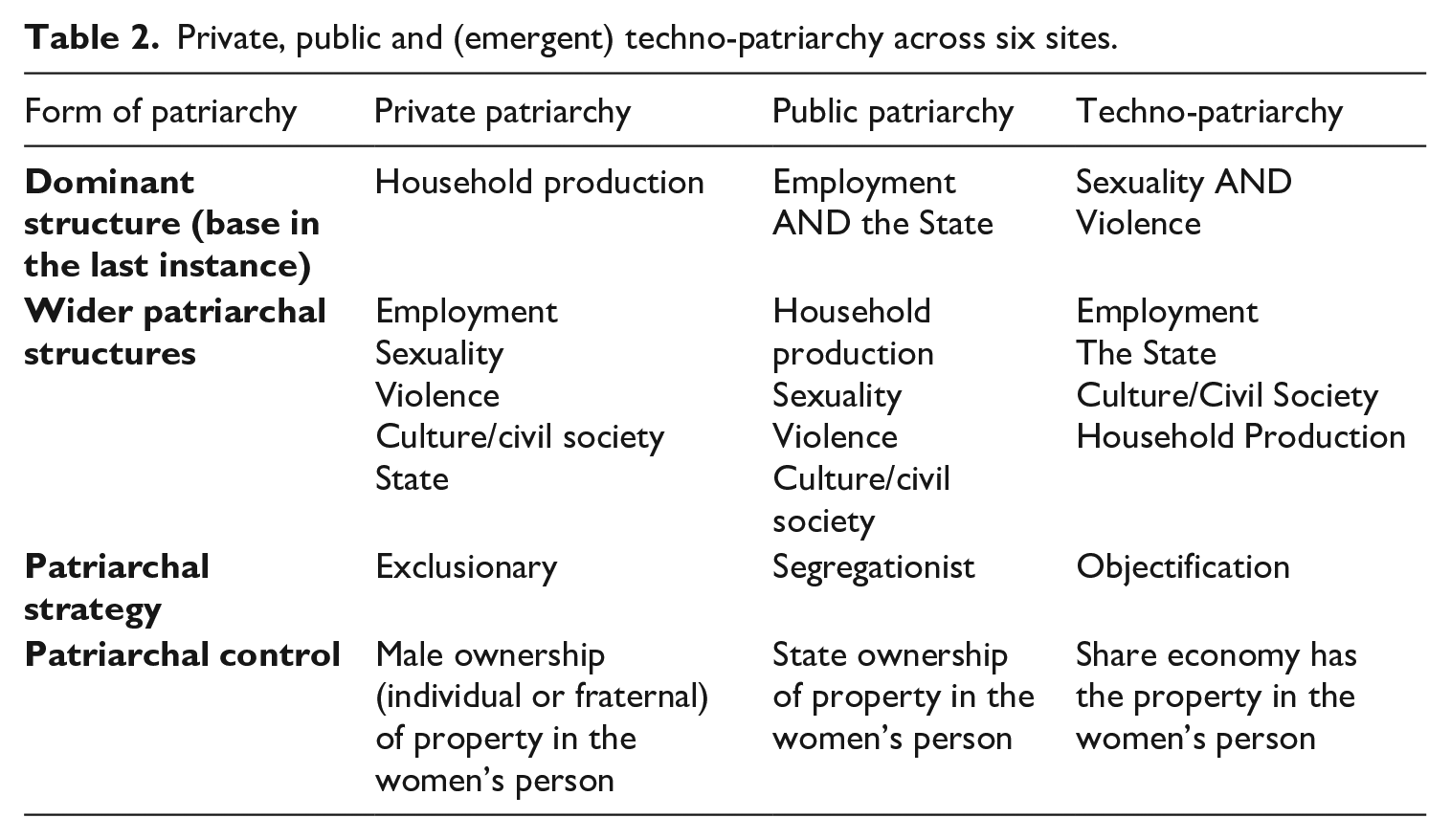
In this emerging techno-patriarchy, we theorise the new basis of patriarchal control as comprising a shared economy in which all men possess property in women’s person, in contrast to previous modes of patriarchal control residing in individual men as heads of households or mediated via the state (Table 2). The control is atomised, diffuse and stochastic, such that women’s resistance has no clear object against which to organise. Techno-patriarchy is now working around and against (and through) the state as a more efficient form of patriarchy.
Private, public and (emergent) techno-patriarchy across six sites.
Today, over 67 percent of the world is online, including 75 percent of 15- to 24-year-olds. Projections expect this number to grow 47 percent to 7.9 billion users by 2029 (Pelchen, 2024). Limited data are available on rates of Internet usage for accessing pornography and sexualized materials, but reports indicate the prevalence of this content on unrestricted social media platforms such as X (Twitter), Instagram, Facebook, Snapchat and so on. Social media platforms have been accused of contributing to real-world sexual exploitation and abuse, including child sex trafficking (National Centre on Sexual Exploitation, 2021).
In this context, we suggest technology enables a more efficient way to organise patriarchal control of men over women and thus becomes embedded as a mechanism of rule. Barry (1995) argues that the normalisation of ‘sex work’ in post-industrial societies played a key function in patriarchal control, such that when women achieve the potential for economic independence, men are threatened with loss of control over women as their legal and economic property in marriage. To regain control, patriarchal domination reconfigures around sex by producing a social and public condition of sexual subordination that follows women into the public world (Barry, 1995: 53 original emphasis).
Under techno-patriarchy, this relationship becomes hyper public. The quantitative shift of men’s surveillance, appropriation, exploitation and consumption of women’s bodies via Internet technology has substantially affected women’s experiences of patriarchal power (e.g. violence, sexuality, the division of labour) in ways that less direct, but more omnipresent. As with Hegel’s ‘water into ice’, we argue that the emergence of these novel logics of patriarchy have seemingly crystallised quite suddenly.
Hints of the emergent techno-patriarchy abound, from the mass penetration of women’s mobile devices by unsolicited dick pics (Hayes and Dragiewicz, 2018) to the objectification of young women in both innocuous forms such as Instagram and by subscription sexual services websites such as Chaturbate and OnlyFans. The ability to sell oneself through such platforms is sold to women as means to seize financial and sexual control of their lives, but research finds most women self-exploit out of economic or physical coercion and experience abuse and harassment for their online presence (Adamsen, 2023; Martins et al., 2023). The real-world effects are acutely felt by women in Korea, for example, where 5,000–7,000 spy-cam related crimes are reported every year (Teshome, 2019), but prosecution rates are low and punishments are weak (Park, 2024). The overall prevalence of online violence against women is 85 percent globally, with highest reported rates in Africa, the Middle East and Latin America (Economics Intelligence Unit, 2021). We also see evidence of this emergent techno-patriarchy in the scientific rationalist ‘pronatalist’ movement advocated by Silicon Valley types concerned with population collapse, investing in reproductive technology startups aiming to engineer human eggs out of stem cells (Kleeman, 2024). Under techno-patriarchy, women’s value is disaggregated into sexual value, reproductive value and domestic labour value and marketized as commodities available on demand.
This is not to suggest that the technology is inherently patriarchal but to emphasise the way technology has facilitated a significant re-organisation of men’s control over women, particularly at the sites of sexuality and violence. The emergence of techno-patriarchy is made possible in part by the restructuring of the state under neoliberalisation, which has given the illusion of redistributing power back into the hands of individual women, who now have ‘agency’ to interact with men’s demands for our bodies, energies and resources in ways that may derive some individual benefit (Kandiyoti, 1988).
What we are seeing, then, in the face of contemporary crises to public patriarchy is a shift in the ordering logics of patriarchy in general. To return to Walby’s (1989) framework for understanding the change, we argue that under techno-patriarchy, the base in the last instance may shift from employment and the state to sexuality and violence (Table 2). The patriarchal strategy under techno-patriarchy shifts from a segregationist one to one of objectification. We shed the illusion of women controlling wholesale property in their own persons, regulated by a beneficent state, and are now in a moment of what we might call a ‘share economy’ of property in women’s person, within which individual men obtain rights to access and use property in women’s person, but ownership is collective and diffuse. Women transition into mere commodities.
While we anticipate with the emergence of techno-patriarchy the attendant emergence of new contradictions, in the interests of space, we will save our in-depth exploration of the operations of techno-patriarchy for future research. For now, we feel it is safe to say that the patriarchy against which we must mobilise today is not our mothers’ patriarchy. Being attentive to the internal relations of patriarchy and its dynamism provides us with better tools with which to not only understand it but to also organise against it.
Conclusion: never let a good patriarchal crisis go to waste
Patriarchy could not have survived if it were not independently dynamic as its own ordering mechanism. Understanding its internal relations using feminist dialectics enables us to better understand the multiple elements of patriarchy across different levels of abstraction and its persistence as an ordering principle of human society/ies. The feminist dialectics outlined here can, in short, help us to see the forest for the trees and give us the means to grasp both the specificities of multiple forms of anti-gender oppositions that have emerged in recent years and their relation to the (re)construction of a broader sociopolitical order of patriarchy in general.
The present moment of crisis in the order of patriarchy offers the opportunity for change. That change could take several forms – a regressive re-entrenchment of coercive (violent) patriarchal control; more diffused, institutionalised hyper-public patriarchal control or even significant concessions to feminist demands. It also offers opportunity for revolution.
The dynamics of patriarchy contain the seeds of its own destruction – its internal relations involve necessary antagonisms of social forces that are productive of recurring crises. We have seen this historically – the crisis in private patriarchy was possible due to the concessions granted to women because of feminist mobilisation, which ultimately undermine men’s patriarchal control over women. Public patriarchy was the way patriarchy in general overcame the antagonisms between women’s challenges to fraternal forms of private patriarchy, but in so doing, we created the seeds of its own destruction by going ‘too far’ in granting rights to women. In this article, we have shown that the same is now happening in the form of a crisis in public patriarchy, fomenting renewed feminist resistance and mass anti-feminist backlash.
Examining patriarchy using feminist dialectics provides us with both the theoretical and methodological tools to not only better understand the multiple forms and functions of challenges to the global order and the role of anti-feminist ideology contained within them but to also draw attention to the transformation to patriarchy currently underway. The key future work will be to develop a more robust understanding of the nature of this transformation and its effects on the structuring of future social, political and gender regimes.
We conclude, then, with an appeal to scholars of the international. When gender relations are studied in an atomistic or parochial fashion, when it is only the unique with which we concern ourselves, it can obscure from our vision a broader view of the general shifts within patriarchy as an ordering condition. Rather than eschewing structural theorising, by employing feminist dialectics, we seek for future feminist scholarship to reconsider the relations of parts and whole, and the future form that patriarchy may take, with attendant effects on political and social organisation at all levels.
Footnotes
Acknowledgements
The authors would like to thank Adam Morton for his suggested readings on materialist dialectics, which proved integral to the development of this article. The authors also thank Tom Chodor and Steve Zech for their generous engagement in nascent discussions of our ideas for this article, and Meagan Tyler and Daniel McCarthy for feedback on early drafts. The authors thank their colleagues of the Australian International Political Economy Network and panelists at their ISA 2023 Panel on ‘Backlash! Patriarchy in the 21st Century’ for their engagement and feedback on early versions of this paper. Finally, the authors thank Laura Sjoberg for her charitable engagement and feedback on this paper as a discussant at the ISA 2024 Workshop on Theorising Backlash.
Declaration of conflicting interests
The author(s) declared no potential conflicts of interest with respect to the research, authorship, and/or publication of this article.
Funding
The author(s) received no financial support for the research, authorship, and/or publication of this article.
