



Abstract
Recent research has drawn attention to states’ backlash against international organizations (IOs), including whether member state withdrawals affect the longevity of IOs. We therefore ask when do member state withdrawals lead to the death of IOs? We are skeptical of a general link between withdrawal and IO death because on average, any one member is not critical for the survival of an IO. Also, withdrawal is often driven by one member state’s preferences diverging from remaining members; these remaining states may band together after withdrawal, ensuring or even enhancing the longevity of the IO. Even withdrawal by several states may not contribute to IO death because a smaller group of remaining members may better overcome collective action challenges. Nonetheless, exit by an important member may affect IO survival by removing resources, market power, and guidance. We test these arguments using survival models on an original dataset of withdrawals across 532 IOs from 1909 to 2014/2020 and illustrate the dynamics with case vignettes. The results support our arguments: withdrawals in general do not lead to IO death but the withdrawal of founding members can speed IO death. Interestingly, withdrawal by economically powerful states seems to facilitate IO survival (often through reform and/or re-entry). These findings contribute to a better understanding of the lifecycle of IOs as well as to the resilience and vulnerabilities of international cooperation.
Keywords
Recent research has drawn attention to state backlash against international organizations (IOs) (Ikenberry, 2018; Lake et al., 2021; Walter, 2021a), including whether state withdrawals affect the longevity of these institutions. Special issues of journals have been dedicated to debates on “the end of international cooperation,” 1 “challenges to the liberal international order” 2 and related issues. These concerns were partially motivated by recent examples of state withdrawals from IOs. When Britain announced its withdrawal from the European Union (EU) in 2016, for example, observers argued that this posed an “existential threat” to the EU (Laffan, 2019: 13–14) and that Brexit could lead to the EU’s “complete collapse” (Oliver, 2017: 131). Similarly, when South Africa announced that it would withdraw from the International Criminal Court (ICC) in 2016, observers asked, “Is this the end for the International Criminal Court?” (Allen, 2016). While the EU and ICC are still alive today, these questions were palpable at the time. In other cases, withdrawal has been followed by IO death. For example, the League of Nations—undoubtedly plagued in many ways—suffered an onslaught of withdrawals before it dissolved. The League reached a highpoint of 58 member states, but only 23 countries remained when it died on 19 April 1946 (Magliveras, 1991). In another example, Germany’s withdrawal from the International Commissions of the Rivers Elbe and Oder in 1936 was followed by the IO’s death (Wessel, 2011: 349). And outside of Europe, the withdrawal of leading states from the African and Malagasy Coffee Organization led to its collapse in 2007 (Dijkstra and Debre, 2022).
Does member state withdrawal increase the risk of IO death? Beyond individual cases, scholars have recently wondered about this more broadly. For example, Hirschmann (2021) argues that “membership withdrawals . . . can pose a significant threat to the existence of IOs” (pp. 1965, 1969). Brölmann et al. (2018) note that “the phenomenon of institutional exits . . . throws into question the health of multilateral institutions more broadly” (p. 256). And Dijkstra and Debre (2022) argue that “IOs face gridlock, contestation, politicization, loss of legitimacy, and even state withdrawal. The ultimate outcome for IOs may be dissolution or death” (p. 1). Policy experts have also wondered whether states withdrawing from IOs could subsequently be linked to IOs dying (Dempsey, 2017) and have noted that “a state’s withdrawal can cause harm to the system’s overall stability” (Contesse, 2019: 24).
Despite the importance of this question in an era of backlash against institutionalized cooperation, we do not have systematic empirical evidence on whether there is a link between state withdrawal and IO death. We “are still only at the beginning of understanding how these processes [withdrawal and death] are related” (Walter, 2021b: 2383). This is because several recent studies have examined the drivers of IO death (Debre and Dijkstra, 2021; Dijkstra and Debre, 2022; Eilstrup-Sangiovanni, 2020, 2021) and the drivers of member state withdrawal (von Borzyskowski and Vabulas, 2019, 2024) but not the intersection of these two phenomena. Building on scholarship examining the causes of IO withdrawals, we can now better understand their effects. These questions matter because IOs themselves can influence important outcomes in international affairs such as conflict, regime change, and trade (Martin and Simmons, 1998; Pevehouse, 2002).
This paper contributes to an understanding of whether and when membership withdrawal and IO death are linked, and thus provides a fuller picture of the life cycle of IOs (Gray, 2024; Gray and Baturo, 2024). Building on foundational institutional theory, we outline our skepticism of a general connection where IO withdrawal causes IO death because the reasons underlying each phenomenon differ fundamentally. Single exits often reflect diverging preferences of the leaving state, and many IOs are robust to an average member leaving. Moreover, IOs tend to live on, exhibiting status quo bias or operating as zombie institutions even when individual member states are dissatisfied. Remaining members may band together or reform the institution after the withdrawing state leaves and some withdrawing states return. We also argue that when multiple states withdraw from an IO, the risk of IO death may not increase because a smaller group of members may better overcome collective action challenges in the IO. Nonetheless, we argue that the exit of important member states—such as founding or economically powerful members—could affect IO survival because their exit may change the leadership and legitimacy of the IO. Thus, who withdraws (and what remaining member states do) matters for the resilience or vulnerability of international cooperation after member state exit.
We test these arguments with a survival analysis on an original dataset of IO withdrawals across 532 IOs 3 from 1909 to 2014 (and extended to 2020); case vignettes illustrate the mechanisms and distinguish causation from correlation. Our findings support the argument that member state withdrawals on average do not change the risk of IO death. Moreover, estimates show that even a larger group of states leaving is not strongly associated with IO death. However, the withdrawal of important states is associated with IO death in two ways. As predicted, the withdrawal of founding members increases the risk of IO death as their exit can lead to a drop in leadership and legitimacy. In contrast, and perhaps surprisingly, the withdrawal of economically powerful members is associated with IO survival. Our case analyses suggest that this is because the IO may be left stronger if the powerful state’s exit triggers reforms or if remaining members unify after the pressures from the powerful state have disappeared. While previous research has emphasized the importance of powerful states for international cooperation, our findings (1) nuance the institutional roles of different kinds of powerful states and (2) underscore how powerful states’ exits (and not just their joining) can affect the longevity of IOs. We thus add new insights on a topic that has been much discussed but not systematically studied.
These findings have important implications for research on IO survival and international cooperation (Eilstrup-Sangiovanni and Verdier, 2024; Haftel and Nadel, 2024). For IO survival, results imply that withdrawal has quite nuanced effects, depending on who leaves and how remaining member states behave. This aligns with recent research on the mixed effects of treaty withdrawal on treaty endurance (Schmidt, 2024). Furthermore, by understanding some of the remaining states’ actions after an economically powerful member has withdrawn, our analysis prompts a different view of IO withdrawals: they can be a relatively regular part of the IO lifecycle (Gray, 2024) rather than triggering a domino effect to death. Withdrawals may even aid IO survival when they result in reforms or a more unified IO. For the literature on international cooperation, which tends to understand withdrawal as a form of challenge or backlash against institutionalized cooperation, it is useful to note that IO withdrawals do not usually trigger IO death. On this point, our results are similar to those on international agreements, where Eilstrup-Sangiovanni and Hofmann (2020) note that US exits from agreements have “not fundamentally destabilized the global order” (p. 1082). And while IO life and death is only one way to measure the state of international cooperation (Gray, 2018), these results are at least somewhat reassuring for the future of international institutions. We thus contribute to the emerging literature on how IOs deal with challenges throughout their lifecycle.
This article proceeds as follows. The first section summarizes previous scholarship; the next sections detail our theoretical expectations and then the research design. We subsequently discuss quantitative results and provide illustrative case examples. We reflect on the surprising finding (that withdrawal by economically powerful states is associated with IO survival) and outline potential mechanisms for this result: return and reform. This can inform future research, which we note in the final section.
What we know about IO withdrawals and IO death
Member states have announced their withdrawal from IOs over 400 times between 1913 and 2022. Explaining when states withdraw from IOs, von Borzyskowski and Vabulas (2019, 2025) show that geo-political factors—such as preference divergence and contagion—are the main drivers of IO withdrawals; democracy levels in the country and the organization also matter. They also show that nationalism is not linked to IO withdrawals historically (1975–2014). Daßler and Heinkelmann-Wild (2021) find that IOs with higher authority experience more withdrawals, while Dijkstra and Ghassim (2024) find no relationship.
Some studies have begun to examine the consequences of withdrawal for the leaving state (but not IO death). Bakaki and Böhmelt (2023), for example, show that withdrawing from economic IOs lowers the country’s likelihood of making bilateral trade agreements (PTAs) the year after leaving. A similar pattern appears when states leave international agreements. Schmidt (2023, 2024) shows that states withdrawing from international treaties (Helfer, 2005; Koremenos and Nau, 2010) develop reputations for inconsistency which leads other member states to ratify fewer treaties with them in the near future and also affects international law. Nonetheless, Peinhardt and Wellhausen (2016) show that states withdrawing from investment treaties maintain most (if not all) international legal protections due to redundancies in the network of investment treaties.
Analysts have pondered (but not yet systemically analyzed) whether withdrawals could challenge an IO’s longevity, as we detailed in the introduction. Other commentaries drawing a connection between IO withdrawal and IO death are really about withdrawal threats, which have different mechanisms. Threats are unlikely to link with IO death in the same way because they are often used as a bargaining tactic to trigger renegotiation and reform (Jupille et al., 2013; Lipscy, 2017; Von Borzyskowski and Vabulas, 2023). For example, Trump used the threat of exit to re-negotiate existing deals, turning the North American Free Trade Agreement (NAFTA) into the United States-Mexico-Canada Agreement (Csehi and Heldt, 2021) and increasing burden-sharing in the North Atlantic Treaty Organization (NATO) (Schütte, 2021). While states may threaten to leave IOs if reform demands are not met, change can happen at the threat stage and beyond (Schmidt, 2024; Von Borzyskowski and Vabulas, 2023).
What defines IO death? IOs die when they cease operations. In line with the Correlates of War Intergovernmental Organization (COW IGO) criteria (Pevehouse et al., 2020), this happens when IO membership drops below three states, when IOs do not hold a plenary meeting in 10 consecutive years, or when they dissolve their secretariat/headquarters. Given that the high times of IO creation have passed (1945–1990s), understanding what factors relate to IO death is important.
Early work on the durability of IOs showed substantial changes in the population of IOs over time (Cupitt et al., 1996; Shanks et al., 1996; Wallace and Singer, 1970). Subsequent studies on IO death have also cast doubt on the notion that IOs rarely die (Johnson, 2013; Jupille et al., 2013; Strange, 1998; Vaubel, 2006). Using a novel dataset, Eilstrup-Sangiovanni (2020) shows that in fact, more than a third of IOs have died and many deaths have resulted in succession (Eilstrup-Sangiovanni and Verdier, 2024). IO death is more likely with an IO’s small size, young age, broad mandates, and external shocks like World Wars (Eilstrup-Sangiovanni, 2021) but interestingly, economic crises and institutional overlap can help IO longevity (Haftel and Nadel, 2024; Reinsberg, 2024). IOs with large secretariats are less likely to die because they are better at coping with external pressures (Debre and Dijkstra, 2021) but even major IOs sometimes die (Dijkstra and Debre, 2022). While our understanding of IO death has advanced greatly, we still do not know whether and how IO death is affected by membership withdrawal.
Systematic data illustrate the empirical puzzle and possible connections between IO withdrawal and death. Figure 1 reveals that cumulative state exits and IO deaths have been rather steady over time. 4 Figures 2(a) and (b) show the frequency of IO withdrawal and death separately over time. 5 This raises the question: does member state withdrawal change the risk of IO death or are these independent processes?
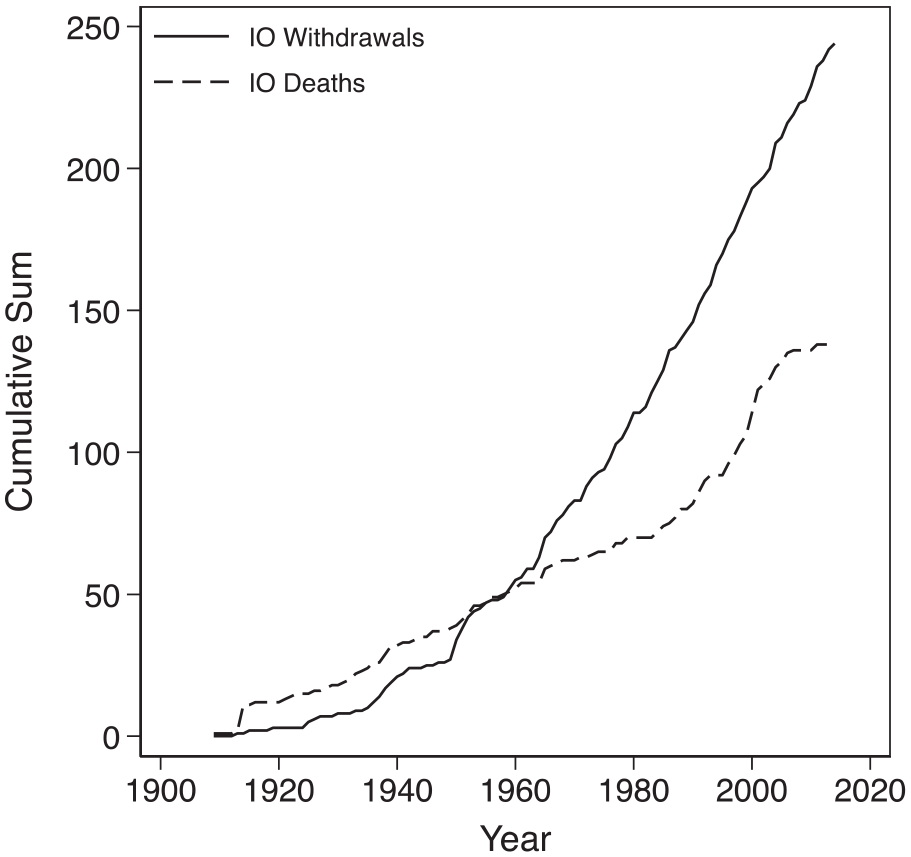
Cumulative sum of IO withdrawals and deaths (1909–2014).
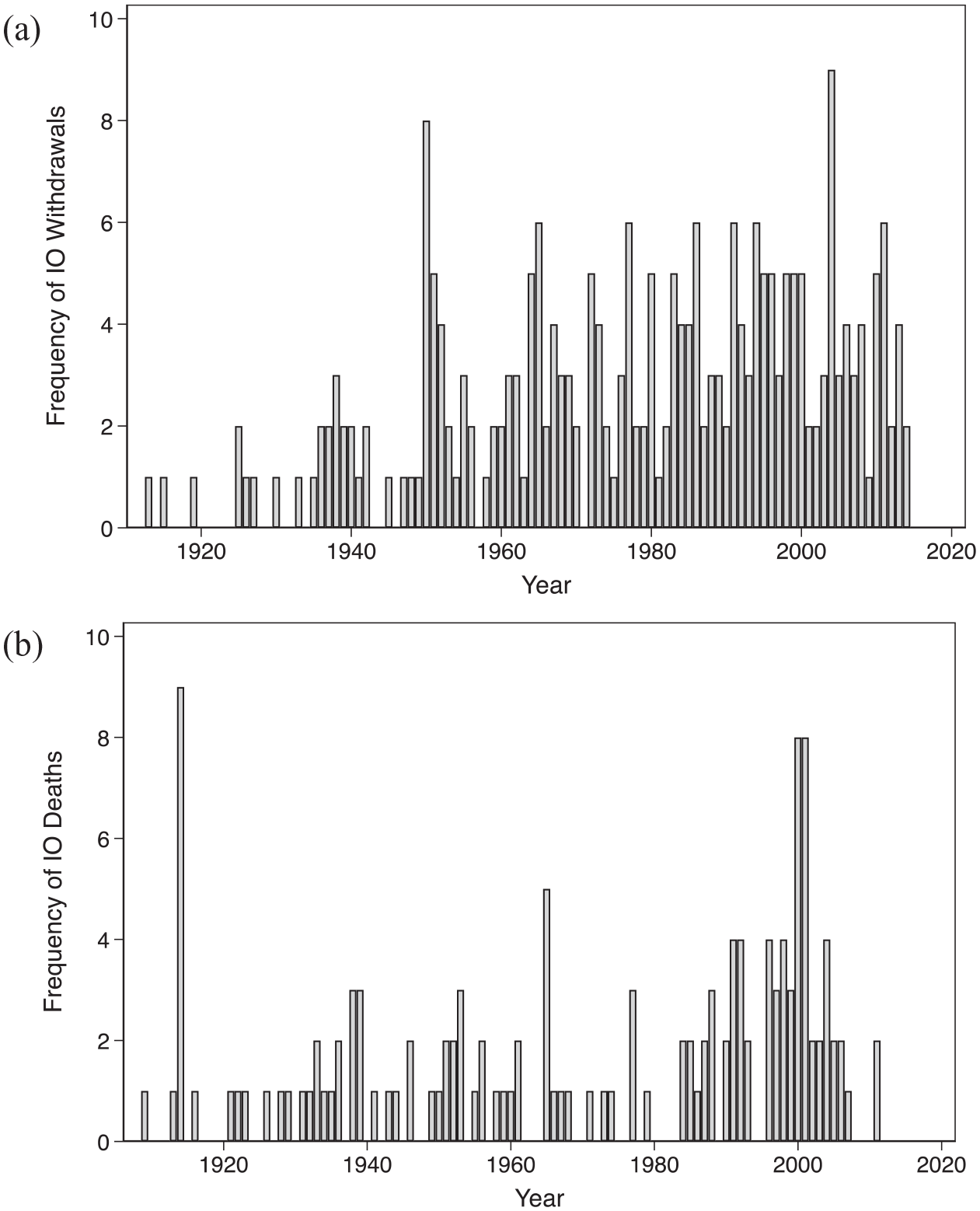
Frequency of IO withdrawals and deaths, 1909-2014: (a) Withdrawals. (b) Deaths.
Theory: when do IO withdrawals influence IO death?
We argue that there should not be a general link between member state withdrawal and IO death for several reasons. First, the drivers of each phenomenon are distinct. As outlined earlier, a member state’s preference divergence from remaining members is a major reason for withdrawal (von Borzyskowski and Vabulas, 2019: 346). This means that an individual member state that withdraws might be pulling away from the IO group while other member states may remain content. Remaining member states may band together to continue moving the IO forward after a divergent state withdraws, particularly if those remaining members are no longer bogged down by the outlier state. One example where remaining states became perhaps more energized toward the IO after withdrawal is the case of Brexit, since the referendum (Copelovitch et al., 2020) and the United Kingdom’s protracted divorce from the EU (Malet and Walter, 2024; Walter, 2021b) increased popular support for integration in other EU member states. The EU defended itself against the challenge, but did not reform or deepen/expand (Schütte and Dijkstra, 2023b). In contrast, a clear issue that could link IO withdrawal and IO death would be the widespread perception that an IO no longer fulfills its purpose which could lead to both withdrawal and subsequent death. Nonetheless, research on the drivers of IO withdrawal show that this is rarely a reason for member state withdrawal (von Borzyskowski and Vabulas, 2019: 346). Thus, single member state withdrawals and IO death appear to be driven by different phenomena.
In addition, foundational theories of liberal institutionalism emphasize the enduring nature of international cooperation. As Keohane’s (1984) seminal work outlines, international regimes provide many benefits to member states, which may contribute to their longevity. IOs facilitate cooperation by reducing transaction costs, providing information, and increasing the probability that the same actors will continue to interact with each other in the future. Abbott and Snidal (1998) build from this logic and explain that IOs survive and thrive by helping states centralize and routinize their cooperation. IOs do this by creating organizational structures and supportive administrative bureaucracies that can act as independent third-party agents. This independence, while constrained, means that international institutions become more than mere reflections of individual states. IOs can therefore be quite resilient to individual states’ behaviors (Hanrieder, 2015) or their departures. Hasenclever et al. (1997: 2) show that international institutions are often robust, underscoring their “staying power” even in the face of challenges.
Building from these foundations, principal-agent theory (Barnett and Finnemore, 1999; Hawkins et al., 2006) also underscores that IOs (as principals) have various strategies at their disposal to reform, adjust, or show resilience in response to pressures from states (such as exit). Theories of organizational autonomy find that IOs can “insulate” themselves from the control of member states and that IOs can adapt to or resist member state contestation (Hirschmann, 2021: 1967–1968; see also Dijkstra et al., 2024). Moreover, sunk cost theories emphasize that member states view the protracted negotiations and time investment from establishing IOs as a reason for them to continue rather than disband. These factors can make institutions “sticky,” or path dependent, even amid member state contestations (Fioretos, 2019; Jupille et al., 2013; Krasner, 1983). In this vein, Gray (2018) shows that many “zombie” organizations live on even after they have ceased to deliver major gains for states. Together, this body of work emphasizes that by and large, international institutions are likely to be quite resilient to the average member state withdrawing and may not be quick to die even when one (disgruntled) member state leaves.
We therefore argue that on average, member state withdrawal is unlikely to be critical for IO survival (as opposed to the IO-related factors and external shocks that have been shown to relate to IO death). Most states in most organizations are but one piece of the institution and their departure can be bridged by remaining member states and the bureaucracy rather than triggering death. Remaining member states may also be keen to win back withdrawing states and incentivize the leaving state’s return to the organization. This leads to our first hypothesis:
H1. Member state withdrawals, on average, do not increase the risk of IO death.
The alternative to no relationship (H1) is a clear link between withdrawal and death. In a regression, we interpret a statistically significant coefficient on withdrawal as supportive of an increase in the risk of IO death, and a null result or non-significant association as supportive of no increased death risk (H1).
While a member state withdrawal on average may not affect IO death, some worry that withdrawals by several member states may increase the risk of IO death. Walter (2021b) articulates this well, saying “the spread of non-cooperative, or even disintegrative, tendencies is widely seen as a threat to international institutions and international cooperation more generally” (p. 2383). As she notes, attempts to withdraw from international institutions can reverberate abroad in a domino effect, and may lead to the dissolution of those IOs. If exit negotiations ensue, the risk that one withdrawal results in further withdrawals and potential IO dissolution is higher when remaining members accommodate the withdrawing state, making withdrawal more attractive (Jurado et al., 2022: 280, 298; Walter 2021b). While this logic has been tested in the context of the EU, cross-IO studies are still needed.
Furthermore, since most IOs have in-built scale economies (Abbott and Snidal, 1998: 13), remaining members may have fewer gains and must shoulder larger costs and responsibilities when more members withdraw. If the IO is deprived of a large share of its means to thrive and pursue policy, other members might also abandon the IO in a contagion effect, resulting in its subsequent collapse (linking withdrawal of several member states to IO death). This logic around domino effects and resources suggests that more withdrawals raise the risk of IO death.
H2a. The risk of IO death increases when more member states withdraw.
However, the logics of collective action and deterrence suggest that the risk of IO death should not increase even when several member states withdraw. IOs are rife with collective action problems that can squander the cooperative progress of groups of states. Yet as Olson’s (1965) seminal work shows, collective action problems decrease with the number of actors. Kratochwil (1997) also notes that large-scale cooperative operations may not be desirable in all cases. Communities of states may better develop when smaller groups of states cluster into cooperative subsystems (Adler et al., 1998; Goh, 2007) to provide club goods (Greenhill and Lupu, 2017) as long as an effective k-group can cooperate (Snidal, 1985). Member state departures—which are often driven by preference outliers—may therefore not cripple IOs, as some have claimed, but ease cooperation and allow the IO to continue.
Relatedly, as Walter (2021b) shows, the contagion risk depends on whether encouragement or deterrence effects are present. Observing other countries’ disintegration experiences can allow voters to better assess the feasibility and desirability of withdrawals—and therefore, the overall continuity of the IO. Watching a bad exit (or two) may make other member states double down on their commitment to the IO rather than triggering its collapse. If exit negotiations ensue and remaining member states do not accommodate the withdrawing country, it should deter further withdrawals by other member states (Jurado et al., 2022: 282) and avoid IO death.
Member state withdrawals from the International Whaling Commission—and its continued survival—provide one example of this logic. Many observers worried about the future of the International Whaling Commission (IWC) after Japan announced its withdrawal in 2019—which would add to an already extensive list of previous withdrawers including Canada, Jamaica, Egypt, and the Philippines in the 1980s. Japan’s withdrawal was not a surprise—Japan had been lobbying the organization to lift its 1986 moratorium on commercial whaling for years, but to no avail. By withdrawing, Japan was no longer bound by the commercial whaling moratorium, but a smaller, more unified group of anti-whaling countries remained. As Zimmermann (2019) asserts, “the recent withdrawal does not necessarily sound the death knell. Rather, it could also mean the end of decades of deadlock in the commission.” Similarly, modification of IO rules and procedures can become less difficult with fewer members. We therefore argue that withdrawal—even of more member states—is not likely to increase the chance of IO death.
H2b. The risk of IO death does not increase when more member states withdraw.
It also likely matters who leaves the organization, with heterogenous implications for IO survival. Member states differ in their importance to a given IO—some are more crucial (Snidal, 1985) while others are less so. While member state exits on average may not affect IO death, the exit of certain important states may be deadly. International cooperation theory has long shown that different kinds of states contribute to—and benefit from—IOs in disproportionate ways (Dreher et al., 2009; Kuziemko and Werker, 2006; Stone, 2011). A state’s importance to an organization can be thought of in terms of the leadership it contributes through economic capacity as well as the legitimacy the state’s membership bestows on the institution.
In terms of leadership through economic power, the departure of an important state may deprive the IO in three ways: resources, market power, and guidance. First, the exit of an economically powerful state often means removing financial and technical resources for staff and programming (Patz and Goetz, 2019), as contributions are often based on economic size. Without the contributions of an economically powerful state, the IO might no longer be able to continue, and may instead die. A second aspect of economically important member states is the market power and volume of issue area coverage they represent. If such a state leaves, the IO may no longer carry (cartel-like) market weight. For example, when the United States considered leaving the International Coffee Organization (ICO) in 1986, observers called it “a potential threat to the body’s survival” (Stainer, 1986). When the United States opted to remain in, remaining ICO members breathed a “collective sigh of relief” because the United States was the world’s biggest importer of coffee (25% of the total) which “would be essential in ensuring that export quotas can operate successfully” (Stainer, 1986). Observers stated, “there is little doubt that the ICO could not function effectively without the US.” Third, hegemonic stability theory (Kindleberger, 1986; Krasner, 1976) argues that economically powerful states can provide leadership (guidance) in IOs by compelling or cajoling other members to adhere to IO commitments using carrots or sticks (Abbott and Snidal, 1998). Without the important state, other members may no longer have incentives to incur the sovereignty costs of IO membership, and the IO might be more likely to die.
In terms of legitimacy, the withdrawal of an important state may deprive the IO because other states may take their cues from an important state’s behavior. Founding members are important because they play a significant role in negotiating the founding treaty which can set the rules and vision for the organization. Moreover, founding members can help ground the IO through institutional memory; even outside the world of international relations, scholarship emphasizes the importance of founding members for upholding the culture of institutions (Schein, 1983). The withdrawal of a founding member may therefore reduce the IO’s legitimacy which could in turn diminish the IO’s authority (Daugirdas, 2016; Johnstone, 2010; Tallberg and Zürn, 2019). States might rethink their commitment to an IO or consider replacing the IO if its institutional legitimacy or foundational values fundamentally shift (Cottrell, 2009: 225). The diminished legitimacy of the IO after an important state’s departure might heighten the risk of IO death because remaining states may no longer use the IO or may propose alternative institutional forums.
H3a. The risk of IO death increases when an important member state withdraws.
However, the withdrawal of an important member state may not affect IO death if cooperation continues without them or if their exit stimulates reform and/or their return. First, as Keohane (1984) has shown, cooperation is possible even without a hegemon if states’ interests sufficiently converge and institutions are appropriate. Similarly, Snidal (1985) demonstrates formally that the decline (exit) of a hegemonic power may actually lead to an outcome that is both collectively superior and distributively preferable. While a powerful state can sometimes be important to international institutions, hegemonic stability is only a special case of international cooperation. Furthermore, if the influential state that withdrew acted as a “spoiler” in the IO (Stephen, 2012: 295), their exit may ease cooperation among remaining members who no longer have to deal with the pressure of the powerful state, keeping the IO alive rather than triggering collapse. Remaining states can also re-legitimate the IO through rhetoric (Schmidtke and Lenz, 2023); re-legitimation depends on IO capacity and member state preferences (Schütte and Dijkstra, 2023a).
Second, the void left from an important state’s departure may induce long-needed changes. Important states might withdraw from IOs as a bargaining tool to push for IO change if they are no longer obtaining their preferred outcomes or if the distribution of power has changed (von Borzyskowski and Vabulas, 2019, 2025). Domestic political concerns may also motivate powerful states to withdraw to protect their sovereignty or as a scapegoat for challenges at home (von Borzyskowski and Vabulas, 2024). They might exit to nudge the IO toward reform/change (Jupille et al., 2013; Lipscy, 2017), showing remaining states how difficult cooperation is without their resources, market power, and guidance. By withdrawing, an important state may change the “status quo” ante against which other parties now negotiate (Ury et al., 1991). Withdrawing may therefore give important states more ability to obtain desired IO reforms if they pledge to return. Whether exit and reform would leave IO survival chances unaffected or improved likely depends on the nature of the change in question.
However, reform is not inevitable, and important states do not always get what they want by withdrawing (von Borzyskowski and Vabulas, 2023). Indeed, some important states may withdraw as a tactic to push their preferred changes but find they have overestimated what remaining states will do. Remaining states may not want nor be able to reshape the IO to woo the state back. Instead, remaining states might proceed with the IO as is. Recognizing that outside options are not as palatable as they had seemed, important states may return to the IO—particularly after domestic political conditions have shifted. 6 That would mean exit has no effect on IO death. Counter to H3a, this implies H3b:
H3b. The risk of IO death does not increase when an important member state withdraws.
Research design
We test these hypotheses with quantitative and qualitative methods. The quantitative analyses reveal patterns of how and when member state withdrawal is correlated with subsequent IO death. Case vignettes illustrate the mechanisms and help distinguish causation from correlation (i.e. where withdrawal is a symptom of death, or both withdrawal and death are caused by a third factor).
The quantitative tests use survival analyses to shed light on whether withdrawal is associated with shorter IO survival (i.e. more proximate death), controlling for alternative explanations. We base our analysis on 532 IOs in the COW IGO dataset version 3, which ends in 2014. 7 We begin in 1909 because the first IO died in 1909 and the first IO withdrawal occurred in 1913. That is, before 1909, the core independent and dependent variables do not vary. Since we are interested in IO survival, the unit of analysis is the IO-year.
We code the dependent variable, IO death, following the standard definition and measure in the COW IGO project. IOs have at least three state members, a permanent secretariat and headquarters, and hold regular plenary sessions at least once every 10 years (Pevehouse et al., 2020: codebook page 2). IOs die when they cease operations: when IO membership drops below three states (what Eilstrup-Sangiovanni, 2020 calls “dissolution”) or when IOs do not hold a plenary meeting in 10 consecutive years (what Eilstrup-Sangiovanni, 2020 calls “desuetude”) or dissolve their secretariat/headquarters. We do not consider an IO dying when it continues living under a new identity, that is, when it is replaced/succeeded/superseded by or integrated/absorbed/merged with another organization. For example, the General Agreement on Tariffs and Trade (GATT) was replaced by the WTO in 1995.
For our outcome measure, IO death, we use the binary variable dead from the COW IGO data but change the coding to 0 for those organizations that were replaced or integrated according to COW. While the vitality of an IO can be captured along a spectrum as noted above, we are interested here in the fundamental and existential question of life or death, which is a binary phenomenon. To mitigate potential causal inference problems, we remove organizations which had a small membership at death as well as recent withdrawals. 8 This is because in such cases, withdrawal is functionally identical to death: if an IO of three members experiences a single withdrawal, it “dies” automatically per the definition in COW. This could also affect an IO of four or five members if several states withdraw. We thus use data from Eilstrup-Sangiovanni (2020) to identify IGOs that died because of “dissolution,” had five or fewer members, and recent withdrawals. This affects only two organizations, which we omit from our analysis: the G3 and CENTO. 9
The resulting dataset features 532 organizations of which 136 died. This frequency of death translates to 25 percent of all IOs and 0.7 percent of IO-year observations, meaning IO death is rare from a yearly IO perspective. Nonetheless, it is important to study these events because they are important (just as scholars have studied coups d’état or interstate wars which are similarly rare). IO age is the yearly duration of the IO in the dataset, varying from 1 to 163 years. 10
The independent variables are measures of member state withdrawal matching our three hypotheses. We source IO withdrawals from recent datasets which source information from the media and IOs (von Borzyskowski and Vabulas, 2019, 2025). We code withdrawal 1 if a state announced its withdrawal from the IO in a given year, and 0 otherwise. We use the year the withdrawal was announced because announcements usually precede the actual withdrawal by 1 or 2 years due to treaty-prescribed waiting periods. During this time, member states must continue paying dues (keeping the IO alive momentarily) but their planned withdrawal is known by other member states and the secretariat, allowing them to act while IO vitality is at risk. In other words, the risk of death (if any) becomes clear in the year when a member state announces withdrawal, not just when it takes effect. Coding only years in which withdrawals become effective would be misleading, under-estimating the effect of withdrawal and potentially violating temporal priority. 11 We also exclude threats of withdrawal that never come to fruition; as we outline above, withdrawal threats represent different actions by states. We lag all independent and control variables by 1 year to mitigate endogeneity.
To test H1, the binary variable Withdrawal by any state indicates whether any withdrawal occurred among IO members in that year. Withdrawals affect 252 IO-years, representing 1.4 percent of all IO-year observations. 12 As a robustness check, we use a stricter measure of withdrawal, which codes withdrawal as 0 instead of 1 when states left an IO as a prerequisite to joining another IO. 13 The list of these 15 IO years (30 withdrawals) is in Supplemental Appendix Table A2.
To test Hypotheses 2a and 2b, the variable Number of withdrawing states is the count of leaving member states in a given IO year. It ranges from 0 to 5. As an alternative measure, we also code Percent of withdrawing states, which captures the share of states within the IO that have announced withdrawal (i.e. the number of withdrawing states divided by the number of member states). It varies between 0 percent and 63 percent, 14 though most are below 10 percent; withdrawals exceeding 30 percent of member states are rare.
For Hypotheses 3a and 3b, we proxy for important states in two ways. First, Withdrawal by founding state indicates whether any of the founding members left the IO because these can be crucial for upholding the legitimacy of the IO. As a second measure, we use Withdrawal by powerful state, which is a binary variable indicating whether an economically powerful state left the IO because these may play stabilizing or spoiler roles, depending on the circumstances. Using historical economic data (Fariss et al., 2022), we measure a member state’s gross domestic product (GDP) and code a binary variable 1 if a state withdrew which (1) was among the top 20 percent of GDP or (2) ranked among the top three states among all member states of the organization in a given year 15 (which helps capture hegemonic power in smaller organizations). This measure is time varying because the relative economic position of countries shifts over time. It also varies across IOs, since even less developed states can rank higher in smaller organizations. There are 100 withdrawals by powerful states and 74 withdrawals by founding states.
Descriptive statistics of IO withdrawal and IO death show that the two coincide only in a small share of cases. About 13 percent of member state withdrawals are followed by IO death (in any future year), and only 7 percent of IO deaths are preceded by an IO withdrawal (in any preceding year). We do not theorize how long it might take between withdrawal and death. Finally, it is important to note that state withdrawals are often not terminal; indeed, in 40 percent of cases, the withdrawing state rejoins the IO—perhaps after it has made amends, working outside the IO to push for change.
Given that our outcome of interest is IO death, we control for common alternative explanations of IO death. We replicate the model specification of the seminal study in the field (Eilstrup-Sangiovanni, 2020) but use the latest COW IGO data and add the withdrawal measures as predictors. Replicating Eilstrup-Sangiovanni (2020), we control for IO Region, Mandate, Scope, Membership, and Number of Member States (lagged and logged). 16 Region indicates whether the IO is primarily in Africa, the Americas, Asia, Europe, Middle East, Intercontinental, or Global (the excluded reference category) because IO creation rates are different across geographic areas (Pevehouse et al., 2020; Shanks et al., 1996), and so too may be their death. Mandate indicates whether the IO’s function is for a general purpose, judicial, security, social, technical/scientific, or economic (the excluded reference category). This proxies for the IO’s “problem structure,” and control for the fact that technical/scientific IOs, which lean more toward coordination or standard setting problems, may have different survival rates than political or social IOs that cover collaboration problems and free-riding. Scope indicates whether the remit of the IO is narrow, medium, or broad (reference category). Membership indicates if the IO is restricted by geography, purpose, or is open (reference category) because the club-based or near-universal nature of an IO might affect its survival. For robustness, we omit Number of member states, because that may induce multicollinearity with membership fluctuation also being part of the explanatory variable. We also control for the First World War and the Second World War since times of geo-political conflict are related to IO death. The availability of data on control variables reduces the number of IOs from 532 to 485; results are substantively quite similar when we omit control variables and analyze the (bivariate) correlations in all 532 IOs. Descriptive statistics are in Supplemental Appendix Table A3.
For the survival model specification, we use Cox proportional hazard models, which non-parametrically estimate the effect of predictors on the survival of IOs, that is, which factors speed IO death. These models rely on the proportional hazards (PH) assumption, meaning that the effects of covariates remain constant over time. We tested this assumption through formal statistical tests and by visually inspecting Schoenfeld residuals. Statistical tests indicate that the data fulfill the PH assumption globally but one control variable borderline violates it individually: Number of member states. To model this time dependence, we follow the standard procedure of interacting with this variable with the log of time (Box-Steffensmeier et al., 2003). As a second test, we also graph the Schoenfeld residuals of our main explanatory variables of interest. Results are in Supplemental Appendix Figure A3 and show no clear time trend, so they do not need to be interacted with time. Our data are right censored since COW IGO data end in 2014. In the Supplemental Appendix, we also show results until 2020 since much discussion about the risk of withdrawals for IO survival was sparked by recent cases. Results are quite similar (Supplemental Appendix Table A12 and Figure A4); details for the data collection are at Supplemental Appendix Table A12. In Supplemental Appendix Tables A8–A11, we also examine the longer term and cumulative effects of withdrawals; results are mostly similar.
Results
The empirical results support H1 and 2b that neither member state withdrawals on average nor exit by a group of states hastens IO death. Results do not support H2a that the risk of IO death increases when more member states withdraw. However, nuances emerge when an important state leaves: withdrawal by a founding member state increases the risk of IO death (supporting H3a), whereas withdrawal by an economically powerful state can enhance IO survival (counter to H3b).
Table 1 presents the estimated coefficients (hazard rates) from Cox regressions. Columns 1 and 2 present estimates for H1, showing estimates for Withdrawal by any state and the stricter version of that variable; columns 3 and 4 show estimates for Hypotheses 2a and 2b in terms of the Number and Percent of withdrawing states; and columns 5 and 6 evaluate Hypotheses 3a and 3b with Withdrawal by founding state and Withdrawal by powerful state. Each model controls for alternative explanations.
Effect of withdrawal on IO death.
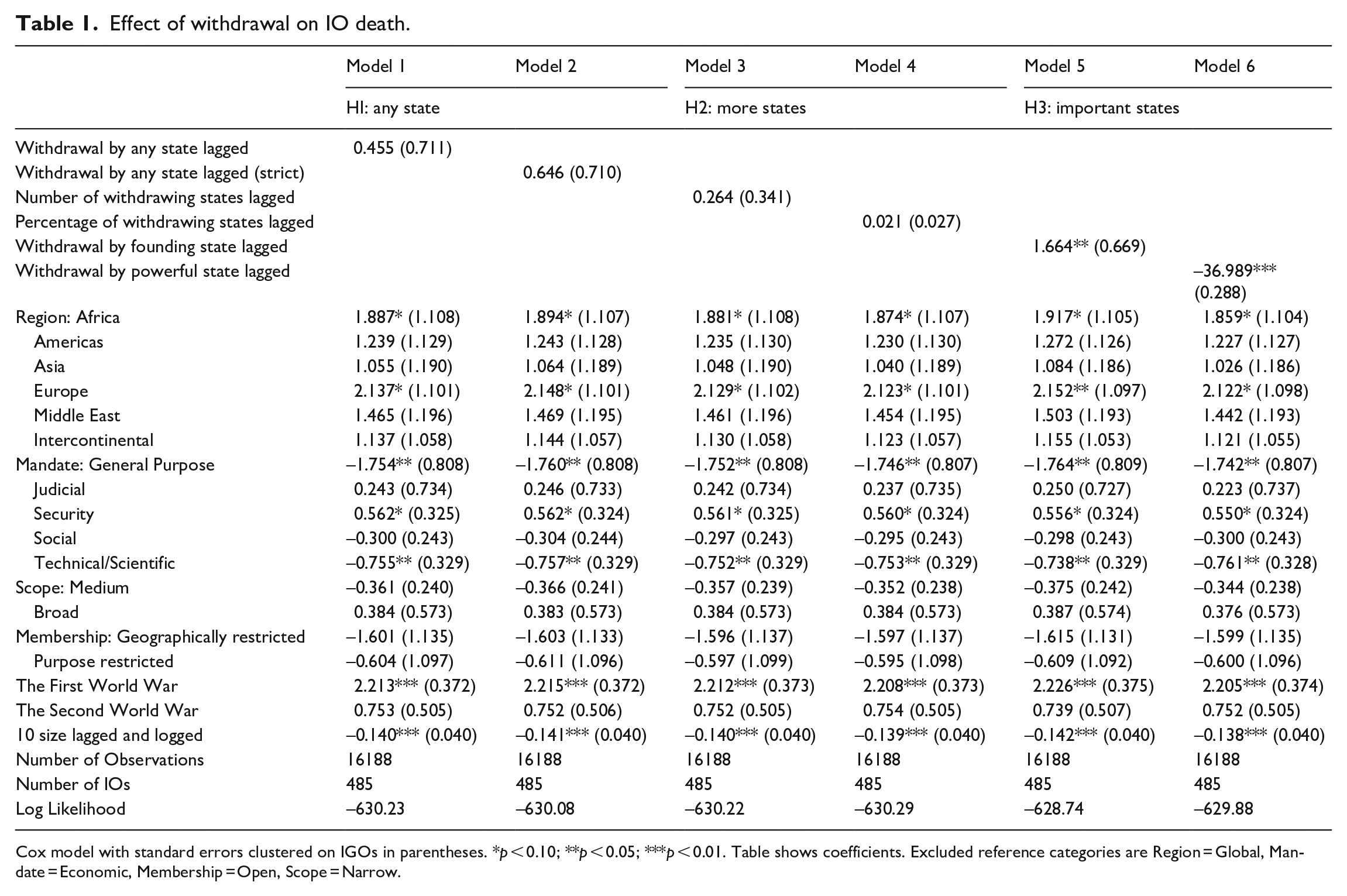
Cox model with standard errors clustered on IGOs in parentheses. *p < 0.10; **p < 0.05; ***p < 0.01. Table shows coefficients. Excluded reference categories are Region = Global, Mandate = Economic, Membership = Open, Scope = Narrow.
For interpreting survival models, positive coefficients (hazard rates) indicate that the hazard/risk of IO death is increasing as a function of the covariate, meaning that the variable is associated with more proximate IO death (i.e. shorter survival time). Negative coefficients indicate a reduced death risk (i.e. longer survival times).
We find support for H1 that an average member state’s withdrawal does not seem to increase the risk of IO death. Columns 1 and 2 show that the estimated coefficient on Withdrawal by any state (in either coding) is not statistically significant. When we plot the IO survival probabilities as a function of Withdrawal in Figure 3(a) and (b) (based on models 1 and 2), the survival lines are very similar.
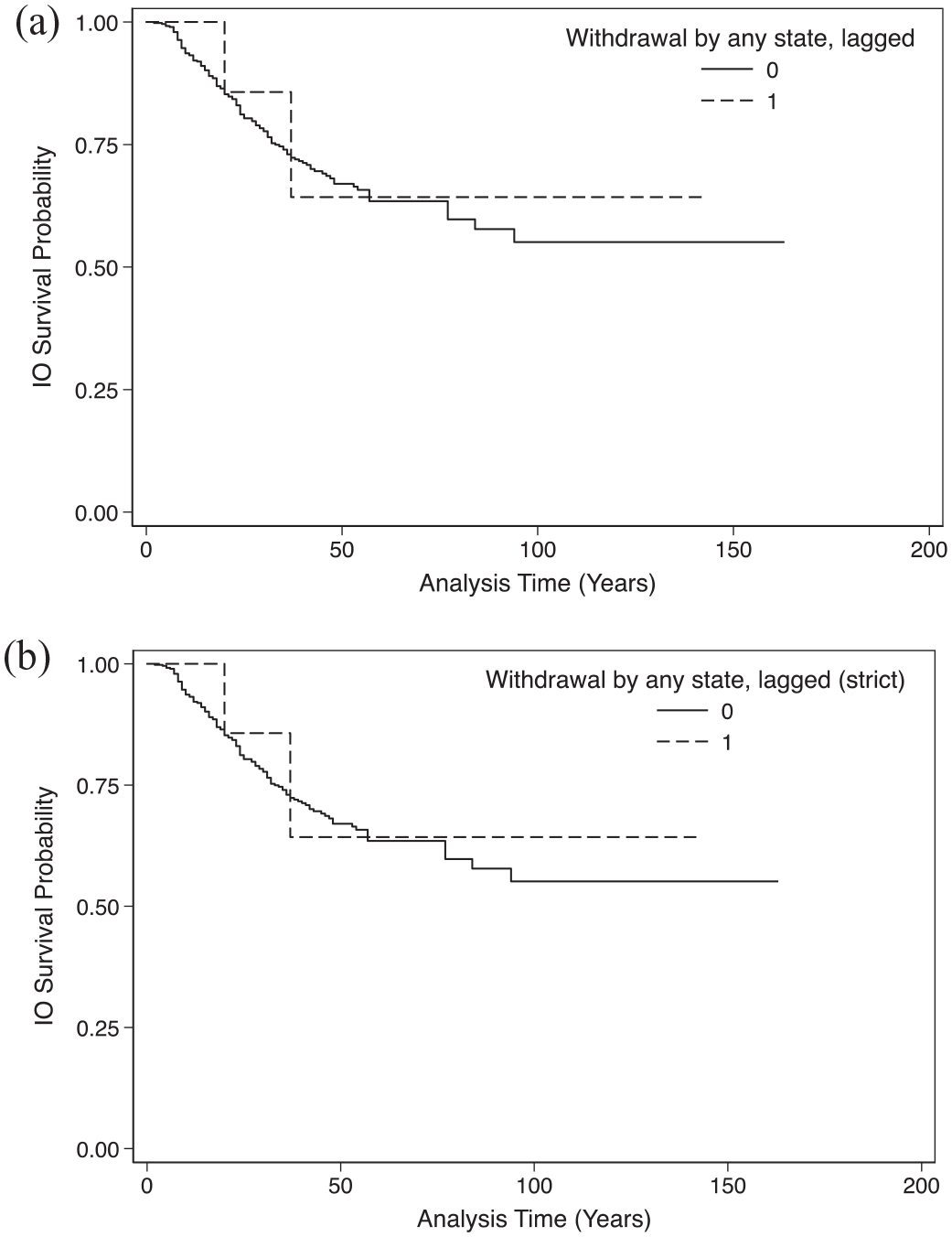
No effect of withdrawal by any state on IO death: (a) Withdrawal by any state. (b) Withdrawal by any state (strict coding).
We return to one of our motivating cases as an example. After the United Kingdom announced its withdrawal from the European Union, many observers worried whether it would sound the death knell of the EU. But remaining member states watched the United Kingdom’s difficult withdrawal process unfold and calibrated the likely economic, social, and political consequences of EU disintegration (De Vries, 2017). The subsequent negative impacts to the United Kingdom’s trade, capital flows, and labor mobility served as a deterrent effect on disintegration (Walter, 2021b).
Another illustrative example of this is the Seychelles withdrawing from the Southern African Development Community (SADC) in 2003. It is the only country to ever have withdrawn from SADC and the decision “caused little joy in the body” (Afrol News, 2006). At the time, Seychelles’ Ministry of Foreign Affairs officials said that “there was little justification for the US$ 550,000 that Seychelles was expected to contribute to the regional organization annually, especially when the country was undergoing difficulties with the shortage of foreign exchange” (Afrol News, 2006). When Seychelles’ human and financial constraints had ameliorated, it rejoined SADC (Afrol News, 2006). Indeed, after Seychelles exited, other member states continued to join SADC (e.g. Madagascar) and SADC has continued to grow and thrive as a regional economic community.
We probe the robustness of results for H1 in a few ways: by changing the explanatory variable, accounting for temporal trends, and changing the sample. First, we change the main measure from withdrawal announcement to withdrawal effective date (usually 1 year later) and control for years since the last withdrawal from the organization. Second, we change the sample by excluding US withdrawals (to make sure this is not just a US story), excluding commodity organizations (which feature many exits and are listed in Supplemental Appendix Table A4), and excluding World War years (rather than controlling for them). None of these changes affects the substantive interpretation of results; details are in Supplemental Appendix Table A5, models 1–4. This strengthens support for H1.
We find support for H2b. Estimates in columns 3 and 4 of Table 1 indicate that the two alternative measures of Number of withdrawing states and Percentage of withdrawing states do not seem to affect IO death. Figure 4(a) and (b) shows these patterns. Since this is a continuous predictor (rather than binary as the other independent variables where two levels can be plotted as two lines), we show the number/share of withdrawing states on the x axis and the predicted hazard ratios on the y axis. 17 Figure 4(a) and (b) shows that the hazard ratio (the risk of IO death) appears to be slightly higher when more states leave; however, the confidence intervals around the estimates are quite large, resulting in a non-significant relationship. This supports H2b but not H2a.
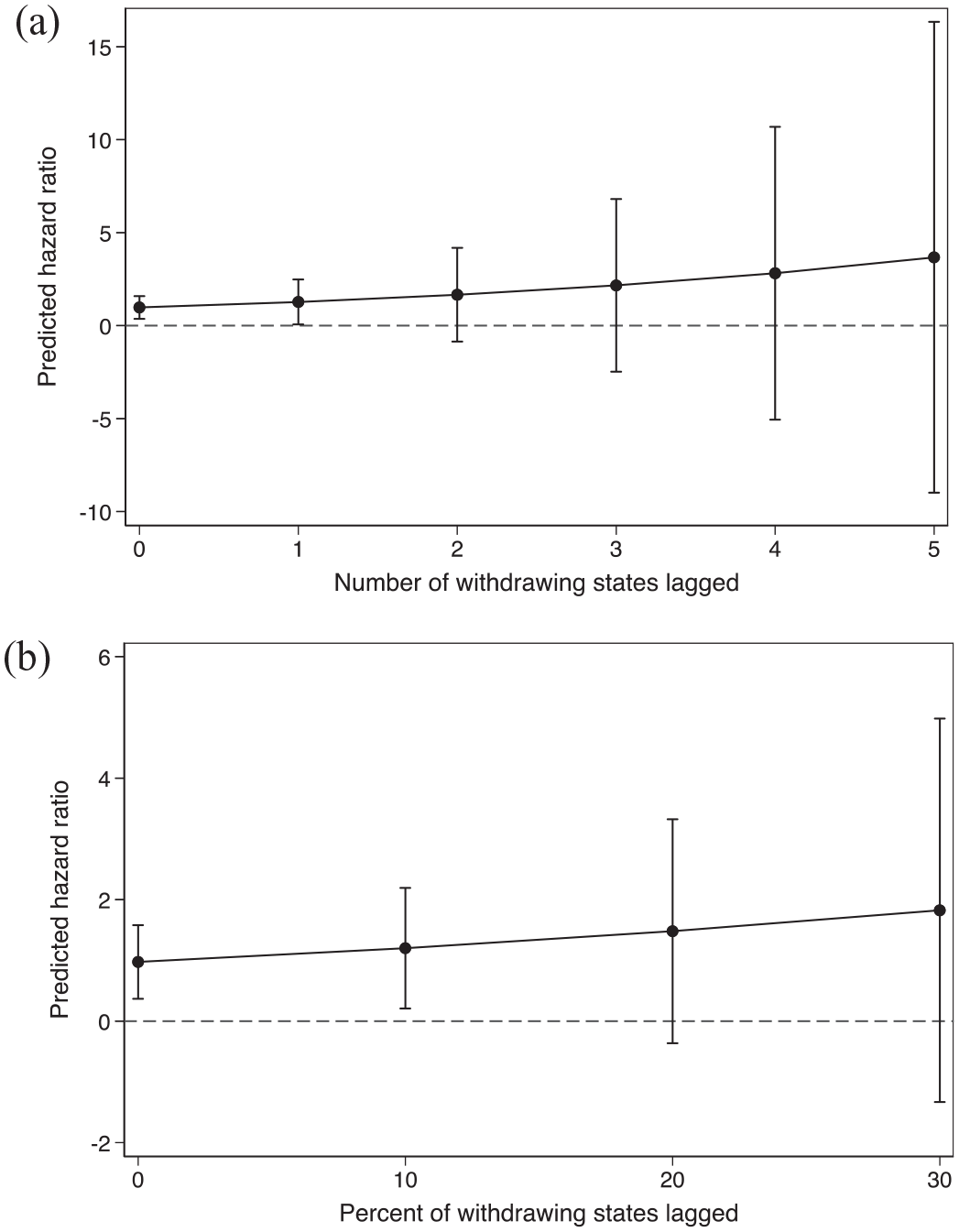
No effect of withdrawal by more states on IO death: (a) Number of withdrawing states. (b) Percentage of withdrawing states.
Looking into the cases, three member states withdrew from the International Monetary Fund (IMF) during the Cold War: Poland in 1950 under pressure from the Soviet Union (Jonáš, 2013), Cuba in 1964 as it defaulted on previous loans, and Indonesia in 1965 after the election of Malaysia to a seat on the UN Security Council. The IMF’s survival was not affected. Indonesia returned in 1967 and Poland in 1986. Cuba remains withdrawn from the IMF but the IO is nonetheless robust in its survival.
Furthermore, several IOs which have experienced groups of states leaving are cases of states coordinating their membership across different organizations, not challenging the IO’s survival. For example, several states left regional European organizations when they joined the EU. One example of this dynamic is when CEFTA saw four states (Poland, Hungary, Czech Republic, Slovakia) leave in 2004 to join the EU, representing 63 percent of members. In late 2006, two more states (Romania and Bulgaria) left, also to join the EU. However, six new states joined Central European Free Trade Agreement (CEFTA) in early 2006 and early 2007 and the organization continues on.
In another set of cases, several states withdrawing appears to be related to shifts in world affairs rather than pushback against a specific IO; withdrawal can leave the IO intact. For instance, the International Labor Organization (ILO) lost 12 members in the run-up to and during the First and Second World War, and the Food and Agriculture Organization (FAO) and the International Criminal Police Organization (INTERPOL) both lost five Eastern European members in the early years of the Cold War. However, these organizations were large enough to withstand a few members leaving for geo-political concerns.
Moving on, H3a specified that the risk of IO death would increase when an important state withdraws while the competing H3b specified that the risk of IO death would not increase when an important member state withdraws. Here we find mixed and perhaps surprising results. In line with H3a, estimates in column 5 of Table 1 show that exit by founding members increases IO death. This is also visible in the left panel of Figure 5(a), showing much lower survival probabilities for IOs that lose a founding member.
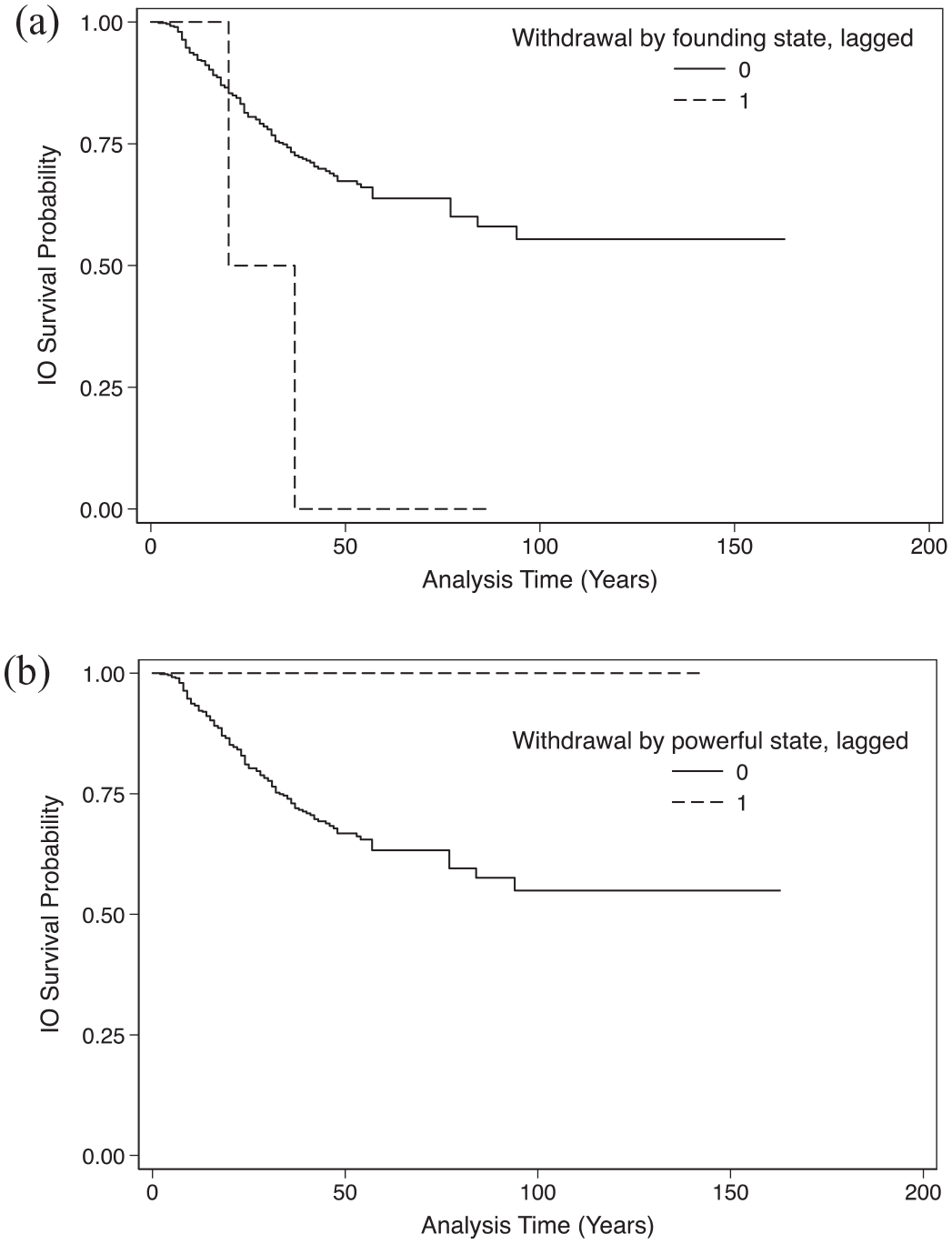
Effect of withdrawal by important states on IO death: (a) Withdrawal by founding state. (b) Withdrawal by powerful state.
As articulated earlier, the withdrawal of a founding member could indicate that the organization has failed to achieve its original purpose or has become obsolete (perhaps moving beyond its purpose). One example of IO death after exit by a founding member is the Common Afro-Malagasy Economic Organization (OCAM). OCAM was founded in 1961 as a group of former French colonies but disagreement soon arose over the strength of relations with the former colonizer and the aims of the organization. OCAM lost one founding state in 1965 (Mauritania, partly due to the admittance of new member states including the Democratic Republic of the Congo; Schiavone 1983: 14). As the organization became increasingly troubled (Kyambalesa and Houngnikpo 2016: 91), three more founding members left in 1974 (Cameroon, Chad, and Madagascar) and some non-founders left as well (Zaire in 1972; Congo (Brazzaville) in 1973; Gabon in 1977; Seychelles in 1978; Schiavone 1983: 15). The organization died in 1985. Our reading of these cases suggests that disagreements about relations with France and OCAM’s purpose seemed to underlie both exit and death.
Another case where some founders withdrew from the institution is the International Tin Council (ITC). The ITC was founded in the 1950s; in the early 1980s, the demand for tin fell considerably due to new technology, lowering tin prices. In 1982, the underlying treaty expired and needed to be re-negotiated but two founding members, the United States and Brazil, did not sign the follow-on agreement and thus automatically exited when the old treaty expired. By 1985, the ITC was unable to keep tin prices from plummeting. New technology and over-supply by non-members lowered commodity prices on world markets, making the IO’s mission to maintain prices all but impossible. The ITC died in 1990. 18 Similarly, founding states also left the Warsaw Pact before its demise. However, exit and death were driven by a large shift in world politics (i.e. the end of the Cold War). Thus, founding state exits may at times be more an indication of organizations failing or becoming obsolete. That is, member state withdrawal may be a symptom rather than a cause of death. Sometimes, as in the case of the Warsaw Pact, both withdrawal and death may have been caused by the upheaval related to the geo-political conflict of war.
We now turn to the second measure of important states: economically powerful members. Counter to both H3a and perhaps surprisingly, exit by economically powerful states is associated with longer IO survival instead of more proximate death. Column 6 in Table 1 shows that the coefficient is highly statistically significant, negative, and large, indicating that economically powerful states leaving are associated with a lower risk of IO death. The right panel of Figure 5(b) shows that the two lines diverge. 19
While 51 IOs experienced withdrawals by economically powerful states, it is important to note that most of them (44) survived. Only five of these 51 IOs ultimately died, giving rise to the strong estimate. A prominent example of an economically powerful state leaving is the United States, which withdrew from 12 IOs between 1919 and 2011, yet none of these IOs died. Upon further inspection, the United States rejoined 6 of the 12 IOs it left, including the International Council for the Exploration of the Sea (announced withdrawal in 1919 and returned in 1971), the United Nations Educational, Scientific, and Cultural Organization (UNESCO) (1983–2003), the ILO (1975–1980), INTERPOL (1950–1958), the International Exhibition Bureau (2001–2017), and the International Coffee Organization (1993–2005).
Given the perhaps surprising finding that the withdrawal of economically powerful states can aid IO survival (not increase the risk of death or leave it unaffected), we further examine the data and develop potential mechanisms through inductive analysis (reviewing cases that drive the regression result). To explain IO survival after economically powerful states withdraw, it is likely important whether the withdrawal is temporary and how remaining member states react. If a powerful state withdraws only temporarily (i.e. returns after a few years), then the IO’s survival chances possibly remain unaffected; survival chances could even be increased if its departure prompts positive changes at the IO. However, if an economically powerful state withdraws permanently (without return), then the risk to the IO is likely higher—and IO survival or death depend on whether remaining member states reform 20 the IO, perhaps trying to entice the leaving state to return or to keep the organization alive without that state. Table 2 thus offers a 2 × 2 matrix to outline how return and reform link withdrawal by economically powerful states to either IO survival or death through four mechanisms: re-negotiated re-entry, remaining states banding together, enlightened re-entry, and potential IO crisis. Further below, we explain these mechanisms and describe the illustrative cases, highlighting variation in powerful states, IOs, and years. 21
Withdrawal by economically powerful states and IO survival (unit of analysis is IO—country—announce-year).
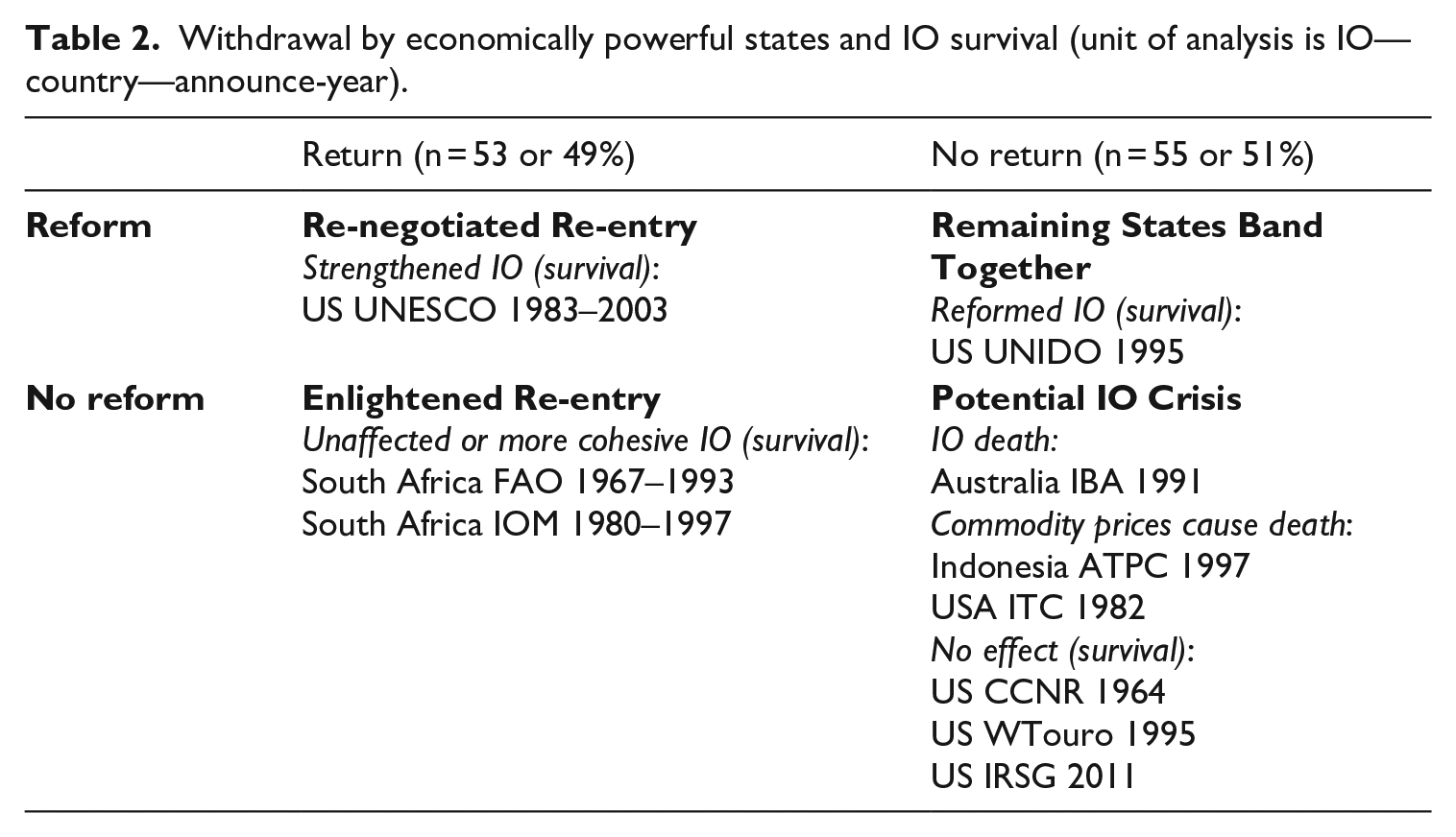
The set of IO survival cases in the upper left quadrant of Table 2 follow the withdrawal of an economically powerful state and are examples of “re-negotiated re-entry.” This is akin to renegotiation of investment treaties, where the withdrawing and the remaining member state can decide to reform the existing treaty by amending it (see Haftel and Thompson, 2018: 32–33; Huikuri, 2023). In these cases, renegotiation means that after withdrawal, states reform and a return to institutionalized cooperation, resulting in institutional survival. For instance, after the United States announced its withdrawal from UNESCO in 1983 because it had “demonstrated unrestrained budgetary expansion” (Waxman, 2017), George W. Bush announced in 2002 that “the United States will return to UNESCO. This organization has been reformed and America will participate fully in its mission.” 22 Instead of the United States’ withdrawal leading to IO death, its withdrawal may have instead helped push change that buffered the survival of the IO. Economically powerful states can sometimes use withdrawal as a bargaining chip to push for change and then rejoin a reformed (and more resilient) IO.
To probe this explanation about rejoining more systematically, we estimate two further models. We replicate Table 1 model 1 but replace the main explanatory variable with its two subsets. Indeed, membership withdrawal without return is associated with a higher risk of IO death and is borderline significant (p < 0.10), while withdrawal with return is significantly linked to lower death risk and longer IO survival. Detailed estimates are in Supplemental Appendix Table A5, models 5–6.
The set of IO survival cases in the upper right quadrant of Table 2 follow the withdrawal of an economically powerful state where “remaining states band together.” Here, the powerful state’s exit prompts IO reform but the efforts are not sufficient to lure the economically powerful country back in. One example of this is the United States’ 1995 announcement to exit the United Nations Industrial Development Organization (UNIDO). The United States argued that UNIDO was ineffective and overlapped in its functions with other IOs. The United States withdrawal in late 1996 deprived UNIDO (1996: 5–7) of a quarter of its budget, prompting significant budgetary and institutional reforms (reducing staff and restructuring). After reforms, UNIDO’s director general tried to bring the United States back but was unsuccessful (Goodenough, 2011). However, remaining member states banded together such that the United Kingdom and Germany decided to stay in the organization specifically because of UNIDO reforms. Moreover, Denmark and Switzerland pledged substantial additional voluntary contributions, lending “their complete support to the revitalized organization” (UNIDO, 1997: 8).
The bottom left quadrant of Table 2 group a third type of IO survival cases which we call “enlightened re-entry” of a previously withdrawn, economically powerful state. Here, the IO does not reform but the economically powerful withdrawn state still returns to the IO, often due to changes in the state’s domestic politics and thus, their approach to the IO. Several specialized agencies took actions against apartheid South Africa in the 1960s and 1970s. To avoid further punishment, South Africa sometimes withdrew in anticipation of being suspended by the organization. For example, after some African countries boycotted FAO meetings in 1963 and also issued draft resolutions to deny South Africa a vote, South Africa saw little reason to remain in and instead announced it would withdraw from FAO effective in 1963, which became effective in 1964 (Bissell, 1974). The International Organization for Migration (IOM) excluded South Africa from all meetings in 1973, and South Africa withdrew in 1980. After the end of apartheid, South Africa rejoined FAO in 1993 and the IOM in 1997. Despite South Africa being an economically powerful country, South Africa’s exit did not cause IO death and may even have generated more cohesion and productivity in the IO, as remaining member states could devote their efforts to implementing the IO’s mandate instead of dealing with a pariah.
The fourth set of cases (in the bottom right quadrant of Table 2) reflects potential IO crisis and IO death following the withdrawal of an economically powerful state. Most IOs in this quadrant survive, but death occurred in 5 of 51 IOs. These include OCAM (noted above), commodity organizations (IBA detailed below, as well as the ATPC and IJO), and the International Bureau for Informatics.
The commodity-related IO deaths are particularly noteworthy because as states embraced market liberalism, these IOs limited states’ benefits through price and supply quotas (Crasnic, 2022). Member state withdrawals were thus part of a larger turn away from the mission of these IOs, resulting in their deaths. For example, the International Bauxite Association (IBA) was created in 1974 by bauxite producing countries and died in 1997 after Australia’s 1991 announced departure. Australia was the world’s largest producer of bauxite and an exporter of other minerals, but since its economy was diversified, its policies sometimes contrasted with those of other producers in the organization. These differences led to a diminution in the organization’s operational ability, which weakened it to the point of collapsing (Araim, 1991: 171–172). Without Australia, which produced 30 percent of world bauxite, the IBA had a void of resources, market power, and guidance. Indeed, “the decision to dissolve the 20-year-old organization followed an extended period of uncertainty regarding the future of the group, caused primarily by the recent loss of several key member countries and increasing funding problems” (Sehnke 1994: 95).
This classification and analysis of the four mechanisms linking withdrawal by economic powers to IO death/survival, along with the quantitative analysis, show that the relationship between member state withdrawal and IO survival is quite nuanced.
Conclusion
Observers have wondered whether state backlash against IOs poses risks to the survival of institutionalized cooperation and global governance more broadly. While there has been a long-term pattern of increasing membership in IOs since the Second World War, some observers note that IO withdrawals signify a sea-change in commitment to multilateral institutions. In this paper, we examine whether member state withdrawals affect individual IO survival. Our findings therefore have implications for understanding the state of international cooperation in the 21st century, which is a question at the heart of many debates about the global order (Cooley and Nexon, 2020).
The empirical analyses show that while member state withdrawals may cause disruption to IOs in many ways, an average member state withdrawal does not necessarily make IO death more likely. The causes of IO withdrawal, which are often rooted in one state’s preferences diverging from the rest of the members, mean that remaining states may band together after exit. In addition, IOs often take on a life of their own, becoming more than just a reflection of states. This gives them stickiness and staying power even when individual members may be dissatisfied. Results indicate that several member state withdrawals also do not make IO death more likely. Indeed, a smaller number of remaining member states may be better able to overcome collective action challenges and ensure the institution continues.
The withdrawal of important states, however, creates a more nuanced picture of the connection between IO withdrawal and IO death. On one hand, the withdrawal of founding member states hastens the risk of IO death because this likely challenges the legitimacy of the IO once a creator state (and its founding vision) has exited. Institutional research—which extends beyond IOs—shows the important power of a founder in keeping organizations going. On the other hand, an economically powerful state’s withdrawal can heighten the IO’s chance of survival, likely because remaining member states use the crisis to band together or push for IO reform. We also see many powerful withdrawn states return which might strengthen the IO—though we caution that this does not mean that any powerful state can withdraw and create a more resilient organization. To be sure, strong selection effects (including the costs of withdrawal) affect when states can credibly threaten to walk away (von Borzyskowski and Vabulas, 2023), and also when they actually leave. This research may therefore serve as a cautionary note for practitioners and policymakers: who leaves, and what the remaining member states do in the wake of withdrawal, could be crucial for keeping an IO alive.
Future research can build on these findings and address related questions. For example, even if IOs do not systematically die when a member state leaves, do IOs lose some of their lifeblood (moving beyond the binary question of IO life or death)? That is, future research can examine if the (sometimes remarkable) survival of IOs in the face of membership withdrawals also holds for more gradual measures of vitality like IO output 23 or “zombie” status. 24 Moreover, research can examine other effects of withdrawal including whether it affects the IO’s legitimacy and power in world politics (Tallberg and Zürn, 2019).
Isolationist and populist movements in many countries have underscored that IOs may be fragile (Copelovitch and Pevehouse, 2019; Ikenberry, 2018; Lake et al., 2021; Walter, 2021a), leaving many to ponder the factors that could lead to IO death. As scholars begin to look more at membership withdrawal because it seems to be an “increasingly popular exit option for global governance” (Drezner, 2017), we need to better understand what happens after exit. Understanding the conditions under which individual states’ membership withdrawal contributes to the robustness of IOs or their dismantling is therefore key to better understanding the vitality and resilience of multilateralism.
Supplemental Material
sj-pdf-1-ejt-10.1177_13540661241256951 – Supplemental material for When do member state withdrawals lead to the death of international organizations?
Supplemental material, sj-pdf-1-ejt-10.1177_13540661241256951 for When do member state withdrawals lead to the death of international organizations? by Inken von Borzyskowski and Felicity Vabulas in European Journal of International Relations
Research Data
sj-zip-2-ejt-10.1177_13540661241256951 – for When do member state withdrawals lead to the death of international organizations?
sj-zip-2-ejt-10.1177_13540661241256951 for When do member state withdrawals lead to the death of international organizations? by Inken von Borzyskowski and Felicity Vabulas in European Journal of International Relations
Footnotes
Acknowledgements
The authors thank Loriana Crasnic, Christina Davis, Maria Debre, Hylke Dijkstra, Daniela Donno, Mette Eilstrup-Sangiovanni, Orfeo Fioretos, Julia Gray, Yoram Haftel, Gisela Hirschmann, Stephanie Hofmann, Tuuli-Anna Huikuri, Anja Jetschke, Tana Johnson, Mareike Kleine, Andreas Kruck, Tobias Lenz, Jon Pevehouse, Tyler Pratt, Bernhard Reinsberg, Avery Schmidt, Henning Schmidtke, Alex Tokhi, Kelebogile Zvobgo, and participants at the 2022 annual meetings of APSA, PEIO, ISA, DVPW, the 2022 IO workshop in Bonn, and the ISA-sponsored Life Cycles of International Organizations workshop in Zurich.
Declaration of conflicting interests
The author(s) declared no potential conflicts of interest with respect to the research, authorship, and/or publication of this article.
Funding
The author(s) received no financial support for the research, authorship, and/or publication of this article.

Supplemental material
Supplemental material for this article is available online.
Notes
Author biographies
References
Supplementary Material
Please find the following supplemental material available below.
For Open Access articles published under a Creative Commons License, all supplemental material carries the same license as the article it is associated with.
For non-Open Access articles published, all supplemental material carries a non-exclusive license, and permission requests for re-use of supplemental material or any part of supplemental material shall be sent directly to the copyright owner as specified in the copyright notice associated with the article.
