




Abstract
While growing attention has been given to the impact of historical traumas on international politics, we know little about how trauma influences the foreign policy of states that have experienced trauma(s). Challenging the dichotomous conceptualization of traumatized states’ behaviours as either aggressive or pacifist, we show that traumatized states tend to articulate their foreign policy roles in a more complex way. We identify five foreign policy roles reflecting the remembering mode associated with ‘acting out’ (i.e. the role of victim and safe-haven/defender of the traumatized minority), with ‘working through’ (i.e. the role of forgiver, the role of canary in a coal mine and the guardian of the memory) or a blend of the two, demonstrating that both types of remembering modes can be activated simultaneously. The oscillation between these modes of remembering is characteristic of the non-linear process of coping with trauma, explaining the traumatized states’ seemingly inconsistent self-representations. We illustrate our claim with the case of Israel, based on the qualitative content analysis of Prime Minister Benjamin Netanyahu’s speeches to foreign audiences between 2009 and 2021.
Introduction
In the aftermath of traumatic events, states adopt various foreign policy roles. While certain states respond aggressively, others take more conciliatory approaches. For instance, following 9/11, US foreign policy discourse centred around retaliation, militarism and the prioritization of national security (Edkins, 2002). By contrast, Rwanda, in response to the genocide perpetrated by the Hutus against the Tutsis, positioned itself as an advocate against genocide on the global stage (Becker, 2013). Other states exhibit contradictory rhetoric, as seen in Israel, where politicians simultaneously emphasize the existential threat of physical destruction while boasting about the nation’s formidable military capabilities. This article considers these complexities by examining underlying factors that contribute to these apparent inconsistencies in how states present themselves internationally when exposed to trauma(s).
Building on the scholarship on trauma, this study demonstrates that states that have undergone traumatic experiences tend to develop specific understandings of their roles which have profound implications for their foreign policy. These roles are distinct from the traditional roles identified by the literature, as traumatic memory has unique characteristics compared to ‘normal’ historical memories. Therefore, to better explain the various discursive responses to trauma and, what seems to be, at first sight, inconsistent self-representations, we propose an original conceptual framework that unpacks the diverse articulations of foreign policy roles that states dealing with historical traumas may evoke simultaneously. We identify five foreign policy roles reflecting either the remembering mode associated with ‘acting out’ (i.e. the role of victim and safe-haven/defender of the traumatized minority), with ‘working through’ (i.e. the role of forgiver, the role of canary in a coal mine and the guardian of the memory) or a blend of the two, demonstrating that both types of remembering modes can simultaneously be activated.
Methodologically, we illustrate the impact of trauma on the discursive articulation of foreign policy roles based on the extreme case of Israel. Founded in the shadow of the greatest tragedy of the Jewish people (i.e. the Holocaust), Israel’s raison d’être is crystallized in the motto ‘never again’. Additional traumas, such as existential wars, terrorism and political violence, including the assassination of a prime minister, have punctuated Israel’s contemporary history. To identify the foreign policy roles that states dealing with traumas are likely to articulate, we conducted a qualitative content analysis of Israel’s Prime Minister Netanyahu’s speeches to international audiences between 2009 and 2021. We found that Israel invokes five foreign policy roles simultaneously – with the role of the victim as the most dominant one (i.e. the group perceives itself as a constant target of victimization), reflecting the typical self-representation of a traumatized actor ‘acting out’ its trauma. The role of the canary in the coal mine, emphasizing the group’s commitment to warn against dangerous actors and trends and constituting a form of ‘working through’, was the second most dominant role. This observation indicates that states often activate both modes of remembering simultaneously. To a lesser extent, Israel also adduces the role of forgiver through its dedication to forgo revenge and prioritize reconciliation, demonstrating its ability and willingness to ‘work through’ its traumas vis-à-vis specific audiences and issues. While the oscillation between ‘acting out’ and ‘working through’ may be puzzling, this paradox can be explained by the effect of trauma resulting in a non-linear process of mixed responses. Our analysis shows that the likelihood of a traumatized state to engage in one mode of remembering over another depends on the nature of the discourse and actual behaviour of past perpetrators and third parties, and on the type of audiences that leaders address.
This article makes several contributions. Theoretically, it contributes to the literature on trauma and foreign policy by providing a nuanced analysis of the foreign policy roles that a state whose identity is built on trauma may invoke. We argue that following traumatic experiences, the remembering mode chosen by political leaders significantly impacts the articulation of foreign policy roles, making trauma an important variable to consider in foreign policy analysis. Rather than conceptualizing the effect of trauma on foreign policy dichotomously (either ‘working through’ or ‘acting out’), we show that states oscillate between these modes of remembering and even invoke roles composed of a blend of the two. Empirically, this article expands the literature on Israel’s foreign policy that has traditionally highlighted Israel’s victimhood and attitude of upright defiance (Adler, 2012; Peleg, 2019). By contrast, we stress the traumatic past as a key determinant of Israel’s foreign policy and theorize overlooked foreign policy roles related specifically to trauma.
While collective trauma has already been acknowledged as a potent political phenomenon (Lerner, 2022: 27), recent international developments, such as the Syrian civil war, the Russian aggression against Ukraine and the latest Israel–Hamas war have created new traumas with significant foreign policy ramifications. Given the direct link between trauma and global security, it is timely to investigate how traumatized states engage in foreign policy. As observed by Schick (2011), ‘unless traumatic loss is worked through, it poses political dangers that operate not only in the immediate aftermath of trauma but also decades and generations later’ (p. 1837). Unprocessed traumas are likely to generate further suffering with political consequences – hatred expressed in further violence or political disengagement (Schick, 2011: 1847). By delving deeper into the activation of different modes of remembering (‘acting out’ and ‘working through’), we enhance our understanding of the foreign policy roles invoked by traumatized states and, hence, of the rationales driving their external actions.
What follows is a discussion of the literature on trauma, discourse and foreign policy highlighting the need for a refined understanding of the relationship between these concepts. First, we unpack the ways in which traumatized states choose to present themselves on the international stage and propose a palette of foreign policy roles they are likely to invoke–albeit in an inconsistent manner. Then, we apply the theoretical framework to the case study of Israel, before concluding with some reflections on the wider applicability of this new understanding of the impact of trauma on foreign policy.
Trauma, discourse and foreign policy: towards a refined understanding
Over the last decades, the study of trauma has spanned various levels of analysis (individual and collective) and crossed disciplinary boundaries (psychopathology, psychology, sociology and political sciences) (Hamburger, Hancheva, and Volkan, 2021). More recently, International Relations (IR) scholars have become interested in studying memory and trauma in global politics. This increased attention to the ‘international dimension of traumatic memory’ is reflected in a growing number of works that seek to explain traumatic events, the ways in which they are experienced, internalized, remembered and forgotten and how they influence states’ identities and interests (Bell, 2006; Edkins, 2003; Fierke, 2004; Fierke and Mackay, 2020; Lerner, 2020, 2022; Resende and Budryte, 2014; Schick, 2011; Zehfuss, 2007). Yet, only a few of these studies have focused on the influence of trauma on foreign policy (Becker, 2013; Lerner, 2022; Sasley, 2013). These works have mostly adopted a constructivist approach, highlighting how traumatic memory becomes an integral part of collective identity, thereby shaping foreign policy behaviour (configuration of national interests, development of policy positions, etc.). By contrast, other scholars have shown how states strategically manipulate their traumatic pasts to justify political agendas and influence international relationships (Bachleitner, 2019; Dixon, 2018).
Elites and decision-makers are instrumental in both the collectivization of traumatic memory and its translation into foreign policy discourses and actions. It is mainly through non-linguistic communication systems (i.e. monuments, museums and remembrance days) and autobiographical narratives (Innes and Steele, 2013; Schick, 2011: 17) that leaders turn a specific traumatic memory into an integral part of a state’s identity, impacting foreign policy. Importantly, the state’s development of its self-understanding through the articulation of foreign policy roles is not a passive political behaviour but a strategic political choice. When experiencing traumas, states can choose to engage in one form of remembering or another, which may eventually result in different kinds of behaviours internally and externally.
Key here is the distinction between two main modes of remembering: ‘acting out’ versus ‘working through’. These concepts, originating from psychoanalysis, refer to modes of remembering of individuals exposed to traumatic events (Friedlander, 1992). Constructivist scholars have also adopted these concepts, arguing that while trauma is experienced individually, it is social groups like political, cultural and intellectual elites who give traumatic events their collective meaning. For Alexander (2012), ‘the lives lost, and pains experienced, are individual facts; shared trauma depends on collective processes of cultural interpretation’ (p. 3). Similarly, Hutchison adds that ‘. . . no matter how seemingly “personal” trauma may feel, individuals are always already embedded in social settings that shape their understanding of trauma. Making “sense” of trauma is therefore an activity that is socially, culturally and often politically framed’ (Hutchison, 2016: 30). In short, the two modes of remembering, which give meaning to collective traumas, are profoundly political acts.
So far, a few studies have used the concepts of ‘working through’ and ‘acting out’ to shed light on states’ discursive responses to traumatic events (Edkins, 2002, 2003; Schick, 2011). They have primarily highlighted the meaning-making narratives adopted by states domestically, corresponding to either maladaptive patterns of behaviours (‘acting out’) or healthier ways of processing the past (‘working through’) via creative expressions, story-telling and critical judgement (Schick, 2011).
Inevitably, as giving meaning to traumatic past is essentially a social act, the process is often subject to domestic political contestation and conflicting interpretations. Various memory entrepreneurs, including political elites and other social groups, may invoke a traumatic memory in order to promote specific policies (Becker, 2013: 71). Even the same traumatic memory can be interpreted and used to justify different policy choices (i.e. Edkins, 2003, on responses to 9/11 and McDonald, 2010, on the diverse policies pursued by Australian prime ministers regarding the killing of Australian soldiers in the 1915 Gallipoli campaign).
Focusing on the foreign policy of states dealing with historical traumas, both Sasley’s (2013) analysis of the impact of the Sevres Syndrome on Turkish foreign policy and Becker’s (2013) study solely consider general foreign policy behaviour related to peace and war, gauging the extent to which a traumatized state is more likely to engage in (1) a pacifist or aggressive foreign policy and (2) withdraw or engage from international interactions. Among the factors influencing the privileged type of foreign policy are the nature of victimhood, the structural constraints related to the external environment, the degree of internal contestation of the trauma narrative, the image derived from it (Becker, 2013) and the decision-makers’ political leanings (Sasley, 2013). Without making it explicit, these studies suggest that such states act in either an aggressive or a defensive way, reflecting the typical responses to trauma associated with ‘acting out’ or ‘working through’.
By contrast, we draw on the literature on trauma (i.e. LaCapra, 2001), to show that states dealing with historical traumas can engage in different modes of remembering simultaneously and hence potentially display seemingly contradictory discursive tendencies – thereby challenging the dichotomous conceptualization that has prevailed in the literature thus far. In addition, these studies fail to scrutinize the missing link between the discursive articulation of the collective trauma and the resulting foreign policy behaviour: while both studies raise a relevant and under-researched question, there are more nuances and foreign policy behaviour types that may be taken by states dealing with historical traumas than suggested by Becker and Sasley (2013).
Conceptualizing the impact of trauma on the foreign policy of states dealing with historical traumas
The unique impact of collective trauma on state’s foreign policy
Among the various ontological traditions of theorizing collective trauma in IR literature, 1 we follow Alexander’s conceptualization of traumas as critical historical events that are culturally worked on, identified, developed, communicated and made into societal cornerstones to serve the group identity (Alexander, 2012). Alexander (2004) coined the term ‘cultural trauma’, which occurs ‘when members of a collectivity feel that they have been subjected to a horrendous event that leaves indelible marks upon their group consciousness, marking their memories forever and changing their future identity in fundamental and irrevocable ways’ (p. 1). In other words, ‘[e]vents are not themselves inherently traumatic’. Rather, ‘[t]rauma is attributed to real or imagined phenomena, not because of their actual harmfulness or their objective abruptness, but because these phenomena are believed to have abruptly and harmfully, affected collective identity’ (Alexander, 2004: 10). This belief results from a sociocultural process, which involves the complex interaction of various agents and practices across a range of national and institutional spaces.
Trauma is often described as a profoundly disturbing event with destabilizing effects on both individuals and collectives. In Bell’s words (2006: 8), ‘trauma implies a breakdown of both meaning and trust in a world that has been shattered, overturned. It is the absence of temporal distance, the failure to regard the past as past, as something that can be left behind, that has such a profound effect on identity’. The concept of breakdown resonates with Edkins’ (2003) definition of political trauma as a moment that, through its catastrophic impact, ruptures settled narratives and frames of meaning. In a similar line, Rüsen (2021) explains that trauma is a ‘catastrophic’ crisis that ‘destroys the reference frame of the historical formation of meaning and prevents its renewal into another, which could fulfil the same function as the destroyed one’ (p. 44).
Trauma produces long-lasting and lingering impacts on the collective exposed to it. A traumatic memory becomes a permanent feature which informs individual and collective understandings of the world. Trauma can be passed down generationally as a powerful latent phenomenon. Volkan (1997) coined the term ‘chosen trauma’ to refer to traumatic encounters that become embedded in a group’s identity, transmitting grievances through generations that can foment violence even after the perpetrators of original traumas have passed. Put differently, post-traumatic grievances can be aimed at otherwise uninvolved actors (Lerner, 2022: 70). Therefore, it is crucial to study how states begin (re)constructing their identities based on new narratives following traumatic experiences.
Similar to individuals, states usually engage in two broad modes of remembering: ‘acting out’ and ‘working through’. For LaCapra (1998), ‘acting out’ occurs when individuals and collectives become ‘stuck’ in the past: ‘In post-traumatic acting out . . . one is haunted or possessed by the past and performatively caught up in the compulsive repetition of traumatic scenes–scenes in which the past returns and the future is blocked or fatalistically caught up in a melancholic feedback loop’ (p. 21). Collectives tend to live a restricted life characterized by hypervigilance and a desire for security. Moreover, in the aftermath of a perceived traumatic event, elites and societies tend to develop maladaptive meaning-making narratives to make sense of their pain. Often, these narratives oversimplify the traumatic event by utilizing a good/evil dichotomy. Rather than fostering healing, this approach prolongs suffering and, by vilifying the other party, triggers ‘revenge-seeking’ behaviour (Schick, 2011: 1843). While this articulatory practice is normal in the aftermath of trauma, it becomes problematic in the long run, as it prevents a full reckoning with previously deeply held assumptions about the world (LaCapra, 2001). This process of assigning meaning to the traumatic event is profoundly political.
By contrast, ‘working through’ relates to successful mourning practices that allow for a critical distance from the trauma (LaCapra, 2001; Schick, 2011). It implies expressing grief and reconstructing events discursively with critical judgement. Essentially, working through is a politically engaged response that rejects dichotomous forms of articulating the trauma. Rather, it entails committed struggle against the social and political arrangements that initially facilitated the suffering (Schick, 2011: 1848). It implies that mourning is a political work that leads actors to consider how things might be different and to risk challenging the status quo. Such political risk-taking might be expressed in the practice of forgiving – whereby the past victim gives a new chance to the past wrongdoer. The difference between these modes of remembering (‘acting out and working through’) matters as ‘the manner in which societies remember their past is central in determining how they plot their futures – for it serves to both enable and constrain practical action and the imagining of political possibilities’ (Edkins, 2003: 15).
Recall that coping with trauma is never a fully linear process, and as such, an actor dealing with past traumas is likely to oscillate between these different modes of remembering: Working through requires going back to problems, working them over, and perhaps transforming the understanding of them. Even when they are worked through, this does not mean that they may not recur and require renewed and perhaps changed ways of working through them again. In this sense, working through is itself a process that may never entirely transcend acting out and that, even in the best of circumstances, is never achieved once and for all. (LaCapra, 2001: 148–149)
The way in which the survivors’ trauma is socially received affects the trauma’s manifestations and the victim’s ability to articulate experiences in politically meaningful ways. It determines the extent to which trauma survivors can re-establish meaning and social trust in the wake of traumatic disjuncture (Lerner, 2022). Therefore, many traumatized actors strive to gain official recognition of that trauma to avoid the added trauma of invisibility. Similarly, states born out of traumatic experiences strive for the recognition of that trauma. In the case of Israel, the pursuit of trauma recognition is concomitant to the recognition of the right to exist. This originates from the fact that the Jews’ traumatic experiences during the Holocaust contributed to the legitimacy of the Zionist aspiration for a sovereign Jewish homeland. Moreover, this traumatic experience was instrumental in garnering international recognition for the establishment of the State of Israel. Consequently, attempts to negate the Holocaust are perceived as an explicit assault on Israel’s legitimacy and right to exist.
A palette of foreign policy roles for states dealing with historical traumas: ‘acting out’, ‘working through’ or blending of the two
Going a step further, we conceptualize the effects of trauma on the self-understanding of states and more specifically, on the articulation of their foreign policy roles. We offer a typology of roles that traumatized states are likely to invoke and eventually adopt, corresponding either to the ‘working through’ or the ‘acting out’ modes of remembering, or a combination of the two. Importantly, these roles are ideal-types, and are not necessarily mutually exclusive, rather the opposite: they complement each other and are promoted simultaneously.
Why does this differentiation between various roles matter? First, the nuanced differentiation of roles allows for a more precise evaluation of the degree to which a particular state addresses its traumatic memory. Second, the way states conceive of themselves informs the policies they pursue and behaviours they exhibit (Bially Mattern, 2005; Lupovici, 2016; Steele, 2008). The articulation of these roles facilitates the adoption of diverse policies, ranging from more aggressive to relatively pacifist approaches. Third, when a state articulates different roles, it communicates its expectations concerning other actors in the global arena, indicating whether it perceives them as allies and friends or potential security threats. Recognizing the specific role conception taken up by a traumatized state helps anticipate how its leaders will act, what kind of reactions they expect from others and how they might react if they do get the expected response.
Role of a victim
Collective victimhood refers to ‘the psychological experience and consequences of the objective infliction of harm by one group toward another’ (Noor et al., 2017: 121). This role can be conceptualized as an example of ‘acting out’, as the victimized group is likely to believe that it is a perennial target of victimization throughout history and see out-groups as victimizers. In line with the concept of ‘acting out’, it is constantly ‘stuck in the past’. To make sense of painful collective experiences, elites construct historical narratives which accentuate the traumatic experience and the in-group victimhood. The victim entity (individual, group or state) will seek to restore its agency through strength and self-reliance. This discourse is accompanied by a staunch commitment to ‘never again’ be exposed to such suffering, underscoring security and the ability to defend itself. As such, it articulates the right to act decisively against any potential adversaries threatening its existence. A strong focus on in-group victimization may also lead to a reduced sense of guilt for harm caused in conflicts unrelated to the source of the trauma (Noor et al., 2017: 123). Furthermore, the state typically strives for the international recognition of its victim status both from former perpetrators and parties that were not directly involved in the infliction of harm. This in turn endows it with the right to claim compensation for the harm committed against both individuals and the collective (Jacoby, 2015).
Role of safe haven/defender of the traumatized minority
This role rhetorically defends the population that has been victim of trauma transnationally and offers the possibility of emigration to the state considered the ultimate security provider. This role is an example of ‘acting out’ as the traumatic experience is seen as foundational and ascribes to the state the responsibility of providing security to the members of the in-group, including those who live outside of the state’s borders. In its discourse characterized by hypervigilance, the defender of the traumatized minority emphasizes both the threats faced by the respective minority and its commitment to provide a safe haven for members of the minority in jeopardy. For example, Israel sees itself as the defender of the Jewish people by declaring itself legally responsible for the well-being of all Jews worldwide (Shain and Bristman, 2002: 119). Israel provides the reassurance that Jews living outside of Israel can find refuge if they feel ever threatened again. Similar to the role of a victim, a defender highlights its military power to guarantee a safe haven for the threatened traumatized minority. This role grants the state the right to criticize states that fail to defend the given minority and to interfere in its domestic affairs and migration issues if needed. This part of the role is often contested by external actors, as it can entail securing the emigration of a given minority through diplomatic relations, as was the case with aliyot to Israel (Thies, 2012).
Role of guardian of the memory
The role of guardian of the memory revolves around the discursive commitment to remember the historical event(s) linked to the collective trauma, to protect the memory of the victims and to make sure that this memory is passed down to future generations. This role can be conceptualized as an example of both ‘acting out’ and ‘working through’ modes of remembering. In the former case, the guardian of the memory aims to keep the traumatic event alive and responds sensitively to those who challenge the dominant historical narrative or who call for moving past the traumatic event. Domestically, political leaders forge a sense of national identity by referring to traumatic event(s) and institutionalizing national days, memorials and relevant school curricula (Funkenstein, 1993; Zerubavel, 2004). Depending on the interpretation given to the traumatic event, it may prolong the suffering (as in ‘acting out’). Externally, the traumatized state demands from the world to remember the event through speeches, international commemorative events and visits to historical and symbolic sites (e.g. Yad Vashem). In a similar vein, it perceives itself as entitled to criticize states, organizations and individuals which distort the truth about the traumatic event. Yet, the articulation of this role also reflects the ‘working through’ mode of remembering. The promotion of universal norms against human rights abuses and the development of a global community advancing the dignity of all, irrespective of ethnicity or religion, are commemorative practices reflecting critical judgement and thinking about how things can be different (in line with ‘working through’).
Role of a canary in a coal mine
This role is an example of ‘acting out’, as the traumatic experience – seen as foundational – lingers in the memory of the actor, increasing its perception of imminent danger. The traumatic past gives the traumatized state a strong moral standing and a sense of duty to warn against actors or trends it deems dangerous. Yet, this role can also be interpreted as an example of ‘working through’, as the traumatic experience empowers the victim to be actively involved in world affairs and help others by changing the status quo. Past exposure to horrific crimes renders actors dealing with traumas more sensitive to the factors that have contributed to their suffering in the first place, and as such, they consider themselves well positioned to raise awareness about potential threats. It is an especial duty of the canary in the coal mine to remain vigilant and speak out against attitudes which may lead to crimes against humanity. The experience of trauma arguably gives a canary in a coal mine a distinctive credibility in its attempt to promote international cooperation to address issues like extremism and human rights abuses. Finally, this role grants the right to be critical of other out-groups and states which commit systematic violence against a specific group based on their ethnicity, race, religion or other characteristics. For instance, Robert Kagame successfully carved out a Rwandan brand highlighting its unique position as a survivor of the genocide to ensure that the promise of ‘never again’ would be fulfilled, and to justify its involvement in the Darfur crisis (Becker, 2013: 69).
Role of forgiver and rehabilitator
We understand the role of forgiver/rehabilitator as a manifestation of ‘working through’, as it corresponds to a response to suffering based on processes of healing and reconciliation (Auerbach, 2004). Rooted in Judeo-Christian culture (Shriver, 1998: 134), a core component of all understandings of forgiveness refers to a change from a negative to a more positive, benevolent orientation towards the offender (McCullough et al., 2003; Worthington, 2005). Articulating the role of forgiver, a state commits to giving up all ideas of revenge, bitterness and hatred towards the wrongdoer (Wells, 2022: 1). Political forgiveness seeks to overcome the cycle of anger and revenge and offers a fresh start (Digeser, 2001). Forgiveness does not require the forgiver to forgo punishment altogether or to annul the existence of the wrong done. Rather, forgiveness relies upon the recognition of wrong having been committed in order to make reconciliation possible: ‘What is annulled in the act of forgiveness is not the crime itself but the distorting effect that this wrong has upon one’s relations with the wrongdoer and perhaps with others’ (North, 1987: 500). The role of forgiver puts the actor adopting this role in the position to receive compensation. Because the forgiving response is outward-looking and other-directed, it also allows the former victim to rehabilitate the wrongdoer and hence improve its image. Finally, it inevitably makes a difference in the interaction with the offender state, allowing for renegotiation of the relationship on a new basis. A state articulating this role is likely to accept apologies and compensation from the wrongdoer, and further down the line, to display the normalization of ties (political, diplomatic, economic and cultural).
Explaining the blending of ‘acting out’ and ‘working through’ modes of remembering
As the different roles in the palette demonstrate, the ‘acting out’ mode of remembering is dominant (i.e. roles of victim and safe haven and partly roles of the canary in the coalmine and the guardian of the memory). This is in line with the scholarship on trauma: the ‘acting out’ mode of remembering is often the default response chosen by states to regain a sense of authority following traumatic events (Edkins, 2003). Yet, while all these roles underscore the imperative of hypervigilance, each one accentuates different aspects, leading to varying foreign policy actions. While the role of the victim might be used to claim compensations, the role of safe haven may be instrumental in seeking military support. As to the ‘working through’ mode of remembering expressed through the articulation of the role of forgiver and partly, canary in the coalmine and guardian of the memory, it is not surprising that it is less dominant as it requires more time and political work – as explained in the previous section.
Importantly, a few scope conditions may influence the mode of remembering that leaders will engage in. First, the nature of the discourse and actual behaviour of past perpetrators and third parties matter. The more they resort to threats of annihilation and to the denial of past traumas, the more likely the political leaders of traumatized states are to articulate roles reflecting the ‘acting out’ mode of remembering. This is because these rhetorical threats and actions reactivate past traumas and fuel the perception of danger, thereby underscoring an increased need for hypervigilance. By contrast, when former perpetrators or third parties do recognize the trauma(s) experienced by the given state, it will be easier for state leaders to engage in the remembering mode of ‘working through’. For a victim to engage in commemorative practices involving ‘working through’, it must no longer perceive the original victimizer as a threat, and it must have its trauma recognized by the international community.
The second scope condition relates to the type of audience addressed by leaders of the traumatized state. Vis-à-vis global audiences in international fora such as the UN, we expect these leaders to resort mainly to roles related to the ‘acting out’ mode of remembering. As mentioned above, following traumatic experiences, states seek the recognition of their traumas through the articulation of the role of the victim. In line with the desire to restore agency, states may project strength to deter potential enemies threatening their security. Importantly, for states whose legitimacy has been questioned, of which Israel is a typical case, we expect leaders to use international fora for justifying and strengthening their legitimacy.
Vis-à-vis former perpetrators, state leaders will most likely allude to roles reflecting a blend of ‘acting out’ and ‘working through’ (particularly guardian of the memory), as it requires from actors that caused the suffering to remember and take responsibility. If reconciliation has been successful, we expect state leaders to evoke the role of forgiver, reflecting the ‘working through’ mode of remembering. Finally, vis-à-vis states considered as allies and security providers, leaders of traumatized states will mostly engage in the roles under the category of ‘acting out’, as they are instrumental in ensuring continuous material support. Consider for instance the typical way Ukrainian President Zelensky has addressed Western leaders since Russia’s attack in February 2022 – he has mostly invoked the roles of victim and canary in a coal mine to better secure military aid and allow Ukraine to protect the democratic world against the threat posed by authoritarian Russia (Zelensky, 2022).
Method and data
Methodologically, we have selected the case of Israel as an extreme case of a state with significant traumatic experiences (Lerner, 2022; Peleg, 2019). The rationale for selecting an extreme case rather than a representative case is that it allows for the accumulation of the greatest possible amount of information on a given phenomenon (Flyvbjerg, 2006). To demonstrate how trauma – embedded in collective memory and national identity – influences the state’s self-understandings on the international scene, we focused on the foreign speeches of one of Israel’s most influential leaders, Benjamin Netanyahu. Not only do speeches of national leaders create new perceptions for the public, maintain existing beliefs and reflect society’s ethos (Liebman and Don-Yehiya, 1983), they also help to translate traumas into policy (Peleg, 2019: 65; Sasley, 2013: 139). Granted, Netanyahu is well known for capitalizing on Israel’s cultural trauma and for manipulating historically ‘loaded’ terminology. Yet, research has shown that he follows in the footsteps of many other Israeli leaders, such as Menahem Begin, David Ben-Gurion and even Yitzhak Rabin (Burg, 2008; Peleg, 2019). While critics might argue that Israeli leaders’ rhetoric refer to historical traumas with the sole purpose of achieving strategic aims, we contend that any instrumental invocation of trauma must necessarily resonate with the audience to be effective. As such, the discourse of Israeli leaders should not be reduced to merely instrumental rhetoric but rather seen as a genuine reflection of the Israeli society’s psyche moulded by traumas.
We conducted a qualitative content analysis of all the foreign policy speeches (136 in total) delivered by Benjamin Netanyahu covering the period in which he fulfilled the function of Israel’s Prime Minister for the second and longest span of time (2009–2021). Aimed at international audiences, these speeches were in English and available on the official website of Israel’s Prime Minister’s Office. The comparative qualitative content analysis was useful as it combined the sensitivity of qualitative discourse analysis with the reliability of classical content analysis. The codebook was developed following a hybrid approach of inductive and deductive coding based on the psychological and political literature on trauma and its manifestations in language (Fereday and Muir-Cochrane, 2006). It contained general statements and detailed information defining each foreign policy role. The coding process was supported by the qualitative data analysis software NVivo12 and an intercoder reliability test was completed.
Empirical analysis: ‘Israel on the couch’
Contextual background: the centrality of trauma(s) in Israel’s national identity
Israel’s national identity and collective memory are undeniably articulated around trauma(s) – past and present. First, it is essential to highlight that the state of Israel was born during the aftermath of the Holocaust, and as such, it is generally accepted that politically and culturally the collective memory of the Holocaust plays a key role in constructing Israeli identity. Indeed, the Holocaust and its millions of dead have been ever-present in Israel from the day of its establishment, albeit in slightly different versions.
2
Specifically, Israeli society has defined itself in relation to the Holocaust both as the heir of the victims and their accuser, atoning for their sins and redeeming their death (Zertal, 2005: 3). For Elon (1971: 198–199), The Holocaust remains a basic trauma of Israeli society. It is impossible to exaggerate its effect on the process of nation-building. . . There is a latent hysteria in Israeli life that stems directly from this source . . . The trauma of the Holocaust leaves an indelible mark on the national psychology, the tenor and content of public life, the conduct of foreign affairs, on politics, education, literature, and the arts.
This is true even today, more than 70 years after the end of World War II (WWII). The presence of the Holocaust in Israel’s national identity has not faded but is rather on the rise (e.g. Klar et al., 2013; Ofer, 2009). So much so that in the words of Bar-Tal, we have been witnessing the ‘holocaustization of Jewish consciousness’ in Israeli society (Bar-Tal, 2023: 241).
While the Holocaust is undeniably the climax of Jewish suffering and the definitive trauma on which Israeli national identity is built, it needs to be situated in the long history of hatred against Jews. From the Roman period through the Middle Ages, the Reformation and the Industrial Revolution until today, Jews have continually been subjects of antisemitism in almost every place they have lived (Bar-Tal and Antebi, 1992: 50). They have experienced a long history of persecutions, labels, restrictions, forced conversions, expulsions and pogroms, culminating in the Holocaust. 3 Therefore, the Holocaust does not stand alone as one grim event but is arguably a metaphor for Jewish history itself (Stein, 1978). Interestingly, even the Jewish religious tradition conveys the view that the hatred of Israel is a unique phenomenon, which has no logical basis, and is not dependent on circumstances (Bar-Tal and Antebi, 1992: 252–53).
Many events that follow the establishment of the State of Israel can also be considered traumatic, further emphasizing the centrality of trauma(s) in Israeli national identity and hence characterizing Israel as a state in ongoing trauma. In its 70 years of existence, Israel has fought several major wars with Arab States in which thousands of Israelis have been killed and dealt with recurring terrorist attacks causing many civilian casualties. In the words of Berent (2019:16), Israel is perhaps the only member state of the United Nations whose existence has been constantly threatened since its establishment.
As discussed in the theoretical section, collective memory and national identity are socially constructed. Various mechanisms explain how Israel’s collective memory of death and trauma was produced and how it has been processed, coded, and used in Israel’s public space (Zertal, 2005). First, it is interesting to note that originally, memory (from zahror or remember in Hebrew) has been the constitutive component of the Jewish identity throughout history. The overarching necessity of remembrance is a crucial part of Jewish scripture and most of the major religious holidays (i.e. Purim, Passover, Tisha’be Av and Chanukah) focus on remembering collective disasters or miracles (Langenbacher, 2010: 13). Second, Israeli elites have played an instrumental role in institutionalizing the collective memory of the Holocaust through the establishment of ‘national days’ (Ariely, 2019), legislation, museums, such as Yad Vashem, and organized trips to Holocaust sites for youth. Collective memory of the Holocaust is also maintained and reflected culturally in Israeli literature (Feldman, 1992), films (Gertz, 2004), visual arts (Katz-Freiman, 2003), and in the education system, as well as in the media (Klar et al., 2013). Importantly, the Holocaust is ubiquitous in Israeli life, in the public and private spheres, affecting the attitude of the wider population (Cohen, 2010). Fear of annihilation and a constant sense of probable doom loom large in nearly all aspects of Israeli life. In short, there is no doubt about the centrality of the Holocaust as the primary political myth of Israeli society, the symbol of Israel’s present condition and the one which provides Israel with legitimacy and the right to its land. . . Its memory is omnipresent, cutting across differences in age, education and even country of origin. (Liebman and Don-Yehiya, 1983: 137–138)
Distribution of roles: prominence of the role of victim and canary in a coal mine
Despite the common assumption that antisemitism and Holocaust denial are major concerns for Israel (associated with the role of the guardian of the memory), we found that the most dominant roles are the victim and canary in a coal mine. These two roles are associated mostly with the mode of ‘acting out’. Yet, there are also non-negligible instances in which the roles of forgiver (vis-à-vis past perpetrators and current adversaries) and canary in a coal mine – characteristic of ‘working through’ prevail. This demonstrates that the processing of the traumatic past is not a linear dichotomous process. Instead, a state dealing with historical traumas can simultaneously make progress in processing its grief, be actively involved in world affairs, forgive perpetrators and even develop cordial relationships with them while persistently remaining ‘stuck’ in its traumatic past, influencing its perception of diverse foreign policy contexts. During Netanyahu’s premiership (2009–2021), Israel assumed all five roles depicted in Figure 1 rather evenly (31% for the victim role, 25% canary in the coal mine, 19% safe haven, 14% forgiver and 11% guardian of the memory). Having said that, roles corresponding to the ‘acting out’ response to trauma dominate, except for the role of forgiver associated with ‘working through’, and canary in a coal mine and guardian of the memory, associated with both modes of remembering.
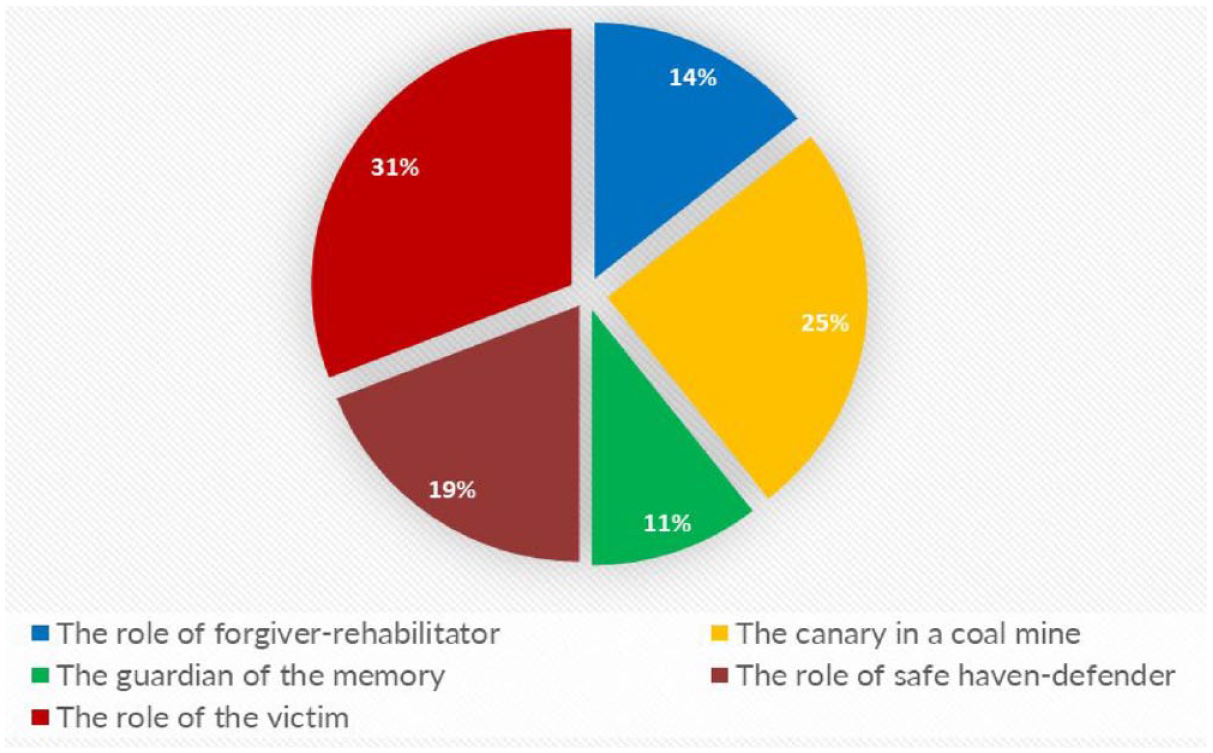
Distribution of roles.
The role of the victim featured prominently with 31 percent of all roles references we coded invoking this role. Notably, Netanyahu rarely referred to Jewish suffering during the Holocaust, instances of antisemitism or older historical events during which Jews were victims of violence. Instead, he evoked this role predominantly in reference to current enemies, primarily Iran and, to a lesser extent, Muslim terrorist groups, with a focus on Palestinian terrorist groups. Netanyahu assumed this role most frequently when addressing the Iranian nuclear programme and Iranian support of terrorist organizations in the Middle East. When warning against the dangers of Iran, he emphasized that Iran did not conceal its aim to destroy Israel, and that the strength of the Israeli army was the best guarantee against Iranian plans. For example, during his meeting with US Secretary of Defense Lloyd Austin in 2021, Netanyahu stated, Iran continues to support terrorists around the world in five continents threatening civilians everywhere. Iran has never given up its quest for nuclear weapons and the missiles to deliver them. Iran consistently and outrageously calls for Israel’s annihilation and works towards that goal. . . . My policy as Prime Minister of Israel is clear: I will never allow Iran to obtain the nuclear capability to carry out its genocidal goal of eliminating Israel. Israel will continue to defend itself against Iran’s aggression and terrorism. (Prime Minister’s Office, 2021)
The second most frequently mentioned role corresponds to the canary in a coal mine (25%). Netanyahu primarily invoked this role when sounding the alarm about the dangers posed by Iran’s nuclear programme. The Israeli leader underscored that a nuclear-armed Iran would not only be a threat to Israel but also to the broader international community. During a meeting with the UK Foreign and Commonwealth Secretary Raab in 2020, Netanyahu reiterated this point: Look at Iran’s aggression today, without a nuclear weapon. What a huge danger Iran would be to the entire world if it did get a nuclear weapon. (Prime Minister’s Office, 2020a)
In a similar line, during a meeting the same year with US National Security Adviser O’Brien, Netanyahu warned that if unchecked, tomorrow Iran will arm itself with nuclear tipped ICBMs that can target Europe and America and it will become a global bully, which will endanger everyone. (Prime Minister’s Office, 2020b)
The Israeli Prime Minister’s third most frequently mentioned role is the role of safe haven/defender of the traumatized minority (19%), emphasizing Israel’s right to defend itself against enemies, primarily Palestinian terrorist organizations, Iran and its proxy Hezbollah. Interestingly, rather than referring only to Israel, he often used the term ‘Jewish State’, suggesting that Israel offered protection not only to its citizens but to Jews in general. He contrasted times when Jews were defenceless against their enemies with the present, when Jews have a state with military capabilities. In his 2015 speech to the UN General Assembly (UNGA), Netanyahu (2015) stated, . . . throughout our history, the Jewish people have learned the heavy price of silence. And as the Prime Minister of the Jewish State, as someone who knows that history, I refuse to be silent. I will say it again. The days when the Jewish people remained passive in the face of genocidal enemies – those days are over. Not being passive means speaking up about those dangers. We have spoken up, we are speaking up, and we will continue to do so. Not being passive also means defending ourselves against those dangers. We have. We are. And we will.
The fourth role assumed was that of forgiver/rehabilitator (14%) – particularly vis-à-vis European leaders, mainly from Germany and Poland – two countries that played a crucial role in the Holocaust: Germany as the main perpetrators of the genocide, and Poland as the place where the mass killing of Jews took place with a population that has often displayed hostility towards Jews. For instance, during one of his visits to Poland in 2013, Netanyahu highlighted, Bilateral relations have strengthened in recent years. We have common values and interests. We remember the difficult past that the Jewish People went through here and, having established independent states, we look forward to the future together. (Prime Minister’s Office, 2013b)
In addition, Netanyahu occasionally assumed this role when addressing Palestinians and calling for a peaceful solution. For example, in his 2016 UN speech, Netanyahu (2016) said, I therefore call upon President Abbas to tell him that he has a choice to make. He can continue to stoke hatred, as he did today, or he can finally confront hatred and work with me to establish peace between our two peoples. I know that many of you have given up on peace, but I want it to be known that I have not given up on peace.
The fifth role mentioned by the Israeli Prime Minister was that of a guardian of the memory (11%). Staunch commitment to keep the memory of the victims of the Holocaust alive is unequivocal, as stated here: The murder of millions of Jews by the Nazis on Polish soil is a crime that has no parallel in history. Tomorrow, I will participate in the opening ceremony of the Jewish exhibit at Auschwitz-Birkenau. We will never forget the victims of the Holocaust; we will never forget the ultimate crime against humanity; we will never forget the crime perpetrated against our people; and we will never forget our obligation to prevent this from ever happening again. (Prime Minister’s Office, 2013b)
Notably, during his UNGA annual speeches, Netanyahu deliberately reminded the international community about the atrocities committed during the Holocaust. He even alluded to past historical events when Jews were subject to persecution, to accuse the UN Human Rights Council of anti-Israeli bias. Netanyahu asserted that the primary goal of the UN, which was to prevent the recurrence of the horrendous events of WWII, was undermined when it allowed individuals like Iranian President Ahmadinejad to disseminate false information about the Holocaust and propagate antisemitism. In particular, he evoked the Holocaust to underscore the threat posed by a nuclear-armed Iran, as illustrated in his 2015 UNGA speech: As for the Supreme Leader himself, a few days after the nuclear deal was announced, he released his latest book. It is a 400-page screed detailing his plan to destroy the State of Israel. Last month, Khamenei once again made his genocidal intentions clear. Before Iran’s top clerical body, the Assembly of Experts, he spoke about Israel, which is home to over 6 million Jews. He pledged that ‘there will be no Israel in 25 years’. Seventy years after the murder of 6 million Jews, Iran’s rulers promise to destroy my country, murder my people, and the response from this body, the response from nearly every one of the Governments represented here, has been absolutely nothing – utter silence, deafening silence. (Netanyahu, 2015)
Moreover, in his criticism of the UN, Netanyahu alluded to historical events when he reproached the resolutions passed by the UNESCO regarding Jewish ties to Jerusalem: . . . we’ve just had an absurd decision of UNESCO that said that the Jewish people have no connection to the Temple Mount. Well, the Arch of Titus was built by Titus’s brother, the Emperor Domitian. He wasn’t a Zionist propagandist. And he obviously was depicting that long, thousands-year connection to the Temple Mount, to Jerusalem and to this country of the Jewish people. (Prime Minister’s Office, 2016)
Unsurprisingly, vis-à-vis his European counterparts, Netanyahu frequently evoked the past, particularly the destruction of Jewish communities in European countries during WWII. During his visit to Hungary, Netanyahu paid tribute to founders of Zionism born in Budapest: These two genius Jews of Hungary formed a partnership that launched modern Zionism and is the reason why I stand before you today as the prime minister of the one and only Jewish state, the sovereign State of Israel. It is because of Theodor Herzl and Max Nordau. But this also commemorates the great destruction that consumed – exactly as Herzl foresaw – the Jews of Europe. And he said, he said 50 years before the State of Israel was born, ‘It may not come in my lifetime, but 50 years from now, there will be a Jewish state’, and he was right. (Prime Minister’s Office, 2017)
Distribution of roles across time
As displayed in Figure 2, Netanyahu appealed most of the time to all five roles with variations in the dominance of certain roles over others (except in 2009 and 2014 with references to four roles and in 2010, 2020 and 2021 with references to three roles). This indicates that Israel refers to these different roles at the same time and most of the time – reflecting simultaneous patterns of ‘acting out’ and ‘working through’ its different traumas. The roles of the victim and the canary in a coal mine are the two most prevalent roles in Israel’s prime minister’s foreign speeches. Importantly, both roles have been regularly invoked to restrain the Iranian nuclear programme, which can be understood as a response to Iran’s recurrent hostile rhetoric and actions aimed at threatening Israel’s very existence. The stubborn Iranian refusal to recognize the state of Israel, pejoratively calling it ‘the Zionist entity’ contributes to the Israeli perception of being threatened by Iran which in turn reactivates past traumas, leading to the hypervigilance reflected in Netanyahu’s speeches.
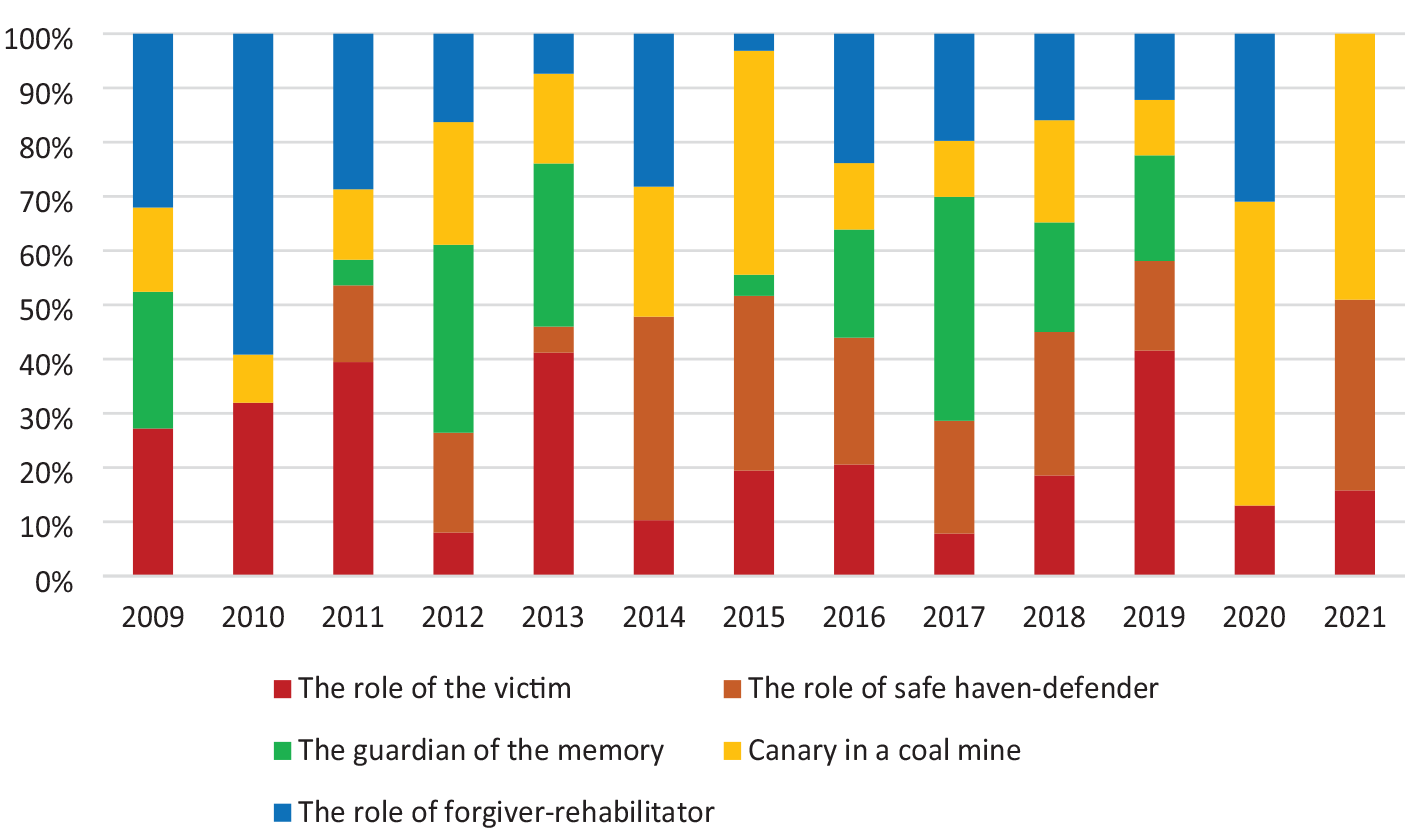
Distribution of roles across time.
Distribution of roles over actors
In terms of distribution of roles over actors (Figures 3 and 4), Israel mostly emphasizes the role of victim in reference to its perceived current adversaries and security threats. The most notable is Iran, followed by Muslim and Palestinian terrorist groups, Arab States and Palestinians generally. Netanyahu often emphasizes the existential threat coming from Iran which publicly calls for the destruction of Israel by referring to past traumas: Given the history of the Jewish people, I would not sit by and write off a threat by those who say they are going to annihilate us. If somebody says that they’re going to annihilate us and they intend to arm themselves with nuclear weapons we take them seriously. . . . It [Iran, added by the authors] wants to be a world power and it wants to annihilate us and it wants to re-establish a caliphate that includes good chunks of Europe. It has even other fantasies that are very dangerous. Fantasies in the arms of very extreme leaders are always dangerous, but when they are backed up with atomic bombs, they’re 100 times more dangerous, and this is something that is of interest for Israel to stop and the Jewish people to stop and the rest of the world that is concerned with peace and security to stop. (Prime Minister’s Office, 2012)
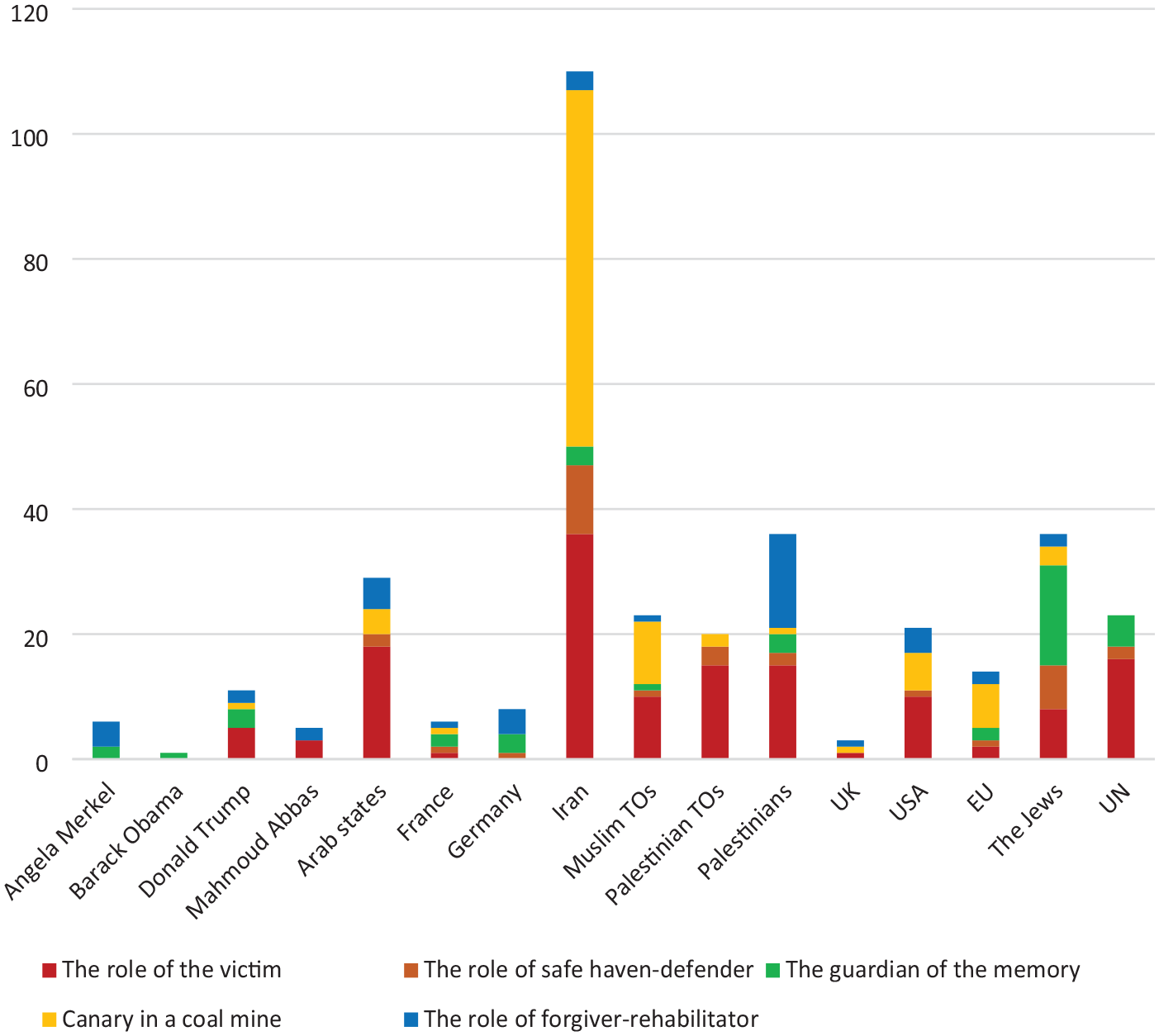
Distribution of roles over actors in total.
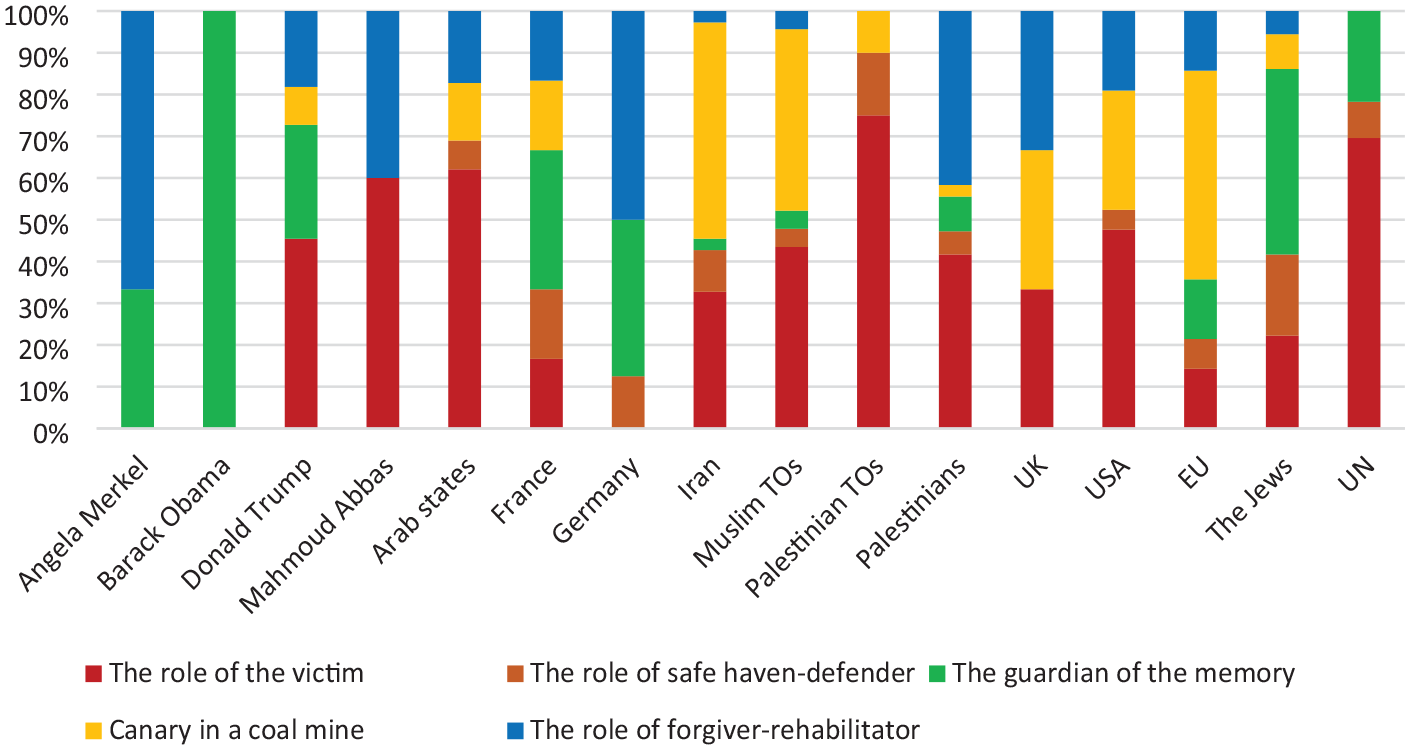
Percentual distribution of roles over actors.
Regarding a different kind of threat (i.e. terrorism) with a distinct impact in terms of security, Netanyahu resorts to the same ‘totalizing’ rhetoric of absolute destruction: Hamas doesn’t give a hoot for the 1967 lines. For them, Israel has no right to live, in any borders. Hamas rejects our very existence. They’re committed to killing every Israeli and every Jew. You just have to read their charter – they say that very plainly. (Prime Minister’s Office, 2014)
Second, the role of the canary in the coal mine prevails in the context of Iran and the fight against Islamic terrorism and fundamentalism. Netanyahu draws on the traumatic past of the Jewish people to position himself as an authoritative and vigilant figure who knows how to recognize patterns that lead to violence and avoid repeating past mistakes. He portrays himself as the bearer of the truth regarding the Iranian nuclear programme, and conveys that it is his role to warn the rest of the international community of Iran’s strategy to fool them: I feel deeply honoured and privileged to stand here before the General Assembly today representing the citizens of the State of Israel. We are an ancient people. We date back nearly 4,000 years to Abraham, Isaac, and Jacob. We have journeyed through time. We have overcome the greatest of adversities. And we re-established our sovereign State in our ancestral homeland, the land of Israel. The Jewish people’s odyssey through time has taught us two things: never give up hope and always remain vigilant. Hope charts the future, vigilance protects it. (Netanyahu, 2013)
Later, in the context of Iran’s nuclear programme, he sarcastically warns, Rouhani thinks that he can have his yellow cake and eat it too. . . . The world may have forgotten that lesson; the Jewish people have not. Iran’s fanaticism is not bluster. It is real. That fanatic regime must never be allowed to arm itself with nuclear weapons. I know that the world is weary of war. We in Israel know all too well the cost of war. But history has taught us that to prevent war tomorrow, we must be firm today. (Netanyahu, 2013)
Third, the role of the guardian of the memory role is prevalent in speeches referencing France. In this role, Netanyahu is endowed with the right to praise efforts to fight antisemitism: ‘I would add that we admire the position of successive French governments and President Macron against antisemitism. It’s bold, it’s clear and it’s right’ (Prime Minister’s Office, 2018). Yet, at the same time, the Israeli leader endorses a more controversial role vis-à-vis France (i.e. safe haven), inviting Jews to immigrate to Israel should they ever feel threatened (in spite of France’s remarkable efforts to fight new and old forms of antisemitism): ‘I as the Prime Minister of Israel, always proclaim to Jews everywhere to come to the Jewish State and make it their home, and there is no contradiction between the two (referring to France’s determination to fight antisemitism)’ (Prime Minister’s Office, 2012).
Finally, the roles of forgiver and guardian of memory are predominantly invoked when engaging with Germany and its leaders (e.g. Angela Merkel), reflecting that, in this case, Israel has effectively processed its trauma. This is facilitated by Israel’s perception that Germany is no longer a threat. Germany acknowledged its role as a perpetrator in the genocide of European Jews during WWII, provided Israel with financial compensation and offered diplomatic support – thus the process of reconciliation between Israel and Germany was relatively swift. This enabled Israel to address its trauma rather than to perpetuate it. When engaging with German leaders, Israeli officials prioritize fostering friendship over dwelling on past crimes and grievances. In numerous speeches mentioning Germany, Prime Minister Netanyahu praises Germany’s travail de memoire: Germany faces, without flinching for a second, the darkest chapter in its past to build a vital future for its people and for the world. And this requires honesty and requires integrity, and you have that integrity, Chancellor Merkel. You show that clarity and that courage, and this is a testament to Germany’s direction under successive governments, and most especially right now under your leadership. It’s something we deeply appreciate and it’s something that has, I believe, momentous historic significance. (Prime Minister’s Office, 2013a)
And in an arguably excessive manner, Netanyahu highlights the friendship linking both states: ‘Welcome to Jerusalem. You’re a friend; Chancellor Merkel is a friend; and Germany is a friend of Israel’ (Prime Minister’s Office, 2013a).
Distribution of roles across audience
To examine the foreign policy roles that Israel evoked depending on audiences (as shown in Figures 5 and 6), we classified audiences geographically into five groups: the United States, European Union (EU) institutions, the international community (referring to speeches delivered at the UNGA), Western Europe, 4 and Central and Eastern Europe. 5 We found that Netanyahu employed all five roles with varying frequency depending on the audience. For instance, when addressing the UN, Netanyahu often took on the role of victim and the canary in a coal mine. The UN was seen by the Israeli Prime Minister as a suitable stage for showcasing strength by articulating its intention to decisively confront those who threaten Israel’s security. Furthermore, by addressing world leaders, Netanyahu utilized the UN as the optimal platform to issue warnings about the global dangers posed by a nuclear Iran. Vis-à-vis the US audience, the roles of the victim and canary in the coal mine were also the most prominent, followed by safe haven. In consideration of the special relationship between the United States and Israel, Netanyahu mostly focused on the security of the Jewish state to ensure the continuation of diplomatic, political and military support of Israel. Vis-à-vis the EU, Netanyahu chose to evoke mainly the role of canary in a coal mine in the context of the Iranian nuclear programme; this is because the EU played an active role in negotiating the Joint Comprehensive Plan of Action, which Netanyahu criticized as not robust enough to prevent Iran from building a nuclear bomb. Netanyahu also evoked the role of the guardian of the memory, by focusing on the question of the memory of the Holocaust. We did not find any substantial difference in the role distribution when Netanyahu addressed audiences in Central/Eastern Europe and Western Europe. In both cases, the roles of guardian of memory and forgiver dominated, followed by the roles of victim, safe haven and canary in a coal mine. The prominence of these roles related to the memory of the Holocaust and antisemitism is not surprising given the tragic history of the Jews in those countries. Nonetheless, the relative importance of other roles, focused on security, explains why, in certain instances, Netanyahu failed to take firm action as a guardian of memory in response to the tolerance of racism and antisemitism by far-right parties in Europe or the relativization of the Hungarian fascist past under Prime Minister Orbán in Hungary. If these actors support Israel and are committed to preventing Iran from acquiring nuclear weapons, other concerns are marginalized.
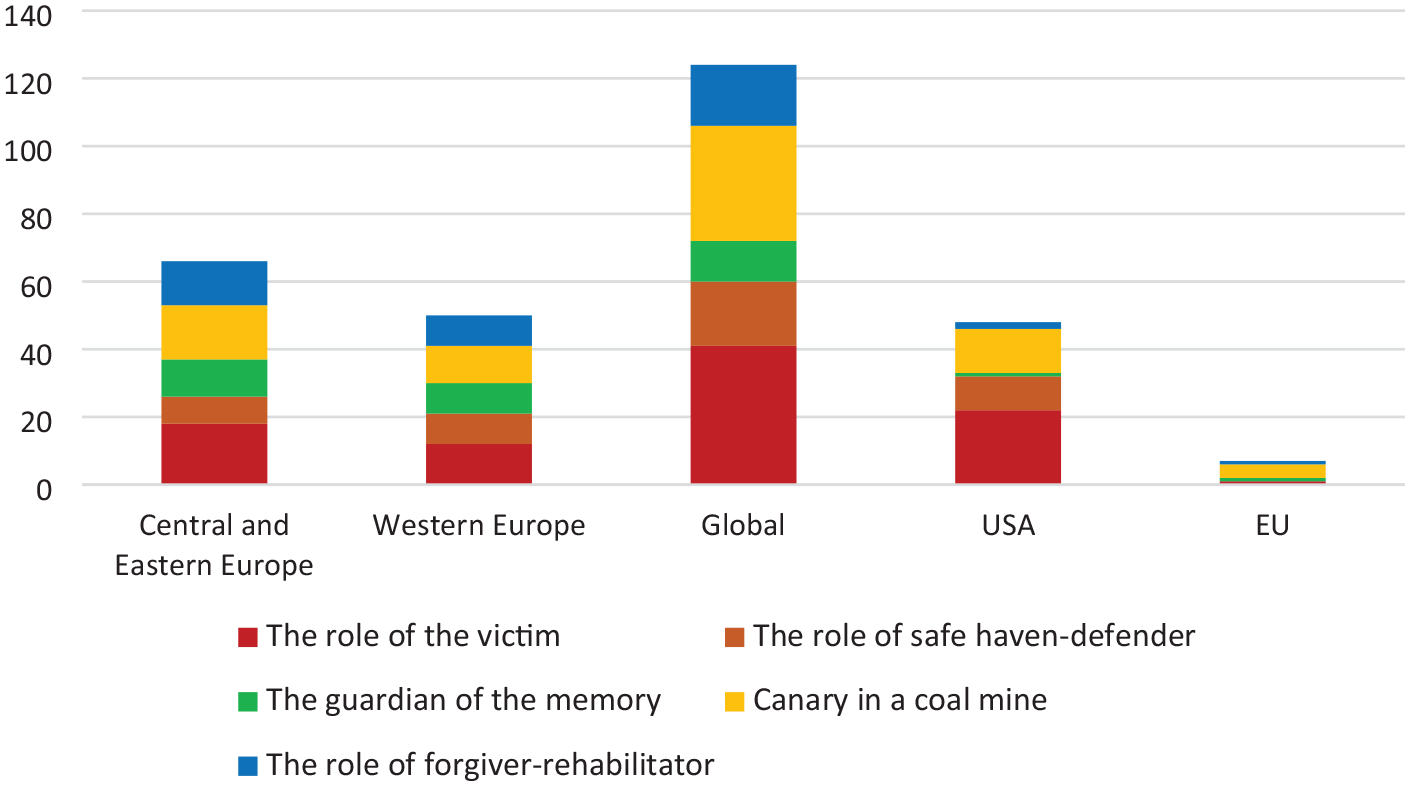
Distribution of roles across the audience in total.
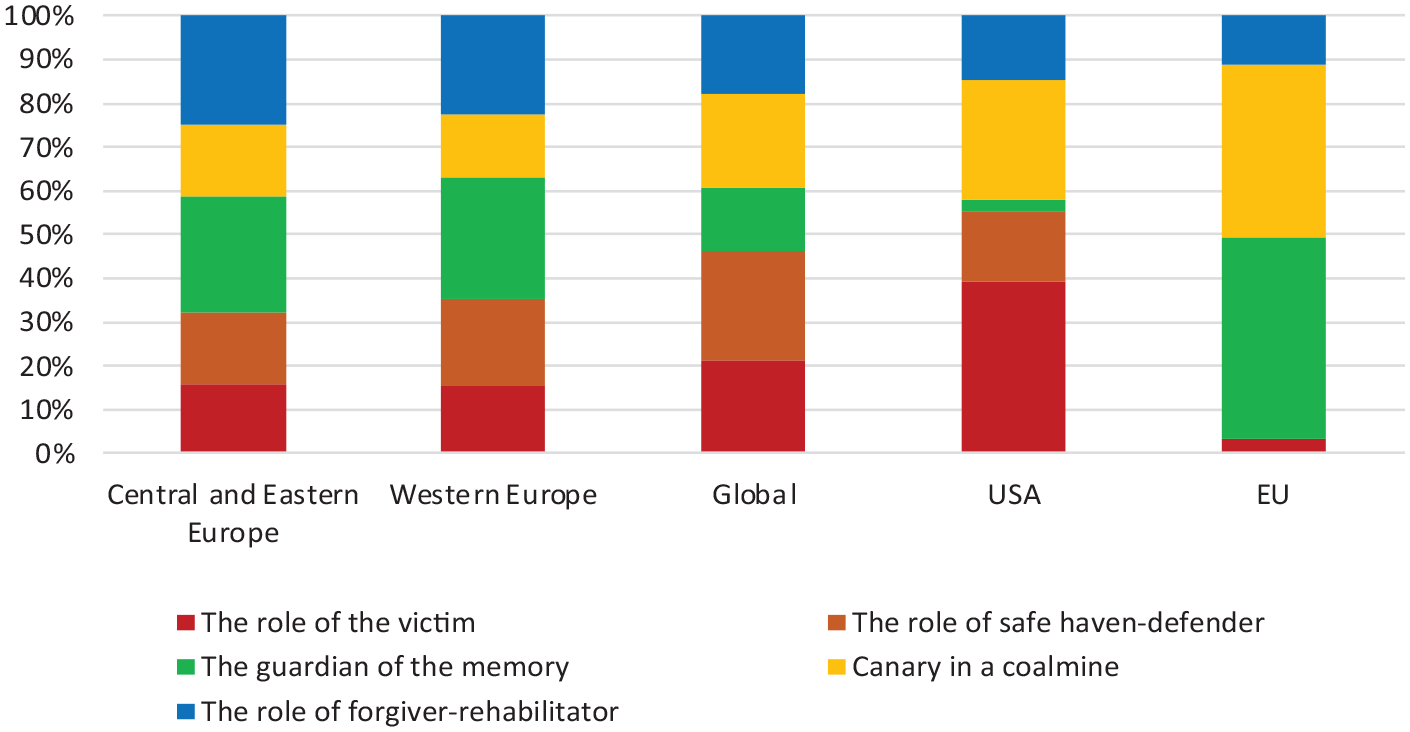
Percentual distribution of roles across the audience.
To sum up, Israel’s foreign policy discourse may appear inconsistent due to the presence of five distinct roles, oscillating between the ‘acting out’ and ‘working through’ modes of remembering. Yet, a closer examination shows that the security issue permeates all five roles. Iran is the dominant topic present in most of the roles. Based on Iran’s verbal and actual attacks, which play into Israel’s traumatic past, Netanyahu identifies a nuclear-armed Iran as an existential threat to Israel. Consequently, when adopting the prominent roles of the victim and the canary in a coal mine, Netanyahu articulates the right to act with strength against those who threaten Israel’s security and warns the international community against the danger emanating from a nuclear-armed Iran, expecting support and understanding for Israel’s concerns and policies. Netanyahu makes the topic of Israel’s security against threats from Iran and its proxies the dominant issue when addressing world leaders (the UN), as well as leaders from the United States and the EU. The constant fear of annihilation, linked to Israel’s traumatic past, thus permeates its foreign policy discourse. In parallel, our analysis shows that even a traumatized state like Israel is capable of ‘working through’ its trauma and can forgive and foster friendly relationships with former adversaries, as shown by the example of Germany. The success of this process is indicated by the fact that Israel no longer perceives the former perpetrator, who has recognized its trauma, as a threat.
Conclusion
Trauma impacts states’ foreign policy discourse and behaviour in different ways. While it has been shown that traumatized states typically engage in one of two broad modes of remembering (‘acting out’ and ‘working through’), we deepen our understanding of this phenomenon by moving beyond this dichotomy. In this article, we argue that traumatized states often oscillate between these two modes of remembering, discursively articulating foreign policy roles falling under the categories of ‘acting out’, ‘working through’ and a blend of the two.
While the most common and prevailing response to a trauma remains the ‘acting out’ mode of remembering, states also strive to ‘work through’ their traumas. Our analysis shows that the preferred mode of remembering depends on the nature of the discourse, the actual behaviour of past perpetrators and third parties, and on the type of audiences addressed. The forgiver role, emphasizing reconciliation over revenge, is assumed when third parties, especially perpetrators, recognize the trauma they caused. This shift occurs when perpetrators are no longer perceived as threats but as potential allies and even friends. Indeed, the acknowledgement of trauma is a crucial prerequisite for the ability and willingness of states to work through their traumatic experiences as it helps rebuild one’s sense of order and justice (Herman, 1992: 70; LaCapra, 2001: 141–146). Recognition thus plays a key role in transforming relationships, paving the way for reconciliation.
In Israel’s case, our findings reveal that Prime Minister Netanyahu articulates multiple foreign policy roles related to past traumas. While he predominantly chooses to present Israel as a victim in international fora, he simultaneously evokes the roles of a canary in a coal mine, safe haven, forgiver and guardian of the memory. What first appears to be contradictory rhetoric becomes intelligible when considering the way leaders of traumatized states respond to trauma. By presenting Israel as a victim, Netanyahu stresses the historical suffering of the Jewish people to elicit international empathy and support. The canary in a coal mine role reflects the state’s extreme vigilance stemming from historical threats and geared towards warning the world of potential dangers echoing past persecutions. The safe haven role underscores Israel’s identity as a refuge for Jews, justified by centuries of diaspora and persecution. As a forgiver, Netanyahu addresses the complex legacy of suffering and victimhood and displays the willingness to move forward when no longer feeling threatened by former perpetrators and when judging that Israel’s/Jewish victimhood has properly been recognized. Finally, the role of guardian of the memory ensures that the traumas of the past remain a guiding force in Israel’s national identity and foreign policy.
Although this article focuses on Israel, its analysis has broad applicability to other contexts. It offers valuable insights into the foreign policy roles of traumatized states – those that have experienced external attacks or are engaged in existential conflicts – where identity formation is deeply influenced by traumatic experiences. By examining how these states articulate their foreign policy roles and confront security challenges, we can uncover insights that transcend the specific case of Israel, revealing broader patterns and dynamics in IR. Based on the dominant response to trauma and the reactions of third parties, we can gauge whether traumatized states will tend to pursue the path of reconciliation or adopt a more defensive or even aggressive stance instead.
Future research might test the theoretical framework developed here on further empirical cases and add other potential roles to the palette. Moreover, given the importance of having one’s trauma recognized at the international level, future studies could explore the extent to which third parties are attuned to the nuances articulated in the different foreign policy roles of traumatized states. As our research shows, a more nuanced understanding of the unique impact of trauma on states’ self-understandings and response(s) can aid in restoring relations between former foes and thus long-term international security.
Footnotes
Acknowledgements
For careful feedback and helpful commentary at various stages of research and writing, we thank Adam Lerner, Avi Ben Zvi, Yoni Abramson and Ingrid Anderson. We also would like to thank Jiri Kocián for generating graphs which appear in this article and other technical assistance with NVivo, and Simon Pikovski for his work as research assistant.
Declaration of conflicting interests
The author(s) declared no potential conflicts of interest with respect to the research, authorship and/or publication of this article.
Funding
The author(s) disclosed receipt of the following financial support for the research, authorship and/or publication of this article: We gratefully acknowledge funding from the Charles University Research Centre Program PRIMUS/22/HUM/011.
