




Abstract
Calls for governments to proscribe white supremacist actors as ‘terrorists’ have increased in recent years, yet little attention has been paid to whether proscription of such actors ‘works’ and what consequences may arise from expanding counterterrorism apparatuses in this way. What happens when states bring violent white supremacist organisations under the counterterrorism umbrella? Using original data on Germany’s 70-year practice of banning white supremacists as ‘anti-constitutional’, this article uses the vehicle of terrorist proscription to explore the political work done by treating white supremacists as ‘terrorists’ in a legal, not only a discursive, sense. I argue that placing security efforts against white supremacists alongside questions of constitutionality and democracy invokes larger debates about German values and identity, rendering visible the role of white supremacy in constructing the German nation. Banning white supremacist organisations, then, becomes a policy instrument that provides a veneer of combating violence without confronting the embedded nature of the ideology underlying that violence. My findings that bans are overwhelmingly symbolic and offer little in the way of deeper political change have implications not only for German security policy, but also for cross-national studies of terrorist proscription and combating white supremacy in all of its manifestations.
In February 2021, the Government of Canada formally listed the Atomwaffen Division, the Base and the Proud Boys as terrorist organisations. The proscription of three US-based white supremacist groups in one fell swoop was unprecedented globally, and Canada would repeat itself in June, proscribing the Three Percenters and Aryan Strikeforce alongside US neo-Nazi James Mason. Speaking to the Proud Boys’ proscription in particular, Canadian Anti-Hate Network Chair Bernie Farber declared that Canada ‘had provided “a real service” to other countries’ by setting a precedent for using legal mechanisms to treat white supremacist groups as terrorist entities (Yosufzai, 2021).
Yet, Farber’s optimism about an international precedent has proven unfounded. As of writing, New Zealand is the only other country that has followed Canada’s lead in proscribing the Proud Boys (Coster, 2022). The Proud Boys remain emboldened in the United States, where members are organising openly ahead of the 2024 presidential election (Roston, 2024). In Canada, Proud Boys Canada announced its dissolution in May 2021, but many of the group’s chapters still exist under different names. As Ontario Tech University’s Barbara Perry put it, ‘Whether or not they’re wearing [Proud Boys] shirts is fairly immaterial if the ideology is still the same’ (Paling, 2021).
As calls to proscribe white supremacists as terrorists crescendo internationally (Birnbaum, 2019; Kaur, 2021; Pidd and Perraudin, 2016), how should we assess their consequences? The example of the Proud Boys in Canada illustrates that conventional measures of proscription’s efficacy, centred around attack patterns and operational capabilities, may fail to capture the full range of international activities in which a proscribed group engages (Best and Lahiri, 2021; Haspeslagh, 2021; Phillips, 2019). Yet, Perry’s point above hints at a larger problem, one linked to the prevalence and permissibility of white supremacist ideology. And if proscriptions in one country are meant to signal the wider legitimacy of placing white supremacists under the ‘terrorist’ umbrella, why have governments not caught on faster?
In this article, I argue that white supremacist proscription is neither a magic bullet nor a sign of slow-but-sure progressive change. Instead, patterns of white supremacist proscription (or non-proscription) reveal deeper issues of structural white supremacy at the heart of Western security apparatuses. Missing from most discussions of proscription’s efficacy is a consideration of the broader institutional environment in which it is embedded. Building on work that shows proscription involves negotiation of democratic states’ political identities as they juggle security and civil liberties (Jarvis and Legrand, 2020; Muller, 2008), I contend that proscription emphasises the contingency of membership in a national polity, one that remains defined in the West to the exclusion of non-white communities. Put differently, liberal calls to expand dominant ideas of what counts as ‘terrorism’ to include white supremacists, and by extension to apply counterterrorism tools to them, are not liberatory manoeuvres. White supremacist proscription may actually further white supremacy by employing a policy instrument that does not challenge the power structures that enable white supremacist violence in the first place. As such, I build on critiques that link liberalism and white supremacy, stressing that the latter, in either its structural or most physically violent forms, is not at odds with the former (Beliso-De Jesús and Pierre, 2019; Kundnani, 2023).
An obstacle to studying white supremacist proscription is that it seems to be a relatively rare event (though see Búzás and Meier, 2023). I proffer Germany as an empirical corrective to this common narrative. Since 1951, the German state and individual provinces have had the power to proscribe domestic non-state actors as ‘anti-constitutional’. Over 80 white supremacist groups have been banned under this mechanism, including several proscribed as ‘terrorist’ in other jurisdictions. This range of cases provides a unique opportunity to examine the politics and effects of white supremacist proscription. I present a comprehensive, English-language data set of white supremacist bans in Germany, compiled via analysis of government publications, archival news sources, secondary academic literature in English and German, and statements from banned groups themselves (see the Supplemental Appendix for further information on specific sources). Closer examination of these official and unofficial discourses around banning informs a case study of bans and their effects in North Rhine–Westphalia, Germany’s most populous state. Overall, I demonstrate that, through widespread use of the banning mechanism, Germans avoid conversations about the actual physical targets of white supremacy – most commonly, German Muslims and/or migrants of colour. In effect, then, conversations about white supremacist bans, though often framed as concerned with protecting German society, reiterate a particular idealised conceptualisation of German society as homogenously white. This furthers the very white supremacy that bans ostensibly seek to address. Banning, then, is not only ineffective but also counterproductive – if the goal is in fact to protect people from white supremacy.
My argument and evidence have implications beyond the German case, weighing on several key questions in the study of terrorism, extremism and neoliberal institutions. A key substantive contribution is to the nascent literature on the proscription of actors alternately termed ‘right-wing’ or ‘white supremacist’ as terrorists or extremists (Búzás and Meier, 2023; Zeller and Vaughan, 2023). Rather than examining why specific organisations are or are not proscribed, I focus instead on what proscription does, intentionally or otherwise, and bring arguments from Critical Terrorism Studies on race and racism as foundational to counterterrorism institutions into the proscription literature (Abu-Bakare, 2022; Khan, 2023; Manzoor-Khan, 2022). In doing so, I underscore that neoliberal institutions are neither apolitical nor post-racial, but instead work to reconstitute racism within newer security discourses under the guise of seeming neutrality (Kundnani, 2021).
A second implication of this article throws the danger of assumed neutrality into sharp relief: the importance of shifting policy and institutional conversations towards considering structural white supremacy and white supremacist violence as part of the same story. As Dixit and Miller (2022) note, equating white supremacy solely with its most physically violent manifestations obscures its enduring systemic and societally embedded role in white-majority countries as a force shaping and affecting all social relations. Divorcing white supremacy from its ‘Hitlerian connotation’ (Rutazibwa, 2016) reveals how mundane white supremacist processes and practices actually are – including in how governments construct and respond to security threats. Newer counterterrorism institutions, such as proscription, do not simply perpetuate older forms of racism; they also generate distinctive structures of racism that uphold white supremacy in ways that may not feel immediately familiar (Kundnani, 2021: 58–59). Accordingly, the study of white supremacist proscription underscores that national security institutions, as entities constituted through and reproductive of white supremacy, are likely unequipped to deal in truly effective ways with white supremacist violence, raising concerns about placing white supremacy under the terrorism umbrella in the first place.
A conceptual clarification is in order before proceeding. By ‘white supremacist violence’, I mean actions of groups more commonly referred to as ‘far-right extremist’ or ‘far-right terrorist’. Indeed, there is no direct translation of ‘white supremacy’ in German, with ‘Nazism’ serving as an imperfect stand-in, such that my invocation of the term in the German context is a choice many Germans would themselves be unlikely to make. This lack of linguistic infrastructure for naming white supremacy beyond the Nazi moment is itself revealing of the limits of the German imagination when it comes to viewing racism as a long-standing structural feature of German society. I therefore choose to invoke the term ‘white supremacy’ in direct relation to violence that is partly but not solely Nazi to underscore that white supremacy is not only an input to physical violence, but also an ordering principle. This framing leaves open the door for exploring connections between violence and the web of ideologies, systems, privileges and personal benefits that produce unequal outcomes along racial lines across multiple categories of life (Belew and Gutiérrez, 2021: 5). White supremacy, then, is a standpoint based on assumptions and commitments that perpetuate a racialised hierarchy (Sabaratnam, 2020), with ‘white supremacist violence’ an imperfect gloss for its physically violent manifestations.
The rest of this article proceeds as follows. First, I situate my argument within existing discussions of proscription, especially what it means for proscription to ‘work’, and consider how these discussions might apply to white supremacist violence. Next, I argue that white supremacist violence is a structural problem that proscription, as a feature of that structure, cannot properly combat. Instead, proscription becomes a matter of perpetuating exclusionary conceptions of national identity. I then introduce the German case in more detail and provide an overview of the data on German white supremacist bans. I follow this with a case study of banned organisations in North Rhine–Westphalia to trace the processes by which proscription is put forward and its effectiveness or lack thereof. Finally, I conclude with implications of my findings for the study of terrorist proscription, white supremacist violence and structural white supremacy.
Proscription as a tool of racial governance
I begin by situating my argument about German banning practices within existing research on terrorist proscription. Proscription, designation, or listing is a practice by which a government legally classifies an organisation or individual as a terrorist actor. Independent from discourse describing various actors as ‘terrorists’, proscription enforces a legal categorisation with an attendant rash of penalties. These can include asset freezes or seizures, financial sanctions, criminalisation of providing ‘material support’ to listed actors, bans on possession and distribution of propaganda, restrictions on freedom of movement and in some cases, full criminalisation of membership. In all cases, the mechanism through which these penalties are levied is the official application of the ‘terrorist’ classifier, through which an actor’s illegitimate status is written into law. Political elites may call an actor ‘terrorist’ all they like, but it is the act of proscription that triggers particular policy consequences.
This article builds on the proscription literature in three ways. First, and most practically, I investigate the specific proscription of white supremacist actors, which has received minimal scholarly attention (cf. Búzás and Meier, 2023). I also engage directly with attempts to broaden the conceptualisation of proscription’s ‘efficacy’ to include its impacts on political actors and institutions beyond specific listed groups. Most significantly, I expand this constellation of affected actors and institutions to include material and ideational structures, such as white supremacy. This consideration of political institutions as constituted by and constitutive of white supremacy is a common starting point in critical and decolonial literature on ‘counterterrorism’ practices (e.g. Manzoor-Khan, 2022) but has thus far been largely absent in discussions of proscription as one of those practices.
Traditional discussions of proscription’s effectiveness focus on the outcomes of decreased attacks or increased operational difficulties for listed organisations, with empirical studies providing inconclusive results at best (Jo et al., 2020; Phillips, 2019; Walker, 2000). Recent work has redefined efficacy to include detrimental impacts of proscription on other actors, including non-governmental organisations (NGOs) (Haspeslagh, 2013; Sidel, 2010), conflict mediators (Palmiano Federer, 2018; Sentas, 2018), researchers (Sabir, 2022; Zelin, 2021) and asylum-seekers (Schulman, 2010). More than warning about negative consequences of proscription, these studies highlight that proscription exists within a broader universe of institutions and actors whose ideas and interests shape and are shaped by notions of the ‘terrorist’ – notions which, the proscription literature only occasionally recognises, are heavily racialised (Beck and Miner, 2013; Búzás and Meier, 2023; El-Masri and Phillips, 2024). Racialisation plays a role not only in what organisations are proscribed but also, I argue, in the ability of proscription to be an effective policy tool in the first place.
The role of racialisation takes on new dimensions when the targets of proscription look like the individuals doing the proscribing – that is, (mostly) white people proscribing white supremacists. I argue that the web of relevant institutions and practices touched by proscription in such situations must also include institutions and practices that make political violence possible in the first place, which in the case of white supremacist violence includes white supremacy itself. Of course, not all policies aimed at political violence can address every part of what is ultimately a complex phenomenon. Proscription is a legal tool, and its capacity to target deep structural issues will always be limited. At minimum, however, proscription should not strengthen white supremacy, no matter how inadvertently. I contend that proscribing white supremacists, while perhaps signalling a government’s commitment to combating a broader range of violence, may in fact achieve this result.
At its core, proscription in North America, Europe and Australia/New Zealand 1 is an instrument for marking legitimate versus illegitimate violence, one that employs the label of ‘terrorist’ to scold and punish actors that challenge the boundaries of accepted political contention vis-à-vis a white liberal democratic polity – a construct I unpack below in the context of Germany. By positioning challengers to the ‘hegemonic order . . . of Western dominance’ as terrorists (Gentry, 2020: 26), governments invoke a category understood as ‘qualitatively different’ from other forms of violence (Huff and Kertzer, 2018: 56). This constructed qualitative difference is then used to sanitise the circumscription of rights in the name of national security. Though those existing outside of mainstream politics have always faced restrictions on their ability to enjoy the full rights accorded to others, painting these restrictions as a national security matter through the lens of counterterrorism makes them seem permissible in a state that is, after all, only out to protect its citizens.
What happens when policymakers attempt to stretch the boundaries of the ‘terrorist’ label to include hegemonic actors – namely, white supremacists? In December 2016, the United Kingdom became the first country to designate a white supremacist organisation as ‘terrorist’, proscribing neo-Nazi group National Action under the Terrorism Act 2000. Since then, Australia, Canada, New Zealand and the United States have joined the United Kingdom and cumulatively proscribed 14 different white supremacist organisations as of writing.
Though white supremacists are often anti-state and may not support democratic systems of governance, 2 their ideologies do not fundamentally threaten liberal democracies built on whiteness. The idea that white people, and particularly white cisgender heterosexual able-bodied men, should enjoy privileges not given to others is foundational to both white supremacist thought and European and North American societies, even if in a less blatant form in the latter cases. As Federal Bureau of Investigation (FBI) operations against the Ku Klux Klan in the United States in the 1960s and 1970s demonstrated, the problem with white supremacy was understood not as one of ideology, but of exceptionally violent methods for enacting that ideology, sidelining racism as a threat (Cunningham, 2003; Winter, 2018). Likewise, federal attempts to make sense of a white supremacist bombing in Oklahoma City in 1995 invoked comparisons to attacks by al-Qaeda and Japanese doomsday cult Aum Shinrikyo rather than other instances of white supremacist violence, illustrating the tight mental link between ‘terrorism’ and a non-white Other (US House of Representatives, 1995: 10).
Accordingly, there is serious doubt as to whether extending the ‘terrorist’ label to white supremacists – a label that exists to shut down discussion of the validity of counterhegemonic resistance – is actually productive in any meaningful sense. To quote Diala Shamas and Tarek Ismail (2021), ‘Using the right words doesn’t flip some magical switch that forces agencies to go after those plotting harm. . . . the decision to do so . . . is largely determined by a combination of ideology and power’. The United States’ single white supremacist terrorist proscription, of the Russian Imperial Movement (RIM), illustrates these dynamics. Though RIM’s designation was deemed ‘appropriate’ and ‘important’, RIM did not operate in the United States, nor had it been linked to any high-profile attacks (Meier, 2020b). As a former State Department official told me, RIM’s designation operated as a ‘fig leaf’ to those demanding greater action against white supremacists in a charged political climate, providing the illusion of targeting white supremacists without putting any contentious domestic political issues on the line. As in the 1960s and 1970s, deeper issues of racism remain outside the box labelled ‘threat’, casting doubt on the efficacy of proscription and other counterterrorism measures if the end goal is protecting all citizens.
That proscription may be ineffective, whether against white supremacists or others, is clear. How it might further white supremacy, however, requires further explanation.
White supremacy by other means
Overlooked in much political science literature on white supremacist violence is that the activities of those termed, alternately, far-right extremists, far-right terrorists and white supremacist terrorists do not encompass the universe of white supremacy. Though such activities are abhorrent, they exist as part of a larger spectrum of behaviours, practices and institutions that coalesce around whiteness as both the default and the superior way of being. In his analysis of settler colonialism and its legacies, Mills (1997: 20) notes that the world ‘has been foundationally shaped for the past five hundred years by European domination and the gradual consolidation of white supremacy’. White supremacy, he underscores, ‘made the modern world what it is today’ (1).
Such a formulation sits uncomfortably in a literature, to say nothing of a worldview that views racial progress as linear and instances of racist violence as aberrations. Yet, it highlights the enduring violence within a white supremacist system and that it is perpetrated overwhelmingly from above rather than from below – ‘the rule itself as standard operating procedure’ rather than exceptions (Martinot and Sexton, 2003: 170). White supremacy is thus not ‘only’ the most extreme of militant racist groups, but also the ‘daily reenact[ment]’ of white domination across social settings (Ansley, 1997: 592). The discomfort lies in its mundane nature: something that happens daily, and that is allowed to happen daily, must certainly not be that bad and certainly not rise to the level of the worst white supremacist events in history (in the German context, e.g. the Holocaust). Indeed, speaking of events like the Holocaust and everyday racism in the same breath is constructed as a devaluation of the very concept of racism (Rutazibwa, 2016), thereby allowing the everyday to persist.
Questioning white supremacy in a systemic or structural sense, then, means calling into question aspects of our ‘daily-being-in-the-world’ so normalised as to seem natural (Gillborn, 2006: 335). For majority white institutions, there exists both little incentive to do this – white institutions, after all, benefit from white supremacy even if they do not intend to – and few if any cognitive scripts to make doing so thinkable in the first place. James Baldwin, in a letter to his teenage nephew discussing white reckoning with changing social relations in the United States, illustrates this mental wall:
Try to imagine how you would feel if you woke up one morning to find the sun shining and all the stars aflame. You would be frightened because it is out of the order of nature. Any upheaval in the universe is terrifying because it so profoundly attacks one’s sense of one’s own reality. (Baldwin, 1962: 9)
Viewing white supremacy as something beyond seemingly isolated acts of violence thus requires shifting reality. Ignoring white supremacy, then, becomes not only a comfortable choice for whites but also an act of self-preservation.
Such self-preservation is especially acute within institutions tasked with national security – that is, with self-preservation on a national scale. Institutions perpetuate the exceptional understanding of white supremacy, whether by equating it with the Holocaust or some other historical atrocity, to normalise and maintain systems of racialised domination (Bonds and Inwood, 2016; Smith, 2012). Accordingly, national security institutions deal with actors who step outside the bounds of this normalised understanding, intentionally or otherwise and thereby make the contingent nature of that understanding visible. Contemporary police forces can trace direct links to colonial institutions of domination, highlighting the continuity of white supremacist practices from the settler colonial era to contemporary mechanisms of control deployed against communities of colour in both former colonies and former coloniser states (Paulson-Smith, 2022; Schrader, 2019; Seigel, 2018). Counterterrorism institutions, growing as they did out of this policing apparatus (Meier, 2022), continue the process of imperial domination via familiar methods cloaked in language that justifies invasion, occupation and violence in the name of global (white) security. Indeed, as Abu-Bakare (2022: 229) discusses in her analysis of the ‘white logic’ of counterterrorism practitioners in the United Kingdom and Canada, mechanisms of whiteness in counterterrorism spaces ‘ensur[e] that imperialism continues’ via expanding a security apparatus that views the non-white Other as the source of eternal and existential danger. 3
I argue that this logic can be productively extended to institutions of terrorist proscription. To return to a first-order question – why have states used proscription mechanisms so rarely against white supremacists – I contend that the answer lies in the need to preserve the white supremacy of security institutions themselves. Shifting focus towards white supremacists goes beyond risking illuminating the deep connections between policing, intelligence, the military and non-state white supremacist militant organisations, though it certainly does this as well (German, 2020; Miller-Idriss, 2020). It also demonstrates the frailty of attempts by national security institutions tasked with upholding structural white supremacy in tackling parts of the white supremacist spectrum. Proscription remains disconnected from any structural conversations about white supremacy, yet it is presented as at least a partial solution to the white supremacist problem. This illusion of ‘doing something’ may then, however inadvertently on the part of individual policymakers, allow white supremacy to persist.
The German case
Studying the effects of white supremacist proscription requires that white supremacist proscription in fact occur. It is, however, quite uncommon. Of 94 organisations proscribed by the United Kingdom, only five are white supremacist; among hundreds of organisations proscribed in the United States across a variety of designation mechanisms, just one is a white supremacist group. The recency of these mechanisms – the United Kingdom proscribed its first white supremacist group in 2016, the United States in 2021 – furthermore makes understanding long-term efficacy difficult.
The German case, I argue, offers a corrective. The German banning system (Vereinsverbote) for organisations exists in a liminal space between terrorist proscription and party bans, 4 where organisations are banned as ‘anti-constitutional’ rather than ‘terrorist’. While the German system is therefore not an exact parallel to precisely terrorist designation mechanisms that exist in the United Kingdom, United States and other Global North countries, it is often used against the same organisations deemed ‘terrorist’ elsewhere. Blood & Honour and Combat 18, two of the very few white supremacist organisations proscribed as ‘terrorist’ anywhere in the world (in the United Kingdom and Canada, respectively), are banned as anti-constitutional in Germany. Likewise, the Islamic State and other notorious actors considered ‘terrorist’ under the law elsewhere are targeted in Germany via the Vereinsverbote. 5 The Vereinsverbote, then, operates within the same narrative universe as terrorist proscription mechanisms in terms of classifying legitimate versus illegitimate violence in the eyes of the state. Moreover, the country’s ability and historical willingness to ban a plethora of white supremacist organisations deserves further consideration, especially given increased calls elsewhere in Europe and North America to target white supremacists with bans.
The Vereinsverbote allows legally defined ‘associations’ to be banned if they are found to oppose the ‘constitutional order’, an act that constitutes acting against democratic values such that the ‘peaceful coexistence’ of individuals within Germany is intentionally disrupted. In statute, this is specified as Völkerverständigung, or ‘international understanding’, a term signifying a commitment to non-violent means to resolve disagreements between different groups. In practice, then, bureaucrats must assemble dossiers showing that an association has violated German criminal law in such a way as to disrupt the public order for purposes viewed as antidemocratic. Calling for overthrowing the German state, for example, would class legally as anti-constitutional for purposes of the Vereinsverbote. By extension, so too would advocating for the return of National Socialism (Nazism). Committing or calling for attacks against marginalised communities – a category that in Germany is often understood as synonymous with individuals with a ‘migration background’ (Migrationshintergrund), which carries connotations of ‘non-white’ – also makes organisations eligible for banning.
The Federal Ministry of the Interior and its analogues at the province/state level have the sole power to ban associations. 6 The de-listing of associations is rare, as reversing a ban requires an administrative court to rule that the ban violates an individual’s fundamental rights under German law. This creates a catch-22 for association members, who cannot appear in court as admitted members of a banned association without opening themselves up to criminal liability. Attempts to challenge bans on the grounds that a listed association does not actually qualify legally as an ‘association’ – meaning in Germany that they are not formally registered as such – have been marginally more successful, as in the case of de-listing the far-right hooligan group Blue White Street Elite in 2010 (Stern, 2010). Despite the nominal possibility of reversing bans, most resound with a sense of finality, and many organisations remain banned after they have long since ceased trying to operate.
Thus, the process of invoking the Vereinsverbote underscores both its comparability with terrorist proscription regimes in other countries and its role in performing neoliberal democracy in Germany. Much like discourses in the United Kingdom that position so-called violent extremism as opposed to ‘fundamental British values’, the Vereinsverbote links legitimacy and liberal values, constructing ‘terrorist’ and ‘extremist’ acts as those that call into question the supposed universal application of values of individual liberty and tolerance in European and North American contexts. The Vereinsverbote’s linking of sociopolitical beliefs with the enacting of violence further mimics how ideology and violence become intertwined in legal conceptions of ‘terrorism’ in the United States and United Kingdom (Búzás and Meier, 2023). It is reasonable, then, to place the Vereinsverbote in conversation with terrorist proscription regimes, in no small part because doing so reveals the sometimes unspoken neoliberal ideological commitments at the heart of the proscription enterprise – commitments that contribute to what Wendy Brown calls a ‘hollowing out’ of traditional democratic values (Brown, 2006: 692). This can, in turn, reveal such values’ contingent and partial character.
The partiality of these democratic values is on full display in the principle of ‘militant democracy’ (streitbare Demokratie in German), on which the Vereinsverbote in its current form is based. The concept, coined by Karl Loewenstein in 1937, proposes that the survival of a democracy requires aggressive struggle against those who would threaten it – in other words, ‘fight[ing] fire with fire’ (Bourne and Veugelers, 2022: 736; Loewenstein, 1937; Nolan, 2012). Adopting militant democracy as a core principle of the West German state post-WWII meant believing that democracy was so important that antidemocratic practices could be permitted if they would help to maintain it. The tension in this statement – pursuing antidemocratic practices in service of democracy would, it seems, reveal the contingency and partiality of democracy rather than elevate it as an idealised form of government – produced a policy environment wherein limitations on civil liberties were routine and accepted in service of West Germany’s, and later unified Germany’s, positioning as a part of the international liberal democratic order.
Invocations of the Nazi era, an authoritarian threat widely classed as exceptionally abhorrent and requiring exceptional responses, are necessary to square the circle. 7 Casting Nazism as the archetype of antidemocracy has been encouraged by the international community, especially after German reunification in 1990. This encouragement manifested, on one hand, in Erinnerungskultur (‘remembrance culture’) and an insistence on public, performative commemoration of the Holocaust as a unique atrocity whose recurrence the community of liberal states must prevent at all costs (Moses, 2021). On the other hand, the desire to assure Germany wed itself to the West rather than the former Soviet bloc prescribed the quick integration of unified Germany into institutions like the European Community (Hayes and James, 2014) that proselytised neoliberal capitalist politics. Though debate remains over the extent to which international versus internal pressures produced Germany’s Westward orientation and national culture of remembrance post-reunification (Lang et al., 2017), the result was a Germany where democracy meant an ideological fight against Nazism via any means necessary – a fight, that, if executed well, would ensure Germany’s membership in a Western-led global hierarchy.
Overlooked in this development of militant democracy in Germany are those harmed most directly by antidemocratic practices: people of colour considered foreign or ‘Other’ to the German polity. Stifling political opposition narrated as a threat to German democracy has resulted in, for example, a ban on all pro-Palestinian rallies in Berlin in May 2022 during the anniversary of the Nakba, following a 2019 resolution in the Bundestag declaring protests against Israel’s policies as antisemitic (Unicomb, 2022). Anti-Muslim racism has become increasingly common in public discourse (Attia, 2009). Likewise, the singular focus on the Nazi era as the prototypical harm from which German democracy must protect itself (Moses, 2021) has written other instances of genocide, specifically colonial Germany’s genocide against the Herero and Nama people in what is now Namibia, out of the narrative of German racism and identity construction (Samudzi, 2021). This ignorance of historical anti-Black violence bleeds into current race relations, with the 2020 ‘Afrocensus’ finding that over 90% of Black Germans report being disbelieved by others when they discuss experiences of racism (Witting, 2021).
Understanding that the German state’s idea of defending democracy involves the assertion of neoliberal principles illuminates why widespread racism remains a feature, not a bug, of Germany’s democratic identity. As Roberts and Mahtani (2010: 248) argue, neoliberalism is ‘fundamentally raced’, with attempts to reduce an individual’s sociopolitical standing to a neutral function of ‘merit’ masking and modifying racism as a set of normalised, everyday practices (Giroux, 2005). Accordingly, German national identity refracted through the prism of neoliberalism harms people of colour by excluding racial and ethnic difference as a category of public discourse. The reunification narrative of ‘Wir sind ein Volk’ (we are one people), an attempt to repurpose ‘Volk’ from its Nazi-era connotations to reference a unified democratic Germany, papered over a surge in violence against non-white refugees and asylum-seekers in the early 1990s. In 1990, the new German state reported 270 incidents of racist violence; in 1991, that number increased to 1,483; in 1992, it was 2,584 (Panayi, 1994). The most infamous instance, a pogrom at an apartment complex for refugees in the eastern city of Rostock in 1992, drew applause from onlookers (Jüttner, 2007). Yet Germany continued to present itself internationally as unified, peaceful and tolerant – a necessary projection to distance the country from its Nazi past and enable its continued admittance to Western institutions. The new Germany could afford no cracks in its façade. As a result, German identity was put forward as particularly Western, and Western identity, by extension, as an unmarked norm (Lewicki and Shooman, 2020).
Militant democracy in Germany, then, means defending the country not only from Nazi-style authoritarianism but also against any accusations of racial discord. Whether to emulate other neoliberal democracies’ colour-blind attitudes towards racism at home or to present a unified and uniformly happy front to international observers, the German government, and German society by extension, refuses to consider racism as a systemic problem. To quote human rights lawyer Eddie Bruce-Jones, commenting on his experience defending the family of a Sierra Leonean asylee burned alive in a German detention cell in 2005, ‘many don’t believe racism affects Germany enough to warrant policy change’ (Bruce-Jones, 2017: 33). This belief, in turn, allows racism to persist within the bounds of a democratic state that pins all racist threats to one variety of hate – Nazism – while allowing others to persist unacknowledged.
This dominant view of racism shapes not only race relations and public discourse in Germany, but also more formalised mechanisms for dealing with racist threats, including the Vereinsverbote. 8 Perhaps paradoxically, analysis of the Vereinsverbote reveals that German institutions are inadequate for addressing even the most obvious and agreed-upon examples of white supremacy. Indeed, it is not uncommon in academic literature on the Vereinsverbote to discuss the neo-Nazi threat as primarily against the democratic order, rather than the safety and security of Germans of colour or Jewish Germans (Backes, 2019; Minkenberg, 2006). While the Vereinsverbote does frame the grounds for proscription in this way, the lack of critique or alternative framings offered underscores the normalisation of viewing the existence of white supremacist violence as a threat to dominant institutions instead of ordinary people.
As of writing, Germany has banned 87 9 white supremacist organisations, an average of 1.26 per year, far exceeding any other country (Figure 1). 10 Historically, bans have tended to happen in lumps, with the largest subset of organisations banned in the 1950s before bans dropped off in the 1960s, only to resurge after reunification in 1990. A full list of banned white supremacist groups and the dates and locations of their bans is available in the Supplemental Appendix.
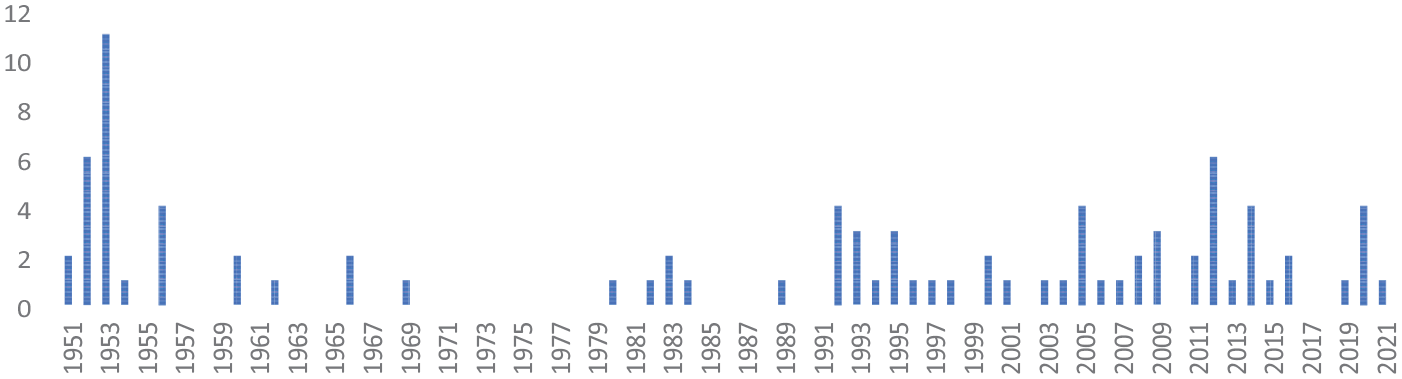
White supremacist groups proscribed in Germany per year, 1951–2021.
Despite the extent of these bans, white supremacist violence remains a serious problem in Germany. Interior Minister Nancy Faeser (2021) declared right-wing extremism the ‘greatest threat to [German] democracy’ on her first day in office. Germany’s most high-profile terrorism case of the 21st century came from the neo-Nazi National Socialist Underground who, over 7 years, had committed a string of murders and bombings against non-white immigrants that authorities treated as unrelated (Köhler, 2016). In 2021, the Federal Office for the Protection of the Constitution (Bundesamt für Verfassungsschutz (BfV), 2022) reported 945 acts of ‘right-wing extremist violence’ and identified 13,500 violent right-wing extremists living in the country. Such widespread violence is not the provenance of a country that has its white supremacy problem under control, even when white supremacy is defined narrowly as physical violence.
Existing research suggests that the Vereinsverbote is used primarily due to public pressure and negative publicity for the government. The return to banning white supremacists in the 1990s, for instance, may have been in response to accusations directed against the Christian Democratic Union (CDU) of ignoring the aforementioned surge in racist violence during that period (Botsch et al., 2013; Wise, 1998). That there exists widespread appetite among the German public for targeting outright violence is difficult to dispute. At the same time, attempts to use banning mechanisms against political parties, while legally possible, have attracted far more controversy, indicating the narrow understanding of white supremacy as white supremacist physical violence in Germany. A proposed ban against the neo-Nazi National Democratic Party (NPD) in 2017, facing charges of encroaching authoritarianism, proved too much even within the ideology of militant democracy: the Federal Constitutional Court concluded that the NPD did not pose an actual threat to the democratic order because of its low level of ‘impact on society’ (Backes, 2019: 144). 11
The point is that the Vereinsverbote, whether or not it was intended to target white supremacist violence, simply is not equipped to do so because of a circumscribed understanding of white supremacy in Germany. This is not to say that banning white supremacists is the most or even an effective mechanism for tackling white supremacy. As discussed, work on proscription casts serious doubt on its effectiveness at combating physical violence, much less structural violence. I suggest, rather, that the Vereinsverbote reveals that this ineffectiveness comes from reinforcing structural white supremacy, which encourages a vicious cycle of wilful ignorance of the extent of the white supremacist problem. To flesh out this argument further, I turn to a specific case of white supremacist bans in Germany to trace the ways proscription has furthered white supremacy.
White supremacy in North Rhine– Westphalia
‘We have torn three holes in the right-wing extremist network’, declared Ralf Jäger in Düsseldorf on 23 August 2012. Jäger, interior minister of the German state of North Rhine Westphalia (NRW), had just banned three violent neo-Nazi groups as anti-constitutional. A month earlier, he had banned a fourth. It was the first time the Government of NRW had banned a white supremacist organisation in almost 20 years. Yet, as further analysis will show, these bans served primarily to reiterate a narrow conception of German identity – one that does not fundamentally challenge white supremacy.
With a population of almost 18 million, NRW is the most populous of Germany’s 16 Bundesländer (states). It is also one of its most diverse: in 2020, between 28.7% and 31% of residents had a ‘migration background’, a category encompassing those with ethnic ties outside of Germany (Statisches Bundesamt, 2022). As a centre for commerce – nine of the country’s 30 largest publicly traded companies are headquartered there – and politics, NRW has been referred to as a ‘microcosm’ of the rest of the country (Spiegel, 2012). With respect to white supremacist violence specifically, NRW was one of a handful of Western German states in which murders and bombings linked to the National Socialist Underground took place between 2000 and 2007 – a revelation that only came to light in 2011 and shook the country (Graef, 2020; Meier, 2020a). That NRW responded the following year with a rash of bans suggests a reactive rather than proactive motivation for attempting to address white supremacy, a common way for bans to play out in Germany (Laumond, 2020). In short, what happens in NRW has significant implications for all of Germany – including but not limited to its security politics.
Furthermore, NRW occupies a significant position in the German national imaginary as the largest state in the former West Germany and the site of the former West German capital, Bonn. The state as a site of Germany’s neoliberal, pro-Western democratic identity was deeply entrenched for 40 years and remains strong even after reunification. Indeed, Jäger was quick to frame his four white supremacist bans in terms of democracy protection and promotion. ‘All of their [white supremacist] actions are aimed at undermining our democratic social order’, he said. ‘They endanger peaceful coexistence in our country. And that’s what makes them so dangerous’ (Jäger, 2012).
Left unspoken are the ways in which the bans themselves endangered ‘peaceful coexistence’, at least among racialised populations facing increased policing from security forces empowered by the state’s new focus on local violence. Indeed, Jäger positioned a police response as essential: ‘Organisation bans and consistent prosecution of crimes . . . are just as important as increased political education and expansion of our exit programs’. 12 Police in NRW have, however, been characterised by neo-Nazism themselves. In 2016, police in the NRW city of Cologne responded to reported incidents of sexual assault by ‘North African-looking’ men, which attracted national attention, by presenting anti-discrimination norms as barriers to addressing ‘immigrant criminality’ (Boulila and Carri, 2017: 290). Four years later, 29 NRW officers were suspended for sharing neo-Nazi imagery in a group chat (BBC, 2020). Following an investigation, the NRW police declared themselves ‘free’ of far-right influence 6 months later; they would come under scrutiny yet again after more racist chats were uncovered in November 2021 (Peoples Dispatch, 2021). The case of the NRW police highlights that the very state institutions empowered to fight white supremacist militancy themselves have a white supremacist problem, and thus, it could be argued that giving more resources to such institutions in the name of countering white supremacy in fact strengthens it.
Following Jäger’s announcement of three bans in August 2012, approximately, 900 police officers carried out coordinated raids in 32 cities across NRW – an enormous operation, but not a unique one in light of the years to come (Jäger, 2012). The extent of such coordinated operations, called ‘Razzia’ (literally, raids, though the term carries colonial connotations 13 ), is evident in a 2018 operation in the NRW city of Essen, wherein around 100 police officers raided 100 shops and bars and performed checks on 600 people in partnership with customs and immigration officers (Streife, 2018). Though a smaller raid than those in the aftermath of NRW’s white supremacist bans, the coordination across government agencies underscores the expansion of state security powers in the aftermath of counterterrorism initiatives – an expansion targeted, in this case, against poorer racialised communities in Essen’s ‘inner city’ who had, according to officers, behaved aggressively towards police.
Sceptics might note that the German police force is a sprawling, multifaceted organ of state power and a strengthening of one branch does not imply the strengthening of another. Indeed, a ban does not automatically trigger the allocation of more resources for police operations. Nevertheless, the enforcement of bans happens via policing and reinforces discursively the power of police institutions, which are profoundly and structurally racist. A 2020 study conducted in NRW on citizen perspectives on policing found that 62% of respondents of colour had had encounters with police they described as discriminatory; this and other findings led the study’s authors to conclude that discrimination is a structural issue within German policing (Abdul-Rahman et al., 2020: 7). ‘There are simply too many of them’, lead author Laila Abdul-Rahman said in reference to the argument that racist police encounters are isolated incidents (Grundmann, 2020). Meanwhile, an analogous study by the federal government was halted after ministers claimed researching racial profiling would reinforce the ‘false’ idea that it existed, echoing claims from 2011 that racial profiling among police in Germany was not real, in contradiction of the lived experiences of people of colour (Washington, 2022). The point is not that enforcement of bans would work better if assigned to a different agency, but rather that the German state continues to assign state institutions the problem of white supremacy without an understanding of the white supremacy constituting those very institutions.
Notwithstanding the structural consequences of banning practices for people of colour, Jäger’s white supremacist bans in NRW were also ineffective against the precise groups he had targeted. ‘Even though the group is banned, the activists will remain’, one neo-Nazi wrote on an online message board after the bans were announced (Brandstetter, 2012). True to their word, by the end of the year, members of the four banned groups had re-constituted under the name Die Rechte (The Right) and had been formally recognised as a political party by the NRW government. The utility of the ban of Nationaler Widerstand Dortmund in particular was so poor that antifascists in Dortmund in 2022 rallied specifically to call attention to the ineffectiveness of the ban 10 years prior (Nordstadtblogger, 2022). With hindsight, the words of a member of another banned organisation, Berliner Alternative Süd-Ost, are eerily prescient: ‘A name was banned. Nothing more!’ (Schuhmann, 2005).
It is typical to describe Vereinsverbote, as Jäger did, in terms of preserving democratic values – these are, after all, the grounds in statute under which a ban becomes permissible. The perceived sense of threat to these values is emphasised in the state’s declaration that white supremacists in NRW had committed ‘intellectual arson’ (Brandstetter, 2012). At stake were not so much the lives and well-being of white supremacists’ victims, but NRW’s and by extension Germany’s ontological well-being as purveyors of neoliberal democratic values that mask race and racism. The language of the Vereinsverbote, then, creates an ostensible national security mechanism that enshrines and perpetuates a vision of the German state that, as the empowerment of police forces illustrates, cannot in fact achieve the ‘peaceful coexistence’ the mechanism claims to protect. As the aftermath of the bans in NRW shows, white supremacist proscription is a tool for furthering a particular narrow conception of state identity, not protecting communities both threatened by political violence and historically excluded from state identity. Structural white supremacy is therefore furthered, not challenged, by proscription.
Conclusion
On 7 December 2022, German police conducted their largest raid against the white far right in history. Some 3,000 officers across 137 sites targeted individuals accused of planning a far-right coup, spearheaded by members of the anti-government Reichsbürger (literally, citizens of the Reich) and QAnon-inspired Querdenker (literally, lateral thinkers). Speaking about the raid’s success, Chancellor Olaf Scholz stated that the reassertion of Germany’s democratic identity was its most important consequence. ‘Everyone knows’, he said, ‘that we have a well-fortified state and a well-fortified democracy’. Federal Minister of Health Karl Lauterbach also emphasised this point: ‘I think it’s important that the state reacts. . . . Democracy is resilient’ (taz, 2022).
What have the reactions of the German state to white supremacy wrought? In this article, I have argued that Germany’s casting of the fight against white supremacy as a matter of ‘militant democracy’ rather than protecting Germans of colour reveals the limited conceptualisation of who German democracy is for. Using the vehicle of the Vereinsverbote, a mechanism through which non-state actors can be banned as anti-constitutional, I have shown that bans of white supremacist organisations have failed at damaging these organisations while strengthening the German security apparatus. In a country where the political establishment has little appetite for addressing structural white supremacy, this latter effect underscores how policies that do not confront white supremacy within the state itself risk perpetuating its harms against people of colour. Germans of colour and their allies will continue to agitate and organise against structural white supremacy; that they will face consistent and coordinated opposition is a feature, not a bug, of German political culture.
My findings, which shed light on a key case within the international ecosystem of white supremacist violence, also have implications beyond Germany. As calls to proscribe white supremacist organisations as ‘terrorists’ are on the rise, the German case suggests that expanding proscription beyond Global South actors racialised as non-white may be equitable but is not emancipatory. Proscription’s ability to expand the security state is likely to perpetuate harm by allowing structural white supremacy to proceed unchecked. Furthermore, the logic underlying the Vereinsverbote – namely, that it is a way of preserving a narrow conception of Western liberal democratic identity through undemocratic means – is likely present in other proscription regimes globally, as Jarvis and Legrand (2020) suggest in their landmark study of proscription in the United Kingdom. This observation encourages future research into proscription not as a security mechanism, but as a tool for ignoring the security state’s white supremacist past and present – a project of neoliberal racism under the guise of colour-blindness (Kundnani, 2021: 66). The starting question for scholars and practitioners of security, then, must be not whether the security apparatus is racialised, but how and in what ways that racialisation manifests.
Supplemental Material
sj-docx-1-ejt-10.1177_13540661241277026 – Supplemental material for ‘A name was banned. Nothing more!’: identity, democracy and banning white supremacists in Germany
Supplemental material, sj-docx-1-ejt-10.1177_13540661241277026 for ‘A name was banned. Nothing more!’: identity, democracy and banning white supremacists in Germany by Anna A. Meier in European Journal of International Relations
Footnotes
Acknowledgements
The author thanks Sophie Haspeslagh, Rabea Khan, Magnus Lundgren, Robbie Shilliam and participants at CRS 2023, ISA–NE 2023, and the University of Edinburgh IR group for helpful feedback on drafts of this piece. Particular thanks to Thomas Trott for excellent research assistance.
Funding
The author(s) received no financial support for the research, authorship and/or publication of this article.

Supplemental material
Supplemental material for this article is available online.
Notes
Author biography
References
Supplementary Material
Please find the following supplemental material available below.
For Open Access articles published under a Creative Commons License, all supplemental material carries the same license as the article it is associated with.
For non-Open Access articles published, all supplemental material carries a non-exclusive license, and permission requests for re-use of supplemental material or any part of supplemental material shall be sent directly to the copyright owner as specified in the copyright notice associated with the article.
