



Abstract
Following a widespread fascination with drones, the materiality of aerial warfare – its bodies, embodied experiences, technologies – has received increasing attention in International Relations (IR) scholarship. This article pushes for a deeper, political theorisation of air in the study of war in its material and embodied dimensions through a critical reading of the Abyssinian War (1935–1936) – a central yet largely neglected conflict in the colonial history of world politics. Exploring the joint deployment of aeroplanes and mustard gas in Ethiopia via a mosaic of sources – literature, strategic thought, cartoons and memoirs – I argue that aerial relations expose the production of a racialised global order underpinned by more-than-human war experiences. Bringing together geographer Derek McCormack’s concept of ‘envelopment’ and Black Studies scholar Christina Sharpe’s idea of ‘the weather’, I show how Italy’s imperial desires – and their international perceptions – cannot be theorised in separation from aerial experiences that are conceived as excessive of human bodies, sensing and imagination. This analysis thus makes two central contributions to the critical study of war in IR. First, an aerial reading of the Abyssinian War highlights the political importance of war experience beyond the human. Second, it challenges studies of drone warfare that reduce discussions of air to either the strategic, technical and ontological plane or to the intimate, embodied and phenomenological one. Instead, the more-than-human aerial experiences of the Abyssinian War call for a theorisation of air as both material and affective, technical and embodied, and grand strategic and intimate.
Our aim was mild and gracious, We dropped from heaven above Our gift to the rapacious And taught them ways of love. Their rude resistance shattered, They warmly grasp the hand Of those who ploughed and scattered, The good seed on the land. Not dreamers nor Utopian, We soon expect to see The swart-skinned Ethiopian As white-souled as are we; And if the unwary scholar Continues to be crass In education’s collar We mean to give him gas. [. . .]
We believe in the possibility of an incalculable number of human transformations, and we say without smiling that wings sleep in the flesh of man.
Introduction
In a telegram sent to Italian General Rodolfo Graziani on 27 October 1935, Benito Mussolini authorised gas bombings on the battlefields of Ethiopia ‘as a last resort to defeat enemy resistance’ 1 (Del Boca, 2007 [1996]: 38) and make of it a new, long-coveted colony. This deliberation turned the Second Italo-Ethiopian War (1935–1936) – also known as the Abyssinian War – into a crucial moment in the history of world politics and Western warfare, albeit one that stays underestimated in International Relations (IR) scholarship. Careless about the authority of the League of Nations, Italy was preserving its role of air power pioneer – conquered in 1911 Libya, with the first ever offensive use of aeroplanes (Kaplan, 2018: 140–141) – through the combined and systematic deployment of two novel airborne weapons: the aeroplane and mustard gas. In its chilling uniqueness, the Abyssinian War violently marked an epoch where imperial dominance is achieved through the weaponisation of air (see Bell, 2020: 229–236, 345–348; Kaplan, 2018) – one that is still far from over.
This paper investigates the case of the Abyssinian War as a politically important moment in the history of aerial warfare, Western imperialism and modern international politics to explore how it can inform the critical study of war. Looking at a mosaic of sources – including literature, strategic thought, cartoons and memoirs – I argue that attending to aerial processes and relations reveals how the martial production of racialised global orders is underpinned by more-than-human war experiences. Bringing together geographer Derek McCormack’s concept of ‘envelopment’ and Black Studies scholar Christina Sharpe’s idea of ‘the weather’, I show how Italy’s imperial desires – and their international perceptions – cannot be theorised in separation from aerial experiences that are conceived as excessive of human bodies, sensing and imagination.
This study makes two main contributions to the critical study of war in IR. First, it contributes to recent scholarship on aerial war and violence – exemplified by ubiquitous analyses of drones – by offering a conceptual vocabulary that theorises air and the atmosphere as intrinsic to war’s materialities. Comparatively few scholars have taken the opportunity offered by drone warfare to shed light on the nexus between war and air (e.g. Kaplan, 2020; Kaplan and Miller, 2019; Klauser, 2022; Parks, 2018). Importantly, most of these interventions engage the aerial domain through a precarious analytical binary. On the one hand, an aerial approach invites ontological and (geo)political analyses of drone violence. Drones are understood as tools of ‘atmospheric governance’ (Feigenbaum and Kanngieser, 2015) and ‘a technology of sensing and representation’ (Grayson and Mawdsley, 2019; Parks, 2018: 147). Their deployment in war and policing as well as their promise of a distant and all-encompassing view signals the importance of gaining access to, and control over, air to forcibly ‘make their worlds, [. . .] gather and produce subjects, objects, discourse, politics, terrains, and, especially, atmospheres and airspaces’ (Kaplan, 2020: 51). The airborne ‘ontological intensification of the relationships between technologies and the worlds they make known’ also turns the drone’s aerial view into a tool of resistance to state violence and a producer of seemingly objective evidence and testimony (Kaplan, 2018: 205, 2020: 55).
On the other hand, many interventions take the aerial dimension of drone warfare as an opportunity to focus on the lived experiences and immersive atmospheres it produces. Warning against the limitations of approaches ‘dominated by political-technical analysis, which is highly visual and abstract’ (Adey, 2014: 836) or centred on ‘macro and meso scales’ (Klauser, 2022: 3), these scholars study aerial violence ‘not as a problem of governance or state security, but as a lived, everyday reality’ (Klauser, 2022: 3). From this perspective, the study of atmospheric violence foregrounds the immersive experiences of drone pilots, only apparently removed from the moral and dangerous confines of the battlefield (Adey, 2014: 840), and uncovers the unending trauma and suffering of drone victims and targets (McSorley, 2019).
By adopting these perspectives, critical scholarship on aerial warfare risks reifying familiar epistemological schisms where ‘the phenomenological is often told apart from economic, legal and class struggles, [. . .] [t]echnological apparatus fails to grasp the experiential lives of the population they are meant to inform [and] meaningful representations of air are told apart from feeling and praxis’ (Adey, 2015: 59). These studies end up framing the aerial as either technical or embodied, grand strategic or intimate, and ultimately ontological or phenomenological. Instead, the intellectual and historical context of the Abyssinian War shows how air and the atmosphere sit uncomfortably with these distinctions, as they are simultaneously the subject of (world) politics and poetry (Feigenbaum and Kanngieser, 2015: 2), the lynchpin of strategy and affective investments (Kaplan, 2018: 175), and the source of political control and of experiences and lifeworlds of their own.
Second, this paper adds to the study of war as embodied experience in IR, illustrating the political importance of theorising the experience of war beyond the human. Inspired by Scarry’s (1985) understanding of war as premised on the injuring of human bodies and the incontestable reality of bodily suffering, the tradition of ‘war as experience’ (e.g. Dyvik, 2016; McSorley, 2013, 2014; Narozhna, 2022; Palestrino, 2022; Parashar, 2013; Sylvester, 2011a, 2012, 2013a, 2013b) seems to be importantly informed by the assumption of experience as a fundamental feature of human body-subjects. In Sylvester’s words, ‘to study war as experience requires that human bodies come into focus as units that have war agency and are also prime targets of war violence and war enthusiasms’ (Sylvester, 2012: 484, 2013b: 65). While the human body is conceived of as ‘the locus of [. . .] war experiences’ (Sylvester, 2011b: 1), critical analyses do question an essentialist notion of human embodiment and, consequently, experience. Feminist theorising offers the tools to analyse the political construction of human bodies (Sylvester, 2013b: 73–75; Wilcox, 2017), and the technological augmentation of the Western soldiering body empirically challenges the centrality and uniformity of ‘the human’ (McSorley, 2013: 7–9). This notwithstanding, many contributions still maintain the primacy of the human to war experience both ontologically and normatively. As a topical example, the study of the experiences of drone attacks is often praised specifically for its focus on the overlooked violence against quotidian ‘spaces of human flourishing and emotional refuge’ (McSorley, 2019: 86) and on ‘questions of human experience’, ‘the human being’ and ‘matter’s “human” qualities’ (Holmqvist, 2013: 536, 548; for a notable exception, see Wilcox, 2017).
In preserving a humanist conception of war experience, these studies ‘remain in the rhetorical frame of modern humanism’, fundamentally subsuming the study of technology, air and the non-human to an analytical imperative to foreground human suffering and ‘protect [. . .] a particular kind of humanity/humanness’ (Masters, 2005: 112). While I do not seek to necessarily reject these justifications, the case of Abyssinia shows how a humanist theorisation of experience obscures fundamental logics and processes behind the institution of colonial war and world politics as a racial formation. As this paper illustrates, we cannot fully make sense of the Abyssinian War in the construction of a racialised international order without noticing how the centrality of aerial warfare was strategically, affectively and politically connected to a more-than-human understanding of experience.
The paper’s argument unfolds across three sections. First, I introduce the importance of thinking about the aerial dimension of social relations and point to a need for further reflection on the atmospheric component of war. I therefore present the historical case of the Abyssinian War, on which I focus in the rest of the paper. In the second section, I contextualise the conflict in its intellectual and political milieu. Through McCormack’s notion of ‘envelopment’, I explore visions of aerial warfare in Futurist literary theory and Fascist strategic thought that conceptually mobilise the aeroplane to depict a Fascist New Man. In the last section, I put these conceptions in context by analysing the impact of aerial warfare on the colonised Ethiopians. Introducing Sharpe’s idea of ‘the weather’, I show how the totalising, destructive experience of gas bombings contributed to the production of a racialised imperial imaginary that rested on specific more-than-human ways of experiencing the atmosphere.
Theorising war, forgetting air
Air and the atmosphere have only recently gained sustained attention in the social sciences. Inspired by the work of Luce Irigaray as well as other global philosophical traditions (Oxley and Russell, 2020), many contributions have stressed the metaphysical and analytical absence of air in social scientific scholarship, rethinking some well-rooted assumptions of Western social thought. Countering conceptions of air as immaterial, intangible and thus not worthy of exploration in relation to social life, air-minded scholarship recovers the materiality of air and its intimate relation to bodies and embodiment. In their relational and material essence, aerial processes such as breathing practices reject any rigid distinction between the fleshy dimension of the body and its surrounding atmosphere (Nieuwenhuis, 2019: 2). Consequently, recent scholarship emphasised the role of air within social and political processes, highlighting how air’s relational qualities re-frame our assumptions about being human. ‘The ephemeral materialisation of air’ constitutes ‘a mode of relating to the world, engaging with others, objects, environments and technologies’ (Oxley and Russell, 2020: 3–4). Air has therefore been investigated as foundational to the social world and productive of historical structures, political imaginations and their attendant subjectivities (Adey, 2015: 57, 71; Nieuwenhuis, 2016, 2018). Critical interventions brought forward the atmospheric components of class-, gender- and race-based struggles, underlying how air links intimate, embodied and local processes to collective, abstract and global ones (Choy, 2012: 142).
If, until recently, ‘air matter[ed] too little in social theory’ (Choy, 2012: 125), air-minded analyses remain scarce in War Studies (e.g. Adey, 2014; Adey et al., 2013; Feigenbaum, 2017; Kaplan, 2018; Nieuwenhuis, 2018). This is all the uncannier when we consider that war and conflict enjoy pride of place in social theoretical discussions of aerial politics. Adey closely illustrates the hermeneutical relationship between war and air that informed European literary production from the 18th century onwards. The early Romantic association of war and weather, whereby ‘imminent war [was made] palpable through air’, translated into the technological seizure of the atmosphere as aeroplanes and poison gas transformed it into a crucial space of war and geopolitics (Adey, 2015: 67–69). This latter phase was also notably articulated in Peter Sloterdijk’s (2009) work. The deployment of gas on the battlefields of World War I, he claims, inaugurated a new mode of violence which did not target the enemy directly, but aimed at altering the immediate environment on which they relied (Sloterdijk, 2009: 15). Making the long-hidden importance of air explicit, this rupture highlighted its material and strategic role – for instance, showing the relevance of breathing in war (Sloterdijk, 2009: 19). The increasing awareness of air foregrounded the interdependence of humans and their surroundings both biologically and culturally (Sloterdijk, 2009: 84).
The political role of air in war is also historically connected to issues of race and colonialism. Caren Kaplan (2018) has explored the history of aerial views in Western warfare, from 18th-century military maps to the War on Terror, to unveil the emergence of a Western visual culture which reinforced colonial tropes and shaped global racial relations of power. Similarly, Lundy Braun (2014) traced the racist history of the spirometer to note how debates around the fitness of black soldiers and their inferior lung capacity were widespread within the American scientific community during the Civil War (Braun, 2014: 33–35). While ‘white’ lung capacity was adopted as the scientific normal, black Americans’ assumed deficiency became a sign of their low status ‘in the hierarchy of capacity and vitality’ (Braun, 2014: 38), constructing the black body as subaltern in both biological capabilities and political subjecthood for decades to come (Braun, 2014: 36–42).
While Braun describes the role of wartime respiration in the construction of scientific racism, Fanon’s notion of ‘combat breathing’ encapsulates the intersection between bodies, violence and empire. In denouncing the French colonial oppression of Algeria, Fanon resorts to breath as the symbolic crucible where individual and national struggles meet. ‘There is no occupation of the territory, on the one hand, and independence of persons on the other’ – he claims; ‘[u]nder these conditions, the individual’s breathing is an observed, occupied breathing. It is a combat breathing’ (Fanon, 2007: 65). Reframing politically what Sloterdijk expressed phenomenally, Fanon’s combat breathing delineates the co-dependence of individual subjects and the space they inhabit (Perera and Pugliese, 2011: 1). The colonial dimension of world politics thus becomes palpable as the coloniser’s accumulation of wealth relies on the martial suffocation of abject bodies, deprived of life and subjectivity (Agathangelou, 2011: 215, 234).
The connections between aerial politics and martial relations are tight and multi-faceted. Strategic concerns for air and the atmosphere have been a recurrent feature in the history of modern Western warfare – from balloons, aeroplanes and poison gas in World War I (Edgerton, 2013 [1991]; Haber, 1986; Kaplan, 2018), to the militarisation and securitisation of the climate during the Cold War (Edwards, 2012; Masco, 2014: chapter 2), the use of tear gas in imperial and state-sanctioned policing (Feigenbaum, 2017) and the drone-driven transformation of aerial violence. More significantly, however, war has played a major role in the emergence and development of social theoretical discussions of aerial politics. Building on these conversations, I look at aerial warfare not as a self-contained empirical case, but as a way to enquire into the significance of air in the study of war ‘as a set of social relations and processes’ (Barkawi, 2011: 704; see Bousquet et al., 2020). Talking to some central concerns in IR – such as the materiality of warfare and the importance of war experiences – aerial relations challenge some well-rooted assumptions about war in favour of a more-than-human reading of martial dynamics in international politics.
The following sections explore how aerial relations wove imaginations of future warfare, embodied experiences of war, and notions of race and imperialism together during Italy’s colonial mission in Ethiopia (1935–1936). While understudied, this conflict occupies an important place in the history of warfare and of the international order, building the nexus between aerial violence and the construction of racialised geopolitical imaginaries. Following the principles laid out by visionary theorists of air warfare – like the Italian Giulio Douhet in The Command of the Air – this colonial conflict materialised European prophecies on future aero-chemical warfare through the first systematic use of ‘large scale aerial bombings with aggressive chemicals’ (Rochat, 2007 [1996]: 72–73). Although the use of gas was never fully confirmed by the Italian regime, and was instead removed from both veterans’ and citizens’ collective memory and kept secret for decades (Belladonna, 2015; Del Boca, 2007 [1996]: 147–177; Labanca, 2005: 381; Rochat, 2007 [1996]: 99–101), its effects uniquely shook European and international public opinion (Sbacchi, 1997: 73). While gas had already been limitedly employed on colonial battlefields after World War I by French and Spanish forces in Morocco, Japanese forces in China, and the Italian aviation in Libya (Del Boca, 2007 [1996]: 148; Pedriali, 2007 [1996]: 133; Sbacchi, 1997: 73; Smith, 2017: 20), the sheer destruction disseminated on Ethiopian territory earned this conflict the eloquent albeit perhaps inaccurate title of ‘first modern war of extermination on colonial territory’ (Xylander cited in Del Boca, 2010: 150).
At the same time, the Abyssinian War is a crucial moment in the shaping of an explicitly racialised international order (Getachew, 2019: 63–70). As Shilliam notes, this war is historically symptomatic of the centrality of colonial intervention and ‘racialised difference’ to modern ideas of sovereignty and international order (Shilliam, 2013: 1147). According to the modern standard of civilisation, the existence of domestic slavery in Ethiopia simultaneously denied its civilised status (and thus its sovereignty) and justified armed intervention (Shilliam, 2013: 1133). More deeply, the conflict has powerfully shaped international racial hierarchies. As such, it evidently exemplifies how the experience of war disrupts and transforms racialised categories and relations, informing political orders beyond the battlefield (Barkawi, 2017: 230–231; Barkawi and Brighton, 2011). Around 30 years earlier, the First Italo-Ethiopian War had witnessed a crushing Ethiopian victory at Adwa. Building on this sensational victory against a European colonial invader, the Ethiopians refused to understand themselves as black: Emperor Menelik II came to define himself as ‘caucasian’, and his successor Hailé Selassié ‘affirmed that Ethiopians were not n[**]roes’ (Sbacchi, 1997: 25) and largely distanced himself from the Afro-American Pan-Africanist movement that saw Ethiopia and its Emperor as a universal symbol of Black Liberation against white domination (Sbacchi, 1997: 1–3, 23, 25; Shilliam, 2013: 1145; Yates, 2013: 83). This racial ordering was strongly supported by European powers, which could not entertain the possibility of a black people defeating a white nation, and instead fuelled a racial mythology that saw the Ethiopians as descendants of Middle Eastern peoples, and therefore intelligent, civilised and ‘belong[ing] to a branch of the white race’ (Sbacchi, 1997: 318).
The Abyssinian War, therefore, was ‘foreboding a new orientation in the problems of race and color’ (Du Bois, 1935: 83). Through colonial invasion, Italy tried to reassert its racial supremacy and recuperate Ethiopia’s barbarity and, with it, its blackness. This move was so successful that, following the Italian occupation, Hailé Selassié steadily strengthened Ethiopia’s political and religious connection to Africans and black Americans, recognising their role in driving Ethiopian decolonisation, donating land to black Americans and fostering regional economic interdependence and mutual support (Sbacchi, 1997: 28; Yates, 2013: 94–95). The Abyssinian War thus brings together an unprecedented strategic commitment to aerial violence and a historically significant process of global racial reordering, whose intersection – this paper suggests – sheds new light on the political significance of war experience.
Enveloping the atmospheric soldier: aerial war and imperial desires
The colonial mission in Ethiopia was central to Fascist Italy’s aim to rewrite its role as a white imperial power alongside – if not above – other European nations. At the heart of this project was a radical transformation of Italians into Fascist ‘New Men’, a symbol of white modernity forged through war (Belladonna, 2015: 262). While it is unclear whether Italian soldiers in the Abyssinian War shared an explicit definition of this New Man (Labanca, 2005: 247), it was an almost dogmatic truth that this transformation would come through the air.
The experience of being in the air underpinned both the political and strategic significance of the Abyssinian War. Indeed, the projects of nationalism and colonialism fuelling the war were heavily indebted to the literary traditions of Modernism and Futurism (Terrosi, 2009: 267), popular in early 20th-century Italy and closely tied to Fascist ideology. The leading exponents of these movements saw the aeroplane as a tool of individual and collective transformation aimed at the affirmation of Italian supremacy. For Modernist avant-garde poet Gabriele D’Annunzio, aviation held ‘the promise of a profound metamorphosis of civic life’, which would lead to ‘a new civilisation’ (cited in Wohl, 1994: 116) and produce ‘a new elite of technocrats and virile technological knights’ (Gat, 1998: 45). Analogously, Filippo Tommaso Marinetti, the founder of Futurism, most clearly depicted ‘aviation [. . .] as the harbinger and agent of a new and fundamentally different machine-driven civilisation’ (Wohl, 1994: 138). Importantly, such convictions animated these authors’ political and belligerent ethos. In particular, Marinetti took active part in Italy’s imperial project, participating in the Libyan War (1911) – where he joyfully admired Italian aviators’ heroic deeds (Wohl, 1994: 140–141) – and enthusiastically volunteered for the Abyssinian War at the age of 60 (Labanca, 2005: 164). Writing during his time in Ethiopia, Marinetti summarises the role of such a uniquely modern colonial war (Labanca, 2005: 164) – dominated by aviation – in re-making Italians as individuals and as a Fascist people: This African war is [. . .] the most synthetic way to condense our life today serving Mussolini’s new Italy. [. . .] Therefore, poets and artists of Italy, I hope to meet you all down there as volunteer combatants of that very original land that is to be Italianised, transforming it and transforming yourselves. [. . .] Against all traditional denigrators of modern war declared antiaesthetic we, Futurist poets and artists, declare that [. . .] [b]eing sped up by the machine, war speeds up and shortens cruel Force while it extends and spreads Kindness. [. . .] War has its own beauty for it realises the mechanical man, perfected by the antigas snout, the terrifying megaphone, the flamethrower, or closed in the tank which establishes Man’s domain over the machine. [. . .] War has its own beauty when it creates new architectures and new plastic complexes, like the great assault tank [. . .] or the flying geometries of aeroplanes, tethered balloons [. . .] or the thumping shots of 50 lined-up rifles competing with 50 noisy echoing laughs. (Marinetti, 1937: 24–29, my emphasis)
If the war was meant to display the racial superiority of Fascist Italy, it was the possibility of new (mechanised) atmospheric experiences that ultimately shaped the imperial soldier-subject. For Mussolini, the Fascist Man was an aerial man – aviators were ‘the new Italian race of producers, builders, and creators’, ‘all Italians should envy [them] and should follow with profound feeling the development of Italian wings’ (cited in Wohl, 1994: 288). Such fascination signals the importance of soldiers’ relation to air as a crucial component of the experience of war. In his figuration of future warfare in Electrical War (ca. 1915), Marinetti exalts the superiority of the Italian people, which ‘forced [foreigners] to admire [them] as the most gifted race on earth’ (Marinetti, 1968: 278). Marinetti’s future war is characterised by Man ‘having become airborne’ (Marinetti, 1968: 275), as emphasised by soldiers’ capacity to shape, control and shield themselves from the atmosphere. In the electrical war, armies use ‘enormous pneumatic machines – elephants of steel full of shining trunks aimed at the enemy’ (Marinetti, 1968: 277). These ‘monstrous drinkers of air’ suck and rarefy the enemy’s atmosphere, turning it into ‘a new unbreathable sky’, and preparing the ground for bolt-throwing machines to attack and destroy enemy cities, ports, mountains and seas (Marinetti, 1968: 277). Victorious soldiers have made themselves immune to airborne destruction, since drivers of pneumatic machines wear suits that generate breathable air, or even turned it in their own favour by mastering the energy of thunderstorms to defy fatigue and sleep (Marinetti, 1968: 277).
The dream of a superior aerial soldier was not peculiar or original to figures like Marinetti, Douhet or Mussolini. Rather, these ideas fed into broader imaginaries that, even before World War I, pictured the martial mastery of the air as the tool to achieve imperial supremacy in Europe and beyond. Thinkers like H.G. Wells, J.B.S. Haldane and J.F.C. Fuller in Britain, Emile Driant in France, and Rudolf Martin in Germany had postulated the conquest of the air – achieved through aeroplanes and gas – as central to future warfare (Edgerton, 2013 [1991]: 67–74; Fritzsche, 1992: 38–42; Gat, 1998: 10, 33–34; Grayzel, 2006: 592; Haldane, 1925). Deeply tied to nationalist ideas of modernity and civilisation, support for aero-chemical war often resisted pacifist criticism and translated into both adulation of fascism and imperial ambition (Edgerton, 2013 [1991]: 33–34, 62, 91; Fritzsche, 1992: 2–5, 36; Haapamäki, 2014: 29–34; Omissi, 1990: 28). Even after the horrors of the Great War, British and French forces still considered gassing and bombing suitable tools to pacify colonial revolts in the North-West Frontier and Syria (Lindqvist, 2001: 123; Nieuwenhuis, 2018: 84; Spiers, 1983).
Complementarily, the writings of air-minded theorists in Italy reflected the European awareness and fears of the destructive power of aerial war. The German development of an airship fleet and the experience of World War I made the British public and army increasingly anxious about their vulnerability to aerial attacks (Gollin, 1989: chapters 2, 11; Holman, 2016), and the prospect of German gas bombings crushed even the proverbial French sturdiness (Grayzel, 2006: 607–608). The anticipation of air war – including discussions of evacuation plans, shelters and distribution of gas masks and vital supplies – soon became central to civilian life and a top priority among inter-war European governments (Fritzsche, 1992: 203–219; Grayzel, 2012: chapter 5; Haapamäki, 2014: chapter 2). Often directly inspired by Douhet’s theories, such plans were aimed at allaying civilians’ fears by making them familiar with aerial danger (Fritzsche, 1992: 206–207; Grayzel, 2012: 123–124). From 1931, the Fascist regime went as far as simulating gas bombings on major Italian cities, where these exercises were met with both anxiety and cheering enthusiasm (Belladonna, 2015: 60–61; Massai, 1934). Futurist and Fascist theories, therefore, were representative of air’s crucial role in European martial imaginaries, where aerial war brought about both the promise of imperial domination and the prospect of total destruction.
Building on these discourses, I suggest that to fully understand the martial dynamics guiding the Abyssinian War as an imperial project, we need to emphasise their aerial dimension through the lens of envelopment. As theorised by Derek McCormack, envelopment is the ‘condition of being immersed within an atmosphere’ and the process through which ‘forms of life and bodily capacities [are] defined [. . .] in relation to the elemental conditions of air’ (McCormack, 2018: 4–5). Envelopment therefore foregrounds the atmosphere as the simultaneously material and affective milieu against which bodies, things, subjects and their capacity to sense and experience emerge as distinctive and differentiated. In so doing, it highlights how particular, often technologically mediated (McCormack, 2018: 52) ways of being in the air can be harnessed for the production of political orders (Philippopoulos-Mihalopoulos, 2016: 151).
Analysing the Fascist New Man via its envelopment exposes the construction of martial subjects as the result of two central processes. First, aerial warfare re-writes the embodied relation between humans and machine. For Marinetti, the condition of making war in the air realises the ‘coveted metallisation of the human body’ (Marinetti, 1937: 28). In his Futurist depiction of flight, written while he was witnessing aerial warfare in Libya (Wohl, 1994: 140), the aeroplane becomes an extension of the pilot’s body: the aviator’s heart escapes its confinement in the chest and makes him ‘fused with [his] monoplane’, the arteries swirling as a propeller (Marinetti, 1914: 12). In this transformation, Man becomes a seemingly unmediated aerial subject in itself – the aeroplane morphs into ‘a gigantic white man, standing on a cloudy trampoline, with open arms’ (Marinetti, 1914: 13).
Teaching young aviators shortly after the war in Libya, General Giulio Douhet echoed these ideas on the aerial soldier. In his depiction of the war, the enveloped bodies of pilots and aeroplanes became ‘mechanical birds with a human brain’, ‘human eagles’ which produced a new embodied formation: Uncertain machines fighting in the wind, piloted with hands so steady they seem carved from bronze, and with a heart firmer than bronze. Man and machine with one single strong pulsation in one single heart; one single tangle of nerves and steel shrouds in these large clever birds. (Douhet, 1931b: 90–91)
Philosopher-turned-aviator Vittorio Beonio-Brocchieri recounts this intimate union of man and machine as central to his experience of the Abyssinian War. In the ‘highest tension of the ultimate effort’ of battle (Beonio-Brocchieri, 1936: 174), when the aeroplanes had ‘flayed wings and over-revved engines’, it was the pilots’ nerves and enthusiasm that were shining in their stead (Beonio-Brocchieri, 1936: 178). In the Futurist and Fascist depiction of man in the air, therefore, the aeroplane is not a simple tool: ‘the flying machine is not inert matter [. . .] it is something alive that pulses and feels, and it must become like an extension of [the pilots’] limbs, obedient to the minimum impulse of [their] will and nerves’ (Douhet, 1931b: 94). Pilots in Ethiopia related to aeroplanes ‘like living beings [that could] hear and understand’ (Beonio-Brocchieri, 1936: 183), beings with a soul that could suffer and perish (Mussolini, 1937: 99). Even the thought of aeroplanes being exposed to bad weather, or the sight of disassembled decommissioned machines would generate ‘an almost material agony in the bones and muscles’ (Beonio-Brocchieri, 1936: 213; Mussolini, 1937: 99).
At the same time, the aerial soldier and his martial will resist the full fusion of human subject and machine (see Terrosi, 2009: 272). As a new condition of envelopment re-writes the soldier’s relation to the atmosphere, the aeroplane acts as a ‘device [that] become[s] more integral to making the atmosphere explicit, [yet] does not lead inevitably to the disappearance or dissolution of the body as a locus of elemental sensing’ (McCormack, 2018: 211). If anything, in this aerial subject it is the aeroplane that is absorbed by the human – in the martial relation between man and machine, ‘the mighty force of armies still resides in their men, for these are who set in motion the powerful mechanisms which, without man, would stay inert, as they are when men abandon them’ (Douhet, 1931a: 210). The possibility of unprecedented acrobatic offensives in Ethiopian skies, where even bombers were brought to low altitudes more suited to fighter planes, was proof of how ‘under the very agile, nervous hand of new [pilots,] even the most colossal air monster would bend to the rhythm of rapacious and rapid gymnastics’ (Beonio-Brocchieri, 1936: 190; De Rysky, 1937). Ultimately, it is ‘always the human spirit, man in its fragile painful structure, that animate the battlefield with the pulsations of his big heart’; ‘the machine does not improve the human, it multiplies it’ (Douhet, 1931a: 210). The aerial soldier championed by Futurism and Fascism is the product of a process of envelopment where, through the aeroplane, the human accesses a new mode of embodiment and a new way of relating to the atmosphere. This aerial formation, however, is still understood as anthropocentric. In exalting the experience of (imperial) war in the air, Fascist soldiers claimed to frame a new, superior way of being human (c.f. Masters, 2005; Terrosi, 2009: 270–271).
The second set of dynamics underlying the formation of the aerial subject is the production of war experience as more-than-human. Notwithstanding the anthropocentric characterisation of aerial warfare in Futurist writings and Fascist strategic thought, I suggest that envelopment shows how the primacy of the human in the aerial experience of war is not only dubious – ethically and phenomenologically – but it is also implicitly rejected in Fascist claims of racial superiority and imperial might. Although the ‘metallisation of the body’ is ultimately understood as an enhanced explication of the human (‘wings sleep in the flesh of man’ – Marinetti cited in Wohl, 1994: 143), the experience of aerial war is not framed as human. While the Fascist imagination sees the imperial soldier as an intrinsically aerial subject, its phenomenology precludes an ideal humanist conception of being-in-the-air. In the process of soldiers becoming airborne, the experience of envelopment is never one of pure immersion, and enveloped bodies are never fully atmospheric (McCormack, 2018: 51–52). As Douhet (1931b: 94) taught, ‘The atmosphere is alive like an infinitely tenuous and mutable creature, impalpable like an unreal thing, resistant like a wall, inconstant and fleeting, mysterious and treacherous’. Contrary to official depictions of ‘perfect machines, which faithfully obeyed their pilots, untouched by the elements’ fury or by the enemy’s hostility[, and] which never betrayed those who had entrusted their ardour and salvation in them’ (De Rysky, 1937), aviators highlight how, among Ethiopian mountains and highlands, a sudden change in atmospheric conditions could easily threaten their mastery of the aeroplane, and with it, of the air, so that ‘the machine would not obey the pilot’s orders’ and the ‘atmosphere’s rarefaction [would] betra[y] him’ (Beonio-Brocchieri, 1936: 210). The aeroplane is essential to new ways of experiencing the atmosphere, but cannot make the human purely aerial (McCormack, 2018: 52–53). Challenging critical approaches in IR and War Studies that centre the human body as the location of experience, the imperial imaginary of Fascist Italy was sustained by the atmospheric envelopment of a subject whose experience and superiority was rooted in aerial technologies.
This conception of aerial warfare as identified by distinctively aerial subjects and more-than-human experiences significantly informed strategic and moral understandings of Italy’s racial superiority. The possibility of war in the air allegedly made the Italian people uniquely noble, civilised and bound to imperial domination. Douhet’s masterpiece highlights the uniqueness of this kind of conflict as exalting military genius. Since ‘the war in the air is the true war of movement’, Douhet (2009: 206) claims, ‘it is the kind of warfare in which the outcome will be largely dependent upon the genius of the commanders’. In fact, ‘the air arm is the arm of high courage and bold deeds, material and spiritual, physical and intellectual’ – ‘it is the arm best suited to the genius of [the Italian] race’ (Douhet, 2009: 206–207). The warplane creates both the possibility and the necessity for imperial domination. Italy’s geographical location is itself taken to predict the fate of an air-powered nation: visualise Rome as the centre of a zone with a radius of 1,000 kilometers, normal range for a plane today, and you will find within the circumference the whole of the ancient Roman Empire. To dominate our sky will mean to dominate the Mediterranean sky. (Douhet, 2009: 206–207)
The Italian aerial subject was called to win wars but also bring civilisation and peace: The conquest of the air cannot be limited to pure armed conquest. [. . .] The armed conqueror must be followed by the daring pioneer, bringing with him the fruitful deed of civilisation. [. . .] If our duty as soldiers pushes us to be ready for war, our duty as citizens of a civilised nation pushes us to be ready for the surprises of future civilisation, or better, it pushes us to be the makers of such civilisation, for we always were masters of civilisation. (Douhet, 1931b: 98–99)
The strategic and moral considerations stemming from the deployment of the air arm were interpreted as glorifying military genius and exceptional moral standing as ultimately human – albeit racially inflected – attributes. Nevertheless, what made them stand out was not simply the experience of aerial warfare, but its distinctiveness as more-than-human. Strategically, Douhet’s (2009: 15) definition of the aeroplane as ‘the offensive weapon par excellence’ rested on the powerful claim that ‘to have command of the air means to be in a position to wield offensive power so great it defies human imagination’ (Douhet, 2009: 23, my emphasis). Echoing some coeval thinkers, Douhet (2009: 57–58) stresses that the power of aerial warfare is more evidently seen on the affective plane, where ‘the effect of such aerial offensive upon morale may well have more influence than their material effect’. By bombing civilian targets and the enemy population, the air could be turned into the decisive battlefield to achieve victory exclusively by ‘put[ting] the people themselves in an intolerable condition of life’ (Douhet, 2009: 305). Douhet (2009: 6) champions the aeroplane and poison gas as revolutionary weapons, ‘entirely different from all others in character’, which can complementarily maximise the affective power of aerial warfare. Relying on man’s relation to the atmosphere, they fundamentally transform the experience of war in a strategically important way: by making the entire enemy territory accessible, the aeroplane and gas produce the most terrifying offensive, lowering moral resistance and leading to strategic dominance (Douhet, 2009: 180–182, 185, 318).
Anticipating the combined deployment of aeroplanes and gas in the Abyssinian War, Douhet’s remarks stressed the importance of particular conditions of envelopment, made possible by revolutionary military technologies, and the experiences they shaped. What makes these conditions strategically significant, and at times deliberately terrifying, is their being in excess of human experience. Recounting the effect of gas bombings on the civilian population in Ethiopia, J.W. Scott Macfie – Second in Command in the British Red Cross Unit – claimed that aero-chemical warfare was something outside experience, a mysterious, devilish, thing. Bombs of high explosives they [the people] had feared, but understood. [. . .] But this thing was different. [. . .] Our ‘boys’ and our men were also greatly exercised in mind about ‘gas’. It was clear that they did not like it at all. They were afraid. (Macfie, 1936: 78, my emphasis)
Complementarily, witnessing the war from the air produced an exhilarating effect, where the symbiosis between pilots and aeroplanes created new ways of navigating the battlefield. Vittorio Mussolini – the dictator’s son – recalls the bombing of Ethiopian civilians with joy and racist contempt: some good fanning and the Abyssinian was on the ground. It was thus an isolated manhunt, as usual, and each airplane poked around in every hole on its own, sniffing at the Abyssinian. [. . .] The Abyssinian is an animal, and as such it is good at hiding [. . .] But even in that case, it has little reason to joust: the lion tamer still exists. (Mussolini, 1937: 52, 78; see Del Boca, 2010: 150)
The condition of envelopment and being-in-the-air therefore made aerial warfare strategically powerful not simply because of its destructive power. Rather, aerial warfare evoked new, more-than-human experiences of war. By crossing the putative bodily, cognitive and phenomenological boundaries of human life, the envelopment of the aerial soldier granted privileged access to a new dimension of warfare, which sustained troops’ morale and facilitated colonial invasion. Aerial bombardment ‘was an amusing work, which created a tragic but beautiful effect. [. . .] Every flight was a new and fascinating adventure, where the danger of death excites [the pilot’s] senses like a supreme sport’ (Mussolini, 1937: 28, 32).
The envelopment of an aerial martial body also framed the more-than-human imperial soldier as morally impeccable and exceptionally modern. For Douhet (1931b: 91), the image of colonial enemies wasting their bullets against ‘winged men’ moved by their love for the Italian homeland represents ‘a new spectacle of virile audacity and of an unconquerable soul!’. All aviators were ‘capable, sober, courageous boys, true sons of the New Italy’, and their valour in East Africa made the aviation Italy’s favourite armed force, ‘on which all attention should be focused, to obtain its perfection and skill’ (Mussolini, 1937: 142). For pilots in Ethiopia, what made war in the air morally peculiar was a looming ‘dangerous atmosphere’ that ‘mould[ed] air warriors’ as able to ‘act as if they do not believe in death’ (Beonio-Brocchieri, 1936: 191; Mussolini, 1937: 28). For these unparalleled soldiers, who ‘entered enemy territory in flight’, the real enemy was not an aerial attack (Ethiopia had no aviation), but the certainty and ‘secret nightmare’ that, while the sky was moralising and invigorating, the ground would instead greet them with torture, mutilation and no civilised mercy (Beonio-Brocchieri, 1936: 264–265). Aerial warfare made soldiers – and, by extension, the people – ultimately civilised. The possibilities opened by this kind of conflict made the aerial nation ‘merciful’ since, by striking the enemy civilian population, it would ‘prove to be more humane than wars in the past in spite of all, because they may in the long run shed less blood’ (Douhet, 2009: 61). Anticipating similarly ‘ethical’ approaches to chemical war (see Haldane, 1925), Douhet claimed that, in an era where ‘armor [. . .] no longer shields the heart, which can be reached by the air arm and paralysed by poison gas’, only the most civilised peoples will ignore distinctions between combatants and civilians, employ ‘rapid and terrifying’ arms that break ‘moral resistance’, and embrace the ethics of a shorter, aerial war (Douhet, 2009: 195–197).
Essentially, what made the aerial subject highly civilised and morally superior was a supposedly humane kind of warfare shaped by particular affective relations to air. By enabling heroic and terrifying ways of being-in-the-air, the technologies of the aeroplane and poison gas created new experiences of war that defied shared understandings of ‘human’ experience, embodiment and imagination. The envelopment of the aerial soldier framed a racialised, and heavily gendered (Yates, 2013), conception of Italy as a civilised imperial power through the force of a new martial sensibility. In making the atmosphere experienced in unique ways, the aeroplane shows how envelopment is also normatively underpinned by ‘assumptions about what kind of bodies can be exposed to [elemental] forces, and under which circumstances’ (McCormack, 2018: 5). The imperial aerial soldier is not only a strategically powerful assemblage, but also a tool through which particular ethico-political (colonial) relations to the ‘earthbound’ Other emerge and are justified. Attending to the processes of envelopment that accompany the technological revolution in aerial warfare – and its primary role in colonial conquest – is therefore essential to an understanding of racialised international orders that decentres the human and locates it in a broader political ecology. To do so, we need to look closely at the effects, experiences and representations of aerial warfare in Ethiopia.
Vaporising race: gas and ‘the weather’ in a breathless Ethiopia
Inspired by the theories of Douhet and the first Minister of the Air Force Italo Balbo, Mussolini and his generals praised ‘the natural marriage of the chemical weapon and the air arm’ within Italy’s imperial project (Balbo cited in Rochat, 2007 [1996]: 74). While the abundant use of mustard gas in Ethiopia was written out of Italian collective memory for decades, its central role in the war and in the formation of the Italian Empire was widely recognised by the international community. The affective power of gas evidently met General De Bono’s wish to deploy ‘a powerful aviation that could bring terror to the capital and in the main centres of the empire’ (cited in Rochat, 2007 [1996]: 74). The Ethiopian Negus himself claimed that gas was primarily responsible for crushing Ethiopian resistance: ‘chemical warfare did not only cause a large number of casualties on our side, but first and foremost it destroyed Ethiopian troops’ resistance and moral strength’ (cited in Del Boca, 2007 [1996]: 66). Denouncing the increasingly lethal use of gas by the Italian aviation, Hailé Selassié spoke to the League of Nations to recount how, while the aviation initially deployed mustard gas by throwing barrels full of liquid sulfur mustard, Italy’s most terrifying strategy and ‘main method of war’ consisted in ‘installing diffusers on airplanes in order to vaporise, on vast portions of territory, a thin deadly rain’ (Del Boca, 2001: 490–491). 2
By examining the effect of aerial warfare on the Ethiopian battlefield, I want to stress how these violent aerial relations also underlie a specific process of envelopment. These experiences complemented the atmospheric construction of the Italian aerial soldier by racialising the Ethiopian subject as a breathless, uncivilised and less-than-human being whose conditions justified Mussolini’s imperial project. Unlike the example of the aerial soldier, the experiences of gassed Ethiopians emphasise the violent political dimension of envelopment. For the Italian aviation, as well as the colonised Ethiopians, the conditioning of air through gas bombings enclosed gassed subjects within ‘an atmosphere [that] directs bodies and airborne affects in politically specific ways and for politically specific purposes’ (Philippopoulos-Mihalopoulos, 2016: 151). Crucially, the atmospheric construction of racialised subjects exposes processes of envelopment in aerial warfare as a strategic tool centrally concerned with the politics of experience.
The Ethiopian experience of gas describes a condition of martial oppression and inferiority constructed primarily through its totalising atmospheric qualities. The first gas bombings on 17 December 1935 are recounted by commander Ras Desta as ‘rain[ing] like hail’ (Del Boca, 2001: 504), and the Negus referred to the vaporisation of gas as a ‘fog emanated by each [airplane, which] formed a continuous blanket’ (Del Boca, 2001: 490). Linking imperial war to particular aerial conditions, these accounts invite a reading of envelopment in conversation with what Christina Sharpe, in her interrogation of the afterlives of slavery, calls ‘the weather’. In Sharpe’s formulation, the weather is ‘the totality of our environments’ where ‘antiblackness is pervasive as climate’ (Sharpe, 2016: 104, 106). Bringing together atmospheric concerns with processes of racialisation, the weather produces ‘new ecologies’, re-writing the relation between bodies, technologies and forms of life. However changeable, the weather ‘[transforms] Black being’ in a climate that ‘nevertheless, remain[s] antiblack’ (Sharpe, 2016: 106–107).
Sharpe’s weather highlights how the envelopment of gassed bodies is the outcome of an atmospheric engineering ‘designed to affect bodies in different ways, moving them, agitating them, or rendering them still or inert’ (McCormack, 2018: 213). In producing demoralising ways of experiencing the atmosphere, the aeroplane and gas frame this lethal weather ‘as the only atmosphere possible’ (Philippopoulos-Mihalopoulos, 2016: 158). Sensed as totalising, a pervasive and racist weather can lead to resignation, acceptance of a seemingly unchallengeable condition of oppression, or even a morbid sense of comfort with it (Philippopoulos-Mihalopoulos, 2016: 158; Sharpe, 2016: 104–105). The attitude of Ethiopian commanders towards gas bombings indeed testifies to the weather’s normalising moral effects. While Ras Imru, facing gas for the first time in late December, hopelessly claimed that he was ‘stunned, [he] did not know how to respond, [and he] did not know how to fight this rain that was burning and killing’ (Del Boca, 2007 [1996]: 54), Ras Kassa – defeated in the Second Battle of Tembien, 2 months later – already stoically accepted its lethal pervasiveness: ‘Our conscience was clear: you cannot kill the fog’ (Rochat, 2007 [1996]: 63). Reading envelopment and the weather through one another in the atmospheres of the Abyssinian War foregrounds the relation between aerial experiences and their function within violent political projects. The Italian imperial project relies on racist atmospheres that are rhetorically terrifying, yet also embodied and sensed within burning, unbreathable air. The weaponisation of air in the Abyssinian War seeks to secure Italy’s place in the international political imaginary via the envelopment of breathless bodies unable to become meaningfully aerial.
The racialising weather becomes politically effective through the production of destructive experiences of martial atmospheres. In making air central to the logics of empire, it importantly re-frames understandings of civilisation, (de)humanisation and colonial extraction in relation to a more-than-human category of experience. First, the racialisation of the Ethiopian subject as uncivilised is embodied in its detrimental form of atmospheric sensing. The British satirical magazine Punch captured this process in two of its notorious cartoons. One, published in January 1936, depicts a fascist soldier in a gas-proof suit of armour, spraying ‘poison gas’ directly on an Ethiopian soldier who – poorly dressed and armed with a spear – can only cover his eyes with his hand. A dark cloud advances alongside the Italian knight, bringing heavy rain onto the battlefield (Figure 1). The caption gives voice to the Italian soldier: ‘It’s your own fault. A civilised man must protect himself – and what’s more, it’s beginning to rain’. Another cartoon, published in April 1936, pictures Italian aeroplanes releasing a fog of gas (Figure 2; see Del Boca, 2010: 152). In the foreground, an Ethiopian man, covering his eyes as he trudges through the blinding fog, replies to the cartoon’s title, ‘The Dawn of Progress’: ‘But how am I to see it? They’ve blinded me!’.
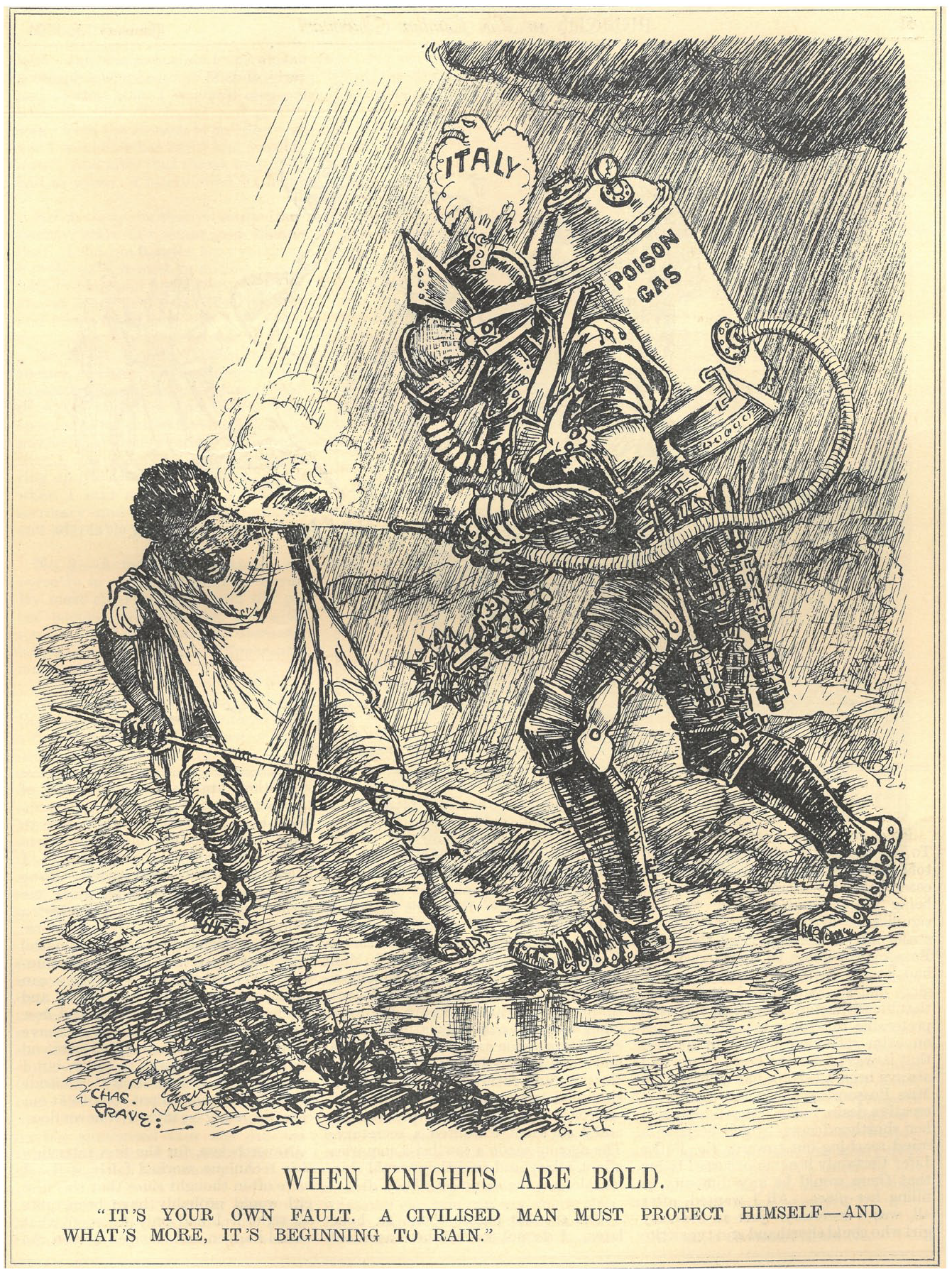
Grave, Charles. ‘When Knights Are Bold’. Punch 190(4963), p. 59.
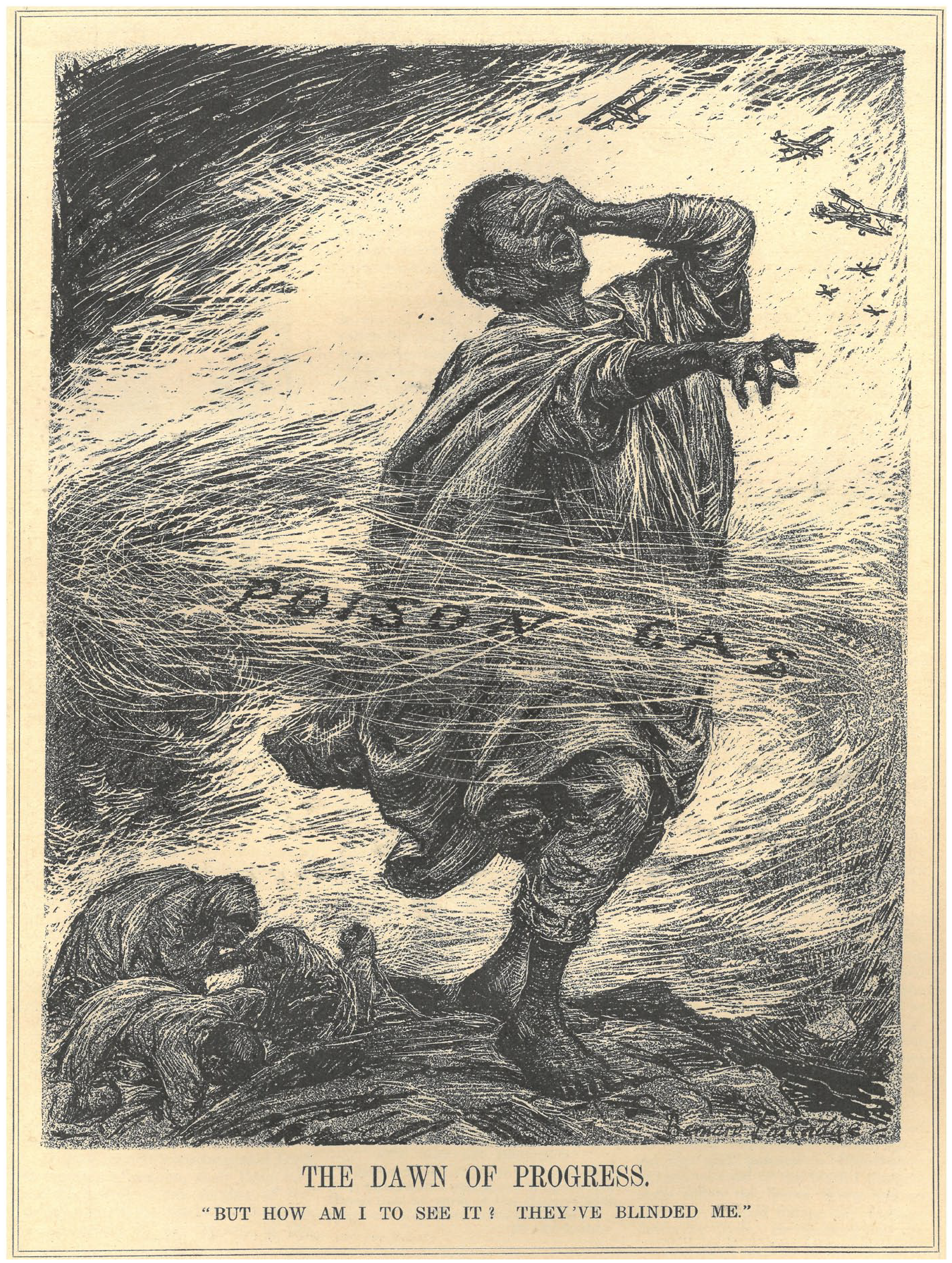
Partridge, Bernard. ‘The Dawn of Progress’. Punch 190(4975), p. 407.
This imagery had considerable historical relevance in the transnational construction and circulation of a racialised, aerially mediated imaginary. Many of these cartoons played an important role in shaping ideas, debates and propaganda about colonial war. ‘The Dawn of Progress’ was reproduced in widely influential pro-Ethiopia pamphlets in Britain and beyond, like the League of Nations Union’s (1936: 90) The Tragedy of Abyssinia or missionary William J.W. Roome’s Ethiopia The Valiant (1936: 89; Pankhurst, 2003: 156). More interestingly, and perhaps inadvertently, these cartoons portrayed tropes that were already explicit in Fascist satire and propaganda. Notwithstanding the regime’s systematic erasure of gas bombings from public discourse, Italian satirical artworks still used gas to express racial contempt. Notably, popular cartoonist Enrico De Seta designed ‘humorous’ postcards for soldiers in Ethiopia. One of these, entitled ‘Weaponry: The Most Suitable Weapon’ (Figure 3), bears striking similarities to Punch cartoons (cf. Figure 1): a disproportionately tall Italian soldier sprays gas (perhaps pesticide) on powerless, animalised Ethiopians. The kinds of representations found in Punch, therefore, were not only influential in shaping the international imagination of the Abyssinian war, but also reflected a specific, aerial understanding of colonial war, which was vividly shared by critics overseas as well as Fascist soldiers and their families.
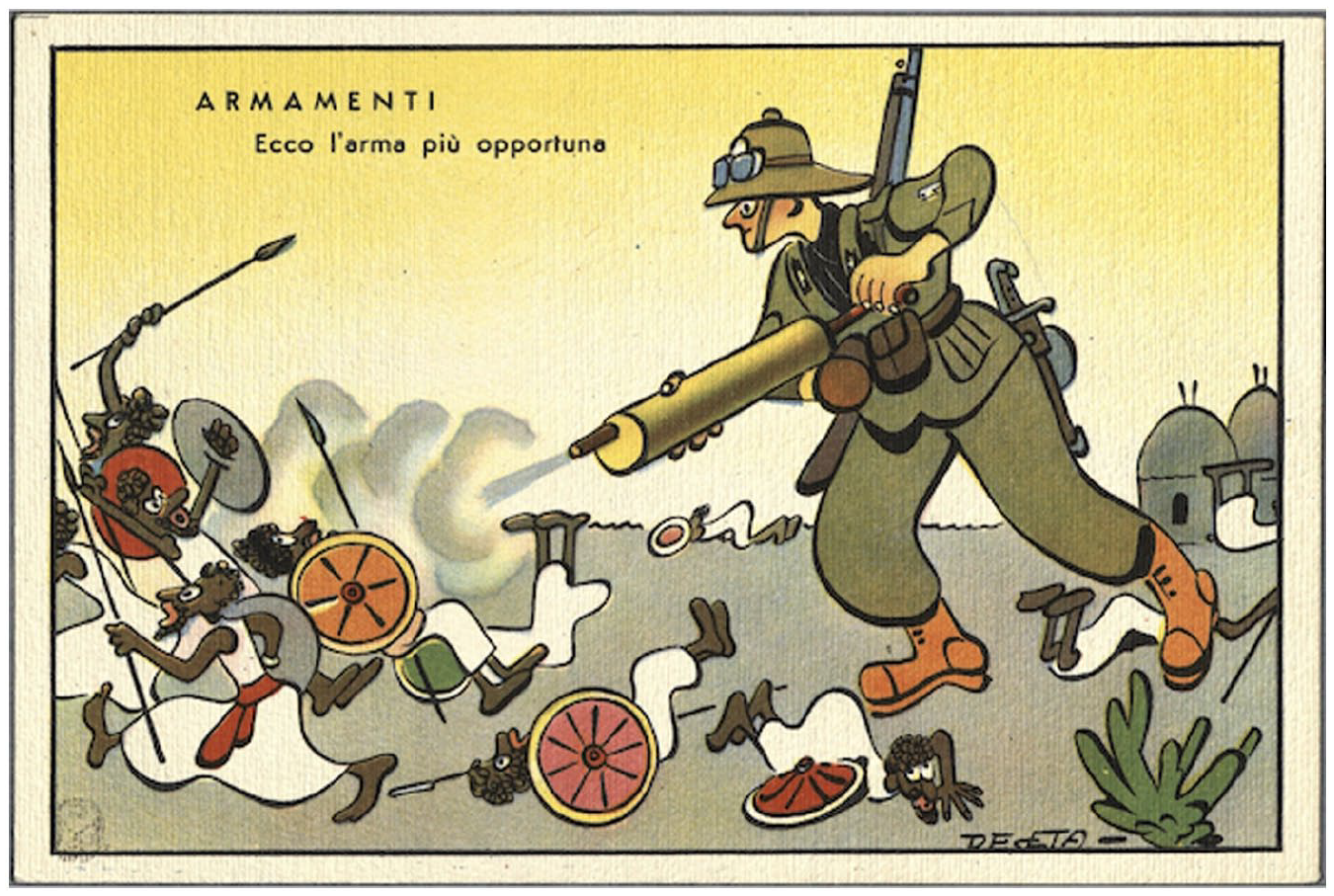
De Seta, Enrico. ‘Armamenti’. Rome: Edizioni d’Arte V.E. Boeri (1935–1936). © Comune di Milano, all rights reserved – Civica Raccolta delle Stampe Achille Bertarelli, Castello Sforzesco, Milan (used with permission).
Beyond their supposedly satirical tones, these cartoons illustrate how, in the caustic weather brought onto Ethiopian lands, the construction of an imperial hierarchy of civilisation relied on specific forms of atmospheric sensing. On the one hand, they recover the familiar trope of aviators as noble knights (Figure 1; Wohl, 1994: 203), but connect civilisation more directly to the destructive effects of a weaponised atmosphere. Echoing Marinetti’s dream of electric war, Italy becomes civilised by virtue of its ability to enact the technological envelopment of an aerial body that is immune to the lethal weather. These representations in fact do not diverge significantly from the convictions of Italian aviators. For many, the seeming invulnerability of flying machines in the eyes of the Ethiopians functioned as a divine reminder of their racial inferiority (Mussolini, 1937: 75), making them aware that ‘[the Italians’] force came from God, that [Italians] were invulnerable and invincible’ (General Mattei cited in Del Boca, 2001: 602). On the other hand, this imagery sanctions the fate of Ethiopians in a totalising and racialising weather, where ‘free air is denied’ to the colonised (Sharpe, 2016: 104). What makes Ethiopians black and uncivilised is not a lack of concern for development, security and progress, as Partridge (Figure 2) might suggest. Instead, a violent weather produces the gassed Ethiopian body as breathless, racialised and inherently unable to experience progress. The Ethiopian blindness to civilisation is more than a discursive device that conveniently serves a parodic purpose. It is the figuration of the nexus between racialised imaginaries and their more-than-human embodiment (see Wilcox, 2017) in martial processes that make aerial experiences possible or unavailable.
Second, gas bombings in Ethiopia expose the modern humanist dream as premised upon the differential production of more-than-human aerial experiences. Predating Mbembe’s reflections on the universal right to breathe, these cartoons implicitly denounce the project of modernity as ‘an interminable war on life’, which always ‘begin[s] by taking away breath’ (Mbembe, 2021: 60–61). The atmospheres of modernity threaten (some) human lives – ‘constrain[ing] entire segments of the world population, entire races, to a difficult, panting breath and life of oppression’ – but inevitably include forms of life beyond the human (Mbembe, 2021: 61–62). The technological engineering of atmosphere on the colonial battlefield questioned the humanity of Ethiopian bodies. Colonised subjects were written out of modernity through their aerial debilitation, and the strategy of demoralisation through gas also featured the aesthetic effacement of their humanity. Mustard gas suffocated and blinded Ethiopians’ bodies; but it also consumed their skin making them barely human-looking: ‘on their feet, hands, face and other exposed body parts, the burns were terrible, after a couple of days people lost pieces of flesh’; ‘many of them are unrecognisable because the skin on their faces has been corroded’ (cited in Del Boca, 2007 [1996]: 63–64).
Yet, when theorising the envelopment of the breathless Ethiopian subject, we cannot separate this process of ‘dehumanisation’ from its more-than-human regimes of atmospheric sensing. By defining ‘forms of life and bodily capacities’ (McCormack, 2018: 5) beyond the human, envelopment enriches our understanding of Sharpe’s weather as a political condition where ‘Black being appears [. . .] as the insurance for, as that which underwrites, white circulation as the human’ (Sharpe, 2016: 110–111). If a lethal process of envelopment racialised the Ethiopian as breathless and therefore uncivilised vis-à-vis an unprecedentedly aerial Italian subject, the Ethiopians’ aerial experiences (or lack thereof) also made them akin to other beings. The total destruction of the living environment through gas functionally elided the difference between the human enemy and other forms of life. Gas indiscriminately targeted humans, animals and vegetation alike (Omissi, 1990: 206; Sbacchi, 1997: 71–72). This undifferentiated contamination of life is clearly remembered by the Ethiopian Negus: [N]either men nor beasts were able to breath any longer. Any living being that was touched by the light rain falling from the aeroplanes, any being that had drunk poisoned water or eaten contaminated food would run away screaming and sought refuge in huts or in the woods to die there. (in Del Boca, 2007 [1996]: 58)
Journalists have similarly described ‘Italian aircrafts flying at ground level, tirelessly spraying every crop, destroying any vegetable life form and thus reducing animals to starvation, eroding the feet and lungs of terrified peoples’ (Rousseau cited in Del Boca, 2001: 491). By subjecting Ethiopian people, plants and animals to a shared atmospheric condition, the gassed weather further encouraged a hierarchy that elevated ‘European Man’ and his aviation while submitting both Africa’s humanity and its very nature (Labanca, 2005: 109–110, 167, 193).
The production of a lethal weather implied a strategy of aerial warfare aimed at ‘systematically kill[ing] living beings, [and] poison[ing] the waters and pastures with certainty’ (Del Boca, 2001: 490–491). This process wrote subjects out of the category of the modern human via aerial experiences that equated Black being to animal and vegetal nature. Here, processes of ‘dehumanisation’ do not define subaltern subjects as legally or semantically belonging to the categories of the animal, the vegetable or any other being (see Gregory, 2016: 957–958; Pugliese, 2020: 6–7; Scarry, 1985: 3–4). Instead, racialisation occurs via the differential production of experiences that shape conceptions of humanity and modernity in the first place. Envelopment evades any assumption about what counts as ‘human’, and instead produces and underwrites the human within a hierarchical ecology of aerial relations.
Finally, by showing the centrality of war experience to the construction of a racialised imaginary, the envelopment of gassed bodies also moves both the category of experience and the experience of race out of the exclusive domain of the human. The racial dimension of envelopment highlights how the experience of a gassed atmosphere in turn becomes dehumanised, naturalised and transformed into a resource for colonial extraction. In Sharpe’s words, under a racist weather ‘Black being seems lodged between cargo and being’ (Sharpe, 2016: 110–111). For Sharpe, the presumed centrality of the human as a transhistorical desirable category for black lives ends up reproducing and neglecting the weather’s key effect: the production of black bodies as defective and monstrous, breathless and condemned to premature death (Sharpe, 2016: 112, 115–117). By exploring seemingly totalising ways of atmospheric sensing which are not ‘distinctively human’ (McCormack, 2018: 4), envelopment translates this argument into the phenomenological domain. If an understanding of black bodies as inert, not human and disposable exalts the vitality and superiority of white European colonisers as ‘human’ (cf. Sharpe, 2016: 110–111), it is the possibility (or impossibility) of explicit and hierarchical aerial experiences – conceived not as human, but as resource to be predated and evidence to be exposed – that seals the racialised reality of imperial Italy. Not only is the colonial subject made sub-human, but their atmospheric experience simultaneously emerges as devoid of individuality, as the product of a diffuse atmosphere and a resource black subjects are inherently dispossessed of. As the selective redaction of the use of gas from Italian memoirs, official accounts and collective memories of the war suggests (Belladonna, 2015: 136–140), the Ethiopian experience of gas was inevitably foundational to Italian imperial prowess, but at the same time it became effaced and its subjects were made intangible and invisible. The Ethiopian aerial experience is a crucial resource that is extracted to justify the abjection of the colonised – but it does so by rejecting their agency and refusing their visibility as experiential subjects (cf. Scott, 1991: 778).
As the cartoons indicate, embodied modes of atmospheric sensing are a fundamental tool of racialisation that exceeds the human subject and body. In the martial relations of the Abyssinian War, race is not primarily understood ontologically, but phenomenologically (Fanon, 2008: 82–83) – according to Mussolini himself, ‘race [. . .] is a feeling, not a reality’, and it can be socially and historically shaped (Yates, 2013: 93). The violent envelopment of the Ethiopian subject supplements a Fanonian reading of race as epidermalisation, where the black body becomes the prism through which racialised subjects understand and internalise their inferiority by ‘experienc[ing] [their] being through others’ (Fanon, 2008: 82–83). While Fanon centres the body and skin as that which fixes Black being and deliberates its humanity, the experience of race always seems to possess atmospheric qualities which cannot be contained by the skin: epidermalisation features a body that ‘is surrounded by an atmosphere of certain uncertainty’ (Fanon, 2008: 83), whose ‘self-esteem evaporates’ (Sardar in Fanon, 2008: xiii), whose experience is externalised and whose consciousness is always ‘third-person’ (Fanon, 2008: 83).
Reading aerial warfare in Ethiopia, envelopment and the weather reframe the co-constitution of experience and race in war in ways that displace the centrality of the human. In the stark juxtaposition between an Italian aerial soldier and a gassed Ethiopian body, the colonised subject is racialised in relation to air and, in turn, ‘in relation to the white man’ (Fanon, 2008: 82). To fully understand the political role of aerial technologies in shaping these racialised hierarchies, we need an understanding of war experience that – following Sharpe – decentres the human as its exclusive domain and rejects it as a category to be reclaimed via experience. Instead, the Abyssinian War and its aerial formations invite a more-than-human conception of how war experience is shaped, represented and exploited. On the one hand, processes of racialisation are not limited to the ‘dehumanisation’ of abject bodies, but also involve the dispossession of experience and its detachment from the category of the human. On the other hand, the experience of race is not only epidermalised, but race is also vaporised and coded within aerial dynamics.
Conclusion
As this article suggests, the aerial experiences of the Abyssinian War open several lines of inquiry in the critical study of war, race and empire in IR. First, by putting in conversation McCormack’s envelopment and Sharpe’s weather, I sought to introduce new conceptual tools to the study of aerial violence. These syntheses help us think about air in war beyond analytical distinctions between the technical-ontological and the phenomenological (Adey, 2014: 836; Philippopoulos-Mihalopoulos, 2016: 151), the macro and the everyday (Klauser, 2022: 150), or geopolitics and poetics (Engelmann, 2015: 430). Crucially, the importance of air to the Fascist strategy and the international politics of race and empire cannot be meaningfully understood in separation from its role within literary imagination, political art and everyday experiences of war.
Second, aerial relations rethink the connections between global politics and embodied experience in war. Moving away from a conception of war experience mainly centred on a self-contained human body, an air-minded analysis of the Abyssinian War shows how the construction of a racialised international order was underpinned by experiences that exceeded conventional understandings of human sensing, bodies and imagination. These observations advance a particular historiography of the Abyssinian War in IR, recovering its importance in the emerge of the modern international system (Shilliam, 2013) while exposing new ways in which experience matters in the logics of war and empire. More broadly, a revisited notion of war experience deepens discussions of race in IR. While experiences of racial violence have historically been central to a ‘global racial imaginary’ (Barder, 2021) and to the discipline itself (Anievas et al., 2015; Thakur and Vale, 2020; Vitalis, 2015), the Abyssinian War points to the importance of examining how the embodiment, understanding and exploitation of such experiences often materially and conceptually outstrip the realm of ‘the human’ (see also Wilcox, 2017).
The aerial experiences and representations surrounding the Abyssinian War are both historically and theoretically exemplary of some overlooked relations between ‘human’ bodies, technologies of violence and racial imaginaries. While exceptionally evident in the Ethiopian tragedy, the political significance of racialising processes of envelopment deserves broader consideration. Douhetian ideas on the command of the air and the efficacy of terror bombing soon became influential within American and European militaries (Haslam, 2012; Schaffer, 1988: 20–34), not without preserving their racist undertones. Incarnating these principles in their most lethal form, the Abyssinian War reignited aerial dreams and anxieties in Europe and reasserted the political power of aerial violence. The war revived the spectre of British vulnerability, stimulating an unprecedented mobilisation against the prospect of future gas bombing (Lindqvist, 2001; Moshenska, 2010). In Nazi Germany, the Italian mission inspired Hitler’s own imperial venture, reinforcing nationalist pride for the aviation and support for gassing as excellent tools of racial violence (Bernhard, 2013: 627; Fritzsche, 1992: 189). If the Nazi gas chambers, as Nieuwenhuis (2018: 80) highlights, ‘should be contexualised as part of a long, convoluted and historical unfolding of a (still ongoing) atmoterrorism’, this article notes how this history finds its intellectual and material archetype in the racialised experiences of the Abyssinian weather.
Yet, while the aerial experiences of Fascist Italy have directly informed Western conceptions of war in the air, their relevance applies to a much wider set of cases and struggles. During the World Wars, states’ capacity to wage total war in the air structured moral and civilisational hierarchies in the West: while German bombing of urban areas exposed European inferiority, it was also deemed abhorrent and barbarian (Grayzel, 2006: 595), paradoxically justifying the Allies’ use of similar methods as a display of civilised power (Schaffer, 1988: 37). Imperial Japan’s development of new tools of biological warfare in the 1930s–1940s – including forms of bombing aimed at spreading plague-infected fleas or bacterial compounds across Asian colonies (Barenblatt, 2004) – reveals the centrality of more-than-human, aerially-mediated relations to the production of racial difference and imperial dominance. By the same token, the American deployment of carpet bombing and, most notably, nuclear weapons in Japan testifies to the historical connection between racial violence and the production of a destructive, all-enveloping weather (Malloy, 2020). Still in our days, the persistent use of tear gas shows how the atmospheres of empire have yet to evaporate: in occupied Palestine, during Black Lives Matter protests, or along Syrian refugees’ journey across Turkish and Greek borders, suffocating and debilitating aerial experiences are still pivotal to the embodied dynamics of militarised racial violence. As this paper has emphasised, future research shall further focus on how war experience exceeds the domain of the human in meaningful ways and simultaneously deepen our understanding of how ‘air wars have been productive of wartime aftermaths’ (Kaplan, 2018: 144) whose colonial traces still haunt today’s violent atmospheres (Apata, 2020; Asher Ghertner, 2021: 1486–1487).
Footnotes
Acknowledgements
For their support and feedback on this and previous versions of this article, I would like to thank Duncan Bell, Tarsis Brito, Caroline Holmqvist, Kevin McSorley, Mirko Palestrino, Corey Robinson, Johanna Rodehau-Noack and Lauren Wilcox. I would further like to thank the organisers and participants of the 2021 EWIS Workshop on ‘(Re-)Imagining Security: Between Science, Technology and Fiction’ and of the 2021–2022 DoingIPS PhD Seminar Series, as well as the editors of the European Journal of International Relations and the three anonymous reviewers.
Funding
The author(s) received no financial support for the research, authorship and/or publication of this article.
