



Abstract
Why and how do pathways to regime complexes diverge? Building on insights from the literatures on institutional design and historical institutionalism, we argue that early institutional design choices produce long-term variation in the pace, density, and composition of institutional layers within a regime complex. In a first step, we argue that if an institution becomes focal, this increases the exit costs for member-states to leave. Additional institutional layers become a more likely outcome. In a second step, we argue that depending on the focal organization’s formal or informal design, variegated sovereignty costs inform the additional layering pathways. If a focal organization is formal, sovereignty costs are high for member-states. Consequently, creating additional institutional layers becomes cumbersome, leading to a slow pace of “negotiated layering” and a regime complex characterized by low density and composed of formal and informal institutions. In contrast, low sovereignty costs associated with informal focal organizations enable a rapid process of “breakout layering” resulting in a high density of mostly informal institutions. We develop our argument by examining the evolution of security institutions in Europe and Asia through diplomatic cables, treaty texts, personal memoirs, and policy memos.
Introduction
Regime complexes—that is, an array of overlapping and nested organizations that share member-states and functional mandates—have become an established feature in international politics (Alter and Raustiala, 2018). Densely institutionalized environments across a wide range of issue-areas exist regionally and globally. For example, scholars have observed regime complexes in trade (Allee et al., 2017), finance (Henning, 2017), climate change (Keohane and Victor, 2011), refugee protection (Betts, 2010), crisis management (Hofmann et al., 2016), and energy policy (Colgan et al., 2012). However, we still know little about how and why regime complexes develop and vary over time.
Questions about how regime complexes unfold carry real-world consequences for global order-making and governance. State actors are turning to new institutions, particularly at the regional level, to circumvent increasing gridlock created by geopolitical divisions within global institutions. As many regime complexes continue to grow, practitioners and scholars alike will need a better grasp of how and why processes of institutional layering vary. Understanding, for example, the pace in which regime complexes develop, and its resulting density, provides us with insights about how stable complex institutional constellations are at any point in time and what politics to expect from member-states. Russia’s invasion of Ukraine, and renewed concerns about a Taiwan Strait conflict make this apparent as policymakers in Asia and Europe debate whether it is best to focus on one focal organization, such as Association of Southeast Asian Nations (ASEAN) and North Atlantic Treaty Organization (NATO), or rely on multiple and new security institutions that facilitate trans-Atlantic and trans-Pacific security cooperation.
How and why do the pathways to regime complexes diverge? In particular, how do we explain differences in the pace and density of regime complexes? Building on recent scholarship on institutional design, historical institutionalism, and regime complexity, we show how the formal or informal design of focal organizations
1
shapes the pace of institutional layering—that is the addition of new institutions in conjunction with existing ones—and the subsequent density of a regime complex. As a first step, we argue that the focality of an institution increases the exit costs for member-states to leave their institution and instead steers policymakers to create additional institutional layers (Jupille et al., 2013). In a second step, we argue that a focal organization’s design—or more specifically, its degree of formality—results in two different paths to institutional layering as a result of variegated sovereignty costs
2
: negotiated and breakout layering. Negotiated layering is likely to occur when the focal organization is formal. When proposals for additional institutions are on the table and at least some member-states would be member of both organizations, the formal institutional layer is likely to result in cumbersome negotiations as states fear that their formalized commitments in the focal organization will not be accommodated in the additional layer. This slows down the pace of layering as policymakers must overcome resistance from states who fear additional sovereignty costs in form of coordination pressures and possible de-coupling. Consequently, negotiated layering tends to produce a low-density regime complex. In contrast, an informal focal organization enables a rapid proliferation of more informal institutions through breakout layering. Thus, breakout layering is prone to generating a high density of additional institutional layers.
The literature on regime complexes to date remains focused on the global level. This complicates comparisons as issue area characteristics can drive differences (Lipscy, 2017). To demonstrate the plausibility of our argument and address existing gaps in the regime complexity literature, we therefore shift away from the global level and turn to the regional level. More specifically, we investigate security regime complexes in Asia and Europe with the aim of making broader claims about structuring processes and regime complex structures across issue areas and levels of analysis. By adopting a regional focus and holding issue area constant, we gain additional analytical leverage in understanding how focal organizations and their institutional design shape regime complexes. After controlling for issue area, the comparison between Asia and Europe enables us to examine the obligations and commitments to focal organizations (in our case, the US bilateral alliances in Asia, ASEAN and NATO), which are not issue area specific but differ on their degree of bindingness (Hofmann and Yeo, 2015). 3 We capture this with varied sovereignty costs. In addition, the presence of both formal (defense) and informal (cooperative security) focal organizations in Asia, highlights how institutional design, rather than any particular regional effect, leads to variation in regime complexes.
Through comparative regional analysis, we advance important insights into multilateral cooperation and highlight the relevance of looking at regime complex dynamics through historical institutional analysis. Whereas existing research has drawn attention to distributional conflicts and heterogeneous preferences to explain variation across regime complexes (Haftel and Hofmann, 2019; Morse and Keohane, 2014; Pratt, 2018), our analysis highlights the importance of path dependence and institutional design. Our argument thus adds to power-based and cost-efficiency explanations, which fall short on their own. Power-based explanations emphasize the role of the United States in establishing security regime complexes but have difficulty in explaining the cross-regional variation that we observe regarding the pace and density of layering. Efficiency-based explanations emphasize bargaining failures within focal organizations; additional institutional layers are created if focal organizations cannot be adjusted to changing institutional needs (Jupille et al., 2013). According to Jupille et al. (2013: 30), institutional creation is a rare event and only occurs when the focal organization no longer provides sufficient benefits, when alternative institutions are unavailable, and when actors cannot easily modify current rules. However, regional focal organizations, such as NATO or ASEAN, have not disappeared but have adapted. Nonetheless, we show that they coexist with a variety of newly created institutions.
Divergent pathways to regime complexity
Regime complexes emerge through the proliferation of new organizations and by way of scope expansion of existing institutions that overlap in membership and mandate with existing institutions (Haftel and Hofmann, 2017). Groundbreaking work has mainly explored individual state strategies (Busch, 2007; Hofmann, 2019) or drawn our attention to one important structural component of regime complexes, namely their degree of fragmentation (Biermann et al., 2009; Keohane and Victor, 2011). We contribute to this literature by shifting the focus from solely strategies or outcomes to, first, layering processes under the condition of potential membership overlap, and second, an underexamined but important structural component of regime complexes (Eilstrup-Sangiovanni and Westerwinter, 2022), namely density. We do so by combining insights from historical institutionalism (Fioretos, 2017; Thelen, 1999) and institutional design.
Variation in regime complex structures
Regime complexes vary in their composition. Some regime complexes, like the global trade regime, have a formal organizational center, such as the World Trade Organization (WTO), surrounded by many preferential trade agreements (Allee et al., 2017; Faude, 2020). In contrast, other regime complexes are characterized more by non-binding agreements and are surrounded by a diverse and manifold set of additional institutions as seen in the area of global health (Hoffman et al., 2015).
Observations about variation in regime complexity have led to attention to the structure of regime complexes, often defined by the degree of institutional fragmentation (Biermann et al., 2009). The emphasis on fragmentation and its link to inter-institutional competition and cooperation only emphasizes one aspect of regime complex structure (Faude, 2020). While distributional conflicts and heterogeneous preferences are commonplace in IOs and provide an impetus for institutional layering (Hofmann, 2013; Morse and Keohane, 2014), not all layering proposals see the light of day, nor do all institutional layers and the resulting regime complexes look the same. Instead of analytically bypassing the pace and density of regime complexes, we put them centerstage and argue that they are crucial in understanding how stable regime complex structures are and what politics to expect from them.
We therefore investigate the temporal dynamics through which regime complexes develop—what could be called structuring processes—that lead to another fundamental structural component, namely density. Density refers to the “number and diversity” of ties between existing institutions within a broadly defined regional space (Eilstrup-Sangiovanni and Westerwinter, 2022). Social network scholars have shown that the density of units are fundamental to our understanding of complex systems (Anderson, 1999: 184; Green and Hadden, 2021). On the organizational level, a dense institutional environment can result in resource scarcity, which in turn can lead to inter-institutional competition (Eilstrup-Sangiovanni, 2022; Hofmann, 2019) and normative inconsistencies (Raustiala and Victor, 2004). Managing synergies under these circumstances becomes more cumbersome than in less dense regime complexes (Gehring and Faude, 2014; Morin and Orsini, 2013). At the state level, a focus on density can help explain why less resourceful actors might experience greater coordination pressures, while more resourceful states enjoy greater forum shopping opportunities (Drezner, 2009). In short, a focus on pace and density is a crucial step in theorizing regime complex politics.
Focal organizations, exit costs, and layering
Crucial to our understanding of the politics of regime complexes is the issue of institutional design—specifically the different properties of formal and informal focal organizations (Abbott and Snidal, 2000; Roger and Rowan, 2022) and their influence on the pace and density of regime complexes. To understand the trajectory and structure of regime complexes, we start with a focal organizations’ existence and associated exit costs.
Focal organizations are widely accepted among their member-states as the “go to” organization to discuss, decide, and implement cooperative and coordinative action that fall into their mandate. Regional focal security organizations are the privileged forum where threats are addressed and member-states frequently evoke them in national and international discourse as integral to their policy response. Focal organizations combine three characteristics: they are central to their member-states, they converge expectations, and they orchestrate relations should there be other organizations (Abbott et al., 2015: 24–25). First, their membership recognizes them as are prominent, conspicuous and central to overcoming coordination or cooperation problems (Jupille et al., 2013: 9). Actors interested in sunk cooperation and coordination costs invest in focal organizations to reconfirm their centrality and shared belief system. For example, they will invest in bureaucratic capacities located within the IO with expertise pertinent to its mandate (note, even informal organizations can have bureaucracies). Second, given the centrality, it is here that it is most likely that different expectations converge (Schelling, 1960) since they “help construct a shared belief system that defines . . . what actions constitute cooperation and defection” (Garrett and Weingast, 1993: 176). Third, should there be other organizations occupying the same or similar mandate, the focal organization will be the “primary governance actor in a given domain” (Fioretos and Heldt, 2019: 1096). As Fioretos and Heldt (2019: 1096) argue, “Unless governments explicitly transfer the authority of the focal organization to another entity, the privileged formal status of the former is not displaced.” They point to the International Monetary Fund (IMF) and the World Bank as focal organizations in their respective areas of financial stability and development financing. Others see the WTO as focal to trade (Faude, 2020; Jupille et al., 2013) or the World Health Organization (WHO) to global public health (Jupille et al., 2013). The International Committee of the Red Cross is often understood as focal to humanitarian protection and assistance.
Given their focality, such organizations carry high exit costs—or the costs of leaving an organization—as they entail diplomatic, reputational, and administrative costs associated with a member state’s exit from an organization (Hooghe and Marks, 2014). 4 Once member states congregate around a focal organization, irrespective of its design, member-states will “adjust their strategies to accommodate the prevailing pattern” (Thelen, 1999: 385). Deliberations take place within the margins of earlier design choices which often generate positive feedback loops within an institution, making it harder to diverge from the initial path. The preceding logic is captured in focal organizations by mechanisms of increasing returns in which “the probability of further steps along the same path increases with each move down that path” (Pierson, 2000: 252). This may occur as the relative benefits of current arrangements, and conversely the cost of exiting a focal organization, can rise over time (Pierson, 2000: 252).
Focality is not a given but must be constructed and reconfirmed, however (Garrett and Weingast, 1993; Keohane and Martin, 1995: 45). In other words, an IO’s focality can vary over time. For example, its centrality can be challenged (Lipscy, 2017). Hence, we should not understand centrality, shared belief system and orchestration capacity as static characteristics of focal organizations but rather as diplomatic everyday practices.
An oft-repeated critique of path-dependent explanations is their inability to explain change outside of exogenous shocks. In response, historical institutionalists have demonstrated how change occurs through processes of layering, conversion, drift, and displacement (Fioretos, 2017; Mahoney and Thelen, 2010). “Layering involves active sponsorship of amendments, additions, or revisions to an existing set of institutions” (Streeck and Thelen, 2005: 24). Conversion comes about when old institutions are strategically redeployed with a new purpose. Meanwhile, displacement is when new institutions replace old ones. Drift occurs when institutions/rules remain the same, but their impact changes as institutional actors fail (or are unable) to respond to shifting external circumstances.
As mechanisms of continuity are at work in both informal and formal focal organizations due to high exit costs, policymakers are more likely to adopt layering over other forms of institutional change. With the existence of a focal organization, the possibility of conversion, drift or displacement become less likely as stakeholders double-down on an existing organization and present strong veto possibilities against any institutional move that undermines the existence (displacement) or mandate (conversion, drift) of a focal organization (Mahoney and Thelen, 2010: 19). While displacement, drift and conversion imply changes to the focal organization which are difficult to come by, layering stands for new additions, which are easier to negotiate as they provide less veto opportunities. Historical legacies condition the interests and available options to actors such that even when the tendency for drift exists in the face of institutional competition, processes of layering still prevail (Fioretos, 2011: 391). Policymakers seeking new institutional arrangements or reforms will prefer layering over other strategies which would be met with greater resistance from supporters of an existing focal organization. Layering has thus become a “dominant feature” in the “institutional character of the international system in the twenty-first century” (Fioretos, 2011: 391). We thereby translate existing insights on layering to densely institutionalized spaces at the international level (Heldt and Schmidtke, 2019; Rixen et al., 2016).
Institutional design and coordinated sovereignty costs: negotiated and breakout layering
In addition to an organization’s focality, we argue that its degree of formality results in different paths to institutional layering due to differences in sovereignty costs associated with formal and informal organizations. The conventional understanding of layering posits that states with vested interests in pre-existing rules and institutions will resist, or try to veto the rise of new institutions (Fioretos, 2011: 327; Rixen et al., 2016: 17). We argue that the ease of overcoming or circumventing a potential veto—and hence the pace of layering—depends on the design 5 of the focal organization and the subsequent constraints. Formal organizations inflict higher sovereignty costs—that is the costs incurred when member-states must cede some control over national policies in support of new institutions as they are based on a binding agreement (Abbott and Snidal, 2000: 436; Hafner-Burton et al., 2015: 1). Binding commitments need a majority or unanimity to be renegotiated or terminated (Gray, 2018; Lipscy, 2017). Consequently, member-states who want to create an additional organizational layer must navigate obligations, commitments and resources between the existing and new organizations. These obligations and commitments are often not only binding but also precise and transparent (Abbott and Snidal, 2000; Roger and Rowan, 2022).
Diverting material and normative resources from this commitment increases the possibility that member-states will be called to duty by several agreements simultaneously, which might overstretch their capacities and capabilities (Wallander, 2000). When member-states attempt to create new autonomous layers, they therefore have to negotiate with the member-states who seek to protect the existing arrangement or potentially exit the existing institution. Policymakers must thus overcome resistance from state actors not only because of high exit costs associated with a focal organization, but also because of higher sovereignty costs that result in more cumbersome negotiations. What we refer to as negotiated layering in the context of formal organizations therefore tends to produce regime complex structures that are relatively less dense and composed of a combination of both informal and formal institutions.
The opportunities and constraints confronting actors tied to informal focal organizations are organized differently because of low sovereignty costs for member-states. Informal institutions are marked by low levels of legalization and bureaucratization; they usually lack an independent secretariat with leadership organized through rotating national presidencies which coordinate meetings in their respective capitals. Commitments are non-binding and voluntary.
In contrast to formal focal organizations, layering will occur at a quicker pace given the “soft” nature of rules and agreements which remain low in their level of obligation, precision, and delegation (Abbott and Snidal, 2000: 424). Informal focal organization enables a rapid proliferation of other informal institutions through a process of breakout layering as sovereignty costs remain less of a concern with informal institutions. Breakout layering is thus prone to generating regime complexes characterized by a high density of informal institutions with few new formal institutional layers. Here we find the structure of regime complexes, specifically its density and composition, linked to the formal/informal design of focal organizations and the pace of institutional layering.
Explaining variations in regime complexes
The entrenched nature of focal organizations, whether formal or informal, leads to high exit costs which require dissatisfied actors to build new institutions through a process of institutional layering. However, formal focal organizations result in slow growth of additional autonomous institutions. Once a formal organization has become focal to its members, at least some member-states will resist additional layers given high coordinated sovereignty costs. Consequently, additional organizations need to be negotiated, which slows down the pace of institutional layering. This is especially the case if additional layers formulate additional rights and obligations. Through negotiated layering, we therefore anticipate several attempts at layering before additional institutions might be created. Informal institutional layers take less time to negotiate given their lower associated sovereignty costs. To not interfere with the formal rights and obligations of the focal organization, however, these informal institutions can be subsidiary to or compatible with formal organizations. A regime complex which evolves through negotiated layering will thus be characterized by a slow pace of layering, and consequently a relatively low density of both formal and informal organizations.
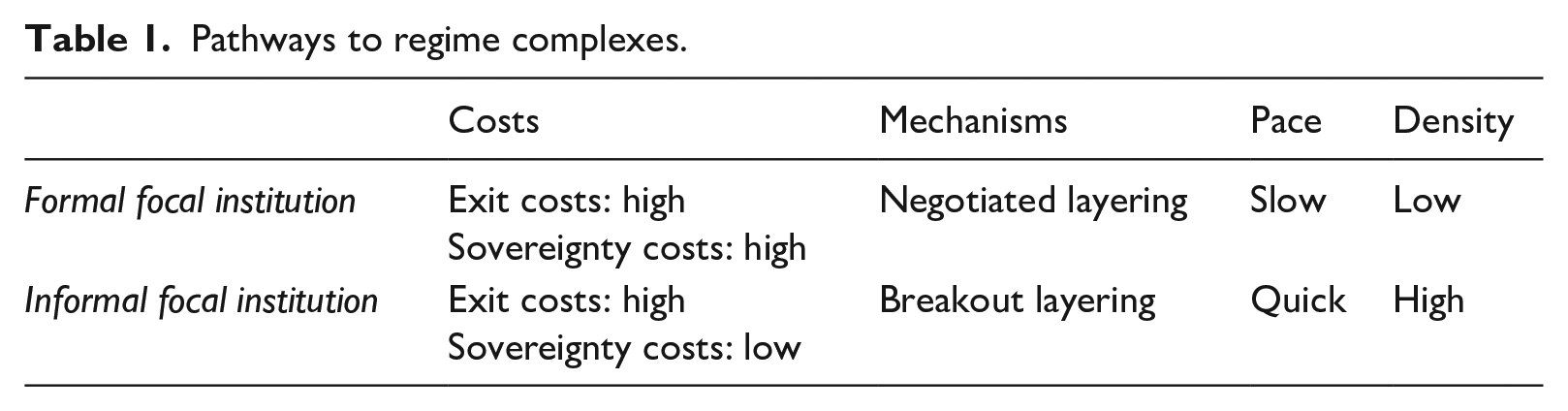
In contrast, the presence of an informal focal organization makes the rise of other subsequent institutions relatively easy as a result of low coordinated sovereignty costs associated with soft rules and less binding agreements. Rather than reach consensus based on hard-nosed bargaining and negotiating, actors seeking to circumvent potential opposition will pursue breakout layering to establish new institutions. In the absence of a formal focal organization and given the less costly nature of establishing informal institutions with few obligations, policymakers will largely look to establish new informal institutions. Given their relatively low barriers and costs to establish, new informal institutions will proliferate more rapidly. Stakeholders of an existing focal organization will not feel as threatened by the establishment of informal institutions that are less likely to interfere with national policymaking or incur significant sovereignty costs compared to formal organization. Conversely, the greater coordinated sovereignty costs associated with establishing new formal institutional layers will make the addition of formal institutions less likely under breakout layering. In particular, proponents of the informal focal organization may feel threatened by the presence of a formal institution layered on top of an informal focal organization due to concerns about displacement or institutional drift. Through breakout layering, then, regime complexes anchored by an informal focal organization will be characterized by a dense patchwork of overlapping, informal institutions over time. Our argument is summarized in Table 1.
Pathways to regime complexes.
Additional theoretical and observable implications
If our theoretical argument holds, we should observe auxiliary implications. For instance, if the design of a focal organization impacts the pace and density of a regime complex as we posit, then it should also influence the sequence of layering as well as the composition of informal and formal organizations within the regime complex. Formal focal organizations enable layering dynamics that might include other formal organizations but emerging very slowly over time. However, given higher coordinated sovereignty costs, we would anticipate only a few formal organizations and more informal institutions to follow the establishment of a formal focal organization. The regime complex will thus be composed of both formal and informal organizations. In contrast, given that informal organizations tend to inhibit formal institutional layers but enable many informal layers in a short period of time, the sequence of layering should include one informal organization after the other, resulting in a regime complex composed of many informal institutional layers.
Furthermore, if a focal organization is contested but does not cease to exist, formal layering should become more likely as the associated costs have been reduced. Contestation should not automatically be equated with the end of the organization’s focality (Morse and Keohane, 2014), only its weakening, which enables formal layers to be negotiated more easily. Finally, if a focal organization continues to exist but changes its institutional design either from formal to informal, or informal to formal, these design changes should also impact the subsequent pace of layering and consequently the overall density of the regime complex.
Breakout layering in Asia: slow and few in mutual defense and fast and dense in cooperative security
In Asia, two security regime complexes have formed around two sets of focal organizations. These exist in parallel with some potential for overlap: one centers on mutual defense and the other on cooperative security. On mutual defense, formal US bilateral alliances became focal to Asia’s security and defense architecture, making it difficult to develop an alternative (formal) organization addressing the same issues. This resonates with our postulated negotiated layering process. On cooperative security, ASEAN became focal and as long as ASEAN remained informal, dozens of new informal institutions (rather than internal sub-division within a given bureaucracy) emerged reflecting the growing density of Asia’s regime complex through a pattern of breakout layering.
The rapid development of new institutional layers within Asia’s cooperative security regime complex was conditioned on the presence of an informal focal organization. ASEAN focality itself could be observed by the growth in its bureaucratic size, function, and routine practices over time (Narine, 2008). Moreover, an implicit shared belief had formed among regional actors, including the United States, regarding ASEAN centrality. If there is any doubt to ASEAN’s focality today, nearly all official policy statements related to new institutional initiatives inserts a reference to ASEAN centrality, even when ASEAN members are not a party to institutional developments. 6
Mutual defense: formal alliances become focal
Between 1951 and 1954, the Philippines, Australia and New Zealand, South Korea, Taiwan, and Japan all signed mutual defense treaties with the United States, thus opting for formal bilateral alliances over multilateral defense arrangements to deter communist threats. A few Asian states did dabble with multilateralism during the early Cold War. In 1949, prior to any bilateral alliances, the Philippines, South Korea, and the Republic of China attempted to create the Pacific Pact as an anti-communist organization. However, the outbreak of the Korean War ended any further attempts to develop the Pact.
More notably, in the wake of France’s withdrawal from Vietnam in 1954, the United Sates and seven other countries created Southeast Asia Treaty Organization (SEATO) as a multilateral organization to thwart communist subversion in Asia. In the absence of other Asian multilateral defense institutions, SEATO carried the potential to develop into a focal organization. However, SEATO remained institutionally weak and ultimately disbanded in 1977. SEATO’s weakness was in part explained by the presence of bilateral alliances and the coordinated sovereignty costs perceived by US policymakers in adding a multilateral alliance structure which potentially restricted US freedom of action in the region. The US commitment to SEATO thus remained limited (Buszynski, 1983: 69). Whereas countries such as Thailand and Australia “desired a collective capability modelled on the example of NATO,” including a standing force and a unified alliance command, the United States preferred “a loose consultative arrangement and at most a small secretariat to carry out the basic office work” (Buszynski, 1983: 44, 47). A July 23, 1954 memorandum stated that rather than developing “an elaborate structure comparable to NATO,” policy planners favored a simple organizational structure limited to a “standing council with a civilian representative and military advisers and no other committees” (U.S. Department of State, 1984: 654). In other words, Washington resisted turning SEATO into a formal (focal) organization given its need for freedom of action which was better suited with bilateral arrangements.
Early attempts to superimpose additional formal defense organizations on top of bilateral ones thus failed given strong shared beliefs among the United States and its allies that bilateral alliances provided the most reliable form of internal regime security and external regional defense against Cold War adversaries (Cha, 2009; Izumikawa, 2020: 9). The centrality of alliances in addressing internal and external communist threats in Asia demonstrated the focality of the “hub-and-spokes” system throughout the Cold War. This was further attested by the strong degree of institutionalized military cooperation between the United States and its allies such as Japan, South Korea, the Philippines, and Taiwan (until the 1970s), respectively, creating high exit costs that helped sustain the hub-and-spokes system into the post-Cold War era. The deep institutionalization of bilateral alliances, including the rise of joint or subordinate command structures, shared military basing arrangements, and joint training and exercises between allies helped construct a shared belief that bilateralism best addressed national security and regional defense needs (Izumikawa, 2020; Yeo, 2011).
Cooperative security: informal ASEAN becomes focal
In the 1960s, domestic political shifts in Indonesia and the Philippines, coupled with reduced British commitments and increased US involvement in Vietnam, opened an opportunity for “new thinking about regional relations and regional organizations” (Ba, 2009: 48). After a couple of false starts with the Association of Southeast Asia in 1961, and Maphilindo in 1963, Malaysia, Indonesia, Thailand, Philippines, and Singapore established ASEAN on August 8, 1967. Unlike the bilateral treaties formed around mutual defense clauses, the ASEAN Declaration supported a more comprehensive understanding of security which “cherished ideals of peace, freedom, social justice and economic well-being” (ASEAN Declaration, 1967). The basic principles behind ASEAN security cooperation included norms of consensus-building and non-intervention, and a commitment to sovereignty, territorial integrity, and non-interference. As Acharya (2009: 94–95) states, ASEAN “organized and represented a microcosm of what might be called Asia’s proto-multilateralism in regional security affairs . . . a regionalism bereft of the formal commitments or mechanisms of collective security or collective organizations.”
Given ASEAN’s mandate and geographic scope, little negotiation was required to justify its existence in conjunction with formal bilateral alliances which were oriented toward mutual defense. ASEAN was oriented toward confidence-building rather than mutual defense, and its functional role “to accelerate economic growth, social progress and cultural development” while promoting “regional peace and stability” was ambiguous (ASEAN Declaration, 1967). Although ASEAN helped foster new ideas about regionalism, its status as a focal organization would not crystalize until the 1990s. It took ASEAN 9 years to hold its first summit meeting in 1976, and leaders held only two additional summit meetings thereafter in 1977 and 1987, respectively. Although ASEAN would not operate as a focal organization during this period, it would exercise its first mover advantage in the 1990s to position itself as an informal focal organization.
New questions pertaining to security emerged at the end of the Cold War, including US commitment to the region, Japan’s increasing role in Asian regionalism, and the emergence of Russia and China as new centers of power in a predicted multipolar Asia (Friedberg, 1993–1994; Leifer, 1996). However, high exit and coordinated sovereignty costs in terms of alliance asset specificity (Suh, 2007: 14–16) and support from domestic political actors invested in formal bilateral alliances (Blackwill and Dibb, 2000; Yeo, 2011: 8) made it difficult to develop additional formal defense institutions.
Actors had little reason to block informal multilateral arrangements fostering confidence-building and comprehensive security given their low sovereignty costs. As an early sign of orchestration, deference to ASEAN organizational norms and the rise of informal institutions centered around ASEAN in the decade after the Cold War would solidify ASEAN’s status as an informal focal organization in the 1990s (Acharya, 2009). The term “ASEAN centrality” itself would come to reflect ASEAN’s focality. Member-states recognized ASEAN as the “go to” organization orchestrating and coordinating security cooperation, particularly in the area of non-traditional security (Caballero-Anthony, 2014).
Different regional actors in the early 1990s—notably Australia and Canada—floated several ideas for more formal Asia-Pacific security cooperation in the form of a Conference on Security and Cooperation in Asia (CSCA) (Katsumata, 2009: 182; Leifer, 1996: 23). These proposals were initially met with resistance, particularly from the United States and ASEAN. The George H.W. Bush administration’s reluctance stemmed from an implicit attitude among US officials that multilateral regional security institutions could undermine US bilateral alliances (Katsumata, 2009: 123). ASEAN members rejected the proposals, but on different grounds. Although ASEAN supported the broad idea of a regional security forum, it specifically rejected more formal manifestations of multilateral security given the higher coordinated sovereignty costs involved which would likely undermine its focality (Yeo, 2019: 67). 7 They feared that deeper institutionalization would undermine the “ASEAN way” of informality and consensus.
Reacting to Australian and Canadian initiatives, other regional actors began discussing alternative security and confidence-building mechanisms. ASEAN policymakers suggested using the ASEAN-Post-Ministerial Conference (PMC) in June 1991 as a venue for discussing regional security issues (Katsumata, 2009: 191–193). This approach was reiterated by Japan’s foreign minister the following month. Australian officials had also shifted away from the more rigid CSCA model, instead advocating a modest form of regional institutional-building which emphasized “regional security dialogue” (Evans, 1992).
The momentum for regional security leadership shifted to ASEAN. In 1992, Singapore’s Prime Minister recommended that ASEAN “intensify its external dialogues in political and security matters by using the ASEAN Post-Ministerial Conferences” (Leifer, 1996: 21). ASEAN carried an interest in preserving its own institutional design—an informal, process-oriented, consensus-based approach to regional institutions—when addressing regional security issues (Acharya, 2009: 118). As a model for multilateral security, the ASEAN-PMC was more in line with the framework preferred by ASEAN policymakers. “In facing up to the realities of the new post-Cold War security context, ASEAN sought to exploit its unique advantage by taking the formal political initiative to advocate its own model of multilateralism” (Leifer, 1996: 27). Thus, ASEAN worked to ensure that any new regional security institution would conform to the ASEAN Way and recognize ASEAN “as the main platform for developing a wider Asia-Pacific regional security institution” (Acharya, 2009: 18). Unlike larger regional players such as Japan and China which drew suspicion, ASEAN’s convening power and its ability to orchestrate and bring other actors to the table helped centralize its position in Asian institution building.
Rapid informal layering in cooperative security
The ASEAN Regional Forum (ARF) emerged as the first additional region-wide multilateral security layer in post-Cold War Asia in 1994. Contrary to arguments that ARF appeared as a natural extension of ASEAN, however, the institutional layering process was more contested and political than assumed by most scholars (Katsumata, 2009). In the decade after its creation, dissatisfaction with ARF’s inability to move beyond the confidence-building stage of security cooperation did not lead to its devolution. Instead, policymakers opted to create new security mechanisms through a process of breakout layering. For instance, the ASEAN Plus Three (APT) and the East Asia Summit (EAS), established in 1997 and 2005, respectively, represented the expansion of the regime complex from Southeast to Northeast Asia. The low costs of entry associated with informal regional organizations made it relatively easy for actors to build new institutions alongside pre-existing ones (Abbott and Faude, 2021: 19). However, the rapid pace of institution-building also pointed to a lack of consensus (or outright disagreement at times) among Asian policymakers regarding the direction and scope of Asian institution-building.
In the aftermath of the Asian financial crisis (1997–1998), Asian leaders, particularly those hit hardest by the crisis such as South Korea, Thailand, and Indonesia, looked inwards to adopt an approach to regional institution-building that would exclude participation from “non-Asian” members (e.g. Australia, the United States, New Zealand). To this end, regional actors leaned toward the informal APT that emerged in response to the financial crisis. The APT helped institutionalize links between Northeast and Southeast Asia. Although initially created to improve regional financial cooperation, member-states later sought to elevate discussions to a “higher plane of regional cooperation” (ASEAN Secretariat, 1998). Within 5 years, security issues such as nuclear non-proliferation, terrorism, and transnational crime were added to the APT’s agenda. By the end of 2007, the APT covered non-traditional security issues such as energy and information technology. These issues were included as part of three general areas of cooperation: economic and financial cooperation, socio-cultural cooperation, and political-security cooperation (Ravenhill, 2009: 219).
Layered on top of ASEAN, the APT met frequently in the form of working groups, senior official meetings, and summits. However, as Yeo (2018: 174), argued, “questions lingered whether the APT could deliver long-term benefits to the region in the form of regional cooperation and political stability.” By the early 2000s, some policymakers discussed widening APT’s membership and scope by establishing another informal institution, the East Asian Summit (EAS), to succeed the APT.
Established in 2005, the EAS emerged out of deliberations from the APT process as an additional informal layer, but not without some contestation. Rather than seek consensus on which institution would work best to address regional security issues, regional policymakers retained informal institutions such as the ARF and APT while layering new institutions such as the EAS on top of existing ones. Initially addressed by the track-two East Asia Vision Group, their 2001 policy report recommended that the annual APT summit transition into a broader EAS. Officials initially assumed that the APT framework would serve as the organizational template for the EAS and subsume its work portfolio (Dent, 2008: 169). However, policymakers were unable to find consensus on how best to institutionalize their vision for Asian regionalism as opinions varied on how best to bring the EAS to fruition.
At its inception, the EAS became “neither a substitute for the APT nor a distinctly separate mechanism in its own right” (Dent, 2008: 169). Malaysia and China lobbied to maintain the existing structure and membership of the APT, in effect retaining the APT but under the new heading of the EAS. On the contrary, Japan, joined by Indonesia and Singapore, opted for greater inclusivity. This included enlarging EAS membership by inviting India, Australia, India, and New Zealand to dilute China’s growing influence in the region (Ravenhill, 2009: 230). For their part, ASEAN states voiced concern that the EAS might replace the APT, thus undercutting its influence. Emphasizing its organizational focality, ASEAN members reiterated its role as the “driving force” behind the EAS. Hence, the EAS should adhere to ASEAN values (Ministry of Foreign Affairs (MOFA), 2005). Despite institutional redundancies, regional leaders, in a process of breakout layering, ultimately decided that the EAS would convene independently from the APT. In the absence of institutional consensus, they were in effect allowing both institutions to operate informally (ASEAN Secretariat, 2004). The rapid pace of layering from the ARF to the APT to the EAS was made possible by the low sovereignty costs entailed by each subsequent informal institution.
APT members believed that the EAS might fill an important institutional role in the region. As stated in the 2005 Kuala Lumpur Declaration on the EAS, member-states “established the EAS as a forum for dialogue on broad strategic, political and economic issues of common interest and concern with the aim of promoting peace, stability and economic prosperity in East Asia” (MOFA, 2005). However, divergent preferences pertaining to the direction of Asia’s security complex reappeared with the inclusion of non-East Asian countries—namely, India, Australia, and New Zealand—to the EAS. Whereas countries such as China and Malaysia preferred limiting EAS membership to only East Asian countries, others, including most ASEAN states, the Anglo-states, and Japan, were keen on promoting an expansive approach to regionalism (Dent, 2008). The inclusion of the United States and Russia to the EAS in 2011 would further expand the boundaries of this particular layer. Greater US involvement in regional institutions was particularly welcomed by ASEAN countries facing maritime disputes with China such as the Philippines and Vietnam. But it also generated concerns about the United States steering the EAS in a direction that might undermine ASEAN focality.
Beyond the ARF, APT, and EAS, Asia’s security regime complex continued to grow while also integrating cooperative security and defense concerns. 8 For instance, since 2002, senior defense officials holding a stake in Asian security have convened yearly at the Shangri-La Dialogue (SLD) in Singapore (Bisley and Taylor, 2015). Although the SLD differentiates itself from the ARF with the participation of defense ministers (as opposed to foreign ministers in the ARF), many of the issues addressed at the SLD, including terrorism and counter-terrorism, maritime security, and cybersecurity overlap with that of the ARF. ASEAN also developed its own dialogue among defense ministers with the establishment of the ASEAN Defense Ministers Meeting (ADMM) in 2006, later expanding the forum to its eight dialogue partners under the ADMM Plus in 2010. Interestingly, the ADMM Plus did not replace the ADMM, but was instead added on top of existing security frameworks. As one analyst remarked following the second ADMM Plus in 2013, the institution represents “what is possibly the last, and best, opportunity in the region’s long quest for creating a functional security architecture” (Mukherjee, 2013).
The formalization of ASEAN and slowing down of layering
ASEAN’s increasing formalization over time, marked by the signing of the ASEAN Charter in 2008, has not changed the structure of Asia’s security regime complex; the rapid pace of layering in the post-Cold War period had already resulted in multiple layers of informal institution-building in the region. However, in line with our expectations, since 2008, the pace of ASEAN-centered institution layering has slowed down with the ADMM+ as the only significant security-oriented institution to emerge, suggesting that ASEAN’s increasing formalization may require greater negotiation (and thus time) for additional institutional layers to appear.
Although our analytical framework treats the (in)formality of institutions in binary terms for ease of presentation, as demonstrated by ASEAN’s increasing formalization over time, (in)formality is a matter of degree (Abbott and Snidal, 2000: 424; Vabulas and Snidal, 2013: 128). Member-states therefore continue to join new security partnerships and institutions, including those initiated by China such as the biannual Xiangshan Forum and the Conference on Interaction and Confidence Building, even if at a reduced pace requiring further negotiation and reassurances. Other informal groups linked to formal US bilateral alliances, such as the Quadrilateral Security Dialogue (i.e. the Quad), first convened in 2007 involving the United States, Japan, Australia, and India, have been revitalized since 2017 to promote each member states’ respective Indo-Pacific strategy. Stakeholders to Asia’s regional architecture, with the exception of China, have explored ways to engage the Quad, through Quad working groups or a Quad-plus format. Some corners of ASEAN have expressed concern about the Quad developing into a formal alliance structure and threatening ASEAN focality (Laksmana, 2020: 107). However, calls to convert the Quad into an “Asian NATO” have been met mostly with deep skepticism, even by Quad members. For now, the low coordinated sovereignty costs associated with the informal Quad grouping or the need to coordinate with existing institutions, have enabled the Quad to overlap with other existing ASEAN and US-alliance-based institutions.
Negotiated layering in Europe: slow and few
In contrast to Asia’s rapid pace of institutional layering and dense regional security regime complex, in Europe, institutional layering occurs under a time-consuming, negotiated consensus-based decision-making process and is comparatively sparse. NATO’s focality both in collective defense and crisis management, results in exit costs that entice member-states to stay in the organization even if they are dissatisfied with it, while its formal design and corresponding sovereignty costs constrain rapid institutional layering. Any new institution could challenge the formalized commitments, obligations and sharing of resources. Smaller European militaries would have to choose how to earmark their national forces in case of military interventions. Despite these costs, some European states (especially France 9 ) have repeatedly tried to create additional formal regional security institutions. However, most were unsuccessful as they were negotiated away. The only formal institution that eventually transpired, the EU’s Common Security and Defense Policy (CSDP), had been negotiated for over a decade. The handful of informal institutions that have since been created are mostly auxiliaries to the EU and NATO and try to bridge the demands of both institutions through capability-generating mechanisms.
NATO becomes focal
In postwar Europe, the nascent security and defense architecture was built around one focal formal organization: NATO. Right after World War II, NATO’s focality was not a given, however, but had to be constructed. Much like the discussion on the Pacific Pact in the early days of postwar Asia, European states also toyed with institutional alternatives to NATO such as the Brussels Treaty of 1948 or the European Defense Community (EDC). The EDC failed during its ratification process. The 1948 Brussels Treaty was transformed into the Modified Treaty of Brussels in 1954 and the creation of the West European Union (WEU) and the WEU became immediately subordinate to NATO. In Article IV, WEU member-states declared that In the execution of the Treaty, the High Contracting Parties and any Organs established by Them under the Treaty shall work in close co-operation with the North Atlantic Treaty Organization. Recognizing the undesirability of duplicating the military staffs of NATO, the Council and its Agency will rely on the appropriate military authorities of NATO for information and advice on military matters (Art 4 of Modified Brussels Treaty, emphasis added).
In other words, NATO started orchestrating relations with other possible alternatives early on. The EDC’s failure and the WEU’s subordination furthermore made NATO central to security and defense matters. And soon thereafter, NATO also was hub to a shared belief system. NATO not only provided a training ground for joint military exercises, but also built trust and reduced uncertainties among its members through weekly consultations among the ambassadors and more frequent exchanges between staff (Wallander, 2000). In addition, the off-the-shelf NATO-sponsored purchases of US weapons equipment to European governments, and efforts to produce interoperability across NATO militaries, also helped anchor NATO as a focal organization, thereby increasing exit costs for member-states. In return for European investments in the United States defense-industrial base, the United States provided Europeans with a security umbrella. 10
Re-focalizing? Potential layers are costly
While NATO was maturing into a focal organization, opportunities for institutional layering existed. Over the next 40 years, however, any attempt to create an additional formal organization next to NATO failed, reinforcing its centrality. France, in particular, tried to circumvent the consensus and shared belief system that had been institutionalized within the transatlantic alliance by suggesting to other European countries to create an additional security institution. However, European governments were not united enough to accrue additional sovereignty costs in terms of setting up new formal structures, committing their military forces to additional multinational command structures, facing a potentially upset US ally and creating coordination mechanisms with NATO—and certainly did want to leave the alliance.
One attempt to create an additional exclusively European layer was proposed by the French government in 1960, the so-called Fouchet plans. Just before exiting NATO’s military integrated command structure (but not NATO itself), France’s De Gaulle government advanced a vision of an intergovernmental Europe (Howorth, 1996: 28). This proposal was at odds with the German, Dutch, and Belgian governments that did not want to support any potential organization which might not operate in line with NATO decisions, which would increase their sovereignty costs in trying to coordinate between the two organizations (Bodenheimer, 1967). Hence, the proposal never materialized into a treaty or institution.
Even a less “ideological” German–Italian suggestion such as the Genscher–Colombo Plan of 1981, which suggested to include matters of defense policy into the EC, did not come to fruition. Only a loose foreign policy coordination mechanism, the European Political Cooperation (EPC), was created, which refrained from any security or defense provisions (Miskimmon, 2007: 30–31).
Adding informal layers
Informal foreign policy coordination mechanisms with security implications managed to be created—handling a very limited foreign policy portfolio. The 1970s witnessed the creation of two informal organizations: the European Political Cooperation (EPC) and the Conference on Security and Cooperation in Europe (CSCE). In the 1970s, European foreign affairs ministers tested the waters for deeper West European political integration within the European Economic Community (EEC) framework. They realized early on that a formal organization was out of the question, given the presence of NATO and the high sovereignty costs an additional layer would entail (Smith, 2004). Instead, they created the EPC as an informal and auxiliary mechanism to the EEC, where foreign ministers could debate and inform each other on foreign and security policy matters (Nuttall, 1992).
The CSCE also saw the light of day in the 1970s. In an attempt to reduce US–Soviet tensions, the United States, Canada, and their European NATO allies, European neutral countries, the USSR, and all Warsaw Pact members negotiated an informal meeting schedule in the form of “conferences” to discuss security matters informally (Flynn and Farrell, 1999). As former US negotiator John Maresca recalls, initially, NATO wanted to negotiate through a special envoy, the former Secretary-General Brosio, to keep NATO member-states in line and to reduce sovereignty costs, but the USSR refused to negotiate with a unified military bloc (Maresca, 2016). Instead, NATO member-states often pre-negotiated their positions. The USSR and Warsaw Pact members pursued a similar strategy. As a result, an informal layer was created on top of both formal NATO and the formal Warsaw Pact. To keep sovereignty costs low, the CSCE was primarily occupied with promoting dialogue between NATO and Warsaw Pact member-states. Given its informal structure, even initial critics of the conference supported the CSCE as a vehicle to communicate NATO preferences to the Soviet bloc. The CSCE’s transformation into the Organization for Security and Cooperation in Europe (OSCE) in 1994/1995 was possible since the OSCE’s decisions continued to infringe very little on national sovereignties as they were non-binding and remained as political commitments (Dean, 1999).
Additional formal layering: taking time to negotiate
Despite the end of the Cold War and the changes in the international system that came along with it, European governments did not initially create a new, formal or informal, security institution adapted to their security needs. Proposals for such an organization were on the table, but European governments could not agree on them. Instead, they invested first in the transformation of NATO. This shows that despite major changes in the security environment and resulting uncertainties, layering organizations on top of a formal focal organization is difficult to negotiate. NATO member-states fear incurring additional sovereignty costs generated by additional layers. In contrast, Asian policymakers, rather than seek lengthy institutional reforms and negotiation, tend to layer multiple informal multilateral security institutions on top of an informal ASEAN.
NATO embarked on several reforms that would stress its focality. One major reform included the strategic command and operational capabilities to include security management functions to NATO’s mandate. With this, the organization would be able to face a diverse set of threats and risks originating not only from states, but also from non-state actors (Wallander, 2000: 715). As Lepgold (1998: 89) points out, NATO’s three traditional functions [nuclear and conventional protection, security community] have not disappeared; they have, however, receded in political and strategic importance as compared to the two types of peace-operations tasks: humanitarian operations and operations designed to affect the political incentives of the actors in the conflict.
In the shadow of this transformation, the creation of a formal autonomous European security institution took three attempts in the 1990s. The main concern expressed by British, Dutch, Danish, and at times German governments was how this new organization—though autonomous—would relate to NATO. During both the EU’s Maastricht (1991–1992) and Amsterdam (1996–1997) treaty negotiations, some EU member-states, in particular Germany and France, tried to push for the creation of an autonomous EU security organization. However, in both negotiation-rounds, a pro-NATO British government, together with the Dutch and others governments, opposed such layering fearing that an additional organization would require too much inter-organizational coordination, which would only further infringe on their national sovereignty in security and defense matters and undermine NATO’s focality. During Maastricht, the British government deemed the endeavor dangerous “inasmuch as it could put trans-Atlantic solidarity and the functioning of NATO at risk” (De Schoutheete de Tervarent, 1997: 50). Suggesting additional sovereignty costs, then British Prime Minister Major stated, “It [Maastricht Treaty] kept foreign and security policy where it belonged, in NATO and with individual nation states” (Major, 1999: 363). Echoing similar concerns, Douglas Hurd (1994: 425–426), British Secretary of State for Foreign and Commonwealth Affairs at the time, argued: It is obvious that on defence matters CFSP was at Maastricht only able to come up with a compromise. The key sentence (in Article J4) refers to the inclusion in CFSP of “the eventual framing of a common defence policy which might in time lead to a common defence.” These words were the result of much debate and argument. Some member states wanted to go much further and faster in the development of a defence element in the European Union, while others argued against any mention of defence. . . . the prospects of a common defence may only follow if all member states agree to it in the future. In the meantime, the treaty also makes clear that any European Union policy on security issues should be compatible with NATO policy. NATO remains vital to ensuring European security and stability.
Even the German government, though keen on a security institution that would further complete the European political project, was worried about how an additional formal layer would impose additional coordinated sovereignty costs on member states. For example, while Germany agreed in October 1991 to create the Eurocorps, a rapid-deployment force together with the French, the German government wanted the Eurocorps to be closely related to NATO (Wall, 2008: 127). In addition, US Secretary of Defense Richard Cheney met French President Mitterrand to voice US concerns regarding sovereignty and exit costs related to military control of the proposed force. Cheney argued that such a force should strengthen the role of NATO as the pre-eminent regional military organization. However, Mitterrand preferred placing a European crisis-reaction force under control of the EC (Smith, 1991: A15). The Eurocorps was eventually created in May 1992. Mitterrand conceded to the German and US governments that “should a military crisis arise in Europe, the Euro-Corps would be placed under the command of NATO” (Cogan, 2001: 4–5).
This reasoning would repeat itself during the Amsterdam Treaty negotiation (Wall, 2008: 157). Many European governments worried that the French would use the additional layer to impose coordinated sovereignty costs on other EU member states by not coordinating between NATO and the new layer. However, the repeated and lengthy negotiations also clarified each governments red lines. The eventual European consensus to create an additional formal layer emerged when all major European governments assured one another that the new institution would not additionally infringe on their sovereignty (Hofmann, 2013). Preceding a third round of EU negotiation, was a bilateral summit between France and the United Kingdom in 1998, which brought the Franco-British differences openly to the table. The French government insisted on the word “autonomous” in the declaration, and the British government went along with it. In return, the British government convinced France to include a clause stating that their respective governments would work in support of the alliance and recognize NATO’s focality. The summit declaration stated, In strengthening the solidarity between the member states of the European Union, in order that Europe can make its voice heard in world affairs, while acting in conformity with our respective obligations in NATO, we are contributing to the vitality of a modernised Atlantic Alliance which is the foundation of the collective defence of its members. (Franco-British Summit, 1998: para. 2)
After the bilateral summit, EU member-states took up the issue at the EU level. The relationship with NATO caused some continued debate. The United States pronounced some misgivings (Albright, 1998). A long negotiation and deliberation process reassured all parties that CSDP is looking for a cooperative relationship with NATO (EU Cologne Presidency Conclusions, 1999: Annex III, para. 1). Since then, debates under the heading of European strategic autonomy regularly re-emerge, with French governments asking their European counterparts to invest more in European security structures and Germany and others pointing to their reluctance to increase sovereignty costs.
Auxiliary informal layers
Some informal institutions have emerged; however, instead of being stand-alone institutions with broad membership like ASEAN’s layers, in Europe, these are auxiliary to either the EU, NATO or both. They have more or less explicit hierarchical affiliations and either target a specific policy goal—in particular the joint acquisition of military capabilities or joint military exercises—or symbolically signal common goals of a subset of states.
In the early 1990s, Germany, France, and potential EU and NATO member Poland met at times in the format of the Weimar Triangle. In this format, heads of state and government or ministers meet irregularly to discuss issues pertaining to European integration and foreign policy (Rother, 2018), and only tangentially touch on CSDP and NATO issues. This informal layer produces low sovereignty costs. It does not convene when differences exist between national elites. Nor does it weaken either the EU or NATO as it diverts no resources. Another informal political group is the Visegrád Four (the Czech Republic, Hungary, Poland, and Slovakia), which was established before its members joined the EU and NATO. As its members joined both IOs, they now produce joint statements at EU and NATO summits, particularly on issues related to migration (Zachová, 2018).
Other informal layers exist that generate military forces in support of existing focal organizations. With both NATO and the EU being operational and requesting military personnel and hardware from member-states, and given decreasing defense budgets in the aftermath of the financial and sovereign debt crisis and the Covid-19 pandemic, EU and NATO member states are building informal mechanisms to create joint capabilities. For example, Finland, Norway, Sweden, and Denmark created the Nordic Defense Cooperation in 2009 to strengthen cooperation in the areas of capabilities, human resources, education, training and exercises, operations and armaments. The Central European Defense Cooperation, created in 2010, fulfills a similar purpose.
Conclusion
Based on conditions set by focal organizations and differences in their institutional design, we have shown how trajectories toward regime complexity diverge. ASEAN’s informal design had conferred low sovereignty costs which enabled a rapid process of breakout layering, thus producing a regime complex occupied by a dense array of informal institutions the past three decades. The high sovereignty costs associated with NATO’s and US bilateral alliances in Asia’s formal design resulted in a slow process of negotiated layering over 50 years with many failed attempts, thus producing a regime complex characterized by low density composed of both formal and informal institutions. More broadly, we demonstrated how a historical institutionalist lens offers theoretical tools that explain not only the pace and density of institutional layering of regime complexes, but also when to expect layering to be successful.
Regime complexity and the pace and density of layering are not mere academic questions. They have real world consequences for regional governance and global order. First, as others have argued (Abbott et al., 2016; Green and Hadden, 2021), institutional density affects the availability of resources. Ceteris paribus, dense regime complexes are more likely to foster institutional competition, even if a given regime complex is characterized by mostly informal institutions. For instance, the faster pace of breakout institutional layering in Asia has enabled regional actors to develop (or revive) institutions such as the Quad and explore new partnerships such as the Australia–India–Indonesia trilateral or the Compact of Free Association between the United States and Pacific Islands in response to security concerns.
In Europe, Russia’s invasion of Ukraine and a rapidly shifting threat environment did not lead to the development of new institutions via breakout layering. Even if European policymakers had the ability to quickly develop informal, ad hoc security arrangements to deal with the Russian threat, they relied on NATO and the EU, sidelining the OSCE. Sweden and Finland applied for NATO membership rather than develop another security institution. However, as initial Turkish opposition to Swedish and Finnish membership indicates, even the process of joining a formal focal organization such as NATO requires significant negotiation. Moreover, as trans-regional linkages in Europe and Asia begin to develop under institutional arrangements such as the AUKUS nuclear submarine deal or increasing Asian participation in NATO meetings, policymakers in both regions will need to better understand how security institution-building proceeds in regions other than their own. Given the different pace and density of security regime complexes, policymakers will need to calibrate their expectations about the viability of hypothetical trans-regional institutions which have been proposed such as a “D10” or a “Quad Plus Quad.”
In addition to exploring these important policy questions, we see at least three fruitful avenues for future research. First, in light of new research on hierarchical relationships in regime complexes (Green, 2022; Pratt, 2018), our focus on focality and institutional design can contribute to understanding when and where hierarchical relationships are most likely to occur.
Second, while we draw attention to the institutional design of focal organizations, that is, whether they are formal or informal, institutional focality is not a static artifact. As we demonstrated, focality needs to be affirmed and reaffirmed over time. Given varying patterns of organizational growth (Abbott et al., 2016) and varying degrees of organizational vitality (Gray, 2018), it is plausible that over time, new institutions challenge an organization’s focality (Hanrieder and Zürn, 2017). Future research could therefore explore how focal organizations change, adapt, or decline within a regime complex, opening the door to other processes of change beyond layering such as institutional conversion and drift.
Third, how regional regime complexes unfold has an impact on global politics and order. Although layers can complement one another, they can also produce rival (regional) projects. Regime complexes anchored by informal focal organizations may be more susceptible to co-optation by revisionist challengers than regime complexes centered around formal focal organizations. For example, Beijing’s inclusion of members outside of Central Asia in 2017 (India and Pakistan) to the Shanghai Cooperation Organization, and its support for informal security dialogues such as the Conference on Interaction and Confidence Building (CICA) which now include two ASEAN states (Vietnam and Cambodia) may prompt China to challenge ASEAN centrality for Southeast Asian states down the road, resulting in increased institutional competition. One might expect European security institutions and the regime complex to be less susceptible to influence or co-optation from challengers such as Russia or China than regional security institutions in Asia. Illuminating the different ways in which institutions are layered advances our knowledge of inter-institutional dynamics and the different opportunities and constraints in which actors must navigate their policy preferences.
Footnotes
Acknowledgements
This paper benefited greatly from comments and suggestions from participants at the two EUI workshops “Institutional Complexity in Global Governance” (May and December 2019), as well as from panel and audience members at the 2018 and 2022 APSA Annual Meetings and the 2019 ISA Annual Convention. The authors would especially like to thank Ken Abbott, Mette Eilstrup-Sangiovanni, Benjamin Faude, Orfeo Fioretos, Julia Gray, Anja Jetschke, Miles Kahler, Bob Keohane, Tobias Lenz, Theresa Squarito, Henning Schmidtke, Duncan Snidal, Felicity Vabulas, Daniel Verdier, and Oliver Westerwinter for sharing their insights.
Author contributions
Both authors made equal contribution to this study.
Funding
The author(s) disclosed receipt of the following financial support for the research, authorship, and/or publication of this article: Stephanie C. Hofmann’s research for this article was supported by the Swiss National Science Foundation (grant number: #100017_172667).
