



Abstract
The current binary understanding of membership in international organizations (IOs), especially regional organizations (ROs), creates blind spots and biases in our understanding of who matters in IOs, as well as why and how they matter. Existing scholarship primarily looks at full member-states or non-state actors to capture who influences such organizations. Associated states are often portrayed as passive receivers of IO rules instead of active contributors. We address this blind spot and resulting analytical bias by exploring what types of association relationships exist and how they impact IOs. We propose a novel conceptualization of membership that we call memberness. On the level of IOs, memberness is based on the relative openness of organizational boundaries and stratified access via material and ideational contributions. On the level of states, memberness captures associated states’ individual choices to contribute materially and/or ideationally to an IO. Memberness moves away from a purely rights-based understanding of membership (or who you are in an IO) to include a capacity-based understanding (or what you do in an IO). This shift in focus uncovers new channels of influence on IOs. Associated states’ material and ideational contributions to IOs constitute three memberness types: payroller, sponsor, and advisor. We argue that these memberness types impact IOs’ vitality, design, and performance in previously unrecognized ways. We illustrate these types with empirical examples from ROs across the globe and discuss the implications of memberness for IO research programs.
Keywords
Introduction
Membership in international organizations (IOs) is not necessarily binary, especially if these IOs have restrictive membership criteria. In fact, many IOs have restrictive membership criteria, either in terms of subject matter 1 (e.g. language, economic development, religion) or geographic criteria 2 (e.g. regional, transregional). This obstructs some states from becoming full members. Even among IOs where membership is open to any state in the world, we find states choosing not to join some organizations for diverse reasons (e.g. national neutrality). Considering IOs as potentially open systems (Scott, 1992, 2004) instead of closed systems of social relations (Weber, 1978) where only legal voting rights determine association with an IO—we allow for the possibility that actors in an IO’s environment can help constitute and influence them. So-called “third-party states” 3 gain access to IOs based on association agreements that legally confer on them the status of observer, 4 partner, 5 special guest, 6 or associate. 7 Beyond their formal status, however, we know very little about whether and how third-party states influence IOs.
We address this blind spot. A glance across IOs reveals that third-party states contribute to IOs in ways not unlike member-states, managing to substantively influence them. “Key partners” of the Organisation for Economic Co-operation and Development (OECD, 2022) facilitated policy benchmarking and the exchange of good practices across regions. India contributed to the OECD’s (2022) international standards on taxation and corporate governance, and South Africa to its regional work in sub-Saharan Africa. Membership in the Organisation Internationale de la Francophonie (OIF, 2019) is restricted to French-speaking countries, but the organization has two tiers of associated members and observers that financially contribute to the organization. Across regional organizations (ROs), countries from outside the region with some form of associated status become able to influence organizations. Egypt, Israel, Australia, and Thailand supported the Organization for Security and Co-operation in Europe (OSCE, 2021) in expanding its activities toward border security, water management, and migration in the Mediterranean. Sweden’s contributions to the 2019 budget of the Organization of American States (OAS, 2019) nearly doubled Chile’s, one of the organization’s top five financial contributors. Even resource-laden organizations such as the North Atlantic Treaty Organization (NATO, 2022a) rely on partners like Australia to contribute troops to military operations. In IOs with universal membership criteria, some states decline membership and instead choose to influence IOs from the position of an associated state. The United States (US) chose to associate itself with the League of Nations (Berdahl, 1929). Due to popular votes, Switzerland remained a permanent observer to the UN between 1946 and 2002, while contributing financially to various UN programs and providing medical teams and military observers to UN operations (Switzerland, 2020).
The exclusive focus on formal members informs an analytical bias in IO scholarship. The existing debates mainly look at full member-states, their relationships with each other, and their international secretariat (Barnett and Finnemore, 2004; Keohane, 1988). In an IO’s environment, mostly non-state actors and other IOs receive attention (Abbott and Snidal, 2010; Franke and Koch, 2013; Kaasch et al., 2019; Kranke, 2022; Tallberg, 2010). Associated states hardly feature as actors in their own right within IOs, despite their manifold and potentially influential contributions. Instead, they are depicted as passive receivers of IO rules in exchange for cooperation, thereby extending an IO’s external governance (Pevehouse, 2002). This argument is made especially in light of vital and rich IOs (Gray, 2018), with scholars assuming that they define the terms of association agreements (Börzel, 2011; Epstein, 2005; Gstöhl and Phinnemore, 2019; Kelley, 2006; Schimmelfennig and Sedelmeier, 2004). However, neither are all IOs rich, nor are all rich IOs self-sufficient, as the examples above illustrate. We want to shed light on existing blind spots in the literature and redress this bias by asking whether and how associated states can influence IOs.
First, we argue that we need a concept that enables us to see third-party states as actors that can influence IOs. Building on work by organizational sociologists (Scott, 1992, 2004), we move beyond legal membership boundaries and a purely rights-based understanding of access. We argue that on the IO level, organizations can be relatively open systems, where actors other than full member-states constitute and influence IOs through tangible and continuous contributions. On the state level, individual associated states choose to contribute materially and/or ideationally to an IO. This engagement constitutes a gradation of membership that we call “memberness.” 8 It not only captures what associated states legally are but also what they do within an IO. Hence, not all associated states fall under the category of memberness.
Second, we argue that this shift in focus uncovers new channels of influence on IOs. A focus on material and/or ideational contributions helps us to systematically distinguish between three memberness types: payrollers, sponsors, and advisors. Payrollers provide a range of general-purpose material contributions, such as payments toward the IO general budget or other non-earmarked financing schemes. Sponsors provide material–ideational contributions such as earmarked funds, conditioning the disbursement of resources to their preferences. Advisors contribute ideationally by supplying an IO with technical knowledge, expertise, and so-called best practices. In their own ways, all three memberness types can influence an IO’s vitality, performance, and design. While payrollers allow for most IO discretion over their contributions, the latter can also incentivize organizational infighting. Sponsors intentionally steer an organization into changing its programs or design—sometimes beyond its original scope and constituencies—thereby significantly impacting its vitality and performance. They also raise questions of accountability. Advisors help IOs normatively fulfill their mandate or expand their scope into new issue areas.
This paper contributes to the scholarship on international cooperation and IOs in several ways. First, by questioning the hard boundary between full members and associated states, we reconsider organizational boundaries and gain a better understanding of the forces that shape how IOs operate. Our paper demonstrates how the legal categorization of association arrangements—while relevant—is not necessarily the most theoretically or empirically meaningful lens of analysis. 9 By focusing on associated state contributions, we uncover their agency and impact on IOs. Second, we contribute to an emerging research program on IO financing, which draws attention to how diversified resource modalities impact IOs. Scholars in this tradition demonstrate that IO funding rules are consequential to IO design (Graham, 2016) and that the origin, type, and rules of funding determine IO governance (Engel and Mattheis, 2019; Goetz and Patz, 2017; Staeger, 2021; Stapel and Söderbaum, 2019). We extend this scholarship by showing that contributions not only vary across member-states, but also across associated states that sometimes outshine member-states. Memberness allows us to specify relationships behind more generic terms such as “donor” in IO financing. 10 Third, by expanding the focus to associated states and going beyond legal organizational boundaries, we become more attuned to the complex, dense, and diverse networks in which IOs exist and multilateral cooperation occurs. This provides us with new insights into the resilience of global order-making and the organizational constellations often called regime complexes (Alter and Raustiala, 2018; Ikenberry, 2018; Lipscy, 2017).
Beyond the conceptual development of memberness and the discussion of its theoretical relevance for IO scholarship, we also demonstrate memberness’s empirical existence. Based on IO founding documents, association agreements, annual review documents, council and assembly resolutions, membership regulations, technical arrangements, official government sources, press releases, background interviews, and secondary literature, we analyze memberness across three ROs: the African Union (AU), NATO, and the OAS. Focusing on general-purpose and task-specific ROs across the globe helps us illustrate that association agreements are not limited to one policy domain, IO, or region. We focus on ROs because they are a very common IO type that significantly shapes international politics and has restrictive membership criteria (Hooghe et al., 2019). In addition, looking not only at general-purpose but also at task-specific regional security organizations (RSOs) helps us assess whether memberness exists even in IOs where member-states are often sworn to secrecy, fear breaches of confidence, and are reluctant to share information. In particular, NATO is a hard case for memberness because it not only includes some of the most developed militaries in the world but is also a vital organization in the Global North. This research design enables us to introduce a widespread empirical phenomenon that we call memberness, a phenomenon that especially occurs in IOs that attach regional, religious, cultural, economic, or otherwise restrictive criteria to their membership.
The common wisdom: association agreements demand compliance from associated states and enable non-state actors
Most IO scholarship understands IOs as closed systems. Consequently, when analyzing actors to explain organizational developments, it either focuses on internal actors (e.g. member-states, international secretariats) or external actors (e.g. non-state actors) (Tallberg et al., 2013). So far, third-party states have received little attention as actors in their own right, although they are able to easily access IOs through their legal association status and exert influence over them—a discussion to which we will later return.
IO scholarship considers why IOs are created and maintained, their design features (Koremenos et al., 2001; Vabulas and Snidal, 2013), performance (Gutner and Thompson, 2010), vitality (Eilstrup-Sangiovanni, 2018; Gray, 2018), socialization dynamics (Johnston, 2001), legitimacy (Fioretos and Tallberg, 2021), and authority (Barnett and Finnemore, 2004; Hooghe et al., 2019). These research programs emphasize formal membership and IO bureaucracies. They demonstrate, however, that the category of full membership should not necessarily be treated homogeneously. Membership composition is variegated and consequently matters to different degrees. For example, “old” members can persuade and teach “newcomers” (Gheciu, 2005). “Original” members can gain political and economic advantages and even elicit policy changes in “subsequent” members by conditioning admission (Magliveras, 2011: 89). Members display variance in power attributes; for example, in some IOs, a hegemon might determine most of the main business (Snidal, 1985). Not only do member-states vary by level of capacity or length of IO membership, they also do not equally engage with their IOs (Adler-Nissen, 2014; Walter, 2018). Hence, member-states impact their IOs differently (Koremenos et al., 2001) and vice versa (Allee and Scalera, 2012).
Most IO research programs have not questioned IOs’ membership boundaries even when looking at an IO’s environment. Some scholars paid attention to indirect governance, where an IO seeks intermediaries to fulfill its organizational tasks while remaining in the driver’s seat and defending its privileges (Abbott et al., 2020). Many scholars studied regime complexes, where formal membership is one criteria to delimit the regime complex (Keohane and Victor, 2011; Raustiala and Victor, 2004). Others focused on openness (Abbott and Snidal, 2010; Tallberg et al., 2013), where non-state actors receive limited and controlled access to IOs and can take on several functions (Jönsson and Tallberg, 2010: 1).
Our argument is that IO boundaries are not necessarily hermetic. While internal actors might try to seal off their IOs from outside structural forces and actors, external actors may permeate these boundaries. Associated states frequently interact with IOs and contribute to IO operations in multiple ways. However, scholarship on third-party states mainly focuses on the obligations enshrined in association agreements. 11 Most of it focuses on vital and rich IOs, especially the European Union (EU) (Börzel, 2011; Lavenex, 2011; Schimmelfennig and Sedelmeier, 2004) and how the EU influences its neighborhood (Browning and Joenniemi, 2008). This analytical angle underestimates associated states’ agency and impact on IOs. Only recently have scholars working on the EU’s external governance and differentiated integration observed that “below the surface of the EU’s central decision-making bodies, third country regulators have gained access to a plethora of committees and regulatory agencies that contribute to the development and implementation of EU policies” (Lavenex, 2015: 838). Memberness gives this observation a conceptual grounding.
Manifold influences on IOs: memberness and memberness types
We introduce a conceptual framework allowing us to check for the theoretical and empirical possibility that associated states systematically matter to IOs: memberness. Memberness is attuned to actors’ actual contributions rather than solely being based on formal rules; these rules are boundary keepers, whereas contributions can potentially weaken organizational boundaries. Organizational sociologists demonstrate that “boundaries of organizations have become more open and flexible” (Scott, 2004: 10). Gayl Ness and Steven Brechin urge International Relations (IR) scholars to see IOs as “live collectivities interacting with their environments” (Ness and Brechin, 1988: 247). We therefore not only introduce memberness to the IO literature but also develop three types of memberness—payrollers, sponsors, and advisors—to demonstrate how associated states can actively engage with IOs and variably influence their vitality, performance, and design. By pointing out how memberness can impact IOs, we demonstrate how memberness can enrich existing IO research programs.
Organizational boundaries and memberness
Ness and Brechin observe that IR scholars have become aware of “more fluid set of actor relationships . . . [but they] may want to theorize more on the nature of the environments of IGOs that include various levels of state influence” (Brechin and Ness, 2013: 15; Franke and Koch, 2013; Kaasch et al., 2019; Kranke, 2022). We answer this call by looking at the near environment of IOs that is being constituted through association agreements. In a world where resources are scarce, actors search for funding, and activities are outsourced; one important aspect of a “more fluid set of actor relationships” is the sharing of resources. No matter how we understand IOs, they need diverse and sustained material and ideational resources to carry out their mandates. IOs have “material and ideational qualities that define, order, and stabilize meanings, rules and norms within a certain issue-area” (Kuyper, 2014). For that reason, IOs often rely not only on contributions from their members, but also from their wider network of associated states.
Building on the organizational sociology of open systems and organizational sets (Scott, 2004), we challenge the binary nature of IO membership to propose that associated states can achieve memberness through their IO contributions. We define memberness as sustained material and/or ideational contributions to an IO. Material contributions can take various forms (Goetz and Patz, 2017; Graham, 2015). 12 Associated states can contribute toward the IO’s general budget, provide earmarked funds, or fund other financial instruments set up by an IO. Some of them offer multiyear and permanent financial instruments to support IO activities. Contributions can also finance IO staff, seconded personnel, or troops, as well as equipment and buildings for IOs. Possible ideational contributions are also manifold (Barnett and Finnemore, 2004; Littoz-Monnet, 2017; Reinalda and Verbeek, 2003; Zürn, 2018). Third-party states can contribute to the formulation of standards or mechanisms, or to the adoption of existing standards. They can also bring in issue-specific expertise to elaborate working procedures that facilitate cooperation. IOs often open up the working processes of their governing or subsidiary bodies to various forms of participation or setting up specific institutional arrangements to facilitate regular interaction with associated states.
Memberness is a concept that enables us to grasp and structure how associated states challenge our understanding of IOs. A systematic account of porous boundaries cannot rely on formal categories alone. Legal association agreements provide “outside” actors access to IOs—but they do not tell us much about the kinds of access that actors have, nor what they do with this access. A strictly rights-based view reveals that IOs do not consistently define and use categories such as “observer” or “partner,” 13 or apply one generic term to associated states. 14 Memberness helps us move beyond existing binary legal categories of membership and association status that constrain the study of IO-associated state relations.
Memberness is a common phenomenon but not all associated states automatically enact memberness, as the examples in the ‘Introduction’ already suggest. This is so for several reasons. Seen from the IO level (or the demand side), not all IOs are equally open nor are all associated states equally likely to want to influence IOs. IOs can open up their organizational boundaries for various reasons. First, IOs are likely to accept association agreements with similarly constituted states, whether democratic or authoritarian (Cottiero and Haggard, 2021; Davis, 2023; Davis and Wilf, 2017). Even in IOs where membership is mixed, member-states that have special relationships with non-member-states will pursue association agreements (Debre, 2022). Second, given that association relationships can unsettle existing governance structures, it is unlikely that IOs would be open to association agreements in the first years after their creation (Eilstrup-Sangiovanni, 2018). Third and most importantly, many IOs need ideational and/or material resources for a host of reasons ranging from functional needs (Gutner and Thompson, 2010) to legitimacy (Tallberg and Zürn, 2019; Zürn, 2018).
From the perspective of the associated states (or the supply side), some only want to be associated with an IO to observe its activities up-close or to signal that they belong to a particular group of states (Hathaway, 2002). These associated states do not actively contribute to IOs or else give only one-off donations; therefore, they do not fall under the memberness category. Second, some states see association agreements as the second-best alternative to full membership, which may be unattainable for them due to membership criteria or political disagreements within the IO (Klabbers, 2015: 96–97; Suy, 1978). Third, other states prefer to guard their national sovereignty or privileges and therefore avoid memberness (Rittberger et al., 2012).
Memberness can be highly political and meaningful as states can be associated with different IOs that functionally occupy the same issue area but have divergent ideological orientations. For example, Serbia has both association agreements with NATO and the Collective Security Treaty Organization (CSTO). While it enacts memberness in NATO by contributing issue-specific expertise and previously training military and civilian personnel in Iraq (NATO, 2022b), it only attends some meetings and observes military exercises at the CSTO (2018). Although Serbia’s current access to the CSTO does not qualify as memberness, its potential to do so alarms NATO member-states. The latter exerted pressure on Serbia to avoid further engagement with the CSTO, leading the country in September 2020 to “suspend all military exercises and all activities with all partners, without distinction” and engage “neither with NATO, nor the CSTO, Russia, the United States, China, the European Union, neither with the East nor the West” (Ministry of Defence of Serbia, 2020).
Memberness types: payrollers, sponsors, and advisors
We propose a typology of memberness that is attuned to associated states’ tangible and long-term contributions to IOs. Contributions explain who and what influences IOs (Goetz and Patz, 2017: 5). We distinguish between material, and/or ideational contributions across three memberness types: payrollers, sponsors, and advisors (see Table 1). 15
Memberness types and contributions.
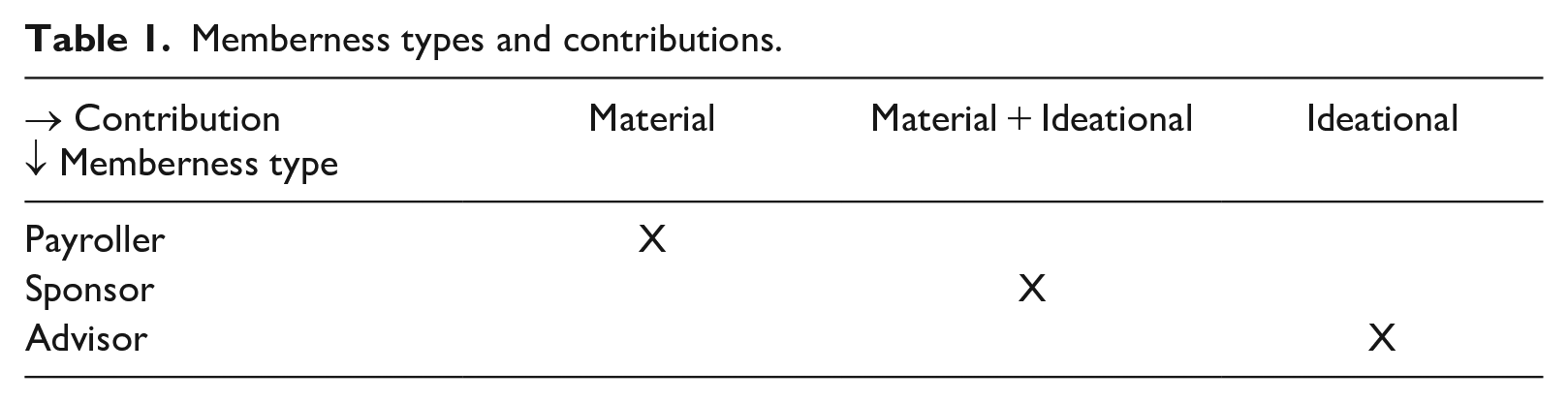
Payrollers provide general-purpose material contributions that flow into the general budget, trust funds, or other unprogrammed budgets, or into personnel and troop salary payments, ensuring that IOs have the necessary resources to sustain activities at large. Payrollers adopt a widespread approach to their “giving” and, as such, might set up long-term cooperation funds devoted to channeling their contributions to IO activities (see Table 2). Importantly, this type of memberness gives the IO significant leeway in using the resources. Payroller contributions both come without explicit conditionality and without targeting a specific thematic area.
Operationalization of memberness types.
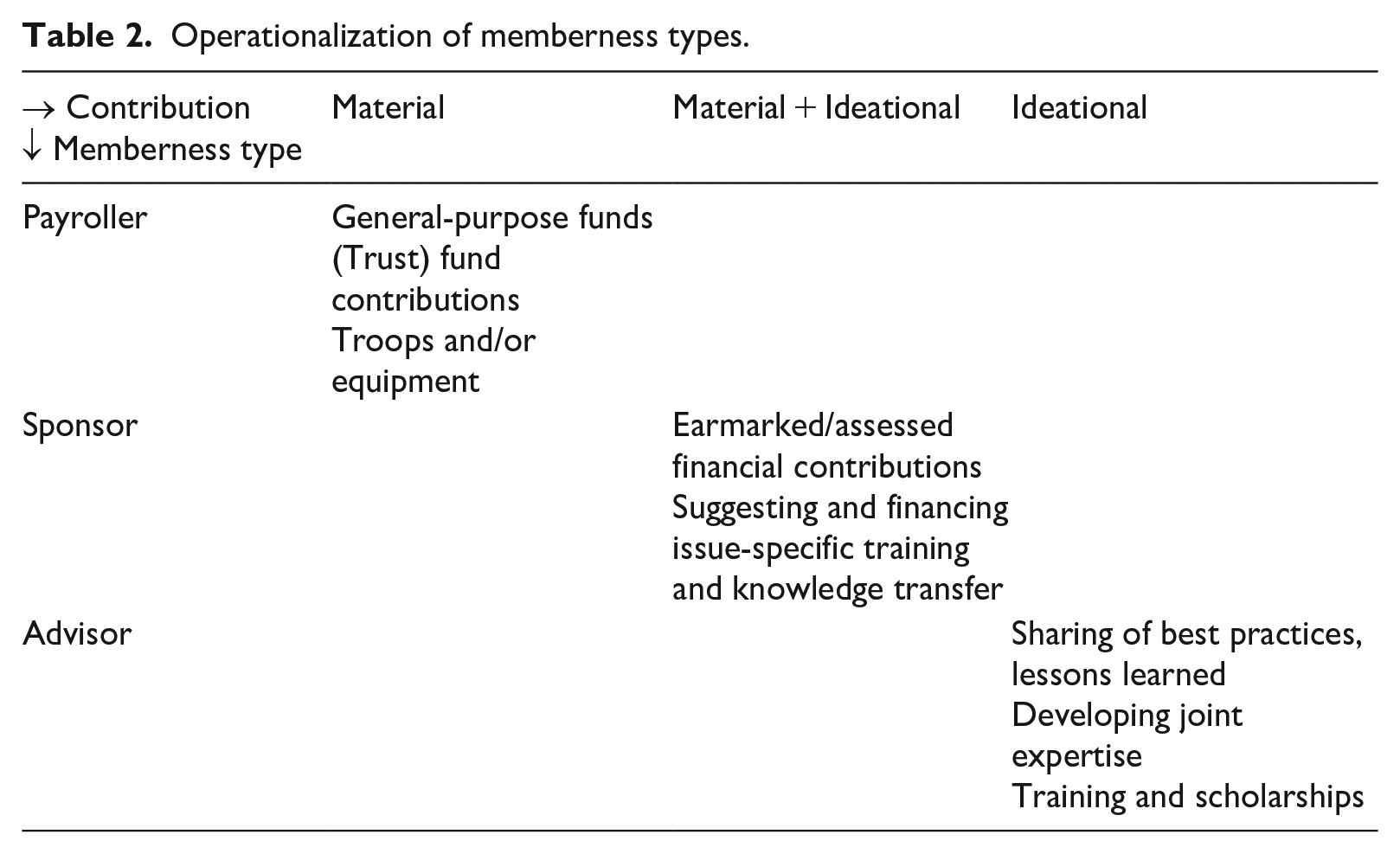
Sponsors contribute material resources that are tied to their own ideational agendas. They retain control over the type and terms of thematic projects they finance. These material–ideational resources take the form of earmarked budget and assessed contributions, project-based funding, and issue-specific expertise (see Table 2). By attaching conditions to their material contributions, or exercising control over implementing the programs they fund, sponsors take a hands-on approach, restricting the IO’s room for maneuver over the use of the resources, both thematically and financially. In tying their contributions to tangible outcomes, sponsors steer the IO in a direction that is often aligned with their preferences and standards.
Advisors provide IOs with ideational contributions, often in the form of expertise, technical standards, and best practices. Some advisors bring their expertise to specific issue areas, while others provide advice on a more generic level. In other cases, they join an IO to develop expertise (see Table 2). Advisors can impact the delivery of the IO mandate by, for example, reformulating or reinforcing its regulatory power, standards, and codes of conduct, or they might help expand an organizational mandate. While active diplomatic relations and participation at meetings are the main channels for advising, advisors need to provide the IO with concrete ideational contributions that result in a tangible output or a change in IO behavior to qualify for memberness. This may be a document, a policy, a program, or new standards and practices introduced by the IO.
Populating the IO memberness universe
We now turn to different ROs across the globe—the AU, NATO, and the OAS—to demonstrate the empirical applicability of our typology. These ROs vary in the scope of their activities, membership size, and age (see Table 3). Together, they formally associate with 198 countries: the AU has 88 associated states, the OAS has 70, 16 and NATO has 40. We illustrate memberness and its impact on IOs by discussing the material and/or ideational assets contributed and the method, duration, and conditionality of the contribution. As this paper is the first to empirically demonstrate memberness to our knowledge, and in light of space concerns, we discuss the countries that contribute the most to IOs (i.e. in terms of percentage of IO general budget, comparison to full member-states’ IO contributions, and delivery of essential aspects of IO mandates). On the state level, we find that states engage with IOs irrespective of their geographical location, historical relationships, regime type, or international standing and power, suggesting that memberness is enacted by a diverse group of actors. Table 4 provides a comprehensive overview.
ROs and their association agreements.
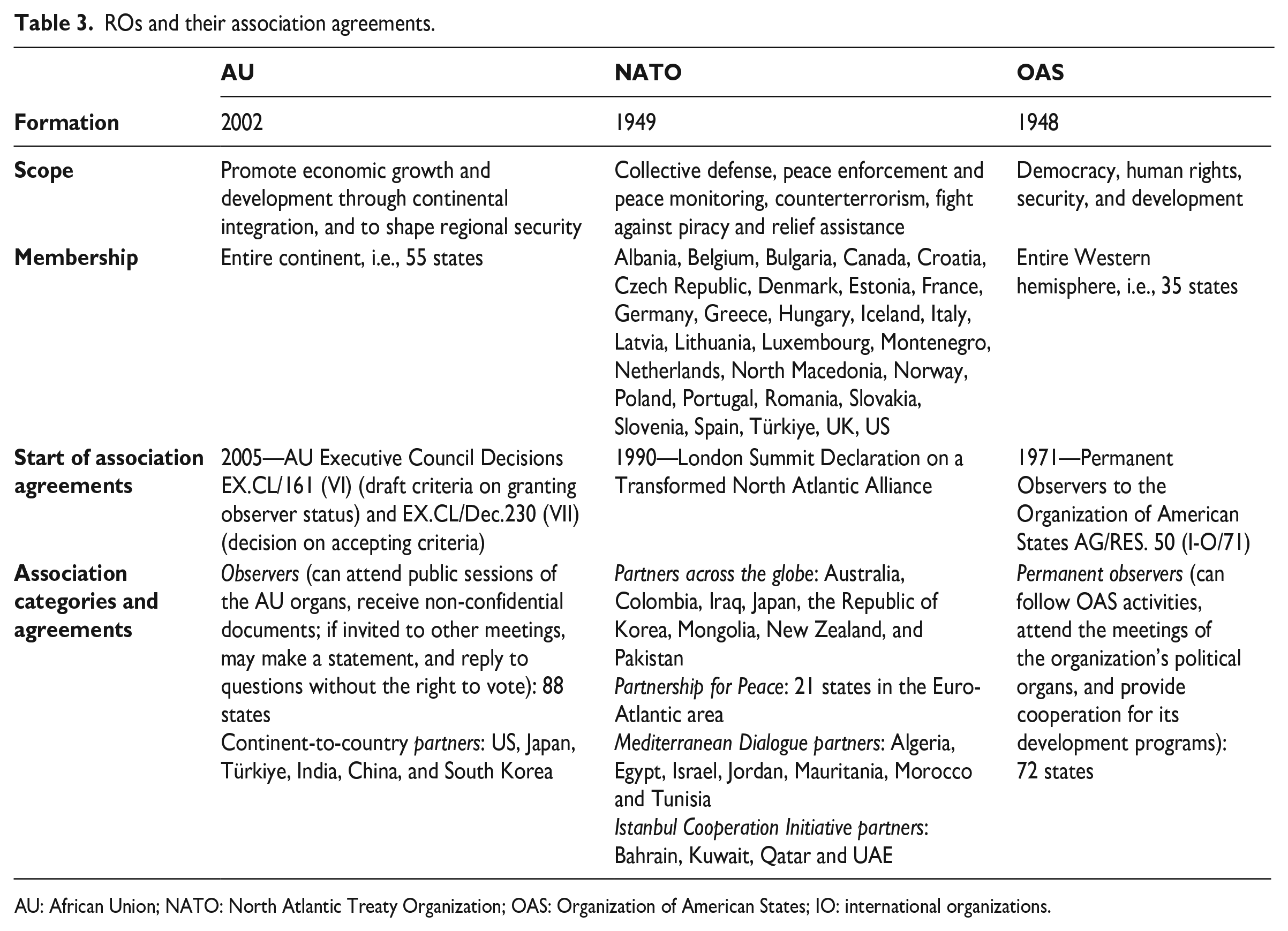
AU: African Union; NATO: North Atlantic Treaty Organization; OAS: Organization of American States; IO: international organizations.
ROs’ memberness in 2022.
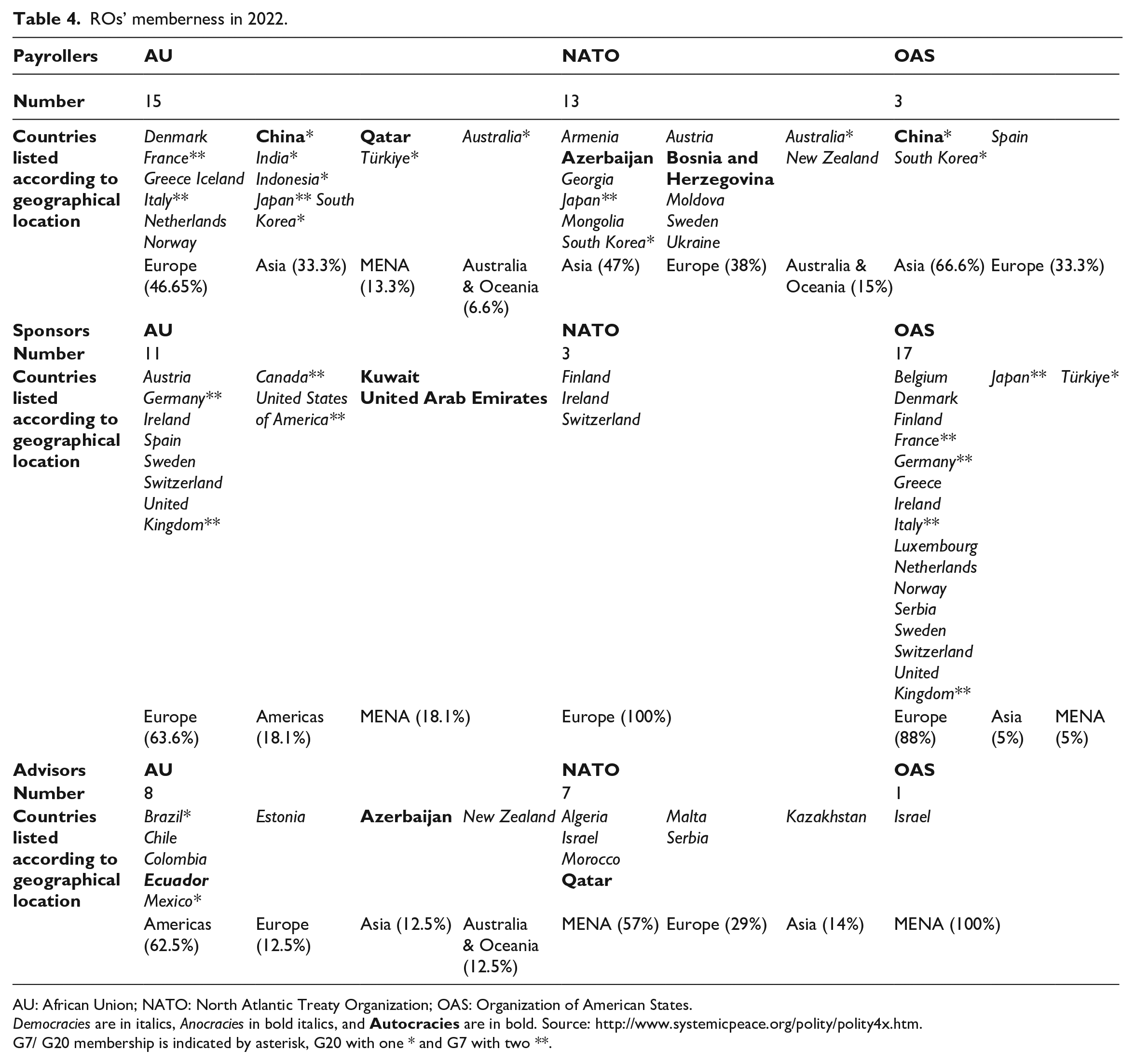
AU: African Union; NATO: North Atlantic Treaty Organization; OAS: Organization of American States.
Democracies are in italics,
G7/ G20 membership is indicated by asterisk, G20 with one * and G7 with two **.
On the IO-level, a first glance reveals that resource-rich and resource-poor ROs both have memberness, that ROs attach associated states to their everyday as well as “big business” politics, and that associated states contribute as much or even more than full member-states to the RO’s performance, vitality, and design. 17 We also find all three memberness types across the organizations (see Table 4).
Payrollers in the AU, NATO, and the OAS
We first turn to payrollers. As a shared characteristic, payroller’s contributions are general-purpose; they lack explicit conditionality, and allow an IO to take the lead in defining how it wishes to utilize them. Payroller’s contributions often come in the form of payments into permanent and/or general-purpose funds, trust funds, grants, and non-earmarked multiyear financial instruments, as well as contributions in personnel and equipment. While the inflow of such resources can help IOs deliver their mandate, it can also incentivize inefficient behavior: infighting over the resources, or the appearance of initiatives just to secure resources. As our empirical analysis demonstrates, ROs situated in the Global South or resource-poor ROs are not the only ones to open their organizational boundaries to payrollers. A diverse collection of countries choose to become payrollers, for example, to downplay potential neo-imperial aspirations or colonial legacies, or to position themselves as neutral and present the lack of conditionality as a political asset.
Associated states across the geographical and political spectrum choose to contribute to IOs through general-purpose funds. For example, the OAS receives significant resources in this manner from two of its payrollers, Spain and China. Both countries set up a designated fund to channel material resources to the RO. In 2006, Spain reinforced its cooperation program with the Americas by creating the permanent and general-purpose OAS Spanish Fund to finance projects in the OAS’s main thematic areas. The fund facilitates the establishment of a multiyear programming system that allows the organization to set goals and long-term priorities (OAS, 2012). A 2013 evaluation report noted that, due to the generic structure and transversal nature of the funding mechanism, the OAS has significant room for maneuver to disburse the Fund’s resources. According to the report “the original design of the Fund corresponds to . . . a kind of ‘empty structure’ that accommodates a multiplicity of interventions that conform to the mandates of the OAS” (Spanish MFA, 2013: 3). This was true to such an extent that OAS units considered “all their projects eligible” and not having some of them approved “generated confusion” among them (Spanish MFA, 2013: 4). While Spain enhanced OAS’s performance and vitality, its contributions also led to dysfunctional competition among some of its main organizational units. As the aforementioned evaluation report observes, “the competitive nature of project approval [by Spain] has had some undesirable effects [stimulating] the presentation of projects prepared at the last minute, with formulations that, if approved, are shown to have little to do with reality” (Spanish MFA, 2013: 4).
China supports the OAS through unprogrammed funds, budget contributions, and cash assistance. By opting for these types of contributions, it seeks to avoid neo-imperial criticism. Formally, a permanent observer to the OAS since 2004, China created the OAS-China Cooperation Fund in 2005 to “promote political stability and the economic and social development of the member states” (OAS, 2014). 18 It is the ninth largest contributor and the biggest non-European contributor among all OAS observers. While for the 2005–2011 period, China’s financial contributions represented around 1.1 percent of total contributions from permanent observers, during 2012–2018 this percentage almost tripled (OAS, 2021a). Since 2015, China’s annual contributions to the OAS surpass those of some full members, such as Nicaragua and Panama (OAS, 2021a). The OAS-China Fund has facilitated the organization’s adaptation vis-a-vis the new context. As the OAS Acting Secretary General pointed out: “this new relationship of cooperation is an important one, because we live in a world where globalization has produced openness, progress and, at the same time, vulnerabilities, which require that regional organizations like the OAS play an important role” (OAS, 2005).
Grants are another example of multiyear financial instruments; a type of contribution that, for example, characterizes the relationship of Norway to the AU. Norway does not fulfill the regional membership criteria but, as an observer to the AU, it can make organizational boundaries more porous. It contributed the equivalent of US$40 million to the AU between 1990 and 2020, and US$6 million in each of the past 3 years. Compared with the US$647 million AU budget adopted for 2020, this might not seem to be a significant amount—but it is if we keep in mind that the 17 AU members participating in the new AU financing mechanism generated US$7.5 million for the same year (AU, 2020: 3). Norway disburses grants, which are large, multiyear agreements that the AU is free to use on its projects (Norwegian MFA, 2021). The AU directs these contributions to peace and security, sustainable development and job creation, democracy, governance, and institutional capacity-building. Some of Norway’s contributions go toward salaries within the African Peace and Security Architecture and operational support to AU liaison offices that increase situational awareness and implement AU Peace and Security Council decisions on the ground (AU, 2011). Norwegian contributions helped increase the number of AU liaison offices from 11 to 16 (AU, 2016).
Trust funds are established by IOs in line with their strategic priorities, which are not subject to negotiation with associated states even when their contributions are significant. At the IO level, for example, in NATO (2021b), informal discussions at headquarters determine the scope and the costs of a trust fund, whereas a lead nation is responsible for mobilizing the required financial support. Associated states decide to join trust funds on a voluntary basis and through different modalities. For example, Australia contributed to different NATO military–political initiatives, providing US$680 million since 2007 to the Afghan National Army (ANA) Trust Fund—more than 21 percent of its total budget, a percentage only surpassed by NATO (2021b) member Germany. Being such an important material contributor, Australia has been very involved in meetings at all levels, 19 including in the ANA Trust Fund steering committee. Yet, this involvement enables it only to monitor and review the ANA Trust Fund’s “cost effectiveness, financial integrity, and accountability” but not to set the issue priorities that can be financed with their financial contributions (NATO, 2006). Australia’s contributions both enhance NATO military capacities and reinforce its global reach. The Republic of Korea paid US$319 million and non-aligned Sweden nearly US$15 million to the ANA Trust Fund, surpassing NATO (2021b) members of comparable size, like the Czech Republic that contributed US$4.5 million or Greece, with no recorded contributions.
In addition to financial resources, payrollers can also contribute with personnel, troops, and/or equipment. Australia, for instance, is “one of the top non-NATO troop contributors” (NATO, 2022a) within the International Security Assistance Force (ISAF) and the Resolute Support Mission (RSM) in Afghanistan—some of NATO’s “most challenging” and largest operations. The Republic of Korea contributed civilian and military personnel to ISAF efforts toward capacity-building in Parwan Province, and lent personnel and vessels to NATO’s (2022a) efforts to increase maritime security in the Gulf of Aden and the Horn of Africa. 20 Sweden also participated in military and civilian NATO exercises. By formally attaching its civilian resources to the Euro-Atlantic Disaster Response Coordination Centre (EADRCC), including its “search and rescue teams, medical experts and protection and decontamination units” (NATO, 2022a), Sweden strengthened NATO’s core mechanism for providing civilian emergency response to countries facing natural or man-made disasters. It also supported NATO-led operations with personnel, such as in Afghanistan, Bosnia, Iraq, Kosovo, and Libya. In addition, in Libya, Sweden’s air force helped maintain the no-fly zone through tactical air reconnaissance (Doeser, 2016), providing around 30 percent of reconnaissance sorties and 2770 reconnaissance reports to NATO (Hendrickson, 2013). These payrollers provide resources to the IO that combines some of the world’s best-equipped and richest militaries.
Sponsors in the AU, NATO, and the OAS
Targeted contributions impact organizations differently. Unlike payrollers, sponsors’ contributions are earmarked, issue-specific, and conditioned by the associated state. Sponsoring allows the sponsor to set the terms of how the IO shall use the contributed resources. In some cases, the sponsor remains fully in charge of the terms of the association relationship.
The contribution that epitomizes this memberness type is the earmarked and assessed financial contribution. Several states choose to “commit” to IOs in this form and steadily supply targeted programs with financial resources. Germany and Spain structure their association to the AU around such contributions, even if their profiles are different. Germany was instrumental in creating the organizational structure of the African Court of Human and People’s Rights, the AU’s judicial arm (GIZ, 2022a); in the promotion of the African Charter on Democracy, Elections and Governance, currently ratified by 34 AU member-states; and through advisory services to the AU Commission’s (AUC’s) Department of Political Affairs and Department of Social Affairs (GIZ, 2022b). Furthermore, it helped develop the AU’s Continental Early Warning System (CEWS) and insisted on cooperation between the continental and the regional levels; that is, between the AU and the Regional Economic Communities (GIZ, 2020). Germany contributed about US$622 million since 2004—for the past 18 years, about 6.5 percent of the AU budget annually—for activities in the areas of social, economic, and rural development, peace and security, regional integration, good governance, and migration (GIZ, 2021). German staff “embedded” in the AUC, in the AU’s development agency, and in other specialized AU organs demonstrates the permeability of organizational boundaries (GIZ, 2018: 11).
Spain built different kinds of leverage into its earmarked contributions. Its two consecutive “Africa Plans” jointly dedicated US$170 million, or the annual equivalent of about 9 percent of the AU budget, to counterterrorism and illegal migration between 2006 and 2012. The third Spanish “Africa Plan” (2019-present) is an open-ended financial instrument to be continuously adapted to the needs of these strategic areas. Spending is entirely defined by Spain’s national foreign policy priorities. The Plan explicitly stipulates that “the ‘appropriation’ of the Plan by African partners is not advocated, as the present Plan Africa is a Spanish national strategy and our African partners do not participate in its design, implementation or monitoring” (Spanish MFA, 2019: 49). Spain has been contributing to key elements in the AU mandate, focusing on combating terrorism, maritime security, and Women, Peace and Security (WPS). However, Spain not only impacts the AU’s performance, but also seeks to pull the AU to its cultural orbit. Although only one AU member-state is officially Spanish-speaking, Spain managed to promote its language as an AU official language in 2003 (Spanish MFA, 2009: 90). If only on a symbolic plane, this is an example of an IO’s willingness to comply with a sponsor’s expectations, even if it makes little sense in terms of its own priorities.
Sweden’s contributions steered the OAS in a particular direction by shifting its priorities to unusual areas. Sweden is the OAS’s second largest financial contributor among associated states. In 2021, for example, it provided the OAS with almost 3 percent of its US$60 million total annual budget (OAS, 2021a). 21 During that year its contributions were only surpassed by 5 of the 34 OAS permanent members (OAS, 2021b) (see Note 21). In 2003, Swedish contributions allowed the OAS to transform a pilot program—the Special Program to Support Guatemala (1996-2003)—into a specialized program (OAS/PROPAZ) that provided training to civil society institutions at the national level (Jansen and Barrios, 2009). 22 OAS/PROPAZ marked the beginning of the OAS’s direct engagement with non-state actors (Shamsie, 2007). Until then, the organization mainly provided technical assistance and training to its government counterparts (Kriegman and Clarck d’ Escoto, 2001). OAS/PROPAZ’s unusual focus on civil society—which had been the traditional focus of nongovernmental organizations (NGOs) working in conflict transformation—generated internal conflict within the OAS, as certain member-states felt uncomfortable with this shift (Shamsie, 2007). In the context of this new area of involvement, OAS/PROPAZ had to carefully negotiate between Sweden and civil society regarding project timelines, with the former wanting quick results and the latter demanding to unnecessarily extend certain phases of the projects (Parsons et al., 2018).
Sponsors can also participate in IO decision-making and broaden or shape IO activities by contributing with issue-specific knowledge and training, even in resource-rich organizations like NATO. Switzerland, for example, in line with its longstanding humanitarian tradition, undertook to keep international humanitarian law on NATO’s agenda. Through engagement of their Permanent Mission to NATO, it ensured that the Montreux Document—which provides the international legal framework for private security companies engaged in military operations—is supported by NATO. In areas where Switzerland has recognized expertise, such as good governance of the security and defense sector, small weapons, or humanitarian demining, Swiss experts have also become NATO’s “irreplaceable partners” (Swiss Mission to NATO, 2022). This enabled Switzerland to shape NATO’s Building Integrity (BI) policy. It has not only financially contributed to the NATO BI Trust Fund, but was also the single partner state to co-lead this Trust Fund with “quite a big say to shape the overall structure and what sorts of things it should involve.” 23 The BI structure thus included a self-assessment tool for measuring corruption in the defense sector, courses for military and civilian personnel, and a compendium of best practices. Switzerland further influenced BI implementation, notably through the Geneva Centre for Security Governance (DCAF) and the Geneva Centre for Security Policy (GCSP), both acting as NATO BI implementing partners (NATO, 2022c). Swiss experts were involved in key publications, such as the NATO BI Reference Curriculum or the NATO BI Compendium of Best Practices (NATO, 2021a). The BI policy influences national governance and defense sector reform, contributing to NATO’s efforts to promote good governance principles in the security sector by expanding NATO’s knowledge base in this field (NATO, 2021a).
Advisors in the AU, NATO, and the OAS
Advisors support organizational procedures and mechanisms, contribute to an IO’s knowledge base, contribute specific expertise that is not covered by an IO’s membership, or use their memberness to jointly create expertise with an IO in a specific area. While they are less likely to vitalize an IO, they can enhance its performance and support or change its institutional scope. Here again, we find that countries across the globe act as advisors. Some affluent countries opt to be advisors instead of materially contributing to IOs. The empirical examples illustrate the importance and impact of advisors on expanding an IO’s knowledge base, either by partnering with an IO to develop new expertise or by transferring their existing knowledge to it.
Examples of contributions to jointly develop expertise are that of Algeria, Israel, and Qatar—all NATO partners and advisors. They participate in NATO’s (2022b) Science for Peace and Security Program (SPS): Algeria in the field of counterterrorism, Qatar in the area of cyber defense and advanced technologies, and Israel in both. NATO SPS programs involve allies and partners in joint development of knowledge, new capabilities, or elements of scientific inquiry that are instrumental in countering NATO-wide security threats. 24 For example, Algeria’s experts jointly “developed the first terahertz imaging technology in North Africa” (NATO, 2022b) with France and Sweden, enabling the detection of dangerous materials and the protection of critical infrastructure from terrorist attacks. Israel shares its existing expertise with NATO (2022b), most notably in the field of advanced technology, counterterrorism, and chemical, biological, radiological, and nuclear (CBRN) threats. This type of advising via SPS projects “reinforces the network of scientists and experts in NATO and its partner nations, contributes to the transfer of knowledge and expertise” (NATO, 2022b). At the IO level, it underpins NATO’s strategic interests in the Gulf and the Mediterranean, by providing better “situational awareness” and improved understanding and monitoring of certain threats in the region. 25 SPS projects can also be supply-driven. Currently, Israel is negotiating to bring Israeli climate experts on drought to NATO to share expertise on climate change’s impact on security, probably through a series of workshops. 26 Israel is also the most prominent advisor to the OAS, contributing to the OAS-affiliated Young American Business Trust (for the period of 2012–2017).
Other countries offer to share their expertise as advisors. Estonia, for example, is an AU observer with expertise in digitalization and information technology. According to the terms of a memorandum of understanding signed in 2017 with the AU, Estonia is contributing its know-how to develop an “e-governance academy” program at the AU, the first step of which was an in-depth report mapping out existing capabilities and a pilot project to provide hands-on experience with e-governance tools (Estonian, 2018). The program is helping to realize the AU’s recently adopted African Digital Transformation Strategy. The role of New Zealand is also far more substantive than suggested by its formal observer status. With minimal material contributions to the AU, its Ministry of Foreign Affairs and Trade jointly manages the project of the African Union Handbook with the AUC (New Zealander Government, 2021). Seemingly a technicality, in the RO where approximately half of employees are on short-term contracts and frequently rotate, the regularly published Handbook provides an authoritative guide to the AU’s organizational structure, contributing to the transparency and institutional capacity-building that are an important part of the agenda. The Handbook is an asset for AU employees, partners, and donors, offering clarity on who does what in the RO, and, consequently, impacts the efficiency of institutional collaborations with both regional and external partners. Through their advisor memberness, both countries improve AU functioning by transferring their existing expertise.
Finally, advisors also contribute to IOs with scholarships and training programs. The Business Trust, a banner of the cooperation between the OAS and Israel, has offered fellowships, training courses, and the sharing of good practices to more than 17,000 young people across all OAS member-states over the past decade (OAS, 2017). The creation of the affiliated body facilitated the OAS’s outreach efforts in the context of growing financial discontent and increasing calls for private sector engagement (Mace et al., 2010).
Memberness’s influence on IOs and implications for IO research
That memberness influences IOs is an insight that can enrich existing IO research programs that do not pay attention to associated states’ agency within IOs. Memberness in general (and its types in particular) improves our understanding of who and what sustains bureaucratic authority and IO vitality (Debre and Dijkstra, 2020; Gray, 2018; Hooghe et al., 2019), institutional design (Koremenos et al., 2001), organizational performance (Gutner and Thompson, 2010), and organizational stratification (Viola, 2020), as well as regime complexes (Alter and Raustiala, 2018; Raustiala and Victor, 2004).
Bureaucratic authority and organizational vitality
Memberness contributes to IO authority and vitality by enhancing bureaucratic size and competences via new infrastructures, competitive staff salaries, training programs, or exchange and secondment of personnel. Payrollers in particular can impact IO authority and vitality. Payroller contributions impact the size of international bureaucracies and individual bureaucratic divisions. This constitutes a significant channel of impact, if what correlates the most with IO survival is the size of its secretariat (Dijkstra, 2019: 12). However, payrollers may also accentuate the propensity for dysfunctional IO behavior (as the example of Spain in the OAS illustrates) or fuel internal struggles for resources, disproportionately empowering certain units over others depending on their respective abilities to capture resources (Barnett and Finnemore, 2004). Bureaucracies can also become dependent on payrollers, which can reduce an IO’s authority even if it boosts its vitality.
A focus on sponsors highlights that an IO’s authority and vitality is not always a result of its members’ and bureaucrats’ choices and bargains. IOs may pursue activities not necessarily aligned with their own policies to benefit from the sponsor’s contributions, as the example of Spain to the AU illustrates. IO recruitment strategies might also adapt to the requirements set by sponsor’s ideas. This can diminish the authority of bureaucrats. Furthermore, paying attention to sponsors corrects our understanding of “strong” IOs and “weak” associated states; as we have shown, influence and regulatory power do not necessarily flow unilaterally from the IO to the associated state.
The expertise that advisors bring to IOs strengthens an IO’s knowledge base, as noted in the examples of Qatar and Israel to NATO. This expertise can be central or challenging to assert an IO’s authority, to justify expanding its jurisdiction into new policy domains, or to enhance its capacity to act. Depending on whether the advisor was invited by the IO or intervened on its own, advisors can either strengthen bureaucracies’ epistemic authority (Littoz and Monnet, 2017) or weaken it, as both sponsors and advisors promote their own expertise while delegitimizing the IO’s. Relying on some advisors and not on others can also insulate an IO from other forms of available expertise and disincentivize or undermine internal knowledge.
Institutional design and performance
Payrollers, sponsors, and advisors contribute to the delivery of an IO’s mandate and potentially facilitate the expansion of its agenda. They also can influence an IO’s perceived legitimacy and operational support. Payroller contributions can influence the design of an institution and its performance. While the size of the contribution might influence which programs and institutional designs can receive additional funding, it is up to the IO to distribute payroller funds. A focus on payrollers can, furthermore, contribute to IO-specific scholarship, such as research on NATO’s burden-sharing debate (Hartley and Sandler, 1999). Payroller contributions to NATO funds and programs imply that costs may be more broadly distributed, impacting burden-sharing dynamics among full members.
Sponsors can enhance IO performance in a particular domain or push for adherence to a particular set of norms and standards. Through earmarked contributions from sponsors, they can incentivize shifts in an IO’s mandate or programs, as noted in the case of Sweden’s sponsorship of the OAS. In extreme cases, a sponsor can impose their agenda on an IO by “reprogramming” its mandate and institutional design through their conditioned contributions. In terms of IO-specific insights, the existence of sponsors within the OAS might call into question what some authors call “club multilateralism,” or an entrenched tradition in the inter-American system in which the OAS has become an exclusive club of member-states with its own rules and privileges (Cooper and Legler, 2006). As much as some of its permanent members, sponsors are able to “shape the organization’s agenda-setting process.” 27 Similarly, it allows us to go beyond the generic observation that the OAS contributed to the consolidation of a regional democratic norm (Herz, 2011) to instead understand the influence countries other than member-states have in this process.
A focus on advisors adds to the IO scholarship on scope expansion, which mainly relied on member-states, international bureaucrats, or outside experts to explain these institutional developments (Littoz-Monnet, 2017). Making advisors visible enables us to better understand who contributes to IO scope expansion and when. As we have shown, advisors (such as Estonia in the AU or Israel in NATO) are in a position to influence an IO’s agenda and policies.
Organizational stratification
Recent IO scholarship debates whether IOs can flatten or increase structural inequalities within their formal membership despite the principle of sovereign equality (Viola, 2020). We do not dispute that formal membership implies institutional privileges such as the right to vote, which associated states do not have; however, as existing scholarship has shown, inequalities persist even among formal full member-states (Fehl and Freistein, 2020).
Our analysis demonstrates that some states with memberness, in particular sponsors, can be more influential in IOs than some full members. In other words, privileged groups do not only form within formal IO membership, and they do not only form based on legal access rights. Therefore, an IO analysis should include not only rights-based but also capacity-based understandings of participation in IOs. As we have seen with the case of the OAS, contributions from associated states, such as China and Sweden, are much more vital to the RO than those from some full members, such as Nicaragua and Panama (OAS, 2021a). Contributions from Norway or Germany to the AU further demonstrate that associated state contributions are essential to IOs, as member-states build their own resource-generating mechanisms. The memberness universe of NATO suggests, however, that memberness is a permanent feature even when member-states have their internal resources to sustain their IO.
Regime complexity
Making memberness visible in IOs can also enrich existing insights on regime complexity, “the signature feature of 21st century international cooperation” (Alter and Raustiala, 2018: 329)—particularly regarding their structure (Fuß et al., 2021; Gehring and Faude, 2013; Keohane and Victor, 2011) and the strategies available to actors (Hofmann, 2009, 2019; Morse and Keohane, 2014).
Memberness often involves creating institutional channels of cooperation by establishing working groups or commissions made up of full member-states with associated states. Payrollers, sponsors, and advisors often participate in IO meetings, which creates a platform for coalitions (primarily with payrollers and sponsors) and epistemic communities (primarily with advisors) to form and for bureaucrats to shape (inter-)institutional relations. In addition, they link different organizations in more ways than is currently being captured in the regime complex scholarship. If porous organizational boundaries and memberness were included in the depiction of regime complexes, then membership overlap and organizational reach would be more substantial and an IO’s “inscribed authority” (Zürn, 2018: 44) as an interlocutor in its region or field of activity might change.
Conclusion
Memberness makes associated state agency in IOs visible. We argued for the need to go beyond examining IOs and their legal membership to consider the contributions of associated states to these organizations. We have shown that associated states can influence IOs—potentially even more than some full member-states. To demonstrate this, we have introduced the concept of memberness and developed three memberness types—payroller, sponsor, and advisor—based on associated states’ material and/or ideational contributions. Memberness draws attention to the relative openness of organizational boundaries by moving away from the understanding that the only dimension that matters within an IO is legal status (or who you are in an IO) and showing that a focus on contributions (or what you do in an IO) renders visible additional channels of influence and IO functioning.
Attention to memberness questions existing assumptions and theoretical propositions regarding how IOs acquire and use resources such as budgets and expertise, helping us ask new research questions about the politics of IO membership and IO legitimacy. While we showed that memberness is at work no matter the motivation of an associated state or an IO, the politics and tradeoffs of membership and memberness deserve more attention. The brief discussion of Serbia’s association with both NATO and the CSTO has illustrated this point. Furthermore, we have only focused on formal intergovernmental organizations in this paper; yet recent research shows that informal organizations make up an important part of global and regional governance structures (Roger and Rowan, 2022). Studying association arrangements in this context could further illuminate how organizational boundaries are practiced and what impact that has on organizations.
Memberness questions the boundaries of IOs. In light of these findings, future research could address whether and, if so, how we should draw the boundaries of IOs—especially in light of what and who grants them legitimacy. Our understanding of IOs and memberness can be productively combined with research that engages with the external environment of IOs, such as regime complexity (Alter and Raustiala, 2018), organizational ecology (Abbott et al., 2016), and international order(ing) (Acharya, 2017; Ikenberry, 2018; Viola, 2020). Many scholars see IOs as a manifestation of ordering principles and often use them as analytically homogeneous blocs to demonstrate different understandings of order. If we understand organizational boundaries as permeable and open up the analysis to memberness instead of focusing solely on formal membership, then we are in a more advantageous position to capture different networked material and ideational entanglements and structural holes, which reflect the interconnectedness (or lack thereof) of international actors. Memberness types call for reconsidering several assumptions to advance our theoretical and empirical understandings of IOs.
Footnotes
Appendix 1
Associated states without memberness.
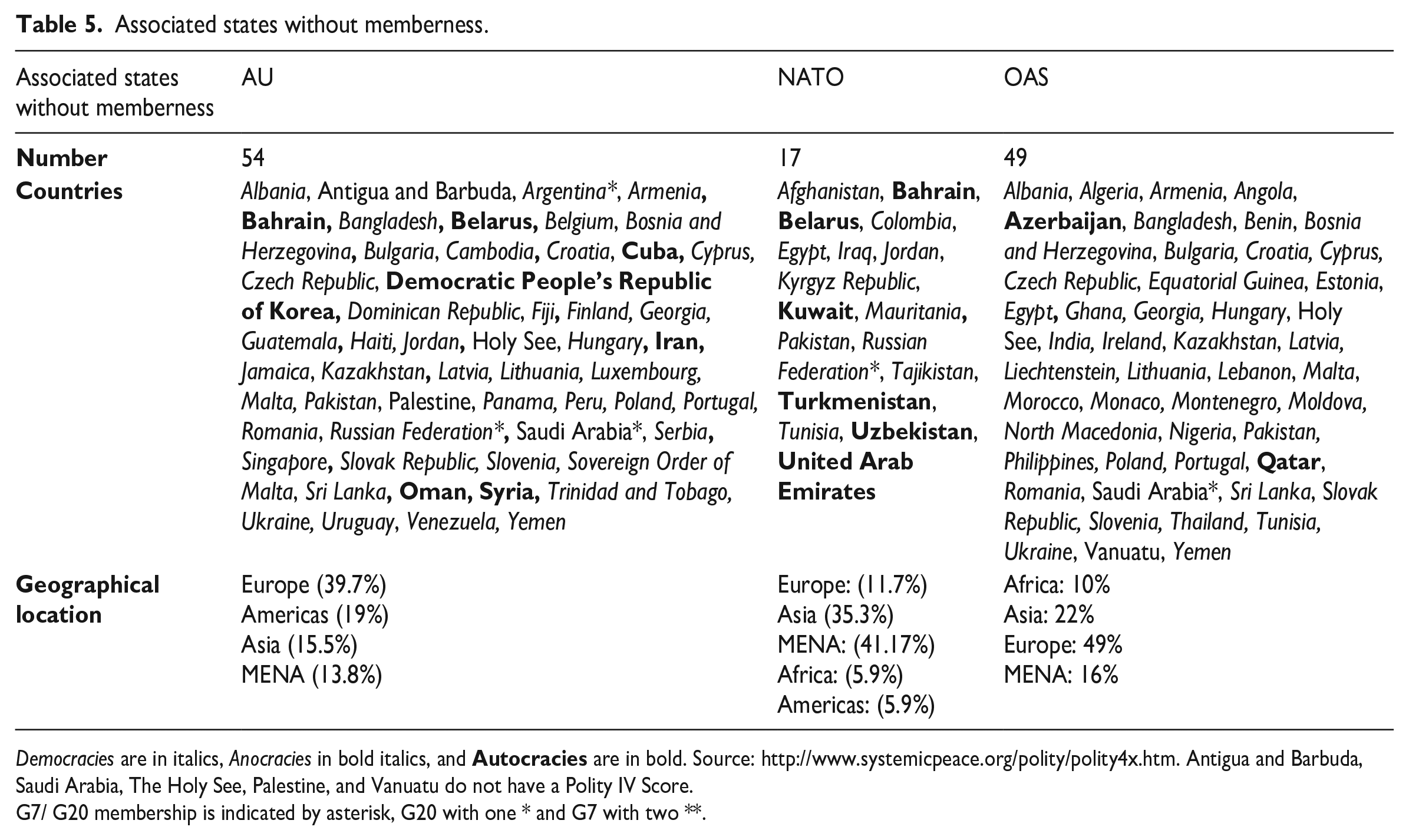
| Associated states without memberness | AU | NATO | OAS |
|---|---|---|---|
|
|
54 | 17 | 49 |
|
|
Albania, Antigua and Barbuda, Argentina*, |
Albania, |
|
|
|
Europe (39.7%) Americas (19%) Asia (15.5%) MENA (13.8%) |
Europe: (11.7%) Asia (35.3%) MENA: (41.17%) Africa: (5.9%) Americas: (5.9%) |
Africa: 10% Asia: 22% Europe: 49% MENA: 16% |
Democracies are in italics,
G7/ G20 membership is indicated by asterisk, G20 with one * and G7 with two **.
Acknowledgements
The authors thank Angelos Angelou, Christina Davis, Benjamin Faude, Orfeo Fioretos, Stefano Guzzini, Sandra Lavenex, participants at the 2019 ECPR Joint Sessions and the 2020 APSA annual meeting, the global governance reading group at the Geneva Graduate Institute, as well as the EJIR editors and reviewers for their helpful feedback.
Funding
The author(s) received financial support for the research, authorship, and/or publication of this article: This research was supported from the Swiss National Science Foundation Research Grant #100017_172667.
