




Abstract
In principle, the 2007 African Charter on Democracy, Elections and Governance (ACDEG) could be a powerful instrument to bring the African Governance Architecture to life and to help ensure that its universal values, including respect for human rights and the rule of law, are implemented across all African Union member states. Yet how serious in reality are the latter on this question? Ratification of the African Charter has taken five years and, as of late 2019, the implementation of its compliance mechanism is still pending. This article asks how these empirical puzzles can be best addressed. In the absence of robust data on member states’ preferences and with a view to developing hypotheses for further research, this article inductively interrogates how data on the various regimes’ political liberties may or may not relate to the ratification of the African Charter and the implementation of the ACDEG compliance mechanism.
Introduction
There has been a long-standing tradition of both the African Union (AU) and its predecessor, the Organisation of African Unity (OAU), adopting encompassing legal instruments on issues of human rights and democratic governance. 1 Per this tradition, the AU adopted at the 8th Ordinary Session of the AU Assembly of Heads of State and Government, held on 30 January 2007 in Addis Ababa, Ethiopia, the African Charter on Democracy, Elections and Governance (henceforth African Charter, or ACDEG). Today, it is the most important reference document for what has become known as the African Governance Architecture (AGA) – that is, the policy and institutional framework complimentary to the African Peace and Security Architecture (see Engel, 2013, 2016).
The empirical puzzles that this article wishes to address are, first, why the ratification of the ACDEG would take five years (2007–2012) – which, even by AU standards, is a fairly long time – and, second, why the implementation of its compliance mechanism is by and large still pending. There is an obvious contradiction between member states’ expressed collective preferences on the one hand and their actual individual behaviour on the other. The fundamental challenge in addressing these puzzles is the lack of data on AU member states’ preferences: there are no public records or minutes open to scrutiny for the biannual meetings of the highest decision-making body of the AU, the Assembly, and also the most important decision-making organ in between: the Peace and Security Council (PSC). In contrast to the deliberations of, for instance, the United Nations (UN) General Assembly or the UN Security Council, the meetings of the AU Assembly and the PSC usually take place behind closed doors. After meetings, only communiqués or press statements are made available to the general public. So far, research on the foreign policies of African states has not come up with detailed analysis of their preferences within the AU or indeed any other international or regional organisation. A body of comparative literature on African states’ foreign policy interests simply does not exist, despite important claims of increased “African agency” (see Blauuw, 2016; Brown, 2012; de Carvalho et al., 2019; Harman and Brown, 2013).
The article draws on mainstream Political Science arguments on the nature of African political regimes emerging in the 1990s in response to Africa becoming part of the “third wave of democratisation” and the subsequent political transitions occurring across the continent after the end of the Cold War. Authors have argued that, as per regime type, the number of formal “democracies” has increased considerably since 1989, yet that many of them still lack democratic substance (see Bleck and van de Walle, 2019; Bratton and van de Walle, 1997; Cheeseman, 2015; Gyimah-Boadi, 2005). In Comparative Politics, this has led to typological distinctions between “electoral” and “liberal” democracies on the one hand and “closed” and “electoral” authoritarian regimes on the other (see, for instance, V-Dem Institute, 2019). Addressing the same empirical observation, others distinguish between “liberal” and “illiberal” democracies, 2 “democracies with adjectives,” and so-called hybrid regimes (see Diamond, 2002; Merkel and Croissant, 2000). Yet another way to deal with the question of imperfect democracies has been in terms of “electoral” versus “flawed” democracies (EIU, 2019).
Building on these general observations, I assume that “electoral,” “illiberal,” or “flawed” democracies, meaning formally democratic regimes with authoritarian features, would have less of an interest in supporting an agenda that is likely to undermine their power base by allowing for more democratic freedom and opening up the space for opposition parties and civil society. To test this expectation, and with a view to generating hypotheses for further research, in a first step I will look at Freedom House scores (2019a, 2019b) and relate them to two issues: first, to AU member states involved in the ratification process of the African Charter and, second, to the members of the Union’s most important decision-making body in between meetings of the Assembly, the aforementioned PSC.
For two reasons, Freedom House 3 data are preferred to more sophisticated and complex indices such as, for instance, the Varieties of Democracy (V-Dem Institute, 2019) or the Economist Intelligence Unit’s Democracy Report (EIU, 2019): first, in comparison to most other simple measurements, the choice of the Freedom House Index (FHI) is a purely technical decision. This is informed by the fact that this is the only index that is available for all AU member states (sub-Saharan and Maghreb) and throughout the whole period under review (2002–2018). Competing indices that are less complex than, for instance, V-Dem – such as the Mo Ibrahim Index (Mo Ibrahim Foundation, 2018), Polity IV (Center for Systemic Peace, 2016), or the Bertelsmann Transformation Index (Bertelsmann Foundation, 2018) – do not offer a comparable data set in terms of regional coverage and/or the time period of investigation. Finally, Afrobarometer (see, for instance, Mattes and Bratton, 2016) also does not provide the kind of data needed for such an explorative and inductive research design. Second, it is also a conveniently available tool that fully serves the purposes of this analysis. I am not interested in contributing to the fine-tuning of regimes typologies (as important as they are), but will rather use a fairly common and simple measurement to interrogate the nexus between regime behaviour and likely regime interests.
Based on Freedom House data, eminent US democratic transition scholar Larry Diamond has observed a global “democratic recession” since the middle of the first decade of the new century – with the overall trend indicating a decline in the democratic quality of political regimes worldwide (Diamond, 2015). Similarly, the V-Dem Institute has attested to the fact that there is a “third wave of authoritarianism” occurring – even though democracy still prevails in many of the world’s countries (V-Dem Institute, 2019: 5). In fact, for Africa these claims can be substantiated by the regular “African Governance” reports of the UN Economic Commission for Africa (UNECA, 2005, 2009, 2013, 2016) and also the latest report on governance by the voluntary and self-monitoring African Peer Review Mechanism (APRM) – in which thirty-seven AU member states currently participate (APRM, 2019). Furthermore, it is also strongly reflected in the trends regarding violent conflict – which may serve as an explanation for the decline in governance and democracy standards recently witnessed in many African countries. 4
In order to contextualise the findings of this analysis, in a second step I will discuss them with reference to the norm cycle model developed by US political scientists Martha Finnemore and Kathryn Sikkink, with it serving as a heuristic framework to structure the analysis. 5 Treating norms in international relations as “a standard of appropriate behaviour for actors with a given identity” (Finnemore and Sikkink, 1998: 891), they conceptualise the process from the emergence of a norm to its spreading (“norm cascade”) – and, ultimately, its “internalisation.” First, norm emergence occurs when “norm entrepreneurs” use organisational platforms to convince a critical mass of state (norm) leaders to embrace new norms. 6 They are “actively built by agents having strong notions about appropriate or desirable behaviour in their community” (Finnemore and Sikkink, 1998: 895). These agents act on the basis of altruism, empathy, and/or ideational convictions. Second, norm cascade refers to the process by which states or international organisations begin to adopt a new norm as they seek to increase their legitimacy, reputation, and esteem. They do so through process of socialisation, institutionalisation, and/or demonstration. Agents of socialisation are states, networks of norm entrepreneurs, and international organisations. States conform to norms because of peer pressure. And, finally, norm internalisation is linked to the process by which conformity to a norm becomes automatic, that through habit and institutionalisation, making it both powerful and difficult to discern (Finnemore and Sikkink, 1998: 898). So the norm cycle model offers a lens through which the findings coming from the Freedom House score analysis can be structured – and also, hopefully, meaningfully interpreted.
The remainder of this article proceeds as follows: in the second section, the main provisions of the African Charter and its compliance mechanism will be introduced. In the third section, the issue of late ratification will be discussed in more detail. In the fourth section, the non-implementation of the compliance mechanism will be examined. Linked to the current reform agenda of the AU, in the fifth section, the recent debate on reviving the AGA reform agenda will be critically recapped. This will be followed by the identifying of overall conclusions in the sixth and final section.
The African Charter and Its Compliance Mechanism
The ACDEG aims, among other things, at fulfilling the following objectives: Promote adherence, by each State Party, to the universal values and principles of democracy and respect for human rights; Promote and enhance adherence to the principle of the rule of law premised upon the respect for, and the supremacy of, the Constitution and constitutional order in the political arrangements of the State Parties; Promote the holding of regular free and fair elections to institutionalize legitimate authority of representative government as well as democratic change of governments; Prohibit, reject and condemn unconstitutional change of government in any Member State as a serious threat to stability, peace, security and development; Promote and protect the independence of the judiciary; Nurture, support and consolidate good governance by promoting democratic culture and practice, building and strengthening governance institutions and inculcating political pluralism and tolerance. (AU, 2007: §2)
The origins of the aforementioned AGA go back to the 16th Ordinary AU Assembly’s decision on “Shared Values” of the AU, held on 30–31 January 2011 in Addis Ababa (AU Assembly, 2011). This provides a mandate for putting in place a “Pan-African Architecture on Governance” (see also AU Assembly, 2016a: §2).
7
The African Charter calls on all signatories to commit themselves to its objectives and principles (AU, 2007: §44[1]). In particular, signatories “shall initiate appropriate measures including legislative, executive and administrative actions to bring State Parties’ national laws and regulations into conformity with this Charter” and also “incorporate the commitments and principles of the Charter in their national policies and strategies.” At the level of the AU Commission, the African Charter calls for the development of benchmarks to monitor its implementation (AU, 2007: §44[2]A). At the level of the so-called Regional Economic Communities (RECs), focal points “for coordination, evaluation and monitoring of the implementation of the commitments and principles enshrined in this Charter [should be designated]” (AU, 2007: §44[2]B). The AU Commission is the central coordinating structure for the implementation of the African Charter (AU, 2007: §45[a]): with other key organs of the Union including the Pan-African Parliament, the Peace and Security Council, the African Human Rights Commission, the African Court of Justice and Human Rights, the Economic, Social and Cultural Council, the Regional Economic Communities and appropriate national-level structures. (AU, 2007: §45[c])
Finally, the African Charter established a compliance mechanism: beginning from 15 February 2012 (when it entered into force), signatories were supposed to submit every two years a report to the AU Commission “on the legislative or other relevant measures taken with a view to giving effect to the principles and commitments of the Charter” (AU, 2007: §49[1]). The Commission was then to prepare and submit to the AU Assembly “through the Executive Council, a synthesized report on the implementation of the Charter” – with the Assembly tasked with taking “appropriate measures aimed at addressing issues raised in the report” (AU, 2007: §49[4]). The extent of compliance with this reporting mechanism will be discussed in the fourth section below.
Late Ratification: Testing Freedom House Scores on AU Member States
In principle, then, the African Charter has the potential to be a powerful tool in fostering the underlying universal values and standards of the AU (in fact, so far there has been very little academic debate on the actual process of implementing the African Charter). 8 In any case, the ratification process dragged on for almost exactly five years – which, by AU standards, is above average for this type of legal document. 9 The African Charter was supposed to enter into force thirty days after the fifteenth instrument of ratification was deposited. This happened after Nigeria had submitted the relevant legal documents on 9 January 2012.
When looking at the various stages of signing, ratifying, and depositing the African Charter, the following observations can be made (based on AU, 2019b): the initial process of ratifying and depositing it started slowly, with Mauritania coming in eighteen months after the initial decision was taken by the AU Assembly (on 28 July 2008), followed by Ethiopia (6 January 2009) and Sierra Leone (8 December 2009). The last two out of the necessary fifteen countries to deposit the legal instruments were Guinea-Bissau and Nigeria (on 4 and 9 January 2012, respectively). Yet, there is no specific regional pattern across the various RECs as regards a collective sequencing – save for Lesotho and Zambia depositing within two days in July 2010, and Guinea-Bissau and Nigeria within five days in January 2012.
As to be expected, the average period between signing and ratifying was usually far longer than between ratifying and depositing: on average, 22.43 months versus 2.07 months (these figures relate to the initial fifteen signatories only). Some AU member states seem to have had a strong political interest and/or the necessary legal mechanisms allowing for a quick transition from one legal step to the next. 10 Other countries seem to have lacked one or both, meanwhile. 11
Once a critical mass – meaning the necessary fifteen member states – had deposited the legal instruments of the African Charter, the norm cascade somewhat continued – but fell short of a fully fledged process of “norm internalisation” (Finnemore and Sikkink, 1998), or “norm localisation” (Acharya, 2004). The latest status list of the ACDEG is dated 28 June 2019. Accordingly, thirteen years after the adoption of African Charter, forty-six out of fifty-five AU member states have signed up – of which, thirty-four have also ratified and deposited the necessary legal instruments (AU, 2019b). As of mid-2019, nine countries still have not signed the African Charter: Botswana, Cameroon, 12 Egypt, Eritrea, Libya, Malawi, Morocco, Seychelles, and Tanzania.
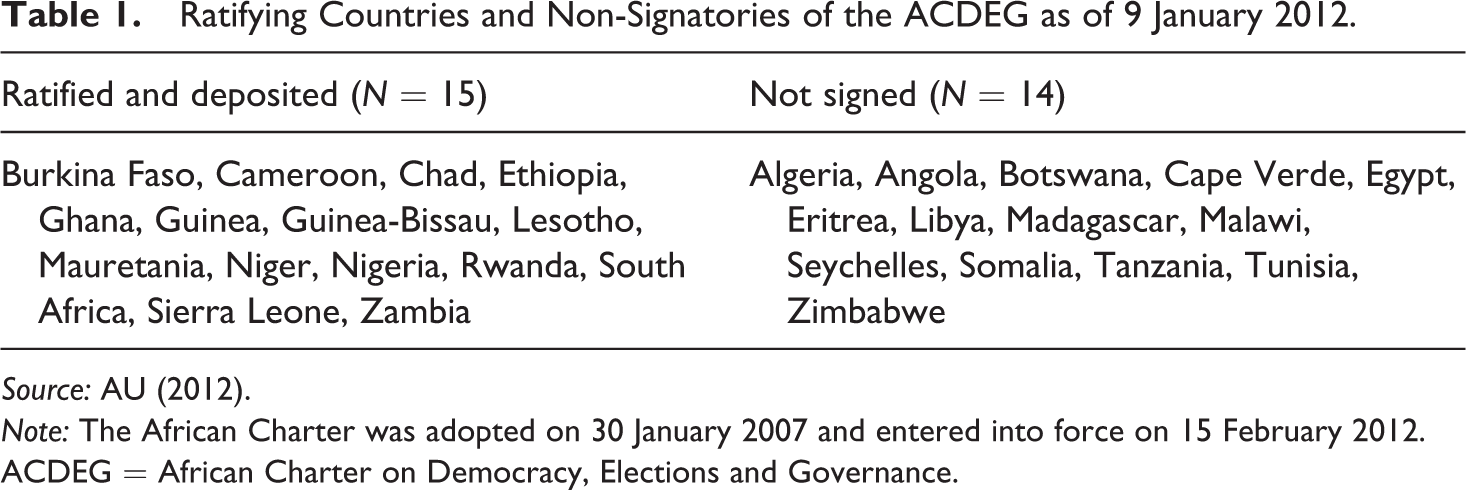
In the following, Freedom House scores are looked at to find out whether a link can be established between ratification of the African Charter (as of January 2012) on the one hand and the respective regime’s governance performance on the other. As of 9 January 2012 – when the required fifteenth state, Nigeria, had deposited the legal instruments for the African Charter – AU member states could be split into three groups: those who had signed, ratified, and deposited; those who had signed, but neither ratified nor deposited (in the following, this second group will be disregarded); and those who had not signed. The first group of supportive countries included (see Table 1) Burkina Faso, Cameroon, Chad, Ethiopia, Ghana, Guinea, Guinea-Bissau, Lesotho, Mauretania, Niger, Nigeria, Rwanda, South Africa, Sierra Leone, and Zambia. Their average Freedom House scores are not exciting: on a scale from 1 to 7, they are a mere 4.13 for “political rights” and 3.95 for “civil liberties.” Among these states, there is a subgroup of extremely well-performing states, including Ghana (averaging 1 for “political rights” and 2 for “civil liberties”) and South Africa (2/2), followed by Lesotho (3/3) and Sierra Leone (3/3). There is also a subgroup of poorly performing countries, including Burkina Faso (averaging 5/3), Cameroon (6/6), Chad (7/7), Ethiopia (5/5), Guinea-Bissau (6/5), Mauretania (6/5), and Rwanda (6/5).
Ratifying Countries and Non-Signatories of the ACDEG as of 9 January 2012.
Source: AU (2012).
Note: The African Charter was adopted on 30 January 2007 and entered into force on 15 February 2012. ACDEG = African Charter on Democracy, Elections and Governance.
A somewhat similar picture emerges for the third group, that of non-signatory countries. As of 9 January 2012, it was made up of Algeria, Angola, Botswana, Burundi, Cape Verde, Egypt, Eritrea, Libya, Madagascar, Malawi, Seychelles, Somalia, Tanzania, Tunisia, and Zimbabwe. The group’s average Freedom House score for “political rights” in 2012 was 4.5, for “civil liberties” 4.36. In this group, too, there are remarkable outliers, including Cape Verde (1/1), Botswana (3/2), and Seychelles as well as Tanzania (both 3/3); and a subgroup of poor-performing countries, including, among others, Algeria (6/5), Angola (6/5), Egypt (5/5), Eritrea as well as Somalia (both 7/7), and Zimbabwe (6/6).
Thus, in comparison, there are some differences in the quality of governance between the first and third groups, but on average not very pronounced ones. Their “political rights” scores differ by only 0.36 points, and their “civil liberties” ones by only 0.41. The results of this comparison are somewhat counterintuitive: signing, ratifying, and depositing the African Charter does not seem to be directly linked to good governance parameters, as identified by Freedom House scores. On both sides of the spectrum some interesting questions arise, for instance regarding the motivations of countries such as Cameroon, Chad, Ethiopia, Guinea-Bissau, Mauritania, and Rwanda in supporting the African Charter – all of which could be considered illiberal democracies (i.e. formal democracies by regime type, but authoritarian in nature). The same goes for the outliers (situated in the third group) of non-signatory countries, for instance Botswana and Cape Verde – and, to some extent, also Seychelles and Tanzania (i.e. liberal democracies). As such, the link between governance scores and actual policy behaviour regarding signing, ratifying, and depositing the legal instruments of the African Charter is somewhat weak.
Non-Implementation of the Compliance Mechanism: Testing Freedom House Scores on PSC Members
By October 2016, twelve country reports on the domestication of the ACDEG were due for submission. However, at that time, even the DPA had only developed guidelines for reporting, but not the benchmarks called for in the African Charter – then still a work in progress (AU, 2007: §44[2]A). 13 In late 2017, Togo was the first AU member state to submit such a report 14 – almost ten years after the adoption of the African Charter. Evidently, there is a huge gap between convergent rhetorical aspirations on the one hand and actual implementation on the other. 15 In the following, this gap will be related to the way in which the AU is making use of the PSC – which is the most important day-to-day decision-making body of the Union outside the meetings of the AU Assembly of Heads of State and Government. This will be done, first, by looking at the legal requirements for PSC membership and, second, by analysing the Freedom House scores of its members.
In addition to the principle of equitable regional representation and rotation, the 2002 Protocol Relating to the Establishment of the Peace and Security Council defines criteria for Council membership. Among other things, it states that PSC members should demonstrate “respect for constitutional governance, in accordance with the Lomé Declaration, as well as the rule of law and human rights” (AU, 2002: §5[2]g). 16 The PSC Protocol furthermore states that the AU Assembly should periodically “assess the extent to which [PSC members] continue to meet the requirements spelt out in Article 5 (2), and take action as appropriate” (AU, 2002: §5[4]). 17 However, when matching Freedom House data with who AU member states elected to the PSC are, a strong inverse relationship is revealed between membership thereof and regime quality. It is obvious that the PSC Protocol’s provisions in large part are not being followed. Also, PSC members apparently have little interest in delivering on the Union’s governance agenda.
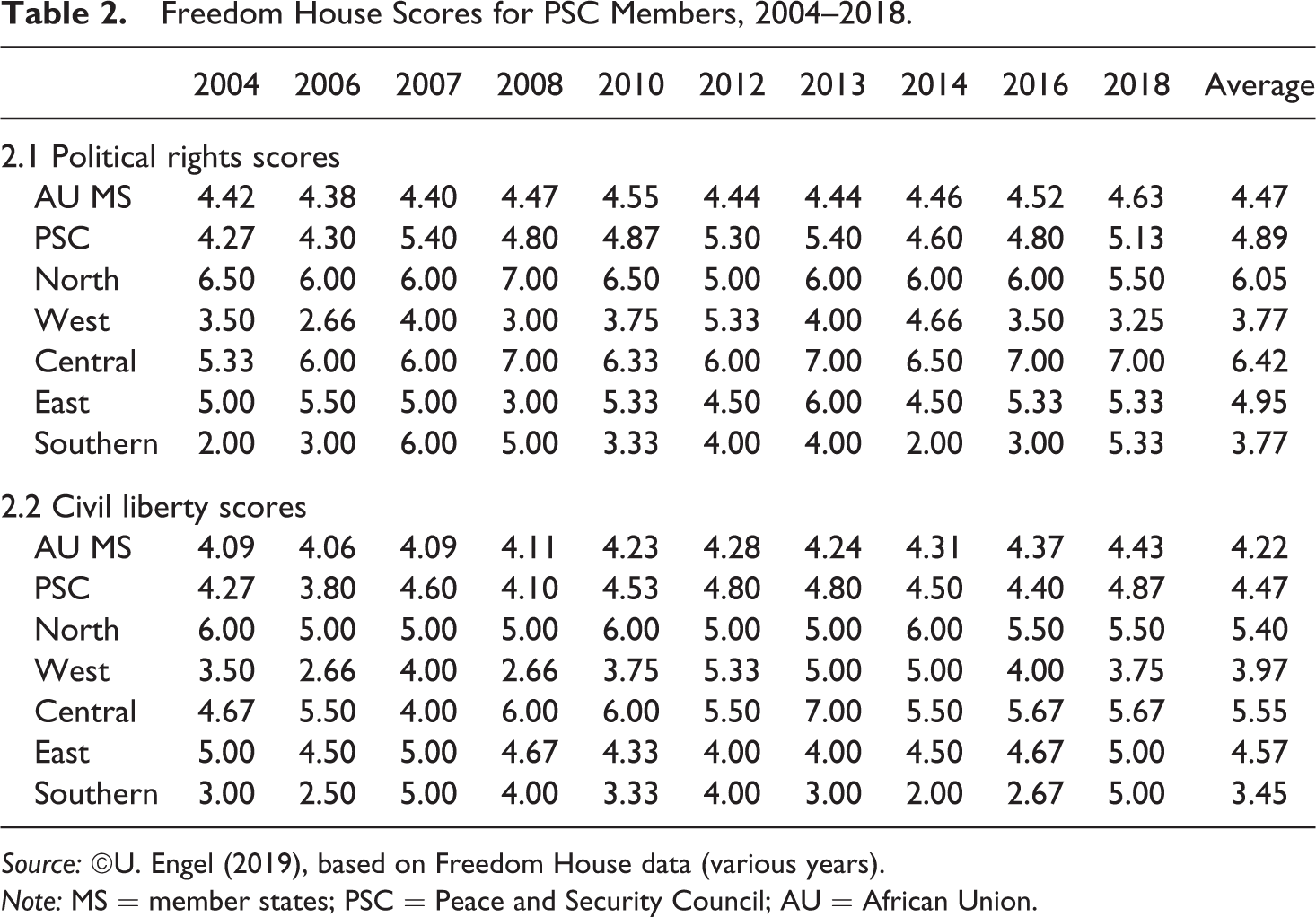
Members of the PSC are nominated according to the five geographical regions that the Union has demarcated (West, North, Central, East, and South). 18 During all ten nomination periods for the PSC between 2004 and 2018, 19 an overall decline in the average scores for “political rights” – from 4.27 to 5.13 – can be observed. In the same period, average scores for “civil liberties” also regressed (though in a unilinear curve) – from 4.27 to 4.87. Scores are situated on a scale of 1 to 7, with 1 representing “free” and 7 representing “not free” regimes. Indeed, the best average score of elected AU member states on “political rights” was 4.27 (2004) and the poorest 5.4 (2007, 2013); on “civil liberties,” the best average score was 3.8 (2006) and the poorest 4.87 (2018) (see Table 2). 20 These figures clearly indicate that in practice “respect for constitutional governance […] as well as the rule of law and human rights” (AU, 2002: §5[2]g) is certainly not a core requirement for becoming a PSC member. In this regard, they are often authoritarian regimes or illiberal democracies in disguise. They barely meet the PSC Protocol’s conditions for eligibility to participate in this body. Yet these member states are still nominated by the five African regions and elected by their peers regardless.
Freedom House Scores for PSC Members, 2004–2018.
Source: ©U. Engel (2019), based on Freedom House data (various years).
Note: MS = member states; PSC = Peace and Security Council; AU = African Union.
When the scores for AU PSC members are compared to the general AU member states’ average, the magnitude of the problem becomes even more obvious. On “political rights,” PSC members – save for the first two periods of election (2004, 2006) – have constantly had poorer scores than the AU average one. The difference between AU PSC members and AU members is, on average, 0.77 points – which, when the measurement scale runs from 1 to 7, is quite considerable. On “civil liberties,” the discrepancy is less marked (with an overall decline from 4.27 in 2004 to 4.87 in 2018): in this case, PSC member scores are sometimes better and sometimes worse than the AU average one. AU member states have, on average, a score on “civil liberties” that is only 0.24 points above that of AU PSC members (the biggest deviations are in 2007 with 0.51, 2012 with 0.52, and 2013 with 0.56 points).
Taking a region-to-region view offers illuminating insights: between 2004 and 2018, AU PSC members averaged a Freedom House score for “political rights” of 4.89 (see Table 2). In comparison, Central Africa (average score of 6.42) and North Africa (6.05) fared far worse – whereas East Africa (4.95) was close to the PSC average, while the remaining two regions did somewhat better (West Africa and Southern Africa both 3.77). On “civil liberties,” a similar picture emerges: Central Africa (5.55) and North Africa (5.40) are poor performers compared to the already not great PSC average (4.87), while the others were doing somewhat better (West Africa 3.97, Southern Africa 3.45) – with East Africa (4.57) again almost on par with the PSC average. According to these figures, the AU illiberal democracies are concentrated in certain regions (Central, North, and parts of East Africa); the better-performing countries are mainly located in West and Southern Africa, meanwhile.
To summarise, on average PSC members demonstrate poorer Freedom House scores than the average AU member state. This strongly suggests that there is link between their interest in regime survival on the one hand and the lack of implementation of the ACDEG compliance mechanism on the other. However, without access to the minutes of PSC deliberations, this assumption remains difficult to definitively prove. It does generate new research questions, though (see the sixth section below).
Conceptually, the African Charter’s implementation gap can be usefully discussed within the context of Finnemore and Sikkink’s (1998) aforementioned norm cycle model. There have been strong norm entrepreneurs working in favour of the African Charter: namely, an alliance between what mainstream political scientists consider to be the “liberal” African democracies and important parts of the AU Commission – such as the Chairperson’s Office, the PSD, and DPA. These actors are basically driven by their joint commitment to a liberal democracy and good governance agenda. In contrast, a norm cascade has only partly taken place – and the internalisation of the norm by all member states has not actually happened yet. Norm emergence can already be traced back to the period 2000–2002, when OAU/AU member states committed themselves to the universalistic human rights agenda of the AU Constitutive Act and the PSC Protocol – both made strong reference to the notion of “human security” as opposed to “regime security” (see Abass, 2010; Dersso, 2008; Hendricks, 2006). However, and in terms of Finnemore and Sikkink (1998), the supporting motives for a norm cascade were not strong enough: while the African Charter was adopted by consensus at the January 2007 AU Assembly, the proposed mechanisms of socialisation, institutionalisation, and demonstration did not fully interlock. Over time, some member states may have signed and ratified it because of concern about their legitimacy, reputation, or esteem – but for many years, the critical mass that the AU Commission had hoped for did not materialise. It would seem that – again along the lines of Finnemore and Sikkink (1998) – a norm cascade happened because of conformity or internalisation, and was not necessarily linked to habit and institutionalisation.
When it comes to the more general issue of dominant decision-making within the AU, and in particular the PSC, there are a (most likely non-exhaustive) number of reasons for the implementation gap of the African Charter. First, there is a strong organisational culture of non-implementation – as reflected in the argument about the pathologies of international organisations (Barnett and Finnemore, 1999). This has been the case since the days of the OAU (see van Walraven, 1999). There is an obvious disconnect between collective, consensual expressions of political will and the actual concrete political desire of individual AU member states to follow through. Partly, this can be explained by the culture of political consensus dominating both AU and OAU decision-making: there is a tacit understanding that other member states will not enforce compliance with a position that a particular member state does not support in principle.
This implies, second, that even so-called well-performing governments have adopted a “do not rock the boat” mentality. Generally, there is very little visible opposition among like-minded African liberal democracies towards their illiberal fellow club members (this is a behavioural pattern that can also be observed at the level of the RECs – Botswana’s critique of Zimbabwe within the Southern Africa Development Community seems to be the exception that proves the rule). In this context, Jordaan (2014: 247) has made a rather worrying point: even those performing well on the FHI, such as South Africa, may pursue reluctant or even obstructive policies. In the case of the UN Human Rights Council, South Africa has “joined in the confrontation with the North” and, as Jordaan argues, rather protects abusive regimes.
Third, this behaviour can be discussed as a variant of the “extraversion” argument – as developed by the French political scientist Jean-François Bayart (2000). To some extent, a non-committal, pro-AGA agenda vote will put one – or keep one – in the good books of the international donors that one is dependent upon. At the same time, this constitutes a resource for further negotiations with exactly these donors on issues where they themselves are dependent on AU member states’ support for international or regional processes – for instance, in the UN General Assembly.
Fourth, and with regard to the relationship between the AU Commission and the regional organisation’s member states, there is a gap between the Commission’s strong capacity for drafting AU documents on the one side and the faltering acceptance among AU member states of these drafts on the other. One illustration of this is how the Commission’s draft of the African Charter was watered down by member states on the issue of presidential third-term debates. 21 The de facto delegation of powers to the AU Commission after 2002 – which, according to the AU’s Constitutive Act (2000: §20[1]), should merely serve as secretariat to the Assembly of Heads of State and Government – as well as its subsequent development of agency in its own right (see Engel, 2013, 2016) has been called into question recently (see Hardt, 2016). In any case, it reflects the lack of de jure leverage that the Commission has over AU member states.
Fifth and finally, one simply has to acknowledge that the gap between “liberal” and “illiberal” AU member states has been widening in recent years. In contrast to the repeated rhetorical claims at the continental level, the AU may now be less and less a community of countries sharing the same values and more a form of governance club (on this notion, see Schneckener, 2009; Narlikar, 2010) held together by geography and an anti-colonial/anti-interventionist impetus.
Pushing the Reform Agenda?
As noted, as of 28 June 2019, a total of forty-six AU member states had ratified the African Charter and deposited the legal instruments, while nine member states still have not signed it (AU, 2019b). As a consequence of the rather long ratification process, the AU Commission would appeal to member states to sign and deposit the African Charter’s legal instruments and repeatedly emphasise “shared values” (AUC, 2011; AU DPA, 2014). The AU Assembly renewed this call at its 26th Ordinary Session, held on 30–31 January 2016 in Addis Ababa (AU Assembly, 2016a). A similar statement was issued by the PSC after it was briefed on 8 February 2016 by the DPA on elections in Africa (AU PSC, 2016b).
Since then, the AU has slowly taken the gap between collective democracy and good governance rhetoric and actual policy implementation more seriously. This reflects a more general move towards enhancing the efficiency of the Union and implementing its own decisions (see AU Assembly, 2014b, 2015a, 2015b). At the 26th Ordinary AU Assembly, a decision was taken on “Streamlining of the African Union Summits and the Working Methods of the African Union” (AU Assembly, 2016a). Again, as had already become routine (see, for instance, AU Assembly, 2015c), the Assembly called on “all Member States to expedite signature and ratification of the Protocol to the Constitutive Act of the African Union relating to the Pan-African Parliament and the Protocol on Amendments to the Protocol on the Statute of the African Court of Justice and Human Rights, to further deepen integration on the continent” (AU Assembly, 2016a: 2[ii]). Going beyond this practice, the Assembly also empowered the Commission “to elaborate a roadmap on the implementation of the Decisions of AU Summits, including using the Scorecard approach on the implementation of decisions to be presented to the Assembly through the Executive Council” (AU Assembly, 2016a: 2[vi]). 22 The Commission was tasked with reporting on progress in this regard on a regular basis through the AU Executive Council (AU Assembly, 2016a: §3). Thus, a strong mandate to develop compliance-documenting instruments and make use of them now exists.
At the same summit, the AU also endorsed a Report of the Commission on Governance, Constitutionalism and Elections in Africa that called upon AU member states …in line with the ACDEG, to maintain zero-tolerance on military coups and other methods of UCG and maintain its tough measures against perpetrators of UCG – including asset freezes and travel bans etc.; …ensure that constitutional amendments are done in accordance with the provisions of the ACDEG (as a baseline) and the active participation of their citizens; …establish permanent, impartial and independent Constitutional Review Commissions whose mandate should be to oversee all constitutional review processes; …sign, ratify, domesticate and implement ACDEG in order to entrench a culture of democracy, constitutionalism and peace. (AU Assembly, 2016b: §3[vi–ix]) The Assembly has adopted more than 1,500 resolutions. Yet there is no easy way to determine how many of those have actually been implemented. By consistently failing to follow up on the implementation of the decisions we have made, the signal has been sent that they don’t matter. As a result, we have a dysfunctional organisation in which member states see limited value, global partners find little credibility and our citizens have no trust. (Kagame, 2017: 6)
Obviously there has also been an issue with competing reporting mechanisms, mainly regarding the APRM – integrated into the AU on a voluntary basis in 2014 (AU Assembly, 2014a). This dual structure may have challenged the capacities of some AU member states to provide extensive governance reports on a regular basis to more than just one institution. In addition, another reporting mechanism was introduced after the 27th Ordinary AU Assembly also requested the AU Commission “report regularly on the implementation of this Declaration” by the Assembly on the “Theme of the Year 2016” – which was “The African Year of Human Rights with Particular Focus on the Rights of Women” (AU Assembly, 2016c: §17). In the following months, the ACDEG agenda was more closely merged with the already existing, but largely dormant, APRM process. This included decisions to revitalise the APRM (AU Assembly, 2017b), to fully integrate the New Partnership for Africa’s Development into the AU Commission (AU Assembly, 2017c), and to urge member states – assisted by the APRM Secretariat – to develop national governance reports “as a self-assessment tool, for promoting good governance” (AU Assembly, 2019). The practical effects of all this on member states’ compliance with the African Charter’s provisions remain to be seen.
Conclusions
Reflecting on the comparatively long ratification process of the 2007 African Charter on Democracy, Elections and Governance, as well as on the current state of non-implementation of its compliance mechanism, this article comes to two conclusions. First, AU member states’ behaviour with regard to signing, ratifying, and depositing the legal instruments of the African Charter does not correlate unambiguously with their quality of democracy as measured by Freedom House: while some of the usual “illiberal” suspects have supported the African Charter, some “liberal” democracies – for their own reasons – have not. Second, and in contrast to this finding, the lack of implementation of the compliance mechanism and the reluctance of AU member states to fully domesticate the AGA agenda seems to correlate with the poor democracy scores of PSC members. The former is counterintuitive and has complex underlying reasons, the latter is a rather obvious expression of authoritarian cultures and related regime interests as shared by a particular group of AU member states. They stand in contrast to other member states who would improve their governance record after the “second wind of change” and the reintroduction of formal democracy across the continent in the early 1990s.
This article also indicates that in the case of the ACDEG, the assumptions on “dominant mechanisms” in the norm cascade model – as sketched by Finnemore and Sikkink (1998) – do not fit. Based on anecdotal evidence, there are a number of reasons why AU member states may have acted the way that they did: pressure by regional peers or hegemons (such as Nigeria or South Africa) or the AU (for instance, in the case of Mauretania after the unconstitutional change of government there in 2008), peace dividends, concerted efforts of a particular REC, incentives or threats by donors, and the like. 23 However, until serious empirical and comparative research has been conducted on this issue there is no way of telling what individual member states’ interests, motivations, and ratification behaviours are. So far, the way that AU meetings have been documented – no published verbatim records, no voting records – has made it impossible to make firm statements on any of these decisions/non-decisions.
To conclude, the late ratification of the ACDEG and the lack of implementation of its compliance mechanism can be attributed to a number of factors. Correlating Freedom House scores on this issue has generated some clues, ones which still require thorough, country-by-country empirical verification. Understanding the policy preferences of AU member states in the arena of AU (and other international) politics remains a major desideratum of International and African Studies, something which at this stage cannot be addressed by deductive reasoning. Rather, it calls for in-depth inductive studies – which may lay the grounds for future robust theorising, probably being embedded in the research agenda sketched above.
Footnotes
Declaration of conflicting interests
The author(s) declared no potential conflicts of interest with respect to the research, authorship, and/or publication of this article.
Funding
The author(s) received no financial support for the research, authorship, and/or publication of this article.