



Abstract
Despite growing scholarly attention to normative and institutional influences promoting international accountability, limited attention has been paid to the transformative role of forensic technologies in reshaping how societies deal with their violent past. The paper contributes to transitional justice debates by revealing the revolutionary, yet undertheorized, role of forensic technologies of justice in advancing victims’ struggle for truth, accountability, and human rights. On one hand, the application of forensic tools has enabled the identification of human remains for humanitarian purposes, while, on the other hand, incriminatory evidence from exhumations is deemed critical to secure the conviction of perpetrators of gross human rights violations. Drawing on interviews with judges, prosecutors, forensic experts, and policymakers, the paper traces the specific pathways through which these tools affect accountability in post-conflict settings. It sheds light on the relationship between the availability of forensic tools to investigate human rights violations and the evolution of transitional justice.
Introduction
The remains of two bodies found in a bog in County Meath, Ireland, were exhumed and identified in the summer of 2015. Kevin McKee and Seamus Wright were allegedly abducted, killed, and then buried by republican paramilitaries during “the Troubles” in Northern Ireland (Dempster, 2019). The exhumation was led by the Independent Commission for the Location of Victims’ Remains (ICLVR), a forensic body created as part of the peace process in 1998 and tasked with locating and identifying all “disappeared” from the Troubles. Thanks to the work of the ICLVR, families could proceed with a formal burial after decades of not knowing what happened and thus start the healing process (Dempster, 2019).
Ireland is not the only country to take this kind of step. The much-celebrated South African Truth and Reconciliation Commission (TRC) created a special forensic team mandated to locate approximately 2,000 persons who went missing during Apartheid, thereby expanding the mandate of the TRC to include the uncovering of forensic truth (Aronson, 2011; Wilson, 2001). Since the mid-1990s, the International Criminal Tribunal for the Former Yugoslavia (ICTY) has used forensic evidence collected from gravesites to build criminal cases against those committing heinous crimes during the war in the Balkans (Wagner, 2008). The immense forensic capacity developed as part of the prosecutorial needs of the ICTY has transformed the designated forensic group (International Commission on Missing Persons) into an independent intergovernmental organization, with missions across the globe to support mechanisms of international accountability. 1 Not surprisingly, given this trend, forensic investigations are now central to the post-conflict work of the United Nations (UN, 2009, 2010).
A common thread linking many post-conflict sites is the growing reliance of national governments and international actors on forensic “technologies of justice” when they design their transitional justice policies. Although these technologies have a central place on the international policy-making agenda, there is limited theorization about their utility and impact. Simply put, in what ways, if any, have they influenced the struggle of societies to deal with past violence?
Addressing this question is important for several reasons. First, forensic tools have de facto become key elements in the transitional justice landscape. Thus, we need to reflect on their impact on the evolution of transitional justice more broadly, and on the ways they influence post-conflict accountability more specifically. Second, over the past decade, a flourishing literature has shed useful light on the role of forensic groups in different parts of the world (see Ferrándiz, 2013; Robben, 2005; Rosenblatt, 2015; Sanford, 2003; Wagner, 2008). Although highly informative, these studies remain mostly idiographic, describing in-depth processes in particular cases or regions. 2 What is missing is an analytical synthesis and theorization of the revolutionary influence of forensic technologies of justice in reshaping how societies deal with issues of accountability in the aftermath of conflict.
The paper addresses this gap by mapping the revolutionary role of forensic technologies in contemporary transitional justice in four areas. The first is humanitarian exhumations; in this case, forensic tools are geared toward addressing the humanitarian needs of the victims of violence, as well as their legal right to repair. The second, truth recovery, is the application of forensic tools to reconstruct and document patterns of past violations in support of fact-finding initiatives. Finally, retributive justice includes the collection of evidence from graves and other sites to support criminal investigation. I am not arguing that these technologies have been the sole drivers of increased international accountability. Rather, their availability has presented opportunities for societies to grapple with old dilemmas in novel ways. For the first time in human history, technology offers a scientific way to identify human remains or reconstruct crimes using “hard facts,” leaving limited room for dispute, denial, or uncertainty. At the same time, the tools of the technology offer valuable flexibility to policymakers. As forensic tools can be used for humanitarian, fact-finding, or prosecutorial purposes, policymakers have been able to design policies tailored to the needs of different societies by linking or delinking policies to the situation at hand. 3 Surprisingly, given the widespread employment of forensic tools, although normative, institutional, ideational, and other influences are central explanations of the “justice cascade” seen in recent decades (Sikkink, 2011), a parallel “forensic cascade” has largely been overlooked by the literature.
Forensic technologies have had a transformative impact on international accountability, echoing the effects of earlier technological advancements in different aspects of international politics. Some influential studies in social sciences have pointed to the catalytic effect of technological innovations on landmark political or ideological developments, notably in work on nationalism. Benedict Anderson (1991) illustrated how print capitalism paved the way for the formation of nationalism and nation-states in Europe. Fernand Braudel (1982) explained how shifts in technology led to sweeping changes in the world economy, and Daniel Headrick (1981) showed how “technologies of empire” created new ways for colonial powers to consolidate and perpetuate their power. In all cases, technology had a revolutionary impact (Akaev and Pantin, 2014). I suggest forensic technologies have had a similarly transformative impact on the evolution of transitional justice and international accountability.
Forensic technologies and post-conflict accountability
Since the end of the Cold War, those working in the area of international politics have sought to explain the growing emphasis on accountability in post-conflict or post-authoritarian settings. They rightly note the global expansion of transitional justice policies, notably the range of accountability mechanisms employed by countries emerging from conflict and authoritarianism to deal with their violent legacy. 4 In the past, warlords or authoritarian leaders were chiefly left “off the hook” for human rights violations, but now previously “untouchable” leaders are often prosecuted, even convicted, a phenomenon labeled the “justice cascade” (Lutz and Reiger, 2009; Sikkink, 2011). Examples include the creation of ad hoc international tribunals (Former Yugoslavia and Rwanda) in the early 1990s, the establishment of a permanent International Criminal Court (ICC), and the prosecution of powerful leaders by national courts, in Guatemala (Ríos Montt), Argentina (Videla), and Chile (Pinochet), to name only a few.
To explain this outcome, a number of studies have pointed to ideational shifts and transnational influences since the 1980s (Keck and Sikkink, 1998; Sikkink, 2011). In particular, a new international liberal order committed itself to democracy and rule of law. Seen through this lens, respect for human rights gradually became an issue of international oversight, eroding claims of national sovereignty and precluding immunity for state officials who had committed human rights violations (Moravcsik, 1995). At the same time, this tectonic change legitimized the global diffusion of international accountability norms and raised the standards for national compliance (see Appe, 2016; Bob, 2005; Brysk, 1993; Powell and Staton, 2009; Risse et al., 1999; Roht-Arriazza, 2005; Sikkink, 2011; Sikkink and Walling, 2007). The result is international accountability in a number of domains of international politics, including corruption and other white-collar crimes (Kim and Sharman, 2014). As states strive for international legitimacy and recognition, they embrace aspects of this culture either instrumentally or because they are socialized in it.
The literature on “transitional activist networks” (TANs) shows international “shaming” through concerted pressure by domestic groups and international human rights organizations—such as Amnesty International—can increase international accountability and affect state behavior, creating opportunities for societies to hold to account those responsible for human rights crimes (Clark, 2001; Murdie and Davis, 2012). National institutional actors, such as the judiciary, may become powerful allies in this process (González-Ocantos, 2016).
Although this literature offers a well-documented and intuitive theory to account for the turn toward international accountability norms, an important step in the process has not been explored: the availability of forensic technologies to reconstruct the violent past. During fragile political transitions, national political leaders and international organizations will think twice before supporting criminal prosecutions unless they have a realistic possibility of success (Cobban, 2007; Snyder and Vinjamuri, 2003). States and international organizations now have the capacity to collect scientific—and largely undisputed—incriminatory evidence as part of a criminal investigation. Consequently, forensics and genetic science are central tenets of contemporary peacebuilding and transitional justice. However, their availability and utility are overlooked facilitative factors in the broader justice cascade.
Despite growing and important scholarly contributions on the role of forensics, we lack a comprehensive theoretical framework to document the ways the application of these particular new technologies has transformed contemporary international accountability. Interdisciplinary studies have explored the evolution of influential forensic communities (Crossland, 2013; Rosenblatt, 2015), discussed crucial case-studies (Collins, 2018; Congram and Fernandez, 2010; Dempster, 2016; Robben, 2005), and examined the use of forensic expertise in international courts (Nettelfield and Wagner, 2013; Wagner, 2008). What we do not have is a synthesis of the literature or an application of these useful insights to a more generalizable framework to paint the bigger picture—how these technologies have shaped the transitional justice landscape.
Research has also shed light on the tensions arising from the operation of international criminal tribunals, in particular, the tension between the narrow evidentiary needs of proving a defendant’s guilt in a criminal setting and the broader need to attribute individual motives for atrocities within a larger historical narrative (see Subotić, 2014; Wilson, 2011). Simply stated, the historical truth is something more than the sum of forensic or legal facts. Within this context, expert-witness testimonies become crucial in both supporting legal arguments and substantiating the historical backdrop against which atrocities took place (Wilson, 2011).
Conceptual framework
Technology and accountability are elusive concepts. In tracing the use of technology as a historical concept, Leo Marx (2010) says referring to it simply as an “autonomous agent capable of determining the course of events” is “hazardous” (p. 928). It is also insufficient to say the impact of technology is “self-evident”—we need empirical documentation. Marx and others (see Salomon, 1984) invite us to draw a distinction between the components of technologies (e.g. machinery, expertise) and the discursive use of technology as a historical marker. Drawing on this framework, in what follows, I offer my definition of forensic sciences and explore how their various technologies have shaped international accountability.
“Forensics” refer to (1) the application of physical forensic tools (e.g. DNA sampling, forensic dentistry, forensic radiology, forensic genetics) to reconstruct human rights violations and (2) the availability of expert testimony (from forensic anthropologists, archeologists, and geneticists but also human rights workers collecting evidence in the field). The term “forensic technologies” refers to two parallel processes: a normative and a technical one. The first is the international normative use of forensics by international organizations as a “good practice” in post-conflict settings. The second is the application of specific forensic instruments to generate new opportunities in post-conflict societies to deal with the violent past in previously unavailable ways. The availability of these technologies offers international legitimacy when dealing with the past and flexibility for policymakers to tailor their application to specific needs. For example, exhumations can be used to support a prosecutorial strategy in a criminal investigation or conducted purely for humanitarian purposes. As such, forensic technologies can accommodate broader accountability needs in post-conflict societies than simply punitive justice.
If “forensics” are an elusive concept, “accountability” is a conceptual minefield. Although accountability has been labeled the “uber concept” of the 21st century (Flinders, 2014), it means different things to different scholars, ranging from “vertical” (democratic) accountability (i.e. elections where office holders are under scrutiny by citizens) to “horizontal” accountability in the governance of international institutions (i.e. audits and other forms of bureaucratic control) and retributive justice. 5 In the transitional justice literature, accountability is almost synonymous with retributive/criminal justice. Still, there is limited conceptual engagement with this term. If we reduce accountability to (individual) retributive justice, we leave unexplored a constitutive element of the term, namely giving an account of what occurred, an official endeavor to reconstruct the violent past, without necessarily holding individuals to account. Illuminating institutional failures that enabled systematic human rights violations or documenting patterns of violations would qualify as alternative types of accountability, without necessarily being linked to criminal proceedings.
Here, I provide a novel and dynamic conceptual framework for accountability. I focus exclusively on “retrospective” (or ex post facto) mechanisms of accountability geared to shed light on the causes of past violence and those responsible for it. I do not explore “prospective” forms of accountability, by which I mean those policies developed to regulate future individual or institutional behavior. Even though accountability is important to create conditions for stable peace and respect for human rights, in post-crisis settings, the demand for accountability is usually backward-looking, primarily to make sense of what happened. However, my conceptualization of retrospective accountability is broader than a simple understanding of “retributive justice” designed to identify and punish individuals responsible for atrocities. It includes any process of uncovering what happened, even if delinked from criminal investigation. From this vantage point, forensic technologies can help societies deal with issues of accountability in four important ways (see Figure 1).
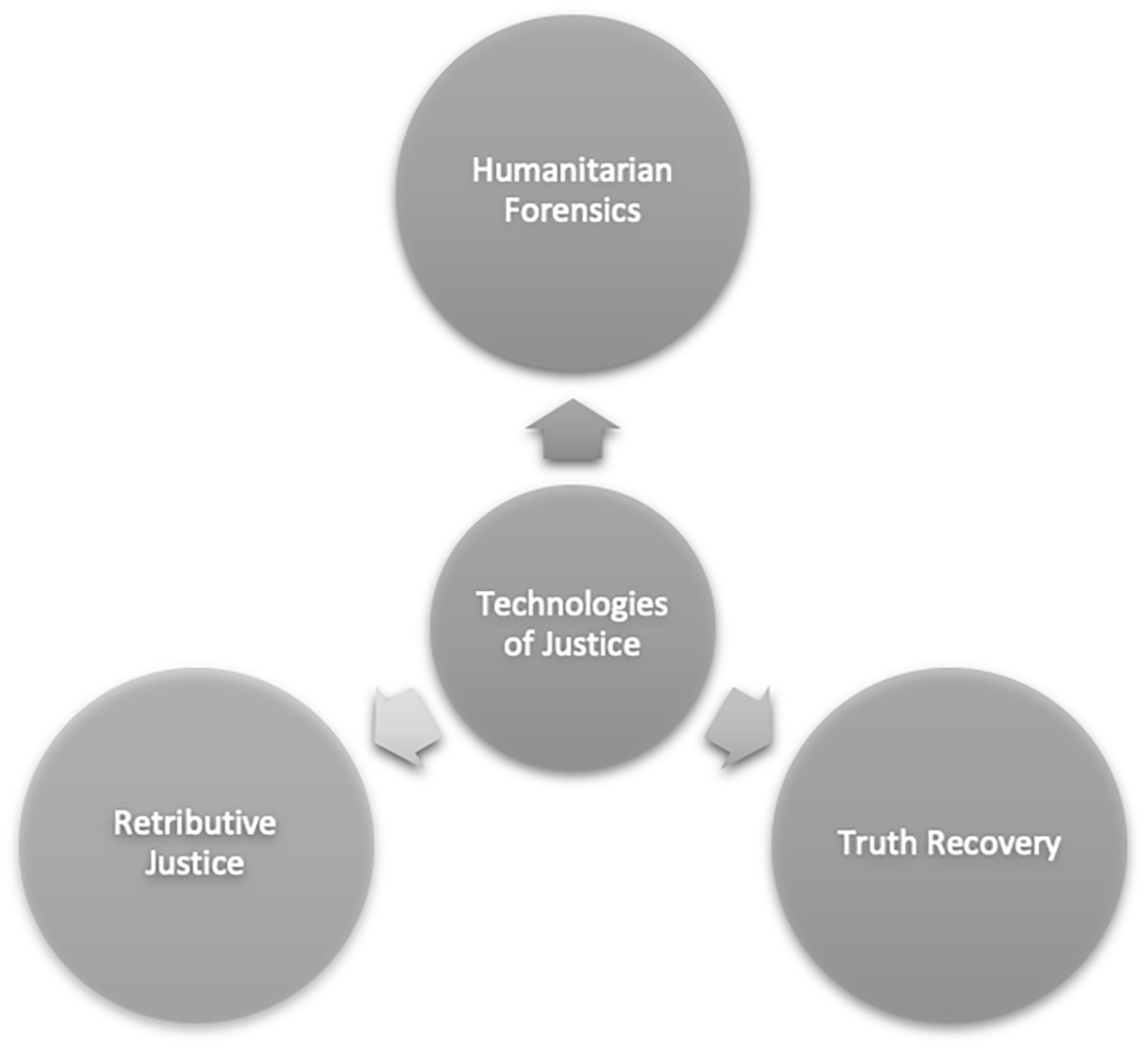
Transformative impacts of forensic technologies on transitional justice.
Humanitarian Forensics: The availability of DNA testing and other forensic techniques has enabled the scientific identification of human remains of victims of atrocity (International Committee of the Red Cross (ICRC), 2009: 9; London et al., 2013). This is particularly important for clandestine crimes (e.g. the disappeared), where bodies are dumped in common graves, and families remain in limbo for decades, not knowing the whereabouts of their loved ones (Boss, 2006). Exhumations enable families to reunite and reach some form of closure, while also getting some fundamental truth about the circumstances (e.g. cause and time of death). With the recovery of a body, thousands of families of the missing in Northern Ireland, Cyprus, Georgia, and other conflict-ridden countries have been able to start the healing process. This is a rudimentary yet essential form of truth recovery and a form of reparation. From the vantage point of international accountability, this provision can satisfy some fundamental legal rights, including the “right to know” the truth and the right to repair (Kyriakou, 2014: 20; Scovazzi and Citroni, 2007)
Truth Recovery: The availability of forensic tools to reconstruct the past is an invaluable asset, allowing official fact-finding bodies to document patterns of atrocities or institutional failures that enabled these atrocities to occur. This is particularly relevant in cases of clandestine crimes, where the ability to reconstruct the past in a systematic and scientific way has revolutionized the operation of truth commissions; not only it is simpler, more affordable, and faster to set up these mechanisms, but they are also more likely to accurately reconstruct the past. As their mandate is mostly to produce a final report or an account of what happened, forensic technologies have become indispensable to their process. International normative changes and the emerging right to know the truth (Schudson, 2015) since the 1960s brought these initiatives to the center-stage, but the availability of reliable technologies has supported the growing international demand to “document” the truth.
Retributive Justice: Forensic technologies have revolutionized the prospects of post-crisis retributive justice. In a nutshell, for the very first time, science has reliable tools to provide evidence that could be used in a court of law to increase the likelihood of conviction. These tools support the prospect of punishing those responsible in important ways. First, prosecutors can collect incriminatory evidence from sources that were not accessible in the past; this, in turn, has helped them investigate crimes where the burden of proof is high. Second, the technologies have influenced the way prosecutors present evidence in a court of law. This is particularly relevant for crimes that are extremely technical in nature and whose details may be inaccessible to the jury or even to the judges.
There is a caveat, however. In the three-part framework presented here, forensic technologies are not the causal factor; they are simply a tool that can be deployed (or not). Obviously, for accountability to flourish—particularly in post-conflict settings—political demand is necessary; still, political appetite alone may be insufficient to trigger a positive outcome. The availability of these particular technological tools has allowed societies and international actors to grapple with old dilemmas in novel ways in settings where there is a political desire to act.
Research design
To trace the three pathways outlined above, I took the following steps. First, I analyzed all truth commissions set up between 1982 and 2015, examining whether a forensic investigation was part of their mandate. I coupled this with personal interviews with forensic experts who worked for such commissions. Second, I added archival research on the publications of all major international forensic groups to explore the remit of their activities. 6 Third, I focused on an in-depth analysis of the experience of Argentina, as I considered this to be the most crucial case to reconstruct the historical origins of the application of forensic tools as part of a truth commission and map the transformative impact of these tools on the global diffusion of both truth commissions and forensic groups.
The most challenging aspect of the analysis was to explore whether—and in what ways—the application of forensic technologies shapes legal outcomes. Do they have a meaningful impact on criminal investigations? The case of Argentina was helpful to answer this crucial question for three reasons. First, Argentina is well known for its success in accountability outcomes. The literature portrays Argentina as a pioneer in challenging impunity even under the most adverse conditions of amnesty for perpetrators, well before other societies started revisiting their violent past. In a nutshell, the Argentinean experience has been essential to the evolution of transitional justice and theory development in transitional justice (González-Ocantos, 2014; Sikkink, 2011). Second, Argentina is important because of the nature of the crimes under investigation; the clandestine types of crimes (disappearances, extrajudicial killings, etc.) raised the burden of proof. For example, the absence of a corpus delicti (body of evidence) made it extremely difficult for Argentinean authorities to investigate crimes, let alone collect incriminatory evidence to use in a court of law (Scovazzi and Citroni, 2007). Disappearances and extrajudicial killings represent the most challenging test to assess the impact of forensic technologies in post-conflict settings, particularly in identifying the bodies of the victims, reconstructing how victims were treated prior to their death and, ultimately, establishing accountability for their death. Third, Argentina was the influential precursor of transitional justice processes in other Latin American countries; as such, it may be representative of a broader regional pattern in a region that is particularly influential in transitional justice.
In short, an in-depth analysis of the most crucial case (i.e. Argentina) seemed the best way to tackle this extremely complex issue. A global comparative analysis exploring the nexus between forensic technologies and conviction rates might offer a robust alternative. But it would address only part of the question, simply showing if there is a statistically significant relationship between the use of these technologies and conviction outcomes. I was more interested in increasing confidence in the internal validity of the findings, achieved through contextually sensitive ways of documenting specific causal processes underpinning the transformative impact of forensic technologies on criminal settings (Mahoney, 2004; Pepinsky, 2019).
To this end, I developed a within-case comparative analysis (Collier, 1993; Gerring, 2004) using a two-pronged strategy. To begin, I analyzed Argentinian court rulings to determine prosecutors’ degree of reliance on evidence garnered through forensic technologies. The analysis draws on official data from the prosecutor’s office to analyze the court rulings in 50 cases with variations in the degree of reliance on forensic expertise 7 to assess whether this expertise had any impact on the outcome (conviction or acquittal) (for more details, see Section 5.3).
Yet legal outcomes do not speak for themselves; it would be difficult to document how the availability of forensic technological evidence (or lack thereof) shaped the judges’ rationale or how much they relied on forensics in their rulings. To overcome this problem, 19 interviews with key actors with direct experience of these cases in Argentina. Interviews are essential in process tracing, as they help establish the direction of causal mechanisms (González-Ocantos, 2020). In effect, the semi-structured design enabled interviews to serve as an “objective” way to showcase the impact of forensics while also enabling participants to air subjective experiences of the perceived value of forensics in this process. Participants were selected following a purposeful sampling methodology, drawing on such criteria as professional capacity (i.e. judges, prosecutors, and forensic experts) and direct involvement with the cases (on purposeful sampling, see McEvoy, 2019). In-depth interviews with judges who ruled on these specific cases, coupled with analysis of the rationale of the court rulings, helped unpack the ways forensics affected the final verdict. Equally, interviews with judges and prosecutors were central in exploring whether/how forensic technologies shaped their repertoire of investigation and prosecutorial strategy. Finally, forensic experts shared their experience with me and explained how they were deployed.
Forensic pathways to international accountability
Humanitarian forensics
Over the past three decades, forensic tools have become an integral part of dealing with the past. With DNA testing, it is possible to identify the remains of victims of clandestine violence and give them back to the family (ICRC, 2009: 9; London et al., 2013). “Humanitarian” exhumations are immensely important, particularly for certain types of crimes, such as the disappeared, where bodies are buried in common graves. In the past, any effort to identify these human remains was conditional on the testimony of eyewitnesses, most often the perpetrators themselves, and they were obviously reluctant to share information that could incriminate them. This left thousands of families of the disappeared around the world, from Northern Ireland to Georgia and from Chechnya to Cyprus, trapped in a state of “ambiguous loss” (Boss, 2006). In the absence of an identified body or a proper burial, it is impossible for families to start the mourning process or reach closure (Kovras, 2017; Robins, 2013). Perpetrators were the only actors who could potentially break this vicious cycle of suffering, but at the same time, they were the least inclined to do so. This left an open wound, even in societies with celebrated transitions, such as South Africa or Chile (Aronson, 2011).
Forensic techniques have alleviated the struggle at both the individual and societal levels. In a 2014 survey in Bosnia and Herzegovina, more than 73 percent of the relatives of the missing and 80 percent of the broader population thought humanitarian forensics contribute to reconciliation (International Commission for Missing Persons (ICMP), 2014: 117). Similarly, in Cyprus, despite the absence of a political settlement, the two communities, with the support of forensic teams, have addressed one of the most painful aspects of the “Cyprus problem” (1963–1974), the missing persons (Hadjigeorgiou, 2022). Former UN Secretary General Ban Ki Moon described the Committee on Missing Persons (CMP) as “a model of successful cooperation” and a mechanism to promote “trust and promote reconciliation that are crucial for long term peace” (Loizides, 2016: 8).
Humanitarian forensics are fundamental to understanding international accountability for another reason. Exhumations may—under certain conditions—be the only way to satisfy the legal right of the victims/relatives to “know the truth.” According to the “Basic Principles and Guidelines” of the UN (Mallinder, 2008: 179–180) and the 2007 International Convention for the Protection of all Persons from Forced Disappearance (art 24 para 2–4), the relatives of the disappeared have the right to repair, creating an obligation by the state to “take all appropriate measures to search for, locate and release disappeared persons and, in the event of death, to locate, respect and return their remains” (art.24.3). As noted above, forensic exhumations in post-conflict settings require assistance from eyewitnesses/perpetrators, and this is usually conditional on immunity and confidentiality. However, immunity contravenes the fundamental duty of the state to prosecute perpetrators of the crime (art. 6), while confidentiality of information often contradicts the state’s duty to carry out an effective investigation (art.3). Post-conflict societies have used the new forensic technologies to delink the “right to know” from the “duty to prosecute.” By exhuming victims of violence purely for humanitarian reasons, they can address the “right” of the victims to know part of the truth without necessarily prosecuting perpetrators.
Truth recovery
The availability of forensic tools to investigate human rights violations is an overlooked factor in the global spread of truth commissions, a central mechanism of transitional justice. Truth commissions are ex post facto tasked with documenting patterns of human rights crimes committed during a period of violence, conflict, or state repression (see Bakiner, 2014; Hayner, 2010; Wiebelhaus-Brahm, 2010). They are vested with investigative powers to reconstruct violence. Based on the findings, they usually publish a final report which publicly acknowledges the truth about the violent past. Between 1974 and 2015, approximately 44 truth commissions were set up around the world in societies emerging from conflict (Kochanski, 2020). They are now widely recognized mechanisms to achieve accountability (UN, 2006).
The literature suggests the first truth commissions were created as a “compromise” solution first in Argentina, and then followed by other Latin American societies in the early 1980s. On one hand, any form of punitive justice was not feasible, as an effort to prosecute military/perpetrators could destabilize the fragile democratic transition (Kritz, 1995). On the other hand, the unprecedented mobilization of the families of the victims to publicly acknowledge their suffering and seek the truth about the state’s role in perpetrating crimes made some form of accountability inevitable. Hence, truth commissions emerged as a novel way to accommodate popular demands for accountability in cases where perpetrators were protected by blanket amnesties (Neier, 1999).
This account, although accurate, overlooks two important factors in the historical evolution of truth commissions. First, truth commissions emerged at a specific historical period to address to a particular set of clandestine crimes committed by Latin American dictatorships (i.e. disappearances, extrajudicial executions), and second, they diffused when—or because—forensic technologies became available. In effect, there is a symbiotic relationship between the evolution of truth commissions and forensics.
It is hardly surprising that the majority of the first truth commissions were set up in Latin America, given the common practice of disappearances and other concealed crimes (Robben, 2005). The availability of forensics certainly benefited the struggle of the families to identify their loved ones, while it could also challenge the “deniability” of the crime (Author, 2017). The Argentinean truth commission, National Commission on the Disappearance of Persons (CONADEP), was the first one tasked not only to find the whereabouts of the disappeared but also to document other human rights violations and in this way reveal the military’s role in perpetrating these crimes. In their repertoire of terror, the military regime drew on three key strategies, as documented in the final report of the truth commission (CONADEP, 1984). First, thousands of detainees were sedated and then thrown alive into the ocean from planes (Robben, 2005). Second, they buried victims in common graves marked with N/N (ningun nombre/no name) (Robben, 2005). Third, it was not uncommon in rural areas after shooting victims to set bodies on fire—often putting the bodies in tires—a practice known as asadito (“little barbecue”). These practices left little to no incriminatory evidence, making it impossible to identify victims.
Forensic methods helped uncover all this, making Argentina the “big bang” in the emergence and, subsequently, the global diffusion of forensics (Rosenblatt, 2015). It was the first instance when forensic expertise was applied to support the work of a truth commission. Although forensics were not fully developed in the early 1980s, the mobilization of the families of victims to uncover the truth about their loved ones served as the catalyst for the growing reliance on forensic evidence. In particular, at the time, the most pressing issue was the quest of the grandmothers of the disappeared to identify the bodies of their daughters and also to reconnect with their missing grandchildren in those cases where it could be proven that they had given birth before being executed (Arditti, 1999; Rosenblatt, 2015). Largely reflecting these grassroots pressures to uncover the whereabouts of the disappeared, Ernesto Sabáto, CONADEP’s President, officially invited members of the American Association for the Advancement of Sciences (AAAS) to provide technical expertise in identification of victims buried in common (NN) graves (Cholakian and Guglielmo, 2017). Two of the towering figures in US forensics at the time, Clyde Snow and Eric Stover, led a mission to Argentina in 1984 to help the investigative work of CONADEP (Stover and Joyce, 1991). 8
EAAF later became one of the leading forensic groups dealing with human rights investigations. EAAF’s work is now central in supporting the humanitarian work of identifying human remains and reconstructing the violent past in post-conflict societies around the globe. Its members visit detention centers and document how torture and other crimes were perpetrated.
The Argentinean EAAF had a ripple effect in the region by providing training and supporting the establishment of national forensic teams in other countries in Latin America facing similar challenges associated with the violent past, including the Guatemalan Forensic Anthropology Foundation (FAFG), the Chilean Forensic Anthropology Team (GAF), the Peruvian Forensic Anthropology Team (EPAF), and the Latin American Forensic Anthropology Association (ALAF) (Juhl, 2005: 25–30). 9 In doing so, it became a catalyst for the diffusion of an epistemic community of forensic experts who later supported the work of national fact-finding missions in documenting human rights violations. In the absence of EAAF, in particular, and national forensic teams more generally, it would have been impossible to reconstruct patterns of violence, a precondition for the work of investigative truth commissions.
Table 1 highlights the symbiotic relationship between the availability of forensics and the global spread of truth commissions. The left column includes all countries that set up truth commissions wherein forensic investigation was an explicit part of the operation; the first date in parentheses refers to the date of adoption of the truth commission and the second to the year of exhumations (where applicable). The right column includes commissions without exhumations (those marked with an asterisk indicate that exhumations were used at a later stage after the commission’s establishment). As the table shows, most commissions employed forensic tools to support their broader investigative work, either during the operation (left column) or at a later stage (marked with an asterisk on the right). In effect, an intrinsic element in the evolution of truth commissions was the unique capacity of international forensic groups to supply “facts” to satisfy a growing international demand for truth recovery.
Symbiotic relationship between forensics and truth commissions (1982–2015).
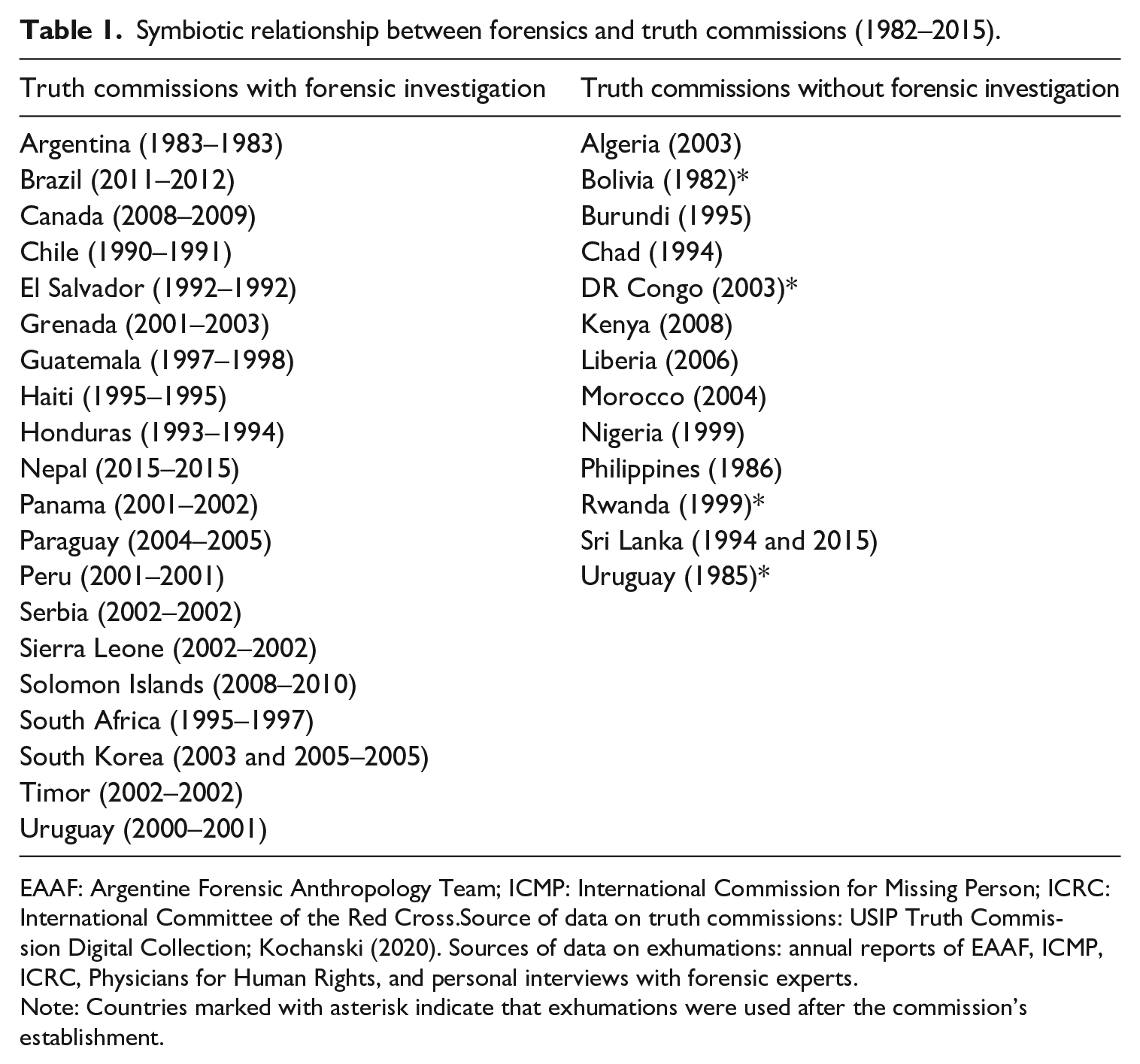
EAAF: Argentine Forensic Anthropology Team; ICMP: International Commission for Missing Person; ICRC: International Committee of the Red Cross.Source of data on truth commissions: USIP Truth Commission Digital Collection; Kochanski (2020). Sources of data on exhumations: annual reports of EAAF, ICMP, ICRC, Physicians for Human Rights, and personal interviews with forensic experts.
Note: Countries marked with asterisk indicate that exhumations were used after the commission’s establishment.
While the availability of forensics legitimized the operation of truth commissions, the reverse is also true. The global spread of truth commissions—coupled with international criminal investigations—has created a lucrative market for forensic groups to flourish over the past four decades. Since the 1980s, EAAF has built expertise operating in post-conflict settings, originally in commissions set up in Latin American countries and later in collaborations with international commissions in diverse countries, including El Salvador, South Africa, and Haiti (Interview No. 1). They may have been the first, but other international forensic groups, such as ICRC, ICMP, and PHR, to name only a few, provide services for commissions around the world. This has created a forensic epistemic community able to diffuse knowledge accumulated from previous experiences in different organizations and conflict settings to new commissions across the globe (Interview No. 12). As these groups develop expertise and specific skills, they are able to provide tailor-made services to meet the investigative mandate of different truth commissions. This has made the original decision to set up a commission—whether by national governments or international organizations—a more appealing policy option, as it is likely to be “effective” in terms of delivering on its mandate.
In short, there is a symbiotic relationship between the availability of forensic tools and the historical evolution of truth commissions: the global appeal of truth commissions legitimized forensic investigations as a mainstream technology of truth. Simply stated, truth commissions and exhumations go hand in hand.
Retributive justice
A number of transitional justice scholars have studied the increase in human rights prosecutions in times of transition or, in other words, the justice cascade (González-Ocantos, 2016; Kim, 2012; Sikkink and Walling, 2007; Sikkink, 2011). In her influential book Justice Cascade, Kathryn Sikkink captures how legal and normative processes propelled new accountability norms essential to the justice cascade. But her account overlooks an important detail: the ability of science to provide indisputable evidence from graves to convict criminals. It is impossible to fully grasp the justice cascade without acknowledging the parallel forensic cascade which revolutionized how states deal with their violent past and hold the guilty to account.
The availability of legal norms does not necessarily mean they will be used or have a positive outcome. For every successful case in which victims have deployed these legal instruments to prosecute perpetrators, like Argentina or Chile, there is an unsuccessful case in another country. For example, Cyprus pursued ambitious legal avenues such as bringing cases to the European Court of the Human Rights but failed to catalyze any concrete outcome for decades. It is predominantly when a legal case is supported by forensic incriminatory evidence that the search for accountability gains credence. That is why forensic technologies of justice have been central to the justice cascade. This is not a one-dimensional relationship, however: as illustrated above, the emergence of new norms and the broader normative shift created new opportunities for forensic techniques to gain global currency. The two processes, normative and technological, go together, with each creating new and unpredictable avenues for the other.
The application of forensics has boosted the quest for retributive justice in three ways: first, it assists prosecutorial authorities in collecting incriminatory evidence from the graves; second, it enables prosecutorial authorities to present the evidence in a court of law in a scientific, indisputable, and accessible way; third, forensics are more likely to convince a judge that the evidence presented meets the burden of proof, thus leading to a conviction. To trace this process, in what follows, I explore systematically the experience of Argentina as the most exemplary case.
Prosecutorial strategy
The Argentinian prosecutors involved in human rights trials and other informed participants I interviewed said they relied on forensic technologies to produce evidence in criminal cases.
10
One of the central obstacles to a conviction is proving a crime has been committed; establishing the identity of the victims and the cause of death is therefore a prerequisite. A case in point is the “stolen babies” (chicos perdidos) in Argentina.
11
Hundreds of young women were pregnant at the time of kidnapping; after giving birth in captivity, they were killed, and their babies given to foster families (often other military) to grow up according to Catholic values (Arditti, 1999). In the absence of the parental generation, often the only way to prove the crime of kidnapping was to establish grand-paternity (Interview No. 12). Forensic evidence from the dead mother’s grave, such as evidence from the woman’s pelvic region, could show that she had indeed given birth while in captivity. Hence, DNA and ante-mortem family data became central to a successful prosecutorial strategy. An experienced judge who ruled in one of those cases admitted, “Restoring the identity of the bodies is crucial information; without technology it would have been impossible to obtain it” (Interview No. 9). The National Genetics Data Bank was a central resource for cases of abducted children, as it collected evidence on histocompatibility, genetic markers, and blood group of the families and children of more than 10,000 persons for 300 families looking for their loved ones (Interview No. 8). This also optimized criminal investigation, as forensic evidence made identification easier, faster, and more reliable. A former judge who ruled on a number of human rights trials in Argentina said: DNA has revolutionized the criminal investigation all over the world. In Argentina, the National Genetics Data Bank works with advanced technology, especially in recent years [. . .]. It used to take a long time to establish identity, or it used to be necessary to collect blood. Eventually, we just needed to order a search warrant and we could establish identity though the genetic material collected in a toothbrush. Technology allowed us to optimize the amount of time implemented to investigate. (Interview No. 7)
Forensics also promoted criminal investigations by reactivating cases that otherwise would be impossible to prosecute. Some forensic seeds were planted at the time the crimes were committed and were retrospectively used to build new cases. For example, the public medical pathologists carried out a preliminary autopsy before burial of victims of what became known as “staged confrontations.” According to a seasoned prosecutor in cases associated with crimes committed by the military in Argentina, this evidence was used to prove a pattern in the logic of the crimes: In those files, the rule is that there is a rather reliable report from the time of the facts. They have allowed us to re-build cases, and charge defendants for these deaths in tens of cases. The reports are built with objective information that has proven useful. (Interview No. 3)
Apart from establishing the identity of the victim (corpus delicti) and proving that a crime had been committed, forensic evidence became an indispensable basis for testimonial evidence in court (Interviews No. 14, No. 17). In the absence of a paper trail to document clandestine crimes, such as abductions, human rights trials in Argentina emphasized testimonial evidence, as evident in the first rulings in the Junta’s trial in 1986: Testimonial statements constitute the main piece of evidence of particular types of untraceable crimes, perpetrated in absolute concealment. In such cases, witnesses are referred to as necessary. These testimonies are supported by the secrecy with which the repression was handled, the deliberated destruction of documents and traces, and the anonymity of perpetrators. (Junta’s Trial. Ruling 309: 319, 1986)
From this perspective, reports prepared by the EAAF or the National Genetics Databank offered indispensable evidence and, as such, were systematically deployed as part of the prosecutorial strategy. According to an experienced prosecutor, these institutions had an excellent reputation, and prosecutors and judges trusted them (Interview No. 6).
Forensic technologies were equally central in establishing a connection between the defendant and the time and/or place of death. Testimonies placing defendants at the crime scene are often insufficient, as it is also necessary to prove who gave the orders for the crime. But forensic technologies can investigate whatever paper trail is available. For example, archival experts can provide invaluable support reconstructing files tampered with by security services. Forensic document examination analysis reveals marks on documents often invisible to the naked eye, and in Argentina, this was particularly useful in confirming the authenticity of military or police files. In one case recounted by an expert in the prosecutorial office, the Argentinian intelligence corps tampered with records to conceal evidence of illegal activity; thus, proving the authenticity of the destroyed file was crucial (Interview No. 5). Similarly, the analysis of military communications, such as radio transmissions of the army at the time, could be invaluable in determining the chain of command and who gave the orders.
It is worth noting that the availability of DNA or other forensic technologies does not necessarily reveal a “smoking gun.” The literature has illustrated the pitfalls of forensics in criminal proceedings and warned against raising “unrealistic expectations” about the burden of proof (CSI effect) (Cole and Dioso-Villa, 2009). Simply stated, forensics have created new opportunities for prosecutorial authorities to carry out an effective investigation into crimes that would otherwise be difficult if not impossible to prosecute. For all these reasons, even the defense lawyers I interviewed did not dispute the crucial role of the evidence produced by forensic experts; as one mentioned, “For the judges they are the Bible and not even the defendants have questioned them” (Interview No. 6).
Presenting data in court
The availability of new forensic technologies has shaped the repertoire of prosecutorial strategies, allowing prosecutors to present highly technical incriminatory evidence to the judges in an accessible way. An experienced prosecutor in human rights cases told me that the complexity of these trials means prosecutors “could not do it alone.” They need to fully understand the crime and be able to explain the technical details to the judge in the court proceedings “one or a hundred times if necessary” (Interview No. 6). As the sheer volume of data and the complex nature of the crime may be overwhelming for a judge, the visual representation of evidence has greatly benefited prosecutors’ ability to present compelling evidence in court. A forensic expert with significant experience testifying in human rights trials noted that “seeing the evidence” has transformed how judges understand these cases (Interviews No. 2, No. 4). For example, architects and computer experts have developed software for topographic reconstruction. That is particularly useful in cases where detention centers have been destroyed; these tools have enabled the reconstruction of the center while also providing a visual reconstruction of the crime to the judge. Memoria abierta (open memory) is one such initiative (nongovernmental organization) developed by architects and computer scientists to recreate clandestine detention centers; when coupled with geo-referencing software, it allows connections to be established between the places where kidnappings took place, and the “repressive circuits” to be reconstructed. When 10–15 reliable testimonies are added to the reconstruction, the judge can take a virtual tour and visualize the testimonies offered by witnesses (Interview No. 2). According to judicial actors involved, although this does not provide a smoking gun, it has enabled prosecutors to (virtually) reconstruct crimes and shape the final outcome. According to a judge, “We are able to establish with certainty where was each part of the clandestine detention centers located and connect the facts with the physical space” (Interview No. 3).
Shaping judges’ rulings
In assessing how the application of forensic tools affect the prospect of criminal liability, I analyzed a sample of Argentinian court cases and then explored the rationale of the final ruling. In doing so I developed a within-case comparative analysis of random court cases; out of 271 cases, 229 were convictions and 42 were acquittals. In 167 (62%) of those cases, some form of forensic tool was applied. Graph 1 presents a breakdown of ruling outcomes (conviction, partial conviction, acquittal) and the number of cases where forensics were used (or not used) as part of the prosecutorial strategy. As the graph shows, there was a meaningful relationship between the application of forensics and the prospect of securing a guilty verdict. When these tools were present, a guilty verdict was more likely; when they were absent, the prospect of acquittal increased, although the possibility of a guilty verdict did not disappear.
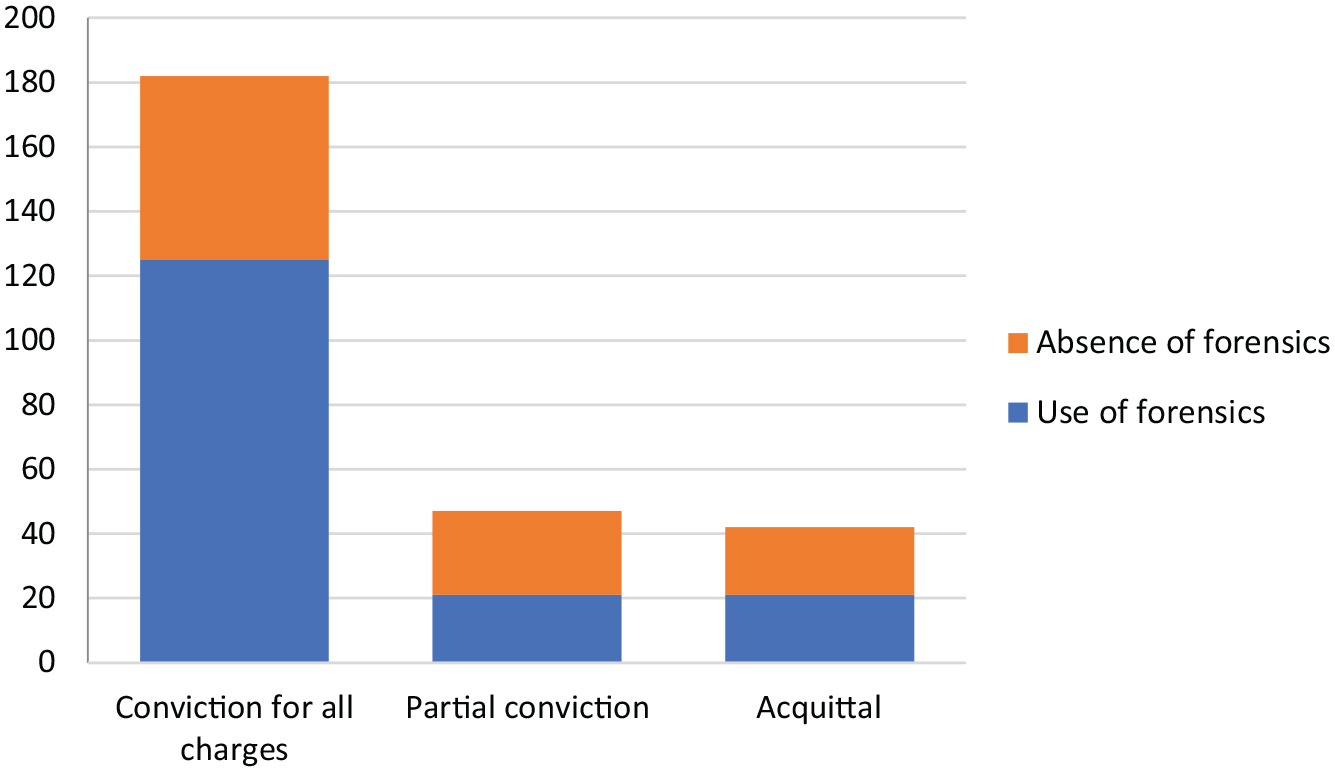
Relationship between the application of forensics as part of criminal investigations and court rulings (source: analysis of data on 271 rulings provided by the Public Prosecutor’s Office of Argentina).
Although the data above suggest a correlation between the use of forensics and the likelihood of a conviction, they fail to explain how these instruments shape legal outcomes. Out of the 50 Argentinian cases analyzed in this study, in 37 cases, forensic technologies were used as part of the prosecutorial strategy; in at least half of the cases, the judges made explicit references in their ruling to the critical role of evidence produced by these technologies in shaping the final ruling. Drawing on interviews with judges and other experts with direct experience of human rights cases, coupled with an analysis of the court transcripts, I suggest the supply of forensic evidence can be deemed crucial to the rulings in three ways. First, it provided hard incriminatory evidence to reach the burden of proof; second, it was a secondary, yet reliable, source to corroborate other types of evidence; third, the reputation of forensic experts increased judges’ confidence in their rulings.
The interviewees thought DNA and forensics were particularly useful in producing sufficient evidence to tie a defendant to the crime. For example, a landmark ruling made reference to the “objective proof” provided in the report of a forensic expert: “These bodies talk, because after they were exhumed, the genetic and fingerprint identification mechanisms confirmed the identity of [name of victim].” 12 An experienced judge agreed: “Obviously a positive DNA test allows a stronger conviction on the commission of the crime” (Interview No. 8). In fact, some forensic experts noticed judges’ overreliance on DNA as sufficient evidentiary basis, swinging the pendulum to the other extreme (Interviews No. 16, No. 8).
While DNA may have been the most common way to shape judges’ rulings, other forensic technologies seemed helpful to corroborate other sources of evidence, and in this way, increased the validity of this evidentiary basis. In a prominent ruling, the judge relied on forensic incriminatory evidence to infer the following: The evidence gathered allows us to affirm that the death of [victims] was the consequence of a deliberate execution [. . .]. [This] must be considered together with the result of the autopsies, which describe the gun-shots in the victims’ bodies. Especially in the case of [victim’s name], who presented three gun-shots in his head, one of which has a top-down trajectory consistent with an execution.
13
Last, it seems the official scientific status of the forensic experts added legitimacy to their testimony (Interview No. 18), as discussed earlier. This may be partly attributed to the global currency of members of the EAAF. One judge was adamant: In Argentina we have the privilege of working with the Argentine Forensic Anthropology Team, an institution with international prestige that works daily with us. The use of technology from these experts has a very high scientific standard and has allowed us as judges to convict defendants for the charge of murder with sufficient certainty.
14
References to expert witnesses from the EAAF abound in court rulings to substantiate the guilty verdict. 15
The experience of Argentina suggested to the rest of the world that accountability and punitive justice were possible when a legal case was supported by forensic incriminatory evidence. With that in mind, international criminal tribunals, including the ad hoc tribunals for the Former Yugoslavia (ICTY) and Rwanda (ICTR) and the permanent ICC, started to use forensic evidence as part of their prosecutorial strategy (Wagner, 2008). These tribunals, in turn, represented a “rite of passage” for a new generation of forensic experts, allowing them to gain skills and diffuse their knowledge in other post-conflict societies Interviews No. 10, No. 12). According to the director of the ICMP, the creation of the ICTY was a “milestone”: There was a massive effort on part of the ICTY to find evidence. And where was the evidence? In mass graves. An army of forensic anthropologist, archaeologists, and many of them from Latin America—trained for different purposes, to return the body to families—it’s this novelty of having an international court engaging in a massive excavation on sovereign territory of crimes. (Interview No. 13)
In short, the growing demand for incriminatory evidence by retributive bodies offered new opportunities for forensic techniques to gain global currency. At the same time, the availability of forensic expertise reinforced punitive mechanisms of accountability.
Lessons from the forensic cascade
Forensic technologies have been critical for the success and global expansion of transitional justice policies. A number of “restorative” or “retributive” practices would not have been possible in the absence of forensic tools. Yet this is seldom mentioned in the literature. For example, as I mentioned previously, Sikkink sheds welcome light on legal and normative processes leading to the emergence of new accountability norms, yet her analysis does not explore an obvious factor in the justice cascade: the ability to use indisputable evidence from graves to convict criminals. It is impossible to fully comprehend the justice cascade without first noting the forensic cascade.
Different countries have used forensic tools in different ways. For example, in contexts of negotiated transitions or “frozen conflicts” with pressing legacies of clandestine crimes, forensic sciences have successfully delinked humanitarian exhumations from any criminal procedure (Interview No. 2). In Cyprus, Northern Ireland, Georgia, and Colombia, humanitarian exhumations have helped thousands of families reach closure, without leading to prosecutions. Most often, a legal framework delinks these two distinct processes and offers incentives (e.g. immunity, confidentiality, anonymity) to eyewitnesses/perpetrators to share information. At the same time, other countries have used forensic evidence to trim amnesty laws and bring perpetrators to justice, as evident in Argentina, Guatemala, and Rwanda. This retributive agenda has been particularly influential, and major international organizations such as the UN, ad hoc criminal tribunals, and the ICC have deployed forensic technologies of justice (UN, 2009). 16
The study of the forensic technologies of justice illuminates the complex moral and legal tensions between the rights of the victims, the legal duties of the state, and the pragmatic constraints accompanying the realities of post-conflict/post-authoritarian settings. Scholars have long debated whether societies should prioritize peace and stability, even if it means amnesty laws preclude dealing with the past (Cobban, 2007; Vinjamuri and Snyder, 2004) or holding perpetrators of human rights violations accountable (Kim, 2012; Sikkink, 2011). An underlying assumption is that there is a trade-off between justice initiatives and efforts to consolidate peace in fragile transitions. This is generally true, but as illustrated here, the introduction of forensic sciences has permitted the delinkage of these two important objectives for specific crimes.
Supplemental Material
sj-docx-1-ejt-10.1177_13540661221127700 – Supplemental material for Technologies of justice: forensics and the evolution of transitional justice
Supplemental material, sj-docx-1-ejt-10.1177_13540661221127700 for Technologies of justice: forensics and the evolution of transitional justice by Iosif Kovras in European Journal of International Relations
Footnotes
Acknowledgements
I am very grateful to Evan Liaras, Neophytos Loizides, Kieran McEvoy, and Maria Mikellides for their invaluable comments on previous drafts of the paper. I am particularly indebted to Lorena Balardini for leading the data collection in Argentina. I am also grateful to the three anonymous reviewers for the insightful feedback that greatly benefited the quality of this article.
Funding
The author(s) received no financial support for the research, authorship, and/or publication of this article.

Supplemental material
Supplemental material for this article is available online.
Notes
Author biography
References
Supplementary Material
Please find the following supplemental material available below.
For Open Access articles published under a Creative Commons License, all supplemental material carries the same license as the article it is associated with.
For non-Open Access articles published, all supplemental material carries a non-exclusive license, and permission requests for re-use of supplemental material or any part of supplemental material shall be sent directly to the copyright owner as specified in the copyright notice associated with the article.
