



Abstract
Does the overtness of external support to rebels affect civilian targeting in civil wars? Conflict studies increasingly scrutinize how insurgent sponsorships shape rebels’ behavior. However, the influence of external sponsors’ decisions to publicly acknowledge or deny their support on rebel conduct is largely neglected. This article introduces a new dataset on the overtness of external support to rebels in civil wars between 1989 and 2018. It then assesses whether the overtness of support is correlated with insurgents’ propensity to target civilians. I hypothesize that overtly supported rebels are less likely to target civilians than covertly supported rebels. This hypothesis stems from how supply-side factors—the way state sponsors expectedly act after having allocated their support—impact insurgents’ structure of incentives around relations with non-combatants. Statistical analyses yield strong support for my hypothesis. Moreover, further analyses show that support overtness influences civilian targeting independently from sponsors’ characteristics, such as political regimes or foreign aid reliance. Thus, in addition to the type of material aid insurgents receive, variation in whether support is covert or overt shapes how rebels treat civilians.
Introduction
Rebel sponsorship is central in contemporary international interactions (Grauer and Tierney, 2018). As state sovereignty has become a normative pillar of the international system (United Nations, 1945), most state adversaries keep their bellicose sponsorship covert. 1 Devising plausibly deniable actions lowers sponsors, “potential security, economic, and reputational costs” (O’Rourke, 2020: 120; Poznansky, 2019). Venezuelan President Hugo Chavez’s refusal to admit supporting the Colombian FARC in the 2000s is an example of covert support (The Economist, 2008). The secrecy of external support is sometimes a collusive one. Both external sponsors and local targets are aware of such operations, but “keeping the public and other governments in the dark” allows them to control potential conflict escalation (Carson, 2020: 3). However, states overtly admit to materially supporting insurgents in some cases. They even, sometimes, openly justify the provision of aid by appealing to the rightfulness of rebels’ ethos. Syrian-acknowledged support to Hezbollah is an example of overt support (Oweis, 2007).
While the literature has increasingly scrutinized the determinants of sponsorship overtness, it has largely overlooked how this variable defines civilian targeting by rebels in civil wars. Salehyan et al. (2014: 635) have shown that, overall, rebel sponsorship is associated with more coercive rebel–civilian interactions. However, recent studies have nuanced these findings. Some articles have found no significant links between support and coercive insurgent–civilian interactions (Fortna et al., 2018; Grant and Kaussler, 2020). Another article has found that sponsorship can promote constructive rebel–non-combatant relationships (Huang and Sullivan, 2020). These contradicting findings thus call for further disaggregation of different forms of external interventions in civil conflicts.
This article hypothesizes that overtly sponsored rebels are less likely to target civilians than rebels who receive mere covert support in civil wars. I contend that this is because supply-side factors—the way states expectedly act after having allocated their support—determine insurgent incentives regarding the targeting of non-combatants. My central assumption is that, as shown in the literature, sponsors do not want to face potential reputation and material costs associated with known aid to brutal rebels. The first consequence is that overt support is expected primarily to groups that are not engaged in widespread atrocities before being supported. Further down the conflict timeline, for the same reputational and material considerations, the second consequence is that sponsors providing overt assistance will expectedly monitor insurgent behaviors more closely than sponsors providing covert support. From these supply-side factors emerge the expectation that rebels receiving overt support face a restrictive structure of incentives that promotes restraint toward civilians. Engaging in civilian targeting would deprive the group of access to significant political and material resources. Conversely, rebels receiving mere covert support face a more permissive structure of incentives regarding civilian targeting. In this situation, rebels are less reliant on civilians’ voluntary cooperation due to access to external resources, and at the same time, are not severely constrained in their behavior by strict monitoring from sponsors.
To test my hypothesis, I introduce a new dataset on the overtness of external support to rebellions for each rebel group-year observation between 1989 and 2018. Overtness is coded using press articles, non-governmental organizations (NGO) and international organizations’ reports, and academic articles. Descriptive data show that overtness is an exception and that covertness remains the norm in the post–Cold War period. I use this original data to establish that, compared with covert support, overt sponsorship negatively and significantly correlates with both the occurrence and the degree of civilian targeting by rebels. Moreover, further analyses show that support overtness influences civilian targeting independently from sponsors’ characteristics, such as political regimes or foreign aid reliance.
The article contributes to the literature by identifying overtness as a moderating factor in the positive relationship between sponsorship and violence. Qualifying existing arguments (Salehyan et al., 2014; Weinstein, 2006), the findings show that insurgent capabilities do not fully explain variations in violence toward civilians. These results corroborate recent findings that associate rebel sponsorship with the development of mutually beneficial insurgent–civilian relationships (Huang and Sullivan, 2020). While a significant strand of research assumes frequent moral hazards in the sponsor–rebel relationship (Popovic, 2017; Salehyan, 2010), the findings also suggest that sponsors have leeway in dealing with rebel violence. Finally, the findings indicate that restraint can be a particularly fruitful strategy for rebels. These results directly resonate with recent ones showing that rebels who refrain from targeting civilians are more likely to secure favorable outcomes in civil wars (Stanton, 2020).
The first section reviews past works on the consequences of rebel sponsorship, the determinants of civilian targeting, and how both variables have been studied conjointly. The second section introduces a new dataset on support overtness and offers descriptive statistics. The third section details the theoretical argument regarding how overtness affects civilian targeting by rebels. The third and fourth sections present the research design and the results of the statistical analyses. Finally, the concluding section briefly reflects on future policy and academic research implications.
Insurgent sponsorship and civilian victimization in civil wars
Insurgent sponsorship in civil wars
In many modern civil wars, external states provide insurgencies with lethal resources, such as weapons and ammunition, and/or non-lethal resources, such as money, training, intelligence, or other logistical aid (Jones, 2017). Another common form of non-lethal support is when states allow rebels to take shelter on their soils to avoid repression by rival governments (Salehyan, 2007).
In the wake of the recent increase in rebel sponsorship (Grauer and Tierney, 2018), several studies have investigated its influence on rebel behavior. Based on principal–agent frameworks, several works aim to explain why, despite material dependence, a convergence of interests toward a common target often gives way to a situation in which rebels’ aims are at odds with their sponsors (Salehyan, 2010). Their conclusions show that interests are rarely sufficiently close, and command-and-control structures effective enough to ensure loyalty (Brown, 2016). Rebel sponsorship often favors opportunistic insurgent behaviors. Rebel groups that are “decentralized” and “factionalized” appear more prone to defect against their sponsors than “centralized organizations” (Popovic, 2017). External support also favors internal splits among rebellions (Tamm, 2016). Despite providing insightful findings, past research has mainly focused on the influence of what is transferred to rebels (Sawyer et al., 2015) without fully considering the influence of the way sponsorship is conducted on conflict dynamics.
Civilian victimization in civil wars
While scholars have investigated rebel sponsorship in more detail, another large body of research has continued to scrutinize insurgent–civilian interactions in civil wars. In that regard, conflict studies strongly emphasize the role played by rebel access to material resources (Kalyvas, 2006). Various works show that when non-combatants are a reliable source of material assets, rebels face strong incentives to refrain from targeting them (Weinstein, 2006; Wood, 2014). In such cases, insurgents are incentivized to provide social benefits to civilians, such as health, education, or justice (Mampilly, 2012; Stewart, 2019). Providing services to non-combatants is perceived by rebels as a way to access “material contributions, political support, and recruits” from the civilians under their direct authority (Arjona, 2016: 50; Huang, 2016b: 74). Consistently, rebels less worried about popular consent due to easy access to lootable resources or external assets are more likely to be incentivized to target civilians to gain their local collaboration (Berman and Matanock, 2015; Stewart and Liou, 2017). The violence toward non-combatants is thus primarily strategic, rather than erratic, unintentional, or caused by uncontrolled rogue fighters (Valentino, 2014).
Insurgent sponsorship and civilian victimization in civil wars
Both rebel sponsorship and insurgent–civilian interactions have been studied conjointly. Despite sharing a materialistic approach, these works reach contrasting conclusions regarding the effect of support on insurgent behaviors toward civilians. On one side, in line with the long line of research outlined above, Salehyan et al. (2014: 635) argue that rebel sponsorship decreases “the rebels” need to “win the hearts and minds” of the population and raises the probability of civilian abuse. Their statistical results show that support provided by autocracies is associated with higher degrees of civilian targeting. Other studies, however, propose more nuanced or opposite results. Fortna et al. (2018) find that externally sponsored insurgents are not significantly more involved in acts of terrorism. Grant and Kaussler (2020: 19) find that support to Syrian rebels in the 2012–2016 battle of Aleppo “had almost no impact on the level of victimization of civilians” by rebels. Finally, Huang and Sullivan (2020) find that sponsorship is positively associated with the extent to which insurgents provide social services to non-combatants.
These contrasting findings call for more scrutiny on the way insurgents’ transnational ties interact with their propensity to develop coercive or constructive interactions with civilians. While most previous studies compare support instances to no sponsorship cases, an underexplored dimension concerns the disaggregation of different forms of support.
New data on external support overtness in civil wars
Defining support overtness
What distinguishes overt support from covert support? As depicted in Figure 1, I contend that support overtness is better conceptualized as a continuum composed of four degrees of public recognition by external sponsors.
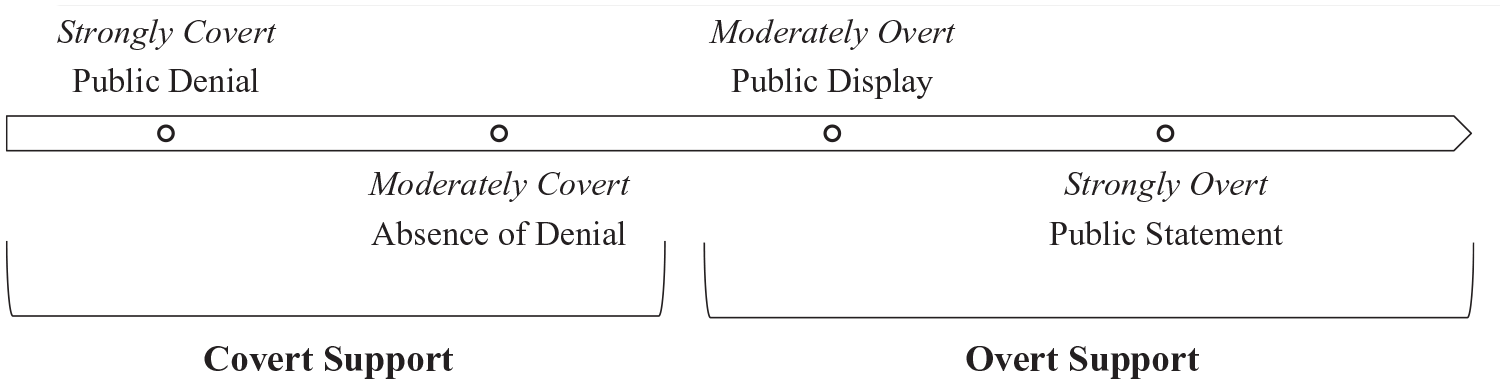
A continuum of external support overtness.
On the left side of the continuum, we find two stages of covert support. Public denial is when a state publicly refutes any material assistance to rebels, and state authorities do not display any obvious signs of material support. 2 An example of this type of covert support is Rwanda’s rejection of its support to Congolese rebels of the M23 Movement in 2012–2013, despite ample evidence provided by the Office of the United Nations High Commissioner for Human Rights (OHCHR) on the matter (Agence France Presse (AFP), 2012b). An absence of denial is when a state does not publicly deny or acknowledge materially supporting rebels following repeated accusations, and, again, state authorities do not display obvious signs of material assistance to insurgents. An example of this type of covert support is when Gaddafi’s Libya was accused of supporting rebellions throughout Africa in the 1990s. While some of these accusations elicited denial from the Libyan authorities (British Broadcasting Corporation (BBC), 1990; Reuters, 1990), others were not publicly refuted.
On the right side of the continuum, we find two stages of what can be considered overt support. A public display is when a state does not publicly deny or acknowledge supporting insurgents but displays obvious signs of material assistance. Apart from not taking any positive actions to hide its ties with rebels, the state voluntarily exhibits its relationship with insurgents. An example of this overt support is the Eritrean government hosting the Sudanese National Democratic Alliance (NDA) in Asmara during the 1990s (Sutton, 1995). Finally, a public statement is when a state publicly acknowledges providing material assistance to insurgents. Such a degree of overtness is justified chiefly by strategic imperatives, moral concerns often related to human rights considerations, or both. An example is Uganda’s public recognition of its support to the Movement for the Liberation of Congo (MLC) in 1998 (Borzello, 1998).
Notably, support overtness does not equate to support’s degree of plausible deniability. Acknowledgment should not be conflated with visibility, as support can be entirely denied or unacknowledged by sponsors but still be implausibly deniable (Cormac and Aldrich, 2018). In addition, overt support does not fully equate to mere diplomatic assistance since the latter can be given without being associated with the provision of material assets to insurgents. Finally, support overtness does not equate to complete transparency regarding the amount or the type of material aid provided to rebels. In most cases of overt support, foreign states admit assisting a rebellion materially but, for strategic reasons, remain vague regarding what is being transferred. Sponsors appear especially reluctant in acknowledging the transfer of lethal resources such as weapons and/or ammunition and often prefer to focus their public declarations on non-lethal aid. 3
Trends in support overtness
Support overtness has been coded for all insurgencies active in civil conflicts between 1989 and 2018 (Pettersson and Öberg, 2020) and materially supported by at least one external state (Högbladh et al., 2011). 4 Figure 2 shows that, among the 1,525 rebel-year observations in the dataset, 452 are known to have received material support from one or more external states. Moreover, among these 452 observations, 295 groups have received solely covert support in a given year, while 157 have received overt support from one or more external sponsors.
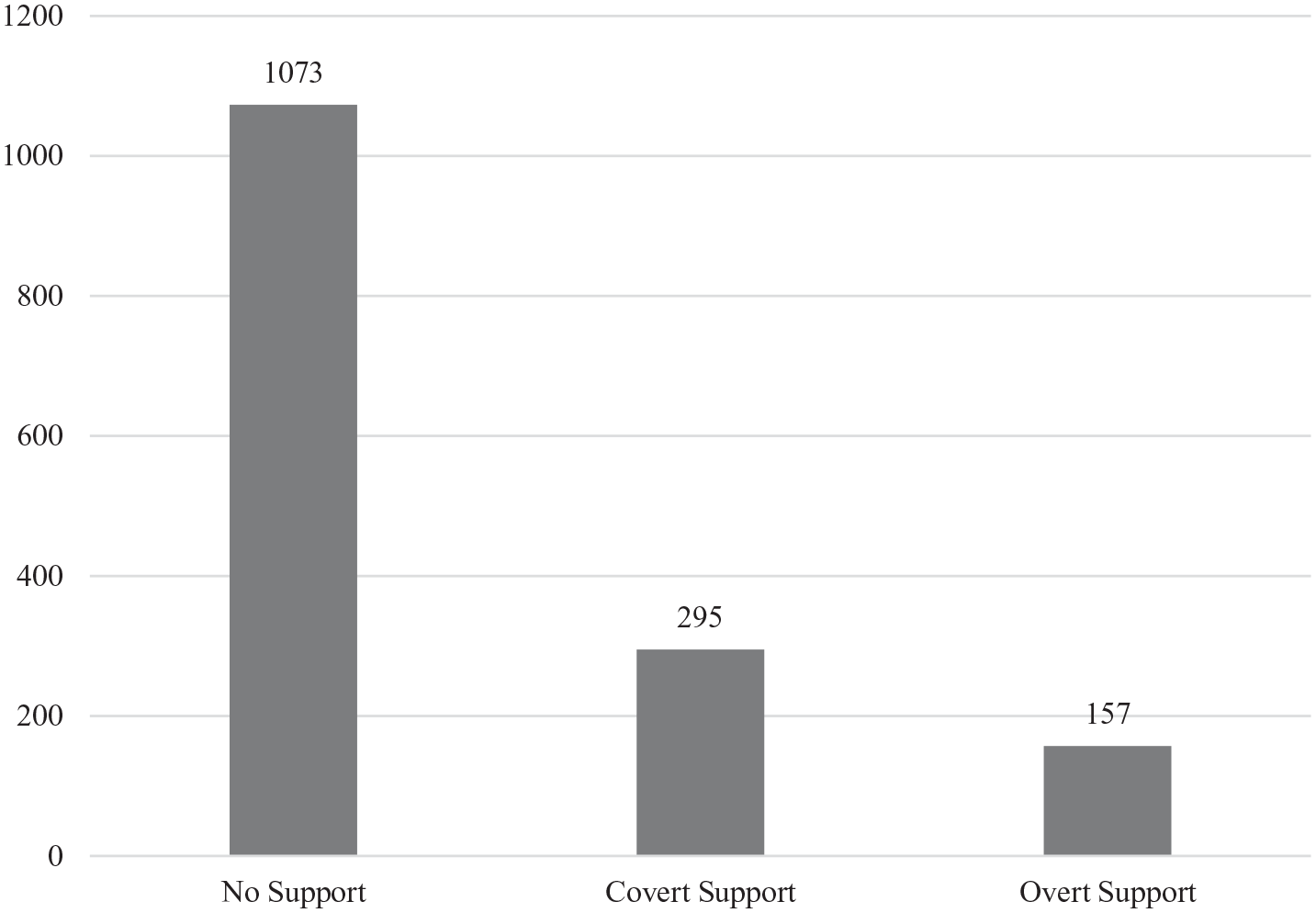
Support overtness between 1989 and 2018—aggregated data.
As depicted, overtness remains an exception in international politics. Instead, covertness is the norm in the period. Figure 3 disaggregates covert and overt support cases along the continuum presented above to scrutinize further the prevalence of overtness in the period.
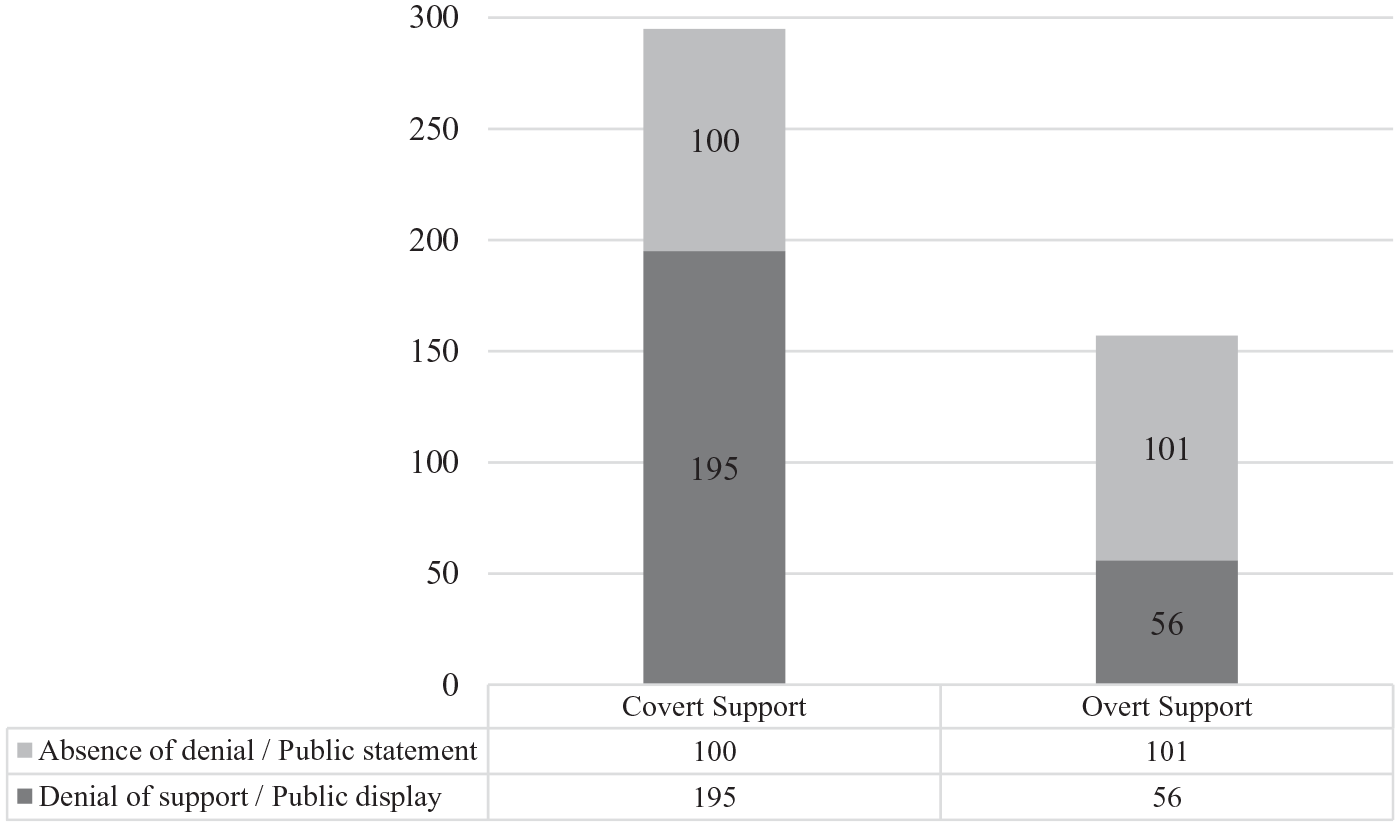
Support overtness between 1989 and 2018—disaggregated data.
One potential question is whether the tendency to receive covert or overt support depends on sponsors’ regimes. Figure 4 disaggregates observations of groups being covertly or overtly aided depending on whether they are, on average, supported by non-democratic or democratic states. 5
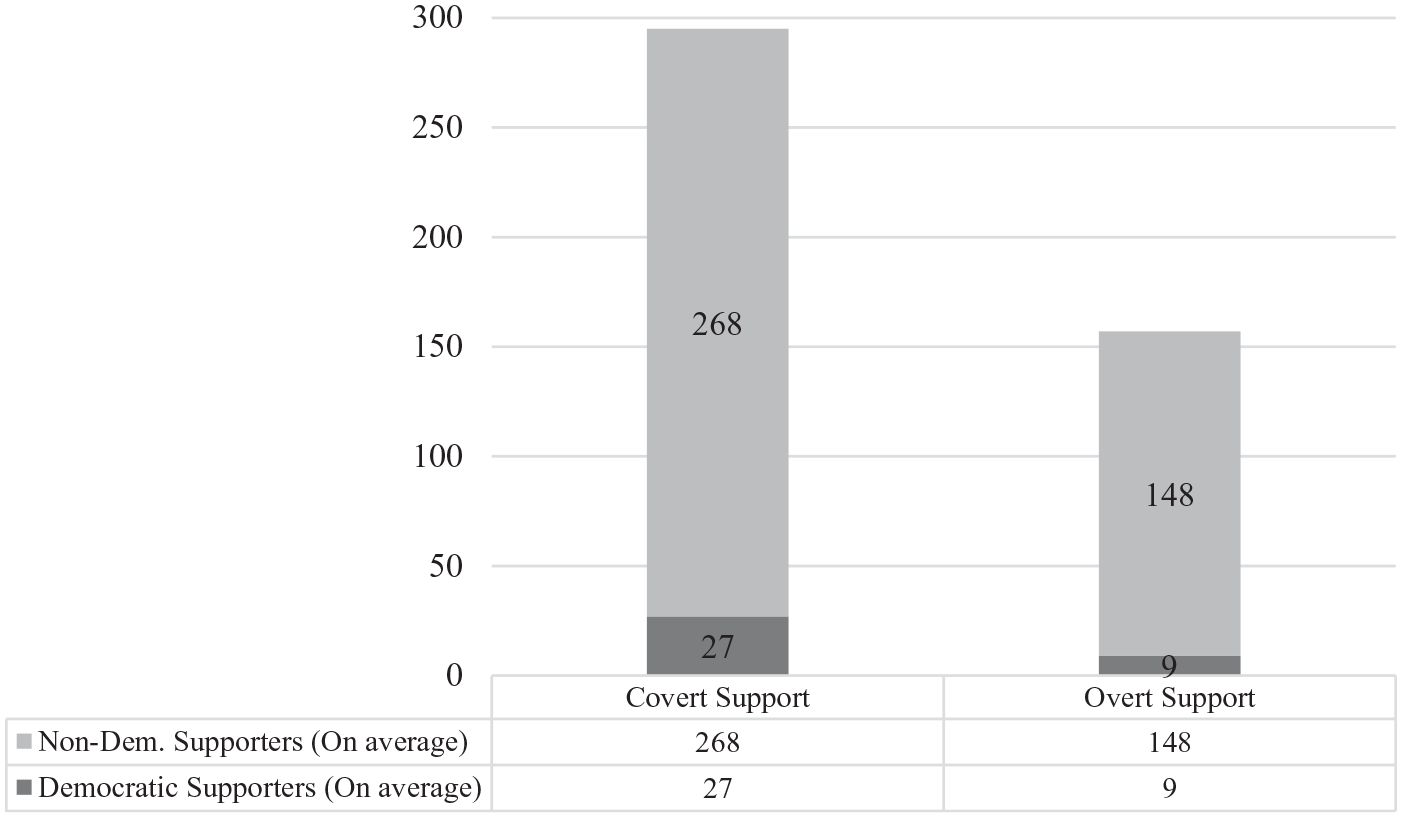
Support overtness between 1989 and 2018—nature of sponsors’ regimes.
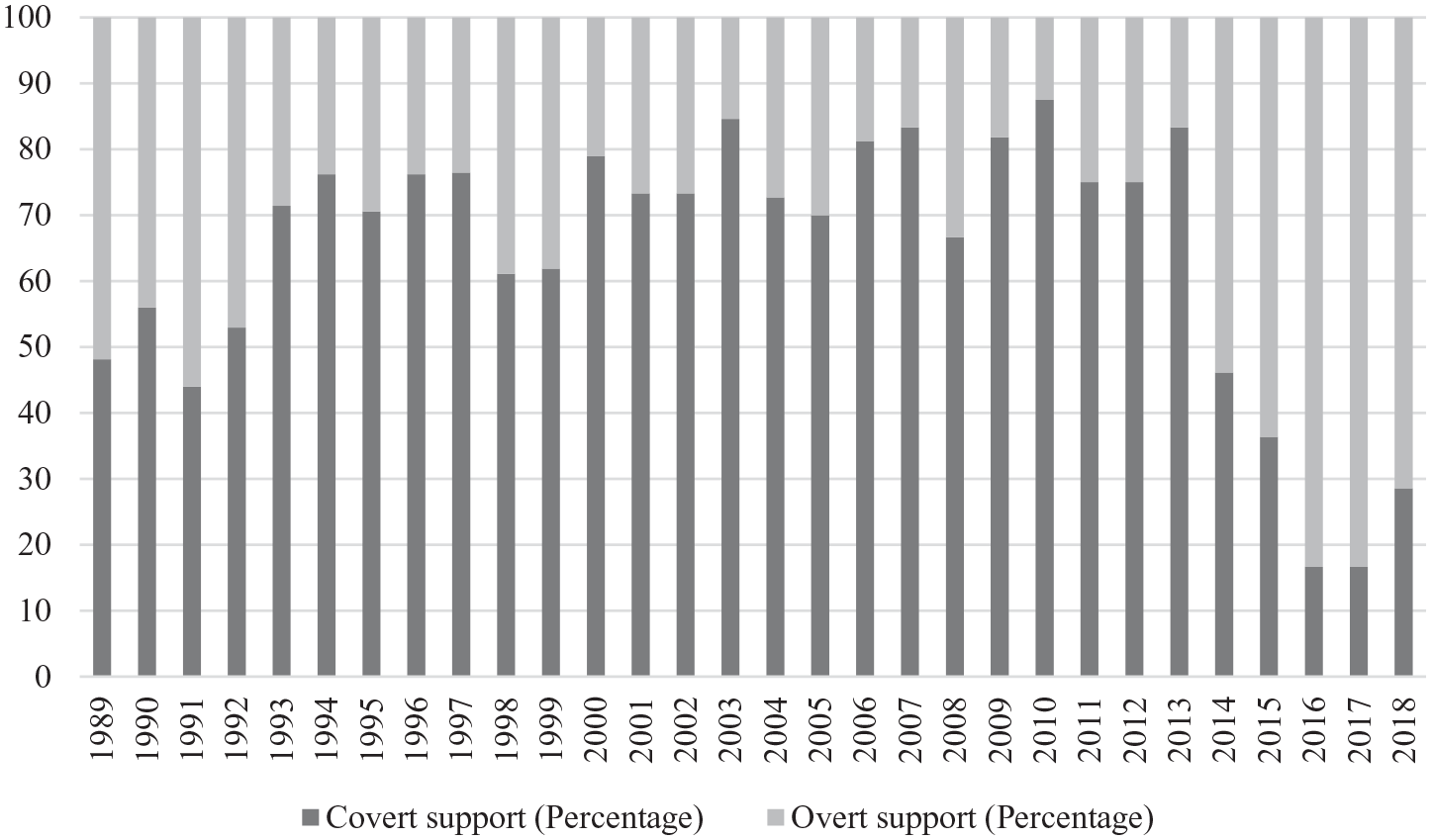
While most rebel groups receive support from non-democratic sponsors on average, the ratio between support from non-democratic supporters and support from democratic supporters does not differ strongly depending on support overtness. Another legitimate question is whether variations in the configurations of the international system favor certain forms of interventions. Figure 5 depicts the percentage of covert and overt support for each year in the dataset to assess potential temporal disparities regarding overtness in international politics.
Support overtness between 1989 and 2018—distribution per year.
The pre-1992 period appears particularly prone to overtness. Half the observations are cases of overt support. A potential explanation for this tendency could be that, in the context of the Cold War, states from the two main blocs instrumentally used overtness to signal the credibility of their political and technological systems. This tendency was observed in Afghanistan when the United States aided the Mujahideen overtly in the early 1990s (Carson, 2020). The 1993–2013 period appears much less prone to overtness. The share of observations being cases of overt aid drops and oscillates between 20 and 40 percent. This likely reflects an emerging international system based on non-intervention norms. Finally, with most cases being instances of overt support, the 2014–2018 period demonstrates a significant return of overtness at the core of states’ modus operandi. This tendency potentially reflects a resumption of open strategic competition among great powers in conflicts such as Syria. 6
Finally, in line with the article’s focus, Figure 6 depicts the share of civilian casualties from groups receiving solely covert support to the same value for groups receiving overt support from at least one state for each year in the dataset. 7
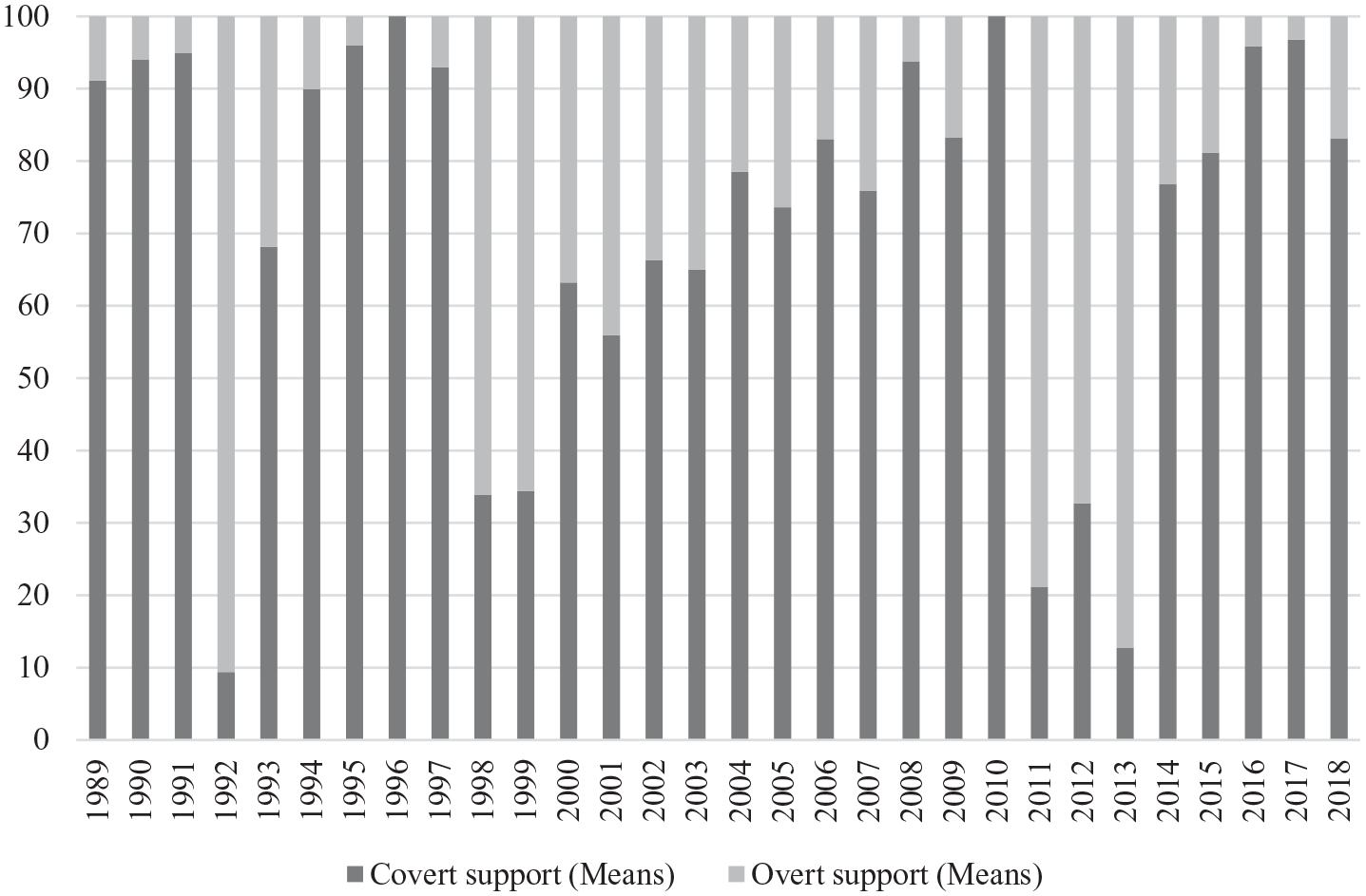
Support overtness between 1989 and 2018—civilian casualties.
Temporally prevalent and quantitatively significant disparities between rebels receiving covert support and those receiving overt aid motivate a further investigation of overtness’s impact on civilian targeting in civil wars.
Costs and advantages of support overtness
Acting overtly in a conflict entails both potential costs and advantages for sponsors. On one hand, overtness can entail potential costs for a foreign state. First, overt intervention is a particularly defying move that can trigger military retaliation from the target government and/or its allies. Then, overtness can also lead to a range of additional adverse effects for the sponsor if rebels engage in human rights abuse. The repercussions can be reputational. A state can be sensitive to reputational costs caused by “naming and shaming” campaigns (DeMeritt, 2012; McManus and Yarhi-Milo, 2017). A state can additionally, or alternatively, be sensitive to reputational costs among its domestic constituency and the conflict-riven country’s constituency caused by overt support to rebels killing civilians with which it claims kinship. Iranian leaders’ likely disinclination to support Palestinian groups coercing Palestinians exemplifies this idea (Malakoutikhah, 2020). Even a state insensitive to reputational costs can be sensitive to potential material costs if aiding violent rebels overtly. Notably, most states do not want to be listed as sponsoring terrorism due to associated sanctions and operational constraints (Byman, 2020; DiBlasi, 2020). Being listed as a sponsor of terrorism prevented Sudanese authorities from accessing “U.S.-dominated lending institutions such as the World Bank and the International Monetary Fund,” for instance (Bearak and Mohieddin, 2020). A state relying strongly on foreign aid can also be reluctant to support violent rebels openly because this could impact the amount of aid received from wealthy countries (Stanton, 2016). Both potential reputational and/or material reasons thus have to be taken into account by a state when evaluating the opportunity for acting overtly versus covertly.
On the other hand, potential advantages can motivate a sponsor for voluntary exposure. First, overtness can be a signaling mechanism for various valued audiences. Domestically, a state can find substantial advantages in publicizing its support to a group with which it shares kinship ties (Ives, 2019a, 2019b). For example, the Palestinian cause’s strong “popular support at home” likely explains Qatar’s open support to Hamas (Levs, 2014). Internationally, intervening overly in a conflict can also allow a state to signal the credibility of its political and technological system. Second, overtness can serve immediate tactical purposes. When intervening overtly, a sponsor can transfer a more significant number of resources and resources of higher quality. Overtness often entails “robust amounts of aid, more advanced technologies, and optimally trained personnel” (Carson, 2020: 36). In turn, this increases a sponsor’s chances to reach its strategic objectives in a given conflict (O’Rourke, 2018). For example, Carson (2020) highlights the American sponsorship of Afghan rebels in the 1980s. In 1986, the US acceptance to adopt overt posture allowed them to provide American-made Stinger missiles to insurgents.
From rebels’ point of view, not all groups searching for material aid value overtness over covertness. Some rebellions do not want to be seen as “puppets of external states” or “out of touch with those inside the country” (Jones, 2017, 158). Nevertheless, overtness can bring insurgents valuable advantages. By signaling a strong sponsors’ commitment toward rebels’ cause, overtness can offer a “legitimacy-seeking” rebellion the necessary political resources it needs (Jo, 2015; Stanton, 2016). An example is Armenian groups in Nagorno-Karabagh heavily relying on outside public support to reach state-building objectives (Beacháin et al., 2016). Then, even a “legitimacy-indifferent” rebellion can find substantial material benefits in overtness (Jo, 2015). As mentioned, overtness often entails the transfer of more resources and higher quality resources. These material advantages can help rebels gain fighting capabilities, ultimately leading to positive conflict outcomes. Following Carson’s (2020) example, receiving Stinger missiles led Afghan rebels to defeat the Soviet-backed government. Based on the costs and advantages of overtness for both sponsors and rebels, the following section develops a theoretical argument stressing the impact of this variable on the way rebels use violence toward civilians.
Rebel sponsorship overtness and civilian targeting in civil wars
This section starts by exposing my expectations regarding how a state’s choice for overtness will impact the incentives it faces regarding how it deals with rebel behavior. I then discuss how this, in turn, defines rebels’ structures of incentives concerning civilian targeting.
Supply-side determinants: sponsors’ incentives depending on overtness
Once deciding to intervene in a conflict through a local partner, a state must choose whether to do it covertly or overtly. 8 Overtness’s advantages and potential costs exposed above provide a sponsor with a trade-off when devising its strategy. A state will weigh potential military retaliation from the target government and/or its allies and potential consequences of the pre-support degree of rebels’ civilian targeting against overt support’s reputational and tactical benefits. 9 When contextual reasons make the expected benefits exceed the potential costs, a state will opt for overtness. 10 However, a complicating factor is that the parameters of the sponsor’s trade-off can be altered after the state has opted for covertness or overtness. 11 As hinted by previous studies, rebel sponsorship “may reduce the constraints on insurgent violence by diminishing rebels” need to connect and contract with the local population (Salehyan et al., 2014: 657; Weinstein, 2006). Rebels that are externally supported see their structure of incentives subsequently becoming more permissive for violence and can thus engage in civilian targeting once they have received aid.
To limit this risk that the rebels start to target civilians once they are supported, sponsors can implement various monitoring mechanisms (Salehyan et al., 2014). The state can monitor rebels through the action of its operatives on the ground. The monitoring can also be discursive, through external threats to sanction atrocities-committing rebels by changing the conditions of their support or by entirely halting it. The argument is here that the strictness of the monitoring will likely increase along the degree of support overtness. When supporting rebels covertly, a sponsor can hope that its support will not be exposed if rebels start to commit widespread atrocities. The sponsor can tolerate a degree of violence to preserve its primary strategic objectives in the conflict. If exposed, the sponsor denying helping insurgents can still rely on plausible deniability to mitigate potential reputation and material costs (Poznansky, 2020). The sponsor does not face high incentives to monitor rebels strictly and has latitude on how it can respond to such a situation. 12 Conversely, a sponsor that has opted for overtness has voluntarily given up plausible deniability. The state is almost assured that rebel atrocities will have reputational and/or material costs. The sponsor thus faces strong incentives to monitor rebel behavior strictly. The argument here is that “rhetorical commitment” can lead to “rhetorical entrapment” for a state (Schimmelfennig, 2001: 66). The sponsor’s choice for overtness caused by its initial perception that benefits outweigh potential costs creates incentives to control rebel behavior strictly to maintain a favorable advantages–costs trade-off.
An example of monitoring in a case of overt support is the Libyan National Transitional Council (NTC) case. In 2011, several states provided the rebels with lethal and non-lethal assets (Nardulli, 2015). Support was principally overt. Different sponsors publicly justified aiding the rebels by appealing to the rightfulness of their cause (Black, 2011; Hopkins, 2011; Kerr, 2011). In line with my theoretical expectations, sponsors carefully monitored NTC–civilian interactions. Foreign advisers were, for instance, on the battlefield to advise rebels on civilian protection (Traynor & Norton-Taylor, 2011). Overall, financial aid was conditional on the fact that it would help with the creation of a free and fair structure of government in rebel areas. The European Union (EU) was very active in this cause. In May 2011, the EU foreign policy chief announced that the EU aid “would be tied to progress in developing civil society” (John, 2015: 156). The EU subsequently created a mission office in Benghazi, considered the rebel capital (Talbi, 2011).
Another example is the case of the People’s Protection Units (YPG) during its war against the Islamic State (IS) in Northeast Syria. The United States started to overtly “furnish weapons, ammunition and medical aid” to the YPG following IS attack on Kobane in September 2014, stressing that it would be “morally very difficult” not to support the group (Letzch, 2014). From this time, the United States monitored YPG’s interactions with civilians. The sponsor notably advocated for the inclusion of non-Kurdish fighters into the group (Reuters, 2017). This advocacy led to the creation of the Syrian Democratic Forces (SDF) in 2015, which, although YPG traditional members still dominate it, includes Arabic, Syriac, or Turkmen fighters.
Instances of strict monitoring thus appear frequent when support is overt, especially when coming from democratic supporters. Evidence regarding monitoring by non-democratic in cases of overt assistance is more difficult to find, likely, in part, due to transparency issues. Nevertheless, evidence still hints at autocracies’ sensitivity to potential abuses committed by their allies abroad. For instance, when Hamas clashed with the Fatah in 2006 and 2007, Iran denounced the “regretful image of family clashes between men and women” and proposed to settle the dispute (BBC, 2007).
Demand-side responses: rebels’ incentives depending on overtness
I believe that overtness’s influence on the strictness of monitoring subsequently defines insurgents’ respective structures of incentives regarding civilian targeting. Rebels’ incentives depend on whether they receive support or not, as previously demonstrated (Salehyan et al., 2014; Weinstein, 2006; Wood, 2014) and whether the support they receive is provided covertly or overtly for those externally assisted. 13 Three different scenarios can be identified.
In the first scenario, a rebel group receives no support from foreign states. In this case, rebels expectedly face a mixed structure of incentives regarding civilian targeting. If insurgents want and expect to receive assets in the future, either covertly or overtly, demonstrating restraint can signal their willingness to abide by basic standards of civilian protection to convince potential supporters (Jo et al., 2021). 14 If, for various reasons, rebels do not want or do not expect to receive resources from foreign states in the future, demonstrating restraint can serve to win civilians’ hearts and minds and foster voluntary cooperation (Kalyvas, 2006; Salehyan et al., 2014). If insurgents do not want and/or do not expect to be externally supported but have access to lucrative natural resources or criminal networks, they can, however, face a structure of incentives permitting civilian targeting (Weinstein, 2006). 15 Rebels’ incentives structures depend in this scenario on factors beyond the mere presence or absence of foreign support.
In the second scenario, a rebel group receives only covert support from foreign states. In this case, insurgents expectedly face a permissive structure of incentives regarding civilian targeting. Access to external resources makes rebels less reliant on voluntary cooperation from civilians to maintain a constant flow of assets needed to fight. In addition, covert sponsors are not expected to control rebel interactions with civilians strictly and have significant latitude in responding to potential post-support rebel violence. Thus, if deemed beneficial to achieve their strategic objectives, insurgents can engage in extortionate behavior to produce short-term forced compliance or cooperation from non-combatants.
Finally, in the third scenario, a rebel group receives overt support from foreign states. In this case, rebels expectedly face a restrictive structure of incentives regarding civilian targeting. While insurgents could be tempted to become more violent due to lower needs to win over civilians’ hearts and minds, strict monitoring from sponsors can prevent rebels from shifting their strategy. Starting to engage in extortionate behavior would make the rebels risk losing the critical benefits of overtness. Faced with the potential reputational and material costs mentioned above, a sponsor could follow two strategies in case of post-support abuses. First, the state could switch to covertness by pretending to cease its sponsorship. This strategy would, however, be both dangerous for the sponsor—public attention linked to the previous overtness would likely continue, increasing the risks of exposure and high costs—and detrimental for rebels—legitimacy-seeking rebels would lose the overtness’s symbolic benefits and all groups would lose the material benefits associated. The sponsor could also decide to cease its support at the entire expense of rebel capabilities. 16 In this case, rebels thus have vital interests in complying with their backers’ expected preferences for restraint toward civilians.
The more overt the support, the more it expectedly restricts rebels’ incentives to use civilian targeting strategically. I anticipate a strong path dependency at the extremities of the overtness continuum (Fioretos, 2011). 17 If sponsors publicly deny aiding rebels—the first step in the continuum—insurgents will expectedly have few hopes that the support will become overt in the future. Switching to overtness would be a strong turnaround for the sponsor, which would affect its future credibility at the domestic and international levels. In these cases, using violence toward civilians can become permitted from rebels’ views. If sponsors publicly acknowledge helping insurgents—the last step in the continuum—insurgents will expectedly be confident enough regarding support’s durability to develop a long-term strategy aimed at preserving such beneficial links. In the intermediary situations—either an absence of denial or a mere public display—insurgents can be incentivized to adopt a mixed strategy regarding civilian targeting.
To return to the previous empirical examples mentioned above, in light of sponsors’ acute monitoring, the legitimacy-seeking NTC faced strong incentives to respect standards of civilian protection in 2011. For instance, the opportunity to continue benefiting from overtness expectedly led the group to pledge not to use landmines to minimize the risks of civilian casualties (Human Rights Watch, 2011). This opportunity also likely motivated the group to commit to international norms and standards in August 2011 as a state actor (NTC, 2011). The consequences of monitoring were not solely rhetorical. The discursive commitment in favor of restraint translated into low reports regarding rebels targeting civilians on the battlefield. This restraint strikingly contrasted with the regime’s behavior. In the same way, the YPG displayed a low propensity to target civilians after 2014, marking a contrast with Kurdistan Workers’ Party’s (PKK) traditional tendencies to use violence toward civilians (The Independent, 1990). 18 Hamas also reduced its terrorist activities from 2006, when Iran started to finance it more overtly following its access to power in Gaza (AFP, 2006). 19
Observable implications
Figure 7 summarizes my expectations of insurgents’ incentives regarding civilian targeting depending on support presence and overtness.
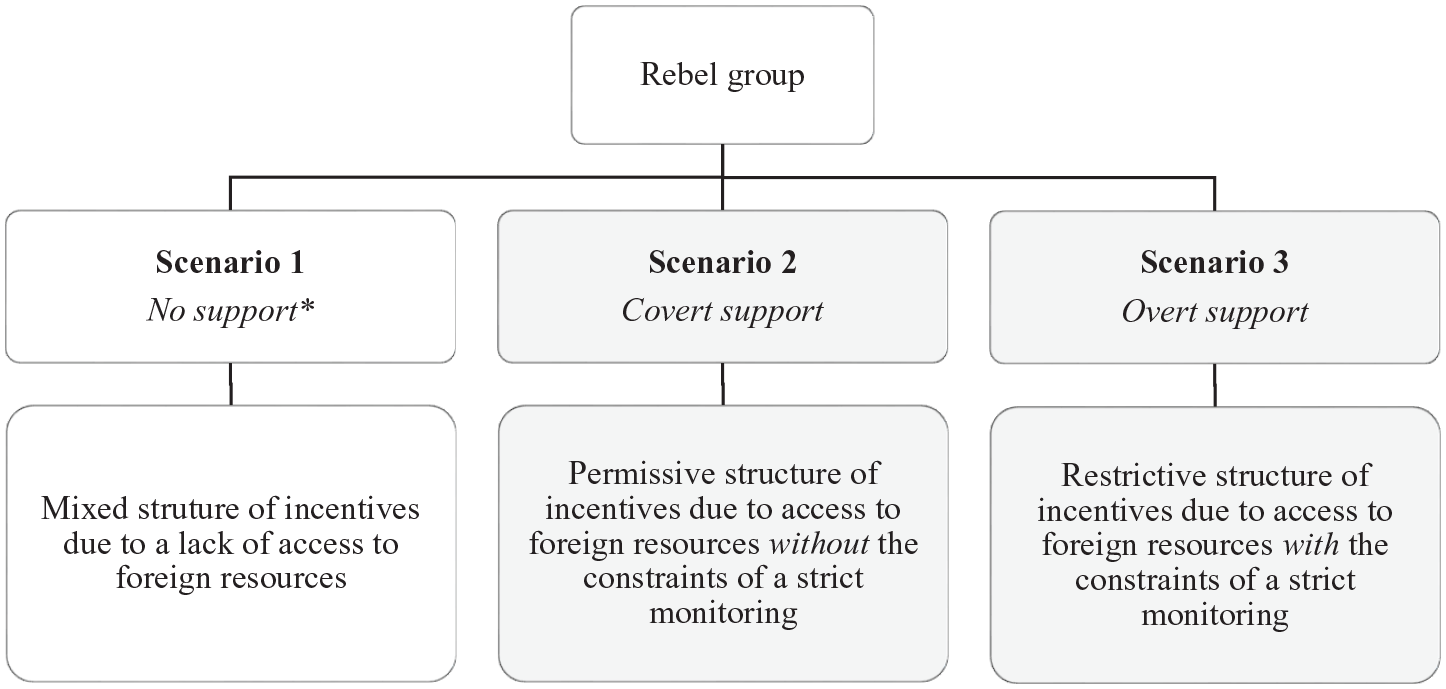
Support overtness and rebels’ strategic incentives in civil wars.
Salehyan et al.’s study (2014) has previously demonstrated that, on average, rebels not being supported—those in Scenario 1—are less likely to target civilians than externally supported ones—Scenarios 2 and 3 lumped together. The present study aims at enriching these findings by disaggregating Scenarios 2 and 3. I expect rebels receiving mere covert support to face a permissive incentive structure that allows civilian targeting if deemed necessary for tactical or strategic reasons. The potential benefits of violence can often outweigh the costs for rebels in this situation. Conversely, I expect rebels receiving overt support to face a restrictive structure of incentives regarding civilian targeting. The potential costs of violence can often outweigh the advantages for rebels in this situation. Overall, these theoretical expectations enable me to devise a central testable hypothesis: In the reception period, rebels receiving overt support from foreign states are less involved in civilian targeting than those receiving covert support.
I will verify this hypothesis through sequential statistical analyses. In terms of causality, following Salehyan et al.’s approach (2014), this article suggests that the causal arrow between civilian targeting and support overtness goes both ways. The argument is that “foreign sponsors impose constraints on the behavior of the rebels they support, and that they work hard to select appropriate agents” (Salehyan et al., 2014: 646). Endogeneity is central to the argument, and the objective is to expose a correlational relationship between support overtness and rebels’ propensity to target civilians. As I will be developing in the “Discussion” section, the idea is to show that, whatever their strategic objectives in a conflict, sponsors have a degree of leverage on the extent of civilian targeting by rebels via both selection and monitoring mechanisms.
Research design
Data structure
The large-N analyses used the group-year as a unit of analysis. I used data from the UCDP Dyadic Dataset and the UCDP External Support in Non-State Conflict Dataset to identify all insurgencies active in intrastate conflicts and receiving material support from at least one state between 1989 and 2018 (Högbladh et al., 2011; Pettersson and Öberg, 2020). 20
To increase the validity of the statistical results, I excluded “alleged” cases of external support from my observations. This exclusion is a limitation, as this might exclude cases of highly concealed sponsorships not sufficiently documented. This issue of false negatives can cause an overestimation of a negative correlation between overtness and civilian targeting. Unrevealed covert actions likely mainly occur in conflicts experiencing low degrees of targeting because they attract less attention from scholars, non-governmental organizations (NGOs), international organizations, or journalists than conflicts experiencing high degrees of victimization. To limit the risk of excluding false negatives, I reproduced my models with all known alleged support cases in the Supplemental Appendix (Models A). I also run models comparing all groups independently from whether they are externally supported or not during a given year in the Supplemental Appendix (Models B).
The monadic data structure excluding alleged cases yielded 452 observations. 21
Explanatory variables
Each observation was matched with two explanatory variables. 22 First, Overtness Dummy was a binary variable coded as “1” if a group received public support from at least one state during the covered year, “0” if all the support received was covert. Again, as there is a risk that the study has excluded false negatives, the number “0” was likely underestimated. Second, Overtness Continuum was a categorical variable coded as “1” if a group’s sponsors all denied providing support; “2” if at least one of a group’s sponsors did not deny providing its support, and if none of the sponsors publicly displayed or stated their support; “3” if at least one of a group’s sponsors publicly displayed its support and if none of the sponsors publicly stated their support; and “4” if at least one of group’s sponsors stated its support publicly. 23
Dependent variables
I then matched the explanatory variables with two dependent variables coded with the help of the UCDP One-sided Violence Dataset (Pettersson and Öberg, 2020). 24 First, to account for the occurrence of civilian targeting, Civilian Fatalities Dummy was a binary variable coded as “1” if a rebel group killed ten or more civilians in a given year, “0” otherwise. Here, the threshold of 10 was associated with rebel restraint. 25 Below this level of violence, it is doubtful that sponsors would alter their strategies in a given conflict. Second, to account for the intensity of civilian targeting, Civilian Fatalities Count was a count variable corresponding to the best estimate of the number of civilians killed by a rebel group in a given year. To assess the robustness of the results, I reproduced my statistical models in the Supplemental Appendix (Models C) using the number of deadly events of terrorism attributed to a rebel group in a year (Fortna et al., 2020).
Control variables
I controlled for several variables that may influence the link between support overtness and civilian targeting in civil wars. At the group level, I first included a dummy variable to specify whether a group had a Religious Affinity with its sponsor (Braithwaite and Cunningham, 2020; Brown, 2016; Stein and Cantin, 2021). As mentioned above, kinship can encourage a state to support rebels overtly, especially if such aid is popular among its domestic constituency (San-Akca, 2016). At the same time, religious ideologies can influence the way insurgents use coercion toward civilians (Isaacs, 2016). I then accounted for a group’s degree of Territorial Control (Cunningham et al., 2013). Holding large swaths of territories can demonstrate a group’s credibility and attract overt support from sponsors (Salehyan et al., 2011). At the same time, previous studies have extensively demonstrated that control patterns affect civilian targeting (Kalyvas, 2006; Stewart and Liou, 2017). I also considered the type of support provided to rebels (Högbladh et al., 2011). Providing Troops or Sanctuary is less likely to be done covertly than providing fungible resources such as money or weapons. In addition, having troops on the ground can enable a sponsor to monitor insurgents more strictly than if they solely provide material resources, therefore bearing on civilian targeting. 26 Rebels having access to sanctuaries abroad are known for being more violent toward civilians (Stewart and Liou, 2017). I also controlled for the fact that a group is supported by Democratic Supporters, using sponsors’ Polity Scores (Marshall and Gurr, 2020). 27 While the sponsors’ political regime can influence the overtness of the support—established democracies with robust institutional control over foreign policy are required to be more transparent about their actions abroad than non-democracies (Norrevik and Sarwari, 2021)—liberal democracies will likely be willing to monitor rebel behaviors more strictly than illiberal political regimes (Salehyan et al., 2014). I also controlled for the sponsors’ Reliance on Foreign Aid (Edgell, 2017). 28 States heavily relying on foreign aid are likely to be more sensitive to potential material costs associated with support to violent rebels, influencing both their propensity to opt for overtness in a conflict and the way they subsequently monitor rebel behavior.
Second, at the conflict level, I controlled for the Number of rebel groups operating in a given conflict (Pettersson et al., 2019). A high number of groups can encourage a state to intervene by supporting its favored group overtly (Byman, 2013). In parallel, the prevalence of civilian targeting increases in line with the number of rivals against which rebels compete (Cunningham et al., 2012; Wood and Kathman, 2015). I also added a variable Government Victimization Dummy coded as “1” if the incumbent killed more than 10 civilians in a given year, “0” otherwise (Pettersson et al., 2019). Intense repression can push a sponsor to endorse a rebel group to defeat the government overtly, but regime violence may also be “successful in deterring civilians from lending support to rebels,” causing the latter to increase their attacks against the population (Ottmann, 2017: 38). Moreover, I controlled for the Intensity of conflicts (Pettersson and Öberg, 2020). High-intensity civil wars certainly attract more attention from potential sponsors (Salehyan et al., 2011). At the same time, insurgents are more likely to brutally extract resources from civilians when conflicts escalate (Downes, 2008).
Third, at the state level, I included variables related to the presence of Lootable Resources in rebel areas; oil (Päivi Lujala, Ketil Rod, and Thieme, 2007), gemstones (Gilmore et al., 2005; Paivi Lujala, 2009), and drugs (Buhaug and Lujala, 2005). While these resources can motivate a state to aid insurgents with whom it can collaborate (Findley and Marineau, 2015), a significant strand of research has linked insurgent access to those resources with violence toward civilians (Staniland, 2012; Weinstein, 2006). Table 1 displays statistics for all variables. 29
Descriptive statistics.
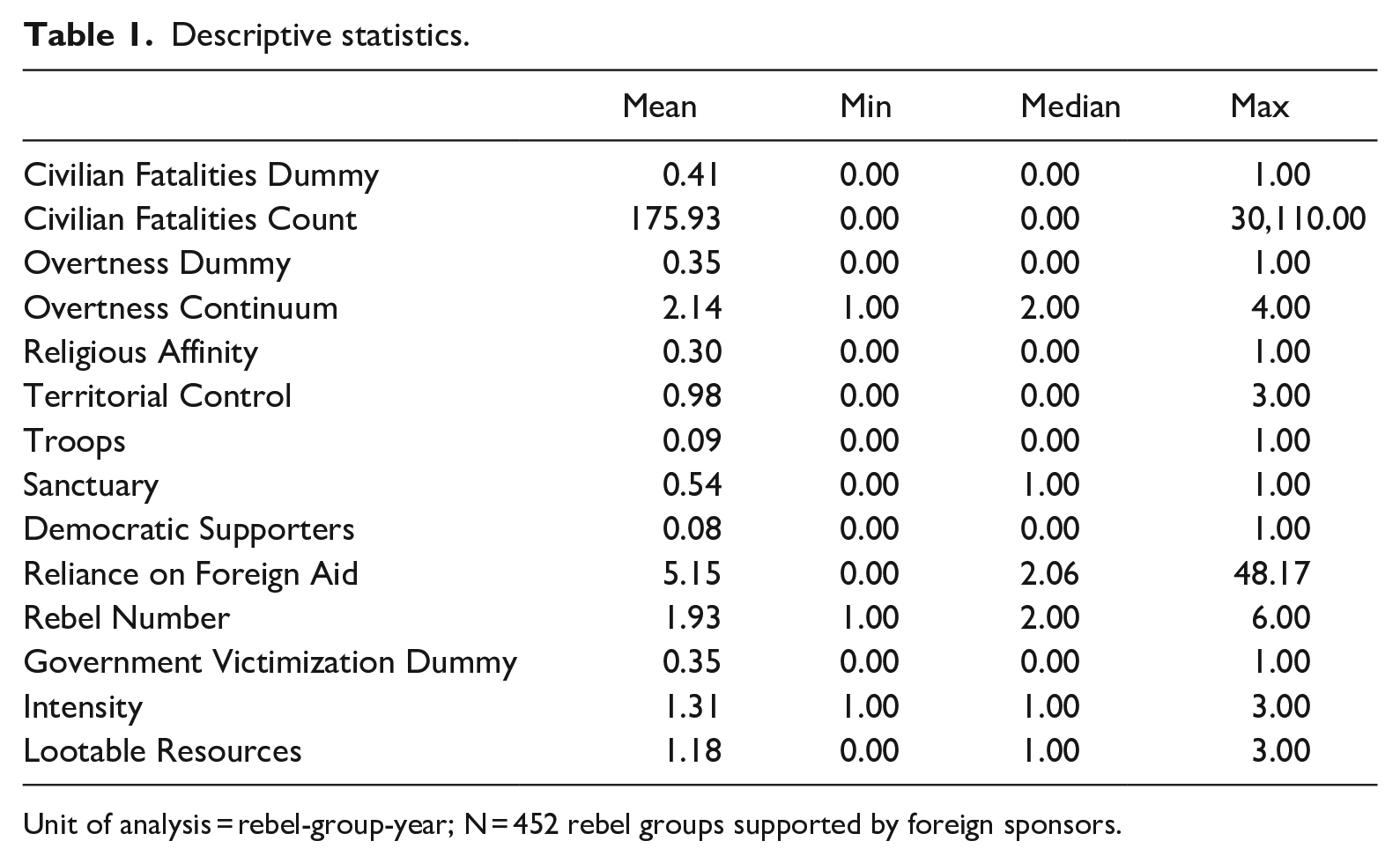
Unit of analysis = rebel-group-year; N = 452 rebel groups supported by foreign sponsors.
Results
General results
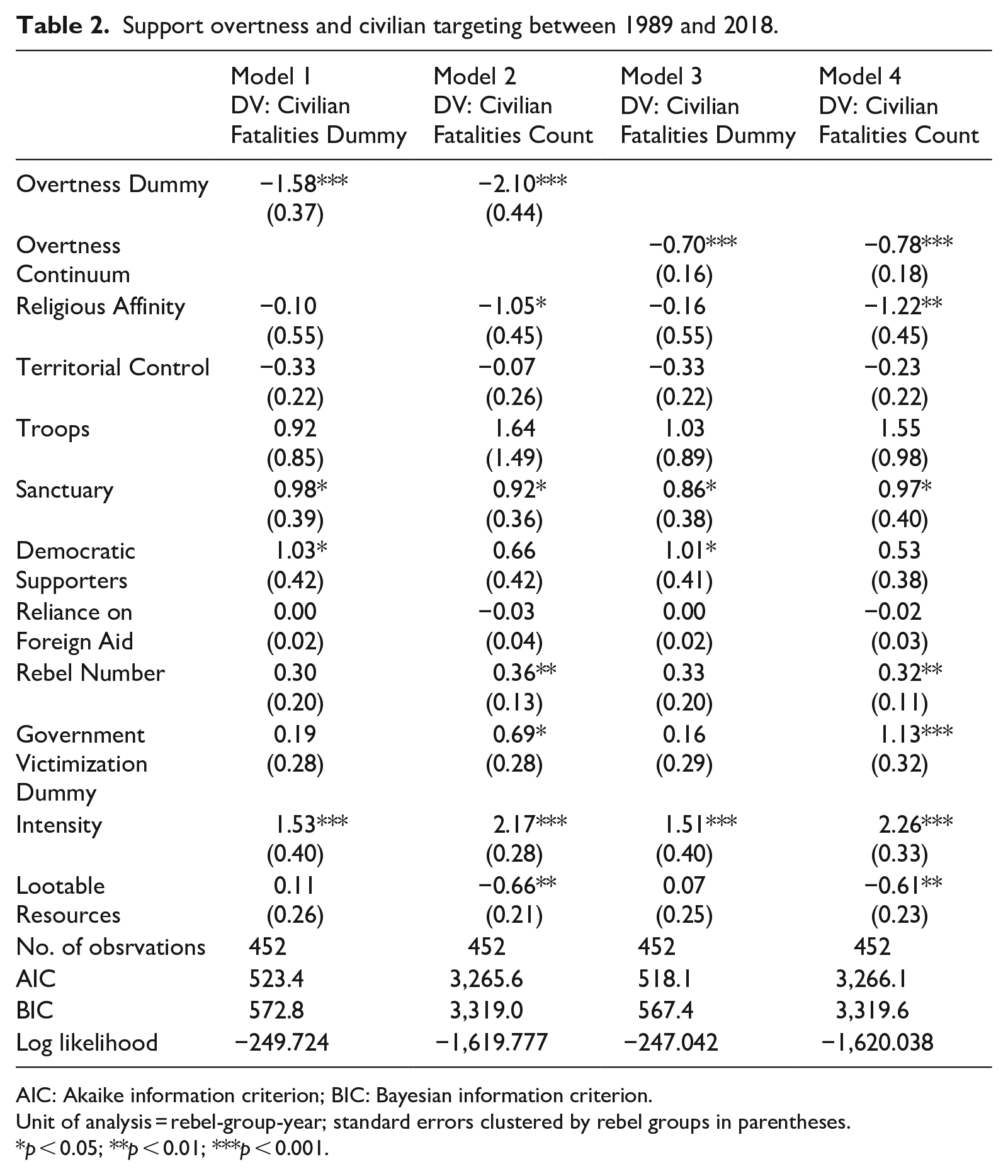
I ran four statistical models to test my argument linking support overtness to the prevalence of civilian targeting. Model 1 used Overtness Dummy as the explanatory variable and Civilian Fatalities Dummy as the dependent variable. Model 2 used Overtness Dummy as the explanatory variable and Civilian Fatalities Count as the dependent variable. Model 3 used Overtness Continuum as the explanatory variable and Civilian Fatalities Dummy as the dependent variable. Finally, Model 4 used Overtness Continuum as the explanatory variable and Civilian Fatalities Count as the dependent variable. I used logit models for the binary dependent variable and negative binomial models for the count dependent variable. 30 Table 2 outlines statistical results.
Support overtness and civilian targeting between 1989 and 2018.
AIC: Akaike information criterion; BIC: Bayesian information criterion.
Unit of analysis = rebel-group-year; standard errors clustered by rebel groups in parentheses.
p < 0.05; **p < 0.01; ***p < 0.001.
All coefficients correspond to the expected change of Civilian Fatalities Dummy, or to the log of Civilian Fatalities Count, for a unit change in the explanatory variable, given the other variables are held constant. The estimates for Overtness Dummy and Overtness Continuum are robust at the p < 0.001 level, indicating negative and statistically significant correlations between support overtness and civilian targeting by rebels in civil wars. Figures 8 and 9 use estimates from Models 1 and 3 to present the predicted values for Civilian Fatalities Dummy based on changes in the variable Overtness Dummy and Overtness Continuum. Confidence intervals are exposed at the 0.95 level. All continuous control variables are set to their means, and all binary variables are set to their base level.
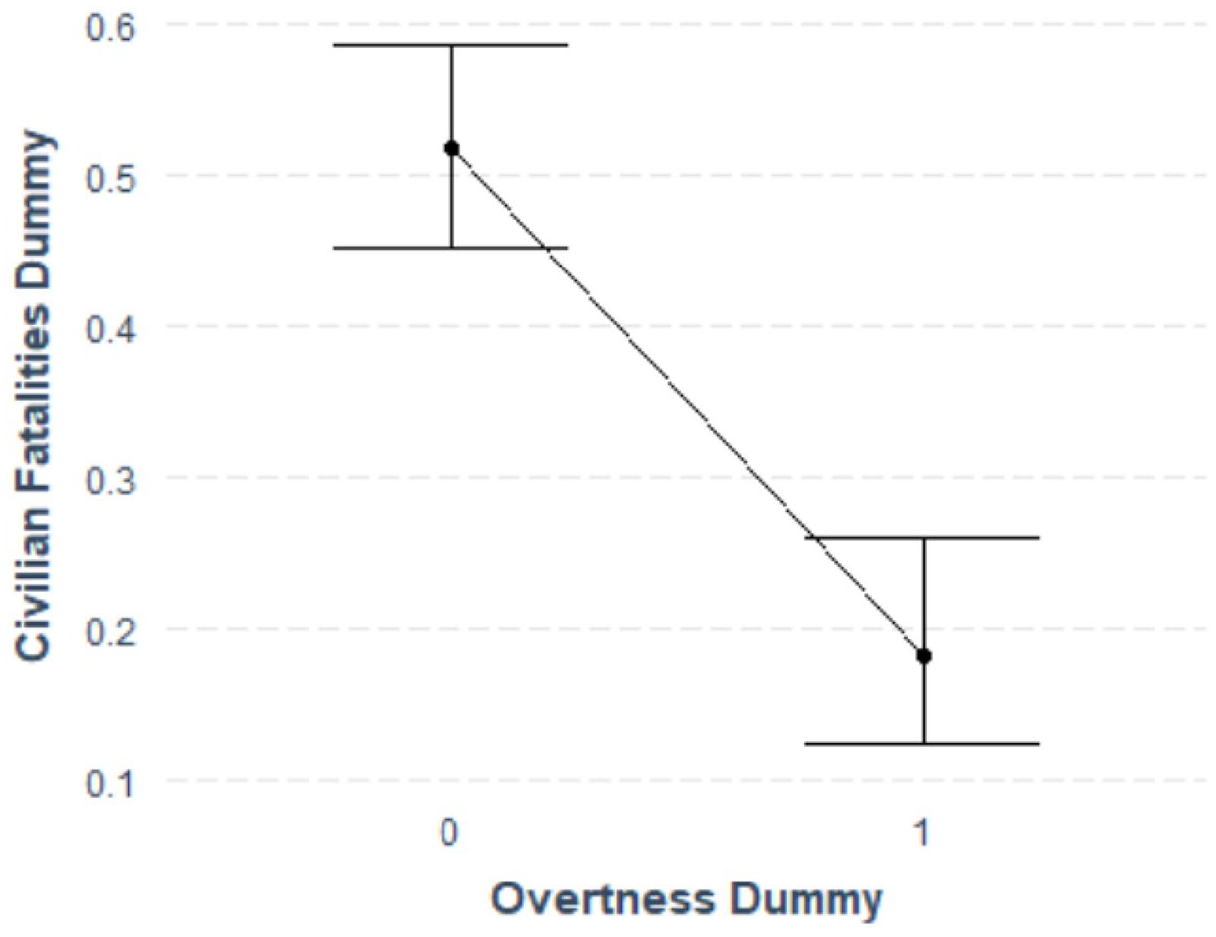
Predicted civilian fatalities—dummy.
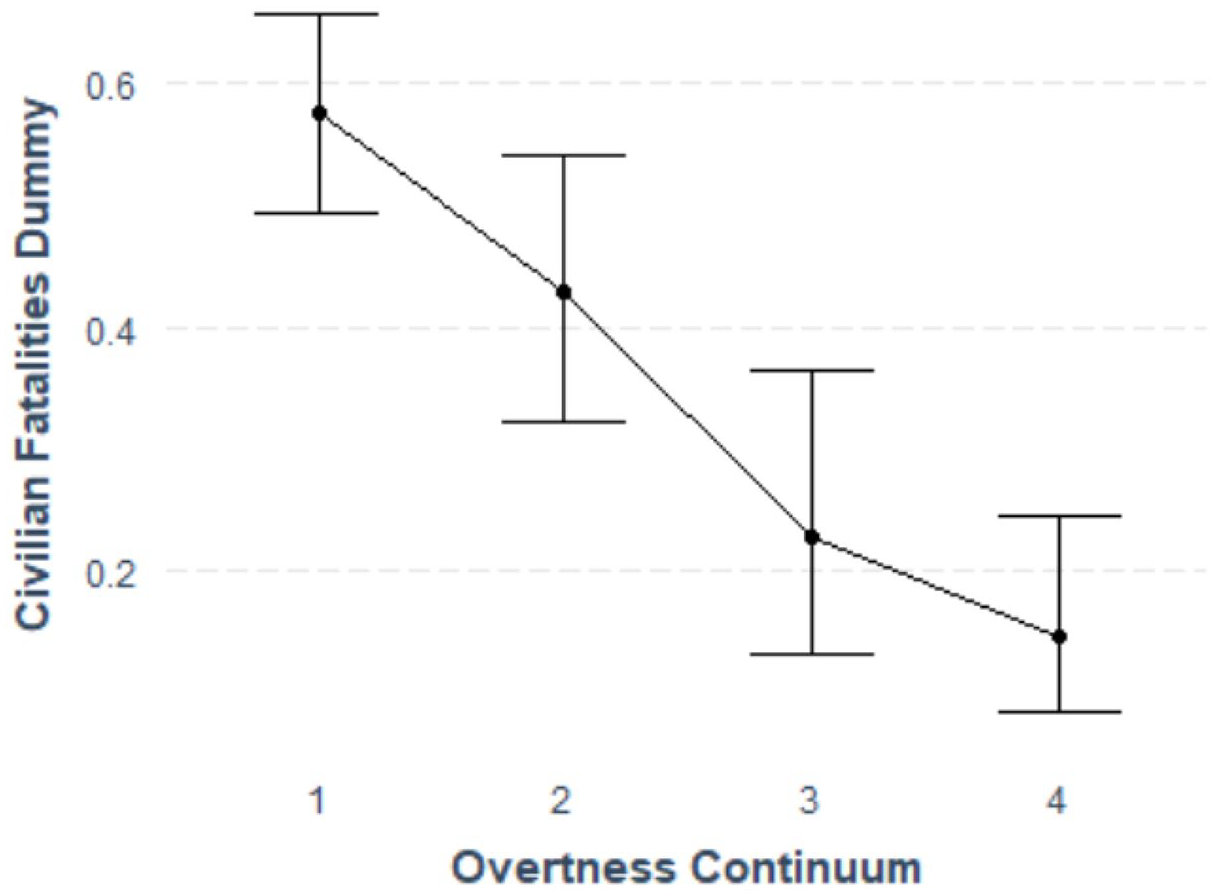
Predicted civilian fatalities—continuum.
Both Figures 8 and 9 indicate that the likeliness that rebels use restraint toward civilians correlates with the degree of overtness of the support they receive from abroad. The more overt the support, the less it appears likely that rebels will widely target civilians.
Further analyses
At this point, one remaining question is whether sponsors’ characteristics influence the extent to which overtness is correlated with civilian targeting by rebels. As mentioned above, two determinants related to the nature of sponsors could interact with support overtness and influence civilian targeting. First, Salehyan et al. (2014) demonstrated that sponsors’ political regimes could affect their willingness to monitor rebel behavior. When providing support overtly, democratic states could be willing to control rebel behaviors more strictly than non-democratic sponsors, which are less exposed and/or sensitive to pressures from human rights organizations. Second, due to a higher sensitivity to material costs associated with support provided to violent rebels, states relying on foreign aid to operate could also be more likely to exert robust monitoring on rebels when they overtly support them.
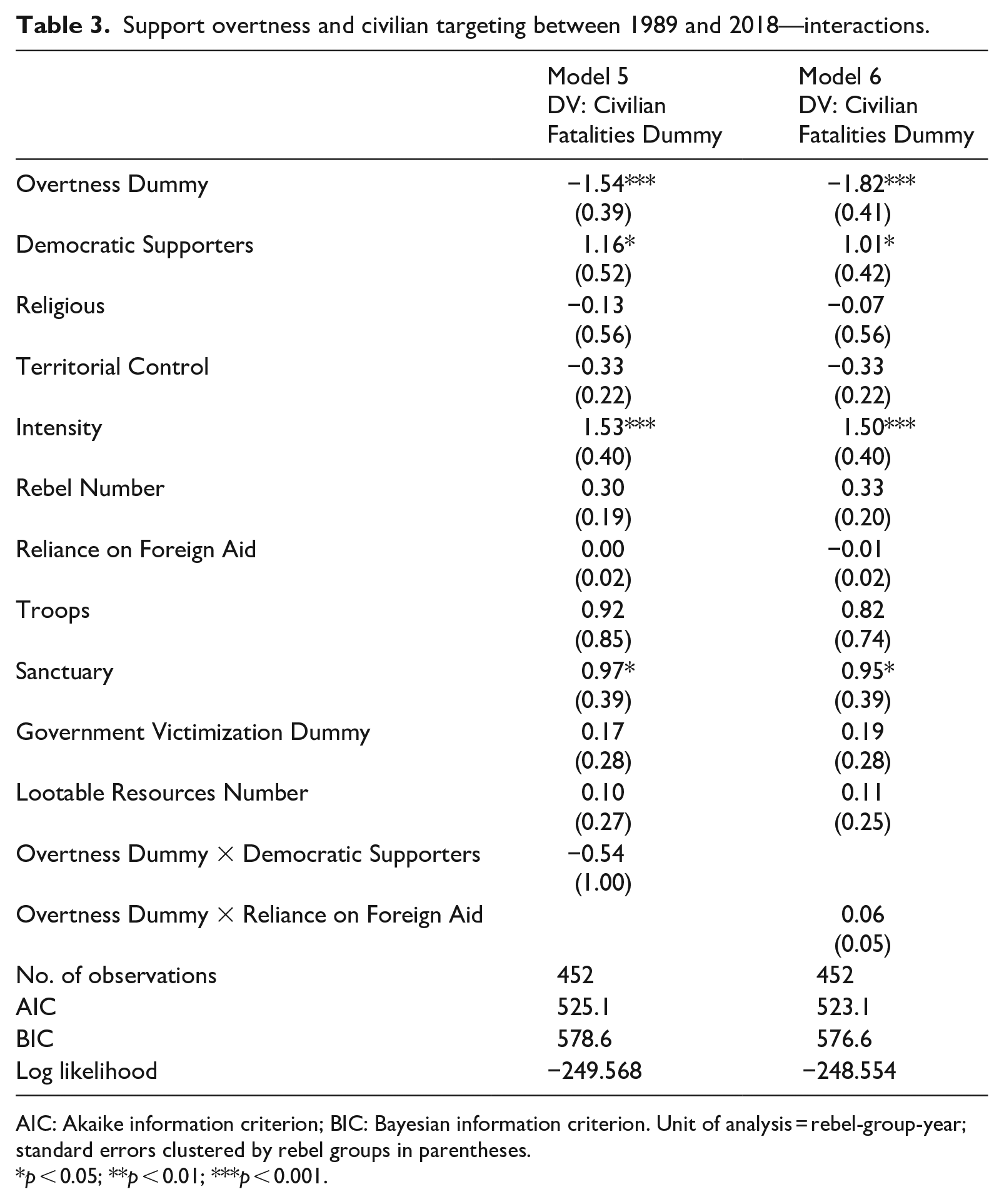
To assess the specific influence of sponsors’ regimes and reliance on foreign aid in the relationship between overtness and civilian targeting, I reran Model 1 to include an interaction term between Overtness Dummy and Democratic Supporters for Model 5 and Reliance on Foreign Aid for Model 6. The results outlined in Table 3 are plotted in Figures 10 and 11.
Support overtness and civilian targeting between 1989 and 2018—interactions.
AIC: Akaike information criterion; BIC: Bayesian information criterion. Unit of analysis = rebel-group-year; standard errors clustered by rebel groups in parentheses.
p < 0.05; **p < 0.01; ***p < 0.001.
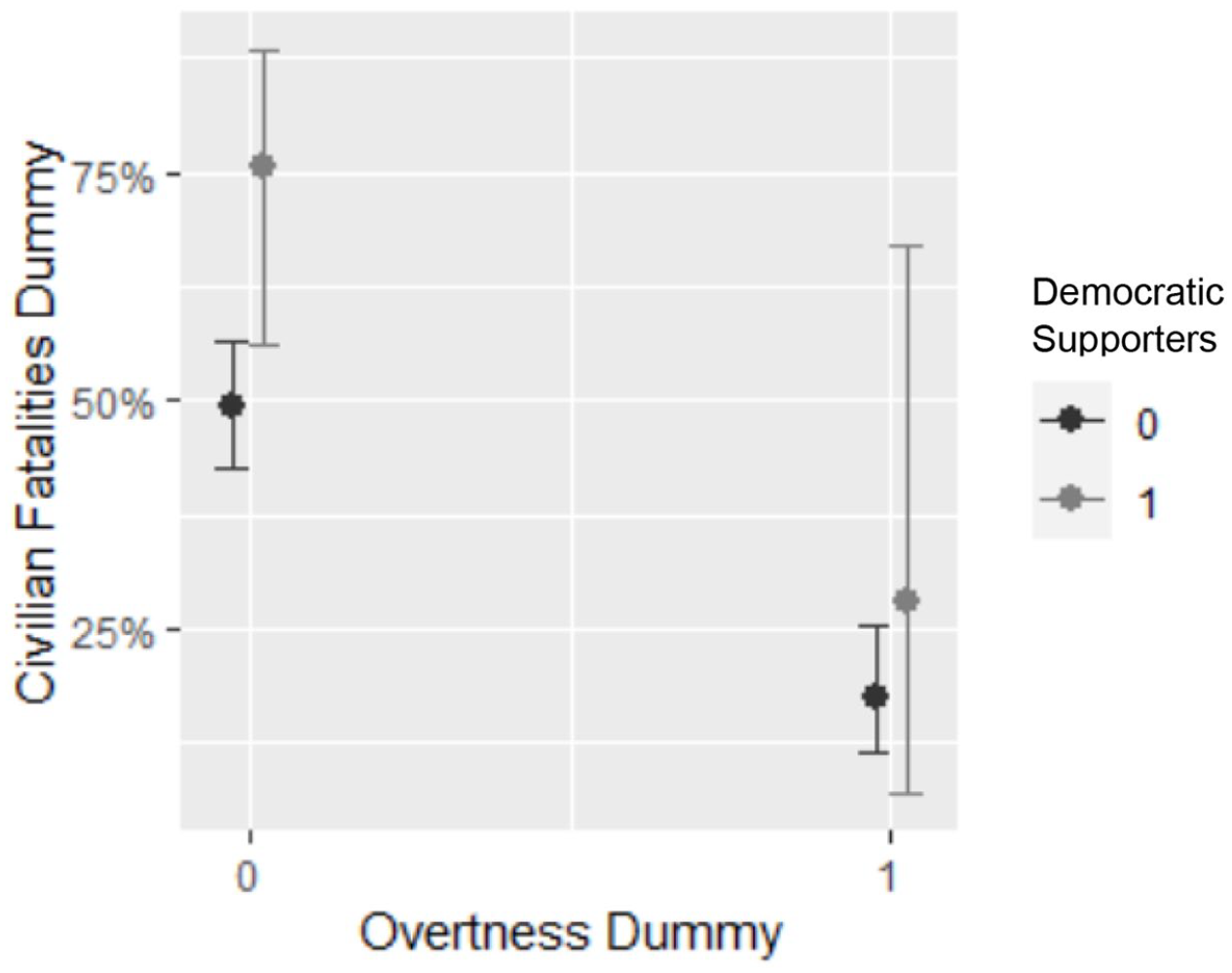
Predicted civilian fatalities—interaction—democratic supporters.
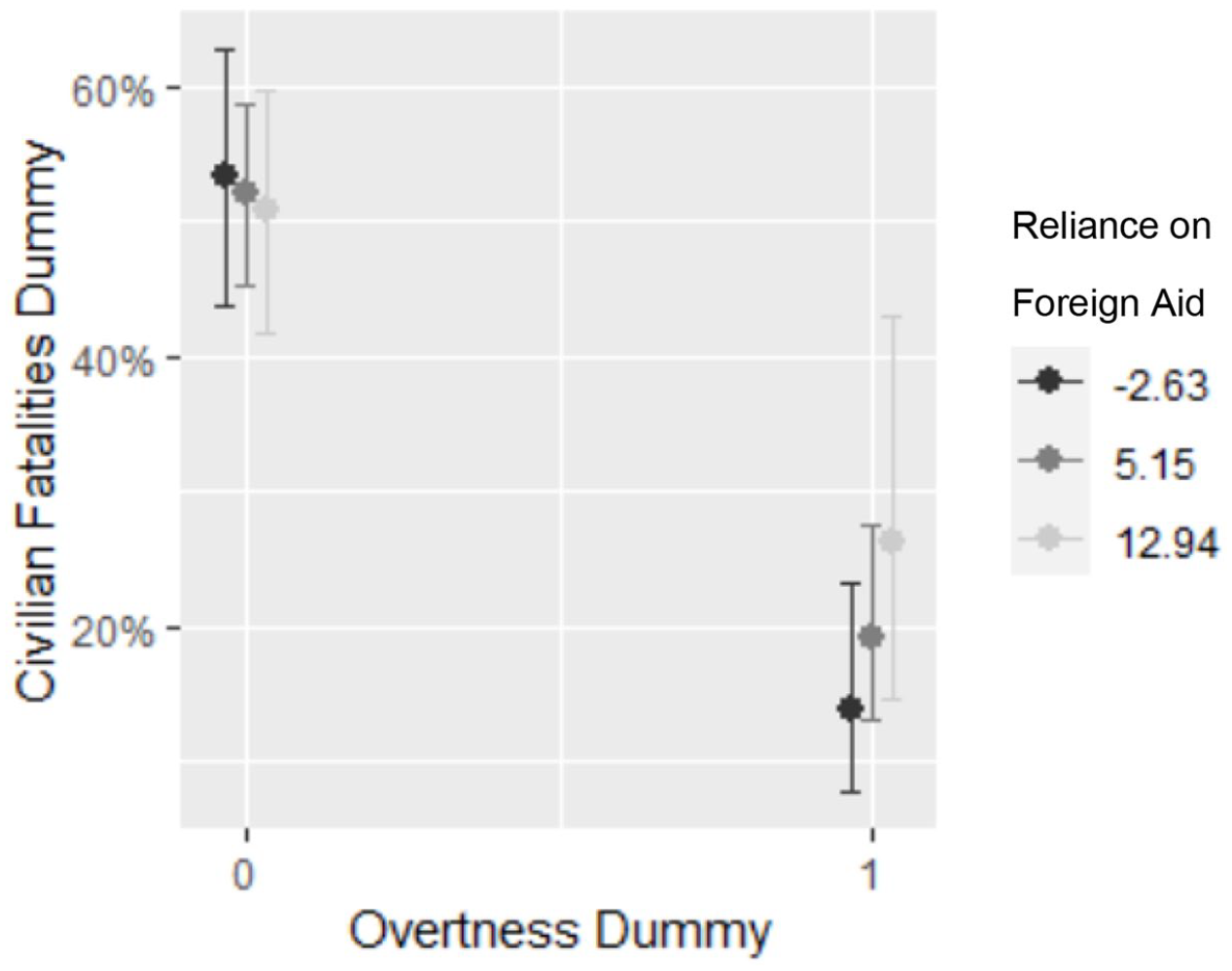
Predicted civilian fatalities—interaction—reliance on foreign aid.
The interaction between Overtness Dummy and Democratic Supporters is not statistically significant in Model 5. The coefficients of Overtness Dummy remain broadly similar to previous models. Empirically, this means that overtness is correlated with civilian targeting independently from sponsors’ regime type. Counterintuitively, Figure 10 shows that rebels receiving covert support from democratic sponsors appear more likely to target civilians than rebels receiving covert support from non-democratic supporters. 31 These interesting findings could be explored further in future research. The interaction term between Overtness Dummy and Reliance on Foreign Aid is not statistically significant in Model 6. The coefficient of Overtness Dummy alone stays significant and is higher than in Model 1. Figure 11 further shows the uncertain influence of sponsors’ reliance on foreign aid on civilian targeting. Empirically, this means that the correlation between overtness and civilian targeting is not dependent on sponsors’ dependence on foreign funds.
Discussion
The results contribute to the literature on rebel sponsorship and civilian targeting, indicating that support overtness is central to understanding violence toward non-combatants. Overtness can be a moderating factor in the positive relationship between sponsorship and civilian targeting. The implications stemming from these results are critical at a time when sponsorship is increasingly perceived as a substitute to direct military interventions abroad (Mumford, 2013). First, while a strand of research using principal–agent theories assumes moral hazards in the sponsor–rebel relationship (Popovic, 2017; Salehyan, 2010), the findings suggest that sponsors have leeway in dealing with rebels’ propensity to use violence. By publicly recognizing the provision of support, states appear to gain leverage on rebels’ conduct. As long as support is overt, rebels face strong incentives to abide by their sponsors’ will and refrain from violence. As such, sponsorship does not ineluctably promote civilian targeting. Whether through denunciations and/or sanctions by other states or via non-governmental campaigns of “naming-and-shaming” (DeMeritt, 2012; Krain, 2012), sponsors can and should be held accountable for the behavior of their rebel allies.
Second, qualifying previous arguments (Salehyan et al., 2014; Weinstein, 2006), the findings show that rebel capabilities do not entirely explain patterns of insurgent violence against civilians. Although overtness is expectedly associated with the provision of more and higher quality resources than covertness (Carson, 2020), it is statistically associated with less violence toward non-combatants. These results corroborate recent findings from Huang and Sullivan (2020) that associate rebel sponsorship with the development of mutually beneficial relationships between insurgents and civilians.
Finally, the findings indicate that restraint can be a particularly fruitful strategy for rebels. Restraints will likely offer rebels more overt support from outside, with all the symbolic and material advantages that overtness provides. These findings resonate with Stanton’s results (2020), which show that rebels who refrain from targeting civilians are more likely to secure favorable outcomes in civil wars due to increased access to resources from foreign sources.
Conclusion
This article reassessed the impact of insurgent sponsorship on rebel behaviors in civil wars by examining whether support overtness influences the rebels’ propensity to target civilians. My theoretical expectations were that rebels overtly supported are less likely to victimize civilians than those receiving covert support from foreign sponsors. This expectation arose from the way sponsors expectedly act once they have allocated their material support expectedly determine subsequent rebels’ structure of incentives regarding civilian targeting. Statistical analysis using a new dataset on support overtness yielded results robustly supporting this rationale. Thus, rebel violence is not only linked with the type of material aid provided to rebels (Sawyer et al., 2015). It also correlates with the form of support that is provided.
From a policy point of view, the central implication concerns the responsibility held by sponsors regarding rebels’ conduct in civil wars. As previously argued by Landau-Wells (2018), publicly endorsing rebels is a robust normative commitment that has concrete implications in conflict zones. As violence in civil wars affects the livelihoods of the civilian population for several decades following a conflict (Deglow, 2016; Rivera, 2016), sponsors should use all the leverage they can gain through overtness to ensure that rebels abide by the standards of civilian protection.
For future research, microlevel studies could help reach a more in-depth understanding of the relationship between overtness and insurgent behavior. Tracing the causal processes altering insurgents’ strategic incentives amidst the “noise” of civil wars will be necessary to move from aggregated correlations to a more fine-grained understanding of the phenomenon. Interviews with rebel leaders could help us map out the strategic calculations during conflicts. In addition, it would be necessary to study how overtness bears on the sociopsychological dispositions of rank-and-file rebel combatants. External actors’ overt endorsement may drastically influence group members’ self-representations and social identities. Naturally, this may also affect their wartime behavior. Finally, the findings raise questions that resonate with the current debates around “post-truth politics” (Adler and Drieschova, 2021; Crilley, 2018). As states “control over both information collection and the disclosure decision” is likely to decrease in the coming years (Lin-Greenberg and Milonopoulos, 2021: 5), it appears crucial to study how the truthfulness of discourses in international politics may have concrete implications on the battlefields in civil wars.
Supplemental Material
sj-DO-1-ejt-10.1177_13540661221084870 – Supplemental material for Committed sponsors: external support overtness and civilian targeting in civil wars
Supplemental material, sj-DO-1-ejt-10.1177_13540661221084870 for Committed sponsors: external support overtness and civilian targeting in civil wars by Arthur Stein in European Journal of International Relations
Supplemental Material
sj-docx-1-ejt-10.1177_13540661221084870 – Supplemental material for Committed sponsors: external support overtness and civilian targeting in civil wars
Supplemental material, sj-docx-1-ejt-10.1177_13540661221084870 for Committed sponsors: external support overtness and civilian targeting in civil wars by Arthur Stein in European Journal of International Relations
Supplemental Material
sj-xlsx-1-ejt-10.1177_13540661221084870 – Supplemental material for Committed sponsors: external support overtness and civilian targeting in civil wars
Supplemental material, sj-xlsx-1-ejt-10.1177_13540661221084870 for Committed sponsors: external support overtness and civilian targeting in civil wars by Arthur Stein in European Journal of International Relations
Footnotes

References
Supplementary Material
Please find the following supplemental material available below.
For Open Access articles published under a Creative Commons License, all supplemental material carries the same license as the article it is associated with.
For non-Open Access articles published, all supplemental material carries a non-exclusive license, and permission requests for re-use of supplemental material or any part of supplemental material shall be sent directly to the copyright owner as specified in the copyright notice associated with the article.
