Abstract
How does diaspora sponsorship of rebel organizations impact civilian victimization? This article argues that diasporas have an affinity for their kin and therefore, an interest in civilian protection. By applying a principal–agent framework to understand diaspora sponsorship to rebel organizations, it highlights how a diaspora, acting as a principal, can reduce violence against civilians perpetrated by a rebel organization, the agent. While rebel organizations may utilize civilian victimization, this article hypothesizes that they restrain violence because of diaspora sponsorship. The article draws on novel data on diaspora support, coupled with data on civilian victimization in the context of armed conflicts in Africa and Asia from 1989 to 2014. The findings demonstrate a statistically significant negative effect of diaspora sponsorship on rebel groups’ violence against civilians. Homeland-related factors reveal heterogeneous effects of diaspora sponsorship on one-sided violence. The article generates an in-depth understanding of a diaspora’s agency as a non-state sponsor for rebel organizations and contributes to the scholarship on civilian victimization during armed conflicts and external sponsorship. It offers avenues for understanding the role of diaspora groups as sponsors.
Introduction
Civilian victimization is arguably the most devastating consequence of armed conflict (Balcells and Stanton, 2020). Recent research highlights the international dimension of these conflicts. Specifically, external sponsorship of warring parties is often associated with an increase in violence, as domestic civilian support is substituted by financial, material or other support from external states (Salehyan et al., 2014; Wood et al., 2012).
However, states are not the sole actors providing external support in armed conflicts. Indeed, rebel organizations like the Sri Lankan Liberation Tigers of Tamil Eelam (LTTE), and the Afar Revolutionary Democratic Union, have benefited from large-scale financial and political support by the Tamil and Afar diasporas, respectively (Byman et al., 2001: 50). More systematically, 64 out of 226 rebel organizations involved in intrastate conflicts in Africa and Asia between 1989 and 2014 received diaspora sponsorship. 1
Diasporas reside outside their country of origin but maintain ties to civilians in the homeland, especially co-ethnics. While extant research on the role of non-state actors in understanding conflict onset or peace processes exists (Smith, 2007), less is known about their impact on civilian victimization. Notably, diaspora sponsorship of warring parties is often neglected, lacking theoretical and empirical analysis. Meanwhile, migration is at a record high (International Organization for Migration (IOM), 2024). Consequently, further investigations into the involvement of diasporas during intrastate conflicts, especially their role as sponsors, is warranted to better understand the dynamics of ongoing conflicts. To shed light on diaspora support and rebel organizations’ behavior towards civilians during conflict, this article addresses the research question: How does diaspora sponsorship of rebel organizations impact civilian victimization?
To answer the research question, I employ a principal–agent framework where the diaspora is the principal who delegates tasks such as fighting against the incumbent government and limiting civilian victimization to the agent. The agent is a rebel organization. Similar to principal–agent frameworks for external state support, preferences between the actors diverge. The rebel organization and diaspora do not necessarily align on limiting civilian victimization given the benefits to rebel groups of, for instance, increased legitimacy, attention, negotiation leverage, or deterrence of collaboration. However, gaining additional support is in the interest of the rebel group unless it compromises a minimally acceptable degree of autonomy. The diaspora decides whether to support a rebel organization, while the rebel organization chooses whether to limit violence against civilians who are non-combatants.
Monitoring from afar is costly and difficult for the diaspora. Therefore, I focus on indirect control as a mechanism. I borrow McCubbins and Schwartz’s (1984) concept of a fire-alarm, transferring it to the context of conflicts.
The fire-alarm describes a third-party informing the principal about (mis-)behavior by the agent. In the diaspora–rebel relationship, the fire-alarm functions as an information-sharing mechanism: co-ethnic civilians in the homeland inform the diaspora about the rebel organization’s behavior, thus alerting the diaspora to potential agency slack. Agency slack refers to a rebel group’s behavior that deviates from the tasks delegated by the diaspora.
Examples of this information-sharing are members of the Filipino or Nigerian diasporas in the United States who maintain regular contact with members of the Filipino or Nigerian population in the homeland through various messenger channels and consumption of different news outlets, including homeland media. Modern technology and communication channels, such as virtual platforms or messenger apps, facilitate these exchanges (Brinkerhoff, 2009; Dufoix, 2008: 98).
Empirically, I focus on diaspora groups residing in the United States because the United States is the primary destination for migrants (IOM, 2021: 9). It is reasonable to assume that the largest share of diaspora groups exists in the United States, making it the most viable focus area given the limitations of existing data. This also serves as a testing ground for democratic countries, for instance, in Europe that host various diaspora groups. Choosing the United States also illustrate the uniqueness of a diaspora compared to neighboring conflict countries, which may include a mix of transborder ethnic kin and diaspora communities, blurring the distinction between transborder ethnic kin and a diaspora group.
Conducting a large-N analysis, I find that diasporas supporting a rebel organization with financial, material, or political means during an intrastate conflict decrease civilian casualties by rebels. However, this relationship does not occur in a vacuum. Consequently, I investigate conditions under which the effect of the information-sharing mechanism may be influenced by varying homeland characteristics. The most pronounced negative effect on violence against civilians occurs when diaspora sponsorship is paired with the presence of discriminated co-ethnics in the homeland.
This article provides several contributions. First, it introduces a new perspective on the role of diasporas as external actors in intrastate conflicts and their potential to restrain rebel behavior concerning civilian harm. It employs an information-sharing mechanism between the diaspora and co-ethnic civilians in the homeland, underscoring transnational ethnic ties. Second, by investigating potential modifiers of information-sharing related to the homeland, the article shows the nuances of diaspora–rebel group relationships during civil wars. Thirdly, the novel data presented opens avenues for future research. Overall, this article deepens the understanding of diasporas as a distinct type of sponsor, emphasizing their violence-reducing effect with implications for civilian well-being in conflict zones and policies concerning the monitoring of diaspora support and responsibilities of host countries.
Civilian victimization, external sponsorship, and diaspora
Determinants of civilian victimization are manifold and include factors such as political education (Oppenheim and Weintraub, 2017), ideology (Thaler, 2012), group structure (Haer, 2015), external support and alternative resources (Salehyan et al., 2014; Weinstein, 2007; Wood, 2014b).
While a large and growing literature examines state sponsorship to states or non-state actors (Byman et al., 2001; Karlén and Rauta, 2021; Moghadam and Wyss, 2020), the role of diaspora sponsorship in conflicts remains under-researched. Diaspora communities’ involvement in intrastate conflicts is mainly focused on either contributing to or opposing peace (Smith and Stares, 2007). Analyses of diaspora sponsorship for rebel groups either focus on the diaspora’s degree of integration in the host country and its influence on motivation and capacity to mobilize (Bird, 2023) or the impact on a rebel group’s switch to nonviolent actions in contrast to state support (Petrova, 2019: 2171). While diasporas can have a stake in civil wars, their impact on civilian victimization during conflict remains subject to further research.
Scholarship on diaspora sponsorship for rebel organizations and its impact on civilian victimization is limited. Asal and Ayres (2018) find that violence against civilians by ethno-political organizations increases diaspora support due to the increased visibility of the organization and a hawkish diaspora. 2 However, research is either restricted to a specific geographical scope, such as the Middle East (Asal and Ayres, 2018), or to particular case studies (Adamson, 2013). Other studies focus on a segment of the diaspora, like religious diaspora–rebel group combinations (Piazza and LaFree, 2019). While a hawkish diaspora fostering violence may exist in some cases, this is often related to attracting attention, thus referring to violent events’ characteristics by terrorist tactics conducted by the organization (Adamson, 2013: 65; Asal and Ayres, 2018).
Lidow’s (2016) case study on Liberia shows that the diaspora can influence rebel groups’ rewards, thereby making violence against civilians less relevant. Furthermore, Piazza and LaFree (2019) demonstrate that Islamist organizations with a diaspora restrain violence compared to non-Islamist organizations. However, it is far from clear whether these findings are externally valid for other regions or types of rebel organizations.
The presence of kin abroad (Piazza and LaFree, 2019) may not necessarily imply diaspora support for a rebel organization. Hence, there is a lack of systematic knowledge about the consequences for civilian victimization given diaspora sponsorship for rebel organization at the large-N level. Additionally, theoretical insights into diasporas’ interests in kin support through delegation is under-studied. While large-N analyses explore external sponsorship, they do not explicitly differentiate diaspora sponsorship from state sponsorship (Meier et al., 2023; Salehyan et al., 2014). This article provides systematic insights by examining the effect of diaspora support on rebel violence against civilians.
What motivates diaspora support?
Diasporas, by definition, are nonviolent groups, unlike non-state armed groups. I argue that external state support and diaspora support are distinct phenomena characterized by unique rationales. They differ with regards to (1) the type of support they provide, with troop support being distinctive for states; (2) the time horizon of the sponsor; (3) the persistence of strategy, which is independent of aspects such as election cycles; (4) the motives of their support; and (5) the possibility of coercion (Daub, 2023: 205).
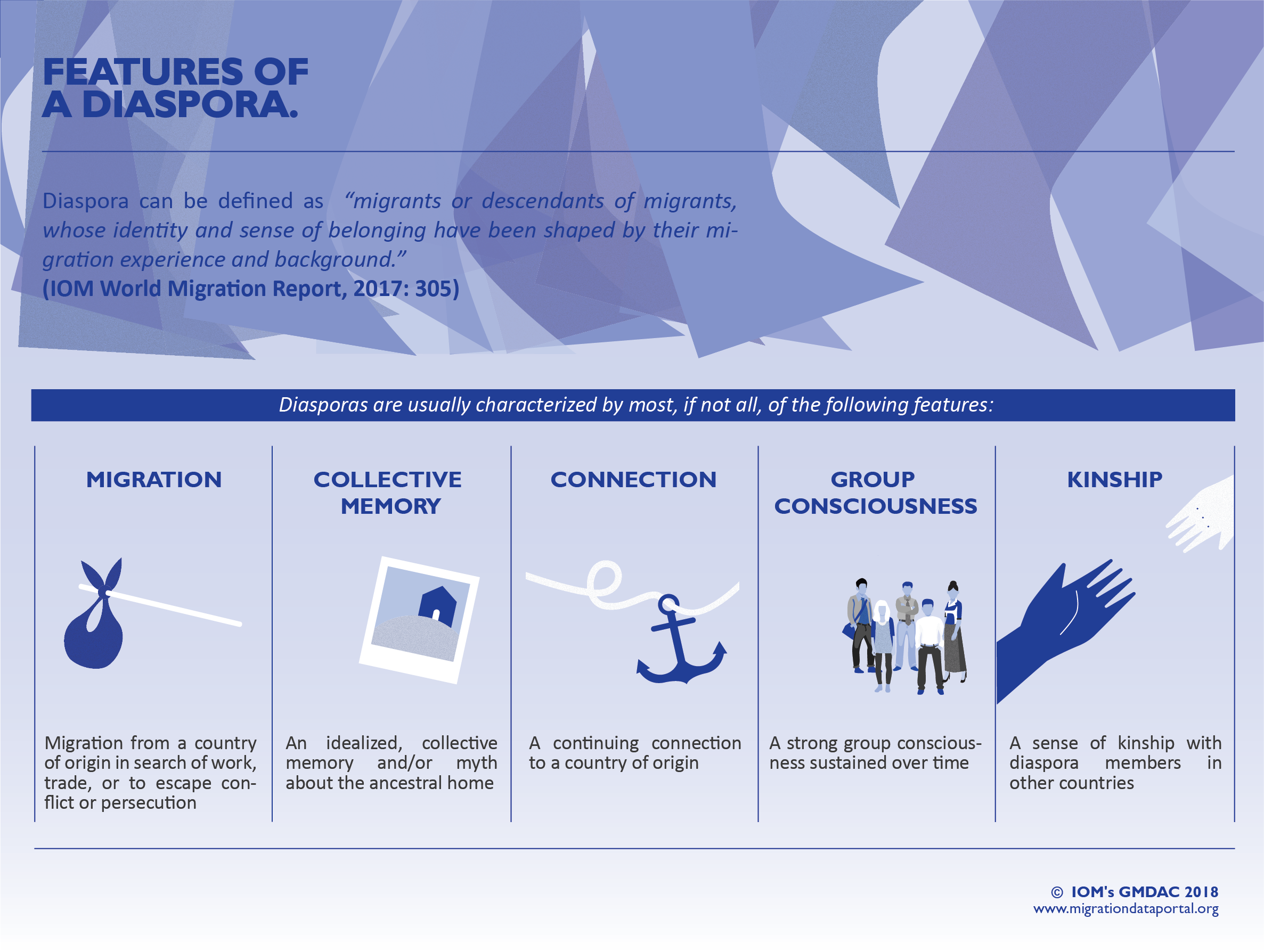
In this article, I define a diaspora as a distinct group characterized by five criteria outlined by the International Organization of Migration’s Global Migration Data Analysis Centre (GMDAC IOM, 2018): diasporas have a migration background, collective memory, a connection to the homeland, group consciousness, and kinship. Members of the diaspora group also have agency (Smith, 2007: 15), implying that ‘diasporas are not merely victims of surrounding circumstances’ (Baser and Toivanen, 2019: 348). Furthermore, the reasons for migration do not need to be linked to conflict onset. For example, economic reasons among the first generation of members of the diaspora can still foster an interest in supporting their kin in context of civil wars. Therefore, the decision to migrate and to sponsor a warring party are not mutually exclusive decisions and can co-exist in the analysis of civilian victimization in conflict dynamics.
The desire to mobilize can be driven by kin and family support and their protection (Van Hear and Cohen, 2017: 174). I argue that kin support is a reason for diaspora support. Kin support refers to support for co-ethnics in the homeland, extending beyond family support. For example, Hockenos (2003) illustrates that the Croatian diaspora in the US was mobilized during the Yugoslavian war from 1990 to 1991 to support their kin.
I consider a mobilized diaspora a precondition for supporting a rebel organization. Following Kopchick et al. (2022: 109), I define mobilization as collective action of a diaspora and its collective participation focusing on the diaspora’s identity and aims. A mobilized diaspora can articulate its aims and act collectively. This is a precondition to provide support to a rebel organization. I define diaspora support as an active element, moving beyond the presence of kin support (cf. Piazza and LaFree, 2019).
Besides collective solidarity, the diaspora may be motivated by perceived obligations and guilt to support their kin (Adamson, 2013: 70; Brinkerhoff, 2009, 2011; Hammond, 2006). Humanitarian reasons can also mobilize the diaspora, as Betts and Jones (2016: 223) show for Rwanda and Zimbabwe. Indeed, members of the diaspora community mobilize for the community in the host country, the kin in the homeland, or both (Müller-Funk, 2019: 254). Kin support may be connected to the diaspora’s aim to re-connect with the homeland, which is not an automatic process (Oonk, 2019: 289). Furthermore, diasporas may strive to gain access to power in the homeland (Anderson, 1999; Dufoix, 2008). By supporting a rebel organization, members of the diaspora retain their ties to the homeland and values, and support the ‘survival of their homeland’ (Bercovitch, 2007: 36). Therefore, policy change in the homeland can be linked to interests of kin support. To summarize, I focus on external diaspora support as one way to achieve the aims of change in the homeland and kin support.
Diaspora support and rebel violence: a principal–agent perspective
I apply a principal–agent (PA) framework to external diaspora support (cf. Lidow, 2016). I acknowledge that multiple factors can influence the effect of diaspora support to rebels on civilian victimization. In line with principal–agent and external state sponsorship literature, I keep all factors constant to examine, ceteris paribus, the relationship between diaspora sponsorship and violence against civilians. Adopting a group-level perspective, I assume homogeneous preferences for all actors involved. 3
The reasoning for applying a PA framework to diaspora support to rebel organizations is multifold. First, the diaspora is a distinct principal given its organizational setup and preferences. Based on the group-level perspective and collective action, I focus on the diaspora as one principal. 4 Variation in the speed and degree of punishment can be influenced by the internal centralization structure of the diaspora, though the possibility to punish still exists in a more decentralized diaspora structure. Consequently, the diaspora is a unique principal with a notable degree of control and insight into the conflict situation on the ground, due to the information-sharing of co-ethnics illustrated by the fire-alarm mechanism.
I argue that the diaspora is a strong principal who can ensure compliance of rebel group behavior to support their kin and limit civilian victimization. Diasporas can influence strategic decisions of rebel organizations, such as shifting towards nonviolent tactics (Petrova, 2019: 2171). For example, the Tamil diaspora influenced the Liberation Tigers of Tamil Eelam (LTTE) (Fair, 2005: 146), by facilitating platforms for human rights advocacy and democratic processes (Orjuela, 2018: 446). While coerced contributions, such as tax by force (Fair, 2005: 141), can limit the power of the diaspora as a principal, examples such as the Tamil, Irish, or Kurdish diasporas show notable voluntary contributions and donations, illustrating the leverage of diasporas (Byman et al., 2001; Fair, 2005). Along these lines, the Tamil diaspora pressured the LTTE to join negotiation efforts and seek a political solution, instead of continuing the insurgency (Fair, 2005: 145).
Whether a diaspora has a central leader who ensures coherent action or is characterized by a decentralized network, it can still support a rebel organization and delegate restraint from civilian victimization. Loidolt et al. (2013: 8) suggest that rebel organizations may find diasporas as sponsors appealing due to their loose organizational structure, which allows for a level of autonomy. This can be classified as a decentralized diaspora, whereas a central leader of a diaspora would be classified as a centralized diaspora. The diaspora can also engage in activities such as political lobbying on behalf of the rebel organization and play a crucial role in legitimizing the rebels. Therefore, the diaspora offers unique possibilities for the rebel organization in comparison to a state sponsor, which the principal–agent relationship can accommodate.
The diaspora, as a principal, decides whether or not to support the rebel organization. Diasporas motivated by kin support delegate the tasks of fighting against the incumbent government and protecting civilians to the agent. The diaspora can be motivated by kin support through emotional bonds, including a feeling of solidarity or guilt of having left the home country (e.g. Adamson, 2013: 70; Brinkerhoff, 2009, 2011; Hammond, 2006). Further motivations consider family ties that foster kin support, self-interest to return to the homeland in the future, or identification with the rebels’ goals that nurture kin support.
The rebel organization, as the agent, has the choice whether or not to adhere to the diaspora’s preferences and limit civilian victimization. While the rebel group gains diaspora support, it has incentives to apply violence against civilians if this strategy enhances the rebel group’s prospects of victory or is more beneficial.
Violence against civilians can help secure domestic support (Wood et al., 2012) and additional resource opportunities (Asal and Ayres, 2018; Wood, 2014a), and demonstrate government’s failure to protect civilians (Hultman, 2009, 2012) or enhance bargaining power vis-à-vis the government (Hultman, 2007). This leads to conflicting preferences between the diaspora’s restraint in violence and the rebel group’s benefits of applying violence against civilians.
The aims of the rebel group can vary across and within groups and change over time (Kasfir, 2015: 41), including survival, territorial control, state-building, or secession (Anders, 2020; Cunningham et al., 2009, 2013; Jo, 2015; Kalyvas, 2008: 128; Schlichte and Schneckener, 2015: 409–410). To achieve its aims, the rebel group applies at least a minimal level of violence. This article focuses on lethal, intentional, collective violence by rebel organizations. 5 In particular, I examine one-sided violence as a form of civilian victimization.
The diaspora can also reward the rebel organization through sustained support over time. Additionally, the diaspora can promote the rebel organization’s image in the host country or on the international level to reward the rebel group’s behavior. This, in turn, may boost the rebel organization’s legitimacy both domestically and internationally. This is particularly advantageous for rebels aiming to distinguish themselves from the government with restraint from violence against civilians. Future rewards of prolonged diaspora support or anticipation of further diaspora support can also serve as a signal to foster compliance.
However, the diaspora maintains the option to withdraw or terminate its support. Unlike states, a diaspora’s interest in supporting a rebel organization is less likely associated with an interest in sponsorship denial. Consequently, concerns for non-association with the rebel organization become irrelevant, as the principal’s aim of limited violence aligns with internationally acceptable standards. Punishment strategies may vary across diaspora groups, depending on their internal structures. Nonetheless, the diaspora can terminate or withdraw external support to a rebel organization in response to non-compliance by the rebels.
The Tamil diaspora support to the LTTE illustrates how withdrawal of diaspora support limits the rebel organization’s means and capability to continue fighting. 6 Additionally, a diaspora can damage the reputation of a rebel organization in the host country, for instance, by disseminating information received from co-ethnics in the homeland. The direct connection to co-ethnics in the homeland lends further credibility to the shared information. Moreover, co-ethnics can adjust domestic support or sabotage the rebel group through incentives by the diaspora.
In an ongoing principal–agent relationship moral hazard can occur, which refers to hidden action by the agent (Rauchhaus, 2009). Hidden action in this context refers to rebel violence against civilians. The agent has an incentive to deviate from the delegated tasks of the principal due to information asymmetry. The diaspora cannot fully monitor the rebel organization’s behavior, including whether it limits violence against civilians. While I acknowledge possibilities of sanctions and rewards, this article focuses on indirect monitoring through the fire-alarm mechanism. This serves as an indirect channel of control for the diaspora to influence the rebels’ behavior.
Information-sharing mechanism
The diaspora induces accountability through information-sharing by the co-ethnic population. For instance, co-ethnics in the homeland are in regular contact with members of the diaspora residing abroad through modern communication technology. Additionally, news outlets foster dissemination of information about the conflict on the ground. This information-sharing serves as a mechanism of indirect control of the diaspora. The diaspora leverages the co-ethnic civilians in the homeland, who provide reliable, cost-effective and improved monitoring options. This information-sharing mechanism is particularly applicable if there is a shared ethnic tie between civilians and diaspora.
In a heterogeneous group of civilians, the possibility of information-sharing is reduced due to fewer co-ethnics, which can introduce noise into the process of information-sharing. This results in a more costly process to verify the trustworthiness of information. Regardless of whether the principal is weak or strong, the principal–agent framework is applicable to diaspora sponsorship of rebel organizations. Importantly, the information-sharing mechanism can enhance monitoring capabilities of the diaspora as the principal.
Following the diaspora’s aim of kin support, I argue that the diaspora is concerned about the well-being of civilians and prefers limited violence against civilians (Bercovitch, 2007: 36). 7 Consequently, the diaspora delegates not only the task of fighting against the government, but also restraining violence against co-ethnics and civilians in exchange for political, material and financial support.
While a diaspora can have strong interests in low levels of violence against co-ethnics due to kinship, they can also have an interest in civilians more broadly. The latter may be driven by indirect protection of their kin if reduced violence overall decreases the likelihood of civilian victimization, or from a general benevolent preference. Civilians prefer survival and highest quality of life which favors no violence by any actor. The rebel organization aims for victory and maximal autonomy. Additional support offers more resources and thereby increases the likelihood of victory.
The rebel organization’s choice to exert violence against co-ethnics or civilians can be influenced by various factors (Wood, 2014a; Wood et al., 2012). Here, I focus on strategic reasons for applying violence against civilians. Strategic reason are, for instance, increasing negotiation power vis-à-vis the incumbent government and demonstrating the government’s lack of security and protection (Hultman, 2007). Following these reasons, a rebel group may have limited internal incentives to restrain civilian victimization.
State sponsors may tolerate civilian victimization or have an interest in civilian victimization and prompt a rebel group to apply violence against civilians. Unless the loss of autonomy exceeds the benefits of additional support, the rebel group will seek a variety of external sponsors to maximize support and leverage the demands of each sponsor against the others. Another factor is the likelihood of punishment, resulting in withdrawal of diaspora support, for agency slack and the type of diaspora, particularly concerning their affinity for co-ethnics. The likelihood of limited civilian targeting by a rebel organization increases with receiving diaspora support. Thus, given the rebel organizations’ potential advantage of applying violence against civilians and diaspora support, I derive the main hypothesis.
Hypothesis 1: Diaspora support to rebel organizations decreases the likelihood of violence against civilians compared to no diaspora support.
Heterogeneous modifiers
The main hypothesis suggests that diaspora support to rebel organizations has a negative effect on violence against civilians perpetrated by these organizations. However, this effect may be particularly pronounced under certain conditions. I acknowledge that contextual factors, particularly characteristics of the diaspora, the rebel organization, and the civilians, can influence the proposed relationship. Following the information-sharing mechanism as a form of indirect control by the diaspora, I focus on factors related to the homeland.
The status of the homeland population can condition the effect of diaspora support on violence against civilians. If co-ethnics of the diaspora are discriminated against in the homeland, the effect of diaspora sponsorship on the rebel group’s violence may be more pronounced. One reason for this is that discrimination can foster grievances (Cederman et al., 2013; Wucherpfennig et al., 2012: 80), which enhances the information-sharing mechanism. This aligns with the diaspora’s aim of kin protection.
Hypothesis 1a: The one-sided violence-reducing effect of diaspora support for rebel organizations is more pronounced if the diaspora’s ethnic group is discriminated in the homeland.
Research shows that violence intensifies in environments where ethnic groups maintain a balance of power against each other (Wimmer and Miner, 2020), and in multi-ethnic settings (Fjelde and Hultman, 2014). Conversely, Hägerdal (2019) finds restrained violence in more ethnically heterogeneous settings in Lebanon. In a multi-ethnic population, fewer co-ethnics are able to share information with the diaspora, potentially leading to conflicting information. I argue that the fire-alarm mechanism functions best among a homogeneous population in the homeland. By contrast, in a multi-ethnic setting, the value of the information shared between co-ethnics and the diaspora increases due to its limited availability and quality. It is unknown whether it is beneficial for the diaspora if a few co-ethnics share highly valuable information or if a larger group of co-ethnics is able to share more information.
The rebel organization has greater potential for domestic support if the ethnic constituency of the incumbent government is relatively small, which is more likely in a multi-ethnic setting. Sharing a major ethnic constituency with the rebel organization can increase the rebel group’s interest in limiting violence to foster domestic support. 8 The rebel group can also benefit from intelligence gathering among the population regarding civilian loyalty to the government or neutral civilians. Rebel organizations benefit in multi-ethnic settings due to the reduced likelihood of information exchange between civilians and the diaspora, enhancing the potential for undetected agency slack. To summarize, I expect that in a multi-ethnic population, the limited but potentially highly valuable information shared with the diaspora and the benefits of violence against civilians for a rebel organization, given a small incumbent ethnic constituency, lead to lower violence against civilians given diaspora sponsorship.
Hypothesis 1b: The one-sided violence-reducing effect of diaspora support for rebel organizations is less pronounced if the population in the homeland is multi-ethnic.
Besides the diaspora’s access to information through the population in the homeland, the availability of information in the homeland media could affect civilian victimization given diaspora sponsorship. The diaspora support for the rebel organization can be seen as support for the opposition of the incumbent. 9 Therefore, unbiased media access can either enhance or restrict diaspora support’s impact on civilian victimization. Homeland media can serve as an additional news outlet for the diaspora residing in the United States (cf. Kopchick et al., 2022). Consequently, I expect that the effect of diaspora sponsorship is less pronounced if the media in the homeland is biased in favor of the incumbent.
Hypothesis 1c: The one-sided violence-reducing effect of diaspora support for rebel organizations is less pronounced if the media in the homeland is biased towards the government.
The diaspora’s interest in kin support can be expected to depend on their affinity towards civilians. The diaspora’s origin, in relation to its homeland, may also influence these dynamics. A diaspora originating from multiple countries has multiple homelands. For example, the Afar diaspora has roots in multiple homelands, including Djibouti and Ethiopia. Originating from different countries with multiple ethnic groups fosters more interactions in multi-ethnic settings and the possibility for increasing affinity with civilians. 10 Consequently, I anticipate that support from a diaspora connected to multiple homelands has a violence-reducing effect, in contrast to a diaspora originating from a single country.
Hypothesis 1d: The one-sided violence-reducing effect of diaspora support for rebel organizations is more pronounced if a diaspora originates from multiple countries.
I argue that the diaspora, as a principal, is informed by co-ethnics in the homeland about the behavior of the rebel organization acting as the agent. This information-sharing mechanism is crucial for limiting the agency slack of the rebel group regarding protection of civilians. Driven by the aim of kin support, the diaspora supports a rebel organization while delegating the task of restraining violence against civilians. This results in the expectation of a violence-reducing effect of diaspora support for a rebel group. However, this expected relationship may vary under different conditions. The diaspora’s origin from multiple homelands or discriminated co-ethnics in the homeland, in conjunction with diaspora support, is related to a higher violence-reducing effect. Conversely, a multi-ethnic population in the homeland or biased media results in less pronounced violence-reducing effects.
Data and methodology
To test my theory, I conduct a large-N analysis using novel diaspora support data from a newly created diaspora support dataset, paired with data from one-sided violence taken from the Uppsala Conflict Data Program One-Sided Violence dataset (OSV) (UCDP OSV v20.1, Eck and Hultman, 2007; Pettersson and Öberg, 2020). Due to resource constraints, I focus on the two most conflict-prone regions: Africa and Asia. The reasoning behind this geographical scope is twofold. While no comprehensive global dataset on diaspora support exists, African and Asian intrastate conflicts involve rebel organizations that have been extensively studied in case studies (Fair, 2005; Lidow, 2016; Radtke, 2009). This offers a starting point for a large-N analysis and systematic data collection that moves beyond the existing knowledge. 11
The sample captures all state-based armed conflicts from 1989 to 2014 within Africa and Asia. The unit of analysis is the conflict dyad-year. The primary dependent variable in this analysis is violence against civilians committed by rebel organizations. Violence against civilians is ‘the use of armed force [. . .] by a formally organized group against civilians which results in at least 25 deaths’ in a calendar year (Pettersson, 2020).
Diaspora support dataset
The main independent variable is dichotomous, capturing diaspora support to a rebel organization. This variable is derived from the diaspora support dataset. The diaspora support data leverage publicly available sources and newswires. The coding procedure of the diaspora support data is outlined in Online Appendix A.1.
Diaspora support encompasses financial support to the rebel organization, material support and political support, such as diaspora lobbying in favor of the rebel organization. The universe of diaspora groups refers to all diaspora groups residing in the United States, based on the dataset by Kopchick et al. (2022). It is reasonable to argue that the largest share of diaspora groups exists in the United States. Consequently, concentrating on diasporas in the United States is the best strategy due to data constraints.
This article utilizes the novel diaspora support dataset to address the gap related to the lack of data on diaspora support, which limits the understanding of non-state actor support in civil wars. The variable diaspora support is shown in Figure 5 in Online Appendix A.1, where approximately 35% of the dyad-year observations include diaspora support.
Main analysis and confounding factors
Considering the nature of the dependent variable – a count – I use negative binomial models with robust standard errors clustered by conflict. The analysis incorporates controls for various potential confounding factors identified by existing scholarship on civilian victimization. Table II in Online Appendix A.2 provides an overview of all variables used in the analysis and their corresponding data sources. The first set of control variables captures economic factors and population factors linked to civilian victimization. Following Fjelde et al. (2021), I include population size and gross domestic product (GDP), both logarithmically transformed. The data are taken from the World Bank and the United Nations Statistics Division.
I capture the presence of transborder ethnic kin for the diaspora group, drawn from the ETH-Transborder Ethnic Kin data (Vogt et al., 2015). To address potential time dependency and auto-correlation between current and previous instances of one-sided violence, I introduce a one-year lag for the dependent variable and the current duration of conflict in years, both constructed using the UCDP OSV data (UCDP OSV v20.1, Eck and Hultman, 2007; Pettersson and Öberg, 2020).
External state and non-diaspora support are incorporated in the analysis, based on the External Support Dataset (ESD) by Meier et al. (2023). This dataset covers external sponsorship but explicitly excludes diaspora support due to the complexity of collecting this data.
Besides external support, a rebel group’s domestic opportunities can confound the described relation. To address this, I include a variable capturing rebels’ recruitment among the ethnic population related to the diaspora based on the Armed Conflict Data to Ethnic Power Relations dataset (ACD2EPR) (Wucherpfennig et al., 2012) which links ethnic groups to rebel groups in armed conflicts (Vogt et al., 2015). I also account for diaspora-level factors, such as the presence of people of color, conflict-driven migration, the possibility of return to the homeland, and the concentration of diasporans within the host country, based on data from Kopchick et al. (2022).
Multiple actors involved may confound the examined relation. Consequently, I control for the number of rebel organizations involved in the conflict which is based on the number of rebel organizations in the conflict (UCDP/PRIO ACD v20.1, Harbom et al., 2008; Pettersson and Öberg, 2020). While recruitment captures a domestic resource that may be related to diaspora support, the status of the co-ethnic population of the diaspora can influence the outlined relationship as well. To account for this, I include a dichotomous variable capturing whether the diaspora’s ethnic group in the homeland is politically excluded, and a dummy capturing whether ethnicity is a relevant cleavage in the homeland. Both variables are derived from the Ethnic Power Relations dataset 2021 (Vogt et al., 2015). Due to the limited availability of data for some potential confounding factors, the number of observations varies slightly among the model specifications.
For robustness, I control for the number of external state supporters (Meier et al., 2023) and the presence of at least one non-state actor providing external support (Meier et al., 2023). I also re-run the models with clustered standard errors at the dyad-level and employ Poisson models, all of which indicate overdispersion.
Heterogeneous effects
To empirically test the conditional hypotheses, I include additional data. I use information from Kopchick et al. (2022) to create a dichotomous variable that indicates whether the diaspora originates from a single homeland or multiple homelands. I introduce another dichotomous variable to capture whether the diaspora’s co-ethnics are discriminated in the home country following the ETH-EPR classification (Vogt et al., 2015). I employ the number of active groups in a country (Girardin et al., 2015) as a measure for a multi-ethnic population. Active groups refer to the ethnic groups in the homeland in accordance with the ETH-EPR classification (Vogt et al., 2015). The data for media bias in the homeland of the diaspora are drawn from V-Dem data (v13, Coppedge et al., 2023).
I compare diaspora support with and without the respective modifiers. Therefore, I perform Wald-tests to examine whether both interaction effects differ statistically significantly from each other. To evaluate statistically significant differences between binary interaction effects that share similar sample sizes and standard errors, applying 83% confidence intervals approximates a significance test with α = 0.05 (Payton et al., 2003: 5). When the 83% confidence levels overlap, the interaction effects are found to be not statistically significant from each other.
Results
This section details the results of the analysis conducted to examine the effect of diaspora support on violence against civilians in the context of intrastate conflicts. The main hypothesis suggests a negative relationship between the presence of diaspora support and instances of one-sided violence perpetrated by a rebel organization.
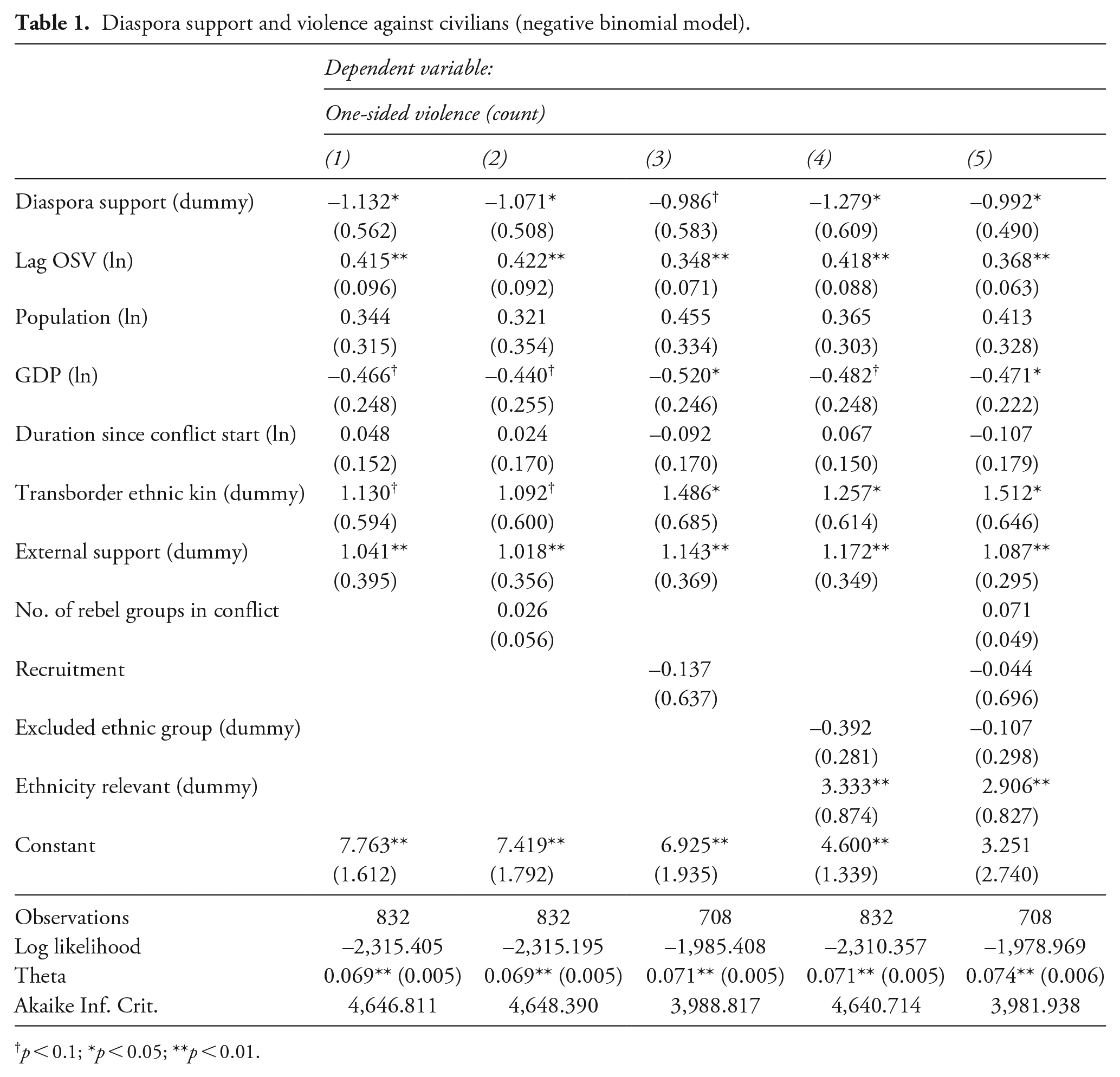
Table 1 presents the estimated coefficients for the negative binomial models. I selected negative binomial models as the baseline model specification due to overdispersion detected in the Poisson model specifications. The baseline specification (Model 1) in Table 1 shows a negative marginal effect of diaspora sponsorship on one-sided violence by rebels. This effect is statistically significant at the 5% level, supporting Hypothesis 1. When a diaspora supports a rebel organization financially, materially or politically during an intrastate conflict, the number of civilian casualties decreases. Conversely, external support has a positive and statistically significant effect across model specifications (Table 1).
Diaspora support and violence against civilians (negative binomial model).
p < 0.1; *p < 0.05; **p < 0.01.
Based on Model 1, Figure 1 displays the predicted number of one-sided violence events in the presence and absence of diaspora support. The effect of having diaspora support reduces instances of predicted one-sided violence from approximately 92 instances to 30. This result underscores the violence-mitigating effect of diaspora support to rebel organizations.
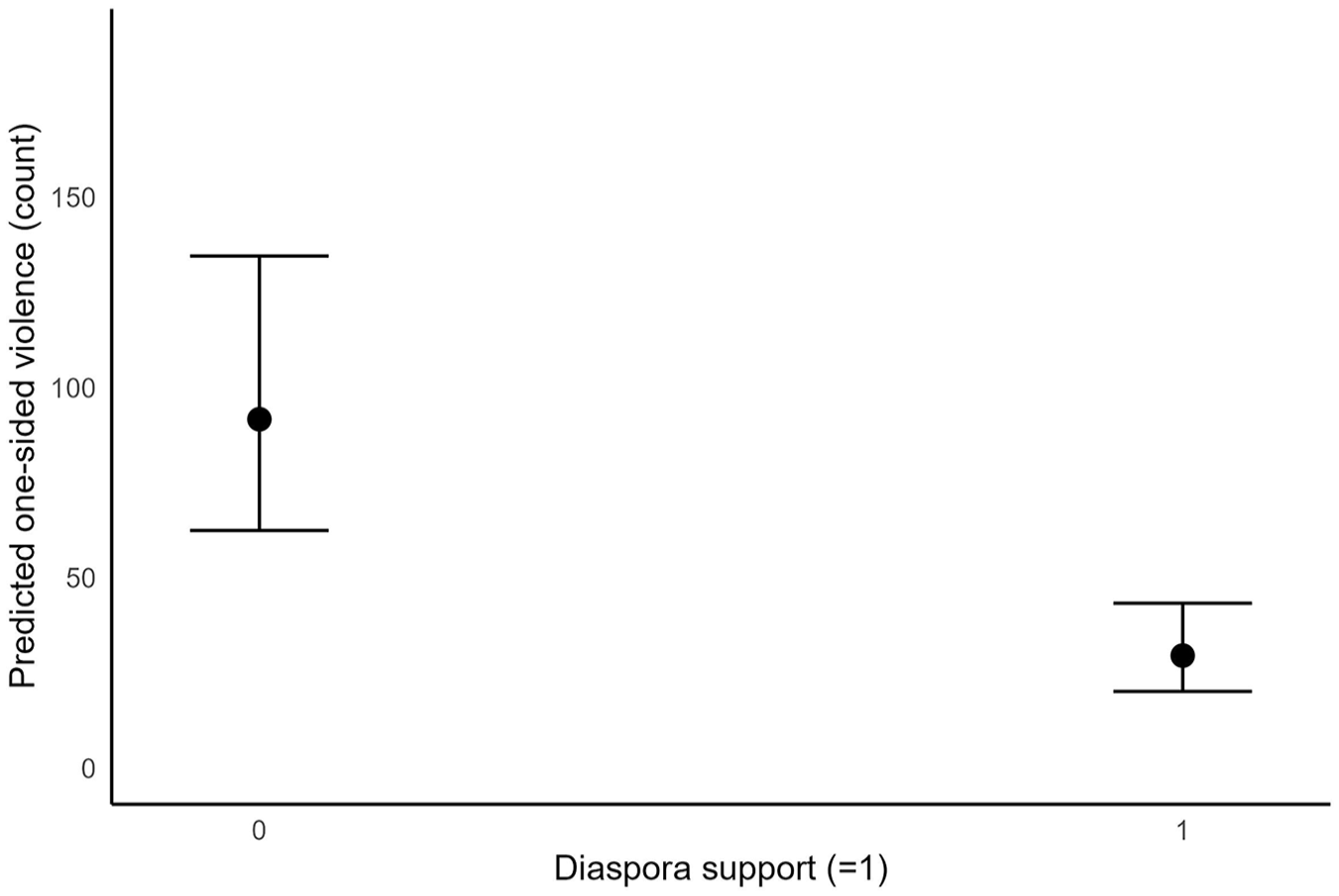
Predicted one-sided violence in presence or absence of diaspora support.
To further understand the relationship between diaspora support and violence against civilians, I discuss the results of the confounding factors. Notably, the violence-reducing effect of diaspora support remains robust across different model specifications. In accordance with scholarship on violence against civilians, previous one-sided violence has a positive effect on current occurrences of such violence. Although the population size does not indicate a statistically significant effect, the wealthy economic indicator, proxied by gross domestic product (GDP), is negative and statistically significant. This finding supports the argument that economically wealthy countries are, on average, less likely to experience violence against civilians.
The duration of conflict and the number of rebel organizations involved do not seem to be confounding factors. While multi-actor conflicts, measured through the number of rebel organizations involved in an intrastate conflict, appear to have a slight positive impact on one-sided violence, this estimated effect does not reach statistical significance at common levels. Conversely, the effect of duration is insignificant and switches coefficient signs. The existence of transborder ethnic kin has a marginally statistically significant positive effect on one-sided violence. This finding further supports the argument that transborder ethnic kin and a diaspora have different impacts on one-sided violence. It highlights the unique role of the diaspora as a sponsor. 12
Models 2 to 4 in Table 1 incorporate additional controls related to ethnic recruitment by the rebel organization, the relevance of ethnic cleavage in the homeland, and the exclusion of the diaspora’s ethnic group from power in the homeland. The results reveal no significant effects, except the relevance of ethnicity as a proxy for ethnic cleavage in the homeland. As expected, when ethnic cleavages are relevant in the homeland, violence against civilians increases. However, factors such as exclusion from power or ethnic recruitment seem to be negligible for one-sided violence in the context of diaspora sponsorship.
Whether I account for multi-actor conflicts, ethnic recruitment, the status of the co-ethnics in the homeland, and the presence of two or more relevant ethnic groups in the homeland, the described effect of diaspora sponsorship on one-sided violence remains robust across model specifications (see Table 1). If anything, comparing the fit for the model across specifications 1, 2 and 4 through robustness and the Akaike information criterion, suggests that the baseline (Model 1) is a conservative estimate of diaspora sponsorship on one-sided violence. 13
Additionally, the results presented in Online Appendix A.4 demonstrate that diaspora-level factors such as conflict-driven migration background of the diaspora, the diaspora’s possibility to return to the homeland, and whether the diaspora consists of people of color, do not affect the robustness of the violence-reducing effect of diaspora support. The concentration of a diaspora group within the United States remains a statistically insignificant factor. In sum, the findings are robust across model specifications and potential confounding factors. They support Hypothesis 1: diaspora support for rebel organizations decreases one-sided violence.
Results for heterogeneous effects
The findings related to the heterogeneous effects yield mixed results, as displayed in Figure 2. The estimated effects, along with their 95% confidence intervals, illustrated by a thin line, function to evaluate the statistical significance at the 5% level. The 83% confidence intervals, represented by a bold line, are used to assess statistically significant differences between binary conditions. The variation in effects underscores the multifaceted nature of the conditional factors influencing the relationship between diaspora support and violence against civilians. By examining Figure 2, I compare how the absence or presence of various factors, when combined with diaspora support, impact violence against civilians conducted by rebel organizations. I employ the 83% confidence intervals to assess statistically significant differences between the interaction effects (cf. Payton et al., 2003: 5). This approach enables the investigation of specific homeland-related conditions under which diaspora support influences one-sided violence.
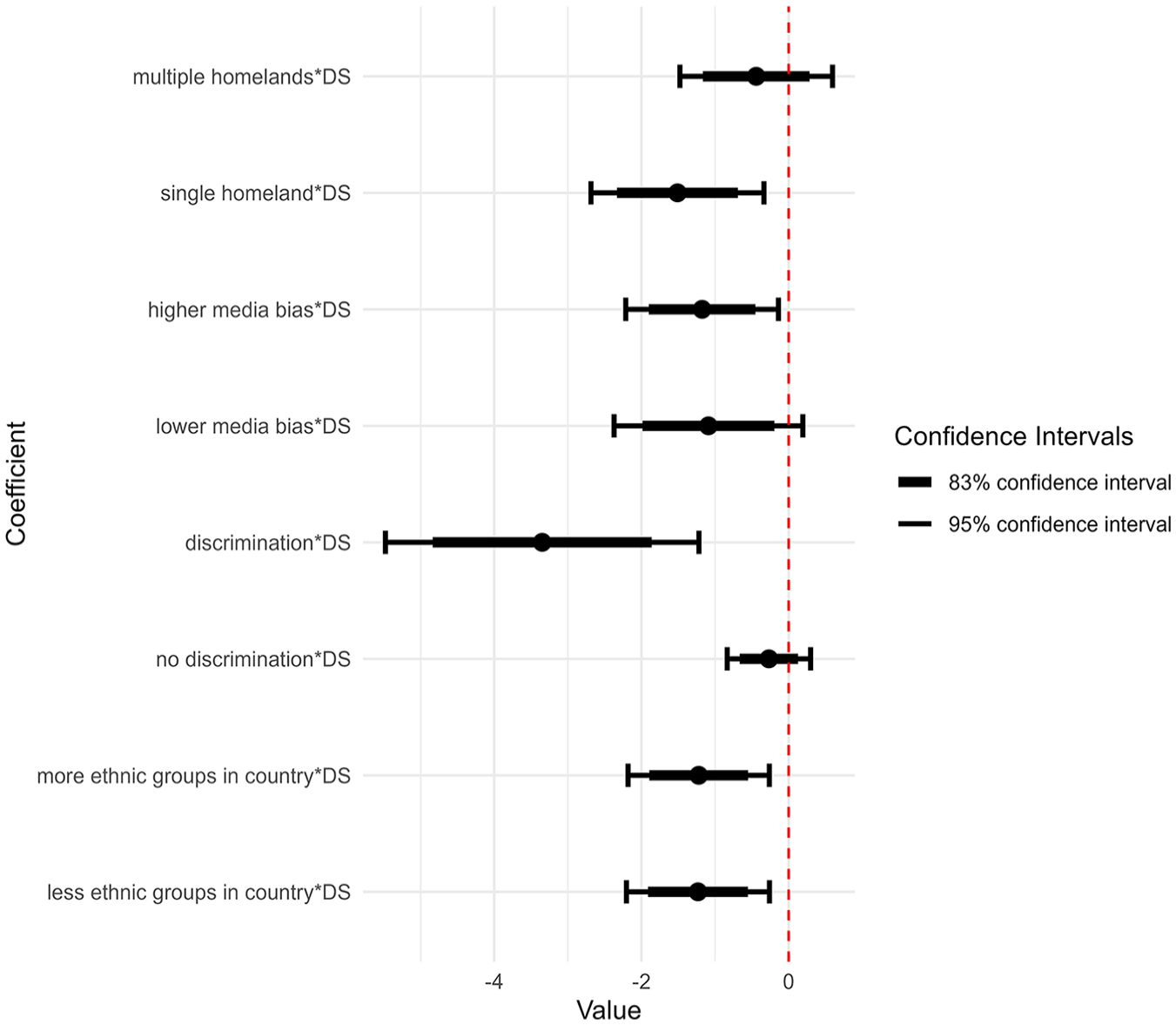
Coefficient plot for models with diaspora support and various modifiers.
Figure 2 displays the effects of diaspora support on one-sided violence in the absence or presence of the respective conditions. When diaspora’s co-ethnics in the homeland are discriminated, diaspora sponsorship exhibits the most pronounced effect in reducing violence, surpassing all other heterogeneous effects. This supports Hypothesis 1a. In addition, I find partial support for Hypothesis 1c. Lower levels of media bias are associated with a more substantial reduction in one-sided violence under diaspora sponsorship compared to scenarios with higher media bias. However, I acknowledge that the statistical significance of the estimated effect diminishes as the level of media bias increases.
The results for the discrimination of homeland population sharing an ethnic tie with the diaspora, paired with diaspora sponsorship, supports Hypothesis 1a. Although these findings support the hypothesized relationship, both the 95% and the 83% confidence intervals encompass zero for non-discriminated ethnic groups, indicating statistically insignificant results. A possible explanation is that rebel groups, driven by their interest to distinguish themselves from the incumbent, may apply less violence against civilians when supported by a diaspora that prefers restraint from violence. Alternatively, grievances foster information-sharing and, therefore, monitoring. This, in turn, can contribute to a rebel group’s adherence to the delegated task.
The results related to media bias paired with diaspora support (H1c) reveal coefficients of similar magnitude for both lower and higher levels of media bias. However, the higher and lower media bias paired with diaspora support finds only partial significance due to the partially overlapping 83% confidence intervals. One possible explanation for these results is that the data on news outlets primarily refer to traditional media, such as TV, print, and radio, and do not account for the influence of social media, which could lead to different results. Furthermore, when media coverage is less biased toward the incumbent, rebel organizations may use the media to disseminate propaganda, which could enhance the diaspora’s information availability through media in the homeland.
Mixed results occur for the marginal effects. The violence-reducing effect of diaspora sponsorship is slightly higher in magnitude for higher levels of media bias, as shown in Figure 5 in the Online Appendix. This finding is empirically substantial, considering that the distribution of media bias levels is skewed towards less biased media, as illustrated by the density plot.
Given the nature of the multi-ethnic homeland variable, I examine the marginal effect for diaspora support on one-sided violence at different levels of a multi-ethnic homeland population. Surprisingly, the effect sizes are similar when we compare cases with multi-ethnic homeland populations to more homogeneous populations. The 83% confidence intervals fully overlap as shown in Figure 2, leading to a rejection of Hypothesis 1b. One explanation could be that the information-sharing mechanism might be equally effective in homogeneous settings or multi-ethnic populations where fewer co-ethnics can serve as a crucial source of information for the diaspora. Importantly, the findings are statistically significant if less than ten ethnic groups exist, which is notable as the majority of conflicts occur in countries with fewer than ten ethnic groups, as the density plot in Figure 3 visualizes.
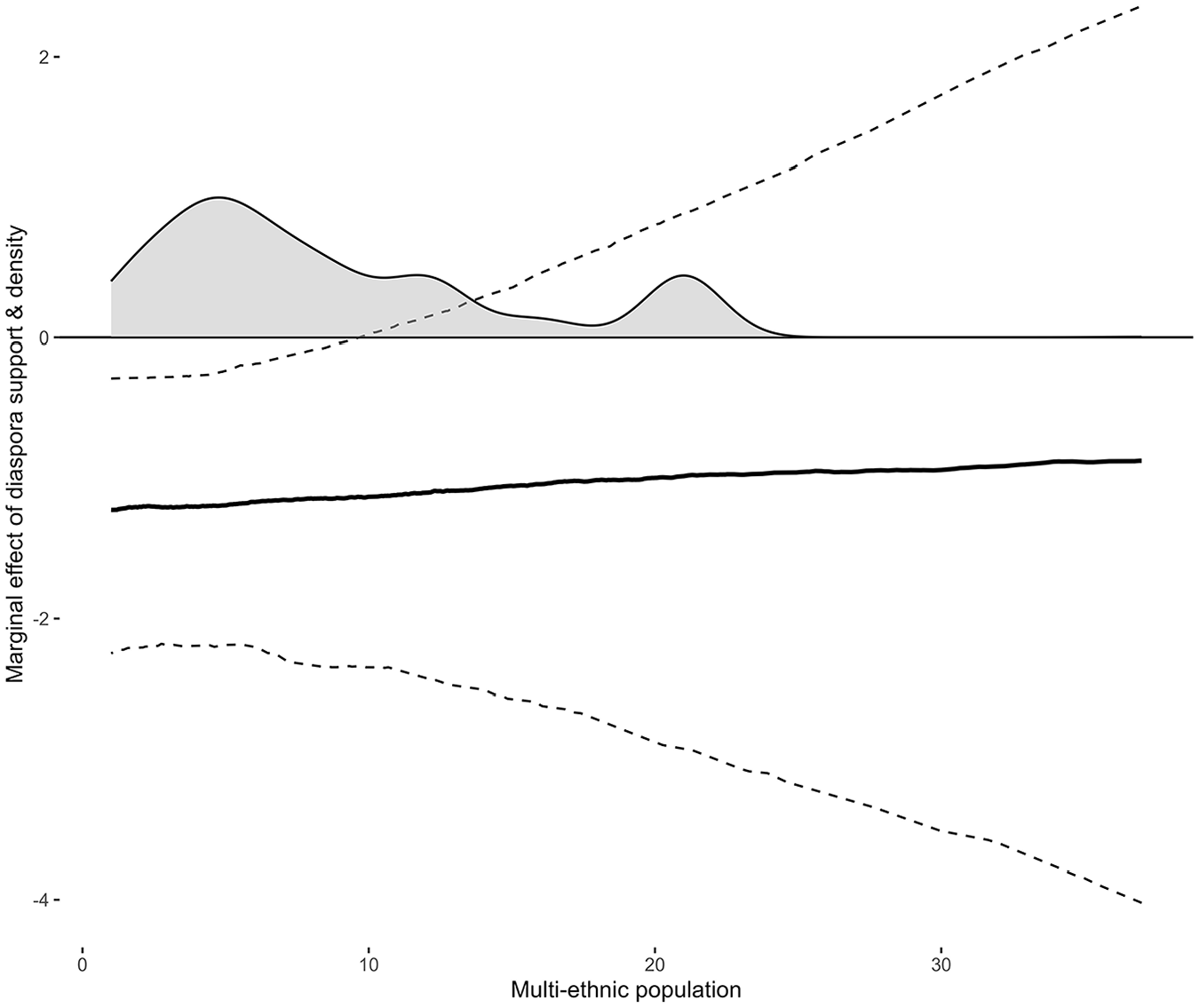
Marginal effect for diaspora support on one-sided violence (95% confidence interval) for different levels of multi-ethnic populations and density plot of levels of multi-ethnic population.
Contrary to the hypothesized relationship (H1d), a diaspora originating from multiple countries appears to have a less pronounced effect than a diaspora originating from a single country. 14 One explanation for the findings is that diaspora groups originating from a single homeland may have distinct characteristics that enhance violence-reducing effects when they support a rebel organization.
These findings suggest that further research could investigate the surprising finding that a diaspora from one homeland seems to affect diaspora sponsorship’s impact on one-sided violence to a larger extent than a diaspora originating from multiple homelands.
Discussion and conclusion
The article theoretically and empirically demonstrates that diaspora support can limit violence against civilians exerted by rebel organizations. Unlike state support to rebels, diaspora support has a violence-reducing effect. I apply a principal–agent perspective to explain the limitation of violence against civilians by diaspora-sponsored rebel organizations. The diaspora acts as a principal that can control the rebel organization through the fire-alarm mechanism. The homeland population, sharing an ethnic tie with the diaspora, is likely to share information, thereby fostering the diaspora’s monitoring of the agent and highlighting the agency of civilians in conflict areas.
Combining original data on diaspora sponsorship to rebel organizations with existing data on one-sided violence, I examine the effect of diaspora sponsorship on violence against civilians across all state-based armed conflicts in Africa and Asia between 1989 and 2014. The results reveal that diaspora support to rebel organizations reduces civilian killings. This effect is robust to various potential confounders such as multi-actor conflict, ethnic recruitment and exclusion of co-ethnics in the homeland.
The findings also highlight the contrasting effects of non-diaspora support, which positively influences civilian victimization, as opposed to the negative effect of diaspora support. In addition, the results for the heterogeneous modifiers indicate pathways through which the effect of diaspora sponsorship may interact with the ethnic group’s status of discrimination in the homeland, a multi-ethnic homeland population, media bias in the homeland, and whether the diaspora originates from a single or multiple homelands. Diaspora support, paired with the discriminated ethnic group of the diaspora in the homeland, reduces one-sided violence. This evidence is not only important but also expected, highlighting the persistent role of ethnic ties in the dynamics of civilian–diaspora relations.
This article offers theoretical and empirical avenues for future research. Theoretically, incorporating the diaspora as a principal with varying degree of organization, leadership, and coherence into a principal–agent framework can enhance the understanding of variation among diaspora groups and their implications for civilian victimization. Empirically, this article lays the foundation for future research to explore how diasporas residing outside the United States and Western democracies might have different mechanisms or constraints affecting sponsorship and its consequences for civilians. In addition, future research can examine whether diaspora support for rebels has a greater impact in contexts of ethnic targeting, as the information-sharing mechanism may enable stronger monitoring. Lastly, the novel data on diaspora sponsorship to rebel organizations can be extended to capture variations over time and enrich comparative analyses on state and diaspora sponsorship.
Diaspora support and other forms of non-state sponsorship, for instance from corporations or nongovernmental organizations, can enhance our understanding of sponsorship decision processes and civilian victimization. Diaspora groups vary in size and composition between and within host countries. This article, embedded in the scholarship on diasporas, armed conflicts, and civilian victimization, underlines the pivotal role a diaspora can play in limiting violence against civilians in the context of civil war. It serves as a starting point for future research to disentangle the conditions of diaspora sponsorship, its consequences, and the interplay with policy discussions on monitoring possibilities of diaspora sponsorship in host countries.
Supplemental Material
sj-zip-1-jpr-10.1177_00223433251317116 – Supplemental material for Protection from afar? Diaspora support for rebel groups and civilian victimization
Supplemental material, sj-zip-1-jpr-10.1177_00223433251317116 for Protection from afar? Diaspora support for rebel groups and civilian victimization by Sara Daub in Journal of Peace Research
Footnotes
Acknowledgements
I sincerely thank the anonymous reviewers and the associate editor of JPR, as well as Julian Wucherpfennig, Kathleen G Cunningham and Shubha K Prasad for their helpful comments and suggestions. I am also grateful to my colleagues at the Hertie School, as well as the participants of EPSA 2023, NEPS 2023, APSA 2023, and Sabine Carey’s publication workshop for their valuable feedback on earlier versions of this article.
Replication data
The data, codebook, and files for the empirical analysis in this article, along with the Online Appendix, are available at https://www.prio.org/jpr/datasets/ and at  . All analyses were conducted using RStudio.
Funding
The author received no financial support for this work but acknowledges the doctoral stipend provided by the Hertie School.
Notes
SARA DAUB, PhD in Political Science (Hertie School, 2024); DAAD [German Academic Exchange Service] Postdoctoral Fellow, Henry A. Kissinger Center for Global Affairs, Johns Hopkins University School of Advanced International Studies (2024–present) and Research Fellow, Centre for International Security, Hertie School (2024–present); her research focuses on non-state actors’ behavior, external sponsorship, civil wars, diaspora politics, and foreign policy.
References
Supplementary Material
Please find the following supplemental material available below.
For Open Access articles published under a Creative Commons License, all supplemental material carries the same license as the article it is associated with.
For non-Open Access articles published, all supplemental material carries a non-exclusive license, and permission requests for re-use of supplemental material or any part of supplemental material shall be sent directly to the copyright owner as specified in the copyright notice associated with the article.