




Abstract
Under what conditions can UN military peacekeeping operations (PKOs) succeed in contexts of civil war? This is an important question given the prevalence and cost of civil wars and the high, yet not always fulfilled, expectations of very costly military PKOs as responses to them by the international community. Yet, the academic and policy debates on this question are as long-standing as they are unresolved. Our article contributes to existing scholarship in several ways. First, adopting a nuanced and multi-dimensional definition of success that considers violence, displacement, and contagion as its 3 essential components, we identified 19 cases of full or partial successes, and 13 full or partial failures, covering all 32 UN military PKOs deployed to civil war settings. Second, we develop an original dataset and analytical framework that identifies a wide range of plausible factors related to the dynamics of both the intervention and the underlying conflict it is meant to address. Third, applying qualitative comparative analysis to our dataset of these 32 military PKOs, our key finding is that what matters most and consistently across all of these missions is the presence or absence of domestic consent to, and cooperation with, deployed PKOs.
Keywords
Introduction
UN missions can have a positive effect on curbing conflict (Bara, 2020; Beardsley, 2012; Beardsley and Gleditsch, 2015; Fortna, 2004, 2008; Gilligan and Sergenti, 2008; Hegre et al., 2018; Hultman et al., 2014). Yet, how and under what conditions military PKOs are (un-)successful is an ongoing, and so far, inconclusive debate. 1
We contribute to this debate by exploring the question which (combinations of) conditions are necessary and /or sufficient for the success or failure of military UN peacekeeping operations in (post-) civil war contexts. 2 Thus, our interest is not in determining whether military PKOs generally are a useful tool to contribute to the sustainable termination of civil wars, but rather more specifically under what conditions they are likely to succeed or fail in doing so once deployed. The originality of our approach rests on three pillars. First, we adopt a multidimensional definition of success that enables a nuanced and in-depth assessment of whether a military PKO has (a) reduced the extent of violent conflict, (b) ended the displacement of people, and (c) prevented the spread of conflict beyond the country of origin. Second, we base our analysis on an original dataset of all 32 military PKOs mandated by the UN for deployment in civil war contexts. Third, the empirical analysis of this dataset is based on a Qualitative Comparative Analysis (QCA) which enables us to determine which pathways lead to success and failure. Crucially, we find that the absence of external support for belligerent parties and the presence of domestic consent to, and cooperation with, a military PKO are two conditions that are components of both pathways to success, while the absence of domestic consent and cooperation and of a peace agreement are part of all three pathways to failure.
In the next section, we discuss our conceptualisation of PKO success and failure. Section 3 introduces the analytical framework outlining the key explanatory conditions and our theoretical expectations on the interplay between them. Section four presents the research design and section five our empirical analysis. Finally, we discuss the implications of our analysis and offer suggestions for future research.
What counts as success in peacekeeping?
Foundational to most peacekeeping research to this day, Diehl (1994) identified two components of success: first, the limitation of armed conflict, and second, the resolution of the underlying conflict. Diehl’s approach addressed a major problem with earlier definitions of success that were heavily focused on the mandate of PKOs, which Diehl (2008) considered too vague and leaving ‘much room for debate on the scope and detail of the operation’s missions’ to be a useful benchmark for success (p. 123). The frequent vagueness of mandates and an overly optimistic outlook on what is achievable in a given situation, enabled by the UN Secretariat ‘apply[ing] best-case planning assumptions to situations where the local actors have historically exhibited worst-case behaviour’ had already been one of the key criticisms in the Brahimi Report (United Nations, 2000: paragraph 51). Similarly, Fearon and Laitin (2004) have noted several pathologies embedded in the process of mandate design (pp. 17–19). Hence, judging the success of a PKO based on the fulfilment of its mandate potentially detracts from a more policy-relevant examination of how a given PKO contributes to the maintenance and/or restoration of international peace and security, the key concern of the Security Council.
In recent years, academics have sought to overcome the hitherto predominantly binary approach to success and failure. D’Estrée (2020) and Diehl and Druckman (2013), among others, have argued that binary definitions are of little use in accounting for the complexity of contemporary PKOs and suggested more fine-grained definitions of success and failure to take account of the multi-dimensional aims of contemporary PKOs beyond limiting violence in general (Fortna, 2004, 2008; Hultman et al., 2014) or containing its spread within the country concerned (Beardsley and Gleditsch, 2015; Reid, 2017). Such a broader conceptualisation of success is also employed in Martin-Brûlé’s (2016) framework of full and partial failures and successes. Emulating Diehl and Druckman’s (2013) distinction between context-specific and general goals of PKOs as criteria of success, she adds the (re)establishment of order as another criterion. While Martin-Brûlé (2016) considers order primarily in a local, in-country context, the concept as such is useful to ‘stretch’ out to the broader context of international peace and security as one of the primary concerns of the Security Council.
We take these insights as our starting point for evaluating PKOs in terms of their sustainable contribution to maintaining or restoring international peace and security and define successful PKOs via three components: (a) reduction of violence, (b) end of displacement, and (c) lack of contagion.
Regarding the reduction of violence, successful PKOs end armed conflict or sustain an existing ceasefire with no more than sporadic ceasefire violations, few armed clashes between conflict parties, and limited civilian casualties. PKOs fail when major and frequent ceasefire violations, armed clashes between conflict parties, and significant civilian casualties occur or when full-scale hostilities between armed factions resume during or after their deployment. 3 We source our data from the Regular Reports provided by the UN Secretary General to the UN Security Council on the respective mission, the Uppsala Conflict Data Programme (UCDP), and existing secondary case-study literature (including Koops et al., 2015).
Displacement has been studied as a motivation for the deployment of PKOs (Binder, 2015), but very few studies exist that examine the impact of PKOs in this regard (Sundberg, 2019). In order to fill this gap and provide a more comprehensive measurement of success, we include ending displacement of people as the second dimension of success in restoring order in a broader sense in addition to simply reducing violence. We deem a PKO successful in this regard if it ends displacement and a failure if this is not the case. Here we rely on a mix of data reported in Regular Reports provided by the UN Secretary General to the UN Security Council, by UNHCR (which also includes data Norwegian Refugee Council’s Internal Displacement Monitoring Centre, IDMC), and in existing secondary case-study literature (including Koops et al., 2015).
Finally, containing conflict forms the third dimension in our concept of success because it contributes to ‘stabilizing conflict-prone regions and the international system at large, through interrupting the contagious nature of conflict and related negative externalities’ (Beardsley, 2011: 1052). By conflict contagion we mean the transnational spread of conflict into one or more neighbouring countries or an increase in the number of external belligerents actively involved with their own combatants on the territory of the state in which the conflict originated (see, e.g. Lake and Rothchild, 1998: 23). A PKO counts as a success if the conflict remains contained to the country of origin or when diffusion to neighbouring countries decreases over the course of the PKO and when no external actors become belligerents, or their number decreases significantly over time. If this is not the case, the PKO is a failure. Our main data sources here include the Regular Reports provided by the UN Secretary General to the UN Security Council and existing case study literature (including Koops et al., 2015), supplemented with data from the UCDP External Support in Non-state Conflict Dataset (Högbladh et al., 2011) and the Correlates of War Intra-state War Dataset v5.1 (Dixon and Sarkees, 2016).
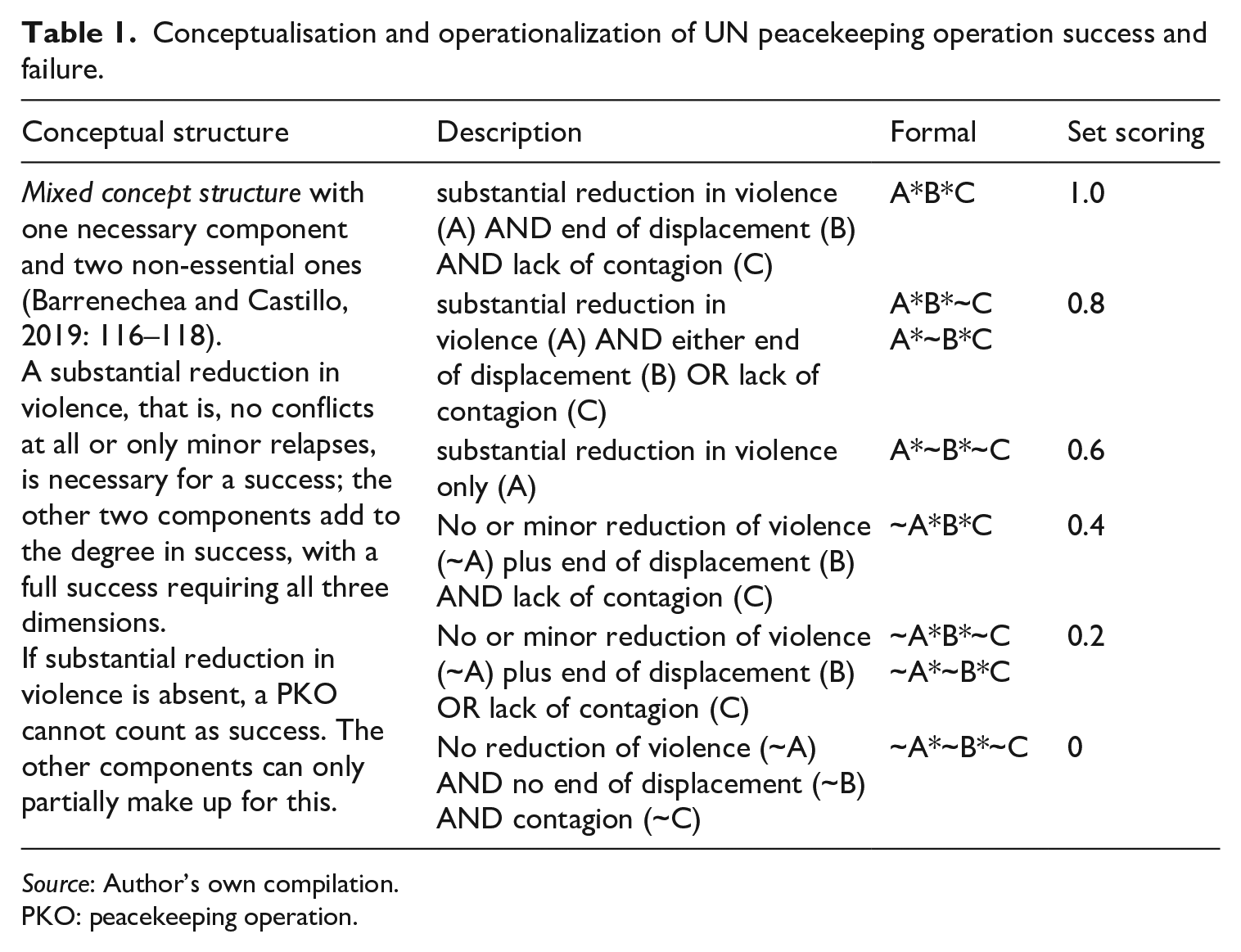
While there is some agreement that the success of PKOs is a multidimensional concept, it remains unclear how the conceptual components should be weighted. We take the view that a PKO that fails to restore and sustain peace cannot be considered successful. Hence, a major reduction of violence, that is, the complete end of armed conflict or a significant reduction of violence with only sporadic relapses, is necessary for being considered a successful PKO, with the other two components adding to the level of PKO success (see Table 1). Reducing violence without being successful on the other two dimensions, however, is only a partial success (0.6), whereas to count as full success (1), a PKO needs to be successful on all three dimensions. If a PKO, in addition to reducing violence, is successful only with regard to either displacement or contagion, it falls in-between as a major, yet not full success (0.8). The rationale for failure is the mirror-image. If a PKO does not lead to a major reduction of violence but ends displacement and contains the conflict, it counts as a partial failure (0.4). Moreover, if it is only successful on one of the latter dimensions, it is a major failure (0.2); PKOs are full failures when they are unsuccessful on all three dimensions (0).
Conceptualisation and operationalization of UN peacekeeping operation success and failure.
Source: Author’s own compilation.
PKO: peacekeeping operation.
Drawing on the concept formation literature (Barrenechea and Castillo, 2019; Goertz, 2006), we conceive two viable alternatives to our conceptualisation. 4 First, we relax the necessity requirement for the reduction of violence component. The rationale here is that the more components of success are present, the higher the level of success, irrespective of which component. PKOs which are (un)successful across all three dimensions are still considered full successes (failures). However, it is now ‘easier’ to count as success since any two out of the three components would already count as partial success (0.6), whereas having only one component would account for a partial failure (0.3).
Second, we build an aggregate index of the three components which ranges from 0 (no success on all dimensions) to 6 (full success on all dimensions). To capture the relevance of a major reduction of violence, we weight this dimension twice in relation to the other two dimensions. A score of 3 is assigned to PKOs which end the armed conflict, 2 if only sporadic instances of violence occurred, 1 if violence was reduced but major violations of ceasefires and relapse of armed conflicts happened, and a 0 if the armed conflict continues or resumes. Accordingly, we assigned a score of 1.5 in cases where the displacement was ended as a result of the PKO (or 0 if otherwise), and a 1.5 if the conflict was contained (or 0 if otherwise). Based on this aggregate index, we consider scores above 3 as (partial) success, and below as (partial) failures. In robustness tests, we probe how these alternative conceptualizations affect our results and find them highly robust for PKO success, and slightly less robust for PKO failure.
What accounts for success and failure in military peacekeeping operations?
In this section, we consider a variety of different existing explanations for the success and failure of UN military PKOs and derive from them several expectations, which we then explore in the empirical analysis.
A first set of factors focuses on the UN itself: the degree of leadership provided for a mission, the motivation behind it, and the resources provided for it. All three of these factors have been shown to be related to each other in various ways, a notion that is often expressed in terms of credible commitment on the part of the intervener (Kathman and Wood, 2011; Walter, 2002). Leadership is particularly associated with major powers (i.e. the P5). Positive engagement by one or more of them has frequently been linked to PKO success (Durch, 2006; Hampson and Malone, 2002; Howard, 2019).
P5 leadership is closely related to two other frequently cited conditions: resources and motivation. If the interests of any major power are engaged and not in conflict with the interests of other P5, PKOs are more likely to be led effectively and provided with the requisite diplomatic, financial, and military resources.
In this context, Autesserre (2017: 125, 2019) notes that part of the reason for the failure of peacekeeping is a lack of effectively-channelled resources, while Doyle and Sambanis (2006) make a similar point when they argue that troop numbers need to be considered in the context of the tasks they are to accomplish (p. 113). This is linked to another problem frequently identified in debates on the effectiveness of peacekeeping, namely the extent to which resources committed by the Security Council are adequate for the objectives set for a mission. This was one of the main criticisms of the Brahimi Report (United Nations, 2000) and has been widely discussed in academic literature as well (e.g. Caplan and Hoeffler, 2017; Fearon and Laitin, 2004; Kathman and Wood, 2016).
Linked to the issue of effectively channelled resources are UN operational problems in the deployment and subsequent running of a PKO (Benson and Kathman, 2014; Fearon and Laitin, 2004; Howard, 2007; van der Lijn, 2010). Operational problems were also highlighted as one factor detrimental to a successful PKO in the Brahimi Report (United Nations, 2000) and still noted as an area requiring further improvement in the 2018 Report of the Special Committee on Peacekeeping Operations (2018: 27–38).
Major powers’ interests matter not only in terms of the level of resource commitments but also when it comes to the motivation behind their engagement. Howard (2007) found that shared, but only moderately intense interest of the P5 in the resolution of a particular conflict is one of three necessary factors of PKO success (p. 327). 5 By contrast, disagreements among major powers are considered detrimental to peacekeeping success (Howard and Stark, 2018).
Based on these considerations in the existing literature, we conceptualise the first four conditions for our analysis as follows:
Major power lead captures the extent to which the P5 are committed to the success of the mission and commit resources to the mission, actively support the extension of the mandate of the mission as required, and engage actively diplomatically with the conflict parties and any of their external backers.
Correspondence between resolutions and resources measures the extent to which commitments in UN Security Council Resolutions are followed up in practice, focusing on the timely deployment of personnel and provision of financing. This allows to ascertain in general how adequately a military PKO is resourced, regardless of P5 commitment.
Conflict salience assesses the extent to which the P5 have individual interests in the country/conflict in question and how these interests relate to each other: how compelling (strong) are their interests and how complementary or competing are they. This allows us to understand how sustained the commitment of the P5 (and their allies) is likely to be in a military PKO or how much its effectiveness may be hampered by P5 disagreements.
UN operational problems measure the extent to which the mission experiences difficulties during its operation, including coordination and disciplinary problems in the field, within and between different military and civilian mission components, and between mission HQ and UN HQ.
The decision to deploy a PKO is one taken at UN HQ in New York City but the context in which the mission succeeds or fails is also a regional and a local one (Gromes, 2019). As established in several studies (Diehl and Lepgold, 2003; Lake and Morgan, 1997), regional actors remain among the most significant in shaping local conflict dynamics. Regional organisations (and their member states) can increase the effectiveness of peacekeeping (Beardsley et al., 2019; Bellamy and Williams, 2005), including when they are given an enforcement mandate (Doyle and Sambanis, 2007; also Lipson, 2007). For example, as van der Lijn (2010) notes, ‘co-operation from neighbouring countries is essential because often these countries support one of the parties and many policy instruments, like the monitoring of borders and the verification of the withdrawal of foreign forces, require their assistance’ (p. 65). Second, an absence of external support for (former) belligerents is one of the most important determinants of peacekeeping success (e.g. Pushkina, 2006; Wood et al., 2012; see also Kane, 2020).
In our analytical framework we account for this by focusing on three conditions:
Regional consent and cooperation measures the extent to which regional organisations and/or neighbouring states consent to the deployment of a military PKO and cooperate with it. This allows us to determine how permissive the regional environment is – from mere passive tolerance of a PKO to its active support.
Enforcement mandate for a regional organisation captures whether a regional governmental organisation is provided with an enforcement mandate by the Security Council on its own or jointly with the UN. Beyond simple consent and cooperation, this indicates a higher quality of partnership between the UN and regional actors, independent of the role-played by individual states in the region.
Support for belligerent parties measures the extent to which (former) belligerents receive external military and/or non-military support. This provides us with information about the extent to which specific actors actively seek to undermine a military PKO, regardless of whether there is regional consent and cooperation and/or a regional enforcement mandate.
When it comes to in-country conditions, warring parties’ consent to, and cooperation with, a PKO are widely described as one of the most important conditions for success (Diehl, 2008; Durch, 2006; Sebastián and Gorur, 2018). Bara and Hultman, 2020: 360) specifically point out in this context that the varying effectiveness of UN and non-UN peacekeeping depends to a large degree on the ‘civil war actors with whom the peacekeepers interact’, while Howard (2007) identified belligerents’ consent to PKO deployment as one factor necessary for success.
Local conflict parties’ commitment to a peaceful settlement of their conflict is another important factor in the success of a PKO (Ruggeri et al., 2013). A key indicator of such a commitment is the presence (or achievement) of a peace agreement (Beardsley, 2012; Doyle and Sambanis, 2007). This is also supported by Gilligan and Sergenti (2008: 115) who found that the UN is ‘good at peacekeeping’ but ‘not good at war fighting’, and Caplan and Hoeffler (2017), who argued ‘that UNPKOs have a positive effect on peace duration when the conflict ends in a settlement’ (p. 149).
State strength, the capacity of local institutions to provide security, welfare, and representation within a functioning regulatory framework that enables economic growth (see, e.g., Di Salvatore and Ruggeri, 2020; Hendrix, 2010), also affects the likelihood of success or failure of a PKO. State capacity has been linked to states’ ability to resist conflict contagion (Braithwaite, 2010; van der Lijn, 2010) and to commit credibly to abiding by a peace agreement (Fearon and Laitin, 2004: 20–21).
We reflect these insights by examining three conditions:
Peace agreement measures whether a peace agreement pre-dates, or is achieved during, the PKO and then sustained as an indication of the parties’ willingness to cooperate with each other.
Domestic consent and cooperation captures whether conflict parties consent to the deployment of the mission and cooperate with it. This reflects the nature of the relationship that conflict parties have individually with the military PKO, rather than their relationship with each other (which is accounted for in the PA condition).
State strength relates to the fragility of core institutions of the state to which the mission is deployed. This provides us with information about the extent to which local institutions pre-exist or develop in the course of the PKO and can contribute to the sustainable restoration of order.
Having identified a number of single-effect explanations for the success or failure of PKOs, our approach is based on the assumption of ‘multiple and conjunctural causation’ (Ragin, 1987: 23ff; see also, Goertz and Mahoney, 2012: 51–74). Recognising that few social and political phenomena have a single cause, and that the impact of individual factors may differ according to which other factors are either present or absent, we focus on which configurations of the individual conditions described above are particularly conducive to the success or failure of UN military PKOs.
Based on the existing literature discussed above and on our own previous case study research [references to be supplied after peer review], we expect that the presence and survival of a peace agreement and domestic conflict parties’ consent to, and cooperation with a PKO are important ingredients of a potential pathway to success. However, we do not assume that a peace agreement and domestic consent and cooperation alone are already sufficient for a PKO to succeed, or that other factors could not further enhance the likelihood or extent of success in such circumstances. Rather, if commitments in Resolutions are followed up in practice and if the mission experiences few, if any, operational problems, success is more likely. Moreover, the absence of external support for belligerents would likely further increase the probability of success. We thus expect the conjoint presence of a peace agreement and domestic consent and cooperation, adequate resources, and the absence of operational problems as well as the lack of external support for belligerents to be positively linked to the success of PKOs. 6
However, not every civil war ends with a peace agreement, and UN PKOs are, at times, deployed under conditions where one or more of the conflict parties object to such missions. Especially from a policy perspective, it is therefore important to establish whether there are (combinations of) conditions that could nevertheless enable at least partially successful PKOs in the absence of a peace agreement and/or of domestic consent and cooperation. In such a context, P5 leadership and high conflict salience (i.e. compelling and complementary P5 interests) could compensate for the absence of a peace agreement and mitigate limited domestic consent and cooperation by the strong signal of deterrence this would send. Moreover, a lack of external belligerent support (partly induced by P5 leadership and alignment) would further increase the likelihood of success, as it would limit domestic conflict parties’ opportunities to continue fighting. We thus expect the conjoint presence of major power leadership, high conflict salience, and the absence of external belligerent support to be linked to the success of PKOs. 7
Moreover, not every post-conflict transition, is free from external spoilers who support the belligerents. In such contexts, the presence of an enforcement mandate for a regional organisation and regional consent and cooperation would be particularly helpful. Regional organisations and neighbouring states would then be expected to mitigate (and over time limit) external belligerent support, for example through effective border controls and/or denial of sanctuary. We thus expect that the presence of an enforcement mandate for a regional organisation and regional consent and cooperation would mitigate external support for belligerents, with all other conditions described in the previous two paragraphs remaining unchanged. 8
Turning to failure, we take our reasoning on potential pathways to success as a starting point. The principal pathway to failure, therefore, could be expressed as the conjoint absence of a peace agreement and of domestic consent and cooperation. 9
Yet, in the same way that we cannot assume prima facie that the presence of a peace agreement and of domestic consent and cooperation guarantee the success of a UN PKO, we cannot rule out failure in their presence either. The presence of significant external belligerent support would be one possible factor to account for failure in such circumstances, especially if unmitigated by an enforcement mandate for a regional organisation and by regional consent and cooperation. Hence, we expect the presence of external belligerent support in the absence of a regional enforcement mandate and of regional consent and cooperation to lead to PKO failure. 10
Likewise, a poorly resourced PKO that experiences significant operational problems, especially under conditions of weak state capacity, could present a combination of conditions under which PKO failure is more likely, even in the presence of a peace agreement and of domestic consent and cooperation. For this reason, we expect that poorly resourced missions which experience significant UN operational problems in a context of fragile states are associated with PKO failure. 11
Research design
Our research objective is to identify those conditions which are necessary and/or sufficient for the success and failure of military UN PKOs deployed in civil war contexts. To this end, we apply a qualitative comparative analysis (QCA; Ragin, 2008; Schneider and Wagemann, 2012) to model patterns of necessity and sufficiency in terms of set relations. Having described the operationalization of our outcome of interest, that is, successful and failed PKO mission, in Section 2, we discuss here the case selection rationale and the operationalization of the main explanatory factors for PKO success or failure. In addition, we give a short introduction to the analytic protocol of QCA.
Case selection
Our case sample includes those UN PKOs in which military troops (not just observers or police forces) are deployed in an intrastate or internationalised intra-state armed conflict as defined by UCDP/PRIO (Pettersson, 2020) with a mandate to contribute to the sustainable termination of this conflict. Applying this selection procedure to all UN peacekeeping missions since 1948, we arrive at a total of 32 military UN PKOs. This reflects the current complete universe of cases.
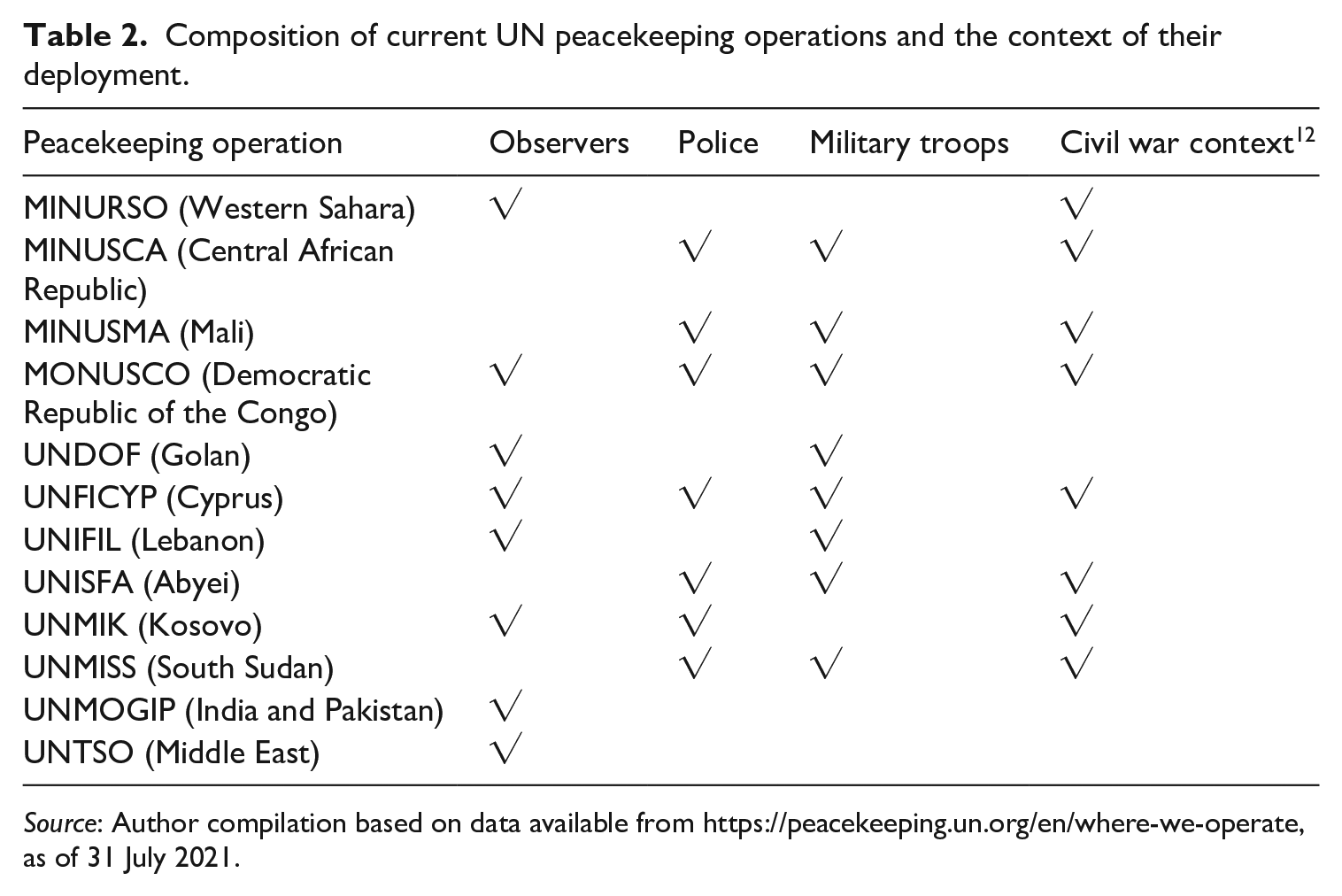
Table 2 illustrates our case selection rationale based on the 12 UN peacekeeping operations deployed as of 1 January 2021. In line with our ‘military’ scope condition, we therefore exclude UNMIK (Kosovo) and MINURSO (Western Sahara) even though these missions were deployed in the context of (internationalised) intrastate armed conflicts. Conversely, UNDOF (Golan) and UNIFIL (Lebanon) are excluded because these two missions were not deployed in the context of (internationalised) intrastate armed conflicts. UNMOGIP (India and Pakistan) and UNTSO (Middle East) do not fulfil either of our two scope conditions and are therefore also excluded.
Composition of current UN peacekeeping operations and the context of their deployment.
Source: Author compilation based on data available from https://peacekeeping.un.org/en/where-we-operate, as of 31 July 2021.
Data
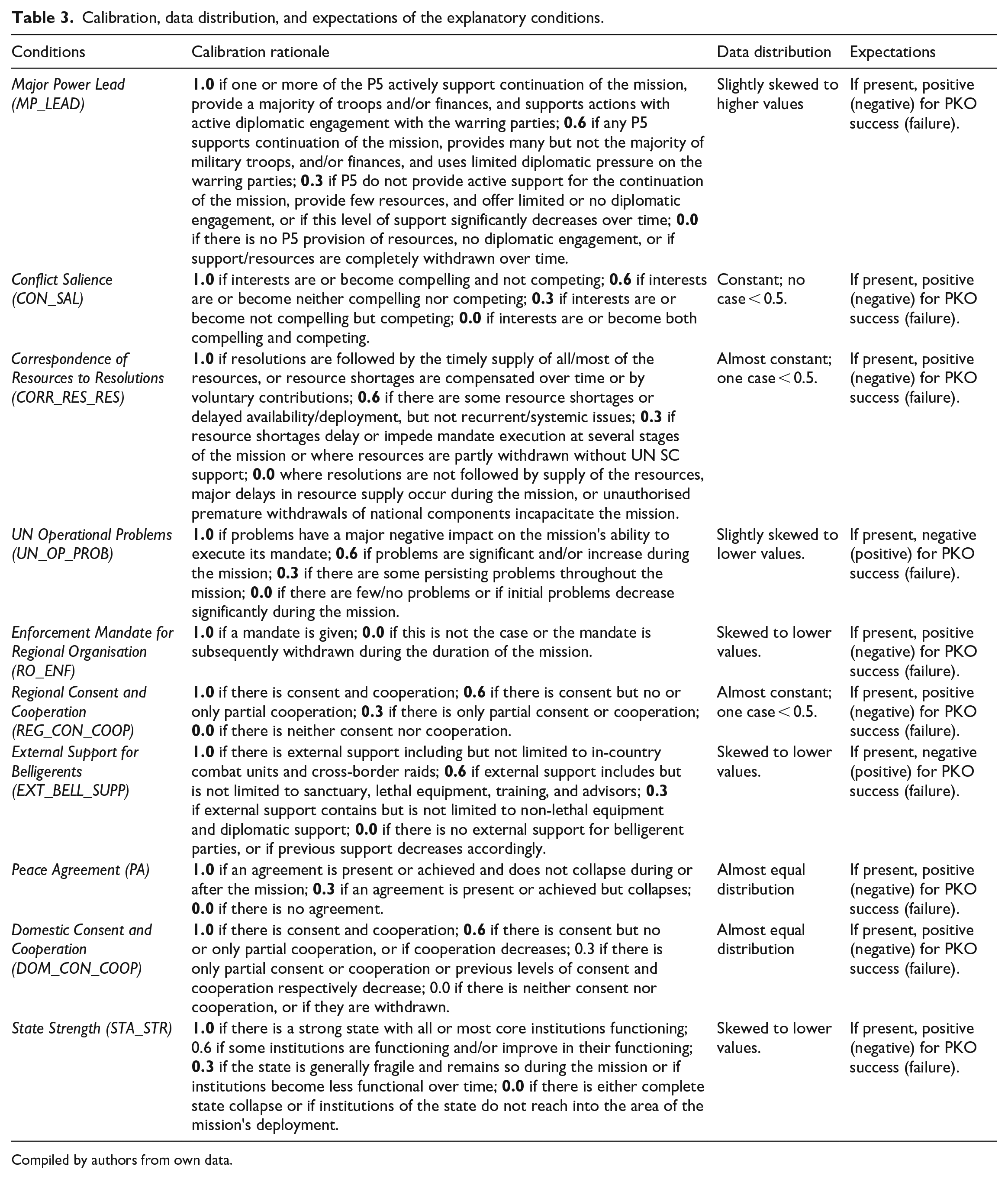
Table 3 provides detailed information on the indicators used to measure the ten explanatory conditions included in our theoretical framework. Three conditions – correspondence between resolutions and resources, conflict salience, and regional consent and cooperation – are (close to) constantly present (see the Supplemental Appendix for additional descriptive information). This means that almost all PKOs in our case universe show (a) a high degree of correspondence between the resolution and assigned resources, (b) high levels of conflict salience expressed by (the interrelation of) interests of the P5, and (c) strong regional consent and cooperation. 13 As they lack empirical variation, we exclude them from further analysis and focus on the seven conditions with empirical variation.
Calibration, data distribution, and expectations of the explanatory conditions.
Compiled by authors from own data.
For each of the 32 cases in our dataset, we collected information on the degree of success of the PKO and its potential explanatory conditions. The coding of the data relies on a qualitative expert coding based on in-depth content analysis triangulating various types of sources. The data include the regular reports by the Secretary General to the Security Council on the relevant mission, Security Council debates, reports by NGOs, think tanks, and regional/international organisations, as well as academic sources on relevant PKOs or specific aspects thereof. We also used existing datasets, including UCDP battle-related deaths (Lacina and Gleditsch, 2005) and information from the Humanitarian Data Exchange (https://data.humdata.org/) which provides data on displacement. 14 The information was directly coded as set data based on conceptual considerations, following best practice advice concerning the calibration of qualitative data (De Block and Vis, 2019).
Method
For the empirical analysis we make use of QCA (Ragin, 2008; Schneider and Wagemann, 2012). This method is particularly suited since we assume that PKO success and failure are the result of different combinations of conditions, with different configurations being possible (equifinality). Because QCA operates under the assumption of causal asymmetry, we independently analyse conditions for success and failure. In both analyses, we first examine potential necessary conditions, which can be single factors or combinations. In a second step, we explore what combinations of conditions are sufficient for (un)successful PKOs. The analysis of sufficiency involves the so-called truth table (Table 4), which displays all logically possible configurations of conditions, assigns all empirical cases to the respective configuration, and highlights combinations without empirical cases. In addition, it shows the strength of the set relationship. Configurations which show a strong set relationship are then further simplified by identifying those conditions which make a difference across cases and remove those which are redundant. All analyses are conducted using the packages ‘QCA’ (Dusa, 2019) and ‘SetMethods’ (Oana and Schneider, 2018) in R. Relevant datasets and scripts are provided in the Supplemental Appendix together with additional analyses and robustness tests.
Truth table displaying sufficient conditions for military peacekeeping operations’ success and failure.
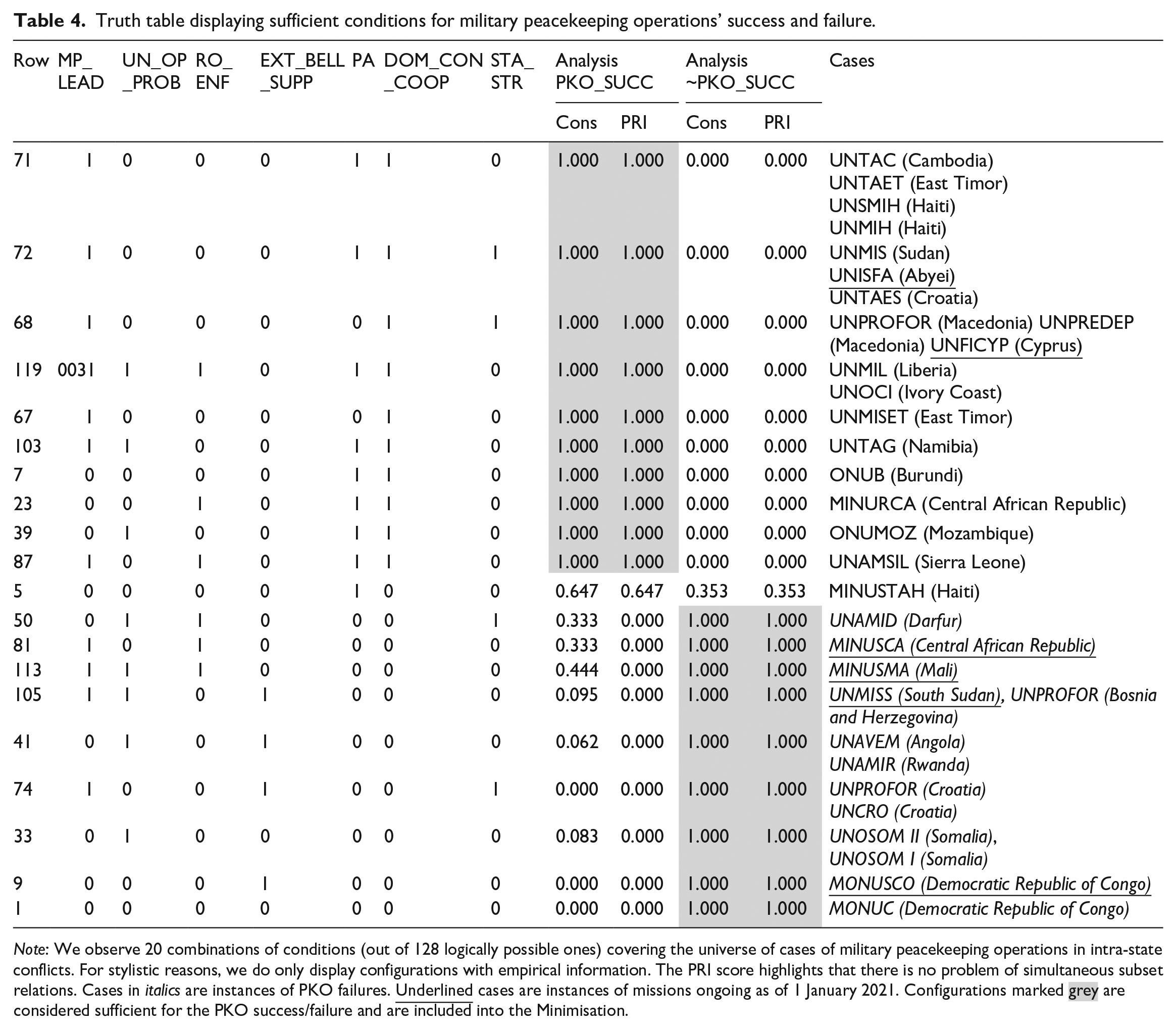
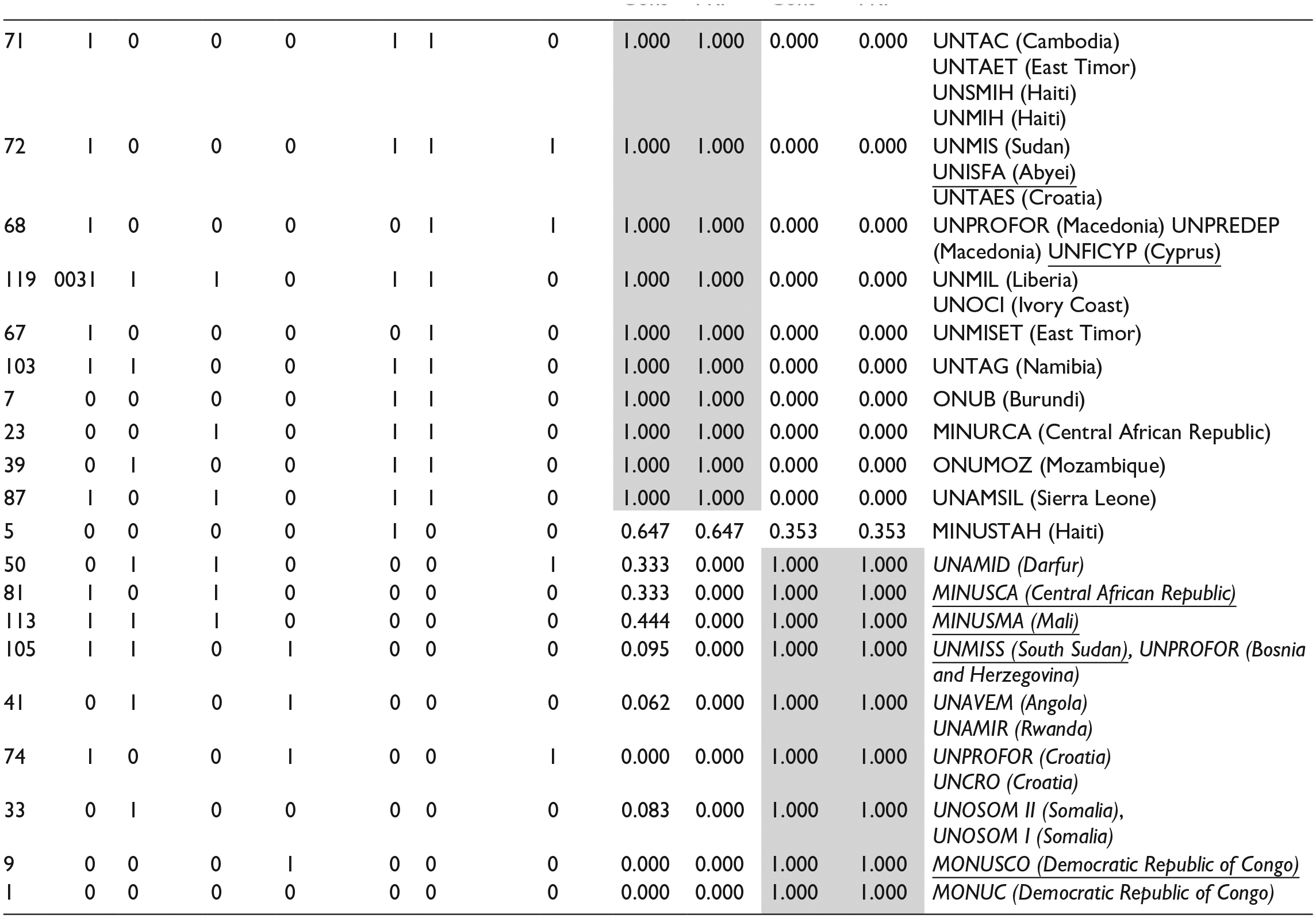
Note: We observe 20 combinations of conditions (out of 128 logically possible ones) covering the universe of cases of military peacekeeping operations in intra-state conflicts. For stylistic reasons, we do only display configurations with empirical information. The PRI score highlights that there is no problem of simultaneous subset relations. Cases in italics are instances of PKO failures.  are considered sufficient for the PKO success/failure and are included into the Minimisation.
The quality of the identified set relationships can be gauged through a several parameters (Ragin, 2008: 44–69; Schneider, 2018; Schneider and Wagemann, 2012: 119–49). The consistency parameter varies between 0 and 1 and indicates the strength of a given set relation: the higher the consistency, the stronger is the observed relationship. A consistency value of 0.9 for necessity and 0.8 for sufficiency are widely accepted benchmarks (Schneider, 2018: 247), allowing for 10 or 20 percent of deviance. The empirical importance is captured by the coverage and relevance parameters. Ranging between 0 and 1, low values indicate that relationships are trivial in case of necessity; for sufficiency, high coverage values denote that a given configuration covers a large part of the outcome.
Empirical analyses
Success conditions
Considering whether there are any necessary conditions for PKO success, we find that the absence of external belligerent support comes close but does not quite reach the 0.9 consistency benchmark. Looking at this condition in greater detail (Figure 1), there are no successful military PKOs in the presence of external support in form of in-country combat units and cross-border raids, or if sanctuary, lethal equipment, training, and advisors are provided by external parties (see upper-left quadrant). Only one PKO, namely UNMISS in South Sudan, shows some levels of success, but not enough to contradict the statement of necessity. The empirical evidence is hence not straightforward whether the condition should be interpreted as necessary. We therefore perform robustness tests where we once accept external belligerent support as being necessary, and once discard it.
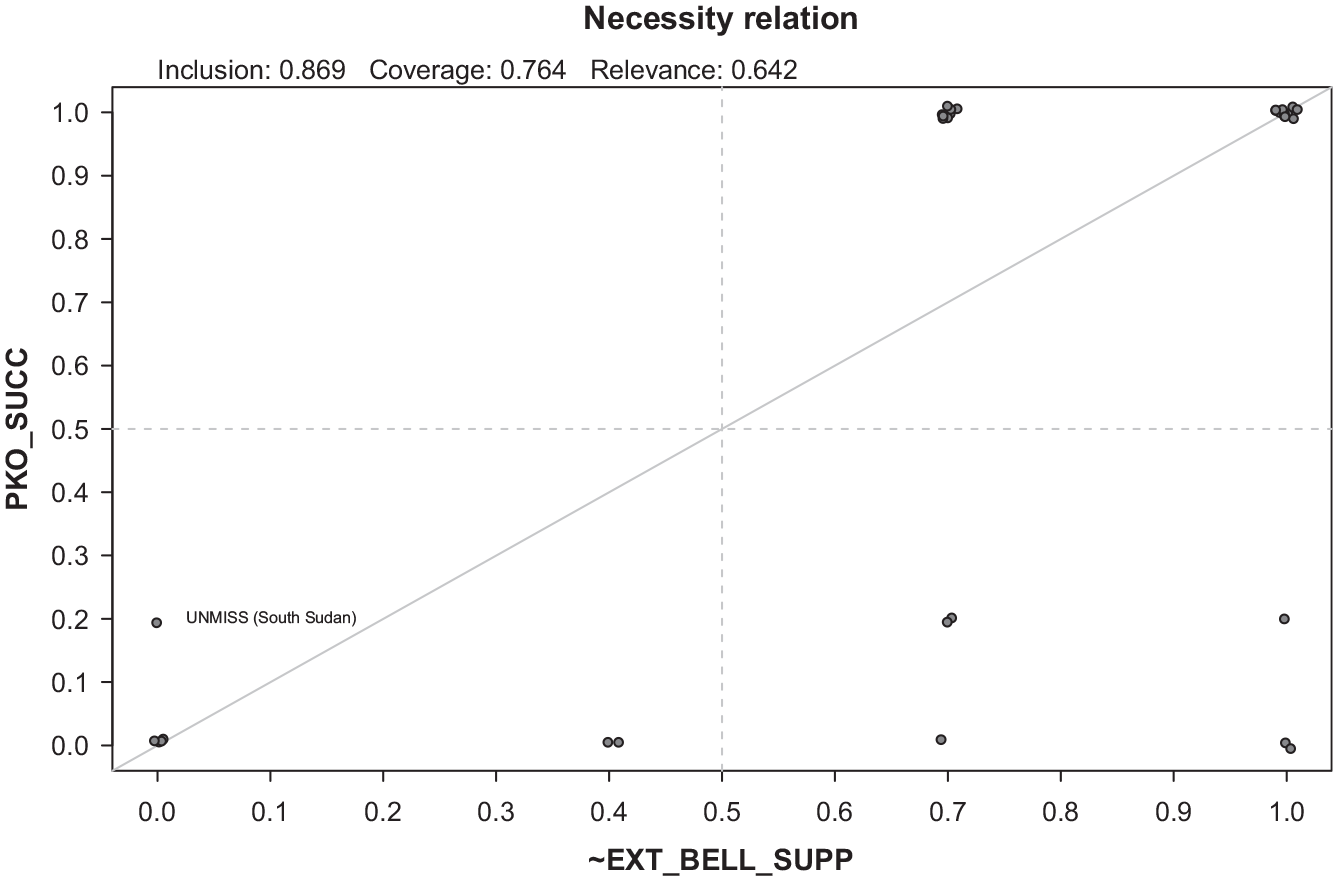
The necessity relation between the absence of external belligerent support and military PKO success.
Checking for OR-combinations, we find nine that pass the consistency threshold of 0.9. Such configurations are difficult to interpret. We follow the advice to look only at those combinations which are theoretically linked by a higher-order concept and treat the others as mere artefacts of the data (Schneider, 2018: 248–249). The only OR-combination which can be meaningfully interpreted is having a peace agreement or domestic consent and cooperation is. In all cases of PKO success there is either a peace agreement in place or high levels of consent to and cooperation with the PKO by domestic parties, or both. This suggests that having a peace agreement OR domestic consent and cooperation is a necessary condition for successful military PKOs.
Next, we turn to examining whether any combination of conditions that includes the absence of external belligerent support is sufficient for success. Based on the truth table (Table 4), we can identify two such combinations, displayed in Table 5. Both identified pathways to success include complex configurations of factors. Besides the absence of external belligerent support, domestic consent and cooperation turns out as another important ingredient for the success of military PKOs since it is part of both solution terms. Contrary to our expectations, successful PKOs do not depend on either enforcement mandates for regional organisations or state strength.
Analysis of sufficiency for military PKO success (PKO_SUCC) – enhanced intermediate strategy.
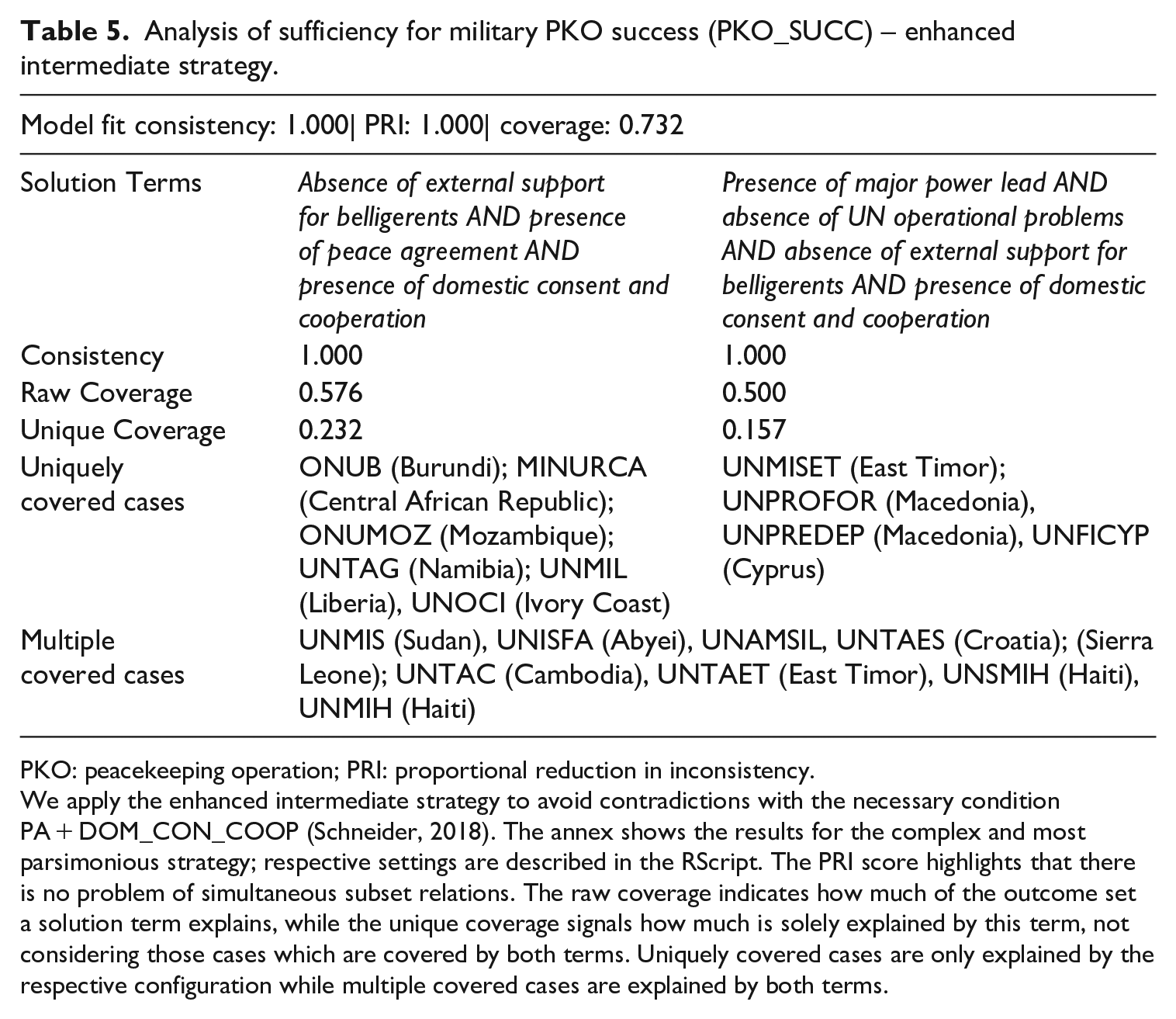
PKO: peacekeeping operation; PRI: proportional reduction in inconsistency.
We apply the enhanced intermediate strategy to avoid contradictions with the necessary condition PA + DOM_CON_COOP (Schneider, 2018). The annex shows the results for the complex and most parsimonious strategy; respective settings are described in the RScript. The PRI score highlights that there is no problem of simultaneous subset relations. The raw coverage indicates how much of the outcome set a solution term explains, while the unique coverage signals how much is solely explained by this term, not considering those cases which are covered by both terms. Uniquely covered cases are only explained by the respective configuration while multiple covered cases are explained by both terms.
The first configuration covers successful military PKOs which are characterised by the absence of external support for belligerent parties in combination with a peace agreement and high levels of domestic consent and cooperation. Seven UN missions are described by this configuration: ONUB (Burundi), MINURCA (Central African Republic), ONUMOZ (Mozambique), UNTAG (Namibia), UNTAET (East Timor), UNMIL (Liberia), UNOCI (Ivory Coast). In the second configuration, the presence of a major power lead and the absence of UN operational problems combines with the absence of external support for belligerent parties and the presence of domestic consent and cooperation. It encompasses five cases: UNMISET (East Timor), UNSMIH (Haiti), UNPROFOR (Macedonia), UNPREDEP (Macedonia), and UNFICYP (Cyprus). Together, both of these configurations explain all cases of successful peacekeeping operations in our case universe, except MINUSTAH (Haiti) which is the only deviant case in our analysis.
Failure conditions
Turning to the analysis of failures (Figure 2), the absence of domestic consent and cooperation shows a perfect superset relation of 1.0 and a high relevance of 0.82. Since there is no deviant case that contradicts this relationship, we treat it as a necessary condition. Moreover, the absence of a peace agreement is just below the consistency level of 0.9. As with external belligerent support above, empirical evidence is not straight-forward since there are no deviant cases. Again, we abstain from interpreting it as necessary condition but check for its effects in the robustness section. Six OR-combinations pass the consistency threshold but cannot be interpreted theoretically meaningfully and are hence discarded.
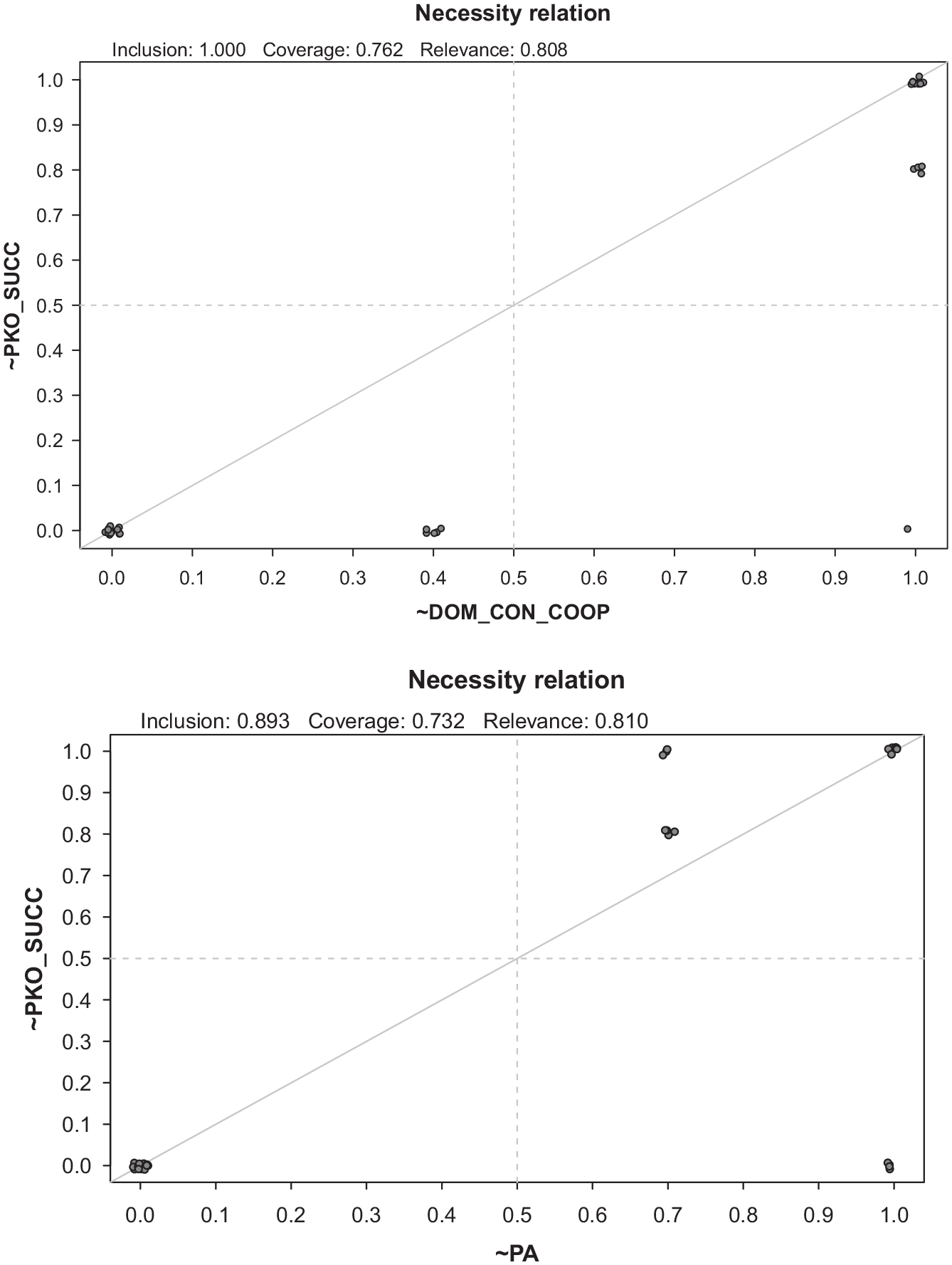
The necessity relation between the absence of domestic consent and cooperation, the absence of peace agreements and military PKO failure.
Based on the truth table (Table 4), we identify three combinations of conditions as sufficient for the failure military PKOs (see Table 6). In-country conditions are particularly significant for explaining PKO failures: in addition to the absence of domestic consent and cooperation, the absence of a peace agreement turns out as a crucial factor. In contrast to the analysis of PKO success, there is a strong overlap between the three configurations which suggests that a combination of these three pathways needs to be conjointly examined when exploring the actual process that leads to the failure of a PKO.
Analysis of sufficiency for military PKO failures (~PKO_SUCC) – enhanced intermediate strategy.
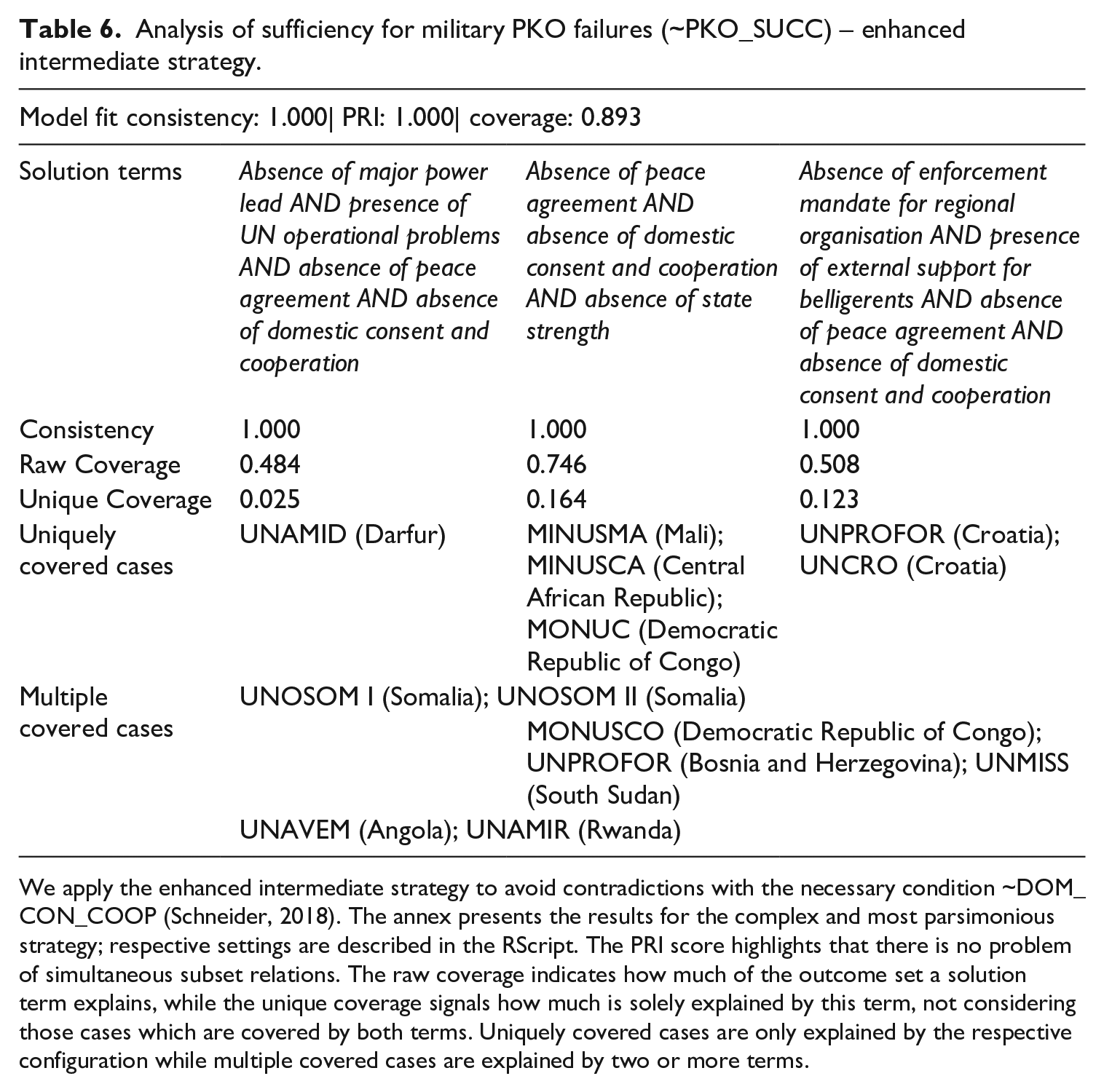
We apply the enhanced intermediate strategy to avoid contradictions with the necessary condition ~DOM_CON_COOP (Schneider, 2018). The annex presents the results for the complex and most parsimonious strategy; respective settings are described in the RScript. The PRI score highlights that there is no problem of simultaneous subset relations. The raw coverage indicates how much of the outcome set a solution term explains, while the unique coverage signals how much is solely explained by this term, not considering those cases which are covered by both terms. Uniquely covered cases are only explained by the respective configuration while multiple covered cases are explained by two or more terms.
The first configuration shows that the absence of a major power lead in combination with UN operational problems, the absence of a peace agreement, and a lack of domestic consent and cooperation is sufficient for failure. The typical case here is UNAMID (Darfur).
The second configuration consists of the simultaneous absence of a peace agreement, of domestic consent and cooperation, and of state strength as illustrated by MINUSMA (Mali), MINUSCA (Central African Republic), and MONUC (Democratic Republic of Congo). The third configuration combines the absence of regional enforcement and the presence of external support for belligerents with the lack of a peace agreement and domestic consent and cooperation. Here, UNPROFOR (Croatia) and UNCRO (Croatia) are typical cases.
Robustness checks
To probe the robustness of our findings, we performed a series of additional analyses (detailed in the Suuplemental Appendix). In particular, we checked, first, whether an alternative treatment of the (potential) necessary conditions has an effect on the sufficiency analysis; 15 second, whether we arrive at the same results using alternate conceptualizations and operationalizations; 16 and third, whether results are stable if we examine only the subsample of the 25 PKOs completed by the end of 2020. 17
Concerning success conditions for UN military PKOs, results are highly robust across all these model specifications. The presence of a peace agreement OR domestic consent and cooperation remains a necessary condition. The absence of external belligerent support remains ambiguous. In all replications it is slightly below the 0.9 consistency benchmark but without strong deviant cases. Only if we take the reduction of violence as sole success measure it passes this threshold with a low relevance score. The sufficiency analyses always produce the exact same results as the original analysis, irrespective of the chosen model specifications.
Findings are less robust regarding failure conditions for UN military PKOs. Looking at the necessity analysis, the absence of domestic consent and cooperation turns out as necessary in all re-analyses except for the analysis using only the reduction of violence. Whether the absence of a peace agreement can be deemed necessary remains ambivalent; two replications provide evidence in favour, two against it, confirming our reluctance to treat this factor as necessary. Turning to sufficiency, only the analysis based on the aggregate index measure for success yields the exact same results. Otherwise, the solution terms slightly differ from the original analysis due to alternative solution models fitting the data or additional conditions being included. It is, however, important to note that the original results presented above are a superset of all alternative solutions. This means they covers the core conditions, yet highlighting that further conditions might also play a role.
Discussion
What do we learn about the conditions under which UN military PKOs succeed or fail? Based on our analyses, we see parts of our initial expectations confirmed, but also supplemented in important ways (Table 7).
Overview of configurational expectations and empirical findings.
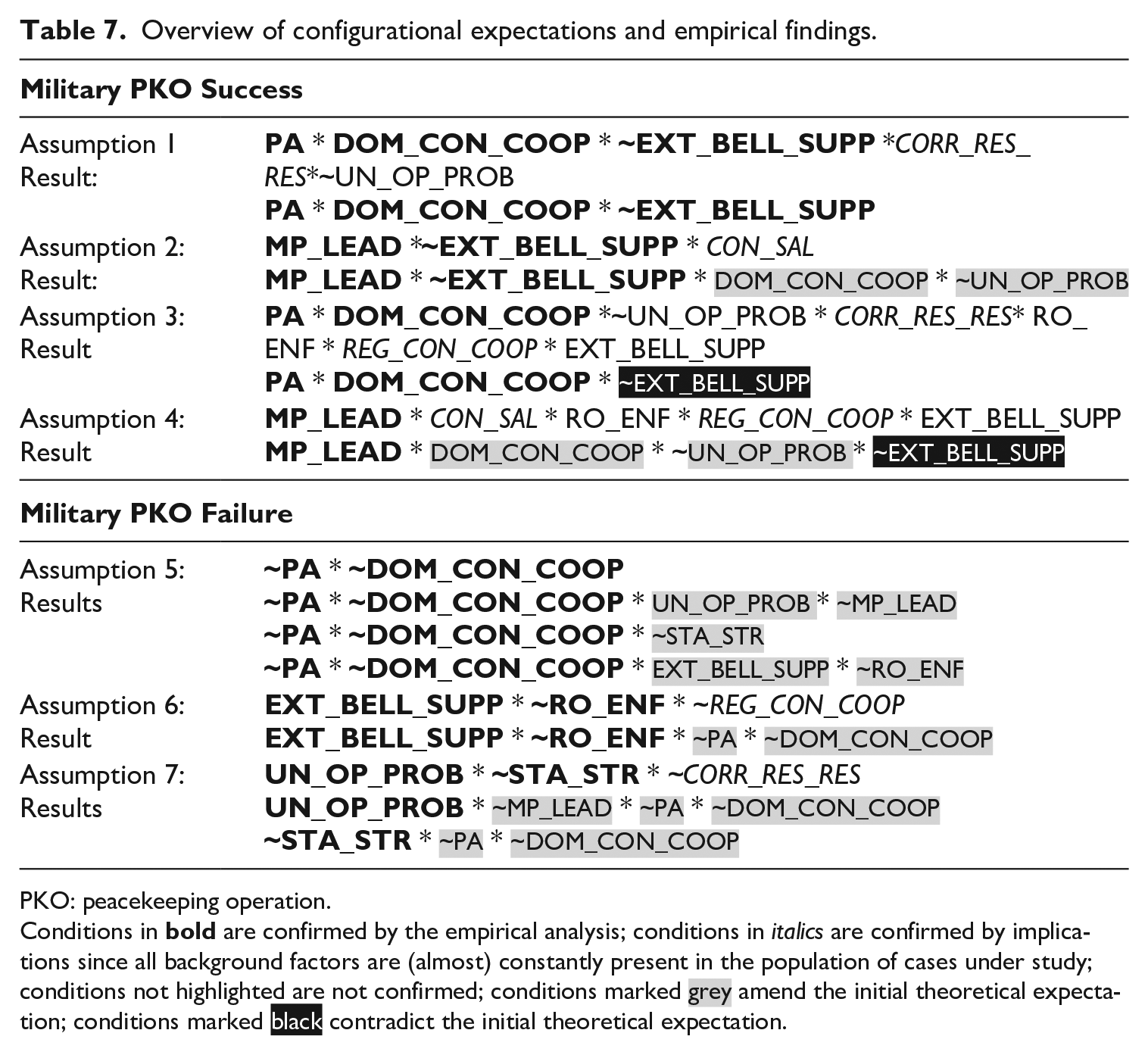
PKO: peacekeeping operation.
Conditions in amend the initial theoretical expectation; conditions marked  contradict the initial theoretical expectation.
Regarding PKO success, a first theoretical expectation was that the local commitment to peace and domestic consent and cooperation combined with sufficient resources, an absence of UN operational problems, and the absence of external support for belligerents would constitute a potential pathway to success. Considering the redundancy of the resources condition, 18 the first pathway accounting for PKO success partially confirms our theoretical expectations. It shows that the joint presence of a peace agreement and domestic consent and cooperation together with the absence of external belligerent support is sufficient for success. However, the absence of UN operational problems is not required.
Our analyses do not suggest that a regional enforcement mandate and regional consent and cooperation are sufficient to mitigate external support for belligerent parties. 19 Given that the absence of external belligerent support is necessary for success, our initial expectation that its presence might be overcome therefore is not supported. 20 In conjunction with the overall redundancy of regional consent and cooperation and the fact that a regional enforcement mandate is associated almost equally with successes and failures indicates that external support for a cessation of hostilities does not have an effect that mirrors the significance of the absence of external belligerent support.
The second pathway to success combines the concurrent presence of a major power lead and domestic consent and cooperation with the simultaneous absence of UN operational problems and external belligerent support. We did not expect the absence of UN operational problems to be part of this term. 21 We cannot fully resolve this discrepancy here without further in-depth case study work. For now, a plausible explanation might be that the absence of a peace agreement, and thus, for example, a lack of clear parameters for disarmament and demobilisation for combatants, requires a higher degree of effectiveness of mandate execution to sustain domestic consent and cooperation while not leaving belligerents with military capabilities to resume fighting.
Each configuration describes a unique set of cases with little overlap between them. The first pathway uniquely covers only African cases, the second pathway covers no African cases uniquely. This suggests that for success of PKOs in African (post-)civil war contexts local commitment to peace and an absence of external belligerent support are jointly sufficient.
Concerning PKO failure, we expected that the lack of a peace agreement and of domestic consent and cooperation would be insurmountable. Also, we expected that external support for belligerents unmitigated by an enforcement mandate for a regional organisation and regional consent and cooperation would lead to PKO failure, as would poorly resourced missions that experience significant operational problems in a context of fragile states.
The three solution terms that we find offer varying degrees of support for these assumptions. First, we find strong support for our principal assumption that the absence of conducive domestic conditions cannot effectively be mitigated. We find in two of our solution terms that (a) the absence of a major power lead and the presence of UN operational problems and (b) the presence of external belligerent support and absence of a regional enforcement mandate, respectively, combine with the absence of conducive domestic conditions to account for the failure of military PKOs.
Even where major powers do make at least diplomatic efforts to overcome these domestic hurdles, such as China with UNAMID (Darfur) or the troika of United States, United Kingdom, Norway (and the EU) with UNMISS (South Sudan), they are unlikely to succeed in the face of a sustained lack of local commitment to peace. This also applies in cases where major power efforts are combined with regional efforts, such as in the case of MINUSMA (Mali) and MINUSCA (CAR).
Our key finding is that what matters most and consistently across all our cases is the presence or absence of domestic consent and cooperation. While neither necessary nor sufficient on its own to explain success or failure, it is, with the exception of MINUSTAH (Haiti), the only condition that is part of all identified pathways to success or failure. Because of the disproportionate impact that a single deviant case can have, a more theory- and case-driven interpretation of our necessity analysis might suggest that domestic consent and cooperation could be considered a second necessary condition for military PKO success in (post-) civil war settings, alongside the absence of external belligerent support. This latter finding confirms existing insights from the literature on spoilers in peace processes (Greenhill and Major, 2006; Stedman, 1997).
The significance of domestic consent and cooperation also speaks to other research on peacekeeping more generally that has found local factors to be of great importance, 22 such as how many peacekeepers are deployed where and how, and what the ‘cultural distance’ is between them and the local population (Beardsley et al., 2019; Bove and Ruggeri, 2019), including the importance of increasing the representation of women in peacekeeping force (Karim and Beardsley, 2017). In this debate about the need for more micro-level analysis in the explanation of peacekeeping success and failure, Phayal and Prins (2019) argue that peacekeepers are ‘deployed to areas that experienced civilian killings, especially when [these] faced armed clashes in the preceding year’ (p. 333). While these deployments happen regardless of perpetrators, absent prior clashes, peacekeepers are more likely to be deployed to areas where rebels commit violence against civilians, and they are also more likely in these areas to constrain rebel rather than government violence, which suggests a higher sensitivity to maintaining host-nation consent (Phayal and Prins, 2019: 329, 334), a finding also echoed by (Fjelde et al., 2019) and by (Hultman et al., 2019) detailed analysis of the MONUSCO case. These studies thus resonate with our conclusion about the significance of domestic consent and cooperation for the success of a military PKO.
Conclusion
The aim of this study was to contribute to the inconclusive debate on the conditions under which UN military PKOs can succeed in contexts of civil war. Adopting a nuanced definition of success that considers violence, displacement, and contagion as its components, we identified 19 full or partial successes and 13 full or partial failures, covering all 32 UN military PKOs deployed to civil war settings to date.
We found that domestic consent to and cooperation with a military PKO turns out as the single most important factor in both its absence and presence. The absence of external belligerent support is part of all pathways to PKO success. Both findings are confirmed in our robustness tests, which underscores the high internal validity of our findings. We are thus confident that we have generated important new hypotheses about PKOs in general that can be further tested in future research on PKOs, including outside the UN context. While this may suggest limited external validity, we note that our findings concern an important and large subset of UN PKOs (32 of all 71 PKOs to date and 6 out of 12 of current PKOs).
Thus, from a policy perspective, military PKOs should not be implemented in the absence of (prior) domestic consent and cooperation or in the presence of external belligerent support. As we know from other research (Binder, 2015; Paris, 2003), the drivers behind UN Security Council decisions on the deployment of military PKOs do not factor in these issues that we found to be crucial for their ultimate success. This raises the question whether and how such consent can be obtained and sustained, and whether and how belligerents can be cut off from external support. Answering this question would be one important avenue for further research, which also connects with existing studies that emphasise the importance of organisational learning for PKO success (Durch, 2006; Hirschmann, 2012; Howard, 2007).
Combining insights from micro-level studies and our own and other research into macro-level factors could be used to guide more in-depth case studies to establish the causal mechanisms that link the factors that we have identified to the outcomes we observe. For example, process tracing in a smaller number of cases could be used to reconstruct how the core ingredients of success and failure that we have identified work, and whether a causal logic of sequencing exists, for example, deriving from the absence or presence of a major power lead that creates subsequent path dependencies. This would also be a significant contribution to building a solid evidence base for policy advice. Beyond the importance of domestic consent and cooperation and the absence of external belligerent support, what we can argue with a high degree of confidence is that military UN PKOs in (post-) civil war settings are more likely to succeed, at least partially, than they are to fail.
Research Data
sj-csv-2-ejt-10.1177_13540661211046602 – for Mission (im)possible? UN military peacekeeping operations in civil wars
sj-csv-2-ejt-10.1177_13540661211046602 for Mission (im)possible? UN military peacekeeping operations in civil wars by Darya Pushkina, Markus B. Siewert and Stefan Wolff in European Journal of International Relations
Research Data
sj-csv-3-ejt-10.1177_13540661211046602 – for Mission (im)possible? UN military peacekeeping operations in civil wars
sj-csv-3-ejt-10.1177_13540661211046602 for Mission (im)possible? UN military peacekeeping operations in civil wars by Darya Pushkina, Markus B. Siewert and Stefan Wolff in European Journal of International Relations
Research Data
sj-csv-4-ejt-10.1177_13540661211046602 – for Mission (im)possible? UN military peacekeeping operations in civil wars
sj-csv-4-ejt-10.1177_13540661211046602 for Mission (im)possible? UN military peacekeeping operations in civil wars by Darya Pushkina, Markus B. Siewert and Stefan Wolff in European Journal of International Relations
Research Data
sj-csv-5-ejt-10.1177_13540661211046602 – for Mission (im)possible? UN military peacekeeping operations in civil wars
sj-csv-5-ejt-10.1177_13540661211046602 for Mission (im)possible? UN military peacekeeping operations in civil wars by Darya Pushkina, Markus B. Siewert and Stefan Wolff in European Journal of International Relations
Research Data
sj-csv-6-ejt-10.1177_13540661211046602 – for Mission (im)possible? UN military peacekeeping operations in civil wars
sj-csv-6-ejt-10.1177_13540661211046602 for Mission (im)possible? UN military peacekeeping operations in civil wars by Darya Pushkina, Markus B. Siewert and Stefan Wolff in European Journal of International Relations
Supplemental Material
sj-docx-7-ejt-10.1177_13540661211046602 – Supplemental material for Mission (im)possible? UN military peacekeeping operations in civil wars
Supplemental material, sj-docx-7-ejt-10.1177_13540661211046602 for Mission (im)possible? UN military peacekeeping operations in civil wars by Darya Pushkina, Markus B. Siewert and Stefan Wolff in European Journal of International Relations
Research Data
sj-R-1-ejt-10.1177_13540661211046602 – for Mission (im)possible? UN military peacekeeping operations in civil wars
sj-R-1-ejt-10.1177_13540661211046602 for Mission (im)possible? UN military peacekeeping operations in civil wars by Darya Pushkina, Markus B. Siewert and Stefan Wolff in European Journal of International Relations
Footnotes
Funding
The author(s) disclosed receipt of the following financial support for the research, authorship, and/or publication of this article: Darya Pushkina and Markus Siewert received no financial support for the research, authorship, and/or publication of this article. Stefan Wolff acknowledges that his contribution to this article was partially funded by the United States Institute of Peace (under the project “Learning from failure: tackling war recurrence in protracted peace processes”, grant number: 1804-18431) and by the Economic and Social Research Council of the United Kingdom of Great Britain and Northern Ireland (under the project “Understanding and Managing Intra-State Territorial Contestation”, grant number: ES/M009211/1).

Supplemental material
Supplemental material for this article is available online.
Notes
Author biographies
References
Supplementary Material
Please find the following supplemental material available below.
For Open Access articles published under a Creative Commons License, all supplemental material carries the same license as the article it is associated with.
For non-Open Access articles published, all supplemental material carries a non-exclusive license, and permission requests for re-use of supplemental material or any part of supplemental material shall be sent directly to the copyright owner as specified in the copyright notice associated with the article.
