




Abstract
Why are acts of organized resistance associated with coups? Inspired by the Arab Spring, a large literature suggests that militaries confronted with civil resistance tend to side with protesters and oust their government. In the historically most coup-prone environment of insurgencies, however, alliances between the military and protesters are implausible because soldiers suspect insurgents behind social dissent. Disentangling different types of resistance, this article analyzes whether and how strikes, demonstrations, riots, and guerrilla attacks affect the military’s disposition and ability to stage a coup during counterinsurgencies. We argue that only strikes trigger coup attempts. Soldiers interpret strikes as manifestations of a strengthening subversive enemy that threatens their victory over insurgents, while economic elites support a coup in the hope that the military will terminate costly walkouts. This interest alignment fosters military takeovers. We provide case-study evidence from Cold War Argentina and Venezuela to show our suggested mechanism at work. Demonstrating the scope of our argument, we quantitatively analyze coup attempts in counterinsurgency worldwide (1950–2005). Results show that strikes increase wartime coup risk, whereas demonstrations, riots, and guerrilla attacks do not. The findings highlight the backfiring potential of nonviolent resistance with important implications for post-coup political orders and democratization prospects.
Keywords
Why are acts of organized resistance associated with military coups? Soldiers are known to overthrow their government if they see the need to do so and believe that their putsch will be successful (e.g. Finer, 1988; Powell, 2012; Thyne, 2010). This article examines how civil dissent influences the military’s disposition and ability for a coup. Regarding soldiers’ coup disposition, the Arab Spring created the expectation that militaries confronted with peaceful demonstrations oust their repressive governments in solidarity with the people in the streets (e.g. Barany, 2016; Chenoweth and Stephan, 2011; Johnson and Thyne, 2018; Nepstad, 2011). In many political settings, however, alliances between protesters and the military are implausible (Holmes and Koehler, 2020; O’Donnell, 1988). In the historically most coup-prone environment of insurgencies, 1 soldiers commonly perceive nonviolent resistance as the work of subversive foes (Kitson, 1971; O’Donnell, 1986; Thompson, 1966). Officers are afraid that the enemy is gaining crucial support among the population, which threatens the military organization and the entire country. Faced with popular dissent, soldiers therefore take over power not in support of protesters but to halt the subversive threat.
Another common expectation is that all forms of public resistance against the state bolster the military’s ability to successfully stage a coup (e.g. Casper and Tyson, 2014; Powell, 2012; Wig and Rød, 2016). Protests are said to generally open a window of opportunity for security forces to coordinate a putsch. However, it remains unclear when coup plotters exactly see an opportunity to successfully overthrow the government. For armed forces involved in a counterinsurgency, for example, the stakes of a coup attempt could hardly be higher. A successful takeover allows soldiers to streamline political decisions and quell the uprising (Thyne, 2017), whereas a coup failure weakens the state, reduces the chances of military victory, and threatens the survival of the military organization. For this reason, coup plotters may worry about potentially opposing factions within the armed forces and are likely to seek the support of influential allies that allow for the smooth seizure of power.
In this article, we analyze the impact of different resistance types on elite interests in the military and the economic sector. 2 We argue that only strikes provide military coup plotters with a powerful ally outside the armed forces. Walkouts impose severe costs on economic elites, which motivates them to turn away from the government and support soldiers in taking over power (O’Donnell, 1973, 1988). Our theory therefore explains the relationship between strikes and coups not through a collaboration between the masses and the military, but through a pact between officers and economic elites that is directed against both the government and the protesters in the streets.
We empirically test our argument using a nested triangulation design, which combines qualitative and quantitative evidence from different levels of analysis (Lieberman, 2005). The qualitative case studies allow us to show the plausibility of our theoretical mechanism. Since coordination between conspiratorial elites is inevitably difficult to observe and quantify, we detail how strikes motivated the close collaboration between Argentine military and business elites in the run-up to the 1976 coup against the Martínez de Perón government. Conversely, we demonstrate how the inability of Venezuelan insurgents to mobilize the working class in the mid-1960s prevented economic elites from supporting the military to take over power. In result, Venezuelan officers refrained from staging a coup during the counterinsurgency despite significant levels of protest. In support of our theoretical argument, the qualitative comparison of two similar cases illustrates the preconditions, developments, and importance of coordination processes between military and economic elites for the occurrence of coups.
To demonstrate the scope of our argument, we conduct quantitative analyses using global data on events of organized resistance and coups across all counterinsurgencies between 1950 and 2005. Deviating from previous studies that use aggregate measures of public dissent (e.g. Casper and Tyson, 2014; Thyne, 2010; Wig and Rød, 2016), 3 we distinguish the four main types of domestic resistance—strikes, demonstrations, riots, and guerrilla attacks. In line with our hypotheses, the results from our quantitative analyses show that only strikes increase the likelihood of coups during counterinsurgencies, whereas other forms of resistance do not.
This article contributes to our understanding of military takeovers by bringing together insights from research on civil resistance, insurgencies, and military coups. Recent studies suggest that military takeovers are especially likely in times of social unrest (Bell and Sudduth, 2017; Casper and Tyson, 2014; Johnson and Thyne, 2018; Thyne, 2010; Wig and Rød, 2016). We advance existing research in five ways. First, we analytically distinguish between resistance types to show that they do not uniformly influence the military’s decision to stage a coup. Second, we uncover the pathways through which different dissent types affect military interests. Third, we show that violent resistance such as guerrilla or terror attacks have little influence on the military’s coup motivation if soldiers perceive them as desperate acts of a weakened enemy. Fourth, we demonstrate the importance of elites outside the armed forces in the initiation of a coup. Finally, we clarify how the political environment of counterinsurgency gives rise to coup coalitions with adverse prospects for democratization. In this context, only strikes both motivate soldiers for a coup and generate the vital support of economic elites.
Research on civil-military relations and coups
We next outline the analytical framework commonly used to explain military coups and discuss how social unrest affects military decision-making. Scholars widely agree that the likelihood of coup attempts increases with soldiers’ disposition and ability to stage a takeover (Feaver, 1999; Finer, 1988; Johnson and Thyne, 2018). Disposition refers to the soldiers’ evaluation to what extent a successful coup would improve their current situation (Powell, 2012: 1021–1022). The more the military or individual factions feel aggrieved by the government, the higher the likelihood for coups (Finer, 1988; Huntington, 1985; Thompson, 1973). Soldiers have staged coups for personal reasons such as private political convictions or unfulfilled career ambitions, but “the defense or enhancement of the military’s corporate interests is easily the most important interventionist motive” (Nordlinger, 1977: 65). 4
Research suggests that soldiers particularly fear for the military’s corporate interests when they are confronted with peaceful protests (Barany, 2016). If governments order harsh repression to quell nonviolent resistance, officers and the rank and file carefully consider the risks of internal divisions, reputational damage, and international repercussions (DeMeritt, 2015: 432–434; Janowitz, 1988: 113). Knowing that foot soldiers lack the appropriate training and equipment to police peaceful crowds, while some recruits may even sympathize with the protesters, officers have to worry that their subordinates will shirk orders or even defect (Albrecht and Ohl, 2016; Nassif, 2015; Pion-Berlin et al., 2014). In the extreme case, this may corrupt the integrity of the entire organization (Geddes, 2004). 5 To avoid these risks, studies argue that militaries are likely to side with the protesters and oust their government (e.g. Chenoweth and Stephan, 2011; Johnson and Thyne, 2018).
However, other than, for example, in Egypt during the Arab Spring, there are contexts where military alignments with the protesters are highly unlikely. This is particularly the case during counterinsurgencies, where soldiers often perceive protesters as the extended arm of the insurgent enemy, which aims at replacing the state and its armed forces by a revolutionary regime (Kitson, 1971; O’Donnell, 1986; Thompson, 1966). The suspected link between rebels and protesters should minimize the military’s willingness to back the people in the streets. While this does not exclude defections by individual soldiers, it reduces the possibility that entire units or factions of the military join the resistance movement.
Beyond disposition, scholars note that soldiers need to have the ability to stage a coup (Powell, 2012). Ability refers to the chances that the attempted takeover will successfully remove the sitting government and that no counter-coup will reverse the newly installed leadership. If coup attempts fail, like in 2016 in Turkey, the instigators and their accomplices usually face draconian penalties and widespread persecution. Coup plotters need to maximize support and legitimacy in secrecy before attempting a revolt (Luttwak, 2016; Singh, 2014). The ability of coup plotters therefore depends on the possibilities to infer the preferences of potential fellow conspirators or supporters, and the capacity to coordinate among those involved without being exposed beforehand (Powell, 2012). The higher the soldiers’ ability to coordinate and sustain a political takeover, the more likely they are to overthrow the government (Casper and Tyson, 2014; Singh, 2014). For this reason, leaders often structurally reduce the military’s ability to organize coups (Talmadge, 2015). Governments may set up parallel organizations that constantly check on each other or break personal ties between soldiers to minimize their ability to revolt (e.g. Böhmelt and Pilster, 2015; De Bruin, 2018; Quinlivan, 1999).
Institutional safeguards, however, cannot provide absolute security from coups. The literature has identified so-called windows of opportunity such as anti-government protests, where soldiers are said to have an exceptionally high coup ability (Thyne, 2010). According to Casper and Tyson (2014: 555–557), for example, protests inform elites about the preferences of the population, the evident vulnerability of the government, and the resulting incentives of other elites to abandon it. Public resistance against the state is therefore supposed to trigger a bandwagon effect with elite members defecting from the government in order to not end up on the losing side (Bell and Sudduth, 2017; Chenoweth and Stephan, 2011). As such, all protests would serve as cues that facilitate coordination among elites and thus increase the risk of a coup.
Notwithstanding their high analytical value for analyzing military takeover, explanations of elite coordination remain largely abstract. It is unclear how elites perceive different types of resistance and how these influence their subsequent behavior. In his seminal study of bureaucratic-authoritarian regimes, O’Donnell (1988: 24–27) argues that powerful elites evaluate domestic resistance in light of the larger political instability. Elites are likely to conspire against the government if they believe that a particular form of resistance is the first sign of a coming revolution, which may deprive them of their hegemony over the populace (O’Donnell, 1988: 28–30). To secure their political and economic supremacy, elites have a strong incentive to establish a new regime that is uncompromising toward protest movements and insurgent groups (O’Donnell, 1988: 31–33).
We build on the argument that the reaction to different forms of resistance depends on the perception and behavior of elites (O’Donnell, 1973, 1988). However, our explanation sheds light on the dynamic coordination between the military and economic elites in the run-up to a coup. We detail how both actors perceive different resistance types and how this influences their subsequent behavior during insurgencies. Since different forms of organized dissent impose distinct costs, we delineate the interests of military and economic actors to explain when and how they conspire against the government.
Resistance types and coups in counterinsurgencies
In this section, we introduce the context of insurgencies and its impact on the perception of public resistance among military and economic elites, 6 before explaining why strikes trigger coups while demonstrations and violent attacks do not. Figure 1 depicts the analytical dimensions and pathways of our argument. By taking into account the central role of the military for staging coups, we classify how different types of organized resistance influence both the soldiers’ disposition and ability to oust the government. 7
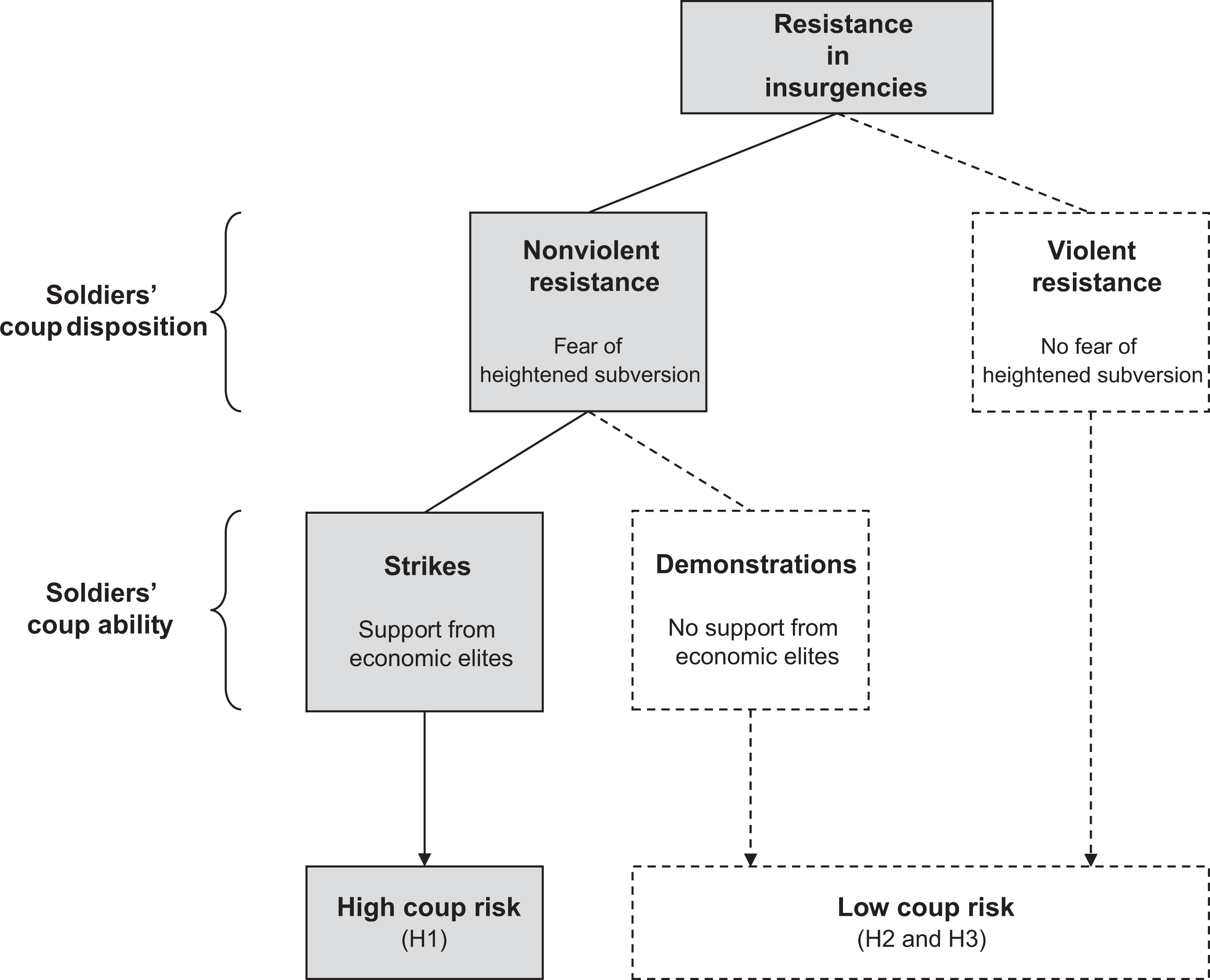
Theoretical mechanism.
Informed by counterinsurgency literature, we argue that significant parts of the armed forces see nonviolent forms of dissent as evidence of a subversive enemy gaining popular support, whereas violent resistance like guerrilla attacks or riots indicate a weakened insurgent enemy (Kilcullen, 2010: 45; Thompson, 1966: 84–111). Confronted with strikes or demonstrations, we expect some soldiers to develop the radical conviction that the incumbent government needs to be replaced as it is incapable of containing the insurgency (Mainwaring and Pérez-Liñán, 2013: 14–15; Stepan, 1986: 136–138). However, soldiers with a coup disposition only attempt to overthrow the government if they believe that they have the ability to do so. Given the heterogeneity of beliefs within the military, coup plotters fundamentally concerned about the subversive threat anticipate that other officers may not share their views and even oppose their coup plans (Albrecht, 2019: 310–316; Scharpf, 2018: 208–209). Conspirators therefore have an incentive to collude with a powerful ally outside the military apparatus to increase the chances of a successful takeover (Aksoy et al., 2015).
We argue that strikes increase coup ability by triggering support from economic elites. Even though business owners worry less about political subversion, entrepreneurs, managers, and investors fear that labor-based dissent may have unpredictable, long-term consequences on the economy with detrimental consequences for their profits (O’Donnell, 1988: 15–22). In the worst case, frequent work stoppages and costly concessions to workers cause economic losses that are severe enough to destabilize entire economic sectors. Faced with strikes, economic elites should thus be sympathetic to actors that are uncompromising toward workers’ demands (O’Donnell, 1988: 25). As we explain next, during insurgencies they are likely to find allies within the military that are also fundamentally concerned about walkouts.
The context of counterinsurgency and subversion
Insurgencies are asymmetric conflicts between militarily inferior rebels and a comparatively strong state (Kalyvas and Balcells, 2010). Because of the uneven combat power, insurgents avoid pitched battles but rely on sporadic hit-and-run attacks to wear down the state in a protracted armed struggle (Kalyvas, 2005; Lyall, 2010). To win the victory over the state and achieve their political goals, insurgent groups must gain the support of the wider population (Johnson, 1962; Valentino et al., 2004). Civilian support allows attackers to minimize own losses, as they can blend in and out of the population and exploit the momentum of surprise (Valentino et al., 2004). More importantly, rebels need civilian backing to acquire resources, attract recruits, and gain legitimacy (Paret, 1964; Thompson, 1966). Only then can insurgent groups overcome their military inferiority and be successful.
To win the vital support from the population, rebels extensively use propaganda. Insurgents try to persuade civilians of the government’s responsibility for all wrongs and injustices while they claim to fight in the name of the people (Paret, 1964: 12). Activities of ideological indoctrination thereby often aim at dissatisfied students, workers, or peasants. These efforts are commonly summarized as “subversive” (Rosenau, 2007: 4–8). Subversion comprises all activities “short of the use of force, designed to weaken the military, economic or political strength of a nation by undermining the morale, loyalty or reliability of its [citizens]” (British Army, 2007: xii). Insurgents draw on subversive tactics to erode the foundations of the state, mobilize the civilian population for the own cause, and achieve their goals through broad popular backing (Nkrumah, 1968: 98–99).
The rebels’ use of subversion in domestic conflicts has a profound impact on the soldiers’ mindset and tasks. Counterinsurgency experts agree that approaches that are primarily concerned with solving acute security problems with military force inevitably remain piecemeal, as it does not address the underlying problem (e.g. Kitson, 1971; Paret, 1964; Trinquier, 1964). A comprehensive counterinsurgency strategy must tackle the ideological roots of the rebellion: “the main emphasis should be given to defeating subversion, not the guerrillas” (Thompson, 1966: 111). As a consequence, the military often assumes a greater role in political decision-making and takes over genuinely civilian tasks in order to prevent the subversive ideas from infecting the minds of the larger population (Huntington, 1962: 19–22). 8 For example, in the hope of countering the insurgent propaganda, soldiers provide public services to alleviate civilian grievances (Stepan, 1986). The military’s meddling in political affairs and its regular interaction with the larger population hereby often politicizes otherwise politically sterile military organizations (Elkin and Ritezel, 1985; Horowitz 1980).
The impression of an ongoing subversion convinces politicized soldiers that the military faces existential threats in the event of defeat. 9 Victorious rebels typically dismantle the military apparatus by imposing far-reaching security sector reforms (Lyons, 2016; White, 2020). This may include the replacement of the old military leadership by former rebel commanders, the creation of a new rebel-led security organization with or without an integration of the traditional army, as well as mass purges in the officer corps. The threat of a successful subversive enemy for the integrity of the military makes soldiers highly sensitive toward suspicious civilian behavior and nonviolent dissent.
Why nonviolent resistance increases coup disposition
Based on counterinsurgency training and the priming on subversive threats, soldiers begin to see society and all civilian behavior through the lens of subversion (Kitson, 1971). Officers commonly suspect insurgents behind social unrest—whether this suspicion is justified or not (O’Donnell, 1986: 104–105). Military doctrines and training manuals highlight strikes and demonstrations as serious indicators of an advancing insurgent enemy (Haugaard, 1997). From the perspective of soldiers, the occurrence of nonviolent resistance is alarming. It indicates that the opponent’s subversive strategy works and that the enemy has won substantial popular legitimacy, increasing the insurgent’s chances of victory (Kitson, 1971).
Whether armed insurgents are actually behind individual events of civil resistance is hard to tell but also largely irrelevant for its impact on soldiers. The mere possibility of insurgent agency is often sufficient to trigger fears of facing a subverted population. In fact, various strategists of guerrilla warfare have explicitly stressed the importance of nonviolent resistance in support of the armed struggle. Both Mao Tse-tung (Marks, 2003: 101–102) and Régis Debray (2017: 46) advised fighters to infiltrate civilian organizations, encourage civil resistance, and initiate “union struggles.” Similar thoughts can be found in manuals of urban insurgency, praising demonstrations and strikes as indispensable tools to disrupt the social and economic foundations of the state (Marighella, 2011: 49, 61–64).
From the perspective of soldiers, it therefore appears crucial to end nonviolent resistance before it creates revolutionary momentum (Paret, 1964). Peaceful dissent signals legitimate opposition against the state, which may attract domestic or foreign support for the enemy and severely reduces the military’s prospects for victory (Chenoweth and Stephan, 2011). In these situations, soldiers are likely to see the government as a risk factor, which, “through its passivity, lack of authority and inefficiency,” obstructs necessary steps in fighting back the subversive enemy (O’Donnell, 1988: 49). Moreover, officers often believe “that their capabilities are superior to those of the civil sectors, and that these capabilities are sufficient to solve a wide range of social problems” (O’Donnell, 1986: 105). Such conceptions, for example, shaped military thinking in Latin America. In the wake of nonviolent opposition, which these officers saw as a manifestation of a large-scale communist subversion, they concluded that a putsch would be the best way to restore law and order, streamline politics according to the demands of counterinsurgency, and protect both the nation and themselves from greater harm.
Moreover, governments often unwittingly corroborate the soldiers’ conviction that taking over power is necessary (Wig and Rød, 2016). When faced with waning popular support and public display of nonviolent discontent, governments are likely to opt for concessions in order to stay in office (Leventoglu and Metternich, 2018; O’Donnell, 1988). From the soldier’s perspective, however, giving in to the demands of protesters would further strengthen the rebels at the cost of state and military (White, 2020). For example, in 1961, French generals attempted to oust President de Gaulle because they felt that his negotiations with the Algerian insurgents was a contempt for their past sacrifices and a capitulation to the enemy (Ambler: 1966: 257–260). 10 Soldiers tend to perceive reconciliatory steps by the government as betrayal of their war efforts, which motivates them to revolt (White, 2020).
In sum, soldiers, who are confronted with a subversive enemy, are likely to interpret peaceful resistance as a threat to their military victory over the rebels, which increases their disposition for a coup. We now further disaggregate nonviolent resistance to assess whether strikes and demonstrations influence the soldiers’ ability to replace the government during insurgencies. In particular, we analyze how these resistance types facilitate the coordination among potential allies.
Why strikes increase coup ability but demonstrations do not
As outlined above, internal security threats significantly change civil-military relations (Desch, 2008; Stepan, 1986). Governments depend on military expertise and resources which is why they include officers in the executive decision-making (Bove et al., 2020: 268–269). Officers commonly serve as advisers to governments, occupying posts in ministries and agencies. Moreover, during insurgencies, soldiers typically perform genuine civilian tasks of the state bureaucracy by organizing essential services such as electricity, telecommunication, water, and food supply (Elkin and Ritezel, 1985: 494). This makes the military a central representative of the state, responsible for public security and economic well-being.
In their role as a public service provider, officers become important contact persons for the economy. To maintain the day-to-day business and minimize adverse effects of security operations, officers regularly meet and communicate with business representatives (Muleiro, 2011). In this context of repeated consultations, members of the military and the economic sector exchange views, establish personal relationships, and build mutual trust. These interactions allow military and economic elites to recognize and communicate common problems and interests in a trustful atmosphere (Casper and Tyson, 2014). If both sides believe that the government is incapable of protecting their core interests, they are likely to plot against the government.
While officers are highly alarmed by any form of nonviolent resistance during insurgencies, only strikes are likely to motivate economic elites for a military takeover. Compared to demonstrations, strikes are highly resilient and impose extensive direct costs on businesses (Butcher et al., 2018; Dinardo and Hallock, 2002). Labor unions offer established institutions with supraregional structures and strong ties at the local level. Relying on such densely knit, well-coordinated networks, strikers can maintain work stoppages and withstand state repression for extensive periods of time (Butcher et al., 2018; Butcher and Svensson, 2016; Schock, 2005). In contrast, demonstrations often lack comparable levels of organization, which makes it more difficult for protesters to maintain cohesion and endure repression (Carey, 2010: 172). Moreover, the capacity of anti-government protesters to inflict direct economic costs on entrepreneurs and business owners is often limited. Demonstrations usually feature a high share of dissidents and students who do not play a crucial role in the firms’ production processes (Karklins and Petersen, 1993: 594). It is therefore particularly labor-based dissent that threatens the vested interests of business owners and investors.
In view of the great leverage and resilience of strikers, civilian governments might opt for reconciliatory approaches to please workers (Leventoglu and Metternich, 2018; O’Donnell, 1988). Business elites anticipate that this would decrease their profits and strengthen the position of workers in future bargaining. Investors and entrepreneurs therefore seek a government that is determined to end labor-based dissent without giving in to the strikers’ demands. The regular exchange between soldiers and economic elites during insurgencies offers a forum to discuss plans on how to end workers’ resistance, eliminate the underlying causes of dissent, and secure the country’s long-term economic stability.
Faced with strikes, both military and economic elites are likely to conclude that a military takeover will be mutually beneficial. 11 Historically, well-connected business elites have frequently profited from military coups (Dube et al., 2011). Hugo Banzer’s military regime in Bolivia, for example, quickly dissolved trade unions and implemented free-market reforms that unequivocally benefited business owners. In Chile, General Pinochet pursued a purely neo-liberal agenda that “led to sharp reductions in labor costs and higher profits for owners” (Pion-Berlin, 1986: 317). Once in power, pacts between military and economic elites may foster bureaucratic-authoritarian regimes, which seek to stabilize the economy through business-friendly policies and systematic repression of organized labor (O’Donnell, 1988: 31–32). In the hopes that a military government will restore order and profitable economic conditions, business elites are likely to defect from the current regime.
From the perspective of soldiers, coup support from business owners and investors is crucial to permanently pacify society and protect the nation from future threats. Such support may comprise access to intelligence, infrastructure, and resources critical to the counterinsurgency campaign. With powerful economic allies at their side, officers can expect to hold on to power long enough to implement comprehensive security measures (Geddes et al., 2014: 151). This includes rooting out insurgents in the jungles or mountains as much as eradicating subversives from the civilian administration, universities, unions, and companies. In sum, strikes are likely to trigger coup attempts during counterinsurgencies, as coup plotters in the military may coordinate the takeover with strategically important economic elites who are equally determined to end the dissent.
Why violent resistance does not motivate coups
Acts of violent resistance, by contrast, are unlikely to raise soldiers’ concerns about military victory and should thus not motivate coups during insurgent uprisings. Counterinsurgency experts agree that an increase in violent attacks indicates that the military campaign is effective and the enemy is losing ground (Johnson, 1962: 652; Kilcullen, 2010: 45). Research shows that guerrillas typically react to waning civilian support or battle losses with an increase in violence to obscure their own weakness and demonstrate the government’s inability to protect its citizens (Hultman, 2007: 209–210). While this strategy may have an intimidating effect on civilians, it is unlikely to impress military officers.
Violent insurgent attacks also do not touch upon other military corporate interests. Soldiers are trained and equipped to fight armed enemies; this is the military’s area of expertise, which explains why Burmese officers felt relieved when, in the 1980s, previously protesting “students fled the cities to join the armed insurgents in the jungles, where the comparative advantage of the state was much greater” (Schock, 2005: 158). Further, soldiers are little concerned about the risks of defections, budgetary cuts, or political opposition for carrying out heavy-handed operations in response to violent resistance (Schock, 2005). To defeat violent insurgents, governments often grant the security forces far-reaching powers and resources (Acemoglu et al., 2010; Bove et al., 2020). Faced with terrorist attacks or riots, governments and soldiers agree on the necessity to answer violence with force, and military units do not have to fear reputation damage, as harsh responses to violent dissent are easy to justify and legitimize (Kalyvas, 2005: 100–101; Schock, 2005: 161). Guerrilla attacks and riots should therefore not motivate military coups during insurgencies.
Qualitative analysis
We test our argument with a triangulation design that nests a qualitative in a larger quantitative analysis. Before we turn to the macro-quantitative analysis demonstrating the scope of our argument, we probe the plausibility of our suggested mechanism with two case studies. The “model-testing small-n analysis” allows us to scrutinize the perceptions, interests, and behaviors of key actors (Lieberman, 2005: 440–443). Hereby, we can identify the collusion dynamics between military and economic elites before a coup, which are difficult to capture otherwise. Contrasting organized resistance during the insurgencies in 1970s Argentina and 1960s Venezuela, we trace back how strikes stirred fears of subversion among officers and generated support from business elites for taking over power.
Following Lieberman (2005: 444) and Przeworski and Teune (1970: 32–39), we select the two qualitative cases for their similar contexts. Besides a common cultural, religious, and colonial background, as well as the shared language and geographic region, both states were confronted with multiple communist insurgent groups fighting in urban and rural areas. Both countries had experienced several military coups and had only recently returned to democratic rule through popular uprisings (Burggraaff, 1972: 125–129; Heinz, 1999: 615–616). The military in both cases suffered from internal divisions that occasionally erupted in mutinies and even armed infightings (Andersen, 1993: 45–47; Trinkunas, 2000: 87–95). Finally, both Argentinean and Venezuelan officers had a similar perception of subversive struggles based on years of foreign training (Burggraaff, 1972: 47; Pion-Berlin and Lopez, 1991: 69–71). The cases did, however, differ in both the mode of civil resistance and the outcome. Nationwide strikes in Argentina motivated soldiers to stage a coup with the active support of economic elites. By contrast, the Venezuelan insurgents could not incite labor resistance and there was no elite support for military intervention preventing soldiers from plotting against their government.
Argentina
Since the early 1970s, Argentina had faced violent attacks by two insurgent groups. Marxist insurgents of the People’s Revolutionary Army and the left-Peronist Montoneros relied on hit-and-run attacks, bombings, assassinations, and kidnappings to interrupt all political and economic life (Heinz, 1999: 621–633). In early 1975, President Isabel Martínez de Perón granted the military far-reaching powers to eliminate the insurgents and their support networks (Scharpf, 2018: 209–211). What started as a military operation in the rural province of Tucumán soon turned into a nationwide military campaign to uproot any subversive tendencies (Heinz, 1999: 684; Lewis, 2002: 105–113).
At the same time, since 1975, general strikes and student protests in urban centers disrupted public life throughout the country (Lewis, 2002: 100–102). These developments strongly influenced many officers’ stance toward the government and their assessment of the insurgent threat, which later motivated the military leadership to take over power. On the one hand, the worsening economic situation, driven by ill policies and galloping inflation, showcased the government’s incapacity to provide political stability (Heinz, 1999: 637). On the other hand, the publicly voiced dissent in the streets and factories alarmed soldiers about the potential magnitude of subversion. After years of French counterinsurgency training and under the influence of the US National Security Doctrine, many Argentine officers were convinced that the acts of organized resistance were clear signs of a communist takeover (Heinz, 1999: 672–680; Lewis, 2002: 137–143). Precisely along those lines, Jorge Videla, the commander of the army, justified the seizure of power on the eve of the coup: “The state shows itself incapable of carrying out its mission […], [t]he citizens’ security is seriously threatened […], [and t]he industrial guerrillas are capable of damaging the country’s productive apparatus” (Andersen, 1993: 170).
While labor unions used strikes to rally against worsening economic and working conditions, the actual influence of insurgents on nonviolent acts of resistance remains unclear (Muleiro, 2011: 88–90; Paulón, 2016: 166–185). Nevertheless, many officers believed that the guerrillas had already disseminated their revolutionary ideas to the working class and were using strikes to wear down the economic foundation of the state. “Trade unionists were thought of as domestic sponsors of subversion in league with international agents of communism” and military hardliners made no distinction between “Marxist, guerrilla, and legitimate working-class organizations” (Pion-Berlin and Lopez, 1991: 75). For these officers, Peronist labor unions were “the most dangerous sectors of society apart from the guerrilla groups,” as the organizations were “infiltrated by the left and potentially dangerous because they were obvious targets for the guerrillas” (Heinz, 1999: 668). Influential officers were convinced that only radical reforms would reinstate law and order (Pion-Berlin and Lopez, 1991: 72–73). With a Peronist government in place, unwilling or incapable to quell subversion, most officers became convinced that an intervention in politics was inevitable. Their goal was to overthrow the government and save the country by eradicating subversion from all parts of society (Lewis, 2002: 131–137). 12
Like the military, the country’s economic elite became increasingly critical of the government. Entrepreneurs and managers worried that giving in to the unions’ demands would rupture the Argentine economy and destroy their wealth. Influential factory owners and families therefore started to support the economic and political plans of the military (Muleiro, 2011). The alignment between the Argentine establishment and soldiers became explicit in 1975, when officers regularly met and discussed political matters in circles organized by influential business representatives in the offices of the director of Citroën, Jaime Perriaux (Muleiro, 2011: 71–75). In these meetings, military officers and businessmen, such as Argentine Economic Council President Martínez de Hoz, agreed on the “composition and purposes of the future government, among them the repression of a supposed Marxist infiltration in the unions of its factories and companies” (O’Donnell, 2012). Business associations sided with the military to “impose a social, economic, and political reengineering program” (Paulón, 2016: 183). By the end of 1975, leading officers with strong coup disposition knew that they had the support of the country’s economic elite. Convinced that the insurgents were gaining momentum from infiltrated trade unions, on the early morning of 24 March 1976, Argentinians woke up to the announcement that the military had assumed power.
Venezuela
Since the early 1960s, Venezuela had faced violent resistance from communist insurgents. As in Argentina, two insurgent groups used guerrilla tactics to disrupt public life with the aim of replacing the Betancourt government with a revolutionary leftist regime. But despite the attempt to demonstrate unity by pooling forces in the Fuerzas Armadas de Liberación Nacional (FALN), the insurgents failed to mobilize workers in the cities. For this reason, in 1964, during the first year of the presidency of Raúl Leoni, the rebels intensified their violence and spread their efforts to more rural areas (Alexander, 1969: 73–94). The government responded by deploying the military and equipped it with great autonomy to fight insurgents and subversive networks (Trinkunas, 2000: 96–97).
Venezuela’s special forces in charge of the military campaign had received US counterinsurgency training and held “exceptionally strong […] anti-guerrilla feelings” (Wickham-Crowley, 1992: 66). Given the large-scale and sometimes violent student protests, military officers were highly concerned about the subversive threat. Assisted and inspired by the revolution in Cuba, the rebels tried to spread their subversive ideas and induce desertions among the armed forces (Levine, 1973: 145–176; Wickham-Crowley, 1992: 88–89). 13 From the perspective of many soldiers, the insurgents wanted to destroy both the government and the military (Irwin, 2000: 5), which fueled their disposition for a coup.
However, despite being a major strategic goal, the insurgents never gained the support of the working class and largely failed to mobilize peasants (Alexander, 1969: 107–109; Wickham-Crowley, 1992: 197). When their calls for strikes did not resonate with the workers, the insurgents turned to terror attacks, which further reduced their public support (Callanan, 1969: 53–54). Most labor unions and the vast majority of the rural population actively supported the democratic parties (Alexander, 1969: 107–113; Wickham-Crowley, 1992: 197). As one leading insurgent member put it: “[W]e forgot that in the working class and the peasantry we had no support—there was absolutely no mass solidarity with the idea of insurrection” (Levine, 1973: 162). Since the interests of economic elites were not affected, they did not actively lobby for a military takeover. Other than in the case of Argentina, this allowed the Venezuelan government to implement an economic program, which included large investments in industries and infrastructure (Alexander, 1964: 115; Alexander, 1969: 189–190).
At the same time, the Betancourt government sensibly improved the conditions of the military. This rapprochement between the executive and the armed forces alleviated soldiers’ concerns about military cohesion while strengthening their loyalty to democratic institutions (Alexander, 1964: 106–117). The government achieved that “the great majority [of soldiers] were at least passively loyal, while a considerable number actually became enthusiastic about the regime” (Alexander, 1964: 117). Only minor factions within the armed forces still perceived the necessity to take over political power. Between 1959 and 1962, revolting soldiers not only lacked the backing by a powerful societal ally, but the mutineers were also unable to gain the support of the country’s main garrisons in Caracas and Maracay (Alexander, 1964: 111). In result, revolts were easily put down by the military factions loyal to the government. The vast majority of the armed forces was convinced that the government could handle the insurgency without undermining military interests and that the economic elites would side with the civilian government in case of a coup (Alexander, 1964: 114). Venezuela’s armed forces therefore did not concertedly attempt to overthrow the government during the counterinsurgency.
Quantitative analysis
To test the scope of our argument, we next conduct a quantitative analysis of coup attempts during all 146 counterinsurgencies between 1950 and 2005. We draw on the war list by Lyall (2010) as the operational definition closely matches the subversive context. Lyall (2010: 175) codes conflicts in which insurgents use guerrilla warfare and subversion to win civilian support and attain their political objectives in an asymmetric, protracted struggle against the government. We collapse countries fighting multiple counterinsurgencies in the same year to avoid double counting data points and biased standard errors. The unit of analysis is the country-year.
Data and method
Our dependent variable is Coup attempts based on Powell and Thyne (2011). The data offer information on “illegal and overt attempts by the military or other elites within the state apparatus to unseat the sitting executive” (Powell and Thyne, 2011: 252). The binary variable takes on the value of 1 for years in which members of the state apparatus undertook at least one attempt to oust the government, and 0 otherwise.
Our independent variables are based on Banks (2008). Following Casper and Tyson (2014), we use these data due to their global coverage throughout our observation period. Other data sources offer more fine-grained information on organized resistance events, but at the expense of limited temporal or geographical coverage (Clark and Regan, 2018; Raleigh et al., 2010; Salehyan et al., 2012). Banks (2008) provides information at the country-year level. In line with previous studies (e.g. Bell and Sudduth, 2017; Powell, 2012), we refrain from lagging our independent variables, as our argument suggests that resistance events have a direct, contemporaneous effect on coup attempts. Moreover, lagging presents a poor solution to endogeneity (Bellemare et al., 2017).
This may raise concerns about temporal ordering and reverse causality. While we cannot completely rule out that strikes or demonstrations occur in response to military takeover, we use event data by Clark and Regan (2018) to mitigate these concerns and assess the magnitude of potential endogeneity problems. If our analysis suffered from reverse causality, we would expect strikes and demonstrations to occur after a coup attempt had taken place. Figure 2 depicts the timing of both dissent types 10 weeks before and after all coup attempts between 1990 and 2017. Strikes clearly increase before coup attempts but remain low afterwards. We are confident that our results for strikes are unlikely to suffer from reverse causality. This is different for demonstrations, which occur in reaction to coup attempts more often. Positive and significant estimates for demonstrations might therefore stem from reverse causality.
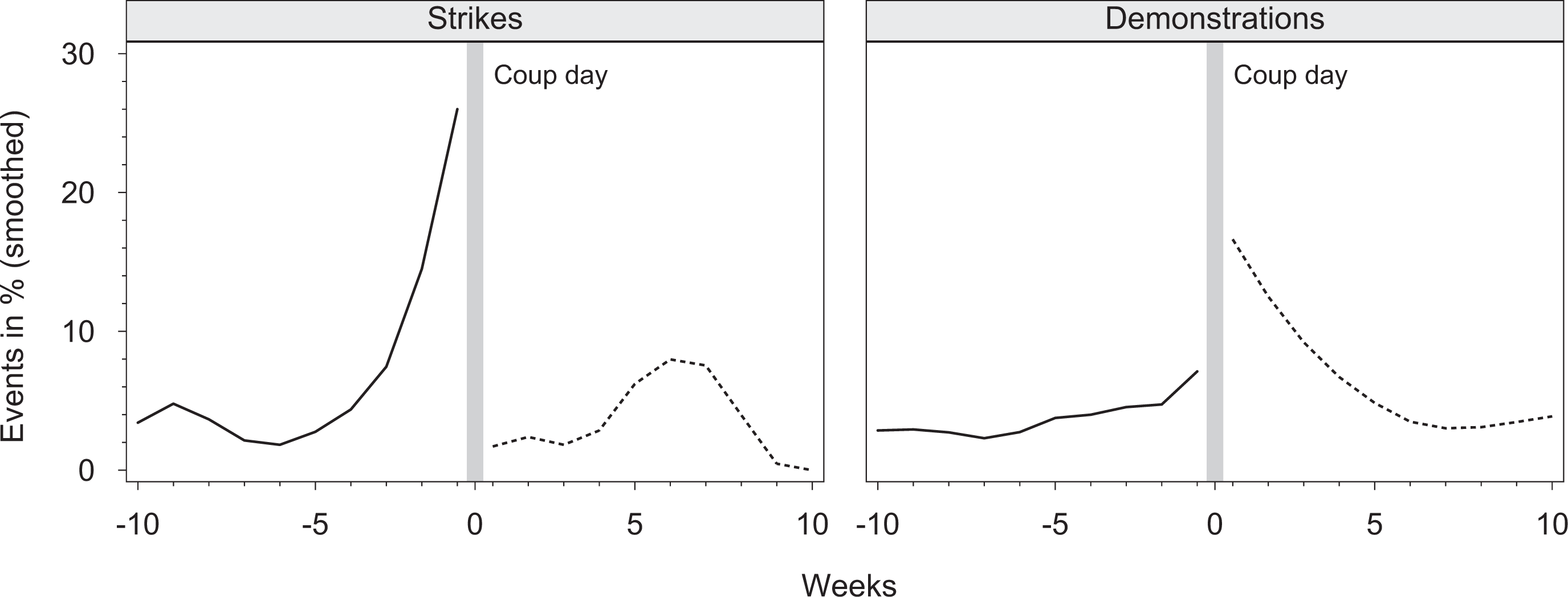
Temporal order of resistance events and coup attempts.
To test our hypotheses, we construct separate variables that code events for each resistance type: Strikes, Demonstrations, Guerrilla attacks, and Riots. Due to concerns about reporting biases and to assess the robustness of our results, we use three versions of each independent variable. First, we employ binary variables indicating country-years in which the respective resistance event occurred at least once. Second, we use count variables giving the number of events of each dissent type. Third, we use the natural logarithm of the count variables to mitigate potential problems with outliers.
Merging data on resistance types with information on insurgencies provides us with a comprehensive picture of resistance events in internal conflicts. Due to the coding rules of counterinsurgencies (Lyall, 2010), not all country-years in our data feature events. We believe that this is a realistic depiction of protracted insurgent campaigns with sporadic attacks, which also guarantees variation in our independent variables. The absence of nonviolent and violent events in some years provides us with an empirical counterfactual in the quantitative analysis. 14
We control for variables that are likely to confound the relationship between resistance events and coups. GDPreal growth controls for economic conditions that may influence social unrest, support by economic elites, and military disposition for coups. Data are taken from Gleditsch (2002). Troop funding measures military expenditures per soldier and is based on CoW (2010) data. It proxies for the sophistication of military training and equipment as well as for potential material grievances among soldiers that might motivate them to rebel. The variable Democracy from Cheibub et al. (2010) indicates democratic governance. We control for democratic regimes because they provide institutionalized ways of accommodating public dissent and usually maintain professional armies.
Distance to capital measures the logged distance between the insurgency and the capital (Lyall, 2010). It captures the logistical ease with which deployed soldiers can oust the government as well as political and military dynamics from operations close to the state’s power center (Bell and Sudduth, 2017; Johnson and Thyne, 2018). We include the variable Multiple insurgencies, which identifies years in which governments fight multiple insurgencies as this depletes military resources and provides groups with the opportunity to organize resistance. Occupation indicates whether the government is a foreign occupier as this might increase resilience of opposition movements and decrease military commitment. Finally, we replicate all our statistical models with region fixed effects to account for idiosyncrasies across different world regions. In the Supporting Information (SI), we offer additional model specifications with control variables including the state’s repressive capacity, two full sets of regime types, the cold war period, and the duration of conflicts to demonstrate the robustness of our results. Our results hold across all specifications. Summary statistics for all variables are shown in Table SI.1 in the SI.
As our dependent variable is binary, we employ logistic regression models. All models include polynomials for the time since the last coup attempt to account for time dependencies in the dependent variable (Carter and Signorino, 2010). Standard errors are clustered on the country-level to account for additional country-specific correlations. In the SI, we show that our main findings also replicate with linear probability models.
Results
Results in Table 1 offer statistical support for the three hypotheses. In line with H1, strikes are positively and significantly correlated with the risk of coup attempts. The effect is robust across all specifications and for all measures of strikes. This supports our argument that soldiers are more likely to attempt coups if they can count on the support of economic elites eager to end costly work stoppages. Results also offer empirical evidence for H2. The coefficient estimates for demonstrations are statistically insignificant. Demonstrations may motivate soldiers to intervene in politics but without elite support this is not sufficient to trigger coups. The results further add to our confidence that the analyses do not suffer from reverse causality, since potential endogeneity problems, if anything, should have resulted in a positive and significant estimate for demonstrations. Finally, in line with H3, guerrilla attacks and riots are statistically insignificant predictors of coup attempts during counterinsurgencies. The military considers violent tactics as a regular manifestation of insurgent struggle.
Types of resistance and coup risk in counterinsurgencies, 1950–2005.
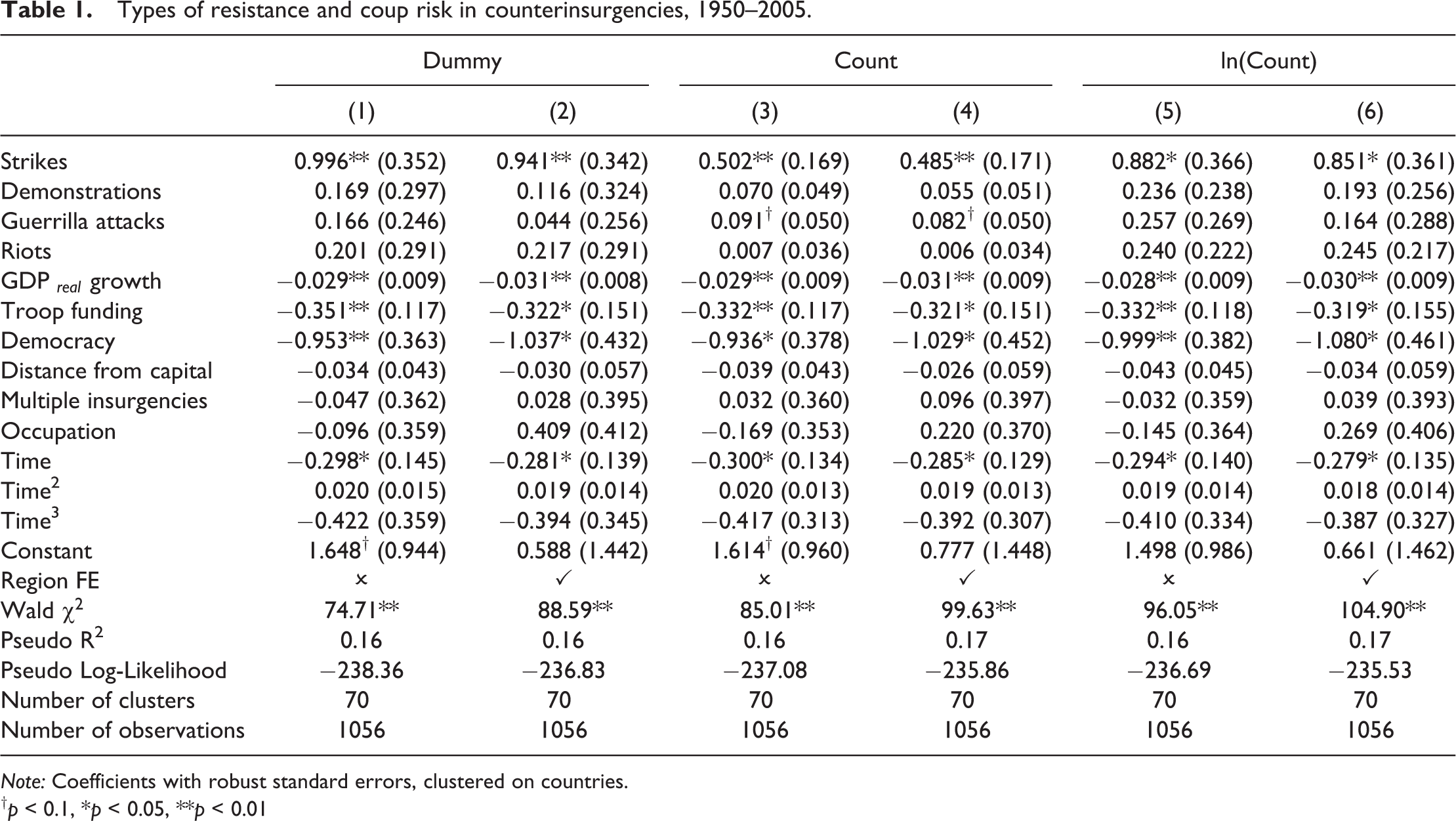
Note: Coefficients with robust standard errors, clustered on countries.
† p < 0.1, *p < 0.05, **p < 0.01
The results for the control variables show that soldiers are less likely to putsch if the military budget is high and the economy is doing well. Furthermore, democratic governments face lower coup risks as these regimes provide institutionalized channels to articulate grievances for both citizens and soldiers. The time polynomials suggest that temporal proximity to previous coups lowers the risk of a repeated attempt. Given that a failed coup weakens the state in its struggle against insurgents, coup plotters may refrain from attempting consecutive takeovers. Finally, location, number, and type of insurgencies do not seem to be correlated with wartime coup risk. These results underpin our argument that it is events within conflicts rather than structural features of insurgencies that trigger military takeovers.
To gauge the substantive effects, Figure 3 depicts predicted probabilities (King et al., 2000). 15 It shows that strikes substantively raise the probability of a coup attempt in that year. As the annual number of strikes increases from 0 to 5, the risk that soldiers try to oust the government increases sixfold, from 6.7% (95% CI: 3.7%–11.0%) to 46.2% (13.4%–81.3%). 16 In contrast, peaceful demonstrations, guerrilla attacks, or riots are not correlated with a heightened coup risk.
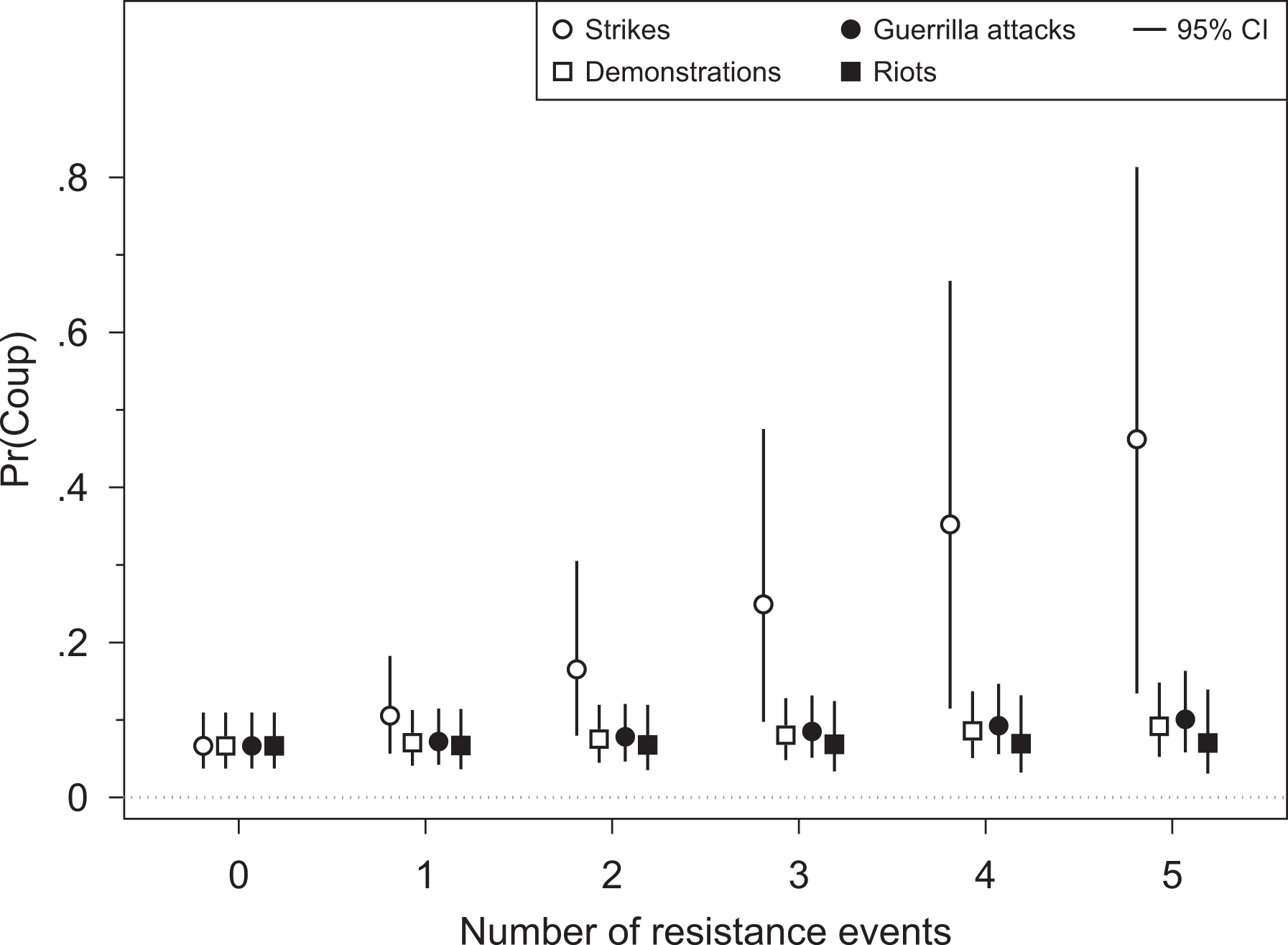
Substantive effects of different resistance types on the risk of coup attempts in counterinsurgencies (based on Model 3).
Overall, the results lend support to our hypotheses. In insurgencies, strikes provide soldiers with the disposition and ability to attempt coups. To soldiers, strikes indicate that the subversive enemy is gaining ground among the civilian population, which threatens military interests and the integrity of the state. With the support of economic elites who are concerned about their business, soldiers attempt to oust the government in the hopes of effectively suppressing the insurgency and stabilizing the country.
Conditional and selection effects
To corroborate our main findings, we test for conditional and selection effects. Before we turn to a Heckman regression model, which accounts for non-randomly selected samples, we first show that our findings also hold if we study the effects of resistance within and outside of insurgencies. To this end, we expand our analysis to all country-years from 1950 to 2005 and include interactions between the resistance types and a dichotomous insurgency variable in the statistical analysis. This enables us to study how each resistance type influences the risk of coup attempts in peace times and in counterinsurgencies. If our theoretical argument is correct, we should observe that during insurgencies the effect of strikes on coup attempts is significantly larger than the effect of any other resistance type. In contrast, during peace times, the effects of all resistance types should be not significantly different from each other (Casper and Tyson, 2014; Thyne, 2010; Wig and Rød, 2016). Statistical results are shown in Table SI.9. 17 Since conditional effects should not be directly interpreted in logit models, we calculate substantive effects (Berry et al., 2010).
Figure 4 shows that the effect of strikes on coup risk is indeed positive and significantly larger than the effects of all other resistance types during insurgent uprisings, which confirms the findings from our main analysis. During peace times, by contrast, the effect of strikes is only marginally significant and statistically indistinguishable from the effect of all other resistance types. This offers further support for our argument. Labor-based resistance leads to military takeovers in a context where fears of subversion and economic loss create an alliance between military and economic elites for taking over power. During peace times, where the military does not fear an ongoing subversion, all resistance types are modestly correlated with a higher coup propensity, which corroborates the findings of previous studies (Casper and Tyson, 2014; Thyne, 2010; Wig and Rød, 2016).
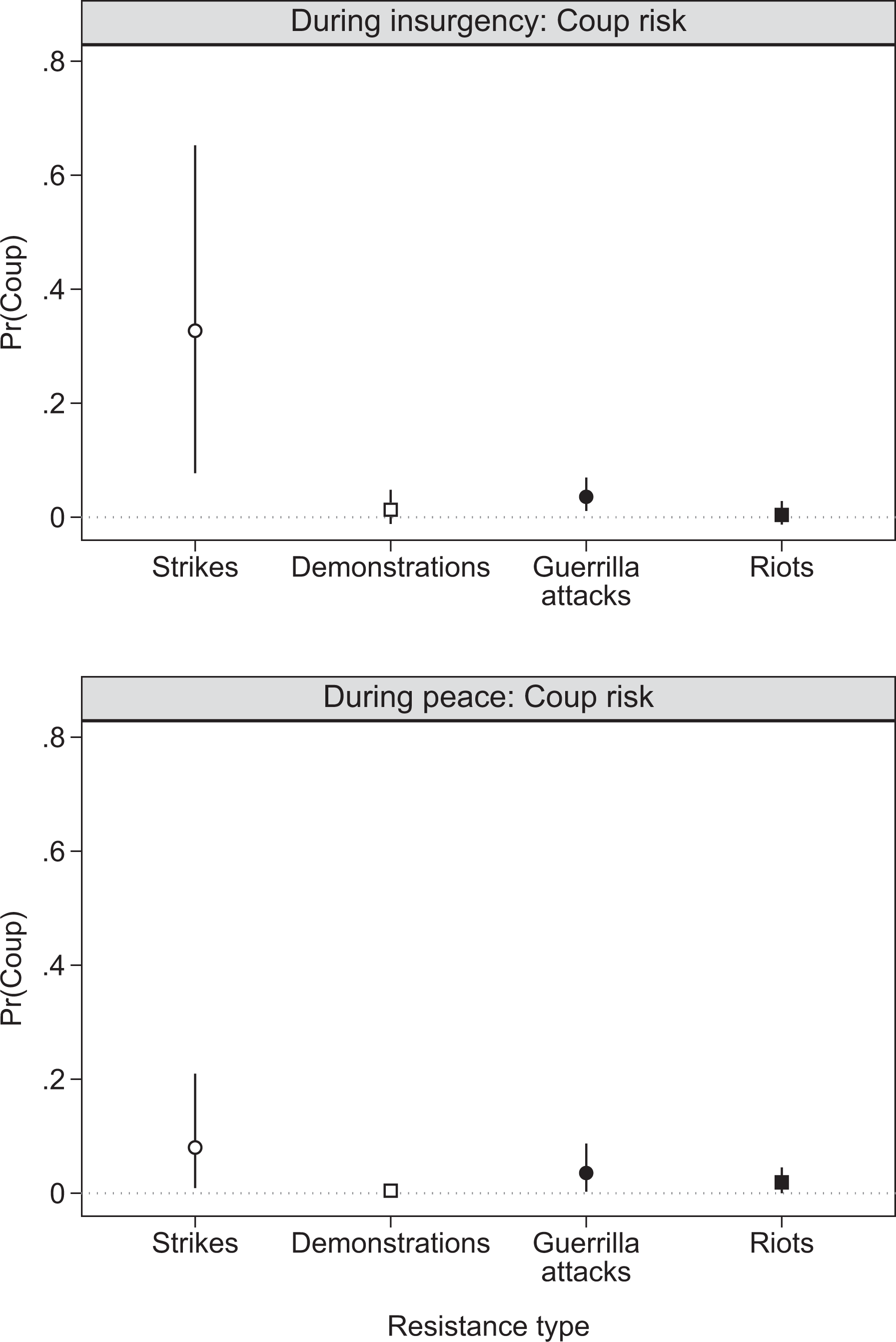
Conditional effects of different resistance types on the risk of coup attempts in insurgencies and peace times (based on Model 3, Table SI.9).
Next, we additionally model the selection process by which countries transition from peace to insurgencies. To this end, we employ a two-stage probit model with Heckman sample selection. The method allows us to first model the outbreak of insurgencies and second, once an insurgency is ongoing, how the different types of organized resistance influence the likelihood of coup attempts. 18
Figure 5 visualizes substantive results. As we would expect, results of the first stage show that only genuinely political dissent increases the risk of insurgencies. Guerrilla attacks and demonstrations are correlated with the occurrence of insurgent uprisings whereas strikes and riots are not. These findings corroborate the larger point of our theoretical argument that the political effects of resistance types depend on the context in which they occur. Once an insurgency is ongoing, strikes are the only resistance type that is substantively and significantly correlated with coup risk. Together, this lends further support to our theory. Strikes stir fears of a subversive enemy among the military while generating support by economic elites, which increases the risk of coup attempts during counterinsurgencies.
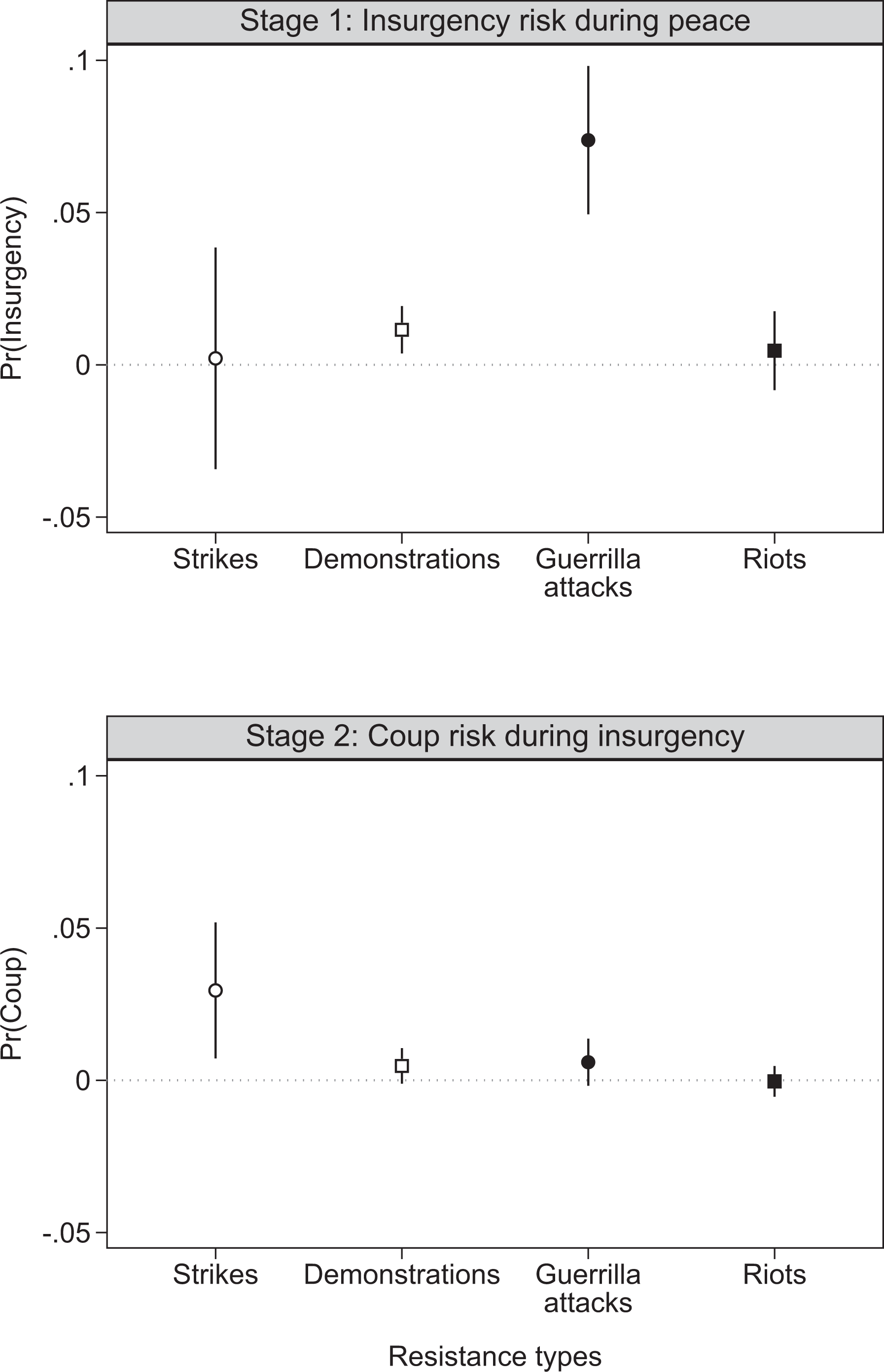
Effects of resistance types on insurgency risk during peace times and on coup risk during insurgencies using probit models with Heckman sample selection (based on Model 3, Table SI.11).
Conclusion
Why are acts of organized resistance associated with coups? This article shows that during counterinsurgencies soldiers are rather unlikely to side with protesters, as they suspect the insurgent enemy behind public dissent. We argue that strikes increase the risk of coups by forging an alliance between military and economic elites. Faced with walkouts, both actors become convinced that the current government needs to be replaced as it is evidently incapable of stabilizing the country and securing the civilian front. We offer empirical evidence of two case studies from Latin America to trace back the impact of strikes on the collusion between military and economic elites. In addition, we demonstrate the scope of our findings with quantitative analyses of coup attempts between 1950 and 2005. Evidence lends strong support to our hypotheses. Strikes are important predictors of coup attempts during counterinsurgencies, while other types of dissent including demonstrations, riots, and guerrilla attacks are not correlated with military takeover.
By offering a more nuanced perspective on how civil resistance motivates armed forces to intervene in politics, this article offers four key implications. First, it shows that in counterinsurgencies, soldiers and business representatives perceive strikes as an existential threat, urging them to conspire against both the government and the people in the streets. This highlights the detrimental effects of nonviolent dissent on post-coup political orders. Soldiers, driven by fears of subversion, do not stage a coup in solidarity with demonstrators. Instead, strikes may help radical factions to dominate inner-military perceptions and facilitate the establishment of a political regime that effectively counters subversive ideas and protesters. Our results therefore question that coups, triggered by civil resistance, present an unequivocally good sign for dissidents and citizens.
Second, specifically for labor-based dissent, our study highlights the potential of a paradoxical backlash effect. By forging an alliance between military and economic elites, strikes may pave the way for pro-business dictatorships that suppress labor-based demands and diminish the democratic participation of workers. This result qualifies the otherwise positive influence of organized labor on peaceful and democratic political transitions. Our results suggest that in order to assess the risk of backfiring, scholars and policy-makers may analyze the relations, networks, and cliques within regime elites in the run-up to a coup. This can help to anticipate the regimes that may emerge after military takeovers and to avoid overly optimistic hopes for post-coup democratization.
Third, the findings imply that during revolutions interactions between domestic protesters and international actors can add “grist to the mill of subversion” and exacerbate the risk of military coups directed against protesters. International assistance or the solidarizing with dissidents may feed the suspicion of a subversive, outside interference among the armed forces and powerful elites. This is likely to fuel fears among radical military and business factions. Rather than strengthening the protesters’ demands for freedom and democracy, foreign support may therefore induce illegal power seizures and the creation of authoritarian regimes.
Finally, our findings highlight multiple avenues for future research. We have argued that the fear of subversion incites soldiers to take over power. Future research may scrutinize how resistance in other contexts produce similar motivations. For example, in countries like Egypt, where the armed forces are a major economic player, strikes are probably sufficient to threaten the soldiers’ vested interests and trigger coups even without an ongoing counterinsurgency. Similarly, revolutions in allied or neighboring countries may forge elite-military alliances to undertake preemptive coups in the hope of immunizing their country against spreading subversive ideas. Moreover, future research may want to pay closer attention to actors within and outside the military apparatus and how they moderate coup risk. Competing factions within the armed forces or other civilian actors such as presidents, parties, and courts may constitute powerful players that break or expand elite alliances for coups.
Supplemental material
Supplemental Material, EJIR_SI - Grist to the mill of subversion: strikes and coups in counterinsurgencies
Supplemental Material, EJIR_SI for Grist to the mill of subversion: strikes and coups in counterinsurgencies by Christian Gläßel, Belén González and Adam Scharpf in European Journal of International Relations
Supplemental material
Supplemental Material, Replicationfiles_Glaesseletal_EJIR - Grist to the mill of subversion: strikes and coups in counterinsurgencies
Supplemental Material, Replicationfiles_Glaesseletal_EJIR for Grist to the mill of subversion: strikes and coups in counterinsurgencies by Christian Gläßel, Belén González and Adam Scharpf in European Journal of International Relations
Footnotes
Acknowledgements
We thank Kyle Beardsley, Charles Butcher, Sabine Carey, Govinda Clayton, Felix Haaß, Jessica Maves Braithwaite, Jonathan Pinckney, Jonathan Powell, Julian Wucherpfennig, the participants of the Tactics in Conflict Workshop at Konstanz University, the Graduate Workshop on Conflict Dynamics at Oxford University, the Workshop on Political Dissent at Essex University, and participants of the 2018 ISA and APSA for their comments. We also thank the two anonymous reviewers and the editors for insightful comments and suggestions.
Disclosure
The authors report no conflict of interest. The authors alone are responsible for the content and writing of the paper.
Funding
The author(s) received financial support for the research, authorship, and/or publication of this article: The authors acknowledge financial support from the European Research Council under the European Union’s Seventh Framework Programme (FP7/2007-2013)/ERC Grant 336019 and the University of Mannheim’s Graduate School of Economic and Social Sciences.

Replication materials
Supplemental material
Supplemental material for this article is available online.
Notes
References
Supplementary Material
Please find the following supplemental material available below.
For Open Access articles published under a Creative Commons License, all supplemental material carries the same license as the article it is associated with.
For non-Open Access articles published, all supplemental material carries a non-exclusive license, and permission requests for re-use of supplemental material or any part of supplemental material shall be sent directly to the copyright owner as specified in the copyright notice associated with the article.
