




Abstract
Loyalty is part of the glue that holds relationships together in times of difficulty. Surprisingly, however, hardly any literature exists on the role of loyalty in International Relations. The concept is routinely invoked – not least the notion of the ‘loyal ally’ – but typically only in passing and often based on questionable assumptions about the nature and effect of loyalty. Building on literature in moral philosophy on the ethics of loyalty, this paper presents loyalty as persistently partial behaviour driven by affective attachments. Such attachments are, in turn, driven mainly by a sense of shared social identity but also the interaction between subjects and objects of loyalty. I show how this understanding of loyalty differs from how most political scientists use the concept and illustrate why it matters for the study of world politics.
Introduction
Loyalty is part of the glue that holds relationships together. Families, friendships, marriages, clans, organisations, nations, regions and states – all depend, at least in part, on loyalty to remain stable in times of difficulty. Loyalty can induce and sustain cooperation. Surprisingly, however, hardly any literature exists on the role of loyalty in International Relations. The concept is routinely used – not least the notion of the ‘loyal ally’ – but only in passing and International Relations scholars tend to talk about very different things when they invoke loyalty. What does it even mean to say that actor X is loyal to Y? Is the United States loyal to its allies? Are they loyal to the United States? How do we know loyalty when we see it? Appeals to study loyalty in International Relations go back at least to the 1950s, when liberals criticised the realist worldview for ignoring ‘the revolutionary ideas now contesting for the loyalties of men’ (cited in Guetzkow, 1955: 7). Van Wagenen, for instance, suggested that handling ‘multiple loyalties is a crucial problem for those concerned with strengthening international organization’ (cited in Guetzkow, 1955: 7). But apart from the central role of loyalty in neo-functionalist theory (Haas, 1968) few heeded the call in International Relations theory even when exploring closely related concepts and phenomena, such as compliance, trust or solidarity.
The time is ripe to begin filling this gap. The recent rise of populism in both Europe and the United States may be resulting in changing loyalties among states on a scale not seen since the end of the Cold War, with major security and economic implications. Partly as a result, existing regional and global international institutions are being questioned by major powers and those left behind are forced to assess just how loyal they are to the institutional status-quo. Do loyalties here contribute to the ‘stickiness’ of world order, or is it mere rhetoric; a luxury that breaks down when crucial interests are at stake? Paraphrasing Lord Palmerston, do states have any permanent loyalties, or only permanent interests? In addition, whereas nation states were, in the words of Morgenthau, the ‘most exalted object of loyalty’ by the middle of the 20th century (Morgenthau, 1947: 197 see also Ross, 2013), greater exit options from national jurisdictions provide ever more individuals and firms with choices about who to attach their loyalty to (Franck, 1996: 378–379). Multiple loyalties are nothing new in the international system of course (Bull, 1977: 255), yet the rise of globalisation, the internet and complex interdependence have facilitated growing opportunities for cross-border loyalties among activist groups, epistemic communities, terrorist organisations and corporate actors. This both enables and constrains states in acquiring and maintaining loyalties within their borders and amongst each other.
Conceptualisation is a necessary precursor to measurement and theory testing, so how do we understand loyalty in the first place? When political scientists use the concept, many refer to Hirschman’s work on Exit and Voice. This is not surprising, as Hirschman’s was one of the first major discussions of loyalty in social sciences and applying his seminal contribution to International Relations holds significant promise. Yet, upon closer inspection Hirschman uses the concept largely as an ‘ad-hoc equation filler’ (Barry, 1974: 95), an error term to account for slack when his model would otherwise predict exit. This paper will extend on Hirschman’s treatment of the concept and apply it to International Relations. Building on literature in moral philosophy, I distinguish between different types of loyalty and present the concept as persistently partial behaviour driven by affective attachments. Loyalty is thereby a behavioural type pursued by one actor towards another (persistent partiality), which is driven by a particular attitude (affective attachment). Affective attachments, in turn, are mainly driven by a shared sense of social identity but also the interaction between the subject and object of loyalty. I show how this differs from the understanding of loyalty in some corners of political science and how it relates to different literatures and topics in world politics. The paper concludes with an important historical case in world politics that is difficult to account for without reference to loyalty as presented here: the case of slave and colonial armies.
Three caveats are in order. Like related concepts in the social sciences – such as altruism, trust and partnership – some aspects of the discussion of loyalty will be inherently theory dependent. Yet, the constitutive components of the concept are applicable across theories and ontological assumptions. There is nothing inherently rationalist or constructivist about the treatment of loyalty presented here, and a discussion of the relationship between loyalty and power will outline what different rationality assumptions imply for the study of loyalty in world politics. Equally, while the meaning of loyalty can be difficult to separate from the value of loyalty, there is nothing inherently good or bad about the account of loyalty presented here: it can be applied to cases of loyalty in world politics that we may see as normatively valuable, but also to the loyal Nazi. Finally, methodological questions of operationalisation and measurement are also left for future work to address and the article does not attempt to clear through the quagmire of endogeneity that inherently follow a concept such as loyalty. Cooperation, for instance, can foster loyalty, but loyalty can also foster cooperation. Hirschman highlighted how loyalty is important for institutions, but institutions are also important for the presence or absence of loyalty. Depending on one’s assumptions about the malleability of preferences, power may be more or less constitutive of loyalty. These, and other, thorny questions pose challenges for empirical identification, but that is all the more reason to start taking loyalty more seriously in the study of world politics.
Who can be loyal, and to whom?
Who can be loyal? Individuals can be loyal in their capacity as consumers, officials, judges, diplomats, state leaders, citizens, migrants, siblings, friends and so forth. But what about groups? Can international organisations, civil society organisations, firms and religious groups be loyal? Can epistemic communities and professions be loyal? And what about states?
Clearly, actors such as states cannot have affective attachments in the same way that individuals do. But the fact that individuals do have such attachments can have second-order effects on the collective actors they are part of. This paper is primarily about the concept of loyalty in International Relations, and it is, therefore, beyond its scope to theorise well-known problems of how to aggregate individual interests and goals to group-level actors. But just as International Relations scholarship routinely treats states and other group-level actors as if they have person-level attributes – such as trustworthiness, credibility, rationality and so forth – there is no inherent reason one such attribute could not be loyalty. In some cases, the path from individual to group-level loyalty can be straightforward, such as when loyalty ties of leaders, diplomats or generals have a material impact on how their states behave during a military crisis for instance. For instance, President Bush (and more recently Trump) had a deeply personal basis for his loyalty ties to foreign leaders and this became particularly prevalent after 9/11 (Daalder and Lindsay, 2003). In other cases, the mechanism could be bottom–up, where group-level identities of each individual result in similar loyalties at the level of their group (see generally Hall and Ross, 2015: 856–860). An example could be popular loyalty, where citizens in one country have affective attachments to citizens in another country. Suffices to say, group-level loyalties are rarely just the sum of individual-level loyalties scaled up: the nature and strength vary and the conditions under which individual loyalties have an impact on group-level actors is, therefore, an important question when considering specific manifestations of loyalty in International Relations. In other cases, actors can engage in what I will refer to as ‘strategic loyalty’. Here, diplomats, state leaders or other actors behave or express themselves as if they are loyal to achieve their ends in International Relations. Resonating with work on ‘emotional’ diplomacy (Hall, 2015; Hall and Ross, 2015), the only requirement here is that the object of loyalty – citizens, diplomats, allies and so on – is somehow affected by the perceived presence of loyalty-ties. Although I will return to this later when discussing the relationship between loyalty and power, this is not the main focus of this article as I am primarily addressing what it means for A to be loyal towards B in the first place. But whatever the mechanism, there is no inherent reason states and other collective actors in International Relations cannot be seen as a potential source, or subjects, of loyalty.
Who, then, can be the object of loyalty? This is less straightforward for our purposes. Loyalty is often used to describe attachments to policies, ideals, moral values, products, brands, religions, groups, individuals or, simply, as Konvitz notes, ‘to anyone or anything to which one’s heart can become attached or devoted’ (Konvitz, 1973: 108). This expansive view has also found its way into International Relations (e.g. Franck, 1996: 372–373; Hurd, 1999: 386–387, 391, 396). On this view, loyalty is not only relevant to understand why communist state A is attached to communist state B, but also why state A is attached to communist ideals, policies, rules and institutions in the first place.
A more restrictive understanding of loyalty uses the concept to describe relationships. Here, loyalty can only be attached to individuals and groups – including organisations. 1 Following the Oxford dictionary, to be loyal is ‘giving or showing firm and constant support or allegiance to a person or institution’. This is too broad a concept of loyalty, as will become clear, but it does share a commonly held view in moral philosophy about what can, and what cannot, be the object of loyalty. Baron notes, ‘Loyalty [is] to certain people or to a group of people, not loyalty to an ideal or cause . When we speak of causes (or ideals) we are more apt to say that people are committed to them or devoted to them than that they are loyal to them’ (Baron, 1984: 6). Even Royce, who made an early but very significant study of loyalty, sees the object of loyalty as a ‘cause’, but then proceeds to understand a cause as something that unites an individual ‘with other persons by some social tie’ (Royce, 1908: 107). Just as only people or groups can be the source of loyalty, so can only people or groups be the object of loyalty.
This notion of loyalty aligns with treatments of loyalty in much of moral and political philosophy (for a notable exception, see Keller, 2007). In his overview of this literature, Kleinig concludes that ‘Most of our core loyalties . . . are loyalties to people, individually or collectively. If it belongs anywhere, loyalty seems to belong most naturally and powerfully in the context of those to whom one is personally, communally, or otherwise associatively related’ (Kleinig, 2014: 29). This is the view I side with here, and it comes with the benefit of providing clearer boundaries for when we should, and should not, invoke the concept. It implies that actors can be loyal to one or more liberal states, but they cannot be loyal to liberalism itself. Loyalty is to the members and leadership of Al-Qaeda, not to radical Islam. Loyalty is to your treaty partners, not to the treaty, or even international law in general. Equally, loyalty is to economists or lawyers as professional groups, not to economic ideas or legalism. Loyalty is to the United Nations, not multilateralism. The relevance of loyalty to certain policies, institutional designs, policy principles and so forth operates through relationships. That said, the object of loyalty is often chosen because of the ideals or other abstractions they embody or represent. Following Walzer, ‘Concomitants to principles are usually also concomitants to other men, from whom or with whom the principles have been learned and by whom they have been enforced’ (1970: 5). Loyalty to a state or an ally, for instance, will often be partially rooted in the ideas or principles that state or ally signify. Clearly, ideas and principles shape and interact with inter-relational loyalty, but the basic building block for loyalty ties remains two actors in a relationship with each other.
Loyalty as behaviour
Partiality
Loyalty is usually more than a dyadic relationship. To say that state A is loyal to state B because they are both democratic, is also to say that state A is not loyal to state C because it is an autocracy (see generally Fletcher, 1995: 8). Partiality is an inherent and inescapable aspect of loyalty. This raises particular challenges in cases of overlapping, or divided, loyalties. Here, A is loyal to B in one context and loyal to C in another but face a situation, where loyalty to A makes it impossible to be loyal to B or vice versa. Examples abound in world politics. Since the 19th century, Catholics, Muslims and Jews have frequently been accused of ‘dual loyalties’ in American foreign policy debates (Waldman, 2019). Loyalty to a security alliance can clash with alliances in other foreign policy areas. Loyalty to a foreign leader can clash with loyalty to domestic constituents. Loyalty to a firm and its shareholders can clash with national loyalties. Loyalty within regional or club-based governance mechanisms is partial. But so is loyalty within multilateral governance in so far as there are always some states or non-state actors excluded from the process.
Partiality is inherent also in the case of nested loyalties. Here, loyalty works like Russian Matruska dolls: loyalty to B is part of a broader loyalty to C, which in turn may be part of loyalty towards an even broader D. In the context of the Roman Empire, for instance, Cicero described a hierarchy of loyalties towards family, province and other collectives with loyalty towards Rome at the very top (Ando, 2000: 11–12, 45). But while loyalty to the Roman Empire did not preclude loyalties to self-ruling communities and provinces forming part of that empire, it did of preclude loyalties to enemies of Rome. It was still partial. Equally, in medieval Europe, loyalty to feudal lords, nobles and monarchs were nested, but conflicts with loyalties to the Church routinely erupted. 2 Haas also wrote about nested loyalties when arguing that loyalty to the European Communities complemented national loyalties (Haas, 1968: 1), but this hierarchy of loyalties was (is) still partial as it could clash with loyalties towards third countries (e.g. the Commonwealth).
Divided loyalties can be a material challenge for diplomats. Traditionally, diplomats were expected to be loyal only to their leader (the Prince, King, Emperor and so on), and as late as the 19th century some European leaders still used foreigners as diplomats based on the notion that they served individual rulers (Black, 2010: 99–100). With Westphalia, however, and particularly since the early 20th century, the object of diplomatic loyalty has shifted towards the state rather than its individual leader. This creates particular challenges when leaders themselves take a pre-Westphalian view of diplomatic loyalty – as in the case of President Trump (see Gramer, 2018).
The challenge of divided loyalties among diplomats is also well known within the UN system. The Report of the Preparatory Commission described UN staff’s loyalty in this way:
Loyalty to the Organization is in no way incompatible with an official’s attachment to his own country, whose higher interest he is serving in serving the United Nations. It clearly involves, however, a broad international outlook and a detachment from national prejudices and narrow national interests.
3
These liberal aspirations of a harmony between national and international loyalties were challenged soon after the organisation was established, however, as the new Czechoslovakian regime wanted to install its ‘own’ UN staff members and the United States extended its anti-communist Loyalty Programme for federal government officials to also cover American representatives on UN agencies (the International Organizations Employment Loyalty Board; see Srivastava, 1958; Megzari, 2015: 6). 4 During this time, the first Standards of Conduct for the International Civil Service were put in place – most of which have remained unchanged since. They reiterate that UN staff have a ‘wider loyalty’ to the UN system – referred to as ‘international loyalty’ – but acknowledge that ‘international and national loyalties may conflict’ and urge governments and organisations to avoid forcing civil servants to choose between the two (International Civil Service Commission, 2013: 4, 9).
Persistence
Loyalty is not any act of partiality of course. In terms of behaviour, loyalty involves persistence. Fair-weather friends are not loyal, they are opportunistic. They may proclaim loyalty, but this proves to be cheap talk when outside options are more attractive. For instance, if a weaker state persistently aligns with a powerful one solely because it results in long-term private benefits (security, market access, stability, and so on), it may pose as a ‘loyal ally’ but its behaviour is ultimately opportunistic. Equally, if a state refrains from leaving an international organisation or institutional arrangement solely because membership results in material benefits, this is not loyalty either. Loyalty is not just being partial when it pays off based on direct or diffuse reciprocity. Finally, loyalty is not an obligation to repay debts. When state A is partial to state B because B expects payback for having assisted A in a war or economic crisis, this is not loyalty but compensation. So, although loyalty can be entirely rational, something I will return to later, it manifests itself particularly when A is making a sacrifice for B. In cases of extreme loyalty, A may even decide to die or, in the case of groups, seize to exist for the sake of B.
This is a different view than in the large public choice literature on ‘loyalty’ and patronage. Following Wintrobe (1998), loyalty is here based on a purely transactional attachment to an organisation or institution. Loyalty is a good that can be purchased from citizens and interest groups by offering a positive expected rate of return of political rents (patronage). Wintrobe describes this as the ‘price’ of loyalty. A similar view can be found in selectorate theory, where loyalty is when members of a coalition stick with the incumbent because of larger expected net private gains than defecting to the rival. A only supplies loyalty if it can expect rents in return from B (De Mesquita et al., 2003: 37; see also De Mesquita and Smith, 2009). In the international context, obvious examples are when states ‘buy’ sustained support through foreign aid or favourable trade relations (De Mesquita and Smith, 2011: 92–99; De Mesquita et al., 2003). Modelling political support and co-optation in this way has provided important insights, but it is a peculiar use of the term of loyalty. It is little more than an equivalent to corporate ‘loyalty programs’, where companies strategically attempt to invoke loyalty by providing cheaper flights, discounts and so forth. This is, at best, an extremely thin form of loyalty (Kleinig, 2014: 200–201). To the extent loyalty is merely utility-based support for some B, the word does not say anything (or at least anything interesting).
This is not to say that loyalty cannot be used strategically. As mentioned earlier, actors can use calculated expressions of loyalty, something I will return to when discussing the relationship between loyalty and power. More broadly, none of this implies that material benefits are irrelevant for loyalty. For instance, Hirschman highlights how A’s voice is more effective if A has proven loyal to B in the past (see the following text). Also, loyalty may develop within relationships initially established to generate material benefits between A and B. Yet, the core behavioural component of loyalty is when A continues to side with B, even when A expects it will involve net material costs to itself. Seeing loyalty as opportunistic and transactional based on purely selfish considerations ignores this core behavioural component of loyalty – persistence. Loyalty, therefore, has considerable similarity with both altruism and solidarity. But they are not the same. Altruism does not have partiality as a constituent feature. 5 Solidarity, on the other hand, does involve partiality and the lines between loyalty and solidarity become particularly murky when the object of loyalty is an ethnic, national or religious group, or when loyalty is along partisan lines. Transnational labour or other social movements, for instance, can be seen through the lenses of both. Still, solidarity is distinct from loyalty – or can be seen as a particular type of loyalty – as one of its constituent features is concern with in-group equity on some relevant dimension (Miller, 2017). The object of solidarity tends to be a weaker party, or at least someone in need of assistance, which is not necessarily the case for loyalty. In fact, in politics the object of loyalty is often a powerful actor, i.e. the relationship is often – though not always – hierarchical rather than horizontal. In addition, ties of solidarity are formed based on some joint purpose – such as protection of labour or human rights – which is not necessarily the case with the associative ties of loyalty (Kleinig, 2014: 37–38). In practice, of course, loyalty, altruism and solidarity can overlap and interact, but they are distinct.
Loyalty types, exit and voice
Apart from partiality and persistence, there is final behavioural dimension of loyalty that needs clarification before turning to motives of loyalty, that is the distinction between minimalist and maximalist loyalty (Fletcher, 1995). The minimalist type of loyalty is where A chooses not to harm B. Simply refraining from supporting B’s enemies or invading B’s allies here qualifies as loyalty. Equally, A might decide to impose costs on all actors except for B. As an example, Mearsheimer and Walt question whether Israel has been a ‘loyal ally’ to the United States, since Israel has historically been willing to harm American interests to promote its own national goals, including the bombing of US offices in Egypt in 1954 (2007: 58–62). In the maximalist version of loyalty, on the other hand, it is not sufficient to refrain from harming B. Rather, to be maximalist loyal A must actively promote the interests of B. This will often rely on a much deeper attachment. Maximalist loyalty was the logic of Bush’s foreign policy after 9/11, for instance, when proclaiming that other countries were either with ‘with us or against us’. On this logic, merely failing to follow an ally into war could be perceived as an act of disloyalty.
Distinguishing between the two types of loyalty gives us a richer understanding on the relationship between loyalty, exit and voice. First, it opens up for four types of exit, illustrated in Figure 1. In one form, A moves from maximalist to minimalist loyalty towards B (Exit 1: reduce loyalty). In the context of alliances, for instance, the equivalent would be moving from a formal pledge of cooperation, including armed attack, to a non-aggression or neutrality pact. In addition, A can stop even being minimalist loyal but still remain in a relationship with B nevertheless (Exit 2: remove loyalty). Here, exit is from minimalist loyalty to an absence of loyalty. For instance, whereas A used to be a loyal ally, it is now merely an opportunistic ally. In the first two types of exit, therefore, the relationship between A and B changes but persists. By contrast, the third type of exit is the one Hirschman is primarily concerned with, namely exiting from a particular relationship (Exit 3: leave relationship). Finally, A can entirely shift its loyalties away from B and instead become an adversary (Exit 4: become adversary).

Loyalty and the continuum of exit.
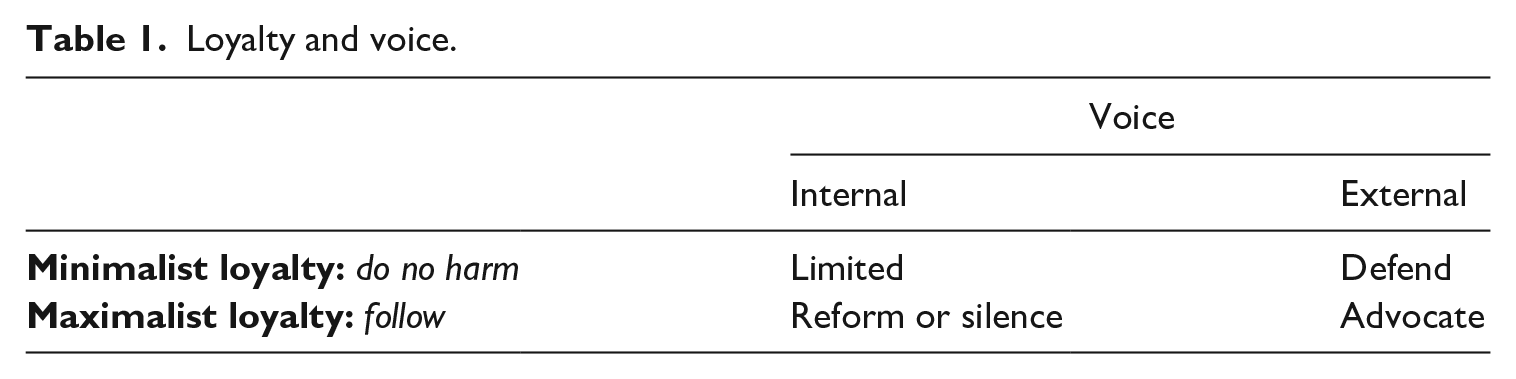
The relationship between loyalty and voice is summarised in Table 1, which further distinguishes between ‘internal’ voice (from A to B) and ‘external’ voice (from A to some C). In the case of minimalist loyalty, the limited expectation that A will merely refrain from harming B means that A will rarely use its voice to reform B but primarily to defend B against external criticism. For an ally with minimalist loyalty, for instance, it will often suffice to merely avoid support for UN resolutions that criticise or harm the interests of state B. Maximalist loyalty, on the other hand, will often involve using voice to support and – if it has gone astray – reform the object of loyalty. 6 In the context of patriotism, for instance, maximalist loyalty is ‘my country, right or wrong’, but typically it comes with the proviso added by Carl Schurz ‘if right, to be kept right; and if wrong, to be set right’ (quoted in Curti, 1946: 1). Equally, the maximalist loyal ally may privately communicate possible concerns with the alliance partner, while forcefully advocating the views of the ally in the Security Council. Maximalist loyalty can also result in silence within the relationship, however. Extreme partisan, ideological or religious beliefs can result in ‘blind’ loyalty, for instance, where A fails to realise deterioration in B and therefore does not engage in voice (Hirschman, 1970: 91–92). This echoes not just insights from social psychology on misperception – Hirschman cites Jervis – but also Marxist literature on false class consciousness, as I will discuss later in the context of power. Secondly, some objects of loyalty explicitly see an absence of internal voice as an expression of maximalist loyalty. In armies, for instance, soldiers with a sense of maximalist loyalty will be the least likely to question decisions coming down the organisational hierarchy. In these cases, however, maximalist loyalty will still involve passionate advocacy vis-à-vis third parties (external voice).
Loyalty and voice.
Even with these clarifications to Hirschman’s framework, leeway remains to classify what is, and what is not, loyal behaviour. Note that the language used here speaks of expectations. This is because the classification of loyal behaviour ultimately depends on how actors perceive it to mean in a particular context. This can be a thorny challenge for actors seeking to secure or show loyalty (not to mention empirical studies seeking to observe it). Consider US foreign policy. When US army officers (A) asked for more troop deployments to secure a victory in Iraq, they may have seen their advocacy as evidence of their maximalist loyalty to the troops (B), but the Pentagon and the chairman of the Joint Chiefs of Staff (C) saw it as the opposite (Gordon, 2003). Disagreements also occur within loyalty relationships. As noted earlier, US allies refusing to join the Iraq war (A) were seen as disloyal by President Bush and core members of his administration (B), who expected maximalist rather than minimalist loyalty from their allies.
Loyalty as motive
Whether of the minimalist or maximalist kind, loyalty is not merely a behavioural variable. For whereas loyalty does not require intentionality on the part of B, it does presuppose that A wants to show its support or allegiance to B. 7 Loyalty, therefore, is when A persistently sides with B due to a particular attitude of A (something that is lost in the Oxford Dictionary). 8 For instance, if partial treatment towards another government is an accident, or outside a government’s control, this is not an expression of loyalty. Equally, when actors anchor to the status-quo for no other reason than default bias or satisficing, this is not loyalty but bounded rationality. What, then, drives loyalty?
Loyalty as a norm?
In some cases, A may find it is inherently ‘right’ to stay put in times of difficulty. Here, loyalty takes the form of a principled belief, understood as ‘normative ideas that specify criteria for distinguishing right from wrong and just from unjust’ (Goldstein and Keohane, 1993: 9). All the major religions value loyalty and deride betrayal for instance. The lowest level of Dante’s hell is reserved for the disloyal (Felten, 2011: 6). Non-abandonment norms can also be central to national cultures – as sometimes observed in the parts of Asia (e.g. Nitobe, 2009 [1905]: ch. 9) – or it can be peripheral, as Huntington argued was the case in the United States (Huntington, 1957: 304–305, 465). Such claims are rarely supported by rigorous empirical evidence, but that does not mean they may not be true, and it could possibly have spillover effects into foreign policy decision-making and expectations.
Within countries, non-abandonment norms are often promoted by elites and institutions that can benefit from them. Armies, for instance, routinely seek to promote loyalty as a higher duty, 9 which is not surprising as the propensities for defection and mutiny are important during armed conflict (e.g. McLauchlin, 2010). Non-abandonment norms can also influence the make-up of a country’s foreign policy decision-making institutions, for instance when state leaders hire officials based on their willingness to endure personal sacrifice. When taken to the extreme, this not only stifles dissent and generates groupthink but can also reduce the competence of the country’s foreign policy apparatus, a loyalty-competence trade-off (see generally Wagner, 2011; Egorov and Sonin, 2011). Finally, elites occasionally seek to invoke domestic loyalty norms when seeking support for their foreign policy decisions.
Seeing loyalty as a norm only takes us so far, however. It does not tell us who is likely to be the object of loyalty, nor how divided loyalties are resolved. Moreover, while almost everyone is loyal to someone most of the time, this is not because almost everyone subscribes to loyalty as a higher virtue. In International Relations, in particular, it seems particularly unlikely that a general non-abandonment norm can be identified among states. In turn, this means that the audience costs of betrayal may be less pronounced in world politics than in (some) domestic political arenas. So, although non-abandonment norms can be important for loyalty, including in world politics, they are unlikely to be determinative in most cases.
Loyalty as obligation?
Perhaps, then, we should see loyalty as a form of obligation? Loyalty comes from the Old French, loyaute, which, in turn, is generated from Lex – the Latin word for law. And indeed, loyalty can be related to actual legal obligations in some contexts. For instance, several countries impose legal sanctions on naturalised citizens that have violated loyalty oaths (Orgad, 2014). Loyalty has also taken the form of legal obligations in the international sphere. European Union (EU) member states, for instance, are bound by the principle of loyalty in EU law to protect the integrity of enhanced EU cooperation (Klamert, 2014: 321). This is not the first time in history loyalty has been enshrined in a specific treaty obligation: at least as far back as Mesopotamia loyalty pacts were used to consolidate power with vassal states (Parpola and Watanabe, 1988). Loyalty oaths are a softer form of obligations, but obligations nevertheless. In early Islamic societies, for instance, leaders would rarely breach their loyalty oaths to other leaders as it would be seen as un-Islamic to breach obligations (Mottahedeh, 2001: 42–72).
Yet, loyalty is not the same as obligation. When states and non-state actors are persistently partial to one another due to obligations their behaviour is ultimately rule driven. This can be related to loyalty, as I will return to later, but it does not have to be. It is rarely meaningful, for instance, to say that a state is being ‘disloyal’ to another state by violating a treaty obligation. That is because loyalty entails an intrinsic affective dimension that is not necessary for rule-driven behaviour (Shklar, 1993). In particular, a largely shared view of loyalty in moral philosophy and sociology is that while A and B’s relationship may initially have been established for strategic instrumental or other reasons, loyalty implies that A has an affective attachment to B (e.g. Shklar, 1993; Connor, 2007: ch. 2; Keller, 2007: 16). As also held by the US Supreme Court, loyalty ‘is a matter of mind and of heart’. 10 Even Hirschman, who primarily writes about the functional purpose of loyalty, speaks of ‘feelings of loyalty’ (1970: 82). So, although obligation and loyalty can overlap and are often used interchangeably in everyday language, they are distinct.
This is not the same as suggesting that loyalty is necessarily irrational. As long as individual choices are transitive and consistent, nothing in rational choice theory precludes actors from having emotions – here understood as particular cognitive judgements – that make them care deeply about others. Yet, the affective dimension of loyalty is (obviously) not accounted for in the transactional view on loyalty in public choice literature and selectorate theory and speaks to a growing literature in International Relations on the role of emotions for world politics (e.g. Bleiker and Hutchison, 2014; Crawford, 2014; Hall, 2015; Markwica, 2018; Mercer, 2014; Ross, 2014), something I will return to in the conclusion. It does still beg the question, however, where affective attachments that induce loyalty come from in the first place. Two drivers stand out: identity and interaction.
Identity
Affective attachments are typically rooted in a sense of a shared social identity (Brewer, 1999). This makes identity critical for loyalty. Whether in-group identifiers are rooted in culture, religion, values and principles, race, gender, nationality or otherwise, A’s identification with B makes it more likely that A will forego attractive exit options and be actively committed to sticking with B. As noted by Kissinger in his critique of loyalty as an international ethic, loyalty is ‘a means to achieve a group identity’ – and only one group identity (Kissinger, 1954: 1017–1018). This is also what Shklar implies when noting that loyalty is ‘generated by a great deal more of our personality than calculation or moral reasoning. It is all of one that tends to be loyal’ (1993: 184).
There are two main reasons why identity is so closely related to loyalty. First, a sense of shared group identity increases the propensity to help other members, even when doing so involves personal sacrifices (Stern, 1995). These sacrifices can be worth it not least because they reinforce an actor’s sense of self. This is key to loyalty. It implies that the affective attachment to B can be direct – where the interests and well-being of B are part of A’s preference function – but it can also be indirect, where A is loyal not because it necessarily ‘likes’ B but because loyalty to B is part of A’s sense of self. I will illustrate this later in the context of colonial armies. The second reason identity is closely related to loyalty is motivated reasoning. Identifying with a group impacts perception of costs and benefits of exit options, by making leaving look inherently unattractive (Van Vugt and Hart, 2004). Paraphrasing Hirschman, loyalty is not the same as faith, but it does involve a degree of self-deception, that is, a resistance to realise that B is deteriorating or defective (Hirschman, 1970: 93). Whatever the exact causal mechanism, however, the upshot is that loyalty in world politics is ultimately rooted in shared identities between groups of states and/or non-state actors. 11
Three implications of this close link between loyalty and identity are particularly important. First, rooting loyalty in social identity reiterates the inherent partial aspect of loyal relationships, as in-groups are defined as much as by what they are as what they are not. As also alluded to earlier, some Europeans may have transcended or nested their national identities into a common European one, but this only moves the reference point as they are now aligned partly due to their difference from, say, Americans (Mercer, 1995: 250). Equally, Walt notes that concerns with ‘dual loyalty’ in foreign policy are about diplomats and stakeholders having a ‘sense of identity with [a] foreign country’, which in some cases can raise questions whether they ultimately side with that country.
Second, the link to identity is what makes ‘betrayal’ more closely associated with loyalty than it is with obligation and commitment. As in the case of treason, betrayal ultimately implies rejecting or devaluing another individual or group. It speaks to the very identity of an actor and therefore has a much deeper affective component than most cases of non-compliance with obligations and commitments (Shklar, 1993). It is rarely meaningful to say a state has ‘betrayed’ another by violating a trade agreement, for instance, whereas it can be meaningful to say that a diplomat that sided with a foreign power has betrayed her home country.
Third, and related, since loyalty is rooted in an actor’s identity it becomes impossible to impose. Consider again the case of loyalty oaths that create obligations for A to persistently side with B. These are typically insisted upon by regimes and leaders that feel threatened (Orgad, 2014) and can be complied with for a number of reasons, including fear. But since loyalty oaths ultimately speak to actors’ sense of self (Sunstein, 1990), they would not be able to induce loyalty as understood here. And they can also backfire for the same reason. When the British Crown insisted on loyalty oaths during the American Revolution, for instance, it went against the very identity of what it meant to be an American and ultimately helped ‘spur the creation of an American patriotism and accelerated the development of a decade of discontent’ (Hyman, 1959: 61).
Interaction
Although a sense of shared identity is a necessary condition for loyalty, it is not sufficient. State A is not solely loyal to state B because both are democratic regimes. The Pashtun is not solely loyal to his tribe because he agrees with the values it represents. The IMF economist is not solely loyal to her employer because of shared professional values and ideology with her colleagues. If that was the case, then state A should be equally loyal to all democratic states, the Pashtun should be equally loyal to similar tribes, and the economist should be equally loyal to all neoliberal economists (see generally Oldenquist, 1982: 174–176). Fletcher notes, ‘If the same personal characteristics are found in another person and if they were sufficient to ground loyalty, then, regardless of historical ties to the other person, one should be loyal to him or her as well’ (1995: 7).
Loyalty, therefore, is not solely driven by two actors being in relation to another due to a shared social identity, but rather because they are in a special relationship, where on-going bonds and patterns of interaction have resulted in a shared history (Scheffler, 2010: 115). Equally, emotions with material implications for world politics are not just rooted in shared abstract identities between A and B but are also shaped by social interactions (Ross, 2014). It follows that A is loyal to B because A considers its relationship with B to be special and therefore wish to cement, strengthen or salvage it. 12
The importance of interaction means that although loyalty can be a one-way relationship with no expectation of reciprocity, it will rarely develop without B behaving in ways that generate positive affective attachments. In particular, loyalty typically hinges on past cooperation, an inherently two-way relationship (Keohane, 1984: 51–52). A is more likely to be loyal to B, if B has previously been seen to adjust its behaviour to promote the interests of A. After having been established, B can retain loyalty from A even without cooperating (recall that persistence is part of loyalty), but not indefinitely since mutual social investments in a relationship are critical for whether it can remain intact in times of hardship. This is particularly the case for actors with no ability to derive loyalties from some deeper commitments (see generally Keller, 2007: 58–62). Whereas the Vatican can safely expect to have a large and secure group of maximalist loyalists almost irrespective of its behaviour, this is not the case for most loyalties between states for instance. They will often have to cooperate to generate, and secure, loyalty from others.
Apart from generating affective attachments, interaction also provides information about other actors, which in turn is necessary to generate trust (Hardin, 2004). 13 For although loyalty can survive occasional breaches of trust, stable loyalty requires that B is seen to be trustworthy (Kleinig, 2014: 43–44). For Hirschman, as well, a core element of loyalty is that A trusts that B can improve itself (Hirschman, 1970, 78–79; 1986: 81). The implication is that reserves of loyalty can be accumulated over time – much as a commodity (Burgess, 1999: 109). But the stock of loyalty can also be depleted when trust is broken. For instance, when it was revealed that the National Security Agency of the United States had targeted European allies, even staunch supporters of a close transatlantic relationship began questioning their maximalist loyalty to Washington. 14
The role of interaction has two important implications for international loyalties. First, loyalty could be both an effect and driver of international institutions. International loyalty ties should be more likely in highly institutionalised areas of world politics, as regimes promote and generate interaction and cooperation among its members, which in turn generate opportunities for affective attachments and trust to develop. Vice versa, one reason that regimes are needed to foster cooperation may exactly be because loyalty ties rooted solely in shared identities are overly contingent or fleeting. Second, international loyalties should be more likely among elites, as they interact more with people and organisations outside their own jurisdiction. In addition, most individuals have close and direct interaction with their state, but few have any direct interaction with international organisations. This makes the latter unlikely objects of loyalty (Guetzkow, 1955: 19), except among political and corporate elites who routinely interact with regional and other supranational institutions. 15
Loyalty, power and choice
As should be clear by now, loyalty can be both vertical and horizontal. The concept of loyalty says nothing about the relative resources of A and B as such. In politics, the objects of loyalty in politics may often be more powerful than the subjects of loyalty, but they can also be less or equally powerful. Soldiers can be loyal to their leaders within the military hierarchy, but they can also be loyal to their fellow soldiers, and leaders can be loyal to their soldiers. Weak states can be loyal to a regional or global hegemon, but they can also be loyal to each other, and there may even be examples of loyalty of powerful to weaker states. This raises the question of what loyalty means for power, and power for loyalty?
Depending on one’s assumptions about A, power can be more or less important to loyalty. If we assume A and B have a given set of fixed preferences (as much rationalist work), then power is not necessarily critical to the study of loyalty. 16 If A provides preferential treatment to B simply because B has control over A – either directly or through institutions – this has little to do with loyalty. Yet, even in a traditionalist rationalist view, power is not irrelevant for the study of loyalty.
First, it plays an indirect role through past cooperation. For instance, to the extent a state can incentivise other states to cooperate due to its superior resources (material or otherwise), then B’s past power over A increases the likelihood of being the object of A’s loyalty in the future. Empirically, this raises the challenge of isolating the role of loyalty expressed by A today from power asserted by B in the past. Secondly, power can play a role through institutions. For instance, by prescribing behavioural roles, constraining activity and shaping expectations, institutions matter when actors are forced to choose between divided loyalties. This can be through strategic attempts by formal international organisations seeking to become the ultimate object of an actor’s divided loyalties but also indirectly when institutions shape expectations about which loyalty reigns supreme (e.g. in the context of religious doctrines).
Third, and as already mentioned, A’s loyalty is a resource that B can use, and abuse, not just in its relationship with A but also with other actors on the domestic or international plane. Loyalty may be a source of soft power for instance (Nye, 2004), and it can have a material impact on international negotiations, if bargaining power is partly determined by the size of a negotiator’s domestic loyalist following. International loyalty ties can also be used domestically. 17 Finally, there is a special case where B believes that A is genuinely loyal because of an affective attachment, but A’s expressions of loyalty are merely part of a calculated strategy (see generally Hall and Ross, 2015: 860–862). In this case, A is not loyal as understood here, but it is still an instance where the expectation of affect-driven loyalty has an impact on B and potentially becomes a power resource for A. As mentioned, this has not been the core focus of this article as the aim has been to clarify what it means to say that A is loyal in the first place. But it does provide a middle ground between traditional public choice views of loyalty, where both A and B are purely transactional, and the perspective here where loyalty entails persistently partial behaviour rooted in an affective attachment. In short, there are numerous ways in which power is important for the study of loyalty in traditional rationalist frameworks.
Power is even more central to loyalty, however, if actor A has malleable preferences as in much constructivist work. On this view, not only past cooperation but also shared identity is a function of power. Without opening thorny agent-structure debates, it is clear that speaking of A’s ‘choice’ in whether to be loyal, or A’s ‘choice’ between conflicting loyalties, means something very different than in rationalist accounts. In the case of structural power, A only exists by virtue of its structural relationship to (the more powerful) B. For instance, Neo-Marxist analyses highlight how capitalist states in the ‘core’ are able to obtain loyalty from periphery states by shaping their capacities, resources, preferences, ideologies and – ultimately – identities (e.g. Cox, 1992). Alternatively, power can be of the ‘productive’ kind, where the very significance and meaning of A’s identity (as, say, a ‘civilised’ or ‘Western’ state) is constituted through discursive and social processes. Here, A’s loyalty to B is part of an ordering of social relations that produce the meaning of A and B as actors in the first place. Loyalty is a role, or ritual, rooted in a logic of appropriateness that shapes, and is shaped by, A’s identity (see also Fletcher, 1995). This also opens up for the possibility, mentioned earlier, that A’s loyalty to B is not because of a direct affective attachment from A to B, but because the acts of loyalty towards B simultaneously create and sustain A’s sense of self.
On both views, however, it is logically impossible to conceive of an actor without any loyalties, as all principles, ideas, interests and identities are rooted in some form of realised or unrealised loyalty, which in turn is a function of power. It also follows from both structural and productive views of power that loyalty will not necessarily imply a ‘choice’ or calculated reason for A, just as you do not rationally ‘choose’ your own identity (Shklar, 1993: 184). In short, and not surprisingly, underlying assumptions of rationality on the part of A have major implications for the relationship between power and loyalty.
An illustration: the puzzling cases of slave and colonial armies
As noted throughout this article, loyalty can manifest itself within all the sub-disciplines of International Relations but to provide a tangible illustration I conclude with reference to war, and in particular what drives individuals to risk their life in war. I home in on two types of armies that had material implications for world politics and were based on affective loyalty ties by design. The cases also help illustrate how loyalty can have different behavioural manifestations (minimalist vs. maximalist), in different social relationships (horizontal vs. vertical), and be both a cause and effect of power for states and non-state actors.
The first is the case of slave armies. In early Islamic empires, young boys were often ‘imported’ from other jurisdictions to serve as soldiers with no social, political, economic or affective ties to anyone but their ruler. These ‘ghulam’ (caliphate), ‘mamluks’ (Egypt), and ‘kapikulu’ and ‘janissaries’ (Ottoman empire) were brought up by their rulers as if they were their children (e.g. Mottahedeh, 2001: 84). They developed into elite forces of higher social status than the general population and often obtained significant military and political power also after their release, in some cases rising higher than their former masters. A functionally equivalent institution was the eunuch used in the empires of China, Egypt, Ancient Greece, Persia, late Rome and Byzantium (Finer, 1997). In some cases, slave armies persisted for centuries – in the case of Mamluks until the early 19th century (Finer, 1997: 737) – and their impact is still felt today in the areas they conquered (e.g. Ahmed, 2019).
Slave armies and officials were explicitly developed as an institution to secure leaders from internal and external enemies based on the underlying premise that loyalty was important for power, and power for loyalty. Slaves were brought in from outside and almost solely interacted with their rulers and among themselves so as to avoid conflicting loyalties among soldiers. They were given positive preferential treatment and a wide range of privileges so as to develop special relationships based on a shared sense of identity and close interaction. More broadly, the very constitution of the slaves’ identity was produced through their relationship with their masters. The assumption was that the nurturing of affective ties among themselves and, importantly, towards their ruler would help secure a more loyal military class, which in turn would enhance the security and power of the ruler. And it often worked. Mottahedeh (2001: 88–89) notes how rulers were often saved by maximalist loyalties among ghulams, and even after they were set free from slavery and direct patronage ghulams, who were otherwise powerful, would often refuse to attack their former masters (minimalist loyalty). In other cases, loyalty ties from masters to servants/slaves also had material implications. Finer (1997: 788) describes how eunuchs who reared and educated Chinese emperors would be bestowed with significant power and privilege later in life. Loyalty ties were not just the result of power, but also a source of power for both patrons and clients.
A related example is the case of colonial armies relied upon by Western powers. In the largest colonial army ever produced, the British Indian Army reached almost one million during the first world war and more than double that during the second (e.g. Strachan, 1993; Barkawi, 2017). In addition to protecting India itself, particularly on the North-West Frontier, Indian troops were critical to the defeat of the Imperial Japanese Army in Burma and played important roles in defeating Italian and German troops in Africa and Italy as well (Marston, 2014: 45). The British could trust the support of their colonial regiments throughout the war, with very few exceptions. 18 This was not because of coercion. The war required a massive expansion of the army but voluntary recruitment of jawans – junior soldiers – proved easy. It was not because of Indian nationalism either. Germany and Japan did not directly threaten India during most of the war, and few jawans bought into anti-Axis propaganda, as most were illiterate and had limited geo-political awareness (Marston, 2014: 19; see also Perry, 1988: 119). British imperial ideology was not crucial either. In fact, with the exception of a minority of urban middle-class Indian officers, who remained steadfast in their support for the King of England even in the face of Japanese torture (Barkawi, 2006: 240), the loyalty of the Indian army towards the British Empire was mostly of the minimalist kind, if at all – the army did not oppose independence after the war for instance (Marston, 2014: ch 5). So why was the colonial army nevertheless so reliable?
Part of the reason is transactional. The army was a potential solution to unemployment and food shortages for the rural poor, not least since its welfare programs extended to soldiers’ families. That said, a reoccurring theme among historians of the Indian colonial troops is that they were not just mercenaries who fought for food, shelter and money (e.g. Roy, 2009; Marston, 2014: chs 2–3; Khan, 2016: 188). They were not just driven by the type of transactional loyalty familiar from selectorate theory for instance. Barkawi, for one, notes that even after considering jawans’ material incentives and the British strategy of ‘divide and rule’ within and across regiments, the Indian Army ‘should have encountered some serious difficulties for cohesion and fighting spirit . . . yet by and large, it remained loyal and fought effectively during the war’ (2006: 328). Why?
After the 1857–1858 rebellion against the East India Company, Britain took over the sovereign control of India and began organising the army along races seen to have ‘martial’ qualities (Ghurkas, Sikhs, Pathans, Punjabi Muslims, and so on). Once inside the army, recruits sought to live up to these ideals and identities nurtured by the British and an intrinsic part of belonging to a ‘martial race’ was maximalist loyalty towards the army as an organisation (Barkawi, 2017: ch. 2). It was a vertical loyalty tie, but unlike the Ghulam–master relationship the object was not the British Empire or the king-emperor but the colonial army itself. In addition, strong loyalty ties were nurtured within each regiment and unit. Soldiers served in the same regiment through their life and posted with soldiers of the same ethnicity and religion (Marston, 2014). This generated personal bonds of loyalty often more critical for the colonial soldiers’ willingness to fight than anything or anyone else (Barkawi, 2006). Together with a social identity tied directly to the army as an organisation, these maximalist loyalty ties along horizontal lines – among comrades with a shared social identity and in close repeated interaction – meant the British could rely on the Indian army as a highly effective fighting force.
This should come as no surprise, as these types of loyalty bonds are exactly what studies have found to drive men and women to fight in other contexts as well (e.g. Costa and Kahn, 2003; Felten, 2011: 25–27). And it was not a unique case. For instance, accounts of the German colonial army in Africa (Moyd, 2014), French colonial troops in Algeria (Evans, 2002), and the Dutch colonial army in Indonesia (De Moor, 1999) also highlight how it was not just material benefits that secured the support of troops, though those were important, but also the creation of institutions and discourses that established the social identity of the colonial soldier and officer as intrinsically linked up with the colonial army itself. This produced loyalty, as understood here, among the ‘guardians of empire’, which in turn had material impacts not just on the internal security of colonial state building projects but also on projections of Imperial power abroad.
Conclusion
Much empirical and theoretical International Relations scholarship invokes notions of loyalty, but the concept is poorly understood and often misused. The aim of this paper has been to provide sufficient clarity to allow loyalty to become a meaningful concept for the study of world politics. It has presented loyalty as partial behaviour that is persistent and driven by affective attachments. Such attachments are, in turn, driven mainly by a sense of shared social identity but also the interaction between subjects and objects of loyalty. Whether loyalty should be seen as a virtue or vice, progressive or regressive, liberal or conservative, stabilising or revolutionary, will depend on the issue at hand and how different loyalties manifest themselves in different circumstances. In this way, loyalty is no different from related concepts in International Relations, such as cooperation, institutions or order. Yet, before we can understand the ethical implications of loyalty in world politics, we need to get a better sense of how, and under and what circumstances, it manifests itself.
Two sets of challenges are pertinent. First, loyalty is not mere opportunistic support but is rooted in affective attachments. At a minimum, it involves the object of loyalty believing that expressions of support are rooted in such attachments. This means that the emerging literature on the role of affect in International Relations is critical to assess the role of loyalty in world politics, including how individual loyalties translate to, or differ from, group-level loyalties. In addition, the understanding of loyalty used here, where the object of loyalty can only be actors or institutions, raises questions about how affective attachments to individuals, groups or institutions interact with affective attachments to specific ideas or principles. Following Waltzer, the reason we are loyal to actor A is often because A represents a certain idea to which we have an affective attachment. So, to understand the role of loyalty for important phenomena in International Relations – such as cooperation and institutions – we also need to understand the complex emotional linkages between actors and ideas that populate world politics.
Second, and related, while I have proposed a clearer conceptualisation of loyalty as well as a range of research questions, the paper still leaves open questions on how to operationalise loyalty, measure it, and empirically identify its role relative to, and in interaction with, other factors in world politics. This not only requires identifying and isolating the roles of identity and affect, but also parsing out observable implications of loyalty that are different from its close conceptual cousins, such as solidarity, altruism and obligation.
Footnotes
Acknowledgements
The author would like to thank Harry Bauer, Thomas Hale, Robert Keohane, Jack Seddon and two anonymous reviewers for helpful comments and suggestions. An early version of the manuscript also benefited from comments at University of Melbourne’s political science research seminar. The usual disclaimers apply.
Funding
The author received no financial support for the research, authorship and/or publication of this article.
