




Abstract
Status has once again become a prominent topic in international relations. However, vague, incomplete, and incompatible definitions continue to stifle the development of a cohesive research program. Even the most sophisticated conceptualizations proposed fail to comprehend the full range of status conflicts and ambitions. Current research centers on collective beliefs about the traits that are valued in individual actors, so it especially fails to properly account for status differentiations that emerge through bilateral interactions and for defiant acts that upend local status hierarchies. It also neglects the most intense status infringements: acts and relationships that are humiliating. To remedy this conceptual weakness, this article will first review conceptual work in International Relations and beyond. It will then present an integrated model of two distinct status hierarchies — prestige and role status — and their causal linkages. In so doing, the article will attempt to clarify how “status” relates to similar concepts, such as “authority,” “prestige,” “honor,” and “glory.” The explanatory value of this consolidated status framework will be demonstrated through a more nuanced and consistent discussion of Russia’s seemingly erratic status disputes with “the West.”
Introduction
This article claims that the dominant understanding of status in International Relations (IR) is too narrow and thus incompatible with many empirical accounts of status disputes. Its status conceptualization ignores that simple patterns of deference suffice to constitute asymmetric ranks in social hierarchies (e.g. leaders versus followers, patrons versus clients). This incomplete conception is not only at odds with recent findings in social psychology. It also fails to properly account for the key role that status needs play in dyadic contests for dominance, as well as in humiliating interactions. Perhaps most strikingly, current approaches are unable to explain the puzzling fact that status-frustrated states frequently resort to defiant behavior — even though such obstructionism and rebellion often tarnishes those states’ image as responsible members of international society. Yet, again and again, governments have been willing to sacrifice international approbation to obtain less submissive roles for their states. In their status disputes with the US, state leaders such as French President De Gaulle and Russian President Putin clearly considered open defiance as the best way to escape an undignified position of inferiority. Likewise, in 2015, the government of Greek Prime Minister Tsipras saw confrontation with its country’s creditors as the only option to restore the nation’s dignity. The following pages will show that a new conceptual framework, which differentiates between public prestige and interactional role status, can readily grasp such otherwise paradoxical status strategies and can put the agenda of status research on a firmer basis.
To clarify the complex nature of status and status disputes, the article presents a more comprehensive and nuanced understanding of social status. Following common usage, it understands social rank, position in a social hierarchy, as the core meaning of “status” (for key definitions, see Appendix I). However, unlike most other contributions in IR, the manuscript theorizes that all societies contain at least two basic forms of hierarchy that are closely connected: a hierarchy of prestige (according to perceived public esteem); and a hierarchy of deference patterns that reflect direct interactions between parties with dominant and subordinate roles. This integrated conceptual framework provides a comprehensive view of international ranking orders that explicitly incorporates the interactional foundations of status and thereby resolves striking inconsistencies in the current IR literature. Moreover, this framework can systematically integrate and properly delineate many of the narrower status concepts advanced by recent scholarship. 1
The article will first show that empirical accounts by leading status scholars give much greater prominence to interaction than their explicit status definition would permit. It will then elaborate why the mainstream conceptualization of international status cannot sufficiently comprehend dyadic conflicts over proper role positions. By focusing primarily on collective beliefs about actors’ valued attributes and accomplishments, the predominant view neglects the more fundamental social asymmetries: ranking orders that are constituted by roles and counter-roles that call for dominant or submissive behavior. A consistent framework must allow for the fact that actors can also enhance their status by advancing in deference hierarchies where the other party routinely engages in submissive deference, that is, in “behaviors … that generally convince the recipient that the message sender is yielding, appeasing, and honoring the recipient’s position in the rank order” (Fragale et al., 2012: 374, emphasis added). The third section will further differentiate the sub-components of the two basic hierarchies. The fourth part briefly outlines the possible status disputes that follow from this conceptual framework and discusses their relative intensity. The article concludes with an empirical illustration which will argue that Russia’s ongoing status disputes with the US, particularly its acts of open defiance, can only be properly understood within this more nuanced framework.
How interaction creeps in: Conceptual stretching in prominent empirical accounts
The recent upsurge of status research in IR is predominantly based on a peculiar understanding of status which essentially holds that a state’s rank is determined by public evaluations of its qualities. According to a widely quoted definition, international status should be defined “as collective beliefs about a given state’s ranking in valued attributes (wealth, coercive capabilities, culture, demographic position, sociopolitical organization, and diplomatic clout)” (Larson et al., 2014: 7). Numerous scholars concur that status ultimately depends on how a reference group is thought to esteem a state’s characteristics and overall conduct (Barnhart, 2016: 389; 2017: 539; Larson and Shevchenko, 2010: 69; Onea, 2014: 130; O’Neill, 1999: 193; Renshon, 2017: 4, 40, 262; Wohlforth, 2009: 55). Following this status notion, one would expect that status conflicts mostly occur when a state’s representatives reject international beliefs about that state’s qualities, and that this will lead them to assert their state’s claimed status by trying to change foreigners’ ideas about the state’s “valued attributes.”
However, these authors’ empirical research frequently tells a very different story. In their published case studies, state governments rarely express complaints about the (individual or collective) views that foreigners allegedly hold about their state. Instead, in these accounts, status-conscious governments overwhelmingly care about the way in which significant others treat them and frequently protest against behavior they consider as disrespectful, often by resorting to direct countermeasures. For instance, Larson and Shevchenko (2014a: 39) claim that the BRIC countries (Brazil, Russia, India, and China) do not seek admission to the “club” of advanced Western countries because emulating the current members would imply “a humiliating relationship of tutelage.” In another important article on Chinese and Russian status ambitions, Larson and Shevchenko (2010: 89, 95) point out that “Putin expected Russia to be treated as an equal partner with the United States,” and ultimately conclude that “the United States must learn how to treat China and Russia in ways other than as rival or junior partners if it is to obtain their cooperation.” Renshon (2017: 230–232, 252), in his acclaimed book, argues that Russia mobilized its forces in 1914 because its status-sensitive government fundamentally felt that it could not afford to back down to yet another German challenge. In a similar vein, his chapter on Imperial Germany’s Weltpolitik asserts that Berlin pursued “policies to coerce [Sic!] other states into ceding status to Germany” (Renshon, 2017: 184). According to Renshon (2017: 201, 204–206), Germany’s “true motivation” in the two Morocco crises was not the acquisition of prestigious overseas territories, but rather to change its peers’ behavior towards Berlin, “to force other powers to take account of Germany,” “to remind the French that Germany is still there,” and to “demonstrate that German rights could not be trampled upon.” Thereby, it sought to make other governments consult Berlin in similar circumstances. This reading nicely echoes Barnhart’s (2016: 413) claim that Bismarck had started Germany’s colonial project not because he considered overseas territories as valuable status markers, but because he “felt it necessary to convey his annoyance at British high-handed behavior.” In Bismarck’s view, Berlin eventually had to move into Africa just to show that it would no longer take London’s “insults” and vetoes. As plausible as all these explanations appear from an empirical point of view, with their focus on interaction quality in dyadic relationships, they are clearly at odds with these scholars’ theoretical conceptualizations of status.
Even more puzzling for an understanding of status that overwhelmingly focuses on collective beliefs about valued attributes is the fact that dissatisfied states sometimes resort to obstruction or spoiler behavior to improve their social rank. If presumed evaluations by one’s peer group were the ultimate basis of status, state governments should avoid controversial activities that could lead to negative characterizations and should instead prefer to act like “good citizens” (Renshon, 2017: 262, 267). However, status-conscious governments seem quite willing to tarnish their states’ credentials as responsible members of the international community when controversial actions seem necessary to show that they can no longer be ignored or confronted with faits accomplis. In these circumstances, they act defiantly to make it clear that they cease to tolerate interaction patterns in which they are assigned the position of a subordinate player. For example, Renshon claims that Imperial Germany’s “only hope of gaining the international standing it desired was to provoke crises in which others would ‘blink’ before Germany or use the threat of a protracted arms race to coerce concessions from Britain” (Renshon, 2017: 199) Accordingly, Berlin repeatedly acted as a spoiler: “Time and again it resorted to policies of dangerous brinkmanship in these crises” (Renshon, 2017: 198). Likewise, Larson and Shevchenko (2010) concede that status concerns can lead to “a state’s disproportionate reaction to perceived humiliations” by intentionally displaying anger, further pointing out that “[s]tates try to demonstrate their importance by engaging in obstructionist behavior, acting as spoilers.” Thus, Russian leaders engage in spoiler behavior and say “no” to Western initiatives because it makes them “feel that they are indeed a world power” (Larson and Shevchenko, 2010: 70, 73). Again, these quotes show that these scholars’ tacit understanding of status stretches well beyond their explicit conceptualizations. Leading status researchers concede implicitly that status is often not so much about social appreciation of one’s attributes as about avoiding domination or establishing one’s own control over others. This mismatch is no coincidence. As the following section will demonstrate, the standard conceptualization of status is inconsistent.
Prestige rankings and patterns of deference: Two basic status hierarchies
Conceptual agreement among status scholars is largely confined to the notion that status is a positional good in a hierarchical order. Thus, we can speak of higher and lower status positions or ranks: the former are central to human aspirations because they satisfy the desire for positive distinctiveness and thus make us feel good about ourselves, while also carrying influence over lower-ranked members of society (Frank, 1986: ch. 2; Rosen, 2007: ch. 3). When considering their status positions, actors may ask where they stand in the ranking order: are “we” and “they” equal, situated on a higher or lower level (Hymans, 2006: 23; Renshon, 2015: 663)? However, as this section will show, social scientists profoundly disagree on the ultimate foundations of such higher and lower positions. Importantly, scholars who neglect the significance of deference hierarchies forgo the opportunity to explain how stratification can emerge in dyadic settings and through domineering behavior that casts others into a subordinate role (Athens, 2005) — stratagems that are widely used by rivaling states.
Predominant views on the nature of status cannot capture this crucial dimension. 2 As quoted earlier, in their prominent survey chapter, Larson et al. (2014: 7) define status “as collective beliefs about a given state’s ranking in valued attributes.” Along with other leading status scholars, they argue that an actor’s status always rests on widely shared second-order beliefs about its relative worth: status resides in the collective belief that society esteems a given actor because of its positive attributes (Barnhart, 2016: 389; 2017: 539, 542; Dafoe et al., 2014: 374; Larson and Shevchenko, 2010: 69).
However, this standard definition hardly captures the common usage of the word “status” as a social rank based on superior and inferior positions within hierarchies. In fact, it sometimes even contradicts the authors’ own discussion of the concept. In the very same chapter, Larson and her co-authors rightly stress the ubiquitous nature of status among humans and their primate relatives: “Studies of primates — whether orangutans or human beings — show that societies invariably have a status hierarchy” (Larson et al., 2014: 17). This would seem to apply an entirely different conception of “status,” for it is hard to imagine that orangutans hold second-order status beliefs, that is, beliefs about other orangutans’ beliefs as to where the members of their troop rank each other on various dimensions of valued traits. 3 Instead, hierarchies among apes and other social animals rest on patterns of behavioral deference that are established, confirmed, and (sometimes) challenged in face-to-face interactions (Fiske, 2010: 943; Henrich and Gil-White, 2001: 166; Mazur, 2005: ch. 7). Yet, along with other leading scholars, Larson and her co-authors regard deference patterns not as an independent foundation of status differentiations, but only as one of its possible effects (Dafoe et al., 2014: 374–375; Larson et al., 2014: 14; Renshon, 2017: 40).
This inadequate attention to the inherent status implications of deference patterns further leads to the dubious claim that status hierarchies cannot develop in bilateral settings. This view severely impedes the understanding of dyadic status relationships, which are often a crucial component of ranking orders. As the aforementioned authors point out, their conceptualizations imply that rank differentiations cannot emerge outside of a group context. After all, status hierarchies are said to be constituted by “collective beliefs” about other group members’ opinions (Barnhart, 2016: 389; Larson et al., 2014: 8; Renshon, 2015: 664; 2017: 36). As one of these authors claims, “It makes little sense to talk about status with fewer than three actors. More to the point, a status hierarchy cannot be said to form with only two actors” (Renshon, 2016: 522). This restrictive view obviously excludes that asymmetric roles, in and of themselves, constitute status distinctions. After all, hierarchical roles can develop without third parties. As shown by Wendt (1999: 328–331), master–slave relationships and other co-constitutive roles can emerge through the interaction of two isolated actors who do not share representations (even though they may have a common understanding of abstract role concepts that have previously emerged within a shared culture) (Cheng and Tracy, 2014: 5). Likewise, to be experienced as a severe infringement of the victim’s status, humiliating acts do not necessarily require an audience holding collective beliefs about an asymmetric interaction between two specific actors. Otherwise, we would have to believe that spouses cannot humiliate one another behind closed doors. In fact, face-to-face interaction appears to be the most direct avenue to dyadic patterns of domination that diminish status. Furthermore, experiments have demonstrated that a series of (isolated) dyadic dominance contests can also form a consistent status hierarchy within social groups (Mazur, 2005: 80). Thus, among both humans and animals, rank differentiations at the group level could have their basis in purely bilateral interactions that engender submission. And alpha and beta ranks can definitely be reversed in private contests. 4
Recent experiments in social psychology also indicate that status can be enhanced in two distinct ways: by gaining peer esteem and by subjecting peers to domineering behavior that imparts deferential reactions (Anderson et al., 2012; Cheng et al., 2013; Halevy et al., 2012). Indeed, patterns of deference seem to be the more important subcategory because behavioral interaction is more easily observed than collective beliefs (Mercer, 2017). Asymmetries between leaders and followers, patrons and clients, or teachers and students are too conspicuous to go unnoticed. Interpersonal treatment is thus a more salient indicator of social rankings than public discourse about the relative standing of actors. Not surprisingly, rankings based on dominant and deferential roles also seem to hold a very prominent place in the innate moral set-up of humans. This also explains why conflicts over “appropriate” status roles tend to become far more emotional and violent than disputes over relative prestige (Athens, 2005; Fiske and Rai, 2015; Haidt, 2012: 165–169; Rai and Fiske, 2011).
An actor’s status can, therefore, be enhanced by both recognition of its excellence (prestige) and by inducing others to recognize its social dominance by routinely deferring to its views, wishes, or commands (role status). In the latter case, the actors involved develop expectations regarding their typical behavior, which, in turn, determine their relative social position according to “a system of role prescriptions” (Holsti, 1970: 240). As demonstrated in the following section, these two kinds of rankings can causally influence each other: usually, a highly esteemed individual also enjoys a higher position in deference hierarchies. On the other hand, a dominant individual’s actions and views typically get more positive evaluations. However, one dimension cannot be reduced to the other: advancements in both types of hierarchies imply enhanced status in their own right. Scholars disputing this proposition would have to make at least one of two astonishing claims: either that reciprocal roles that reflect asymmetrical patterns of deference do not constitute divergent rankings in social hierarchies; or that higher/lower social ranks need not signify different status positions. 5
Sub-components of status
Once we accept the fact that any thorough understanding of status must entail both prestige and deference rankings, it becomes far easier to specify the distinctions and connections of the various sub-concepts that have been advanced in the literature. Let us first consider the prestige hierarchy. Accepted prestige rankings presuppose at least some elements of a common culture that entails shared standards of evaluation. They must be differentiated into three often-blurred sub-components of prestige: trait-status, glory, and honor. While the first is based on the common recognition of valued attributes, the latter two sub-components reflect perceptions of an actor’s actions — only actions positively evaluated in the case of glory, and those both positive and negative in the case of honor. Deference hierarchies likewise consist of three sub-components: asymmetric yielding based on natural authority; that based on negotiated authority; and that based on coercive domination (see Figure 1). While the latter type originates with force or unilateral threats, the other types refer to patterns of voluntary deference, although only natural authority requires a shared cultural background that provides an agreed understanding of evaluative standards. By contrast, negotiated authority can be based solely on a profitable exchange of functions. 6
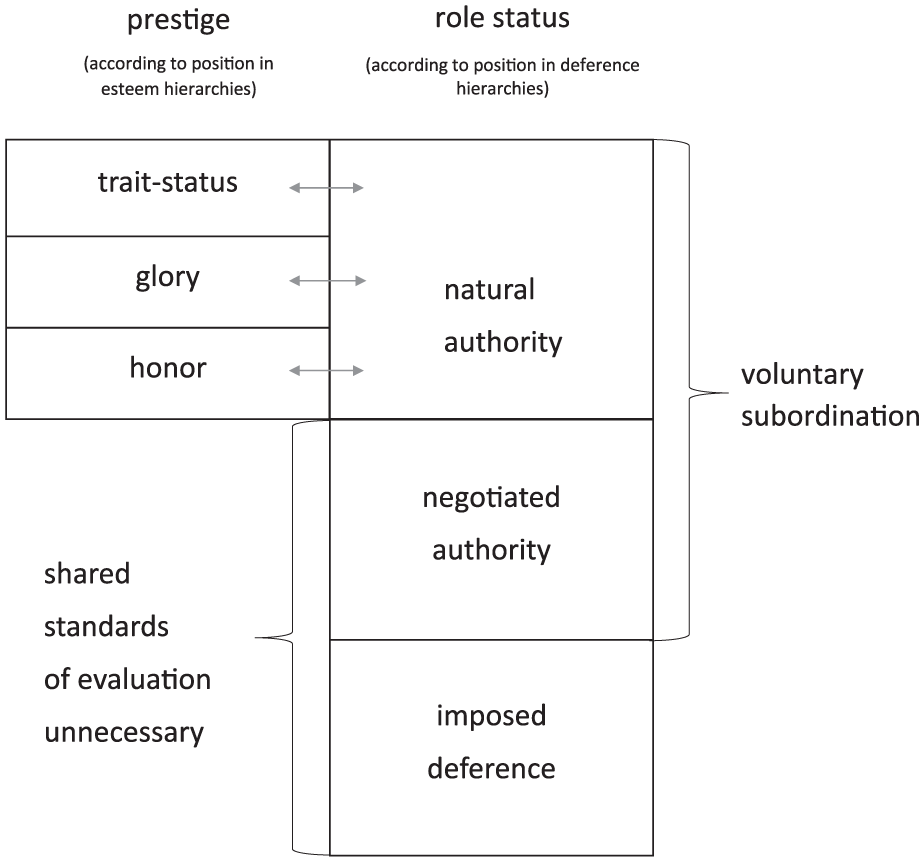
An integrated framework of status.
Sub-components of status in prestige hierarchies
Authors who focus on the workings of prestige hierarchies assume that high-status actors are commonly perceived to excel in that which society grades on an evaluative scale. High status is enjoyed by those whose attributes or possessions are known to be widely esteemed by a given society (trait-status) and by actors whose behavior or deeds are admired and ethically accepted (glory or honor). As indicated by Social Identity Theory (SIT), actors with a higher trait-status typically form (formal or informal) groups whose members are commonly ascribed a higher rank (e.g. Ivy League graduates, advanced industrialized countries); other actors will try to gain access to such groups by acquiring the necessary attributes (social mobility) (Tajfel and Turner, 1979).
The notion that a party’s status is based on public recognition of its eminent qualities underlies many well-known definitions of status and related terms. Thus, Larson and Shevchenko (2010: 69) see status as “based on a group’s standing on some trait valued by society” 7 ; Lebow (2008: 64) depicts honor as a status “that describes the outward recognition we gain from others in response to our excellence”; Markey (1999: 158) defines prestige as “the public recognition of eminence, and thus an assessment of relative position”; finally, for O’Neill (1999: 193, emphasis in original), “[s]omeone possesses prestige in a group if the members believe that the person is generally admired in the group. The admiration must be seen as having some grounds, such as the individual’s deeds or possessions.” Despite some terminological differences, these authors obviously share a common concept: societies rank their members according to the public esteem they are thought to enjoy. They agree on the fact that such a ranking can only be consistent to the extent to which the members of a given society share a common culture (Markey, 1999: 161; Neumann, 2014). 8
However, as the previous quotations show, these scholars appear to differ on the nature of the phenomena that typically evoke public esteem. Those who take SIT as their theoretical point of departure focus on an actor’s attributes, such as possessions, traits, and other characteristics (“trait-status” in my typology). Others, such as Lebow or Weber (2002: 631–640), emphasize actions or behavior that are prescribed by an honor code or a certain lifestyle. A third group, including Lebow, Markey, and O’Neill, as well as Wood (2013), include both individual characteristics and behavior. These scholars apparently share an intuition that these rankings of esteem follow similar but distinct logics of esteem allocation. However, they must be differentiated to gain a better insight into the workings of status.
Glory and honor, unlike trait-status, are based on esteemed behavior, rather than on attributes such as wealth, coercive capability, intelligence, or gender (Tsygankov, 2012: ch. 2). Honor, in particular, cannot be understood without reference to a relevant code of honor that actors or office holders must uphold (Appiah, 2010; Larson et al., 2014: 16). Honor is intrinsically related to norm-compliant behavior, more precisely, to behavior required to maintain an image of integrity. In contrast to the allocation of trait-status, the allocation of honor is not only based on current features; rather, it primarily reflects past events. Honor connects an actor to its past selves (Gould, 2003: ch. 6; O’Neill, 1999: 91). This temporal distance that separates honor from trait-status becomes yet more conspicuous once we consider a third difference that lies between those two subcategories of prestige: the honor scale of evaluation primarily focuses on stable negative values. For example, according to typical honor codes, one can be dishonored by lying, through inappropriate involvement with the other sex, or by failing to avenge an insult. Often, a blatant violation of the pertinent honor code will taint an actor’s prestige for many years. Genocide can profoundly diminish a state’s international prestige. Regaining honor through acts of repentance and reparation often takes decades. By contrast, acquiring a positive attribute (e.g. an advanced technology) may quickly enhance a party’s trait-status.
Glory stands somewhat between honor and trait-status. On the one hand, the allocation of glory also rests upon actions. Often, courageous military actions are considered both glorious and honorable, whereas excessive caution is held to be inglorious and dishonorable. On the other hand, there are also acts or feats that are deemed glorious but need not be performed by an actor who wants to remain in good standing. In contrast to honorable behavior, glorious actions are supererogatory. A successful moon landing can promote a nation’s international prestige. Nevertheless, a failure to participate in space races is rarely considered inglorious. Honor codes focus on the essential duties that all “honorable men” need to fulfill. They stipulate minimum requirements. Glory, on the other hand, potentially knows no bounds. Therefore, as with trait-status, glory is also less conjunct: it does not depend on complete compliance with a certain code. The demands of honor, by contrast, form an integrated web, so one kind of deficiency cannot be compensated by another honorable deed (O’Neill, 1999: 90). Finally, glorious accomplishments can also depend on fortunate circumstances, such as securing victory in a close contest. By contrast, honorable conduct never requires propitious conditions.
Sub-components of status in deference hierarchies
Deference hierarchies emerge from patterns of deference between two or more actors (or groups of actors). In international relations, the legal construct of sovereign equality largely constrains the explicit establishment of deference hierarchies. Nevertheless, asymmetric patterns of deference exist anywhere where one party routinely yields to the views, wishes, or commands of another who does not reciprocate. Typical examples include leadership in groups, patron–client relationships, regional hegemonies, and colonial empires.
Hierarchies between superior and inferior actors are scarcely established by isolated acts of deference, but rather result from patterns of deference (Gould, 2003: ch. 2; Mazur, 2005; O’Neill, 1999: ch. 9). Once I have begun to accept that you may interrupt me whenever you like, whereas I must listen carefully to your long statements, we are no longer equals. In effect, my submissive behavior has produced expectations that will structure our future relationship. The longer my acquiescence lasts, the more you will expect that you can continue your domineering behavior. Moreover, you will increasingly believe that you are entitled to do so (Rai and Fiske, 2011). I have thus found myself participating in a differentiation of roles with unequal (informal) rights. 9 Furthermore, you may eventually anticipate that my yielding in some domains entitles you to extend your domination to related fields. My yielding to your commands has become a convention. Thus, in weakly institutionalized societies, actors may be extremely reluctant to yield on trivial matters lest they give rise to unwanted stratifications of superior and inferior roles. Role status is therefore closely related to some conceptualizations of power. 10
These kinds of asymmetric relationships seem to be the most basic forms of status orders. Simple habits of subordination can explain rank ordering among apes, wolves, and other social animals far more plausibly than concepts of prestige hierarchies. Hence, some social scientists regard dominance relations as prototypical of status hierarchies (Athens, 2015; Gould, 2003: 23; Rosen, 2007: ch. 3). Status asymmetries in prestige hierarchies can be quite fuzzy due to incomplete agreement on the relative importance and actual possession of various valued attributes (Mercer, 2017). Often, it is impossible to ascertain if most actors believe that society holds two parties in equal regard. By contrast, hierarchies based on asymmetric roles tend to be stark and conspicuous, with participants being fully aware of their relative rank (Lake, 2014: 248).
As with prestige hierarchies, I distinguish three basic types of deference hierarchies: deference patterns based on natural authority; those based on negotiated authority; and those where deference has been imposed. As indicated by the term “authority,” the first two types refer to relationships where subordinates freely consent to their subordinate role. Authority is a legitimated form of dominance. In the case of natural authority, subordinates usually yield because they accept a leader’s superior prestige — for instance, when faculty members regularly defer to their most renowned colleague. In the case of negotiated authority, subordinates grant leadership in an agreement that stipulates respective roles and responsibilities. 11 Imposed deference is a more one-sided variety of deference relationship that normally originates with the dominant individual’s threat or use of sanctions (often related to the application of force).
Natural authority establishes patterns of deference that evolve without any implicit or explicit agreements (Magee and Galinsky, 2008: 355). While these patterns obviously constitute a social relationship, they often seem to emerge quite “naturally” since the dominant party need not resort to deliberate actions to establish its superior role. Typically, natural authority is voluntarily and spontaneously bestowed on prestigious actors without expectations of compensation. In that sense, prestige is also a possible cause of deference: those who enjoy it expect that others will defer to them. 12 One’s recognized eminence can induce deference for quite a number of reasons and to rather different degrees. In the weaker forms of natural authority, others simply wish to closely associate with a prestigious actor in an effort to make this higher status reflect on themselves (Benoit-Smullyan, 1944: 157–158). Hence, they will try to avoid behavior likely to displease that actor and may often imitate that person’s behavior. This interest in prestigious role models may be further enhanced by the presumption that the one imitated is particularly wise or refined. Such a belief will also induce those lower ranked to accept this person’s views and seek their recognition (Cheng and Tracy, 2014: 16; Johnston, 2008: 79–88, 156–157). Therefore, this kind of “effortless influence” is a kind of authority that can work almost inadvertently — just through the appreciation of an actor’s superior traits or accomplishments. Apparently, the Chinese tributary system often functioned in this manner (Kang, 2005).
In groups united by common purpose, natural authority can also induce actors to voluntarily obey explicit orders, even in the absence of formal arrangements. Thus, in a team of mountaineers, less skilled members may gladly follow the directions of the most experienced member. Team members form task-performance expectations based on what, according to this article’s conceptual scheme, would be called the team members’ trait-status and glory (as climbers), and then accept the most qualified member as their leader (Berger et al., 1998). 13 In international interactions, states sometimes recognize “lead nations” because they trust in their greater competence (although such lead nations also usually contribute a greater amount of resources to the task at hand). 14
Usually, however, regular deference of one state to another state’s commands presupposes another type of deference pattern: deference rooted in negotiated authority. This form of voluntary deference is based on a bargain between two or more states, reflecting their asymmetric interdependence. As described by Lake, some states may freely accord another authority in a specific domain (e.g. monetary or defense policy) in exchange for that state’s willingness to provide order or security for its dependants. Sometimes, this goes as far as giving the dominant state permission to enforce its wishes against its dependants in the interest of upholding the order when it is confronted with occasional deviance (Lake, 2009: ch. 2).
Strictly speaking, negotiated authority — unlike natural authority — does not depend on a shared culture with agreed standards of evaluation. Shared values certainly contribute to the stability of such a deference pattern (Lake, 2013: 59), yet, ultimately, the latter is built on a transaction that the contracting parties consider advantageous for reasons of their own: “Although prevailing social norms undoubtedly condition the terms of the relationship, the ‘glue’ that holds authority relationships together is not equity but rather the gains relative to each state’s next best alternative” (Lake, 2007: 54; see also Lake, 2014: 252). Most authority relationships will be a blend of natural and negotiated authority. Typically, compliance is reinforced by the superior partner’s special prestige. For instance, after the Second World War, the privileged position accorded to the permanent members of the United Nations (UN) Security Council resulted not only from the expectation of other members that these states would be the most effective guardians of international security, but also from the prestige that these states had achieved by defeating the Axis powers.
Finally, patterns of deference can also be arbitrarily imposed (imposed deference). Where common criteria for the allocation of prestige are weak or lacking altogether, raw power can become the sole arbiter of conflicting status aspirations — especially when material asymmetries do not suggest a mutually advantageous authority contract (Lebow, 2008: 67, 362, 520, 528). When such domineering acts remain unopposed, submissive behavior subsequently becomes habitualized. What started as a mere asymmetry in power morphs into a pattern of deference, a pecking order constituted by superior and subordinate roles that actors have internalized (Athens, 2015). Of course, onlookers may sometimes doubt that force can establish a “real” status asymmetry — even when applied in subtle ways. The oppressed parties themselves usually disagree. They know very well that whatever norm their oppressor may have violated in the process, their status has been impaired, and this is often the very reason why they eventually rebel. They feel denigrated or even humiliated, and, consequently, they derive emotional satisfaction from the very attempt to break free (Fukuyama, 1992: part III; Lindner, 2006).
Implicit threats will often suffice to impose a hierarchical relationship. For instance, the stronger party may confront the weaker side with a series of faits accomplis that the latter cannot afford to challenge; the former thereby obtains acquiescence to an asymmetric deference pattern. Sometimes, status gains through imposed deference are an unintended side effect of exploitative designs. Well-known examples of imposed deference relationships in world politics are the unequal treaties once imposed on China and Japan. Imposed deference may also result from highly asymmetric material interdependence, which gives rise to lasting role differentiations. Furthermore, in some cases, subordinates are no longer at eye level with their new superiors simply because they were less willing to risk unpleasant confrontations.
These examples again highlight that making analytical distinctions between deference patterns is often easier than the correct categorization of concrete empirical cases. What the dominant side may regard as voluntary accommodation to asymmetric interdependence, the weaker party might consider a humiliating surrender. Debt negotiations between Greece and other euro states provide a recent example where the dependent side eventually saw open defiance as the only way to regain its dignity (Wolf, 2018; Zahariadis, 2016). Likewise, it can be difficult to discern the impact of implicit threats. What may appear as voluntary compliance with the dominant state’s commands to some, may seem as helpless submission to superior force to others (Lake, 2007: 53). 15
As status has so many different foundations, complex societies have devised various symbolic tools to simplify public status hierarchies. Thus, many pre-modern societies established formalized orders of status that comprehensively regulated the deference patterns of whole societies (e.g. feudal systems), buttressed by ideologies that allocated prestige according to deference rank. As a result, numerous divergent rankings have been consolidated into one overt and consistent hierarchy. A similar function is served by public awards, privileges, and other “honors” still used in contemporary societies to allocate prestige more consistently and conspicuously. Perhaps, most importantly, all societies are stratified into groups with different hierarchical status. In IR, the exclusive “club” of Europe’s great powers was perhaps the most important status group: joining it tended to give new members a whole suite of special privileges, such as participation in the common management of the system, the “right” to share in the distribution of overseas territories, and the right to claim special spheres of influence.
Naturally, the consolidation of diffuse status differentiations into stratified status groups not only promotes order — inasmuch as it reduces ambiguities and hence, also, the number of status disputes — but can also create new categories of disputes relevant to such groups, raising the stakes in the conflicts that ultimately occur. These can usually be avoided so long as the various kinds of stratifications remain congruent, so that members’ status beliefs reinforce each other. Stability is surest when all the different status asymmetries neatly match up, when the actors with the higher status markers, greater accomplishments, and honorable records also occupy superior ranks in the deference hierarchies (Berger et al., 1998). However, this is rarely the case. Typically, disagreements about different rankings tend to produce a variety of status disputes.
How status conflicts differ: A typology of disputes
Status conflicts arise in various contexts and this should be reflected in IR theory. In particular, disputes about proper glory or trait-status must be clearly distinguished from disputes about deference because the latter always involve specific antagonists and tend to be far more acrimonious. This is because setbacks in these conflicts are more conspicuous since they result from the parties’ observable interactions rather than from suspected beliefs. In addition, a clarification of deference patterns affects relative influence more directly as it determines who must yield to whom. By contrast, in disputes about glory or trait-status, the unsatisfied party usually feels less aggrieved and often lacks a clear opponent, especially when it is dissatisfied with collective beliefs about its relative worth. Occasionally, conflicts about appropriate prestige will also be tempered by norms that discourage self-advertising communications.
The typology developed earlier provides a heuristic tool for identifying various tensions that can give rise to status disputes. Such conflicts can result from several kinds of friction, particularly:
between actors with differing views concerning an actor’s appropriate prestige (Types I and II);
between an actor’s prestige and its authority (Types III and IV);
between an actor’s unchanged status position and the latter’s shifting material basis (Types V and VI); and
between actors holding differing views about the appropriate status position of third parties (Type VII).
Disputes about appropriate levels of trait-status or glory (Type I) are confined to the prestige cell in Figure 1 and can occur in two basic forms, depending on whether the dissatisfied party aspires to become a member of a specific status group or not. In the second case, the party simply believes that wider society does not adequately appreciate its valued properties or accomplishments. A contemporary example is China’s so-called “Nobel Prize complex” (Gries, 2004: 67). Many Chinese believe that due to their country’s remarkable development, a Chinese economist should have already been awarded the Nobel Prize in Economics. Therefore, the fact that the Swedish Academy has not yet done so is widely seen as an inadequate appreciation of China’s accomplishments. Usually, such disagreements remain on the level of hurt feelings and rarely trigger open quarrels. Often, the targets of such resentment remain unaware of the aggrieved party’s anger. In the other case, an actor feels unjustly excluded from a distinct status group. This is a typical result of unsuccessful social mobility (Tajfel and Turner, 1979). Here, the aggrieved party has a (collective) target for its indignation. However, so long as the primary payoff of group membership is only prestige, corrective measures tend to remain rather mild. One measure is implementing a policy of “social creativity” that attempts to convince society that alternative status markers should be used for allocating prestige (Larson and Shevchenko, 2010; Tajfel and Turner, 1979).
Honor conflicts (Type II) are also confined to the prestige cell but tend to be more acrimonious because the stakes are higher. Due to its all-or-nothing quality, any successful tarnishing of an actor’s integrity can strongly affect social interactions, often leading to an actor’s ostracization from a social community. Such consequences can endure for a long time because, unlike diminutions in glory or trait-status, a loss of honor cannot quickly be reversed by compensating measures. Finally, a state whose honor is at stake often has a specific target that it can hold responsible for “unwarranted” acts of “slandering.”
Another prominent type of status conflict is caused by perceived friction between prestige and natural authority (Type III). In this case, a party believes that given its (commonly accepted) level of prestige, others should show greater deference. These conflicts will be further aggravated when actors subscribe to honor codes that demand a vigorous defense of one’s rank (Fiske and Rai, 2015: ch. 6). In some of these conflicts, both parties may feel entitled to expect deferential behavior on the part of their opponent. In other conflicts, someone once socialized in a subordinate role will no longer feel obliged to accept the other party’s dominance. This kind of conflict can be seen in the American–German dispute over the Iraq invasion of 2003. At the beginning of the new millennium, leading members in both administrations sensed that their country’s relative prestige had recently improved. The Bush administration expected Germany, which it perceived as stagnating and militarily weak, to simply follow the lead of America, which had done so much to liberate Germany from Nazism and the communist threat. Hence, Washington saw little need to consult Berlin before it resolved to invade Iraq (Gordon and Shapiro, 2004: 102; Pond, 2004: chs 1–2; Szabo, 2004: 5–9, 58, 129). The Schröder government in Berlin, on the other hand, believed that the new Germany finally had come of age and thus deserved a more prominent voice in transatlantic decision-making. Perceiving a narrowing prestige gap between the two countries, German decision-makers no longer accepted the America’s natural authority. Instead, they resented Germany being treated like a “slave” or a “Roman province” (Szabo, 2004: 19, 28, 134). Likewise, conflicts in deference relationships may arise from the mistaken assumption that increased prestige has been successfully used as a permanent substitute for material power. Indeed, there may be instances where enforced domination has been temporarily replaced by natural authority, so that the dominant party no longer relies on its material superiority. However, this makes the dominant party vulnerable to a sudden decline in its prestige that would undermine its natural authority, leaving it exposed to acts of insubordination. Thus, imperial powers have often underestimated the eagerness of their colonies to gain independence.
Similarly, negotiated authority can be destabilized by perceived friction with the prestige hierarchy (Type IV). In this case, a subaltern party comes to believe that its growing prestige (or the declining prestige of the patron state) entitles it to renegotiate the contract, deeming the latter’s asymmetry no longer “appropriate” considering the greater esteem the client enjoys in international society. It seems that friction such as this also complicated relations between the Schröder and the Bush governments. An even better example is the transatlantic rift that followed Charles de Gaulle’s return to power. His vision of France’s restored “grandeur” clearly ruled out any form of “subordination” under US hegemony. When Washington refused to grant Paris coequal leadership within the Western alliance, the French leader thus saw no alternative to defiantly expelling US forces and leaving the North Atlantic Treaty Organization’s (NATO’s) military integration (Bozo, 2001; Martin, 2016).
Another type of conflict between non-equals occurs when divergent assessments of material dependence weaken negotiated deference patterns (Type V). In this case, the subordinate actor comes to think that it can afford to ignore its patron’s directions. This also played a role in the American–German conflict mentioned earlier. Following the Soviet Union’s disintegration, Berlin felt less need to secure US military protection. Hence, it was less prepared to acquiesce to American wishes. US officials, on the other hand, perceived a world of new threats in which a militarily declining Germany still depended on its American protector. Consequently, unlike Berlin, Washington sensed little need for “renegotiating” the implicit contract between the two states (Pond, 2004: chs 1–2; Szabo, 2004).
Naturally, an evolving disparity between established roles and their material base can also destabilize deference patterns that originated as imposed deference (Type VI). For instance, in struggles for emancipation, those oppressed will attempt to break free when submissive habits are being questioned and the distribution of resources has shifted in their favor. Unless actors in an inferior position eventually come to see the relationship as one of natural authority that rests on the superior’s higher prestige (see earlier), they will be tempted to challenge the latter’s dominance as soon as the balance of enforcement capacities provides an opportunity. Another subtype of such status conflicts can arise when a rather balanced distribution of capacities begins to tilt to one side. The ascending party will gradually become disinclined to tolerate a symmetric role configuration by adhering to a practice of mutual deference (e.g. reciprocal respect for spheres of influence). Instead, such a party will be tempted to confront the other with an increasing number of faits accomplis that it would not dared to have carried out before, when the other party’s deterrence capacity had still been fully effective. By demonstrating that it can afford to ignore the other’s interests, the ascending power subtly tries to establish a one-sided deference pattern. This kind of status conflict has profoundly damaged contemporary American–Russian relations (Putin, 2008, 2014a). Sometimes, the rising side may even commit a purely symbolic offense just to prove that the declining party is no longer its coequal. In that sense, even small provocations can be seen as opening moves in a game that is aimed at establishing a pattern of imposed deference, if only in a narrow domain, which the rising side may hope to enlarge in the future (O’Neill, 1999: ch. 9).
Importantly, fears that another party might attempt to enforce an asymmetric relationship tend to provoke the most severe form of status conflicts. Faced with a perceived fait accompli or another insulting or humiliating act, the target often perceives no choice but to vigorously defend its claim to equality (Athens, 2005). These reactions rarely correspond to the logic of status theories in the tradition of SIT. Usually, a victim of faits accomplis or humiliating acts does not seek to restore its compromised status by challenging collective (second-order) beliefs about its own attributes or accomplishments. Nor does it attempt to acquire or redefine a valued trait by applying one of the status strategies explicated in SIT. Instead, the victim tries to directly harm the (role) status of its opponent by “putting it back into its place” or by “making it pay” for its status infringement — preferably, but not necessarily, in front of a larger audience (Lindner, 2006; Löwenheim and Heimann, 2008; Saurette, 2006). The perception and approbation of the general audience are of secondary importance here as the very act of open defiance suffices to break a pattern of deference. Unlike prestige-enhancing acts, effective defiance does not require anyone’s approval. To disrupt the expectation of deferential behavior, a defiant act merely needs to be noticed as such by the “arrogant” opponent. As pointed out earlier, the source of insubordination will often deem this message so important that it will not hesitate to compromise its own prestige status to put its opponent into place. 16
Finally, status conflicts between two parties can also result from shifts in the relationships with third parties (Type VII). Again, such disputes are more likely to be caused by changes in deference patterns. In some cases, deference gains by one party affect not only the deferring party itself, but also other members of the whole network of deference relationships, because third parties may lose some meaningful rights or options, for instance, if they must henceforth desist from interfering in a newly established sphere of special influence. This explains why, in international society, great powers are those who react most sensitively to other states’ status improvements in deference rank: for one thing, they are the states that are most easily impaired by some other state’s deference to its new patron (for they would have been better placed to influence the new client than most other international actors); for another, the great powers will usually “play in the same league” as the new patron and are hence more likely to suffer a relative status setback (Barnhart, 2017: 540).
Understanding Russia’s status disputes with America and “the West”
This section demonstrates the explanatory value of this framework by applying it to a case that has often puzzled IR scholars: Russia’s contemporary status disputes with the West. While there is no controversy that Putin’s Russia feels disrespected by the US and, to a lesser extent, by its European allies (Heller, 2014; McFaul, 2018: 67, 130–131; Stent, 2014; Tsygankov, 2014), Western observers often remain bewildered by the fact that the West proved unable to integrate Russia into the existing status order. After all, its former Cold War opponents, particularly the US, tried to actively support Russia’s liberalization efforts, refrained from treating it as a defeated nation (by refusing to “dance on the Berlin Wall”), staged prestigious US–Russian summits, concluded highly symbolic US–Russian arms control agreements, and even welcomed Moscow into prestigious Western clubs, such as the G8 and a special NATO–Russia council (Forsberg, 2014: 326–327; Pouliot, 2010: ch. 4; Stent, 2014: 9, 40). Some even argued that Washington had actually accorded Russia too much status (Applebaum, 2014; Goldgeier and McFaul, 2003: 359). Yet, others take the opposite view. For instance, the former Director of Policy Planning in the US State Department, Richard Haass, regretfully said in retrospect: “We neglected the Aretha Franklin principle with Russia — we did not give them enough respect” (Stent, 2014: 75; see also Matlock, 2014).
This paradox, however, is resolved once it is understood that contemporary Russia is far more interested in regaining its previous role status as America’s coequal than in increasing its prestige. True, in the early 1990s, Russian reformers partly accepted the Western democracies’ natural authority and openly tried to enhance Russia’s prestige by emulating their liberal institutions (Clunan, 2014; Kozyrev, 1993; Stent, 2014: 24–27, 36; Tsygankov, 2013: ch. 3). Before long, however, Russian elites perceived the West, above all its American leader, as trying to capitalize on what it saw as Russia’s weakness by seemingly ignoring the Kremlin and pushing it around (Type VI dispute due to attempted imposed deference) (Ambrosio, 2005: chs 4–5; Mankoff, 2009: ch. 3; Pouliot, 2010: 138–147, 168–182). NATO enlargement proved to be crucial in this regard. Moscow saw this as a dishonorable attempt to meddle in its traditional sphere of influence: “They promised that NATO’s military infrastructure will not move to our border, they deceived us. They promised that there will be no NATO military sites in the territory of its new members, they deceived us” (Lavrov, 2014b; see also Putin, 2014a). Even after the dissolution of the Warsaw Pact, the Kremlin expected East and Central European deference to what it saw as its special security rights based on its superior prestige. Furthermore, it likewise felt entitled to Western deference to this regional right to lead, not only because it saw this as a constituent component of its great power role, but also because this privilege seemed well deserved due to Russia’s outstanding contribution to the defeat of Nazi Germany (Type III dispute due to friction between prestige and natural authority; Type VII dispute over status relations with third parties) (Larson and Shevchenko, 2014b: 5–7). Western efforts to sweeten these bitter pills with symbolic concessions to prestige could thus only fail. To the extent that Moscow took them seriously at all, they could only strengthen Russia’s sense of entitlement (Forsberg, 2014: 326–327). A belief in one’s growing prestige, after all, raises the hope of gaining natural authority and thus increases the risk of Type III disputes.
In fact, however, Western politicians and observers viewed Russian prestige as being in decline. As Russia had failed to modernize according to their expectations, Western governments, above all the US administrations, sensed less and less need for deferring to its views, wishes, or rights (Kanet, 2015: 506). Hence, NATO leaders scarcely hesitated to initiate air strikes against Serbia in the face of Russian opposition. Things only became worse, in Russian eyes, with yet another round of NATO enlargement, the unauthorized Anglo-American invasion of Iraq, Western assistance for the color revolutions in Russia’s “near abroad,” and the West’s growing criticism of Russia’s internal policies (Lo, 2015: 19, 48; Putin, 2014a). All this seemed to demonstrate that whatever Russia contributed to the common war against terror, it continued to be treated as a quantité négligeable, expected to tolerate US unilateralism (Type VI dispute due to imposed deference) (Mankoff, 2009: 97–102; Putin, 2014a). Russian elites, however, had long ceased to accept the West’s natural authority and saw no need to rely on Western protection or support to stabilize the international order. The result could only be frustration, anger, and confrontation (Forsberg, 2014; Larson and Shevchenko, 2014b; Stent, 2014: ch. 11).
Nobody expressed this more clearly than Vladimir Putin himself. In the wake of the 2014 Maidan revolution and the ensuing Russian invasion of Eastern Ukraine, the Russian president bitterly complained about Western double standards, particularly about Washington’s arbitrary behavior and disregard for Russia’s rights as a great power, as well as about Western disrespect for Russia’s “appropriate” sphere of influence (Putin, 2014b): “Whatever Jupiter is allowed, the Ox is not. We cannot agree with such an approach. The ox may not be allowed something, but the bear will not even bother to ask permission.”
Although, in the same speech, Putin denied that he wanted to divide the globe into spheres of influence, he insisted that there should be “regional centres and integration projects forming around them [with] equal rights to development” (Putin, 2014b). Thus, by enticing Ukraine to join the European Union (EU) sphere, Western negotiators had allegedly violated the informal rights of another “regional centre” (Type VII dispute over relations with third parties) (Marten, 2015): “Nobody wanted to listen to us and nobody wanted to talk” (Putin, 2014b). This alleged Western trampling on Russia’s rights was contrasted with presumed Western attitudes towards Khrushchev’s Soviet Union: “this Nikita is best left alone, he might just go and fire a missile, they have lots of them, we should better show some respect for them” (Putin, 2014b).
In this view, invading the Crimea and Eastern Ukraine put an effective end to Western ideas that the Kremlin would keep deferring to Western interference in Russia’s sphere of influence (Kanet, 2015: 509–516; Lavrov, 2014c; Lo, 2015: 25, 48; Marten, 2015). While the intervention may have tarnished Russia’s international prestige (Götz, 2017: 238), this was apparently considered a price worth paying for restoring its overall status as a power that could not be pushed around (Clunan, 2014: 288–289; Lukyanov, 2016). In the same vein, Russia’s NATO ambassador had already described the 2008 invasion of Georgia as a “key diplomatic achievement” since it had allegedly restored Western “respect” for Russia (Heller, 2014: 341). That unlawful interventions had tarnished Russia’s honor in the eyes of the West was deemed an acceptable price. Clearly, Russia’s current leadership is more attached to the country’s role status than to its international prestige, seeing the former as more instrumental for enhancing its overall status (Forsberg, 2014: 328–329; Lo, 2015: 51, 179; Lukyanov, 2016). 17
Discussions that focus on SIT’s status conceptualization miss most of these dynamics because they assume that Russia primarily aspires to attain recognized status markers or to gain access to a specific status group. Yet, the Russian leadership has long shed any ambition to improve Russia’s rank by joining the group of “advanced Western democracies” (Kanet, 2015: 518–519). Nor does it place much emphasis on the country’s G8 membership. What it does care about strongly is its position vis-à-vis the US, which, according to Putin (2008), tries to behave “like a Roman emperor,” or, as he put it in his famous Munich speech (Putin, 2007; see also Primakov, 2006), like a sole “master,” a single “centre of authority,” which “imposes” all kinds of policies on other nations. It is this dyadic relationship that matters most in its status thinking and it is here where the Kremlin emphatically refuses to accept a subordinate role (Lo, 2015: 51, 98) by “show[ing the] servile obedience” that had allegedly been expected by the West (Lavrov, 2014a). As the Russian Foreign Ministry asserted quite unambiguously: “Complexities in relations with the US arise, as a rule when, on the American part, a striving appears to arrange them according to the leader and led scheme” (Ministry of Foreign Affairs, 2007: emphasis added). Likewise, Putin complained in his 2007 Time interview: “Sometimes one gets the impression that America does not need friends. Sometimes we get the impression that you need some kind of auxiliary subjects to take command of. We cannot build our relations on such grounds” (Time Magazine, 2007). “This country,” former Prime Minister Primakov (2006) vowed, “will not agree to the status of a state that is ‘led.’” To feel respected, Russia’s current leadership wants to be treated “as an equal partner” of America, the only NATO country it sees as having a foreign policy which deserves that name (Putin, 2008). This seems far more important than acquiring status markers that merely enhance Russia’s international prestige (Ambrosio, 2005: chs 8–9; Kanet, 2015: 507–508; Mankoff, 2009: 134; Sakwa, 2015: 571–574; Stent, 2014: 25, 48, 255–259).
Revealingly, this reading is not even disputed by scholars whose status conceptualizations focus on status attributes and inclusion in status groups. Thus, in their detailed accounts of the Kremlin’s status frustrations, Larson and Shevchenko fail to mention Russian criticisms of Western beliefs about Russian traits. Instead, they refer to numerous incidents where Moscow explicitly complained about being treated as a subordinate and consequently insisted on equal role status (Larson and Shevchenko, 2010: 81, 89, 95; 2014b: 273–277; see also Clunan, 2014).
Conclusion
As the world undergoes a profound shift from erstwhile Western preponderance to a more balanced distribution of economic resources and military power, international status disputes will gain prominence. Given the mutual benefits of economic interdependence and the secure deterrent provided by nuclear weapons, the intrinsic benefit of a higher rank may actually become the chief factor driving great power revisionism. In such a situation, IR urgently requires a differentiated and consistent typology of status aspirations and the various conflicts that they can provoke.
Scholars particularly need to move beyond the constraints of status theories beholden to SIT. As long as IR experts disregard the value of paramount status that states perceive from superior roles, and the emotional intensity with which they detest their nation being cast in subaltern roles, researchers will misconstrue the most significant drivers of status disputes. They will fail to build theories that can consistently account for the importance of humiliation and the attraction of defiance. Impoverishing our understanding of status dynamics in this manner is not only harmful from an analytical point of view, but also dangerous from a more practical perspective. After all, role differentiations are especially important for Asian civilizations, which seem destined to play a very prominent role in the crucial status disputes to come (Goh, 2008). Therefore, neglecting role status will become even more costly in the decades ahead.
Footnotes
Appendix I. Glossary
Acknowledgements
The author would like to thank Brian Greenhill, Daniel Jacobi, Markus Liegl, Steve Wood and the anonymous reviewers for the helpful comments and criticism.
Funding
The author(s) received no financial support for the research, authorship, and/or publication of this article.
