



Abstract
Preschool is an important time for children to grow in their experiences, abilities, and knowledge before entering formal school. Therefore, it is vital that the classroom acoustic environment supports children’s listening, learning, and wellbeing. The aim of this scoping review was to determine what is known from the literature about the effect of classroom acoustics and noise on preschool children’s listening, learning, and wellbeing, and what the knowledge gaps are. The scoping review followed the PRISMA-ScR guidelines. Seven papers met the criteria to be included in the review. The findings suggest that poor classroom acoustic conditions and particularly high noise levels, can have a negative effect on preschool school children’s listening and wellbeing, but may not affect word learning at the SNRs investigated. Nevertheless, it would be beneficial to install acoustic solutions and manage noise in preschool classrooms to enhance children’s listening, learning, and wellbeing. Future research avenues are discussed.
Introduction
Preschool is an important time for children where they can use play activities to grow in their experiences, abilities, and knowledge before they enter formal school. Preschool education has been shown to improve children’s cognitive abilities, social skills and contribute to children being more successful at school.1,2 Therefore, it is important to understand how the classroom acoustic environment design and management may affect children’s listening, learning, and wellbeing. Room acoustic parameters that are helpful to consider when characterising a space include the reverberation time (the time it takes for a sound to reduce in level by 60 dB), early decay time (EDT; the time it takes for sound to decrease by 10 dB), speech clarity (C50; the ratio of the early sound energy (between 0 and 50 ms) and the late sound energy (that arrives later than 50 ms)), definition (D50; the ratio between the sound energy between 0 and 50 ms. and the total energy). These measures quantify how sound behaves in a room. Noise refers to unwanted sound and, in the classroom, includes external noise such as traffic and aircraft noise, and internal noise such as equipment noise from heating, ventilation and air-conditioning systems, speech and movement from the children. Noise and/or reverberation can affect speech intelligibility. Measures specifically related to speech intelligibility include the signal-to-noise energy ratio (SNR; the ratio between the target signal and the background noise), speech transmission index (STI; a measure of the transmission of speech in a space) and the useful-to-detrimental ratio (U50; obtained from D50 and the signal to noise ratio). The AS/NZS2107:2016 standard 3 does not have specific acoustic recommendations for preschool classrooms, however, the standard recommends that unoccupied noise levels in school classrooms should be 35–45 dBA. The recommended reverberation time depends on the volume of the classroom, but for typical classrooms it should be 0.4–0.5 s.
Recent reviews have shown that poor classrooms acoustic conditions can have a negative effect on primary school children’s speech intelligibility, listening comprehension, literacy, numeracy, cognition, behaviour, physical health and mental wellbeing.4–11 Additionally, poor classroom acoustic conditions affect speech intelligibility and are a barrier for primary school children who have hearing loss or are non-native speakers to engage in listening and learning.12–15 Noise can increase repetitive behaviours in children on the autism spectrum. 16 Furthermore, children with attention deficit hyperactivity disorder (ADHD) are more affected by auditory distractions than children without ADHD. 17 Noise and poor acoustics have also been shown to have a negative effect on high school and university students’ listening, learning, and wellbeing.18,19 However, what about the effect on preschool children’s listening, learning, and wellbeing? Preschool children’s auditory and cognitive neurological systems are less developed than primary school children, so we may expect different results.
The Listen to Learn for Life (L 3 ) Assessment Framework 20 provides a framework to understand how the classroom acoustic environment affects children’s listening, learning and wellbeing. Listening is categorised along a spectrum – hearing, listening, comprehending and communicating. 21 Hearing is a passive function that concerns the perception of sound. Listening is active and involves intention and attention. Comprehension involves the reception of information. Communication involves the bi-directional transfer of information. For preschool children, listening is both important for learning (e.g. remembering stories as they cannot yet read), and for their social development. 22 Listening skills are critically formed up to age three, but continue to develop until age 15. 22 Playful learning is also important in preschool as it can enhance academic, social, and emotional outcomes in children. 23 As there are important links between children’s listening, learning and wellbeing, gaining an understanding of the impact of the acoustic environment of preschools on these outcomes would be beneficial.
Therefore, a scoping review was conducted in order to systematically map research investigating the effect of classroom acoustics and noise on preschool children’s listening, learning and wellbeing. The review also aimed to identify any existing gaps in knowledge to inform future research needs in this area. The research question for the review was: What is known from the literature about the effect of classroom acoustics and noise on preschool children’s listening, learning, and wellbeing? In terms of listening, the scoping review investigated the effect of classroom acoustics and noise on speech perception, speech intelligibility, listening comprehension or communication. In terms of learning, the scoping review investigated the effect of classroom acoustics and noise on any type of learning activities or learning processes and behaviours such as cognition, attention or memory. In terms of wellbeing, the scoping review investigated the effect of classroom acoustics and noise on physical or mental health, quality of life, annoyance or disturbance.
Method
Protocol
The Preferred Reporting Items for Systematic reviews and Meta-Analyses extension for Scoping Reviews (PRISMA-ScR) 24 was the protocol used for this scoping review. The PRISMA extension for scoping reviews website can be found here: http://www.prisma-statement.org/Extensions/ScopingReviews.
Eligibility criteria
The peer-reviewed journal articles had to meet the following criteria to be included in the review: (i) conduct a study on the effect of classroom acoustics (e.g. reverberation) or noise on children’s listening, learning, or wellbeing, (ii) be conducted with preschool children (i.e. include children aged < 6 years) and (iii) have the full text in English available.
Information sources
To identify potentially relevant documents, the following bibliographic databases were searched by author 1: ERIC, PubMed, Scopus and Web of Science. The final search results were exported into .csv files where duplicates were removed.
Search
A comprehensive search of the four online databases by author 1 was conducted on 25th September 2023 to identify the effects of classroom acoustics and noise on preschool children’s listening, learning and wellbeing. The search term was (preschool OR ‘early childhood’ OR ‘day care’) AND classroom AND (acoustic* OR reverb* OR nois*) AND (listen* OR intelligibility OR ‘speech perception’ OR comprehen* OR communicat* OR learn* OR cognit* OR atten* OR memor* OR behav* OR health OR wellbeing OR ‘quality of life’ OR annoy* OR disturb*). No publication date restrictions were applied.
Selection of sources of evidence
All publications identified in the searches were evaluated by the titles, and then abstracts and full text when needed for potentially relevant publications.
Data charting process
Data from eligible studies were charted to capture the relevant information on key study characteristics on the effect of classroom acoustics or noise on children’s listening, learning and wellbeing.
Data items
Data was abstracted on the following characteristics: populations that have been studied, the types of acoustic conditions that have been assessed, the types of measures used to assess listening, learning or wellbeing, and the effect of the acoustic conditions on children’s listening, learning and wellbeing.
Synthesis of results
Studies were grouped by the outcome measured and summarised according to the effect of the acoustic conditions on pre-school children’s listening, learning and wellbeing.
Results
Selection of sources of evidence
The search and selection process of the papers to be included in the review is shown in Figure 1. A total of 240 papers (132 after removing duplicates) were returned in the searches. These were vetted for relevance via reading the title, abstract and when needed for clarification, the full text. Seven papers were deemed relevant for the review.
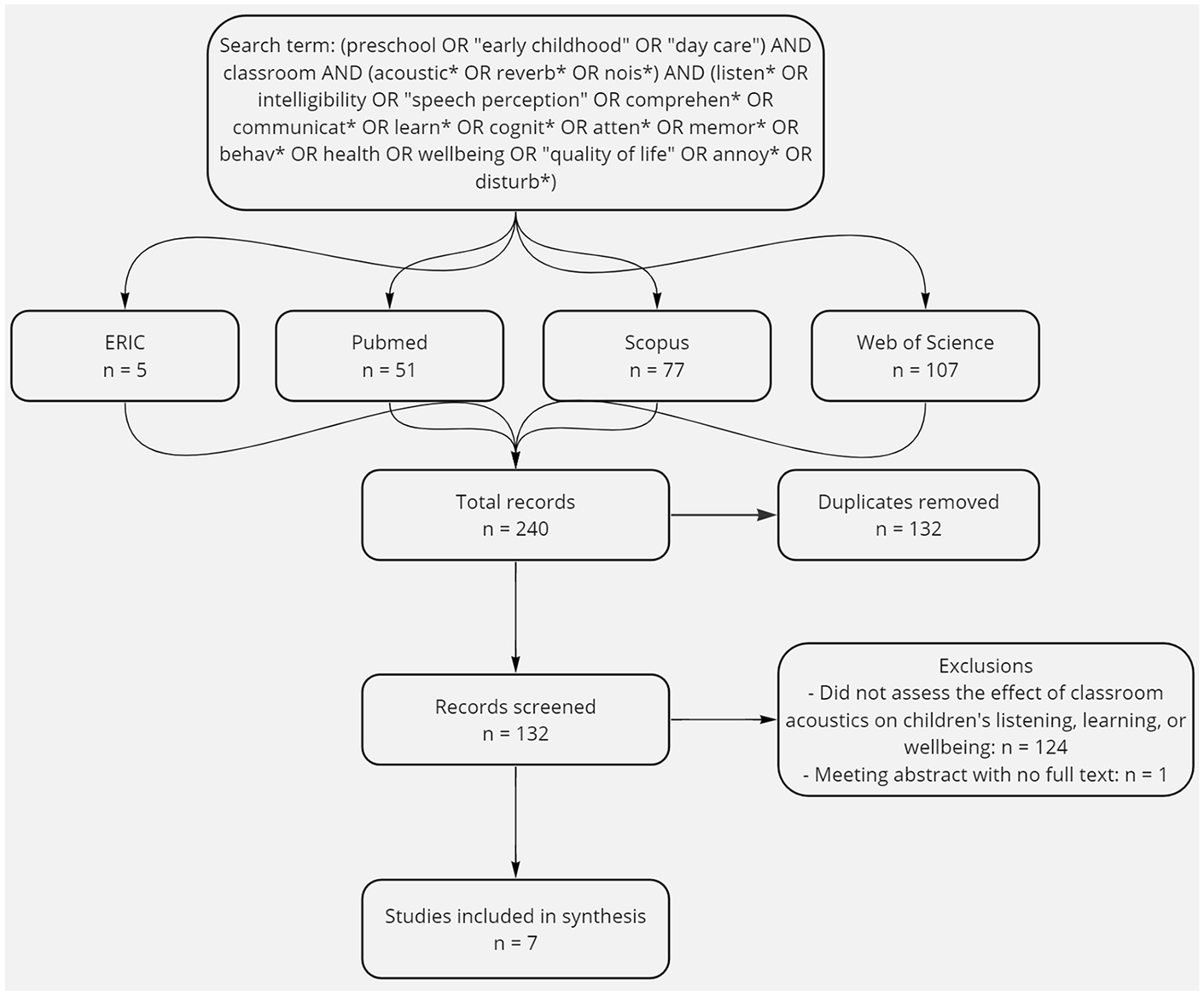
Database search results.
Characteristics and results of sources of evidence
The general information for the seven papers included in the review is shown in Table 1. The following sections describe the years of publication of the papers, the age and demographics of the children studied, the acoustic conditions investigated, the measures and methods used to assess listening, learning and wellbeing, and the outcomes of the papers.
General information for the seven papers included in the review and effect on children’s listening, learning and wellbeing.
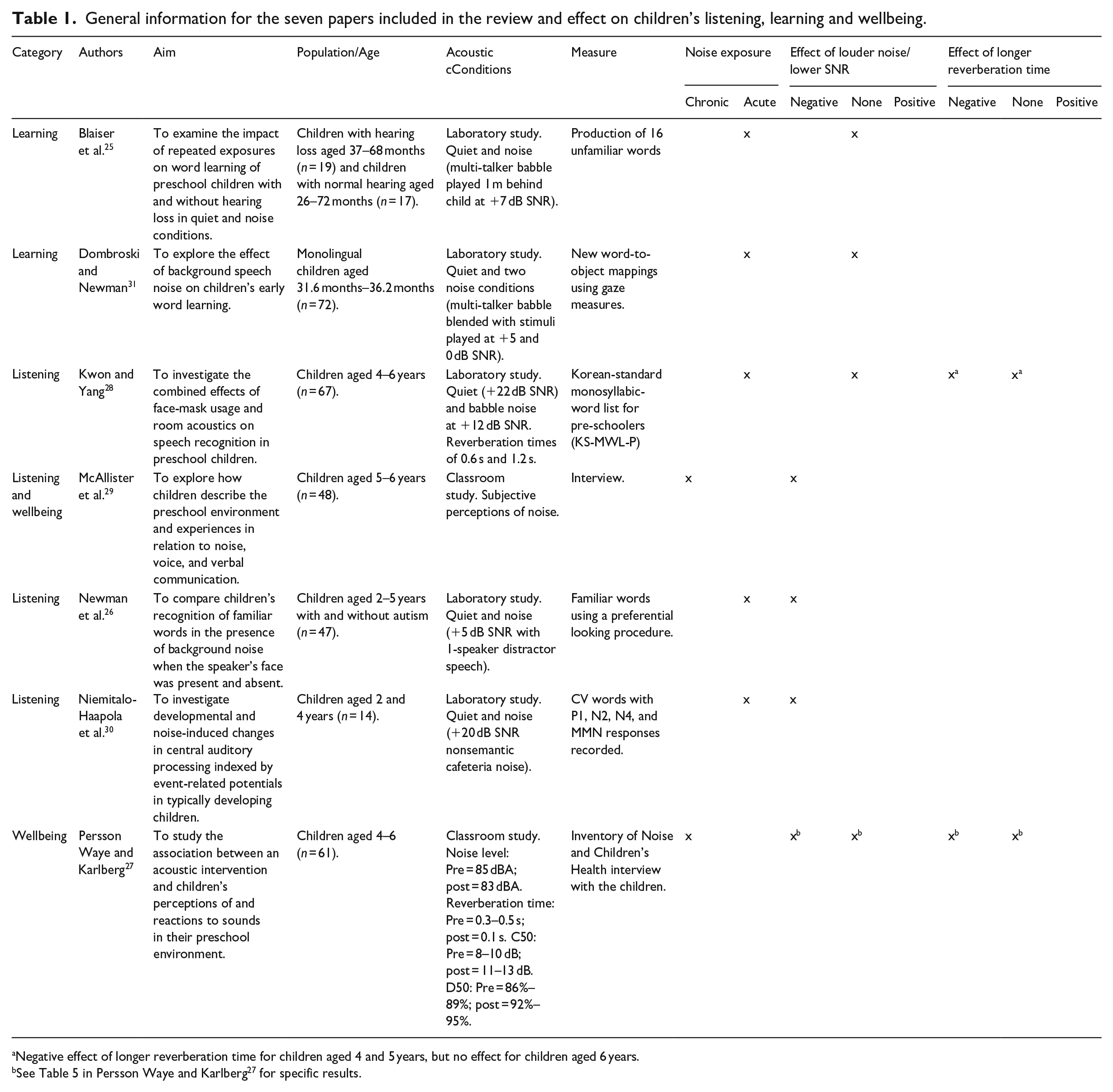
Negative effect of longer reverberation time for children aged 4 and 5 years, but no effect for children aged 6 years.
See Table 5 in Persson Waye and Karlberg 27 for specific results.
Publication years
The range of publication years was from 2014 to 2023.
Population
All seven of the studies involved typically developing children. One study also included children with hearing loss. 25 Another study included children with autism. 26 The age range across studies was 2–6 years.
Acoustic exposure
All seven studies investigated the effect of noise on children’s listening, learning and wellbeing. Two studies examined the effect of reverberation.27,28 One of these studies also reported C50 and D50 values. 27 Two studies examined the effect of chronic exposure, that is, long-term exposure to reverberation or noise,27,29 while five examined the effect of acute exposure, that is, short-term exposure to reverberation or noise.25,26,28,30,31
Measures and methods
Two studies used word perception/production methods.25,28 Two studies used eye gaze measures.26,31 One study used electrophysiology event-related potentials. 30 Two studies used interviews.27,29
Outcomes
An overview of whether increased noise/reverberation resulted in a negative effect, no effect, or positive effect on children’s listening, learning, or wellbeing can be found in Table 1, Figure 2 (SNR studies) and Figure 3 (reverberation time studies). Note that McAllister et al. 29 is not included in the figures as the noise levels were subjective so could not be quantified. Additionally, Persson Waye and Karlberg 27 were the only study assessing noise level (not SNR) so a figure was not constructed as there was only one study. Below is a summary of the findings categorised by the outcome measure.
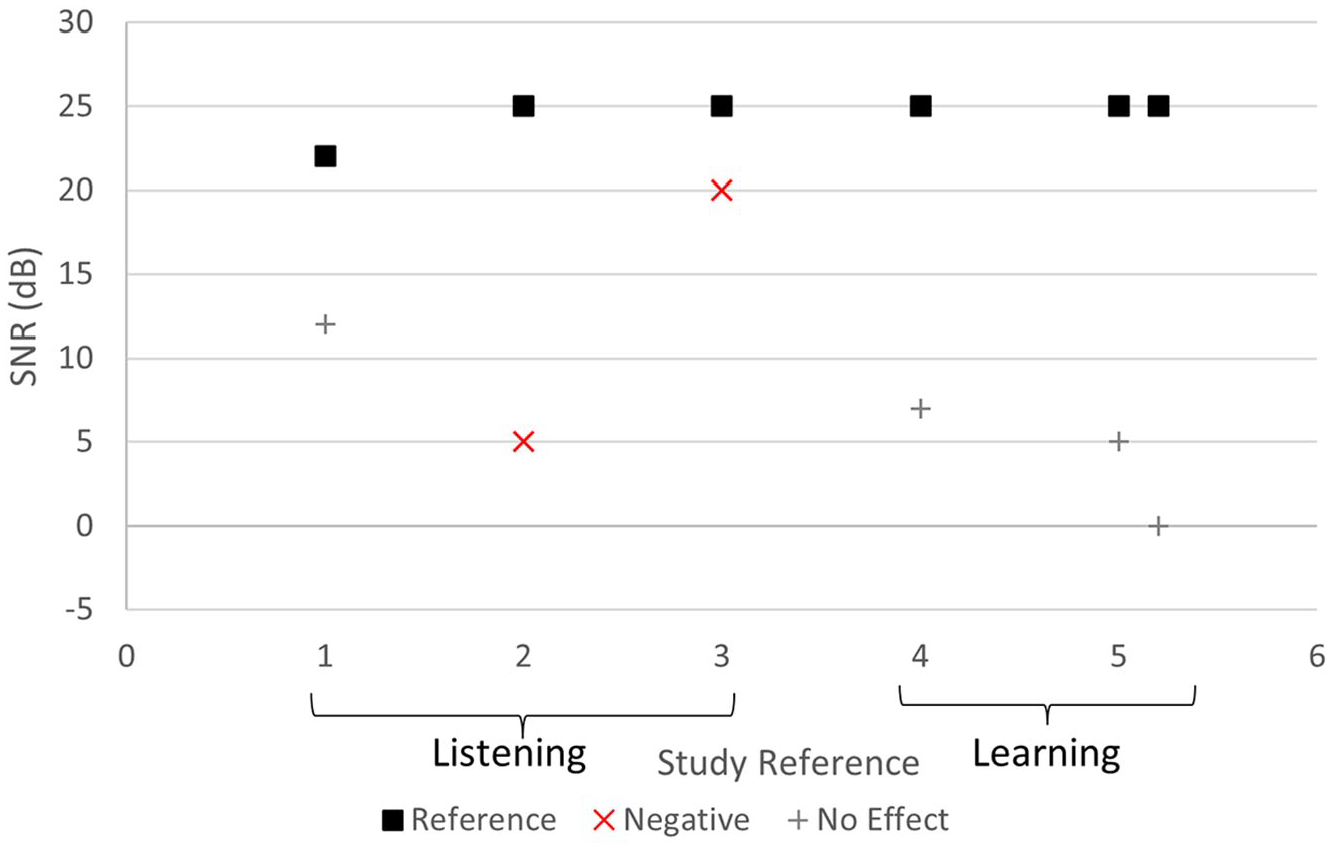
Effect of SNR (negative, no effect) on children’s listening, learning, and wellbeing for different noise levels compared to the reference condition collated from reviewed papers. Note that a SNR of +25 dB was chosen for a quiet condition.
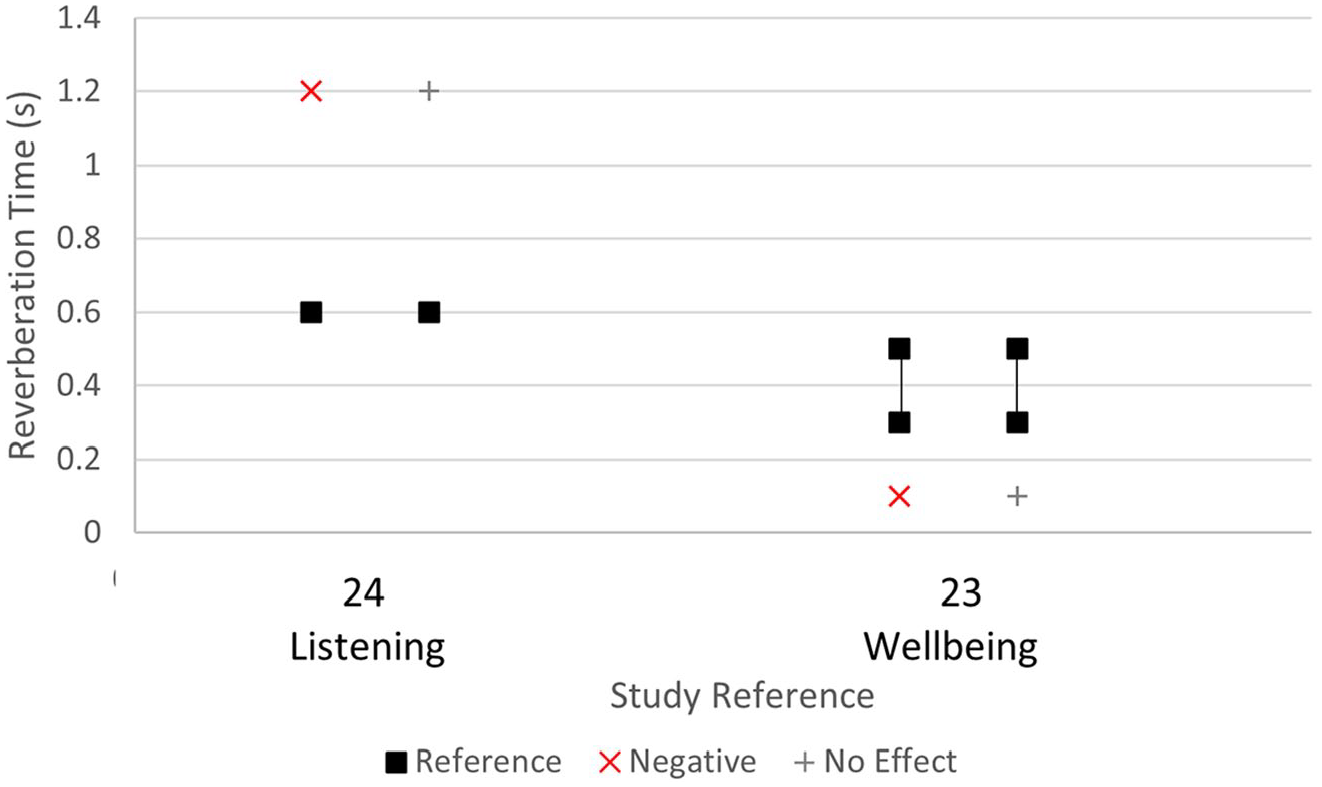
Effect of reverberation time (negative, no effect) on children’s listening and wellbeing for different noise levels compared to the reference condition collated from reviewed papers. Lines represent when a range of levels were studied.
Listening
Kwon and Yang 28 investigated the combined effects of face-masks and room acoustics on children’s speech recognition. The authors found no effect of SNR (quiet at +22 dB and noise at +12 dB). However, they did find a negative effect of longer reverberation time (1.2 s vs 0.6 s for children aged 4 and 5 years, but no effect for children aged 6 years). Children’s speech recognition scores were significantly negatively affected by masks in the poorest acoustic conditions (+12 dB SNR and 1.2 s reverberation time).
McAllister et al. 29 explored how children describe the preschool environment and experiences in relation to noise, voice, and verbal communication via interviews. The authors found that children can have difficulty hearing when there is noise.
Newman et al. 26 compared recognition of familiar words in the presence of background noise (+5 dB SNR) versus quiet when the speaker’s face was present and absent in children with and without autism. The authors found that all children were negatively affected by noise. However, when the children could see the speaker’s face, the children without autism performed better than the children with autism, suggesting that they could make better use of the cues from the speaker’s face.
Niemitalo-Haapola et al. 30 investigated developmental and noise-induced changes in children’s central auditory processing. The authors found that noise played at +20 dB SNR degraded sound encoding, degraded echoic memory, and negatively affected auditory discrimination in the children.
Learning
Blaiser et al. 25 examined the impact of repeated exposures of words on word learning in preschool children with and without hearing loss in quiet and a +7 dB SNR noise condition. The authors found no effect of the noise level when given repeated exposures.
Dombroski and Newman 31 assessed children’s ability to map a label on to an object in quiet, a +5 dB SNR, and 0 dB SNR noise conditions. Children did not show any difference in word learning across conditions.
Wellbeing
McAllister et al. 29 explored how children describe the preschool environment and experiences in relation to noise, voice, and verbal communication via interviews. The authors found that children can have a bodily reaction to noise (e.g. their ears hurt) and emotional reactions (e.g. being bothered by the noise).
Persson Waye and Karlberg 27 assessed the effect of an acoustic intervention on children’s wellbeing. The reverberation time of the classroom without acoustic treatment was 0.3–0.5 s and with acoustic treatment it was 0.1 s, and the noise levels were 85 dBA pre-treatment and 83 dBA post-treatment. The authors found that the acoustic intervention was associated with a 31% reduction in children’s perception of scraping and screeching sounds and a 29% reduction in the frequency of reported stomachache.
Discussion
The purpose of this scoping review was to synthesise research assessing the effect of different classroom acoustics and noise on preschool children’s listening, learning and wellbeing. Seven papers fitted the criteria to be included in the review and all of them assessed the impact of noise (measured mostly by the SNR) on children’s listening, learning or wellbeing, but two of them also assessed the impact of reverberation. The results were a mix of negative effects and no effects of SNR/noise and/or reverberation.
In terms of the SNR studies, for listening, a negative effect of SNR was found at +5 dB, 26 but no effect was found at +12 dB. 28 However, a negative effect was again found at +20 dB. 30 The reason for these inconsistent results may be because of the measure and the noise source. Newman et al. 26 used a one-speaker distractor rather than the babble noise used by Kwon and Yang. 28 Only having one speaker distractor is more distracting than having multiple people speaking as the distracting source. 32 This may also explain in addition to the lower SNR, why a negative effect of SNR was found at +5 dB, 26 but no effect was found at +12 dB. 28 Regarding the negative effect that appears again at +20 dB, 30 this may be because of the measure. Niemitalo-Haapola et al. 30 used electrophysiological measures (event-related potentials) to determine if there was a difference in the children’s processing of speech in quiet and noise. This method is likely to be more sensitive to processing in contrast to the behavioural measures used by Newman et al. 26 and Kwon and Yang 28 which is why we may have seen a negative effect here despite the higher SNR. In regard to learning, both studies assessed the effect of noise on children’s word learning, and neither of them found an effect of noise at 0, +5 or +7 dB SNR.25,31
In terms of noise (excluding the SNR studies described above), noise could negatively affect children’s reports of how well they could hear, and also could have a negative effect on their wellbeing.27,29 In terms of reverberation, there were mixed effects for both studies depending on the age of the child (younger children more affected than older children) and the measure.
These results have practical implications for preschool design and management. Noise from the children talking and playing is inevitable, but the impact can be reduced through room acoustic treatment and classroom management strategies. Although there does not seem to be an effect of SNR on children’s word learning, there can be negative effects on the children’s listening and wellbeing. Therefore, minimising noise where possible is of benefit. Future research is needed to understand what the optimal noise level and reverberation time for preschool classrooms are that balances the need for necessary sound but is not at a level that significantly negatively affects children’s listening, learning and wellbeing.
Limitations and future research needs
Listening
According to Kiessling et al., 21 listening can be divided into four auditory functions: hearing, listening, comprehending and communicating. Hearing is a passive function that concerns the perception of sound. Listening is active and involves intention and attention. Comprehension involves the reception of information. Communication involves the bi-directional transfer of information. The studies reviewed included studies of hearing and listening, however, the higher-level processing of listening comprehension and communication were not examined. Therefore, future research would be beneficial to investigate the effect of different classroom acoustic and noise conditions on preschool children’s comprehension and communication.
Learning
The only type of learning examined in the reviewed studies was word learning. This is very important for preschool children, however, it would be interesting to also investigate other types of learning. As preschool education is important for children’s cognitive abilities, social skills and success at school,1,2 examining the effect of noise and the acoustic environment on learning the skills that contribute to these abilities is also of importance.
Wellbeing
Both of the reviewed studies used interviews to assess children’s wellbeing. Subjective interviews can be helpful for exploring the effects of different acoustic conditions and noise on children’s wellbeing, however, they can be subject to response bias. Therefore, complementing subjective data with objective physiological measurements would be beneficial.
General considerations
One limitation of this review is the diversity of studies found over the preschool age range of 2–6 years, where children’s listening, cognitive, and emotional skills rapidly develop. 33 For example, at 2 years of age, children are using between 50 and 200 words and can put two words together in a sentence. 33 At 3 years of age, sentences start to develop further into paragraphs and children begin to take part in back-and-forth conversation. 33 At 5 years of age, children use more than 2000 words, know consonants and vowels sounds, and can read around 25 words. 33 These milestones demonstrate the large changes in development that happen over the preschool years. Therefore, strong, generalised conclusions cannot be drawn for preschool children in as a whole due the wide range of studies reviewed across this age range. Additionally, some of the reviewed studies included special populations such as children with autism and hearing loss, who may have different development trajectories.34,35 Future research is needed to systematically assess the effect of the classroom acoustic environment on children’s listening, learning, and wellbeing at each age of the preschool age range as there is a large developmental change across these years so the effect of the acoustic environment might be different depending on the child’s age. More research is also needed with different populations including children with special educational needs as only two studies included children with hearing loss or autism. Further research is needed examining the effect of different acoustic conditions on listening, learning, and wellbeing for children with language delays, attention deficits, as well as more studies on children with hearing loss and autism. Additionally, research with children who are second language learners or bilingual would be beneficial as listening in noisy conditions can be more difficult for these children. 15
Another limitation of the reviewed papers is that all of the studies investigated the effect of internal noise (mostly babble) on children’s listening, learning and wellbeing. This is important, however, it would also be beneficial for research to be conducted looking at the effect of external noise such as road traffic, aircraft and railway noise. These types of noises can negatively affect primary and high school students’ listening, learning and wellbeing,4–8,18 so it would be beneficial to also examine the effect on preschool children.
A further limitation of the reviewed studies is that all of the studies assessed the effect of the acoustic parameter of noise on children’s listening, learning, and wellbeing. Only two studies examined the effect of reverberation and only one of these studies also reported C50 and D50 values. Therefore, there is a need for room acoustic parameters to be investigated including EDT, C50, D50, U50 and STI to more fully understand the effect of different acoustic conditions on preschool children’s listening, learning and wellbeing and how particular acoustic treatment can be optimally installed.
Finally, it would be beneficial to examine some of the positive effects of different soundscapes on preschool children’s listening, learning and wellbeing. For example, primary school children prefer sounds that promote calmness and restoration during lessons, such as music and nature sounds. 36 Therefore, it would be interesting to see if these sounds promote preschool children’s listening, learning, and wellbeing.
Conclusions
The findings of this scoping review suggest that poor classroom acoustic conditions and particularly high noise levels, can have a negative effect on preschool school children’s listening and wellbeing, but may not affect word learning at least at the SNRs investigated. Nevertheless, it would be beneficial to install acoustic solutions in preschool classrooms to help reduce the exacerbation of the noise in reverberant spaces. It is also important for the teacher to manage the noise in the classroom and to be aware of when the noise is too high and might impact listening, learning, and wellbeing, so they can control it. This requires future research to determine optimum classroom acoustic parameter values and noise limits so that a balance can be found between allowing noise that is necessary, but also controlled to enhance children’s listening, learning and wellbeing.
Footnotes
Declaration of conflicting interests
The author(s) declared no potential conflicts of interest with respect to the research, authorship, and/or publication of this article.
Funding
The author(s) disclosed receipt of the following financial support for the research, authorship, and/or publication of this article: This research was funded by The Martin Lee Centre for Innovations in Hearing Health.
