




Abstract
Porous ceramic composite materials are fabricated for sound absorber materials. The ceramic composites are made from silica (SiO2) with a filler mixture to change the pore structure. Natural fillers synthesized from sugarcane bagasse with compositions of 0.5, 0.75, and 1.0 g are considered for sound absorber fabrication. Each filler weight comes with three different fiber sizes, namely 212, 425, and 630 µm. Subsequently, a blowing agent made of Al2O3 and CaCO3 is added to create pores in the composite, while a binder made of a mixture of gypsum powder and Portland Composite Cement (PCC) is used to bind the whole ceramic composite materials. Sound absorption coefficients α of each sample are evaluated by using impedance tube measurements according to ISO 10534-2. The results suggest that adding 0.5, 0.75, and 1 g filler gives the composite an absorption coefficient of 50%–80%, 60%–90%, and 75%–90%, respectively.
Introduction
Porous materials have been widely used as sound absorbers where the sound absorption mechanism is produced by a viscous/thermal effect due to the movement of the acoustic fluid within the pores.1,2 Other physical characteristics determining the absorption of sound are, tortuosity, fiber size, thickness, flow resistivity and fiber density.3,4 This suggests that these physical parameters need to be determined carefully during material fabrication to allow the sound absorption mechanism to work effectively for the targeted frequency range. Hence, fabrication techniques for a porous absorber material become crucial to form targeted perforation characteristics with specific pore diameter, which dictates other physical parameters affecting sound absorption behavior.5–8
The selection of raw materials is also important to comply with environmental and health requirement. Instead of the conventional synthetic subtance the use of natural fibers for sound absorber materials is now studied extensively. Such fibers are intrinsically friendly to the environment and the supply is abundant as a part of the plantation system. It has been known that natural plant fibers are good raw absorber materials, such as sugarcane, 9 tea fiber, 10 coconut fiber, grass fiber, and wood fiber, 11 pineapple fiber,12,13 and rice husk fiber. 14 It is evident from those studies that the absorbers show good acoustical performance where absorption coefficients of 0.5 and above are present. Hence, environmental issues normally found in mineral absorbers can be alleviated by using these raw materials.
A good absorption performance of natural fiber-based absorbers still needs some refinement to meet practical requirements. Natural fiber-based composite absorbers can produce fibrous pores. 15 The size and density of natural fiber can change the porosity and affect the sound absorption performance.16,17 The acoustic performance of the fibrous absorber is also affected by the porosity, thickness, and pore size. 7 A composite concrete-based absorber material with natural fiber filler was found to increase in porosity.18,19 Several studies developing natural fibers-based composite have been published.20,21 Natural fibers-based composite could provide more mechanical features related to the material and absorption capacity, such as heat resistance typically found in composite ceramics. Ceramic absorber is more suitable for warm or tropical areas because it is non-flammable and does not generate smoke or pollutants. As the ceramic absorber is also non-corrosive, it can be used indoors and outdoors. 22 Hence, the absorber can tackle acoustic absorption and heat insulation simultaneously, which is useful for practical purposes.
In this study, we propose an alternative sound absorber based on a ceramic composite with natural sugarcane bagasse fibers. The bagasse waste is abundant in tropical countries like Indonesia. The sugarcane bagasse fiber has been widely used as a mixture in various productions to reduce fabrication costs.23,24 The same approach is adopted in this study, where the sugarcane bagasse fibers are processed into sugarcane bagasse powders and then used as the filler for the mixture in the composite ceramic fabrication. The use of filler is to reduce the density of ceramic foam composite to initiate the formation of pores in the composite absorber. Therefore, such composite can be utilized as sound absorber material with different micro-morphology and absorption characteristics. Moreover, the proposed materials are developed by utilizing plantation waste; thereby, our work aims to develop a new sound absorbing material which utilizes environmentally friendly materials. The proposed absorber is expected to be applicable in a harsh environment such as industrial areas where the heat of operating mechanical system are likely present or the coastal/docks areas which are prone to corrosives.
Materials and methods
Synthesis process of sugarcane fiber fillers
The bagasse powder fiber was used as filler material for the ceramic composite absorber. Bagasse powder filler has variations in the composition of 0.5, 0.75, and 1 g and filler sizes of 212, 425, and 630 µm. The process and steps in making the sugarcane fillers as the mixture materials for making the ceramic composite-based absorber can be described as follows: (1) washing and sun drying the sugarcane fibers for 1 week to reduce the moisture content so that the mixture materials are easily ground; (2) chopping the dry sugarcane fiber into small size pieces (3) grinding for obtaining fine particle fibers or bagasse powder (4) sieve process is to get sugarcane fiber filler with utilizing sizes. Various filler sizes are used to get and fulfill the physical characteristics, such as the absorber’s appropriate size, density, and compression. The shape of pores created inside the material can give the material’s porosity effect. The fiber’s size, the arrangement of shapes, and density/compression would become the essential factors in changing the absorber’s physical characteristics, as suggested in Tang and Yan 7 and Mati-Baouche et al. 25 The fabrication steps of sugarcane bagasse powder filler can be seen in Figure 1.
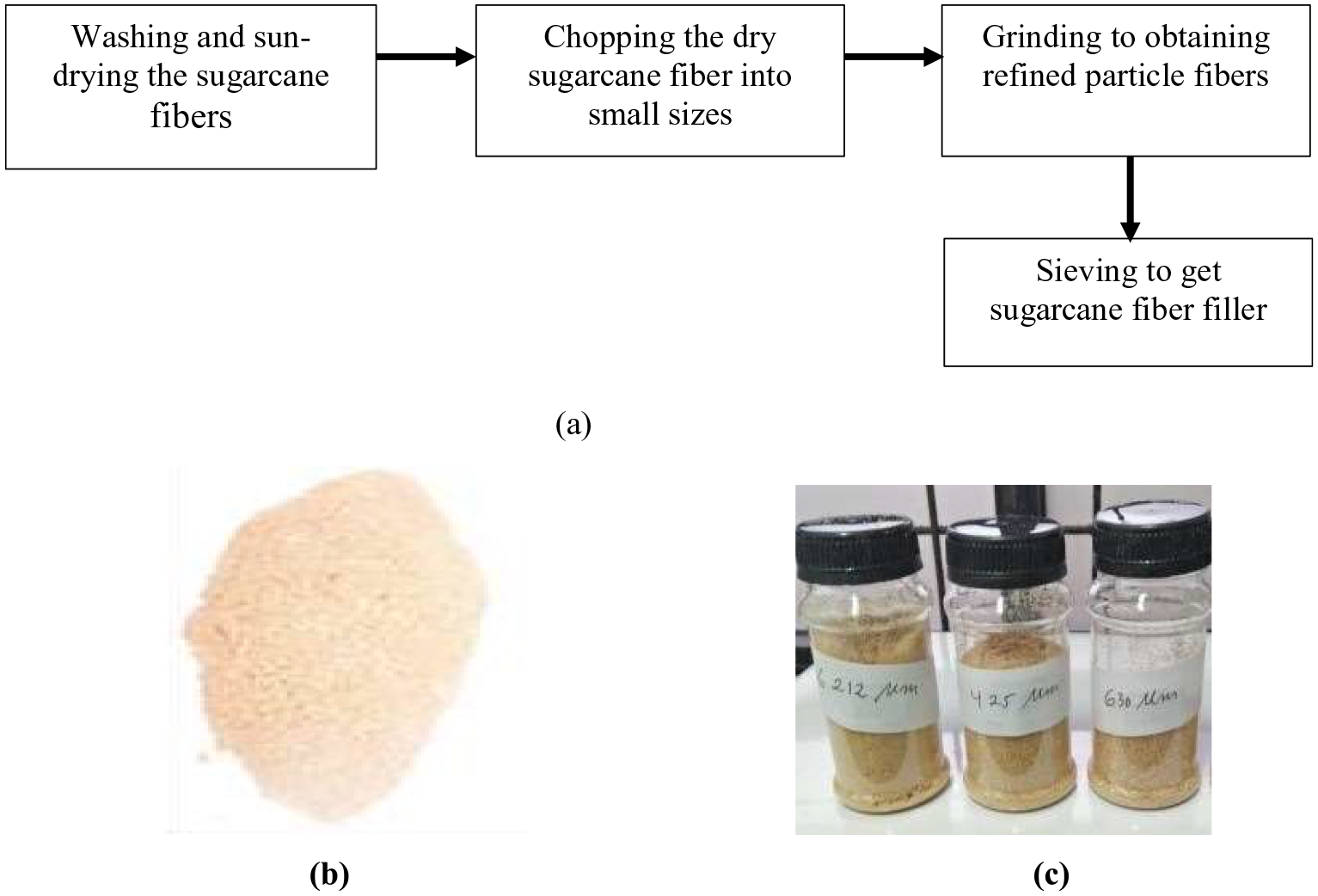
Sugarcane bagasse powder filler: (a) flow chart, (b) grinded fiber, and (c) sieved fibers with different filler sizes.
Materials and composite ceramic fabrication process
Materials and composition needed in the porous material fabrication are the aggregate material (silica) 10 g, sugarcane bagasse powder filler 1 g, blowing agents are 2 g alumina powder and 2 g CaCO3, binder materials are 40 g gypsum powder and 10 g Portland Composite Cement (PCC), and 40 ml of water as the solvent. This composition can produce a composite absorber thickness of around 10–17 mm so that the material composition is doubled to create a thickness of about 2 cm. In this study, sugarcane bagasse powder was obtained from the waste of sugarcane juice sellers. Gypsum and PCC are obtained from building materials stores. Calcium carbonate and silica are obtained from Brataco chemical and alumina powder from an industrial partner.
A mixture of gypsum powder and PCC is employed as binder material since they are widely available and affordable. However, the variation of PCC and gypsum powder composition would change the viscosity and density of the binders, which can affect the material’s mechanical characteristics and porous forming process. Gypsum and PCC have different viscosities of 1.2578 and 1.3849 cP, respectively, and have densities of 1.1401 and 1.3310 g/ml, respectively. Composite absorber fabrication was made using a ratio of 4:1 for Gypsum and PCC.
All powders are mixed in a tube and then shaken for 15 min until evenly distributed and form a homogeneous powder. After that, water is added to the homogeneous powder and mixed evenly with a spatula until bubbles form. The mixture was then poured into a mold with diameters of 30 and 100 mm and a thickness of 20 mm, as required to fit into the impedance tube. All fabrication process is depicted in Figure 2.
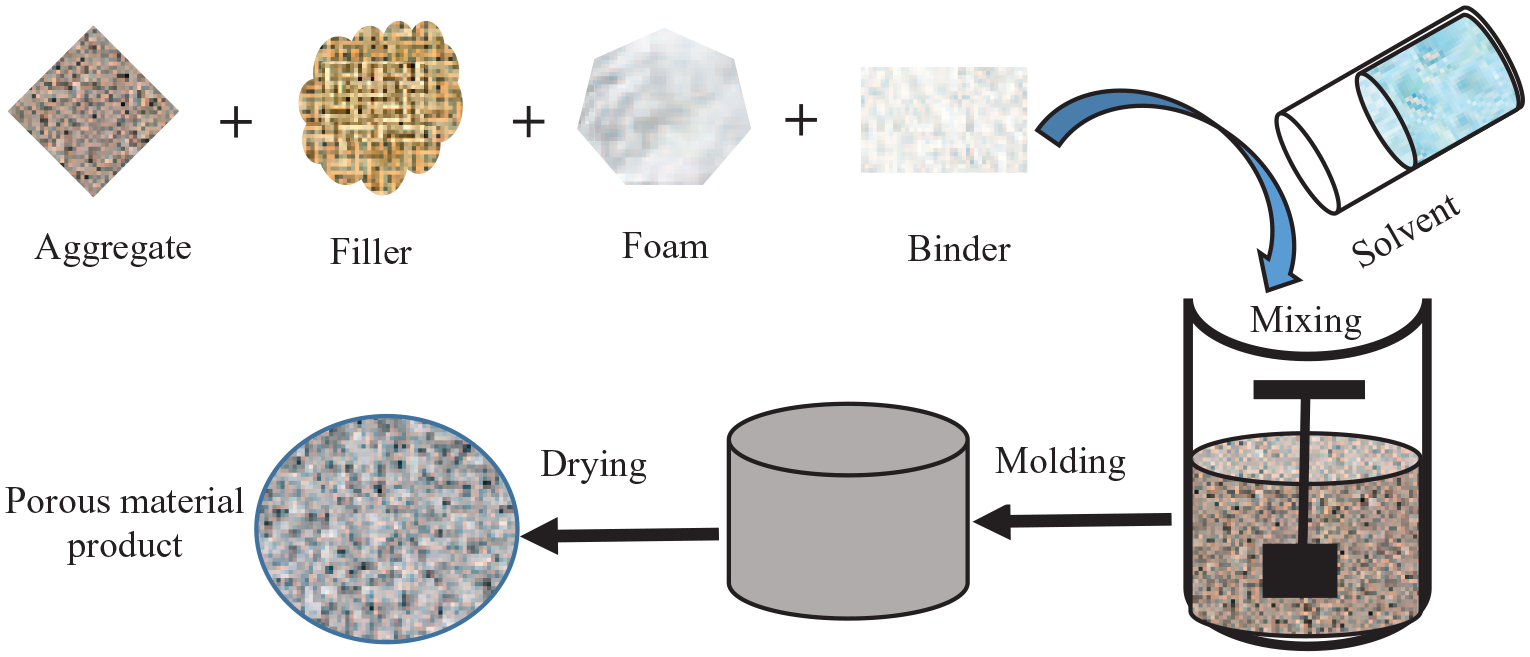
The synthesis process of porous composite ceramic.
Morphology and sound absorption characterization
Morphology characterization was performed using the SEM (Scanning Electron Microscope) Hitachi SU3500. The absorption coefficient of samples was tested using an acoustic impedance tube based on the transfer function method. 26 The 100 mm and 30 mm diameter tubes were employed to pick up incoming and reflected waves in the tube for a low to high-frequency sound absorption (250–6000 Hz) where two microphones were positioned on the impedance tube as shown in Figure 3.
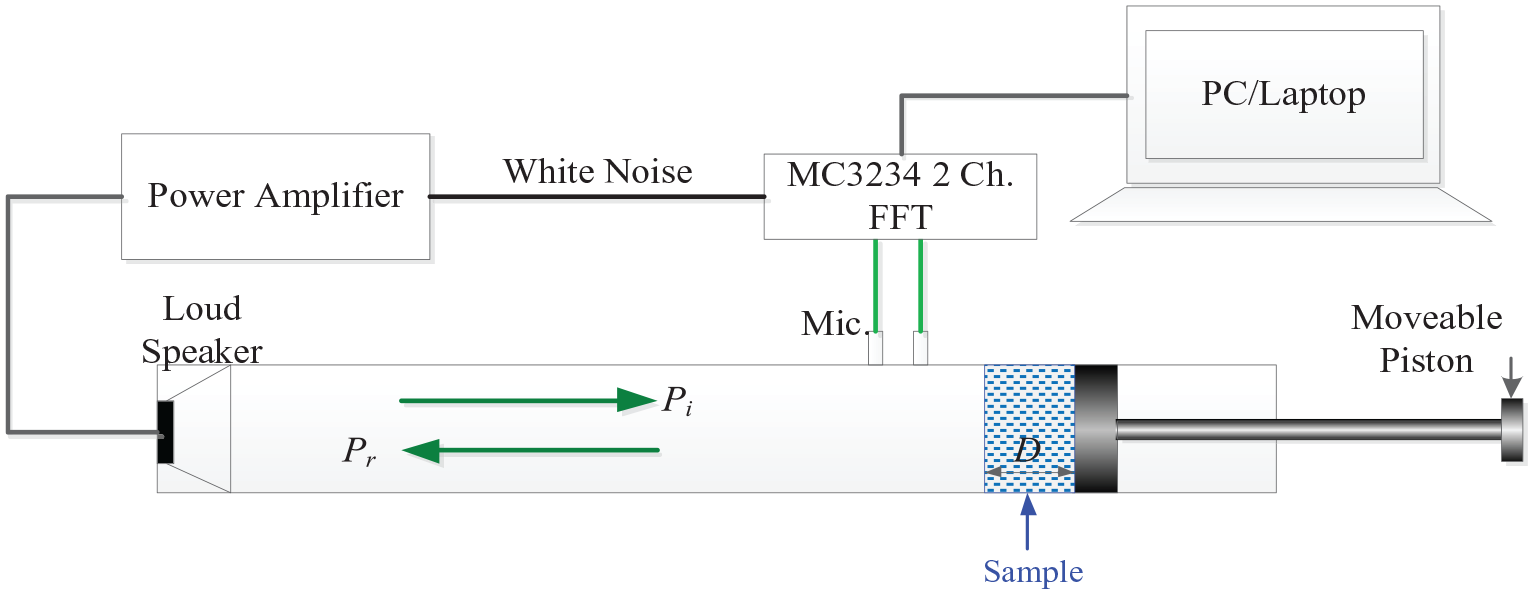
Schematic measurement for obtaining the sound absorption coefficients using impedance tube.
Result and discussion
Morphology of composite ceramic
The SEM results in Figure 4(a) to (c) show that the ceramic composite with sugarcane fiber filler addition has a cellular pore shape. Porous ceramic is created due to the addition of the blowing agent and sugarcane fiber filler. Open pore structures are essential so that the absorption properties are greater than the reflective properties when sound waves propagate into the pores. Therefore, open pores are expected to be present in the composite for good sound absorption.
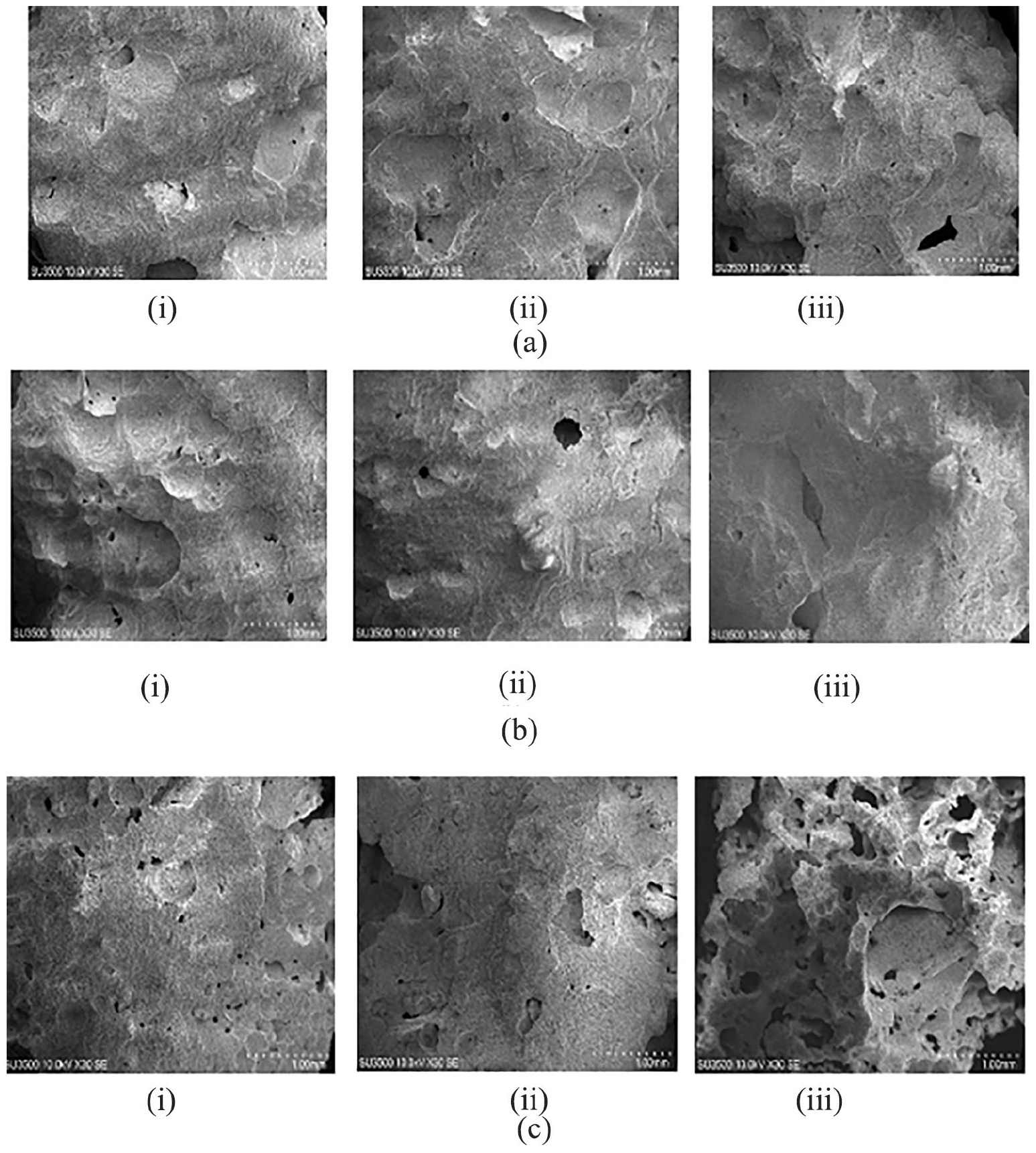
The pore structure of composite ceramic with different filler addition of (i) 0.5 g, (ii) 0.75 g, and (iii) 1.0 g: (a) Filler size of 212 µm; (b) Filler size of 425 µm, and (c) Filler size of 630 µm.
Based on the sample morphology from SEM results in Figure 4, the fillers showed a difference in the size and shape of the pores. The results for 1 g of 212, 425, and 630 µm filler addition can produce average pores diameter of (1.96 ± 0.4) × 102 µm, (2.20 ± 1.14) × 102 µm and (2.33 ± 0.94) × 102 µm, respectively, while the pore spacing distribution is (4.73 ± 1.19) × 102 µm, (4.91 ± 1.72) × 102 µm and (4.97 ± 1.23) × 102 µm, respectively, as seen in Figure 4. The results show that bagasse powder filler with the smallest size of 212 µm results in the highest pores quantity and the smallest pore size compared to the other filler sizes of 425 and 630 µm. It is indicated that the smaller the filler size, the easier pores form inside the material because blowing agent gas makes the small filler more easily lifted. Coarser fillers do not produce as many pores but give wider pores. Adding filler with various sizes into a composite ceramic can affect the pore structures, sizes, and spacing. The use of fine filler in composite ceramic results in also fine pore surface with a smoother surface and texture. The bigger the filler size, the bigger the pore diameter, while the finer the filler size leads to a smaller pore diameter. It is also found that the pore spacing increases as the filler mass increases, as seen in Figure 5(a) and (b).
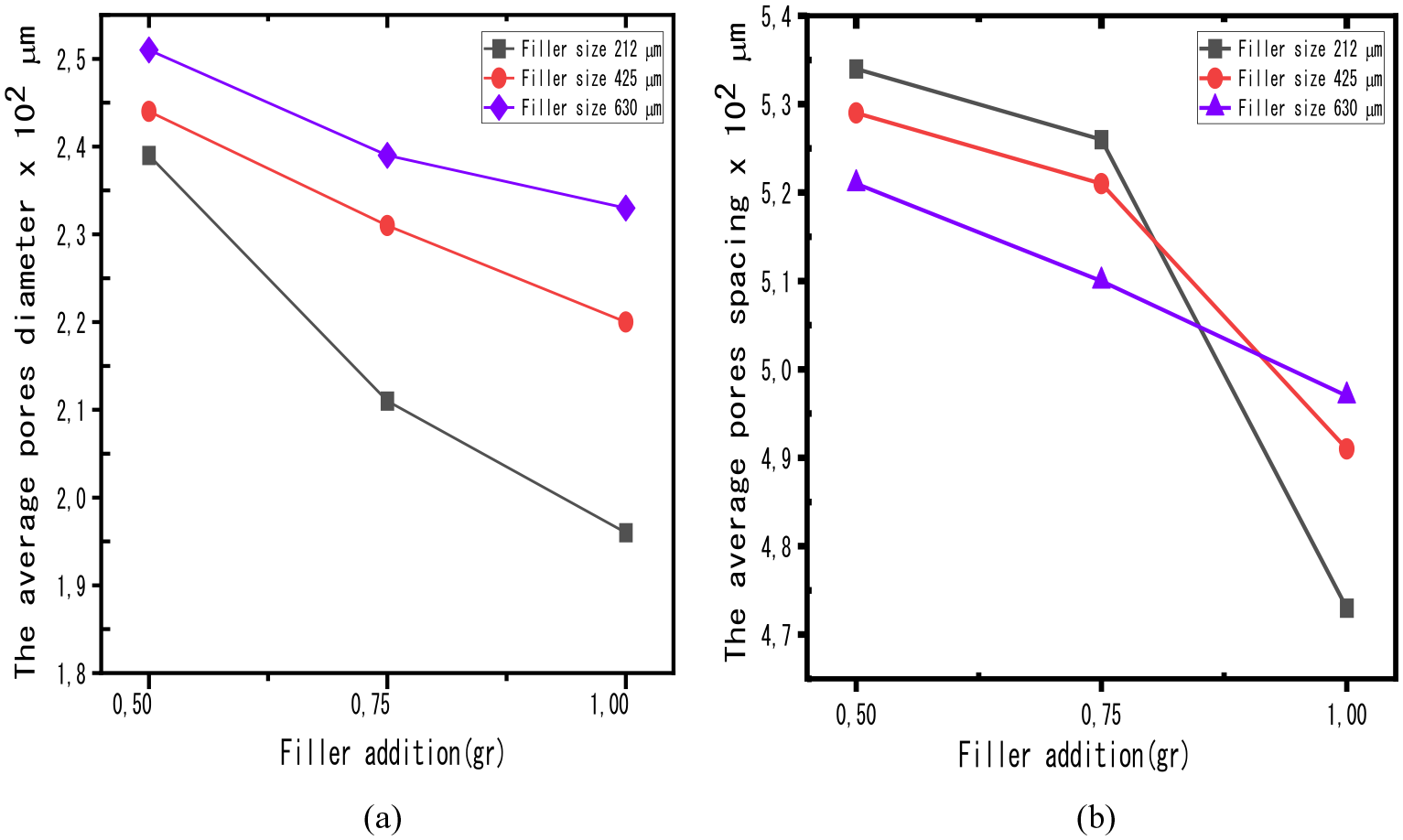
The effect of filler addition on the composite absorber morphology: (a) average pore diameter; (b) average pore distance.
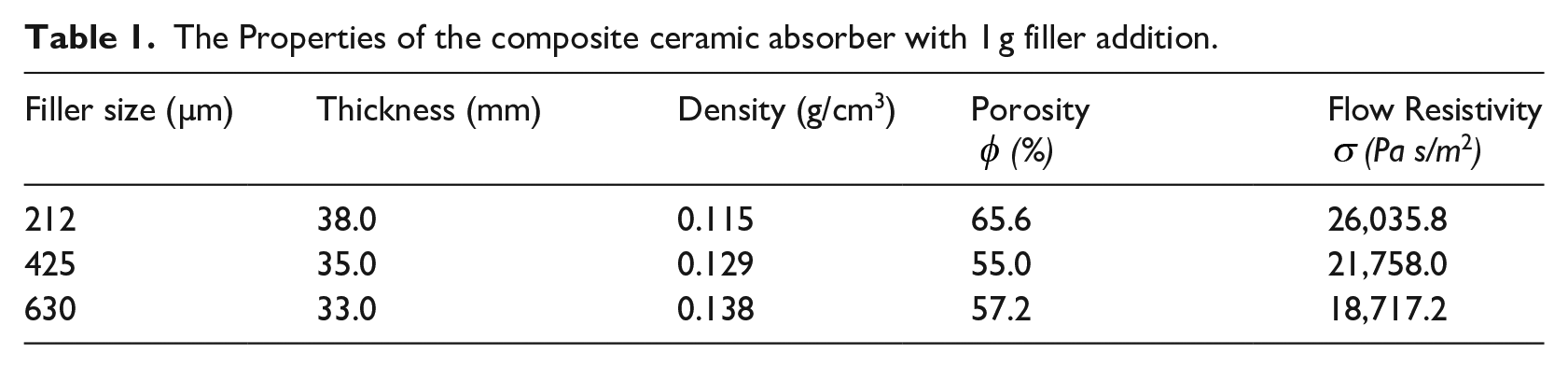
The porosity of each filler size is approximated by the SEM image processing where the pore or void area and solid area can be identified under a regular hexahedron condition. The resulting porosity are listed in Table 1, while the flow resistivity is calculated using
The Properties of the composite ceramic absorber with 1 g filler addition.
Absorption characteristics
Sound absorption coefficients α of the absorber with each filler size can be seen in Figure 6(a)–(d) for 20–30 mm thick samples. The filler addition to the ceramic composite material affects its sound absorption characteristics where absorption performances are increased by 0.2 up to 0.45 points after comparing the ceramic composite with the control material (see Figure 6(a) and (b)). Moreover, adding 1 g of 212 µm filler results in greater absorptions than 0.5 and 0.75 g fillers, as shown in Figure 6(b). For the greater size of filler diameter, the absorption performances for different filler weights are slightly different, as indicated by the case of 425 and 630 µm, as shown in Figure 6(c) and (d), respectively. It can be seen those broadband sound absorption characteristics are pronounced for each filler composition, but sound absorption reduces by 0.1–0.2 points if compared with the 212 µm filler case in 1 g mass.
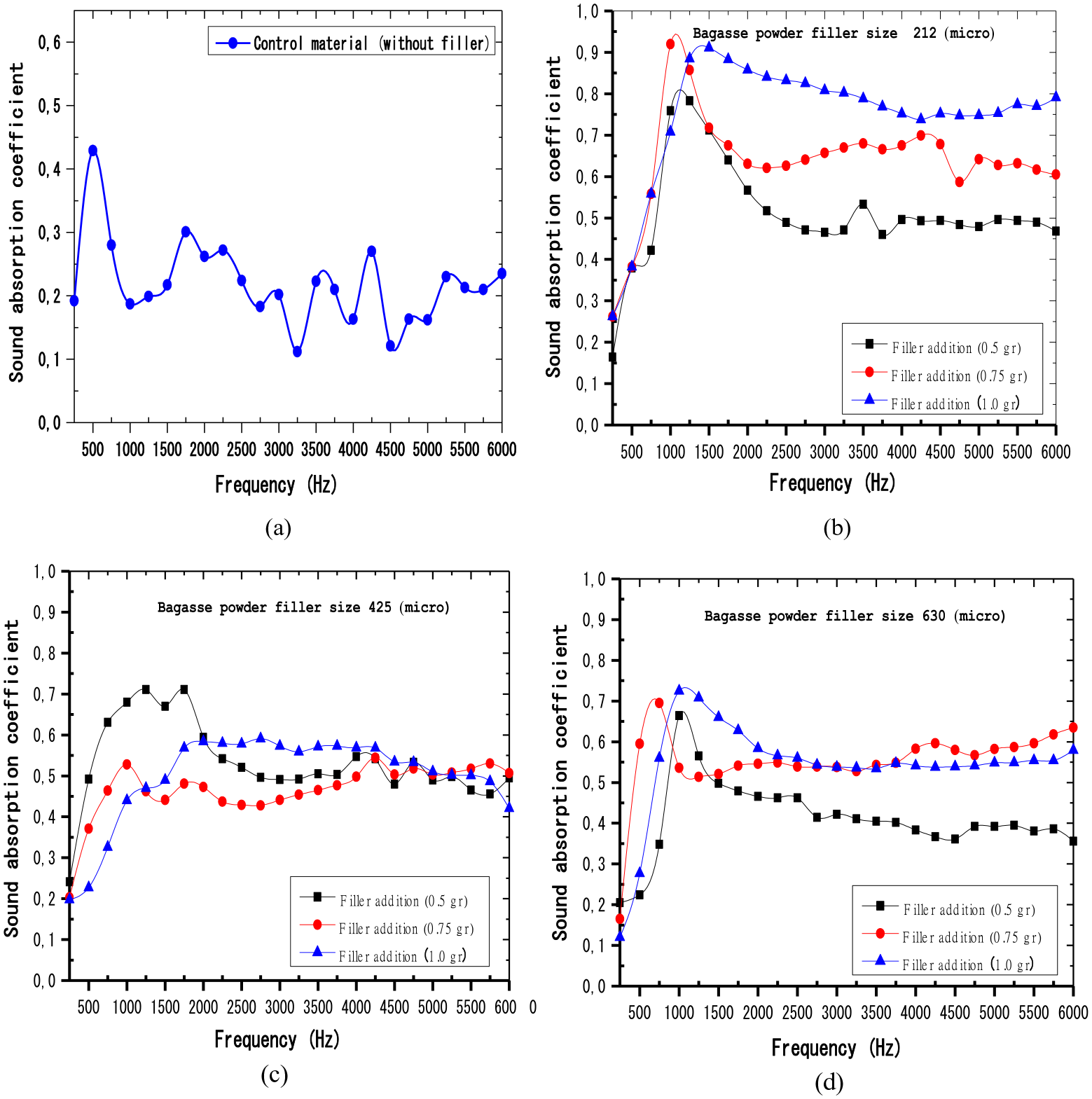
Sound absorption coefficient comparisons: (a) without filler addition, (b) with filler size of 212 µm, (c) filler size of 425 µm, and (d) filler size of 630 µm.
A narrow sound absorption at a lower frequency is present, as shown in the 212 µm filler diameter for 0.5 and 0.75 g filler, respectively. This condition is typically related to dead-end pores and greater pores by which resonance mechanisms exist.27–30 However, such a characteristic is lesser for greater filler diameter, as seen in the case of 425 µm and 630 µm filler diameter cases (see Figure 6(b)–(d)). This characteristic suggests that using a smaller pore diameter and a higher percentage of filler in the composition can create higher sound absorption as a result of higher flow resistivity. Theoretically, this may be discussed by considering the Johnson-Champoux-Allard (JCA) formulation8,31 where the pore sizes govern dynamic bulk modulus and density of saturated air inside the pores including the flow resistivity as one of main parameter of the JCA model.
A theoretical verification is provided for the case of 1 g filler addition for all filler size. With circular idealized pore and evenly distributed condition, the JCA formulation is employed to predict the absorption behavior where the pore size and porosity characteristics are considered in the calculation. Meanwhile, other JCA parameters are deduced from pore radius and a tortuosity of 1.3–2 is applicable for this case. The results are presented in Figure 7 where the overall behaviors of experimental results are verified by the theoretical ones. This reflects that the flow resistivity and resulting pore properties govern the absorption behavior. Meanwhile, the observed discrepancies may be attributed to a non-evenly distributed pores and pore geometry that leads to multi-porosity condition. This will be investigated further in our next study.
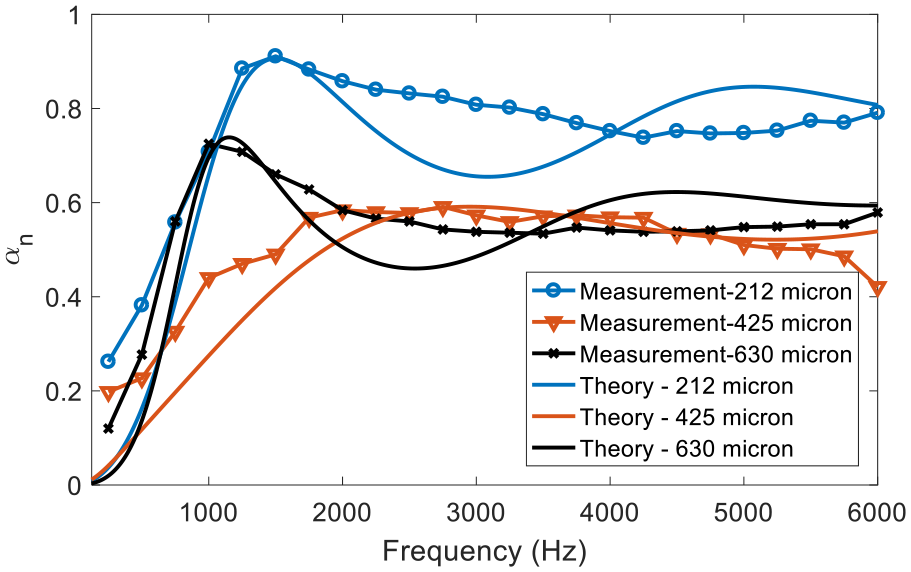
Sound absorption comparisons between theoretical model results and experimental ones.
To further evaluate the performance of each filler composition, Table 2 compares the peak absorption and half-absorption bandwidth evaluated at α = 0.5, while Noise Reduction Coefficient (NRC) is used to express a single number value that describes the average sound absorption performance of a material. It can be seen that the smallest filler size can produce good absorption, particularly for 0.75 and 1 g, where all those performances are outperformed compared to other compositions. However, the filler size of 212 µm in 1 g weight composition shows better absorption at a frequency greater than 2 kHz than that of 0.75 g with the same filler size. Meanwhile, composite with lower filler weight tend to have narrower absorption bandwidths.
The acoustic performance of composite ceramic absorber.
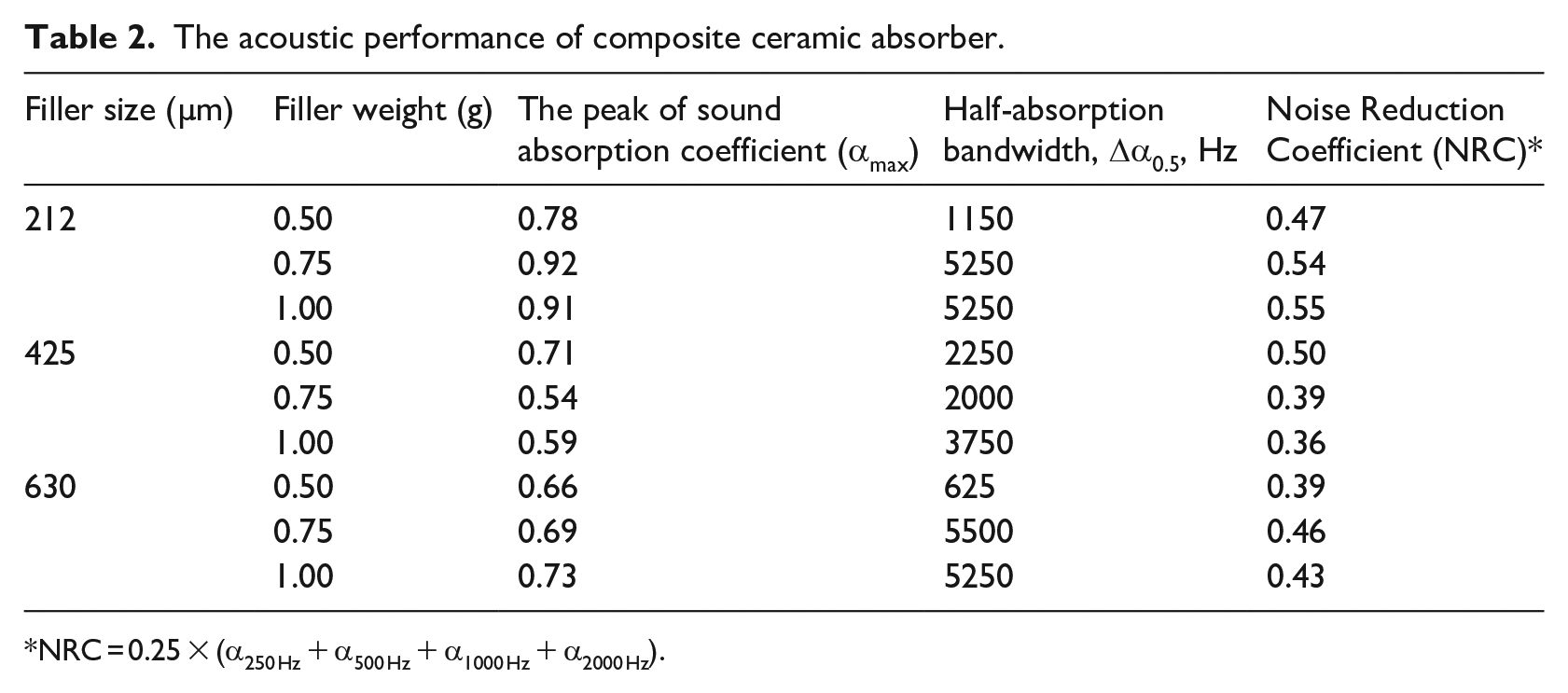
NRC = 0.25 × (α250 Hz + α500 Hz + α1000 Hz + α2000 Hz).
Conclusion
Porous composite ceramic with sugarcane fiber filler as a sound absorber was fabricated. The composition of the ceramic composite’s blowing agent, solvent, and filler was optimized to obtain an appropriate pore structure to be applied as a sound absorber. Adding sugarcane fiber filler to the ceramic paste can change the physical properties of the absorber, such as density, thickness, compression, and pore structures, where these physical properties can affect the absorption performance. Pore structures such as pore diameter and spacing could be controlled by varying the sugarcane fiber filler size and mass composition. Sugarcane filler sizes of 212, 425, and 630 µm were utilized, as well as variations on filler mass of 1, 0.5, and 0.75 g. It was found that finer filler size yields finer pore diameter with a smoother ceramic surface and texture. It is also found that the pore spacing increases as the filler mass increases, with a more significant increase of pore spacing observed for finer filler size. This result in different porosity and flow resistivity that lead to different absorption characteristics. Sound absorption characteristics improved for higher filler mass, especially for the high frequency of 2000 Hz and above. Adding 1 g of filler into the ceramic absorber resulted in a 50%−90% absorption coefficient range. The highest sound absorption performance, up to about 90%, was obtained for the ceramic composite with the smallest filler size of 212 µm and highest filler mass of 1 g, which based on the morphology analysis, has the smallest pore size and pore spacing distance. Moreover, absorption behaviors are generally verified by theoretical results. This indicate that the absorber made from porous ceramic composite material with natural fiber waste addition can be applied as an alternative sound absorber with a decent performance.
Footnotes
Declaration of conflicting interests
The author(s) declared no potential conflicts of interest with respect to the research, authorship, and/or publication of this article.
Funding
The author(s) disclosed receipt of the following financial support for the research, authorship, and/or publication of this article: The authors gratefully acknowledge the research funding granted by the Ministry of Research, Technology and Higher Education of the Republic of Indonesia to support applied research.
