




Abstract
Effect of floor coverings on impact sound insulation can be described with a vibration level reduction (ΔLa). In this study, tests with two floor coverings, eight wooden slabs and with a concrete mock-up slab were conducted by applying the method presented by Sommerfeld and the standard ISO 16251-1. The aim was to study the differences affecting the measured ΔLa and the behaviour of the floor coverings installed on different slabs. The results suggest that the ΔLa on concrete slabs do not correspond with the ΔLa on wooden slabs. Thus, the floor coverings should be measured on wooden slabs when they are to be used within the timber construction industry. The results also show that the coverings should be measured on the wooden slabs where the products are expected to be used. In addition, a standardized test method for the wooden slabs corresponding the method of ISO 16251-1 should be developed.
Introduction
Typical floor coverings used in apartment buildings are cushion vinyls, wall-to-wall carpets, and multilayer parquets or laminates installed on an underlayment. 1 From an acoustic point of view, the purpose of a floor covering is to improve impact sound insulation between rooms by reducing force generated by impacts upon a bare intermediate floor (later briefly called slab). This relative improvement of impact sound insulation (ΔL) caused by the floor covering is a function of frequency and it can be determined by following two different standardized measurement procedures2 –5 using an ISO tapping machine as an impact sound source. To take real products into account in the assessment of the impact sound insulation, the measured ΔL of the floor coverings should be available and represent the behaviour of the floor covering on the corresponding slab. The measurement results should also be available because the exact modelling of the floor covering, for example, by using finite element method (FEM), is often tedious due to the complexity of the floor covering (c.f. multi-layered resilient toppings or soft wall-to-wall carpets).
Traditionally, the ΔL of the floor covering is determined in a laboratory with impact sound insulation measurements between source and receiving rooms according to the laboratory standard ISO 10140 series.2 –4 The measurements are carried out on a reinforced massive concrete slab or on one of the three wooden rib slabs presented by ISO 10140-5. 4 An optional method for measuring the ΔL of a light floor covering on a concrete slab has been presented in the standard ISO 16251-1. 5 The standard method 5 is based on measuring the vibratory acceleration levels of a small concrete slab. The tests on the concrete mock-up slab are conducted with and without the floor covering specimen on the slab and the vibration level reduction (ΔLa) is yielded from the acceleration level differences of these measurements. Since the concrete mock-up slab is 200 mm thick, the method involves measurements mainly above the coincidence frequency of the slab.
The method of ISO 16251-1 5 has been noted to yield results comparable to those gained with ISO 10140 series2 –4 on concrete slabs,5 –10 that is, for concrete floors, the ΔLa can be regarded to correspond with the ΔL. The method in ISO 16251-15 is based on the study conducted by Sommerfeld, 6 where he tested the method both on a small concrete and on a wooden mock-up slab. The method 6 for the concrete mock-up slab was later standardized 5 and so far, a similar standardized measurement method for a wooden mock-up slab does not exist. However, the method using a wooden mock-up slab proved promising when compared with ISO 140-1111 tests on a wooden slab, especially when they were conducted for the PVC, the carpet and the linoleum floor coverings. 6 In case of the laminate floor covering, minor discrepancies between the ΔLa and the ΔL from the standard method 11 were discovered. 6
The reason why the measurement method 6 for the wooden mock-up slab has not been standardized could have been driven by the simplicity of the wooden mock-up slab used in the study 6 : the wooden mock-up slab was small, and consisted of two wooden joists at the edges of the floor and a chipboard layer upon them. According to the recent research, 12 the impact force generated by the ISO tapping machine varies on a rib slab due to the different distances between the source positions and the ribs. Thus, a very essential behaviour of the slab could have been discarded by considering only the deck between the ribs in the measurements. Furthermore, it is possible that the laminate floor covering in Sommerfeld 6 acted as partially resonantly reacting floor covering when the size of the floor could effect on the results.
It is an acknowledged problem that the ΔL depends upon the bare slab.4,13 –15 This is also the reason why the wooden slabs and the wooden mock-up slab have been included in the standard ISO 10140-5. 4 Despite the possibility to measure on the wooden slabs, construction industry has made measurements of floor coverings mainly on concrete slabs. One reason for this is could be that the wooden slabs presented by the standard 4 do not represent the floors under the floor coverings used by the timber construction industry, see for example.16,17 This is the situation for example in Finland.
Comparing the results of different laboratory measurement series presented in the literature18 –23 reveals that resilient floor coverings have a different ability to reduce impact sound on wooden and concrete slabs. 24 In fact, the differences between the ΔL results on these slabs are evident especially in the high frequency range from 1000 to 5000 Hz, where the ΔL levels are always lower on the wooden floors. However, these observations are based on individual measurements on resilient floor coverings on different slab types. According to the authors’ knowledge there is a lack of a systematic study where the results of different floor coverings are compared on concrete and different type of wooden slabs. In addition to the resilient floor coverings, a parquet or a laminate installed on a resilient underlayment needs to be considered.
The purpose of this paper was to study the differences affecting the ΔL of the floor coverings when they are installed on wooden and concrete mock-up slabs. This has been done by applying the method of Sommerfeld 6 (presented currently in ISO 16251-1 5 ) on wooden slabs with the difference that, in this study, the studied slabs were considerably larger than the mock-ups in Sommerfeld. 6 Studying the method itself was not of the main interest of this research. Instead of that, the authors were interested in studying the behaviour of the floor coverings on different types of slabs. In addition to the traditional wooden rib slab, a massive wooden slab (cross-laminated-timber, CLT) was studied. The influence of adding mass to these load-bearing wooden slabs was also investigated. For comparison, the measurements on the concrete mock-up slab were carried out according to ISO 16251-1. 5 Thus, the vibration level reduction ΔLa for the wooden slabs and the concrete mock-up slab have been derived from the vibrational acceleration level differences on the corresponding floors. The research was done by conducting a series of experiments on eight different wooden slabs, concrete mock-up slab and with two floor coverings. The total number of the measured wooden floor constructions was 10, and the two on the concrete mock-up.
Materials and methods
Floor coverings
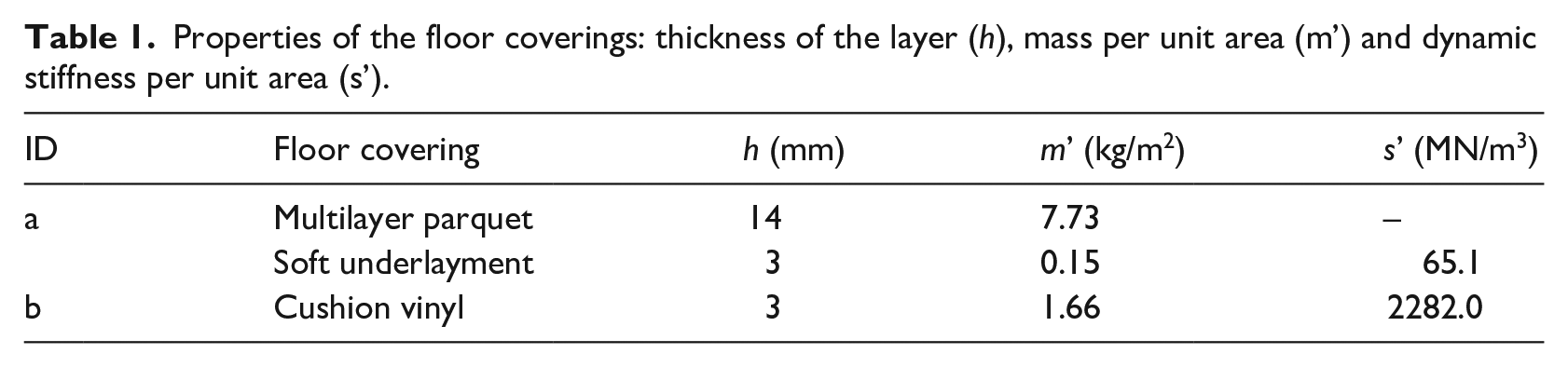
Two different floor coverings were studied: a 14 mm thick multilayer parquet on a 3 mm thick, soft underlayment (a), and a 3 mm thick cushion vinyl (b). Both materials are used especially in Nordic apartment houses and their weighted reductions in impact sound pressure level ΔLw are ca. 20 dB on concrete slabs. 1
The multilayer parquet was made of maple and equipped with tongue-and-groove joints. This was installed on an underlayment consisting of two thin polyethene layers with flexible polystyrene granules between them. Hence, the parquet on the underlayment formed a floating structure where the parquet acts as a plate on a resilient layer formed by the underlayment. In all the measurement situations, the parquet was installed in identical order on the wooden slabs.
The cushion vinyl was a soft 3 mm thick product especially used in apartment houses. In the measurement situations, the cushion vinyl was glued to the surface of the wooden slabs around the centre hammer of the ISO tapping machine at each source position. This was done due to the simultaneous impact force excitation measurements presented in Lietzén et al. 12 Otherwise, the cushion vinyl was installed loosely to the surface of the slab.
Table 1 shows the thickness (h) of the floor covering layers, and the mass per unit area (m’) of the floor coverings and the dynamic stiffness per unit area (s’) of the resilient products measured according to the standard ISO 9052-1. 25 Cross sections showing the floor covering materials installed on CLT slabs has been shown in Figure 1.
Properties of the floor coverings: thickness of the layer (h), mass per unit area (m’) and dynamic stiffness per unit area (s’).
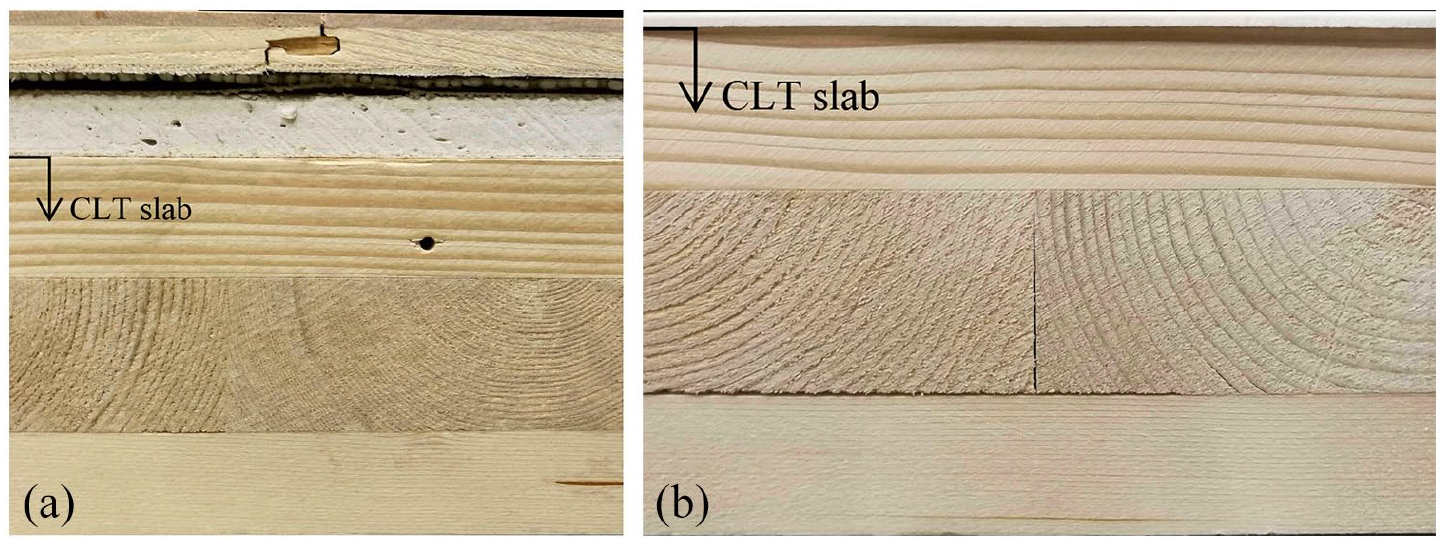
Cross sections of the multilayer parquet on the underlayment (a), and of the cushion vinyl (b) installed on different CLT slabs. Note that the figure (a) includes a single layer of 15 mm plasterboard attached to the surface of the CLT (see Section 2.2).
Load-bearing slabs and additional layers
The floor coverings described in Section 2.1 were installed on eight different wooden slabs illustrated in Figure 2. The slabs comprised two different load-bearing wooden slabs and the slabs with additional plasterboards increasing the mass of the slab. The two load-bearing slabs were a 100 mm thick three-layered CLT slab (floors C0–C4) and a prefabricated rib slab (floors R0–R4) with 25 mm thick LVL panel deck and 45 mm × 260 mm LVL beams (c/c 578–600 mm). In addition to the load-bearing wooden slabs, the slabs C1–C4 and R1–R4 included one, two or four layers of additional plasterboards (h = 15 mm, m’ = 15.4 kg/m2). These plasterboards were attached to the surface of the slabs and were glued and screwed to each other.
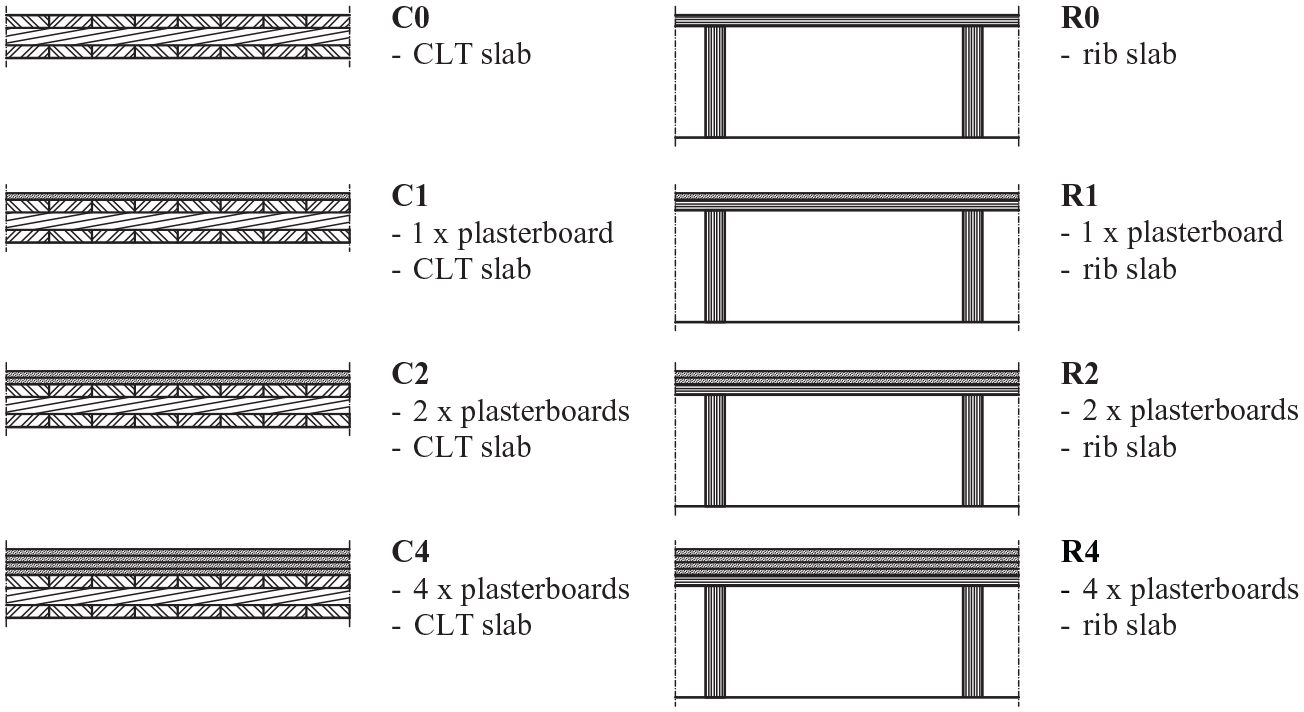
Wooden slabs.
To overcome the problems with the wooden mock-up slab in Sommerfeld 6 (see Section 1), the experiments on wooden slabs were carried out on larger floor constructions, in this study. The size of the floor constructions was 2.4 m × 2.7 m with a span of 2.7 m. In the test setup, the CLT slab and the rib slab were fixed from their both ends to the load supports with screw connections. The supports were attached to vibration isolated steel structures. For further details of the wooden slabs and their installation procedures, see Lietzén et al. 12
Procedures of experiments
In the present study, the vibration level reduction ΔLa caused by the floor coverings (see Section 2.1) was studied both on the wooden slabs (see Section 2.2) and on the concrete mock-up slab. The aim of this was to find out how the results differ on wooden and concrete slabs, and the reasons for the possible discrepancies. First, the ΔLa of the floor coverings were determined on the wooden slabs by adopting the measurement methods from Sommerfeld 6 presented in the standard ISO 16251-1. 5 Secondly, tests in accordance with the standard 5 were carried out for the same floor coverings on the concrete mock-up slab. The results for the ΔLa were derived from the measured vibratory acceleration levels of the floors.
Probably because of the observations done by Sommerfeld, 6 the method presented in ISO 16251-15 is restricted to light, soft, flexible floor coverings placed on top of concrete slab. Such coverings behave locally on the floor when the size of the floor covering would not influence the results. The soft cushion vinyl (floor covering (b), see Section 2.1) studied in this paper obviously falls into this category. However, the parquet with the soft underlayment (floor covering (a), see Section 2.1) consists of a flexible underlayment and a floating layer upon it so the question is whether it behaves locally.
A similar floor covering, a parquet with an underlayment, was tested in accordance with the method 5 in Keränen et al. 10 and compared with results from ISO 101402–4 tests. In the study, 10 it was shown that there were no significant discrepancies between the results of the different standard methods. Therefore, the method of the standard ISO 16251-1 5 can be regarded to be suitable for testing the ΔLa of the floor covering comprising the multilayer parquet on the soft underlayment, that is, the floor covering (a).
Both on the wooden slabs and on the concrete mock-up slab, the results for the ΔLa were calculated from the measured vibratory acceleration levels La, in a similar manner according to ISO 16251-1. 5 The vibration level reduction ΔLa,t,i [dB] for each accelerometer position i and tapping machine position t combination was the level difference

where the La,without,t,i [dB] is the background noise corrected 5 vibratory acceleration level of the bare slab and the La,with,t,i [dB] denotes the background noise corrected acceleration level when the floor covering was on the slab, in the corresponding source and receiver positions. The total vibration level reduction ΔLa was

where t runs from 1 to the total number of tapping machine positions and i from 1 to the total number of accelerometer positions. 5 All the results were determined for 1/3-octave band centre frequencies in the frequency range 50–5000 Hz.
Experiments on wooden slabs
The measurements were carried out using five tapping machine positions per wooden floor construction (Figure 3). The vibratory acceleration levels of the floors were recorded at measurement positions M1–M6 below the slabs during the operation of the ISO tapping machine. The acceleration sensors (Kistler types 8704B50M1 and 8702B50M1) were glued to the underside of the CLT slab or to the underside of the deck of the rib slab, however, the position M3 lied below the centre rib of the rib slab where the sensor was glued to the underside of the rib. The measurements were conducted with and without the floor coverings using LMS system for vibration testing (Test.Lab 11b). In addition, the background noise levels were recorded at each receiver.
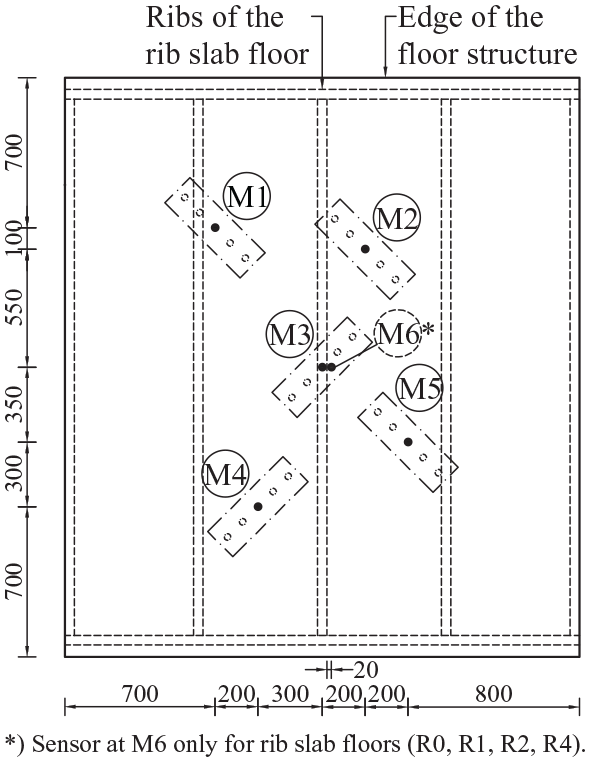
Measurement positions M1–M6 below the floor constructions. The black circles show the location of the sensors at the underside of the slabs. The rectangular boxes illustrate the orientation of the ISO tapping machine on the five source positions on the floors. Dimensions in the figure are presented in millimetres.
Figure 3 shows the measurement positions M1–M6 below the slabs and the orientation of the ISO tapping machine at the source positions on the floor. All the positions were kept the same for all studied floor constructions, but the additional measurement position M6 was used only for the rib slab floors R0, R1, R2 and R4 because (different from the other positions) the M3 lied below the centre rib of the floor. The results were derived so that the vibratory acceleration levels directly below the source position were neglected.
The experiments were performed for the multilayer parquet and the underlayment (floor covering (a)) on all the wooden slabs and for the cushion vinyl (floor covering (b)) on the floors C0 and R0. The reason for testing the floor covering (a) on all the slabs, and the floor covering (b) only on two slabs, was that in literature there already exists more information of the resilient coverings’ performance on different types of floors, but the parquets or laminates have been minorly discussed (see Section 1). Furthermore, according to the authors’ knowledge, a parquet (or a laminate) on a soft underlayment is one of the most common floor covering types in Nordic apartment buildings.
Standard tests on a concrete mock-up slab
To compare the ΔLa results of the floor coverings on wooden and concrete slabs, standard tests using the ISO 16251-15 were carried out on the concrete mock-up slab. The measurements were performed by the Acoustics Laboratory of Turku University of Applied Sciences. The tests on this concrete slab were carried out for the same floor covering specimens that were used in the experiments on wooden slabs.
Force level reduction of a resilient floor covering
The behaviour of the resilient floor covering (b) on the wooden slabs was assessed by comparing the ΔLa results to the force level reduction (ΔLforce). The ΔLforce presents the ΔL values calculated from the input force generated by the ISO tapping machine on the floors equipped with a soft floor covering. The purpose for computing the ΔLforce was to simply verify the ΔLa results and to find out if the behaviour of the floor covering (b) on wooden slabs can be explained by its effect on the input force. According to Vér, 26 the ΔLforce can be derived from the known driving force spectra by

where Fwith [N] and Fwithout [N] are the root-mean-square (rms) forces exciting the floor construction when the floor is equipped with and without the soft floor covering, respectively.
The input force with (Fwith) and without (Fwithout) the soft floor covering were gained from the impact force excitation measurements. 12 In the measurements, 12 the centre hammer of the ISO tapping machine was instrumented to measure the impact force generated by the apparatus upon the floor surface. The impact force measurements 12 were simultaneous with the vibration measurements. For further details of the impact force measurements, see Lietzén et al. 12 The results for ΔLforce were calculated from the measured 1/3-octave driving forces in the frequency range 50–5000 Hz.
This method of deriving ΔLforce is restricted to describe the ΔLa of soft floor coverings only. Thus, the comparison of ΔLa and ΔLforce was carried out for the cushion vinyl, that is, the floor covering (b). However, the equation (3) considers purely the change in the input force neglecting any other possible effects of the floor coverings on the slabs. Thus, it is likely that the ΔLforce provides only approximate results of ΔLa. It must also be noted that since the ISO tapping machine was equipped with one instrumented hammer in the impact force measurements, 12 the result of ΔLforce hereby assumes that the impact force generated by all hammers are uniform at the same source position. This assumption is slightly rough because there are differences in the driving force spectra between the source positions. 12
Results
ΔLa by floor coverings on wooden slabs
The measurement results for the ΔLa by the floor coverings on the wooden slabs are shown altogether in Appendix A. The average results are illustrated in Figure 4, where Figure 4(a) shows the measurement results on the CLT slabs and Figure 4(b) on the rib slabs. In the figure legend, the first two characters denote the bare wooden slab (see Figure 2), and the third character shows the ID of the floor covering (see Table 1), for example, the curve (C0a) illustrates the ΔLa for the floor covering (a) (the multilayer parquet on the soft underlayment) on the wooden slab (C0) (the bare CLT slab).
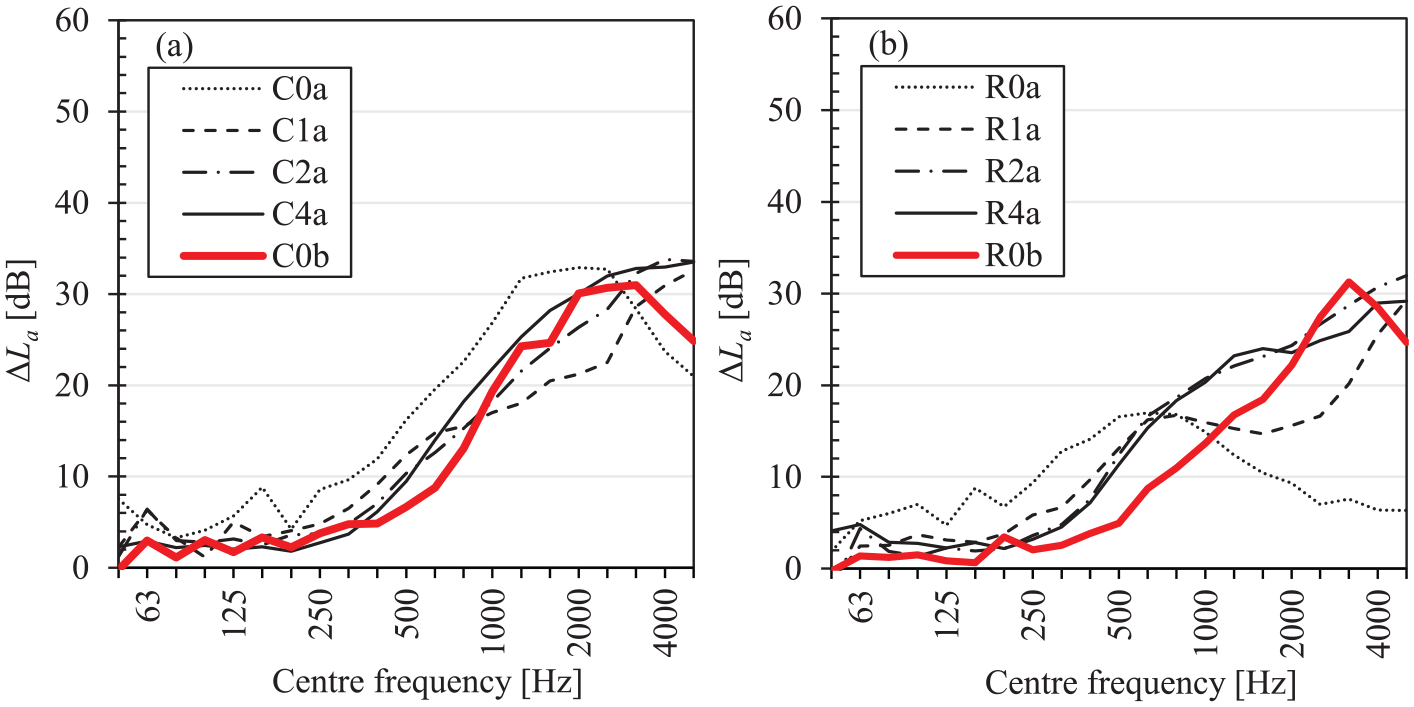
Measurement results of ΔLa in 1/3-octave centre frequencies in the frequency range 50–5000 Hz on (a) CLT slabs, and on (b) rib slabs.
The results show that the vibration level reduction ΔLa was positive almost in the entire frequency range for all the studied floor covering and wooden slab configurations (Figure 4). In the low-frequency range up to 250 Hz band, the values were rather constant apart from the individual peaks illustrated in Figure 4. The values of ΔLa in this range varied from 1 to 9 dB depending on the configuration. In the mid-frequency range after the 250 Hz band, the ΔLa began to increase until at higher frequencies it decreased or at least remained at constant level compared to the latter.
The measured ΔLa levels of the floor coverings depended on the type of the wooden slabs (Figure 4). The results for the floor covering (a) showed high dependency between the ΔLa and the bare wooden slab. If we limit the review to the frequencies under 2000 Hz, it can be noted that there were also significant differences between the maximum ΔLa values of the floors. In case of the lightest slabs, that is, C0 and R0, the ΔLa levels were higher in the low-frequency range and lower in the high frequencies than on the slabs where plasterboards were added. On these light slabs, the maximum ΔLa values occurred at lower frequencies than on the others. In case of the slab C0, the maximum ΔLa was at 2000 Hz whereas on R0 the values begin to diminish at the mid-frequencies and the maximum level occurred at 630 Hz.
The differences of the ΔLa results C0b and R0b for the floor covering (b) were minor but prominent in the frequency range between 800 and 2500 Hz (Figure 4). However, the peak values of the ΔLa were near the same level at 3150 Hz octave band. The ΔLa levels for the floor coverings (a) and (b) were different when measured on the same wooden slab. When comparing the results C0a to C0b and R0a to R0b, it is obvious that the floor covering (a) produced larger ΔLa levels than (b) in the low- and mid-frequency ranges. On the bare CLT slab C0, the ΔLa levels were larger even up to 2000 Hz frequency band. It is also notable that the shapes of the ΔLa curves for the floor coverings (a) and (b) were completely different on the rib slab R0 whereas on the CLT slab the curves showed a frequency shift.
Adding plasterboards to the load-bearing slabs gradually evened out the differences between the floors on the same load-bearing wooden slab (Figure 4). It can also be seen that the additional mass reduced the ΔLa in low- and mid-frequencies and increased it at high frequencies. However, adding four plasterboard layers instead of two was not beneficial with respect to the ΔLa (see especially Figure 4(b)) although this would improve the impact sound insulation of the corresponding floor.
Comparison of ΔLa and ΔLforce on wooden slabs
In addition to the results determined from the vibrational acceleration level measurements shown in Figure 4, the ΔLforce of the floor covering (b) was calculated according to the equation (3) based on the measured rms force spectra generated by the ISO tapping machine on the wooden slabs C0 and R0 with and without the floor covering. The results for the ΔLforce are shown in Figure 5(a). These results were compared to the ΔLa presented in Figure 4 and the absolute differences between the values are illustrated in Figure 5(b).
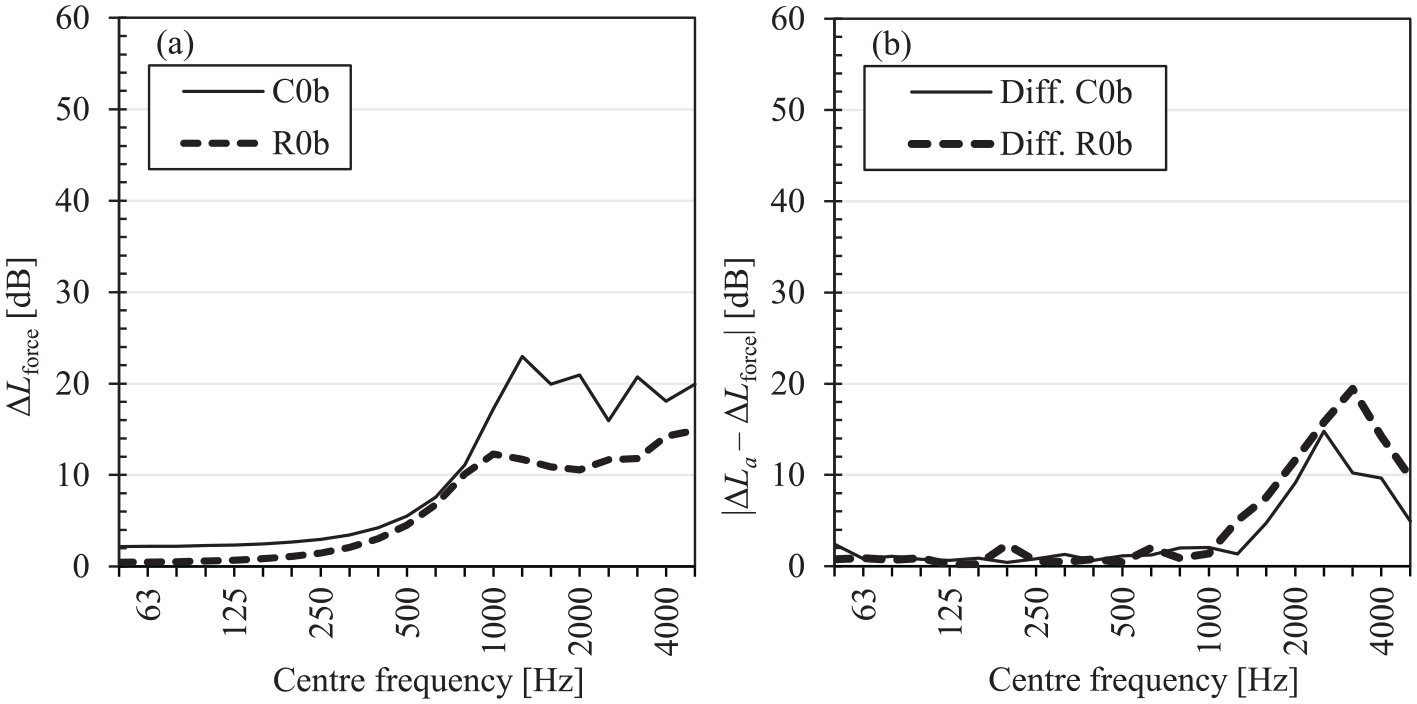
Measurement results of ΔLforce (a) and the absolute difference between the measurement results ΔLa and ΔLforce on the corresponding wooden slabs (b) in 1/3-octave centre frequencies in the frequency range 50–5000 Hz.
The comparison of ΔLa and ΔLforce (Figure 5(b)) shows that the measurement methods produce corresponding results at least up to frequencies 1000 and 1250 Hz for the rib slab and the CLT slab, respectively. In this frequency range, the ΔLforce followed closely the measurement results of ΔLa presented in Figure 4 and the absolute difference varied from 0 to 2 dB. The differences above these frequencies were probably caused by the measurement accuracy, the measurement method used for determining the ΔLforce, and the behaviour of the floor covering (b) on the wooden slabs. These effects should be taken into consideration when comparing the results of different measurements. The main issue is that there are some shortcomings in determining the ΔLforce.
The ΔLforce was determined on the basis of the impact force measurements from the single hammer of the ISO tapping machine, 12 even though the tapping machine operated on the wooden slabs normally using all of its five hammers. This means that it has been presumed that the impact force measured from this single hammer would represent the impact force produced by the other hammers, too, as discussed in Section 2.4. However, as noted in Lietzén et al., 12 there are differences in the impact force between source positions, which could lead to mispredictions of the ΔLforce, especially in the high-frequency range.
Comparison of ΔLa by floor coverings on wooden slabs and on a concrete mock-up slab
The results ΔLa for the concrete mock-up slab are shown in Figure 6 for the floor coverings (a) and (b). The ΔLa was positive in the low-frequency range and rather constant up to 250 Hz band. In this range, the values of ΔLa varied from 1.4 to 2.8 dB and from 2.7 to 3.2 dB for the floor coverings (a) and (b), respectively. The maximum values of the ΔLa were between 53 and 55 dB. The differences between ΔLa on the concrete mock-up slab and on the wooden slabs, that is, ΔLa,conc–ΔLa,wood, have been illustrated in Figure 7, where the ΔLa on the concrete mock-up slab has been compared to the ΔLa gained on the CLT slabs in Figure 7(a) and correspondingly with the rib slabs in Figure 7(b).
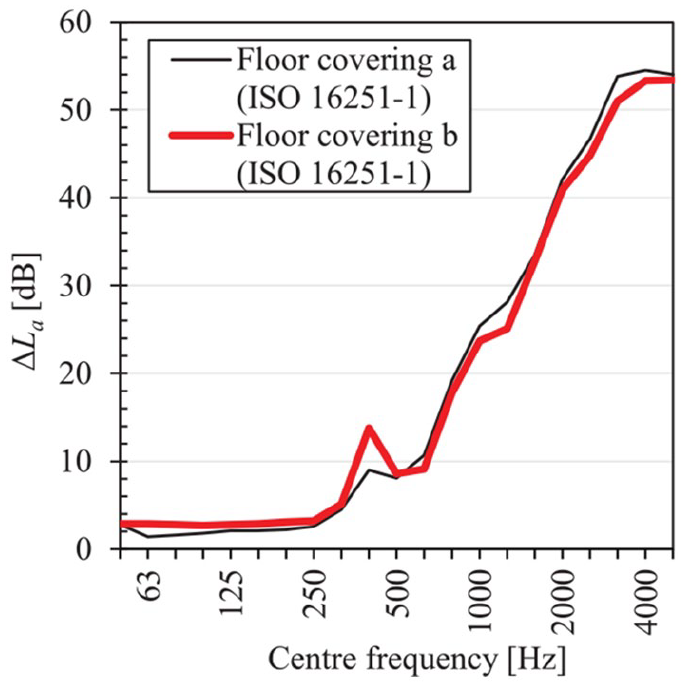
Measurement results of ΔLa of the floor coverings (a) and (b) on the concrete mock-up slab in 1/3-octave centre frequencies in the frequency range 50–5000 Hz.
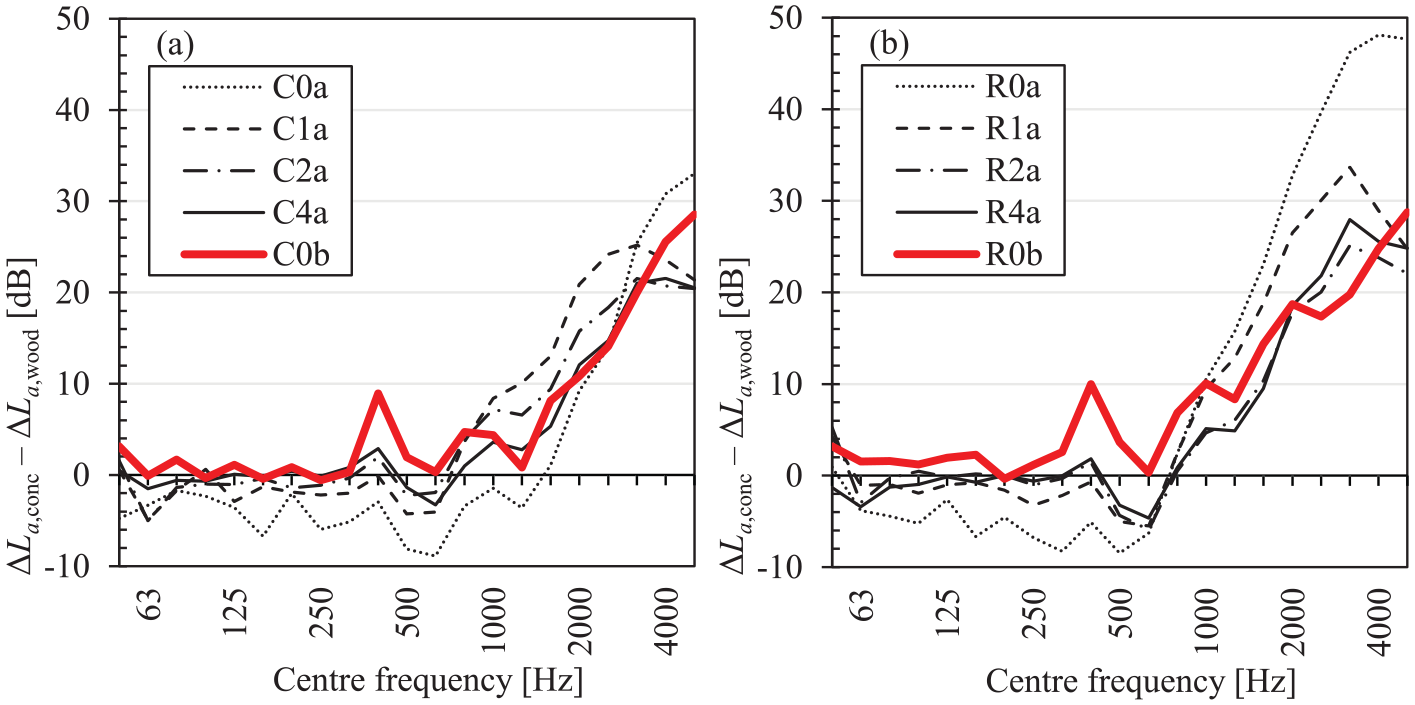
The difference between the measurement results on concrete mock-up slab (ΔLa,conc) and wooden slabs (ΔLa,wood) in 1/3-octave centre frequencies in the frequency range 50–5000 Hz. The figure (a) compares the results on the concrete mock-up slab with the results on the CLT slabs and (b) compares the results on the concrete mock-up slab and on the rib slabs.
The ΔLa results for the two floor coverings on the concrete mock-up slab seemed to be close to each other (Figure 6). As discussed above (Section 3.1), this was not the case for the wooden slabs. In the mid-frequencies, resonance frequencies were evident for both floor coverings probably due to the interaction between the hammers and the soft floor covering, and due to the floating floor constituted by the multilayer parquet and the soft underlayment. At the higher frequencies, the values increased until the highest frequencies in consideration.
The differences between the measurement results of ΔLa on the concrete mock-up slabs and the wooden slabs were major especially in the high frequencies (Figure 7). A significant characteristic of the differences was that in the low-frequency range, the differences were rather constant and floor dependent and in the mid-frequencies a turning point was prominent after which the differences began to increase. In the low frequencies, the ΔLa on wooden slabs was larger than on the concrete mock-up for the floor covering (a), especially in case of the lightest floors. The turning point frequency seemed to vary slightly depending on the floor covering and on the wooden slab. In addition, for the floor covering (a), the differences diminished when the plasterboards were added to the wooden floors.
Discussion
ΔLa by floor coverings on wooden and concrete slabs
It is evident that the two floor coverings studied in this paper behave differently on different slabs. First, the multilayer parquet on the underlayment (floor covering (a)) forms a floating structure on the floor. Secondly, the cushion vinyl (floor covering (b)) is a resilient topping which affects the impact sound insulation by reducing the impact force level directed to the floor. These types of performances explain the results for the ΔLa on the different floor constructions.
The ΔLa of the floor covering (a) was clearly at its highest in the low-frequency range when the wooden slab was light weighted, that is, the bare CLT slab C0 or the rib slab R0 (Figure 4). In this frequency range, the values were several decibels higher than on the concrete mock-up slab. The reason for this phenomenon is presumably the relative increase of mass brought by the floor covering (a) to the bare slab. 27 This was also supported by the other results: when mass and stiffness of the slab increased by adding plasterboards, the differences in comparison with the concrete mock-up slab diminished in the low-frequency range (as well as in high frequencies). Another reason for the results is the differences in the impact force produced by the ISO tapping machine on the bare wooden slabs and the slabs with the floor covering. 12 When the floor covering is installed, the level of the impact force decreases compared to the bare wooden slab even in this low-frequency range.
In the mid-frequencies there seemed to be a turning point for the floor covering (a), where the ΔLa began to suffer from the lightness of the wooden slab compared to the concrete mock-up slab (Figure 7). This occurs most probably due to the sinking impact force levels on the bare wooden slabs. 12 In other words, the softness of the bare wooden slab drops the impact force in the mid-frequency range whereas on the bare concrete mock-up slab the force levels continue to increase until the highest frequencies under consideration. These effects are seen from the mid- to high frequency results. Thus, even though the floor covering would affect the impact force similarly, the different basis for comparison makes the ΔLa values lower on the wooden slabs. When plasterboards were added to the slabs, the results approached the ones received from the concrete mock-up measurements.
In the high-frequency range, the shape of the ΔLa curves for the floor covering (a) could suggest – in addition to the lowering force levels – that the multilayer parquet acts resonantly on the wooden slabs. 28 Because of this phenomenon, the growth rate of the values begins to slow down in this range. On the concrete mock-up slab, apparently this does not occur, but the slight flattening of the curve after 2500 Hz is probably caused by the lowering impact force levels.
For the floor covering (b), the overall equivalence between the ΔLa results received on the wooden slabs and concrete mock-up slab was better in comparison with the floor covering (a) on the same floors (Figure 7). In the low frequencies up to 630 Hz band, the correspondence of the results was reasonable apart from the 400 Hz peak evident in the ΔLa on the concrete mock-up slab (Figure 6). However, using the ΔLa measured on the concrete mock-up instead of the ΔLa measured on the rib slab, would slightly overestimate the performance of this topping in the low frequencies.
The ΔLa of the floor covering (b) on the wooden slabs began to differ from the result on the concrete mock-up slab after the 630 Hz band (Figure 7). After this turning point, the differences increased up to the highest frequencies. This occurs due to the impact force differences on the different bare slabs, similarly as with the floor covering (a) discussed above. The differences of the results between the two wooden slabs C0 and R0 were also prominent because of the impact force differences. When the impact force acting on the rib slab is lower, especially between the ribs, than on the CLT slab, the ability to reduce the impact force of the resilient floor covering is lowered by the basis of the comparison. These results confirm the observations from the literature,18 –22 discussed in Section 1.
In addition to the impact force differences, it is possible that the ΔLa of the floor covering (b) on the wooden slabs would be affected by the damping effect provided by the cushion vinyl (Figure 5(b)). When the soft floor covering is installed on the floor, the vibrational levels of the wooden floors could also be reduced by the damping properties of the material. 29 This effect could increase the values of ΔLa in comparison with the ΔLforce because this damping effect is not considered by the equation (3).
To conclude, the ΔLa results for the concrete mock-up were usually higher than the ΔLa on the wooden floors, but there were exceptions (Figure 7). As noted, however, in the low-frequency range the differences were prominent but minor in comparison with the higher frequencies, which is important since the low-frequency performance is important for the subjective rating of the wooden floors.30,31 In the high- and mid-frequency ranges the differences between the ΔLa on concrete and wooden slabs became increasingly larger. These issues suggest that using the ΔLa measured on the concrete floors instead of the ΔLa measured on wooden floors could lead to mispredictions when designing the impact sound insulation between the apartments of wooden buildings.
Measurements of ΔL of floor coverings used in timber construction industry
According to the results (Figures 4, 6 and 7) and to the literature,18 –22 it is obvious that the ΔL measured on concrete slabs do not fully correspond to the ΔL gained on wooden slabs in the whole frequency range of interest. This should raise an interest to measure the floor covering products also on the wooden slabs. 4 In any case, this would increase the applicability of the products for use in the timber construction. However, the results also illustrate that there are differences between wooden slabs. Thus, it is important to measure the floor covering products on the wooden slabs corresponding to the floors the products are expected to be used.
There is also a need to develop a standardized test method for wooden mock-up slabs corresponding the method presented in the standard ISO 16251-1. 5 Because of the differences between the results brought by the standard 11 and the wooden mock-up tests in Sommerfeld, 6 the compact wooden floor should at least be larger than the corresponding concrete mock-up slab. As noted in Section 4.1, it is possible that the floating floor coverings, such as the floor covering (a), act resonantly on the wooden slabs, which should also be taken into consideration in the development of the method. In addition, it would be beneficial to include alternative floor types in the method, at least those as in ISO 10140-5. 4
Limitations and need for further research
It must be noted that the measurement method 6 used in this study is not standardized on the wooden slabs. Thus, the vibration level reduction ΔLa by the floor coverings on the wooden slabs have not been confirmed to correspond with the improvement of impact sound insulation ΔL.2 –4 For example, increasing the measurement positions below the wooden slabs would have improved the accuracy of the results. Therefore, the results of this study should not be considered absolute, and the conclusions remain preliminary until they are confirmed by a further research conducted in a full-scale building acoustics laboratory.
Conclusions
It is known that ΔL of floor coverings depend upon the bare slab it is installed. The problem is, however, that the products are usually tested on concrete slabs even though laboratory standards2 –4 acknowledge also wooden slabs. Therefore, two floor coverings, a multilayer parquet on an underlayment, and a cushion vinyl, were tested on wooden slabs and on a concrete mock-up slab by applying the method presented by Sommerfeld 6 and the standard ISO 16251-1, 5 in this study. The object of this was to study the behaviour and the vibration level reduction ΔLa by the floor coverings on different types of slabs. The findings suggest that the ΔL results achieved on concrete slabs do not correspond the results on wooden slabs. In case of the parquet, novel results were brought to light since, according to the authors’ knowledge, systematic studies comparing the ΔLa by a parquet on several floor types has not been previously published. The results for the cushion vinyl represent similar behaviour as seen in the literature.
Possible reasons for the discrepancies between the results on different slabs were found from the behaviour of the slabs and floor coverings. The main reason for the different results of both specimens on different slabs was the different impact force levels generated by the ISO tapping machine on the bare slabs. Secondly, the behaviour of the ΔLa of the parquet on the underlayment was explained by the floating structure composed by the floor covering. In the low-frequency range, the relative increase of mass brought by the parquet to the slab increased the ΔLa levels on wooden slabs in comparison with the concrete mock-up slab. In high frequencies it was noted that it is possible that the parquet acts resonantly, thus reducing its ability to improve impact sound insulation. Adding plasterboards to the floors seemed to diminish the discrepancies. Third, in case of the cushion vinyl, it is possible that the results were affected by the damping effects of the floor covering.
The results suggest that the floor coverings should be measured on wooden slabs when they are to be used within the timber construction industry. This should be done even though the results would not be as promising as on concrete slabs, and because using the ΔL measured on concrete slabs instead of the ΔL measured on wooden slabs could lead to mispredictions when designing the impact sound insulation of wooden floors. Additionally, there is a need for developing a fast and affordable standardized test method for wooden mock-up slabs corresponding the method presented in ISO 16251-1. 5 These findings and suggestions should be confirmed in a follow-up full-scale laboratory research.
Footnotes
Appendix A
Acknowledgements
This paper was written within the Doctoral School in Industrial Timber Construction of Tampere University. The authors would like to thank Dr Valtteri Hongisto and Mr Pekka Saarinen from Turku University of Applied Sciences for conducting the tests on the concrete floor mock-up. The authors are grateful for the constructive comments to the manuscript given by Dr Valtteri Hongisto.
Declaration of Conflicting Interests
The author(s) declared no potential conflicts of interest with respect to the research, authorship, and/or publication of this article.
Funding
The author(s) received no additional financial support for the research, authorship, and/or publication of this article.
