



Abstract
This article provides the first comprehensive study of the material relating to sliding bearings, lubrication and wear within the writings of Leonardo da Vinci (1452–1519). While in many instances he was evidently describing contemporary practice, in other cases he demonstrated great innovation and insight. His descriptions of plain journal and pivot bearings and their materials are far richer than those of any other Renaissance engineer. His ability to classify and analyse his observations led him to highly perceptive conclusions about the effect of loading direction on wear rate and the mechanisms of wear in sliding contacts. In deducing the dependence of wear on load and sliding duration, Leonardo's thinking anticipated that of Reye, Preston and Archard by more than 350 years.
Introduction, sources and previous work
Leonardo da Vinci (1452–1519) had an enduring interest in the phenomenon of friction, 1 but his curiosity about what we would now call ‘tribology’ was much broader, and his notes on rolling-element, disc and sector bearings have recently been discussed elsewhere. 2 Leonardo also described designs and materials for plain sliding bearings, the use of lubricants and the phenomenon of wear in much more detail than any other Renaissance engineer. These topics form the focus of this paper.
More than 6000 pages of notes and sketches by Leonardo have survived, dispersed in many different locations. The most important manuscript sources for this work are Leonardo's Codex Madrid I (referred to below as Madrid I: Ms. 8937, Biblioteca Nacional, Madrid), Codex Atlanticus (CA: Biblioteca Ambrosiana, Milan), Manuscript I of the Institut de France (MS I, Bibliothèque de l’Institut de France, Paris), Codex Forster II (V&A Museum, London), and a single sheet (Getty 86.GG.725) in the J. Paul Getty Museum, Los Angeles. Codex Leicester (Gates Foundation) also contains numerous references to wear in geological rather than technological contexts. Images of the pages of Leonardo's notebooks are available on-line i (for endnotes see Appendix A) and in published facsimile editions. Their chronology has been summarised in. 1
Leonardo intended Codex Madrid I (compiled in 1493–1497) to be a formal treatise on machines and machine elements; it forms a particularly rich source of information about his knowledge and thoughts on bearings, with clearly-drawn illustrations and a more systematic arrangement of the subject matter than is found elsewhere in his notes. A recent facsimile edition has a translation into German and a detailed commentary 3 ii ; this complements an earlier edition with English translation. 4 Translations into English of the texts of the Paris manuscripts (including MS I) are also available, 5 and translations of many of these as well as of some other relevant parts of the notebooks (except Madrid I which was mislaid for many years and only rediscovered in the 1960s) by MacCurdy. 6 iii
Leonardo's coverage of tribological topics other than friction has received rather little attention from previous authors. Some sketches of plain bearings from Leonardo's manuscripts (with the inevitable exception of Madrid I) were reproduced by Beck in his early study of the history of mechanical engineering 7 but with very little discussion. Uccelli 8 provided a useful collation of relevant diagrams and text from the sources then available to him.
Reti published three articles on the Madrid Codices which included critical discussion of Leonardo's work on bearings.9–11 He later extended his coverage of bearings to include material from other manuscripts, and also noted some of Leonardo's remarks on wear.12,13 Dowson14,15 put Leonardo's tribological work into a broader historical context, but his source material originated almost exclusively from Reti.
Most recently, Betancourt-Parra 16 has drawn attention to Leonardo's notes on wear in the context of grinding and polishing. Sawyer 17 carried out experiments with a wooden shaft rotating in a hole in a wooden block and found that wear leads to changes in the dimensions and shape of the shaft and of the hole that are similar to those noted by Leonardo in Codex Madrid I and discussed below.
Plain bearings and sliding interfaces
Plain journal and pivot bearings with sliding interfaces have been used since antiquity, in applications such as wheeled vehicles, grinding mills and potters’ wheels. 15 Leonardo incorporated bearings into sketches of many machine designs without comment. Only in a few instances did he provide detailed designs for these bearings and information about the materials used in them, but these details are very informative.
Figure 1 iv shows an example from 1497 to 1500 (Getty 86.GG.725 verso; see 18 ). On the left, Leonardo has drawn a hand-cranked rolling mill, probably for thin metal sheet, v loaded by a weight hanging from a double lever. On the right are details of the axle (labelled ‘replaceable axle’) and a plain half-bearing marked ‘a’. He notes ‘a is an iron that is replaceable when it is worn by the axle and similarly it is possible to replace the axle when it is worn.’ vi
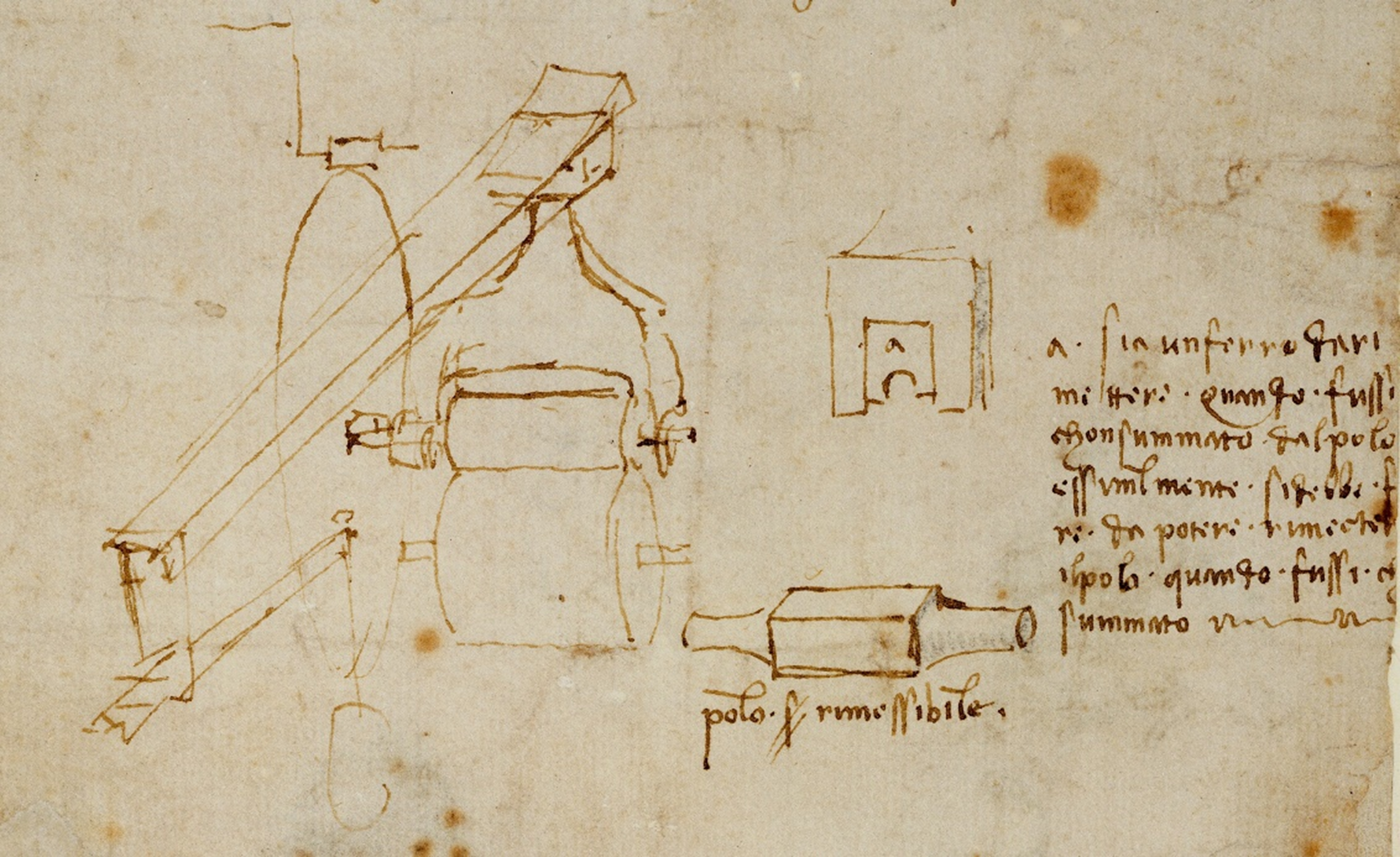
Sketch of a hand-operated rolling mill with details of the axle and bearings. (86.GG.725 verso, 1497–1500, J. Paul Getty Museum, Los Angeles).
Iron (and steel) are also mentioned elsewhere as bearing materials to resist wear: e.g., in Madrid I f.13r (1493–97, discussed in more detail below), and in an early design for a perpetual motion machine of which Figure 2 shows a detail (from CA f. 880r, 1487–90). Over more than two decades, Leonardo explored many different ways of achieving perpetual motion, even though on several occasions he also made clear his view that such motion was intrinsically impossible.19,20 This example is a hydraulic machine consisting of a pair of bellows driven by a waterwheel which would ‘run continuously, pumping vinegar, white wine or distilled vinegar, so long as the bellows, pumping water, do not rot’. vii Two vertical bellows full of liquid carry lead weights to pressurize them, and are arranged to discharge in turn through nozzles: the emerging streams of liquid impinge on a fan-like impeller which in turn drives the bellows and the necessary valve gear. Leonardo was anxious to reduce the friction on the impeller shaft, which he imagined would turn very rapidly. Figure 2 shows the detail of the shaft bearing, which consists of a deep horizontal groove in an ‘iron’ block (labelled b), and also includes a strip of felt (a) which supplies water to the contact to reduce both frictional heating and wear; a spring is used to take up any wear between the shaft and the iron bearing. viii
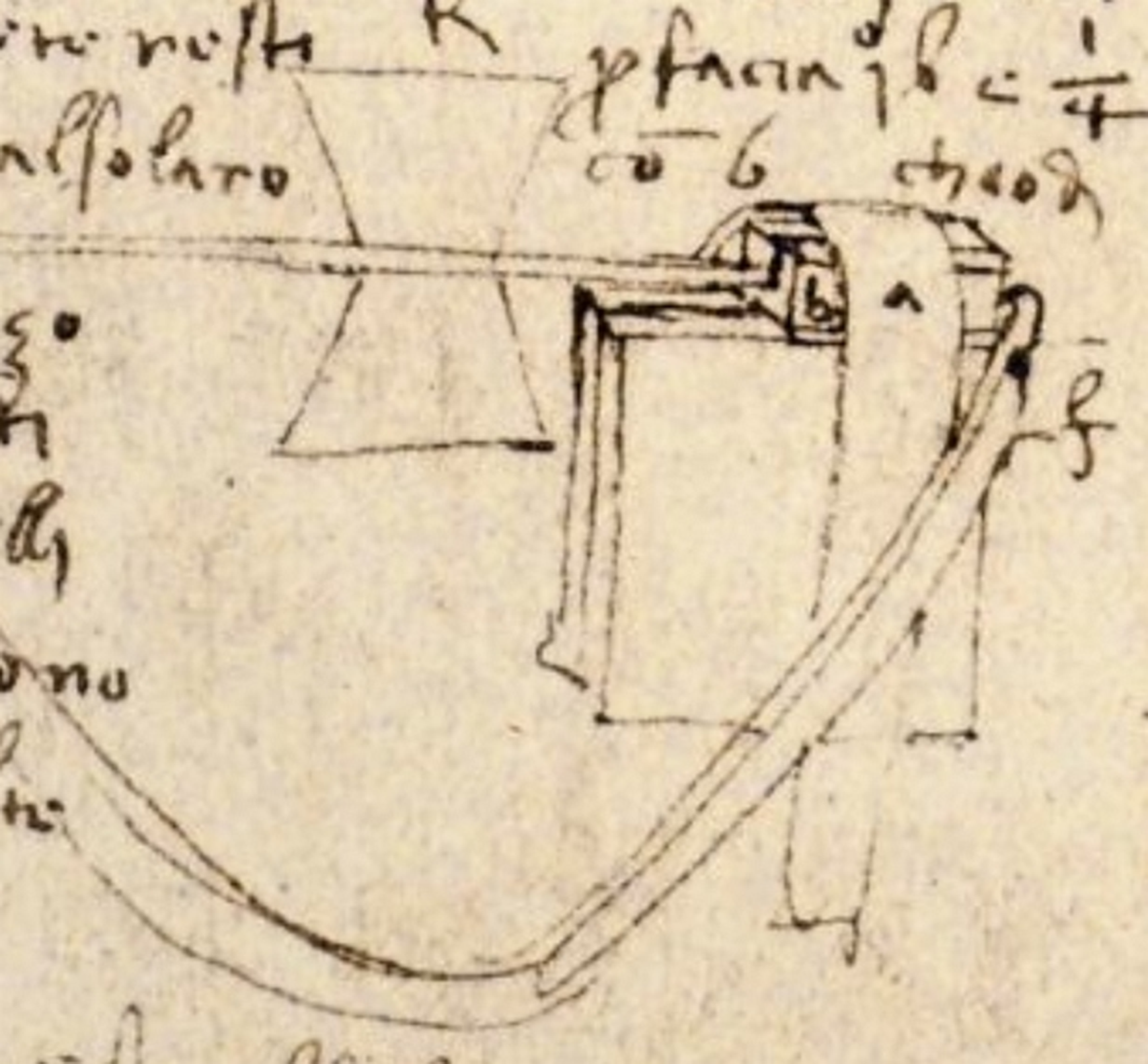
Detail showing a plain bearing for a rapidly rotating shaft in a hydraulic perpetual-motion machine (from CA f. 880r, 1487–90, Biblioteca Ambrosiana, Milan).
Other metallic bearing materials mentioned elsewhere by Leonardo are softer alloys presumably used in combination with a harder iron or steel shaft, the approach still used today in most metallic plain bearings. Figure 3(a) shows a split plain journal bearing (from Madrid I f.100v, 1493–1497), with the text ‘if you wish to make an axle that always runs enclosed and which never jumps up with the load that is put on it, make its cavity or bearing of mirror metal, that is three parts of copper and seven of tin melted together. And make this bearing in two parts, shown as m and n, with the axle f in the middle’. ix He also points out that the upper half of the bearing can be made from lead, and that as the bearing wears it can be adjusted with the wedge. Another sketch (Figure 3(b)) shows how a screw can be used instead of a wedge to tighten the bearing. In Madrid I f. 119r he specifies ‘metal for mirrors or bells’ for the lower half of a full bearing, again with lead for the upper half, and with the shaft made from tempered steel. x Beside a later diagram of a split bearing (CA f.1036v, 1513) secured with wedges is the text ‘block, one of copper and two (of) tin’. xi
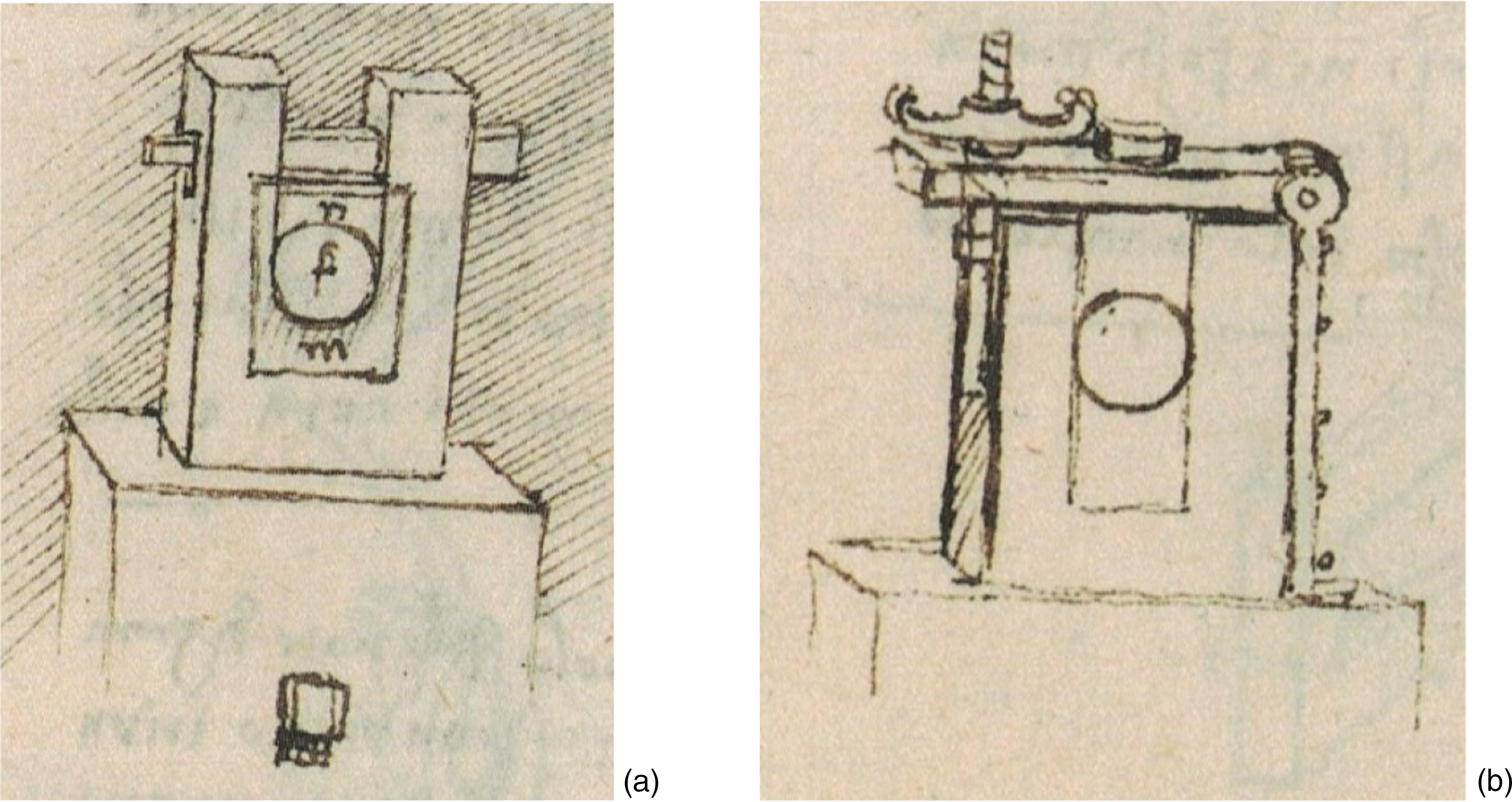
Details of housings for split plain bearings (from Madrid I f. 100v, 1493–97, Biblioteca Nacional, Madrid) (a) with wedge for clamping and adjustment; (b) with screw.
The contact pressure in a pivot bearing, carrying the end-thrust of a vertical shaft, can be much higher than that on a radially-loaded journal with a larger bearing area, so that a harder bearing material is needed. Pivot bearings feature in many of Leonardo's sketches of machines, but seldom with any detail. Figure 4(a) (CA f. 1017v, 1513) shows an exception, included in a series of drawings related to the design of a polishing machine for concave mirrors. The bush below the shaft is labelled ‘glass’ (vetro). The same sheet carries two other drawings of a vertical shaft with a cup-shaped pivot bearing, combined with a split (three-part) plain radial bearing, as shown in Figure 4(b). Another sketch of the same period (Figure 4(c), CA f. 1036v, 1513) shows how the bearing socket is formed by grinding with loose abrasive: ‘a b copper with emery. b c block of crystal, in which the hole is made using emery and the copper, to produce good durability of the hardened steel shaft. The whole hardened part is polished’. xii
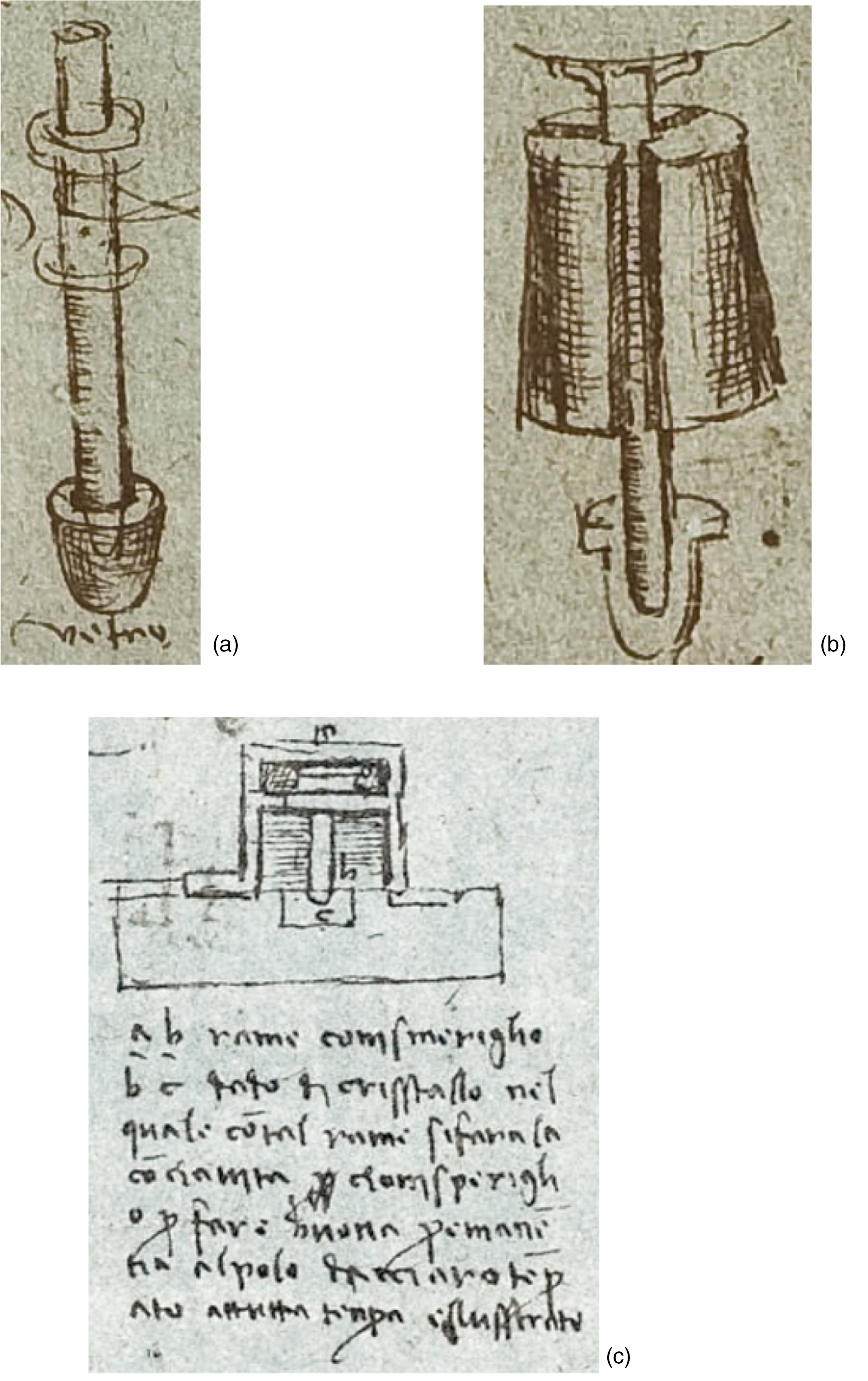
Plain pivot (axial) bearings (a) with glass bearing cup (from CA f. 1017v); (b) with additional split plain radial bearing (from CA f. 1017v); (c) device for grinding and polishing a bearing cup (from CA f. 1036v) (all 1513, Biblioteca Ambrosiana, Milan).
Wear and lubrication
Leonardo observed wear in a wide range of mechanical devices and thought deeply about its origins and development, both in machine elements such as bearings and gears, and also in more complex machinery. In a list of the topics planned for Codex Madrid I (on folio 82r) he included ‘the nature of bearings and their wear’ xiii ; during the period 1493–99, in that manuscript and in others, he recorded many comments on wear, and followed them with further thoughts on the subject in his later writing. He also recognized wear in a geological context, for example by recording the erosion of rocks and river banks by the flow of water. In Codex Leicester (f. 15r 21 ) he also described explicitly what would now be called the ‘slurry erosion’ of stones by water containing sand particles: ‘the motion of turbid and sandy water wears the stones over which it flows’. xiv
Noting the progressive nature of wear, Leonardo deduced that even the slightest relative sliding motion must necessarily lead to some wear, writing ‘whatever is completely worn by the long motion of its sliding will have part of it worn at the beginning of this movement’ xv (Forster II f. 133r, 1497). He illustrated this with a ‘thought experiment’ involving a pair of compasses, concluding that since the compass point sliding around the circle will inevitably have undergone some wear in its travel, it cannot return exactly to its starting point, and that it is therefore, strictly speaking, impossible to draw an absolutely perfect circle with compasses.
An understanding of the effects of both contact pressure and sliding speed on wear rate is implicit in many of Leonardo's notes, for sliding bearings and also for the meshing of gears. For example, Figure 5(a) (from Madrid I f. 13r, 1493–97) shows sketches of rotating drums supported by axles with large and small bearing areas, accompanied by the comments ‘When the weight is large, or when it is small and the speed is high, then the bearings must be long, so that the weight is distributed over a large contact area. If the axles are short and the weight heavy or (moves) fast, then the axles wear, and the bearings that support them.’ xvi Elsewhere (Madrid I f. 118r) he states quite explicitly that the wear rate of a shaft is inversely proportional to its contact area (for the same load): ‘… short axles will wear down so much more than long axles as are the proportions of the lengths of their contacts’. xvii In the context of gears he also refers on many occasions to the benefits of a larger contact area between the teeth, or of lower relative sliding speed, in terms of reducing the wear, xviii as illustrated in Figure 5(b).
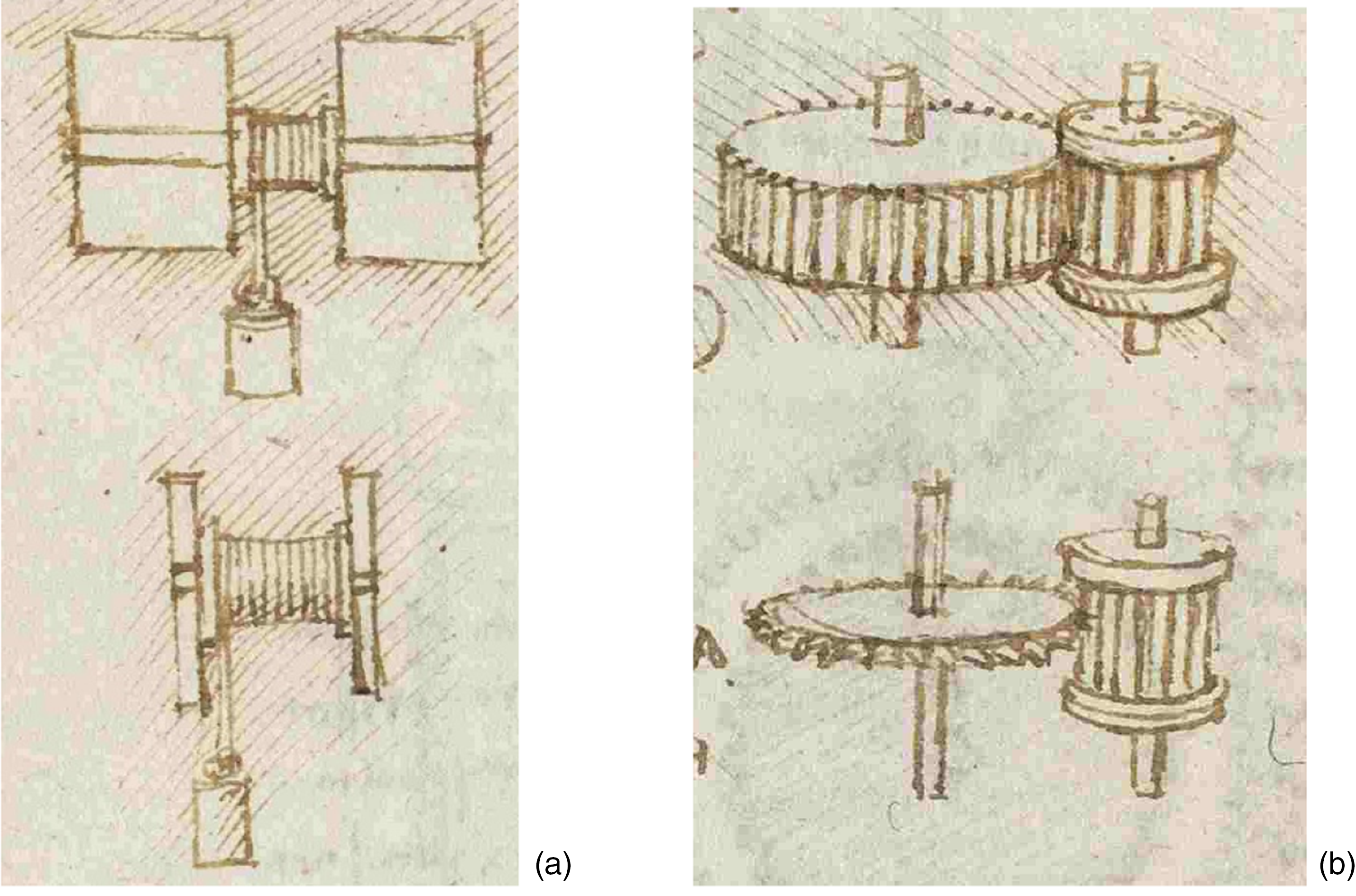
Illustrations accompanying comments on the effect of contact pressure on wear rate for (a) plain bearings, and (b) gear teeth, in both cases with large and small contact areas (from Madrid I f. 13r, 1493–7, Biblioteca Nacional, Madrid).
Leonardo remarks in several places that wear of a rotating horizontal shaft and its supporting plain bearing occurs in the direction of the applied force. In Madrid I f. 102v, for example, he distinguishes between the action of the upper and lower parts of a horizontal shaft carrying a vertical load: ‘that which wears the axle (together) with its support is that part which descends towards the centre of the world. But that part of the axle that wears neither itself nor its support is that which moves with its rotating motion towards the sky’. xix Figure 6(a) (from Madrid I f. 118r) illustrates this effect, showing wear of both a shaft and its bearing with the accompanying note: ‘hole worn by the shaft that turns within it’. xx On the same page he writes: ‘and the shape of the worn hole remains pyramidal (i.e., triangular) on its two sides, because the shaft wears from its rotation, and from the wear it becomes thinner. The place that supports it also wears, and the wear is equal to (i.e., matches) the contact area, and the contact area becomes less from wear of the shaft. Thus one concludes that the hole wears out before the shaft, because it loses its roundness and the shaft always retains it’. xxi
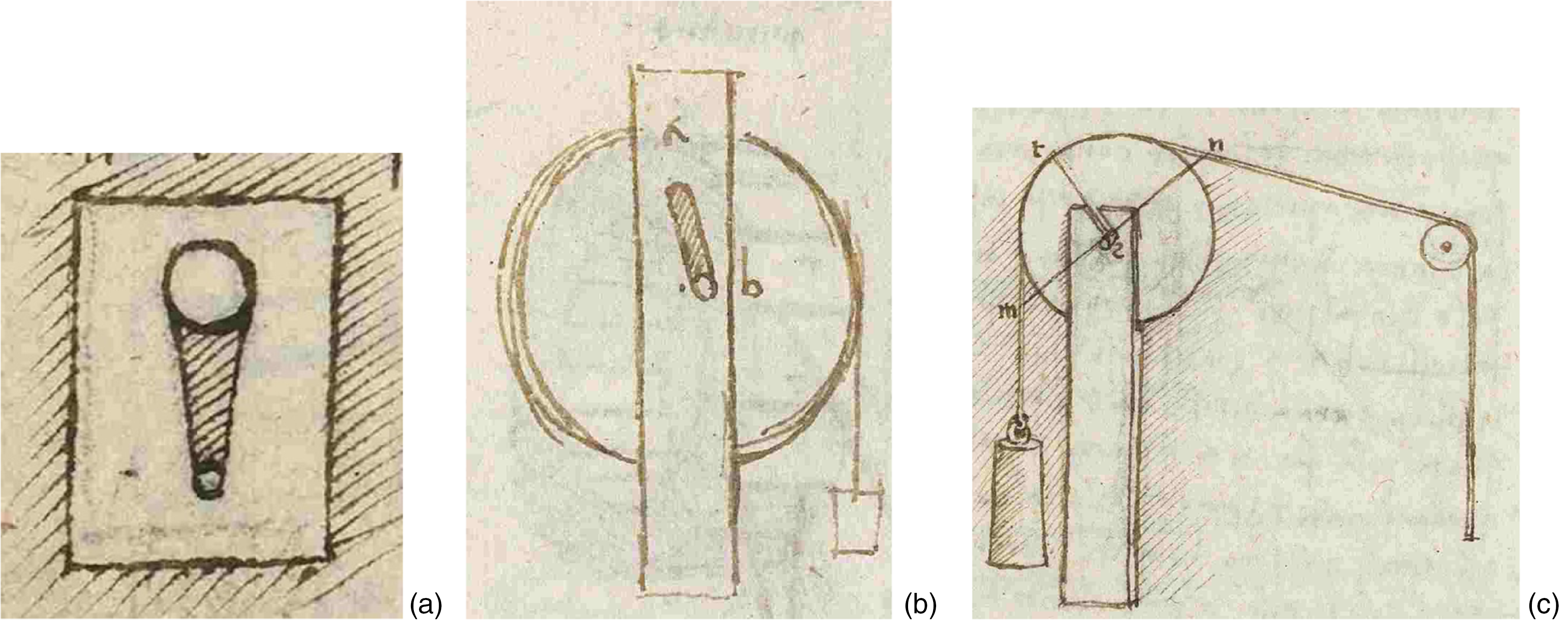
Illustrations of heavily worn plain bearings, showing (a) tapering slot formed under vertical loading (from Madrid I f. 118r); (b and c) effects of oblique loading (from Madrid I ff. 12v and 132v). (all 1493–7, Biblioteca Nacional, Madrid).
In some cases, however, the wear of a bearing supporting a horizontal shaft develops at an oblique angle. For example, Leonardo states in MS I (f. 45r, 1497–99) ‘the axle is worn more on the side where the applied force is greatest’ xxii and then describes in some detail how asymmetric wear of the bearings supporting a foot-operated grindstone, a common device used by itinerant knife-grinders, is caused by a combination of gravity and of the driving force. Codex Madrid I contains diagrams demonstrating this phenomenon. In Figure 6(b) (from f. 12v) the net force on the axle results from the weight of the wheel, the suspended weight and the friction on the lower bearing surface, causing the bearing journal to become worn in an oblique direction, while in Figure 6(c) (f. 132v) Leonardo suggests that ‘the axle of every wheel wears its support in an oblique line’ and deduces that the direction of wear along ts bisects the angle between the two cords tm and tn. xxiii
Leonardo devotes a whole page of Madrid I (f. 119r) to a discussion of how wear in a journal half-bearing leads to matching curved profiles in the shaft and the bearing, as shown in Figure 7. He starts by saying ‘I have found that all shafts of any metal that protrude from their bearings or are of the same length wear in such a way that the part of the length nearer to the middle of the length becomes thinner and conversely the part that is further from the middle remains thicker, so that where the shaft had consisted of straight lines, it now has curved lines’. xxiv He then provides a detailed and thoughtful description of the wear mechanisms that lead to a higher wear rate in the middle of the bearing. He explains that if it is lubricated with water, as in the case of water-mills, then the wear debris will be flushed away at the two ends of the bearing, but becomes embedded in the wooden bearing surface towards the centre of the bearing and acts ‘like a file or emery, removing material from the shaft’. xxv He observes parallel circumferential grooves around the worn shaft, and suggests that these are caused by an uneven distribution of the embedded wear debris, associated with the grain structure of the wood. If the bearing surface is metallic rather than of wood, it will be lubricated with ‘olive oil or grease from pork bone marrow’. xxvi Because the lubricant is expelled from the ends of the bearing by the contact pressure, the lubrication becomes poorer and the wear rate higher towards the centre of the bearing, where there is direct metal-to-metal contact. The lubricant at the ends of the bearing will be contaminated with wear debris, and Leonardo comments that ‘iron against iron wears more than iron (lubricated) with grease thickened by debris from the shaft’. xxvii
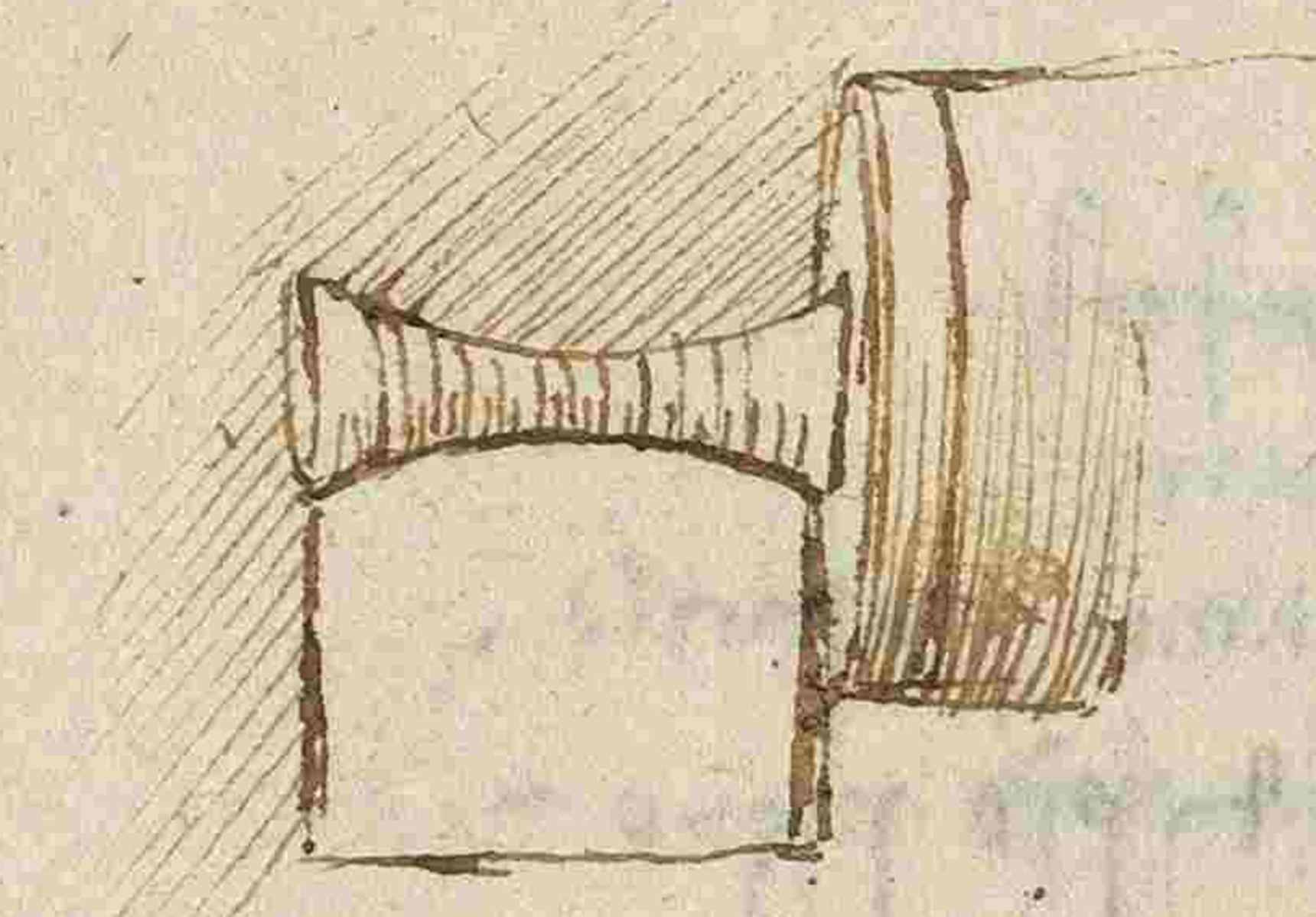
Heavily worn shaft and mating half-bearing, with enhanced wear towards the middle of the bearing (from Madrid I f. 119r, 1493–97, Biblioteca Nacional, Madrid).
Leonardo later discussed the behaviour of third bodies between the bearing surfaces in a more general way (CA f. 1043v, ca. 1513). He identified three types of contact: hard on hard, soft on soft, and soft on hard. ‘Simple’ contacts involved no third body. In what he termed ‘composite’ contacts, where third bodies were present in the contact, he observed that ‘the sharper these are, the more they wear the bodies. If the sliding bodies are of different hardness, the softer wears the harder, and this is because of the sharpness of the material between the bodies which embeds in the softer body and, fixed there, acts like a file which wears the harder material. If the materials are of equal hardness, the matter between the two bodies grinds itself down if it is less hard than the sliding bodies. But if it is harder, it wears the two bodies just like two files of the same strength rubbing against each other.’ xxviii
Leonardo's writings contain few references to specific lubricants. Water has been mentioned above in the context of wooden mill bearings, and both olive oil and ‘grease from pork bone marrow’ for metallic bearings. He also comments on the use of olive oil or grease from sheep bones in Madrid I f. 117v: ‘If the shafts are not lubricated with olive oil, they abrade their bearings so that one often finds wear debris on the supports. And if you use that oil, debris and time thicken it and make the motion difficult. Observe this in the counterweights of clocks: if the axles and teeth of the pinions are lubricated, ten pounds act like 100, unless they are greased with (grease of) wether-bones.’ xxix Elsewhere in Madrid I (f. 152v) he again notes the deleterious effects of wear debris contaminating the oil in a clock mechanism, where even a small increase in friction will be problematic.
A further natural lubricant is suggested in Madrid I f. 100r, where Leonardo observes that if an ox-horn is placed beneath the axle in a bearing, then ‘as it is worn it is converted into a kind of product which is like grease’ xxx and does not tend to adhere to the bearing and thus avoids wear. He provides the sketch shown in Figure 8(a), with the note ‘if (the horn) is filled with oil, it can only come out at the place where the horn is worn away by the shaft, and so always provides oil lubrication to the shaft.’ xxxi
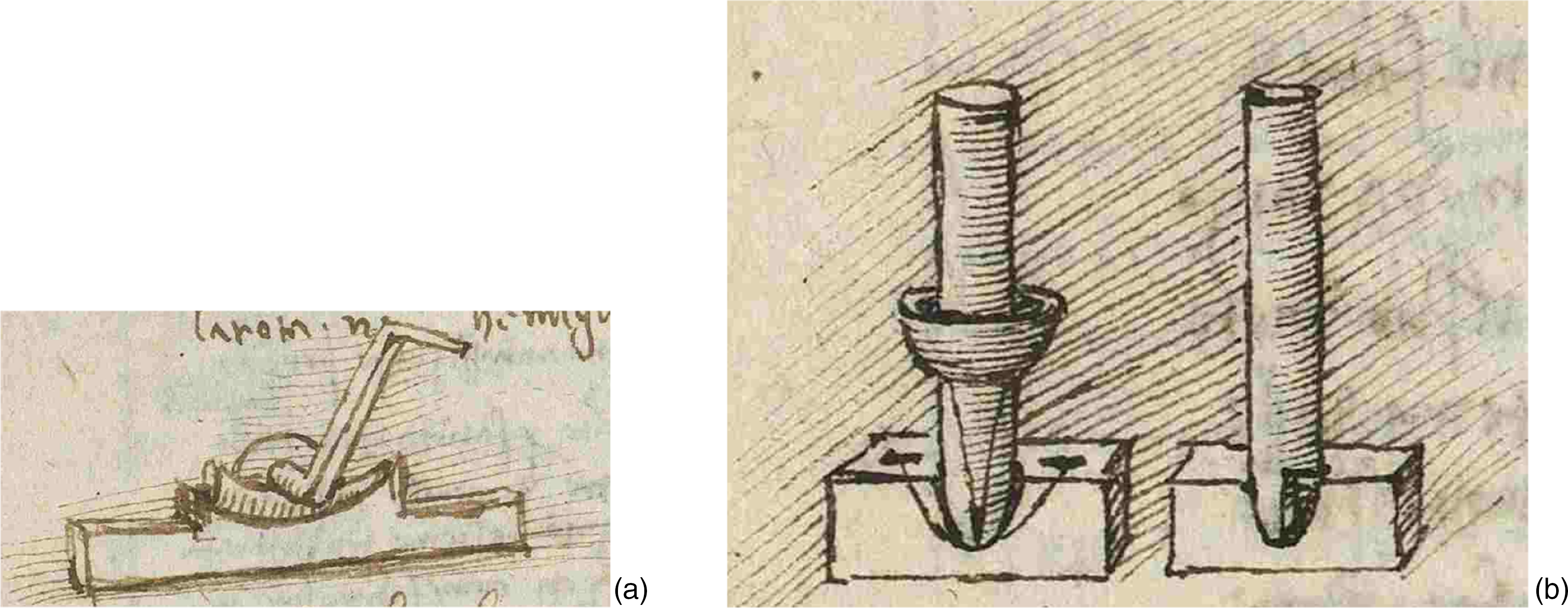
(a) Method for supplying lubricant to a bearing by means of an ox horn (from Madrid I f. 100r); (b) two methods for supplying lubricant to a plain pivot bearing (from Madrid I f. 118r). (both 1493–97, Biblioteca Nacional, Madrid).
Madrid I also contains some practical notes about the delivery of oil to the bearing surfaces in plain pivot bearings. Figure 8(b) shows two sketches. The one on the left shows two types of oil passages, indicated by curved lines leading from larger holes in the lower bearing block, and by straight lines within the shaft that would feed oil from a cup-shaped collar surrounding the shaft. On the right, a cut-out region at the end of the shaft provides a small reservoir. The accompanying note reads ‘to supply oil beneath the end of the shaft, when it is loaded downwards along its length. But a better way is to lift the shaft and to put oil into the cavity where it rests, because using holes, as in the diagram above, those holes quickly become filled with the iron that is worn, mixed with the oil and dust.’ xxxii
Discussion
Leonardo was well-connected and well-travelled, and much of the material he recorded was based on careful and critical observation of the world around him. The ideas presented in his notebooks should be viewed in the context of the European technology of his time, and in particular that of the northern Italian and neighbouring German-speaking regions. In some cases, designs and concepts once thought to have originated with Leonardo can be shown to have already been prevalent before his time. Numerous drawings of mechanical devices by early Renaissance Italian engineers have survived in the form of ‘machine books’, manuscript collections whose authors remain in some cases unclear. Known authors include Mariano di Jacopo (known as Taccola) (1382–c. 1453) and Francesco di Giorgio Martini (1439 −1501), both from Siena, and Buonaccorso Ghiberti (1451–1516) from Florence. The work of Francesco di Giorgio in particular was widely copied, but was itself partially derived from earlier sources.22,23 The German tradition is represented by a greater emphasis on military applications: notable sources are manuscripts originating from Konrad Kyeser (1366 – after 1405), Johannes Formschneider (before 1420 – after 1470) and other authors.24–26 Later printed works on mining and metallurgy by Georgius Agricola (1494–1555, Saxony) 27 and Vannoccio Biringuccio (1480–1539, Siena) 28 also provide valuable glimpses of contemporary practice.
Plain bearings
Many drawings in the machine books show only schematic indications of plain bearings, for example in mills, wagons, military equipment and lifting gear. None of these sketches approaches the level of detail provided by Leonardo in the examples shown in Figures 1 to 4: the bearings are simply included as generic components of larger-scale machines. Figure 9 provides an example from Taccola of 1432–33 from which at least some tentative conclusions can be drawn about bearing design and materials. It shows a type of reversible hoist originally designed by Filippo Brunelleschi (1377–1436) for the construction of the cupola of the cathedral in Florence.29,30 Without changing the direction of movement of the horse, the rotation of the windlass can be reversed by raising or lowering the vertical shaft by means of a massive screw to engage either one or other of the horizontal gear wheels with the vertical wheel. The drawing shows two plain bearings on the horizontal shaft which in this design would have to sustain both upward and downward loads. In each a relatively thin axle is constrained by strap-like bands: while no mention is made of the bearings or their materials in the accompanying text, the configuration suggests that these axles would have been metallic components, probably of iron, attached to the ends of a wooden shaft and running between iron bearing surfaces. The upper and lower pivot bearings on the vertical shaft are similarly likely to have been of iron, but possibly running against wood; they would carry significantly lower loads than those on the horizontal shaft. The use of iron-on-iron bearings was not at all new: there is evidence of their use as early as the 9th century, 31 and in the twelfth century, Theophilus Presbyter (ca. 1070–1125) described a method of hanging large bells by inserting iron pins into the ends of the wooden cross-beam (yoke) and supporting these pins on curved iron bearing liners set into a wooden bell-frame. 32
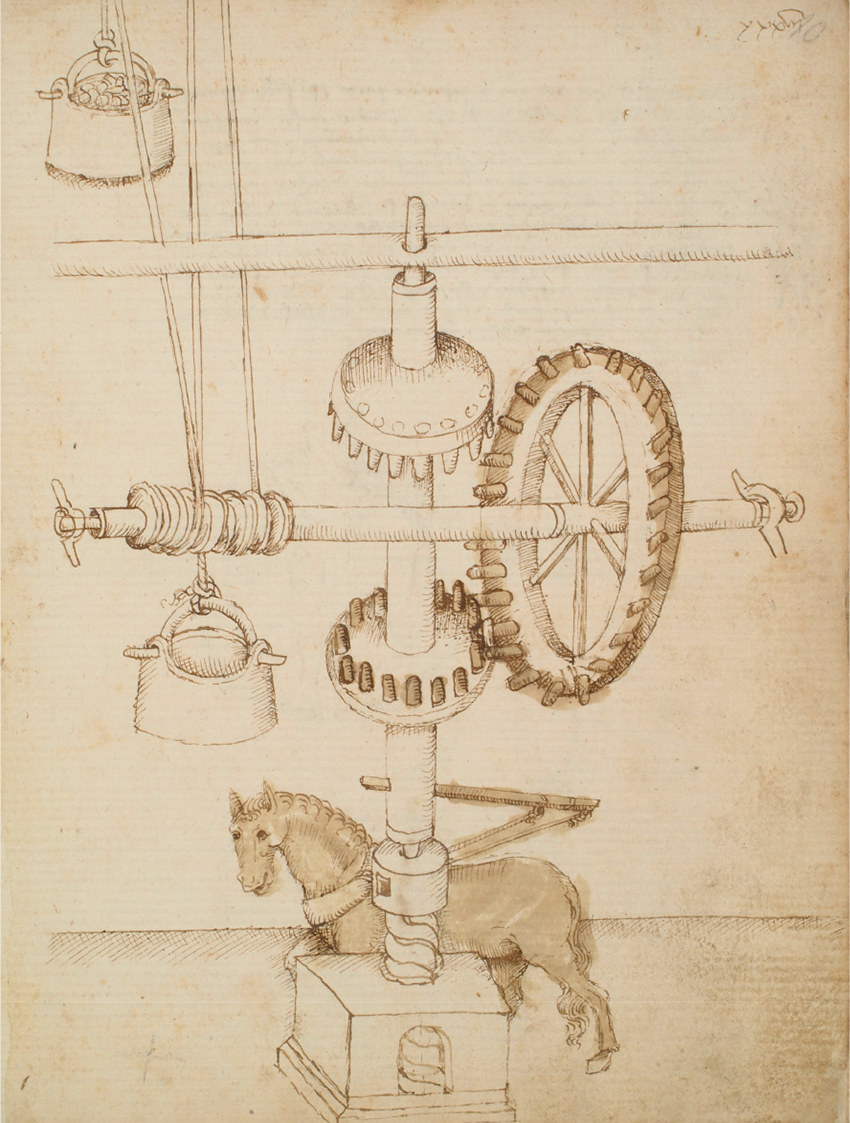
Reversible hoist, from Mariano Taccola, De ingeneis (MS Palat. 766 f. 36r, 1432–33, Biblioteca Nazionale Centrale di Firenze, Florence).
Taccola specified the use of wood for bearings on several occasions: for example, he wrote that sleeve bearings for a mercury-driven mill (a model or demonstration device) should be of ‘cedar or orange wood… Young laurel is also good.’ xxxiii He also listed cedar, oak or ilex (holly) as low-wear bearing materials (presumably in conjunction with iron shafts) for a large man-powered treadmill hoist. xxxiv
Leonardo's sketches in Figures 1 and 3 show split bearing blocks, a design that would involve a different method of manufacture from the strap-like devices shown by Taccola and which is not visible in any other drawings of the period, or even in later Renaissance sources such as those of Agricola of 1556 27 or Ramelli of 1588. 33 Indeed, it may be that the next earliest depiction (at least, within Europe) of a similar design is that by Vittorio Zonca (1568–1603) a century later, who showed split bearing blocks carrying the axles of rollers in a printing press. 34 However while Leonardo's bearings were metallic (and necessarily so, in view of the high loads involved in rolling sheet metal), Zonca specified that the material for both the bearings and the stub axles (and rollers) should be of box or pear wood.
Bronze (copper-tin alloy) was already in use for plain bearings in machinery in Leonardo's time, as shown by records of the construction of Florence cathedral 30 ; the copper-rich alloy was probably similar to that used for bells. As noted above, Leonardo specified alloys with a higher tin content on at least two occasions (7Sn 3Cu in 1493–97, and 2Sn 1Cu in 1513). Reti9,10,12 has suggested that Leonardo's proposal to make bearings from ‘mirror metal’ with a high proportion of tin was an original idea, and that such a tin-rich alloy was never in fact used for mirrors. However, the classic Italian treatise on Renaissance metallurgy, the Pirotechnia of Vannoccio Biringuccio (1540) records that while the ‘ancient method’ for making mirrors used an alloy that was also used for bells, of 3 parts copper and one part tin with possible small additions of antimony and silver, ‘nowadays most of the masters who make them take 3 parts of tin and one of copper, and melt these together’. 28 There is thus no convincing evidence that the tin-rich compositions noted by Leonardo were not already in contemporary use for plain bearings.
Wear and lubrication
That Leonardo was familiar with contemporary tribological practice is shown by his comments in numerous places in Madrid I: for example, ‘the masters sometimes use oil….’ xxxv ; ‘it is a general custom among experts…’ xxxvi ; ‘some people have made the wheels of brass and the pinions of tempered steel’. xxxvii But in recording his observations and thoughts on wear, Leonardo went much further than any other Renaissance engineer; contemporary machine books contain no images comparable with those in Figures 6 and 7, for example. It is clear from Leonardo's accompanying comments noted above that these representations of plain bearings subjected to extensive wear were based on examples that he had himself observed in water mills, grindstones, clocks and other machinery. However, it is hard to imagine such excessively worn components being tolerated in functioning devices, and in these generic diagrams he almost certainly exaggerated the extent of wear in order to emphasise the underlying principles.
It is not necessary to suggest, as Sawyer has done, 17 that Leonardo carried out long-term experiments (perhaps lasting for months) to generate the pattern of wear shown in Figure 6(a), for example; this is likely to be an enhanced representation of the wear pattern he had observed in a mechanism such as a clock or hoist. That diagram (only 18 mm high) occupies a very small area at the bottom of a page, which suggests that Leonardo considered it of only subsidiary importance to illustrate the point he was making in the accompanying text. Although his deductions about friction must have been based on systematic experiments, 1 there is no evidence that he ever made more than occasional tribological measurements, and certainly none that he carried out prolonged wear tests. xxxviii
Leonardo's deductions about the mechanisms responsible for the wear he observed were highly perceptive. He correctly identified (in Madrid I f. 199r) that hard particles might become embedded into the softer surface of a bearing bush and then cause abrasive wear of the harder journal. This process has been extensively studied in modern times,35–37 and Dwyer-Joyce et al. have referred explicitly to Leonardo's original comments on this wear mechanism. 36 Leonardo's explanation of the reasons why wear might be higher towards the middle of a plain metal-on-metal bearing is also plausible: expulsion of lubricant from the free ends of the bearing, and the greater viscosity of the lubricant at the ends where it would be contaminated with solid debris, could contribute to a thinner lubricant film rate towards the middle and thus to poorer lubrication and greater wear in that region.
It is evident from his comments noted above, both in general statements and in the context of plain bearings and the meshing of gears, that Leonardo appreciated that wear in a sliding contact progressed steadily even from the onset of movement; that at a constant sliding speed it increased linearly with time; and also that it increased linearly with increasing contact pressure. In essence, Leonardo's understanding of the dependence of wear rate on contact pressure foreshadowed the much later statements of the same relationship by Reye (1860), 38 Preston (1927, in the context of polishing) 39 and Archard (1953). 40 xxxix While it is true that, as Preston has noted, this dependence is hardly surprising, it is nevertheless remarkable that Leonardo reached the same conclusions several centuries earlier.
Leonardo's concept of the hardness of materials had, unsurprisingly, only a semi-quantitative basis, but he had no problem in deciding from its response to touch or to pressure against another body, whether one material was ‘harder’ or ‘softer’ than another. xl In his discussion of bearing materials, and of the wear of sliding contacts, he frequently referred to hardness as a key property. For example, the plain thrust bearings shown in Figure 4 are made from ‘glass’, and for the rubbing components of the hydraulic valves of a fountain he proposed the use of ‘crystal or other hard stone’. xli
The lubricants mentioned by Leonardo are unexceptional: the use of animal fats and vegetable oils (notably olive oil), as well as of water for wood-on-wood bearings, was widespread in Renaissance engineering. 31 More notable are Leonardo's occasional comments on the method of delivery of the lubricant; Figure 8(b) shows two such methods for a vertical pivot bearing, and is accompanied by his thoughts on the disadvantages of using easily-blocked oil feed holes. xlii While there is no evidence that these particular designs are original to Leonardo, the curious use of an ox-horn to dispense oil while itself wearing to add further material to the lubricant, shown in Figure 8(a), may well be an example of Leonardo's ingenuity leading to an impractical result, as was also common in his studies of rolling bearing systems. 2
Conclusions
As with the other tribological topics of friction and mechanical bearings,1,2 Leonardo's notes and sketches relating to plain bearings and their materials, lubrication and wear show a richness of detail, coupled with insightful analysis, that far surpasses that of any other contemporary engineer. He was clearly well-informed about then-current technology, and much of what he recorded was probably a reflection of contemporary practice. It is therefore not possible to decide with certainty whether features present in his notes, such as the use of replaceable parts for wearing components, the designs of split bearings, specifications for tin-rich bearing alloys and methods of lubricant delivery were truly original to him. However, his ability to classify and analyse his observations led him to highly perceptive conclusions about the effect of loading direction on wear rate, the relationship between wear rate and load, and the mechanisms of wear in sliding contacts. In deducing the dependence of wear on load and sliding duration, Leonardo's thinking anticipated the quantitative models of Reye, Preston and Archard by more than 350 years.
Footnotes
Declaration of conflicting interests
The author declared no potential conflicts of interest with respect to the research, authorship, and/or publication of this article.
Funding
The author received no financial support for the research, authorship, and/or publication of this article.
