



Abstract
Amontons’ widely cited paper of December 1699 on the subject of friction in machines is not the first to contain his statement of the laws of friction. An earlier paper on a novel heat engine, presented to the Académie Royale des Sciences 6 months earlier, describes the measurements of forces in glass polishing and contains a clear statement that the friction force is independent of contact area and proportional to normal load. The comments in Amontons’ paper on the physical origins of the friction force at surface irregularities (asperities) do not appear in the contemporary record of his lecture in December 1699, but were included in the published version after similar ideas had been presented by Philippe de la Hire; credit for these ideas should be given to La Hire rather than to Amontons.
Introduction
Duncan Dowson's important book on the history of tribology 1 is the natural starting point for any tribologist wishing to learn about the origins of their subject and, together with David Tabor's chapter published 15 years earlier, 2 was responsible for sparking my own interest. In his review of Dowson's book, 3 Tabor comments that it was ‘a labour of love, and Duncan Dowson reveals himself not only as a dedicated tribologist but also as a humanist of wide interests’. The purpose of this note is to extend the discussion presented by Dowson and shed a little more light on the work of a key figure in the development of our understanding of friction: Guillaume Amontons (1663–1705).
Amontons’ papers of 1699
The so-called ‘laws of friction’, which state that the friction force is proportional to the normal load and independent of the apparent area of contact, are usually ascribed to Amontons, although they were in fact clearly enunciated by Leonardo da Vinci more than 200 years earlier. 4 The source that is widely cited for Amontons’ first statement of these laws is a paper presented at a meeting of the Académie Royale des Sciences in Paris on 19 December 1699 and published in the Mémoires de l’Académie, entitled ‘De la resistance causée dans les machines, tant par les frottemens des parties qui les composent, que par la roideur des cordes qu’on y employe, et la manière de calculer l’un et l’autre’ (On the resistance caused in machines, by the friction of their components as well as by the stiffness of the ropes they use, and the method of calculating these; author's translation). 5 Numerous writers on the history of tribology over the past 80 years have cited this paper.1,2,6–15 However, the key importance of a previous contribution by Amontons is nearly always overlooked; the paper in Japanese by Yoshitake written for the tercentenary of Amontons’ paper 11 is perhaps the most accurate but has not been cited by any subsequent author.
Six months earlier, in June 1699, Amontons presented to the Académie a lengthy paper entitled ‘Moyen de substituer commodement l’action du feu à la force des hommes et des chevaux’ (Method of conveniently substituting the action of fire for the force of men and of horses). 16 The main topic of that paper was the design of a novel heat engine, a ‘moulin à feu’, based on the thermal expansion and contraction of air. Sheet metal cells arranged around the rim of a giant wheel were alternately heated by a furnace and cooled by immersion in water as the wheel rotated. 17 The expansion of the air in these cells pushed water through tubes into another ring of cells, and the unbalanced distribution of the weight of water around the wheel led to a gravitational torque and could thus generate mechanical work. Amontons’ ingenious design was based on a series of detailed experiments described in his paper, in which he investigated the expansion of air by heating, its contraction on cooling, and rates of heat transfer through metal sheeting. To estimate the power of the engine, he also compared the effort produced by men and horses, carrying out experiments showing that a man could work at about one-sixth of the power of a horse. Hence, he calculated that a heat engine with a wheel 30 feet (9 m) in diameter rotating once every 9 s would be equivalent in power to 39 horses or 234 men.
To estimate the rate of mechanical working by a human worker, Amontons measured the forces and displacements involved in the manual polishing of plate glass and, in doing so, made a significant contribution to the concept of mechanical work. 18 It is from these observations that Amontons first drew his important conclusions about friction. Diderot's Encylopédie of 1765 provides details about the polishing process that Amontons observed, as illustrated in Figure 1. 19
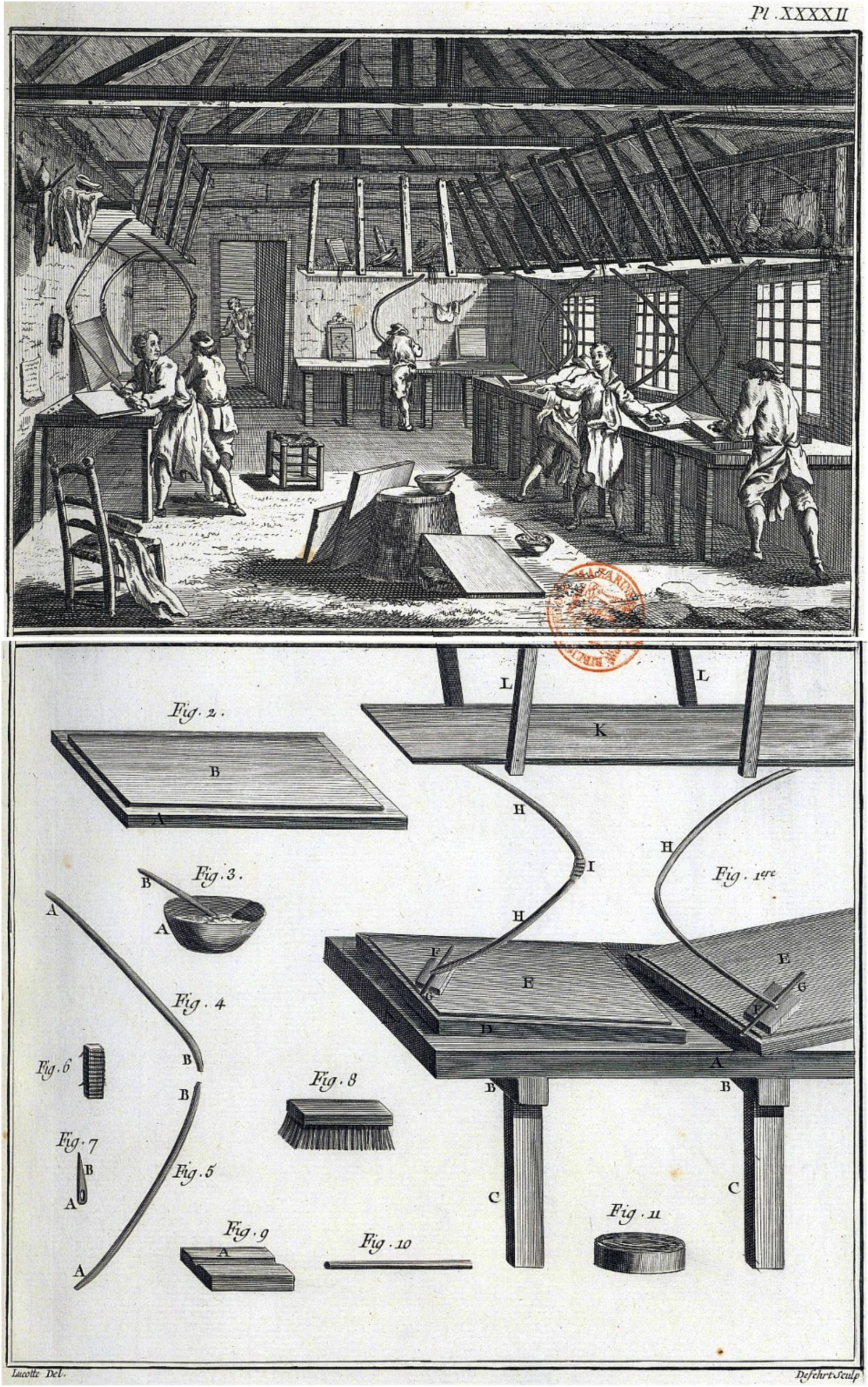
Eighteenth-century illustrations of the manual polishing of glass. 19 A glass sheet (E in the lower image) is polished with progressively finer abrasives by the action of a polishing block (F) that is dragged backwards and forwards by the operator. The downward force on the block is supplied by a springy wooden strut or flèche (H) bent between an upper board (K) and the block.
The polishing block was moved repeatedly backwards and forwards over the surface of the glass sheet in the presence of abrasives such as sand and emery. As explained in the Encylopédie, 20 the task of the operative was made easier by the fact that the block was pressed down onto the glass by a long springy wooden rod or flèche bent between an upper board and the block. The worker thus did not need to press down on the block, nor continually accelerate and decelerate a heavy mass, and all his effort could be employed in sliding the block horizontally.
Amontons explains that he measured the downward force on the block with a spring balance arranged to pull the end of the flèche upwards, and the horizontal force required to cause sliding also by the same method. He measured the sliding forces for three different sizes of polishing blocks, with areas of 6, 11 and 24 pouces (literally, inches, but implicitly, square inches; the pre-Revolutionary French inch was 27.07 mm). He reported values for two slightly different downward forces: 28 and 30 livres (pounds, one livre being 489.5 g). Amontons’ results, given as the values of the sliding force within the text of the original paper, are plotted in Figure 2 in terms of the ratio between the sliding (frictional) force F and the normal load N. In most cases, he gave two values for the sliding force: a maximum value that applied when the flèche was vertically above the centre of the polisher (and presumably applying the maximum normal force) and a minimum value when the flèche was most obliquely inclined. These are plotted in Figure 2 as solid and open points, respectively. In Figure 3 the mean values of the sliding force are plotted against the normal load.
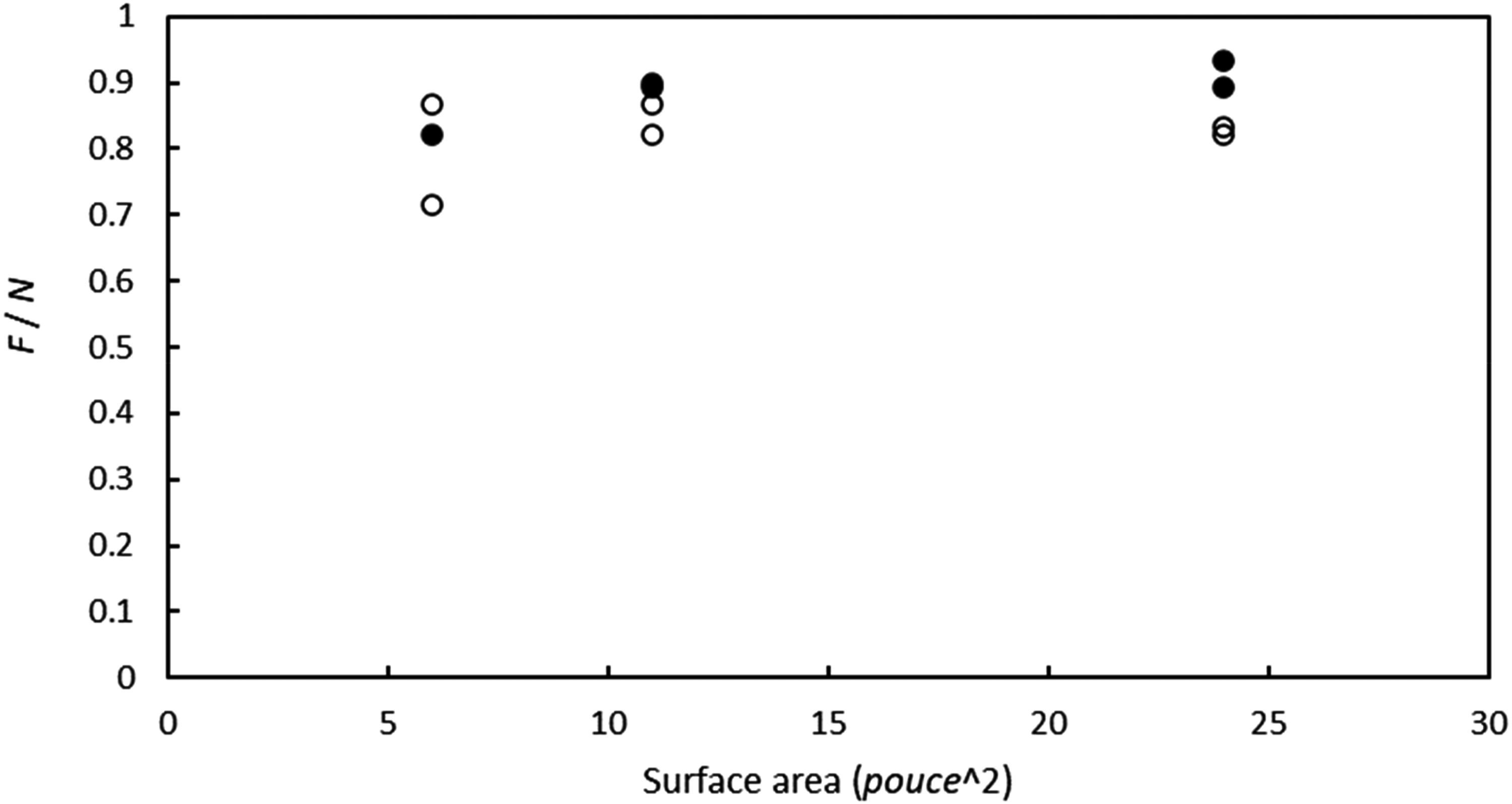
Ratio between sliding force, F, and normal load, N, plotted against the nominal area of contact, as reported by Amontons for the polishing of glass. The filled points relate to maximum values of F, and the open points to minimum values.
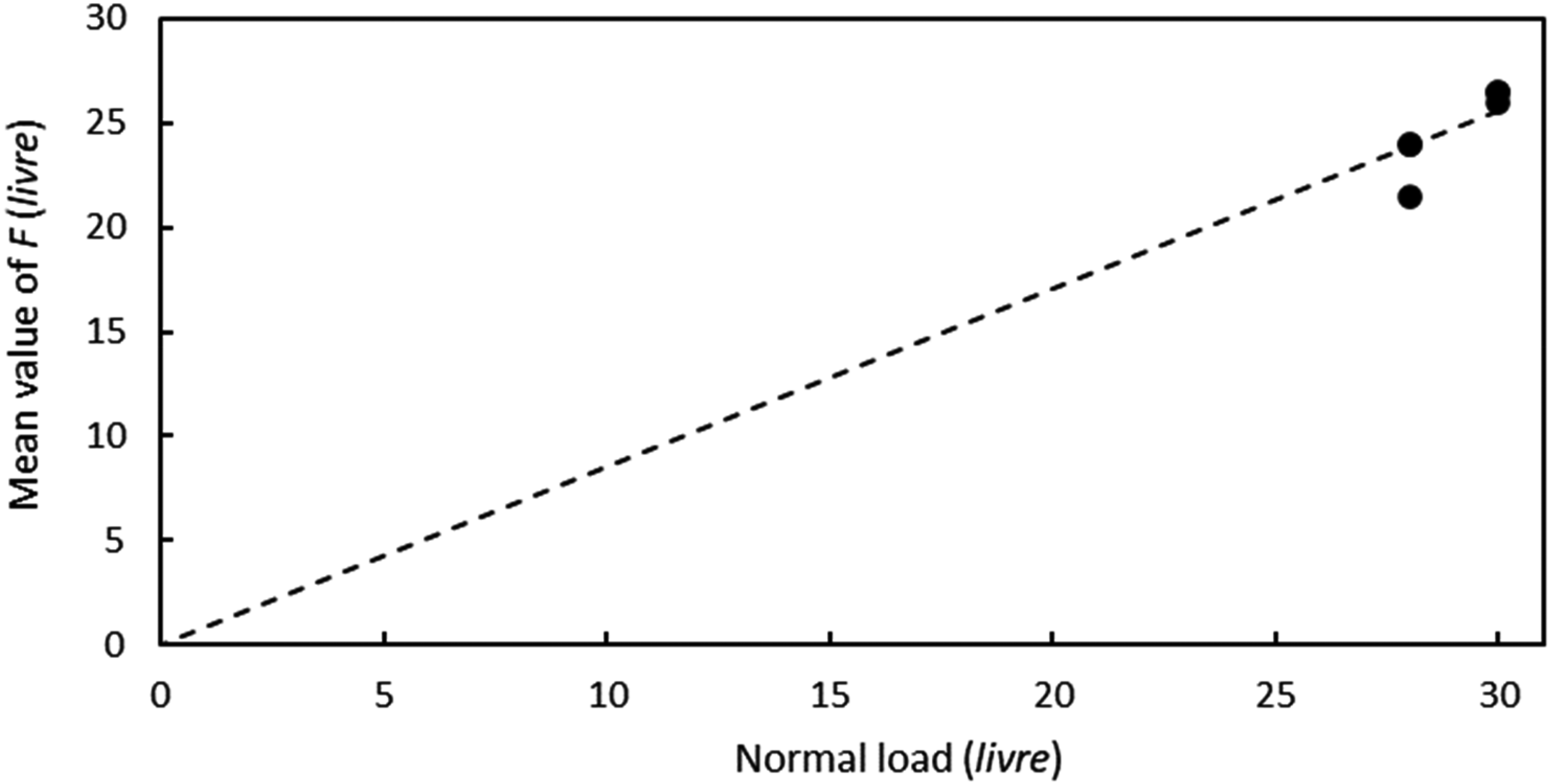
Sliding force, F, plotted against normal load, as reported by Amontons for the polishing of glass. Values of F are the means of the maximum and minimum values reported.
In his paper of June 1699,
16
Amontons wrote: From these observations one can note, in passing, that it is an error to believe that friction in machines increases or decreases in proportion to the size of the sliding surfaces, and, for example, that the wheel of a mill turns more easily if its bearings are shorter, which is in any case poor practice because they wear the bushes in which they turn unacceptably. But friction increases or decreases in proportion to the loads which are moved, and in the ratio of the length of the levers which move them along (the bodies) on which they are pressed.
Apart from the formal papers published in the Mémoires, other sources of information about the proceedings of the Académie include the original handwritten minute books, maintained by Bernard Le Bovier de Fontenelle, secrétaire perpétuel for 42 years, which record not only the content of the papers read at meetings but also the names of members present on each occasion. The minutes for 1699 21 reveal that while Amontons started to read his lengthy paper on the moulin à feu on Saturday, 20 June 1699, he completed its presentation at the following meeting on Wednesday, 24 June (erroneously referred to in the minutes as 23 June). They provide the full text for his paper almost exactly as it was later printed in the Mémoires, but include one further data point not present in the published version (which has been included in Figures 2 and 3).
Summaries of the most important material presented at the meetings of the Académie, intended for the non-specialist reader, were also prepared by Fontenelle and published in the Histoire. 22 The Histoire and the Mémoires for each year were published together in a single volume, but with the pages of each part separately numbered. The first edition of the volume for 1699 was published in Paris in 1702, with subsequent editions in 1718 and 1732; although these later editions contained some corrections and revisions, Amontons’ papers remained unaltered, and their pagination was the same in all the Paris editions. A further version of the first edition was published in Amsterdam in 1706 with different pagination. English translations of some of the content of both the Histoire and the Mémoires, in abridged form, were also published in 1742 in London. 23
The extract from Amontons’ paper on the moulin à feu quoted above is followed by a significant passage in both the published Mémoires and the minute book, but this is omitted from the abridged English version: I greatly wish to have had the opportunity to carry out the same experiments with samples of iron, copper and wood, on surfaces of the same materials, because from those one could deduce some very important rules to calculate friction in machines.
It is apparent that in June 1699, based on his experiments on polishing, Amontons was making definite claims that the friction force was independent of the area of contact and also that it varied in proportion to the normal load. Having carried out his initial experiments only in the context of glass polishing, it is not surprising that Amontons expressed the wish to extend his work to other materials more relevant to machinery construction, presumably in the absence of polishing abrasives.
The widely cited paper of December 1699, in which Amontons restated his laws of friction more forcefully and explicitly, 5 describes his further experiments on the sliding of copper, iron, lead and wood against samples of the same materials, all lubricated with aged pork fat. While the minute book for 19 December 1699 21 describes these experiments in the same way as in the paper published in the Mémoires, and contains much of the text of that paper, the published version had been substantially edited and additional material added by the time it was printed in 1702. For example, Amontons’ thoughts contained in the published paper on the problem of friction in a stack of interleaved plates were only presented to the Académie as ‘a new paper on friction’ at its meeting of 27 February 1700. 24 However, as far as the experimental work is concerned, the paper and the minutes of the meeting on 19 December 1699 are consistent.
Amontons’ apparatus is shown in Figure 4: he used a bent elastic strut to provide the downward force on the slider, and a spring balance to measure the horizontal force. This arrangement appears unusual and unnecessarily complex to the modern eye and immediately raises the question as to why, more simply, he did not apply the normal load with a weight on the slider. The reason is, however, clear: Amontons was using exactly the same methods that he had employed in his experiments on glass polishing. Apart from the statements that the samples were of various (unspecified) sizes, and that he tested a wide range of combinations of the different materials, other information about the experimental conditions is completely absent from the record. Only a single value of normal load, 30 livres, is mentioned, although in a theoretical discussion on the effect of moment on friction in a rotating system (which develops a point he had already raised in the June paper). This is the same load as that used in his polishing experiments. It seems probable that Amontons used exactly the same type of flèche as in his glass-polishing studies and may well have performed his new experiments in the same workshop.
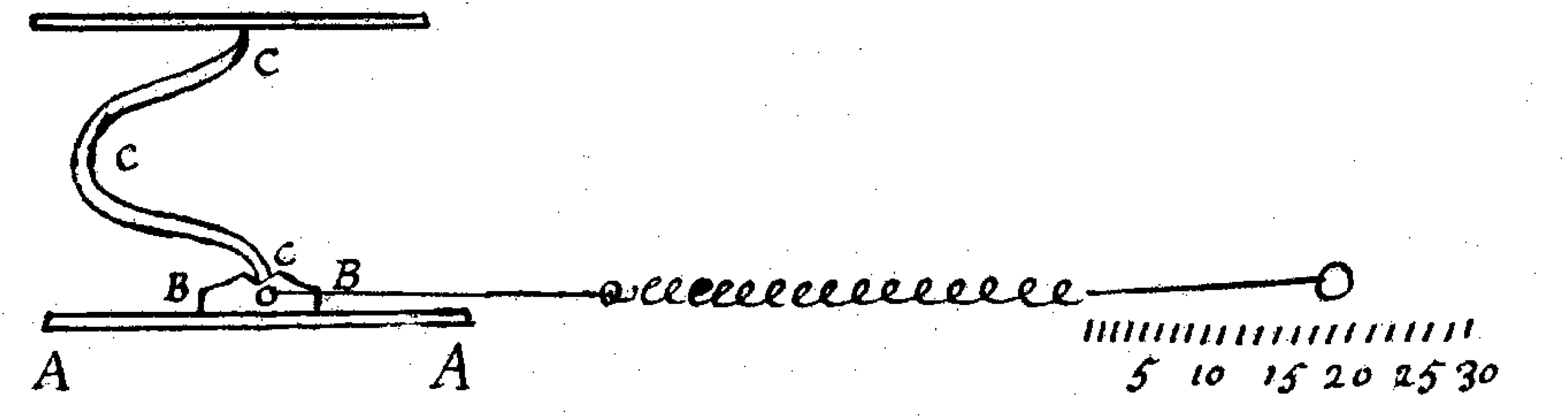
Apparatus used by Amontons and described in his paper of December 1699 (original drawing from the minutes of the Académie). 21
According to the minutes of the meeting, Amontons made it clear to his audience on 19 December that, in stating his laws of friction, he was repeating a claim he had already made in June, based on his work on glass polishing: the resistance caused by friction only increases or decreases, as I have already said in the experiments reported to the meetings on 20 and 23 June, in proportion as the load is larger or smaller, and not according to whether the bodies that slide are more or less extended.
The italicised reference to the June meetings, present in the minutes, is absent from the published version in the Mémoires.
An important difference between the published version of Amontons’ paper 5 and the minutes of the meetings of 19 December 1699 and 27 February 1700 is the absence in the minutes of any comments on the physical basis of friction. In the printed version, Amontons provides a diagram showing elastic asperities as springs attached to the surface; he ascribes frictional resistance to the effect of surface roughness and discusses the origins of friction in terms of the force needed to lift asperities, whether flexible or rigid, over each other. All these ideas are missing from the contemporary accounts of his talks in the minutes of the Académie, the only occasions on which Amontons presented his work on friction before the publication of his paper. The paper he actually presented at the December meeting was more strongly focused on the question of predicting the effects of friction and rope stiffness in machinery than was the subsequently published paper, and omitted any discussion of the presence or role of asperities.
La Hire's study of friction
Amontons’ paper was the second to be presented to the Académie on 19 December 1699. It was preceded by a paper by Philippe de la Hire, entitled ‘Expériences et observations sur les corps qui frottent l’un contre l’autre’ (Experiments and observations on bodies that slide against each other). Although its main substance was included by Fontenelle in the Histoire, 25 no quantitative information is provided in that summary, and this paper, the text of which is recorded in the minute book, was never published in the Mémoires. Nor was Fontenelle's piece on friction in the Histoire included in the English version of 1742. 23
Philippe de la Hire (1640–1718) was considerably older than Amontons (59 years old compared with Amontons’ 36) and a senior figure within the Académie, his membership being as a pensionnaire while Amontons had only recently been admitted as an élève. 26 Although initially trained in the visual arts, by this time La Hire had had very wide practical experience in geometry, cartography and observational astronomy and lived in the Paris Observatory. He made several contributions in mechanics 27 and had published a comprehensive textbook on the subject in 1695. 28 La Hire has been described as ‘an empirical and eclectic scientist who made a modest contribution to a broad range of subjects rather than to a narrow field of research’, 26 and his interests were extremely diverse. His contributions to the Académie were certainly prolific: the Mémoires for 1699 alone include no fewer than seven papers, including reports of eclipses, notes on the optical properties of mirrors and experimental techniques relevant to telescopes, as well as a paper on the forces that could be exerted by humans in various ways.
On 19 December, La Hire reported the results of the experiments on friction that he had initiated following Amontons’ paper in June, which Fontanelle had recorded as having caused some astonishment to the Académie. 25 The details of his experiments are provided by the minute book.21,27 La Hire used several blocks of wood, well finished but not polished, and with surface areas in the proportions 1, 2, 3, 4, 5, 6, 7 and 8. He placed them on a well-finished but unpolished wooden table and loaded them all to provide the same normal load of 2¼ livres. By using a weight attached to a string over a well-turned pulley with a small axle, he found that the load needed to cause the blocks to slide was in all cases 1¾ livres. He commented, perhaps unnecessarily, that the part of the string that was horizontal was parallel to the table. La Hire was a careful experimenter; indeed, he has been said to ‘have been noted for meticulousness bordering on pedantry in his scientific research’. 26 La Hire's journal of astronomical observations for 1699, preserved in the Observatory, 29 shows no record of any tribological experiments, but is testimony to his detailed observation and careful recording of measurements.
La Hire repeated these experiments with two flat but unpolished blocks of marble, with areas of 6 and 20 (square) pouces on a table of the same material, and both loaded to 4½ livres. He found that both started sliding at a force of 1 livre 5 onces (i.e. 1.31 livres). Adding water to the contact region made little difference to the friction force.
La Hire then stated: 21
These experiments are contrary to the common beliefs about the sliding of bodies against each other, since one had always believed that friction was in proportion to the areas touching, the load on the areas being equal, and that is how I reasoned in my treatise on mechanics. But M. Amontons having found in his experiment on the polishing of mirror glass that the friction increases in the ratio of the loads and not of the areas, as soon as I was notified of this I became convinced by physical reasoning, clarified by the experiments that I then made.
La Hire went on to provide an explanation for these observations. He suggested that if the bodies in contact had soft, flexible regions (as in wood) one could consider them as tiny springs that would deform under the load, and that the deformation of each of these springs would be proportional to the load it carried, and independent of the total area of the bodies. Similar arguments would apply if the regions were hard and inelastic (as in marble): then the regions that engaged with each other would either rub against each other and become worn, or rise over each other as sliding occurred. In all these cases, he argued that the friction force would be independent of the apparent area of contact, but depend solely on the normal load.
Discussion
Many previous accounts have either failed to mention La Hire's contribution, or understated its importance in confirming Amontons’ proposed laws and influencing Amontons’ thinking. In some cases, even when La Hire's role has been mentioned, the sequence of events has been described unclearly or in a misleading way. One reason for the confusion is that Fontanelle's account in the Histoire 25 provides meagre chronological information.
As discussed in the previous sections, the minute book of the Académie shows that both Amontons and La Hire regarded the former's paper on the moulin à feu, presented in June 1699, as including a definitive statement of the laws of friction: both referred to it in their papers read in December. Fontanelle's account 25 states that on hearing Amontons’ paper in June, La Hire immediately carried out his own experiments, but this has been wrongly interpreted by some authors as occurring after the December paper. In fact, it is clear not only that La Hire's investigation took place between June and December 1699, but that at the December meeting he presented his own results to the Académie before Amontons’ presented his paper. However, Amontons’ priority in the discovery of the laws was in no doubt: the minutes describe him as ‘M. Amontons who had first had occasion to examine this matter in detail,’ and La Hire explicitly acknowledged Amontons’ role in his own remarks. La Hire freely admitted that his previous understanding of friction had been wrong; in his textbook on mechanics, for example, he had erroneously suggested that the friction of the axle of a pulley wheel could be reduced by reducing the area of contact with its housing. 28
As Figure 2 shows, the evidence on which Amontons based his statement in June 1699 that friction is independent of contact area was strong, but the evidence in Figure 3 of its proportionality with load was much less convincing: his exploration of the effect of load involved the use of only two, marginally different loads of 28 and 30 livres. It is completely unclear how many values of load he investigated before his December paper: only a single value is mentioned in his reports, and in any case, his apparatus that used a bent spring to provide the load was probably not well suited to changing this variable. La Hire was helped by using weights to apply the normal load, and as far as can be judged, his experiments, while restricted to only two materials (wood and marble) under unlubricated conditions, seem to have been more systematic and certainly in the case of area to have explored a wider range of values.
Many writers assume that because in his December paper Amontons stated that he had found the force of friction in all cases to be close to one-third of the normal load, he believed that to be true for all sliding conditions. That is emphatically not the case: the ratio F/N that he had himself measured for the polishing of glass was ∼0.8–0.9, and he also stated clearly in his published paper of December (although this part is not found in the minutes) that the friction between a wooden beam and the ground was ‘around three-fourth of the weight’. 5 He was also aware of La Hire's results, which gave ratios of 0.8 for his experiments with wood and 0.3 for marble. Amontons’ value of about one-third, as Dowson has also stressed, 1 applied to the particular conditions of boundary lubrication that he had investigated.
It is striking that there is no record in the minute book of any discussion by Amontons of the physical origins of friction at either of the meetings in December 1699 or February 1700. Nor is the topic mentioned in Fontenelle's summary of Amontons’ work on friction in the Histoires 25 : he presents it solely as the work of La Hire. Amontons would have been aware of La Hire's ideas about the behaviour of what we would now call asperities from the December meeting, and included very similar concepts in his published paper. However, it is clear that La Hire should be credited with the first statement of these important ideas in the development of theories of friction, and not Amontons as has been suggested by many previous writers.
Conclusions
Guillaume Amontons’ first statement of the laws of friction was made in his paper on a novel heat engine, presented at a meeting of the Académie Royale des Sciences in June 1699, rather than in the paper on friction of December 1699 that is usually cited. Amontons based his statement on measurements of the forces involved in the polishing of glass, which demonstrated convincingly that the friction force was independent of apparent contact area, but less persuasively that it was proportional to the normal load.
Amontons’ paper on friction restated his laws more explicitly and described the use of the same unusual apparatus in which the normal load was applied with a spring, to study the grease-lubricated sliding of several combinations of materials more relevant to machine construction. Both Amontons and Philippe de la Hire, who had carried out his own independent measurements and reported them at the same meeting of the Académie, acknowledged the priority of Amontons’ earlier work.
However, priority for the idea that the physical basis of the laws originated in the behaviour of small protuberances or asperities in contact should belong to Philippe de la Hire, who enunciated it before Amontons, and of whose work Amontons must have been aware.
Footnotes
Declaration of Conflicting Interests
The author declared no potential conflicts of interest with respect to the research, authorship and/or publication of this article.
Funding
The author received no financial support for the research, authorship and/or publication of this article.
