




Abstract
The paper presents transient thermal-mixed-hydrodynamics of piston compression ring–cylinder liner conjunction for a 4-cylinder 4-stroke gasoline engine during a part of the New European Drive Cycle (NEDC). Analyses are carried out with and without cylinder de-activation technology in order to investigate its effect upon the generated tribological conditions. In particular, the effect of cylinder deactivation upon frictional power loss is studied. The predictions show that overall power losses in the piston–ring cylinder system worsen by as much as 10% because of the increased combustion pressures and liner temperatures in the active cylinders of an engine operating under cylinder deactivation. This finding shows the down-side of this progressively employed technology, which otherwise is effective in terms of combustion efficiency with additional benefits for operation of catalytic converters. The expounded approach has not hitherto been reported in literature.
Keywords
Introduction
The automotive industry is driven by the need to manufacture more efficient vehicles, with ever-stringent global emission directives and regulations to reduce the effects of greenhouse gases. Better fuel economy and reduced emissions are key motivation for increased efficiency in internal combustion (IC) engines.
Different technologies have been used to reduce emissions and improve fuel economy. These include variable valve actuation (VVA), turbo-charging, stop-start and cylinder de-activation (CDA). Although these technologies show potential for reducing emissions and fuel economy, they also promote certain undesired side-effects such as durability or increased frictional losses in some engine conjunctions, which are not often taken into account.
Frictional power losses typically account for 15–20% of the overall losses in an IC engine. These include the piston ring and piston skirt friction, 1 which are the major contributors with 40–50% of the frictional losses. 2 These can be affected by changing the working conditions with the introduction of the aforementioned new technologies. Uras et al. 3 showed that frictional losses increase under stop-start conditions such as that experienced in an urban drive cycle with modern vehicles. Mohammadpour et al. 4 investigated the effect of CDA on big end bearing performance. They found that although the overall fuel efficiency was improved, the bearing efficiency was reduced through increased overall frictional power loss. This was caused as the result of reduced minimum lubricant film thickness, which can lead to higher wear of components and generated contact temperatures.
CDA is particularly effective at low and partial engine loading such as in congested traffic and in urban driving. 5 This is represented by the urban driving section of the New European Driving Cycle (NEDC). 6 Thus, to improve fuel economy, many modern IC engines utilise CDA technology. With CDA the intake and exhaust valves of the deactivated cylinders are closed during the combustion cycle. This eliminates the pumping losses. On the other hand, in order to maintain the required output power, the combustion pressure is increased in the remaining active cylinders, which leads to higher combustion efficiency. Finally, the higher exhaust temperature as a result of CDA aid the effective functioning of the exhaust catalyst. A study conducted by Douglas et al. 7 simulated the effect of CDA on emissions and fuel economy, based upon the NEDC. It was found that efficiency can be improved, but only for specific parts of the fuel map. The report suggested that CDA can be utilised for 75% of time spent under NEDC, resulting in an estimated fuel consumption saving of 10%. The fuel consumption saving is also coupled with an estimated 28% reduction in the NOx emissions.
The effects of CDA on IC engine performance and friction was studied by Boretti and Scalco 8 for a selection of deactivated cylinders. Although it was concluded that CDA would improve fuel economy of both petrol and diesel engines by 30% and 20% respectively, their contribution was confined to an overview of the piston-connecting rod-crank subsystem, and did not specifically refer to the piston ring pack.
The compression ring’s main function is to seal the combustion chamber and prevent leakage of gases into the crank-case and ingression of lubrication into the chamber. Therefore, the compression ring should conform well to the cylinder bore, thus resulting in increased friction. Baker et al.9,10 showed that compression ring elastodynamic modal behaviour and conformance to the bore surface results in a disproportionate share of parasitic losses from such a small contact conjunction.
The current study focuses on the effect of CDA upon the piston compression ring-to-cylinder liner contact conjunction. The analysis is based on the combined transient solution of 2D Reynolds equation, lubricant rheological state equations and the Greenwood and Tripp’s method11,12 for boundary interactions. Viscous friction of a thin lubricant film and boundary friction resulting from any asperity interactions on the counter surfaces are predicted and frictional power loss evaluated. A 4-cylinder 4-stroke gasoline engine is considered in a snapshot within the NEDC. The ring–liner conjunction is analysed assuming a required engine power with and without CDA. In the case of CDA, the frictional performance of both the active and de-activated cylinders is considered. The frictional performance of the compression ring conjunction under transient mixed regime of lubrication with CDA has not previously been documented in literature.
Methodology
Hydrodynamics
The 2D Reynolds equation for a compressible piezo-viscous lubricant is
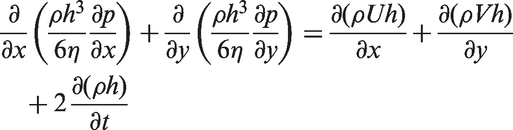
Furthermore, no axial motion of the ring relative to the piston within its retaining groove is assumed. In practice, the ring moves between the lower and upper groove lands during the piston cycle. Inclusion of this feature is only essential when gas flow analysis is considered, which is not the focus of the current analysis. Therefore, the sliding speed of the compression ring is taken to be that of the piston
13

For the axial x-direction of the contact, Reynolds (or Swift–Stieber)14,15 outlet boundary conditions are used, which determines the lubricant film rupture location. A fully flooded inlet is assumed. The boundary conditions become

Lubricant rheology
The lubricant viscosity and density are affected by temperature and pressure. For viscosity, the Roelands
16
equation is used, with the further development of the same by Houpert
17
yielding

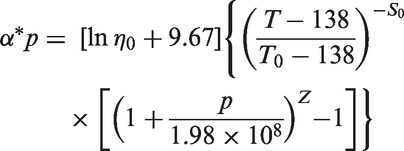
Values of Z and S0 are obtained as
17


Variations of lubricant density with pressure and temperature are obtained using the Dowson and Higginson equation
19
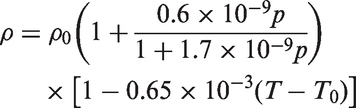
Conjunctional geometry
In the current study the compression ring is considered to be rigid, thus not undergoing its in-plane radial, as well as out-of-plane twisting deformation. A study including these features was carried out by Baker et al.9,10 The generated contact pressures are also insufficient to cause any localised contact deflection as shown by Bolander et al.
20
and Mishra et al.
21
Therefore, the lubricant film shape is a function of its instantaneous gap and the ring axial profile, hs as


Forces acting on the ring
Two outward forces act on the ring in its radial plane. These are the ring tension, Fe, and the gas force, Fg, which acts behind the inner rim of the ring (Figure 1). These forces strive to conform the ring to the cylinder liner surface, thus
Radially applied forces acting on the compression ring.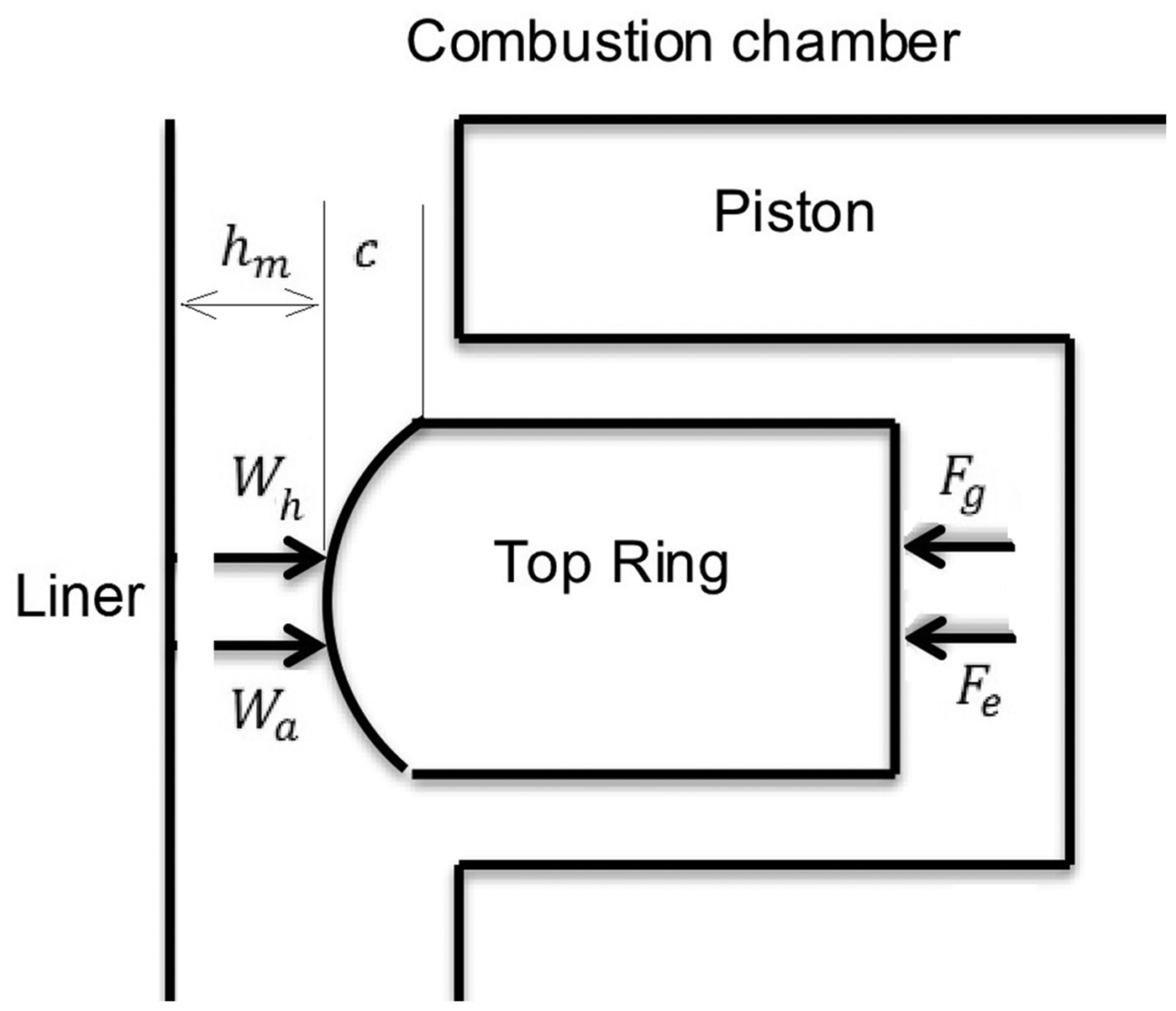


The ring tension force is

The elastic pressure is calculated using
22

For a ring with an assumed rectangular cross section

Rahmani et al. 22 considered an out-of-round cylinder where the compression ring only partially conforms to its surface in parts of the engine cycle. In the current analysis an idealised right circular cylinder is assumed, as in most studies reported in literature.
Transience of regime of lubrication
For parts of the engine cycle, particularly in the compression and power strokes at the piston dead centre reversals or in its immediate vicinity, analyses show prevalence of mixed or boundary regimes of lubrication.20–25 Under these conditions, the mechanisms underlying generation of friction comprise viscous shear of a thin lubricant film, as well as direct interaction of asperities on the contacting surfaces. In fact, Styles et al. 26 showed that most of the generated friction in an engine cycle from the compression ring conjunction occurs in the vicinity of the top dead centre in transition from the compression to the power stroke. This prediction was in line with the observations made by Akalin and Newaz 27 using a motorised test rig, based on an engine cylinder and by Gore et al. 28 using a single-cylinder engine under both motorised and fired operating conditions with direct measurement of friction using a floating liner. Therefore, inclusion of a boundary friction model is an essential part of any representative analysis.
The applied load by ring tension and gas pressure on the ring is supported by the hydrodynamic reaction and the load share of asperities on the opposing surfaces. The hydrodynamic reaction is obtained as

The load share of asperities is obtained using the Greenwood and Tripp11,12 model, which assumes a Gaussian distribution of asperity heights with an average asperity tip radius of curvature, κ

Therefore, the total load carried by the contact (contact reaction) is:
The use of Greenwood and Tripp11,12 model implies a roughness profile of fairly smooth surfaces adherent to an idealised Gaussian distribution. In practice, cylinder liner surface is cross-hatched and honed and thus the topography deviates from an ideal Gaussian distribution. The Greenwood and Tripp model should therefore be adopted with measured topography to obtain a surface-specific non-Gaussian model as highlighted by Leighton et al. 30 Therefore, the use of a Gaussian distribution in the current study is for experimentally measured run-in liner topography. 22
In the same manner, the total generated contact friction at any instant of time is

The boundary friction caused by the interaction of the opposing asperities is obtained as


The viscous friction is calculated as


Method of solution
Reynolds equation has been discretised using a finite difference central method. A point successive over-relaxation method is then used to obtain the generated pressure distribution.
32
The iterative process is made up of the following steps:
An initial guess for the minimum film thickness is made at each crank angle, ϕ. This is used in equation (9) to find the film shape. Using the film shape, a pressure distribution along the piston ring is calculated using the discretised Reynolds equation and lubricant rheological properties from equations (1), (4) and (6). Two convergence criteria must be satisfied. The first criterion is for pressures, which is deemed to be converged when

If the criterion is not met, then over relaxation is applied

The relaxation factor, γ, is determined by numerical testing. It was found that an over-relaxation factor of 1.4 yielded the fastest solution.
The second criterion is for load balance. The applied contact load, F, should equilibrate the contact reaction, W. Thus, at each crank angle
When both convergence criteria are met, the crank angle is advanced within the combustion cycle, which for a 4-stroke process comprises 720°.
where



Validation of methodology
Engine data.
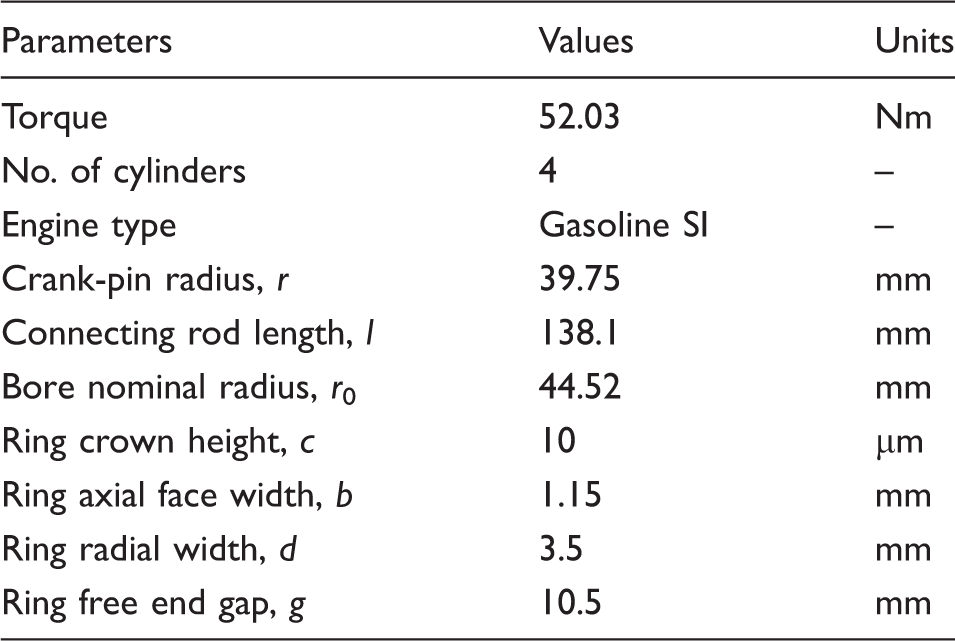
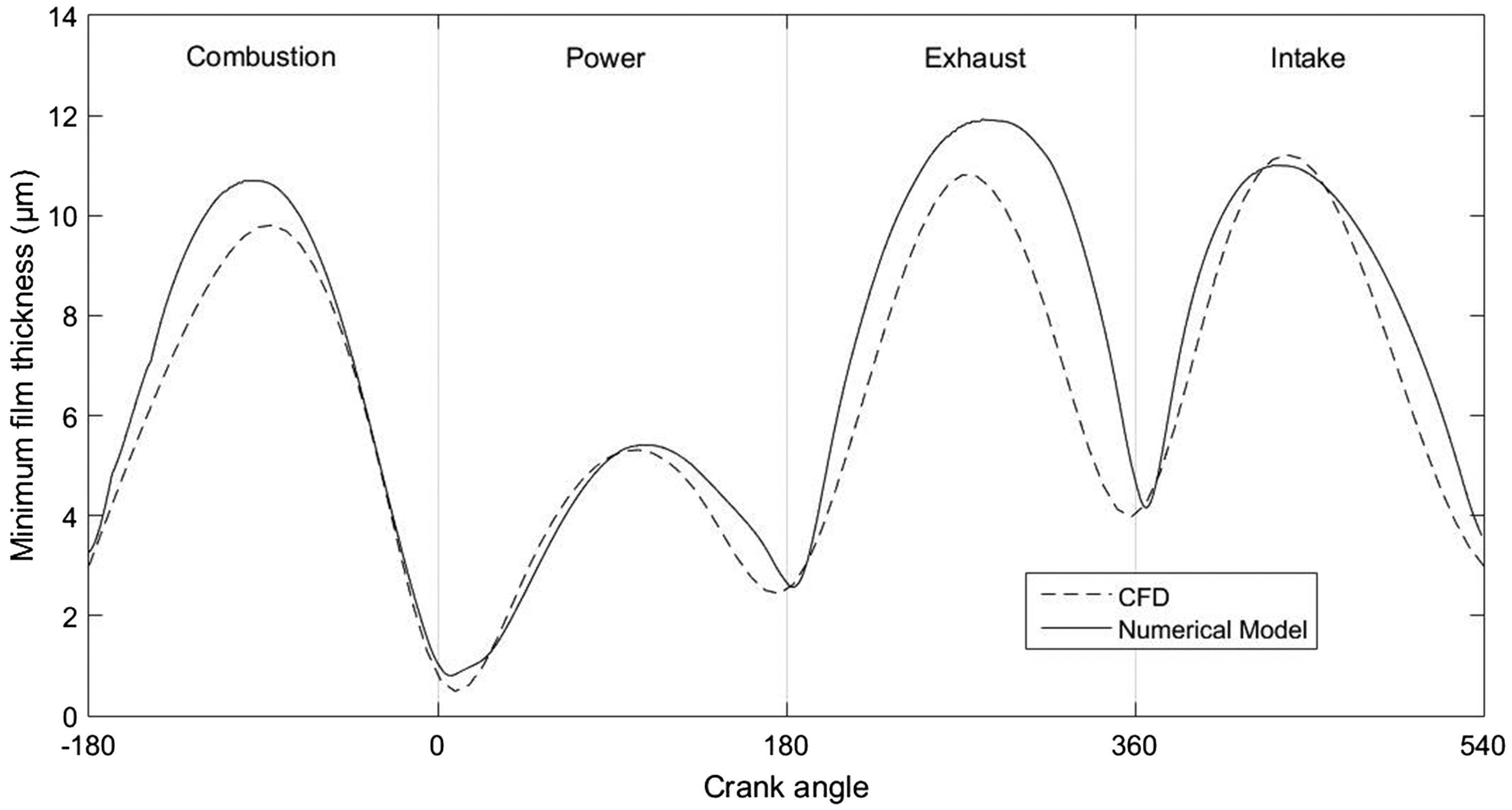
Results and discussion
Lubricant properties in atmospheric pressure.
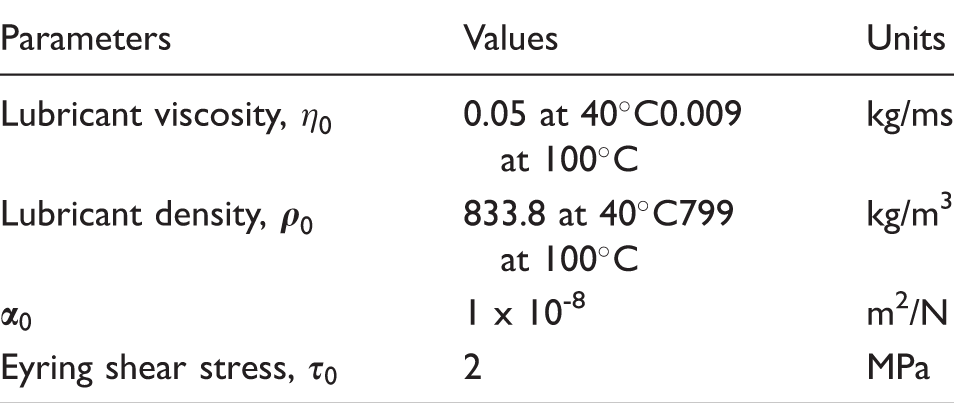
Material properties and surface topographical parameters.
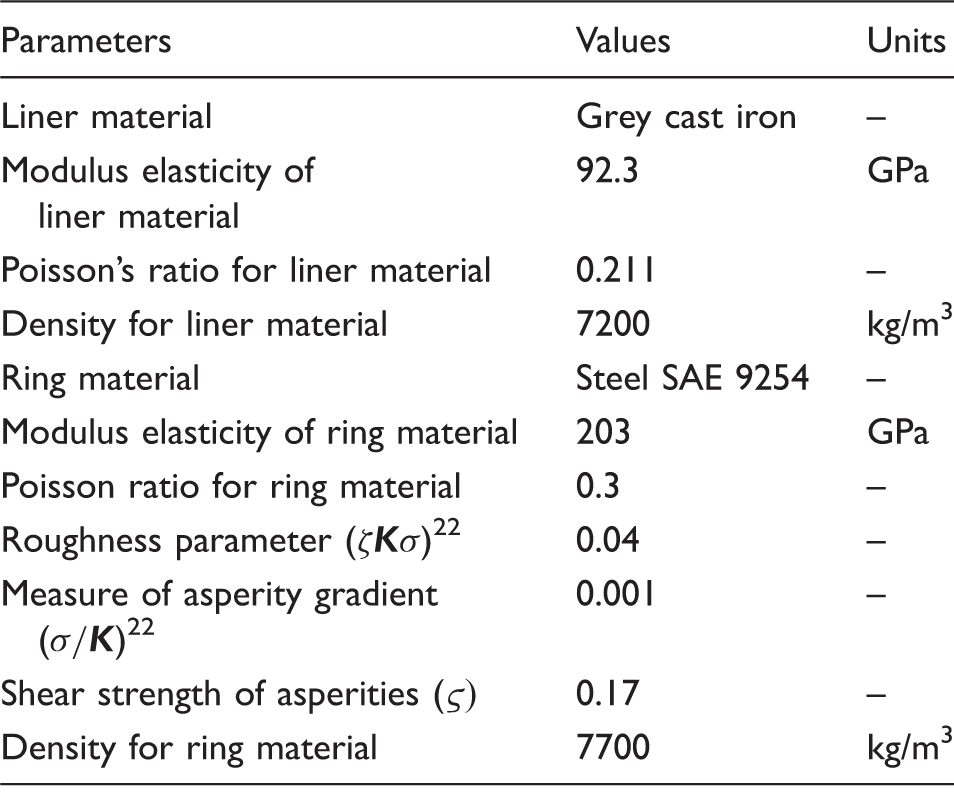
All topographical data in Rahmani et al. 22 were measured using white light interferometry with Alicona with measurement sensitivity of 1 nm normal to the surface and 0.175 µm in horizontal directions.
The results presented are for conditions which all cylinders remain active, delivering the required torque. Results are also presented for CDA with two active cylinders delivering the same output torque. Figure 2 shows the combustion pressure, Pc, throughout the engine cycle. Figure 3 shows the corresponding measured variation in the liner temperature. The results correspond to (i) all active cylinders, (ii) an active cylinder in an engine with CDA and (iii) a deactivated cylinder in an engine with CDA.
Combustion pressure.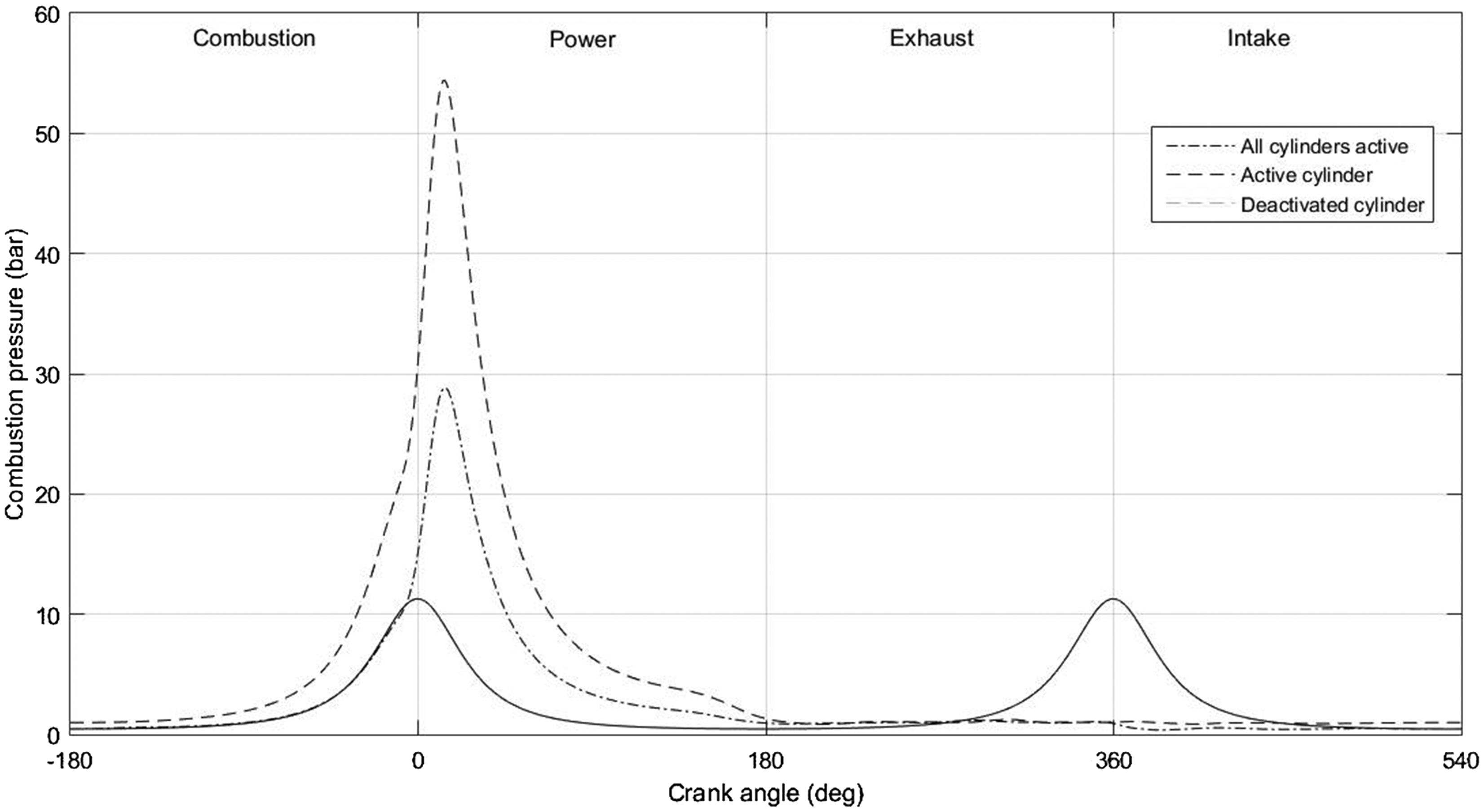
The results are for the predicted minimum film thickness and the total friction in the piston top compression ring-to-cylinder liner conjunction. Under CDA, a considerable increase in the combustion pressure is required in the active cylinders to allow for the delivery of the same engine power as that with all the cylinder remaining active. In order to achieve this, a higher rate of fuel injection is required, which may not essentially achieve improved fuel efficiency and reduce engine emissions with CDA.
The crank angle
Figure 4 shows the equivalent liner temperature for each mode of operation. This is required in order to update the lubricant viscosity with the instantaneous in situ temperature.
Liner temperature.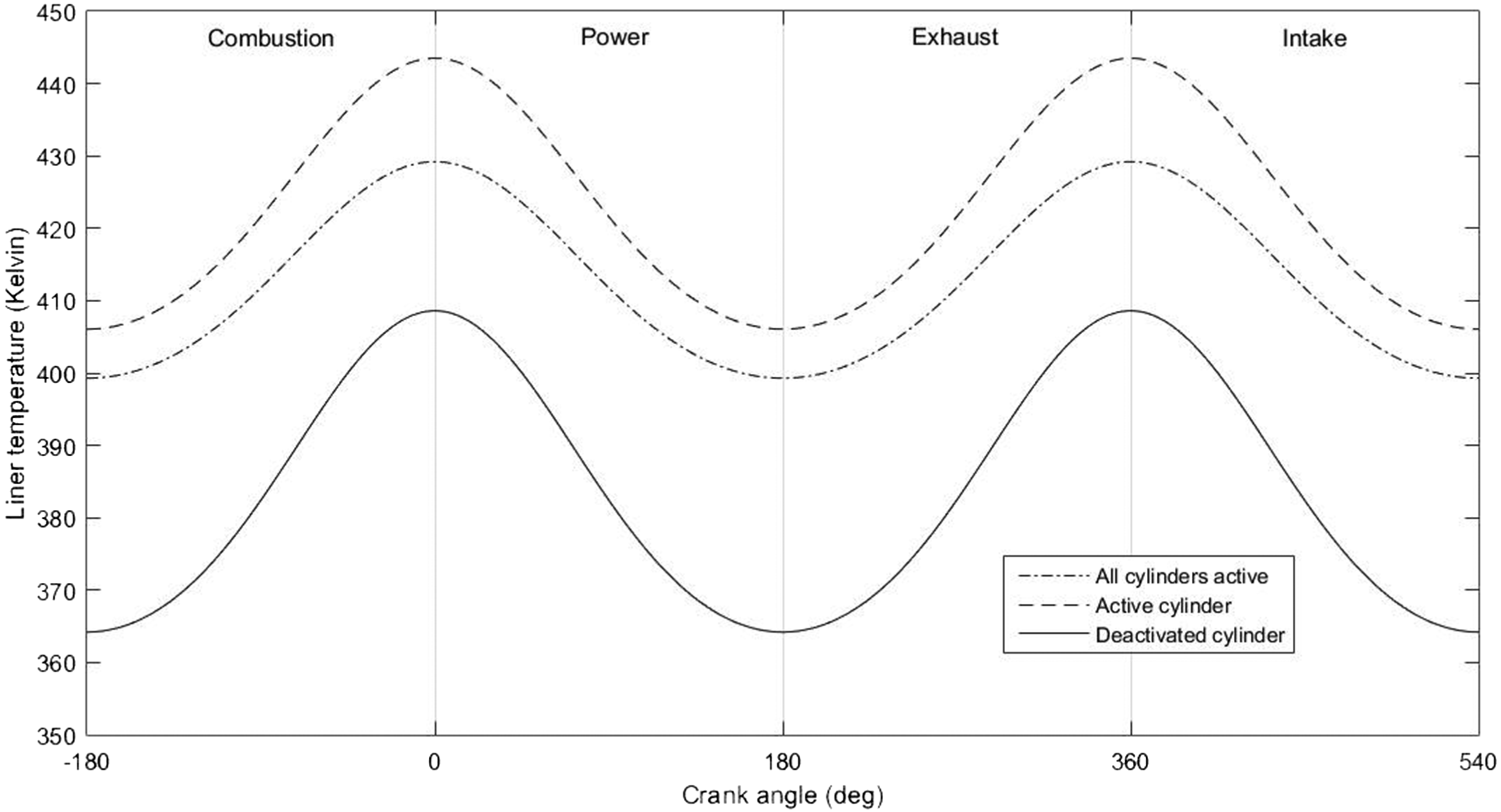
Figure 5 shows the minimum film thickness in the piston ring to cylinder liner conjunction during the engine cycle. It can be seen that at TDC ( Cyclic variation of minimum film thickness. Cyclic total friction.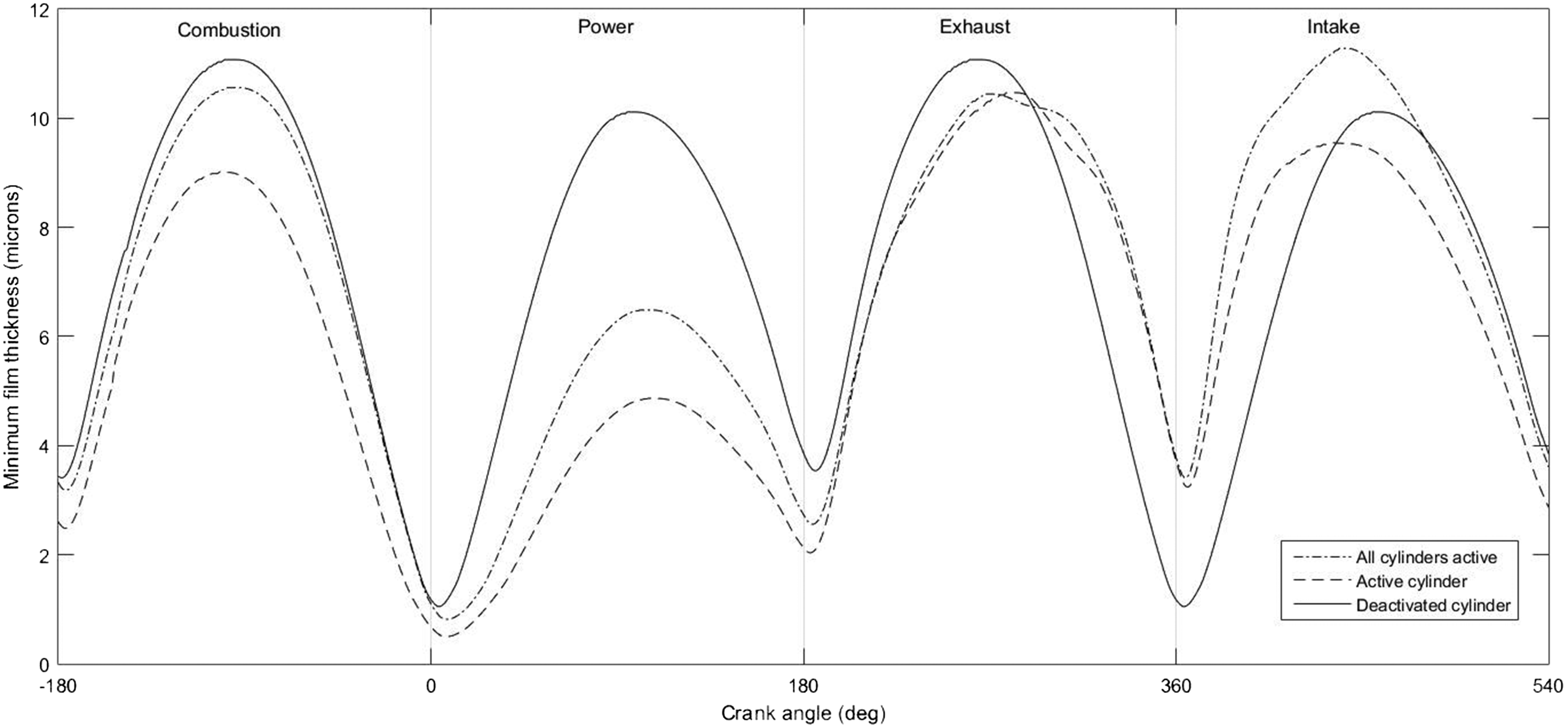
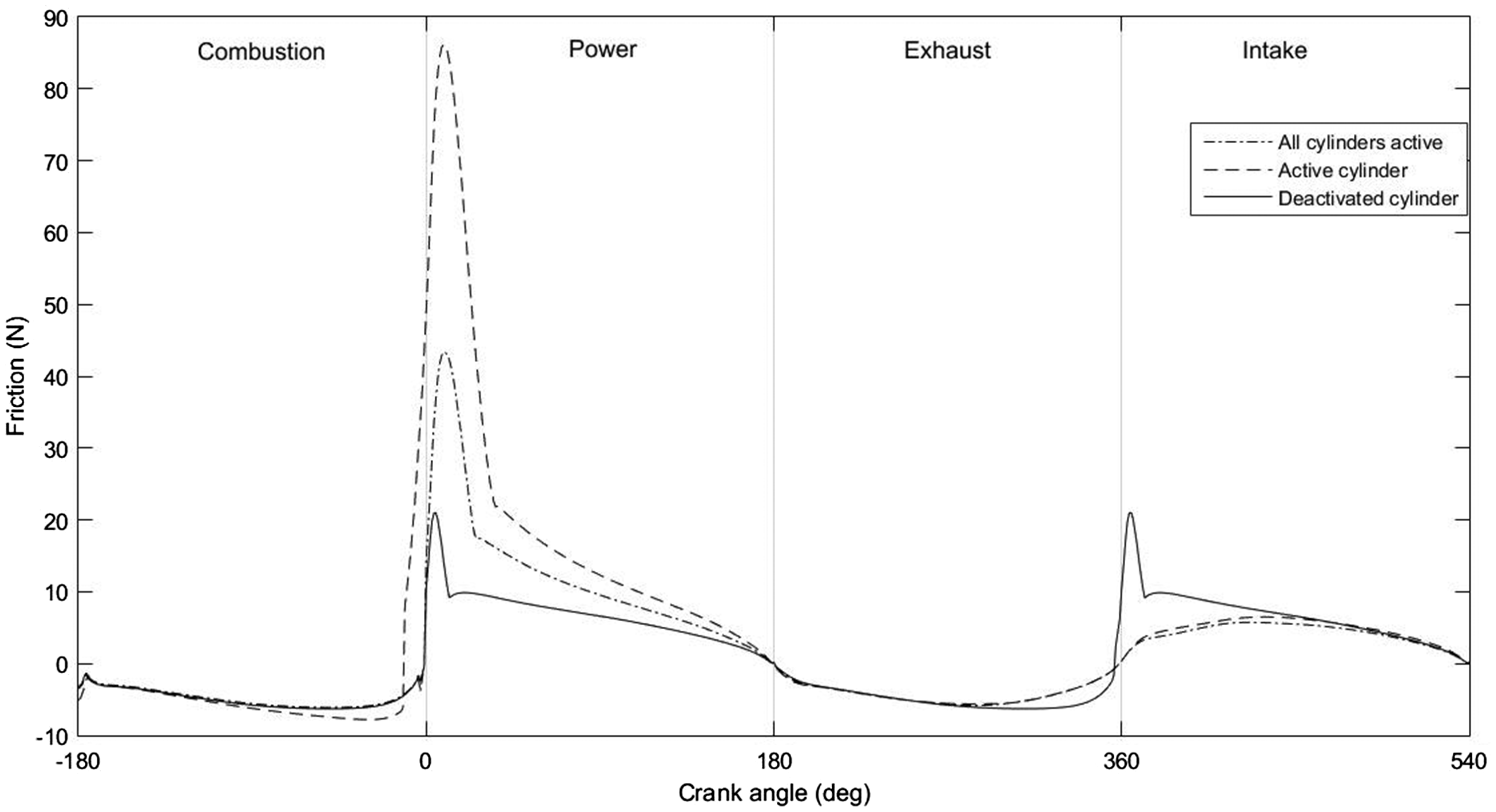
Analysing the results as a whole, it can be said that for multi-cylinder engines with CDA, frictional power losses are not necessarily reduced with the application of technology. The cause of this is the increased cylinder liner temperature in active cylinders at higher combustion (Figures 3 and 4).
In order to evaluate the effect of CDA on the overall efficiency of the system, the frictional power loss is calculated as

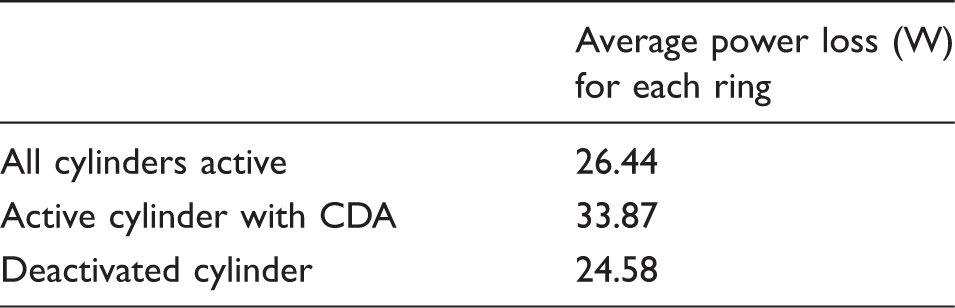
Figure 7 shows the frictional power loss of compression ring under different conditions. The magnitude of frictional losses follows the friction variations in Figure 6. Table 4 shows the average power loss of each ring during the whole combustion cycle. This is 105.76 W for the engine without CDA, 116.9 W when CDA is used with two cylinders active. This amounts to a 9.53% increase in the overall power loss of compression rings with CDA. Therefore, although CDA is progressively utilised to improve combustion efficiency and catalyst performance, it has consequences in terms of tribological performance and frictional power loss.
Frictional loss. Average frictional power loss of the compression ring.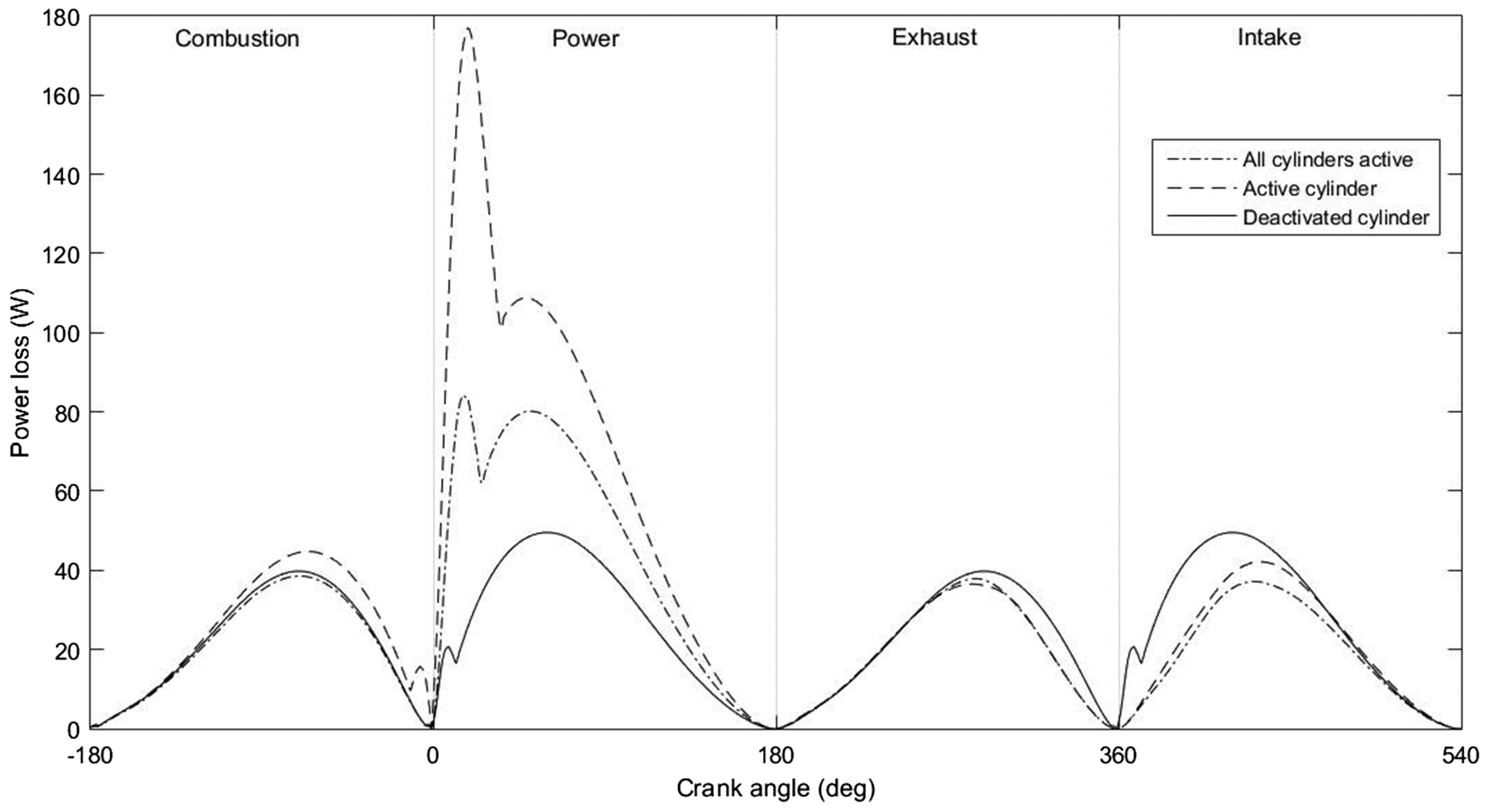
Concluding remarks
This paper presents the effect of CDA on the tribological performance of piston ring to cylinder liner conjunction. The analysis shows that CDA has a significant effect on the film thickness and frictional power losses for the active and deactivated cylinders. It is shown that the total frictional loss in an engine with CDA is 9.53% higher than that in a similar engine under normal operational mode. Although the effect of CDA on frictional losses is not negligible, it is small in comparison with the higher gains (10%) in fuel economy because of higher combustion efficiency identified by Douglas et al. 7 The results of this paper indicated that the tribological consequences of this new technology should also be considered.
Footnotes
Declaration of Conflicting Interests
The author(s) declared no potential conflicts of interest with respect to the research, authorship, and/or publication of this article.
Funding
The author(s) disclosed receipt of the following financial support for the research, authorship, and/or publication of this article: The authors would like to thank the Engineering and Physical Sciences Research Council (EPSRC) for their funding, under which this research has been carried out in collaboration with AVL List who have also provided technical support.