



Abstract
This essay examines the capture of scholarly communication by commercial publishers who have transformed into data analytics firms. We show how the consolidation of infrastructural, epistemic, and rhetorical control enables not only economic profiteering but also enacts symbolic violence: reshaping academic values, practices, and futures. Through opaque systems of surveillance, data extraction, and algorithmic governance, these firms increasingly dictate what counts as knowledge and success. We frame this transformation as a form of techno-colonization that threatens academic autonomy and integrity. In response, we call for active resistance—reclaiming scholarly agency, dismantling extractive infrastructures, and building alternative futures.
Keywords
Introduction
For many years, neo-liberal ideologies have dominated universities, imposing private sector management techniques such as accountability metrics, performance incentives, and competitive transparency that prioritize control over collegiate values (Prichard and Willmott, 1997; Willmott, 1995). This shift has led to an environment of individualism, hypercompetition and alienation (Clarke and Knights, 2015; Parker, 2014), resulting in devaluation of academic values and freedom.
In this context, major commercial academic publishers have developed parasitic business models that use monopolistic pricing practices (Harvie et al., 2012), and exploit academic labour while expanding their market dominance (Beverungen et al., 2012). A less examined but increasingly threatening development is their expanding influence over the technological infrastructure of academia. Once merely academic publishers, these commercial actors have evolved into powerful data analytics firms. Nowadays, a small oligopoly controls both the systems of research evaluation and the digital platforms that rule over academic communication and workflow. This enables them not only to monetize scholarly activity, but also to extract behavioral and institutional data across the research lifecycle. We conceptualize this development as a form of techno- and data-colonization (Couldry and Mejias, 2019, 2023; Mejias and Couldry, 2024) that is a reconfiguration of academic life through the commodification of scholarly practices and behavioral data. Notably, while we find the use of these constructs analytically useful, we avoid trivializing and equating the material effects and violences of colonialism. 1 These new forms of colonization do not operate through overt coercion but through symbolic means, embedding domination into the everyday tools, metrics, and routines of academia. This conversion of everyday academic life into a data stream has become a means of capitalist accumulation by dispossession reminding of the territorial conquest and exploitation of historical colonialism (Couldry and Mejias, 2019) as well as the enclosure movement (Jones and Murtola, 2012). What is emerging is not merely a regime of profiteering, but it is one of epistemic and institutional domination. Commercial publishers now shape what counts as research, how success is defined, and how scholars engage with knowledge itself. Algorithmic cultures and pervasive datafication subordinate values like autonomy, professional judgment, and criticality to rankings, metrics, and predictive analytics.
This essay traces the colonization of scholarly life by means of symbolic violence, and issues a call for resistance that is not only against extractive platforms, but against the epistemic and rhetorical controls that sustain their power. While we recognize that the unfolding of these trends varies across institutional types, disciplinary traditions, and national academic contexts, we show that this techno-centric approach promoted by commercial publishers tends to override these differences resulting in unifying and globalizing effects for institutions and regions historically positioned as peripheral.
Our engagement with these issues started prior to 2018, exploring the evolving strategies of commercial publishers and discussing their implications with librarians, editors, and academic communities. These conversations have revealed a growing sense of unease not only about monetization and control, but also about the quieter forms of violence embedded in everyday academic routines: the normalization of surveillance, the narrowing of academic judgment, and the subtle disciplining of research. Added to this is the concern that commercial publishers now promote a dominant leitbild—that is, an idealized model of research shaped by metrics, quantified control and market logics (Burrows, 2012), displacing more diverse and critical scholarly imaginaries. We gradually came to the realization that these are not just technical or infrastructural shifts, but profound transformations in how knowledge and research labour are governed, valued, and lived. These experiences have made visible the tension between critique and complicity that defines academic life today, and the urgent need to imagine alternative futures of scholarship grounded in care, solidarity, and collective resistance. This essay grows out of these engagements and dialogues, and out of a shared urgency to name, confront, and act against this deepening colonization of the academic commons.
Techno-colonization of academia: The rise of techno control
The history of scholarly publishing has long been marked by profit-driven models and systemic exploitation (Fyfe et al., 2017; Parker, 2023). This exploitative trajectory has only intensified with time as commercial publishers have embedded themselves more deeply into the inner workings of academia. A key aspect of these development was the emergence of what a 2005 Deutsche Bank report described as a “bizarre triple-pay” system—a model that capitalizes on publicly funded research while drawing on the unpaid labour of academics who serve as authors, reviewers and editors, while being paid by public universities. The same institutions that produce knowledge are then required to purchase access to it through costly subscriptions and article processing charges (APCs). This structural absurdity has persisted despite the optimism surrounding open access, open science movements and the proliferation of open repositories (Beverungen et al., 2012). Rather than diminishing the grip of commercial publishers, these developments have been absorbed into the dominant logic of accumulation, further increasing the market power and profit margins of these publishers. The “Big Five” academic publishers: Elsevier (2928 journals), Springer Nature (2920 journals), Taylor & Francis (2508 journals), Wiley (1607 journals), and Sage (1151 journals) form an oligopoly, which controls a substantial portion of scholarly communication (Fyfe et al., 2017).
Through a series of in-house developments and strategic acquisitions of platforms and services, these companies have consolidated their dominance, not only in terms of article processing but across the entire publishing life-cycle: from discovery and knowledge development right through to distribution and sharing journal outputs. 2
Acquiring and developing scholarly infrastructure
Over the past decade, the major commercial publishers have moved aggressively to acquire and develop a range of digital services that allow for vertical integration across the entire scholarly workflow including literature searches and data acquisition to analysis, writing, publication, and dissemination (see Figure 1), which has been referred to as the second digital transformation (Bergstrom et al., 2024). What initially appeared as a diversification strategy has in fact laid the groundwork for an extensive data extraction regime embedded within the infrastructures for scholarly communication. 3
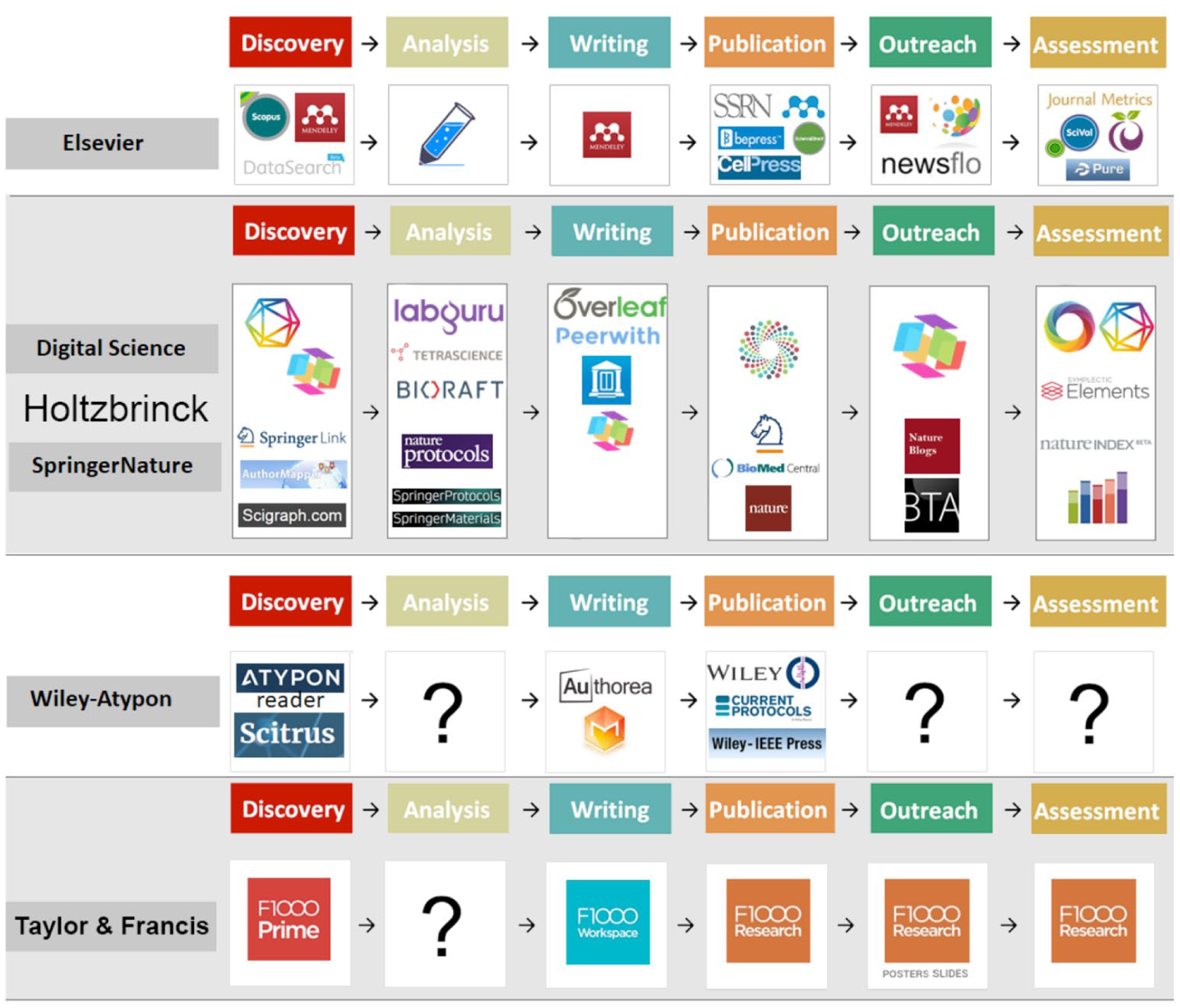
Providers of digital tools for scientific work (Reproduced from Bianca Kramer, Jeroen Bosman—https://101innovations.wordpress.com/workflows. Licenced under Creative Commons Attribution (CC BY)).
The expansion of digital infrastructure accelerated as publishers realized the substantial value of behavioral and institutional data generated through everyday academic activity. This realization catalyzed the construction of an expansive digital ecosystem, enabling publishers to monetize multiple dimensions of academic labour. At the core of this transformation lies a self-reinforcing cycle: (1) the exploitation of free academic labour, payments, content, data, and rights used to (2) build and maintain a research and publication infrastructure explicitly designed for extended data extraction, including uploads, behavioral surveillance, and granular tracking of user engagement, (3) continuing value extraction through data analytics (customer segmentation and diversification, new products and services), (4) producing globally comparable indicators and trackable metrics, integrated into national evaluation systems, (5) and feeding proprietary AI solutions such as Scopus AI and ScienceDirect AI.
This transformation is exemplified foremost by Elsevier, which is part of the RELX Group geared toward developing electronic decision tools (RELX Group, 2014: pp. 4–5), stands at the forefront of this shift and has rebranded itself as information analytics business. Elsevier has pursued a deliberate strategy of digitalization, diversification, and vertical integration. Over the span of just a few years, it acquired 29 firms. These acquisitions enabled Elsevier to assemble a comprehensive suite of digital tools that span the entire academic communication process. As shown in Figure 2, these include productivity platforms like ScienceDirect and Mendeley; bibliometric and altmetric tools such as PlumX and CiteScore; as well as analytics, decision support services, and research information systems (RIS) like Pure and SciVal targeted at the market segment of university management, funding organizations and governmental bodies.
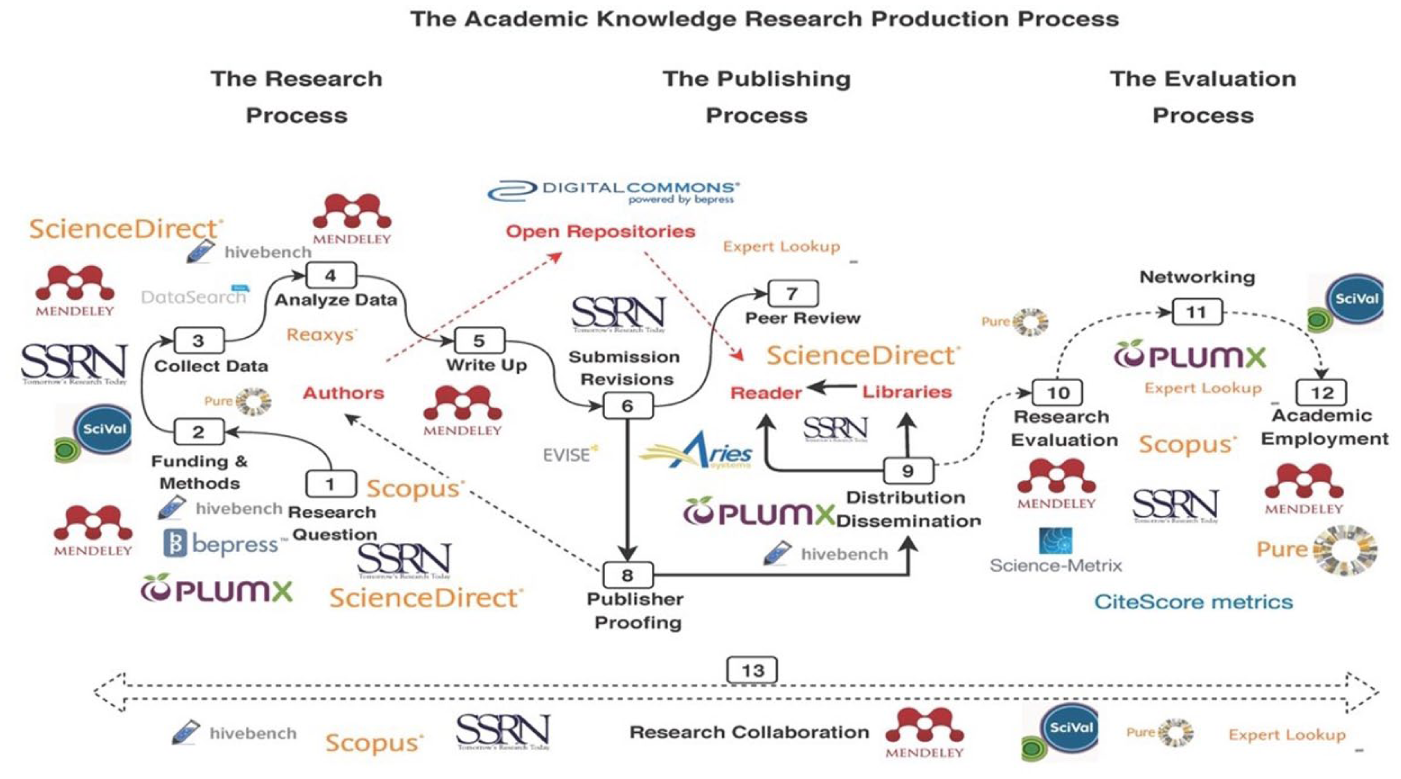
Elsevier presence throughout the research lifecycle (Reproduced from Chen et al., 2019 . Licensed under Creative Commons Attribution (CC BY)).
In the domains of scientometrics, bibliometrics, and research information systems (RIS), Elsevier (Scopus) and Clarivate (Web of Science) have become the two most influential commercial providers 4 of citation databases and analytics tools underpinning research evaluation worldwide. Clarivate, which describes itself as “a leading global provider of transformative intelligence” (Clarivate, n.d.), was established in 2016 following the acquisition of Thomson Reuters’ Intellectual Property & Science division. Since then, it has pursued an expansive acquisition strategy across the research workflow, purchasing Publons in 2017 to integrate peer-review analytics, and the reference-management startup Kopernio, rebranded as EndNote Click in 2018 (Clarivate, 2018). In 2020, Clarivate completed a $6.8 billion merger with CPA Global, consolidating intellectual-property data services (Clarivate, 2020), and in 2021, it finalized the $5.3 billion acquisition of ProQuest, expanding into library and discovery infrastructures (Clarivate, 2021).
Together, these moves represent not just corporate expansion but a strategic colonization of the research workflow, ranking and research assessment as well as research decision support. By embedding themselves within the very infrastructure of scholarly communication, these firms have secured unprecedented access to academic practices, outputs, and relationships, transforming research into a data resource to be mined, analyzed, and monetized. In the process, academic institutions have grown reliant on commercial actors whose primary accountability is not to the scholarly community, but to shareholders.
Appropriation and extraction
At the heart of academic techno-colonialism lies a Faustian bargain: academics are offered free access to digital productivity tools, but in return, they surrender a trove of behavioral and institutional data (Ngwenyama et al., 2024). These seemingly benign platforms, which assist with writing, reference management, data analysis, or publishing workflows, operate as data-extractive environments and epitomize what Pooley (2022) terms “surveillance publishing,” that is a regime of automated monitoring, tracking, and profiling that mirrors the practices of Big Tech firms like Google, Amazon, or Meta. Publishers routinely monitor article views, downloads, and citation patterns, extending this surveillance into the social sphere through altmetric indicators and engagement dashboards. Studies and policy reports have shown that such systems collect and process extensive metadata, including user logins, IP addresses, clickstreams, and search histories, which are subsequently used for recommendation engines, targeted advertisements, and institutional analytics (Deutsche Forschungsgemeinschaft [DFG], 2021; Fried, 2022).
These practices form part of a larger culture of opaque surveillance that threatens academic autonomy and privacy. For instance, the German Research Foundation (DFG, 2021) has raised concerns about the disproportionate and non-transparent collection of user data by academic publishers. Surveillance tools have been implemented at scale, without informed consent or institutional oversight. One particularly troubling example is Elsevier’s use of ThreatMetrix, which reportedly tracks user activity across 4.5 billion devices and fingerprints every downloaded PDF (Franceschi-Bicchierai, 2022). Springer Nature and Elsevier have also proposed the installation of spyware on university networks, allegedly to combat academic piracy and cybercrime. Such measures raise serious questions about surveillance creep and the erosion of digital rights (Lamdan, 2023). The extent of data collection is illustrated by the response to a researcher’s GDPR data subject access request, which contains over 700,000 rows of personal and behavioral data, including emails and phone numbers (Fried, 2022). The outcome of these surveillance practices is the production of highly datafied academic profiles where every reference, citation, search, and upload becomes accessible to commercial platforms. This is enabled by persistent digital identifiers such as the ORCID iD or metrics like the h-index, which integrate disparate actions into performance profiles that can be analyzed, ranked, and sold. One study of platformization argues that scholarly information is being decoupled from the normative agreement and instead co-determined by market or platform mechanisms (Ma, 2023), and thereby converted into data assets. Through this process, research outputs, researcher profiles, and institutional reputations are reconstituted as tradable data products governed by market-based logics of visibility and value extraction (Ma, 2023). This logic of platform capitalism transforms academic life into a continuous flow of behavioral data, rendering scholarly activity visible, measurable, and monetizable (Couldry and Mejias, 2019; Fyfe et al., 2017).
Monetization and exploitation
Commercial publishers have positioned themselves not only as stewards of scholarly content but as producers of “authentic” services, dashboards, and predictive systems that claim to offer authoritative insights into academic quality, relevance, and future potential.
One of the central monetization strategies involves the development and sale of data-driven products and services such as Journal Citation Reports or SciVal, which are marketed to support university governance. The methods behind such predictive analytics remain proprietary and opaque, e.g. Elsevier’s Fingerprint® Engine deploys machine learning to analyze an extensive array of data “signals” in order to assign weighted conceptual profiles to individual researchers (Pooley, 2023). According to RELX Group’s 2021 Annual Report (RELX, 2021), Elsevier’s research intelligence portfolio targeted at university leaders, R&D heads, funders, and policymakers, now accounts for over a third of its total revenue. Yet such tools are not neutral as they constitute mechanisms of epistemic governance that shape what is valued, made visible, and rewarded within academia. As Mills (2022, p. 486) observes, these infrastructures “transform and aggregate complex data into globally comparable indicators,” thereby embedding commercial metrics within state and institutional evaluation systems and reinforcing epistemic coloniality across the global academy.
Monetization extends further into ethically fraught territory. Publishers have been implicated in the direct sale of personal data to third parties often without the knowledge or consent of academic users. For instance, Thomson Reuters (part of Clarivate since 2016) and RELX (parent of LexisNexis and Elsevier) have reportedly provided data to U.S. Immigration and Customs Enforcement (ICE), contributing to surveillance practices that have supported the detention and deportation of hundreds of thousands of immigrants (Pooley, 2022). As Lamdan (2023) documents, RELX and Thomson Reuters market data analytics products such as LexisNexis Risk Solutions and CLEAR, which rely on the same infrastructures that underpin their scholarly platforms, illustrating how data gathered from academic ecosystems can intersect with state surveillance and policing. This reveals the porous boundary between academic datafication and wider surveillance capitalism, where the informational residues of research are treated as monetizable assets irrespective of privacy commitments.
The latest frontier in this extractive logic is the deployment of artificial intelligence that is used not only to analyze scholarly work data but to generate it. The introduction of Scopus AI in 2024 exemplifies the move toward algorithmically mediated research production, as Elsevier now markets systems capable of summarizing, synthesizing, and predicting research trends. 5 AI-generated peer reviews, impact assessments, and even full research articles are no longer speculative. For instance, a new preprint server aiXiv has gone live in 2025, whcih accepts AI-generated papers and has a complex AI-driven review system and architecture. Infrastructures now move beyond supporting academic labour to replicating and replacing it (Elsevier and Ipsos MORI, 2019), extending the reach of what Birhane (2020) terms “algorithmic colonization” within global academia.
The perils of data coloniality: From autonomy to automation
What lies beneath the infrastructural capture of academia is not merely profiteering but a reconfiguration of authority, autonomy, and epistemic legitimacy. The transformation of publishers into data analytics firms has extended their reach far beyond content provision, allowing them to shape how academic value and legitimacy are defined. As Posada and Chen (2018) note, the vertical integration of publishing, analytics, and research management systems enables corporations like Elsevier to govern the entire research lifecycle. This shift from owning content to owning infrastructures grants private firms the capacity to steer knowledge production itself (Fyfe et al., 2017). In this sense, the accumulation of infrastructural power across data, metrics, and evaluation systems has moved commercial publishers from the margins of academia to its institutional core, where they now exercise diverse forms of control over scholarly life.
Infrastructural control over authority
Commercial publishers increasingly shape core academic decisions that span from hiring and promotion to research evaluation and collaboration. This is particularly visible in Elsevier’s “Research Intelligence” case studies, where tools like SciVal and Scopus are presented not as sources of passive analytics but as infrastructures of authority that guide, normalize and standardize institutional decision-making. For instance, one case study explains how SciVal can help universities determine “who to hire to gain the most impact,” applying benchmarking, scenario modeling, and predictive analytics when deciding “who to recruit and who to retain” (Elsevier, 2019: p. 4). Another notes that these tools can help identify collaborators, noting that researchers are “becoming more strategic about making connections rather than relying on ad hoc meetings at conference,” arguing that “collaborations with more diverse partners will lead to higher citation rates” (Elsevier, 2019: p. 4). These tools therefore operate as algorithmic mediators of academic judgment, recasting decisions about hiring, funding, and collaboration through datafied projections of value. As Burrows (2012) notes such metrics infrastructures promote a managerial rationality that replaces scholarly deliberation with quantified governance. Success, once grounded in disciplinary expertise or intellectual contribution, becomes measurable primarily through algorithmic ranking and citation optimization. Through these infrastructures, authority is not merely exercised but technologically re-configured.
Epistemic control and algorithmic visibility
Publishers do not simply distribute knowledge, but they now shape it, filter it, and increasingly automate its production. Platforms like ScienceDirect AI, Scopus, Scopus AI and Pure Impact AI operate not just as repositories but as epistemic engines that structure visibility and legitimacy through algorithmic classification, citation analytics, and predictive modeling, thereby sustaining the current dynamics of indicator games (Fochler and De Rijcke, 2017). This constitutes a new regime of knowledge production that prioritizes data processing through advanced statistics and prediction models where the dominant discourses revolve around the growing importance of big data and machine learning. This system operates within a broader, post-positivist data-driven epistemology grounded in three interlinked assumptions: (1) data reflects reality, (2) data analysis produces the most accurate knowledge, and (3) algorithmic predictions improve decision-making across domains (Ricaurte, 2019: p. 350). Such assumptions support what Gray (2023, p. 9) calls a form of “epistemic violence” —that is, a colonial logic that prioritizes what is quantifiable, and makes invisible other ways of knowing, particularly those rooted in non-Western epistemic cultures (Birhane, 2020). In practice this means epistemic legitimacy is redefined around what can be measured, ranked, and sold. Relying on “trusted content, comprehensive data” (as argued by Elsevier, 2024) also means further marginalizing non-Western, non-English, and non-quantitative contributions (Gray, 2023). This marginalization is not abstract as it plays out through concrete global mechanisms. For instance, a report from the Publisher for Development conference points out how Southern research was framed as lacking credibility and needing to follow the Western path of techno-centric modernization (OCSDNET, 2017). Initiatives like Research4life, while positioned as philanthropic, enable publishers to access institutions in the Global South, gather market intelligence, and expand platform-based influence. Similarly, publisher-led librarian training embeds proprietary systems and extends control over local knowledge infrastructures (OCSDNET, 2017).
Rhetorical control and narrative capture
Beyond managing platforms and infrastructures, publishers increasingly position themselves as authoritative voices shaping the future of academia. In white papers and foresight reports such as The Future of Research (Elsevier, 2022, 2024; Elsevier and Ipsos MORI, 2019), they portray themselves not merely as service providers, but as visionaries and stewards of higher education. Scenarios such as “Tech Titans” in the Research Futures report project a world in which technology companies and commercial publishers increasingly govern research priorities, redefine academic workflows, and delegate human judgment to algorithmic systems (Elsevier and Ipsos MORI, 2019: pp. 16–17). Further evidence of this shift is visible in Elsevier’s launch of Scopus AI, which promises to “transform the research workflow . . . helping scientists move faster . . . synthesize literature rapidly, connect with collaborators and accelerate productivity” (Elsevier, 2025). These developments mark a transition not merely from knowledge dissemination to value-extraction, but also from academic judgment to epistemic governance.
Their discursive power is further reinforced by a strategic appropriation of critical discourses, where critique becomes opportunity, and systemic extraction is reframed as innovation Claims to support goals like Open Science and the UN Sustainable Development Goals often conceal the expansion of proprietary control. As OCSDNET (2017) argues, many of these initiatives work against the idea of a knowledge commons, favoring centralized infrastructures over pluralistic and community-led knowledge systems. Even the Open Access movement, once envisioned as a democratizing force, has been co-opted by commercial publishers to serve new revenue models through Article Processing Charges and hybrid publishing (Chan et al., 2019). These developments illustrate how rhetorical control operates through hyperbole, selective transparency, and the repackaging of enclosure as progress while undermining both genuine openness and academic sovereignty (OCSDNET, 2017).
From control to colonization: Automated symbolic violence
Taken together, these forms of control over authority, narrative and epistemic legitimacy culminate in what Bourdieu, 1990; Bourdieu and Thompson, 1991) described as symbolic action i.e. a subtle, yet powerful mechanism of domination through which power becomes normalized, and embedded in systems of classification, quantification, and algorithmic evaluation. In this context, symbolic violence manifests when scholars begin to accept citation counts, h-indexes, and dashboards as natural indicators of worth, and when dissenting values such as care, depth or slowness are branded as inefficiencies. The result is not just change in practice, but also transformation of academic values and identities (Burrows, 2012; Fochler and De Rijcke, 2017). Scholars further re-enforce their identities as “microentrepreneurs of the self” through strategizing visibility, optimizing and gamifying metrics (Butler and Spoelstra, 2024; Hall, 2016), enforcing conformity and diluting the role of critical scholarship (Clarke and Knights, 2015). Originality and critical inquiry is displaced by calculable impact (Lamdan, 2023) and judged according to position within research rankings (Chubb et al., 2021). At the same time, teaching and community work have become sidelined.
Algorithmic systems now extend this symbolic violence through automation. Tools like Scopus AI blur the lines between human and machine judgment, offering citation patterns, AI-generated summaries and reviews and even “intelligent” research suggestions on emerging themes, (e.g. Scopus AI, ScienceDirect AI, Wiley’s Integrity Intelligence, and Nature’s in-house tools). These systems do not merely support decision-making, but they replace it. In this context, epistemic automation becomes epistemic authority. These commercial publishers no longer just evaluate research, but they begin to produce it, and in doing so they re-cast scholarship itself as a problem of AI augmentation and eventually substitution. This automation does not correct inequities but encodes them where gender, race and institutional reputation remain embedded in the training data of these systems leading to scaling bias (Lamdan, 2023). As a result, this is not just automation, but an automated symbolic violence, a case where academic work is stripped of its values, sociality and critical vision and replaced by AI-generated content, dashboards and predictions. 6
Decolonializing academic commons: A call to act-up
From complicity to practicing ethical solidarity
To decolonize the academic commons is not to imagine a position outside the system but to act from within it. We are all entangled in the infrastructures we critique including publishing in extractive journals, complying with evaluation metrics, and internalizing the language of excellence and impact. Yet complicity need not condemn us to silence. As Bourdieu and Wacquant (1992, p. 167) remind us, symbolic violence depends on misrecognition as domination endures when it is no longer seen as such. Resistance therefore begins with recognition of how our own actions sustain what we oppose. The current regime operates precisely through such misrecognition and encourages unconscious acceptance of metrics as neutral, normalize inequality as natural, and turns reputational insecurity into self-discipline. To follow Ahmed (2017), our task should be not to smooth things over but to be the “killjoy,” which means to make symbolic violence visible, and thus open it to critique and contestation.
For us, ethical solidarity speaks to this work of recognition and response. It is not about moral purity but about reflexive engagement and about acting critically and compassionately in a system that rewards conformity and punishes dissent. Ethical solidarity asks how we might turn our involvement into a resource for care and how we might live with contradiction without surrendering to it. Our own experience captures the tension of acting within complicity. One of us was invited to serve as senior editor, an invitation that initially felt like a possibility to contribute to the scholarly community. Yet the Elsevier’s “work-for-hire” contract and requirement that all communication occur through its proprietary platform conflicted with the independence and collegiality valued in editorial work. The co-author refused the fee and used institutional channels for correspondence instead, practicing small gestures of maintaining autonomy within such constraints. The turning point came when his university canceled its Elsevier subscription amid a national standoff over open-access negotiations. Overnight, the sense of service that justified participation collapsed. What he had framed as a strategic compromise, serving his scholarly community, revealed itself as complicity. He stepped down out of a need to realign with the community meant to serve. In retrospect, we see this as a moment of ethical solidarity, involving a refusal to normalize coercion and an attempt to act otherwise while still inside the system that enables it.
Such moments point toward an academic agency that is neither heroic nor individual, but interdependent and situated. It emerges in the small spaces between compliance and refusal, where scholars use their positions to open cracks in the system rather than to reinforce it. Yet the responsibility for cultivating such spaces cannot fall equally on everyone. Senior scholars, editors and established academics must carry a particular obligation to act with foresight and care. Freed, at least in part, from the career anxieties that discipline early-career researchers, they can mobilize their institutional capital to advocate for open review, to challenge metric-driven policies, or to mentor early-career researchers in valuing care over citation. Their role should not be simply administrative but moral to model ethical courage, to make visible that integrity can coexist with ambition, and to embody the values they wish to protect. These gestures may appear modest, yet they trace the contours of a longer horizon of academic life. They can remind us that to be in academia is not merely to survive within its metrics, but to sustain its deeper values of curiosity, critique, and collective care. Those with greater security have to bear a particular responsibility to enact this horizon in practice and to show where compromise is possible and where integrity demands refusal, to anticipate the long-term consequences of infrastructural change, and to protect the fragile conditions that make scholarly life possible. Acting up, in this sense, is less about standing apart than about standing with, transforming complicity into collective responsibility, and constraint into a space of renewal and shared possibility.
From critique to collective resistance
Shared possibility begins with collective refusal and the courage to say no while building alternatives together. The future of academic life will be decided not by ideas alone but by the political economy of data infrastructures that now mediate research, publication, and evaluation. If we are serious about decolonization, we must confront not only the extractive platforms that structure our workflows but also the epistemic and affective rationalities they cultivate. As Couldry and Mejias (2023, p. 798) remind us, struggles against data colonialism must always be double, involving struggles both over particular practices of technology and over the knowledge systems and values that justify their dominance. This resistance requires multiple intersecting strategies:
Practicing data activism and ethical solidarity
Decolonizing academia also means reclaiming data agency. From privacy breaches to unauthorized commercial use, scholars must begin to view their data not as a passive byproduct but as a political asset. Data activism, both reactive and proactive, is key to building resistance and solidarity:
- Refusing to participate in predatory platforms or ranking schemes.
- Demanding transparency via data rights—utilize GDPR Data Subject Access Requests to uncover how data is collected and sold.
- Supporting coalitions that advocate for technological sovereignty and collective ownership of knowledge infrastructures. One particularly notable initiative is the Radical Open Access Collective, 7 which challenges the commercial publishing model by promoting non-commercial, commons-based alternatives for scholarly communication. Rather than focusing on centralized platforms, APCs, or business models, the collective emphasizes rethinking the material practices and social relations of publishing itself. Other examples include the Non-Aligned Technologies Movement (NATM) 8 and the growing field of data justice activism (Milan et al., 2016), both of which seek to democratize technological development and resist extractive models.
Rethinking metrics and rankings
We must begin by abolishing the epistemic authority of rankings and proprietary metrics. As Mills (2022) and Zembylas (2024) argue, the decolonial challenge is not just to disassemble current infrastructures but to imagine inclusive alternatives. This can be done by:
- Developing regional citation indexes and repositories that reflect epistemic pluralism, not just bibliometric dominance. For instance, SciELO 9 has created a successful South-South model of scholarly publishing grounded in public values.
- Supporting infrastructures of bibliodiversity—multilingual, regionally grounded, and socially engaged scholarship. Initiatives like Redalyc 10 reject impact factors, promoting community-based evaluation systems.
- Embracing the concept of the “pluriverse” (Reiter, 2018), recognizing multiple knowledge systems and methodologies, including indigenous and feminist epistemologies.
Reclaiming technological infrastructure
As long as academic knowledge circulates through privately owned, extractive platforms, it remains colonized. The solution is not withdrawal alone, but reconstruction. This means:
- Support non-commercial, community-owned platforms like CODESRIA 11 or Global Africa, 12 which demonstrate regional knowledge ecosystems grounded in public mission (Dobusch and Heimstädt, 2024).
- Advocating for national and institutional investment in open-source platforms and democratic infrastructure governance. 13 Models such as OpenAIRE 14 in Europe suggest scalable, publicly supported alternatives, but much more is needed to break oligopolistic control. 15
- Establishing enforceable accountability frameworks, similar to the Digital Markets Act or the EU AI Act, to limit exploitation and mandate transparency.
Decolonizing academia is not about restoring a golden past, nor simply resisting the present. It is about reclaiming the capacity to imagine otherwise and to reassert knowledge as a public good and intellectual life as rooted in care, solidarity, and collective vision. While the structural grip of commercial publishers is tightening, hope exists. Alongside negative developments, counter-movements have emerged—sometimes fragile, sometimes fragmented, and at times supported by illicit or informal practices of shadow libraries and preprint servers (Dobusch and Heimstädt, 2024). Decentralized scholarly communities such as the Radical Open Access Collective demonstrate that a future grounded in non-commercial, scholar-led publishing is not only imaginable but already in motion. We need spaces of critical cosmopolitanism (Mignolo, 2005), where openness is not commodified as a market virtue but pursued as a political and ethical struggle for justice (Burrows, 2012). Such spaces depend on scholars who refuse the comfort of neutrality and act instead as guardians of plurality and care. Decolonizing academia, then, is not only a structural or epistemic project, but is a lived, intergenerational ethic of responsibility that entails learning to resist with integrity, to mentor through example, and to imagine the university as a shared commons, grounded in care, solidarity and critical engagement.
Manifesto for reclaiming academic futures
The problem is clear: our knowledge, labour, and futures have been colonized. The infrastructures we use to write, publish, teach, and think are no longer ours. They belong to those who trade in metrics, who mine our behaviors, who rewrite academic value in the name of extraction, efficiency and profit. We are not just living under techno- and data-control—we are feeding it.
Practice epistemic insubordination
Write in your language. Think with your people. Value care over citations, justice over metrics, imagination over prestige.
Reclaim knowledge infrastructures
Build, support, and maintain open, community-governed platforms for research, publishing, research assessment and data sharing. Fund them. Fight for them.
Boycott extractive platforms
Refuse to publish, review, edit, 16 cite for extractive monopolies. Reject metrics as the currency of value and reclaim scholarship as a practice of meaning, not measurement.17,18
Divest from ranking systems
Lobby your university to withdraw from THE, QS, and other global ranking regimes. 19 These are tools of epistemic control, not excellence.
Expose the symbolic violence
Make visible the surveillance, algorithmic bias, and dispossession embedded in academic tools and platforms. Name the complicity of institutions. Publish with an eye to what you make possible, and what you make impossible.
Imagine otherwise
Move beyond critique and cultivate counter-worlds. Reclaim the capacity to envision academic life on different terms, rooted in solidarity, plurality, and collective care.
Be the killjoy
Disrupt convenience. Challenge professional comfort. Interrupt the machinery of metrics, rankings, and automation. Refuse neutrality when it masks complicity.
Footnotes
Acknowledgements
We thank the Associate Editor and three anonymous reviewers for their careful engagement and reflective comments, which helped sharpen and improve the ideas developed in this paper. We are also grateful to Donncha Kavanagh for his insightful feedback on earlier versions of the manuscript.
Funding
The authors received no financial support for the research, authorship, and/or publication of this article.
