




Abstract
Writing and publishing are critical components of an academic career. For many years however, my idealized notions of scholarly writing were demolished by painful and traumatic attempts to publish. The significant time and effort poured into crafting an academic article yielded desk rejection after desk rejection, at times unkind and unhelpful reviews, and a growing pile of unsent manuscripts gathering cyber dust in deliberately forgotten archived folders. I was both astounded and relieved at the discovery that I was not alone in my frustration. So, I turned my academic publishing failure into a subject of research. In this essay, I reflect on what it means to be a scholar and share the lessons I learned about the common blind spots that often lead to a failure to publish. Using management education scholarship as an example, I break down my writing process into stages, identify pitfalls at each stage, and describe the writing guardrails I put in place to keep my academic manuscript drafts on track. I share these lessons not from a place of exceptional success but from a place of failure, recognizing that lessons from many unsuccessful attempts offer equally important insights into what it means to succeed.
Research is formalized curiosity.
It is poking and prying with a purpose.
Perishing
Publish or perish, they say. The threat of death to my academic career is often unbearable. If writing is hard, then academic publishing is harder. The process feels punctuated by instruments of torture. After completing my PhD, I managed to publish a few pieces, but I mostly failed. The worst part of it all was that I could not understand what made some of my work “good” and what made most of it “bad.” In a publish-or-perish world, I was perishing in the dark.
The pressure to publish intensified as the number of manuscripts in my “rejected-multiple-times-and-needing-major-rework-from-scratch” pile rapidly grew. My failure was not for lack of trying or for refusal to seek guidance. I invested considerable time in writing manuscripts (alone and with collaborators). I thought the papers were robust, but they never seemed to get anywhere. The advice that I received from well-meaning colleagues was good but did not succeed in making me feel any less lost. For example, the advice “to have a good hook” left me asking, “So, what is a ‘good’ hook?”. To this, the inevitable response was, “Well, it depends on what you want to say.” The circularity of the advice was maddening.
I was astonished and quietly relieved to find that there were many others floating around aimlessly with me in the same boat (but in my case, it was more akin to furiously paddling around in circles in a leaky boat). With my confidence at an all-time low, I found myself questioning my ability to succeed as a scholar. More fundamentally, I began questioning if my motivations for pursuing a scholarly career were based on seriously flawed assumptions. Did I completely misunderstand what it meant to be a scholar?
I was faced with the prospect of sinking. Fast. But the depths of my frustration and desperation led me to do what my PhD taught me to: research and find explanations for my failure.
I searched a wide range of academic and non-academic literatures for advice on writing and publishing, attended different workshops on writing, research methods and paper development, and participated in as many meet-the-editors sessions as I could. I eventually found a wealth of material that helped me rediscover my purpose, shed light on my blind spots, and chart practical ways forward.
This paper consolidates what I learned from these and from my own experience as an associate editor of a teaching and learning journal. As associate editor, I was given the opportunity to view manuscripts and the publishing process “from the other side.” I now better appreciate how we all need someone to walk the writing road with us, to carry a torch to help us see, and to converse with us to help us find our voice.
I crystallize my notes and share them here not as the watertight prescription for academic publishing success. I continue to fail, and I have not met an academic with a 100% success rate. Rather, my intentions are to assure others that there are ways to patch up that leaky boat and that we are not alone in those dark and desperate times.
(Re)searching Purpose
The first step I took to find my way was to revisit my inspiration for pursuing an academic career. I wanted to reconnect with “The Academy” and rediscover its essence. I hoped to reignite what intuitively drew me to scholarly life. Harnessing my keenness for history, I began my (re)search for purpose at the beginning.
Beginnings
The beginnings of the Academy reminded me that academic life ultimately traces its philosophical roots to the ancient Academy of Plato (Baltes, 1993). While the ancient Academy simply denoted a place, the people and activities in the place became more strongly associated with it. The “Academy” thus eventually came to refer to a community of people who devoted their lives to satisfying their curiosity about the world. They defined problems (research questions), devised ways to understand them (research designs), and so gained insights on how to live in the world. In contrast to the common conception of Plato as teacher surrounded by students learning at his feet, Plato’s Academy was in fact a community discovering the world together (Baltes, 1993).
Knowledge Creation
Revisiting the ancient Academy reminded me of why I chose to become a scholar: I too was curious about the world and was driven by the rush of discovery. Being a scholar was all about knowledge creation. I drew renewed inspiration from this reconnection. In so doing, I stopped my leaky boat from sinking, rediscovered my purpose and recalibrated my direction.
It struck me to see how the ancient Academy’s approach to the search for truth echoes in contemporary theories of knowledge. For example, Nonaka and Toyama (2003) propose that knowledge is created in a virtuous spiral (Figure 1) composed of four sequential phases (socialization, externalization, combination, and internalization or SECI):
Socialization. Knowledge creation begins when people gain insights about the world as they go about their day-to-day lives. This insight is not articulated but permeates practice through shared experiences.
Externalization. When tacit knowledge is articulated, it is transformed into explicit knowledge. This externalization allows people to formally share and discuss their insights with others. It brings to light any contradictory insights and creates opportunities for dialog.
Combination. As agreements and contradictions are uncovered, individuals and groups work together to resolve them by combining and synthesizing knowledge. This results in a deeper and richer understanding of the world.
Internalization. Synthesized knowledge subsequently informs changes to practice and is eventually internalized in new ways of doing and living in the world. Internalization does not signal the end of knowledge creation. Rather, internalized knowledge eventually becomes the new tacit knowledge. It signals a new way to experience and interpret the world and effectively triggers another cycle in the virtuous knowledge creation spiral.
Reconnecting with the ancient Academy helped me remember the wonder of curiosity, the buzz of questioning, and the thrill of solving mysteries. This renewed my scholarly inspiration and purpose. The SECI model of knowledge creation gave me a lens through which I was able to interpret and make sense of what I learned from my failure to publish.
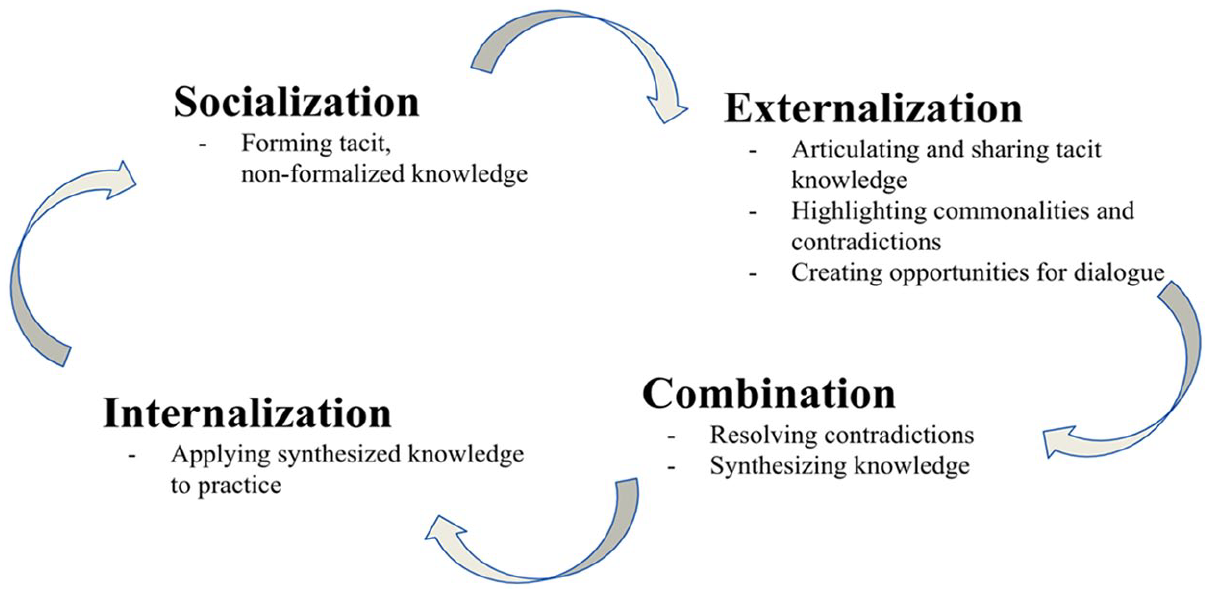
The knowledge creation process.
Formalizing Curiosity
Here I share seven lessons framed by the SECI model. This framing helps explain the reasons for my failure and provides the grounding and rationale for my suggested ways of avoiding pitfalls. I articulate my approach to satisfying curiosity and share the paper development guardrails I crafted for myself, offered as sets of questions in the Appendix. These Writing and Review Guides help shape my work at each stage in the writing process. They also serve as checklists to determine if the manuscript has fallen (or is in danger of falling) into a pit. As I go through the pitfalls and suggested ways to skirt them, I use an example of preparing a manuscript for submission to the Journal of Management Education (JME). In so doing, I hope to take most of the guesswork out of writing papers that are robust enough to get past the initial editorial desk review. Major journals typically claim a desk rejection rate of more than 90%. This makes the editorial desk review a critical hurdle on the road to publication.
Lessons in Socialization
The knowledge creation process begins with the acknowledgement that we are all unique individuals uniquely experiencing the world. On the one hand, no one else can know the reality of our world exactly as we do. On the other hand, however, knowledge is socially constructed (McAdam & McCreedy, 1999). When insight stays in a person’s head, it simply remains a thought bubble. For this thought bubble to begin its journey of transformation into knowledge, it needs to be articulated, communicated, discussed and debated (Liyanage et al., 2009; Nonaka & Toyama, 2003).
Knowledge creation thus requires us to understand the different lenses people use to experience and interpret reality. Understanding these lenses is the starting point for sharing perspectives, identifying commonalities and contradictions, and fostering productive debate.
Lesson 1: Clarify the Frame
When embarking on a research project, our first task in contributing to academic knowledge creation is to clarify the existing theory (or theories) that serve as the lens through which we view and interpret a phenomenon of interest.
A theory offers an explanation of a phenomenon: why it happens, how it happens, and its impact when it happens (Sutton & Staw, 1995). Proposing and testing theories about how the world works is what we do. It is theory that makes scholarly contributions distinct. When insight strikes us, our first responsibility is to thus specify the theoretical frame that contextualizes our exploration of the phenomenon at hand.
In academic knowledge creation, the theoretical frame is just as important as the phenomenon. This is because there are competing explanations of the same phenomenon offered by different frames or schools of thought. It is the theoretical frame that puts the “sense” into sense-making. For our proposed scholarly contributions to make sense, we must let others know what lens we are employing in our investigation.
We are trained in our doctoral studies to ground our work in theory and contribute to the enrichment of that theory (or its alternatives). It was thus amusing, befuddling, and embarrassing for me to read my own rejected papers to find that I did not have a clear theoretical frame for many of them. If these manuscripts ended up on my associate editor desk, I would have rejected them too for lack of theoretical grounding.
Writing for JME
JME is a journal dedicated to the scholarship of teaching and learning (SoTL). Its main audience is the educator inside the classroom. Therefore, the journal expects submissions to be about teaching and learning phenomena framed by relevant theories on why and how people learn, how to design approaches that inspire people to learn, and the impact of these approaches on learning. Scholarly contributions must help the dedicated educator hone and advance their craft.
Refer to Writing and Review Guide 1 for questions to help you frame your idea.
Lessons in Externalization
Having clarified the lens that frames our study of the phenomenon we are interested in, we now prepare to externalize and share our insights with others in the scholarly community (Nonaka & Toyama, 2003). I find Externalization to be the most challenging in the academic paper development process. Preparing to take my gossamer thought bubble out into the world requires me to be inside my head to give my bubble recognizable shape. Yet, I also need to be outside myself to understand the ways of thinking of others around me. Understanding how others think helps me find ways to craft my bubble out of material that gives it sufficient strength and pliability: it needs to withstand the poking, prying, and scrutiny that it will inevitably be subjected to when I take it on the social road to knowledge creation.
Lesson 2: Plot the Paper
Sometimes, when a thought bubble swells out of the breath of my subconscious thought, I seize my laptop to blast-freeze that bubble before it dissolves. While there is a strong urge to write the entire manuscript and send it out to a top journal before daybreak, I have learned that it is best to not surrender to this compulsion.
Efficiently writing papers that can withstand the rigors of academic debate requires planning and plotting. Plotting involves mapping out all the important elements of the paper before sitting down to write in earnest. This is in contrast to “pantsing” (etymology: flying by the seat of your pants) or writing the final manuscript as you think (Campbell, 2018).
To clarify, writing is an extremely valuable tool for thinking, learning, and problem-solving (Tynjälä et al., 2001). The important process of writing for discovery can result in critical drafts or fragments of thought that may or may not find their way into a journal submission. By contrast, pantsing is almost a form of stream-of-consciousness writing with the intention of submitting the end product to a journal.
Pantsing an entire manuscript on a plane ride may work for some. In my case, however, pantsing exposes me to the danger of being inside my head for too long. It is easy to forget that knowledge creation is social and that I need to explicitly relate my insights to other scholars’ insights. Establishing these conceptual links helps me clarify my contribution to the academic conversation. I have learned that pausing to plot is the way to save myself from the devastation of the dreaded rejection-for-lack-of-contribution email.
Plotting lays out a paper’s structure and gives bones to your thought bubble. In outline, diagram, or dot/bullet point form, the bones articulate the contribution of the paper and how the fragments of that contribution are arranged into a coherent whole. To be clear, plotting assumes that the research project is completed: that is, that you have clarified your theoretical frame (Lesson 1 above), completed the literature review, gathered and analyzed data, and summarized your findings and conclusions. The pieces of the research puzzle are there and the task at hand is for you to plot out how the pieces coherently and persuasively fit together before sitting down to write the manuscript.
Plot before you write: this is by no means a world-changing lesson. Most of us already do this in some form. The plot would most probably be in our heads. But taking the manuscript outline out of our heads and onto a page allows us to figure out the most compelling way to present our insights to others. This is why architects create blueprints on paper. Careful plotting before investing the time and effort to write well can mean the difference between a desk rejection and a first review round.
Refer to Writing and Review Guide 2 to help you plot your paper.
Lesson 3: Pitch to the Party
I have lost track of the papers I have peddled to countless journals. I dutifully followed well-worn academic publishing advice: I wrote my best work and sent it to a top journal. And when the paper got inevitably rejected, I progressively sent it to lower-ranked journals on the prestige ladder. I peddled downwards until it finally got accepted. Or until I hit the bottom of the ladder. I mostly hit bottom. And then I would dig. Dig a pit to bury my best work in.
This well-meaning advice can be equated to “throw (something) at a wall to see what sticks.” The origins of this expression are unclear. It may work for cooking pasta, building mud huts, or crafting public relations campaigns. But I have tested this strategy on academic writing, and it does not work.
I now understand that there is a critical component of this expression that unfortunately remains unsaid. That is, prior to hurling something, it helps to get to know the wall and aim at a specific section of that wall. In the case of academic writing, it helps to aim at a specific journal prior to writing your best work for that journal.
Having a target journal is yet another piece of well-worn academic publishing advice. However, as in the case of throwing something at a wall, there is also much that is implicit in the advice that needs to be made explicit.
I have learned that having a target journal goes beyond knowing its name, aims, and scope. A journal is as nuanced as a cocktail party: it is attended by a particular group of people who engage in particular kinds of conversations. The number of management journals out there is an indication that the Academy is not one big cocktail party. It is a myriad of cocktail parties. The onus is on us to understand their peculiarities and decide which party and conversation we want to join. We then need to prepare a pitch to persuade the bouncers at the door that we have something new and interesting to take to the party.
A strong pitch offers a better chance of gaining entry to a party. I have found that it also saves me from soul-crushing rejection-for-lack-of-fit emails. As in the case of plotting the bones of your manuscript on paper, it helps to write down your pitch. And what better way to write out a pitch than through a cover letter?
These days, I draft a cover letter that pitches a manuscript to a very specific target journal before I sit down to write the paper. This may seem odd, especially since it is typically not the intention to send the letter out to the journal for purposes of getting editorial buy-in before writing the final product. It is important to note, however, that some journals do require a pitch and a proposal prior to submission of a full paper such as the Academy of Management Annals (https://journals.aom.org/journal/annals).
I have learned that writing a pitch before writing the manuscript helps me give a face to my prospective readers as I write. A pitch is about deeply acquainting myself with the people at the cocktail party. It helps me craft the insights in my head into shapes and forms that are recognizable to the people at a specific cocktail party.
The pitch (cover letter) is just as valuable to you as it is to the journal. It not only helps you write the paper but also serves as the ticket that you present at the door to the party.
Refer to Writing and Review Guide 3 for questions to help you pitch your paper.
Writing for JME
JME is a scholarly community of educators interested in advancing the craft of teaching and learning. A unique feature of the conversations in the journal is the diversity of their forms. Some cocktail parties have a very strict dress code (e.g., black tie: theoretical and empirical research articles only). The JME party, however, is inclusive in that it welcomes a range of dress codes or ways of expressing contributions to the scholarly conversations (Robinson & Leigh, 2023b).
You can come in black tie and discuss your empirical or theoretical work. You can also come in your explorer or archeological gear and discuss insights and findings from your literature review. Those in camp or outdoor gear who propose instructional innovations and revisit the effectiveness and relevance of existing ones are welcome. Finally, you can come in smart casual attire to discuss insights from an interview or dress down (like me) to share personal experiences as a management education scholar. This diversity makes for an inclusive and interesting party.
Knowing what and how you would like to contribute to the conversation will help you plot the bones of your paper and prepare to pitch it to the journal. Because JME accepts a wide range of contributions, it will be helpful to include a bit more information on the history and context of your paper (Robinson & Leigh, 2023a). If you would like more targeted guidance, the JME editors accept abstracts (not full papers) to review by email and in online Editor’s Office Hours (Leigh & Robinson, 2023).
Lessons in Combination
At this point, we have scoured the literature, completed the research, plotted the paper, and written a pitch. We are now ready to sit down and write. It is worthwhile to remind ourselves that writing a manuscript is not the end point of thinking. Reading and writing are constructive and discursive processes where an individual’s mental models interact with the models of others (Tynjälä et al., 2001).
When we write, we not only summarize knowledge put forward by others. We also ponder and combine this knowledge with our own internal models of the world. We transform existing knowledge to generate new knowledge. And we publish to draw others into conversation, discourse, and dialog. While writing may seem to be a solitary activity as we hunch over our keyboards in darkened offices, it is in reality a highly social one. Writing and publishing are the twin engines of the Combination phase of knowledge creation (Nonaka & Toyama, 2003).
Combination involves highlighting similarities and differences in insights between scholars for the purpose of resolving contradictions and synthesizing knowledge. This requires us to write papers that actively engage with others and that are ready to advance scholarly conversations. The lessons I share here offer practical ways to ensure robustness in our own work while engaging with other scholars in each major section of a conventional research paper.
Lesson 4: Position and Emphasize
If the cover letter (pitch) is the ticket that gets us through the door to the party, then the Introduction of a paper is the opening line to the conversation we attempt at the party. The Introduction is critical as it can mean the difference between mingling with others (which is the aim of knowledge creation) or standing alone in a corner (which is just sad).
I was surprised to find that the structure of the Introduction as recommended by scholars and editors was fairly straightforward. It captures the tacit rules of scholarly engagement in knowledge creation.
To appreciate how to structure the Introduction (and why it is structured that way), we must remind ourselves that knowledge is not a monolithic bloc: rather, it is made up of smaller pieces of knowledge clustered together to create a gestalt—a whole—that represents our understanding of the world. This gestalt, however, tends to be an illusion because our brain tends to fill in gaps. Our primary responsibility as scholars is to find those gaps and fill them through research.
Therefore, the purpose of the Introduction is to show others that we have found a gap in the tapestry of knowledge that we intend to stitch up in our paper. We show where we found the gap in the tapestry (thus positioning it in the body of existing knowledge) and why it is important to stitch up this gap (thus emphasizing the importance of our little bit of contributed insight).
Referring to Figure 2, a robust Introduction can be divided into distinct sections for a compelling scholarly conversation starter (Barney, 2018):
Section 1: What we know
This section articulates the boundaries of the phenomenon explored in the paper (e.g., assessment formats and learning outcomes). It presents a brief summary of we already know about this phenomenon and how existing theories explain what we know about it (e.g., how different formats evaluate different outcomes).
Section 2: What we do not yet know
This next section highlights a new or persistent issue or question that existing theories cannot quite fully explain (e.g., the moderating effect of students’ experience or familiarity with assessment formats). This articulates the specific issue or question (research gap) that the paper aims to address. The section also includes a broad overview of how the paper intends to fill the gap (e.g., through an empirical study of performance across different assessment formats).
Section 3: Why it is important and urgent to know
Finally, a strong Introduction offers a justification of the significance and importance of urgently addressing the issue or question. It is insufficient to say that the paper attempts to do something that no other scholar in the world has attempted to do before (n.b. most of us are guilty of arguing this non-argument at one point or another). Rather, we must focus on arguing how filling this gap may change the way we understand the world and how we live in it. This new way of seeing the world is what makes our work interesting (Davis, 1971).
This structure acknowledges the scholars who have previously contributed to creating knowledge in this space, positions our unique contribution, and establishes the legitimacy and importance of the contribution.
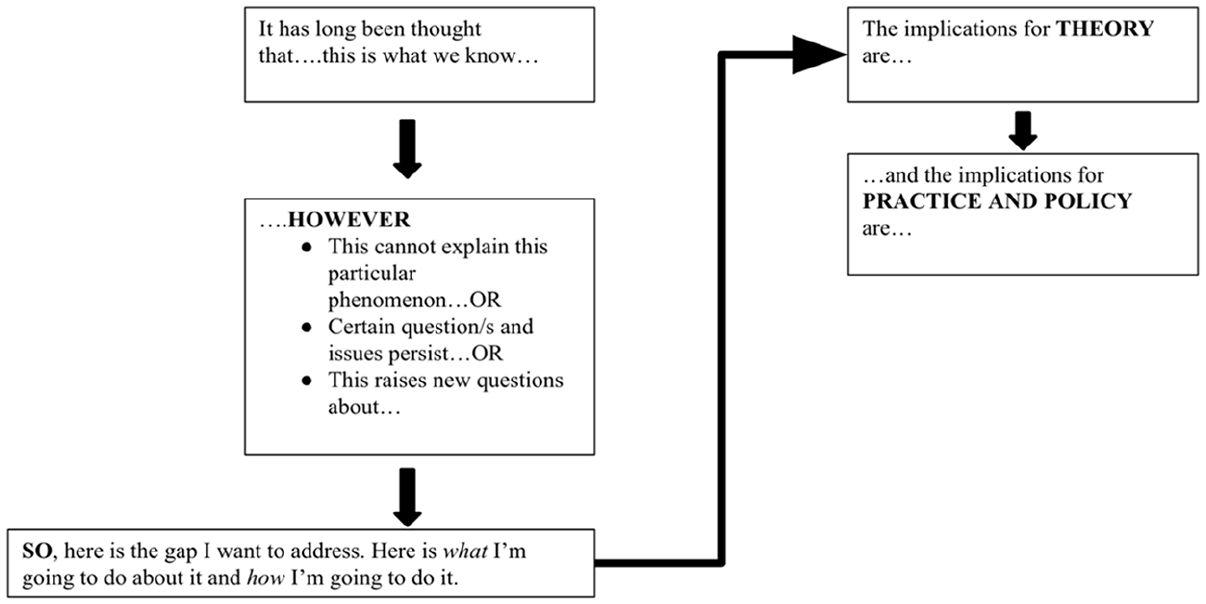
Positioning and emphasizing contribution.
Refer to Writing and Review Guide 4 for questions to help you craft a strong Introduction.
Lesson 5: Anchor
I still remember the day when I had a meeting with one of my PhD mentors. He had just read a draft of my Literature Review chapter and was going to give me feedback. I was ready to receive praises for my very hard work, but I was floored when he matter-of-factly intoned, “A Literature Review is not a summary of the literature.” I had to rewrite it. Significantly.
In response to my stunned silence, he explained that a Literature Review starts with our burning question about a phenomenon. We then take this question to the corpus of existing knowledge about this phenomenon and challenge the literature to answer our question. If we find that the literature cannot satisfactorily answer our question, then we would have called attention the existence of that elusive gap in our tapestry of knowledge of the world.
Proving that the gap exists establishes the legitimacy of our research question. Filling in the gap with an answer to the question represents the contribution of our research project: the threads that we uniquely stitch onto the tapestry of knowledge. A robust Literature Review demonstrates how our contribution is connected to the stitches that other scholars have contributed to the tapestry. It recognizes and reinforces the social dimension of knowledge creation. It gives our contributions the intellectual heft and grounding of the ideas that have come before ours. Indeed, studies have shown that the most influential ideas are clearly contextualized in established knowledge (Fortunato et al., 2018).
Some papers that come to my associate editor desk have literature summaries, not Literature Reviews. The most unsatisfying ones simply enumerate the studies that have been done without as much as an explanation of the significance of that previous body of work to the study at hand. Many of the full papers that I wrote and that are gathering cyber dust are those with orphan insights: they do not have clear intellectual connections, genealogy and grounding. The insights themselves may have been interesting but they would have been stronger if I had argued and anchored them on the existing thought that informed it.
Referring to Figure 2, the Literature Review essentially expands the first two boxes in the structure of the Introduction. Writing and Review Guide 5 offers questions to help you structure your Literature Review.
Lesson 6: Align
Having argued for the legitimacy of our research question in the Literature Review, we now set out to answer it.
Much of the advice on methodology has focused on approaches to data collection and analysis (new and shiny methods), analytical robustness (ever-sophisticated ways to show that data will produce the same results regardless of our battering and hammering), and data integrity and transparency (demonstrating data “cleanliness”). These issues are certainly critical to advancing scholarship and central to upholding the robustness of the insights that we contribute to the world. I learned, however, that these are in fact methods that do not equate to methodology. It is methodology that gives methods meaning and significance.
In academic research, scholars are artisans gazing upon the knowledge tapestry before them. For example, when aiming to investigate the impact of social connections on learning in a management course (a research question), they make a decision on the kinds of insights they want to generate to fill that gap in the knowledge tapestry. They also need to decide on an overall approach to arrive at those insights. Do they want to offer insights on the relationship between the breadth and diversity of friendships across the university on student learning? In this case, they may opt to analyze the university-wide social network cultivated by students enrolled in a management program. Alternatively, do they want to offer insights on the relationship between the quality of the student relationships (friendship circles versus study groups) on learning? In this case, they may opt to do in-depth interviews on social versus study relationships among students enrolled in a management course.
In this example, social network analysis and in-depth interviews are methods. However, the decision to undertake one or the other is a methodological one and is dependent on the research question and the kind of insights the scholar aims to contribute.
The choice of method answers a “what” question, but the choice of research approach or methodology answers broader and more fundamental questions. These are important questions of why that method was selected (alignment with the research question), on whom the method is employed (sample), how the data for that method is gathered (to include validity and reliability assurance techniques) and how the data is analyzed (to include analysis and robustness assurance techniques), and how the findings answer the research question (relevance; Andiappan & Wan, 2020).
I learned that if the Literature Review justifies that a knowledge gap exists, then the Methodology justifies that the overall research approach (sample, methods, data type, and analysis) is relevant to the research question. It also assures the validity, reliability, and credibility of the insights generated.
Most Methodology sections typically answer questions on the robustness of research methods. However, the more fundamental questions of relevance, validity and reliability are typically overlooked. We must answer these critical questions as they assure other scholars in the community that the stitches we contribute do belong to that particular section of the tapestry (thereby contributing to a richer and coherent picture of the world). It also assures other artisans that the stitches we contribute are of sufficient quality such that they can be combined with existing stitches to result in a more durable and elegant knowledge tapestry.
Writing and Review Guide 6 offers questions to help you write your Methodology.
Writing for JME
There is a sea of scholarly work on management education in JME and elsewhere. And there are oceans of scholarly work out there on higher education in various fields from archeology to zoology. This range is both a boon and bane to the management education scholar aiming to contribute to JME. The journal is inclusive in educational theory framing, scholarly approaches and—as the discussion in the section on Externalization underscores—in the form of scholarly contributions.
We must, however, acknowledge the challenges that the big JME tent poses. On the one hand, there is significant opportunity to draw from frames and practices in other fields to enrich our own. On the other hand, there are considerable challenges to positioning, anchoring, and aligning our work so that we clearly bring out the novelty of our contributions to the tapestry of management education knowledge.
Lessons in Internalization
And here we are: we have framed our work, plotted its structure, drafted a pitch to the party, and positioned, anchored, and aligned our contributions within the tapestry of knowledge to which we aim to contribute a stitch. We have also written up a summary of results in a Findings section and proven or disproven our hypotheses. We have thus far taken care to adhere to the rules of academic engagement to ensure a productive journey on the knowledge creation road from Socialization to Externalization to Combination.
At this stage in the writing process, we are exhausted. And it usually shows in our lethargic and baggy-eyed Discussion section.
To re-energize ourselves, it helps to remember that the synthesis that occurs in the Combination stage does not signal the end of the knowledge creation road. Looking back in history, scholars point to evidence that Plato’s Academy went beyond discovery to encourage students to positive political action (Baltes, 1993; Chroust, 1967). We continue to carry this tradition of concern about the implications of the knowledge we generate on the way that life is lived.
The concern is mirrored in contemporary knowledge creation theories. Scholars propose that the synthesized knowledge that emerges from the Combination stage is disseminated across communities of practice, where it gets translated and incorporated into new ways of doing. This new way of living is eventually transformed into tacit knowledge through a process of Internalization (Nonaka et al., 2006; Nonaka & Toyama, 2003). The power of knowledge is manifested when it is embedded in practice.
Lesson 7: Advance
It is easy to lull ourselves into believing that presenting our findings signals the last stop in our scholarly journey, given that our insights cannot immediately find themselves in practice. Unfortunately, it is this thinking that is behind tired and repetitive Discussion sections. It blinds us to the true purpose of the Discussion, leading us to underappreciate, underestimate and underutilize the powerful opportunity that lies at the tips of our fingers hovering over the keyboard.
I have learned that the Discussion is not a summary of the research project and its results. That is what the Findings (or Results) section is for. Having contributed stitches to filling a gap in the tapestry of knowledge, the Discussion is where we invite other scholars to take a step back and view the tapestry anew. The Discussion is less about the stitches themselves but more about how the tapestry has changed on account of our stitches.
In this critical section, we must first articulate the answer to our research question (I am embarrassed to say that I have forgotten to do this in many of my papers). We then explain how our answer—our discovery—transforms and advances the way we view and understand the phenomenon that we investigated. I now understand that this is what it means to articulate a contribution to theory. And while our contribution may not as yet have found itself embedded in practice, we are responsible for describing a world that could be if this contribution were successfully internalized. Our Discussion offers a glimpse into the possibilities of advancement in practice, scholarship, and policy: how our work changes our view of the world and the ways to live in it.
If the Literature Review justifies the existence a knowledge gap and the Methodology justifies the relevance and robustness of the overall research approach, then the Discussion justifies the value of our contribution.
Writing and Review Guide 7 offers questions to help you write your Discussion.
Writing for JME
This takes us back full circle to the knowledge creation aim of JME outlined above in the Socialization phase of our research. The journal’s purpose is to advance the practice and scholarship of teaching and learning among management educators in the classroom. Therefore, the Discussion is where we shine a light on how our work transforms what we know about teaching and learning in management, how it challenges and transforms the frontiers of what we do in the classroom, and how it transforms our impact as management educators.
Lesson 8: Sense-Check
And here at last we have a full manuscript in hand. When I get to this stage, I find myself eager to tear through a journal’s submission system to get to that “submit” button buried underneath those manuscript information pages. In this moment of intellectual euphoria, I have found it best to step as hard as I can on the brakes.
It is useful to breathe, bring our heart rate down and recall the social character of knowledge creation. While our written draft effectively converses with other scholars, the scholars whose work we cite, rebut, and extend are not in the room where our writing happens. The scholarly conversation has been done asynchronously throughout the writing process. However, there is much value to having conversations of the synchronous, real time, and in-person kind.
All of us have blind spots that can be quickly highlighted and addressed through these synchronous collegial discussions. Seeking friendly feedback from other scholars will go a long way in giving the manuscript a further polish. I have learned to embrace brown bags, seminars, conferences, manuscript development workshops, or a combination of formal and informal review opportunities to tighten the focus, structure, and prose of a final draft.
Before uploading that manuscript to a journal submission system, I have further found it helpful to let the paper rest or “cool.” This consistent advice comes from different kinds of writers (academics, novelists, and journalists). Resting a piece of written work gives our brain some distance from the writing process so that it can read a manuscript with a reader’s eyes.
A reader’s fresh eyes allow us to see both small and glaring lapses in a written piece. More importantly, they allow us to critically assess if all the elements of the paper come together coherently. This is the time to dispassionately evaluate the manuscript’s ability to clearly guide the reader through the knowledge creation journey.
A simple way to do this would be to use the prompts in our Writing and Review Guides to check if each section in the draft effectively addresses the relevant guide questions. When serving as a reviewer for journals or conferences, we can also use the same Guides to structure our feedback to authors.
Figure 3 offers a visual representation of how the different elements of a conventional academic manuscript hang together. When you are satisfied with how the elements of your paper line up, it is time to take another deep breath and calmly click “submit.”
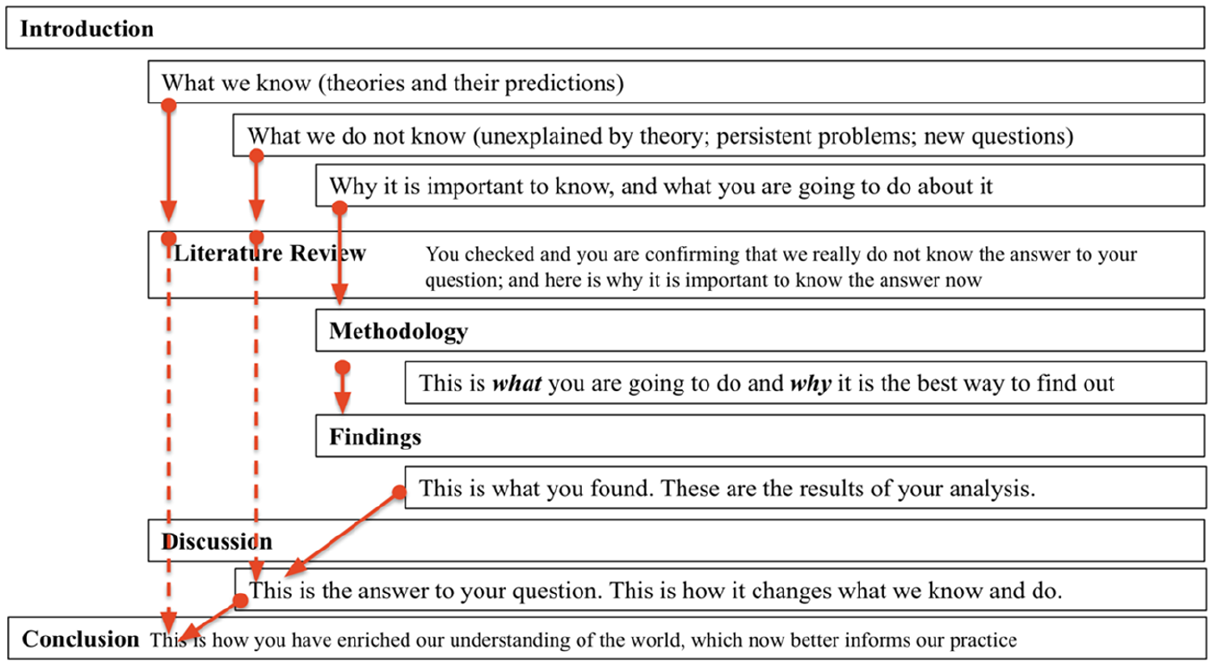
Sense-checking.
Clicking “submit” hands over our ticket and prospective cocktail party contribution to the bouncers at the door. The review process is by far the most unnerving nail-biting phase of sense-checking. The process may feel like an interrogation where beast-like bouncers appear intent to rip us and our manuscript apart (this is the subject of a whole new essay). Setting aside (for now) the possibility of post-traumatic review stress, engaging in a developmental process is crucial in fine-tuning the positioning and plot of our paper. Responsible editors and reviewers can carry the brightest torches to shine a light on the remaining gaps in our thinking and in the communication of our thinking. In productively conversing with us through the review process, they coax our voices out in sections of our paper where we may have been unconsciously mute.
The result of a constructive sense-checking process is a manuscript ready to go out and contribute a stitch to the tapestry of knowledge created by a community of scholarly weavers through the ages.
Figure 4 embeds my seven lessons in academic publishing within the knowledge creation framework of Nonaka and Toyama (2003).
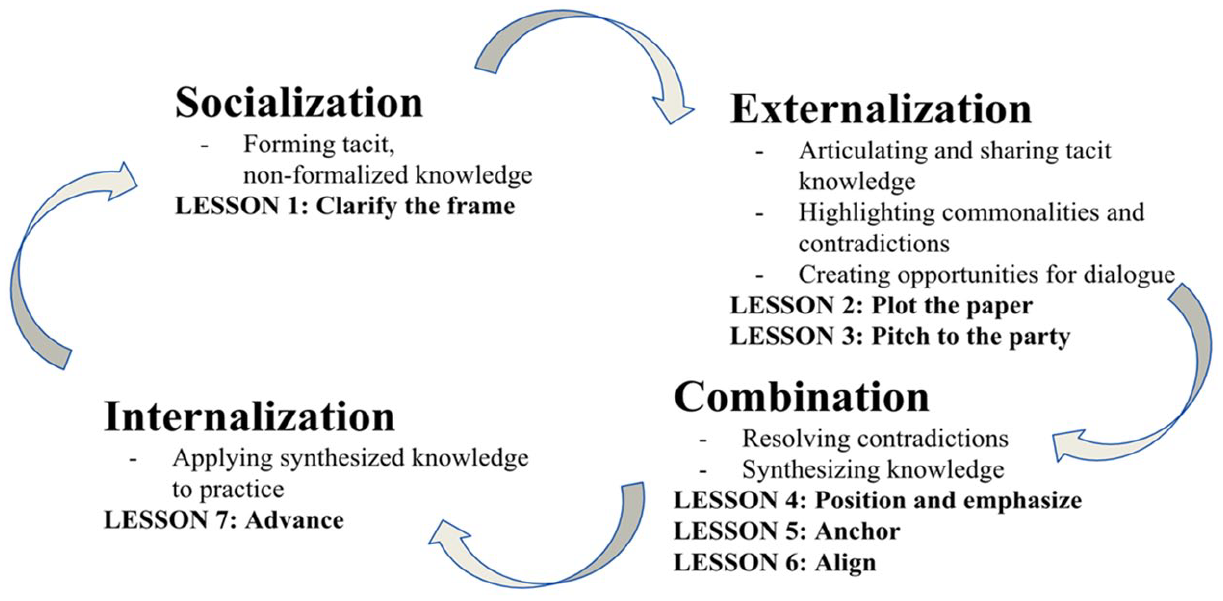
Idea to ink: lessons in academic knowledge creation.
Poking, Prying, and Publishing
The process of articulating these lessons and sharing them with others has proven to be a cathartic experience for me. The lessons come from a place of failure but crystallizing them has empowered me to take agency of my scholarship. These days, when one of my papers fails to get published, I no longer feel irreparably demolished. I have the tools that can help me make sense of my failure. I now fail and succeed with my eyes open.
I anchored my lessons on the purpose of scholarship and embedded them within the context of a knowledge creation framework. This has allowed me to see the bigger picture of scholarship and to reinterpret our publish-or-perish world. Publishing is the beating heart of scholarship: it is the engine that pumps insights across networks of people dedicated to understanding the world. I now appreciate that viewing the failure to publish as the death of one’s academic career is a severely limited (and limiting) view of the Academy. I instead invite us all to collectively lift our gaze to the unfinished tapestry before us and to acknowledge that if we do not publish, it is in fact our knowledge of the world that perishes.
Finally, articulating these lessons has heightened my awareness of the many others who are poking and prying at the world alongside me. Writing down these lessons in solitude has paradoxically underscored for me the powerful social nature of knowledge creation. I now recognize and am grateful for the others who walk with us, encourage us and help smooth the rough road from idea to ink.
Footnotes
Appendix
Declaration of Conflicting Interests
The author declared no potential conflicts of interest with respect to the research, authorship, and/or publication of this article.
Funding
The author received no financial support for the research, authorship, and/or publication of this article.
