



Abstract
Business schools (BS) can be seen as a microcosm of the neoliberalist society upholding 4P’s of patriarchy, power, profit and privilege. Through autoethnographic illustrations this Acting up! essay uses a Critical Animal Studies lens and contributes to the emerging field of Animal Organization Studies analyzing the underlying ideals that hinder interspecies solidarity in business and organization. I argue for interconnectivity, a decolonializing effort to support an interspecies agenda beyond an immediate circle of, often anthropocentric and exploitative, concerns which not only diminishes multispecies wellbeing but also separate us from our own humanity. Some examples of academic activism are shared to highlight how one of the most prominent social injustices of our times—the exploitation of animals—is hidden by animals being absent referents in the performative context of the BS. I also discuss how affective ignorance of animal concerns shape dissonance and intentionally resist the rationalized language of the field, to highlight the affective and passionate, of being a vegan in a non-vegan world.
Keywords
Our task must be to free ourselves from this prison by widening our circle of compassion to embrace all living creatures and the whole of nature in its beauty—Albert Einstein
This Acting up! essay explores the business school (BS) as traditionally built around four P’s: patriarchy, power, profit and privilege creating a “prison” that Einstein spoke of. The BS is a performative site of dominant business theory; one built up around neoliberalist and capitalist values at the cost of more vulnerable and marginalized human and nonhuman groups. Many who safeguard these dominant interests often support (overt or hidden) sanitized exploitative and extractive processes, categories, and rationalizations. This avoids the often messy, emotional, and paradoxical nature of entangled life and the cause and effect of human business activities as part of the natural and social worlds. While sentiments of whether we can reimagine business responsibilities toward supporting, what has been called “interspecies solidarity” (Blattner et al., 2019; Coulter, 2016) and kinder business practices may seem idealistic, especially considering intensifying geopolitical, environmental and economic pressures of human groups, a key element for critical scholars is to question underlying motives of powerful institutions. The BS is one such establishment as its reach is increasingly exponentially 1 thus ever more shaping society. Without considering the ideals such institutions transmit, we limit solutions of dealing with the problems of our time.
The BS is a performative site in terms of the values, concerns and ethical thinking conveyed to future business professionals and much revolves around pure profit maximization with limited real sustainability activities. The BS espouses a hegemonically Western anthropocentric worldview—one that could be argued has led to climate and biodiversity emergencies. My exploration takes a Critical Animal Studies (CAS) approach whereby “the critical” denotes creating awareness of the neoliberal system in its multiple exploitations of vulnerable human and nonhuman groups (Matsuoka and Sorenson, 2018; Taylor and Twine, 2014). CAS’ anti-capitalistic standpoint endorses a more democratic and decentralized community (Best et al., 2007) to “confront this unthinkability [the violence, exploitation and suffering of animals], the taken-for-granted assumptions that form a hidden structure of violence and make the most unspeakable atrocities seem an acceptable part of everyday life” (Matsuoka and Sorenson, 2018: 1–2). There is also a recognition of the intersectionality of injustices to speciesm linking it to race, gender, class among others. For example, animal agriculture impacts detrimentally animals, leads to climate change, biodiversity loss and negative health effects particularly for vulnerable human groups. Further, a “critical” stance also advocates practice rather than just theory—whereby actions become part of the liberating endeavor with ethical vegan animal activism at its core. Many non-vegans mistakenly think that ethical veganism is restricted to diet, but it is a multilayered political approach that resists diverse exploitative systems foundational in much taken-for-granted organizing of human society.
In business related studies, animal interests have been limited. The sanctioned norm of animal treatment is an “open secret” (Zerubavel, 2006) with limited discussions of multispecies organized injustices. However, some animal inclusion has started to gain momentum in the fields of business, management and organization studies signaling a shift from the earlier anthropocentric blind-spot (e.g. Clarke and Knights, 2022; Connolly and Cullen, 2018; Coulter and Fitzgerald, 2019; Hamilton and McCabe, 2016; Hannah and Robertson, 2017; Huopalainen and Jammaers, 2025; Labatut et al., 2016; O’Doherty, 2016; Sayers et al., 2022; Skoglund and Redmalm, 2017; Tallberg et al., 2022a, 2022b). Additionally, the creation of a sub-field that specifically deals with human-animal relations in organizing and organization—Animal Organization Studies (AOS)—is emerging that consider multispecies relations as a key part of organized societal, business and private efforts (see Tallberg and Hamilton, 2022). While AOS includes a wider spectrum of views on human-animal relations—not all anti-capitalist or vegan—CAS focuses on animal liberation with multispecies (or “trans-species”) justice as its goal. The aim of this essay is to illustrate moments of my vegan journey in the BS as means of acting up, exposing and voicing the prevailing BS anthropocentric ideals, and, as such, contributes to both AOS and CAS literatures. In AOS, vegan activism is still relatively unexplored—especially in the BS space—and in CAS there has been limited insider BS critique.
An embodied perspective can lead to reconsidering ethics in organizations (Pullen and Rhodes, 2015: 116). Exposing business graduates affectively to business ethics beyond pure human interests could create more awareness of unethical business decision-making and their impact on human and nonhuman stakeholders (Tallberg et al., 2022a). Organizing and management are anything but cold, mechanic processes as human beings are feeling (and thinking) creatures. Thus, to train business graduates to avoid affective sentiments create limitations in navigating realities or finding humane solutions to the often complex problems. Parker (2018) argues that the neoliberalist capitalist ideology that dominates the BS keeps flourishing despite common societal perceptions of managerial greed and egoism as undesirable. He calls for an overhaul of the BS to become places for responsible study that transcend limited notions embedded in the hidden curriculum, to “respond to the challenges that face human life on this planet. . .[to] radically re-imagine the business school as usual” (p. viii) as “the ideas that business schools sell will contribute to shaping all our futures” (p. 157). In this way, an evolution of the BS is warranted to meet the aspirations Parker (2018) speaks of and create more responsible business communities. I argue, as does CAS, that the hierarchical assessment of life involved in speciesism is one of the underpinning forms of all forms of societal and business exploitation. This is because humans are (more or less) complicit in upholding anthropocentric valuations in daily consumption and production decisions while replicating these in professional lives. No other social injustice matter intersects with everyday lives to the degree than the animal question and much thinking and treatment of animals can be seen as an exemplar for injustices to other vulnerable groups.
My tales from the field (Van Maanen, 1988) are based on autoethnographic moments, as seen through the autobiographic and personal exploring wider societal themes (Ellis, 2004) of hurt. The moments illustrate the lived experience of almost 20 years of being a vegan in the BS, which is a distinctly non-vegan space. Opening to and sharing the vulnerable and personal in a professional space, such as an academic journal, is a challenge, yet when it comes to experiences of marginalization and injustice such an approach can help in creating affective understanding. This can be seen as an effort in decolonializing the BS, creating an “ongoing sabotage. . .in opposition to the Master (western/white/male) traditional central subject of knowledge” (Abdallah, 2025: 396) which is still undeniably exploitative, extractive and reductive. My lived experience illustrations are analyzed through the themes of patriarchy, profit, power and privilege, as 4P’s underscoring a hidden political agenda that supports dominant groups and traditional Eurocentric humanist interests. Following ecofeminist and CAS thinking that emotions are key forms of knowledge and, rather than being fully individual, are created in political and social systems (Matsuoka and Sorenson, 2018), my language is intentionally affective and passionate to resist the overly rationalization of business-related fields.
The first P: Patriarchal ideals upholding exploitation and anthropocentrism
The BS is traditionally anthropocentric, highlighting limited humancentric interests which are predominantly built on patriarchal rationalized ideals of power and profit for the privileged few. The BS has considerable influence to determine what conversations business and society engages in, and the values that are communicated to students and society beyond. Could we aspire toward more conscious business practices? Could we imagine and act toward supporting a world built on an interspecies solidarity with humane jobs, for humans and animals (see Coulter, 2016), with activities that bring out humanity’s more positive aspects?
Resisting cultural and habitual norms, such as meat-eating and animal agriculture, may require uncomfortable moments, but critical inquiry of such practices is fundamental to thinking about and organizing our relations with animals (and other humans). The tendencies to disparage practices not seen as the norm (such as veganism) makes this venture even more necessary.
I had volunteered to be on my BS department Christmas party organizing team which we decided would have a ‘green’ theme. Overseeing the food was my opportunity to share vegan cuisine and introduce kinder holiday eating options. But there were heated discussions on whether Christmas was ‘the time to moralise diets’ (as one of my female colleagues argued), while others opposed that they would smuggle in chicken (as this wasn’t ‘meat’ in their opinion). I offered politely (as vegans we must always be calm and collected when dealing with the outrage people feel when faced with us) to step down from the role and let someone else do the catering. Nobody else wanted to assume the laborious task so we ended up with a vegan buffet. This was not without ridicule. A group of male colleagues laughed at me in our breakroom commenting they’d ‘go past McDonald’s to fill up before’ the party and that plant-based options weren’t ‘Real food’. Had the buffet been a non-dominant ethnic cuisine others would surely have been more sensitive (as demonstrated from past years), yet a plant-based menu does not seem to warrant the same diplomacy and tact by some academic colleagues. Although it was a success with compliments on how tasty and (for many, surprisingly) filling the food was, I dreaded the event and was spent from anxiety and lack of sleep at how it would be received, feeling the weight of responsibility to act up for animals in a way that could be well received.
Acts of resistance can be emotionally and psychologically taxing, and studies show that there are often alienation, stigmatization and social exclusion that comes with being vegan (Vestergren and Uysal, 2022). Academic vegan actions can be seen as unrecognized “service” work like other types of care work that is unpaid and frequently considered “female” interests. In addition, there is a disproportionate number of females involved in animal-related research creating a “feminization” of the field (see also Coulter and Fitzgerald (2019) on other animal-related professions) which undoubtedly also creates barriers for mainstream acceptance in the often-patriarchal business-fields.
The human fixation with meat has been critiqued as a patriarchal obsession, where its politics are wrapped up with the sexualization of the female in a “cultural misogyny” (Adams, [1990] 2015). Historically, the university and the BS has been the “finishing school for the male children of the elite” (Parker, 2018: 84–85) and core business functions, such as marketing, often use images where women are sexualized as animals are consumed. Animals and women are therefore “overlapping absent referents” and “in a patriarchal, meat-eating world animals are feminized and sexualized; women are animalized” (Adams and Calarco, 2017: 36–37) and studies show intersections of speciesism and meat to sexism and masculinity (Salmen and Dhont, 2023). As seminal ecofeminist scholar, Carol Adams, explains in The Sexual Politics of Meat, “patriarchy is a gender system that is implicit in human/animal relationships. . .who, we eat is determined by the patriarchal politics of our culture, and that the meanings attached to meat eating include meanings around virility” (2015: xxvi–xxvii). Consequently, disrupting the “male way of relating to the natural world” within the BS (Parker, 2018: 60) can become an essential step toward destabilizing entrenched hierarchies and reimagining more ethical, caring and relational practices.
The second P: Profit and the absent referent in the business school—a denial of connection
There is an absent referent (Adams, [1990] 2015) of silenced beings who are at the center of societal exploitation, hidden in the sanitized BS concerned with profit and egoism. This neglects aspects of planetary interconnectivity and how business does not exist separately from entangled human and nonhuman life. This means that animals are absent in the BS in three ways; in a literal sense as their bodies and lives are missing in profit rationales becoming statistical numbers (such as in agrobusiness), in a physical sense as dead matter for consumption (such as in fashion and food) where pieces of animals are cut into business opportunities for human desires, and in a metaphorical sense as animal exploitation is similar to other societally marginalized human oppressions.
The animals of the world exist for their own reasons. They were not made for humans any more than black people were made for whites or women for men.—Alice Walker
At the heart of AOS and CAS lies a sustained critique of anthropocentrism—the worldview that places humans, particularly (white) men, at the top of a moral and material hierarchy. This hierarchy cascades downward from males to females, animals, and other forms of life. In contrast, many Indigenous and non-Western ontologies have long recognized interdependence between humans, animals, and the natural world, relations that the BS rooted in Eurocentric and hierarchical logics has historically ignored. Thus, decolonizing the BS and its research practices includes resisting governing traditions as solely contributing to knowledge and including marginalized and traditionally excluded voices such as Indigenous, female, people of color, queer, crip, and animal voices. Writing with pigs (Sayers, 2016), feminist dog-writing (Huopalainen, 2022), crystallization (Tallberg et al., 2014), and other storytelling and multispecies methods (Huopalainen et al., 2025) are examples of counteracting the absent referent in the field and extending research methodologies beyond the human lens.
Academic activism politicizes scholarly work (Rhodes et al., 2018) and there is a need to connect personal values to work in more radical and planned ways. While acting toward positive change for animals is core of both AOS and CAS, the latter more radically campaigns for animal liberation through its outward vegan activist agenda (although there are vegan activists within AOS as well). Activist engagements in higher educational institutions can include multiple interactions (teaching, research, writing, peer-reviewing, service) as opportunities for speaking up, dismantling the silence and denial of animal suffering, of “making the open secret (the ‘elephant in the room’) part of the public discourse” (Wicks, 2011, p. 196). Personal values are exhibited in consumer choices and for many BS faculty and students these convey status and wealth.
For most of my academic career the missing agent in the BS were animals despite parts of their bodies often being present (even beyond the cafeteria). The students’ (and some faculty’s) Louis Vuitton designer bags
2
and Canada Goose
3
winter coats screamed of animal violence in classrooms while discussing sustainability and ethics. Textbook cases still problematically uphold animal industries by an omission especially considering they are by far the most destructive and inhumane industries that are ’normalized’ and even receive governmental support. Yet, awareness in the general population is increasing as a recent poll found 27% of people avoid animal-based fashion (Four Paws, 2024) and many nation’s fur-farm bans are impacting demand and fashion houses. However, in the BS the use of animal fashion is still seen as luxury and objects of status for many individuals.
The Animal Industrial Complex (AIC) is an institutionalized system of oppression and domination that reduces animals to machines (Noske, 1989) in processes based on profit maximization. Powerful marketing-mechanisms have “normalized” this dominion with social condonement that conditions the daily dissonance of not connecting to the origins of products. In 2023 an estimated 92.2 billion land-based animals were killed (Faunalytics, 2024; The Humane Society, 2023), an estimated 133 billion farmed fish and 630 billion crustaceans (Fishcount, n.d.) and an estimated 2.2 trillion wild fish were killed in 2019 (Mood and Brooke, 2024) 4 for human food. These animals are all individuals who want to live and arguably deserve to as much as humans do. Despite readily available plant-based food options, animal slaughter is rising globally due to a growth in popularity of Western animal-based diets and increase in human population. But it’s not only because there are more humans, it’s also because meat production and consumption have experienced scientific, technological and sociocultural changes in the last century creating large-scale animal industries providing the market with cheap animal products (Potts, 2017: 1). Studies show the interconnected harms cascading beyond animals as these negatively impact marginalized and vulnerable humans, including Indigenous people (Nibert, 2002), migrant, low-skilled workers (Human Rights Watch, 2004), and low-income communities creating “sociologies of violence” around slaughterhouses (Fitzgerald et al., 2009). Furthermore, industrial animal agriculture is a key factor in the loss of biodiversity, deforestation and increase in climate change (Poore and Nemecek, 2018), as well as negatively affecting human health in terms of obesity and cardiovascular diseases along with links to zoonotic diseases and pandemics. Yet, concerns for human health and safety have done little to alleviate the suffering of animals, as industrial farming practices continue to intensify and the underlying causes of these threats, that are often rooted in systemic animal exploitation, remain largely unaddressed (Clarke et al., 2022). Exposing the links between consumer and organizational choices and the underlying values that define who we are as humans and what practices we endorse is crucial to making the invisible visible within complex decision-making processes. Ignoring the interconnectivity of harms between humans and nonhumans is not a neutral act, it is a choice to sustain the power structures that perpetuate violence, silence responsibility, and endanger the future of all life.
The third P: Power—challenging affected ignorance to decrease separation
CAS highlight speciesism as legitimizing “a particular social order” (as other isms, such as racism and sexism) and is about power which exploits nondominant groups intersectionally (Taylor and Twine, 2014). Power structures are often invisible through cultural socialization and unearthing speciesism opens questions of dismantling the status-quo to conceive alternative ways of acting. As I argued in the previous P’s, the exploitation of animals and oppression of women are based on the same systems of control—patriarchy—thus excluding animals from one’s consumption choices is one way to oppose this multifaceted power structure. Movements of liberation from dominant power structures have long been interconnected, although affected ignorance to this link often dismiss animal concerns as somehow of “less” concern or competing with other social injustice causes rather than recognizing their intersectional natures.
Affected ignorance is a specific type of moral ignorance which refers to what most know but do not want to hear as it would disrupt cultural and traditional norms. Such ignorance further stems from not recognizing (or acknowledging) the link between one’s actions and the resulting suffering of others (Schwartz, 2020). Affected ignorance relates to situations where there are victims, whether they be human, animal and/or nature. Some dismiss personal responsibility due to conventional habits, norms and beliefs; however, this can be critiqued in that adult humans are “moral agents” who should have “moral accountability of their actions” (Williams, 2008: 371). Famous historical examples of affected ignorance include the practice of slave owning and the Holocaust (see Moody-Adams, 1994; Speigel, 1996). Today, affected ignorance takes form in what Gröling (2014: 89) calls “socially sanctioned speciesist violence,” as mainstream society collectively denies moral responsibility for systemic animal exploitation. The notion of “culture” itself warrants deeper interrogation when it legitimates practices that betray the very values of care, compassion, and justice that “civilized” societies claim to uphold. Many regard themselves as “good” and ethical people, yet their everyday consumption and organizational choices continue to sustain systems of harm. The BS, grounded in an ethics of “egoistic realism” (Parker, 2018), epitomizes this contradiction as it promotes self-interest and material gain while disregarding the victims and moral costs of such pursuits.
In 2019 I attended a gala dinner at my BS. Speciesism shone through many women’s fashion choices of fur-coats and mink-throws. Conversation with a senior academic was cut short in my ‘intersectional disgust’ (Twine, 2010) by the fox-throw as part of her evening-dress attire. The fox’s small furry paws dangled lifeless over her chest in this societal context’s symbol of status, beauty, and wealth. The political climate of this BS is heavily linked to the Swedish people’s party in Finland which supports fur-farms despite national polls from the past thirty years of overwhelming negative public opinions to the business practices. Yet power, wielded through governmental and business influences, are used to quell democracy in an industry that receives government subsidies for its continued existence. For the poor animals forced to live in small wire-cages with conditions that do not meet basic animal welfare (even legally not to mention ethically), the horror of these concentration camp rows is silenced in elitist fashion that avoids engagement with the suffering involved. At the gala, in Swedish Finnish academic tradition, snaps-songs were sung, many about animals. A memorable moment of affected ignorance - anthropomorphizing a seagull and fish - was sung while ironically fish was being served to others while my vegan dishes were a source of entertainment especially for the avid hunter sitting across from me. The senior female academic at my table did nothing to aid my discomfort, instead riling up debate making me feel even more alienated rather than creating a safe space for me as a more junior, and targeted, colleague or supporting sisterhood.
Equality in the BS has gained attention through gender (e.g. Tienari and Taylor, 2019), race (Dar et al., 2021) and wider in the field of ability (Jammaers, 2023) but equality for vegans (or the animals voices they represent) is generally unrecognized as an issue of concern. Yet, whether in small moments of dissent inside traditional places or in spaces around it, challenging affected ignorance is part of most vegan activist agendas. Abdallah (2025: 390) argues, “epistemic decolonizing in the Business School is only possible in the margins, it is an oppositional standpoint.” She contends that those on BS margins need to become “trespassers” (Abdallah, 2025: 393), to be disruptive of the institutionalized Western/Eurocentric positionality and instead invoke the “embodied, situated, and messy” (p. 395).
I – and others – understand this working on the margins, in “messy” and affectively charged moments, requires the courage to speak out despite potential personal discomfort. Across the world, animal outreach and rights groups have long operated within mainstream public margins—giving voice to nonhuman suffering. For instance, Cubes 5 and Diamonds of Truth have been staged in hundreds of cities worldwide by volunteer activists. These focus on peaceful direct action, where there is one non-interactive, silent and motionless team holding TRUTH-signs or video-screens with undercover film-footage (often from the documentary Dominion), and another outreach team engaging onlookers in Socratic dialog about their feelings on seeing the animal industry footage to empower consumption changes (i.e. to go vegan).
I took the above photo (Figure 1) two blocks from my BS as part of my first direct action animal rights demonstration in Helsinki. My afternoon BS lecture prior to the event had included animal rights footage to discuss animal ethics and its links to social justice in a sustainability lecture. Students were surprised at being confronted with this, but later course feedback was positive with students reflecting on the entangled and hidden multispecies relationships in business. Elsewhere I have argued that discussing what can be seen as decisive, uncomfortable topics in the classroom requires a degree of “fierce compassion”—both for educators and students (Tallberg et al., 2022b)—and some (non-animal) academic colleagues have started to include multispecies lenses into their courses signaling broader receptivity to including nonhuman interests. In this way, patriarchal power of the hidden curriculum can be challenged on the margins and compassion, care and thriving can be positioned as responsibilities also for business professionals.
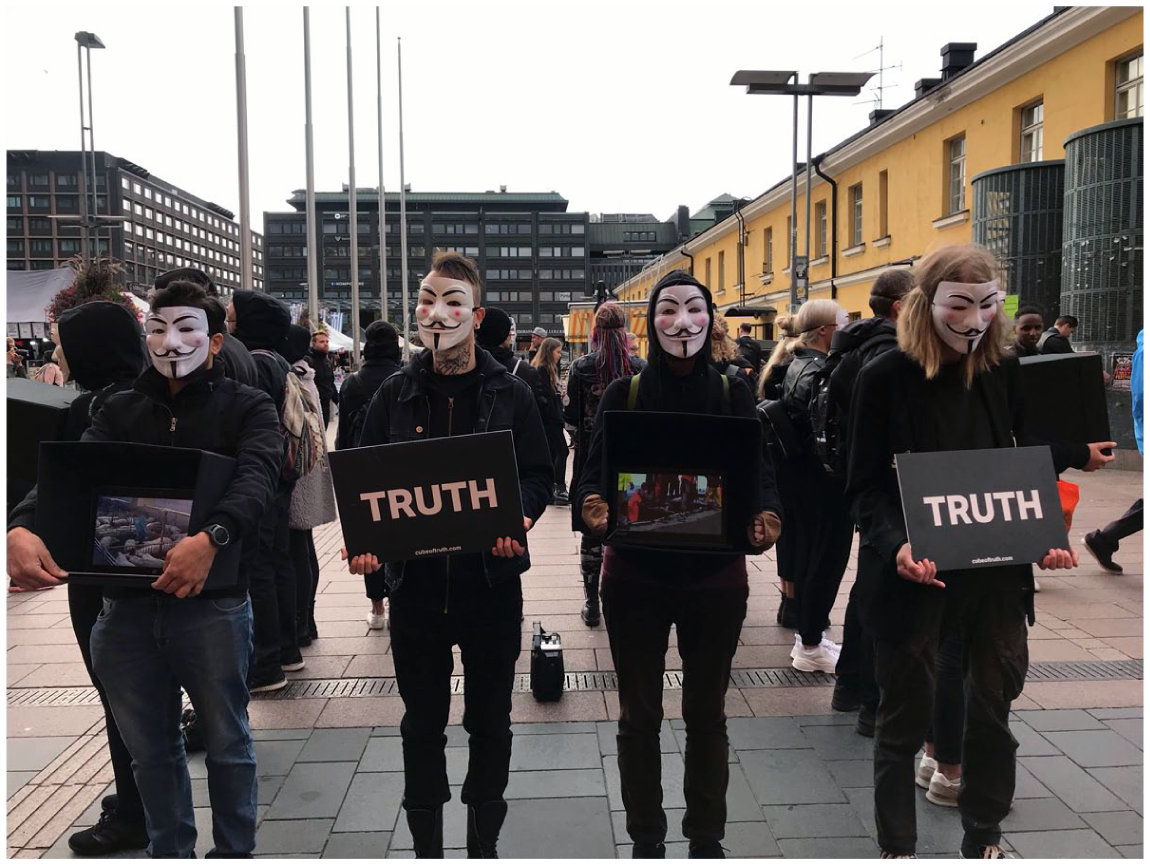
My first direct action demonstration.
The fourth P: Privilege—born amidst carnism
As most Westerners, I was born into carnism. Carnism is the set of beliefs and opinions that support the consumption of animals, especially meat (Joy, 2010). It is a taken-for-granted ideology, an illusion based on human privilege that hides the realities and impacts of daily choices. Privilege is often invisible to those with it, but all forms of privilege share the same defensive psychological structures, skewing perspectives and preventing “logical discussion and maintain[ing] widespread injustice” (Joy, 2020: 23). Carnism is a result of speciesism whereby the oppression of other animals is taken-as-granted due to the hierarchical belief of moral worth where some are seen as worthy of moral consideration and treated with integrity, while others are not (Joy, 2020). The key rationalizations people use for continuing to eat meat (which also apply to other issues involving affective ignorance) are that meat eating is “natural” (believing that humans are “designed” to eat meat and dominate over animals), “necessary” (believing that humans need meat to be healthy), “normal” (believing that most people eat meat and it’s the way it’s always been), and “nice” (that meat tastes good) (Joy, 2010; Piazza, 2020). Non-vegans often use these strategies of justifying their continued support of animal exploitation, thus, vegan acting up means encouraging critical reflection over these inaccurate and harmful beliefs. This is often the aim of awareness campaigns such as direct action initiatives.
Categorizing through an anthropocentric lens, places different amounts of value on lives, suffering and wellbeing. This categorization is mostly based on cultural social programing and value is awarded based on emotional attachments in one’s circle of concern. For example, a rabbit can be seen as an experimental test-object, food, clothing, or dear companion, but for the rabbit his life is of the same value; he feels joy, pain, and suffers independently of the human categorization which is a subjective social (and often political) structure rather than biological truth. Recognizing these politically laden and positional categories of value requires an understanding of the privileges we each hold. Privilege literacy is an awareness of the factual underpinnings of advantages and the meanings and myths such attitudes create (Joy, 2020). Hence, as humans born into species-based privilege, we need to actively examine and challenge the systems that uphold speciesism, just as we should interrogate privileges tied to gender, race, and class (Cudworth, 2014). The BS, as a central site of knowledge production and power, has the potential and the responsibility to disrupt entrenched hierarchies and systemic injustices. While interspecies solidarity in business contexts might remain an aspirational ideal, it is a necessary one: the BS cannot turn a blind eye to the economic rationalizations that justify exploitation and must instead foster better business and organizing practices rooted in compassion, justice, and ethical accountability across species, especially for those most vulnerable and marginalized by corporate actions. One of my most memorable and vulnerable acts of activism using my positional privilege was during my Viva as academic colleagues, my opponent, supervisors, family, and friends had to listen—without interruption or deflection—to some uncomfortable truths about “normalized” animal injustices.
A large animal slaughter kill-clock ticked behind me as I ’forced’ my PhD Viva audience to listen to facts of animal cruelties involved in everyday life, happening all around us while we were seemingly insulated in my ceremonial rite of academic passage. I spoke of the choice between the blue and red pills of awareness (from The Matrix), where people are unconscious to the realties and systems of oppressions they live in and often support. The ‘carnist matrix’ - which vegans actively unplug from - involves people supporting a worldview where eating animals is the ‘right thing to do’ (Joy, 2020: 20). The audience’s squirms from bearing witness to the unapologetic animal activist stance amidst the formal, and usually quite traditional, PhD ritual was unheard of in my BS and I could see how uncomfortable many were. Speeches, the defence itself and other worries of non-vegan fellow PhD students was low on my priority-list as my vegan defence dinner was the first encounter with plant-based choices for many of my 50+ guests (this was back in 2014). Instead, I was concerned with using my voice that day to transmit concern for animals and our shared responsibility to choose kinder options with less harm. The kill-clock following my words, was my way of inviting the animals killed each second into the space of the sanitized BS and, at least momentarily, for these concerns to enter the minds of my audience.
To extend this illustration, Figure 2 continues this act to invite readers to bear witness—this time in the forum of this journal—using my positional power and privilege as an author to include visual material. This functions as a refusal to hide the mass animal suffering unfolding in every moment, thus calling readers to confront both their own complicity and capacity for change. The global kill-clock below tracks the number of animals slaughtered in food systems as this essay is read (as per figures in 2024) for the average rate of 20 minutes.
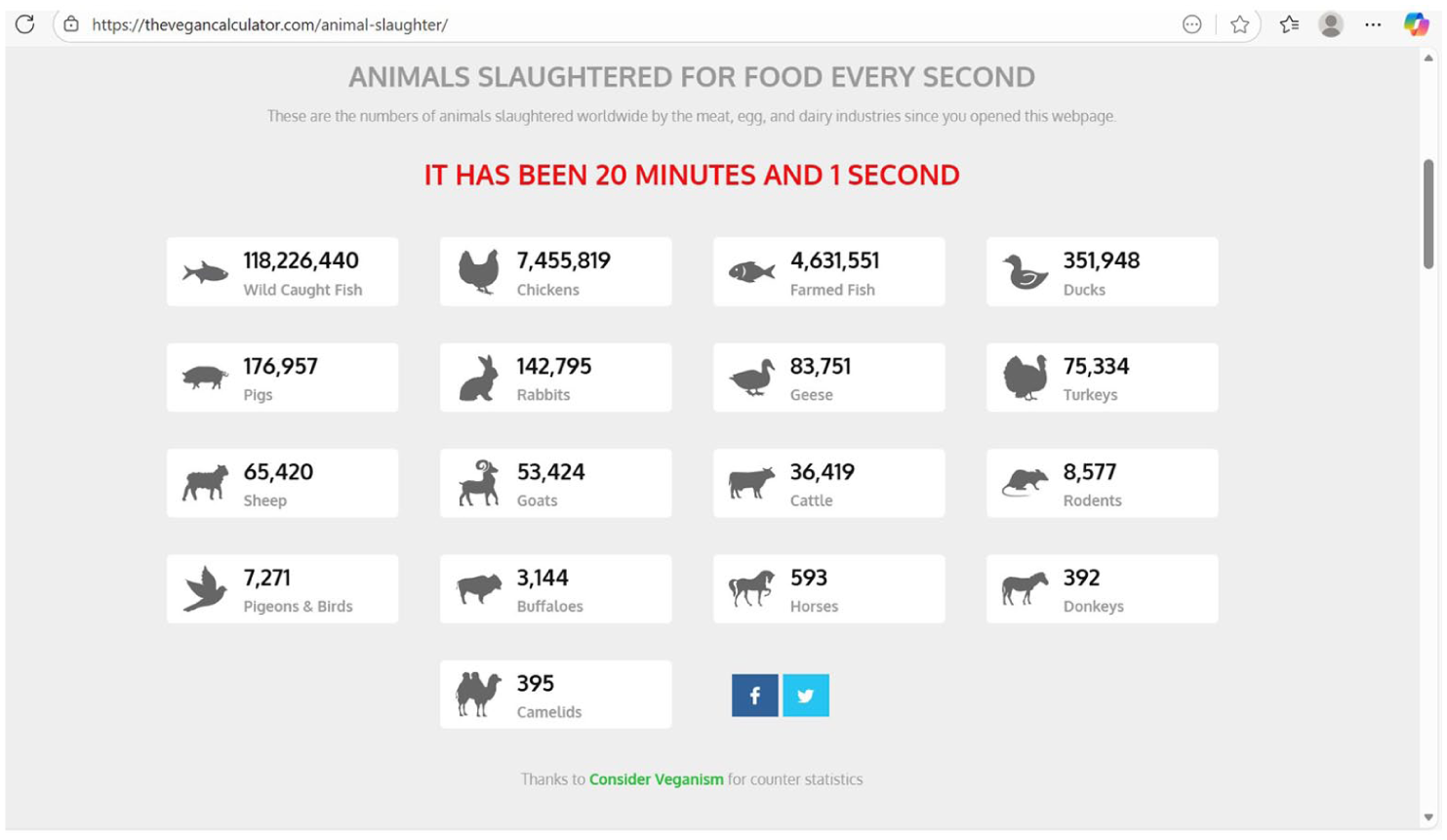
Global Food Industry Kill-clock (in 2024) showing that almost
Acting up for animals—an opening for more positive futures
The trancelike, modern dystopia of how animals are treated and thought about, can create an “anguish of being vegan in a non-vegan world” (Mann, 2018: 19). The question is how we can consume less, of animals, plants and other planetary life to minimize suffering for others (Gaard, 2017). Vegan ethics removes animals from consumption systems, eliminating what is often an unnecessary aspect of modern living. This ethos, by challenging entrenched practices, stands in opposition to the traditional capitalist goals of the BS and helps explain why its critical interrogation of contemporary norms can be unpopular. Rational arguments about the inefficiencies of animal agriculture, its socio-ecological harms, and the suffering inflicted on animals and many humans may persuade some, but moral appeals alone do not impact everyone. Instead, pragmatic strategies have been suggested to broaden impact for animals such as animal welfare reforms, accessible alternatives to animal products, and widening the tent of championing for animal interests (Leenaert, 2020). Thus, acting up for animals needs to go beyond vegans to include non-vegan allies in collaborate communities of care to support multispecies life and justice. Such collaborations are being crafted, for example, in the AOS community, forming a collective of “missing people” with research interests that stretch beyond traditional anthropocentric lenses (Tallberg et al., 2025; Tallberg and Huopalainen, 2024).
While advancing recognition beyond traditional Eurocentric anthropocentric ideals, a vegan activist approach embodies an ethical stance that historically has often been found in Indigenous and non-Western ontologies, where humans are understood as interconnected with other life and bear responsibilities. While some critique veganism for its “whiteness,” scholars such as Greenebaum (2018) and Robinson (2018a) emphasize that such perspectives can marginalize people of color, Indigenous, or non-Western vegans, highlighting the need for a more inclusive understanding of vegan ideals. While veganism and many Indigenous ethical systems share overlapping values – particularly in terms of multispecies relationality and responsibilities - many cultural practices need further thought.
Postcolonial discussions in CAS interrogate traditional cultural practices around killing and eating animals (Struthers Montford and Taylor, 2020), yet today’s AIC often remains disconnected from these traditions. The intersectional “entangled violence” of settler-colonial systems (Nibert, 2002; Wadiwel, 2020) – which modern animal agriculture and the AIC is the prime example of – harms humans, animals, and nature alike, demonstrating the urgency to rethink these dominant framings. Contemporary adaptations of Indigenous ethics, such as Māori veganism (kaimangatanga), “break from the dominant and from the status quo and are acts of decolonialism” (i.e. resisting the settler-colonial system of the AIC) (Dunn, 2019: 55). Similarly, Ahimsa (nonviolence toward all beings) has long underpinned vegetarianism in Hindu, Buddhist, and Jainist traditions. These decolonial food practices constitute a refusal of imposed systems and values and the openness to evolve is exemplified by Mi’kmaw scholar Margaret Robinson (2018a) who notes that: “Indigenous cultures are living traditions, responsive to changing circumstances. . .our oral culture is not fixed in time and space, but is adaptable to our needs, to the needs of our animal siblings, and to the needs of the land itself” (p. 331, cursive added).
As living traditions that evolve, even historically meat-based cultures can prioritize foundational values over food practices that harm humans, animals, and the environment (Robinson, 2013). In the context of the BS, integrating these relational ethical perspectives challenges the entrenched capitalist and anthropocentric goals of the traditional curricula. By foregrounding more multi species responsibility and compassion, the BS can disrupt normalized hierarchies, encourage critical reflection, and cultivate graduates attuned not only to human-centered outcomes but also to ethical obligations toward marginalized animals, humans and the environment. In this way, vegan and Indigenous ethics offer mutually reinforcing frameworks for more decolonial, interspecies-informed business education that could create a (r)evolution of more ethical, responsible and kinder ways of organizing human needs. Focusing on alternative ways of business actions and cases where profit and ethics are balanced for multispecies beings and entities are surely the way of the future. The BS needs to mature and evolve to meet such visions.
But promoting a post-anthropocentric decolonialization, requires also a critical reflection on one’s situated positionality. Growing up and living in Western contexts as a white, female, northern European, and being educated entirely within the BS, I have not faced the additional barriers encountered by many individuals from non-English speaking or non-Western backgrounds. Yet challenges remain. After almost two decades in the BS, my research still didn’t “fit” strategic BS goals or traditional expectations, leading me to relocate to a faculty of social sciences with more academic freedoms. Not everyone has the possibility or determination to pursue controversial academic topics or willingness to live more simply as a result of resulting precarious work conditions, and these barriers must be acknowledged when advocating activist approaches (even though interspecies solidarity and academic activism can take many forms).
The future of interspecies justice is not predetermined; it depends on the choices we make and the privileges we leverage. Our response to the animal question defines our own humanity in a (r)evolution of our human species. In educational spaces, we hold the voice, freedom, and positionality to challenge normalized harm and disrupt entrenched hierarchies that echo out into community and practices to move past anthropocentric lenses across organizing efforts (Tallberg et al., 2025). Acting boldly, thoughtfully, and collectively, we can build a world where compassion, justice, and thriving extend beyond humans. Remembering that silence is complicity—the time for Acting up! is now.
Footnotes
Acknowledgements
My thanks to Astrid Huopalainen for her generous support, to Steffen Böhm for his engaged editorial guidance, and to the three anonymous reviewers for their thoughtful feedback. I am indebted to the beings—human and animal—whose lives are systematically exploited and rendered invisible within capitalist business-as-usual, and who demand that we work toward multispecies futures grounded in care, dignity, and liberation rather than profit and domination. I also stand with the scholars, vegans, and animal activists who—despite marginalization, persecution, and even imprisonment—refuse to abandon the struggle for animal justice. Any remaining shortcomings are entirely my own.
Author contributions
100% by Linda Tallberg.
Data availability statement
No data is made available.
Declaration of conflicting interests
The author declared no potential conflicts of interest with respect to the research, authorship, and/or publication of this article.
Funding
The author received no financial support for the research, authorship, and/or publication of this article.
Ethical considerations
The article follows the ethical standards of The Finnish National Board on Research Integrity TENK as appointed by the national Ministry of Education and Culture in Finland.
Consent to participate
As this is based on autoethnographic data, full consent is given by the author.
Consent for publication
Not applicable.
