




Abstract
Post-secondary institutions and the business schools within them have been inhospitable spaces for Indigenous peoples. Changing this pattern requires decolonization (dismantling of entrenched colonial approaches) and Indigenization (incorporating Indigenous-informed content), which are actions that schools increasingly purport to be enacting. These practices are likely to significantly impact Indigenous students. Yet, due to their continued marginalization, these students’ voices are rarely incorporated into the very discussions that concern them. We address this oversight through in-depth interviews with 18 Indigenous undergraduate students and recent alumni. Our conversations reveal distinct challenges that stem from liminal decolonization where students encounter disparities between words and deeds, as well as inconsistencies in how Indigenous ways of knowing and being are incorporated into classrooms and other spaces. They indicate the need to unlearn impersonal “robotic” relationships, as well as partial and misguided inclusion of Indigenous content. By centering students’ voices, we develop an integrative framework of responsive Indigenization with “personal regard” in relationships and “rhythmic inclusion” of Indigenous ways of knowing and being as its foundation. This framework also includes four “balancing points” that institutions and individuals must be prepared to persistently navigate as an inherent part of, rather than an obstacle to, decolonization and responsive Indigenization.
I know I said a lot of things, but there’s, like these moments where, as Indigenous people, we have people listening, so we’re like, we need to say it. We need to say what that experience is and what that’s like.—Stá:xwelh (Student)
Post-secondary institutions in general, and business schools in particular, have long been colonial spaces where Indigenous voices have been relegated to the margins, if not outright excluded (Battiste, 1998; Woods et al., 2022). This marginalization is evinced through the small numbers of Indigenous students and faculty (Doucette et al., 2021), a lack of Indigenous-focused content (Hrenyk and Salmon, 2024), and the attitude that western science and education are superior to Indigenous ways of knowing and being (Bastien et al., 2023). There are, however, glimmers of change on the horizon. In Canada, for instance, the Truth and Reconciliation Commission (TRC) (2015) has called for integration of Indigenous teaching and learning practices into post-secondary classrooms. However, the vast majority of business schools are “fumbling in the dark” when it comes to doing so (Kelly and Hrenyk, 2020). Surprisingly absent from conversations around decolonization and Indigenization are Indigenous students themselves. This omission is concerning given the importance of centering Indigenous voices in these change processes (Bastien et al., 2023). Our knowledge journey began through a desire to understand how students are experiencing the ostensible decolonization and Indigenization of their post-secondary education. Their stories yield insights for business schools and management educators seeking to avoid performative or tokenistic Indigenization and instead engage in meaningful transformation.
The neoliberal values undergirding contemporary “management thinking” emphasize individualism, competition, and self-interest, in service of perpetual economic growth and the accumulation of financial wealth (Pio and Waddock, 2021: 329). Business schools inculcate this ideology in their students, either explicitly (McLaren, 2020) or through the “hidden curriculum,” which consists of practices that reproduce colonial knowledge and power hierarchies (Liu, 2022: 783). The predominance of neoliberal values, which are incompatible with alternative definitions of wealth, such as community well-being and harmony with nature (McLaren, 2020), is at least partially responsible for the underrepresentation of Indigenous students in business schools (Verbos et al., 2011). There is also evidence that racialized business students face direct discrimination, which can cause them to disengage from their studies (Porter Robbins, 2020; Verbos et al., 2011). To decolonize therefore requires a fundamental disruption of the ontology and epistemology of management education (Hrenyk and Salmon, 2024; Śliwa et al., 2025).
The margins, or spaces occupied by individuals who have been denied social power (Alm and Guttormsen, 2023), are where this unsettling must begin (Abdallah, 2025). We believe this means listening to what Indigenous students have to say and allowing their voices to be a guide to action. Our knowledge journey was inspired by two questions: (1) How do Indigenous students experience institutional efforts toward decolonization and Indigenization? And (2) what unlearning and learning is needed for management educators to enact these processes in more inclusive ways? By “unlearning” we mean the conscious abandonment of assumptions, values, and ideologies engrained in prevailing power structures (Battiste, 2010; Dar and Faria, 2024).
To answer these questions, we draw on in-depth conversations with 18 Indigenous undergraduate students and recent alumni. We embraced Kirkness and Barnhardt’s (1991) 4Rs as our theoretical lens, which emphasizes empowering Indigenous students, instead of the dominant approach of requiring them to mold to western ways (Tessaro et al., 2018). Our First Nations and Métis participants, who following guidance from an Indigenous language educator we hereinafter refer to as “stá:xwelh,” 1 shared their lived experiences of a Canadian post-secondary institution that is, like many others, in a liminal phase of decolonizing and Indigenizing.
Our knowledge journey, which responds to calls to “listen to and learn from [Indigenous] voices” (Bastien et al., 2023: 667), contributes to the management learning literature in several ways. First, we extend understanding of the overlooked outcomes of unlearning (Klammer et al., 2024). This process is more complex than some unlearning being inherently better than none. Rather, we find that disparities across organizational members’ unlearning can exacerbate marginalization. Second, we build upon previous scholarship (e.g. Doucette et al., 2021; Woods et al., 2022) that envisions how colonialism can be dismantled in business schools, focusing on what Śliwa et al. (2025) refer to as the micro level: how students perceive and experience attempts to decolonize the curriculum. Stá:xwelh highlight how “robotic” interactions, along with partial and misguided inclusion, must be unlearned to make way for personally regardful relationships and rhythmic inclusion of Indigenous ways of knowing and being. The integrative framework of responsive Indigenization we develop addresses the importance of Indigenous students feeling the direct impact of institutional change (Pidgeon, 2016). This framework includes four “balancing points” related to interpersonal connections, colonial history, Indigenous content, and culture that require continuous consideration and reconsideration to honor the individualized and contextualized desires of Indigenous students.
Author positionality
Our positionality and ancestral roots are integral to how we came together as a team, developed our research questions, and connected with stá:xwelh. Each of our life stories has been dissimilarly shaped by colonization and we continue to be differentially impacted by the power structures it creates. Thus, while walking alongside one another in collecting and analyzing our data, we acknowledge the diverse perspectives that we brought to bear upon this process and how they affected the learning that emerged (see Pio and Waddock, 2021).
The first author is Nlaka’pamux and her Band’s territory is T’eqt”aqtn meaning “the crossing place.” She is married into Shxw’ōwhámél First Nation of the Stó:lō Nation. Before transitioning to academia, she worked within Indigenous communities for over 20 years focusing on employment, training, and post-secondary education. Her mothers’ and grandparents’ generations are Residential School Survivors; her husband is a Sixties Scoop survivor; she also has personal connections to Missing and Murdered Indigenous Women and the Child Welfare systems, and experiences of systemic racism within the Justice, Healthcare, and Education systems. She dedicates her work to family and friends who are survivors and victims by sharing her stories, truths, and realities to foster reconciliation, decolonization, and Indigenization. The principles she uses are two-eyed seeing (Marshall, 2004), the 4Rs (Kirkness and Barnhardt, 1991), and Indigenous storywork (Archibald, 2008).
The second author is a white settler scholar who was born and raised in Canada. As a member of the dominant culture in the region, she has benefited from feeling welcomed into formal educational spaces throughout her life. Her efforts to unlearn what had been comfortable western approaches to teaching and learning began 6 years ago through enrolling in workshops (some with the first author) and engaging in self-directed readings on decolonization and Indigenization. She therefore approached this project with humility and recognition that her own post-secondary experiences would likely diverge from those of stá:xwelh.
The third author is a new immigrant to Canada who was born and raised in India, which was under colonial rule for almost 200 years. She has worked closely with Indigenous students and colleagues over the past 4 years. Through these interactions she realized that, although she was on the other side of the globe, the trauma and tensions they experience are similar to what she had lived and grown up with in her native country. Her ability to identify with some of the fears, apprehensions, and joyous moments expressed by Indigenous students has helped her to feel more connected to them and to the land, despite being a newcomer.
Context and theoretical background
Marginalization of Indigenous peoples
The term “Indigenous” describes the descendants of peoples who were living in a region when another culture became dominant through occupation, conquest, or settlement (United Nations, 2024). Thus, while having important and myriad differences (Banerjee and Tedmanson, 2010), the globe’s over 476 million Indigenous peoples have a common history and continued experience of marginalization: they are denied power and influence by their colonizers (Alm and Guttormsen, 2023; Battiste, 1998). In Canada, there are three groups of Indigenous peoples—First Nations, Inuit, and Métis—who form over 680 recognized communities.
The Canadian government historically aimed to sever Indigenous peoples from their cultures and used the education system to accomplish this objective (Battiste, 2010). The first residential school was opened in the early 19th century, and 1883 saw the beginning of the horrific policy of forcibly removing Indigenous children from their homes and sending them to these institutions, where they were subject to emotional, physical, and sexual abuse (TRC, 2015). 2 Hence, even though Indigenous peoples on Turtle Island have valued lifelong learning since time immemorial and developed complex systems for teaching younger generations community-relevant skills aligned with their gifts, western education became a source of trauma and loss (Battiste, 2010). The residential school system was a “significant historic injustice” (TRC, 2015: 29) that contributed to the genocide of Indigenous peoples and cultures. As its damaging legacy continues to reverberate, it is no wonder that many Indigenous peoples distrust formal educational systems (Brant, 2022; Doucette et al., 2021).
Management education has done little to welcome Indigenous peoples or knowledges (Bastien et al., 2023). The assumed superiority of western approaches is exemplified by characterizations of North American business values as benign and spreading them as a means of attaining “progress” (Verbos et al., 2011). Business ethics textbooks, for instance, largely exclude Indigenous approaches (Price et al., 2022), and the rare cases from top publishers that focus on Indigenous peoples often reproduce harmful stereotypes (Hrenyk and Salmon, 2024). This devaluing or erasing of the non-western that is endemic to “intellectual colonization” means Indigenous students are likely to feel that they must abandon their identities to be accepted (Woods et al., 2022: 82), which perpetuates their marginalization.
Decolonization and Indigenization in post-secondary and business schools
Decolonization entails disrupting the colonial values and power structures that have underlain post-secondary education (Kelly and Hrenyk, 2020; Woods et al., 2022). We adhere to Battiste et al.’s (2002: 84) definition of decolonizing education which involves “understanding and unpacking the central assumptions of domination, patriarchy, racism, and ethnocentrisms that continue to glue the academy’s privileges in place . . . [and] requires the institutional and system-wide centring of the Indigenous renaissance and its empowering, intercultural diplomacy.” It is a “pathway to unlearning colonial ideologies” [emphasis added] (Dei and Cacciavillani, 2024: 210). Fiol and O’Connor (2017) and others (see Hislop et al., 2014; Klammer et al., 2024) have defined unlearning as the rejection of prior learning that is part of the process of experimenting with and adopting new beliefs, values, and behaviors (also referred to as re-learning). Although sometimes conceptualized at more macro levels, it is the individuals within organizations that ultimately bear the responsibility of unlearning and learning (Brooks et al., 2022). Notwithstanding its western origins, the concept of unlearning has been productively applied by decolonization scholars to describe relinquishing the racism that has been consciously and unconsciously learned into dominant ways of knowing and being in education (e.g. Battiste, 2013; Kuokkanen, 2010). Donald et al. (2025) articulate how recentering Indigenous knowledges from the margins is predicated upon such unlearning.
Indigenization refers to the addition of Indigenous peoples and knowledges into organizations (Kelly and Hrenyk, 2020). Gaudry and Lorenz (2018) distinguish between Indigenous inclusion (retaining existing structures while engaging with Indigenous peoples), reconciliation Indigenization (reconciling Indigenous and non-Indigenous worldviews and boosting the presence of Indigenous peoples), and decolonial Indigenization (transforming the organization and returning sovereignty to Indigenous peoples). In entrepreneurship education, as an illustration, Indigenizing can involve providing equal weight to conceptual, cultural, political, and relational ways of knowing, which contrasts with the narrower western emphasis on opportunity exploitation (Woods et al., 2022). As it stands, however, while post-secondary institutions liberally use the term Indigenizing, they predominantly practice Indigenous inclusion whereby established university systems are maintained (Gaudry and Lorenz, 2018).
Within business schools, action toward decolonizing and Indigenizing has lagged behind commitment (Kelly and Hrenyk, 2020) and is inhibited by the hidden curriculum (Dar and Faria, 2024). It has by-and-large been driven by non-Indigenous administrators (Woods et al., 2022) and prone toward being “cosmetic” (Bastien et al., 2023: 668), where Western institutions engage in self-aggrandizing talk rather than transformative action. This means that interest in Indigenous peoples’ “needs” will wane as they become less useful to advancing white peoples’ objectives (see Wilson, 2020). We use quotation marks to denote how needs-based language perpetuates marginalization (see Battiste et al., 2002). If management educators rarely, or never, speak to Indigenous students about their experiences, how can we respect and heed their voices? Indigenous students have much to teach us about decolonizing and Indigenizing if these processes are to realize their promise. We are privileged to share what we have learned from stá:xwelh and view our work as a step toward advancing reconciliation.
Method of inquiry
Our knowledge journey was collaborative, interpretive, and guided by Kirkness and Barnhardt’s (1991) principles of respecting Indigenous ways of knowing and being, producing knowledge with relevance to Indigenous students, embodying reciprocity in our relationships, and taking responsibility for ensuring that Indigenous voices lead our inquiry. We chose an interview approach that would allow stá:xwelh to openly share their stories because of its alignment with these guiding principles. When engaging with marginalized populations, researchers must ensure that participants can express their realities in their terms, a possibility that is more likely to be realized through qualitative methodologies (Alm and Guttormsen, 2023; Chowdhury, 2023).
Connecting with stá:xwelh
We conducted our interviews at a mid-sized Canadian university from March 2023 to June 2024. Information about the project was shared through posters and bookmarks placed in university gathering places and our findings include all Indigenous students who expressed interest in contributing to the research. We met with these students either in-person or by video conference, in accordance with the format they preferred. Aligned with responsibility, the procedures were reviewed and approved by the university’s Human Research Ethics Board. While we had questions prepared ahead of time, they were open and exploratory so that we could “listen to what the person interviewed autonomously and freely wants to say” (Alm and Guttormsen, 2023: 313). Examples of questions include: “Are there any stories that stand out from your first semester? Why does this story matter to you?” And “Tell me about your greatest success so far at university.” Each interview proceeded differently because we followed the lead of stá:xwelh in devoting more time to the topics or issues that personally resonated with them.
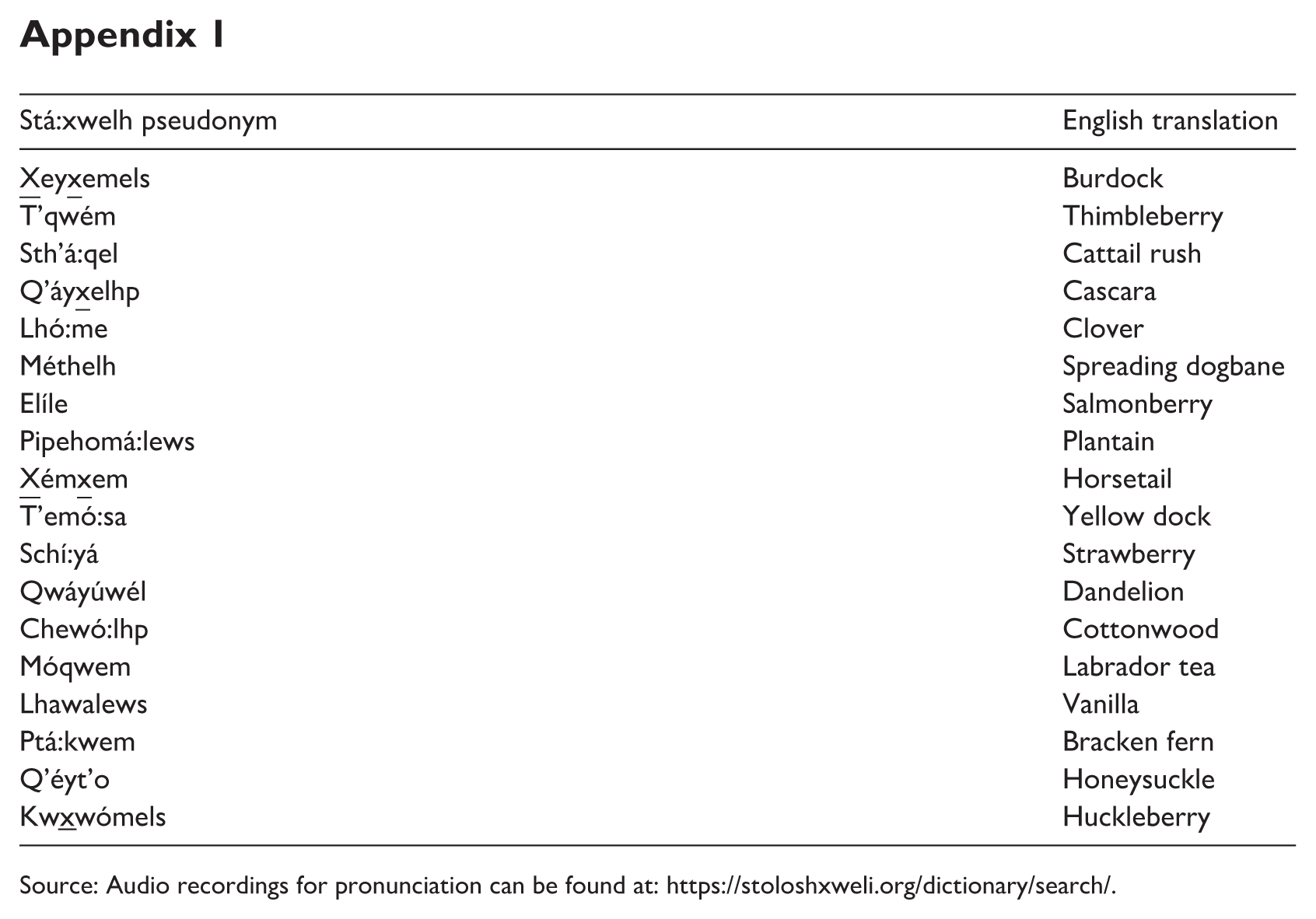
In total, we interviewed 16 First Nations and two Métis students, two of whom were recent alumni; 15 identify as female, 2 as male, and 1 as non-binary, which reflects the gender distribution of Indigenous post-secondary students in Canada (Ministry of Advanced Education and Skills Training, 2021). Their ages range from 19 to 63 years. Throughout the findings, we identify each participating stá:xwelh through a plant name expressed in Halq’eméylem. 3
Analyzing our learning
Part of our data analysis was conducted orally during our ongoing research team meetings. We discussed the stories we heard and how they affected us, as well as commonalities that began to take shape across them. This process informed a thematic coding of the interviews, which was conducted in accordance with constructivist grounded theory principles (Charmaz, 2014; Thornberg and Charmaz, 2012). Our initial coding involved inductively identifying and naming discrete ideas and actions by carefully reading each transcript line-by-line (Flick et al., 2014). We followed Charmaz’s (2014) advice of focusing on process through incorporating gerunds in our labeling. To avoid “speaking over” stá:xwelh with our interpretations (Hrenyk and Salmon, 2024), we used in vivo codes extensively, captured through expressions like “being pinpointed” and “being othered.” We also revisited the recordings to ensure that the overall stories and expressions of stá:xwelh were not lost in the parsing associated with initial coding.
We then proceeded to focused coding, where we used constant comparison to group codes into categories (Charmaz, 2014). Although surfacing similarities can be powerful and point to priority areas for making changes, we were alert to not obscuring important differences, such that stá:xwelh would be “thrown into a bucket and like this is how you all feel” (Schí:yá). The unlearning categories, as well as “personal regard” and “rhythmic inclusion,” gained traction at this analytic phase. Their interrelationship and the complexities inherent in the “balancing points” emerged as we moved into theoretical coding, which aims to coherently explain the processes occurring within data (Flick et al., 2014). Our integrative framework of responsive Indigenization is the culmination of this phase. In presenting and unpacking these ideas in the following section, we reaffirm Schí:yá’s words that we are not implying that stá:xwelh are speaking for all Indigenous peoples on Turtle Island. Yet, we believe the framework, rooted in their realities, has not only enriched our own learning, but similarly will for readers. We include additional examples of core thematic codes and categories in Table 1.
Additional illustrations of thematic codes and categories.
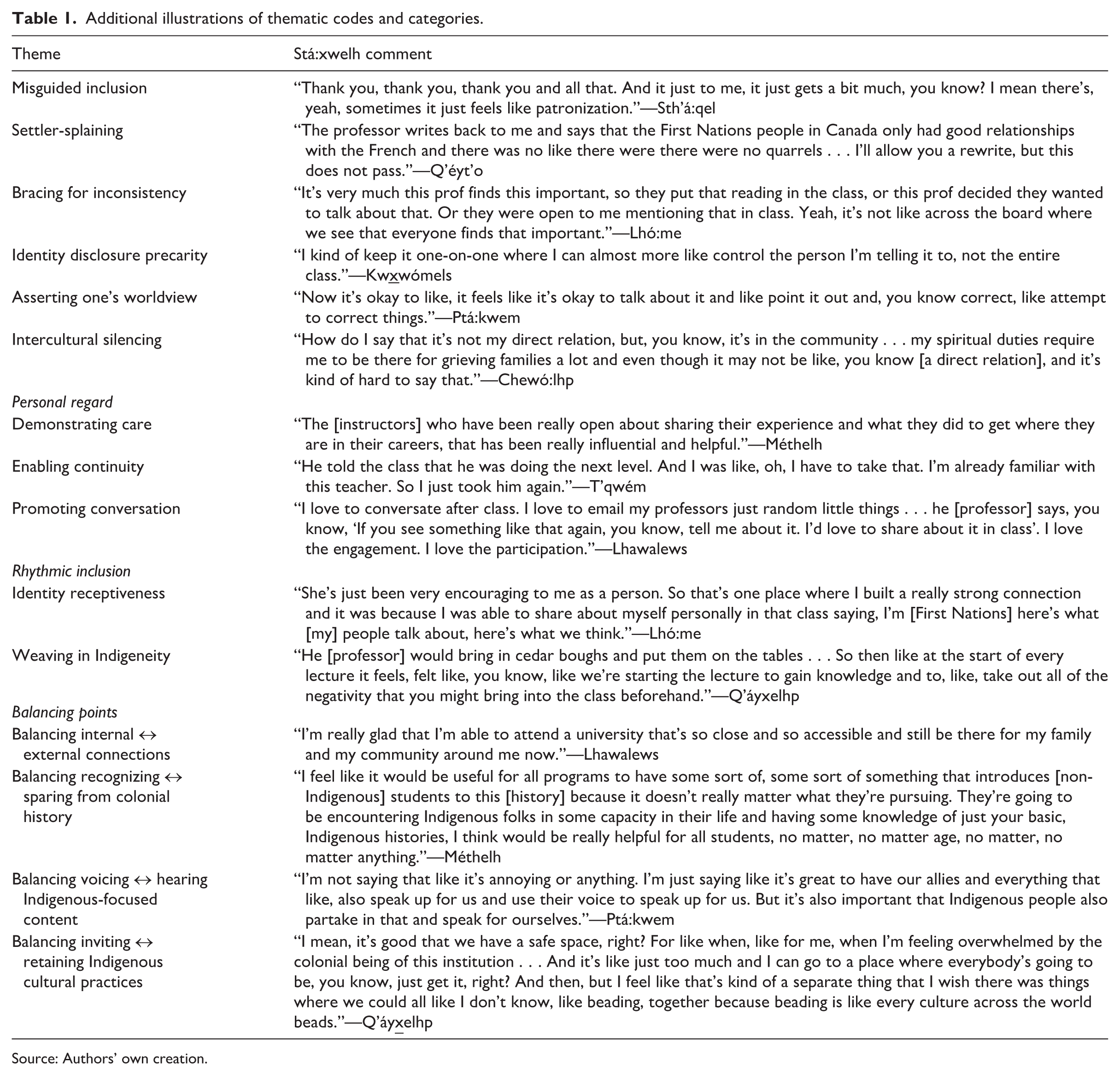
Source: Authors’ own creation.
Unlearning and learning from stá:xwelh
We open by elaborating on the context within which Indigenous post-secondary students navigate and interpret liminal decolonization. Then, we transition to discussing the pedagogic practices that stá:xwelh indicated need to be unlearned: robotic relationships and partial and misguided inclusion. The sections that follow in turn explore the components of responsive Indigenization as voiced by stá:xwelh: a foundation of personal regard and rhythmic inclusion of Indigenous ways of knowing and being, which support balancing points related to interpersonal connections, colonial history, Indigenous content, and Indigenous culture.
Contextualizing liminal decolonization
There are key differences in the paths that Indigenous students pursue to arrive at university (e.g. immediately from high school, beginning as mature students, or returning after previously exiting), as well as their connection to their communities. Access to supports also varies depending on students’ “status” (i.e. whether they are legally recognized under Canada’s Indian Act), live on or off reserve, and their family’s socioeconomic circumstances. While Indigenous peoples face barriers due to social and educational marginalization (Brant, 2022), as
Being an Indigenous person in Canada and pursuing formalized learning requires “going back and forth between the culture and the colonized” (Ptá:kwem), or as Q’éyt’o shared: “Indigenous people have Indigenous something, and they’ve carried that with them all the time while also learning western education.” In addition to having “to know what was going on on the Disney Channel but also ha[ving] to know your cultural protocols” (Lhó:me) while growing up, all stá:xwelh had encountered incidences of racism in Western educational settings. These experiences contributed to anxiety about attending post-secondary: “I thought of it [university] as quite scary because I’ve experienced quite a lot of racism growing up . . . I assumed that I would be discriminated against” (Pipehomá:lews) and mean events occurring there can trigger “trauma regarding school, that I didn’t realize that I even had” (Ptá:kwem). Feeling alone in one’s Indigeneity on campus can compound these apprehensions. Méthelh remarked that “everybody in all of my classes is non-Indigenous” and
Stá:xwelh were alert to the changing political landscape related to Indigenous peoples in Canada and accelerated by the TRC’s final report and Calls to Action. Schí:yá commented on how “nobody talked about it the first time I went to school, it wasn’t something that people had conversations about.” Upon returning to university after a 10-year break, T’qwém noted “the political climate has been helpful, like it’s very pro-Native.” What Q’éyt’o characterized as “attempts to Indigenize” were palpable, or as Ptá:kwem explained: “I know that everyone in the university is trying to like, decolonize and stuff, but there are certain aspects that I guess aren’t quite there yet.” We learned that being immersed in an institution where on one hand “there’s an effort being made” (Méthelh), but on the other is “very institutional, very colonial” (Elíle), creates distinct challenges for Indigenous students “that can be really hard.”
Unlearning “robotic” relationships
Featuring Indigenous imagery (e.g. “they’re bringing in a lot more of the Indigenous art and stuff around the campus” (Móqwem)) and languages in official documents (“we see that written [in local First Nations language] on every single parchment” (Q’éyt’o)) signals organizational unlearning of western superiority. Yet, a reciprocal relational spirit may only occasionally be embodied in the day-to-day interactions that structure students’ educational journeys: signing up for courses, purchasing course materials, and applying their funding, among other administrative tasks. These “impersonal” (Q’éyt’o) moments were jarring and led some stá:xwelh to question whether they belonged in that space: “My first year, I really struggled with navigating this system, and I still do” (Lhawalews). As a Band-funded student,
How instructors interact with Indigenous students is therefore critical for maintaining, or more often building, their sense of belongingness. The imposition of boundaries around communication possibilities and disinterest in students’ personal lives align with western conceptions of “professional” (Lhó:me) but preclude the kinds of relationships stá:xwelh desired: “There was really no relationship at all. It was very to the point, answer your question, move on” (
Some stá:xwelh responded to impersonal interactions by disengaging from those courses. In recounting a related ongoing experience, Lhawalews was “saddened” by how “I’m really struggling with motivation to go there. It’s [content] easy, but still, I just struggle to, you know, making myself go.” For others, it had farther-reaching effects, leading them to delay taking courses with certain instructors (“I had to wait two years . . . it was such a hurdle” (Elíle)). Méthelh noted how: “I have specifically not chosen to pursue taking a class for my degree because of just generally hearing from other Indigenous students and learners about their experiences.” To add further insight, Pipehomá:lews explained “the way you are treated when you are getting your education” is what differentiates Indigenous students who continue and have “a wonderful experience” from those who “drop out of your courses and never go back. And that happens a lot with Indigenous people.” Indeed, for Q’éyt’o, unapproachable instructors and “not having like relationships with people in the university” played into why she had previously dropped out.
Unlearning “partial” and misguided inclusion
Rather than anticipating the omission of Indigenous content, as was the case in earlier decades, now when students enter the doors of a classroom, they do not know to what extent or how an instructor will incorporate it into the course. Lhó:me described “partial” inclusion: It’s just like pockets . . . I feel like I go into one class and it’s more Indigenous oriented and I can put on that little hat and then I leave that, I kind of have to take that off because I’m going to a different space, where that’s not the perspective and those things aren’t really understood or things maybe aren’t as like respected.
We define misguided inclusion as incorporating Indigenous content in a way that is misaligned with its cultural intent or as if it is “for” Indigenous students. As examples of the former, Lhawalews referenced land acknowledgements in “a little section at the bottom of your slides” rather than sharing them orally, and others lamented the repeated mispronunciation of Indigenous words (e.g. local First Nations). When it comes to the latter, T’qwém described how, while she appreciated hearing land acknowledgements in class, “it’s awkward for me because everyone looks at me when it’s happening . . . those professors try not to, but they’re like, ‘hey man, you.’” Ptá:kwem recalled an instructor who took her aside to apologize for not including Indigenous content more thoroughly. While she appreciated the sentiment to some extent, the situation was “uncomfortable . . . I just kind of felt like it was very profiling” and others similarly reported stress from being singled out as Indigenous students without being the ones to offer their knowledge. We were struck by how Elíle referred to this uncertainty as a “roller coaster.”
Another aspect of partial and misguided inclusion is the unpredictable responses students receive when Indigenizing their assignments, which they are increasingly allowed or encouraged to do. If instructors respond negatively or grade Indigenized assignments using a purely western frame, it is experienced as a harmful rejection of a student’s identity. I had one professor dock me a mark on my self reflection because my title was too creative and yeah, I was like, I’m an Indigenous person, storytelling is a huge part of our culture and you don’t like my title? Like it seemed like, you know, he didn’t appreciate creativity in the same way as somebody who does understand kind of like the oral storytelling better . . . I don’t know if [instructors] know it’s hard, but it’s hard for me.
Stá:xwelh sometimes pushed back against misguided inclusion by asserting their worldview: “I do confront my professors when I feel as if they are saying something disrespectful or if they’re wrong . . . I’ll point it out and say, oh, you know, it’s this way, not that” (Lhawalews). However, other times, the gap between their reality and what they were hearing felt too wide to attempt to bridge, leading to a sense of being silenced: “I don’t like having to explain that sometimes” (Chewó:lhp) or “Absolutely, what do I say? . . . I didn’t know what to say” (Q’éyt’o). In either case, it created palpable frustration: “I get frustrated at [university], and the way I have to adapt myself all the time” (Lhó:me). Inconsistency can also undermine a sense of safety. T’qwém said how now when an instructor omits a land acknowledgment it’s “like, oh, wait a second, why aren’t you acknowledging the lands? I thought that was the thing you had to do” and so “you’re like what’s happening here? I’m like, is it you?” as in the instructor rejecting their inclusion. Elíle explicated how misalignment between words and deeds meant that even though she persisted with her education, “[I’m] not as trusting as I used to be” because if “it’s not followed through . . . it’s hard to kind of like face that and it’s also, like makes it scarier.” When there’s “not like an automatic guarantee kind of thing” that students will feel accepted as Indigenous peoples in class, “it’s just so incredibly difficult to feel safe” (Pipehomá:lews).
Responsive Indigenization
In addition to surfacing pedagogic practices that must be unlearned, through stá:xwelh’ stories, we learn what it can mean to feel genuinely “at home” in being an Indigenous post-secondary student, allowing us to articulate a new vision for a responsively Indigenized business school. We use the term “responsive” because it is rooted in the expressed desires of Indigenous students. We illustrate this vision in Figure 1. It centers on an ongoing and mutually reinforcing interconnection between personal regard in relationships and rhythmic inclusion of Indigenous ways of knowing and being. This foundation supports four balancing points, which capture opposing desires of individuals within localized circumstances. The ongoing work of attending and adjusting involved in balancing affirms the differences among Indigenous students.
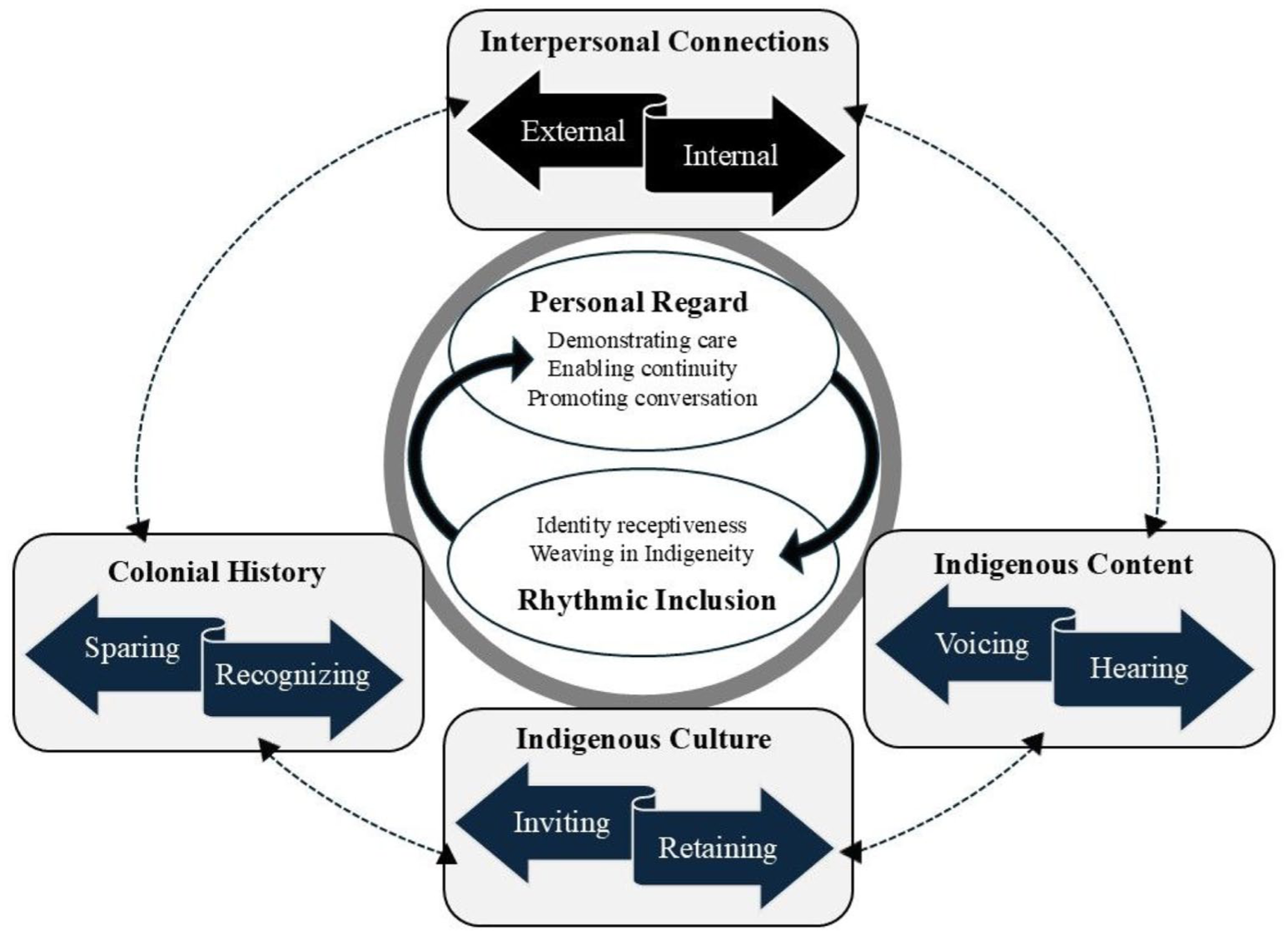
Integrative framework of responsive Indigenization.
Learning to embody personal regard
In place of “traditional” (Kwx̲wómels) or “dehumanized” (Q’éyt’o) relationships among students and staff or faculty, a responsively Indigenized post-secondary experience rests on a foundation of personal regard. The three related themes expressed by stá:xwelh are demonstrating care, enabling continuity, and promoting conversation. Móqwem described how these behaviors impacted her: “It fills my cup and allows me to be able to get the schoolwork done without feeling too drained or feeling overcome or burnt out.”
Demonstrating care
Unlearning robotic teacher–learner dynamics and learning personal regard means abandoning entrenched patterns of hierarchy and formality. There is no place for impersonal “hoop jumping” ( I love like getting to know my professors because they all have like doctorates in their respective fields. And I want to know, like how they got to those, to make those decisions, to like become instructors and like why they even did so. (Q’áy
Caring relationships also do not cease at the classroom threshold: “Spending extra time after class to share what they know and share their experiences has been really helpful” (
Enabling continuity
The western academic structure is fragmented in that each course typically comprises different students and, aside from assumed prerequisites, is disconnected from previous semesters: students navigate their programs individually. Stá:xwelh, however, identified how the continuity they craved could be made possible. For one, through instructors maintaining connections with them beyond the semester, which shifted Kwx̲wómels’ attitude toward university: “I’m a lot less stressed about every semester. It’s just kind of more about the learning journey.” This can involve checking in by email, providing research assistant opportunities, or be as simple as taking the time to stop and chat when walking by a former student in the hallway: “she immediately recognized me, and I was so excited to see her” (Pipehomá:lews). When assignments are structured to allow students to get to know one another, it helps them “get comfortable . . . we always made sure we sat next to each other . . . I think that was very wholesome, like just having this kind of friend” (Ptá:kwem). Lhawalews reiterated: We’re doing a lot of group assignments, which is nice. I think it really helps me bond with them [classmates] and having small talk before lectures, which is really nice. I feel like, you know, it’s nice to have a friendly smile versus sitting down and not saying anything.
We also raise the positive possibility of cohort models, which Kwx̲wómels experienced temporarily during the pandemic, or multi-semester courses because: “being in multiple courses with the same person, that can be helpful to have a familiar face” (Méthelh).
Promoting conversation
Regardless of the course structure or topic, all stá:xwelh yearned for “having back and forth conversations and learning from each other and having meaningful debates in class” (T’emó:sa). Conversations were means of sharing ideas and experiences from which they could glean knowledge, rather than a dialectic aimed at identifying incontrovertible truths. Móqwem said, “As an Indigenous person, you’ll learn more through stories.” Learning can then become mutual: “I think all teachers learn from their students to a degree in conversations and hearing different points of view” (T’emó:sa).
Learning to embrace rhythmic inclusion
Bringing in occasional references to Indigenous peoples or asking Indigenous students what “they” want may feel like inclusion from a western perspective, but it can actually reinforce “othering” (Lhó:me). Instead, we introduce the concept of “rhythmic inclusion” such that students can come to rely on rather than be surprised by the integration and acceptance of Indigenous perspectives. This necessitates consistency with respect to both subthemes of “weaving in Indigeneity” throughout every course and “identity receptiveness.”
Weaving in Indigeneity
Stá:xwelh envisioned an education system where Indigenous ways of knowing and being are “infused” rather than “just being like a one-day conversation that kind of happens” (Schí:yá). This requires “go[ing] from awareness to inclusion and involvement, like involving ourselves and immersing ourselves in actually practicing and sharing Indigenous knowledge and pedagogy” (Q’éyt’o). Schí:yá expanded on how it means: “You wouldn’t even be able to kind of pull that piece out at all. But if you did, it would kind of like crumble.” Stá:xwelh were exuberant about instructors who consistently and respectfully incorporated Indigenous content. Q’áy I think it has helped me just be more excited about being Native, I guess. Like, not that I wasn’t before, I wasn’t really ashamed of it. But, I never really paid attention to it. I’m like, I’m just me, right? But it is nice to hear that other people are paying attention because there have been a lot of struggles. (T’qwém)
Weaving allows Indigenous students to learn more about their cultures, which was especially valued by urban and non-local stá:xwelh: “I haven’t necessarily had the privilege of growing up with the cultural connections and the cultural traditions. So, it’s kind of been a process of me trying to learn those things, learn my language while residing down here” (Méthelh).
Identity receptiveness
With a foundation of personal regard in place, stá:xwelh wanted to bring their full identities to their courses and to expect that, however they do so, will be met receptively. That means allowing students to be themselves without being “pinpointed” (Elíle) or having to explain, beyond what they choose to offer. If Indigenous peoples are discussed in class, it involves: “Recognizing that Indigenous Nations are just that: they’re different Nations” (Méthelh) or as Chewó:lhp said: “[First Nation] is 23 nations, it’s and that means thousands of people, we’re not just a one Nation, one group of people.” Focusing assignments on Indigenous communities or topics, either because they have requested to do so (e.g. “he probably didn’t even know what I was really asking maybe, but he let me do a full economic analysis of our community” (
Learning to engage in ongoing balancing
In listening to what decolonizing and Indigenizing should be from the perspective of stá:xwelh, we heard that it is a living process. Just as they have needed to navigate two worlds throughout their lives, so instructors and institutions will continuously need to work to balance pulls in opposing directions to respect the diverse experiences of Indigenous students. Below, we describe the balancing points raised in our conversations and thus incorporated in our integrative framework of responsive Indigenization, recognizing there may be others that are relevant to Indigenous peoples in different contexts. The first balancing point (internal ↔ external connections) is most strongly related to personal regard in relationships, and the remaining three (recognizing ↔ sparing from colonial history, voicing ↔ hearing Indigenous-focused content, and inviting ↔ retaining Indigenous cultural practices) connect to rhythmic inclusion.
Balancing internal ↔ external connections
As much as stá:xwelh desired their educational experiences to be organized around caring, continuous, and conversational internal relationships, these are unlikely, and should not be expected, to become dominant over external relationships with family, friends, and community members. There are several reasons why external relationships will exert a strong pull upon Indigenous students. Family and community are integral to Indigenous worldviews (Pio and Waddock, 2021). In addition, Indigenous students are more likely than their non-Indigenous peers to begin or return to education at a later stage in their lives, meaning they often have family responsibilities. Móqwem, for instance, is a busy mom raising several children. Participants without children described taking an active role in caring for siblings, parents, and grandparents, such as Ptá:kwem who said: “I mainly help my mom take care of things . . . I have four siblings, so I’m usually the one who’s a little bit more organized out of everyone, and I’m the one who kind of helps manage things like gatherings.” There will be times where external relationships must be prioritized: “When my grandson needs me, I gotta be there for him” (Qwáyúwél). Inasmuch as a responsively Indigenized institution supports internal connections with instructors and other students, it must also anticipate at least periodic stepping away from those relationships both within and across semesters. During our conversation, Chewó:lhp remarked “now that I just said it, I realize I’m probably going to have to take a break that semester so that I can help the family because these are big gatherings.” She elaborated that it was important for instructors to understand that “we’re a part of your class, but you have to know that we’re taking everything in your class and bringing it back home. While dealing with everything [there] too.”
Balancing recognizing ↔ sparing from colonial history
A core frustration expressed by stá:xwelh related to others’ nescience of colonial history, which contributes to misguided inclusion. Educators have a responsibility to recognize, that is, learn about and teach non-Indigenous students about past colonial actions and how they have shaped the present experiences of Indigenous peoples. Sometimes, Indigenous students will want to be a part of related discussions and sometimes they will not. We refer to the latter as being spared from reliving painful histories in an educational setting. Elíle explained that it “can be really hard to like, actually go to class” when she knew that non-Indigenous students would be speaking about topics connected to Indigenous peoples in a detached way, when she had been directly and negatively impacted. Chewó:lhp shared how around the time of National Day for Truth and Reconciliation: “I just felt like my grief is public and I didn’t want to think about it. I didn’t want to be acknowledged in that way. So I just kind of, I usually stay home.” The more that historical atrocities are openly addressed within the institution, the greater the duty to ensure Indigenous students are not being retraumatized. Lhawalews described the significance of being given a choice to be exempt from an in-class discussion of residential schools: “[The instructor] always gave me a heads up to that kind of thing. Emailed me after, made sure I was okay.”
Balancing voicing ↔ hearing Indigenous-focused content
This balancing point relates to how Indigenous students participate in discussions around Indigenous peoples’ experiences and organizations. It could be disheartening when instructors attempted to include Indigenous content but were hesitant to be the ones voicing it or did not correct others’ misstatements. Instead, they sometimes put stá:xwelh in a position of feeling like they needed to take on the work of educating. After a classmate made an untrue statement about Indigenous peoples, “the professor did nothing. So I did something, but it’s like I shouldn’t need to do something. Like I will, but I shouldn’t need to” (Elíle). This requires “mental and emotional labour” (Méthelh) when “we’re just here to learn . . . I’m not trying to educate the whole class about everything Indigenous. You know, you’re just trying to navigate your education and have a good day.” Elíle expressed how this “mixes up the idea that you’re there as a ‘student,’ over the ‘Indigenous person.’ That person to like teach people, and it’s very distracting from learning.” At the same time, there is immense value in hearing students who choose to offer their experiences because they feel comfortable doing so. One of When I shared my presentation [on an Indigenous case], the instructor was very heartfelt and she had actually asked if it would be okay to share my presentation sometime down the road and so that was really, I really loved hearing that.
Lhawalews echoed: “We have really, really good knowledge . . . if you’re talking about Aboriginal or Indigenous topics, talk to the people in the room who are that, if they feel comfortable.”
Balancing inviting ↔ retaining Indigenous cultural practices
The final balancing point considers how Indigenous cultural practices are integrated within classrooms and the school more broadly. By inviting we refer to the desire for non-Indigenous university members to participate in Indigenous practices and ceremonies. Lhó:me emphasized how “we can make those things accessible to non-Indigenous students and that they can understand, that we can build important connections with one another” and Schí:yá said: “The growing number of opportunities for like Indigenous culture being shared on campus is awesome to see and helpful.” In addition to “promoting more socializing between everybody and the Indigenous” (Móqwem), increasing the frequency and openness of events “would make me a little bit more proud” (Ptá:kwem). However, it is also crucial to remember the significance of cultural practices and that they may not be intended for everyone. As Chewó:lhp underscored, western peoples have appropriated or mishandled sacred knowledge and rituals. University is not the place for all cultural practices (“I’m not going to come here with my smudge bowl and be like out in the greens. I would do that at home right before I came” (T’qwém)), and certain events should be retained for Indigenous students and faculty by being held in Indigenous-only spaces.
Discussion
Our work responds to the need to better understand how Indigenous students are affected by decolonizing initiatives (Śliwa et al., 2025) and recognizes their voices “as sites of knowledge” (Gao et al., 2023: 2) in the scholarship of teaching and learning. Stá:xwelh ask us to unlearn the impersonal relationships that are likely to be comfortable for western educators, along with partial and misguided inclusion, which may feel like progress but because of its unpredictability undermines a sense of safety and belongingness. For deep unlearning to occur, people must recognize why old understandings are no longer acceptable (Fiol and O’Connor, 2017). We believe that hearing the stories that have gone “unexposed or untold” because of marginalization (Brant, 2022: 30) can catalyze business schools and instructors to act on decolonization. Continuing to center Indigenous students is critical for ensuring that the language and spirit of decolonization are not hijacked for recolonizing ends (Jammulamadaka et al., 2021).
To persist in our knowledge journey, we needed to hear that sitting with us was a positive experience for stá:xwelh and that they saw benefit in participating. Words like the following are the most important contribution of our work: “I haven’t really had this kind of discussion before up to this point. And I feel almost like some weight has been taken off my chest after this whole thing. I feel good about this” (Lhawalews). Stá:xwelh asked that we share our learning widely so that it would benefit future generations of students. As part of that process, we first expand upon how our findings contribute to the management learning literature and then provide suggestions for applying our framework within business schools and classrooms.
Theoretical contributions
Impact of inconsistent unlearning
To date, conceptualizations of unlearning have been relatively unproblematized. Initially, it was seen as a linear process where the conscious abandonment of old or non-useful knowledge and practices makes way for new and better knowledge (Hislop et al., 2014). There is increasing recognition that the process is ongoing, with unlearning and learning occurring simultaneously and old knowledge fading only gradually, especially when it relates to norms and values (Klammer et al., 2024). An additive view is implicit in this perspective: if old knowledge is bad and new knowledge is good, then some unlearning is better than none. Not only is there limited research on how workers’ unlearning efforts affect those with whom they interact, but it has also been argued that outcomes can only be assessed after the process is “completed” (Klammer et al., 2024: 13). Such views are complicated by decolonization as a pathway to unlearning because there is no end point (Abdallah, 2025). Śliwa et al. (2025: 157) describe it is an “ongoing process” where “our efforts are bound to bring about results that will be imperfect and incomplete.” We argue that this feature does not absolve institutions from considering the impacts of their initiatives.
We show how exposure to inconsistent unlearning—interacting with organizational members who are at different stages of unlearning or who have not invested in understanding how their actions are misguided—is not neutral or “better than nothing” when it comes to decolonization. Rather, it creates uncertainty and substantial work for marginalized people. For instance, are Indigenous students able to or supposed to put on their “Indigenous hat” or will doing so be problematic? Needing to figure out how much of one’s identity to share can provoke anger when expectations are unmet or undermined safety from others’ variegated responses. Hence, the intersection of unlearning and marginalization is complex in that actions that may be intended to move people away from the margins can have an opposing effect.
Strengthening the relational fabric of business schools
Our findings build on previous research that has identified relationships like mentoring as integral to Indigenous students’ sense of belonging (Pidgeon et al., 2014). Stá:xwelh remind us to also think about the day-to-day interactions that structure their educational journeys, such as in relation to securing funding, obtaining educational advice, and enrolling in courses. These interactions are the foundation of what we argue should be reconceptualized as a student’s relationship with the institution. Rather than developing and implementing policies, which is a western preoccupation, educational events (e.g. acceptance into an academic program) can be reframed as offerings to relationship. What might seem like a small incident or “just following the rules” to someone who is steeped in western post-secondary culture can have immense repercussions for students who are in the process of determining whether there is space for them within the institution.
Decolonizing the curriculum (Liu, 2022; Śliwa et al., 2025) asks management educators to rethink how they build relationships with students. Since Kirkness and Barnhart’s (1991) seminal work, other scholars have advanced the notion that relationships are the glue that hold the Four Rs together (Tessaro et al., 2018). We add personal regard to the Rs in extending upon how students want those relationships to materialize: through care, continuity, and conversation. Students lit up when recounting such interactions, where instructors were fellow humans rather than information imparters, and they serve a mooring function, given the pull that many will also feel toward their external relationships. Thus, unlearning impersonal relationships and learning to become comfortable with caring, continuous, and conversational connections with all students is paramount for building an inclusive space that can respectfully hold Indigenous content.
Responsive Indigenization framework
Engaging in research with marginalized populations cannot just be an intellectual exercise—theoretical contributions must involve positive change (Chowdhury, 2023). Jammulamadaka et al. (2021: 727) address this issue by asking “how do we do decolonization rather than turgid theorisations of it?” Our integrative framework of Indigenization is one answer, among what will necessarily be many. We elevate the principle of consistency, as it relates to weaving in Indigenous ways of knowing and being. We refer to this practice as rhythmic inclusion because it is regularly recurring and harmonious. It also invokes an artistic approach to learning, which may help instructors to shed the neoliberal aim of efficiently downloading information to students (see Kostera and Strauß, 2022). By reducing the uncertainty and identity disclosure risks that provoke stress in Indigenous students, there is greater possibility for “not knowing” safely and together. The consistency of rhythmic inclusion will also support non-Indigenous students in adapting to new ways of doing and thinking, which are likely to initially be uncomfortable (Hrenyk and Salmon, 2024).
Western conceptualizations of unlearning tend to be goal-directed, implying that exactly what the new learning is will be known (Grisold et al., 2020). The balancing points embed differences into Indigenizing, while also recognizing that it is a living process. Each student’s post-secondary experience will be shaped by their backgrounds and the supports available to them. An Indigenous student who grew up without connections to their community might appreciate the opportunity to discuss colonial history, such as the legacy of residential schools, within the classroom. Conversely, a student whose family members were forced to attend such schools may not want to relive that harm in the presence of their instructor and classmates. Students’ desires also evolve over time. By providing management educators with interconnected points to attend to, but not a recipe to follow, our framework guides continuous interrogation (Liu, 2022) of the impact of their actions on both students and themselves.
Implications for institutions and educators
While essential, we anticipate two reasons why reorienting relationships around personal regard may be challenging for management educators. First, it can be unnerving to let go of the western practices of hiding vulnerabilities and conveying disciplinary mastery. Second, the time required to build such relationships runs counter to the rationalization of business schools. Like corporations that are extolled to increase revenues and cut costs to maximize profits, neoliberal universities require doing more (e.g. increasing class sizes and publication requirements) with less (e.g. funding and support staff) (Liu, 2022). A student’s absence is less likely to be noticed in a large class, and instructors who are overwhelmed by administrative tasks and publication pressures may feel unable to take time to converse with students outside of class. Professing decolonization while tightening market-based controls is doomed to fail. We believe that instructors have an obligation to Indigenous students, but institutions must structurally support them in upholding it. With that in mind, we expand upon how management educators can attend to each balancing point in embarking upon the responsive Indigenizing process.
Team projects, which have a long history in business schools (Goltz et al., 2008), can be a means of balancing the importance of internal (e.g. peer, student–instructor) and external (e.g. family, community) relationships. Stá:xwelh appreciated the deeper internal connections that could be built through such projects. However, needing to meet outside of class interfered with external relationships and was difficult for those living far from campus (e.g. on reserve) with limited transportation access. Team projects designed to be substantially, if not wholly, completed during scheduled class time are more inclusive of Indigenous students. By observing teams working, instructors can also be alert to signs of exclusion and proactively intervene.
How can colonial history be grappled with inside the business classroom? Let us begin by recognizing the power dynamics of colonialism and how they have shaped organizations. Rather than presenting business concepts as value neutral (Battiste et al., 2002), their colonial histories can be acknowledged, and attention drawn to differences between western and Indigenous ways of organizing and doing business (e.g. Colbourne et al., 2024). Because this learning is not “for” Indigenous students, they should be provided with options for how to engage in assignments or discussions that incorporate colonial history; whether this is done through one-on-one dialogue or course policies will depend on the relationships that instructors cultivate with students.
Management educators can voice Indigenous content by integrating cases, examples, and practices (e.g. Berge, 2020) into their courses. Simply looking for Indigenous-related terms is insufficient; rather, materials must be read thoughtfully to ensure they do not depict stereotypes (Hrenyk and Salmon, 2024). Language is critical, as stá:xwelh were positively impacted when instructors described the multiplicity of Indigenous communities, the resurgence of Indigenous ways of knowing and being, and how Indigenous peoples and businesses are “thriving. . .it doesn’t matter what you want to do, there’s space for you” (Chewó:lhp). Hearing does not involve singling out or expecting Indigenous students to respond to these examples. However, if self-initiated, instructors should provide space for sharing and positively reinforce insights. Over time and through consistent hearing, students’ confidence to express themselves in larger groups may grow organically, as described by Ptá:kwem and Kwx̲wómels.
There are numerous ways to welcome Indigenous culture into the business school. Elders and Indigenous learning specialists can be invited to relay their experiences. Having members of local Indigenous communities share their expectations for land acknowledgments will help all students learn to deliver them respectfully. Indigenous students can be supported in retaining their practices by decolonizing course syllabi, such as acknowledging times of year where they might have community responsibilities and integrating bereavement accommodations that are inclusive of deaths in the community. Students can thus be assured that should they be away from class for cultural reasons, it will be respected without requiring detailed explanations.
Limitations and future research
Our study is rich with stories and one of the few that involves undergraduate Indigenous students. However, we recognize that there are students who may not have felt comfortable identifying as Indigenous or contributing, and whose views are therefore not reflected in our framework. Because participants were predominantly female, additional research focused on male and two-spirit students could enrich and extend our ideas. We also acknowledge that two of the authors are non-Indigenous and so have different worldviews than stá:xwelh. We encourage future inquiries that highlight the perspectives of Indigenous management educators, as well as Indigenous students in different regions. As business schools take up our framework, they will become more welcoming spaces for Indigenous students. It will also create new possibilities for research that explores how to responsively Indigenize specific business courses.
Conclusion
The integrative framework of responsive Indigenization we develop is one thread in a growing tapestry of scholarship about Indigenous pedagogy (e.g. Doucette et al., 2021; Pio and Waddock, 2021; Woods et al., 2022) and research by Indigenous management scholars (e.g. Bastien et al., 2023; Hrenyk and Salmon, 2024; Price et al., 2022). We show how regardful relationships and rhythmic inclusion anchor dynamic considerations about interpersonal connections, colonial history, Indigenous content, and Indigenous culture. While there is no easy path to reconciliation, attending to the four balancing points contributes to honoring the diversity of Indigenous students. We hope that hearing from stá:xwelh about their positive experiences at university, meaningful connections with faculty and peers, and pride in using their learning in ways that matter to them, will spur readers to embrace this perpetual process. As educators, this work is not something we do first so that we can teach: it is the work and it is the teaching.
Footnotes
Appendix
| Stá:xwelh pseudonym | English translation |
|---|---|
| Burdock | |
| T’qwém | Thimbleberry |
| Sth’á:qel | Cattail rush |
| Q’áy |
Cascara |
| Lhó:me | Clover |
| Méthelh | Spreading dogbane |
| Elíle | Salmonberry |
| Pipehomá:lews | Plantain |
| Horsetail | |
| T’emó:sa | Yellow dock |
| Schí:yá | Strawberry |
| Qwáyúwél | Dandelion |
| Chewó:lhp | Cottonwood |
| Móqwem | Labrador tea |
| Lhawalews | Vanilla |
| Ptá:kwem | Bracken fern |
| Q’éyt’o | Honeysuckle |
| Kwx̲wómels | Huckleberry |
Source: Audio recordings for pronunciation can be found at: https://stoloshxweli.org/dictionary/search/.
Acknowledgements
The authors express their genuine gratitude to the students who took the time to participate in this knowledge journey. They also thank Leanne Joe for her Halq’eméylem language guidance. This manuscript has substantially benefited from the advice of Associate Editor, Dr Maria Canal, and from the suggestions provided by five anonymous peer reviewers.

Ethical approval
The Human Research Ethics Board at University of the Fraser Valley approved our interviews (Approval No.: 101276) on 30 January 2023.
Consent to Participate
Participants gave written consent for review and signature before starting the interviews.
Funding
The authors disclosed receipt of the following financial support for the research, authorship, and/or publication of this article: This work was supported by a University of the Fraser Valley administered SSHRC Explore Grant.
Declaration of conflicting interests
The authors declared no potential conflicts of interest with respect to the research, authorship, and/or publication of this article.
Data availability statement
The participants of this study did not give written consent for their data to be shared publicly, so due to the sensitive nature of the research, supporting data is not available.