




Abstract
This article engages with the growing literature on visuality in work and organisations to examine how glitter functions as a compelling aesthetic means, organising how we perceive workers and work. Drawing on an empirical illustration of women STEM workers and work, it shows how glitter is deployed to enhance visibility, inviting broader gendered identification and encouraging more young women to pursue future STEM careers. However, by developing the new concept of ‘visual cuts’, the article argues that glitter does more than make visible, as it also renders invisible. Glitter directs visual attention towards certain representations of women STEM workers and work while obscuring others, thereby limiting understandings of diversity in STEM careers. Nonetheless, the article concludes that glitter retains a radical potential for organising more diverse workspaces thus emerging as a complex aesthetic means with critical implications for how we understand visibility, knowledge, ignorance and value in work and organisations.
Keywords
Introduction
Glitter is a ubiquitous aesthetic means found in a variety of settings, and it thus plays a significant role in most people’s lives (see Coleman, 2019, 2020, 2022; Coleman and Osgood, 2019; de Aráujo, 2019; Iqani, 2022; Osgood, 2019; Sandager, 2022, 2024a, forthcoming; Seymour, 2022; Plotnikof, Dille and Sandager, 2025). Glitter vividly dazzles from the cosmetic products we powder on our faces; it sparkles from the clothing we wrap around our bodies; it shines from the glossy paint on cars and bikes daily taking us from one destination to another; it vibrantly gleams from shop decorations, especially during festive seasons; it sparkles from silverware at formal dinner settings; it radiates from recent history, where it has been key in making the glam rock movement and figures like Ziggy Stardust, Gary Glitter and Iggy Pop famous; it flamboyantly flashes at celebratory pride parades; it twinkles on ‘vajazzled’ genitals and pubic hair; it flickers from outdoor restaurant umbrellas to scare off birds; it beams from iridescent fishing lures; it glitzes from animated children’s TV shows; it energetically blazes from glitter-bombs, used to express a critical stance towards homophobic politicians in non-violent ways; it rays from the packaging of fancy food and drinks we consume, while it also blinks in food and beverages, for instance, taking the form of edible sugary sprinkles on cupcakes or little sparks in tinted cocktails.
Narrowing the focus to work and organisations, we see a similar overwhelming omnipresence of glitter. Glitter shimmers from the many tech devices that make possible modern work life; it shines from the interior of stylish meeting rooms, framing crucial corporate decisions; it sparkles from the blank metal of impressive espresso machines, where informal – but often highly important – collegial updates are given; it beams from the steel instruments used for surgical procedures in medical clinics and hospitals; it twinkles from golden watches on the arms of high-profile CEOs; it blazes from the merchandise given to students at aspiration-raising career fairs in business schools and, as this article shows, it flashes from educational policy campaigns, intended to diversify future work and organisations, through mesmerising glitz and glow.
One might think that the omnipresence of glitter (also) in work and organisations has led to an ample amount of research critically scrutinising the enactments of this aesthetic means. Yet, in work and organisation studies, glitter seems largely overlooked as relevant for critical research, with only very few scholars having turned their attention to glitter (see Sandager, 2022, 2024a for exceptions). The sparse attention shown to glitter might be explained by glitter being an aesthetic means ‘. . . associated with fun, frivolity, magic and enchantment’ (Coleman, 2020: 10) and thus pure innocence, neither harming workers or work – in fact, maybe rather the opposite, by spreading a little bliss and joy amidst the triviality of everyday organisational working life. However, glitter is not pure innocence, and this article thus critically explores glitter as an aesthetic means with bleak implications for both workers and work (see Sandager, 2022, 2024a).
More specifically, the article explores the bleak implications of glitter with an empirical illustration from the case of women in STEM (Science, Technology, Engineering and Mathematics) work, namely an educational policy campaign launched by the European Union (EU) to attract more young women to future STEM education and careers. Women have been underrepresented in STEM work for decades (Organisation for Economic Co-operation and Development (OECD), 2017; World Economic Forum (WEF), 2025), and women STEM workers and work have thus been saturated with glitter over the last few years with the aim to make visible these workers and this work, thereby enabling more young women to identify with and pursue future STEM education and careers (Sandager, 2022, 2024a, 2024b, forthcoming; Sandager and Pors, 2022; see also Andersen et al., 2024; Plotnikof and Pors, 2024; Plotnikof et al., 2025).
To critically study the bleak implication of the aesthetic means of glitter, the article finds inspiration in the visual turn in work and organisation studies (e.g. Bell et al., 2014; Boxenbaum et al., 2018; Quattrone et al., 2021; Shao et al., 2024), as well as in thought-provoking literature on the aesthetic means of light (Bille and Sørensen, 2007; Edensor, 2012, 2017; Katila et al., 2023) and colour (Beyes, 2017, 2024; Beyes and De Cock, 2017; Kisacky, 2012). The latter literature argues that the seemingly innocent aesthetic means of light and colour allow workers and work to become through complex processes of in/visibilisation, while it also points to the need to scrutinise the enactments of ‘innocent’ aesthetic means to ensure that we do not end up blindly ignorant of important workers and work. Lastly, the article draws inspiration from Karen Barad’s (they/them) feminist new materialism, suggesting that worlds are worlded through in/exclusionary cuts in and among various inextricably entangled elements. The article utilises Barad’s work to develop the new concept of ‘visual cuts’, enabling it to explore the aesthetic means of light, colour and, in particular, glitter as specific apparatuses worlding worlds of work through the production of visual in/exclusions and thus in/visibilities.
The article is structured in five sections. The first section introduces literature on different processes of in/visibilising workers and work, including studies on the aesthetic means of light and colour, before merging this literature with Barad’s feminist new materialism and theory on glitter in the second and third sections. The fourth section is dedicated to analytical explorations of a glittery worlding of women’s STEM work. This section serves the primary purpose of exploring glitter as a materialised apparatus while further analytically studying the bleak implications of worlding with this materialised apparatus. The article concludes with a final section, discussing the article’s findings and the broader relevance of turning to glitter in work and organisation studies when seeking to promote organisational diversity. The section argues that, despite the bleak implications glitter might have for workers and work, this aesthetic means still retains a radical potential for disrupting norms and opening workspaces for greater diversity, creating a paradoxical tension that demands deeper scrutiny of glitter within work and organisation studies.
Processes of in/visibilising workers and work
A large body of literature emphasises the vital role played by visuality – visibility as well as invisibility – in work and organisations (Boxenbaum et al., 2018; Quattrone et al., 2021; see also Bell and Davison, 2013; Bell et al., 2014). The literature argues that what comes to matter as work is merely what is made directly visible for us to perceive, while much important work is also overlooked, creating ignorance of what constitutes valuable workers and work. For example, arguing for a continuum of in/visibility, Star and Strauss (1999) contend that workers and work are made in/visible through processes of ‘[a]bstracting and manipulating indicators’ (p. 9). These processes make work visible through purchasable commodities, clearly demonstrating productive work has been done, while concurrently invisibilising the workers behind the work. The in/visibilising processes dynamically emerge when commodities are produced far away from where they are purchased and thus travel through extended supply chains. The extended supply chains leave consumers only to see the final commodities, often in enchanting settings of glittery luxury shops (see e.g. Endrissat et al., 2015; Ritzer, 2005), while the workers crafting the commodities, as well as the less enchanting organisational settings in which they usually work, are ignored.
Ham and Gerard (2014) point to the same continuum of in/visibility – or ‘links between in/visibility’ (p. 298) – as Star and Strauss (1999). However, contrary to Star and Strauss (1999), Ham and Gerard (2014) do not describe processes of in/visibilising workers and work as dynamically emerging, but as strategically managed. Investigating sex work, Ham and Gerard (2014) show how this type of work is performed through high visibility, with sex workers being legally obliged to record their business in official registers. But, at the same time, sex workers have to adopt social invisibility, enabling them to avoid stigmas, potentially resulting in discriminatory access to necessary medical services as well as reduced chances for social mobility (see also Easterbrook-Smith, 2022; Rand, 2019). As such, sex workers and work are made visible to people actively seeking sex work but invisible to others, who become unaware of the support that some sex workers might benefit from in an industry that can be both mentally and physically violent.
Lastly, examining organisational charts in a third and different work setting of a consortium of Fortune 500 companies and government agencies, Cross et al. (2002) add a – for this article, and its explorations of glitter – relevant focus on materiality to the study of processes of in/visibilising workers and work. Scrutinising the visuality of organisational charts, Cross et al. (2002) contend that this visuality only makes visible formal work and worker networks while invisibilising informal work and worker networks, which also ‘promote organisational flexibility, innovation, and efficiency as well as the quality of products or services by virtue of effectively pooling unique expertise’ (Cross et al., 2002: 25). Based on this, Cross et al. (2002) conclude that the visuality of current organisational charts makes organisations blind to their full potential, and that we must develop new material mapping methods, allowing the visuality of organisational charts to capture both formal and informal work and worker networks.
To bring focus closer to the aesthetic means of glitter, it is relevant to introduce literature on the additional aesthetic means of light and colour. This literature does not explicitly describe which workers and work are in/visibilised through processes of in/visibilisation, nor does it address the implications of such processes. However, it does explain how aesthetic means play a crucial role in in/visibilising workers and work, while adding a relevant dimension of aesthetics to the different processes of in/visibilisation presented above.
Katila et al. (2023) argue that ‘[l]ight is fundamental to (organisational) life’ as ‘light facilitates the perception of our surroundings’ (p. 55) in work as well as in organisations. The argument of Katila et al. (2023) is supplemented by Edensor’s (2012) work on light, suggesting light is not alone in facilitating visual perception but instead plays a part in promoting such perception. Edensor (2012) contends that visual perception is facilitated through the ‘contrasts between illuminated and unilluminated space’ (p. 1106) and thus in the meeting between what light makes visible and what it does not. As such, Edensor (2012) follows the logic that visual perception is shaped by complex visuality, while he is also not prioritising the visible or the invisible when explaining how visual perception is facilitated (see also Bille, 2017; Bissell, 2009; Edensor, 2017).
Supporting Edensor’s (2012) argument on how visual perception is shaped amidst the tensions of the visible and invisible, Bille and Sørensen (2007) underline that ‘the appearance of the world is determined by the changing lightscapes, cast by the shadows in the relationship between things, persons and light’ (p. 266). Hence, these two scholars emphasise that light serves as an aesthetic means, facilitating visual perceptions through the production of in/visibility, or, if we are to follow the terminology of the literature on light, the interchangeable and vigorous visual production of shine/shadow.
Closely related to the arguments on light, literature on colour contends that this aesthetic means also ‘organises what is given to perception’ (Beyes, 2024: 15; see also Beyes and De Cock, 2017). For example, focusing on the early growth of industrial labour, Beyes (2024) describes how colour was used to order factory life by facilitating visual perceptions of factory workers and their work performance. Beyes (2024) writes that colour codes were introduced to signal either high or low worker productivity, with different colours assigned to workers to colourfully visibilise the standard of their work behaviour within a spectrum, ranging from ‘super excellence in conduct’ to ‘excessive naughtiness’ (p. 52). Colour was thus applied to facilitate visual perceptions of worker performances as satisfying or not, while this aesthetic means was also used to allow for new forms of organisation, supporting more excellent worker productivity along with higher work quality.
Referring to contemporary times, Kisacky (2012) further demonstrates the importance of colour in making workers and work visible. Focusing on modern worker activities, Kisacky (2012) illustrates how, for instance, workers performing work tasks related to surgery and the curing of illness have gone from being visibilised by the colour white to being visibilised by the colour green, with hospitals and medical clinics previously full of workers in long white robes now being occupied by workers in green scrubs. As such, the colour green has come to play a key role in shaping the visual perception of who and what different health workers and work are and involve.
However, like light, colour not only facilitates visual perception by making things visible, but also by making things invisible. According to Beyes (2017), colour promotes visual perception through a ‘play of simultaneously revealing and concealing’ (p. 1468), thereby constituting workers and work in-between that which is made available to perceive visually and that which is not. Hence, colour allows workers and work to become through the same in/visibility as the one produced by light. Yet, the in/visibility produced by colour differs from that of shine/shadow, with colour instead producing in/visibility in the form of (shiny) ‘revealing’ and (shadowy) ‘concealing’ and thereby dynamic productions of revealing/concealing.
The literature above presents different processes by which workers and work become through in/visibilisation, emphasising how (i) dynamically emerging, (ii) strategically managed, (iii) material and (iv) aesthetic processes, in similar ways, make us see some and not other elements of workers and work, thus shaping our perception of them. The article now leaves the focus on dynamically emerging and strategically managed processes, but it returns to examine material and aesthetic processes below, where it critically studies glitter as an aesthetic means, which, like the aesthetic means of light and colour, facilitates processes of in/visibilising workers and work.
Worlding through ‘visual cuts’
Arriving in queer studies from quantum physics and mechanics, Barad (2007) explores the social world through the laws of nature, finding similarities between material atoms and protons and the immateriality of sociality. They draw their primary inspiration from the work of Danish physicist Niels Bohr and the feminist work of Donna Haraway, arguing that humans are neither subjects nor objects, but instead cyborgs, equally becoming and being in and with their surroundings (Haraway, 1985, 1991, 1997). As such, Barad (2007) describes worlds as large entanglements, consisting of various im/material elements, which gain their specific cyborg existence in and through each other (see also Barad in Juelskjær and Schwennesen, 2012; Juelskjær et al., 2020).
To illustrate the importance of not privileging any elements when studying the worlding of worlds, Barad (2007) introduces the concept of ‘intra-action’ (p. 353). This concept suggests the opposite of inter-action, with the latter concept indicating that elements exist as distinct, independent entities. In contrast, intra-action reveals that elements are inextricably entangled, thereby taking on unique existences in and through each other. Hence, the concept of intra-action suggests that elements always exist as elements of each other, while we must also pay equal attention to all when studying worlds and their becoming. In clarifying how worlds become, Barad (2003) writes: The world is a dynamic process of intra-activity in the ongoing reconfiguring of locally determinate causal structures with determinate boundaries, properties, meanings, and patterns of marks on bodies. This ongoing flow of agency through which ‘part’ of the world makes itself differentially intelligible to another ‘part’ of the world and through which local causal structures, boundaries, and properties are stabilised and destabilised does not take place in space and time but in the making of spacetime itself (p. 817).
The quote reveals how Barad sees worlds as becoming through ‘a dynamic process of intra-activity’ and thus an ‘ongoing reconfiguring’. However, the quote also shows us how worlds are configured and ‘stabilised’ in specific ‘locally determinate causal structures’ before being ‘destabilised’ to stabilise anew in the dynamic process of ‘ongoing reconfiguring’. This last point is relevant to the article’s later analytical explorations, which focus on a particular local configuration in the ongoing worlding of women’s STEM work emerging in the context of an EU educational policy campaign. As such, the article does not explore the fluid in-betweenness related to intra-activity as much as it does the political implications of intra-activity and its significance in specific local configurations.
To deepen the discussion of in/visibilising processes concerning the aesthetic means of light and colour, it is relevant to further introduce Barad’s work on ‘Apparatus’ (Barad, 1998). This concept covers a technology, structure, medium or means through which perceptions of worlds are made possible (Barad, 1998, 2007). This does not mean that apparatuses are neutral tools, enabling ‘true’ perceptions of worlds. Instead, apparatuses are highly active in the worlding of worlds, as each apparatus allows for different perceptions of these worlds; one apparatus enables what another apparatus does not, while remaining only one among many elements that intra-act in the worlding of worlds (Barad, 2007). To spell out the worlding effects of apparatuses it is helpful to cite the words of Haraway (2016): ‘It matters what matters we use to think other matters with; it matters what stories we tell to tell other stories with; it matters what knots knot knots, what thoughts think thoughts, what descriptions describe descriptions, what ties tie ties’ (p. 12).
Understanding apparatuses as means worlding worlds by facilitating certain perceptions, we can use the descriptions of light and colour above to read these aesthetic means as specific apparatuses, worlding worlds of work by facilitating certain perceptions. In reading light and colour as apparatuses, we can moreover understand them as aesthetic means, worlding through what Barad (2007) calls ‘agential cuts’ and indeed particular agential cuts, which this article develops and dubs ‘visual cuts’. The article unfolds this new concept below, but first, it presents Barad’s original concept of agential cuts, allowing a novel visual development of this concept.
Agential cuts are enacted by apparatuses and described as worlding actions of slashing in and through large im/material entanglements (Barad, 2007). As such, agential cuts are also defined as in/excluding actions, allowing some elements to matter while excluding others in determining how worlds come to matter (Barad, 2012, 2013, 2017). Explaining what agential cuts are as well as their worlding implications, Barad (2007) writes: [A]pparatuses are the material conditions of possibility and impossibility of mattering; they enact what matters and what is excluded from mattering. Apparatuses enact agential cuts that produce determinate boundaries and properties of “entities” within phenomena, where phenomena are the ontological inseparability of agentially intra-acting components. (p. 148, added emphasis)
The quote shows us that elements excluded by agential cuts are not disentangled from the larger entanglement constituting worlds, instead – returning to the first quote of Barad (2003: 817) – what agential cuts enact is that one part of the world makes itself differentially intelligible to another part of the world, as ‘different cuts produce differences that matter’ (Barad, 2007: 348). Agential cuts are thus actions ‘cutting together-apart (one move) in the (re)configuring of [. . .] differencing/differing/différancing’ (Barad, 2007: 168), while they are also actions, worlding worlds by enacting perceived but not actual difference (see Harris and Ashcraft, 2023).
Returning to a reading of light and colour as apparatuses, these apparatuses indeed world worlds of work by enacting in/excluding agential cuts. However, these agential cuts are specific agential cuts, which we can define as visual cuts, since light and colour are aesthetic means that world through visuality, allowing certain visual perceptions of workers and work by making some elements visible and others invisible: that is, by producing intra-acting in/visibility, with the visible only gaining meaning through the invisible and the invisible only gaining meaning through the visible. So, we can understand the new concept of visual cuts as one covering a range of performative actions that allow worlds of work to become through visually in/excluding particular elements, thereby establishing organisational reality based on a certain organisational knowledge, but also organisational ignorance, understood as a blindness that occurs when organisational information is there but ‘kept out of sight’ (Knudsen, 2011: 963).
Glitter – sparkle, shimmer and shadow
Continuing to focus on light and colour as apparatuses, the article now turns to explore glitter as a similar apparatus. In concentrating on tangible material glitter in addition to that of the abstract, immaterial aesthetic means of light and colour, the article returns to a focus on material processes of in/visibilising workers and work while critically exploring glitter as a particular materialised apparatus, intra-acting with light and colour to enact in/excluding visual cuts that world worlds of work. A relevant return to material processes is supported by the scarce but currently growing literature on glitter, wherein glitter is introduced as vibrant materiality. For example, Coleman (2020) argues that glitter is a ‘collection of small, reflective plastic fragments that come in different colours and shapes, reflecting light at various angles so that it sparkles’ (p. 1). And, broadening Coleman’s (2020) definition, Sandager (2024a) states ‘that glitter is not only plastic fragments, but also matter such as iridescent gemstones, glitzy metals, sugary cupcake sprinkles and, well, broken pieces of glass’, while she ‘more generally understand[s] glitter as shiny surfaces bringing about shimmer and sparkle as they attract and reflect light’ (p. 660).
Although Sandager (2024a) defines glitter in broader terms than Coleman (2020), the two scholars agree that glitter is materiality that attracts and reflects immaterial light, while we can also describe glitter as materiality that intra-acts with light to enforce the shiny visibility produced by this aesthetic means. This description is fortified by de Aráujo (2019), arguing we can observe queer activists’ use of glitter in flamboyant outfits, at extravagant parties, and in illustrious pride parades as part of a strategy to secure ‘visibility to neglected populations, depicting their existence as powerful’ (de Aráujo in Seymour, 2022: 38). Further, the description is emphasised by Iqani (2022), suggesting glitter is used to make Black women more visible through intra-actions with light. In her studies of South African celebrity culture, Iqani (2022) illustrates how the materiality of glossy magazine covers depicting Black women mixes with light to ensure Black women become highly ‘visible in [their] joyous glory’ (p. 22). Glitter is thus a kind of shiny materiality that produces immaterial glitz and glow, through intra-activity with light.
Understanding glitter as materiality that intra-acts with light to bring the elements it touches to our visual attention, we can study glitter as a materialised apparatus. So, as in intra-acting with light, glitter is materiality that allows us to visually perceive particular worlds of work by making them visible in specific ways. However, as the literature on light and the new concept of visual cuts show, light not only makes worlds of work visible, since light enacts both in/excluding visual cuts, casting equal amounts of shine/shadow, producing in/visibility. Indeed, this is confirmed by the example of businesswoman, billionaire and reality star Kim Kardashian, who has become famous for her use of glittery contouring. Contouring is a make-up technique involving a highlighter, which is a glittery cosmetic powder strategically dabbed on specific areas of the face to draw attention to those areas through high visibility (Sakti and Yugafiati, 2019). Cosmetics producer Maybelline describes their highlighter as ‘a double-whammy product, attracting light and enhancing skin tone, [and which] can be used to accentuate [. . .] bone structure’ (Maybelline, n.d., added emphasis). But highlighter is not only meant to make certain parts of the face highly visible, as it is also intended to make invisible ‘less flattering’ parts. For example, highlighter is often applied to the nose bridge to attract shiny light to this part of the nose, leaving the broader nostrils in dark shadow, thereby worlding a face with a slender nose, fitting a traditional (white) beauty ideal. Figure 1 shows an image of Kim Kardashian, illustrating how glitter in the form of highlighter is applied to world a specific attractive (white) face; glitter is applied to intra-act with light in ways that ensure that her nose bridge, but also her cheekbones and forehead, shine brightly, while her nostrils and the lower parts of her chin and cheeks remain in shadow.

Image of Kim Kardashian and her use of glittery contouring. Credit: E! News.
Glitter is not only materiality that is intra-acting with light, but also materiality, which, qua its intra-action with light, intra-acts with colour. In her work on glitter, Coleman (2019) states that glitter ‘comes in different colours’ (p. 1), while she also concludes that glitter is colour. But, according to Sandager (2024a), glitter is not only colour because it comes in different colours; glitter is always colour, also when in monochrome. Defining glitter as colour, Sandager (2024a) writes: Glitter is colour; it is colour because it comes in different colours, but it is also colour because it is never singular, it is always plural in being multiple pieces, hence “reflecting light at various angles”, allowing the radiation of glinting bursts of ever-changing hues. (p. 663).
With this quote, Sandager (2024a) describes glitter as materiality, which, in being the ‘collection of small, reflective plastic fragments’ that Coleman (2019) identifies, or the many shiny surfaces she herself suggests, will always be multi-colour, regardless of whether it comes in different colours or monochrome. The messy piles and orders of the multiple shiny surfaces that make up glitter will forever result in light being attracted and reflected from various points, thereby spreading as multiple sparkly rainbows that cover a broad spectrum of beaming colours. Figure 2 illustrates how silver-coloured glitter spreads a wide range of glistening tints and hues, despite being in a simple monochrome silver colour. Relevantly, the figure also demonstrates how glitter in intra-acting with light/colour brightly reveals whatever elements it touches while concealing all other elements in shadow, for example, a mask-wearing worker in a glitter factory attempting to protect themselves from the many dangerous leftovers of dust and dirt involved in the production of ‘innocent’ glitter.
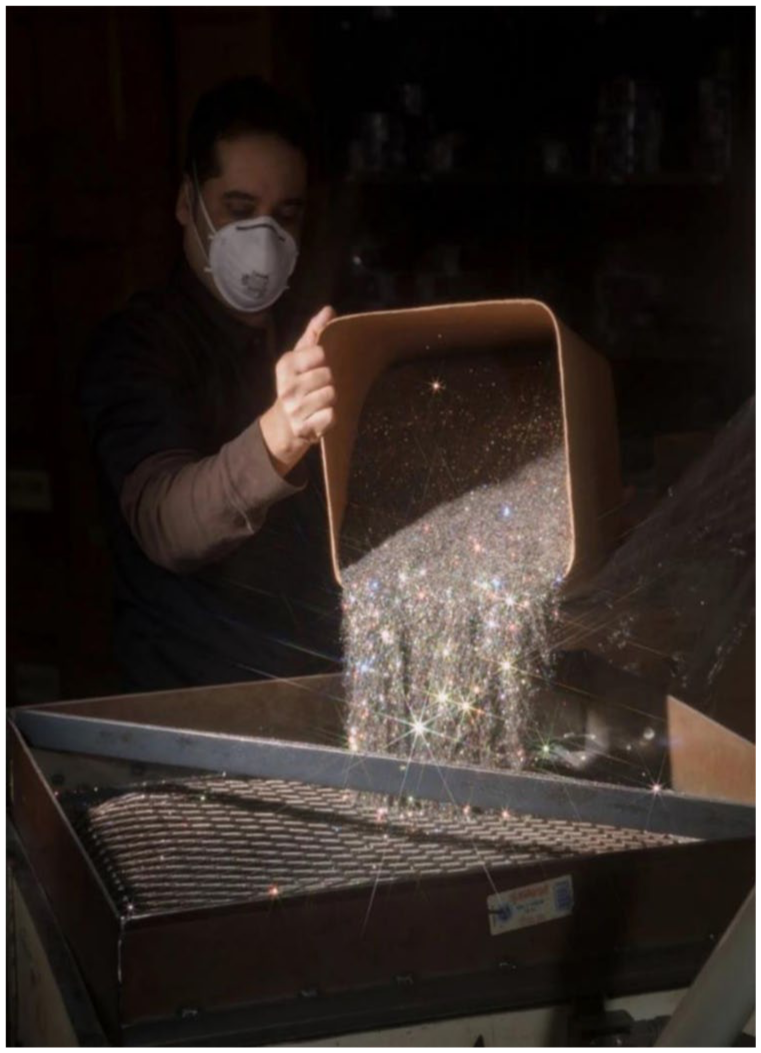
Image from a glitter factory. Credit: Chris Maggio for The New York Times.
The multiple intra-actions between the materiality of glitter and immaterial light/colour mean that glitter is not only an apparatus that worlds worlds of work by enacting in/excluding visual cuts in the form of casting shine/shadow, but also in producing colourful revealings/concealings. As such, the in/visibilising processes of worlding worlds of work, facilitated by the aesthetic means of glitter, call for critical analysis, showing equal attention to materiality as well as visual cuts in the form of shiny revealings and shadowy concealments. Below, the article conducts such critical analysis, focusing on a specific educational policy campaign launched by the EU to attract more young women to future STEM education and careers, while paying particular attention to how the material glitter in this video enacts visually in/excluding cuts, worlding a certain world of women’s STEM work.
Research context and methods
The low number of women in STEM work has remained stagnant for decades, meaning women workers have long been close to invisible in STEM work (UNESCO, 2017, 2024). The low number is of concern to the global field of policy, as it has a range of adverse economic and democratic implications, with global society facing (i) a large future lack of STEM candidates and (ii) a need for utilising women’s talents and unique gendered experiences in addition to those of men (WEF, 2025). Zooming in on Europe, the region from which this article is written, a recent policy document published by the EU (2023) states: ‘The European Union (EU) faces skills shortages, particularly in the STEM – science, technology, engineering and mathematics – and information and communications technology (ICT) fields. Women especially are underrepresented in these fields’, while the document further underlines that ‘the EU needs to act if it is to ensure the continuous development of skills required to remain economically competitive at the global level’.
Educational policy data
Based on urgent policy needs, the EU has acted – and continues to act – to increase the number of women in STEM work through both the introduction of new educational policies (e.g. Europe’s Choice, 2024; STEM Education Strategy Plan, 2025) and the launch of educational policy campaigns intended to make women STEM workers and work visible, thereby allowing more young women to identify with and pursue future STEM education and careers (see Sandager, 2022). This article focuses on one specific EU educational policy campaign called Science, It’s a Girl Thing, which is saturated with glitter in the form of both plastic fragments and shiny surfaces. The campaign was launched in 2012 and has since been available online for young women to view and draw inspiration from. However, due to extensive critique, the EU removed the campaign shortly after its release, meaning it is no longer available from official EU sources. Instead, it can be found through different online sources that have made the original content available, for instance, on YouTube (n.d.).
The campaign was launched with the following words by then European Research, Innovation and Science Commissioner Máire Geoghegan-Quinn: ‘This campaign will show women and girls that science does not just mean old men in white coats’ (EU, 2012). It is thus evident that the campaign aims to ‘show’ – or make visible – women as an element in the world of STEM work. The educational policy campaign featured a shimmery website, offering young women colourful facts about the options that future education and careers in STEM involve, as well as a glittery video, which is the focus of the analytical explorations below. A focus on the 52-second-long video was chosen because it presents a range of different but still coherent visuals, allowing unique insights into the worlding enactments of glitter in the context of women’s STEM work. With the glittery video only being 52 seconds long, the article reads it as a local configuration amidst the ongoing reconfiguration of the world of women’s STEM work. As such, the analytical explorations are not intended to present general knowledge on the world of women’s STEM work but to illustrate how glitter can be theorised as a materialised apparatus, worlding worlds of work through in/excluding visual cuts.
Data coding and analysis
With glitter occupying little space in work and organisation studies, there is not much research to guide explorations of this aesthetic means, let alone guide explorations of this aesthetic means as a materialised apparatus, worlding through productions of in/visibility. Indeed, the issue of how to study the in/visible has long been a concern for work and organisation scholars, who are currently calling for new approaches to attend to that which is not immediately visible to the sense of sight (e.g. Quattrone et al., 2021). It would thus be (too) bold of this article to claim the method for how to study the in/visibility produced by glitter. Instead, the article suggests one possible way to approach such critical studies, hopefully supporting current developments of new approaches for studying the in/visible. The approach suggested is guided by Rose’s (2001, 2016) visual content analysis (VCA), which is explained as helpful in identifying common themes across large groups of visual data. As such, this approach helps identify common themes of what glitter makes colourfully visible, and what it leaves invisible, thereby showing how in/visibility is intra-actively produced in the worlding of women’s STEM work.
The VCA consists of three steps (Rose, 2001, 2016). The first step involves setting up categories, which guide the coding of a group of sampled images. In this case, the sampled images consist of 26 screenshots taken from the glittery video. With an interest in broad readings of how the glittery video visualises women STEM workers and work, I defined and applied the categories of ‘work identity’ and ‘work activities’, with the first category focusing on visible race (i.e. skin colour) in addition to gender (i.e. women). Based on these two categories, I conducted the second and third steps of the VCA, which entailed (i) reviewing the different sampled images while (ii) concurrently searching for how the material glitter in the glittery video intra-acts with light/colour to in/visibilise elements related to the categories (Rose, 2001, 2016).
A focus throughout the coding was thus on identifying where the materiality of glitter was present in the screenshots from the glittery video, as well as how this materiality intra-acted with light/colour to allow some elements related to ‘work identity’ and ‘work activities’ to become brightly visible and others not. From steps two and three, I identified three themes: (i) whiteness, (ii) beauty and cosmetics production and (iii) sexism. While the theme of sexism does not directly fall under the categories of ‘work identity’ or ‘work activities’, it is a theme that exists across both of these categories, and it is therefore still relevant to include in a unique section of the analytical explorations below.
Using static screenshots from the glittery video, the analytical explorations cannot directly capture the ongoing reconfiguring that the worlding enacted by glitter involves. However, as the article reads the glittery video as a local configuration amidst the ongoing worlding of women’s STEM work, focusing on revealing shine and concealing shadow is also of greater analytical relevance. As such, the analytical explorations aim to detect how glitter is worlding by enacting differences that matter rather than by facilitating dynamic processes of intra-activity, while the final concluding discussion also focuses on the bleak implications of worlding by enacting visually perceived differences within actual sameness.
A glittery worlding of women’s STEM work
Starting with the 26 screenshots taken from the glittery video, this section examines the in/excluding visual cuts that the glitter in the glittery video enacts to allow elements related to the themes of (i) whiteness, (ii) beauty and cosmetics production and (iii) sexism to become in/visible, thereby worlding a certain world of women’s STEM work.
Whiteness
From Geoghegan-Quinn’s words on the glittery Science, It’s a Girl Thing campaign, it is evident that the bodies displayed in the glittery video should be visible as women’s bodies, challenging long-standing male dominance in STEM work. This is moreover clear from the glittery video itself. The video showcases a chemistry lab featuring shiny walls, decorative science formulas written on them, polished chemical tools and transparent glass bottles. However, at the beginning of the video, the lab is entirely dark. It is only as three shadowy silhouettes enter that the lab is slowly illuminated, revealing that we are in a lab and that the shadowy silhouettes are women’s bodies, all dressed in traditionally feminine outfits, including short mini-skirts and high stilettos (see Figure 3).
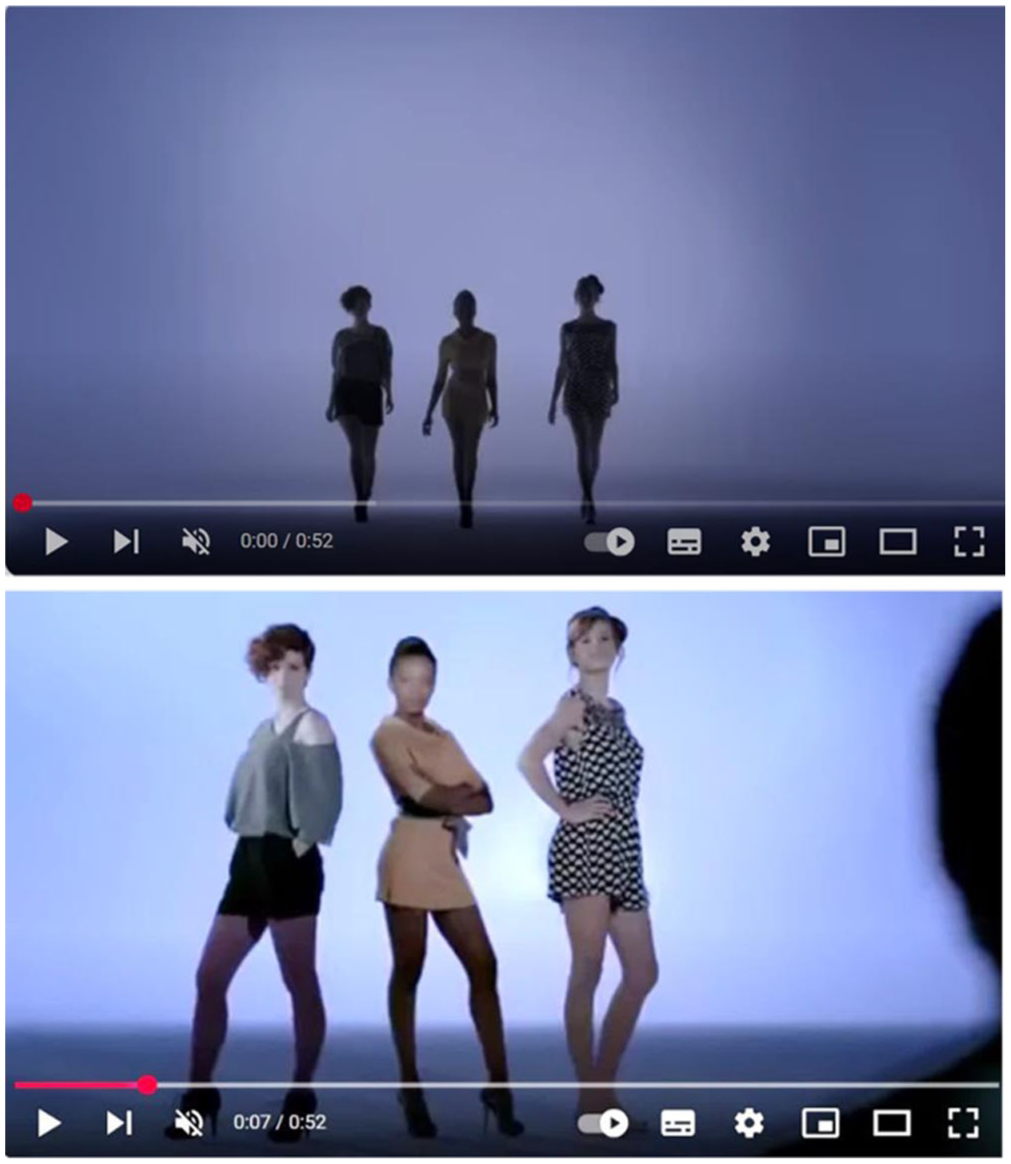
Screenshots of the three women.
The bright illumination of the element of women is enhanced by the three women wearing glittery make-up, allowing light/colour to cast a revealing shine on them. The glittery make-up of the three women intra-acts with light to radiate a range of bright colours, making them vibrantly visible. In particular, the glittery lip gloss smeared on their lips intra-acts with light to radiate shimmering dark and light pink colours (see Figure 4).

Screenshots of glittery lip gloss.
The glitter of the glittery video casts a revealing shine not only on the element of women but also on the element of certain women. The shadowy silhouettes revealed as women’s bodies at the beginning of the video are made up of two white women and one Black woman. However, when the Black woman is present in the glittery video, she is mainly introduced in the concealing shadow of all the video’s glitter, making it difficult even to detect the colour of her skin (see Figure 5). As such, the element of Black women is (largely) invisible in the glittery video, and we mainly get to see the Black woman when she stands next to the white women, thus sharing the leftovers of the shine cast on the element of white women.

Screenshots of the Black woman.
Opposite the Black woman, the two white women are, if not directly covered in glitter themselves, then surrounded by glitter, allowing the element of white women to be colourfully illuminated, through vivid glitz and glow. For example, during the glittery video, the white women are positioned next to a group of shiny pink plastic circles on a contrasting black wall. The shiny pink plastic circles intra-act with light to allow a beaming pinkish gleam to spread around the white women while also enabling high visibility to surround the exact element of white women (see Figure 6).
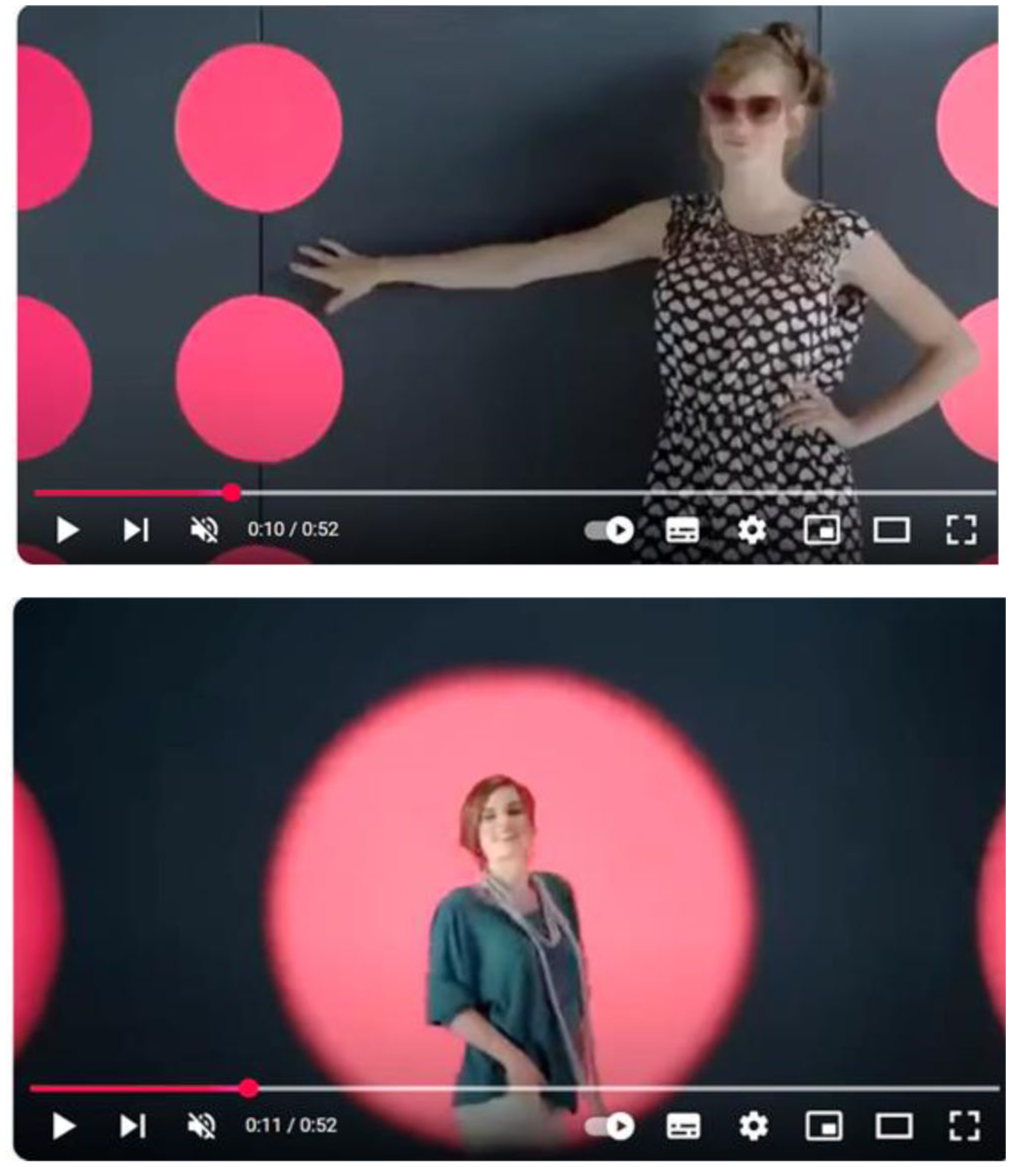
Screenshots of white women.
From the analytical explorations above, we see that the glittery video is full of glitter that intra-acts with light to radiate a range of shimmery dark and light pink colours, making the element of women vibrantly visible. However, we also see that glitter mainly intra-acts with light/colour in ways that make the element of white women visible, leaving the element of Black women invisible. As such, we see that the glitter in the glittery video intra-acts with light/colour to produce intra-acting in/visibility, worlding a world of women’s STEM work, where the element of women is indeed visible, but primarily in white bodies.
Beauty and cosmetics production
The glitter of the glittery video not only casts a revealing shine on the element of (white) women but also on elements related to the work activities that women STEM workers engage with and the products these work activities result in. For example, glitter is mixed in pink nail polish, exploding as a sparkly rainbow of pink and red shades as it drops from a turned-down applicator and intra-acts with light from different angles to become colourfully visible (see Figure 7).
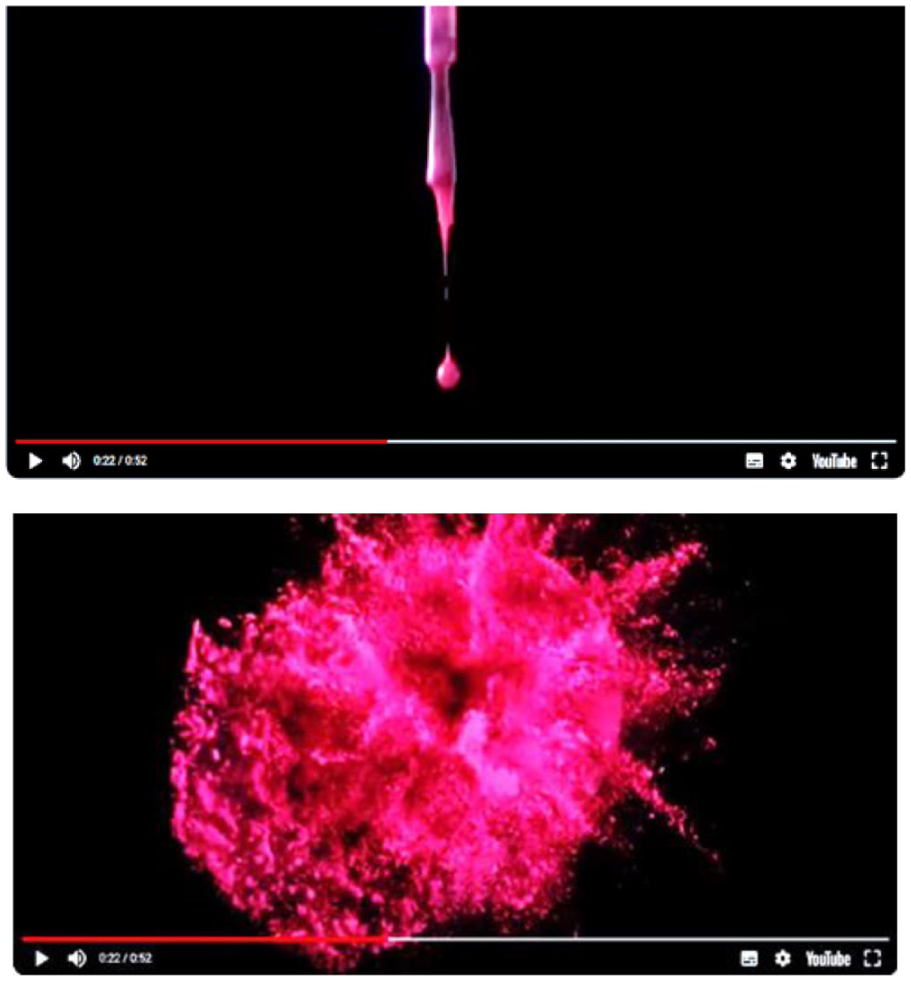
Screenshots of glittery nail polish.
Furthermore, glitter is blended into a pink blush and blue eyeshadow, consisting of piles of sparkly powder that burst into a broad spectrum of colours when thrown into the air to catch and intra-act with light to become vividly visible. Figure 8 illustrates how the glittery pink blush transforms into a firework of sparkly red and rosy colours as it spreads from a tilting cosmetics container, and how the glittery blue eyeshadow intra-acts with light to spread arrays of glitzy white, purple and blue colours when blown from a large cosmetics brush.
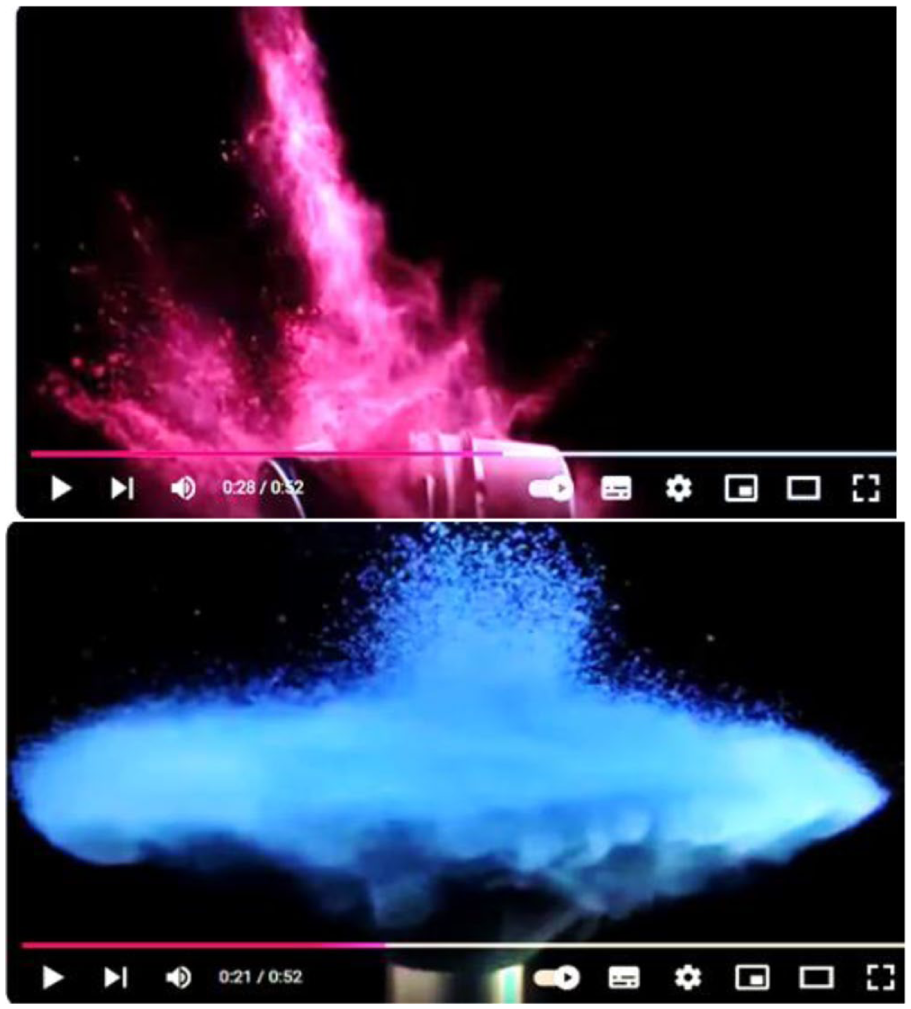
Screenshots of glittery blush and eyeshadow.
Lastly, glitter is mixed in pink lipstick and lip gloss, surrounded by glittery dust circles, intra-acting with light to shimmer pink and white colours, making these two particular cosmetic products highly visible. The glittery lipstick and lip gloss, as well as the glittery circles of dust surrounding them, are showcased on colourful backgrounds that vary in bright colours, switching between white and black nuances, making the two glittery cosmetic products appear to glow even more as the colours of the background change. Figure 9 shows images of the glittery lipstick and lip gloss on white and black backgrounds.
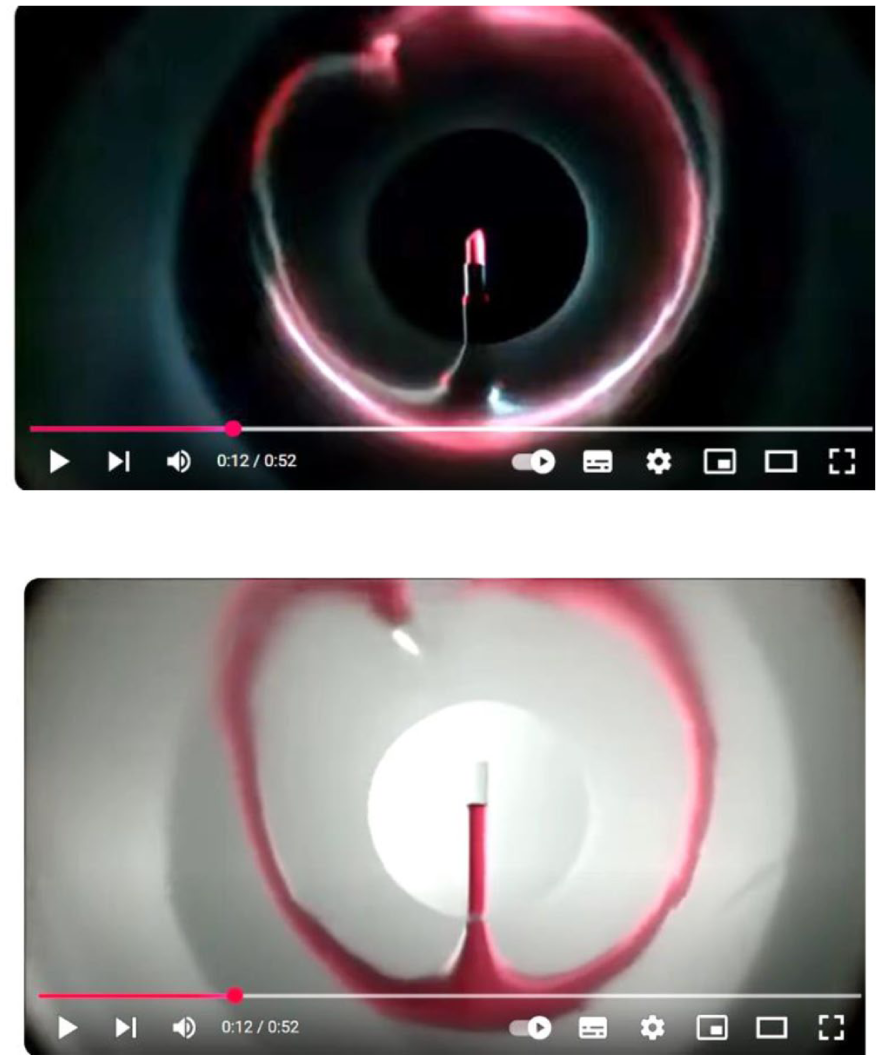
Screenshots of glittery lipstick and lip gloss.
From these analytical explorations, we see that the glitter in the glittery video intra-acts with light, radiating shimmery pink, red, rosy, blue, white and purple colours, making colourfully visible elements of STEM work activities related to beauty and cosmetics production. However, in doing so, glitter does not intra-act with light to spread its beam and brightness to other elements of STEM work activities, thus making these elements invisible in the concealing shadow cast by the glittery work activities related to beauty and cosmetics production. For example, work activities related to ‘hard’ science, such as chemical or biological engineering, including mathematical formulas and technical understandings of atoms, particles and molecules, are introduced as lustreless in a blurry dimness next to the sparkly work activities (see Figure 10).
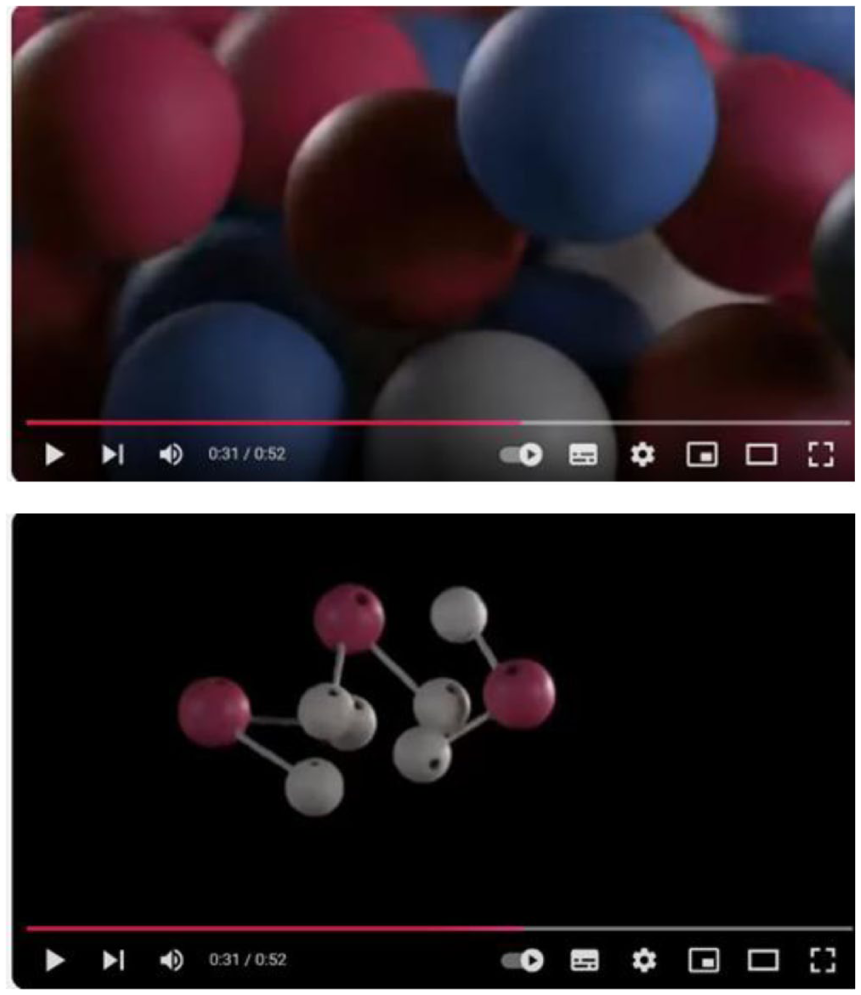
Screenshots of lustreless science figures.
This second part of the analytical explorations demonstrates how the glitter in the glittery video intra-acts with light to make elements of STEM work activities related to beauty and cosmetics production visible, while elements of STEM work activities related to ‘hard’ science are left invisible in concealing shadow. As such, the glitter in the glittery video intra-acts with light/colour to produce intra-acting in/visibility, worlding a world of women’s STEM work where women workers are occupied with beauty and cosmetics production rather than ‘hard’ science.
Sexism
From above, we see that glitter is present in the glittery video in ways that make the element of (white) women vividly visible. Furthermore, we see that these visibilised women are presented in sexualised ways, with especially Figures 3 and 5 illustrating how the glittery video presents women in STEM work as subjects dressed in short mini-skirts and high stilettos. Indeed, a woman STEM worker, ‘covered up’ in a loose, dark-green shirt, beneath a long-sleeved, beige cardigan, is also showcased in the glittery video. This woman is pictured in the middle of an attempt to solve what appears to be a complex math equation, and both her clothing and work activity thereby challenge the analysis of women in STEM work as subjects who are simply visibilised as sexually dressed and engaged in the production of beauty and cosmetic products. However, this woman is placed in a dull and unglittery setting, which, along with her mellow outfit, prevents visibilising intra-actions with light/colour from happening. Hence, the ‘covered up’ woman’s visibility is limited to perpetuate a dominating high visibility of women in STEM work as sexually dressed and not occupied with ‘hard’ science (see Figure 11).
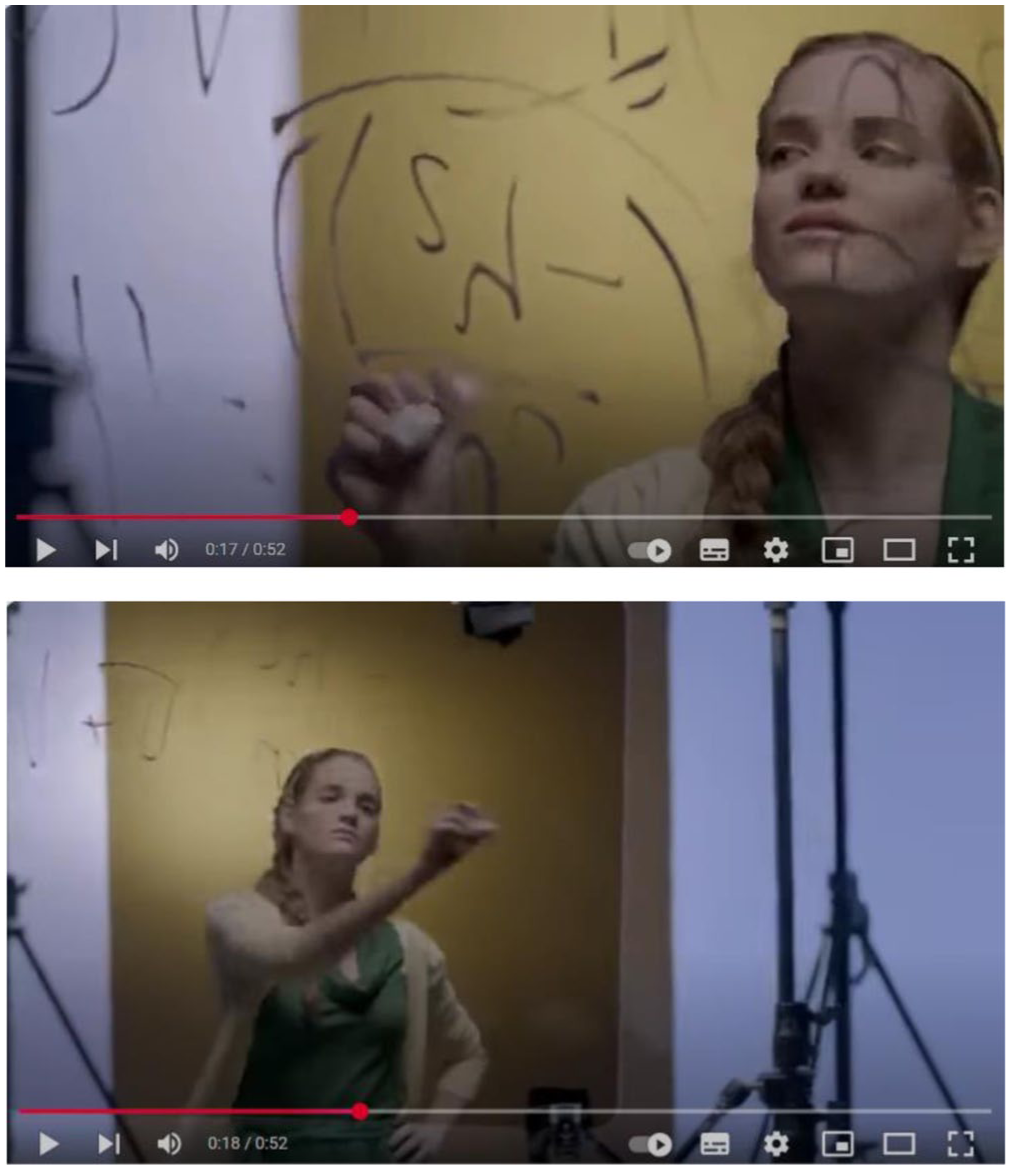
Screenshots of ‘shadowy’ woman STEM worker.
Adding to women being visibilised in sexualised ways, the video presents a male figure. But like the Black and ‘covered up’ women, this figure is hard to detect, as he is placed in a concealing shadow. Despite the male figure sitting in front of a microscope with shiny parts that could easily intra-act with light/colour to make him highly visible, light is dimmed when the glittery video zooms in on him, meaning the shiny parts of the microscope are not allowed to make him fully visible through colourful illumination. While leaving the only male figure in the video invisible – contrary to leaving the Black and ‘covered up’ women invisible – could be seen as a generous gesture, allowing the element of women to shine undisturbedly alone in STEM work, this choice might be more harmful than helpful. So, the male figure seemingly symbolises the male gaze, scrutinising the women in STEM work as passive sexual objects through first his magnifying microscope and then, to secure even greater detail, a pair of glasses (see Figure 12). Invisibilising the element of a male figure is thus to invisibilise the element of sexism in STEM work.

Screenshots of the male figure.
This third part of the analytical explorations demonstrates how the glitter in the glittery video intra-acts with light to render the element of women colourfully visible in ways that introduce a sexualised norm regarding how women in STEM work dress, while also leaving invisible women who are not dressed in a sexual manner. Furthermore, it highlights how the glittery video invisibilises the element of a male figure, including the discriminating male gaze, and thereby how the glitter in the glittery video worlds a world of women’s STEM work, where women are sexually dressed but without being under constant sexualising scrutiny by men.
The analytical explorations of the glittery video from the EU educational policy campaign illustrates how the glitter in the glittery video enacts a range of in/excluding visual cuts worlding a world of women’s STEM work, where women are white, and in general not Black, and where women engage in STEM work activities related to beauty and cosmetics production and not ‘hard’ science. Moreover, the analytical explorations demonstrate that the glitter enacts in/excluding visual cuts worlding a world of women’s STEM work, where women have a sexual presence and sexism does not exist. Below, the article discusses the bleak implications that this worlding has for futures of more women in STEM work.
Concluding discussion
Engaging with the growing body of research on visuality in work and organisations, this article has defined four different processes of in/visibilisation by which workers and work become. The four processes of in/visibilisation are (i) dynamically emerging, (ii) strategically managed, (iii) material and (iv) aesthetic. While the four processes are unique, they still operate in the same way, namely by visibilising some elements, while also invisibilising others, thus allowing visual perception of workers and work through the equal production of visibility and invisibility. The article has mainly focused on aesthetic processes of in/visibilisation, specifically those facilitated by the aesthetic means of glitter. As such, the article has argued that glitter is an aesthetic means composed of materiality that attracts and reflects light, spreading whole rainbows of colours, casting revealing shine on what it touches, while leaving everything it does not touch in concealing shadow.
To define glitter as an aesthetic means that in/visibilises workers and work, the article has found inspiration in Barad’s feminist new materialism while contending that glitter operates as a materialised apparatus. The article has argued that glitter, by casting revealing shine and concealing shadow, enacts agential cuts that allow some elements and not others to matter in how we perceive worlds of work. However, with glitter operating on a visual spectrum, the agential cuts enacted by glitter are specific agential cuts, which the article has dubbed ‘visual cuts’, thus contributing this new concept to the growing literature on visuality in work and organisations. The new concept of visual cuts encompasses a range of performative actions that allow worlds of work to become through visually in/excluding certain elements of workers and work, thus establishing organisational reality based on both particular organisational knowledge and ignorance. In that way, the concept of visual cuts reminds us that organisational reality is always a matter of visual exclusions and ignorance, while the workers and work that should be valued and supported to improve important organisational developments might be other and more than what is made directly visible for organisations to perceive and know about.
To analytically explore how glitter is worlding worlds of work through an aesthetic process of in/visibilising, the article has applied the Baradian-inspired theory on glitter to an empirical illustration from the case of women in STEM work. More specifically, the article has focused on a glittery video from the educational policy campaign Science, It’s a Girl Thing, which the EU launched to increase the visibility of women STEM workers and work, thereby allowing more young women to identify with and pursue future STEM education and careers. Focusing on the glittery video, the article has illustrated how the glitter in the video enacts in/excluding visual cuts, worlding a world of women’s STEM work in which women are (i) white, (ii) engaging with work activities related to beauty and cosmetics production and (iii) follows a sexualised norm for how to dress, while not being exposed to sexism.
In worlding such a world of women’s STEM work, the visual in/excluding cuts enacted by the glitter in the glittery video can be argued to translate directly into social in/exclusions. Only young women who can identify with white women’s bodies, work interests in beauty and cosmetics production and a sexualised norm for how to dress, will experience this world of women’s STEM work as socially inclusive, while all other young women will experience it as socially excluding. Furthermore, the young women who initially feel socially included in this world may ultimately feel excluded. Discriminating sexism, invisibilised or not, is an element of the world of women’s STEM work (see Clark et al., 2021; Einersen et al., 2021), and if young women are made ignorant to this fact and therefore are not prepared for how to navigate it – in common solidarity with the rest of us (see Vachhani and Pullen, 2019) – then STEM work could become so debilitating that they will soon have to leave it again. As such, the glitter in the glittery video has bleak implications, casting a dark shadow on futures of more women in STEM work, even though the EU intended the opposite when launching their educational policy campaign.
In demonstrating how glitter is an aesthetic means with bleak implications for workers and work, and indeed women STEM workers and work, the article states that glitter can be seen as harmful when studied in the context of work and organisations (see also Sandager, 2022, 2024a). However, the article still ends on an affirmative note. So, as it will argue that if we accept glitter as a serious material force with profound political implications, while also using it with considerate caution, it indeed retains a radical potential for worlding more diverse worlds of work by disrupting ingrained gendered and racialised norms. As de Aráujo (2019) points out, when contending that queer activists use glitter to secure visibility for neglected populations in worlds of heteronormativity, the visibilising characteristics of glitter could allow us to use it to bring attention and awareness to important workers and work who are otherwise hidden and ignored in revealing shadow.
Returning to the glittery video, glitter could, for example, have been present in the video in ways that (also) made visible the Black and ‘covered up’ women, thereby making such women in STEM work visually perceivable for young women to identify with. Furthermore, glitter could have been present in ways that made work activities related to ‘hard’ science and the male gaze visible, thus allowing young women to perceive the variety of work options available for women in STEM careers, while also preparing them for the discriminatory sexism they might encounter when they enter STEM work. This alternative type of visibility could have enabled a more diverse group of young women to identify with and pursue future STEM education and careers, as well as develop collective strategies for navigating sexism in STEM work, making it possible for women to lead satisfying and thus sustainable work lives in STEM organisations.
Based on the developed critical theory on the aesthetic means of glitter, the article overall concludes that glitter is neither inherently virtuous nor evil, nor is the act of worlding with glitter fundamentally good or bad. Instead, glitter and the act of worlding with glitter are complex and paradoxical, calling for a deeper scrutiny of glitter within work and organisation studies, as well as careful ethico-political considerations, when worlding with glitter.
Footnotes
Acknowledgements
The author would like to thank the editor and anonymous reviewers at Organization for their generous inputs and highly valuable feedback to this paper.
Funding
The author received no financial support for the research, authorship, and/or publication of this article.
