



Abstract
The current paper examines the use of dreams as a methodological source of collective reflexivity among organizational scholars. Current organizational literature discusses the role of dreams in promoting reflexivity, drawing largely on psychoanalytical approaches of researcher self-understanding as an individual process. Recognizing in individualistic approaches a risk of egoistic projection and identification, we propose an alternative dream-based methodology inspired by Amerindian philosophy and practices of dreaming. Examining illustrations from literature on Amerindian knowledge practices, we argue that dreams inform ideas about collective relationality and cosmology, moving away from a focus on individual psychology. This alternative conception of dreams is particularly useful for organizational perspectives emphasizing researcher-participant collaboration, collective reflexivity, and action-oriented research. On this basis, we elaborate a dream-based approach as a form of inquiry. We contribute to a nascent literature on dreams in organizational scholarship, highlighting the diverse ways dreams can support collective reflexivity. Moreover, our approach recognizes the importance of Indigenous knowledge practices as sources for organizational scholarship, providing philosophical and practical pathways for relating to others in a non-colonial way.
It has been my experience - and to this I have found no exception - that every dream treats of oneself. Dreams are absolutely egoistic. The whites sleep too much, but they only dream about themselves.
Introduction
The disjunction between modernist and Indigenous conceptions of dreams, as marked in the opening quotes above, informs divergent ways of being and knowing the world. Colonial processes drew boundaries over lands, bodies, knowledges, and forms of life (Dussel, 1993; Krenak, 2020), boundaries that continue to define social theories and organizational research practices (Banerjee, 2022; Ibarra-Colado, 2006). Few spaces in daily life have escaped such domination. Yet, perhaps best articulated during the first author’s fieldwork by an Indigenous leader, dreams may be such a space: “they can access our territory, they can try to domesticate our plants, but they cannot control our dreams.” 1 The disruptive and undomesticable aspects of dreams have, at the same time, been a thorn in the side of modernist philosophy and epistemology (Descartes, 2012; Kant, 2003). 2 Even in its suspicion of dreams, the urge to learn from dreams continues as a modern epistemological sub-current, most developed in the psychoanalytic tradition (Freud, 1953) as a hidden symbolism of the psyche. As such, dreams are a persistent, if “minor,” tradition within epistemology and methods (Deleuze, 1986; Mazzei, 2017). In brief, dreams are both compelling and unsettling within modern social scientific inquiry.
As an important, but perplexing, source of social knowledge (e.g. Long, 2019), dreams have been used sparingly but occasionally as organizational research methods (e.g. de Rond and Tunçalp, 2017; Gosling and Case, 2013; Lawrence, 2003; Valtonen et al., 2017). Dreams have recently appeared in organizational scholarship (de Rond and Tunçalp, 2017; Gosling and Case, 2013; Page et al., 2014), promoted as a source of reflexivity and researcher self-understanding, and as a methodological tool. Moreover, they can inform collective aspects of reflexivity, acknowledged in organizational studies (e.g. Cayir et al., 2022; Gilmore and Kenny, 2015; Ripamonti et al., 2016), but about which little is known. Drawing on psychoanalytic notions of dreams as containing subconscious meanings, organizational scholars employ dreams to support self-analysis, manifestations of countertransference or similar psychodynamic processes (de Rond and Tunçalp, 2017). Dreams have been framed as methodologically useful because they give researchers back images of themselves, positioning their subjectivity within organizational inquiry (de Rond and Tunçalp, 2017). At the same time, Gosling and Case (2013) suggest a more-than-psychological approach, emphasizing a “social” dreaming to understand organizing as an imaginary and non-rational achievement, made urgent in the c`ontemporary world of systemic crises.
In this article, we build on the idea of social dreaming as an approach to organizational inquiry, drawing upon Indigenous philosophy of dreams as elaborated in Amerindian communities in the lowland Amazon region (Kopenawa and Albert, 2010; Limulja, 2022). Complementing but departing from the individual (and sometimes collective) psychodynamics of dreams in the psychoanalytic tradition, Indigenous cosmology and dream practices provide a powerful reflexive and political tool for organizational researchers. The essence of our argument is that dreaming involves social (and not only psychological) images, presenting dreamers with a sense of radical otherness and the limits of knowledge. Such images, when shared in collective exchanges, can promote reflexivity and impact social reality. Focusing on dreaming as a social knowledge practice, we argue, departs from reflexivity discussions that are self-oriented and risk epistemic narcissism, moving instead toward an ontology of otherness and an emphasis on collective reflexivity, participant collaboration and community action-oriented research.
The emphasis on dreams as modes of reflexivity around otherness (Limulja, 2022) pertains to our own positionality with regards to these knowledge practices. Two of the authors are Brazilian, non-Indigenous academics engaged in a broader research project about Indigenous issues and theories in the context of Brazil, one of whom is conducting ongoing fieldwork in the Amazon region with Indigenous communities and is engaged on Indigenous activisms. The third author is a North American non-Indigenous organizational scholar focused on reflexivity and decolonizing perspectives. The varying degrees of proximity and otherness with regard to the local knowledges inspiring the current paper demand a nuanced and reflexive approach, as we describe further in the text, and one which carries insights for decolonizing perspectives more generally.
Concretely, we ask how concepts and practices of dreams associated with Indigenous 3 philosophy can help researchers to decolonize reflexivity, listen to others, and establish collective actions in their ethnographic work. In this sense, our paper is a “methodological” paper, although in the exploratory sense of experimental qualitative methods (see e.g. de Vaujany et al., 2024). That is, we do not offer a recipe or standardized guidelines, which would be anathema to our focus on situated and relational forms of knowing, which rely on ongoing boundary negotiations and contestation (e.g. Yousfi, 2021). Rather, through engagement with theory and the ethnographic record on Indigenous dream practices, we dialogue with and build upon recent literature about dream approaches in organizational studies. Our goal is to decolonize the idea of dreams as self-focused spaces of psychic projection to reconsider them as spaces for encounters with alterity and collective reflexivity (de Rond and Tunçalp, 2017; Gosling and Case, 2013; Limulja, 2022; Page et al., 2014). By doing so, we respond to recent calls to promote innovative methods through collaboration and reflexivity (e.g. Scobie et al., 2021), to collectivize processes of reflexivity (Ripamonti et al., 2016) and to decolonize research methods (cf., Banerjee, 2022; Ibarra-Colado, 2006), by drawing on historically marginalized knowledge and by recognizing the otherness inherent in social knowledge construction.
To illustrate this methodological approach, we draw upon Yanomami concepts of dreams, as described in extant ethnographic works such as “A Queda do Céu” (“The Falling Sky”; Kopenawa and Albert, 2010) by the Yanomami Shaman Davi Kopenawa and anthropologist Bruce Albert and “Others’ Desires: An Ethnography of Yanomami Dreams” (Limulja, 2022) as well as from diverse philosophers, theorists, and anthropologists of Amerindian thought (Limulja, 2022; Shiratori, 2022; Viveiros de Castro, 2015), and from Indigenous philosopher Ailton Krenak (e.g. Krenak, 2019, 2020). Our methodological proposal thus draws upon ethnographic and theoretical works constructed around Indigenous communities and by Indigenous scholars around the reflexive use of dreams. Reporting on data and insights from these scholars’ works, and our reading and interpretation of their insights, we formulated a broad set of considerations for promoting collective reflexivity through dream work.
This theorization resulted in a social-epistemic process of dreaming that involves multiple and overlapping processes: (i) recognizing the dreamer as a locus of others’ desires, (ii) describing and sharing the dream with “the others” in the field to build a collective interpretation, (iii) accessing collective reflexivity, through construction and reconstruction of knowledge from the dream, and (iv) movement toward action or becoming, resulting from the intentional engagement with shared dreaming. We illustrate these concerns in published Indigenous ethnographies by selecting descriptions and reports of dreams presented in these works to identify mechanisms and actions that can guide researchers and communities to dream together.
By elaborating and illustrating this mode of inquiry via social dreaming, we seek to stimulate concern to learn how to dream other (and others’) dreams. Listening closely to Kopenawa’s critique, cited above, that “the whites [. . .] only dream about themselves,” we attempt to imagine methodological dreamwork differently, in a way that can open reflexive possibilities in our discipline. By acknowledging the epistemic value and conceptual nuance of Amerindian dream practices, we contribute to an emerging literature on Indigenous theoretical and methodological insights (cf., Henry and Pene, 2001; Peredo, 2023; Salmon et al., 2023) by elaborating on plural ways of knowing, dreaming, and being. Elaborating a dream approach in a philosophical dialogue with Indigenous knowledge and practices is a step in decolonizing knowledge (e.g. Konadu-Osei et al., 2023; Smith, 2005), providing researchers with a less violent way of learning, acknowledging communities as relational supports for individuals. Considering Amerindian knowledge as a philosophical foundation, and as a source of conceptual insights, opens possibilities to relate to others in a non-colonial way. It multiplies and acknowledges the voices of others, promoting their flourishing in their and our environments.
Dreams in organizational scholarship
Although dreams sit on the margins of organizational research, the conceptual value of dreams has periodically been acknowledged in organizational scholarship. Dreams have appeared in organization studies as a process of imagination (Woźniak, 2010), a reference to utopia or future possibilities (Otto and Strauß, 2019; Resch et al., 2021), and as a lived experience affecting well-being (Valtonen, 2019). In some cases, dreams have been examined for their methodological potential (de Rond and Tunçalp, 2017; Gosling and Case, 2013; Page et al., 2014). Running across studies is an understanding of dreams as linked to the unconscious, projections, imagination, or representations, often drawing upon psychoanalytical approaches, both individual (de Rond and Tunçalp, 2017; Woźniak, 2010) and social (Gosling and Case, 2013; Lawrence, 1991, 2003).
One consequence of this psychoanalytic provenance of dream scholarship may be a tendency to study dreams through projection, with a focus on individual reflexivity and self-analysis (de Rond and Tunçalp, 2017). Freud’s (1953) opening quote diagnosing dreams as “absolutely egoistic” (p. 106) explicitly reveals the projective tendency of modern conceptions of dreams. This tendency has two related consequences. The first is to relativize the epistemic validity of dreams as self-oriented knowledge practices, framing them as psychic traces or projective experiences and drawing attention away from any direct access to knowledge through dreaming. The second is to locate the original source of dream knowledge in the dreaming subject, leading to an ego-centered view of dreams as psychological images projected onto the screen of the dream world.
Complementing such approaches, some scholarship acknowledges a collective basis of dreams, moving away from ego-based and projection views of dreams. In particular, the social dreaming matrix, proposed by Lawrence, has been presented as an approach with a less egocentric understanding of dreams (Gosling and Case, 2013). This approach has applied to the case of the climate crisis, to support new ways of knowing beyond current imaginaries, and Gosling and Case (2013) compare its function to the shamanic dream visions of certain traditional cultures. Their study opened a path to examining dreams as a socially engaged reflexive practice, invoking Indigenous knowledge to propose the possibility of using dreams to promote collective reflexivity within ethnographic research.
The social dreaming approach is related to but shifts importantly away from dominant psychological approaches. First, it treats dreams as “overdetermined” (Ballas, in Long and Manley, 2019) by intra- and extra-psychic sources, seeing them less as outward projections than as traces of interactions between mind and world. Second, it moves from individualistic to “democratic” (Lawrence, 2005) conceptions of social knowing as interactive and abductive, with dreams as knowledge objects that anchor collective knowledge practices. Third, it recognizes that such practices are not new, acknowledging Indigenous forms of social dreaming that pre-date, and which can dialogue with, psychological approaches (Long, 2019). The first two of these points reframe the epistemic possibilities for dreams to emphasize world- rather than psyche- centered knowledge, while the third suggests that developing these possibilities involves engaging with other ways of knowing to develop dream-based knowledge practices.
Thus, the social dreaming approach (Gosling, 2019; Gosling and Case, 2013; Lawrence, 2005) promotes dialogue with traditional knowledges to explore the epistemic possibilities of dreams. Nevertheless, it engages indirectly with Indigenous traditions, drawing only sparingly on thick ethnographic knowledge of specific Indigenous dream practices. Indeed, the role of dreams and visions within Indigenous communities are extensively documented in anthropological and psychoanalytic literatures (see, e.g. Adlam and Holyoak, 2005; Duerr, 1985; Goulet, 1998), and have been emphasized by Indigenous scholars (e.g. Shawanda, 2020; Tobon, 2015). While references to the role of dreams abound in studies of Indigenous communities, the dynamics, characteristics, and mechanisms of these dreams have rarely been explored in the organizational literature. Thus, organizational scholarship around dreams remains anchored to traditional psychoanalytical concepts and processes (de Rond and Tunçalp, 2017; Page et al., 2014; Woźniak, 2010), without the benefit of dialogue recognized in the social dreaming approach. Advancing Indigenous perspectives is a crucial next step, as we elaborate below.
Reflexivity and indigenous knowledge practices
Acknowledging Indigenous knowledge as a philosophical basis for theorizing is an important form of epistemic decolonization (e.g. Allen and Girei, 2023; Hrenyk and Salmon, 2024; Konado-Osei et al., 2023). Given that dominant epistemologies, arising from colonial traditions, are unrepresentative of the varieties of global ways of knowing (Banerjee, 2022), it is crucial for scholars to seriously engage with alternative knowledge traditions, bringing marginalized knowledges, including Indigenous thought, into organizational discussions. A first step is to recognize the complexity, sophistication, and potential of Indigenous perspectives to sustain theorizations, reflections, problematizations, and propositions (Viveiros de Castro, 2015). It is to move from “cosmetic indigenization” (Bastien et al., 2023), to an epistemic practice closer to the center of knowledge production. This involves “taking seriously” Indigenous knowledge as more than merely metaphorical and illustrative. As argued by de Castro (2014) in the context of Amerindian populations: to take seriously does not mean (. . .) to be in awe of what people tell you, to take them literally when they do not mean to (. . .) to take it as a profound dogma of sacred lore or anything of the sort. It means to learn to be able to speak well to the people you study, (. . .) to speak about them to them in ways they do not find offensive or ridiculous (p. 17)
In this passage, Viveiros de Castro traces a nuanced position between a purely cultural and mythical conception of Indigenous thought, and one that dogmatically asserts alternative knowledge as inscrutable. The former position over-subjectivizes Indigenous knowledge, as mere projections of metaphorical images that are “scientifically” explainable by social, political, or economic factors. Early anthropological treatments (e.g. Durkheim, 1961) took this path, considering Indigenous knowledge as symptoms of group structure and not taking it seriously in its own right. The latter position over-objectivizes Indigenous knowledge, treating it stereotypically and statically. Romantic and “new age” approaches to Indigenous knowledge (e.g. Jenkins, 2004) follow this path, positing myths as “profound dogma” (de Castro, 2014) that foreclose on dialogue between ways of knowing. An alternative to both conceptions is to consider Indigenous knowledge, and dreams in particular, as social practices of knowing, containing both representational and ontological aspects, and therefore able to bridge subjective representations and collective processes of world-building.
Examining dreams as knowledge practices allows scholars to take them seriously as ways of knowing without an overly-literal treatment as empirical descriptions of an objective world. It also allows a relational epistemology based on dialogue across differences, rather than either a hegemonic view of scientific modernity, or a relativistic view of self-contained lifeworlds. From the “positionality” of situated identities to the “relationality” of listening and communicating across boundaries, this approach allows a reconsideration of the worlds to be described as themselves interpenetrated with incompleteness, possibility, and semi-objectifications that remain partially in flux (cf., de la Cadena and Blaser, 2018). It moves away from the binary of a subjective knower attempting to explain an objective world, a hallmark of modern epistemology. It dovetails with collective conceptions of dreams as knowledge practices by allowing a rapprochement between a subjective world populated by social images and a world of possibilities in the process of becoming.
By presenting Indigenous knowledge as involving such a rapprochement, Viveiros de Castro (e.g. Viveiros de Castro, 2015) shows how it can address a core shortcoming of modern philosophy. In this view, decolonizing methods is not (only) a political plea to include marginalized groups, but a way to refigure relations between knower and world to address the most intractable philosophical problems in the West (e.g. Ehrnström-Fuentes and Jääskeläinen, 2022). Specifically, Viveiros de Castro (2015) notes that recent debates around the “ontological turn” (cf., Holbraad and Pederson, 2017) that specifically promote a more processual and relational onto-epistemology (Strathern, 2020), are prefigured and elaborated in Amerindian thought. Thus, the decolonizing move in this case is a source of scholarly advancement as well as epistemic justice (e.g. Konadu-Osei et al, 2023; Smith, 2005; Tsosie, 2012).
Dreams as knowledge practices: Indigenous approaches
Considering dreams specifically, a vast and varied literature notes the importance of dreams across Indigenous communities as ways of understanding the world and its inhabitants (e.g. Alvarez, 2003). Given the immense plurality of Indigenous social forms, dreams are unsurprisingly represented in diverse ways, involving ways of knowing, intuiting, or imagining the world. For instance, the Cree people of North America give dreams a central role in organizing and planning hunting practices, informing the time to leave from hunting: “dreaming of an opposite sex person, especially of foreigners, must be taken as an indication of game close at hand” (Tanner, 1976: 220–221). Among the Mapuche of the southern cone of South America, dreams are considered a form of communication, a way of receiving information about their lives and territories, as mentioned by a Mapuche chief in an organizational meeting about territory demarcation: “when I came for the first time to Chodoy, the pulli (spirits) of this territory did fortunately welcome me. They give me dreams about the way we have to work” (Hirt, 2012: 105).
Within the context of lowland Amazon Amerindian groups, dreams take on specific roles as practices of knowing, and are often central to the cosmological views of Indigenous groups in this region (Shiratori, 2022; Shiratori et al., 2022). Dreams are considered a source of knowledge and relationality, configuring an important dimension of members’ daily lives. In many Amerindian communities, members begin the day by discussing their dreams. Among the Kanixawa, they ask in the morning “min hawa namaxumen?” (What have you dreamt about this night?) (Lagrou, 2007: 377). For the Juruna people, talking about dreams is so present in daily practices that a specific suffix indicates the temporality of dreams. When talking about something that happened in a dream, the suffix “-pãpã” is added, for example, to walk- pãpã means that the walking happened in the space and time of a dream (Lima, 1996).
Acknowledging the great diversity of dream practices in Indigenous peoples more broadly, as well as in Amerindian groups specifically, we focus our analysis on dreams as knowledge practices in the Yanomami people, a group composed of around 30,000 people spread across over 200 villages on the Brazil-Venezuela border (socioambiental.org, 2024). Recent works on the Yanomami, including those written by Yanomami authors, have given significant detail on and emphasized the importance of dreams in constructing Yanomami cosmology (Kopenawa and Albert, 2010; Limulja, 2022). This recent and growing literature provides specific detail about Yanomami dreaming, that we draw on to illustrate and elaborate an alternative view of dreams as knowledge practices.
As noted above, our own positionality in this conversation, as non-Indigenous scholars, is based on a principle of relationality, respect for alterity, and co-construction of collective knowledge, principles which are central to Yanomami dream practices themselves (Limulja, 2022). We do not attempt to speak for Indigenous knowledges, but present and interpret our readings of works written by Indigenous scholars (e.g. Krenak, 2019, 2020), collaborations among Indigenous and non-Indigenous scholars (e.g. Kopenawa and Albert, 2010), and ethnographies of Indigenous ways of knowing (e.g. Limulja, 2022). Each of these works, including the present one, are relational constructions, representing the “other’s desires” in an always imperfect attempt to communicate. The epistemic appropriateness of such a “relationality statement” 4 are less a purity of authentic identity than a respect for the other as a source of knowledge and an authentic desire to listen to dreams other than one’s own.
On that basis, and as we develop in the next section, Yanomami conceptions of dreaming establish an ontological continuity between the nighttime dream and the “waking reality,” a continuity that reflects an ontological discontinuity with modernist assumptions about a stable and unitary reality. As de Castro (2014) argues, ethnography offers a unique method to engage in “speculative concern with ontological questions when it came to dealing with our ethnographic materials,” involving an “ontological delegation” (p. 3) to traditional communities that moves the focus away from the epistemological “what do they think” to the ontological “how do they live.” Taking this ontological shift as a possibility, below, we present a general description of the role and practices of dreams in Yanomami communities as described in ethnographic literature. We then use this description to ground a discussion about how researchers can use collective dream practices to build collective reflexivity in collaboration with their research participants.
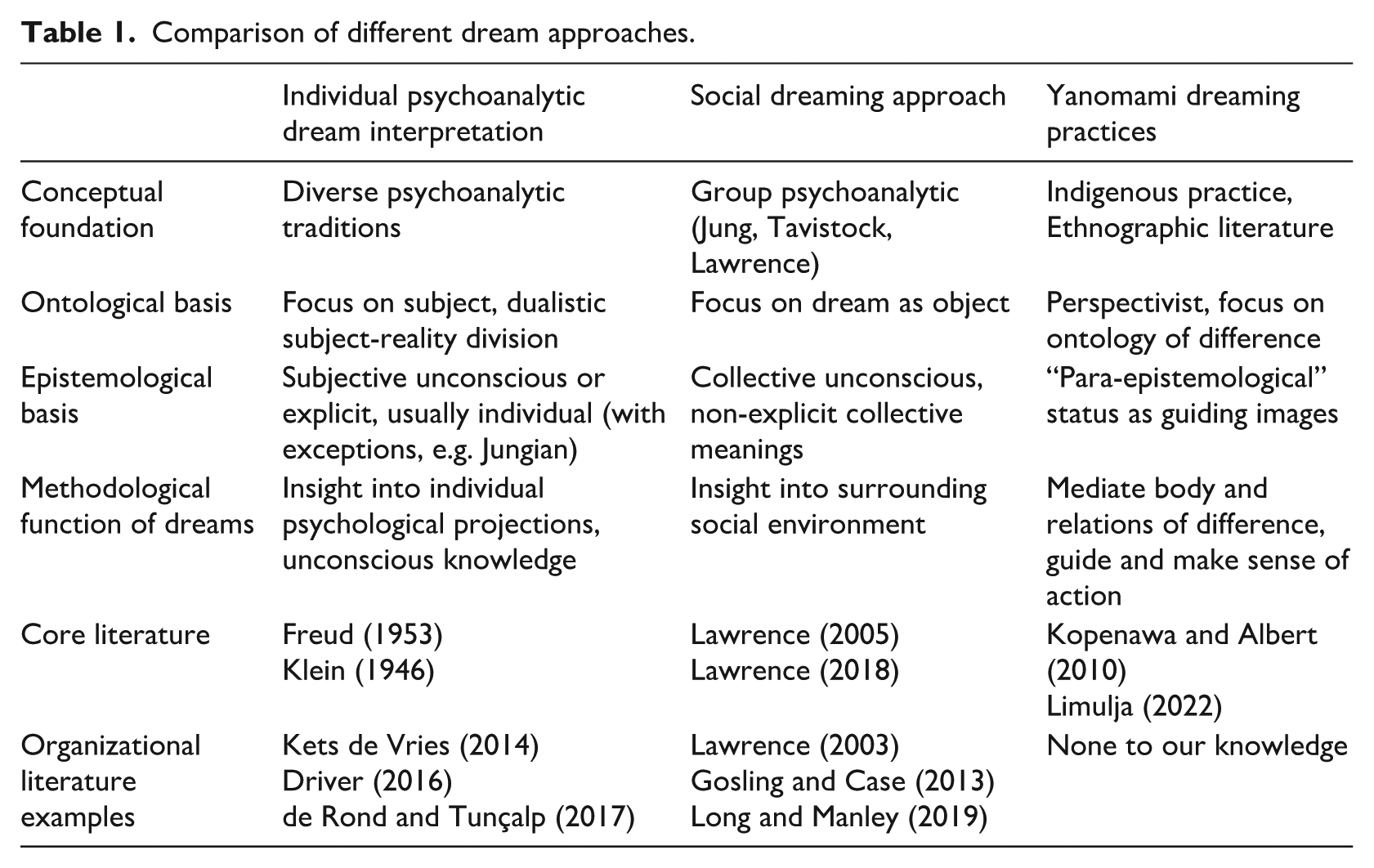
To broadly summarize the treatment of dreams as knowledge practices in a comparative frame across psychoanalytic, social dreaming, and Yanomami contexts, we present key elements of each approach to dreaming in Table 1.
Comparison of different dream approaches.
Yanomami knowledge and practice about dreams
Limulja (2022) describes Yanomami practices of knowing “a thing” as involving trying to see it in their dreams. Dreams elaborate knowledge and are foundational to establishing relationality. Dreaming is a source of knowing and experiencing the world, and dreamed experiences receive attention similarly to experiences during waking hours. This ontological continuity between dreamed and waking experience is a core aspect of dreams as described by Yanomami informants (Kopenawa and Albert, 2010; Limulja, 2022). The space-time of dreams coexists with that of waking life, in the sense of affecting each other.
Dreams are ubiquitous in Yanomami worlds. Everyone dreams, but some are described as dreaming “further.” Community members describe dreaming about proximal things and regular activities such as hunting, fishing, and relatives from other communities. However, some people, like shamans, dream further (Limulja, 2022). Shamans’ dream experiences form a central part of their roles and mediate the community’s connection with the unknown. Shamans dream about distant places, unknown cities, and about the white people, and they receive messages from the forest’s spirits (Kopenawa and Albert, 2010). Shamans’ dream experiences are often mobilized within the community to build collective decisions and shape policies for the community. As described by Davi Kopenawa of his people, “For us, politics is something else. It is the words of Omama and those of the Xapiri that he gave us. These are the words that we listen to during the time of dream and that we prefer because they are truly ours” (Kopenawa and Albert, 2010: 313). The political articulation of Yanomami people is deeply rooted in their ability to dream from and for a collective perspective.
These descriptions of Yanomami dreams characterize them differently than as a space of self-expression. Rather, dreams establish spaces of vulnerability to the expression of others’ desires (Limulja, 2022). Different from a self-projected ego-oriented mirroring, in Yanomami practices, dreams are not a space of the inside (unconscious) but an extension of the outside. In Limulja (2022) description, what dreams offer is not a mirror of one’s own image but a diffraction of collective intentions and desires that complement and extend those experienced during waking hours. Shifting from self-projection to social reception, dreaming marks a process of moving beyond the self. In Yanomami dream practices but also in other Amerindian communities, Shiratori (2022) conceptualizes the idea of dreaming as a self-fragmentation process. Dreams are compared to a state of “almost death” or “illness” in Amerindian communities. The reference to dreams as a space-time in the borders of a lived experience identifies dreaming as a suspension or setting aside of the self, in opposition to psychological notions of self-expression or unconscious projection. Dreaming, in such practices, is a process of self-fragmentation because during the dream, the self gives space to the other. Dreaming enacts an openness to connections with the outside.
The continuity between dreamed and waking experiences also involves a kind of spatial and temporal unevenness, where dreams are not related to waking life in a linear or correlational way. For Yanomami, dreams do not reflect what happened in the past to inform the unrealized future but involve a coexistence experience that shapes and affects waking life, just as the latter shapes and affects dreams. Yanomami dreams are not treated as predictions since they do not correspond to a progression of events in a temporal sense. Rather, dreams “demand a specific action, a pragmatic one based on the virtuality of the dream dimension” (Shiratori, 2022: 18).
To develop such pragmatic action, the Yanomami talk about their dreams, usually in the morning (Limulja, 2022). Because dreams are as important as any other social experience, they are treated as events to be discussed and circulated. This means that there is not a special place to talk about dreams in daily life; talking about dreams is a regular collective practice. Some people feel more comfortable talking about their dreams, especially the elders compared to younger people (Limulja, 2022). However, the practice of sharing and bundling a collective meaning to dreams is an important aspect of the pragmatic characteristic of dreams for these communities.
The action resulting from the interaction between dreamed and waking decisions treats dreams as real social phenomena, moving from a purely epistemic conception to an onto-epistemic one, considering dreams as knowledge practices. The Yanomami world is co-constituted by relational exchanges rooted in the continuity of dreamed and waking experiences (Kopenawa and Albert, 2010). From daily decisions to political engagements, dreams play a central role in maintaining Yanomami life as collective rather than individualistic.
Because of this collective aspect, Davi Kopenawa Yanomami talks about dreams as a source of knowledge and relationality that goes beyond selfish and materialistic reflexivity. For Kopenawa (2020), “white” people (non-Indigenous people) destroy the forest because they do not know how to dream. The shaman says that people need to learn how to dream; this is the only way to maintain the forest alive and to prevent the “sky from falling” (the end of the world).
Illustration: Yanomami dreams and the desires of others
To illustrate this approach to dreams as practices of knowing, we draw on examples of ethnographers and community engagement around Yanomami dream practices. Our illustrations seek to draw from the ethnographic literature to establish methodological paths by which dreams can provide (1) collective reflexivity, (2) participant collaboration, and (3) community action-oriented research.
Although the ethnographic record on the Yanomami is large, within a broader ethnographic literature across the Amazon region (cf., High, 2015), we drew on three specific examples with which to illustrate the specific use of dreams described above. The first involves Limulja (2022) ethnography, “The Desire of Others: An Ethnography of Yanomami Dreams” (“O Desejo dos Outros: Uma Etnografia dos Sonhos Yanomami”), with focuses specifically on dreaming practices among the Yanomami. The second, a collaborative ethnography between Davi Kopenawa and the French anthropologist Bruce Albert, “The Falling Sky: Words of a Yanomami Shaman” (“A Queda do Céu. Palavras de um Xamã Yanomami”), is a more general account of Yanomami society and its relation to the outside world, where dreams play a central political role. The third, a more general treatise on Indigenous relations to nature and humanity by the Indigenous philosopher Ailton Krenak, “Ideas to Postpone the End of the World” (“Ideias para Adiar o Fim do Mundo”), discusses the Yanomami dream practices as cosmovisions allowing political engagement in a context of deforestation and barely regulated violence. Taken together, these three illustrations move from the more focused on dreams (Limulja) to the more general socio-political context (Krenak), with Kopenawa’s book usefully bridging the two.
Illustration 1: Circulating dreams and collective reflexivity
It is through this opening that they understand the surrounding world, and in this way their thoughts can expand. (Limulja, 2022: 51)
During her ethnographic work (Limulja, 2022) collected over 100 dreams of Yanomamis from the Pya ú community in the Brazilian Amazon. She focuses on the collective use of dreams in constituting daily practices among the Yanomami, including how her own dreams became moments of contact between herself and the community.
Limulja describes dreaming of a journey to an unknown destination at the top of a steep staircase, with a musician waiting at the top, who gives her a mysterious and knowing glance. At her arrival, she noticed the burnt wooden furniture of her host, a woman who, she noted, was also completely burnt. No one around her realized that the woman, in fact, was dead and everything around burnt. Turning to those around her for acknowledgment, they told her to pretend everything was normal, and she felt an enormous desire to escape. She was awoken by the voice of “Olimpia,” who said that she must be ill.
Reflecting on her dream, Limulja considered that her voyage could refer to her seeking out of the dead, and the musician as being a figure who can move between life and death. However, she does not linger in her individual dream interpretation, but beginning with the premise that dreams contain the desires of others, she concludes that she needs to share her dream. She visits Fátima and Ari, a Yanomami couple in a neighboring community who claimed to have experienced dreaming of the dead (pore), and they have a long conversation about the “borders of the sky” (hutu mosi). This myth is one that Limulja had long wanted to discuss but had not found the right moment, and the dream catalyzed this moment, as Ari reported having had similar dreams.
Ari describes the Yanomami myth of the dead, who do not know their condition and remain among the living, even as their bones are ritually burnt. Inquiring why they appear charred, their family tries to avoid the subject but the birds tell them the truth, flying away and leading the spirits of the dead with them. Ari then sends Limuja to the old shaman Luigi, who elaborates on the hutu mosi and the after-life beliefs and rituals of the Yanomami, including the role of animals such as birds and flies, the roles of music, the reasons for different practices of wrapping, burning and burying remains, and the ways that spirits decide to stay or leave the earth.
In short, Limulja’s initial dream led to a sequence of events allowing her to learn, and the community to circulate, knowledge about animals, kinship, and rituals. This knowledge had been inaccessible and too sensitive to address directly, but the recounting and circulating of the dream catalyzed this access. Moreover, different community members had different levels of access to the cultural knowledge, but each had accessed that level through their own dreams, which in sharing traced a line between them. The dream had become a tool for organizing the community through a line of shared pieces of collective knowledge.
Summarizing Limulja’s process, she (i) intuited that the dream is a space of exposure to alterity, beginning but not ending her dream in a self-analysis, (ii) she sought out community members to narrate and construct collective experience, (iii) she constructed a chain of narration and collective reflexivity through the exchange with Fátima and Ari, then Luigi, building knowledge from their dreams and finally, (iv) she took an action that resulted in accessing knowledge of an important theme for her research that emerged from the desire of the other expressed through the dream.
From the analysis of Limulja’s example, we note how Yanomami dream practices exhibit an ontological openness with no clear separation between dream and reality. These frame dreams as spaces of vulnerability, involving a collective dimension of dream interpretation, to build reflexivity and knowledge. Dreams become a mechanism of collective learning, of knowing about the world, about myths, about existence (Limulja, 2022). Finally, the process of dreaming and collective interpretation generates a chain of actions that ultimately impacts everyday life.
Illustration 2: Speaking to the other through dreams
Your professors had not taught you to dream like we do. (Kopenawa and Albert, 2010: 11)
Differently than Limulja, Kopenawa and Albert (2010) “The Falling Sky” is not specifically about dreams, but about the social, political, and environmental crisis facing the Yanomami. Yet there is barely an argument appearing in the volume that does not draw on dreams for its description and analysis. A collaborative narrative by Kopenawa in collaboration with Albert, Kopenawa describes many events of his life that shows his in-depth relationship with dreams; even his name, derived from the kopena wasps, was given in a dream vision. Kopenawa’s dreams are narrated as an offering to non-Indigenous populations of an image of their actions’ consequences, a politically-charged collective reflexivity exercise.
Speaking of a protector spirit, Kopenawa elaborates: I saw him during the time of dream. His image accompanied the image of our forest in tears. Becoming ghost under the effect of epidemic fumes, the sick forest was asking the xapiri to heal the suffering the white people’s rage had inflicted upon her. She implored them to clean her trees and to make their leaves shiny; to make their flowers grow and to make her fertility return. She told them: “You are mine, you must avenge me!” I see all that in dreams when the inner part of my body becomes other, after the yãkoana has turned me into a ghost by day; Otherwise I would not be able to speak about all this like I do. (p. 33)
Kopenawa draws on dreams not only as received knowledge but as giving impetus to communication and “the ability to speak,” and dreams become a primary material of the collaborative ethnography. Kopenawa’s critique of “white people” centers on their difficulty in dreaming “far,” with the result that their “thought remains blocked, and they slumber like tapirs or turtles” (p. 313). The result of this distorted dreaming, he argues, is an attitude to nature that leads to illegal mining activities, deforestation and contamination of their territories, bodies, and foods. Seeking to understand the obsession of “white people” with gold and minerals, Kopenawa inquired from where such minerals come, explaining that “the xapiri (spirits) allowed me to see their origin in the time of the dream. What white people call ‘ore’ are the splinters of the sky, the moon, the sun and the stars that fell in the first time.” (Kopenawa and Albert, 2010: 357).
Kopenawa continues by arguing that in using machines to extract metals from the earth, “white people” are not able to understand that those metals are fragments of ancient sky, and that they are dangerous. He writes, “By digging so much, the white people will even end up pulling out the roots of the sky, which are also supported by Omama’s metal. Then it will break again, and we will be annihilated, to the last.” (Kopenawa and Albert, 2010: 361). He adds that he is carrying these words that were given to him, that he receives through dreams, so that he can alert “white” people of the risks being taken by engaging in environmentally destructive activities.
Kopenawa’s dream-based analyses were shared worldwide through his book, his worldwide interventions and activism. An ethnographic innovation reflecting what has been described as “reverse anthropology” (Wagner, 1975), Western modernity is read through the interpretive lens of Indigenous dreams, providing an unexpected yet uncannily resonant perspective on environmental destruction. The “desire of the other” is felt in an alternative mode of conceptual articulation, jarring Western self-understandings and providing a vantage point for self-reflection. The articulation of Kopenawa’s life story, dreams, and knowledges are considered an announcement of new style of work, politically, and academically speaking (e.g. Buddy, 2014). Such novelty derives not only from the co-authored ethnographic format, but from the evocative nature of his words and the political impact of his activism. Dreams are used as a mirror of the collective, rather than as a mirror of his own psychological position. They become a tool by which Kopenawa engages with the West, and an attempt at performatively reorganizing the relation between the “white people” and the earth.
Illustration 3: Dreams as collective action
Once the dream has been told, those who listen are ready to pick up their tools and begin the activities of the day. (Krenak, 2020: 20)
Turning to how dreams can be mobilized in community action-oriented research, we examined the work of Indigenous philosopher Krenak (2020), whose discussions of dream practices are central to his works “Life is Not Useful” (“A Vida Não É Útil”; Krenak, 2020), including the chapter “Dreams to Postpone the End of the World” (“Sonhos para Adiar o Fim do Mundo”) and his book “Ideas to Postpone the End of the World” (“Ideias para Adiar o Fim do Mundo”; Krenak, 2019). Both of these works locate dreaming practices among the Yanomami while extending these analyses to a more general Indigenous (and beyond that, activist) approach to social dreaming. In both works, Krenak conceptualizes the institution of dreams as a response to current ecological and sociological degradation, and takes an orientation to dreams as politically actionable knowledge practices. Krenak suggests that dreams are a “disciplined practice,” allowing actors to reimagine ways of living beyond current economic systems marked by industrialism and forms of colonialism.
Krenak argues against an overly “oneiric” (i.e. dreamlike) approach to dreams that view them as fantastic or non-realistic, focusing instead on dreams as “institutionalized” practice. As he argues, when I suggested that I would talk about dreams and the earth, I wanted to introduce you to a place, a practice that is perceived in different cultures, in different peoples, of recognizing this institution of dreaming not as an everyday experience of sleeping and dreaming, but as an exercise disciplined in seeking guidance in our dreams for our day-to-day choices. (Krenak, 2019: 25).
Krenak suggests that the common ground for mobilizing alterities through collective ecological action comes from a disposition to dream differently, as disciplined exercise. Specifically, the dream is a spur to action and has a material effect: “the dream affects the sensible world, how the act of recounting it brings connections from the dream world into the dawn, presenting them to fellow beings and transforming these in the moment” (Krenak, 2020: 20). As an attempt to mobilize social action in relation to ecological catastrophe and the possible “end of the world,” Krenak affirms the inevitability of a “fall.” He thus argues for the ability to create “colorful parachutes” (Krenak, 2019: 15), which come “from the place where visions and dreams are possible. Another place that we can inhabit besides this harsh land: the place of dreams.” (Krenak, 2019: 33).
Krenak’s (2019) environmental Indigenous philosophy posits the exercise of dreaming as a resource to “postpone the end of the world.” The author refers to ecological crises as an ongoing process of falling, and in this discourse, we can draw a psychoanalytical provocation: for Western modern subjects and societies, falling and the end have always been topics of despair. In Krenak’s philosophy, falling is an inevitable condition of life, and continuing to live depends on the ability to dream up alternatives for our current world. Such a practice of dreaming is not merely a projection or inspiration for the future but a disciplined, collective connection with the world that opens a path for reflexive thinking about our modes of organizing social life.
The use of dreams in Krenak’s work involves an explicit discourse of collective engagement in the practice of dreaming differently, to mobilize collective action. As such, Krenak presents dreams as sources of mobilization that establish relationality with audiences and materialize dream contents in social ties. Krenak’s example of calling for a collective initiative to dream differently can be read as an action orientation by which researchers build relations and possibilities for collective mobilization with community members.
From the above three cases, it should be evident how the production of knowledge from dreams from an Amerindian onto-epistemic approach differs from that presented by more psychological perspectives (e.g. de Rond and Tunçalp, 2017), and complements and deepens emerging social dreaming approaches (e.g. Gosling and Case, 2013). The foundational difference from both of these perspectives is that the dream is no longer considered solely as an object, with a separation between reality and the dream. Rather, dream and waking life are considered on a continuum, with each happening in parallel across different ontological planes that can affect each other (Viveiros de Castro, 2015). Connecting this dream approach to contemporary continental philosophy, Limuja notes: “Guattari already warned that the rigid separation between the mental, the social and the environmental results from a regime of capitalist subjectivation” (Limulja, 2022: 16). In this sense, Limulja, Kopenawa and Albert, and Krenak all view the undoing of this separation as a political form of activism, beyond the ontological and epistemic possibilities that it provides.
Lessons of collective dreaming to support organizational inquiry
Based on the above descriptions and illustrations from Indigenous authors and the ethnographic record, we can discuss more general implications for organizational inquiry regarding the collective exercise of interpretation and reflexivity through dreams. We summarize these in four broad considerations. Each involves the recognition of dream experiences as more than private projections of individual unconscious images. Such projections would be considered colonizations of the dream material by the ego (Kopenawa and Albert, 2010), paradoxically closing the researcher off from self-understanding by an over-focus on the self. By contrast, ethnographic dream practice can draw from Yanomami dream practices by allowing ontological fluidity between dream and waking reality. The experienced activities that come from dreams are also lived experiences (Kopenawa and Albert, 2010; Limulja, 2022; Viveiros de Castro, 2018), and are considered as a modality of reality that can influence the existence of those who dream as well as the broader community (Krenak, 2020). Therefore, what is dreamed of when the body is asleep and what is experienced when the body awakens are interrelated layers of experience and action (Limulja, 2022).
First, while individualized conceptions of dreams lead analysts to search for themselves and their projected experiences (de Rond and Tunçalp, 2017), collectivizing this conception leads to a relational approach to dream analysis (Lawrence, 2003). This involves recognizing the dreamer as a center of vulnerability to the expression of others’ desires during the dream experience (Limulja, 2022). The dream becomes a form by which the person materializes and expresses the desires of others: “the dream is the result of a feeling that comes from the other [. . .] the object of the dream is the subject of the feeling and the dreamer wakes up in the same state as the one who triggered the dream” (Limulja, 2022: 110). Therefore, if the dream is about a relative who is absent (due to geographic distances) or dead, it is because that relative misses you, so the dreamer will also wake up with that sentiment. (Limulja, 2022).
Concretely, mobilizing such experiences involves practices by which one recognizes and seeks the otherness within dream events. A free association or introspective technique may be appropriate, but rather than interpreting the dream only through the question of what emotions or experiences led one to produce dream images, the technique looks outward. Specifically, the importance of the dream is to find aspects that are “motivated by others” (Limulja, 2022: 51). One implication is that the process of dream interpretation begins with an examination of social surroundings, an attempt to listen to or feel the desires of others, and to remain “outside of oneself” in the analytical process.
Second, because the dream is considered an intermediary image that links self and other, it can perform a boundary function that is useful for inquiry. Specifically, this involves the exercise of sharing and narrating, for example, in the first moment after awakening or in another semi-waking or liminal moment. This exercise of describing the dream experience generates a collective construction and interpretation of the dream content (Limulja, 2022). The commitment to description must be greater than the commitment to attributing meaning, to avoid closure of the experience and turning the dream into an object. The commitment toward deep description without abstraction also maintains the otherness inherent in the dream experience as an ongoing and irreducible process (cf., Viveiros de Castro, 2016). This interpretative exercise is carried out together, collectively in the field, through listening and exchange processes.
In practice, narrating the dream becomes both essential for understanding but also curative for the dreamer and the surrounding community. Limulja (2022: 72) notes that “recounting the dream is fundamental, as the socialization of oneiric content allows, in the case of a bad omen, that the dreamer or affected person take the needed precautions.” Thus the narration of dreams is already action-tending, moving toward the question of what the community or person should do in light of the dream content.
Third, the sharing of the dream should be followed by a collective process of construction and reconstruction of knowledge from dreams. In Yanomami communities, this practice of collective construction happens in the early hours of dawn, when dreams are told to close family members or in the collective house. By telling dreams, knowledge is produced and constructed (Limulja, 2022). However, the very liminality of the dreams’ border condition (between individual and collective, between waking and sleep, between night and daylight) maintains knowledge in a state of potentiality, making knowledge relational without being overly public (Krenak, 2020), and articulated without losing fluidity.
The process of collective construction goes together with the narrative aspect of recounting the dream, but deepens it by engaging in a multi-vocal and communal appropriation of the dream. This step de-centers authority from the “author” of the dream to a community of practice, where the meaning of the dream is ultimately established as a social fact that remains open to change over time based on community concerns and multiple perspectives. Beginning in the body of the dreamer, the dream is progressively revealed as a shared matter of concern and a source of inspiration and direction.
Fourth, the avoidance of treating dreams as objects of self-projections leads scholarship to prioritize the ontological possibility of relationality over the epistemic meaning and the interpretation of the dreams. This preference reinforces the importance of moving from “being there” to “being with” (Gherardi, 2019) and establishing relations. In Yanomami ethnographies, through the process of telling of dreams, specific decisions shape and negotiate the dreams’ impacts (Limulja, 2022). What Yanomami members do with their dreams in the moment of bodily awaking shapes their waking experience. Thus, the fieldworker may focus on the action or event resulting from the dream, that is, where one is led by the dream, not necessarily what the dream means, prioritizing relation over interpretation.
Concretely and pragmatically, the dream reaches its culmination as an ongoing guide for action. Rather than the Western “making your dream come true,” this should be understood rather as both divinatory and performative. The dream is, in a sense, already “true” as a relational phenomenon, and recognizing it as such allows the community to respond to its calls and warnings, as a prefiguration of relational possibilities. At the same time, as an action object, the dream serves as a catalyst for concretizing and realizing collective actions, which is its performative component. The Western model of a dual ontology—involving “inside to out and unreal to real”—is replaced with a networked and dynamic model where the dream voice is taken seriously and feeds back into ongoing practice.
We summarize these considerations in Table 2, which examines the four moments of dream practice described above. By “moments” we do not imply that these are a linear process of discrete phases, and we assume them to have varying temporalities and to be context-dependent.
Summary aspects of collective dreaming as within organizational inquiry.
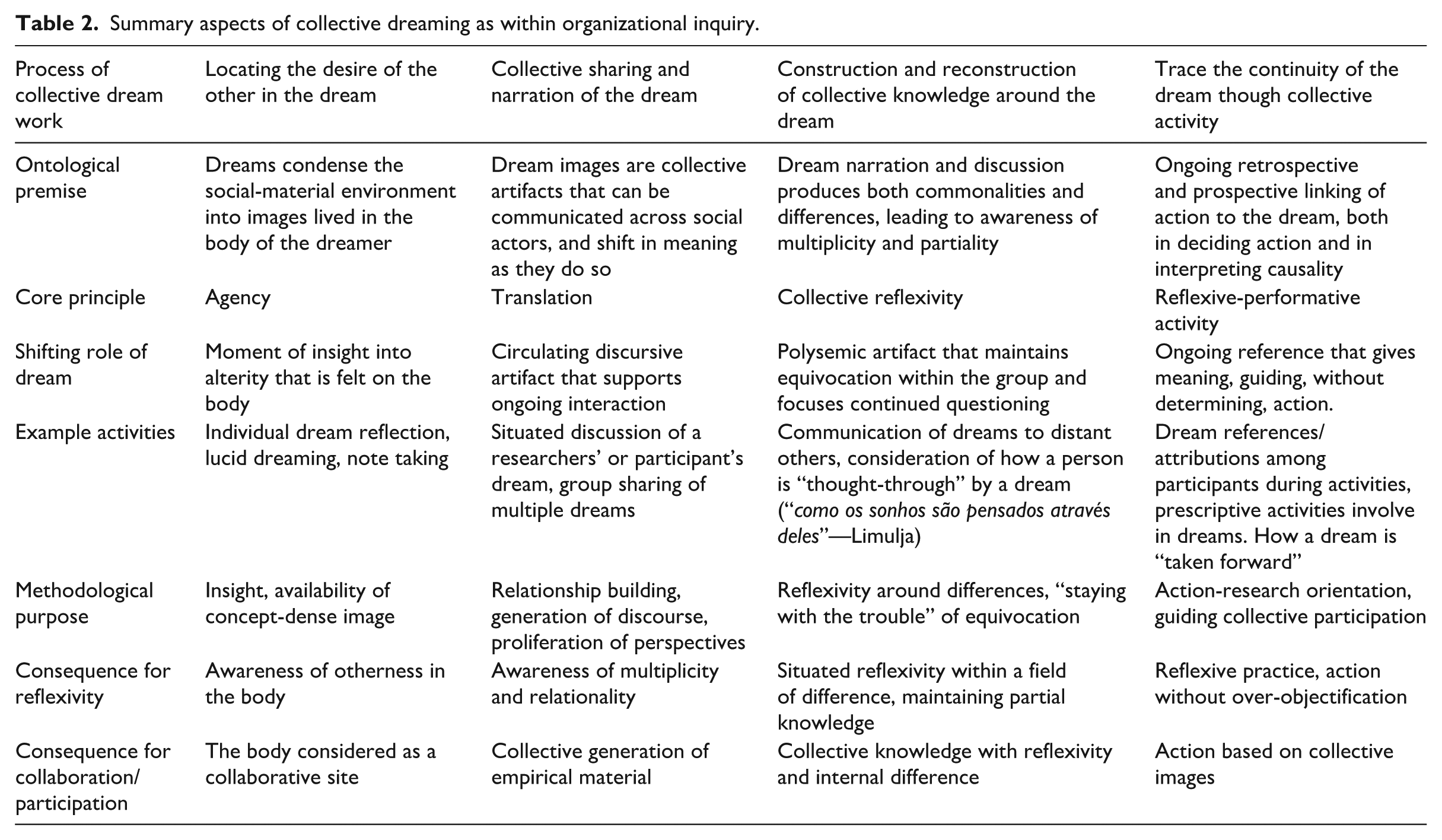
As described in the Table 2, the initial location of the other’s desire involves a perception of the dreamer’s body and experience as a condensation of complex environmental inputs. Agency is located in the individual, although the individual is not the “owner” of the dream. Rather, the bodily sensation is experienced as a source of alterity, registered through note-taking or other mnemonics. Moving from “agency” to “translation,” the dream is circulated across a social network and discussed in relation to others’ dreams and experiences, using the dream to build relationality, with the ensuing conversations providing further empirical material that can be added to notes and creates a polyvalent set of interpretations. Moving to “collective reflexivity,” the dream narration takes multiple paths and leads to discussions of adjacent social concerns, recognizing that it will produce divergent meaning across actors and that collective reflexivity is occurring within a field of differences and family resemblances. Finally, the dream becomes part of an ongoing store of narratives and relational moments that are part of the collective stock of experience, referred to in future moments of narration, reminiscence and decision-making. As such, they can be used as guides for the group to understand and direct its activities, moving from an epistemic to a pragmatic orientation.
Taken together, these moments constitute a complex onto-epistemic position in which dreams appear in the dreamers’ body while retaining their connection to otherness, which allows them to be communicated and travel across actors. This circulation of dream images mediates commonality and difference among members, establishing them as a differentiated collective acting together while retaining their differences. Recognizing this continuing otherness displaces agency from the dreamer outward, in a process of translation across speakers focused on action-oriented collective reflexivity. Insight from the dream is linked to relationships across the group, including differences among members, in the building of group practices.
Discussion: Collective dreaming and decolonizing organizational research
These are words that the spirits gave me in a dream [. . .] These are the words that I would like to make heard, now, with the help of a ‘white’ who can make them heard by those who do not know our language. (Kopenawa and Albert, 2010: 74)
The current paper contributes to organizational approaches to dreams by drawing on Indigenous dream practices to take seriously the epistemic, and collective, potential of Indigenous approaches to dreams for knowledge discovery. This approach expands current work on dreams as individual reflexivity tools, by emphasizing a collective process. By shifting from the understanding of dreams as an object of projection and mirroring to a space of lived experiences and crossings, we open the possibility of using dreams to explore issues of alterity, researcher-participant collaboration, and collective reflexivity in organizational research.
The four methodological phases described in broad lines in the previous section (see Table 2) can be translated into methodological practices focusing on agency, translation, collective reflexivity, and reflexive-performative activity, respectively. While we do not offer a specific “recipe” for application, given the context-bound and intersubjective nature of this process, applying this method would begin with a logging and analysis of one’s own or an informant’s dreams, which are then analyzed in terms of the desire of the “other” expressed in the dream material. This analysis moves the method into phase 2, which involves a collective discussion of the material between researcher and participants. In both of these phases, “data” and “analysis” are intertwined, as the data is constituted through an intersubjective reflection that is also analytical, and likewise the analysis becomes the source of further empirical material as it is intersubjectively experienced.
In the third phase of application, the dream material is more widely shared within the community, with the aim of linking it to other stories, knoweldges, and associations between the members, moving outside of the dream itself but using it as an object to “think with.” Finally, these stories and associations are analyzed in terms of the practices they support and the outcomes of such actions, recognizing the performative dimension of the collective knowledge process, including the research itself and the process of dreamwork as part of the ongoing activity of the community.
Although this brief programmatic overview of a collective dreaming method is open to variation in practice, we emphasize the key principles of dreams as an embodied experience of the other (phase 1), a collective translation process that moves beyond the self (phase 2), a collectively-produced network of meaning and associations that build reflexivity around the dream (phase 3) and a performative turn that examines the material effects of such reflexivity (phase 4). Beyond these broad phases, we emphasize the relational trust and ability to accept loss of certainty that this method implies, meaning that, in practice, things may go differently.
Contributions to organizational scholarship
Indigenous approaches to dreams suggest that dreams provide images that are not reducible to projections of self, but are supports for collective reflexivity and activity. While we appreciate the power of dreams to reveal the inner desires and apprehensions of researchers (de Rond and Tunçalp, 2017), we extend this perspective by focusing on the social aspect of dreaming, with “social” taken in the broad sense utilized by Gosling and Case (2013). This involves the ability to cultivate “non-anthropocentric sensibilities and organize responses to an impending cultural crisis” (p. 705). Such social dreaming synchronizes well with emerging calls for methodological decolonialization and voices from the south (Konadu-Osei et al., 2023; Smith, 2005), promoting epistemic justice (Tsosie, 2012) and expanding organizational scholars’ possibilities for pluralistic inquiry.
Thus, we contribute to critical organizational scholarship by drawing upon Yanomami thought to make a crucial link between a non-egocentric view of dreaming and a non-anthropocentric way of relating to the social and natural world. Both of these aspects draw on a relational perspective that is foundational to Amerindian thought (Viveiros de Castro, 2015). In this perspective, essentialized boundaries separating self from other, human from non-human, are replaced by ongoing processes of becoming “other,” making relations though mutual contact and translation. Such processes are always insecure and are never guaranteed; this very aspect, however, maintains the need for ongoing relational becoming within one’s own perspective and in one’s understanding of others’ perspectives. This relational aspect has important epistemological and methodological consequences.
Specifically, it reframes questions about the subjectivity and objectivity of belief into questions about the nature and quality of exchanges between social actors (cf., Hosking, 2011; Strathern, 2020). These may be actors within a human organization, relations between humans and non-humans, or researchers and research participants. Dreams are useful not only as indicators or evidence of underlying psychological phenomena (although they can be that too), but primarily as images arising from a relation between the knowing self and the other, in which the image arises as a token of that relation and can inform, in dialogue with others, the nature of that relationship.
Qualitative research, and especially ethnographic methods, depend on acknowledging that cultural understanding requires engagement in the lived practices and sensibilities. In that sense, ethnography rests on an epistemology of knowledge-in-practice, on “being there” (e.g. Watson, 1999), rather than a purely disembodied vision of propositional knowledge. Nevertheless, ethnographic approaches have given short shrift to dreams, which remain relegated to the psychic life of the dreamer, as a kind of personal property. Recognizing that the “other” as already present as a co-producer of one’s dreams (Limulja, 2022) allows a deeper form of ethnographic engagement and a decolonization of dreams that recognizes the agency of those with whom those images were built. It displaces the “merely” epistemic question of “is the dream a valid form of data about the field” to a relational, onto-epistemic question of “what form of relation with the field is manifest in the dream.”
Moreover, and as a consequence, dreams are best used as artifacts that can be brought into dialogue across researcher-participant relationships, where the researcher and participants share and elaborate their dreams collectively and use these as a basis for elaborating their mutual relations (Lawrence, 2003). The practice of collective dream elaboration is best thought of as a form of collaborative research (e.g. Ramirez and Islam, 2024), a mode of collectively reflexive research between Indigenous and non-Indigenous actors that has been called for in organizational research methods (Scobie et al., 2021). Distinct from “action” or “activist” research, in which the researcher applies their ideas to specific practical goals (e.g. Reedy and King, 2019), it does not have a particular “performative” goal as a research outcome, but neither does it seek to build decontextualized propositional knowledge of the research participants. Rather, it engages in an ongoing attempt “reassemble the social” (Latour, 2005) between researchers and participants to build shared knowledge with the participants (Gherardi, 2019). The outcome of this exchange cannot be set in advance and accepts that this process may change both the research and the participants. It assumes the responsibilities and ethical weight that this implies.
The idea of using dreams in this way emerged in complex engagements with non-Western groups, where the characterizations of radically different cultures was barely distinguishable from Western dreams about the other; as it turns out, “they” were also dreaming about “us” (Viveiros de Castro, 2015). In classic anthropology, the shamanic dream or Indigenous dreams are often taken as metaphors, illustrations, or allegories that draw boundaries between Indigenous beliefs (oneiric, image-based, and mythical) and Western science (evidence-based and propositional) as fundamentally opposed (cf., Geertz, 1982; Levi-Strauss, 1962). Later elaborations of those works reconsidered Indigenous dreams, practices, and philosophy as foundations to build concepts, “taking them seriously - as practices of meaning” (Viveiros de Castro, 2015: 158). This methodological turn implied both an ontological turn and a decolonizing political stance.
Building knowledge by collectively working with dreams does not happen as an individual process. Self-centered dreams deliver to dreamers concerns about themselves, projections of their lived traumas, fears, desires, past, and current experiences (de Rond and Tunçalp, 2017). By expanding the understanding of dreams to relational and interactive processes, we contribute to bringing organizational scholars closer to their own relationships in the field, in a collective process. A dream that makes room for alterity, for communication with others.
In sum, we propose a methodological approach to use dreams as sources for collective reflexivity in organizing, based on Indigenous knowledge practices. Organizational scholars have recognized the need to move from more individualistic to more collective forms of reflexivity (e.g. Gilmore and Kenny, 2015; Ripamonti et al., 2016), including in research methods (Cayir et al., 2022). However, literature on collective reflexivity is still very incipient, has not acknowledge the potential of dream practices, and most importantly, as overlooked the plethora of reflexive practices already existing in Indigenous practices. The current paper thus brings to bear practices of collective reflexivity in ways that have not been recognized in, and can help decolonize, organizational research, and research methods.
Fieldwork applications and practices of this approach can form a future research agenda in organizational scholarship. To be sure, our work here does not exhaust the exploration of Indigenous dreaming in organization studies; quite the opposite, we encourage and invite researchers to explore this subject further, particularly in collaboration with and highlighting the voices of Indigenous community members, scholars, and activists (cf., similar calls by Bastien et al., 2023; Hrenyk and Salmon, 2024; Peredo, 2023). In that spirit, the invitation for Western scholars to learn from and explore Indigenous dreaming has been explicitly urged by Yanomami scholars: “I entrusted you with my words and I asked you to carry them far away to let them be heard by the white people, who know nothing about us” (Kopenawa and Albert, 2010: 11). Dreaming has been a useful tool for Western scholars to learn about themselves but can also be used to learn about others and their mutual relationships.
Thinking with indigenous cosmologies: Epistemic plurality and decolonizing methods
Organizational scholars are increasingly calling for scholarship engaging with and integrating alternative epistemological perspectives, including Indigenous ways of knowing (Fan, 2024; Konadu-Osei et al., 2023; Peredo, 2023), noting that experiences of colonization and marginalization are also reflected in theoretical and methodological approaches of Indigenous research (Banerjee and Linstead, 2004). Careful attention is needed to consider how these theories are related to Western and colonial knowledge, structures, and projects (Banerjee, 2022; Salmon et al., 2023), and to decolonize research methods (Konadu-Osei et al., 2023). Attempting to methodologically translate, however equivocally (Viveiros de Castro, 2018), Yanomami ways of dreaming is an attempt to move from dream analysis as individualistic experience to stressing the relational nature of knowledge production (Strathern, 2020), a relationality linked to a decolonizing ethic (Ehrnström-Fuentes and Jääskeläinen, 2022).
Thus, we engage with relationality as a central aspect of Indigenous knowledge (Bastien et al., 2023) as source of organizational insight. The research approach presented above attempts to engage seriously with Indigenous conceptions of dreams as a philosophical stance and methodological tool. Addressing this concept/phenomenon takes particular salience in the light of recently emerging and rapidly growing literature around Indigeneity and organization studies (Bastien et al., 2023; Peredo, 2023; Salmon et al., 2023).
This emerging literature involves research around the articulation and comparison of Indigenous epistemologies (e.g. Daher, 2024; Fan, 2024), individual and community-based entrepreneurship (Peredo, 2003; Peredo and McLean, 2013), and the influence of colonization on current-day interactions between Indigenous peoples and modern institutions (Clydesdale, 2007; Kuhn and Sweetman, 2002; Miley and Read, 2018; Ramirez et al., 2024). Peredo (2023: 1218) notes how engagement with Indigenous practices can help to highlight “new forms of agency” that complement and extend current thinking in organization studies, while contributing to the project of “unsettling the settled” ideas and practices in the field.
Complementing such perspectives, we seek to contribute to the possibilities raised by increasing engagement with Indigenous worldviews, promoting new ways of knowing by listening and learning from Indigenous perspectives. One consequence is a re-valuing of dreams as key practices of knowing, while shifting from individualistic to relational views of dreams (Gosling and Case, 2013; Lawrence, 2003). Such relational views have been intricately developed in Amerindian contexts (Limulja, 2022). From a self-centered reflexivity, dreams become linked to the collective, from the desire of others that run through dreams. By opening this other-focused ways of dreaming to methodological exploration, we contribute to bringing organizational studies closer to a dream that goes beyond ourselves. A dream that makes room for otherness, for communication with others, and an invitation to reflect on the needs of others.
The practice of reflecting on others’ needs does mobilize individual reflection and contemplation, but this is continuously built into collective practices of exchange, as dreams are narrated and circulated, thought out and reflected upon collectively. Knowledge is constructed and acted upon through such exchanges, from telling and hearing about each other’s dreams, and the embodied intimacy of the dream experience is felt collectively.
Conclusion
Collective thinking from the perspective of Amerindian dreams opens new trajectories into an area that has had periodic but limited development. Analyzing dreams and incorporating them into methods has a history in organizational scholarship (de Rond and Tunçalp, 2017; Gosling and Case, 2013; Lawrence, 1991, 2003; Page et al., 2014; Woźniak, 2010). However, these investigations, to a greater or lesser degree, focus on understanding dreams through psychological lenses, and thus leave a space for a more collective approach.
Understanding dreams not (only) as psychic objects but as continuous social events legitimate dreams as a part of social reality, experienced intimately and shared collectively. It is unfortunate that such an intimate and ubiquitous experience as dreaming has received so little attention as a source of social knowledge. The current paper brings attention back to dreams, while avoiding an egocentric view of dreaming. Indeed, the greatest value of dreams as knowledge practices may lie less in their deep rootedness within the individual unconscious than in the otherness that constitutes them relationally, by which they link actors to each other, and by what they make happen between people and their worlds.
Footnotes
Funding
The authors received no financial support for the research, authorship, and/or publication of this article.
