




Abstract
In this study, we explore a student-supervisor relationship and the development of relational and reflexive research identities as joint actions towards decolonizing management knowledge and practice. We frame a specific case of PhD supervision through he awa whiria the braided rivers metaphor, which emerges from Māori traditions. This metaphor recognizes a plurality of knowledge streams that can start from different sources, converge, braid and depart again, from the mountains to the sea. In this metaphor, each stream maintains its own autonomy and authority, but knowledge is created at an interface in partnership. We use this framing metaphor to illustrate the tensions between co-creating knowledge with an Indigenous community that a research student has kinship ties with and feels a strong affinity to, and navigating the institutional requirements for a PhD within a UK university. We surface two contributions that open up future possibilities for supervision, research and practice. The first is the use of the metaphor to frame the student-supervisor partnership and strategies for decolonizing management knowledge more broadly. The second is the requirement for relational and reflexive research identities in decolonizing management knowledge.
Introduction
Decolonizing management knowledge requires both critique of hegemonic management knowledge and practices derived from Anglo-American capitalist traditions and the presentation of Indigenous alternatives (Dar, 2018; Girei, 2017; Henry and Pene, 2001; Jaya, 2001; Nkomo, 2011; Ruwhiu and Cone, 2010). Yet many students from around the world decide or are incentivized to attend universities in former imperial powers. When doing so, they may experience a form of neo-colonialism or intellectual imperialism through being schooled in ideas, theories and practices that were developed by previous colonial powers to maintain dominance (Ul-Haq and Westwood, 2012: 243). It does not have to be this way as hitherto efforts to decolonize management knowledge have illustrated. For example, there is a growing literature on the decolonizing of ideas, practices and histories (Alcadipani et al., 2012; Ibarra-Colado, 2006; Mir and Mir, 2012) and research methodologies and relationships (Girei, 2017; Gonzalez y Gonzalez and Lincoln, 2006; Henry and Pene, 2001; McNicholas and Barrett, 2005; Ruwhiu and Cone, 2010). So far, insufficient attention has been given to the way in which the student-supervisor relationship during doctoral studies may contribute to the decolonizing of knowledge. The PhD student-supervisor relationship is not only pivotal in either validating and celebrating, or denying and belittling the alternative perspectives students can contribute towards decolonizing knowledge, but it is also important because PhD students are the next generation of academics who have the responsibility for developing the future curriculum in higher education.
This article aims to report, theorize and learn from a case in which actions of a student and his supervisors became aligned in a relationship that helped decolonize research relationships and identities as a step towards decolonizing knowledge more generally. The setting for the case is a Russell Group university in England where Business and Management Schools continue to benefit from – and help to perpetuate – an Anglo-American intellectual hegemony (Boussebaa, 2020). Financial benefits from that hegemonic position enable institutions to offer scholarships to attract the next generation of scholars who may inadvertently or otherwise build on and help to sustain the prevailing intellectual imperialism. The focus here is on the student-supervisor relationship from a PhD project conducted between 2015 and 2019, which contrasts with such a scenario. The student was from the settler-colony Aotearoa New Zealand which, therefore, has ongoing colonial dynamics within its borders (Smith, 1999). Reflecting this, the student had mixed descent of Pākehā (NZ settler-European) that provided the identity claim in which he had been raised and Ngāi Tahu (Indigenous Māori) from which he had been disconnected. The supervisors had obtained the scholarship for another project, but when the PhD was awarded, it was for an ethnography-informed case study that utilized a decolonizing methodological framework. The new project sought to explore the role of accountability within Ngāi Tahu, an Indigenous kinship grouping pursuing self-determination and Te Rūnanga Group, the organization established to manage collective settlement assets in the settler-colonial context of Aotearoa New Zealand (see Scobie et al., 2020).
Two themes for analysis are central to understanding the transition of this project into a decolonial study. Firstly, the supportive relationship with the supervisors who respected the student’s agenda and helped remove obstacles as the decolonizing PhD project became firmer; and secondly, the PhD student’s increasing consciousness of being a decolonial researcher as he utilized the project to reconnect with his disconnected Indigenous identity, relations and knowledge systems. The account provided is an ex-post conceptualization based on our retrospective sense making (Cunliffe and Alcadipani, 2016). In providing the account, we frame this case using he awa whiria the braided rivers metaphor advanced by Māori scholars Angus Hikairo MacFarlane (Ngāti Whakaue) and Sonja Macfarlane (Ngāi Tahu). In contrast to the dualisms in Eastern ideas about paradoxes and Western notions of dialectic tensions (e.g. Kakkar, 2019), the braided rivers metaphor has emerged from Indigenous Māori traditions to recognize multiple streams of knowledge that come together and depart while maintaining their own mana (prestige/authority). This metaphor therefore recognizes the mana of the student, the influence of the Indigenous communities that participated in the research, the supervisors’ facilitative knowledge of the immutable and transmutable parts of the institution’s postgraduate research provisions, and the institution’s accumulative and potentially colonizing wisdom of prerequisites for successful, timely PhD completion. We use this framing metaphor to illustrate the tensions between on the one hand, co-creating knowledge with an Indigenous community that a research student has kinship ties with and feels a strong affinity to and on the other hand, navigating the institutional requirements for a PhD within a UK university.
The contribution of this study is twofold. Firstly, by framing our case through he awa whiria the braided rivers metaphor, we are able to identify when potential conflicts emerged in the student-supervisor relationship and offer a novel, decolonial perspective on how they were resolved by aligning different autonomous interests in pursuit of progressive goals. Secondly, we use Indigenous concepts to understand the dynamics of identities, particularly that of the student’s in his relationship with his supervisors, the community to which he belonged and others with an interest in this project. The remainder of the paper is structured as follows. First, we review the literature to develop a framework for applying he awa whiria the braided rivers metaphor to the PhD project of decolonizing management knowledge in an enabling partnership that recognizes and enhances the mana of supervisors and the student as he became increasingly aware of his Indigenous identity. Next we frame the doctoral journey through the braided rivers metaphor to present an overview of some of the tensions during a doctoral project aimed at decolonizing management knowledge and we outline strategies deployed to address these tensions through the student-supervisor relationship. Following this, we discuss these tensions and solutions and draw out some key implications for the student-supervisor relationship and research identities.
Decolonizing the student-supervisor relationship
Although we focus our analysis specifically on the student-supervisor relationship and the student’s research identity, this study is embedded within a much wider decolonial tradition. Decolonization has been approached from many disciplinary perspectives (Coulthard, 2014; Fanon, 1968; Green, 2007; Mbembe, 2016; Simpson, 2017; Smith, 1999; Thiong’O, 1986; Tuck and Yang, 2012). One strand of literature dedicated to decolonizing management knowledge has developed over recent decades. Many such contributions appear in special issues and literature reviews that reflect on the colonial and hegemonic position of particular management knowledge systems and practices (Alcadipani et al., 2012; Banerjee and Linstead, 2001; Ibarra-Colado, 2006; Jack et al., 2011; Jaya, 2001; Mir and Mir, 2012), exercised by notions of whiteness/patriarchy (Dar and Ibrahim, 2019) and the English language (Tietze and Dick, 2009). Much empirical research in this tradition focuses on decolonizing and critiquing aspects of management and organizational practices, for example, stakeholder engagement, accountability and development administration management (Banerjee, 2000, 2008; Cooke, 2004; Dar, 2018). Another strand explicitly offers alternatives to hegemonic knowledge systems within their own critique (Islam, 2012; Khan and Koshul, 2011; Nkomo, 2011; Ul-Haq and Westwood, 2012).
Decolonizing management knowledge also requires decolonizing the methodologies that drive research and create management knowledge. An important strand in Aotearoa New Zealand’s decolonial school of thought is around decolonizing research methodologies (Henry and Pene, 2001; McNicholas and Barrett, 2005; Smith, 1999; Ruwhiu and Cone, 2010). This literature has emerged across a number of disciplines such as education (Smith, 1999) and law (Mikaere, 2011) but are all embedded in Māori perspectives and intimately tied with struggles for self-determination and the recognition of rights under Te Tiriti/The Treaty of Waitangi. 1 Our study is largely a response to the interventions of Henry and Pene (2001) and McNicholas and Barrett (2005) in critical management studies. Henry and Pene (2001) implant a kaupapa Māori perspective into the management literature and provide an early example of both critiquing the colonizing potential of research methodologies and presenting viable alternatives grounded in Indigenous traditions. As a guiding methodology, kaupapa Māori upholds the mana of Māori communities and recognizes the intimate relationship between research and self-determination. Although these are particular Māori approaches to research methodology, many of the same principles are important across decolonizing contexts. Indeed, the work they draw from heavily, Decolonising methodologies: Research and Indigenous Peoples by Linda Tuhiwai Smith, has been influential across the world (Smith, 1999).
A fundamental part of knowledge creation within universities is PhD-supervision. Supervisors have a lot to learn from decolonizing methodologies and Indigenous perspectives (Berryman et al., 2017; Glynn and Berryman, 2015; Pihama et al., 2019). Pihama et al. (2019) outline the creation of a Māori and Indigenous doctoral programme as one response to a shortage of Māori academics employed at universities (see McAllister et al., 2019; Naepi, 2019). Designed as an Indigenous intervention in the higher education sector their programme highlighted two broad areas that marginalize Māori in the university – systemic racism and inadequate supervision. They argue that well-informed leadership and trusting respectful relationships between students and supervisors are key to addressing this shortage (see also Glynn and Berryman, 2015). Berryman et al. (2017) reflect on their supervisory practices of working with students from Indigenous (Māori) communities. In doing so they argue that experiences with students have taught them to seek culturally authentic and responsive pathways that respect Indigenous Peoples’ rights to define what, how and why research is conducted towards their own well-being as Indigenous Peoples (Berryman et al., 2017). As supervisors Berryman et al. (2017) learned to appreciate their role constructing new knowledge with students and communities in contrast to being colonial experts and gatekeepers of research: Māori doctoral students retain their rights, to define their own research questions, research paradigms, worldviews and methodologies. Importantly, Māori doctoral students should expect to find these concerns at the center of their institution’s research agenda. Institutions, therefore, need to ensure that their research supervisory processes respect indigenous, culturally located ways of knowing and caring, and that their supervisors engage in authentic power-sharing and reciprocity in learning with and from their doctoral students and their indigenous cultural communities – Berryman et al., 2017: 1358
Within the same line of argument, Glynn and Berryman (2015) suggest that higher education institutions in Aotearoa New Zealand need to ensure that Māori doctoral students and their communities maintain their right to uphold their own research traditions as an obligation under Te Tiriti/The Treaty. These authors include several culturally embedded principles that inform their student-supervisor partnerships. Two of these resonate with the present case – manaakitanga and mana motuhake – as key principles to guide our two themes. Manaakitanga is often translated as hospitality but is really the practice of giving mana. That is, one’s mana is enhanced if it maintains and enhances the mana of others. Our first theme, the supervisory relationship, is about supervisors and students maintaining and enhancing each other’s mana. Mana motuhake – which is about asserting, maintaining and enhancing mana in an interdependent way – frames our second theme, which is the student’s research identity. We draw on these two culturally located principles to guide our two themes for analysis: manaakitanga as guiding the student-supervisor relationship and mana motuhake as the student carving out their own research identity with the support of this relationship.
These Aotearoa New Zealand studies provide salient points that are largely unaddressed in Management and Organization Studies. Cultural insensitivity both in work published in the hegemonic tradition of management thought read by doctoral students and in supervision provided by some former or settler-colonial academics, may lead institutions to be unresponsive to the Indigenous communities that their students are from and/or working with. In our case, the lead author chose to undertake doctoral studies at a UK university, with UK-based supervisors who had little knowledge of the Indigenous community that this student was from and subsequently worked with in the research process. This institution was also outside of the formal obligations under Te Tiriti/The Treaty of Waitangi. There are many student-supervisor relationships in similar situations across the globe. This raises the question of whether such students can, or will, be supported in efforts to help decolonize knowledge? In our case, both the supervisors and the student worked within a tradition of critical theoretical and methodological research that resulted in an openness of supervisors to learn about substantive parts of the particular project while ensuring that the requirements of the institution were met. We frame this student-supervisor relationship through he awa whiria the braided rivers metaphor, as streams of knowledge that start from different places, weave together and depart, while maintaining their own mana in partnership. We now introduce this established metaphor for research to draw together and frame the principles of manaakitanga and mana motuhake.
He Awa Whiria the braided rivers metaphor
In contrast to the tensions found in the dialectical thought of thesis, antithesis and synthesis in Western traditions (Putnam et al., 2016; Schad et al., 2016) and the enduring dualisms of paradoxes in Eastern thought (Bednarek et al., 2017; Jarbzabkowski et al., 2013; Kakkar, 2019; Schad et al., 2016), He Awa Whiria the braided rivers metaphor recognizes a plurality of knowledge systems. The metaphor has been advanced by Māori scholars Angus Hikairo MacFarlane (Ngāti Whakaue) and Sonja MacFarlane (Ngāi Tahu) out of education research (Macfarlane et al., 2015). The education discipline has been a driving force for decolonizing perspectives from which other disciplines have drawn (see e.g. Macfarlane et al., 2015; Smith, 1999; Tuck and Yang, 2012). Macfarlane and Macfarlane (2019) refer to the braided rivers metaphor as an evolutionary partnership approach for reconciling Māori and non-Māori knowledge systems that listens to culture. The framework is therefore specifically inspired by Aotearoa New Zealand’s Treaty partnership perspective but it is useful for our argument advocating a partnership between students and supervisors.
Braided rivers (pictured in Figure 1) are important features of Te Waipounamu (The South Island) of Aotearoa New Zealand. They form a fundamental part of the cultural identities of Ngāi Tahu and reinforce a sense of nourishment, place and belonging. This metaphor for knowledge is inspired by the landscape which the lead author calls home, but we further adapt the metaphor to embrace a Ngāi Tahu worldview. Ngāi Tahu view rivers through the perspective of Ki Uta Ki Tai from mountains to the sea; this informs and is informed by their philosophy and policy for ecological relations (Tipa, 2009). Ki Uta Ki Tai guides Ngāi Tahu’s resource management policy and draws together Ngāi Tahu indicators with indicators from Western science to extend the narrow view of rivers as the water in a channel to open up the complexity and diversity of ecosystems within a catchment (Tipa, 2009). This suggests a deep understanding of the interrelationships between ecosystems – rivers connect entire landscapes from mountains to sea and people live within this landscape. When deploying this metaphor, we also want to think through the entirety of the river, from mountain to sea, rather than just the braided sections. As a metaphor for knowledge systems this provides a useful starting point, but just as the streams of the river are not fixed and static, neither is Ngāi Tahu knowledge fixed and static. There is no simple binary between contemporary Ngāi Tahu knowledge and ‘Western’ knowledge (Tipa, 2009).
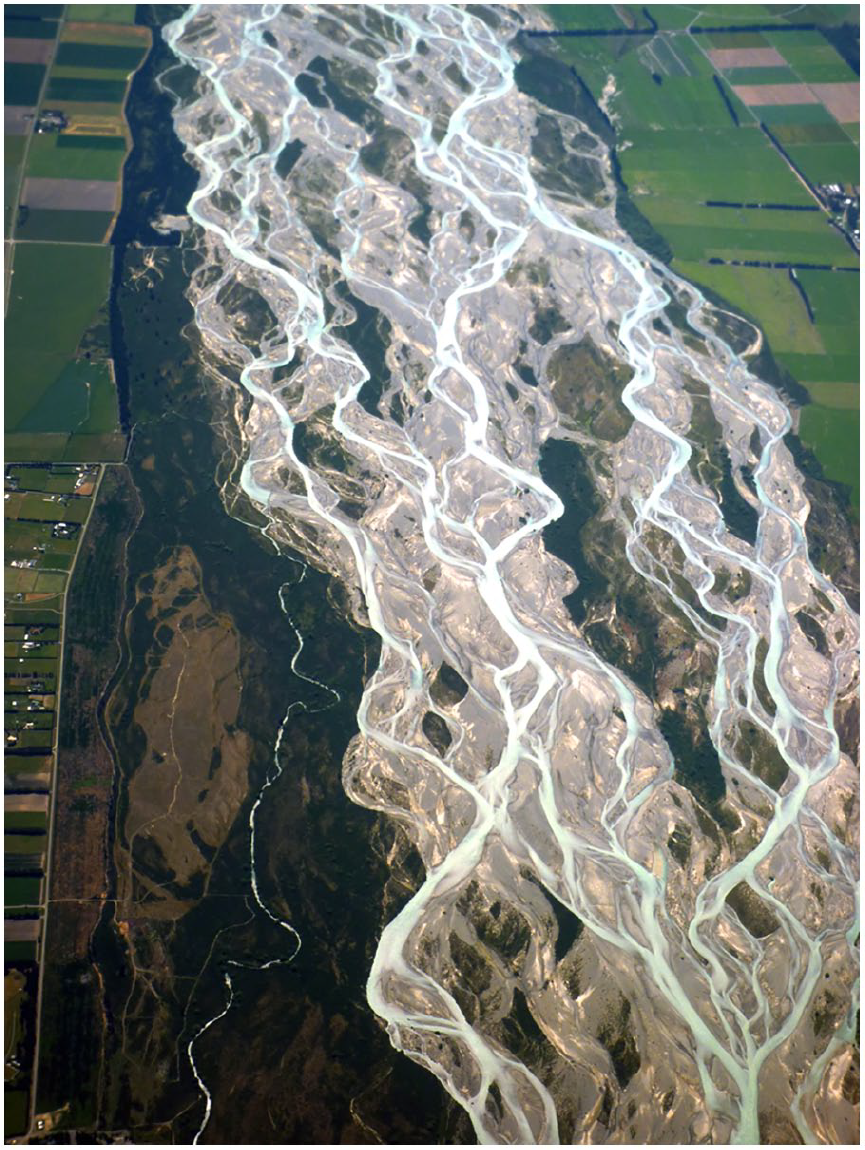
About here Rakaia River Photo by Andrew Cooper/CC BY (https://creativecommons.org/licenses/by/3.0).
Braided rivers comprise complex systems of shingle and gravel channels constantly shifting and transforming. These rivers can have single or multiple sources and braid further down the riverbed according to certain typographies, creating an unusual geological phenomenon where all or part of their length flow in multiple channels separated by alluvial islands (Cram et al., 2018). They converge and braid again throughout the landscape and often spend more time apart than together. They also interact with subterranean water sources in multiple ways. But just as colonization has impacted on Ngāi Tahu ways of knowing, being and doing, so too has colonization impacted on these rivers. Over the last 100 years major modifications to rivers including damming, storing, diverting and extracting, have transformed rivers and their life-sustaining capacity (Tipa, 2009).
Moving the metaphor towards knowledge, Durie (2006) argues that despite differences in knowledge systems that are culturally bound, they can interact, blend or be reconciled at an interface (as cited by Macfarlane and Macfarlane, 2019). Insight can be harnessed as two systems of understanding come together to create new knowledge, useful for both worlds (Macfarlane et al., 2015). Here the streams of knowledge come together, embrace, depart again and run in equal strength. When they do come together, the space created is for learning, not assimilating (Macfarlane and Macfarlane, 2019). It also acknowledges the perpetual changes in knowledge and understandings as the braided river is fed by new sources (Cram et al., 2018).
Cram et al. (2018) extend the metaphor and envisage the river flowing towards and into the ocean, ‘symbolic of a progression towards a multitude of opportunities and perspectives represented by the expanse of the ocean’ (p. 4). This framework gives mana to Māori research and knowledge systems when they are contested by Western science and increases the integrity of both streams to enhance knowledge and wellbeing for all people (Macfarlane and Macfarlane, 2019). Deployed in this way, the braided rivers metaphor suggests a partnership in knowledge creation, driven by manaakitanga, to recognize, maintain and enhance the mana in that partnership of traditions, peoples, students and supervisors. It is in this framing that the metaphor becomes useful for one of our themes, the student-supervisor relationship. Finally, He awa whiria recognizes that knowledge is co-constructed among people within a group, with the group having greater importance than the individual (Macfarlane et al., 2015). Out of this emerges a key consideration for our other theme, the student’s research identity and the principle of mana motuhake to be explored in the following. Reflexivity can often be reduced to a researcher’s identity as an individual, but in this context, it is about whether one is being/becoming a ‘good member’ of a collective. In the spirit of he awa whiria, we turn next to braiding together existing literature from organizational and decolonizing methodologies around reflexivity to frame our second key theme, research identities.
Reflexivity and research identity
To explore implications for research identities and practice, Cunliffe and Karunanayake (2013) propose four ‘hyphen-spaces’ in ethnographic research; insiderness-outsiderness, sameness-difference, engagement-distance and political activism-active neutrality. Understanding how researchers ‘work the hyphen’ requires a reflexive examination of how research presence influences people and practice and vice versa. Decisions around positioning within and across these hyphen spaces are not just choices about research but choices about being a researcher, often made in relation with others including participants and supervisors. This surfaces identity relations as impacting research practice. By exploring hyphen-spaces, researchers learn about others as well as themselves because ‘we are reflected in others as they are in us’ (Cunliffe and Karunanayake, 2013: 387).
Although all of these spaces are useful for our case, the hyphen-space of Insiderness-outsiderness is particularly relevant. It recognizes that positioning oneself as a researcher is not a singular act, but a continuous interplay of relationships, identities and expectations. An awareness of this allows researchers to be more conscious of and responsive to shifting relationalities. In our case, the student was Indigenous to the community but not necessarily identified or socialized as an insider when the research commenced. According to Smith (1999: 138) who also works the hyphen of insiderness-outsiderness, Indigenous insiders have to live with the consequences of research alongside their families and communities. Insider status has been further problematized in an Indigenous context because there are a number of ways a researcher can be an insider and an outsider simultaneously. For example, the lead author could identify as Māori and Ngāi Tahu without having grown up in the community, or with a strong affinity with that identity. To claim an official insider voice in this case and many others is arrogant, so insider research must be humble. Smith (1999) concludes that the complexities of an insider research approach can be mediated by strong support structures and with strong supervisory and local mentor/community partnerships.
Cunliffe and Alcadipani (2016) offer ways that researchers can reflexively negotiate the challenges of access by positioning access as a relationship not an event. They conceptualize three forms of access as a relationship that provide a springboard for reflexive inquiry into research relationships towards impactful practice. These are instrumental, which is about achieving the goals of the researcher; transactional, which emphasizes reciprocal goals and outcomes; and relational, which is a fluid relationship between researcher and participants based on integrity, trust and mutuality. The relational perspective most closely captures our case, both in terms of the student-supervisor relation and the student-participants relation. In a relational perspective, agency is shared between researcher and participants where diverse intentions, values and goals are respected with transparency at the heart. Transparency is not just about the research but about sharing personal experiences, interests, backgrounds and ties with participants – the research relationship. In the case described, Alcadipani gained access because the organization was more interested in him than his proposal. His identity and positionality became a key aspect of negotiating and maintaining access. Finally, a relational perspective foregrounds integrity to participants, ourselves and the research. This requires a reflexive sensitivity to relationships in the field, and responsibilities beyond the field during and after exit.
Manning (2018) and Prasad (2014) offer thoughtful reflections on reflexivity. Manning (2018) describes a decolonial feminist approach to ethnography that enabled her to identify the key complexities in researching with marginalized ‘others’. These are positionality and representation. In terms of positionality, the otherness of the researcher was not a barrier to trust, but that positionality required a decentring of the researcher’s power and the acceptance of differences with a concurrent exploration of potential commonalities. In this way, being a decolonial feminist required a move beyond the insider-outsider and sameness-difference spaces to a space of mutual influence where relationships can be explored through un/foreseen commonalities. Prasad (2014) offers an introspective analysis of experience in a field he deliberately selected as being distant from his own perspective – the West Bank, which required regular border crossing. It was this border-crossing which drew him to reflexively consider the ontological, epistemological and methodological implications of research in neo-colonial sites and specifically, where a border crossing significantly alters the researcher’s conception of self and Other. These border crossings drew Prasad towards a form of solidarity with research participants that not only encouraged the circulation of participant stories, but demanded that he expose the reprehensible conditions of the neo-colonial occupation. He, therefore, developed a particular relationality or ‘insider/sameness’ with participants despite beginning as an outsider/different.
To conclude, Smith (1999) points out that community is defined in multiple ways. Thus, in this case, the researcher could become a reflexive member of an Indigenous community through mana motuhake which represents the carving out of individual and collective mana together. This requires being a good ancestor, being a good descendent and being a good contemporary relation in the role of research. Smith (1999) also points out that although Indigenous communities have a critical perspective of universities, they also want their members to gain university qualifications, without destroying their Indigenous identities and practices. This brief braiding of perspectives on reflexivity has surfaced research relationality as complex, ongoing and multifaceted with regards to both research-participant relations and student-supervisor relations. These both demand and drive constant researcher reflexivity as research identity is constructed relationally over time.
Overall this section has surfaced two interrelated areas of concern as themes for the present analysis – the student-supervisor relationship and research identity – as situated in an overarching goal of decolonizing management knowledge. Our response was to frame these two themes through he awa whiria the braided rivers metaphor as enabling a partnership between student and supervisors based on manaakitanga, which enables the student’s construction of an interdependent research identity, based on mana motuhake. This framework provides an ecological basis for knowledge systems that acknowledges the intimate connectedness between needs, knowledge, knowledge keepers and the lands where knowledge is created. We deploy this as a metaphor to structure the remainder of the paper. In the next section we explore how the tensions between the UK university requirements and the cultural context of the student’s Indigenous community were navigated within this framing metaphor.
Navigating the rivers
The PhD journey in question will be discussed in four stages with different aspects of he awa whiria the braided rivers metaphor to frame each stage. Firstly, the establishing of the PhD project with multiple tributary and subterranean streams. Secondly, the first year and confirmation of the PhD with a dam, a diversion and another tributary stream. Thirdly, the fieldwork where the river braided and then converged. Finally, writing-up and submission of the PhD opening up into an ocean of opportunity and collective reflexivity. This frames the student-supervisor relationship as a journey from the mountains to the sea, based on manaakitanga where streams of knowledge can start from different sources, come together, braid apart, while all maintaining and enhancing their own mana.
The colonial/decolonial tension is addressed in our case through the metaphor by recognizing a more processual approach to knowledge creation in partnership. However, an underlying ‘subterranean’ tension affected the process based fundamentally on whether the student and supervisors could trust each other. The student wondered whether the supervisors would support (or even ‘allow’) him to pursue a decolonial approach in the interests of his community. The supervisors wondered whether they could help the student complete a PhD through this approach. The student was accountable to his community and the supervisors were accountable to their institution. Thus, the subterranean stream of tension across colonial divides was omnipresent but only occasionally surfaced explicitly during the student-supervisor relationship and research identity development.
Establishing the project: Multiple tributary streams and subterranean tensions
This project began from two divergent sources, or tributary streams of knowledge. Initially, the project was the result of a studentship bid, prepared and submitted in a competitive internal process for doctoral funding by the supervisors. The supervisors developed a broad project based on reframing the relationship between social accounting and democratic accountability. The idea was to move away from accounting as an anchor discipline towards ideas of democratic accountability (Dillard and Vinnari, 2019). The supervisors’ division of a Management School in a Russell Group institution was going through a renaissance of its critical tradition. Although the intellectual tradition was broadly Marxist which has sometimes been seen as embodying vestiges of colonial thought (Said, 1978), the supervisors shared an appreciation of the Italian Marxist Gramsci’s (1971) ideas which recognize the autonomy of civil society institutions through which oppressed voices are expressed. This led them to be amenable to changing the focus of the original project.
This internal bid for funding was successful and the project was then advertised publicly. At this point the student found the advertisement online. The student also came from a critical perspective towards social change but embedded in the aspirations of his Indigenous community. The student developed a proposal based on democratic accountability broadly but geared towards Indigenous perspectives. This was considered to be an important aspiration for Ngāi Tahu, many of whom had offered support and considered that attending an overseas institution was a way to find new ideas and bring them home. The student also checked with his Master’s supervisors in his home country that the university and these supervisors would be appropriate for him to conduct this type of study. This proposal was accepted by the supervisors when the student undertook the interview process and was successful in attaining the studentship. This enabled the student’s intellectual stream to connect with the intellectual stream of the supervisors. However, the project was now financed by an institution in a former colonial power. While the supervisors were prepared to provide the student with the means to develop the project as he saw best, as part of their contribution to decolonization, they were also accountable to the institution to ensure that its policies were observed and the money that it was investing in studentships was not wasted.
At this point there were no surface tensions, but we can already see subterranean tensions and the project evolving within the parameters of a broader critical tradition around democratic accountability. The student was open to this broad perspective, and the supervisors were open to a different empirical field, with potentially profound theoretical and methodological changes. This openness and flexibility was the first of many such encounters. While this project started from divergent streams, it came together across a geographical and cultural distance as all parties saw the potential to work together. While the student started out with a commitment to decolonizing knowledge and this was explicit in his proposal, there was no initial discussion of what this meant and how it could play out. For better or worse, these potential tensions remained subterranean with the concepts of manaakitanga and mana motuhake absent from the relationship in the beginning.
Arrival and confirmation: A dam, a diversion and another tributary stream
The first year was where the majority of supervisory guidance occurred and we discuss some of the tensions and solutions in the following. Applying the metaphor, we can think of this period as featuring a dam, a diversion and a new tributary stream as the student-supervisor partnership was underscored by the omnipresent subterranean tensions and negotiated. Here manaakitanga began to surface as student-supervisor relations came to know one another and as the student tested the limits of mana motuhake within the relationship.
The project encountered what the student interpreted as a dam in the stream at the first formal meeting. An initial point for discussion was how Māori and Ngāi Tahu mentors in Aotearoa New Zealand – those with authoritative knowledge of the local particularities of the community – would be involved. The student initially wanted additional supervisors. However, the immutable requirement of the university to have only its own employees in an initial supervisory team, a potential means by which universities protect the hegemonic authority of traditional management knowledge, prevented this. The student and supervisors negotiated the compromise of having ‘local mentors’ consulting on the project and acknowledged in presentations and writing. In this case the institutional tensions were not accommodating Indigenous norms and expectations, but the compromise was accepted, because manaakitanga between student and mentors meant that other forms of relationality between the student and others in the Māori world would compensate. It does however have problematic aspects because the mentors were not being financially compensated for their time by the university. This had the potential to be a dam in one of the streams of knowledge, but a negotiation between students, supervisors and mentors punctured the dam.
Next came another diversion in the river because of a dam provided by the university’s immutable confirmation review and ethics application processes. The project sought to answer questions important to Ngāi Tahu, but the student was unable to formally contact and develop these questions with his own community until successful passage through the confirmation review and ethical approval processes. A solution agreed between the student and supervisors was to keep research questions direct enough to illustrate theoretical contributions in the confirmation review but flexible enough to be driven by community during fieldwork. This approach was appropriate although it resulted in extra reading, work and reformation of positions as the project shifted from student-supervisor-university expectations towards community-student-supervisor expectations. The enabling student-supervisor relationship required reciprocal accountability between student, supervisors and community, as the streams of knowledge departed, diverted and then converged. Seeing this as a process of knowledge streams coming together, rather than clashing, opens up the potential for knowledge creation partnerships based on manaakitanga.
In addition to the institutional ethics process, a consultation and protocol document was prepared and submitted to the Ngāi Tahu Consultation and Engagement Group (University of Canterbury, 2021) to ensure local customs, norms and values were respected. This process helped ensure that the project was relevant to the communities and proved invaluable to initiating access, building relationships and discussing expectations and outcomes. Rather than adding a barrier, this process resulted in significant changes to the empirical field and case design which made the project considerably more legitimate in the eyes of Ngāi Tahu people. Although this submission was on the initiative of the student, the supervisors were supportive of the process because of their shared commitment to decolonizing methodologies and a more general commitment to ethical research praxis that values the autonomy and aspirations of participants. The process resulted in a move from a focus on the central organization to a focus on the relationship between the organization and the kinship grouping. These are often falsely conflated by external parties and researchers and only local knowledge would understand the complexity of this relationship. Without the supervisory openness to local knowledge of knowing and being, it is possible the student may have recreated colonial dynamics rather than going through the additional process to attain more local guidance. This process helped the student align his stream, with the new tributary stream of his community thus contributing to an interdependent sense of mana motuhake in research identity and practice.
Fieldwork: Braiding and converging
The fieldwork aspect of the PhD journey involved significant change to the original strategy negotiated between the student, supervisors and community. It both enabled and demanded a degree of autonomy for the student as his encounters with the different sets of ideas within Ngāi Tahu led towards a transformation of research identity. We suggest this is the point where the river of knowledge reaches the shingle plain and braids quite rapidly as the streams diverge, converge, combine and depart again. A key outcome of the student-supervisor relationship during this time was the realization on the student’s part that he was inappropriately treating decolonization as a single entity, when it was an intimately localized practice requiring relationality and shared reflexive identity within that relationality. The realization that it was localized and that unproblematically generalizing experiences could recreate structural colonial processes was a key part of the student’s research identity construction. The relationships with community and knowledge and identities constructed through these, would be key to decolonizing knowledge in this context. The student-supervisor relationship enabled this large-scale pivot as strategies changed.
The beginning of fieldwork saw the increasing prominence of the third tributary stream with which the student was trying to reconcile – community knowledge. One of the key principles of kaupapa Māori research is to listen to and respect authoritative voices within the local community, so that their voices emerge in the research. During fieldwork, it was crucial to have local advisors for the project who were more aware of the local context and ethical practices to meet with regularly and recommend appropriate actions and responses. However, one of the first things the student was told by a local advisor, with authority within both his community and academia, was ‘you’re not using that kaupapa Māori stuff are you? It doesn’t work for us’. So immediately on arrival for fieldwork the student was advised that the methodological framework developed in the UK in preparation for going home was not suitable for the local context, despite it being a methodology responsive to the local context. We could speculate as to why the local advisor said this, but it was not pursued at the time. The same sentiment, however, was repeated in talks with two additional Ngāi Tahu academics and these talks revolved around the challenges of excessive essentialism and requirements for adaptation.
An explicit difficulty that arose during fieldwork was the consent form. In university ethics the consent form is often a necessary part of establishing formal relationships/contracts between researcher and researched. In this case, it became a necessary evil, protecting the UK university only. It added an excessively formal character to the manaakitanga relationships between the student and his community. For example, one community leader agreed to an audio-recorded conversation with the student because he trusted a Ngāi Tahu researcher, but he refused to sign the ‘stupid form’. This is because the form transformed an internal relationship between distant kin to an externalized research relationship on a contractual basis. His relationship to the research was with the student, not with the institution or the supervisors. This participant and the student also both recognized the participant’s power derived from the mana of his standing within Ngāi Tahu. That power was more important to both than any authority that universities or academic conventions could confer. Here the streams that the student was seeking to reconcile were being pushed apart by university processes, but the participant saw the connection between these streams as more powerful than the university. The supervisors were prepared to help the student to justify inclusion of this empirical evidence in the final thesis, despite a prima facie interpretation of the university’s regulations that it should be disregarded because of its collection without a formal consent form. At the same time, this moment and subsequent reflection led to a realization that pursuing this research would establish relationality, identity and obligations beyond university institutions towards manaakitanga and mana motuhake.
As part of building flexibility into the project, the confirmation review suggested the conduct of two comparative case studies, but soon into the fieldwork, it became apparent that this was more complex than anticipated. There were a number of reasons to support a decision of abandoning the idea of a second case. First was the student’s growing consciousness of his identity as Ngāi Tahu. Shared kinship means participants were more willing to share than in other communities, although the obligations that come with shared kinship are far greater than those of an external researcher. There is an enduring awareness that all of those who contributed to the project, welcomed the student into their lives to share precious time and knowledge. More crucially, the student needed to build trust and integrity in his own community before trying to visit other groups. This takes time. Without the support and trust of Ngāi Tahu, the student would not hope to be able to visit other Indigenous groups with mana. Here the student-supervisor relationship enabled the student to make his own decision between conducting an additional case study with likely benefits to his academic career and PhD thesis, or diving more deeply into this case study to better practice obligations to community. The supervisors supported the decision but their awareness of suggestions of a second case made at the confirmation review meant that they expected to see some evidence of the empirical materials gathered so they could justify to others the significant change in research strategy. This was fundamentally about mutuality and reciprocation in manaakitanga and mana motuhake and the relationality among community-student-supervisors.
At one point a supervisor, who by coincidence was in the area during fieldwork and attended a community/university seminar given by the student, advised the student to carefully consider how much internal conflict to reveal in the dissertation, because although this may be effective for theorization, it may not be in the political interests of the student and his community. The supervisor in this instance was effectively siding with the political positionality of the student at the expense of potential academic contributions, but acknowledging that in a decolonial framework these are one and the same. This was based on a moral principle shared by the supervisor but also fits within Gramscian ideas about developing strong blocs in civil society. The student-supervisor relationship was reconciling these tensions and bringing the multiple braids of the river together. Although the river had reached the braid plain during fieldwork, the streams departed, continued, converged and departed again in a careful partnership. This partnership had to maintain a rapid responsiveness to the obligations conferred on the student by community around manaakitanga and mana motuhake as these obligations reshaped his research identity in common with community.
Four: Writing up – To the Ocean
In this section we detail the writing up process, a time of intense critical self-reflexivity driven by self-doubt around multiple senses of self-worth. Here the student can no longer rely exclusively on past literature, academic supervisors and the Indigenous community, but must carve out his own contribution as a knowledge-holder in/with the community. It is fundamentally therefore about mana motuhake. This suggests that rather than being a reflexive individual researcher, the student must become part of a reflexive community and be a ‘good’ member of that community. We envisage this as the convergence of the braids towards an open ocean of opportunity where the student, supervisor and community streams come together while maintaining their own mana into the ocean. In this section we move from a focus on one theme, the student-supervisor relationship, to its effect on our other theme, reflexive research identities.
When writing-up the student experienced difficulties in finding an author-voice to navigate between writing for and to the Indigenous community, versus writing for UK-based examiners within the discipline. There were also limitations in trying to follow the principles of kaupapa Māori because creating knowledge with communities as part of a UK University PhD programme presents difficulties. The PhD thesis has to be individually authored to fulfil university requirements, which contradicts the co-creation of knowledge with communities. Therefore, the PhD dissertation was only one part of the entire knowledge creation process, the student’s contribution, but not the end-result of it. This resolution was presented by the supervisors as the student struggled to balance the conflicting needs of community and university. The supervisors also made clear that academic writing had particular conventions, which may be flawed, but meeting these conventions would make attaining a PhD possible and there would be more freedom to engage in co-creating knowledge subsequently. The advice from the supervisors that the dissertation is only one output of the PhD and that the development of the student’s identity and research capacity is another output, enabled the student a more critical look at the existential complexity of creating knowledge with a community, through a university. This could be interpreted as the student sacrificing his aspirations for institutional requirements. Another interpretation is that the thesis is just one drop in the ocean, where the student’s other potential contributions to the community represents the ocean. This raises the contradiction that universities can contribute to Indigenous self-determination in some ways, while constraining it in others.
Within the enduring metaphor that frames this paper, our second theme – reflexive research identities – can be thought of as the student carving out his own stream in relation with other streams, connecting with and departing from one another, towards an open ocean of opportunity. The streams maintain and enhance each other’s mana. This fundamentally revolves around exploring identity and the role of a Ngāi Tahu or Indigenous researcher in a decolonizing context. The evidence for this section is drawn largely from the student’s reflexive field diary and a key question within the interview schedule of: ‘How can I be accountable to you as a Ngāi Tahu researcher?’ The most frequent response to this was to maintain ongoing relationships with participants. Ngāi Tahu members related their experiences, sensed discomfort and empathized in a mana-enhancing way: ‘You’ve got a similar story to mine actually’; ‘Your voice is critical for people to feel like. . . like they’ve got something to offer. It’s really important’; ‘So if you are first gen, like us, to get connected with the iwi, you can take as many baby steps as you want to get involved’. These comments recognize that the student was not particularly confident in his Ngāi Tahu identity but was seeking to reconnect in a humble way. This is a norm rather than an exception in the contemporary settler-colonial context. This suggests that within the metaphor, all of these participants carved out their own stream at some stage in order to try and converge with other streams in the community. These relations in community were based on manaakitanga towards mana motuhake.
A crucial part of being a Ngāi Tahu researcher is the role played in the immediate and extended family; the whānau institution. A number of people pointed out that accountability starts within the family unit. ‘Accountability comes primarily from your family. If you can’t stand honest in your own family, you may as well stay at home’ (Participant). Another participant, within the lead student’s family suggested ‘the accountability that I would like to see from you is a recognition of the role that you’re taking for our whānau’. The privileges of carrying knowledge as a researcher, come with parallel obligations towards a collective reflexivity, because it is less about being a good individual researcher and more about being a good community member. This requires competence and confidence in the Indigenous Self, and the relationality and responsibility between that self and the community. It is the recognition of responsibility as part of research identity with community that is the key feature in our case of the student’s mana motuhake. This recognizes the convergence of streams, together, towards an ocean of both obligation and opportunity.
In this section we have reflected on the process of a doctoral project committed to decolonizing management knowledge and outlined some of the tensions and solutions that arose over the course of the study. We did so with a framing metaphor that sees streams of knowledge as braided rivers flowing from the mountain to the ocean. We stretched this metaphor to frame our first theme for analysis – the student-supervisor relationship – with notions of subterranean streams, dams, diversions and braids. We argue that as the student developed his own identity as a researcher, in relation with community, the role of the supervisors became more of enabling the student’s autonomy while ensuring he would meet the requirements for a PhD at a UK university. Out of this seemingly common sense finding, two key interrelated aspects of decolonizing management knowledge across a colonial divide emerge. The first is a student-supervisor relationship open to critical theoretical and methodological innovation and the second is reflexive and relational research identities. We discuss the wider implications of these, based on this particular experience next.
Discussion
So far, we have outlined joint actions in the student-supervisor relationship towards decolonizing research identities. We framed our case through he awa whiria the braided rivers metaphor, which emerges from Indigenous Māori traditions. In doing so we have developed two contributions to be discussed here that open up future possibilities for supervision, research and practice. The first is the use of the metaphor to frame the student-supervisor relationship and strategies. The second is a commitment to relational and reflexive research identities. Both represent important components in overall strategies towards decolonizing knowledge and practice.
Student-supervisor relationships
We stretched he awa whiria from its general deployment in framing knowledge creation (Macfarlane and Macfarlane, 2019; Macfarlane et al., 2015) towards a student-supervisor relationship. Key to this framing was maintaining the mana of the knowledge, experience and aspirations that the student brings to the partnership in relation with their community and the knowledge, experience and aspirations that supervisors bring to the partnership. These streams start from different sources in the mountains, converge at times, flow down to the braid plain, braid, converge, depart, braid again and then flow out together towards an ocean of opportunity all while maintaining each other’s mana – this is manaakitanga. They often spend more time apart than together and other sources, for example, the knowledge held by others in participant or academic communities, also join and braid and have subterranean elements that occasionally surface. However, we also acknowledged the historic and contemporary role that colonization has and can play with regards to knowledge, rivers and rivers of knowledge. We included damming, diversion and would also imagine draining, silting, sedimentation and other river metaphors are of use. Obligations under Te Tiriti/The Treaty and Māori frameworks were also explored to connect the metaphor with student-supervisor relationships (Berryman et al., 2017; Glynn and Berryman, 2015; Pihama et al., 2019). Although this has particular validity in the Aotearoa New Zealand context, the articles and principles of Te Tiriti/The Treaty and Māori frameworks could be useful as framing devices in other contexts, especially so with Indigenous students studying and researching between the empire and periphery.
In this case, the student-supervisor partnership brings together the strengths of multiple streams of Indigenous and other knowledge to create new knowledge that maintains the authority and autonomy of both. From this we can make a more general abstraction to decolonizing management knowledge. Hitherto, Indigenous knowledge/decolonizing methodologies have been used to critique the colonizing tendencies in the positivist tradition within Western thought (see Smith, 1999). Alternative Western dialectical traditions have sought unifying truths or states to synthesize opposites (Putnam et al., 2016; Schad et al., 2016) while other traditions of paradox seek a higher principle to ameliorate the tension between enduring contradictory differences (Bednarek et al., 2017; Jarbzabkowski et al., 2013; Kakkar, 2019; Schad et al., 2016). In contrast to the moments of resolution between two parties or principles in the dialectic and paradox approaches, the braided rivers approach provides the means for a more processual and relational analysis. There are ongoing tensions in knowledge creation that are not necessarily only between two parties, or worldviews. This provides scope to not only address tensions between Western traditions and Indigenous knowledge (in our case, the lead author’s commitment to his kinship community), but also to address tensions that exist within different parts of that community or that particular Indigenous thought. He awa whiria as a metaphor for relationships between knowledge and knowledge-holders opens up relational approaches to generating and/or decolonizing knowledge together in partnership.
Critical Indigenous scholarship (Coulthard, 2014; Simpson, 2017) has raised similar points regarding exploring Western perspectives within Indigenous frames where the mana or the authority of Indigenous knowledge is maintained. This opens up the potential for these different streams of knowledge to come together, represented in our case by the capacity for both the student’s and supervisors’ critical traditions to embrace without denying the other’s development. It also recognizes a heterogeneity of thought within both Western traditions and Indigenous knowledge. In our case, this was illustrated through the different approaches to creating Indigenous knowledge within the lead author’s kinship community and recognition of the radical potential for plurality of knowledge within any knowledge tradition/community, rather than lumping all Indigenous thought together into a static amorphous whole. This also suggests that decolonization is an intensely localized and relational experience. Out of this emerges our second contribution, which is the reflexive and relational research identities required to navigate these braids.
Reflexive research identities
Researcher reflexivity is by no means new to management knowledge (Alvesson and Sköldberg, 2000) or Indigenous and decolonizing methodologies (Smith, 1999), but this case braids together both traditions to build on existing perspectives around relational and reflexive research identities (Cunliffe and Alcadipani, 2016; Cunliffe and Karunanayake, 2013; Manning, 2018; Prasad, 2014; Smith, 1999). Our case illustrates manaakitanga as mana enhancing relationships between student and community and student and supervisors, which provides a reading of an individual entering the university as a disconnected Indigenous researcher and then carving out mana motuhake as interdependent autonomy in common with community. This is less about being an individual reflexive researcher and more about developing a collective reflexivity with mutual obligations to past, present and future generations of a community in the knowledge creation process. Understanding these relationships, which have obligations and knowing the unique role that researchers play in Indigenous communities as both insiders and outsiders, is crucial for maintaining the mana of individuals and collectives in the knowledge creation process. Student-supervisor relationships can enable or constrain this towards decolonizing or colonizing management knowledge. The implications of this for decolonizing the student-supervisor relationship are the maintenance of autonomy and authority of student, supervisor and community, mutual respect, continuous communication and clearly defined goals and expectations. Recognizing that knowledge starts from multiple sources, comes together, braids and flows towards an ocean enables these.
We have found existing literature on relational reflexivity instructive. In particular, various explicit and implicit ways of ‘working the hyphen’ (Cunliffe and Karunanayake, 2013) of insiderness-outsiderness (see e.g. Cunliffe and Alcadipani, 2016; Manning, 2018; Prasad, 2014), draw clear parallels off vastly different experiences to Smith (1999) and other kaupapa Māori scholars. In our case, although the student had whakapapa (genealogy) relations with participants, he did not have existing and active relationships with them. As the research proceeded these boundaries shifted and perhaps the most generative outcome of the PhD project was the relationships that the student developed in common with community as he worked the hyphen of insiderness-outsiderness. This supports and extends Cunliffe and Alcadipani’s (2016) conceptualization of access as a relational approach and sets up ongoing and likely enduring mutual obligations between student and community. While mana motuhake provides a localized principle in this case, this principle and others within this case can be transferred and localized across contexts.
Concluding thoughts
In this article, we have explored the student-supervisor relationship and research identity as joint actions contributing towards decolonizing management knowledge and practice. We did so by framing our story through he awa whiria the braided rivers metaphor, which emerges from Māori traditions. We deployed this metaphor because it represents both Ngāi Tahu relations with the landscape and ways to think about knowledge. We turned this metaphor towards the student-supervisor relationship and framed this as a partnership that braids multiple streams of knowledge together through manaakitanga towards the mana motuhake of student in relation with community. In exploring these two themes for analysis through the metaphor, we have surfaced two contributions that open up future possibilities for supervision, research and practice. The first is the use of the metaphor to frame the student-supervisor partnership and strategies for decolonizing management knowledge more broadly. The second is a particular form of collective reflexivity as part of research identity development in decolonizing management knowledge.
Our case is of course by no means idyllic and we may have made too many compromises to fit within the university’s institutional requirements. Universities and academic conventions may well be part of the problem, but greater recognition of this (see e.g. Boussebaa, 2020; Mbembe, 2016; Pihama et al., 2019) over time can encourage coalitions to turn our decolonial gaze towards the university and other related conventions and institutions. We have also focussed our discussion on the student’s development of a relational and reflexive research identity, but this relationship has also impacted on future supervisory and research practice for both supervisors and student. While this paper could be interpreted as the student being empowered towards an Indigenous research identity through effective supervision, the effect of the relationship on the supervisors’ research practice gives us plenty to reflect on. We encourage readers to do the same in recognition of the reciprocal nature of student-supervisor relationships. The braided rivers metaphor is a useful step towards decolonizing management knowledge together. It introduces a partnership in supervision and knowledge which enables us to think more widely about decolonizing universities, knowledge and practices, as an opportunity for future research and praxis.
Footnotes
Acknowledgements
Thank you first and foremost to the Ngāi Tahu whānau who graciously shared their knowledge, experience and aspirations as part of this study, without whom none of this would have been possible. A doctoral scholarship from the Sheffield University Management School provided financial support to this research. Non-financial support and guidance was given by the Ngāi Tahu Research Centre throughout the project including Te Maire Tau and John Reid. Thanks also to Tyron Love, Lyndon Waaka and Angus Hikairo Macfarlane for mentorship. Finally, a sincere acknowledgement of thanks to the anonymous reviewers who enhanced the paper at every stage and the guest editors of this special issue for reading versions of this paper and giving constructive feedback.
Funding
The author(s) disclosed receipt of the following financial support for the research, authorship, and/or publication of this article: A doctoral scholarship from the Sheffield University Management School provided financial support to this research.
