




Abstract
To avoid negative social and ecological consequences associated with growth-based economics, businesses with a post-growth orientation intentionally forgo scaling for profit maximization and instead seek to scale positive socio-ecological impacts. This study investigates 35 small and medium-sized businesses (33 private and 2 cooperatives) with a post-growth orientation to examine how they strive to scale their positive socio-ecological impact. Our findings reveal four distinct scaling approaches: Enhancement, Expansion, Bridging, and Collaboration. We provide a typology of these four approaches and explain how they can be interlinked to create synergy. Our study shows how private businesses can participate in creating a post-growth economy, thus broadening the scope of previous post-growth research that has focused on other organizational forms such as social enterprises, benefit corporations, and cooperatives.
Introduction
To address social and ecological issues caused by the pursuit of unbounded economic growth in capitalism (Daly, 2019; Jackson, 2021; Wiedmann et al., 2020), it is important to study businesses that embrace a post-growth orientation (Banerjee et al., 2021; Johnsen et al., 2017). Businesses with a post-growth orientation do not pursue profit-maximizing financial growth and instead prioritize socio-ecological well-being over wealth accumulation (also see Banerjee et al., 2021: 341). However, these businesses encounter a fundamental tension. On the one hand, there is increasing consensus that businesses with a post-growth orientation are needed to stop and reverse social and ecological ills that the conventional growth-based businesses have created (Banerjee et al., 2021; Colombo et al., 2024; Heikkurinen et al., 2019; Johnsen et al., 2017; Rauner-Lange, 2018). On the other hand, although scaling these businesses is vital to see a broader positive change, businesses with post-growth orientation often prefer to stay small and local in order to usher in a more sustainable future “that is not driven by economic growth” (Ramos-Mejía et al., 2021: 1228).
To address this scaling tension, researchers have begun to examine different scaling approaches in alternative organizations with a post-growth orientation, and how these differ from growth (and scaling) in the conventional business literature. While the pro-growth literature often views scaling as an individual business size growth to maximize profit, post-growth literature defines it as “achieving greater impacts” (Colombo et al., 2024: 5) by creating deeper and/or broader positive social and ecological outcomes (Bauwens et al., 2020; Desa and Koch, 2014). Empirical studies in the post-growth scaling literature have typically examined small samples of specific alternative organizational forms, such as non-profit organizations (Chatterjee et al., 2023; Moore et al., 2015; Uvin et al., 2000), social ventures (Desa and Koch, 2014), benefit corporations (Khmara and Kronenberg, 2018), cooperatives (Colombo et al., 2024), or social enterprises (André and Pache, 2016; Bauwens et al., 2020; Lyon and Fernandez, 2012). These studies offer different ways to scale positive socio-ecological impacts such as purpose-driven expansion, impacting social behaviors, and influencing broader policies (Colombo et al., 2024; Moore et al., 2015). Building on and complementing this body of research, our study examines private businesses that have a post-growth orientation but do not necessarily have an alternative legal structure. This form of business has been overlooked in the post-growth literature. Therefore, this study asks: How do businesses with a post-growth orientation seek to achieve greater positive impacts (i.e. scale)? And: What may our findings add to current literature about scaling in a post-growth era?
To answer research questions, we investigate 35 small and medium-sized businesses (33 private and 2 cooperatives) with a post-growth orientation in North America. Consistent with the larger post-growth literature, the businesses in our study follow alternative approaches and practices regarding scaling that do not fall within mainstream business growth narratives. More specifically, we found four scaling approaches (i.e. four different ways that businesses with a post-growth orientation seek to advance social and ecological sustainability) that were not financially motivated. These four approaches are organized in a two-by-two farmwork based on locus of scaling (individual business vs collective) and modality of scaling (structured vs less structured). First, scaling as Enhancement (individual business and less structured) enriches a focal business’s existing responsible practices and operations in order to increase its positive impact among key stakeholders it interacts with, including suppliers, employees, customers, and nature. Second, scaling as Expansion (individual business and structured) extends a focal business’s sustainable practices to include and have a positive impact on more stakeholders. Third, scaling as Bridging (collective and structured) improves access to sustainable products and services by linking sustainable local vendors/producers to like-minded customers. And fourth, scaling as Collaboration (collective and less structured) develops inter-organizational networks and cooperation among like-minded rivals and agents in order to foster positive socio-ecological impact.
This study makes several contributions to literature. First, as far as we know, it is the only study in the management/organization literature that empirically examines scaling sustainability among a sample of private businesses that operate with a post-growth orientation, thereby adding to previous studies in the post-growth literature that had examined alternative organizational forms such as benefit corporations, cooperatives, and social enterprises. This is important for theory building (e.g. it enables examining the transferability of post-growth scaling approaches across business and non-business organizations) and for practical reasons (because private businesses can play a key role in transforming the economy). Second, building on this, we introduce a new scaling approach (Bridging) to the post-growth literature. This is important for theory building (e.g. to identify what factors may explain whether Bridging is transferable across business and non-business organizations) and for practical reasons (because Bridging can foster post-growth scaling for collections of post-growth businesses). Third, we begin to examine and theorize about interrelations between scaling approaches that have been overlooked in the literature. Again, this is important for theory building (e.g. it provides a closer understanding of possible synergies among post-growth scaling approaches) and for practical reasons (how might businesses seize synergies among post-growth scaling approaches?). And fourth, we believe our discussion about “right-sizing” makes a valuable contribution to the post-growth literature. Again, this is important for theory building (e.g. identifying key factors in determining right-sizing) and for practical reasons (how can firms know their right size?).
The remainder of our paper is organized into five sections. First, we review the literature on scaling within the post-growth literature. Next, we describe our methodology, data collection, and analysis. Third, we present our findings, supported by illustrative quotes. Fourth, we provide a typology of scaling approaches among post-growth businesses and explain the interlinkages between them. Finally, we discuss the limitations of our study and propose lines of inquiry for future investigations.
Theoretical background
Organizing for a post-growth era
To address social and ecological issues caused by infinite economic growth in capitalism (Daly, 2019; Wiedmann et al., 2020), there are calls for alternative ways of organizing (Schiller-Merkens, 2024; Zanoni, 2020). One of the alternative perspectives is post-growth—including interrelated narratives such as steady growth, degrowth, a-growth, and qualitative growth—that challenges the merit of pursuing ongoing economic growth and underscores the necessity of focusing on enhancing socio-ecological well-being (Daly, 2014; Jackson and Senker, 2011; Kerschner, 2010; Meadows et al., 1972; Raworth, 2017; van Den Bergh and Kallis, 2012; Wiefek and Heinitz, 2018). While it is notoriously difficult to provide a definition of post-growth organizations, Banerjee et al. (2021) review past research in the field (which has examined mostly alternative organizations) and suggest that “for these organizations, economic growth is subordinate to” seeking social and ecological well-being (e.g. collective ownership and democratic decision-making, localization, integration of ecological principles into business practices, reducing energy consumption, localization) and also caring for a fair distribution of financial resources. Taken together they suggest that “Post-growth organizations attempt to create value that is unrelated to growth” (Banerjee et al., 2021: 346). Such organizations are key to achieving the larger post-growth agenda: “The necessary transformation of the economy and, hence, the society could only be realized through a transition of organizations towards an orientation which seeks to foster wealth in social and environmental terms” (Rätzer et al., 2018: 198). This requires redefining the purpose of business away from being about individual profit-maximizers, and toward a focus on the collective flourishing of well-being (Donaldson and Walsh, 2015; Euler, 2019; Ramos-Mejía et al., 2021).
A post-growth approach to sustainability goes beyond the business case for sustainability (Johnsen, 2021) in which greenwashing (Montgomery et al., 2024) and virtue signaling (Berthon et al., 2023) are prevalent to fuel green growth as a “misguided objective” (Hickel and Kallis, 2020: 469). Post-growth businesses challenge the quantitative financial growth hegemony and embrace a qualitative view where the quality of the material, process, working conditions, and final outputs (service/product) are improved to accumulate social and natural wealth (Liesen et al., 2015; Rätzer et al., 2018). It by no means advocates only one way of organizing, but rather encourages a multiplicity of reflexive enactments of post-growth organizations in different spatiotemporal situations (Vandeventer and Lloveras, 2021).
Post-growth practices often include: internalizing instead of externalizing socio-ecological costs, (re)distributing wealth fairly, making better products instead of more products, democratizing instead of centralizing decision-making, sharing instead of privatizing, diversifying rather than homogenizing, ecologizing rather than monetizing, collaborating rather than competing, and moving from the Anthropocene to ecocentrism (Banerjee et al., 2021; Daly, 2019; Dyck and Silvestre, 2018; Hankammer et al., 2021; Johnsen et al., 2017; Jouvenel, 2021; Khmara and Kronenberg, 2018; Ramos-Mejía et al., 2021; Rätzer et al., 2018). Post-growth promotes the conviviality of an enriched, simple lifestyle under the principles of enoughness and abundance, instead of promoting the scarcity of resources under lavish consumerism which demands more growth (Reichel, 2017; Wells, 2018). This requires an alternative view to scaling.
Scaling sustainability in post-growth businesses
Although post-growth businesses do not seek economic growth per se, they do aspire to change the broader economic system by scaling their post-growth practices. In the management literature, scaling typically refers to achieving traditional business growth: a business’s financial or size expansion. In contrast, from a post-growth perspective scaling can be defined as “achieving greater impacts” (Colombo et al., 2024: 5) by creating deeper and/or broader positive social and ecological outcomes (Bauwens et al., 2020; Desa and Koch, 2014). In our research, we follow the latter meaning of scaling in which businesses seek to advance their positive socio-ecological impacts while acknowledging that the scaling process can differ across time and space (Goworek et al., 2018). Note how a post-growth view to scaling differs from what we see in, for example, green growth which “relies on technological and market innovations to improve the efficiency of production and thus, decouple the use of natural resources and environmental impacts from continued economic growth” (Sandberg et al., 2019: 133). Green growth and post-growth have different “normative ideals,” in which the former is concerned with preserving the current economic system through the green market, whereas the latter gives precedence to environmental and social well-being over the economy (Sandberg et al., 2019: 134).
Our review of extant empirical and conceptual research on scaling in the post-growth, social innovation, social enterprise, and social impacts literature revealed 12 ways of scaling positive impacts that are not based on the conventional economic meaning of scaling, which can be categorized into four groups (see Table 1). Although not shown in Table 1, we note that some general terminology was used in multiple studies (e.g. terms like Scaling-Out, -Deep, -With, -Up, -Down, -Within, and -Beyond) but, because there was significant variation in the meaning of these terms, we deliberately chose not to list them in Table 1 to avoid unnecessary confusion.
Scaling sustainability: Twelve approaches extracted from literature.
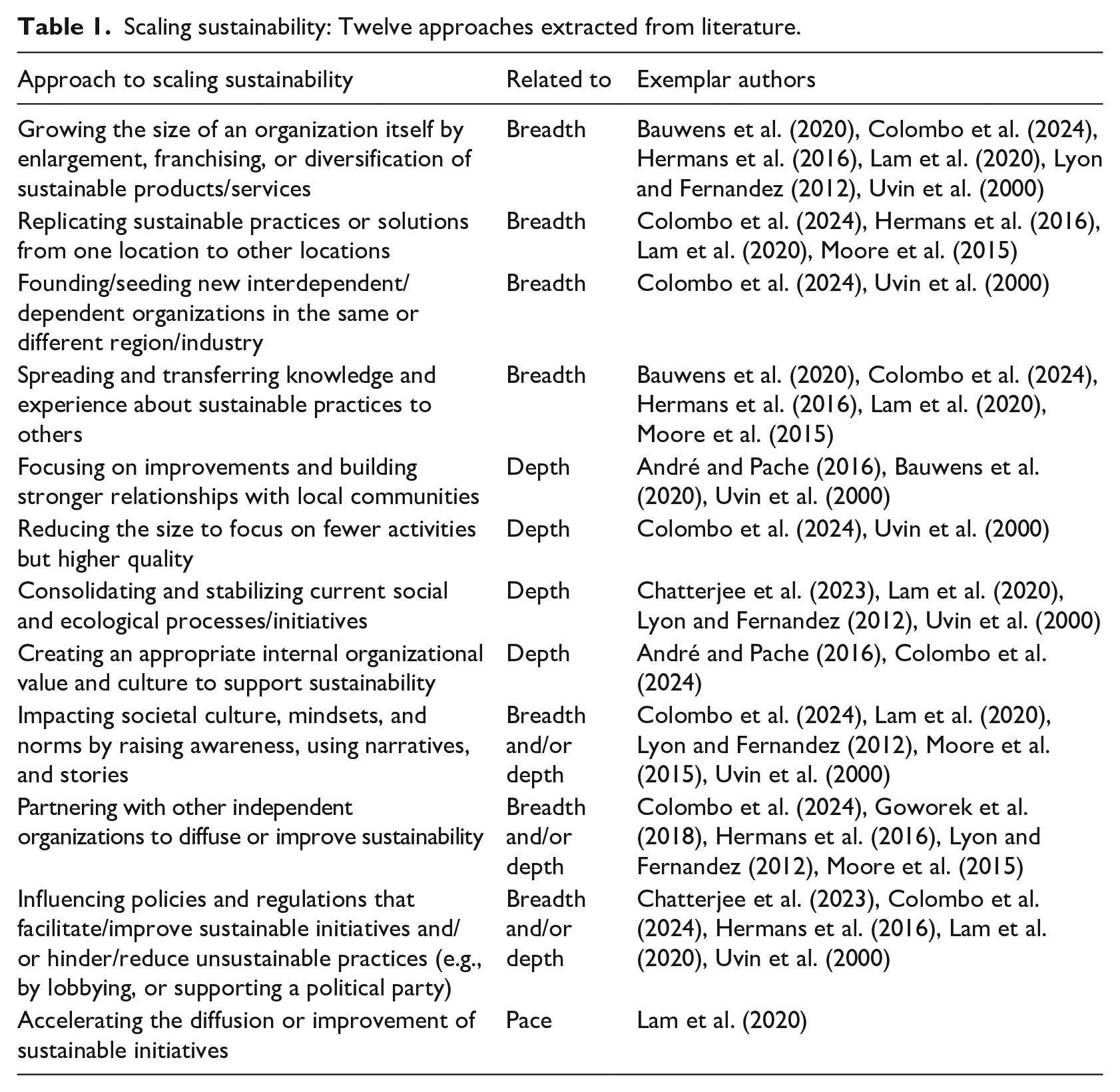
As we can see in Table 1, the first group of scaling approaches seeks to increase the breadth of sustainability by expanding in size (#1), replicating (#2), and spreading (#3 and #4) sustainable practice/knowledge. The second group emphasizes enhancing the depth of sustainable practices through improving (#5 and #6), consolidating (#7), and embedding sustainability in organizational culture (#8). A third group seeks to increase the breadth and/or depth of sustainability through influencing societal culture (#9), partnering (#10), and influencing higher policies (#11). The final group, concerned with accelerating the pace of increasing breadth and/or depth of sustainability (#12), can be applied to all of the other approaches.
Of the three general categories of scaling—breadth, depth, and pace—depth may appear to be the most different from conventional business, though there are some parallel ideas. A post-growth understanding of depth “focuses on improving and enriching current processes in order to enhance the [positive] impact on beneficiaries. The focus here is on the quality rather than the quantity of the impact generated” (André and Pache, 2016: 665). In the conventional business literature, depth may appear similar to ideas like fine-tuning operations (e.g. in the Kaizen approach, Singh and Singh, 2009), or perhaps vertical integration (Harrigan, 1985) or a cost leadership strategy (Porter, 1980). It may seem especially akin to green growth firms which emphasize processes and technologies that reduce negative social and ecological impact to foster the economic growth of the firm (i.e. the business case; Hickel and Kallis, 2020). In contrast, in a post-growth approach, the purpose of increasing depth is not to increase financial profits, but rather to enhance socio-ecological well-being.
Of the three general categories, breadth may appear at first to be the most similar to scaling among conventional firms where the emphasis is on growing organizational size and revenues. However, whereas conventional firms seek to grow their profits, post-growth firms have a fundamentally different understanding of breadth. For them, breadth refers to the “geographic scale of programmes or initiatives, and increasing the number of people [positively] impacted by a social innovation” (Moore et al., 2015: 77). In other words, breadth is not all about making more profit, it is about making the world a better place.
Finally, a post-growth understanding of pace “involves increasing the pace by which [sustainable] initiatives create impact or are brought to fruition [. . .] The aim is that initiatives create change faster” (Lam et al., 2020: 12). Here, given the urgent need to address pressing issues such as climate change, post-growth businesses aim to diffuse sustainable initiatives faster within the principles of the post-growth paradigm.
In sum, our research seeks to contribute to the understanding of scaling sustainability in the post-growth literature. First, whereas earlier studies tend to emphasize alternative legal forms – such as cooperatives, non-profits, benefit corporations, and social enterprises—in our study 33 out of 35 of the cases are private businesses with a post-growth orientation. In order to address the negative externalities associated with conventional business, and in particular to scale sustainability coupled with post-growth thinking, it will be important for post-growth principles to be embraced by different types of legal forms including typical private businesses. Our study will allow us to examine whether the scaling approaches in the extant post-growth literature apply to such businesses, and also whether the latter have approaches to scaling not found in the former. Second, our study includes 35 businesses, which is a significantly larger sample than previous studies in this field, which is more amenable to developing a typology of scaling approaches and examining interconnections between the approaches.
Methods
We opted to employ a qualitative research design, recognizing that qualitative methods are well-suited to answering a “how” question like ours because they get closer to the phenomena under investigation (e.g. Aspers and Corte, 2019). The details are presented below.
Research context and data collection
Examining our research question called for an investigation of businesses that have a post-growth orientation; thus, we needed to identify and recruit such businesses. The initial list of potential businesses for the study was based on the second author’s familiarity with small, local, and sustainable businesses that showed signs of operating on post-growth principles. The list was expanded via active research (members of the research team searched the internet and asked friends, colleagues, and family members if they could nominate local businesses that appeared to operate according to post-growth principles) and snowball sampling (getting names of businesses from interviewees). Before contacting any businesses, further investigations were done by learning about each firm’s products/services via exploring their websites, social media, and newspaper articles as appropriate. This information was discussed by a team of researchers and research assistants, and if the team agreed that adequate indicators were pointing to a notable emphasis on socio-ecological well-being, the business was contacted and invited to participate in our interview-based study. In this phase, we sought to identify and exclude firms that were driven by a business case for sustainability (i.e. greenwashing, conventional triple bottom line, or green growth businesses).
This resulted in conducting a single semi-structured interview (45–90 minutes) with owners and/or managers of 52 organizations starting in 2019 over 3 years, most of them operating in Canada. Interviews were completed in-person or via Zoom (especially due to Covid-19). In addition to being asked about business growth (“How important is it for your organization to grow?”), the interviewees were asked about the business’s history, products, customers, supply chain, success factors, and performance. The process to select which of these 52 businesses met our study’s criteria involved the lead author, the lead researcher, and the lead Research Assistant who had been involved in identifying firms for the study and conducted many of the interviews. Borderline cases required agreement among all three.
To be included in our final sample, a business needed to meet five criteria, the first three related to having a post-growth orientation, and the final two criteria related to our study design to examine approaches to scaling/growth in businesses with a post-growth orientation. First, each business explicitly self-identified with placing people and the planet ahead of maximizing profit (one of the questions in the interview protocol). The next two criteria were designed to determine whether the firm’s self-declaration was corroborated in the rest of the interview and our observations of the firm. Thus, the second criterion was to ensure that each business described itself and its aspirations in a way that goes beyond the business case for sustainability (i.e. the firm rejected the idea of growth for the sake of profit-maximization or wealth accumulation, but rather embraced an understanding of scaling that emphasized advancing socio-ecological sustainability). Third, the practices of each business demonstrated moderate to strong signs of socially and ecologically sustainable practices (e.g. paying a living wage, using organic and natural raw materials, being zero-waste, having a democratic structure, employing people facing barriers to employment, and having a commitment to the local community). Fourth, there were sufficient data in the interview to examine the firm’s approach to growth and/or scaling. Finally, though not a criterion to be a post-growth organization per se, each firm in our study had self-sustaining revenues (e.g. it was not dependent on grants, donations, or external funding). Note that, as we will discuss more fully in our Limitations and Future Research section, there are inherent challenges in determining whether or not a firm is truly post-growth, and the firms in our sample were very aware of their shortcomings vis-a-vis the challenges of pursuing post-growth practices in a conventional marketplace.
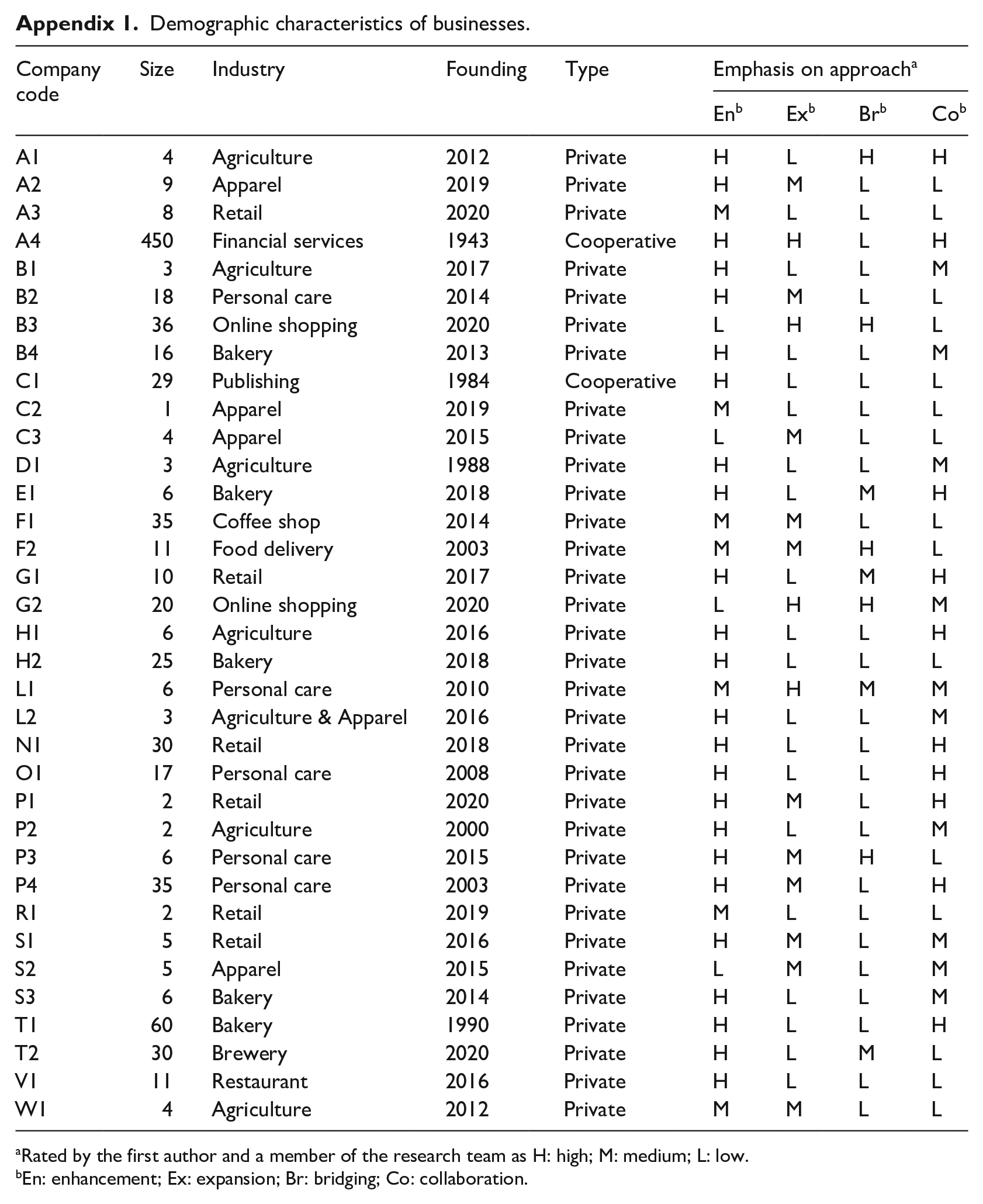
Following this process, of the 52 organizations in our initial sample, 33 private businesses and two cooperatives met our criteria for further analysis. The following are two examples of how we decided on borderline cases. First, a well-established local, small papermaking business that followed many practices consistent with a post-growth orientation (e.g. it is a B Corp Certified) was removed because it had not explicitly self-identified as placing people and the planet ahead of profit (criterion #1). Second, a small local bakery exhibited also many aspects of post-growth, but it was dropped because it did not use local or organic flour. As shown in Appendix 1, the final sample of 35 businesses includes 20 very small (1–10 employees), 15 small (11–100 employees), and one medium-sized (101–600) local businesses, 33 of which are located in Canada and two in the USA. The oldest business was founded in 1943 and the youngest in 2020. The average age of the selected businesses is 14 years as of 2024. The sample includes six agri-businesses, six retail stores, five bakeries, five personal care businesses, four apparel firms, two online stores, and one business each from agriculture-&-apparel, financial services, publishing, food delivery, coffee shop, brewery, and restaurant sectors.
Data analysis
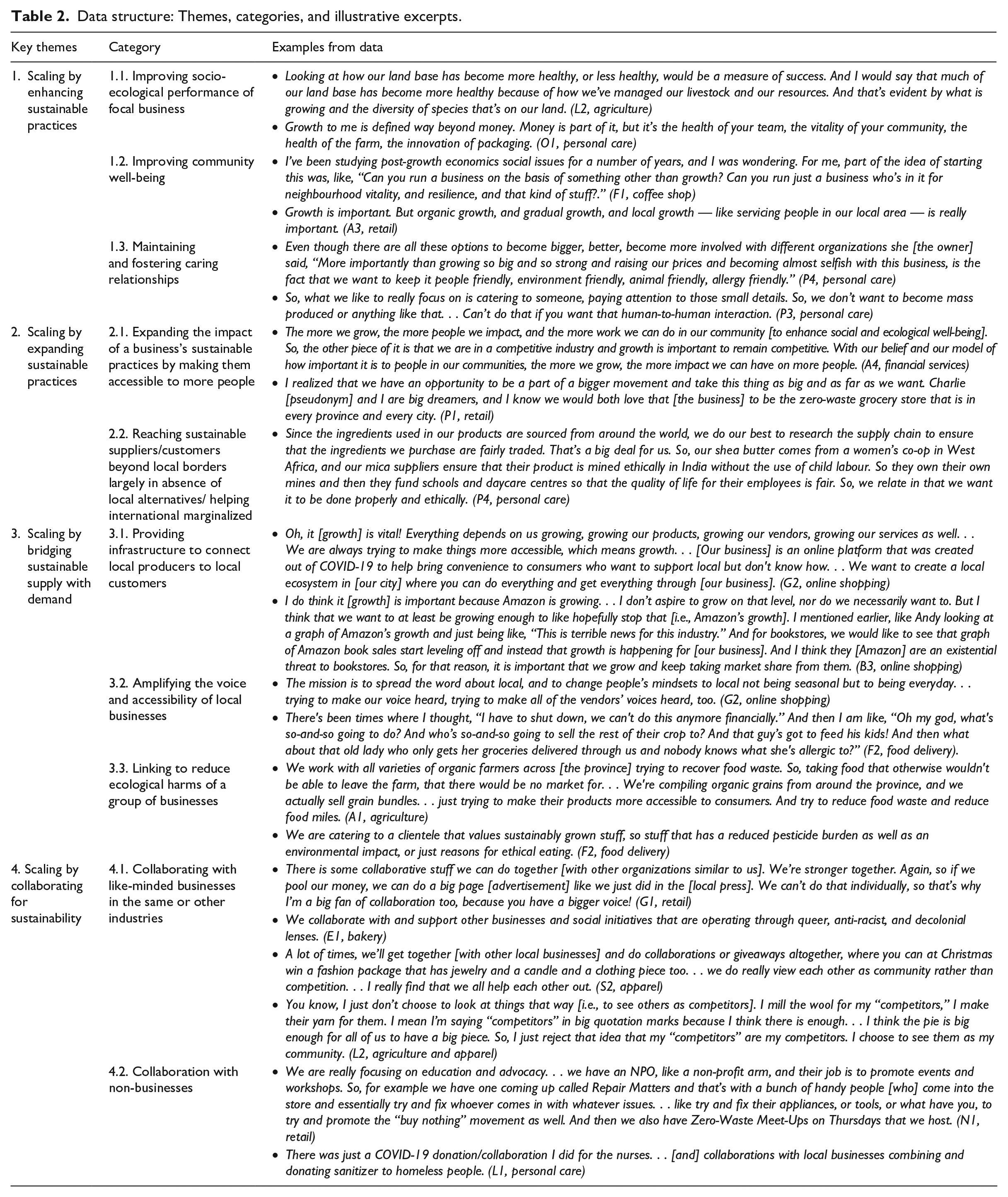
To analyze the qualitative interview data, we followed an abductive approach that includes simultaneous engagement with data and literature (Sætre and Van de Ven, 2021). First, the interviews were transcribed and imported into qualitative data analysis software (QDA Miner), and then all the data chunks related to growth and scaling were identified. Second, these data chunks were examined to identify narratives of business growth and scaling, which included creating temporary descriptive codes. Third, we sat with the data, re-read excerpts, and re-read interviews to better understand the big picture and interlinks between codes. Fourth, thanks to our deep engagement with the data and the literature, we began to recognize patterns among codes and eventually identified four distinct themes in interviewees’ responses regarding business growth and scaling.
The first theme included comments that: (a) focus on social and ecological improvements in existing business operations, (b) see scaling as improving community well-being, and (c) describe scaling as maintaining and fostering caring relationships with primary stakeholders (e.g. suppliers, employees, and/or customers). We aggregated these three categories into the conceptual theme: scaling by
The second theme included comments that describe scaling as extensions of individual businesses’ activities that could happen in two ways: (a) offering sustainable practices to larger audiences by increasing the number of employees, branches, products/services; and (b) purchasing from sustainable suppliers beyond local borders if local sustainable options were not available and/or if a firm wanted to support a sustainable overseas supplier. We combined these two categories under scaling by
The third theme included descriptions of scaling as creating greater possibility for local trade in a community. To do so, some businesses: (a) served as hubs to link local suppliers to local customers, which helped (b) amplify the voices of local vendors/producers, and (c) reduce ecological harm. We called this theme scaling by
The last theme placed high emphasis on scaling positive socio-ecological impacts by cooperating with and among: (a) other like-minded businesses in the same or another industry, and/or (b) non-businesses (e.g. NGOs, neighbors, and universities). We labeled this last theme as scaling by
Our data structure and illustrative data excerpts, categories, and key themes are summarized in Table 2.
Data structure: Themes, categories, and illustrative excerpts.
Findings
Our analysis of the interviews collected from 35 businesses with a post-growth orientation revealed that they have a variety of approaches to scaling and its relation to sustainability. In particular, we found four approaches to scaling positive social and ecological impacts: scaling by enhancing sustainability, scaling by expanding sustainability, scaling by bridging sustainable supply and demand, and scaling by collaborating for sustainability. Appendix 1 shows the relative emphasis each business placed on the four approaches, using ratings developed and agreed upon by the lead author and principal Research Assistant based on their overall reading of the interviews, publicly available information about the business, and personal experiences with the business.
Before presenting these four, it is important to note that our data analysis reassured us that businesses in our sample have a post-growth orientation in which enhancing human and non-human stakeholders’ well-being is a primary purpose of their business. For example, one of the interviewees explained that: “As a business, we’re not highly motivated by financial success. . . Our entire business is based around environmental and social values and seeing that happen” (L2, agriculture and apparel). Another interviewee told us: “I seek to make enough money but not maximize profit” (S2, apparel). Similarly an owner of personal care business maintained that “[Name of business] is NOT a financial vehicle; it is an abundance vehicle” (O1, personal care).
Scaling by enhancing sustainable practices
One approach to scaling sustainability is to enhance existing social and ecological practices. Enhancing was the most common approach in our sample, rated as having a “high” emphasis in 24 of the 35 businesses in our study, and a “medium” emphasis in another 7. This approach focuses on: (a) improving internal social and ecological practices, (b) improving the local community’s well-being around the business, and (c) nurturing and enhancing caring relationships with primary stakeholders (e.g. employees, customers, suppliers, and nature).
First, regarding improving day-to-day operations to enhance ecological well-being, interviewees described how they enhanced their environmental performance through activities such as reduction of waste and overconsumption, minimization and removal of packaging, optimization of recycling and use of organic materials, implementation of regenerative practices (in farming), and use of renewable energy. For example, one participant stated: I know we’re making advances in that [ecological performance]; we’re looking more into this regenerative ag[riculture] type of stuff. So, we’re switching our farm to that. Another thing I’ve seen the other day was this no-till cropping, so that was kind of interesting to me there too, something they’re doing in Australia. So, we’re always trying to advance as far as the farm goes. . . improve the soil and stuff like that. (D1, agriculture)
Regarding social well-being, interviewees talked about changes to existing operations that enhance employees’ work/life balance and job security, including paying a fair wage, ethical sourcing, serving people who have been marginalized, and addressing discrimination.
Second, building on this, some businesses described scaling as nurturing well-being in their local communities. For instance, one participant said: “I see my role in this industry in this community as adding resilience. So as long as growth equals building resilience in my community and in my environment, that’s a really big value to me” (L2, agriculture and apparel). Similarly, when talking about growth, interviewees described improving their local community’s well-being by preserving local culture and nature, creating local jobs, supporting local suppliers and customers, creating a local market that can serve local businesses and customers, and being good citizens.
Third, several businesses in our study placed strong emphasis on sustaining and nurturing caring relationships with their stakeholders, characterized by treating everyone with dignity. For example, several businesses referred to the importance of maintaining and fostering “a family-like culture” (E1, bakery) with their employees, customers, suppliers, and neighbours. One farm that supplies organic ingredients to local bakeries maintained: “the bakeries are just like extended family. In fact, I see those customers as often as I see some of my own brothers and sisters” (P2, agriculture). Another interviewee described their business “as a way to strengthen relationships with neighbours” (H2, bakery). Interviewees noted that intimate and personal interactions fostered mutual trust, a greater understanding of each other’s circumstances, and caring. Several interviewees noted that developing deep relationships was not limited to other humans. One business described its goal for “people to have a better relationship with food and have closer connections with where their food comes from” (H2, bakery). A honey producer noted that they seek to enable their customers to have closer connections with nature through increasing “their understanding and appreciation for pollinators and the honeybee in particular” (B1, beekeeping). Another food-related business (A1, agriculture) described how developing close connections with stakeholders helps to foster a caring relationship with nature.
Scaling by expanding sustainable practices
The second approach to scaling sustainability in our data involves expanding sustainable practices by enlarging the size of the focal business. While a conventional variation of size increase might be the most common form among conventional profit-centric businesses, in the 35 businesses in our study the emphasis on expanding was rated as “high” in (only) four businesses, and rated as “medium” in another 11 businesses. Interviewees described how they wanted to expand in size in order to increase customers’ access to: (a) the organization’s sustainable products/services, and (b) sustainable products/services that had not been available locally (but are available from suppliers beyond the local community). To be clear, it is important to note that none of the businesses in our sample expressed a desire to grow indefinitely or to grow for the sake of it. Rather, interviewees described seeking to reach a “sweet spot” or “ideal” size to optimize the sustainability of their business: I'd say it [growth] is really important. Yeah, I don't think we've reached, you know, cruising altitude or anything like that. I want to keep pushing to grow. I think every business has a sweet spot for
To be clear, when the above interviewee states that growth is important, from the rest of the interview it is clear that they do not mean “growth” in the conventional sense, but rather more in the sense of breadth and expanding as found in the larger post-growth literature (e.g. see Table 1). In addition to displacing the sales and negative effects of conventional firms, C3’s growth may also create more opportunities for suppliers who operate according to post-growth rather than conventional principles. Finally, this idea of growing until a firm reaches its sweet spot is also found in other interviews, including ones that have already reached that spot and do not want to expand any further: I don’t feel like it’s [growth] that important. I know that is the theory in business: “Oh, you [got to] get bigger” . . . I think we have a pretty sweet spot where we’re at right now, we do like all of our staff. If we grow, can we do it in a way where our staff are still happy, and can we still afford to pay them well? I don’t think so. I don’t know if it’s sustainable to just grow, grow, grow. Especially the way we want to run our business. (S3, bakery)
Consider the example of a slowly grown 80-year-old cooperative credit union in our sample that seeks to continue growing locally in order to provide more sustainable banking services to local clients—with a special focus on clients who have been marginalized—even when this does not make sense in terms of profit-maximizing growth. A4 is a carbon-neutral cooperatively owned bank that envisions “a sustainable future for all” (A4, financial services). It offers services such as a “home ownership program for low-income Indigenous families,” has “opened up branches in communities where other financial institutions abandoned the neighbourhoods and left them without anything,” and has “a specialized team called the Community Financial Center that works specifically with co-ops and non-profits to support their financial needs” (A4, financial services). Many local social enterprises rely on the financial services provided by this B Corp-certified financial institution. A4 explained that to continue helping local sustainable businesses and people who are marginalized, it would need enough financial resources which required growing its financial assets and client base (i.e. expanding).
Finally, our data also show how expanding can happen when a business seeks out and supports sustainable international suppliers because of a lack of sustainable local suppliers. In other words, a business may grow when it provides its customers with sustainable products from non-local suppliers when such sustainable products are not available locally (e.g. fair trade coffee in Canada). An owner of a zero-waste retail store in Canada explains: First of all, we like to only check out Canadian companies, if possible. This can become difficult because Canada doesn’t really produce a lot of certain things. . . Obviously, a lot of sustainable products are being made of things like bamboo, and we can’t grow that here. (P1, retail)
Such expanding can help non-local sustainable businesses to survive and to displace unsustainable local products, but at the same time, it may come with costs related to GHG emissions in transportation and reductions in the Local Multiplier Effect (Domański and Gwosdz, 2010).
Scaling by bridging sustainable supply with demand
A third scaling approach in our sample, Bridging, is evident in businesses that aim to increase customers’ ability to conveniently access goods offered by other local sustainable retail businesses. In the 35 organizations in our study, Bridging was rated as “high” in five and “medium” in four. Businesses following this approach facilitate the exchange of goods and services between local producers/retailers and local consumers. For example, two businesses in our sample created online platforms to connect local customers to local organic farmers and related vendors, thereby serving as “a centralized hub that could connect the ‘growers’ and the ‘eaters’ who value the same sustainability ethics in food” (F2, food delivery). This benefits local customers, local suppliers, and Earth. Another business started an online platform to help local customers purchase books from local bookstores, thereby helping the latter remain financially viable in the presence of multinational booksellers like Amazon. In addition, our sample included a farm that recovers food waste by collecting small batches of different organic grain residue from other local farms and then selling it in bundles to local consumers.
Hub businesses often sought, as one interviewee put it: “to make all of the vendors’ voices heard” (G2, online shopping) and help them to be viable. This includes listening to and respecting the voices of suppliers and customers who rely on the hub businesses. For example, the owner of one of these hubs stated: We believe local bookstores are essential community hubs that foster a culture of curiosity and a love of reading. And we are committed to helping them survive and thrive. Our platform gives independent bookstores tools to compete online and financial support to help them maintain their presence in local communities. (B3, online shopping)
Finally, Bridging can improve ecological efficiency for both customers and producers. Bridging can reduce the delivery cost of products and the carbon footprint of transportation as the hub business receives and delivers products on certain days: We are a hub for all of the items, and then we go out and deliver. Everything is combined into one box, one delivery. And it can be from ten different vendors. So instead of someone driving to ten different places in the city, they are either coming to pick up from one place (which is ours) or it is being delivered to one place (which is theirs). Or the vendors are dropping off 20 bulk orders into one spot instead of 20 different places. (G2, online shopping)
Scaling by collaboration for advancing sustainability
The final scaling approach, Collaboration, has an emphasis on advancing positive impacts beyond a business’s direct influence, by fostering collaboration among other sustainable and local businesses. Among the 35 organizations in our study, the Collaboration approach was rated as “high” in 10 and as “medium” in 10 businesses. Collaborative scaling advances socio-ecological impacts not through the growth of the focal business per se, but rather via fostering inter-organizational cooperation, relationships, networking, sharing, seeding, and helping. For example, a small local organic farm explained: “If we’re able to do it [sustainably] at our current scale, then growth within the business would probably look like making more connections with other organizations or reaching out to other groups. . . to increase food access to neighbourhoods that currently don’t have it” (H1, agriculture). Interviewees also stated that Collaboration with like-minded businesses puts them in a stronger position to influence or utilize opportunities that arise. For example, we saw some small businesses introduce each other to their customers, which enabled them to better meet the customers’ disparate needs.
Businesses that prioritize Collaboration prefer to reproduce sustainable businesses/initiatives via sharing and helping practices. A local organic bakery founded over three decades ago is an exemplar of such a collaborative approach. Instead of opening new branches itself, it gladly helps former employees and other interested entrepreneurs to start and run similar post-growth-oriented bakeries. The bakery creates positive impacts by sharing its list of suppliers and sustainable practices and by modeling community-building and cooperation. Spreading sustainable practices via sharing proven, ready-to-use components of a sustainable business (e.g. organic supplier networks) challenges the conventional competitive practices associated with capitalism (e.g. Porter, 2008).
Consistent with and building on this, we noted a substantial divergence between the businesses in our sample versus how mainstream businesses safeguard resources to gain a competitive advantage. Indeed, when asked who their competitors were, many interviewees explicitly expressed their opposition to the idea of competition in its conventional capitalist manifestation, instead advocating for a transformation of the system through Collaboration with local, sustainable businesses. When businesses in our sample did identify a competitor, they typically referred to large corporations that do not offer the same level of socio-ecological benefit to the community as smaller, local businesses do. In contrast, businesses in our study did not view similar post-growth businesses as competitors, but rather they “view each other as a community” (S2, apparel). For instance, an interviewee stated: I don’t know if we look at them [other eco-friendly cosmetic businesses] so much as competitors. . . because we’re very supportive of other green beauty brands. If people are trying to make the world a better place for other people, and create options for women, we support that. We’re definitely not trying to be top dog. We’re really, honestly, just on the same journey with a lot of other green beauty companies. (P4, personal care)
Advancing impacts through Collaboration was also evident in businesses that belonged to local and international sustainable business associations, where members share with and learn from one another. For example, three businesses in our sample had joined the B Corp movement (which provides a space for sharing notes and experiences with fellow B Corps) and many of them participated in local social and ecological partnerships to address a local social or environmental issue. In some cases, Collaboration between businesses, NGOs, and local governments helped to tackle local sustainability issues. By doing so, these organizations were able to share ideas and resources to address local issues or promote sustainability. For example, an owner of a local organic farm told us: “We acted as a practicum farm for several years for training for new organic inspectors for the northern states and all across Canada” (P2, agriculture).
Discussion
By including private businesses in our sample, we sought to expand the post-growth narrative beyond organizational forms such as cooperatives, non-profits, social enterprises, and benefit corporations. We believe that including private businesses that adopt a post-growth approach can unleash the overlooked potential for transitioning toward a post-growth era. Building on our findings of private local businesses with a post-growth orientation, we now develop a four-part typology of scaling approaches for sustainability. As we will see, one of the approaches has not been introduced in the larger post-growth literature (i.e. Bridging). Then, in light of our observations that some businesses in our sample simultaneously use more than one scaling approach, we engage in speculative theory-building regarding how scaling approaches may be interrelated and create synergy to advance scaling sustainability.
A typology of approaches to scaling sustainability
The 2 × 2 conceptual framework in Figure 1 depicts our four approaches to scaling sustainability in post-growth businesses. The horizontal axis describes the locus of the approach to scaling sustainability and indicates whether it is grounded in the activities of an individual business, or in the collective efforts among businesses and/or other organizations. The vertical dimension describes the modality of the approach to scaling sustainability and indicates whether it is relatively formalized and structured, or less formalized and relatively unstructured/organic. For example, starting in the lower left-hand quadrant, Enhancement is a scaling approach where businesses improve sustainability within their operations and with their key stakeholders. In Enhancement, these improvements are not so much pre-planned on a carefully structured path and measured quantitively, rather they occur on a more natural and adhoc basis when opportunities for improvement are recognized. The top left-hand quadrant, Expansion, also focuses on the firm-level, but here the scaling is more by design, with the business developing steps, measurable goals, and appropriate structures to accommodate its Expansion. The bottom right-hand quadrant, Collaboration, inherently involves multiple organizations and stakeholders, and it often proceeds in a purposeful, but adhoc, voluntary, informal, and unstructured manner. Finally, Bridging, in the top right-hand quadrant, represents a second approach to scaling that inherently and deliberately involves multiple organizations, but here the collective nature centers around the formal design and structures and systems of the organizations.
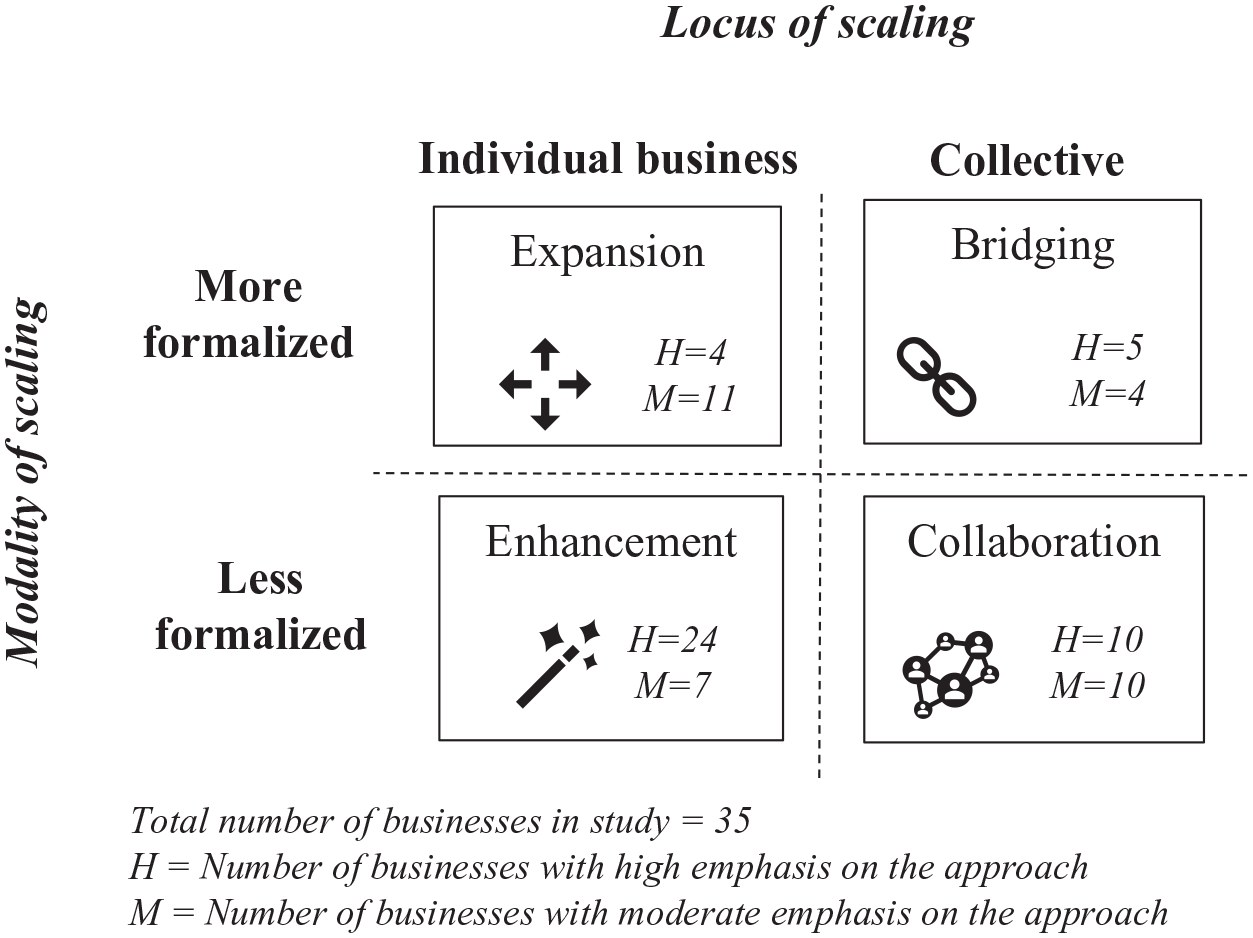
A typology of scaling sustainability among post-growth businesses.
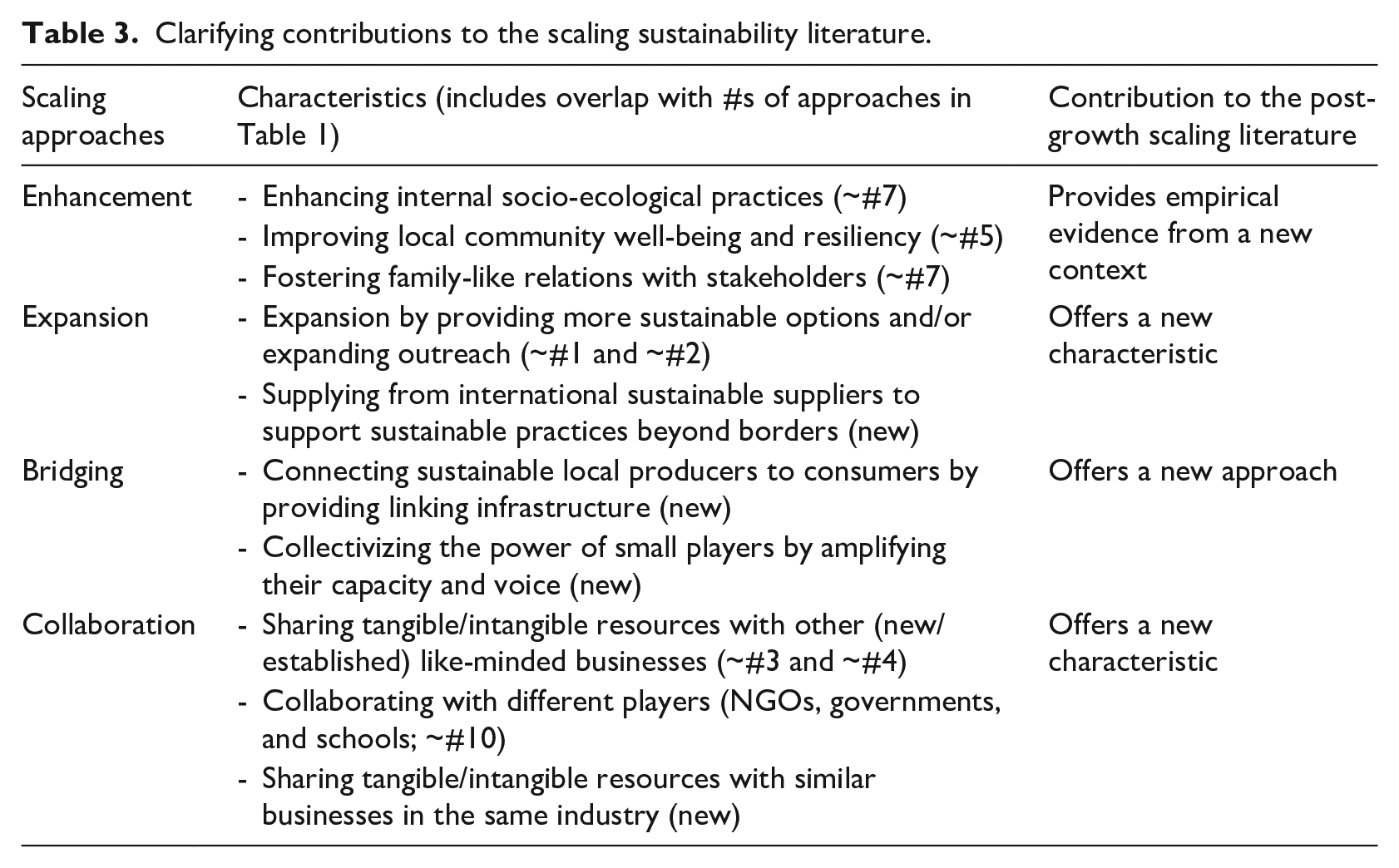
As rated in Appendix 1, most of the businesses in our study had a primary emphasis on only one scaling approach (19/35 = 54%) or two approaches (14/35 = 40%), but some evidence of all four approaches was common in each business. Enhancement was the most common scaling approach in our sample (rated “high” in 69% of businesses) while Expansion was the least common (rated “high” in 11% of businesses). As summarized in Table 3, our findings overlap with and provide support for findings in the existing literature, but we also make several distinct contributions to the field, most notably introducing the Bridging approach.
Clarifying contributions to the scaling sustainability literature.
Scaling by enhancement
In this scaling approach, which occurs at the firm-level and is less formalized, the emphasis is not on growing the size of a business per se but rather on having greater positive impacts by improving social and ecological performance. According to our findings, post-growth businesses following this approach seek to improve their caring relationships with stakeholders, enhance their socio-ecological practices, and improve the local community’s well-being. Scaling by Enhancement means continuous improvement in practicing sustainable values internally and in relations with stakeholders (including nature) and the local community. As summarized in Table 1, Enhancement overlaps with others’ findings in the literature (André and Pache, 2016; Bauwens et al., 2020; Uvin et al., 2000). Over half of the businesses in our sample use Enhancement as one of their main scaling approaches to generate greater qualitative positive impacts. Even though Enhancement was the most common approach in our sample, in the larger post-growth literature Enhancement is not explored as much as what we call Expansion.
Scaling by expansion
The emphasis on scaling by Expansion, which occurs at the firm-level and is relatively formalized, occurs by offering sustainable products/services to more audiences, including via increasing the number of employees, branches, products/services, and/or by purchasing from sustainable suppliers beyond the local community if local sustainable options are not available. This approach is well-recognized in the literature (e.g. see Bauwens et al., 2020; Colombo et al., 2024; Lam et al., 2020; Lyon and Fernandez, 2012). However, rather than growing indefinitely, post-growth businesses that scale by Expansion seek to reach their “right size” (or “sweet spot”) in their local sphere. The “right size” is shaped by spatial, temporal, and contextual factors. For instance, controlling other factors, the right size (in terms of the number of employees and financial transactions) for a local bank will differ if located in a densely populated region with middle-class customers versus a remote region with people under the poverty line. And generally, the right size for a bank will be larger than for a zero-waste retail store. The right size also needs to stay within the bounds of a safe zone for humanity, an area between a social foundation and an environmental ceiling (Raworth, 2017).
What is new in our findings, and may at first appear counterintuitive, is that local post-growth businesses can source goods from international suppliers when local sustainable options are not available. This may also serve as an important avenue for supporting sustainable businesses in low-income markets where there may not be enough demand from customers seeking sustainable products. However, long supply chains can reduce positive externalities associated with the Local Multiplier Effect (Domański and Gwosdz, 2010) and contribute to socio-ecological issues (e.g. emissions, and complexity of transparency). In this way overemphasizing Expansion without Enhancement can result in losing the caring components associated with post-growth businesses (André and Pache, 2016). This may help to explain why most of the expanders in our sample coupled their Expansion with Enhancement.
Finally, skeptics might argue that Expansion, because it appears to grow the economy, is inherently at odds with the post-growth movement. For example, when an organic bakery expands (or right-sizes) by opening a new retail outlet, it can be seen to be increasing the economy, especially if its loaves of bread cost $2.00 more than conventional loaves. To understand how the bakery can nevertheless contribute to the development of a post-growth economy, it is helpful to consider the externalities (e.g. hidden financial costs) baked into a loaf of bread. For example, consider the positive effect on externalities of loaves baked with grains that were grown locally (saving greenhouse gas emissions related to transportation) without the use of manufactured nitrogen fertilizers (one of the planetary boundaries we have crossed) and without pesticides (saving costs related to farmers’ cancer and biodiversity loss in the soil and among birds and pollinators), and baked and served by people facing barriers to employment paid a living wage (thereby reducing costs related to social services, recidivism, and mental health). In this way, while the price of a loaf may be $2.00 more than a conventional loaf, its hidden benefits may easily amount to $3.00 per loaf. As a result, each loaf purchased from an organic bakery can de-grow the economy by $1.00, and also fundamentally reshape the economy.
Scaling by bridging
According to our findings, another approach to scaling positive socio-ecological impacts is to bridge responsible local producers with like-minded local customers. Bridging does not entail producing/processing per se; rather, it provides a space/service to connect local supply and demand for sustainability. We have not seen this scaling approach discussed in previous post-growth research. The primary goal of Bridging is to develop infrastructure that enables and supports a self-sustaining local economy by connecting local capacity with local demand. The hub businesses in our sample enabled small local producers to expand their reach by selling their products through online or physical platforms, and by providing services to deliver local goods to local customers. The major value of Bridging is that it strengthens the engagement of local customers and suppliers in sustainable practices; customers are able to meet their diverse needs in a more coordinated and convenient way, and suppliers enjoy adequate levels of demand to allow them to survive and flourish. In many ways, this parallels conventional marketplaces, in which a conventional business seeks to create value by connecting suppliers and customers (e.g. Amazon and Alibaba). However, Bridgers with post-growth orientations prioritize socio-ecological purposes, local operations, and caring relationships rather than mere networking. They also strive to amplify the voices of producers who are small or otherwise marginalized to unleash the power of collective actions (vs conventional hub firms who use their position to predate power from their platform users: Rikap, 2022). By facilitating the involvement of multiple actors, Bridging catalyzes advanced social and ecological sustainability in a local domain.
Scaling by collaboration
Finally, consistent with extant literature (Goworek et al., 2018), Collaboration among businesses is an effective way of scaling sustainability without the need to grow in size individually. This scaling approach involves proactive relationship-building and sharing/transferring capabilities/resources with current or new businesses to facilitate the diffusion of sustainable practices. Echoing others (e.g. Bell and Dyck, 2011; Pansera and Fressoli, 2021), rather than hoarding valuable, rare, inimitable, and non-substitutable (VRIN) resources for the sake of competitive advantage, businesses with a post-growth orientation transparently share valuable resources, support others in starting up sustainable businesses, connect their responsible suppliers to newcomers, introduce other sustainable local businesses to their customers, collaborate with local competitors, and so on. Scaling by Collaboration is also evident in multi-stakeholder partnerships where diverse actors from different sectors (e.g. NGOs, governments, businesses, and civil society) work together to address complex socio-ecological issues (Dentoni et al., 2018). Unlike Bridging, which is more formalized and where a hub business takes a central role, Collaboration is often more fluid, with all actors taking leadership roles and not waiting for a specific business to lead the transition on their own. Here, businesses proactively share tangible/intangible resources with other businesses, start-ups, local governments, and non-profit organizations to expand and/or enhance sustainability. Therefore, Collaboration fosters a high potential for expanding and enhancing sustainability beyond the capacity of individual businesses. This scaling approach has similarities to scaling via transferring, spreading, partnering, and joining as described in the extant literature (see Colombo et al., 2024; Hermans et al., 2016; Lam et al., 2020; Lyon and Fernandez, 2012; Moore et al., 2015). What all have in common is the collective, bottom-up, and shared responsibility in scaling sustainability.
Linking the scaling approaches
Our data suggest that the four scaling approaches in our typology do not exist in isolation. For example, as shown in Appendix 1, 13 out of 35 of the businesses in our study place a “high” emphasis on more than one approach for scaling sustainability. Such observations prompted us to reflect upon the possible interconnections between the four approaches to scaling sustainability.
Collaboration and feedback loops
When looking at businesses that placed an equally high emphasis on two or more scaling approaches, the most common dyad was Enhancement and Collaboration (10 of 13 cases). We speculate that this may be explained because of a feedback loop operating between these two approaches. In one direction, Enhancement facilitates Collaboration in two ways: (a) Enhancement includes building stronger relationships with other stakeholders, which in turn provide richer connections necessary for mobilizing collective actions associated with Collaboration, and (b) Enhancement may increase the trust and legitimacy that facilitates Collaboration or being accepted as part of collective actions.
Similarly, in the other direction, Collaboration may foster Enhancement in two ways. Collaboration may: (a) offer social, ecological and financial benefits related to the economy of scope (Carballo-Penela et al., 2018; Freeman et al., 2006) and reduce social and ecological negative externalities (e.g. through collaborative logistics), which in turn serve to increase Enhancement. Moreover, Collaboration typically reduces collaborators’ financial costs for access to space, marketing, new customers, and like-minded suppliers, which is valuable because individual post-growth businesses often face resource scarcity. Collaboration can also: (b) serve to enhance socio-ecological performance in individual businesses because it draws in free expertise and ideas from multiple sources about how to enhance sustainable practices. As we have seen, some of the businesses in our sample are actively engaged in sharing their knowledge and experiences with other local businesses and even so-called competitors. Such emphasis is consistent with the principle of relationality emphasized in ecocentrism and deep ecology where collaboration among ecological entities lead to the enhancement of the whole ecosystem as well as individual participants (Heikkurinen et al., 2016; Waddock, 2021). Thus, the two scaling approaches may operate as a positive feedback loop, where Enhancement fosters Collaboration and Collaboration fosters Enhancement.
We cautiously speculate that there may also be a feedback loop between Collaboration and past emphasis on Expansion. When examining the four sectors in our sample that had a least five firms (agriculture, retail, bakeries, and personal care), and comparing the size of firms within each sector, we found that the largest firm in each sector places “high” emphasis on Collaboration (H1, N1, T1, and P4). We speculate that this may suggest that Collaboration fosters expansion, and/or that there is a lag between past Expansion (which ostensibly enabled firms to get closer to their “right size”) and subsequent Collaboration. When post-growth firms become large enough, they may be inclined to Collaborate with others (perhaps in part because these firms benefited from the Collaboration of others and are now able to “pay it back”). Again, we do not have the data to confirm our speculations, but offer them for future research.
Bridging: Interlinkages and caveats
We speculate that the Bridging approach to scaling, which has not been found in previous empirical research on post-growth scaling, maybe the most strategic of the four approaches with regard to promoting post-growth businesses at a meso or macro ecosystems level. By providing a formal and permanent infrastructure designed to link many post-growth businesses, Bridgers create spaces that may foster and indeed bolster: (a) Enhancement, (b) Collaboration, and (c) Expansion for other post-growth businesses.
First, Bridging can enhance sustainability in other individual businesses by releasing some of their “attentional” resources (Ocasio, 1997) so that they can invest more energy on improving sustainability. Bridging can reduce their “costs” of finding and building relationships with other post-growth businesses, and it can reduce the amount of attention that local businesses need to invest in marketing, warehousing, and logistics activities; instead, businesses can concentrate on the Enhancement of their core business practices. For example, thanks to Bridgers, instead of spending time on finding customers, delivery, and sales, small farmers can enhance regenerative farming and labor practices. Moreover, one of the critiques of small local businesses is that they have inefficient logistics, which neutralizes the GHG emissions benefits of local economies (Young, 2022). Bridging can help to address this shortcoming by aggregating the logistics of local businesses. However, if they over-rely on Bridgers, individual post-growth businesses may spend less time relating to customers and thus be less attuned to ways to improve their mutual socio-ecological well-being.
Second, Bridging can also facilitate the Expansion of other post-growth businesses to reach their sweet spot. One of the challenges facing small businesses is finding enough customers to break even, and Bridging initiatives can open new sales channels for sustainable products/services. Participating in a Bridging initiative can be valuable for local small businesses that are often marginalized and have lower visibility compared to large corporations; through Bridging they can become visible and heard by the local community. However, there may be a danger that what starts as post-growth Expansion supported by a post-growth Bridging business and a cohort of post-growth businesses, may over time be co-opted by conventional approaches to growth-based expansion. For instance, there is some evidence of such a “mission drift” happening in the FairTrade movement (Reinecke and Ansari, 2015).
Third, by providing a formal platform that connects a variety of post-growth businesses, Bridging provides opportunities for more informal Collaboration amongst those businesses. The Bridgers themselves occupy a central position and opportunity to mobilize Collaboration among the actors in their network, which connects sustainable producers, service providers, and customers. For example, Bridgers can create spaces/platforms/events that connect producers and encourage them to share stories, experiences, and know-how. Moreover, such Collaboration can have very practical socio-ecological and financial outcomes, such as when connections among producers prompt them to coordinate the delivery of products heading to a central warehouse, or when they reduce unnecessary competition between producers by providing feedback on how to differentiate their products from one another, thereby satisfying the diverse needs of customers.
However, the effect of Bridging on Collaboration—as well as, to some extent, its effect on participants’ Enhancement and Expansion—depends on the capacity of the passageways that the bridge provides. Linking a large network of sustainable demanders and suppliers may not automatically result in strong relationships between them. Therefore, the potential of Bridging depends on the ability/capacity to transfer not only products and services from vendors to customers, but also to facilitate the exchange of ideas/feedback in ways that foster relationships between and among these two groups. In other words, there is a “right-sizing” component to Bridgers. In addition, there may be a risk of over-relying on the Bridgers, which may result in the concentration of power and power imbalance over time, thus undermining Collaboration’s leaderfulness in which every organization can be a leader (Raelin, 2003). Thus, in joining a Bridging initiative, businesses with post-growth orientations must remain attentive to the issue of re-marginalization and foster an ongoing healthy distribution of power by taking appropriate initiatives such as developing participatory governance structures or diversifying sales channels.
In sum, taken together the four scaling approaches show that businesses with a post-growth orientation can take various approaches to scale sustainability, each of which contrasts with conventional notions of growth in the mainstream literature (and even in the green growth literature: Hickel and Kallis, 2020; Sandberg et al., 2019). Moreover, in light of the observation that businesses often do not take only one scaling approach, these four approaches can create synergy to further facilitate scaling sustainability.
Limitations and future research
Our study has limitations that can be addressed in future studies. First, although our sample of 35 businesses is larger than other qualitative research about post-growth businesses, decisions about whether to include a business in our study were limited to assessing information drawn from an interview with its manager/owner, publicly available data about the business, and personal experience. Therefore, we were unable to triangulate our findings by analyzing different stakeholders’ views (e.g. employees and customers). This may raise concern about the accuracy or fullness of our findings, and may also contribute to the (re)marginalization of those stakeholders who typically have a smaller voice compared to managers and owners. Future research should collect data from multiple sources and longitudinally.
Second, we believe that organizational forms (e.g. cooperative, nonprofit, private, benefit cooperation, and social enterprises) may affect the prevalence and efficacy of different post-growth scaling approaches. For example, cooperatives might be more aligned with scaling through collaboration, while nonprofit organizations might prefer scaling socio-ecological benefits by education and impacting societal culture. While our study was not designed to capture such differences, it provides a basis and a call for future comparative studies to examine the influence of organizational form on post-growth scaling.
Third, although we offer a four-part typology of scaling approaches, we do not have enough data to adequately capture the tensions that may occur within and between scaling approaches, which await future research. For example, Enhancement in one area (e.g. paying employees a living wage or sourcing organic supplies) may require compromising on other aspects of socio-ecological well-being (e.g. becoming less affordable for low-income customers). Along the same line, Expansion (even for socio-ecological reasons) may require compromising sustainability in other facets (e.g. sourcing from an international supplier a sustainable product that is not available locally—such as bamboo toothbrushes—increases transportation-related greenhouse gas emissions). Similarly, by serving as a go-between to facilitate access to local sustainable products, Bridging may be prone to depersonalizing and commodifying the relationship between customers and producers. Finally, collaborators who willingly share valuable resources with others may be more likely to find themselves exploited by profit-maximizing players (i.e. firms who are not post-growth), which undermines overall trust and goodwill in the community. Although we lacked enough relevant data to adequately explore such tensions and challenges, future research that explores such dilemmas and inevitable trade-offs promises fruitful insights into the business sustainability paradox literature (Hahn et al., 2018).
Fourth, as with alternative organizations (Schiller-Merkens, 2024; Zanoni, 2020), businesses with post-growth orientations still work alongside or within a capitalist system and its institutional and economic infrastructures. For example, while businesses in our sample deviate from some aspects of capitalism (e.g. maximizing profit, growth for wealth accumulation, and conventional competition), still they pay for work, need to make enough profit to self-sustain, use software/hardware developed by corporations, rely on national/international currencies, and have some degree of formal/informal hierarchy that can undermine egalitarian practices. Such embeddedness and associated skepticism have also been reported in the alternative organizing literature (for instance see Ul-Haq et al., 2022; Watson, 2020). We acknowledge these paradoxical co-existences, and call for future studies with richer data to investigate this important line of inquiry.
This draws attention to a related tension or limitation. On the one hand, Weberian ideal-types like “post-growth business” are critical for addressing the social and ecological crises caused by ideal-types like “conventional pro-growth business.” Such ideal-types provide the conceptual foundations for the post-growth literature and for studies like ours—and our typology of scaling approaches and their interrelationships—which hope to enrich our understanding of how post-growth businesses can scale and thereby foster a truly flourishing economy based on post-growth principles. On the other hand, we also agree that pure Weberian ideal-types do not exist in the real empirical world: there is no such thing as a pure post-growth business, just as there is no such thing as pure conventional business (or a pure introvert or a pure extrovert).
This leaves researchers facing a conundrum of sorts: how to empirically study ideal-types when they do not exist in the empirical world. In our study, facing such a compromise, we chose to study businesses that were the “closest” to the post-growth ideal-type that we could find. We believe that, if the two ideal-types can be seen to lie on opposite ends of a continuum, and if all businesses were placed somewhere along that continuum within their industries and context, then the 35 businesses in our study would be among those closest to the “post-growth” end of that continuum. We do not claim, nor would the businesses themselves claim, that they are an ideal-type of post-growth business. Many explicitly and humbly described their awareness of their limitations and compromises vis-a-vis fully implementing post-growth principles. For example, one of the businesses in our study explained: “I think that in our imperfect way, we are trying to be examples of benevolence and love and action. I repeat, in our highly imperfect way” (O1, personal care). In short, our businesses faced conventional constraints that influenced their degrees of freedom to fully implement post-growth principles. An important question for future research is to examine those constraints and how post-growth businesses respond to them. In the meanwhile, we hope that as firms like those in our sample nudge economic systems toward de-growth, this will create space in the future for firms that are even closer to the post-growth ideal-type.
Conclusion
This study offers four main contributions. First, it adds to the extant post-growth scaling literature by examining private businesses rather than other organizational forms. Second, it introduces a new scaling approach (Bridging) to the post-growth literature. Third, it theorizes about interrelations between scaling approaches to advance future research in this area. And fourth, it discusses “right-sizing” and the challenges of determining a good size for post-growth businesses. Finally, beyond contributions to management scholars and practitioners, this study also provides insights for policymakers seeking to reorient economic activity away from insatiable financial growth and toward scaling positive socio-ecological impacts. In general, policymakers need to avoid subsidizing businesses that expand beyond their optimal size, but rather penalize careless growth and introduce new legislation/programs that encourage businesses to enhance socio-ecological performance. For example, regulations can enforce the need for organizations to measure and report their negative/positive externalities, and to incorporate this information in calculating their prices in order to encourage the adoption of increasingly responsible socio-ecological practices. Similarly, policies can support collaboration among businesses to nurture a post-growth economy, including systems that support healthy competition that improve sustainable performance rather than exploitive or predatory practices that (merely) maximize revenues and profits. For example, collaboration can be enhanced by policies that support Bridging businesses, incentivizing infrastructure that shares valuable resources, knowledge, and skills to improve societal sustainable performance.
Footnotes
Appendix
Demographic characteristics of businesses.
| Company code | Size | Industry | Founding | Type | Emphasis on approach a | |||
|---|---|---|---|---|---|---|---|---|
| En b | Ex b | Br b | Co b | |||||
| A1 | 4 | Agriculture | 2012 | Private | H | L | H | H |
| A2 | 9 | Apparel | 2019 | Private | H | M | L | L |
| A3 | 8 | Retail | 2020 | Private | M | L | L | L |
| A4 | 450 | Financial services | 1943 | Cooperative | H | H | L | H |
| B1 | 3 | Agriculture | 2017 | Private | H | L | L | M |
| B2 | 18 | Personal care | 2014 | Private | H | M | L | L |
| B3 | 36 | Online shopping | 2020 | Private | L | H | H | L |
| B4 | 16 | Bakery | 2013 | Private | H | L | L | M |
| C1 | 29 | Publishing | 1984 | Cooperative | H | L | L | L |
| C2 | 1 | Apparel | 2019 | Private | M | L | L | L |
| C3 | 4 | Apparel | 2015 | Private | L | M | L | L |
| D1 | 3 | Agriculture | 1988 | Private | H | L | L | M |
| E1 | 6 | Bakery | 2018 | Private | H | L | M | H |
| F1 | 35 | Coffee shop | 2014 | Private | M | M | L | L |
| F2 | 11 | Food delivery | 2003 | Private | M | M | H | L |
| G1 | 10 | Retail | 2017 | Private | H | L | M | H |
| G2 | 20 | Online shopping | 2020 | Private | L | H | H | M |
| H1 | 6 | Agriculture | 2016 | Private | H | L | L | H |
| H2 | 25 | Bakery | 2018 | Private | H | L | L | L |
| L1 | 6 | Personal care | 2010 | Private | M | H | M | M |
| L2 | 3 | Agriculture & Apparel | 2016 | Private | H | L | L | M |
| N1 | 30 | Retail | 2018 | Private | H | L | L | H |
| O1 | 17 | Personal care | 2008 | Private | H | L | L | H |
| P1 | 2 | Retail | 2020 | Private | H | M | L | H |
| P2 | 2 | Agriculture | 2000 | Private | H | L | L | M |
| P3 | 6 | Personal care | 2015 | Private | H | M | H | L |
| P4 | 35 | Personal care | 2003 | Private | H | M | L | H |
| R1 | 2 | Retail | 2019 | Private | M | L | L | L |
| S1 | 5 | Retail | 2016 | Private | H | M | L | M |
| S2 | 5 | Apparel | 2015 | Private | L | M | L | M |
| S3 | 6 | Bakery | 2014 | Private | H | L | L | M |
| T1 | 60 | Bakery | 1990 | Private | H | L | L | H |
| T2 | 30 | Brewery | 2020 | Private | H | L | M | L |
| V1 | 11 | Restaurant | 2016 | Private | H | L | L | L |
| W1 | 4 | Agriculture | 2012 | Private | M | M | L | L |
Rated by the first author and a member of the research team as H: high; M: medium; L: low.
En: enhancement; Ex: expansion; Br: bridging; Co: collaboration.
Declaration of conflicting interests
The author(s) declared no potential conflicts of interest with respect to the research, authorship, and/or publication of this article.
Funding
The author(s) disclosed receipt of the following financial support for the research, authorship, and/or publication of this article: This work was supported by the Humanities Research Council of Canada (Grant #435-2022-281) and the Norman Frohlich Professorship in Business Sustainability at the Asper School of Business.
Ethical consideration
This study was approved by the University of Manitoba Ethics Board (Protocol Number: P2019:051 (HS22788) originally approved on April 22, 2019.
Informed consent
Informed consent was obtained from all participants prior to their involvement in this study.

Data availability
The datasets generated during and/or analyzed during the current study are not publicly available due to confidentiality reasons.
Author biographies