



Abstract
This paper explores the potential and limits of countercultural practices in reshaping arts-based approaches to disability inclusion, as increasingly advocated by alternative and community-based organizations. Adopting the framework of crip theory, the study focuses on the use of noise music in a French association of alternative organizations dedicated to mutual aid. We find that countercultural practices in that context rework disability inclusion in three ways: (1) By considering accessibility as not merely the removal of barriers, but also as a cultural transformation characterized by friction; (2) By emphasizing the importance of disharmony to challenge normalizing and assimilatory expectations related to the climate of inclusion; (3) By fostering economic eccentricity that shifts the valorization of disability from an individual to a collective level. We consider these practices as examples of an approach that overcomes the simple inclusion/exclusion dichotomy and claims the value of being in the margins. At the same time, these practices are also characterized by an essential tension between margins and center, as they often rely on the very organizational forms they want to counter. We propose the term “dis-including” to conceptualize this ambivalent, as well as contestatory and non-dichotomous character of the countercultural way of practicing inclusion. Dis-including is not a simple way out of marginalization, but a practice that questions established values, shifts the focus from the individual to the collective and requires breaking the mold when organizing. We therefore highlight the potential of dis-including to reshape mainstream notions of disability inclusion, extending beyond alternative organizations.
Keywords
We agitate against independence and productivity as requirements for existence
(Hamraie and Fritsch, Crip Technoscience Manifesto, 2019)
Introduction
An increasing focus on the inclusion of disabled people in organizations has seen creative arts activities gain recognition for providing a broader range of opportunities compared to employment access via mainstream work organizations (Collins et al., 2022; Hacking et al., 2008; Hall and Wilton, 2011). Alternative and community-based organizations—committed to autonomy, equality, participation, and solidarity (Bendl et al., 2024; Cheney, 2014; Chew, 2009; Fujimoto et al., 2014)—are increasingly engaging with the arts to provide pathways for disabled people to find meaningful activities within a society where paid employment is still difficult for many to access and sustain (Hall and Wilton, 2011; Maravelias, 2022). Examples can be found in the numerous theater and music groups made up of disabled people, such as Ållateatern in Sweden (Solvang, 2018) and Drumdee in Scotland (Cathro and Devine, 2012). In both cases, people with intellectual disabilities—usually directed by non-disabled people—rehearse and act/play on stage, experiencing intense feelings of togetherness, friendship, conflict and happiness. They also receive praise, strengthen their self-confidence and acquire new skills.
Some studies have shown, however, that alternative organizations are not necessarily more inclusive of disabled people. This is due to a reliance on ableist normative assumptions (Knights and Latham, 2020) and the construction of the disabled as “others” (Kallio-Tavin, 2020; Mauksch and Dey, 2024) by drawing strict boundaries between disabled and non-disabled and adopting pietistic and charitable forms of inclusion (Buchter, 2022). In this way, alternative organizations persist in reproducing a dichotomy between inclusion and exclusion (Bendl et al., 2024; Dobusch, 2021; Reeves et al., 2022) that characterizes most mainstream approaches. As highlighted by scholars in organizational inclusion studies (Dobusch, 2021; Van Eck et al., 2021; Zanoni et al., 2010), this dichotomous approach ends up maintaining the discrimination it is supposed to combat, as it upholds power imbalances between those who are in the position to include and those who have to be included.
A strong and thorough critique to this approach is being provided by the crip movement (Hamraie and Fritsch, 2019; Kafer, 2013; McRuer, 2006, 2018), which has a particularly radical approach. Inspired by the queer movement, it gathers scholars, activists and artists that use countercultural practices—practices that claim the transformation of established society through the power of ideas and arts (Bolaki and Gair, 2015; Leary, 2004)—to confront and enact protests against compulsory able-bodiedness, and conciliatory views of disability. An illustration of the crip movement’s use of countercultural practices is the work of blind activist and artist Carmen Papalia: by using a striking 20-foot white cane on bustling streets, he engages in a performance to prompt frictions and conflicting emotions linked to disabled individuals’ demand for visibility, access, and inclusion (Hamraie and Fritsch, 2019). Rather than simply pursuing inclusion as a “good thing” in itself (Tyler, 2019), the crip movement aims to actively break the mold. It challenges normalizing and dichotomous approaches to inclusion, and claims a rearticulation of what it means to be human in all its diverse forms, beyond pre-established categories. In this sense, it is more radical than other disability rights movements, as it rejects identitarian disability politics and its tendency to reduce subjective experience down to ready-made identities through the label of disability. The crip movement claims marginality as a baseline condition to transform established values and meanings associated with disability, with art among the means to achieve that transformation.
In this study we explore how the crip movement and related crip theory (McRuer, 2006) are inspiring countercultural practices in alternative organizations engaged in art activities with disabled people. We argue that these countercultural practices are significant sites for observing new paths in disability inclusion, as well as their limits. In line with this, we investigate empirically what form inclusion takes within countercultural practices related to crip art-based approaches, and discuss whether these practices are capable of blurring the boundaries between inclusion and exclusion, and inspiring a more general reworking of approaches to disability inclusion.
We address this issue through fieldwork conducted within a French association of alternative organizations known as Groupes d’Entraide Mutuelle—“mutual aid groups” (Bourg et al., 2014; Gardien, 2022; Moreira de Alcântara, 2021)—who use creative and artistic practices typically associated with counterculture as non-therapeutic, non-prescriptive and non-profit forms of social and work organization. Our study focuses on the use of noise music (Hegarty, 2007) as a collective creative practice that involves neurodiverse people. We observed collaborative networks and workshops in which people improvise together and “make noise,” which clashes with feelings usually related to inclusion. Our analysis adopts a practice-based approach (Gherardi, 2019), highlighting that these practices differ from how alternative organizations usually address disability inclusion in three main ways: (1) By considering accessibility as not merely the removal of barriers, but also as a cultural transformation characterized by friction; (2) By emphasizing the importance of disharmony to challenge normalizing and assimilatory expectations related to the climate of inclusion; and (3) By fostering economic eccentricity that shifts the valorization of disability from individuals to collectives.
Our contribution is to show that countercultural practices related to the crip movement—insofar as they emphasize friction, disharmony, and economic eccentricity—break the mold in terms of disability inclusion. However, by doing so, they produce a series of ambivalences. In fact, while placing the agency of marginality at the forefront, these practices are also characterized by an essential tension between margins and center, as countercultural approaches often implicitly rely on the very organizational forms they want to counter. To conceptualize this ambivalent, as well as contestatory and non-dichotomous character of the countercultural way of practicing inclusion, we propose the term dis-including. In this term, the “dis-” particle recalls both crip’s contestation of dis-ability inclusion and Derrida’s (1972) notion of the ambivalence of margins, which are at the same time inside and outside. As such, this term evokes that a logic of ambivalence is a constitutive trait of non-dichotomous approaches, highlighting the challenges related to practicing inclusion in other ways.
Therefore, our notion of dis-including fits into the organizational studies debate about the inclusivity of alternative organizations in light of the critiques to the dichotomy between inclusion and exclusion (Bendl et al., 2024; Buchter, 2022; Collins et al., 2022; Dobusch, 2021; Mauksch and Dey, 2024; Reeves et al., 2022). This concept contributes to reshaping perspectives on disability inclusion, potentially extending beyond the scope of alternative organizations.
In the following sections we start with a review of organizational literature on disability inclusion, highlighting critical aspects present in both mainstream and alternative organizations. We then explain crip theory. This is followed by a description of our case study, the techniques used in the fieldwork and data analysis, and reflections on our positionality. Findings are presented according to the three identified practices and their key aspects: noise-making and friction, improvisation and disharmony, and do-it-yourself and economic eccentricity. The paper concludes by discussing the implications of our analysis.
Inclusion between mainstream and alternative arts-based approaches
In the last two decades, disability inclusion has received growing attention in organizational literature (e.g. Danieli and Wheeler, 2006; Dobusch, 2021; Williams and Mavin, 2012; Zanoni, 2011), in large part thanks to the numerous prompts from disability studies. The notorious shift from the medical model to the social model of disability (Oliver, 1996; Shakespeare, 2006) promoted by those studies has claimed that disability is not an individual condition to be cured but a social construct—a form of inequality deriving from societal practices that “disable” people with impairments, both through environmental barriers and cultural prejudices. Accordingly, the social model denounces how the requirements of a certain group of people are taken for granted and naturalized as “normal,” regular, and typical in organizational settings, while the requirements of people with impairments are discriminated as special needs, idiosyncratic and extraordinary (Williams and Mavin, 2012). This condition produces the marginalization of disabled people and calls for solutions at the level of social justice (Oliver, 1996; Shakespeare, 2006; Siebers, 2008). Following this perspective, scholars and institutional policies (United Nations, 2007) have highlighted the importance of considering inclusion as the effort of changing the environment to allow everybody, regardless of their diverse social, biological, and cultural characteristics, to have agential possibilities, feel recognized and valued in their uniqueness, and reach the highest level of effectiveness in carrying out their assigned tasks (Ferdman, 2014; Mor-Barak, 2015; Nishii and Rich, 2014; Shore et al., 2018). This idea of inclusion is opposed to that of integration, which demands adaptation on the part of people (Ravaud and Stiker, 2001).
Scholars have underlined the limits of this idea of disability inclusion, especially as it relies on a dichotomous approach. Scholars who critique the dichotomy between inclusion and exclusion (Bendl et al., 2024; Dobusch, 2021; Mauksch and Dey, 2024; Reeves et al., 2022) argue that “inclusion and exclusion are mutually constitutive” (Dobusch, 2021: 380), as inclusion only makes sense with the background of a corresponding exclusion. Moreover, as highlighted for the concept of inclusion in general, it is often practiced in unidirectional and top-down ways which uphold existing power imbalances, since the conditions of one’s inclusion remain dictated by a privileged elite (Adamson et al., 2021; Dobusch et al., 2021; Janssens and Steyaert, 2020; Nkomo, 2014; Tyler, 2019; Van Eck et al., 2021; Zanoni et al., 2010). The consequence of this approach is that inclusion keeps reproducing the discrimination it is supposed to combat. This is particularly evident in mainstream approaches, which have been criticized for focusing on access to paid employment and on the employability of disabled individuals, rather than on the disabling character of paid work and work environments (Danieli and Wheeler, 2006; Van Laer et al., 2022).
Art-based approaches in alternative organizations are gaining recognition for their potential to complement and/or replace employment as the basis for disabled people’s inclusion and social participation (Collins et al., 2022; Fujimoto et al., 2014; Hall and Wilton, 2011). Alternative organizations have been defined in relation to five key elements: autonomy, equality, participation, solidarity, practices, and policies in accordance with these values (Cheney, 2014). Among these, community-based arts organizations (Chew, 2009; Fujimoto et al., 2014) and deliberately developmental organizations (Kwon, 2019) have been studied for the inclusive potential of their non-performance-oriented approach, commitment to diversity and social justice, attention to marginality and criticism toward the cultural ecosystem. Nevertheless, scholars have shown how disability is also often implicitly discriminated against in alternative organizations or social entrepreneurship (Kallio-Tavin, 2020; Mauksch and Dey, 2024), highlighting that a dichotomous approach also persists in those forms of organizing (Bendl et al., 2024). In light of this consideration, we highlight that art-based alternative organizations are not entirely alternative to mainstream organizations in terms of inclusivity. We do this by identifying three main themes in the literature on disability inclusion and highlighting how both mainstream and alternative organizations involved in art activities present the same aspects which can be subject to critique. As summarized in Table 1, we identify the three themes of (1) Accessibility; (2) Climate of inclusion; (3) Valorization of disability; and associate each theme with a key critique: (1) Immediacy; (2) Harmony; (3) Person-centrism.
Overview of the three main themes in disability inclusion literature and their critiques.
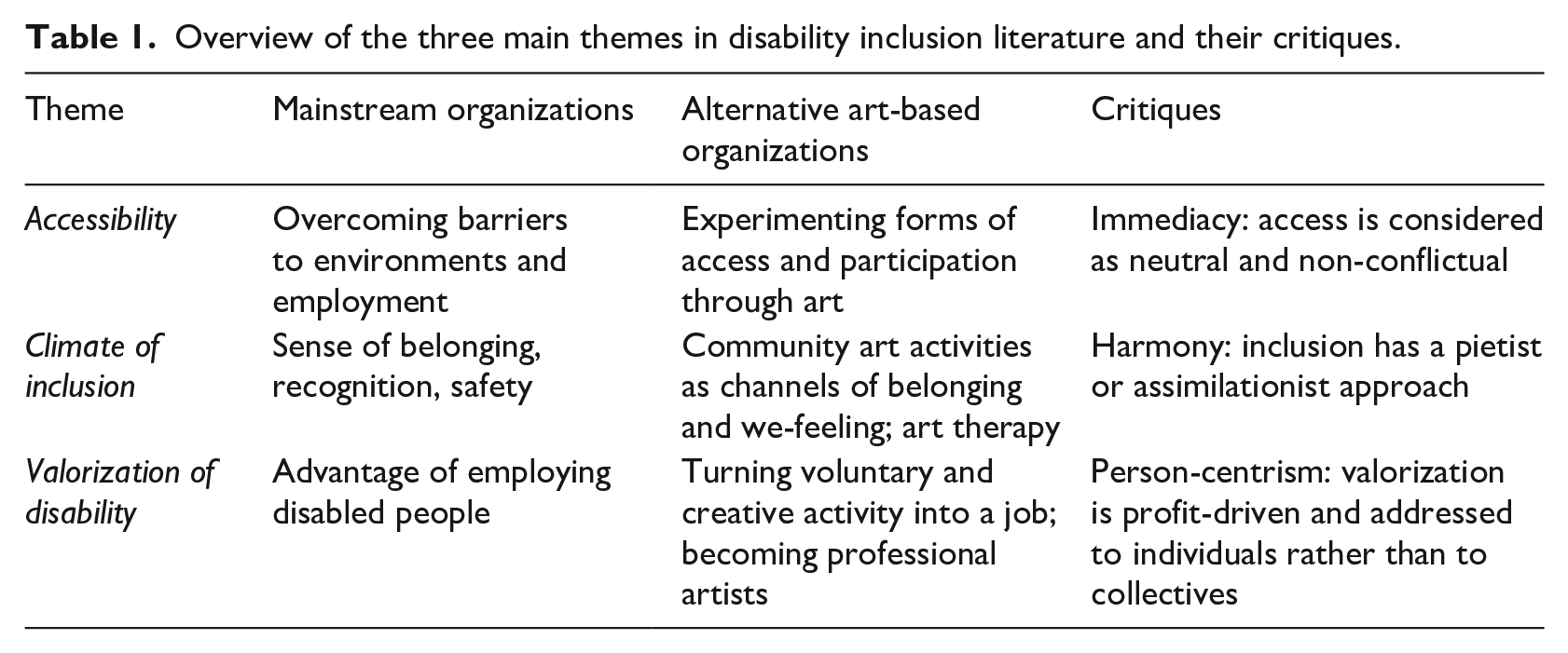
Literature on accessibility highlights that barriers are one of the main causes of disabling for people with impairments, as they are the expression of a world built ignoring the needs of certain people, which as a consequence become marginalized (Hamraie, 2017). Therefore, removing barriers is a fundamental moment of inclusion, providing conditions for everyone to achieve their full capability (Collins et al., 2022; Schur et al., 2014). Pursuing accessibility entails both transforming the built environment and enabling inclusive HRM practices that take into account physical diversity and neurodiversity: the different bodily, cognitive, communicational and emotional attitudes of people in the selection process (Beatty et al., 2019; Schloemer-Jarvis et al., 2022). Scholars have highlighted that art settings have great potential for allowing disabled people to enter and participate, as they are eager to experiment forms of accessibility that go beyond mere compliance with standards (Cachia, 2023; Collins et al., 2022; Hall and Wilton, 2011) and are keen to create a “culture of accessibility” (Hamraie, 2017: 18). As such, they are seen as a model for mainstream organizations (Collins et al., 2022). Critical scholars, though, have highlighted that the removal of barriers is usually considered as a neutral and non-conflictual process, both in mainstream (Van Laer et al., 2022) and in art-based organizations (Cachia, 2023). We call this approach “accessibility as immediacy,” as it considers the removal of barriers as immediately producing access and participation. In this approach, barriers are seen as elements that separate a clearly defined outside from a clearly defined inside, thus reinforcing a dichotomy. On the other hand, scholars such as Hamraie and Fritsch (2019) highlight that accessibility entails a conflict of values and meanings. As they explain, the etymology of the word “access” reveals two opposite meanings: access as “an opportunity enabling contact,” as well as “a kind of attack” (p. 2). From their perspective, art practices can foster accessibility by attacking established ableist values embedded in organizational spaces, instruments and procedures.
Literature on the climate of inclusion relies on the idea that organizational members have to experience feelings of belongingness, being recognized, accepted, and valued in their uniqueness and diversity (Bryer, 2020; Mor-Barak, 2015; Nishii and Rich, 2014; Shore et al., 2018). With reference to disability, creating a climate of inclusion entails eradicating forms of discrimination based on ableist prejudices (Beatty et al., 2023; Elraz and McCabe, 2023; Jammaers and Zanoni, 2021; Kulkarni and Lengnick-Hall, 2011), such as considering people with certain bodily and cognitive characteristics as inferior (Siebers, 2008). In terms of challenging this discrimination, creative art activities are seen as opportunities to foster a climate of inclusion, improving feelings of empowerment, confidence, and self-esteem (Hacking et al., 2008), especially in community-based arts organizations where disabled people engage in community activities, developing the experience of we-feeling and natural belonging (Chew, 2009; Fujimoto et al., 2014). In particular music is considered as facilitating the building of social networks and the strengthening of social cohesion (Cathro and Devine, 2012; Schroeder et al., 2019), contributing to de-pathologizing mental illness (Castrodale, 2019). Nevertheless, critical scholars have highlighted that a climate of inclusion is sometimes seen as a form of pietism toward disability, relying on a charity model and a welfarist solidarity (Buchter, 2022; Jammaers, 2023; Knights and Latham, 2020). In art-based and community-based contexts, this very often risks a shift from inclusion to therapy (Kallio-Tavin, 2020; Solvang, 2018), resulting in the fostering of assimilation and an alignment with established values rather than an unconditional recognition of diversity (Tyler, 2019). Mitchell and Snyder (2015) define “inclusionism” as the motifs of normalization and assimilation latent in certain rhetorical uses of inclusion typical of community-based and art organizations. According to them, this particular rhetoric poses disability as something to be tolerated, rather than something that significantly challenges the esthetic ideals and cultural values through which normalcy is defined. Dobusch (2021) also highlights that the climate of inclusion may uncritically assume social skills and desires of sociality as the base for inclusion, which would instead end up excluding those neurodiverse people who don’t feel comfortable with that. Following these critiques, we see the limits of the climate of inclusion approach in its pursuit of harmony, as assimilation to established values, while underestimating the importance of challenging normative and normalizing expectations.
Literature on the valorization of disability highlights the importance of focusing on the potential mutual advantages of having disability and neurodiversity in organizations (Beatty et al., 2023; Krzeminska et al., 2019). Scholars propose approaches such as positive discrimination (Noon, 2010), job adaptation (Tims and Bakker, 2010) and person-job fit (Hennekam et al., 2021; Maravelias, 2022) in order to produce the conditions for disabled people to improve their performance, express their value at work and become an important resource for the organization. In alternative and arts-based organizations, the valorization of disability is related to ways that the arts can become a mechanism through which disabled people move into paid employment (Fujimoto et al., 2014; Hall and Wilton, 2011; Solvang, 2018) and become professional artists (Stuhldreher, 2020). All these approaches are specifically connected to the valorization of disability, as they aim to insert disability into an economic value system. However, scholars have criticized these approaches to inclusion for being profit-driven and for having a purely economic concept of performance (Kwon, 2019), as well as for commodifying and exploiting disability (Jammaers, 2023; Jammaers and Zanoni, 2021; Maravelias, 2022; Zanoni, 2011)—similar critiques have also been made in diversity and inclusion literature in terms of the “business case for diversity” (Herring, 2009). Moreover, we see the limit of this idea of valorizing disability in terms of its being person-centric. By this, we mean that valorization focuses solely on the individual aspect of disability and consequently on how the individual disabled person can be economically valued, rather than conceiving disability as a historical-social condition of discrimination with wider economic repercussions, as highlighted by scholars in disability studies (e.g. McRuer, 2018; Oliver, 1996; Siebers, 2008). For example, Ferdman (2017: 239) considers inclusion as the state of being where “members do not have to leave valued parts of themselves outside as a condition of membership.” Assuming the existence of precise borders between what belongs to the self and what doesn’t, this dichotomous approach results as discriminatory toward disability, ignoring the tenet that disability is not an individual but a relational condition (Dobusch, 2021; Mauksch and Dey, 2024; Siebers, 2008). This approach is, however, also very common in organizations devoted to disability art (or so called “outsider art”), where individuals need “coming out” (Stuhldreher, 2020: 225) about their individual condition in order to be included and recognized as professional artists.
Crip theory provides fruitful prompts for addressing these issues, and for rethinking and practicing disability inclusion in a non-dichotomous and non-normalizing way.
Crip theory and counterculture
Crip theory was initially proposed by McRuer (2006, 2018) as an extension of queer theory, and then elaborated by scholars and activists such as Kafer (2013), Mitchell and Snyder (2015), Mingus (2010), Hamraie and Fritsch (2019), Egner (2019), and Mills and Sanchez (2023). Relying on Butler’s (1990) performative and non-dualistic approach to gender, McRuer (2006, 2007) highlights that the concept of normalcy often serves as a means of asserting power and control over marginalized groups, reinforcing societal hierarchies, and morally disqualifying disability. Therefore, McRuer proposes “crip theory” as a site of collective contestation and as a series of tactics to escape normalization and compulsory able-bodiedness (and able-mindedness)—the idea, promoted at every level of culture, that some bodies and minds are more valuable than others. The use of the term crip (deriving from “cripple”), although sounding provocative to many, is the first of these tactics, as it aims to problematize the term disability—in itself an expression of an idea of the corruption of a supposedly normal condition of ability. Crip theory aims to encompass diverse forms of embodiment and states of mind that arguably surpass the limitations of the able-minded or able-bodied/disabled binary (Kafer, 2013), so empowering individuals to challenge the status quo and redefine what it means to be human in all its diverse forms (Egner, 2019). In this way, crip theory emphasizes the importance of intersectionality and the understanding that individuals embody multiple identities and experiences simultaneously.
Crip theory therefore indicates a radical and unapologetic model of disability that goes beyond the claims of the social model and of the disability rights movement (Egner, 2019; Kafer, 2013)—although not denying their value. The crip perspective is also critical of other disability movements’ claims of inclusion, as it underlines their inherent assimilationist motive. McRuer (2007) highlights that it is not enough to include disabled people as long as that very category keeps indicating subjects that are considered defective or deviant from the norm. On the contrary, crip theory proposes to subvert norms and open up to radical sociomaterial rearticulations of the human, claiming interdependence (Hamraie and Fritsch, 2019) and emphasizing the importance of collectives, distributed solidarities (Mingus, 2010) and heterogeneous coalitions (McRuer, 2018). Drawing on Hooks (2000), crip theorists rely on marginality as a site of possibility, not only of oppression: a vantage point from which to develop counter-practices and alternative ways of “worldmaking” (Hamraie and Fritsch, 2019) that confront the ableist constructs which permeate our society.
The interest in counter-practices connects crip theory with counterculture (Egner, 2019; McRuer, 2006; Mills and Sanchez, 2023; Mitchell and Snyder, 2015; Yergeau, 2018), as an attitude that uses the power of ideas and arts to transform dominant culture (Bolaki and Gair, 2015; Leary, 2004). In the framework of crip theory, art is not considered as a therapy or as a means to create a climate of inclusion (Cathro and Devine, 2012; Hacking et al., 2008; Solvang, 2018), but as a moment of protest (Hamraie and Fritsch, 2019), a practice that produces counter-discourses about disability and mental illness (Castrodale, 2019), as well as exposes the disabling imagery and has potentially transformative effects (Mills and Sanchez, 2023). This aspect has been claimed particularly in relation to neurodiversity (Runswick-Cole, 2014). Besides having been described in medical terms as the atypical neurological development which characterizes, for example, the autistic spectrum condition (ASC), neurodiversity is also a political movement that recognizes the diversity of human neurology (Egner, 2019). Despite the fact that ASC has been defined as being characterized by loss of communication and linguistic skills (Parnas et al., 2002), authors close to the crip movement such as Yergeau (2018) and Rodas (2018) argue that autistics’ relation to language has a lot in common with avantgarde and subculture poetics in its being disturbing and deviating from established esthetic and expressive norms.
Within the realm of economics, crip theory sheds light on what Kafer (2013: 56), recalling Halberstam, has termed “eccentric economic practices.” These acknowledge the diverse forms of labor and expertise that disabled individuals bring to the table, including caregiving, advocacy, and community-building efforts. In doing so, crip theory highlights the potential for alternative modes of exchange and reciprocity such as mutual aid networks, gift economies, and barter systems, which prioritize solidarity, cooperation, and collective well-being over individual profit (McRuer, 2018).
Through our empirical work, in the following sections we look at how inclusion is practiced within the crip countercultural context of noise music in terms of accessibility, climate of inclusion and valorization of disability.
The study: Noise music and disability
Field research was conducted within a French association of organizations dedicated to the inclusion of disabled people—especially those within neurodiversity and autistic spectrum condition—through sound-based practices related to counterculture, such as noise music. The studied organizations often present themselves as Groupes d’Entraide Mutuelle (GEM, or “mutual aid groups”). Adopting instances originating from the social model of disability and the movement of deinstitutionalization (Morvan, 2010), as well as from the crip movement, those organizations are not addressed to treat, but rather to enable disabled people (who are not considered patients but members) to meet, to help each other, to organize activities aimed at personal development, to spend quality time together, and to create links (Bourg et al., 2014; SUP, 2010). They are organized on a daily basis by the members themselves, with the help of facilitators (animateurs), who are employees or volunteers (some facilitators are former GEM users themselves). Thus, the organizational and operational model of GEMs is centered on self-management, with the aim of empowering people by increasing their autonomy and self-determination (CNSA, 2019; Gardien, 2022).
Despite their alternative attitude, GEMs were officially recognized by the French State in a circular from August 2005, and a second one in March 2007, in which the principles, objectives and funding tools are defined (CNSA, 2019; SUP, 2010). The circulars state that, to be recognized and financed, a GEM must be sponsored by another association. Sponsors can be associations of users of GEMs and their families, social centers, or any organization working in the field of disability or mental health. As they are complementary to health care organizations (Bourg et al., 2014), GEMs can be considered as alternative organizations (Cheney, 2014) with some traits of community-based arts organizations (Chew, 2009; Fujimoto et al., 2014). In fact, GEMs’ distinctive traits can be summarized as: commitment to self-determination, no neat distinction on the base of disability, self-management of members, connection with local communities, non-profit creative activities and a critical attitude toward mainstream culture.
Among the activities carried out within GEMs, creative and artistic practices have great relevance as non-therapeutic, non-prescriptive and non-profit forms of social and work organization, experienced and reworked day by day in the collective (Moreira de Alcântara, 2021). In this context, art and creativity are not considered as instrumental to forms of cure or therapy, but as valuable parts of social and working life in themselves. Many GEMs conduct music activities, privileging approaches to music originating from the counterculture tradition, such as noise music. Noise as a music style is characterized by an emphasis on free expression and rejection of conventional esthetic and social norms. It affirmed itself in the underground and independent music scene that started in the 1990s. It is a part of counterculture, as it challenges the linguistic and esthetic assumptions of the established definition of music (Mattin, 2009). Noise music, in fact, is not based on harmony, melody or rhythm, but on the physical effect of sound frequencies and of their loudness on the body (Hainge, 2013; Hegarty, 2007). As a countercultural practice, noise music works on the polyvalence of noise as something that is undefined and open to a plurality of interpretive and experiential paths (Hainge, 2013). Noise therefore resonates with the crip approach, pushing the limits of what is commonly acceptable beyond predefined categories.
Data collection
Research started in 2015 with the personal involvement of one of the authors in a series of noise music concerts in a French psychiatric hospital treating autistic people. This experience led to an attempt to map the network of French associations dedicated to the inclusion of disabled people through sound-related practices in 2019. This work was interrupted because of Covid-19 and restarted in summer 2021. In March 2022, the authors attended an annual meeting in Paris, which gathers all the organizations engaged in countercultural practices concerning disability, such as GEMs and other associations. This is the main event in Europe focusing on disability and countercultural practices, lasting 1 week. It hosted three workshops of noise music and improvisation, nine speeches and lectures held by representatives of the organizations gathered, five concerts resulting from the annual activities, two video documentary presentations, and a round table open to the audience.
During the event we conducted nine extensive, open interviews with facilitators (Czarniawska, 2004), and were participant observers in the three workshops of noise music where neurodiverse people played together, improvising with a variety of conventional and customized instruments. Each interview lasted between 60 and 90 minutes; five were conducted in French and four in English. Five interviewees defined themselves as artists and activists, two as educators and activists, one as artist and educator and one as nurse and musician. They were all volunteers, four in GEMs (one was also a former member) which had music workshops among their activities, three in associations specifically dedicated to music and counterculture, two in associations dedicated to disability and art. Explaining the emancipatory purpose of the research (Barnes, 2013) was important in establishing collaborative relationships with the interviewees and in getting access to the workshops. Participating in the workshops, we also had the chance to list objects and instruments used, and to observe interaction dynamics between participants (sometimes with their carers) and facilitators.
To the interviews and participant observation, we added official presentations, public speeches, lectures, and conferences held during the meeting, press releases, websites of organizations and hosting venues, newsletters and newspaper articles. These materials gave us access to the enactment of the bundle of practices analyzed.
Analysis and self-reflection
Following crip theory’s interest in counter-practices, our analysis adopted a practice-based approach (Gherardi, 2019) aimed at identifying how countercultural practices performatively produce meanings of disability inclusion, in discursive and non-discursive ways. The analysis was structured in three steps. The first step consisted of identifying key activities from the analysis of participant observation and interviews, namely noise-making, improvisation, and do-it-yourself. The second step consisted of coding the discursive and non-discursive components of those three practices. Interviews and other textual materials were analyzed and coded using NVivo software along keywords related to the three practices. Fieldnotes from participant observation of workshops were coded around the non-discursive components of embodiment and materiality (Janssens and Steyaert, 2020), in particular in relation to instruments, sound, and the relationship between facilitators and participants, proxemics and use of the space. The third step of analysis consisted of “zooming out” (Nicolini, 2009) from situated practices toward their relationship to wider societal, economic and organizational contexts.
As each practice invents its own way of doing (Gherardi, 2016), the analysis process identified “objects of practice” (p. 694) emerging from the entanglement of discursive and non-discursive elements through which a practice produces “effects and affects” (p. 695). Based on our research focus, we considered effects and affects related to countering established ways of practicing inclusion. We identified three key aspects emerging from each of the practices analyzed. Friction emerged from noise-making, disharmony emerged from improvisation, economic eccentricity emerged from Do-It-Yourself. Finally, we coined the term dis-including to conceptualize the insights emerging from our findings.
As researchers who identify themselves as non-disabled and don’t directly belong to the crip movement, we also felt the need to reflect upon our own positionality and how it produces a specific and affective reading of the observed experiences (Barnes, 2013). When attending the annual meeting events, through our senses we experienced the friction and disharmony created by the noises of improvisation groups. Immersed in that peculiar reality, we found ourselves in a condition of ambivalence: as outsiders trying to enter the crip noise music scene, we felt that the boundaries between inclusion and exclusion could work both ways and also concern us as researchers. From this ambivalent position, we interrogated our own epistemic prejudice when identifying participants and facilitators with visible disabilities (considered problematic from the crip perspective, McRuer, 2006). This led us to avoid asking our interviewees if they recognized themselves as disabled or non-disabled. We felt that this decision helped to avoid an overly dichotomous approach, thus breaking the mold also during the research process. We also felt that this approach was more connected to the crip countercultural sensitivity, giving us a greater potential to enter into a relationship of trust with our informants. Still, one of the interviewees autonomously defined himself as disabled, confirming the multifaceted aspect of the crip perspective.
Findings
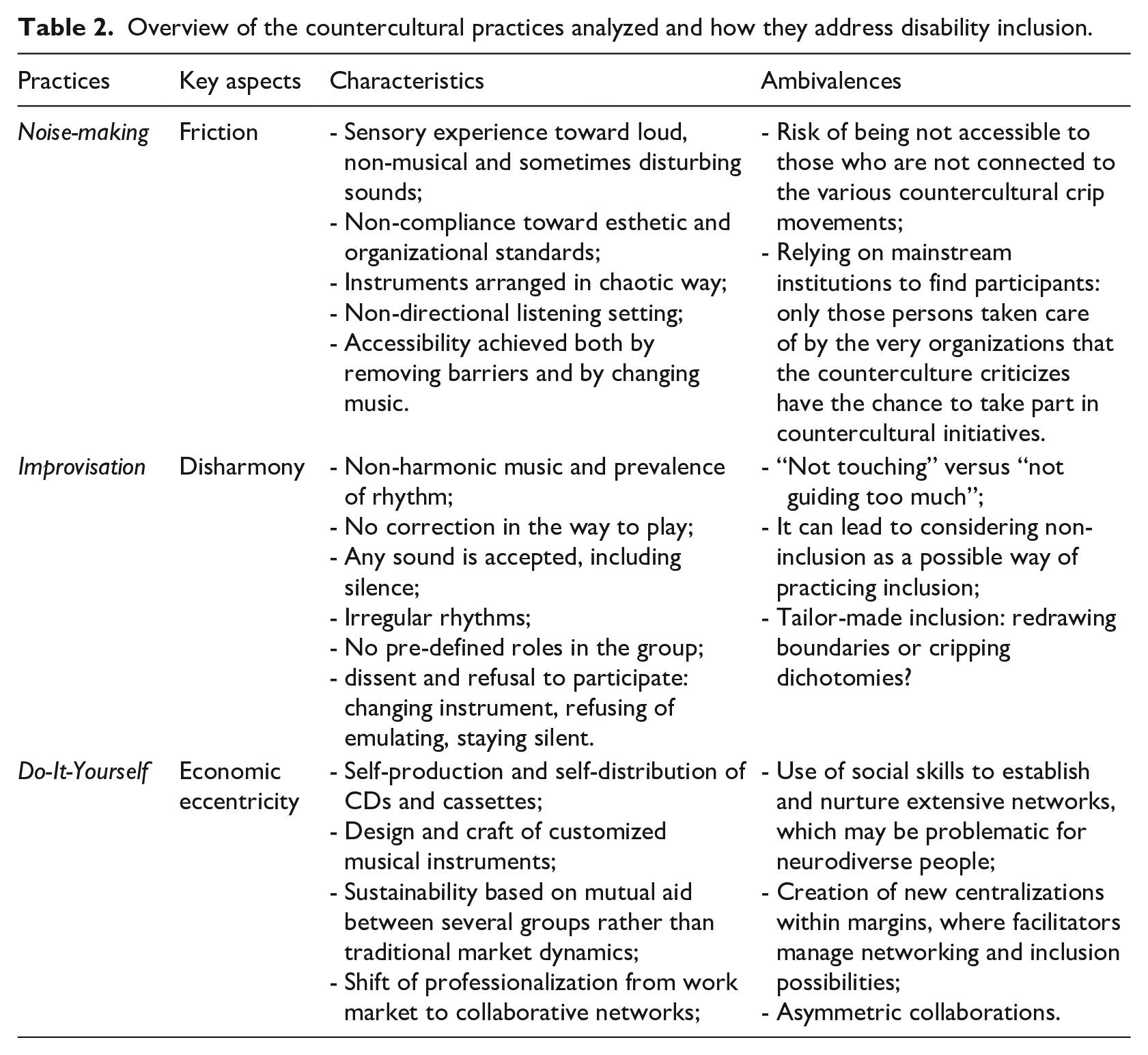
We present our findings organized over three sections. As shown in Table 2, each section relates to a practice observed during our fieldwork (noise-making, improvisation and Do-It-Yourself) and to a key aspect of disability inclusion within it (via friction, disharmony and economic eccentricity), highlighting characteristics and ambivalences.
Overview of the countercultural practices analyzed and how they address disability inclusion.
Noise-making and friction
At the annual meeting we attended, noise is considered by facilitators as an immersive and involving experience, something which can connect people with different backgrounds, capabilities, and visions of the world. The facilitators we interviewed pointed out that noise music is an activity they perform with no distinction between autistic and neurotypical people, as it precedes language and order and involves first of all the senses and the body. John (pseudonym), who is a musician and a facilitator in workshops with autistic people, said during the interview: After several years working with autistic people I realized that my relationship to sound was especially directed towards the sensory and physical effects, and I was amazed to understand that for many autistic people it was the same.
During the workshops held at the event, we observed that noise music fosters accessibility as it gives everybody the opportunity to participate and express themselves in a free and direct way, no matter what their musical skills are. Nevertheless, we noticed that this accessibility is not only achieved with a removal of barriers, but also with what can be considered as the opposite operation, that is the production of noise, which, for many people, is an element of friction and interference. We consider friction as both a sensory experience—involving unconventional, non-musical and sometimes disturbing sounds—and as an act of non-compliance with esthetic and organizational standards.
We observed both of these manifestations of friction during the first workshop of the event. The workshop was conducted by John and Antoine, both defining themselves as “noise musicians” in terms of their artistic activity, and both employed as educators in public schools. The workshop was attended by five participants on the autism spectrum, three of them teenagers, two somewhat older. It started by the facilitators saying a few words and demonstrating the instruments present in the room. These were electronic and acoustic instruments, mostly custom-made to adapt to peoples’ sensor-motor attitudes: unusual one-string guitars played with a stick, electronic devices with big knobs connected to microphones to modulate the sound of the voice, hand-controlled sound generators that produced various noises and frequencies, percussion, and a drum kit. Encouraged and guided by the facilitators, the five participants shyly approached the instruments. One of them spoke into the microphone to hear the voice transfigured by digital effects through the loudspeakers; and after a few tries he started to scream. Others slammed sticks on strings and moved knobs, exploring the prototypes put at their disposal, slowly gaining more confidence with the instruments, and with the other people around them. After about an hour they all started to play altogether with the facilitators. The music was noisy and hectic, sometimes disturbing. In certain parts it became more rhythmical as the facilitators encouraged one person to hit the drums, after which he continued with a martial cadence for several minutes. After about an hour of improvisation, they stopped and took a break. In this example, the ability (e.g. to play an instrument) is not a parameter for access, as access is rather determined by the arrangement of the instruments in space, the type of instruments, and the type of music being played. In fact, instruments were arranged in the space in a rather chaotic way that didn’t facilitate access, but rather produced a certain friction when participants approached, as they sometimes had to move or touch other things in order to reach the desired instrument. Nevertheless, this chaotic arrangement and the friction it produced was functional to noise-making, as it encouraged people to play in unconventional ways, creating unexpected effects and interferences.
The second part of the workshop was dedicated to listening. The facilitators set up a circle of loudspeakers around a big carpet, inviting the participants to sit or lay down, but leaving them also free to move around. When sound arrived, it was a wall of noise, akin to “white noise” modulating and moving around the circle of speakers, producing an immersive bodily experience. Participants listened to it revealing a mix of ease and surprise. One of them came closer to the speakers and looked into them; two others laid in the center of the carpet, still another one was sitting and stimming, and one held the hand of one of the facilitators. In this example, loudspeakers do not orient the listening space in a unidirectional manner, but define margins within which listeners’ freedom of movement is an integral part of the sonic experience.
In both the examples above, accessibility is achieved by both removing barriers to music making and by changing music itself. In fact, although customized instruments and the circle of speakers can facilitate access to the music experience, they are ineffective if not accompanied by a change in the very idea of what music is. For example, customized instruments would never enable people playing a sonata; and the circle of speakers would not give the same immersive bodily experience with a different music genre. In this countercultural practice, accessibility goes along with the friction produced by a music which is undesirable to most and with an act of non-compliance with the esthetic standards. Here, inclusion comes with a challenge to established norms and values: what for many people is a noise, a friction or a malfunctioning can be seen as a possibility, a form of beauty. As Françoise, activist and educator, highlighted during the interview, interferences become a creative channel through which autistic people can deal with communication issues: We have a lot of kids who are non-speaking, non-verbal, who like to take the microphone. We put a lot of effects on voice, distortions, echoes, and so the voice becomes an instrument. It’s not about talking anymore, and they feel comfortable.
Accessibility through friction also highlights a fundamental tension that characterizes these practices: the alternative “culture of accessibility” (Hamraie, 2017: 18) promoted by countercultural practices, in fact, risks being itself not accessible to those who are not connected to the various countercultural crip movements, as well as to those who do not have the social and cultural capital to discover and appreciate the value of the alternative. We observed this tension in the framework of the annual meeting. As some of the interviewees explained, they rely on other organizations to find participants, especially medical and health care units with a rehabilitative aim, as people would otherwise not have the chance to learn about their workshops. At the same time, almost all the interviewees emphasized that there was a neat separation between their countercultural artistic practices and the therapeutic activities of mainstream organizations. Almost paradoxically, though, only those persons taken care of by the very organizations that the counterculture criticizes have the chance to take part in countercultural initiatives. Therefore, we see in these practices a tension between the margins and the center that cannot be easily overcome, that we define as dis-including (which will be discussed later). The countercultural attempt to transform the center (established values and norms) from the margins, in fact, depends on the center itself and its institutions.
Improvisation and disharmony
All three of the music workshops held during the annual meeting were based on improvisation. As a method for artistic collaboration, improvisation has been associated with counterculture, especially as it is considered a form of rejection of authorship (Bailey, 1980; Schroeder et al., 2019). There is no pre-defined form to be achieved during an improvisation; the participants have to listen to one another and be open to the cues that arrive. Most of the facilitators interviewed affirmed that the use of improvisation makes those workshops open to everyone and allows for the participants’ free expression. They argued that improvisation challenges hierarchical structures, thus emphasizing egalitarian relationships between participants and escaping normative expectations.
During our attendance at the workshops, we noticed that improvisation helps to create a climate of inclusion where participants can self-determine without being treated in a charitable fashion, or as patients to be normalized. This was especially noticeable as there was no correction of their way of playing and each participant had the same chance to contribute to the musical performance. At the same time, we noticed that this climate of inclusion was not based on harmony, but on disharmony. With this term we refer to both esthetic aspects of the music produced, and to specific group dynamics. In terms of the esthetic aspects, we experienced disharmony during improvisation sessions from the way that sounds and noises were juxtaposed without creating harmonic music (based on the combination of musical notes in chords). The only element related to conventional music structures was rhythm, and we noticed that those who were able to keep a rhythm were in some way giving a direction to the improvisation. As for the group dynamics, we observed that interactions within the group during improvisations were often accompanied by a sort of dissent, which contributed to the sense of disharmony. In fact, the groups had no strict roles and participants sometimes didn’t want to play or changed instrument frequently. In many cases we observed that facilitators suggested ways of playing and gave a series of cues, in a certain sense conducting the improvisation. They suggested to participants which instrument to pick up, how to play it, or even started playing an instrument and invited a participant to emulate. At the same time, most of the facilitators didn’t push participants to follow their suggestions, leaving them free to play in other ways—as often happened.
Another example of disharmony—in both the esthetic and interactional senses—was due to the fact that, during the improvisations, any sound was accepted, including silence. For example, during the second workshop, a participant remained still for almost the entire duration of the improvisation, until they let out a distorted scream from the microphone which brought about the end of the session. As Serge, activist and artist who was a former member of GEM, said during the interview: The aim is not to produce harmony, but to make noise together. . . Everybody is free to do something or to stay still. Also silence is part of the process, and sometimes it is noisier than sound.
It is important to note that, in all these cases, facilitators created the organizational conditions within which participants could dissent and be disharmonic. We noticed that different approaches were adopted to enable this possibility. This also emerged from the interviews, as facilitators were aware of how delicate their leading role was, and of the issues related to it. This is how it was explained to us by Michelle, artist and educator: There are different attitudes. . .Someone like V. has the dogma of “not touching” – by this I mean not interfering with what people do while playing, and letting them go wherever they wish. We are less purist, so even if we leave them do what they want, we propose and choose certain instruments or effects. We make suggestions. . . I look for a kind of artistic truth in improvisation, but it can come in many ways, also when improvisation is conducted. . .but it can become horrible when people guide too much, it looks like watching the circus.
These sentences evidence how countercultural practices reject charitable approaches that make the disabled appear like freaks in a circus. Still, they highlight how facilitators oscillate between radical approaches oriented to “not touching” and less radical ones oriented to “not guiding too much.” In light of the various manifestations of neurodiversity (Dobusch, 2021; Egner, 2019; Runswick-Cole, 2014), guiding in this case is a way to encourage the participation of those who are more hesitant toward (or uncomfortable with) collective activities. Nevertheless, guiding is also a form of goal-oriented management which may be normative, as those goals are set from above and not by members themselves. At the same time, not touching may equate disorganization, where dissent and non-participation are legitimate choices.
Therefore, the ambivalence that characterizes this approach to inclusion is that, being open to non-participation, dissent and disaffiliation (Ravaud and Stiker, 2001), it can lead to considering non-inclusion as a possible way of practicing inclusion.
During the interview, John expresses this ambivalence in this way: Inclusion at all costs, to me, that’s super dangerous. There is no ready-to-wear method for inclusion, but for us, inclusion as is meant today is ready-to-wear. While I think the only thing that is possible is precisely to make it tailor-made.
In our interpretation, tailor-made inclusion could consist of researching a way of leaving space for self-determination, dissent and disharmony without arriving at the extreme of non-inclusion. It is, nevertheless, ambivalent, as it entails redrawing boundaries between disabled and non-disabled—just in a less stereotypical way. On the other hand, those very boundaries had been blurred or “cripped” (used as a verb, McRuer, 2006) when improvisation led to new and proudly disharmonic forms of being together. As in the previous section, we can also notice here a tension between the agential possibilities inherent being in the margins claimed by crip counterculture (dissent, disharmony, disorganization) and the reproduction of a center that conducts harmony and manages inclusion, even though it is tailor-made. We consider this tension a trait of what we call dis-including.
Do-It-yourself and economic eccentricity
The press release of the event reads as follows: The practices of experimental creation that attract us, of whatever nature (sound, visual, stage or writing), are lodged in particular in the margins of the laws of the mainstream, where creators, collectives, cinemas, labels or publishers, magazines, audio or digital media and even the production structures are interconnected in lively and active assets and share a sensitive apprehension for egalitarian human relationships to be defended [. . .]. This is what creates the border between the “Just do it” and the “Do It Yourself,” between mass movements and passionate movements. If this kind of counter-culture, heterogeneous in spite of everything, retains its intensity, it is because it continues to hybridize with the various counter-power, the struggles for emancipation which concerns bodies, identities, social issues, environmental issues, etc.
Countercultural activities performed during the annual meeting rely on a network of people involved in independent publication, distribution of music, and in the organization of events. The press release calls this attitude “Do-It-Yourself.” Do-It-Yourself is a political and philosophical movement, which started in the 1980s from the confluence of illegal youth parties with a series of protest movements which shared an anti-authoritarian bent in struggles for social justice (McKay, 1998). Its most prominent traits are the reliance on self-production, the refusal to participate in the market dynamics and the preservation of spiritual and expressive autonomy (Sicca et al., 2022). The movement has had its greatest success in underground and counterculture, for example in punk music (McKay, 1998). Do-It-Yourself movement involves a network of groups which extends all over the world. One form of connection within this network is the distribution of its music products, such as old-fashioned cassettes and CDs (but streaming of digital files is also accepted). Publication of music products is one of the activities of GEMs and associations that were present at the annual meeting as well. As Paul explained during the interview: . . . we record all the sessions of the workshop and after we edit the recordings, selecting the passages that make sense for us. This is also our usual way of making records, not only within the workshop. For us the CD is like a business card, but it’s also important to leave a trace of what we are doing.
Another meaningful aspect of GEMs’ Do-It-Yourself practice is the design and craft of musical instruments customized around the specific cognitive and sensor-motor possibilities of individuals. For example, we observed a one-string guitar equipped with a slider, that allows people with limited hand coordination to simply make sounds by moving the slider along the guitar neck. As Remy, activist and artist, told us during the interview: We come from Do-It-Yourself culture, so we have always been interested in making our own instruments . . . We are militantly open-source and want to make things and knowledge accessible to everyone. This means also building instruments which are cheap and affordable, in contrast to most assistive devices that are very expensive.
Custom-made instruments were made at FabLabs, open laboratories based on the sharing of tools and knowledge, where anyone can develop an object or software and share it with the other members of the lab, who can also provide help and expertise. During the annual meeting, we could only partially observe this process, with a visit to the local FabLab during the construction of a custom-made instrument. John introduced us to the designers and described us the ongoing and next steps of production. None of the workshop participants came with us. As John said: We try to work in the sense of co-construction between users and designers. The point is that it is not easy to co-construct with people who don’t speak at all, or don’t express their desires in words, so don’t say “I would like an instrument like this. . .,” while on the other side most of the designers have never worked with disability. So we have to be the bridge. It is also a way to make a meeting between different worlds, like the one of GEMs and that of professions. . . and making knowledge circulate.
Through the practices of self-producing CDs and custom-making instruments, Do-It-Yourself fosters an economic eccentricity that challenges normative views of productivity and performance. Taking inspiration from what Kafer (2013: 56) defines as non-traditional and “eccentric economic practice,” we use the term economic eccentricity to refer to Do-It-Yourself’s capacity to shift the valorization of disability from the traditional labor market (that values individuals) toward alternative collaborative networks. As found from observation and interviews, this shift occurs through mutual aid between several groups—each with a specific expertise—who recognize themselves as part of the same countercultural milieu and work together to make their practices sustainable. In this way the crip world connects with that of noise music enthusiasts, as well as with other activists and their various expertise. We can see this, for example, in the fact that rather than relying on off-the-shelf technologies to achieve inclusion at the personal level, Do-It-yourself practices harness techno-scientific knowledge through collective and collaborative hacking and tinkering practices. Here, custom-made instruments turn disability from a condition of exclusion into an occasion for meeting, micro-scale resistance and alternative world-building. We also observed this approach in other aspects of the event organization, such as catering, communication, and cleaning, which were entirely taken care of by the network of volunteers linked to GEMs.
Recalling the etymology of the word “eccentric,” we could say that Do-It-Yourself’s economic eccentricity dislocates value from the center to the margins. Within this approach, inclusion is less about professionalizing disabled people by inserting them into the mainstream work and music market, and more about feeding collaborative networks within which diverse and non-standard attitudes are recognized and made sustainable. As stated in the press release, these “hybridized” alliances aim to generate innovative ways of communal existence and collective work while still being located “in the margins.”
Nevertheless, we noticed that Do-It-Yourself can also create new centralizations within those very margins. This is especially evident as establishing and nurturing extensive networks of people is often entirely in the hands of some facilitators, as it hinges upon the use of social skills, which may be problematic for neurodiverse people (Dobusch, 2021)—as proven by the fact that none of the workshop participants went to the FabLab. In this context, then, facilitators may not only function as “bridges” (as in John’s words) between several groups, but also as “centers” that direct networking and the related possibilities for inclusion. This opens up the issue of determining whether and to what extent inclusive collaborations actually allow each person to bring complementary skills to a project. Therefore, in Do-It-Yourself we also see an ambivalence that characterizes the countercultural way of practicing inclusion—that which we call dis-including.
Concluding discussion: Theorizing dis-including
This paper has explored what form disability inclusion takes in countercultural practices using the empirical case of alternative art-based organizations related to the crip movement. We have observed how inclusion is practiced in French GEMs dedicated to noise music, and we have found three key aspects characterizing the crip approach to inclusion, namely friction, disharmony, and economic eccentricity. By comparing the three themes of literature on disability inclusion (i.e. accessibility, climate of inclusion, valorization of disability) with our findings, we now discuss the novel insights coming from our research.
Our findings show that noise-making, introducing friction into the core of accessibility, counters, and “crips” the idea of accessibility as immediacy (Beatty et al., 2019; Collins et al., 2022; Schur et al., 2014). According to this approach, which is in line with crip theory’s refusal of normalization (Hamraie and Fritsch, 2019; Kafer, 2013; McRuer, 2018), the removal of barriers is not a neutral and non-conflictual operation that immediately produces access and participation; rather, friction reveals access-making as an act of non-compliance and as a site of political contestation and cultural transformation. Nevertheless, our findings have shown that friction is accompanied by a tension between the margins and the center. A countercultural attempt to transform the center (established values and norms) from the margins often depends on the center itself and its institutions, or presents a cultural complexity that risks of making those practices inaccessible and exclusive rather than inclusive.
Moreover, the disharmony that characterizes the practice of improvisation clashes with the feelings of harmony usually associated with a climate of inclusion (Fujimoto et al., 2014; Hacking et al., 2008; Schroeder et al., 2019). In line with the crip perspective (Kafer, 2013; McRuer, 2006), disharmony promotes forms of being and behavior that don’t fit pre-defined and normative categories, countering charitable or assimilationist approaches that neatly distinguish between disabled and non-disabled. This potentially overcomes the tendency to set boundaries which define who is inside (and therefore who has the authority to include or not) and “others,” who have to be included via this process (Kallio-Tavin, 2020; Mauksch and Dey, 2024; Mitchell and Snyder, 2015). At the same time, disharmony expresses an ambivalence, as the emphasis on dissent and disaffiliation leads to considering non-inclusion as a possible way of practicing inclusion—an outcome avoided via redrawing new boundaries, despite being tailor-made.
Finally, our findings show that Do-It-Yourself practice activates an economic eccentricity that reworks person-centric approaches (Beatty et al., 2023; Krzeminska et al., 2019; Stuhldreher, 2020) typical of business-led forms of disability inclusion (Jammaers and Zanoni, 2021). Resonating with crip theorists’ interest in non-traditional forms of relationality and economy (Kafer, 2013) based on heterogeneous coalitions (McRuer, 2018) and distributed solidarities (Mingus, 2010), this approach locates valorization of disability in terms of collaborative networks, rather than individuals’ capabilities. Nevertheless, we also noticed a tension here between the possibility of shifting value toward the margins and the centrality of facilitators as pivots in the creation and management of collaborative networks that require social skills that autistic people don’t have.
These considerations highlight that countercultural practices related to the crip movement break the mold when compared to both mainstream and alternative approaches to disability inclusion. By placing the agency of marginality at the forefront, these practices contrast normalizing views of inclusion (as an assimilation of the “outside” by the “inside”) thus transcending the inclusion/exclusion dichotomy. At the same time, our study shows that the contestatory and non-dichotomous approach claimed by crip counterculture is inextricably linked with an ambivalence, expressed by the tensions between margins and center we observed in our research, which is an underestimated factor in literature. To conceptualize this ambivalent (as well as contestatory and non-dichotomous) aspect of the crip countercultural way of practicing inclusion, we introduce the term dis-including. The choice of this term relies on the ambivalence of the prefix “dis-.” As suggested by authors in crip theory, this prefix signals that dis-ability is a conflictual and contested word (Kafer, 2013; McRuer, 2006) that cannot be reduced to binary notions of boundaries between disabled and “normal” identities. This “dis-” particle also recalls Derrida’s (1972) logic of marginality as fundamentally ambivalent, as margins are inside and outside, so evoking a tension between the margins and the center which cannot be simply overcome. Finally, the use of the gerund emphasizes the processual dimension (Czarniawska, 2014): dis-including is not a stable, “once and for all” condition, but rather a performative and open-ended practice (Gherardi, 2019).
We conclude our paper by elaborating the key implications of dis-including, with a specific emphasis on the possibilities and limits of this non-normalizing, non-dichotomous and ambivalent practice. We therefore consider how dis-including can theoretically contribute to the debate about disability inclusion in alternative organizations transcending the inclusion/exclusion dichotomy (Bendl et al., 2024; Buchter, 2022; Collins et al., 2022; Dobusch, 2021; Mauksch and Dey, 2024; Reeves et al., 2022)—with possible implications extending beyond the scope of alternative organizations.
Our findings show how dis-including is not limited to improving or expanding existing practices, but rather questions, reinvents, and gives new meanings to them—for example, through friction, disharmony and eccentricity. As this process begins in the margins—such as crip counterculture—dis-including doesn’t aim to exit from marginalization, but rather aims to make the margins a site of re-articulation of reality as such. At the same time, our findings show how the agential possibilities of marginalized individuals to “crip” intentions to normalize and assimilate often depend on the center itself and its institutions. For example, we have seen ambivalences in the relation between counterculture and health-care organizations, as well as between disorganization and organized participation. These ambivalences produce spaces in which different forms of management and subjectivities coexist. We see this as a tension between the assertion of margins as a site of possibility (well expressed by crip theory and counterculture), and the resorting to more traditional forms of inclusion that aim to exit that same marginality (expressed, e.g. by the mainstreaming of disability art and disability rights). These considerations allow us to clarify the sense of dis-including not as a simple way out of marginalization, but as a process of ex-marginalization, in the threefold sense of this expression: (a) as a way of getting out of confinement to the margins, but (b) starting from the margins in such a way that (c) the margins are at the same time exceeded and maintained, therefore becoming “ex.”
This way of seeing the tension between margins and center also points to the potential of dis-including beyond the context of alternative organizations committed to art. First of all, because we see dis-including as a practice that requires breaking the mold when organizing. This means that organizations cannot just include someone; rather, it is the practice of inclusion that changes the character of an organization—a consideration consistent with a constructionist (Czarniawska, 2014) and sociomaterial perspective (Gherardi, 2019), as it doesn’t consider organizations as stable objects with closed and well-defined borders, but as performed into being through organizing actions. After all, mainstream approaches also acknowledge that inclusion is not possible without a change in organizational norms and structures, and such change does not come easily (Nkomo, 2014). Inclusion has little to do with comfort; rather, it has to do with the discomfort of change (Adamson et al., 2021; Ferdman, 2017), and with dissent (Gagnon and Collinson, 2017). Nevertheless, as already noted, most of the mainstream approaches to disability inclusion reflect a one-sided approach in which inclusion initiatives originate from the top management, thus perpetuating a fundamental discrimination between those who include and those to be included (Dobusch, 2021; Jammaers and Zanoni, 2021; Tyler, 2019). We argue that such a dichotomous approach—assuming clear and pre-defined borders between what is inside and what is outside organizations (Czarniawska, 2014)—overlooks the importance of the margins. In response to this, dis-including maintains the need of change and transformation from the established notion of inclusion, but doesn’t see this process as a unidirectional movement from the margins to the center, but as a tension between the margins and the center which cannot simply be overcome. Breaking the mold when organizing (and when doing research), then, means enabling practices that don’t simply recognize disability as an “otherness” to be included, but that question established values and assumptions from the standpoint of disability. This entails granting autonomy to the margins to negotiate if and how their inclusion should take place, and under what conditions.
This introduces us to the second prompt we gain from dis-including, that is the importance of addressing inclusion to collectives rather than to individuals. Our findings show how countercultural practices treat the realms of accessibility, the climate of inclusion and the valorization of disability as collective efforts, rather than focusing on conditions regarding individuals and their abilities. For example, expanding on our observations, dis-including makes accessibility a collective effort of transforming meanings and practices that cannot be undertaken by management alone, nor does dis-including simply rely on technology and accommodations addressed to individuals—an aspect that crip activists have also critiqued in the much-acclaimed Universal Design (Hamraie, 2017). Rather, this is an effort that starts from the margins and involves sociomaterial collectives made up of activists, artists, designers, health institutions, artifacts, technologies and so on. Similarly, dis-including emphasizes the importance of economic eccentricity based on collaborative networks and distributed solidarities as a way to face the problem of work inclusion without falling into welfarist and paternalistic approaches, nor into neoliberal market dynamics which—beyond the easy inclusionism rhetoric (Mitchell and Snyder, 2015)—deeply penalize disabled people (Hall and Wilton, 2011; Jammaers, 2023; Maravelias, 2022). These collective efforts, as we have seen, are marked by friction, disharmony and ambivalence, which exposes them to drawbacks—for example the risk of reproducing exclusionary dynamics: the inaccessibility of countercultural practices due to their marginality and intellectual complexity; the disaffiliation of crip subjectivities; the exclusion from network activities which require social skills. Nevertheless, we consider these risks as part of the complexity of dis-including. As argued by crip scholars and activists Hamraie and Fritsch (2019: 21): “The point is not to achieve ideological purity outside of mainstream disability technoscience, militarism, or capitalism, but to locate and center threads of resistance already occurring within and against these systems.”
Drawing on this consideration, we further clarify the sense of dis-including as in itself a noisy, disharmonic and eccentric practice. First of all because out of noise, disharmony and eccentricity it creates some tactics of resistance to the latent ableist and normalizing assumptions that accompany most understandings of inclusion (Dobusch, 2021; Hamraie and Fritsch, 2019; Kafer, 2013; McRuer, 2018; Siebers, 2008; Tyler, 2019). Secondly because noise is itself by definition open to multiple and non-pre-defined meanings (Hainge, 2013) and as such can foster the articulation of new, non-exclusive relations through which the idea of inclusion can be redefined—hopefully without the drawback of discriminating against those who are interested in the various practices associated with the mainstream view (Kafer, 2013). Therefore, dis-including is not the opposite of including but expresses the noisy (and therefore contestatory, disharmonic, eccentric and ambivalent) character of inclusion. In this sense, dis-including doesn’t even correspond to emancipation, as the latter means freeing a person from constraints, while dis-including, emphasizing the importance of hybrid, heterogeneous sociomaterial collectives, expresses doubts about the very possibility to consider the terms “freedom,” “person,” and “constraint” in a univocal and non-conflictual way.
In conclusion, we see dis-including as a practice with the potential to reshape both mainstream and alternative approaches to disability inclusion—in particular because it is non-dichotomous, breaks the mold when organizing, and shifts the focus from the individual to the collective. Dis-including contributes to organizational literature on accessibility, climate of inclusion and valorization of disability, providing the debate with prompts from the crip countercultural approach but also highlighting the challenges arising from practicing inclusion beyond dichotomous, normalizing, assimilatory approaches, and from embracing the ambivalence of the margins. We therefore encourage scholars to conduct further research on disability inclusion from the perspective of crip theory and counterculture—for example investigating different arts contexts and considering intersectionality between disability and other categories of marginalization—and explore the ways such approaches rework the boundaries and margins of organizations.
Footnotes
Acknowledgements
We wish to thank Barbara Czarniawska who encouraged us in writing this paper from the very beginning. Thanks to Silvia Gherardi for her friendly review after the second round of peer review. Thanks to Antoine Capet and Arnaud Rivière who kindly helped us during the fieldwork. Thanks to the puntOorg International Research Network for weaving ideas that served as a constant stimulus for the development of the research. Naturally, we also thank the anonymous referees for their constructive invitation to reflect and improve the paper.
Funding
The author(s) received no financial support for the research, authorship, and/or publication of this article.
