




Abstract
Participatory capture refers to the manner in which institutions and organizations engaged in participatory projects deploy participatory methods, however unintended, in ways that further endanger or disempower the most vulnerable participants. To further articulate this phenomenon, this article presents a critical discourse analysis of key documents associated with HOPE VI, a federal public housing program in the United States known for its emphasis on community participation amid antiblack power structures. The result of the analysis are two models of participatory engagement—deficit and governance—that facilitated HOPE VI’s participatory capture. Deficit models rely on participants who are discursively rendered as “inferior,” while governance models prioritize “token” participants at the expense of more robust participant feedback. Moreover, these models, in the context of the U.S., carry with them particularly racialized predicates that demonstrate potential perils of participation for low-income, marginalized communities. With implications for organizational communication, diversity initiatives, and community engagement, the analysis presented in this article offers researchers, organizers, and policymakers ways to continually evaluate the efficacy of participatory methods, especially in racialized or hierarchical contexts.
Keywords
Introduction
In 1999, Chicago mayor Richard M. Daley, son of former segregationist mayor Richard J. Daley (also of Chicago), initiated his administration’s plan to demolish 18,000 public housing units occupied by mostly Black, mostly female residents. Residents were legally required to participate in the planning and execution of Daley’s initiative, part of a U.S. federal housing program called HOPE VI that subsidized private developers in their efforts to gentrify Black and low-income communities. Though residents participated in early plans for redevelopment, government officials and developers worked to minimize resident input and resistance, leading to a federal lawsuit brought by residents. One public housing resident said about the demolitions, “How can they take our roots from us without our input? . . .. They’re planning to move the poor and destitute and build for rich folks” (Austin, 2018: 233). HOPE VI eventually phased out around 2012, but the program, while noted for its emphasis on resident participation, would come to facilitate the demolition of hundreds of thousands of public housing units as well as the displacement of tens of thousands of vulnerable residents. Chicago, at times considered the most racially segregated city in the U.S., would later resolve its legal issues and become the single-largest recipient of HOPE VI funds (due in part to Daley’s personal relationships with officials in President Bill Clinton’s administration) (Austin, 2018: 256–257). A legal representative for Chicago public housing residents called the redevelopment plans “ethnic cleansing, Chicago-style” (Kamin and Kass, 1996). Commenting on the Black and low-income residents often framed as dysfunctional and dependent and likely to be disproportionately affected by his redevelopment plans, Mayor Daley said, “I want to rebuild their souls” (Austin, 2018: 255). With the antagonism exemplified by HOPE VI—between organizational imperatives on one hand and vulnerable stakeholder interests on the other hand and with participation in the middle—this article interrogates the antiblack rhetoric, organizational communication, and programmatic methods by which participation can be co-opted against those called upon to participate.
Participatory methodologies remain dubious tools for organizations seeking to enlist the expertise, input, and cooperation of marginalized communities, especially in contexts of economic development. Methods like workshops, listening sessions, surveys, and public forums have long promised to reduce conflict between communities targeted for development and organizations and institutions seeking to carry out development and interventional policies. Yet, in many such contexts, disagreement, mistrust, and exploitation proliferate, prompting several scholars and practitioners to question the efficacy of participation. Participatory engagements often fall short of their democratic ideals because organizations and community members have divergent agendas. In numerous cases, organizations implement participatory projects in bad faith, using discourses and methods of participation with little to no institutional accountability for any outcome other than organizational control of a development or community project. Thus, what looks like organizational failure to effectively collaborate with communities can actually be an intended success in limiting resistance to institutional mandates at the expense of marginalized and vulnerable communities.
Contentious participatory projects often involve racialized and marginalized communities. Even those optimistic in their assessments of organizational uses of participation advise caution when appropriating participatory methods, because such projects can perpetuate the naturalization of racial difference and racialized hierarchies. Raelin (2012: 16) notes that “Without authentic citizen voice, we risk having emancipatory discourse represent no more than a staged affectation.” Lang (2023: 100) laments “the multiplication of mechanisms whose aim is more to build acceptance for urban renewal projects. . .or to tame criticism rather than to engage in co-constructed public policies.” In “Participatory Methodologies for Intersectional Research in Organisations,” Plowman (2016: 39) emphasizes, “Being reflexive was essential to. . .understanding of power and silences. Revealing the impact of gender and race is found in what is unsaid, as well as what is said.” Scholars such as these highlight the delicate boundary between collaboration and cooptation when it comes to community or development work between organizations and communities of color. Some critics go further, however, and view racialization as endemic to participatory projects because racialized difference and hierarchy (particularly in development contexts) are socially and discursively taken-for-granted.
In its worst iterations, organizations seize upon this taken-for-grantedness to frame marginalized communities as incapable of self-determination or agency to be treated as legitimate partners. Demsas (2022), for example, argues that participatory approaches increase racial disparities in United States housing development policy, writing, “Expanding opportunities for political participation failed to solve the problem of inequitable project distribution, because the fundamental problem wasn’t lack of community input; it was a lack of political power among disadvantaged groups.” The view that participation undermines the most vulnerable stakeholders is not new in assessing organizations’ uses of participatory methodologies. Critics have long questioned the sincerity and effectiveness of organizations that advocate for participation (Cleaver, 1999; Williams, 2004). Yet, despite participation’s questionable effectiveness, organizational and institutional reliance on participatory methodologies remains. As Lee (2015: 279) notes, “Participation is so normalized in the ideologies of contemporary organizations as to require new perspectives on participation, encompassing cross-cutting and overlapping discourses and practices experienced by participants as they move through the various organizations and communities in their lives.” Participation’s persistence therefore poses the question: how have researchers, organizers, and policymakers become captured by participation?
To begin answering this question, I present this article as a historical case study of the discursive and programmatic iterations of participatory capture in a U.S. federal housing program named HOPE VI. I use the term “participatory capture” to refer to the way institutions and organizations engaged in participatory projects deploy participatory methods, however unintended, in ways that further endanger or disempower the most vulnerable participants. HOPE VI (Housing Opportunities for People Everywhere) was a federal program in the United States administered by the Department of Housing and Urban Development (HUD) that, from approximately 1992–2012, funded public housing demolition in favor of housing vouchers and privatized development—a housing policy approach still very much active in subsequent U.S. federal policies. Participatory methodology was central to HOPE VI’s implementation. Over the life of the program, policymakers “emphasized the importance of resident participation in redevelopment efforts, especially in the planning of community and supportive services . . . [and] the redevelopment process. However, in actual practice, the rights of residents and others to participate in the HOPE VI process [were] much more limited than HUD’s policies [suggested]” (National Housing Law Project, 2002: 17). Moreover, these limited policies negatively and disproportionately affected low-income, Black residents, many of whom were geographically and economically displaced as a result of HOPE VI. Yet, an often overlooked aspect of HOPE VI’s inequitable methods is the organizational discourse that facilitated its participatory policies. Ultimately, these policies in their participatory capture gave cover to institutional and organizational practices that actually limited resident participation and constrained residents’ choices of where to live.
In the case of HOPE VI, participatory capture and its attendant organizational discourses reflected the logics of racial capitalism. Namely, the result of HUD’s approach to participation was that HOPE VI discriminated “against [the] lowest-income African-American women, because it disproportionately destabilize[d] the economically-precarious, female-headed households who predominate in the severely-distressed public housing projects its grants targeted” (Duryea, 2006: 571). Not surprisingly, households headed by Black women with children were disproportionately displaced—“not only in comparison to the US population as a whole, but also in comparison to the general public housing population” (Duryea, 2006: 579). In light of the racial and economic disparities enacted by HOPE VI, and in further articulating participatory capture from a historical standpoint, this article takes the view that participatory appeals and policies “[leave] unexamined the cumulative economic effects of colonial power, that is, of the still-working mechanisms of dispossession, displacement, and death that facilitate the expropriation of the productive capacity of the lands and bodies of the ‘others of Europe’” (Silva, 2015: 35). In other words, institutionalized and organizational deployments of participation have the potential to obscure the power dynamics inherent in racialization and its reliance upon marginalized Others. From that perspective, the racial and economic implications of HOPE VI lead me to ask, what subtle (and not-so-subtle) but effective discourse strategies and organizational models are at work when institutions advocate for participation in development contexts that are structurally constituted by racialized, gendered, and economic hierarchies?
Beyond the contemporary considerations of race and participation that I mentioned above, such a question prompts additional reconsiderations of the practical and ethical implications of race and participatory methodologies within management and organization studies. Sparre (2020: 5) uses participatory action research, for instance, to support organizational learning but offers that “Who participates, how they participate, when they participate, and why they participate are questions that expose real differences.” Likewise, Gronouwe et al. (2022: 40) advocate for a “participatory (re)design process which focusses on increasing the ability to self-design of employees” in integral organizational renewal. They concede, however, that “Yet, as a fully participative, bottom-up and non-directive redesign process is considered as unfeasible. . .it remains exposed to the possibility of expert-driven elements getting the upper hand, potentially nullifying its emancipatory potential” (Gronouwe et al., 2022: 40). Importantly, though, Puri and Sundeep (2003: 284) have intervened in organization studies with their examination of participatory methodology along the lines of ethnicity and nationality. They conclude that participatory methodology is mostly “mediated by governmental agencies, drawing upon institutional structures that emphasize hierarchy, a top-down philosophy, and the application of a project-based scientific knowledge. These structures tend to stifle participatory processes, or at best accept inputs from the end-users within the development framework defined by the bureaucracy.” I build on critical-cultural interventions like those of Puri and Sundeep (2003) by articulating the discursive machinations of participatory capture. I argue that participatory methodologies and their relation to participatory capture complicates organizational deployments of participation, especially in contexts wherein those enlisted to participate occupy sociocultural, ontological, and material positions of marginalization. In HOPE VI, for example, the U.S. federal government mandated the participation of low-income Black residents in ways that ultimately undermined the abilities of Black residents to effectively influence the development process.
In this article, I offer critical discourse analyses of two major organizational texts associated with HOPE VI, particularly its community building program which articulated its participatory methodology. My analysis of these reports further interrogates the racial and neoliberal assumptions of participatory organizational discourse that is deployed uncritically in racialized and predatory economic development contexts. Economic development projects and policies tend to elide racialized power dynamics with rhetorical appeals to “markets,” “democracy,” and “progress” and yet such development projects often burden marginalized communities with unpayable debt all while blaming racialized Others when markets, democracy, and progress stall or never materialize (Chakravartty and Silva, 2012: 362). My analysis yields articulations of two development models—deficit and governance—of participatory capture as found in HOPE VI’s organizational discourse and community engagement methods. HOPE VI is an effective case study because it sits at the intersections or race, materialism, and identity as well as institutional and organizational discourse, providing a productive lens with which to evaluate an instance of participatory capture, an analysis that offers discourses and methods to avoid in breaking free from (or at least better accounting for) the constraints of participation.
Literature review: Defining participatory capture
“Capture” or “regulatory capture,” as terms in economics and political science, have referred to the process whereby special interests overtake the capacity for public oversight and regulation in favor of monopolies or other self-interested motives (Laffont and Tirole, 1991). The concept is applied in organization and management studies to refer to ways that organizations influence policies or processes in conflict with public resistance. In this view, organizations influence communities or stakeholders in order to reduce resistance to institutionalist aims. Importantly, capture is an exercise in power; capturers seek to gain or to consolidate power at the expense of collaboration, deliberation, and contestation by those most affected and who tend to be less powerful.
Along these lines, critics of participation have highlighted how participatory methodologies are prone to “elite capture,” in which “communities are stratified along lines of wealth, class, ethnicity, gender, political affiliation, livelihood strategy, religion, and/or norms, and that elites within them tend to capture participatory initiatives for their own benefit and at the expense of non-elites” (Lund and Saito-Jensen, 2013: 104). Critics of elite capture view participation with skepticism and argue that participation can “reproduce and reinforce relations of domination and subordination between elites and non-elites, leaving little, if any, possibility for participatory initiatives to circumvent them, despite specific measures to prevent elite capture, such as regulations ensuring the representation of minority groups in decision-making forums” (Lund and Saito-Jensen, 2013: 105). Those that see capture as a persistent underlying dynamic within participatory initiatives refer to such dynamics as “participatory capture.”
Historically, the term “participatory capture” has been deployed in two contexts. The first context is a critique of participation in economic development—development the likes of which seen were in HOPE VI. Young and Meijaard (2002: 305) frame participatory approaches as a particularly Eurocentric mode of governance based on the assumption that “cultural predispositions are directly related to the manifestation of political culture and economic structure.” In northern Europe, for instance, political systems are based on consent and thus promote outcomes as states of “participatory capture,” in which “regulatory capture is reversed” and “Agents are captured to commit themselves to accept the finally resulting social welfare” (Young and Meijaard, 2002: 306). The second context in which participatory capture has been articulated is information systems development. Yu (2012: 185) used the term to highlight “the gap between the theory of user participation and the user’s lack of real influence on design and development.” Importantly, Yu (2012: 193) reveals how user feedback can be co-opted by those with greater influence on a design project’s communicative practices and also by participants’ own reluctance or inability to effectively communicate resistance. Thus, participatory capture also refers to ways that participants lose or are deprived of critical perspective and independence even as their participation is used to legitimate a design project.
Participatory approaches in organizations often carry within them inherent contradictions, namely that the greater the institutional invocation of participation, the less agential participants become. For example, with respect to organizational deployments of racial and hierarchical identities, Holck (2018: 252) concludes that, “The lack of transparency of hierarchy and authority and the replacement of formalized roles and rules with tacit codes put minorities at a disadvantage.” Howcroft and Wilson (2003: 2) go farther and specifically examine the paradoxes of participation, while emphasizing “the conceptualization of systems design and implementation as a process of social contention and political, as well as technical, determination.” The contention, which Howcroft and Wilson additionally term “fundamental antagonisms,” arises, since participation is typically deployed to mediate conflict between managers and end-users, institutions and agents. As such, a key aim of their argument is “highlighting the dissonance between rhetorics of participation and empowerment as against the actuality of maintenance of the relationship of power and powerlessness” (Howcroft and Wilson, 2003: 3). Primarily, participation fails to capture the actual dynamics at work in a systems design or public engagement effort. On one hand, the labor and rhetoric recognized as performed by participants do not necessarily represent what participants actually feel, think, or even contribute. On another front, participatory engagements often fail to accurately reflect the motivations and influences—institutional, local, personal, or otherwise—that animate such engagements and as a result, “difference is emptied of any vitality, history or politics” (Swan, 2010: 95). With my case study of HOPE VI, I illustrate how fundamental antagonisms between housing residents and governmental organizations lead to participatory capture.
Similarly, Rigg (2016: 201) criticizes participation for not accounting for the power dynamics and political abuses inherent in development contexts, writing that proponents of participation do not “use the words ‘politics’ or ‘political’” and that “participatory approaches are far from being politics-proof” (i.e. exempt from the cultural, social, and material forces that maintain structural inequality). As a result, in lamenting the prevalence of participatory capture, Rigg asks two fundamental questions of participation: (1) “Are local systems of management socially inclusive and equitable with respect for example to women and ethnic minorities?” and (2) “Do participatory development initiatives tend to become captured and controlled by local elites for their own benefit?” (Rigg, 2016: 222). He concludes that participatory development is too conceptually aligned with civil society, which he says, “has its roots in Western thinking and experience” and likewise its methodological progeny of participation “conceals the power relations that are always present, in every society” (Rigg, 2016: 222). Others in organization studies have raised similar questions about how race and institutional management are often co-constitutive and adversarial. Regarding benevolence, for example, Romani et al. (2019: 374) contend that benevolence “is not neutral, yet it perpetuates broad historical and geopolitical inequalities across societies and races . . .. the benevolent persons has the power to impose a worldview and a hierarchical order in which she is superior in multiple and intersecting dimensions.” My analysis of the HOPE VI community development manuals builds on these perspectives and further articulates participatory capture by showing how participation often legitimates longstanding social hierarchies even while such efforts make discursive claims to the contrary.
Background: Community building as participation in HOPE VI
Participation was a major component of HOPE VI’s community building approach which stipulated and regulated input from communities targeted for redevelopment. In fact, community building relied upon “the participation of both public housing residents living at HOPE VI sites awaiting revitalization and the surrounding community.” HUD, the U.S. Department of Housing and Urban Development, said, “The spirit of HOPE VI is one of consultation and collaboration among the housing authority, affected residents, social service providers, and the broader community” (US Department of Housing and Urban Development (HUD), 2000: 1). Moreover, HOPE VI was “founded on four principles regarding the involvement of residents affected by demolition and new construction: collaboration, inclusion, communication, and participation. These principles also form a guide to resident participation outside the HOPE VI context” (HUD, 2000: 67). HUD additionally remarked that “Ideally, the housing authority and residents will be able to come together and develop a common vision. Residents must be invited to work closely with the housing authority in all phases of HOPE VI—from preparation of the application and planning through implementation and operation of the revitalized housing community” (HUD, 2000: 67). This “working closely” implies that residents maintained a direct influence on the process.
To that effect, organizational rhetoric and communication were integral to HOPE VI’s participatory approach. Housing authorities were charged with “communicating with and disseminating information to all affected residents and ensuring that all affected residents have opportunities to participate in the activities related to the HOPE VI planning and development process” (HUD, 2000: 67). Similarly, resident councils practiced constitutive rhetoric—the communicative act of identifying with groups of people—in aligning themselves with institutional processes. According to one HOPE VI manual Community Building Makes a Difference (HUD, 2000: 67), “Resident councils must see themselves as representatives of the public housing community at large, keep the other residents informed of developments, and bring their concerns to the housing authority. . ..ways must be found to represent the interests and concerns of non-public housing residents.” From the perspective of non-resident stakeholders, communication was central to persuading residents, increasing identification, and informing the development process. Housing authorities were encouraged to “develop a public information strategy that provides for regular communication and information sharing with the residents regarding all aspects of the revitalization plan.” HUD mentioned that, “It may be necessary to simplify or explain certain technical concepts and to use translators in cases where English is not spoken. Some housing authorities have found that a regular HOPE VI newsletter is an effective means of keeping residents (especially those who are temporarily relocated) updated and connected to the revitalization process” (HUD, 2000: 67). Indeed, HUD’s community building encompassed a variety of technical and professional communication applications, especially with respect to resident participation.
In HOPE VI, participants were additionally charged with procedural responsibilities related to organizational communication and project management. Community Building Makes a Difference offered that, “Public housing developments that become [redeveloped] communities will present special concerns in such areas as representation, community strategizing, and establishing new priorities for action” (HUD, 2000: 67). One example included a directive that, “Residents should be encouraged to participate in the planning and implementation of the entire process.” These planning and implementation activities included: “sitting on the selection panels that choose development partners and consultants; attending meetings with the development team, program manager, public and private lenders, the city, and other partners; and taking an active role in working or advisory groups” (HUD, 2000: 67). At the same time, residents were presumed to suffer from a certain degree of unfamiliarity regarding the overall development process. HUD wrote, “To ensure their meaningful participation, the housing authority must provide training (generally through community partners) to residents on the fundamentals of technical development issues.” Additionally, housing authorities were told to work with residents “to identify specific needs and appropriate sources of training to meet those needs” (HUD, 2000: 67). In these scenarios, the residents were necessary though not entirely needed, functional though not agential. This assumption of ignorance as well as the utility of participant “ignorance” as necessary for meeting organizational goals reflects elements of HOPE VI’s participatory capture, since the housing developments-to-be were not primarily resident driven. Instead, HOPE VI’s participatory approach served to limit resident input, while relying on racialized tropes to legitimate the discursive and organizational structures of capture. In the next section, I discuss my methodology for analyzing such structures in selected HOPE VI texts; and, I elaborate on how such structures constitute a racialized policy approach.
Methodology: Critical discourse analysis of HOPE VI community building manuals
I practice critical discourse analysis (CDA) on two HOPE VI community building manuals to show how the program’s discourses and rhetorics of participation facilitated a racialized, participatory capture in U.S. national housing policy. CDA functions as a productive methodology by which to articulate characteristics of organizational discourse defined as “the structured collections of texts embodied in the practices of talking and writing (as well as a wide variety of visual representations and cultural artifacts) that bring organizationally related objects into being as these texts are produced, disseminated and consumed” (Grant et al., 2004: 3). The purpose of CDA is to bring to light “critically social inequality as it is expressed, constituted, legitimized, and so on, by language use (or in discourse)” (Wodak and Meyer 10). Additionally, critical discourse analysts argue that, given “new transnational, global and local developments and related institutions . . .. phenomena such as ‘depoliticization’ and ‘participation’ need to be investigated in detail” (Wodak and Michael, 2009: 11). In practical terms, in dealing with larger theoretical concepts, CDA is “similar to Grounded Theory” in that “data collection is not considered to be a specific phase that must be completed before analysis begins: after the first collection exercise, it is a matter of carrying out the first analyses, finding indicators for particular concepts, expanding concepts into categories and, on the basis of these results, collecting further data (theoretical sampling)” (Wodak and Michael, 2009: 27–28). In other words, critical discourse analysts read organizational texts for shared or comparative themes, representations, and rhetorical strategies.
In this article, I analyze HOPE VI community building manuals for discourse strategies related to participation, which, for the sake of this project, reflects linguist Ruth Wodak’s discourse-historical approach, namely her discursive strategies of: referential/nomination, predication, and argumentation. Wodak defines the strategies of referential/nomination as “Construction of ingroups and out-groups” featuring “membership categorization, biological” and “naturalizing and depersonalizing metaphors and metonymies” (Wodak, 2001: 73). Predication is defined as “Labeling social actors more or less positively or negatively, deprecatorily or appreciatively” (Wodak, 2001: 73). This strategy uses devices such as “stereotypical, evaluative attributions of negative or positive traits” and “implicit and explicit predicates” (Wodak, 2001: 73). Finally, Wodak defines argumentation as “Justification of positive or negative attributions” which relies upon “topoi used to justify political inclusion or exclusion, discrimination or preferential treatment” (Wodak, 2001: 73). I identify these strategies in the community building manuals, because they are discursively attuned to the communicative predicates that facilitate participatory capture (i.e. how an organization’s communication rhetorically constructs a participatory process with the effect of legitimizing hierarchy and exclusion). In this case, the participatory capture enacted by HOPE VI relied upon community building processes and procedures as detailed in its manuals, which I read and coded for Wodak’s discourse-historical strategies mentioned above.
Ultimately, the U.S. federal government codified its programmatic approach to community building in two key documents: Community Building in Public Housing: Ties that Bind People and Their Communities (1997) and HOPE VI: Community Building Makes a Difference (2000). Community Building in Public Housing is a 100-page handbook primarily attributed to development and social work scholar Arthur Naparstek (1938–2004), formerly a frequent consultant to federal and congressional housing advocates. Other document preparers listed are the social policy think tank Urban Institute as well as the now-defunct Aspen Systems Corporation, an information management firm purchased by technology and defense contractor Lockheed Martin in 2005. The book contains a foreword by then-U.S. Secretary of Housing and Urban Development Andrew Cuomo, in which he writes, “Community building. . .involves residents in setting goals and shaping strategies to achieve them. Community building starts not with deficit or problem-oriented thinking, but with identifying the unique set of assets that a particular area possesses” (HUD, 1997: iii). Cuomo identifies the audience for the handbook as “public housing managers and all individuals and organizations concerned with the physical and social revitalization of American communities” (HUD, 1997: iii). The book begins with an introduction to the general concept of community building and then outlines processes for implementing a community building paradigm at local levels. Those processes are: Preparing a Mission Statement, Naming a Community-Building Facilitator, Creating a Representative Community Organization, Assuring that Management is Connected and Responsive to Residents, and Modifying the Physical Setting. Importantly, the publication frames resident participation as an institutional management process wherein residents participate via governance or through recognized local organizational bodies like associations and councils.
Community Building Makes a Difference is a similar document, a 96-page status report also attributed to Arthur Naparstek. An introduction by then-U.S. Senator Barbara Mikulski identifies the audience as “not only public housing staff and residents, but also. . .local and national policymakers, along with private-sector community stakeholders, community-based nonprofit organizations, advocacy groups. . .[and] service providers” (HUD, 2000: vi). As a report, Community Building Makes a Difference is more evaluative than instructional, and its goal is to illustrate the successes and “lessons learned” from HUD’s community building approach. A secondary purpose of the report is to show that community building achieves its objectives. In his forward to this report, Cuomo contextualizes community building as “an approach that combats the isolation of public housing residents” by promoting “mainstream opportunities,” “self-sufficiency,” and “partnerships among housing authorities, residents, local organizations, and the business community” (HUD, 2000: i). Accordingly, the document contains many visual and narrative examples of joyful residents, many of whom are Black women who, for instance, “learn childcare skills,” move from “welfare to work,” and display “entrepreneurial crafts.”
In the following sections, I reflect on these discursive and organizational elements of HOPE VI’s participatory capture. My analysis found that, in their manuals, HUD employed two models of participation (deficit and governance) (Table 1) by appealing to values of self-sufficiency, which implied that local communities undergoing redevelopment were underdeveloped and were lacking in capability. Deficit models paradoxically and disingenuously place responsibility on local communities, while also using discursive strategies of exceptionalism and benevolence. Governance models build on these strategies and limit participation to forms of tokenism and representation. Importantly, given that HOPE VI’s calls for participation presupposed inferiority of its disproportionately impacted Black woman participants, the racialized animation of HOPE VI’s participatory discourse cannot be ignored in understanding how participatory capture relies on structures of hierarchy.
Deficit and governance models of community engagement in HOPE VI manuals.
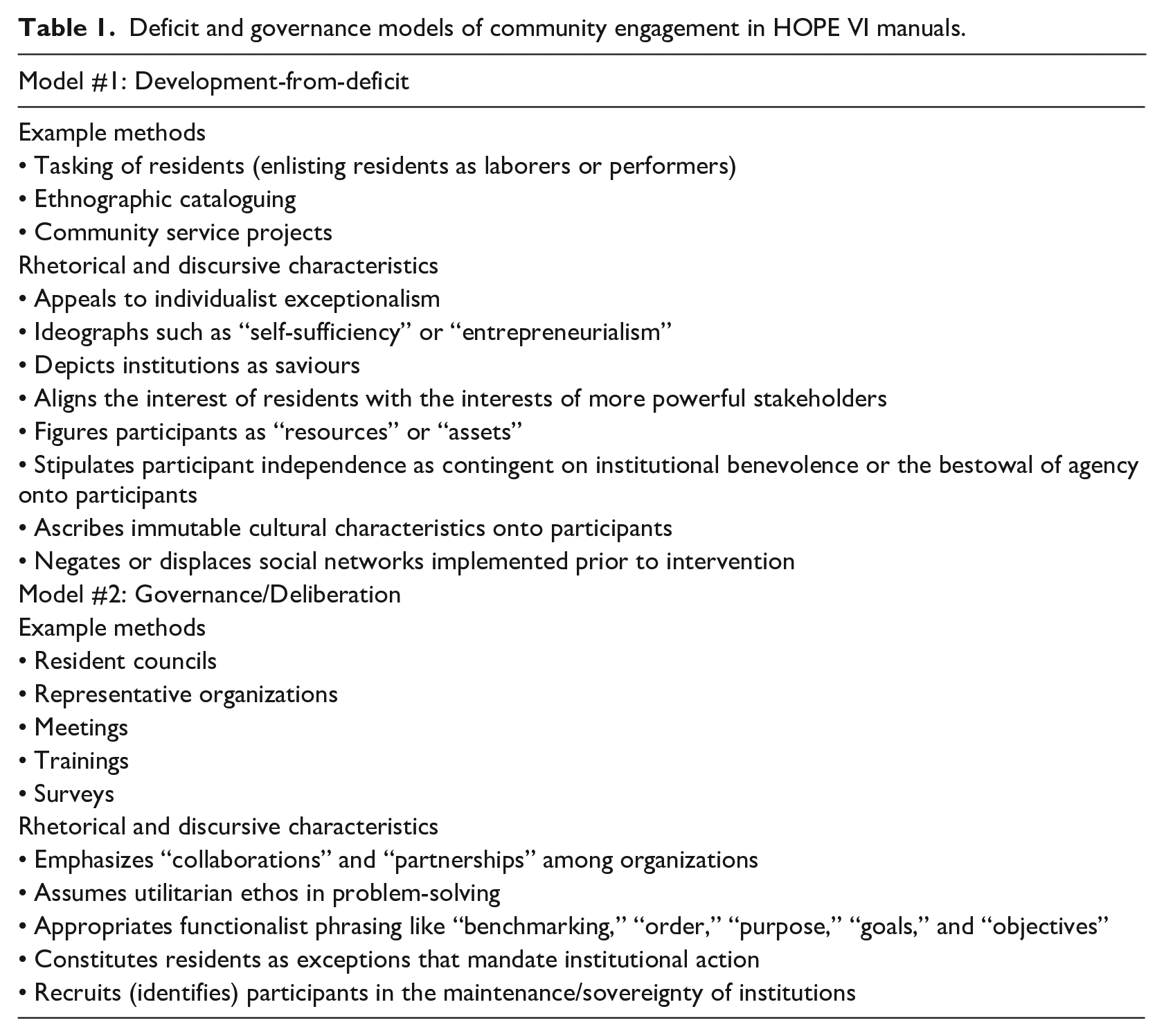
With racialized hierarchy in mind, calls to participate promulgate the “fetish of transparency,” or the idea that each individual is capable of achieving a standard ontological position centered upon agency (Northover, 2012: 68). The concept of agency itself, however, is bound up with non-agency; and, appeals to a universal (or transparent) agency legitimate hierarchical social structures, setting the stage for institutional, racialized exploitation. Definitions and exercises of agency often rely on renderings of what agency is not. In applications of power within socially stratified contexts, one kind of (empowered) subject is figured as a fully functional social “ideal” while at the same time a non-subject (in need of empowerment) is figured as a dysfunctional social “aberration.” Regarding racial formation in the U.S., Hartman (1997: 82) contends that the criminalization and stigmatization of Black agency allows the state to “obfuscat[e] its instrumental role in terror by projecting all culpability and wrongdoing onto the [formally] enslaved.” Linkages between raciality and power, between participation and influence reflect how, for racialized institutions like U.S. federal housing, “states of violence and poverty would be explained by the irrationality of the resisters of the life of freedom, by the unreasonableness of the colonized mind, or by the idiosyncratic immoral or irresponsible nature of persons unfortunately stricken by aberrations” (Northover, 2012: 75). Consequently, immorality, irrationality, and lack of social fitness are discursive strategies steeped in raciality, or broadly, “signifiers of racial and cultural difference” (Silva, 2009: 219). Such signifiers are invoked to justify state violence and population management such as the segregationist housing policies that preceded public housing crises and broader shifts to neoliberal programs like HOPE VI that ultimately relied on tropes and visions of aberrant, Black criminality. Consequently, calls for the subaltern or the aberrant to participate have the potential to lay culpability for violence and poverty not with the state for exclusionary or exploitative policies but with the subaltern for being at a naturalized ontological deficit. Emphasis on the deficit of marginalized groups potentially obscures the role of organizational, institutional, and policy actions that create and sustain inequality.
In the case of HOPE VI, the state’s claim of provisioning tools “of empowerment” for instance, presupposes a universality, an abstract equality, that positions the racial Other as naturally lacking, “that the targets of the development project [e.g. poverty, crime] resulted from certain peoples’ and places’ natural incapacity to move forward on their own” (Silva, 2015: 36). This rhetoric of development, reflective of idealized notions of agency and Self-Determination, “writes the ‘others of Europe’s’ failure to achieve human beings’ highest vocation because of how the laws of nature prevent them from even contemplating the highest principles and values according to universal reason” (Silva, 2015: 35); in other words, the rhetoric of development in this regard states to the subaltern, since you are incapable of achieving on your own, the state or institution will do it for you, to you, or on your behalf. Participation is one such statement expressed at the levels of discourse and organizational methodology in HOPE VI. In the following sections, I present my analysis of the HOPE VI manuals. First, I articulate the discursive elements of the deficit model of development. I show how HOPE VI appealed to themes of self-sufficiency and “assets” to justify its institutional intervention. Next, I describe the governance model of development as it appears in the practices and discourses of HOPE VI. The governance model reformulated top-down hierarchical methods as “participatory” by emphasizing representative forms of deliberation like resident councils that relied on appeals to exceptionalism. Both models are instances of participatory capture that demonstrate how power, raciality, and organizational communication influence contested policy outcomes.
Self-sufficiency, cultural deficit, and assets
HUD’s discourse minimized the contentiousness of its relationship to public housing residents. The department’s goal was to displace undesirable residents and to privilege the ones that conformed to HOPE VI’s institutional mandates. This dynamic inherently pits residents against developers. This oppositional relation, though, stems from persistent anti-poor, antiblack public policies. As a result, “the attitudes of the poor toward municipal authorities are. . .rooted in deeper histories, tied to community power relations linked to class, race, and gender inequities that long predate anything known as HOPE VI but still help to condition its reception” (Vale, 2009: 33). HUD sought to increase its organizational and programmatic control by implementing a development-from-deficit participatory model that signaled participation but configured residents as unworthy of determining their own physical communities.
In legitimating this model, HOPE VI’s community-building manuals stressed entrepreneurialism, once more obscuring the larger, deliberate market forces and public policies that were central to the formation of segregated neighborhoods. Not surprisingly, the rhetoric of these documents further suggests that “enhanced and broadened participation can sometimes lead to genuine power sharing, but sometimes may yield little more than an illusion of inclusion, masking the increased domination of private economic actors” (Vale, 2009: 42). HOPE VI claimed harsh budgetary environments as the impetus to rely more on the private sector and on residents themselves, who HOPE VI rhetorically positioned as “resources.” Community Building Makes a Difference opens with the statement that, “Declining Federal housing subsidies and the advent of welfare reform are bringing dramatic changes to the funding environment for public housing.” The document continues, “As traditional sources of revenue diminish, public housing managers are re-examining a previously little-used resource: the energy and efforts of residents of public housing themselves” (HUD, 2000: 1). Self-reliance was one of HOPE VI’s core political values. For HOPE VI, the goal of self-sufficiency was, “to provide residents in [low-income] areas with the opportunity to learn and acquire the skills needed to achieve self-sufficiency.” Another related goal was “community sweat equity—to instill in these Americans the belief that with economic self-sufficiency comes an obligation to self-responsibility and giving back to one’s community” (HUD, 2000: v). On the surface, HUD’s discourse strategies implied a reduced role for institutions.
After all, community building was framed as “predicated on the idea that residents must take control of their destiny and the destiny of their communities” (HUD, 1997: v). HUD wrote that community building was “built on efforts to help residents take on new responsibilities, make new connections with the larger community, get and retain jobs, start their own profitable businesses, and even own their own homes” (HUD, 1997: vi). Additionally, in referencing the budgetary environment, the authors of Community Building Makes a Difference wrote that, “Today’s changing policy environment is causing public housing managers to seek new ways to accomplish the traditional goals of providing decent, low-cost housing and helping residents to move toward independence” (HUD, 2000: 7). With these comments, it seems that HUD supported the self-determination of communities and signaled support for economic and cultural independence. However, both comments suggest that community building refers more strongly to individual assimilation into desired institutional contexts rather than to communal independence from institutionalist economic planning. The result of this reference is a subtle rhetorical effect that asserts two messages: the first is that individual success/freedom depends on institutional intervention, such that the individual must act in accordance with institutionalist mandates in order to achieve a level of apparent independence; and, the second is that, because the institutionalist aims are set in opposition to the community (which is configured a priori as deficient), the immutable characteristics of the community are to be blamed for any failures. With this strategy, HOPE VI encouraged a deficit model of development—one that figured residents as blameworthy for their communities’ ills.
At the same time, the program’s participatory mandate was justified with the argument that the residents could take care of themselves, with the condition, of course, that residents meet the appropriate requirements that not only enabled institutional sanction but also reduced institutional accountability. Along those lines, according to legal scholar Perrone (2017: 7), “A basic premise of neoliberal governmentality is that investors need to be blind to the social consequences of their actions.” In the state-aided privatization schemes of neoliberalism, accountability is implied and prefigured almost to the point of being nonexistent or imperceptible. Accordingly, low-income residents must be made to be at a deficit, both materially and ontologically, as seen in the discourse of HOPE VI, a regime that operated under a diminished accountability that was central to its function. The purpose of HOPE VI was to make the “hand” of the state as invisible as that of the market; and, to achieve these aims, accountability had to be diffused away from the state and, discursively, onto the mostly Black residents whose purported deficiencies mandated state intervention from the start. From that vantage, the development-from-deficit model persisted in representing institutional action as a savior for an incompetent, deficient population, with HUD arguing that, “Public housing communities can become effective training grounds and launching pads for underprivileged or marginalized citizens who want to become self-sufficient and a catalyst for the revitalization of the larger neighborhood” (HUD, 2000: 61).
In gesturing toward participatory capture, critics see the discursive iteration of “community” as particularly debilitating to marginalized groups, because such appeals limit the agency of those deemed community members, at the same time that it makes certain “kinds” of people visible within an institutional purview. Williams (2004: 561) argues that the reliance on narratives of “community” represents an “uncritical celebration” in participatory development. Moreover, in that respect, “the danger here is that what are often arbitrary divisions of space are naturalized, and the power effects of these divisions are ignored. Those who don’t fit into easily demarcated and territorial ‘communities’ can all too easily fall foul of visions of development, participatory or otherwise” (Williams, 2004: 561). Mohan and Stokke (2000: 254) concur, saying, “instead of romanticizing the role of local civil society in development theory and practice, we need to examine the political use of ‘the local’ by various actors.” At issue, then, are the ways in which “community” formulates certain locales and groups of people into monolithic states of exception that legitimate institutional actions, even when (and often because) those actions bring about negative material consequences for groups inhabiting certain spaces. Once more, in HOPE VI’s worldview, “‘communities’ are not merely given naturalized boundaries, they are also idealized in terms of their content. Social norms are seen as part of a ‘local culture’ for development programs to respond to, without necessarily unpacking that culture, or seeing it as the product of internalized power relationships” (Williams, 2004: 562). This constitutive function of participatory discourse—naming populations and bestowing the stigma of failure upon them—enables institutions to shirk accountability in how they (fail to effectively) collaborate with marginalized groups and places.
In relying on this constitutive function in its discourse, participatory capture naturalizes institutional action, by arguing either that certain communities need intervention and/or that their purported social failures result from natural, cultural deficiencies. These discourses impute institutional values onto both the subjects and audiences of such rhetorical appeals. In this regard, despite complexity (i.e. “the overlapping, shifting and subjective nature of ‘communities’ and the permeability of boundaries”), “The ‘community’ in participatory approaches to development is often conceptualized as some kind of natural, desirable social entity imbued with all sorts of desirable values and the simple manifestation of this in organizational form” (Cleaver, 1999: 603). At the same time, however, “Concepts of ‘the individual’ underlying participatory approaches swings widely between ‘rational choice’ and ‘social being’ models” (Cleaver, 1999: 600). Herein, accordingly, lies yet another paradox that marks the nature of exclusion/inclusion within participatory approaches and how they can lead to capture: cultures and communities are often deemed deficient based upon failure to enact individual rationality (i.e. agency). Thus, this lack of agency mandates institutionalist-statist intervention, construed as “participation.” Likewise, in participatory development, “Culture is variously perceived as a constraint. . .the ‘glue.’ which keeps the community together. . .and a resource to be tapped in development. . .It has already been seen how institutions are at once supposed to develop from weak ‘traditional’ forms to strong modern forms whilst at the same time remaining culturally embedded” (Cleaver, 1999: 604). In HOPE VI’s community building, low-income, Black communities were discursively and programmatically barred from the sovereign rationality and determinism of the state, even as they were enlisted to legitimate the state’s methods. Indeed, cultural deficit operated at a fixed position within the organization’s institutional, interventionist stratagem; this cultural fixedness is a pillar of participatory capture, because it constrains both voice and influence of the marginalized, especially when those most vulnerable are discursively and materially rendered as inferior or at a deficit.
The aspect that prevails in community building’s participatory rhetoric is that the residents altogether lack sovereignty, thus allowing for benevolent intervention on the parts of institutional stakeholders. In other words, the residents’ independence was contingent upon a forced, interventionist salvation that rewarded those who conformed to institutional imperative. The community building protocols advise facilitators to prioritize participation from better qualified residents. In this way, the program advocates a strain of individualist exceptionalism that reflects a more affective rendering of a racialized, neoliberal ethos. In a “Resident Involvement” sub-section of one of the manuals, the authors write, “Residents should be actively involved from the start in identifying the needs and priorities of the community and shaping and implementing the strategies for addressing them. Failure to include residents lengthens the process and quite often leads to lawsuits. The best people must be continually sought out and nurtured to fulfill this critical role” (HUD, 2000: 61). Extending from the belief that the “best” participants were those that reduced programmatic friction and confrontation with powerful stakeholders, the conflation of participation and expediency in HOPE VI’s approach suggests a structural misalignment between institutional objectives and communal potential.
Specifically, the language of national “assets” (i.e. the naming and identifying of “assets”) served a constitutive function, in that it allowed more powerful stakeholders to lay claim to exercising authority over a geographically chartered constituency. HUD argued that, “Residents of public housing could help stretch Federal dollars by assisting with such necessary programs as childhood disease immunization, tutoring and cleanup, along with tasks that might lead to permanent employment, such as routine repairs. . .or remodeling” (HUD, 2000: 21). HUD justified this “tasking” of residents by gesturing toward an innate productivity that was initially supposed to have been lacking. The Department wrote, “By linking self-sufficiency with responsibility to one’s community, HOPE VI opened the door to a previously unacknowledged and tragically underutilized asset of PHAs [public housing authorities] around the Nation” (HUD, 2000: 21). Moreover, based upon HUD’s deficit model and participatory capture, community building appeared to take the material and racial composition of neighborhoods as given rather than as the result of government policy. Thus, in the eyes of HOPE VI, communities were already fully formed as well as distinguished by immutable cultural characteristics. The language of assets facilitated the naturalization of this view.
Ultimately, HUD’s actual definition of community is not as telling as its ability to define what community means in justifying and conducting its policies. This ability to define communities—similar to what Foucault termed “governmentality”—allows institutions and organizations to define problems for a targeted group of people and also to define targeted groups of people as problems themselves. Foucault (2007: 108) defined governmentality as “the ensemble formed by the institutions, procedures, analyses, and reflections, calculations and tactics that allow the exercise of this very specific, albeit complex form of power, that has the population as its target.” HUD had as its target population low-income, Black residents of “bad” neighborhoods. From that perspective, “an evaluation of HOPE VI’s success depends largely on HUD’s definition of community” (Barlieb, 2007: 210). Often, HOPE VI managers defined community as the quality of a neighborhood’s physical area (property rates and crime reduction statistics, e.g.). Conversely, if HUD’s “community,” “refers to the residents themselves, then a [privatized redevelopment] model that results in the reduced availability of public housing is problematic. The HOPE VI project does not make a large portion of the ‘community’ any better off because the project serves only to displace its members” (Barlieb, 2007: 210). This displacement highlights another core (albeit paradoxical) element of participatory capture—by enlisting societally marginalized participants into a hegemonic, institutional endeavor, the organization undermines the preexisting collective bonds that allow for community resistance and identity. Not surprisingly, “Public housing communities are hotbeds of social and political activism, a characteristic attributable to an environment conducive to organizing. The propensity for activism is often born out of the shared circumstances and strong social ties among residents and is often fueled by the communication network” (Wolfson, 2005: 61). In contrast, HOPE VI neighborhoods, in particular, resulted in marked dislocation and splintering of local community ties, as a result of federal redevelopment. In HOPE VI, “thousands of public housing units were sacrificed and restrictive admissions policies fenced out would-be returnees—including friends and family. . ..Without showing sensitivity to racial composition, it is difficult to maintain powerful social networks that nurture successful communities” (Kost, 2012: 1412). Yet, in an instance of participatory capture, HUD’s discourse singled out the community social capital at the same time that the organization undermined the social capital’s legitimacy by using governmentality to delegitimate the integrity of what HUD defined as problem areas inhabited by problem subjects.
This ability to define spaces and people in need of intervention scaffolds the deficit model of governance. HUD relied on the criminalization and stigmatization of low-income, Black residents to legitimate its policies. HUD wrote, “The relationships created and nurtured by [existing low-income] community structures become a kind of social capital. . ..Community building initiatives that work do so by redirecting the energy of residents away from dependency and a victim mentality toward positive and constructive goals for the wider community” (HUD, 1997: 10). The distinction between dependency and constructiveness formalizes the deficit model—a before-and-after—whereupon the low-income, marginalized residents become more productive with institutional intervention, thus seeming to align the interest of residents with the interests of more powerful stakeholders. This alignment had the added effect of materializing the geospatial populace being called upon (i.e. translating the fungible into a body to be acted upon). The body that materialized in HOPE VI’s community building discourse was a body-at-risk that needed institutional rehabilitation—for HUD, the body of public housing was afflicted with (Black) crime and disease. The department argued that, “Health problems, especially chronic conditions, can be one of the biggest stumbling blocks to success, especially for minorities” (HUD, 1997: 23). Public housing residents suffered from “stress, smoking, poor nutritional habits, lack of access to healthcare, inadequate coping styles, and a general lack of health education” (HUD, 1997: 24). At the same time, the conditions for residents were said to have originated with the populace itself, further backing the deficit model. For instance, HUD argued that, “Exposure to violence both outside and inside the home has also been identified as both a health risk and a factor leading to long-term physical and emotional or behavioral problems that can form barriers to success” (HUD, 1997: 24). In invoking residents’ health and homes (i.e. their very social animation) as “barriers to success,” HUD implied that residents lacked agency and needed to be managed or sanctioned before they could achieve a fully formed agency. This implication is further underscored when HUD offers that, “Social epidemiologists have shown that social ties even have a measurable impact on health and longevity.” Yet, according to HOPE VI, public housing residents maintained “comparatively few social and community ties” and “face substantially greater risks of physical and mental illness and mortality” (HUD, 1997: 26). This biopolitical function narrowed the scope of what constituted “participation.” Having framed the residents within the deficit model, institutional stakeholders were better able to negate any modes of cooperation, democracy, resistance, and development practiced by residents prior to, or later against, intervention.
For HUD’s deficit model, community building meant that, “The residents of many public housing neighborhoods often have been isolated from each other and cut off from the larger community and its opportunities. They have been defined as dependent, passive recipients of services, subject to other people’s priorities. They have been at the mercy of many forces over which they have no control, such as poor maintenance, drugs, and other criminal activity—much of it the doing of outsiders” (HUD, 1997: 13). HUD offered also that, “Too often they have spent what collective energy they have mustered to work on obtaining basic services or fighting off terribly negative conditions in the ‘projects.’ These residents have lacked the means of creating the kind of social capital that binds families to one another and creates access to opportunities” (HUD, 1997: 13). This aspect of participatory capture is iterated in HOPE VI’s asset-driven orientation, with regard to what makes a community viable. HUD defined community or group assets as “all those material and human factors that constitute its often underutilized resources” (HUD, 1997: 14). HOPE VI’s use of the term “assets” encapsulates determinative ironies with respect to participation as flowing from institutionalist imperative. For one, the evaluation of assets functions to map the material value of a community from an interventionist viewpoint. What is deemed an asset to the interventionist becomes a liability to the resident, because the “asset” facilitates a divestiture of power—it reduces agency. In fact, the imperative “Begin each community’s strategy with an inventory of its assets” was among HUD’s “Successful community-building activities” (HUD, 1997: 14). These “underutilized resources” imply that residents themselves lack the capacity to “utilize” their own resources. Accordingly, the extent to which community resources actually function as resources appears limited in HOPE VI’s community building framework, illustrating once more how participation can become an organizational operation in capture.
Resident councils and rhetorical legitimation of participation
Participatory capture can occur when institutional, top-down directives inherently figure participation as a framework for reducing and eliding conflict among structural adversaries. HOPE VI’s community building heavily emphasized governance, or the coordination of stakeholders through official, formal organizations. In this regard, the discourse of participation allowed for the introduction and empowerment of myriad stakeholders, not just housing residents. Vale (2009: 24) calls this framework “constellation governance” and argues that HOPE VI’s structure lacked uniformity and instead represented a “constellations of forces,” which included “the housing authority, the housing market, the local political climate, the power of neighborhood groups, the strength of tenant advocacy organizations, and neighborhood experience with prior urban renewal efforts.” Resident councils were also a part of the governing constellation. While resident councils have become standard policy methods for engaging housing residents, HOPE VI’s organizational approach reveals that councils can be framed as participatory even as they work against its participants. In this section, I articulate the governance model, wherein more formalized organizational entities splintered the collective potential for resistance in favor of the federal government but not necessarily on behalf of the most vulnerable residents. HOPE VI’s community building relied on a static model of deliberation. On the surface, it appears that HUD embraced a representative system, wherein resident councils spoke for those living in the buildings or communities in question. While councils are common practice in housing development, HUD seemed to understand councils as a method mostly to reduce conflict and friction with (and not necessarily among) residents. The department’s utilitarian embrace of councils reflects the chronic, uneven distribution of power inherent in development, further troubling the efficacy of participation in such contexts. Moreover, vague, noncommittal discourse paid lip-service to proposed participatory ideals while still leaving in place hierarchical power dynamics that ultimately reduced democratic resistance to HUD’s housing developments.
In HOPE VI, HUD took the stance that, “Resident involvement is typically centered in an elected resident council” (HUD, 1997: 66). The department advised, “The housing agency should take steps to ensure that the resident council is truly representative of the community” (HUD, 1997: 66). Meanwhile, HUD required “that all affected residents be given reasonable notice of all meetings concerned with HOPE VI planning and implementation and that they be given adequate opportunities to offer input” (HUD, 1997: 66). Beyond the resident council, other methods of engagement, or what HUD termed “opportunities to participate,” included “holding open meetings, conducting resident surveys, and providing technical and leadership training to interested residents” (HUD, 1997: 66). Meetings, training, and surveys are standard methods for engaging stakeholders in planning processes. And, HUD mandated that public housing authorities consult with public housing residents in drafting their initial redevelopment proposals.
These consultations ideally took the form of “a resident training session and several public meetings” (Vale, 2009: 27). However, these requirements “remained vague, so actual practices varied quite a bit….[and] participation could often be rather rushed and limited, especially if a local tenant organization had leaders who were not broadly supported or well engaged with the full range of constituencies in the development” (Vale, 2009: 27). In this way, participation often became non-participatory, creating a crowding-out effect that amounted to something more akin to collusion among more powerful stakeholders. Likewise, HOPE VI embraced an antagonistic stance in which these planning engagements served to manage the risk of resident pushback and stakeholder conflict.
For example, HUD advised that “The housing authority must also help residents to contact a legal aid attorney and any other consultants they wish to have present at these meetings” (HUD, 1997: 66). Additionally, they advised “that residents get involved and line up technical advisors at the very beginning of the process so they will be prepared to grapple with and respond in an informed manner to each set of decisions that need to be made” (HUD, 1997: 66). At the same time, HUD maintained that decision-making capacity lay primarily, if not solely, with more powerful stakeholders. The department wrote, “The housing authority has final decision-making authority regarding HOPE VI funds, but it is imperative for the sake of the ongoing relationship that the input and cooperation of residents be sought before any significant changes, such as demolition or major planning studies, are authorized” (HUD, 1997: 66). In referencing the temperamental nature of the “ongoing relationship,” HUD acknowledged the adversarial conditions among the process’s stakeholders. But, in perpetuating its institutionalist ethos, HUD iterates its preference for approved organizational action. Indeed, the prospect of agency among residents is what HOPE VI sought to avoid. In touting its training program, HUD suggested that “A leadership training program provider, such as a local community college or civic organization, may carry out the training program for resident representatives” (HUD, 1997: 66). The department also turns back to the resident council as the standard governance model, and offers that “Working together, the housing authority and the resident council should set both long- and short-term goals, with benchmarks for evaluating success. Resident leaders should strive for a sense of order and purpose at all meetings” (HUD, 1997: 66). This bias toward organizations and institutions reflects HOPE VI’s participatory capture, which privileged resident displacement in favor of representative voices amenable to HUD’s and developers’ priorities.
On this front, HOPE VI sought to manufacture the appearance of consent. In reference to its position on resident councils, HUD wrote that, “The resident council should build a new spirit of cooperation among all the residents and urge them to lay aside old disappointments and resentments and move forward to a new relationship with management” (HUD, 1997: 66). Once more, HUD openly acknowledged an adversarial relationship but turned to participation in seeking consent, concluding that, “Constantly bringing up old promises that were not kept…only gets in the way of new business and perpetuates negative feelings” (HUD, 1997: 66). In prioritizing resident councils, HOPE VI attempted to recruit participants to align with institutional agendas, further demonstrating that participatory methods and their attendant discourses maintain a precarious relation to capture. In participatory capture, participation is a rhetoric and methodization of sovereignty insofar as it seeks to preserve institutional means and logics. Foucault (2007: 99) comments that sovereignty is “not a matter of imposing a law. . .but of the disposition of things, that is to say, of employing tactics rather than laws, or, of as far as possible employing laws as tactics; arranging things so that this or that end may be achieved through a certain number of means.” In HOPE VI, HUD relied on the governance of resident councils in conjunction with rhetorical appeals to the inherent deficit of low-income Black residents to arrange development projects in ways that limited residents’ means of democratic resistance and community-building.
Meanwhile, if the sovereign is that which “decides on the exception,” as is commonly argued in critical analyses of state and legal power, participation can be construed also as maintaining sovereignty at the expense of a population constructed as or as part of the exception. For HOPE VI, the exception comprised the racialized dysfunction associated with low-income U.S. housing. While racialized hierarchy had become normalized in U.S. public policy and cultural discourse, the ideological persistence (and socioeconomic effects) of said hierarchy is often invoked to legitimate institutional intervention as was the case in HOPE VI. As previously mentioned, residents in U.S. low-income and public housing were constructed as threats or impurities that imperiled the national body and its juridical-civil order. In this respect, residents were the foundation for the state’s authority. As the exception legitimating HOPE VI, residents, their deficits, and their blighted, aberrant conditions constituted the federal government’s sovereignty, its raison d’état, and its “moment” to enact its housing agenda. Moreover, the liminal position of residents illustrates that, as a “borderline concept,” sovereignty can maintain a zero-sum effect, where in the case of the government and public housing residents, for example, one entity’s power is contingent upon the absence of power in another. Thus, participation can become capture by virtue of reification and reiteration of presuppositional hierarchies, often implemented through organizational and institutional discourse. Indeed, “participation” functions rhetorically and methodologically to govern subjects, and participation exemplifies the argument that power is proportional to its ability to conceal itself. Participation epitomizes this ability to hide, thereby signifying organizational discourse strategies that obscure their own power even as it claims to bestow power upon the otherwise “powerless.”
Conclusion
In this article, I’ve identified instances of participatory capture in the organizational discourse and programmatic approaches of the U.S. federal housing program called HOPE VI. Participatory capture manifested in two models of housing and economic development: deficit and governance. Deficit models rely on the purported inherent deficiencies in a particular culture or population, while the governance model in its reliance upon exceptionalism and representation, undermine collective resistance to antagonistic, institutional imperative. Both models are figured as participatory, though they can work against the interests of the most vulnerable participants, as occurred in HOPE VI. Indeed, HOPE VI’s community building approach often resulted in the dismantling of communities. In the context of HOPE VI, “community” served as the fulcrum of participatory capture by which institutional stakeholders were able to conflate participation and exclusion.
Participatory capture in development contexts is almost always (if not inherently) a racialized phenomenon. Economic development projects, particularly those that are in some way cross-cultural are often race-based; and, racial politics and racialized materiality undermine the efficacy of participation to the extent that universalism itself is understood as an instrument of antiblackness. In HOPE VI and subsequent similar approaches to housing development in the U.S., “tenants are not able to participate throughout the redevelopment process when they are relocated and never return to the development. In particular, the uncertainty over who will be invited back makes it particularly difficult for tenants to meaningfully contribute to the development plan” (Greene, 2008: 228). Given such power dynamics, postcolonial and racialized development assumes both a universal equality and a presupposed inhumanity of difference that legitimate the market’s efforts to assimilate the “inhuman” or “subhuman” as a means of enacting Anglo-American transnationality. This argument flows from the dilemma of race (as naturalized difference) as being determinative of equality (to be achieved). Historically, “the stipulation of abstract equality produces white entitlement and black subjection in its promulgation of formal equality [i.e. institutional and organizational policies of meritocratic equality]” (Hartman, 1997: 116). Given the persistence of antiblackness in Western institutionality, however, participatory policies and methods can be used to maintain social control.
Participatory approaches cannot override their contexts. In the United States, race (as defined legally and ontologically by property) has been arguably the central arbiter in the housing market and the government’s role in it. What iterative powers of raciality, then, does the state and its approved, aligned institutions invoke in recruiting their Others to take part in national projects? In what ways can surreptitious, methodical acknowledgments of exclusion on the part of institutions more effectively undermine resistance to hegemony than gratuitous, spectacular displays of legal, organizational, and institutional power? Analyzing participatory capture allows scholars and practitioners to consider these questions and how participation for marginalized populations can represent the threshold of Becoming and thereby legitimate any institutional action as long as the structure being participated in remains intact and strengthened. In this regard, understanding difference and exclusion as an always-already participation “allows us to see how racial and cultural differences have. . .been deployed to reconcile a conception of the universal (as encapsulated by the notion of humanity) with a notion of the particular (of difference as marked in bodies and spaces)” (Chakravartty and Silva, 2012: 370). In participatory capture, institutions and organizations call upon participants, with the dual, paradoxical assumptions that: (1) participants are outside of (or simply not of) the institution; and yet, (2) the institution maintains an inherent, active ability to exercise power over the (non)participant.
Footnotes
Funding
The author received no financial support for the research, authorship, and/or publication of this article.
