



Abstract
The proliferation of trolls may be one of the main reasons why democratic organizations fail to use social media to renew. The literature predominantly assimilates these trolls to psychologically deviant individuals. This article questions this individual-centric approach by suggesting that trolls may well be socially constructed organizational monsters. To investigate this phenomenon, for 2 years, we studied the interactions on a Facebook group between the leaders and members of a trade union. We identified three bi-directional effects at the heart of what we call the monstrification process: discording, disordering, and disgusting effects. The paper contributes to the troll and organizational monster literature by evidencing the four-stage process through which trolls are organizationally constructed as deviant online participants. Our work also adds to the democratic organization literature by metaphorically underlining actors’ emotional and moral distress caused by the dysfunctional encounter of offline and online democracy.
Keywords
Introduction
In recent years, Trump’s frenetic use of Twitter exemplified how democratic organizations can be challenged by social media (Gills et al., 2019). Mocked as the “world’s greatest troll” (Silver, 2015), Trump accrued many attributes of the technology-facilitated monster as he was perceived as morally disgusting, out of control and a creator of chaos. Democracy eventually became so threatened by his online behavior that he had to be expelled from the online public sphere. Paralleling this illustration, this article investigates how social media in democratic organizations can engender organizational monsters (Bloomfield and Vurdubakis, 1999; Thanem, 2006), understood as abnormally deviant individuals who threaten the organizational order.
Ironically, social media was initially considered to be more of a solution than a problem for existing democratic organizations (Dahlberg, 2011), defined as organizations where members “have some real control over organizational goal-setting and can thus ensure that their own goals (. . .) can be met” (Foley and Polanyi, 2006: 174). This new technology was expected to counteract the oligarchical tendencies of democratic organizations (Michels, 1915) by boosting transparency, accountability and access to information (Bruns, 2008; Shirky, 2011; Surowiecki, 2005) and by fostering mass participation through the removal of time and space constraints (Bennett and Segerberg, 2012; Vaast et al., 2017). However, empirical studies have dampened these hopes, suggesting that social media participation has largely failed to renew democratic organizations. Instead, it is commonly associated with online misbehavior, often referred to as “trolling.” Two main bodies of literature analyze trolling in democratic organizations, focusing either on the isolated individual misconduct or its study within the context of digital organizational democracy.
The literature addressing individual online misbehavior explores the potentially devastating effects of trolling, highlighting its detrimental impact on victims (Mandalaki and Pérezts, 2023) and the organizational climate (Ybarra et al., 2006). Though it aptly depicts trolls as monstrous (Thanem, 2006), this perspective reduces them to psychologically deviant individuals (Buckels et al., 2014). Hence, this narrow view overlooks how the specific context of existing democratic organizations can also contribute to participants’ monstrification.
By contrast, digital organizational democracy literature highlights how the misfit between social media and democratic organizations leads to online misbehavior and chaotic participation (Etter and Albu, 2021; Wilner et al., 2017). It suggests that the online and offline democratic spaces support so different processes, practices and labor divide across actors that their coexistence prove to be dysfunctional (Barros and Michaud, 2020; Bennett et al., 2018). Although it identifies various types of online-offline incompatibilities that trigger online misbehavior, this stream treats trolling mainly as a negative but marginal side effect of technical failure but still overlooks the chaos and emotional distress that it can engender. Overall, the literature on digital organizational democracy fails to account for trolls’ monstrosity.
Despite the contributions of these two literature streams, we still do not know how democratic organizations’ use of social media contributes to turning online participants into monstrous trolls. To fill this gap, we metaphorically elaborate on the concept of organizational monsters, defined as abnormally deviant individuals who threaten organizational order, whether internally or externally (Bloomfield and Vurdubakis, 1999; Thanem, 2011). Using this theoretical lens, we longitudinally explore
To do so, we focus on a labor union which created a Facebook group to modernize its democratic functioning during a collective bargaining process. Attracting roughly 12% of the union’s 40,000 members (about 5000 individuals), the group generated the equivalent of 2500 pages of discussion over nearly 2 years (from November 2014 to June 2016). As well as analyzing these Facebook posts, we conducted 35 face-to-face interviews and held 15 monthly meetings with managers of the Facebook group.
We identified different stages during which interactions between union leaders and online participants dramatically changed. Initially positive, the experience became seen on both sides as discordant, uncontrollable, and performed by morally deviant actors. We theorize these problematic interactions as a “monstrification” process (Cohen, 1996; Thanem, 2011), relying on three bi-directional effects: discording, disgusting and disordering. The monstrification of online participants into trolls was indeed paralleled by an equivalent transformation of union leadership into a Leviathan-like figure, recalling the Hobbesian monster endowed with absolute power. The monstrification process ended when the union leaders reacted by banning the “trolls.”
This article advances the literature on trolls, organizational monsters, and digital organizational democracy. It sheds new light on internet trolls, commonly viewed as inherently malicious individuals, by highlighting how they are organizationally constructed as deviant participants. Our research also extends the organizational monster literature by theorizing the stages of the “monstrification” process and by defining it as a bi-directional phenomenon. Finally, it contributes to the literature on digital organizational democracy by metaphorically suggesting that the dysfunctional juxtaposition of online and offline democracy may be much more than a mere technical issue and could generate deep emotional distress including moral disgust and fear.
Trolls in democratic organizations: Individual and organizational perspectives
Two lines of research illuminate “trolls” in the context of democratic organizations’ use of social media. The first explores the individual determinants and outcomes of trolling as online misbehavior. The second, through an organizational lens, identifies three types of incompatibility between online and offline democracy that could prompt online misbehavior.
Trolls as monstrously deviant individuals
The growing body of work on trolls primarily focuses on the individual causes and consequences of online misbehavior.
Trolling is commonly defined as anti-social behavior aimed at inciting emotional reactions and derailing discussions in online communities (Sun and Shen, 2021). This form of online misbehavior, marked by crude language and inflammatory tone, could manifest in any organization, be it commercial (Golf-Papez and Veer, 2017), political (Forestal, 2017) or social movement (Saka, 2018). Like monsters (Bloomfield and Vurdubakis, 2006), trolls clearly infringe the acceptable social norms of online communities. By seeking to create chaos and to disrupt online interactions, trolls offer a striking parallel to monsters who, according to Cohen (1996), are notoriously associated with times of crisis.
The literature underscores that the consequences of trolling are far from benign. Mandalaki and Pérezts (2023) conducted an in-depth examination of how traumatic the trolling experience can be for victims. Other studies have noted potential emotional distress and physical ailments associated with online misbehavior (Hinduja and Patchin, 2007). On a collective level, trolling can alter the dynamics of an online community (Ybarra et al., 2006). Following Mittman (2017), who stated that “the monster is known through its effect, its impact” (p. 14), the consequences of trolling also invite us to classify trolls as monsters (Thanem, 2006).
Concerning the causes of trolling, most existing research has focused on individual determinants. Buckels et al. (2014) link trolling to individual pathologies like sadism and psychopathy. Further research associates these deviant online behaviors with boredom, as trolling may be motivated by the desire for fun (Bishop, 2014). Other studies reveal that individual mood and the existence of prior online misbehavior can further encourage trolling practices (Cheng et al., 2017).
Overall, the literature encourages us to view trolls as a distinct type of organizational monsters (Thanem, 2011), as their attributed characteristics and consequences lead us to regard them as deviant individuals who threaten the existing organizational order. However, this body of research largely approaches trolling as an individual rather than a collective phenomenon. This decontextualized approach therefore fails to explain how the interaction between organizational democracy and social media may contribute to this phenomenon. As such, it is of limited help in understanding the proliferation of trolling when democratic organizations adopt social media.
Three incompatibilities between social media and democratic organizations which lead to online misbehavior
The digital organizational democracy literature evidences three types of incompatibility between online and offline democracy, in terms of processes, actors, and practices. This literature then highlights how these problematic online-offline interactions can aggravate the proliferation of online misbehavior and contribute to disrupt pre-existing forms of democracy (Etter and Albu, 2021; Wilner et al., 2017).
Processes incompatibility
Democratic processes refer to the series of actions undertaken to ensure members’ effective involvement in collective decision-making and oversight. The literature suggests significant differences between the often-ritualized offline processes of existing democratic organizations and the new algorithm-driven democratic processes on social media (Fuchs, 2014). Existing democratic organizations are generally characterized by ordered debate (Diefenbach, 2019) and bureaucratic stability and usually entails a level of secrecy, as members delegate power to a limited number of elected experts (Diefenbach, 2019; Pek, 2019). Social media participation, however, is primarily associated with more emergent and participatory democratic processes (Chadwick, 2009) characterized by openness and transparency (Husted and Plesner, 2017). Nonetheless, Milan (2015) suggests that social media algorithms are not primarily designed to encourage constructive democratic participation, empowerment or social justice. Instead, the architecture of social media is conceived to serve companies’ financial interests and their orientation toward advertising (Etter and Albu, 2021).
Actor incompatibility
Two main types of actors are generally distinguished in representative democratic organizations: the members, whose role notably involves choosing their representatives, controlling and validating their action, and taking part to collective-decision making; and the representatives (leaders), whose role notably involves to implement the decisions taken collectively and to represent the organization to its stakeholders. Social media participation seriously affects how leaders and members traditionally enact their roles in democratic organizations (Pasquier et al., 2020).
Digital democracy seriously recast the traditional expertise-based leadership (Diefenbach, 2019) making it oscillate between two extremes. In some cases, social media encourages the emergence of “soft” leaders (Gerbaudo, 2012; Tufekci, 2017) whose role is to act behind the scenes to foster individual expression and coordinate collective action. In others, social media favors the advent of stronger and more populist forms of leadership (Gustafsson and Weinryb, 2020; Pasquier et al., 2023). For example, new and technology-intensive political parties tend to be ruled by “hyperleaders,” as digital technologies encourage the personification and the disintermediation of democratic organizations (Gerbaudo, 2019).
As the role of leaders evolves online, so does the role of lay members. Social media would foster “networked individualism” (Gustafsson and Weinryb, 2020) which leads online participants to challenge their leaders’ legitimacy (Bekkers et al., 2011) by demanding full recognition and voice (Castelló et al., 2016). Barros and Michaud (2020), for instance, show how the democratic degeneration of a consumer coop led members to use social media to criticize and deconstruct the organization’s governance from the margins.
Practice incompatibility
Democratic practices refer to micro-level actions through which collective participation is concretely enacted and regulated. Some authors suggest that social media participation is fundamentally at odds with pre-existing offline democratic practices. They describe social media discussions as being polluted by aggressiveness, mainly because of anonymity (Janssen and Kies, 2005) and frustrations when participation does not generate immediate results (Bryer, 2011). The commercial imperative guiding social media also favors brief and over-emotionalized forms of interaction (Tufekci, 2017) and the prevalence of misinformation can further undermine the quality of debate (Kermer and Nijmeijer, 2020; Hennebert et al., 2021). These distinct democratic practices are related to the variable capacity to regulate participation. Whereas the bureaucratic rules of existing democracies help to regulate the length, tone, and order of democratic participation (Rothschild-Whitt, 1979), social media deprives democratic organizations of most of these regulatory techniques (Halpern and Gibbs, 2013).
Overall, this stream identifies three levels of incompatibility between online and pre-existing offline democracies which prevent social media from delivering the initial promise of renewed and flatter democracy. However, this literature regards these incompatibilities as mere technical failures. “Trolling” – considered as a marginal side effect – is at best quickly evoked.
From this literature review, we conclude that research on online misbehavior highlights the monstrous nature of trolling but overlooks how digital democratic organizations may contribute to engender it. Conversely, digital organizational democracy literature portrays social media use by democratic organizations as problematic, yet misses to evidence the monstrous behaviors it may lead to (Gustafsson and Weinryb, 2020; Janssen and Kies, 2005; Lundgaard and Etter, 2023). Hence, in the continuation of Thanem’s work (2006), we aim to analyze how monsters are socially and organizationally constructed in the specific context of digital organizational democracy. More precisely, we propose to study
Research setting
Our research focuses on a Canadian labor union which represents 40,000 blue-collar public administration workers – mainly secretarial staff and technicians. The union’s democratic model is indirect and relatively centralized, as described by a staff member:
There is a cultural gap between the 1,800 people involved in the union structure and the remaining 40,000 members. It is normal to have such an organizational structure. But it is somewhat disconnected from the reality of the shop floor.
In late 2014, due to a perceived distance from their base, the union leaders created a Facebook group at the start of negotiations that would determine members’ pay and working conditions for the next 5 years. The bargaining process lasted almost 2 years, ending in June 2016.
Facebook groups operate as forums where participants post content and react to posts by “liking” them or adding comments. In our case, the union adopted a “closed” Facebook group restricted to union members, with individuals having to request and be approved for group membership.
A community manager was hired to moderate the Facebook group, provide information, and answer members’ questions. A “netiquette” established the code of conduct for the group and served as moderation guidelines. The moderation was to be as loose as possible so as not to contradict the democratic ethos of the organization or the spirit of social media. According to one regional executive:
The idea is not to exert censorship. There will always be pros and cons. The union’s ethos is based on this. You are for or against. If you’re against, it’s ok. Members have the right to say if they are for or against.
The union served as an ideal representative case study (Yin, 2017) for three reasons: its centralized and democratic functioning was typical of most organizational democracies (Voss and Sherman, 2000); the online misbehavior observed was consistent with patterns found in other democratic organizations (Barros and Michaud, 2020); and our timely and privileged access to data, facilitated by our main contact, the chief of staff, made it an ideal choice.
Methodology
We conducted a process study (Langley, 1999) to explore how trolls emerge from the interactions between offline and online democratic processes. As monsters are primarily a matter of perception (Cohen, 1996; Thanem, 2006), we longitudinally explored how union leaders and online participants perceived the online–offline interactions.
Data collection
We collected three types of data: interview transcripts, observational notes, and Facebook group interactions.
Interviews
We conducted 35 face-to-face interviews in November 2015 and September 2016 (i.e. at the middle and end of the collective bargaining process). These included 25 union leaders (12 of whom were staff members) and 10 online participants (see Table 1). The semi-structured interviews lasted around 75 minutes and were recorded and transcribed with the consent of interviewees. They centered on three main areas: the interviewees’ background; their perception of the discussion on Facebook; and their perception of the main changes brought about by this form of social media.
Participant observation
We had 15 meetings with the chief of staff and the community manager (around one per month during our data collection period). Each meeting, in which we took copious notes, lasted about an hour. The meetings helped us understand the context of the union’s democratic process and the leaders’ actions and perceptions. Indeed, both the chief of staff and community manager were working daily with national union leaders.
Facebook interactions
We downloaded all the messages posted on the Facebook group and their associated comments and “likes.” Within these, we distinguished between messages posted by union leaders (326) and by online participants (3307). This information enabled us to corroborate and expand our analysis of interviews and to better contextualize responders’ perception.
Data analysis
Our analysis strategy consisted of three stages, as proposed by Langley (1999).
Stage 1: Distinguishing the different phases
We applied a “temporal bracketing” logic to construct a detailed timeline, identifying four periods in the development of the online–offline democratic process. These periods - “negotiating,” “waiting,” “deliberating” and “implementing” - corresponded to distinct phases in the union’s democratic decision-making. We confirmed this sequencing through both quantitative and qualitative analysis of Facebook participation and then analyzed the leaders’ and online participants’ perceptions.
Stage 2: Abductively elaborating an analytical framework
We abductively constructed an analytical framework to study actors’ perceptions across the four phases. Some analytical categories emerged during the initial months of our study. Then, when the union suddenly faced a democratic crisis, the monster metaphor appeared to be a promising “intuition” (Tsoukas, 1991) to make sense of the situation. Exploration of the academic literature confirmed the potential for the metaphor as a powerful second-order construct for this case (Cornelissen et al., 2008). By refining our initial analytical framework thanks to literature, we identified three types of perceptions central to the monstrification process: harmony between the offline and online processes; moral integrity of the actors; and controllability of the democratic participation. Finally, we analyzed the data in order to identify the actors’ perceptions alongside these three categories.
Stage 3: Analysing the perceptions of leaders and online participants
Leaders’ perceptions
We analyzed the leaders’ perceptions primarily by coding their interviews, their Facebook messages and our observation notes (see Table 2). This task was performed by the first author, with the other authors helping to check and refine the analysis.
First, we analyzed the leaders’ perceptions of harmony between online and offline processes. We coded this as “harmonious” when they considered that social media participation positively complemented the existing offline democratic process and as “disharmonious” when they reported that it negatively affected or even disrupted the existing offline process.
Second, we identified leaders’ perceptions of the online participants’ moral integrity in terms of their perceived respect for representative democratic principles. We coded this as “correct” or “deviant,” respectively, when leaders considered online participants to be adhering to or violating the union’s democratic principles.
Third, we considered the leaders’ perceived need for and ability to effectively control social media participation. We coded this as “unproblematic” if no active regulation was deemed necessary and as “problematic” when leaders perceived a need for strong ruling. We additionally paid particular attention to the following forms of online regulating: “creating rules” (e.g. creating a netiquette); “discussing” (e.g. by engaging with protesters); “removing messages”; and “banning members.”
Online participants’ perceptions
We analyzed online participants’ perceptions mainly by using their Facebook messages, corroborated with interviews. To focus on the most impactful messages, we formed a sample consisting of the posts with the most likes or comments. This sample was generated by calculating an “engagement indicator,” using the number of “likes” and twice the number of comments (Poell et al., 2016). Then, the first author coded the top 20% of messages in each phase in terms of engagement. In the end, our sample comprised 687 messages, which had generated 60% of all engagement in the group (see Table 3).
Using this sample, we analyzed the online participants’ perceptions as follows.
First, we analyzed participants’ perceptions of the harmony between online and offline democratic processes. Messages were coded as “favorable,” “disfavorable,” or “neutral” based on their stance toward the union, considering tone, language and context.
Second, we coded how online participants perceived union leaders’ moral integrity (either correct or deviant) based on the characteristics attributed to the leaders and the adjectives used to describe them. We also used other types of references such as “we”/ “they” to gage members’ proximity to their leaders.
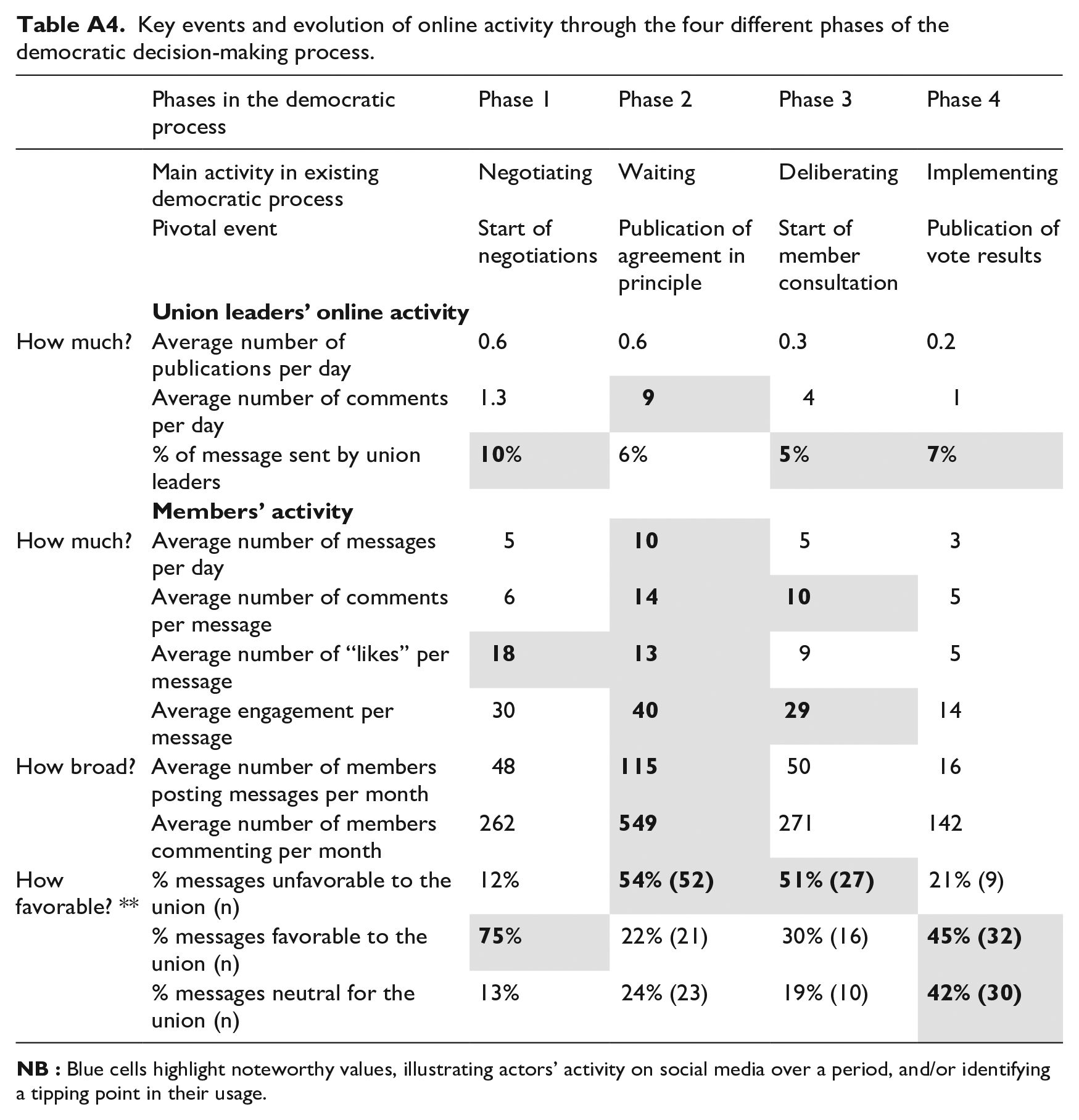
Third, we analyzed online participants’ perceived ability to regulate the union process. We classified this as “problematic” or “unproblematic” by elaborating on the view of Klandermans and Oegema (1987) that people are more willing to participate when they feel they can influence decision-making. We thus considered the evolution of participation level (number of messages per day), breadth (number of unique members posting messages or commenting per month) and interactivity (number of “likes,” comments, and engagements per message) – see Table 4.
Findings
To understand how democratic organizations’ use of social media can engender organizational monsters, we next detail how union leaders and online participants perceived the online–offline assemblage through the four main phases of the union’s democratic process (see Figure 1).
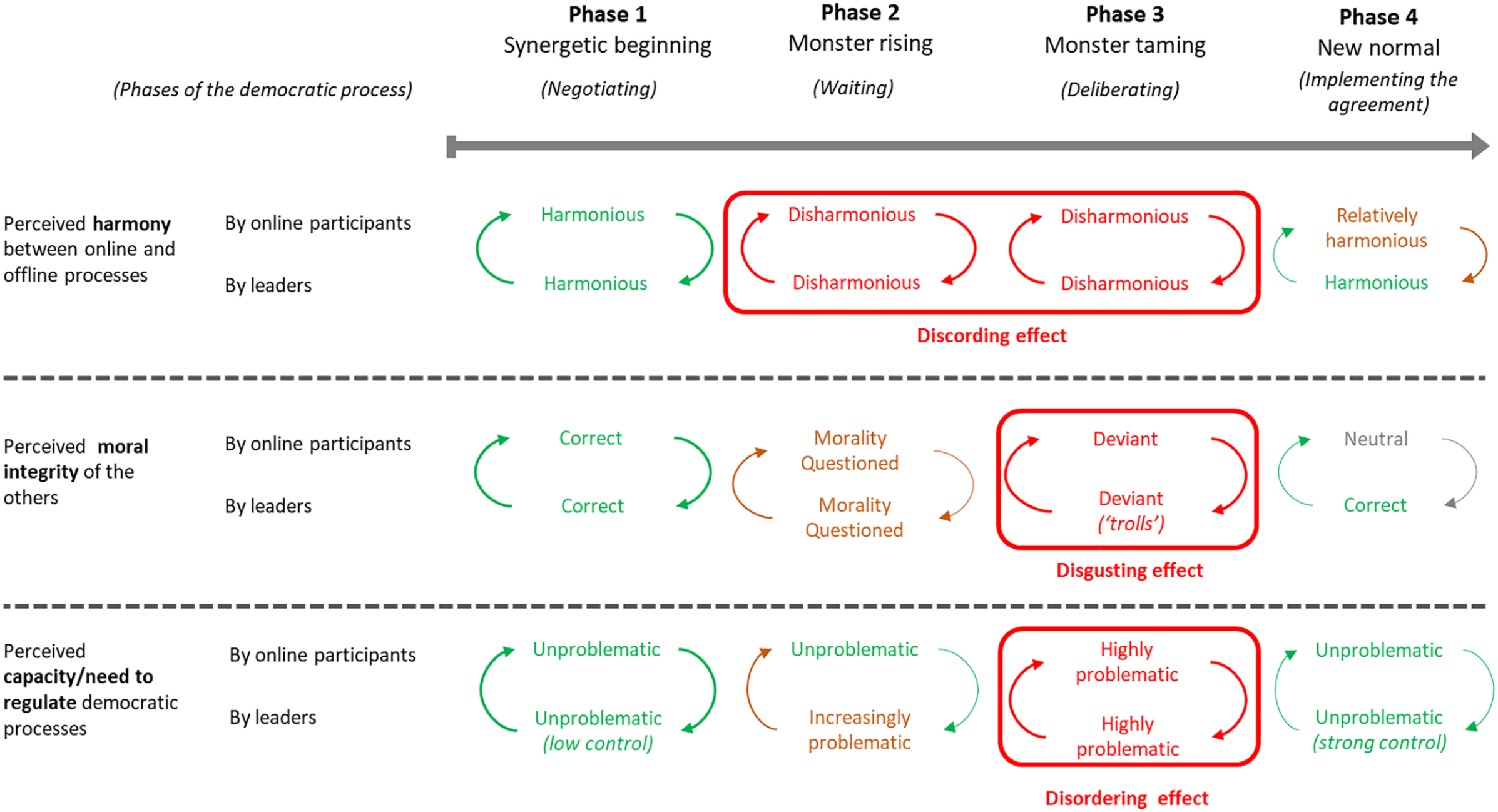
Synthesis of union leaders’ and online participants’ perceptions.
Phase 1: Synergetic beginning (November 2014 to December 2015)
Context of offline democratic process
In the first phase of the democratic process, the union’s focus was on the negotiations, which began in November 2014 and which simultaneously saw the launch of the Facebook group. At this point, the offline process mainly consisted in negotiating with the employer. Only a dozen actors, mainly union leaders, were actively involved. The first 10 months were relatively calm as the leaders wanted to demonstrate their goodwill toward the negotiations. But from autumn 2015, the union held five non-consecutive days of strikes to increase their bargaining power. These strikes were a key turning point for the union’s collective dynamic. As its activities moved from the negotiation table to the streets, members at all levels became actively engaged in the offline democratic process.
From the I sincerely want to congratulate the people who came from so many different and remote places to demonstrate in Montreal today. Together, we are going to do it, we have many ways to fight the government (. . .) and together we are capable of defeating Coiteux [Minister of Finance]. (Posted 5 October 2015)
During this “honeymoon” phase, online participants praised their leaders’ moral integrity, for actively representing and defending members’ interests. This was clearly demonstrated by most of the members’ Facebook discussions converging with the union leaders’ official discourse. Online participants often underlined leaders’ dedication and involvement in the negotiation process. One member expressed their trust in the union leadership as follows: In such a period we have to act strategically, and I think our union leaders are doing so brilliantly. They give their time without counting it. In the evenings, at weekends or lunchtime, if need be. (Posted 16 September 2015)
Lastly, the online participation showed no signs of needing to control the union’s offline actions. Members’ positive and growing contributions indicated their integration into the union’s practices. Facebook engagement surged over the first year, with the number of individual commenters increasing from 12 in November 2014 to 698 in November 2015.
They primarily viewed Facebook as a way to share news about the ongoing negotiations more quickly and accurately and to a broader audience – a significant improvement over their slow and often-criticized paper-based communications. It was also an efficient way for them to shape members’ views of the negotiations. About a quarter of the leaders’ messages aimed to shape members’ opinions by criticizing the employer’s policies or attitudes. They particularly praised the social platform’s unprecedented contribution on collective action days for enhancing togetherness feelings among geographically dispersed members. As one national leader said:
It helped members to get closer to the union. A strong feeling of belonging. When I go into a meeting, I might see someone and say, “that picture of you in your pyjamas in the office was really good.”
As online and offline processes were viewed as synergistically harmonious, union leaders naturally considered the online participants’ behavior as morally correct. They saw online participation as reflective of the attitudes commonly held by their lay members, believing that it accurately represented members’ broader opinions and feelings. A national leader stated:
(The union Facebook group) reflects what we have in our meetings; it reflects our world of workers. It’s not worse, it’s not better. I think it reflects our people
Finally, the union leaders saw no need for further control of the overwhelmingly positive online democratic practices. However, they were irritated by the small but continuous flow of criticism (12% of messages were “unfavorable” to the union – see Table 4). Nevertheless, they gradually learned to cope with this slight perception of uncontrollability and accept the criticism as part of the online democratic game. Only a few messages were considered too disrespectful and were removed. The union’s staff and executives were even more satisfied with the spontaneous self-regulation by online participants. As one national executive noted:
People self-regulate. At one point, a woman wrote on Facebook: “Miss Tremblay
1
[the interviewee] needs to get some balls.” And somebody answered: “You obviously don’t know her!” [Laughing] In the end, I didn’t even have to respond.
Overall, the leaders considered this loose regulation of the Facebook group to be unproblematic.
Phase 2: The monster rising (December 2015 to February 2016)
Context of offline democratic process
During the second phase, which began in mid-December 2015, the negotiators reached an agreement in principle (referred to hereafter as “the agreement”). However, because labor law requires an agreement to be validated by a majority of union members, the union had to consult its membership.
The second phase of the offline process therefore consisted of a 6-week “waiting period” between the announcement of the agreement in principle (mid-December 2015) and the beginning of the consultation (early February 2016). This was necessary to organize the logistics of this province-wide deliberation process. After a first “euphoric” period, the leaders now expected them to wait patiently for the deliberation phase to begin.
For
After the euphoria, there was a kind of multiplied disenchantment on Facebook. And, as the Christmas holidays started around then. . .well, people had lots of time.
As a first sign of monstrosity, the democratic process on Facebook increasingly signaled disharmony with the offline negotiation process. The online discussion became a polarized political debate, which generated long and often acrimonious discussions. For example, the average number of “likes” per message dropped from 18 to 13, while the average number of comments per message increased from 6 to 14. Unfavorable posts about the union increased from 12% to 54%, while favorable posts dropped from 75% to 22%. Most of the criticism related to the content of the agreement or the poor negotiation process: In the end, after reading the document several times, I am telling you this: vote against it as what they are offering us is a load of s***. (. . .) We are gaining nothing. In reality, we will only have a salary increase of 5.25% over 5 years. The rest is just giving back the money that we lost by striking. (Posted 24 December 2015)
One event indicated that this perception of disharmony was widespread among online participants. A few days before the consultation began, a member organized a Facebook poll to see whether online participants would accept the agreement. About 200 members participated, with nine out of 10 stating they would vote against it. The main reason for opposing the agreement was the perceived meager salary increase compared to the cost of going on strike, as illustrated by this post: COOOOOOOOL my salary will drop by –0.35% in 2019!!! Wonderful! Heyyyyyyyyyy bastards, we are not dumbasses!!!!! VOTE AGAINST, THIS MAKES NO SENSE!!!! (Posted 19 January 2016)
The online participants began to question the moral integrity of the union leaders. Dissenters regularly dismissed the leaders for trying to influence members’ opinion, being ineffective or for selfishly prioritizing their own interests as leaders. Although they did not mainly portray the leaders as morally disgusting actors yet, members of the Facebook group referred to them much more negatively than during the first period, as illustrated by the following message: I’m not angry just because I’m not getting a pay rise. It’s also because I realize that the government thinks I’m making too much money. (. . .). And because my union validates all this!!!! (Posted 19 January 2016)
Despite their disappointment, online participants did not yet view their leaders as monstrous or consider their ability to regulate existing democratic processes as problematic. As the sharp increase in messages (about 10 per day) and members commenting (about 549 per month) indicated, online participants felt they could influence the vote by sharing their views, often aggressively.
This radical change dramatically affected how
The leaders started to perceive disharmony between the online and offline democratic processes, fearing that Facebook would disrupt their existing and relatively well-organized offline democratic process. It had been intended that the deliberation phase, in the form of official consultation, would start in early February 2016, but this was unexpectedly sidelined by Facebook, which had become the focus for political discussion. Originally viewed as an addition to traditional processes, the now unbridled social media participation threatened to replace the traditionally controlled deliberation space.
The tone of online discussion also signaled a high risk that the agreement might be rejected. This created a potential danger not only for union democracy but also for the leaders, especially as union elections were approaching. The deluge of critical messages on Facebook reflected a highly negative image, which was deeply concerning for the union leaders. As one staff member expressed it:
Previously, there was strong criticism, but it was manageable. The union structure could stand it. But it no longer was during the critical phase.
With the online tone becoming much more virulent, union leaders began to view online participants as increasingly morally deviant. They felt that, through the growing wave of criticism, many online participants were infringing the norms of acceptable democratic participation:
Not only was the amount of online criticism hard to bear. . . the attacks on the union leaders and staff, and on people favourable to the agreement, were getting stronger. The attacks became really tough, and sometimes personal.
This second period was described as increasingly demanding for the union leaders, who were caught between feeling exasperated and threatened. The emotional impact of online participation on leaders clearly suggest that they were facing a type of online behavior akin to trolling:
Take the case of Claire [a national leader] who was on Facebook day and night, weekends included. She constantly faced negativity during that period. (. . .) She ended up being deeply harmed and resentful.
These signs of danger worried the leaders, who were increasingly afraid of losing control of the deliberations. There was a growing threat that their digital creature would escape their control and they felt an urgent need to regulate the Facebook participation. However, they were still reluctant to control it too directly, for example by removing messages, in order to respect the union’s democratic ethos. Only a few dozen messages were deleted during this second phase.
The communication department then opted to engage directly and calmly with online protesters to stem the tide of criticism. The daily number of comments posted by the community manager increased from one to nine to reason with online participants, as in the following message: In the end, it is the members who will decide whether or not the agreement in principle will be accepted during the consultation. (. . .). Our institution is truly democratic. (Posted 20 December 2015, by union staff member)
But even with this new mode of regulation, the moderators increasingly felt unable to control the dissent.
Phase 3: Taming the monster (February 2016 to April 2016)
In the third phase,
While it is done with humour, our union denounces the new Disney movie, which portrays civil servants as sloths. By doing so, they only strengthen clichés about public service workers who are dedicated to serving citizens. What do you think?
But instead of rallying opposition against Disney or public service-bashing, the post backfired, resulting in strong criticism against the union leaders for attempting diversion and lacking humor. From then on, the leaders felt they had lost control over the Facebook group, leading to a perception of facing monstrous online participants.
The disharmony between online and offline processes was exacerbated, with the threat of social media overshadowing the traditional deliberative process becoming more tangible than ever. As a leader explained:
At that moment, I noticed that the discussions were monopolized by a limited number of individuals who were not representative. (. . .) And this creates a real democratic issue.
The leaders’ perception of monstrosity was further fueled by the perception that they were facing morally deviant online participants. Three weeks after the Disney movie polemic, the first author received a panicked call from union staff members. Faced with relentless criticism on the Facebook group, leaders began to feel exasperated and threatened. Some withdrew from the group to protect themselves and there were serious considerations of shutting it down. They described the community manager’s mood as particularly worrying due to the amount of harsh criticism he had to deal with. A prominent leader was reported to be “disgusted” by the ongoing harsh criticism, seeing no “added value” in the group. Reflecting on that period, another national leader added that the tsunami of criticism had “deeply and fundamentally hurt union executives.” Their emotional state resembled those faced with online trolling behavior, and they no longer just questioned the online participants’ integrity but outright dismissed them for disrespectfully violating the norms of representative democracy. Interestingly, the union leaders began referring to the critical members as “trolls” who were “massively invading” social media during this third phase.
Facing an increasingly disharmonious and morally disgusting phenomenon, the union leaders sought to regain control over the group. Previous efforts to reason with dissenters had backfired, only feeding the so-called “trolls.” Much like Dr. Frankenstein’s creation, the digital entity was slipping out of its creators’ control. Though the leaders considered shutting down the group, they concluded that it wasn’t viable. Such a move might have inflamed tensions further and been seen as censorship, potentially driving dissent to an unofficial group where the union would have no control. As one staff member said:
If we look at it objectively, the main reason we’re keeping the group open is because we have no option, because Facebook is here and because we cannot get around it.
Unable to rid the Facebook group of its monstrous participants, the union leaders sought to contain the situation by establishing firmer boundaries. They strictly enforced netiquette rules and implemented a clear expulsion policy, leading to the deletion of around a 100 posts and comments and the banning of 29 members. Thus far, leaders considered that banning online participants was incompatible with the union’s democratic principles of inclusiveness. However, faced with a disharmonious, uncontrollable and immoral phenomenon, they felt it was acceptable to delete messages and expel “monstrous” members. However, the leaders’ perception of not being in control remained palpable: Facebook is like an assembly without any rules or time control. And our ability to regulate it is too limited. Facebook is probably not adapted for such a large audience. (Monthly meeting, February 2016)
Although From what I have seen and heard, national and local executives are selling the agreement (during offline meetings). Where is the impartiality here? You should only be presenting the offer and answering the question. Speeches like “you should take the agreement” should not be allowed! Thank you. (Posted 5 February 2016)
Online participants were now more openly questioning their leaders’ moral integrity. Echoing the disgust the leaders felt toward the “trolls,” they perceived that their representatives were violating the norms of “good” democratic leadership by being manipulative and oligarchical. Leaders’ attempts to influence members’ vote during the offline deliberative session were regularly condemned for breaking the democratic moral contract: At my meeting, they tried to make me believe that this was a wonderful offer. I wasn’t born yesterday. I don’t speak up often, but enough is enough. I’m tired of being taken for a fool. (Posted 2 February 2016)
Many opposed the new Facebook regulation policy, which they saw as an arbitrary practice to protect the union leaders’ interests: That’s it, go ahead and censor our comments. You can’t handle the truth. You’re pathetic. (Posted 7 April 2016)
Others bluntly expressed their disapprobation toward the morally questionable attitude of the union leaders throughout the whole democratic process: Well, in addition to getting screwed over by the government, we’re getting screwed over by our own union as well. . . Not cool. . . (Posted 15 March 2016)
Finally, leaders’ monstrosity was fed by the online participants’ perception that the offline democratic deliberation process was escaping their control, as indicated by the declining participation on Facebook. Compared with the previous phase, the daily number of posts halved (from 10 to 5). Only 271 members got involved in the discussion each month compared to 549 in the previous period. The following post is an example of online participants’ perception of powerlessness: It was obvious that the new collective agreement would be accepted and that the voting process was just a mandatory but fake democratic exercise. (Posted 4 April 2016)
The first – a disgusting effect – was created by the reciprocal perception that each side was facing morally deviant actors (Jones and Fitness, 2008). This effect acted as a two-way distorting mirror: online participants viewed the leaders as manipulative and self-serving oligarchs, akin to monsters, while the leaders perceived the online participants as troll-like in their obstinacy.
The second effect – a disordering effect – closed the monstrous vicious-circle loop through the reciprocal perception of the uncontrollability of practices. While both sides had been attempting to regain a grip of the democratic process, they each failed to do so, thus accelerating their feelings of frustration and panic.
In the end, the leaders’ behavior attested to the presence of organizational monsters. Faced with an existential threat to their organization, they agreed to break the (almost) unconditional rule of inclusivity. Only the presence of an “organizational monster” could justify such a rejection of this core democratic principle.
Phase 4: The new normal (April 2016 to August 2016)
The
There appeared to be relative harmony between the online and offline processes, with 45% of the messages being favorable to the union and 42% being neutral. As a sign of a return to normality, neither the result of the vote nor the signing of the agreement led to a significant wave of positive posts.
The I would say that we are back to a similar situation to the very beginning. We’re giving information from the top down. We’re also providing some details and we’re answering questions. But nothing’s really happening.
The leaders began to evaluate their use of Facebook, recognizing the platform’s advantages for easy, cost-effective and timely communication with members. However, they no longer saw Facebook participation as an accurate representation of their members’ typical moral attitudes. As one national executive expressed:
We realized during the deliberative phase that Facebook was a bad mirror, as our meetings eventually became quite popular and in most cases were held in a calm atmosphere. I’m not saying that nobody criticized the agreement, but overall people proved to be satisfied with it.
The union leaders perceived Facebook as amplifying morally deviant attitudes among a vocal minority, overshadowing the silent majority of members. While the decrease in participation and the acceptance of the agreement reduced their insecurity, the digital storm had left deep scars. One staff member reflected:
Our decision makers are still irritated. . . Well, it’s not irritation. It’s trauma from when we collectively had to make decisions about the agreement in principle.
The leaders debated the necessity of maintaining the Facebook group after the end of the democratic decision-making process but decided to retain the group with certain conditions. First, the group would mainly serve as a channel for top-down information, capitalizing on members’ appreciation for timely and practical information. Second, they decided that the group should not be used for deliberative purposes and that online participants should no longer be allowed to post messages.
Discussion
To understand how the use of social media in democratic organizations can engender monstrous trolls, we studied how union leaders and online participants interacted during a major negotiation. The findings revealed that the synergy between discording, disordering, and disgusting effects in online-offline interactions led to a “monstrification process.” Our theorization of this process contributes to the literature about trolls, organizational monsters and digital organizational democracy.
Contributions to the trolling and organizational monster literatures
Our work contributes to and bridges the emerging literatures on trolls and organizational monsters by viewing trolling as an organizationally constructed, bi-directional and processual phenomenon. This original approach to trolling contributes to these streams of literature in the following ways.
Our study shifts the understanding of trolling from an individualistic deviance (Sun and Shen, 2021) to an organizational construction (Thanem, 2011). It notably shows that this “monstrification process” performs the organizational functions of policing and purifying. This process first helps policing the organizations by redefining “good” and “bad” democratic behaviors (Bloom, 2014; Bloomfield and Vurdubakis, 1999), which proved to be a necessity as social media brought unprecedented forms of democratic participation. Second, the monstrification process helped leaders purify the organization by more easily excluding disruptive members. This allowed union leaders to enforce policies that might otherwise be seen as illegitimate as they contradict the core democratic principle of inclusivity. This study then concur with Ingebretsen (1998) that organizational monsters are created – even unconsciously - to be (symbolically) killed. Thus viewed, we believe that organizational monsters may be engendered by any type of organizational forms. Our research suggests nevertheless that democratic organizations might be more likely to “go wild” (Greve et al., 2010). First, their principles of inclusivity and freedom of expression strongly refrain them from strictly regulating participation – which is more likely to propel a disordering effect. Second, their political nature might foster ideological divides, which is likely to ignite a disgusting effect. This said, we do not view monsters as inherent to democratic organizations, as other types of processes and practices could be enforced to distinguish between good and bad democratic behaviors and to sanction deviant members (Rothschild-Whitt, 1979).
Our analysis also contributes to the understanding of organizational monsters, presenting their emergence as an interactive two-way process rather than the unidirectional approach found in current literature (Bloom, 2014; Bloomfield and Vurdubakis, 1999; Diedrich, 2014; Thanem, 2011). In our case, the monstrification of online participants as deviant, uselessly aggressive and radicalized trolls cannot fully be understood without considering the reciprocal monstrification of union leaders perceived as selfish, manipulative and inefficient oligarchs. Overall, our theorization of the offline–online encounter as a bi-directional monstrification process enabled us to suggest a two-sided organizational crisis. The offline representative democracy revealed its oligarchic tendencies and was regarded by online participants as illegitimate and unacceptable (Diefenbach, 2019). At the same time, the social media democracy revealed its chaotic functioning, and its lack of structure appeared tyrannical to union leaders (Freeman, 1972).
Finally, our study enriches the literature on organizational monsters by detailing the various stages of the monstrification process, moving beyond the static approach that primarily focuses on the characteristics of monsters (Bloomfield and Vurdubakis, 1999; du Gay, 1994; Thanem, 2006). Some researchers (Diedrich, 2014; Thanem, 2011) touched upon the dynamics of the monstrification process, but they did not provide further details. In our study, we identify four phases of monster construction, throughout which the three perceptions of harmony, moral correctness and controllability variously combine: the synergetic beginning, monster rising, monster taming, and new normality. The initial stage was unproblematic regarding the three perceptions, but the second stage brought the monster’s emergence through cumulative perceptions of disharmony and moral deviance. Organizational monsters truly became apparent in phase 3, where actors recognized the cumulative impact of discording, disordering, and disgusting effects which led the monsters’ elimination (Diedrich, 2014). The last stage is characterized by a return to normality where no perception prove to be fundamentally problematic.
Contributions to digital organizational democracy literature
Our empirical investigation also sheds new light on the disappointing impact of social media on existing democratic organizations (Chadwick, 2011; Wilner et al., 2017). Unlike previous research, we argue that the failure of digital technologies to revitalize democratic organizations is more than a technical flaw. Using the “monster” metaphor, we indicate that its effects and consequences are deeper and more traumatic than previously evidenced.
First, the “monster” metaphor enhances our understanding of the deleterious interaction between social media and existing offline democracy in three ways. First, this metaphor enables to link concepts that were thus far conceptually separated (Morgan, 2006). In the present article, the “monstrification” metaphor helps to conceptually unify the organizational features of disharmonious processes, disgusting actors and uncontrollable practices. By uniting these so-far analytically isolated dimensions, this image underlines the synergies produced by their combination. Hence, the monster metaphor helps “to reinforce features that previously were considered not salient” (Cornelissen, 2005), as was the case of trolling behavior in the digital organizational democracy literature. Second, the metaphor helps better understanding the consequences of the failed online-offline integration by articulating “what cannot be said in literal language, thus expressing an emotional reality lying beyond even conscious awareness” (Tsoukas, 1991: 571). The image of the monster indeed centrally highlights how the combination of disgust and fear contributed the actors’ mutual rejection, leading to online participants’ exclusions. Finally, this metaphor highlights that the incompatibilities between online and offline democracy may produce effects that go far beyond that of an unsuccessful graft (Bennett et al., 2018). Rather, it shows that such a failed combination may represent a serious threat to the existing organizational order and justifies the breach of core organizational principles. It then helps explaining why existing democratic organizations may be more reluctant to use digital technologies (Della Porta and Mosca, 2005) and why, when they do so, they use their interactive features in a limited way (Kerr and Waddington, 2014).
Second, our work departs from the prevailing techno-determinism regarding social media’s impact on organizational democracy. Contrary to techno-optimists who view social media as inherently democratic (Bruns, 2008; Shirky, 2011; Surowiecki, 2005) and techno-pessimists who see it as detrimental to democracy (Dean, 2016; Fuchs, 2014), we neither solely blame the organization’s pre-existing democratic processes nor the social media platform. Instead, our work aims to underline that the nature of their interactions depends on the stage of the democratic process and the type of activities involved. More precisely, we propose to elaborate upon Husted and Plesner (2017) distinction between “opening” and “closing” phases in democratic processes. In opening phases, where relatively unstructured members’ participation is welcomed, the interaction of online and offline processes proved to be largely positive in terms of processes, actors and practices - as was the case during the first period of the democratic process. Our research indeed evidenced that for these activities, online participation harmoniously enriches existing processes, it doesn’t recast the classical leader-participants divide, nor does it necessitate new forms of regulatory democratic practices. By contrast, during the phases of closure, where actors shall fix a “common understanding” of the situation such as during the deliberation (phase 2) and collective decision-making phases (phase 3), the interaction of online and offline democracies proved to be dysfunctional because of incompatible processes, actors and practices. Through these phases, the combination of online and offline democracy messes the decision-making process (Diefenbach, 2019), blurs the roles of actors (Gustafsson and Weinryb, 2020) and precludes the organization from regulation mechanisms (Tufekci, 2017).
Third, this study offers a novel perspective on trolls in the context of digital organizational democracy. Unlike traditional views that label trolls as deviant individuals whose main goal is to derail the democratic processes (Forestal, 2017), our research alternatively suggests that “trolls” could be a rhetorical label used – consciously or not - to disqualify and delegitimize political opponents. By so doing, our work follows Cohen (1996) according to whom political and ideological differences contribute to the creation of the monster. Aligned with this view, it suggests that the trolls do not only refer to the digital enemies of democracy. In a digital context where classical forms of democratic regulation prove ineffective, the “troll” label could operate as a rhetoric device which enables to silence overly virulent political opponents in order to preserve the current democratic order (Ingebretsen, 1998).
Conclusion
The technology-driven process of monstrification outlined in this article strongly reflects the destabilization phase that many representative democracies are experiencing with the widespread adoption of social media.
Going back to the example of Trump, we find that the key mechanisms of monstrification in his case closely parallel those described in this article, notwithstanding certain differences, including Trump’s dual role as both “troll” and “leader.” To begin with, both processes of monstrification shed light on how the principles of traditional representative democracy are increasingly challenged by advocates of a more direct and populist approach to politics. Trump’s use of Twitter exemplifies the discording effect, as his round-the-clock and compulsive use of social media often directly challenged the timing of media, diplomatic or political democratic processes. Furthermore, the perception of Trump’s moral deviance is likely best highlighted by his incendiary and shocking online communication style, in which he himself portrayed his opponents as defiantly “crooked.” This undoubtedly fueled a mutual sense of disgust, contributing to the unprecedented polarization of US politics. Finally, the failure to effectively control and regulate the proliferation of online political hate speech, whether directly stated or encouraged by Trump, underscores the disordering effect and helps explain why he was ultimately banned from mainstream social media platforms.
Nevertheless, contrary to this pessimistic account of social media’s impact on existing democracy, a more hopeful reading exists. Sass and Crosbie (2013) argue that crises can actually benefit democracy by prompting a re-evaluation of its institutions, leading to rejuvenation and improvement. From this angle, online trolls, instead of just being disharmonious, disgusting, and panicking figures, might be considered as “hopeful” creatures that could inspire positive change (du Gay, 1994).
Footnotes
Appendix
Key events and evolution of online activity through the four different phases of the democratic decision-making process.
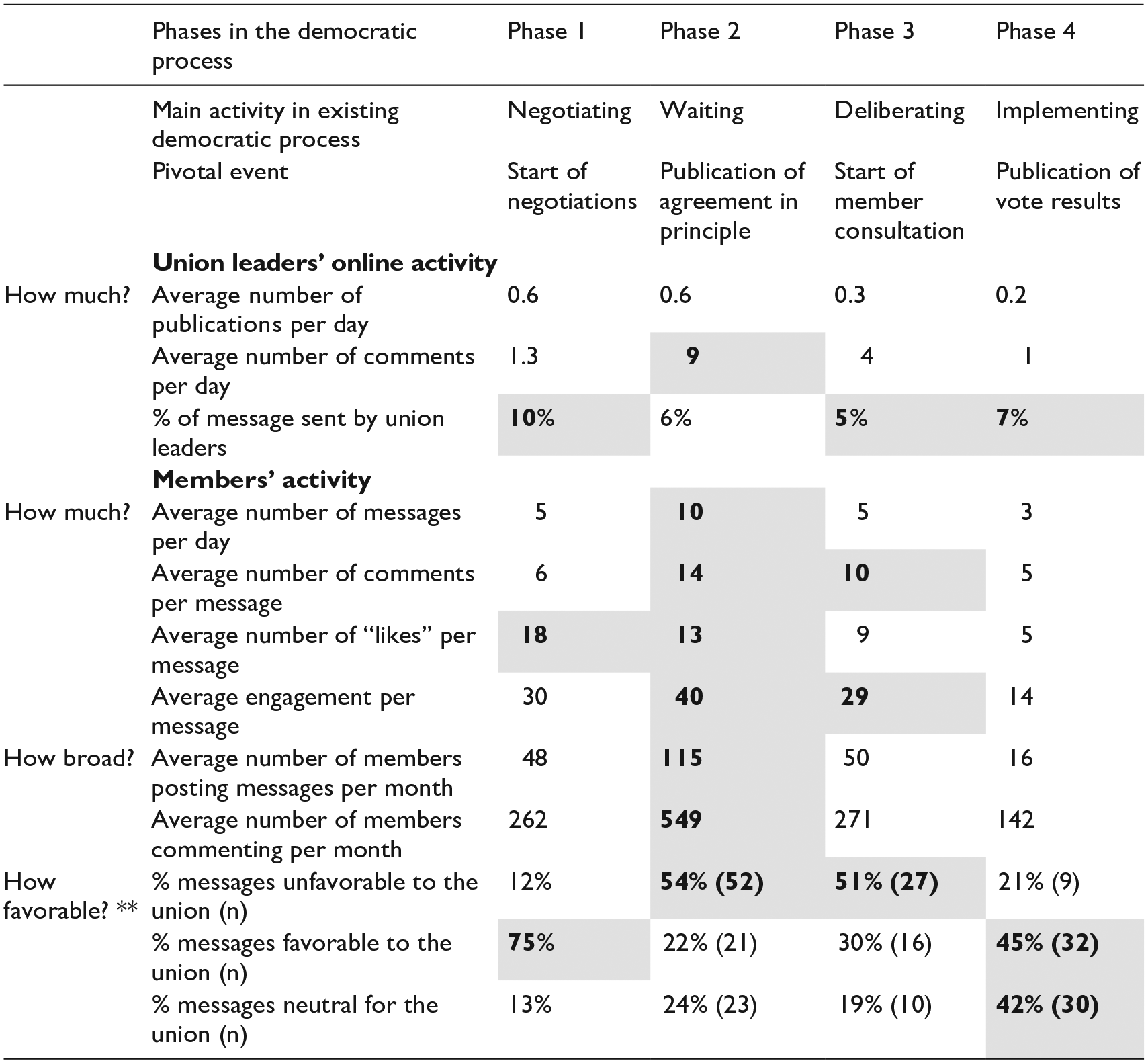
|
Authors’ Note
Marcos Barros, one of the co-authors of this paper, is also co-Editor-in-Chief of Organization. The paper was submitted before his tenure as Editor-in-Chief and he was not involved in any aspect of its peer review process or revision, nor the decision to accept this manuscript for publication.
Funding
The author(s) received no financial support for the research, authorship, and/or publication of this article.
