



Abstract
Pornography organizes bodies in ways that reproduce, challenge, or possibly even change norms of gender and sexuality. In this paper, we explore the gendered organization of pornography, responding to a lack of research on this issue. The study engages in rhetorical and queer listening to investigate feminist pornography, analyzing audio stories produced by an all-female sex-tech company that creates pornography for women through a female gaze. Drawing on literature on gendered organizing, the study shows how the female gaze in feminist pornography organizes bodies in sexual scripts. Furthermore, an application of the concept of happy objects illuminates the complex embodied and entangled relations between sexual subjects and objects of desire. Finally, we demonstrate how, despite a shift from a male to a female gaze, feminist pornography is still prone to the reproduction of heteronormative gender stereotypes. The paper thereby outlines potentials as well as challenges for the (re)organization of bodies in feminist pornography.
Introduction
In the last decades, bodies and embodiment have become increasingly central themes in the study of organizations and organizing (e.g., Acker, 1990; Dale and Latham, 2015; Giazitzoglu, 2024; Hassard et al. 2000; Pullen and Rhodes, 2015; Thanem, 2004). Particularly studies concerned with organizing gender have brought back the body to disrupt our understanding of gendered dualisms, such as body/mind and male/female, by moving away from dichotomy and towards entanglement (McMurray and Pullen, 2019). Pornography, with its decisive focus on bodily entanglements, is an apt place to study the relationship between gendered bodies and organizing. Bodies touching and being touched, bodies penetrating and being penetrated, bodies watching and being watched, bodies slapping and being slapped, bodies licking and being licked, bodies sucking and being sucked, bodies sweating together. A growing stream of literature has been interested in the bodies that perform these acts (Shadnam et al., 2021; Voss, 2015) as well as the bodies that consume pornography (Macleod, 2021; Træen et al., 2004), but less attention is paid to the organization of bodies in pornography, not as an industry but in its enactment. In this article, we show the potential of studying pornography as an example of embodied organizing, as bodies are at the very core of pornography hitting “the blind corner of reason” and directly addressing our “primitive fantasies” (Despentes, 2010: 85). With inevitable and explicit gendered embodiment in its sexual scripts, pornography provides a pertinent case to trace and analyze the complex interdependencies of gendered organizing more easily, providing insights that can be transferred to other forms of organizing.
In this study, we analyze how pornography organizes bodies in ways that reproduce, challenge, or possibly even change norms of gender and sexuality. Mainstream porn is, bluntly put, porn made by men for men. Most producers of mainstream porn are men, imbuing mainstream porn with a visual logic that impels the viewer to identify with the male actor (Srinivasan, 2021), what Mulvey (2013: 63) calls “his screen surrogate”. In her book King Kong Theory, Despentes (2010) notes that pornography is a “male prerogative” that only values female desire as it occurs "via the male gaze" (p. 96). This male gaze organizes bodies and their desire in pornographic content to be mainly centered around men’s lust, putting women in a passive role of desired objects. In her influential essay, Visual pleasure and narrative cinema, Mulvey (2013) shows how heterosexual male perspectives are dominant in mainstream movies, and how this male gaze sexualizes, commodifies, and subordinates the female body, rendering men as the active “bearer of the look” and women the passive “bearer of meaning” (p. 63). Where Mulvey applies the male gaze to Hollywood movies, the implications of the male gaze are intensified in pornography, as the body is in the very focus of the gaze, to the effect that “gender roles and sexual categories are amplified to titillate audiences” (Smith, 2017: 28). Hence, mainstream pornography “offers the pleasure of looking at the woman’s body on display, its orifices, one by one, awaiting penetration: mouth, vagina, anus” (Srinivasan, 2021: 64). While authorizing men as the bearer of the look, it has been argued that mainstream porn diminishes women’s sexual agency and reproduces and disseminates gender inequality (Lischinsky, 2018). Consequently, women are rendered passive and sexually submissive, sometimes even dehumanized as anonymous (headless) bodies to be used and discarded like objects of consumption (Brownmiller, 1975), all in service of male pleasure. It is, thus, not surprising that mainstream porn is criticized for circulating “fake representation of sex, bodies and pleasure” (Macleod, 2021: 674) that leads to female subordination and confers on women an inferior civic status (Srinivasan, 2021: 46).
For this reason, some cultural entrepreneurs have opted for exploring the possibilities of a feminist version of pornography, centering female lust and desire (e.g., Naught, 2013; Royalle, 2013; Taormino, 2013; Young, 2014). One may say that porn made by women for women adopts a female gaze, rather than the hegemonic male gaze of mainstream pornography. Porn that is produced through a female gaze organizes pornographic content to center around women’s lust, empowering them to indulge in their own fantasies of active desire. This change of perspective thereby renders women active in how they pursue their sexual lust, turning them into desiring subjects rather than primarily objects of others’ desires (Despentes, 2010). As such, feminist pornography draws on principles like authentic and diverse representation of bodies, genders, fantasies and sexuality, and fair-trade production (Maina, 2014, Penley et al., 2013, Taormino, 2013; Young, 2014). Thus, while a male gaze has organized sexual scripts of mainstream pornography, feminist pornography offers an alternative perspective by letting the female gaze organize bodies and interactions in sexual scripts. These alternative scripts hold the promise to disrupt the gendered organizing of bodies and lust by offering women agentic subject positions in sexual interactions. At the same time, binary conceptions of a female/male gaze tend to reproduce and simplify dichotomies (such as male/female, objectification/subjectification, unethical mainstream pornography/ethical feminist pornography), rather than opening perspectives of gendered organizing as a broad, fluid spectrum. We therefore note here, while admitting our inability to find a fitting language for this, that not all women have a female gaze and not all men a male gaze. Certainly, these identity categories are generic and incomplete, and the female gaze is not necessarily better or more ethical than a male gaze. Yet, we acknowledge that female gaze pornography provides new and alternative ways of producing sexual scripts that centers the overlooked perspective of and on women.
In this paper, we will explore how Erotic Stories (a pseudonym), an all-female sex-tech that produces audio pornography for women, organizes bodies in relations of sexual desire. By producing pornographic audio stories with a focus on consensual sex, romance, and female fantasies, the organization is actively incorporating the female gaze in its version of pornography for women. More specifically, the female perspective is front and center at all levels of the organization: the organization is founded and managed by women, all stories are written, edited, and audio recorded by women, and all stories are narrated from a woman’s point of view. Focusing on Erotic Stories’ audio content, we investigate how the female gaze organizes bodies into sexual subjects and objects in feminist audio pornography and how a change of gaze, from male to female, might disrupt the gendered organizing of pornography. To unpack how the female gaze organizes Erotic Stories’ audio content, we employ Ahmed’s (2010) concept of happy objects. In doing so, we show how bodies are organized around certain objects, towards which their sexual desire is directed. Empirically, the study draws on qualitative empirical material consisting of 50 of Erotic Stories’ pornographic audio stories. Applying our theoretical perspective to this material, we ask: How does the female gaze in feminist pornography organize bodies in relations of sexual desire?
Gendered organization of feminist pornography
The increasing interest in bodies and embodiment in organization studies (e.g., Dale and Latham, 2015; Hassard et al., 2000; Pullen and Rhodes, 2015), has opened avenues to understand organizing as gendered (Blomberg, 2009; Giazitzoglu, 2024; Kenny and Fotaki, 2015; Pullen et al., 2017; Satama and Huopalainen, 2022). In her seminal work, Acker (1990) explains how organizations are not gender-neutral but gendered sites in which unequal positionalities for men and women are presumed and reproduced. Within organizations and organizing, gender is understood as a foundational structure that is present in organizational processes, practices, images, ideologies, and distributions of power (Acker, 1992). Discursive approaches suggest that gender works as an organizing force that situates subjectivities through agentic embodied communication (Mumby and Ashcraft, 2006) that entails a ceaseless process of (re)producing meaning and crafting subjectivity (Hancock and Tyler, 2001; Hassard et al., 2000). Hence, gendered organizing is viewed as an unfolding, dynamic everyday practice that draws on the broader context of gendered power relations in societal structures and discourses (Martin, 2001). The examination of gendered subject and object positions thus requires understanding the co-construction of masculinities and femininities (Gherardi, 1994, 1995), as they assume shape and meaning in relation to each other. If the production of gender difference is an ongoing, interactive, and dialectical process (Mumby and Ashcraft, 2006), organizational analyses need to reflect the constitutive interdependence of femininity and masculinity. According to Deetz (1992), this involves self-destruction, submitting subjectivity to the play of possibilities that emerges in the subject’s engagement with different others, which creates the possibility to shift the sense of self.
In the context of feminist pornography, this raises the question of how gender differences are actively constituted differently than in mainstream pornography and what consequences result from it. Here, pornography is defined as content created with the intent to evoke sexual arousal, containing explicit exposure of genitalia and detailed sexual acts (Hald, 2006). The internet has become the most used medium for pornography, which has made pornography available for the masses and through which the porn industry has grown exponentially (Cardoso and Paasonen, 2021). In parallel to this development, mainstream pornography has emerged as a term to describe porn that is not only intended to create sexual arousal but to also make profit in the male dominated mass market (Corsianos, 2007). Feminist pornography, as both a discursive genre and political practice (Maina, 2014), is defined as sexual content produced from and for a female gaze that appeals to and represents women’s lust and desires. As such, feminist porn is not just committed to producing sexual goods but also sexual idea(l)s (Labinski, 2019) that reconceptualize and reorganize lust and bodies through a female gaze, thereby challenging the existing male gaze and its respective norms within mainstream pornography.
From a discursive perspective in which the embodied experience of the subject is in focus, feminist pornography acts as an interpretive community (Ryberg, 2014: 224) and is understood as a “a site of struggle” (Pearce, 1997: 212) held together by “a bond of collective concerns” (Bobo, 1995: 59–60). These collective concerns entail sexual conscious-raising and empowerment of women’s subject positions and their agency, rooted in second wave feminism (Ryberg, 2014: 235). As such, feminist porn is articulated around certain gendered principles that mainly refrain from objectification, centering the establishment of subjects instead of objects (Maina, 2014; Penley et al., 2013). Fritz and Paul (2017) conceptualize sexual objectification and sexual agency to explore scripts of bodies and their interactions in pornography. Sexual objectification defines the separation of a body, body parts, or sexual functions from the person, reducing the body to the status of a mere instrument (Fredrickson and Roberts, 1997). This objectification can be indirect, for example, in the form of a male gaze through which a woman’s body is seen as an object for men’s pleasure, or direct, including all kinds of sexual aggression.
Feminist pornography’s explicit focus on women’s desire and lust raises the question of what “women’s desire” is and how it ought to be represented (Stewart, 2019). ‘What women want’, was interpreted by early pioneers in feminist porn, as replacing hard-core porn scenes, common in mainstream porn, with “romance and ‘vanilla’-flavoured couples play”, avoiding all kinds of objectification (Labinski, 2019: 105). For instance, feminist porn maker Royalle (2013) argues that the distinction between mainstream and feminist pornography lies in avoiding focus on gynecological close-ups and instead showing more sensuality on people’s faces while climaxing, e.g. through hands gripping or bodies contracting instead of ending the scene with a close-up cum shot. Other feminist pornographers agree, noting that pornography for women should involve depictions of sex where women’s pleasure is paramount and revolving around women’s experiences of sex and orgasms (Naughty, 2013).
However, later feminist critiques of such arguments point to how the exclusion of all forms of objectification reinforces harmful stereotypes of women’s lust. Locating women’s lust exclusively in romantic, sensual, and relational contexts risks deeming some sexual practices ‘feminist’ while excluding others as ‘non-feminist’ (Labinski, 2019). This demarcation renders certain women’s desires less ethical than others – for instance, BDSM (bondage, discipline, sadism, masochism), consensual violence or other fantasies of direct self-objectification – thereby reinforcing existing stereotypes, even as the perspective is reversed (Mondin, 2014). Many of the early feminist filmmakers, like Royalle (2013), listened to the critique and changed the direction of their work, for example by disassociating the sexual content from redundant sentimentality. Fritz and Paul (2017), however, show that aggressive behaviors like spanking and gagging are mostly directed against women in mainstream pornography, which suggests a normalization of sexual scripts depicting dominance over and objectification of women. Despite this normalization in mainstream pornography, they also find that queer feminist pornography shows significantly more acts of aggression against women (in relation to mainstream pornography) with the distinction that these acts are consensual as part of BDSM interactions. Heeding the argument that “the very notion of feminist porn necessarily stands as a work in progress” (Labinski, 2019: 105), feminist pornographers seek to create spaces that accommodate the diverse and shifting needs of their audiences, translating into fluid subject-object relations in their sexual scripts.
Through this redirection, sexual agency, rather than mere avoidance of sexual objectification, becomes the new focus in feminist porn scripts. For instance, it has been argued that scenes in which women initiate sexual interaction and focus on their orgasms may show women that they can take charge and be the center of sexual experiences (Naughty, 2013). This gives consumers of feminist pornography a different, and possibly more agentic, sexual script that opens up for more diverse understandings of sexuality and desire (Piemonte et al., 2022). Sexual agency, as defined by Fritz and Paul (2017: 642), is understood as “the ability to make individual sexual choices, to vocalize individual desires, and to direct, demonstrate, and experience personal pleasure”. Curtin et al. (2011) further relate agency to efficacy and assertiveness, for instance shown in the ability to ask a partner to use contraceptives and direct a partner to what is sexually pleasing. Fredrickson and Roberts (1997) connect this to embodiment, theorizing agency in the context of sex as sexual embodiment, the ability to stay in the body as a subject. For example, a study by McKee (2005) suggests indicators of sexual agency, such as who initiates sex, number of orgasms, who is a named and central character, speaking to the audience and to other characters. This focus on sexual embodiment challenges power hierarchies, suggests diverse representation, and implies unsettling of normative conceptions of gender, both within the content and in the production team (Penley et al., 2013).
While the main difference between mainstream (male gaze) porn and feminist (female gaze) porn seems to be the representation and catering to the desires of women versus men, it remains unclear how exactly feminist porn reorganizes bodies and relationships between women as sexual subjects and the objects of their desire. To better understand the co-construction of gendered positionings (Gherardi, 1994, 1995) that shape each other in ongoing, interactive, and dialectical processes (Mumby and Ashcraft, 2006), further work on the complex interdependencies of gendered organizing is needed. In addressing this issue, we turn to Ahmed’s notion of happy objects, which allows us to reveal the specific bodies and conditions portrayed as desirable by women as desiring subjects. With a starting point in the gendered gaze, we follow how bodies become gendered as they are directed towards certain happy objects, which in turn organizes bodies of feminist pornography in certain gendered ways.
Women as sexual subjects and happy objects of female desire
In The Promise of Happiness (2010), Sara Ahmed claims that ideas of happiness involve social as well as moral distinctions about who is worthy of being happy. Similarly, there are norms for what things are considered causes of happiness and what are not. Ahmed (2010) describes how subjects turn toward objects that make them happy, referring to those objects as happy objects. Furthermore, she argues that happy objects exist also: . . .in the absence of happiness by filling a certain gap; we anticipate that the object will cause happiness, such that it becomes a prop that sustains the fantasy that happiness is what would follow if only we could have “it” (p. 32).
In the case of pornographic content, the sexual fantasies that give people pleasure become what directs them towards happy objects, thus organizing the subjects that consume and enjoy porn. The pleasure the consuming subjects get from their consumption puts these subjects into intimate contact with the happy objects of porn.
Yet, Ahmed argues, happiness also prevails in the absence of pleasure, so that the promise of satisfaction through pornography may sustain the fantasy that sexual pleasure is what would follow if we consumed it. By making visible a fantasy of desire, the promise of pornography conveys a certain hope, a dream, an aspiration, and an inheritance. As we inherit our ideas of what brings happiness and how to seek it from the society we live in, it is not just that certain groups cohere around certain happy objects, the groups are also asked to reproduce what they inherit by being affected in the right way by the right kind of thing (in our case the right kind of sexual desire). Happiness therefore involves a regulation of desire where happiness is imagined as what one gets in return for desiring well. Hence, we are affected by what is morally attributed to be good, and thereby become constituted as happy subjects. This means that the way of desiring that is morally acceptable in our society promises to bring happiness and pleasure through normative happy objects. In relation to porn, this may include that women’s desire is limited by what is morally acceptable for women in our society to desire, such as heterosexual sex, which then becomes the pivotal focus point for conceptions of objects created in pornographic content for women.
Through this normative conditioning, Ahmed argues that happiness is often used to justify oppression, for instance by picturing oppressed women who have a duty to ensure the happiness of men. This is particularly poignant in pornographic content, which often depicts supposedly sexually satisfied women who are pleased with men desiring them while being objectified without having desires of their own beyond the function of satisfying male desire (Srinivasan, 2021). Referring to “happy housewives” as fantasy figures that maintain the normative happy object of family, Ahmed (2010) sees these figures as embodying “the claim that women are happy and that this happiness behind the work they do functions to justify gendered forms of labor, not as a product of nature, law, or duty, but as an expression of a collective wish and desire” (p. 50). In a similar way, happy sexual objects in mainstream pornography tend to have the function of justifying the submissive role of women, framing what is being portrayed in pornography as a collective desire. This means that the framing of women’s desire as the desire to satisfy men’s sexual wishes makes men’s desires superior, thereby becoming the collective desire that ought to bring happiness for everyone. Hence, we suggest that women as happy sexual objects in mainstream pornography are fantasy figures that tend to erase the signs of their labor to satisfy others under the sign of happiness.
Conceptualizing happiness as conditional to others’ happiness, Ahmed argues that if the happiness of women is conditional to men’s happiness, such that the male happiness comes first, then men’s happiness becomes a shared object. By implication, if women’s sexual desire is conditional to men’s sexual desire, and the satisfaction of men comes first, it becomes the shared object of sexual desire. Hence, in the case of pornography, in which women are presented as happy sexual objects, their happiness is bound to a public fantasy of happiness rather than women’s actual satisfaction of desire. Ahmed claims that as a result, women can only be happy for men as they are not socialized to develop a desire that only belongs to themselves and that, consequently, feminism challenges the collective happiness as it gives women desires that kill the collectively claimed male happiness. This makes pornography that centers exclusively around women’s desire and positions itself against the male gaze an obstruction to, rather than a conduit for, collective happiness. As Ahmed (2010) claims, the history of feminism is a history of making trouble in the act of refusing to make men happy and thereby getting in the way of the happiness of others. Hence, “feminists might kill joy simply by not finding the objects that promise happiness to be quite so promising” (p. 61).
Consequently, we might infer that pornography that is at odds with the male gaze and focuses on women’s desire must display women’s lust in a radically different way, more independent of the satisfaction of men’s happiness. This would imply a shift of the perception of women’s lust in mainstream pornography that makes women the happy objects of male desire, to women becoming subjects with distinct desires, independently from men. Therefore, feminist pornography – that caters specifically to women’s lust by putting women’s desire and sexuality in the center of attention – would kill the joy of the male gaze by questioning that men’s desire is superior to women’s, putting women’s pleasure in focus with women as the desiring subjects. Yet, this might be an especially difficult endeavor in the case of sex and intimacy when the very essence of feminist pornography involves mutual attraction of men and women as in the case of consensual heterosexual acts. Furthermore, the binary conceptions that come from focusing on men’s versus women’s lust, risk upholding essentialist conclusions about binary gender norms that also risk reproducing gender stereotypes. This leads us to wonder how relationships between objects of women’s desire and women as sexual subjects are organized in feminist pornography. Accordingly, in analyzing Erotic Stories’ audio pornography, we explore what happy objects are in this context and how these objects organize bodies in gendered ways.
Methodological considerations
During a visit to Stockholm, the second author noticed Erotic Stories’ printed advertisement in the metro train, which sparked an interest in learning more about this organization, as women’s lust is seldom displayed in the public sphere. The commercial stood out from other commercials that use sex to sell products, as it directly addressed female lust and women’s desire for being sexually satisfied. In what follows, we will discuss the case organization, data production and coding.
Erotic Stories – A case of pornography for women by women
Founded in Stockholm in 2019, Erotic Media (a pseudonym) launched its pornographic audio service in February 2021, as the first provider of audio-pornography for women in Sweden. Erotic Media is a publishing company that broadcasts erotic and romantic stories in its smartphone app, Erotic Stories (a pseudonym). Erotic Stories was the brainchild of one of the founders, who missed a service providing pornographic content for women by women. Working as a producer in the film industry, she decided to take the matter in her own hands and founded Erotic Media together with the two other female founders, who also worked in the media industry. With Erotic Stories, the founders explicitly sought to challenge the dominant norms in the porn industry by moving away from the male gaze and producing pornography with a focus on women’s lust, consensual sex, and romance. The all-female team of founders is consciously seeking to engage women in its organization, the main ambition being the literal embodiment of women’s perspectives on lust through the writers, editors, and narrators of the pornographic audio stories. The focus on engaging women reaches beyond the creative sphere; 70 per cent of the organization’s funding comes from female investors, which demonstrates the organization’s dedication to working not only for but also with women.
Erotic Stories offers a monthly membership that gives access to the organization’s library of stories, similar to conventional audio book services. At the time of the empirical engagement, the library consisted of about 350 stories, but Erotic Stories publishes new stories every week, making the library ever-growing. The stories are between five and twenty minutes long and are all set to music. A majority of the stories are written by women and are, with few exceptions, recorded with female voices. All stories are categorized as either erotic, romance, or wellness. While the erotic category contains stories with explicit sexual content, the romance category contains stories of more romantic character, and the wellness category includes good night stories, masturbation guides, and guided meditations. Despite this categorization, all categories include sexually explicit content, albeit in different forms and extents. All stories are provided with tags to facilitate the navigation in the app. While the use of tags is not extensive, all stories have a tag for the author, the composer, and the narrator of the stories. A majority of the stories also have a tag that indicates if it is a heterosexual or homosexual encounter, by using the tags her+him or her+her. Other tags we have encountered are often linked to sexual kinks, such as BDSM, fetish, dominatrix, submissive, kinky, and swingers. However, stories with such tags only make up a smaller part of the full library, most stories are simply tagged her+him. The tags facilitate the navigation in the app, as the listener can access all stories tagged with the same tag, by clicking on it.
Data generation
This article builds on the audio pornographic stories produced by Erotic Stories. The selection of audio pornographic stories, which constitute the empirical material for the analysis, consists of 50 audio stories of 618 minutes in total. This corresponds to almost fifteen per cent of the current story archive. Half of the included stories were in Swedish and half in English, all quotes from the Swedish stories were translated into English by the authors. We have included stories from all three categories (erotic, romantic, and wellness) in our listening (see Table 1, for an overview). In addition, we have made sure to include both heterosexual and lesbian sexual encounters as well as stories only including one character. There are both stand-alone stories, where we follow the main character in one story, and serial stories, which is an extended narrative divided into three to four episodes, where we follow the same main character over a longer period of time. What is interesting in the serial stories is that, while categorized as erotic, the first stories rarely include any sexually explicit content, but function as a way to build the narrative arch and introduce the characters. Similarly, in the single stories the sexual interaction usually only appears in the last half of the story, where the first part is used to contextualize the sexual encounter.
Overview of erotic stories.
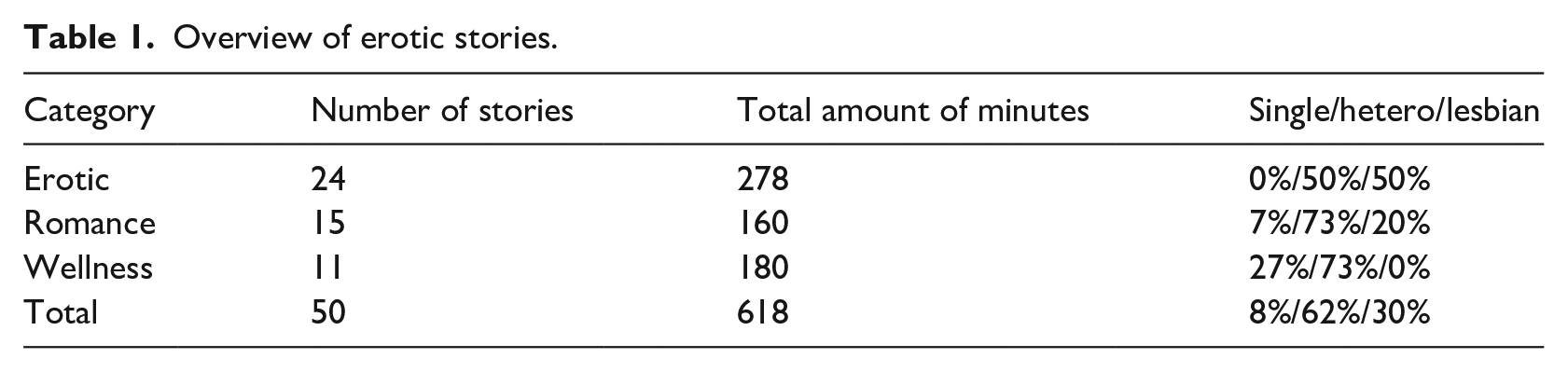
Selecting a set of stories that represents the content of the library posed a challenge, as the app does not provide a full list of all stories in the library. Rather, the stories are thematically listed under each category (erotic, romantic, and wellness). Working under these conditions, we decided to start listening to stories that appeared under the top list (most popular stories) under each of the three categories. As a rule of thumb, we aimed to include as many different writers as possible in order not to adopt the view of only a few writers. However, when a story was a part of a series, we included all the episodes in the series to get the ‘whole’ story. As many of the stories on the top lists depicted heterosexual encounters, we decided to listen to stories appearing in the thematic list ‘Sapphic love’ to also include lesbian sexual encounters. Listening to the stories, we also used the tags to navigate through the content. For example, when listening to a story tagged with her+her, we could access all stories with that tag by clicking on it. In this list we could then see that some stories were, in addition to her+her, also tagged with her+him, indicating stories that included group sex or a threesome. As such, the selection of the stories could be seen as a way of snowballing through the content, letting one story lead us to the next. While deeming this approach appropriate to select stories, we also acknowledge that our choices of stories were colored by our individual affective linkages to the stories. As we looked at the list of stories provided by the tags, some stories seemed to stand out, they were glowing and “gathering our attention” (MacLure, 2010: 282). This glow does not indicate a recurrent feature of the stories, but rather a quality of teasing or awakening our curiosity. Hence, we let our curiosity and the stories’ glow lead the selection process. In Appendix A we provide an overview of the stories included in our data set where we have also given each story a number instead of a name, thereby ensuring anonymity.
Listening for a female gaze
Accessing the stories through listening was initially grounded in a wish to experience the stories through the same medium as Erotic Stories’ costumers. However, as we started to listen to the stories it became clear that listening provided us with more than just an experiential parallel. Listening provided means of close analytical engagement and allowed us to think differently about our data, as we could hear things we could not see (Ratcliffe, 1999), thereby discovering and making new aspects visible to us and the readers. Not needing to use our eyes, we were able to immerse ourselves into the audio content with eyes closed, which enabled us to engage our imagination. We noticed, listening to the stories, that our imagination and fantasy were engaged in different ways, compared to written or video pornographic content. For instance, we both listened to a story of a woman receiving oral sex in a pool, and when talking about it, we realized that one of us had depicted the person giving the oral sex as a woman and the other had imagined a man. At this instance, it became clear to us that there was an inherent potential in audio pornography to engage people’s imagination in different ways. We also noted that we needed some methodological guidance in our listening, which is why we turned to rhetorical listening. Ratcliffe (1999) describes rhetorical listening as “a trope for interpretive invention” (196) that provides a ground for intersubjective receptivity. Inherent to the approach is a constant negotiation of meaning and positions, including our own perspective (Landreau, 2012). By employing rhetorical listening “one listens not for the intention of the other but with the intention to hear claims and meanings—both one’s own and another’s—and to listen to those claims and meanings in their noisy social and discursive contexts” (Landreau, 2012: 155–156).
Thus, rhetorical listening enabled us to identify the discursive strategies of the stories and how these strategies produced discourses of women’s lust and sexual objectivities and subjectivities. While listening to the stories, we noticed that the discursive strategies many times echoed dominant hetero- and homonormative discourses, indicating, for us, a need to queer our listening. Turning to Guschke et al. (2022), we adopted their approach to combine rhetorical listening with queer listening (Landreau, 2012). Engaging in queer listening, Landreau (2012) states, allows us to be disoriented, letting misalignment stay misaligned and rendering what might otherwise be taken for granted strange and unfamiliar. As such, queer listening “entails an angle of vision from which the active making of heteronormative familiarity can be made visible and eventually challenged” (Landreau, 2012: 156). Queer listening enabled us to scrutinize and contest the normative basis of the stories (Guschke et al., 2022: 6) and to step out of hetero- and homonormative familiarity.
Analytical strategy and data coding
Approaching the data inductively, we first coded all the stories with the loose conception of the female gaze, that is, the centering of women’s experience of sexual interactions, in mind as we listened to the stories. Taking notes as we listened, we created an overview of the audio material. The integration of our two senses of hearing and vision, made listening for a female gaze a synesthetic research experience that opened new perspectives of working with and interpreting data. This process resulted in 43 thematic codes (see overview in Figure 1), that directed us to the specific parts of our material that address how Erotic Stories depicts female lust and desire. Relistening to the stories, we transcribed the parts of the stories that included the thematic codes. Reading this material, we started to see patterns of how female lust was directed towards certain objects and practices, which is why we turned to Ahmed’s (2010) theory of happy objects.
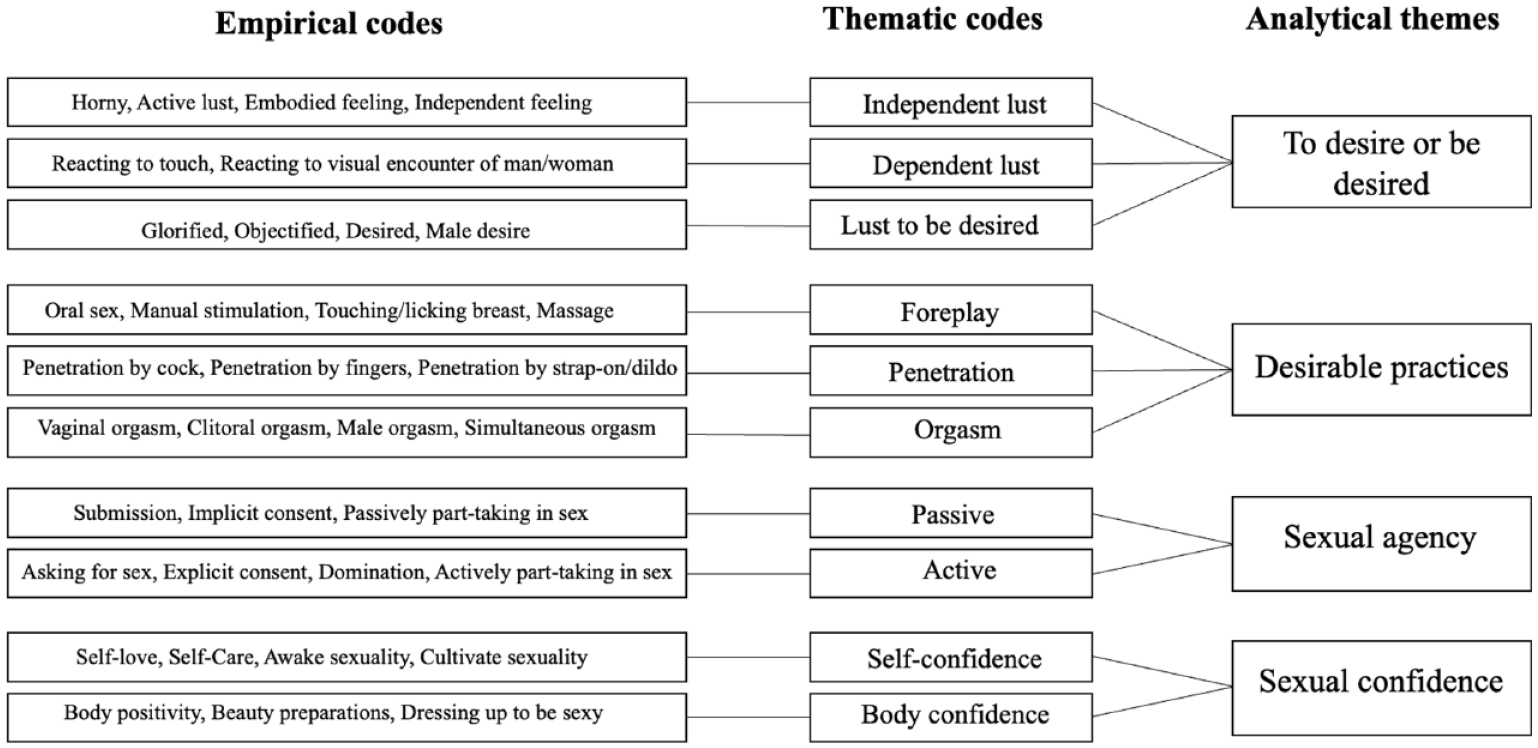
Data structure.
The analytical strategy of using happy objects as a starting point for interpreting the data involves focusing on how the female gaze organizes objects and subjects of women’s lust, in which some objects become constituted as objects of desire. As the objects of desire direct female lust, the female main character becomes constituted as the desiring subject in the erotic stories. This leads us to the theoretical codes that detail the objects that direct female lust and how the desiring subjects are constituted. The stories’ desiring subjects are the actors who long for and express their desires towards objects of desire, from which satisfaction is expected to come. For instance, when the main female character of a story expresses her desire to have penetrative sex, she is considered the desiring subject, and what she desires (to be penetrated by a penis, fingers, or a vibrator) is considered the respective desired object. However, the ways in which subjects and objects relate to each other is complex and roles may also change. For instance, a story might start with the main female character of the story in the role of the desiring subject, but the moment the story shifts the focus towards how she pleases her partner by giving them what they desire, her role shifts from being the desiring subject to being the object of the partner’s desire.
The second round of coding resulted in twelve theoretical codes, which identifies certain objects of desire in the stories (e.g., certain bodies or sexual practices) as well as details how the subject of desire is constituted and related to the objects of desire (e.g., dependent lust or self-confidence). The different roles of desiring subjects and desired objects in the stories are related and entangled in multiple ways, constituting the gendered organizing of bodies accordingly, which we will show in the following analysis.
Happy objects and the gendered organizing of bodies in Erotic Stories
Our findings provide a deep understanding of how the female gaze in the audio stories organizes bodies, through the sexual subjects’ direction towards happy sexual objects. First, we show how women’s lust is both dependent and independent of sexual objects, and how the wish to both desire and be desired blurs the lines between sexual subjects and sexual objects. Second, we show how sexual agency and sexual confidence support the constitution of women as sexual subjects.
To desire or be desired - (Un)directed lust
Erotic Stories focuses explicitly on women’s lust and describes women as sexual beings with strong sexual desires. In some stories, women’s lust exists without dependence on other people or things. In these stories, the desire is not targeted towards specific objects, but the desire remains focused within the desiring subject. In these examples, being horny is portrayed on par with happiness or sadness, a feeling that can be felt without a specific cause. An example that demonstrates this independent lust is found in story 5, where the desiring subject is on her way to the theater: “It is already obvious as I sit in the metro. I cross my legs and feel the heat, a thumbing. I am horny.” In these stories women’s desire is described as an independent feeling rather than a reaction to sexual attraction, attention, or action, which enforces women’s lust as a feeling in its own right.
In most stories, however, women’s lust arises in the meeting, mental or physical, with an object of desire. Hence, women’s lust becomes a reaction to a visual encounter with the sexual partner or a response to physical stimulation by the sexual partner. For example, in story 32, the main character is getting a massage by her male partner, which ends with him giving her oral sex: “You pulled my panties down and took them fully off. At this point I was so horny that my thighs were drawn against you”. Similarly, the main character in story 17 expresses her desire as she is blown away by the female lead singer in a punk band that she is about to interview, expressing that she had “never been attracted like this, to a person before”. As she is entering the backstage area to meet with the lead singer, the main character describes how her “cunt was throbbing by unbearable horniness”. Thus, the stories verbalize strong bodily manifestations of horniness, centering women’s lust and installing women as desiring subjects.
At the same time, many stories link women’s lust or horniness to being desired by a partner, something that is most prevalent in the heterosexual stories. Being a desired object becomes the happy object towards which women’s lust are directed, thus entangling sexual subjects and objects. For instance, many stories express how the sexual partners express their desire for the women, which in turn becomes a source of women’s lust: “[someone] who says that you are dramatic like the ocean, beautiful like a day, sensual like a goddess, someone who cannot get enough of you” (story 45). In other stories, the women are glorified in their sexiness and thereby become objects rather than subjects of desire: “It is the way he speaks to me. Like he is constantly surprised that I am in his life. He is talking to me like I am a glittery miracle, a silvery, precious, new-polished thing” (story 46). Here, the woman is deriving her lust from her male partner’s desire to be with her, desiring to be the object of his desire. Similarly, the massage story (story 32) shows how the male partner’s sexual attraction to the main character’s butt, also turns her on: You started to massage my shoulders, moving down my back, and on my buttocks. You stayed there for a while, like if the glutes would demand more oil than the rest of my body. But I knew, it was because you loved my butt so much. (Story 32)
Women’s lust is thus linked to the sexual partner’s approval of her sexiness. At the same time, giving the massage both renders the man active but also makes his action centered around her as both are giving and receiving pleasure. This shows the important role the desired objects play for women’s lust and how women as desiring subjects sometimes carry internalized social logics of female objectification as a source of lust and pleasure. As the collective desire of all the involved bodies becomes entangled with female pleasure, it gets increasingly difficult to separate the two, especially in sexual acts in which objects of sexual desire and the protagonist’s own objectification become sources of her satisfaction. Hence, we seldom see women’s desires independent from their sexual partners’ pleasures.
Desired practices: penetrative sex and mandatory orgasms
While the contexts of the stories vary, the sexual encounters tend to follow a similar pattern with vaginal penetration and vaginal orgasms as the happy objects, towards which the desiring subjects are directed. Overall, there are only a few stories that involve more diverse forms of sex other than oral stimulation as foreplay and vaginal penetration leading to climax. Penetration and vaginal orgasms are the ultimate goals that satisfy the desires of the female subject. Most stories start with kisses and hugging, followed by touching, licking and/or rubbing the breast and nipples, usually followed by some oral sex and/or fingering. At this point, many of the desiring subjects are begging for (more) vaginal penetration, as in this example of a sexual encounter with a Tinder-date, who has licked the protagonist very close to climax: “Suddenly, Maria wants more, she wants him inside her” (story 7). In a majority of the stories, especially in the heterosexual encounters, penetration becomes the unquestionable finale that all other things have been building up to. Other times, the penetration is seen as a relief (from the unbearable horniness), which takes the main character to climax: “the relief of having you inside me put me in ecstasy, I rose to my knees to show you that I wanted more” (story 32). In story 11, all these steps from desiring penetrative sex to the mandatory orgasm are detailed: She freed his erection and marveled at the size of it as she took it in her hand, enjoying the feeling as she began to stroke him slowly. She bit her lip, wanting to take it slow but feeling an overwhelming need to have him inside of her. [. . .] He slid his hand under the fabric of her dress and cupped her sex with his warm hand, not wasting any time as he pushed away the lace of her underwear, moving straight to her sensitive clit. She felt her heart racing faster, [. . .] giving in to the torment, the need to feel him inside her growing stronger with every stroke of his fingers. [..] He slowed his movements, just enough to keep her on the edge. Please, she cried out breathlessly. It wasn't like her to beg but in the moment she didn't care. I need you inside of me. [. . .] She felt the heat and desperation inside her growing until she couldn't take it anymore. [. . .] He saw the look on her face and nodded without a word, positioning the tip of his cock at her entrance. [..] Finally, he plunged into her, making her scream and buck against him. [. . .] They settled into a rhythm, and she closed her eyes, focusing on the feeling of his skin against hers, his hard cock inside of her, filling her. [. . .] He brought his mouth down to her breasts letting her set the pace as she slowly moved her slick body against his, up and down, riding him. She pushed her knees wider apart, taking him deeper as he brought her closer and closer to orgasm. She slowed down and looked at him desperately, challenging him. And he didn't disappoint her. He plunged into her. His pace quickened for a few relentless rusts. One hand working her clit, the other exploring her breasts until she felt the rush of her orgasm flooding over her. The look on his face told her that he was just as close as she was and finally, he came at the same time. An overwhelming rush of pleasure and ecstasy. She felt it in every nerve of her body as she cried out and then collapsed onto him. (Story 11)
As detailed in this passage, the penetrating cock becomes the ultimate happy object towards which the female lead character directs her desire and lets the large cock fill her vagina fully, as the utmost ideal of satisfaction. The sexual act’s culmination in a simultaneous orgasm marks the peak of the story and underlines the fulfillment of the joint desire. This fulfilled desire, however, goes beyond the woman’s desire as it is entangled with the cock and the man’s orgasm, whereby the man’s and woman’s lust can only be fulfilled together.
Furthermore, male orgasms, cocks, and male desire also become the center of attention in heterosexual stories on desired female submission: Will you hurt me a little? Please? I ask. My voice sounds tiny. I've never dared ask for this before. But I feel full of some unexpressed emotion, and I need the sharp sting of pain to ease the pressure. [. . .] I turn my head to the side and gasp when his hand comes down on my ass. Two, three times. [. . .] His nails dig into me when he drags them across my back. I gasp again, grinding into him. [. . .] “You've been so good tonight,” he whispers. “So, I have a treat for you. I'll let you suck my cock until I come in your mouth". (Story 1)
While the female subject is asking to be hurt, which is answered with spanking and scratching, she is also getting to perform an unrequested blowjob resulting in a cum-load in her mouth. Hence, the focus on penetration as the ultimate satisfaction of female desire, as the relief-giving, climax-providing sexual act, reproduces mainstream porn’s focus on penetrative sex as “real sex”, whereas other forms of sex become secondary. However, while many stories depict men’s desire and penetration as happy objects, none of the described sexual encounters depict penetration of men or men interacting with each other, even in group sex situations (e.g., stories 22, 23, and 24).
While this pattern is very clear in the heterosexual encounters, there is also a tendency to favor penetrative sex in the lesbian stories: “She moaned in my ear, a shiver, I needed her now, to have her inside me” (story 19). What often remains open, is to what extent the subject’s desire is in focus and how much it is entangled with the satisfaction of the sexual partner’s desire to penetrate them. For instance, focusing on the perspective of the active part, in story 20, the desiring subject wishes to penetrate her (female) partner with her fingers. This exemplifies how the subject and object positions are not always separated, which indicates that the women can be a sexual subject and object of desire simultaneously. Hence, subject-object positions can exist as shifting positions that are deeply relational and entangled.
Sexual agency as a source of sexual subjectivity
Erotic Stories operationalizes the female gaze through narrating the stories from a woman’s perspective, either in first or third person. As such, many stories center women’s sexual agency, for instance, when women approach sexual partners, when they actively instigate sexual acts, and when they actively participate in sexual encounters. For instance, in story 7, the female main character takes the lead in the sexual act: “Suddenly, Maria takes the initiative, pulls down her panties and takes off her dress and sits herself upon him”. Other stories portray more explicit forms of sexual agency, where the female main character becomes dominating and, thus, exerts power over her object of desire: It was her, who made the decision this evening, she pulled and managed him, the willing majorette doll. [. . .] She was a wave. No, she was the ocean, and he was a man who was drowning, but he did not want to be saved. The drowning had awakened his heart and made him want her even more. (Story 38)
While portraying different types of sexual agency, the common thread is that the women have agency in their sexual encounters and that they act on their lust. Thereby, the stories clearly constitute women as desiring subjects.
While women are portrayed as the active desiring subjects, they do not always hold the active role in the sexual encounters. For instance, in story 9, the main character is first described as a desiring recipient of her partner’s touches with him in the role of her object of desire. Shortly after, her agency is described as she gives him pleasure, turning into his object of desire: His touch was sending sparks of electricity through every inch of her body. His capable hands explored her breasts, her stomach, moving lower as Katie pressed her lips to his. Slipping her tongue into his mouth. She unbuttoned his jeans and something like a growl escaped his lips. Katie moaned as their warm bodies pressed together. (Story 9)
In these encounters, the roles of desired objects and desiring subjects that give in one moment and take in the next, shift constantly. Thus, sexual agency both enables giving and receiving pleasure in sexual encounters. This further complicates the boundaries between subject and object position, as we cannot by default assume that giving pleasure would imply an object position. Rather, while being the desired object of the partner, the woman exerts sexual agency by giving pleasure (as shown in the quote above). The stories, thus, exemplifies sexual agency as a happy object, orienting women’s lust towards a sexual ideal of women as simultaneously sexual desiring subjects and desired objects, which promotes a relational understanding of sexual interactions.
Sexual confidence of desiring subjects
Sexual confidence is fundamental for the constitution of women as desiring subjects in Erotic Stories’ audio pornography. The stories emphasize two forms of sexual confidence, one focused on the mind and one on the body. Thus, sexual confidence is a prevalent topic in the wellness stories – that often borrow the format of self-help literature, including affirmations, positive thinking, and guides for mental training – where women are urged to “awaken the inner lover” (story 49) and nurture their sexuality. Sexual confidence is, hence, seen to stem from self-love and self-care, rendering sexual agency a happy object to which women model their lust and desire. Women as desiring subjects take time to get to know their lust and bodies in order to feel good about themselves and be confident in sexual encounters. For instance, in story 49, readers are advised: Remember to pause and linger in bed or in the sofa. It is not laziness, idleness or comfortability. It is courage. Courage to choose yourself. Courage to choose your body. Courage to take a break and choose your wellbeing today. [. . .] put your hands upon your divine kingdom, protect it, gild your world with your amazing you. (Story 49)
Similarly, in story 50, the main character literally walks toward her desire, feeling the body while walking and breathing consciously. The narrating voice reminds the listener to appreciate the body as a vehicle for lust: Bear in mind, that all this is yours, your tool, and it can give you everything you dream about. [. . .] Only those who satisfy you are allowed into this place, embrace your body and your lust. [. . .] You have every reason to be proud of your body and what it does for you. (Story 50)
Sexual confidence thereby becomes a happy object that originates and resides within the desiring subject, a space for the desiring subject to cultivate and nurture. Other stories portray women who manifest and affirm their worth, sexiness and desirability. For instance, in story 46, the main character speaks to herself: “I like my skin, my body. I am most of the time grateful to be me, and I have heard that this makes me sexy”. Here, the sexual confidence, and sexiness, of the desiring subject is manifested within the subject herself, but also from external confirmation by affirmative comments from sexual partners.
Another way of gaining sexual confidence is by preparing the body for the sexual encounter. Oftentimes, stories detail the process of moving from less desirable to more desirable. By getting ready for a date, the main character boosts her sexual confidence by making herself more desirable. For example, in story 5, the main character says: I paint my lips red; the lipstick tastes like wax and violet candy. I have put nail polish on. I have flossed my teeth. [. . .] I have dressed up for her sake. Black satin dress, black nylon stockings, leather boots with heels. (Story 5)
In addition to putting on makeup and dressing sexy, the act of getting ready also involves cleaning and shaving rituals as well as putting on shoes for “a better posture”, for example: She has made herself ready. She has taken a bath, she is newly shaved, and she has put on nicely smelling body lotion all over her body, topped with soft lace underwear. Finally, her favorite dress, a vintage find from Diane von Furstenberg that hugs her curvy body. . . The soft flowery fabric makes her feel exclusive and maybe a little sexy. On her feet she wears a pair of high heels that gives her a better posture. (Story 7)
These examples show how, by presenting themselves as desirable for their objects of desire, women, in their role as desiring subjects, themselves become (or maybe more precisely position themselves and their bodies as) objects of desire, which indicates the intertwined relationship between desiring subjects and objects of desire. Sexual confidence as a happy object plays a central role in the constitution of women as desiring subjects and shows how social power structures, especially in heterosexual fantasies of lust where the woman needs to be confident in her sexiness for the male gaze, continue to shape the representation of women’s desire.
Concluding discussion
In the analysis we have shown how the female gaze organizes bodies in feminist pornography through detailing the ways women’s lust is directed towards certain happy objects. With a starting point in these findings, we will now discuss our results in relation to 1) feminist and mainstream pornography, and 2) gendered organizing and subject- object positions.
Feminist pornography as an alternative to mainstream pornography
This article explores the potential of feminist pornography to organize bodies differently than mainstream pornography by shifting the gaze from male to female. Erotic Stories is not a typical case of feminist pornography, as it is a for-profit organization producing pornographic content for a mainstream segment. This adoption to the mass market of women implies that it presents a less radical form of feminist pornography than what we often encounter in the literature (e.g., Labinski, 2019; Lee, 2013; Noble, 2013; Royalle, 2013). We argue, however, that the case of Erotic Stories offers important insights into the challenges arising in the shift from a male to a female gaze. A shift that becomes even more pertinent as Erotic Stories at the same time directs its product to the masses and thereby has the potential to change mainstream gender norms with significant reach but by catering to the mainstream audience of women also risks reproducing norms. Erotic Stories can thus be seen as yet another commercial organization that rides the wave of feminism to position itself in a more politically aware market (see Ciclitira, 2004). While being less radical than other feminist porn producers (Whisnant, 2016), the organization still provides an alternative to mainstream porn through incorporating the female gaze and thereby challenges sexual scripts of mainstream pornography. By providing different sexual scripts that promote the perspective of women, the organization holds the potential to challenge sexual norms and, thus, create social change that reaches the mass market of women. Hence, while working for profit, Erotic Stories combines commercial interest with a social agenda, similar to organizations that showcase a hybridization between ethical and commercial goals (e.g., green capitalism, for-profit cooperatives, etc.). While acknowledging the risk that commercial interests might co-opt or appropriate the feminist logic (as also seen in discussions of alternative economic practices, see for example Ul-Haq et al., 2022), we argue that Erotic Stories provides a fruitful case for studying challenges that feminist pornography faces in countering the organizing of mainstream pornography.
An important lesson from this case of feminist pornography lies in the way bodies and their interactions are organized in the audio stories. Erotic Stories’ audio pornography provides a novel way of approaching bodies in pornography in so far as there are no physical bodies involved in sexual acts in the production of this type of pornography (if we disregard the implicit sex work that lies in writing pornography, see Wood, 2015). While there are still bodies involved in writing, producing, and consuming the audio pornographic content, these bodies are not involved in bodily labor of sexual interactions. Audio pornography thereby circumvents the discussion on the labor of doing porn and thereby allows listeners to engage with sexual fantasies that can otherwise be difficult to portray ethically in video content (Berg, 2021; Grant, 2014; Miller-Young, 2014). Furthermore, as we learned from rhetorical listening (Ratcliffe, 1999), the engagement with audio content can enable the self to immerse more deeply in one's own imagination. As our different interpretations of the stories show, audio pornography leaves space to hear what we cannot see. This possibility of audio pornography also bears potential to reorganize bodies in more fluid ways by inviting a “listening gaze” as wide as the interpreter’s fantasy goes. As the listener’s imagination fills in the pictures of the pornographic scenes described in the scripts, it becomes more about indulging in one’s own fantasy than about the actual depictions of bodies and interactions.
The organizing power of the pornographic scripts is not contained to the audio stories. As Piemonte et al. (2022) argue, sexual scripts have an impact on the way people interact sexually. Thus, alternative scripts that reorganize bodies in pornography by engaging imagination influence peoples’ perceptions of sexual behavior, which in turn influence sexual interactions. For example, as all stories are told from a women’s point of view, women as sexual subjects (rather than objects of men’s desire) become normalized. As such, we see that Erotic Stories holds potential to push for a normalization of active women subjects, as their audio pornography reaches a broad mass market. In line with Labinski’s (2019) statement that “the very notion of feminist porn necessarily stands as a work in progress” (p. 105), what we have analyzed is just a first iteration of what audio pornography for women can be. While containing troubling features from a feminist perspective (e.g., the persistent focus on making the female body desirable), the audio stories hold potential for being reiterated in the spirit of feminist porn as an unfinished process. We could imagine a greater diversity of described bodies, sexualities and sexual practices represented in the stories as well as more variation in the representations of genders. In short, we suggest that Erotic stories could make use of the audio format to produce more ambiguous stories (such as the pool story discussed in the method section), where the inconclusive elements allow for a wider range of imaginaries or interpretations.
Gendered gaze, gendered bodies, and gendered organizing
Gender provides a pertinent link between the gaze and the bodies of organizing, given that qualities attributed to bodies, for example what is sensual, sexual, or gendered, depend on the eye of the beholder, which is not given but socially organized (Hassard et al. 2000 rephrasing Mumby and Putnam, 1992). The way pornography is organized is thus not gender-neutral, but a gendered site in which unequal positionalities for men and women are presumed and reproduced (Acker, 1990). The stories show how this works through embodied communication (Mumby and Ashcraft, 2006) that (re)produces meaning and crafts subjectivity (Hancock and Tyler, 2001; Hassard et al., 2000) by drawing on larger societal discourses in the context of gendered power relations (Martin, 2001). Thus, we argue that focusing on the gendered organizing of pornography can open potential avenues for change. Gendered reorganizing efforts appear to work through a change of gaze that rearranges bodies into different positions that shape their possibilities for interaction. The gendered gaze (in our case the female gaze) organizes bodies in (our case feminist audio) pornography, and thus, genders the bodies that appear in the scripts. By tracing how these bodies are gendered through the female gaze, we show potential processes of gendered organizing, which open possibilities for reorganizing for more gender equality. While the concept of the male and female gaze has often been reserved for media analyses, we argue that bodies are always observed and organized through a gendered gaze - also in organizations. The organizational capacity of the gendered gaze can, thus, be considered in organizational analyses more broadly to advance our understanding of gendered organizing processes. As our study shows, gendered narratives through embodied communication (Mumby and Ashcraft, 2006) are crafted from a particular gendered position and a related gendered gaze. We therefore suggest paying closer attention to the discursive organizational forces of gendered gazes to understand their implication for organizing. Changing the organizer’s gaze has the potential to change embodied organizational narratives and the way subjectivities and objectivities are installed in organizations. The gendered gaze can, thus, be utilized as an analytical tool for illuminating alternative organizing processes and organizational transformations. By understanding how the gendered gaze organizes bodies and, thus, renders these bodies gendered, we can thus get a better understanding of gendered organizing.
However, what we see in our analysis is that although the gaze is shifted from male to female in Erotic Stories’ audio pornography, gender is still organized in similar ways as in mainstream pornography. Thus, while the woman’s perspective is centered, we see similar sexual practices, relationships and interactions as in mainstream pornography. On the one hand, the stories involve depictions of sex where the woman’s pleasure is narrated from a subject position of sexual embodiment (Fredrickson and Roberts, 1997) that centers her experience of sex and her orgasm (Naughty, 2013). On the other hand, her pleasure remains linked to men with (simultaneous) orgasms, cocks, and male pleasure in general, remaining central in the stories as happy objects of desire and essential for women’s lust. This entanglement of sexual subjects and objects makes it particularly difficult to reorganize the sexual scripts and provide a critical alternative to mainstream pornography. Our analysis, thus, shows the complexities of reorganizing gender in pornography, also for an organization that has set out to do exactly that.
With Ahmed’s (2010) concept of happy objects we can understand how gendered organizing works through subject and object positions. As such, we provide an in-depth understanding of the means through which organization is gendered. Detailing how female lust is directed towards certain happy objects of desire allows us to illuminate the complex relations between desiring subjects and objects of desire that are heavily shaped through the entanglement of masculinities and femininities (Gherardi, 1994, 1995). The female actors in the stories are constituted as desiring subjects through developing and cultivating sexual agency and sexual confidence that enables the subjects to act upon their sexual lust (Fritz and Paul, 2017). The shifting roles of sexual subjects and objects in the sexual encounters are poignant reminders of existing gendered power relations and demonstrate how desiring subjects and objects of desire are deeply interrelated, reproducing heteronormative ideals, such as penetration and simultaneous orgasms, as happy objects of women’s lust. Thus, it is tricky to understand the demarcation of shifting roles of subjectivity and objectivity in feminist pornography, as the boundary between subject and object positions appears fuzzy.
More precisely, the women in the stories simultaneously hold the position of a sexual subject and in many instances also the position of an object of desire for their sexual partners. As most sexual acts imply another person to interact with, the fussy boundaries between subjects and objects accentuate the relationality of pornography where the sexual subject can desire to please their partner and become their object of sexual desire as much as they desire to be pleased themself. This interrelatedness is inherent to Ahmed’s (2010) theory of affect, as “emotions operate to ‘make’ and ‘shape’ bodies as forms of action, which also involve orientations towards others” (p.4). Emotions, such as desire, are thus shaped by the contact with the object, just as objects are shaped by their contact with emotions. As the subject shapes the object, the object also shapes the subject, which results in the blurred boundaries between the two. This is exemplified in the title’s call “I need you inside of me”, which is ambiguous and can be interpreted in different ways. One interpretation would be that the desiring woman is active but at the same time also actively reproducing existing norms of desiring heteronormative penetrative sex. Another, more radically relational interpretation could be that sex and intimacy is about letting the other in, pointing to broader ethics of entanglement. Yet, this call would only hold if mutual penetration was portrayed, indicating a real change of norms.
To conclude, our study has illuminated how the gendered gaze in pornography organizes bodies and sexual desire. We show how the female gaze in feminist pornography organizes bodies in the sexual scripts by positioning them in subject and object positions, through tracing how the bodies are directed towards certain happy objects. For feminist pornography, we highlight the potentials and challenges of reproduction when rethinking scripts of sexual interactions. For organization studies, we suggest taking inspiration from our study to pay more attention to the gendered gaze and its capacity to organize bodies, which can be fruitfully studied through employing happy objects as a conceptualization of this gendered organization into subject and object positions.
Supplemental Material
sj-docx-1-org-10.1177_13505084231224841 – Supplemental material for ‘I need you inside of me’: Gendered organizing of feminist pornography
Supplemental material, sj-docx-1-org-10.1177_13505084231224841 for ‘I need you inside of me’: Gendered organizing of feminist pornography by Lea Katharina Reiss and Sara Dahlman in Organization
Footnotes
Funding
The author(s) disclosed receipt of the following financial support for the research, authorship, and/or publication of this article: This research was supported by The Velux Foundation and The Villum Foundation with grant number 27102/39017.

Supplemental material
Supplemental material for this article is available online.
Author biographies
References
Supplementary Material
Please find the following supplemental material available below.
For Open Access articles published under a Creative Commons License, all supplemental material carries the same license as the article it is associated with.
For non-Open Access articles published, all supplemental material carries a non-exclusive license, and permission requests for re-use of supplemental material or any part of supplemental material shall be sent directly to the copyright owner as specified in the copyright notice associated with the article.
