




Abstract
Based on a review of existing qualitative research, this study proposes a gender-based interpretation and critique of the incorporation of self-spirituality into mainstream organizations. The article’s findings show that the enactment of self-spirituality in organizations often evokes experiences of tension or objection. The basic premises of self-spirituality culture are concerned with the authentic self and the emphasis on the individual’s awareness of his or her body, thoughts, and feelings is, in fact, a manifesto of the legitimate sources of ‘knowing’ at work. This premise is radically different from rationality as a fundamental principle of knowing and organizing. Self-spirituality further proposes an alternative to workplace relationships, which is based on a radical equality. I argue that these perceptions are embodied in gendered power relations—the relationship between the feminine self-spirituality and the masculine secular organizations. Two main modes of incorporation of self-spirituality into organizations were identified: the ‘domesticated masculine mode of incorporation’, which is presented as a ‘joining force’ in achieving main organizational values, and the ‘feminine’ modes of the incorporation of self-spirituality, which presents a revolutionary alternative to organizations. As for the viability of these modes of incorporation for creating change, self-spirituality in its domesticated masculine mode of incorporation appears to align itself with organizations public domain. In contrast to this, the two ‘feminine’ modes of incorporation create the possibility for self-spirituality to be lived by individuals as an ‘individual wisdom’. The study contributes to organization research by identifying ways in which radical alternatives may be incorporated into organizations.
Keywords
This study explores the viability of a new culture, one that has evolved over the course of the last three decades across the Western world, for engendering change in organizations. Specifically, the study focuses on ideas and practices associated with the culture of self-spirituality and with the rise of ‘post-secularism’, a perspective that criticizes secularization’s fundamental claim that ‘modernity’ and ‘religion’ are fundamentally antagonistic concepts (Watts, 2018). According to Charles Taylor (2007), a cultural revolution has swept across the Western world over recent decades, which has ‘profoundly altered the conditions of belief in our societies’, and has begun to shape the contours of society as a whole (p. 473). This culture is informed by an ethic of authenticity. The focus is on the individual and on his or her experience; on unity, integrity, holism; and on a language that often evokes sensations of harmony, balance, flow, integrations, and ‘being at one’ (Taylor, 2007: 506–513).
Despite disagreements between conceptualizers of this ‘Spiritual Revolution’ as to what ‘spirituality’ actually means, a number of scholars are anchored by the assumption that it is defined, as its most fundamental level, by the belief that the sacred resides within—rather than outside—the self (Watts, 2018: 345). As a culture, developments in self-spirituality influence, and influenced by, developments in ‘soft secularism’, traditional religions, and by the New Religious Movements (Barker, 2008). Scholars agree that many of the ideas which fall under the rubric of ‘spirituality’ in the West today were once classified under the term ‘New Age’, a movement, which came of age during the 1960s and 1970s counterculture (Heelas, 1996; Watts, 2018).
When applied to the context of the workplace, notions of self-spirituality are commonly described as ‘workplace spirituality’. The term refers to employee experiences of spirituality in the workplace; they include a sense of meaning, community, and transcendence (Pawar, 2009, quoting others), and the organizational context that facilitates these experiences. It has been argued that the workplace spirituality discourse has become well established, even institutionalized, in the global business management context (Bell and Taylor, 2003; Gonzalez-Gonzalez, 2012).
In the main, the ideas and practices of self-spirituality, if not explicitly translated into the workplace context, pose a fundamental challenge to the basic premises of Western organizations. Tensions between self-spirituality and the organization can be conceptualized in relation to rationality. Rationality has been strongly criticized in New Age thought (Hanegraaff, 1998; Hedges and Beckford, 2000), and has long been identified as a fundamental characteristic of the Western organization (Abbott, 1988). Other possible tensions can be identified in relation to self-spirituality’s focus on the ‘whole person’ in the workplace: the premise that every aspect of an employee or manager—including her or his body, mind, and spirit—should be fully present at work (Ashforth and Pratt, 2003; Ashmos and Duchon, 2000; Sointu and Woodhead, 2008). However, existing research has denoted the limited legitimacy attributable to a person’s body within an organization (Fotaki, 2013; Mumby and Putnam, 1992).
Despite these tensions, existing research has shown that the ideas and practices of self-spirituality have extended into the realm of the Western organization (Case and Gosling, 2010). One indication of the growing significance of self-spirituality can be seen in studies documenting its incorporation into various mainstream organizations. These include medical institutions (Fadlon, 2005; Heelas, 1996; Kabat-Zinn, 1993; Solomonsen et al., 2011), profit organizations (Driscoll and Wiebe, 2007; Heelas, 2008; Islam et al., 2017; Zaidman et al., 2009), and the educational system (Arweck and Nesbitt, 2007; Heelas, 1996; Sarath, 2003; Waters et al., 2015). The language, ideas, and practices of self-spirituality are also evident on the ‘outskirts’ of organizational life. Examples of this positioning can be seen in social entrepreneurship events and in management development programs (Bell and Taylor, 2003; Mauksch, 2017). These studies illuminate certain aspects of the incorporation of self-spirituality into mainstream organizations. However, they do not present a complete and comprehensive description of the permissible venues (in terms of public visibility and potential impact) that organizations ‘allow’ for the incorporation self-spirituality, as an alternative culture, into mainstream organizations.
This study proposes a gender-based interpretation and critique of the incorporation of self-spirituality into mainstream organizations. It is based on a review of qualitative studies presenting empirical data detailing the ways in which practitioners (e.g. organizational consultants, spiritual care providers, school instructors) and employees (workers and managers) embrace and incorporate ideas and practices derived from self-spirituality into organizational life.
The gender-based critique is informed by research that has identified that women are more likely than men to engage with self-spirituality (Heelas and Woodhead, 2005; Houtman and Aupers, 2007; Houtman and Mascini, 2002; the Zaidman et al., 2017). It is also informed by research that has articulated the link between self-spirituality and femininity. For instance, Sointu and Woodhead (2008) have suggested that women relate to self-spirituality because it aligns with traditional spheres and representations of femininity. The authors identified similarities between holistic practices and expressions of modern femininity, such as a focus on the body (providing access to the authentic inner life of the emotion and spirit), self-worth, and well-being. The authors argued that self-spirituality legitimates the relational mode of selfhood that ‘has traditionally been central to feminine forms of identity and labor, through insisting on the uniqueness and value of each individual, and on the right to articulate the inner “core” of selfhood and seek embodied self-fulfillment’ (p. 273). Likewise, Barker (2008) denoted the emphasis attributed to the feminine within self-spirituality.
The article focuses on two main research questions:
RQ1. What are the organizational perceptions and responses to the ideas and practices of self-spirituality?
RQ2. How are self-spirituality ideas and practices incorporated into Western organizations, by both practitioners and employees?
This article begins with a survey of the existing research on self-spirituality, workplace spirituality, and gender and organization, followed by the ‘Methodology’ section. The ‘Findings and gender-based critique’ section is based on a literature review of studies exploring the incorporation of self-spirituality into mainstream organizations and on an interpretation based on a different reading of these articles informed by a gender perspective, followed by the ‘Summary and conclusion’ section.
Literature review
Self-spirituality and workplace spirituality
Self-spirituality
In spite of a diversity of perspectives, scholars have identified several common core and interrelated dimensions of self-spirituality. The first is the transcendence of the self, that is, a belief that one is connected to other people, ideas, nature, or some kind of ‘higher power’ (Ashforth and Pratt, 2003). In parallel with this is an emphasis on authentic selfhood and inner wisdom, and on connecting with these inner depths through what Taylor has described as ‘intimate contact with oneself’ (Sointu and Woodhead, 2008; Taylor, 1991: 27). Second, people who embrace self-spirituality tend to be committed to a vision of authentic selfhood-in-relation. Such relationality is conceived as fundamentally small-scale and egalitarian in outlook. It places an emphasis on life lived out in ‘healthy’ connection with intimates, coworkers, family members, and others. Furthermore, its characteristic social exchanges involve a high level of emotional self-disclosure (Sointu and Woodhead, 2008). The third overarching dimension is holism and harmony, that is, integration of different aspects of one’s self into a coherent and symbiotic conception of the self (Ashforth and Pratt, 2003). This dimension includes a focus on the body, understood as being the access point to unique selfhood, and serving as a means of achieving greater well-being. Self-spirituality recognizes and validates the bodily existence, consequently giving meaning to the embodied self—making the embodied self count (Sointu and Woodhead, 2008). The fourth dimension is a belief in growth, that is, a clear sense of what one seeks to become, and what one needs to do in order to achieve self-actualization (Ashforth and Pratt, 2003).
Workplace spirituality
This can be defined as a discourse focusing on employee experiences of spirituality in the workplace (Pawar, 2009). Gotsis and Kortezi (2008, quoting others) summarized the main foci of this discourse as follows: ‘A need to find meaning and purpose and to develop employees’ potential at work’; ‘the need to integrate various parts of individuals professional and personal lives in authentic ways at work’; and ‘the need to develop a sense of community at work’. The literature on workplace spirituality broadly describes the phenomenon as a positive development (Lips-Wiersma et al., 2009). For instance, Petchsawang and McLeah’s (2017: 219, quoting others) summary of empirical evidence suggested that workplace spirituality is positively correlated with (among other qualities) job satisfaction, organizational commitment, and intrinsic work satisfaction; and that it is negatively correlated with organizational deviant behaviors and stress.
A second direction in workplace spirituality research includes studies that have argued that workplace spirituality may in fact be more harmful than useful, because it has the potential to be used as a negative force to impose hegemony (Bell and Taylor, 2003; Lips-Wiersma et al., 2009). In line with this view, Case and Gosling (2010) argued that the current academic interest in workplace spirituality mirrors the corporate trend of appropriating employee spirituality for primarily economic ends. Consequently, they argued, much of the body of contemporary literature on spirituality is narrowly utilitarian and instrumental in outlook, and is often concerned principally with the commodification of spirituality (Case and Gosling, 2010).
This study does not focus on the workplace spirituality discourse. Rather, this article is an attempt to reorient the existing discussion, so to engage with and understand the ways through which the ideas and orientations of self-spirituality are incorporated in organizations by practitioners and employees, and the link between this and gender relations in organizations. In particular, the analysis draws from a diverse range of ideas and practices. These include the following: (a) Contemplative practices such as meditation (Boyle and Healy, 2003; Islam et al., 2017; Islam and Holm, 2016; Kabat-Zinn, 2011; Karjalainen et al., 2018; Lychnell, 2017; Sarath, 2003; Zaidman, 2017; Zaidman et al., 2009; Zaidman and Goldstein-Gidoni, 2013). This category also presents ‘mindfulness’ as an example of a workplace spirituality practice, one that draws on Buddhist thought and has been framed as suited for business settings (Islam et al., 2017). (b) Body-oriented activities such as yoga and reiki (Boyle and Healy, 2003; Hedges and Beckford, 2000; Lychnell, 2017; Zaidman, 2017; Zaidman et al., 2009). (c) Other practices directed toward to invoking the ‘authentic self’ that lies dormant within a person; guided imagination and storytelling are two examples of this approach (Boyle and Healy, 2003; Zaidman, 2017; Zaidman et al., 2009). (d) Certain values derived from specific worldviews incorporated in organizations (Arweck and Nesbitt, 2007).
The analysis also engages with the spiritual orientations of employees (Lychnell, 2017; Mitroff and Denton, 1999; Tejeda, 2015). Examples include Neo-Paganism, which in the United States refers to a broad range of spiritual orientations encompassing a common set of religious practices centered on reverence for the Earth (Tejeda, 2015: 89). These orientations reflect the spirit of the culture of self-spirituality culture, and its focus on the individual.
Self-spirituality and the gender perspective in organizations
According to Weedon (1997), an essential analysis of organizational gender relations should consider how and where knowledge is produced in the organization, and by whom; and what is considered as knowledge in the organizational context. An important reference point for this view, albeit not from a feminist perspective, is proposed in the work of Abbott (1988: 53). Abbott argued that in most modern professions, the knowledge that carries value in the organizational context is based on values of rationality, logic, and science, which are used to legitimize professional work. Abbott (1988) suggested that over the course of the last century, science—with the broader, related phenomenon of formal rationality—has become the fundamental benchmark for the legitimacy of professional work; he argued that most professions have, in fact, unhesitatingly adopted efficiency as a basic justification for their work.
Existing research has long shown that these specific traits, rationality and functionality, which are treated in organizations as taken-for-granted, are in fact associated with masculinity. Traits defined as feminine are, conversely, framed as ‘other’ (Mumby and Putnam, 1992; Ross-Smith and Kornberger, 2004). Writers such as Kanter (1977) and Morgan (1997) have suggested that rationality (i.e. intentional, reasoned, goal-directed behavior) and bounded rationality (i.e. optimal choice limited by organizational actors and their institutional practices) reflect a view of organizing defined by the presence of patriarchy as a dominant value system (Mumby and Putnam, 1992, quoting others). Ross-Smith and Kornberger (2004, quoting others) argued that the concept of rationality as a masculine trait informs organizational practices; thus, masculinity shapes the organizational reality. From this perspective, emotions are devalued or treated as inappropriate in the workplace; alternatively, they may be harnessed to serve organizational ends (Mumby and Putnam, 1992). Furthermore, according to Mumby and Putnam (1992), the ‘institutionalization of the organizational mind reifies its separation from the suppressed and negated body. Thus, bounded rationality is a way of isolating and suppressing the emotional/physical self from the process of organizing’ (p. 471).
Accordingly, management and organizational scholars argue that professional women encounter difficulties in the workplace because organizations are gendered in ways that circumscribe and/or marginalize the ‘feminine’ body, in favor of the ‘masculine’ (Trethewey, 1999: 426). According to Acker (1990: 151), the abstract worker is actually a man: it is the man’s body, sexuality, and conventional control of emotions that run through work and organizational processes, to the point of defining them.
In contrast, the body of the woman and female sexuality are suspect, stigmatized, and are often used as grounds for control and exclusion. But, according to Trethewey (1999, quoting others), women negotiate the problem of ‘fitting in’ as a personal problem; they take the approach of ‘normalizing’ their bodies in organizational contexts, by maintaining a fit, controlled, and disciplined body (see also Fotaki et al., 2014).
According to Buzzanell (1994), certain traditional organizational themes continue to exclude women’s experiences and values. These include cause–effect linear thinking, which is juxtaposed against the holistic or integrative style of thinking commonly associated with women. Buzzanell (1994: 368) also referred to the personal qualities of autonomy and connectedness: while men are associated with separation and increasing individual autonomy, women are associated with attitudes such as nurturance. The worth of these positions, according to the author, is insufficiently acknowledged; consequently, in their public personas, women are often obliged to deny the importance of values, such as cooperation, relationships, and interdependence.
Several authors refer to the (masculine) ethic of competition as a principle that excludes women (Acker, 2006; Buzzanell, 1994; Kerfoot and Knights, 1993; Ross-Smith and Kornberger, 2004). Acker (2006: 180) argued that the symbolic production of organizational gender images includes the metaphor of the lean, mean, efficient, aggressive, and competitive organization; the perception is that this configuration is best equipped to survive and prosper in today’s unforgiving and competitive economy. Others have proposed that competition is an intrinsic element of strategic management, a prevailing approach of the moment in organizational life. In this context, the argument is that organizations are dominated by masculine rationality, and are characterized by dissimulating intimacy and the depersonalization of interpersonal contact at work (Kerfoot and Knights, 1993: 662; Ross-Smith and Kornberger, 2004).
More recently, this focus on masculinity in organizations (e.g. as discussed in Acker, 2006; Buzzanell, 1994) has been challenged, some commentators contending that we should seek alternative paths for interpreting women’s experiences in organizations, placing an emphasis on variation, complexity, and contradiction (Lewis, 2014: 1847, quoting others). Billing (2011: 305), for instance, argued that the contemporary organization is more interested in creativity, emotions, intuition, teamwork, empathy, and social intelligence than it might have been two decades ago. According to Lewis (2014: 1847, quoting others), what is required is a research agenda capable of critically exploring the incorporation of women and femininity into the organizational sphere. This way, femininity (which, it should be noted, can be mobilized by both women and men) can be understood in the plural, as femininities, and as connected to a performative understanding of gender as a situated social practice.
The literature on organizational masculinity discussed above can lead to the understanding that—as the antithesis of the core characteristics of masculine organizations—the ideas and practices of self-spirituality will be rejected by the contemporary organization. However, the more recent positions on femininity in organizations (e.g. Billing, 2011; Lewis, 2014) can inform a different assumption, one that assumes a complex pattern regarding the incorporation of ideas and practices associated with self-spirituality ideas into mainstream organizations. Dean’s (2010) study on constructs of feminism in mainstream media discourse shed light on this latter approach. The author presented the notion of ‘domestication’, which describes ‘the process of drawing distinctions between different manifestations of feminism, some of which are repudiated at the same time that others are afforded space and legitimated’ (p. 391). Domestication, according to the author, refers to the process of acquiring and affirming a legitimate space for a ‘moderate’ feminism, by the repudiation of an ‘excessive’ feminism. The domestication of feminism is more in line with the notion of the domestic as tameness, whereby, ‘as with a domestic animal, the “wildness” and unpredictability of feminism is curtailed, so as to render it more docile, less threatening, and more amenable to the hegemonic gender regime’ (Dean, 2010: 394). Interestingly, as will be discussed below, ‘domestication’ is defined as the ways ‘in which the foreign is rendered familiar and palatable to local tastes’ (Fadlon, 2005: 2); this description was applied by Fadlon (2005), and later by Zaidman et al. (2009), to describe the incorporation of self-spirituality practices into organizations.
According to Ross-Smith and Kornberger (2004: 298), despite the existence of more flexible organizational forms, a masculine version of rationality can still be seen as dominating organizational discourse.
In the research reviewed for the present study, two studies addressed the issue of gender in their analyses of the incorporation of self-spirituality into organizations. Zaidman et al.’s (2017) study focused on the incorporation of the language of self-spirituality in education and in high-tech and finance organizations, in New Zealand and Israel. The authors observed that in the organizations studied, the language of self-spirituality—like feminine language—is marginalized and silenced. However, women did perceive and use self-spirituality language to convey peace, confidence, and meaning; similarly, they used this language to direct responses and actions in the workplace; among other things, they used this as a way of managing task-related challenges, stressors, and relationships of domination. This, the study held, justifies conceptualizing self-spirituality as a form of ‘spiritual capital’. However, if not gauged correctly, involvement with self-spirituality by women could lead to the loss of social capital (e.g. their relationships) and cultural capital (e.g. their professional reputation). The article presented implications for feminist theory from this observation, suggesting that the spirituality of women should be considered as an important factor in explaining how women interpret and negotiate workplace challenges, including gender relations. Boyle and Healy’s (2003) study focused on the work of Australian paramedics, who are expected to display the ‘feminine’, softer emotions of compassion and empathy in public, while adhering to a rigidly hegemonic masculine and militaristic emotionality. In patient–paramedic interactions, the paramedics may indeed engage in spiritual work such as alternative healing practices. Paramedics also engaged a whole range of spiritual activities when they struggled to ‘balance’ their emotions: they undertook practices like meditation, visualization, or reiki; developed close relationships with indigenous animals; and took part in paranormal/occult practices. The authors argued that in heavily emotion-laden organizations, spiritual work is an important part of employees’ process of emotional labor, and that it should be acknowledged as such.
Combined, these two studies presented a masculine organizational context, and the practices and language of self-spirituality as a feminine alternative, one perceived as highly valuable and functional to employees in the course of their work.
Methodology
The ‘Findings and gender-based critique’ section presents a critique based on the authors’ analysis of a number of qualitative empirical studies that focused on the incorporation of self-spirituality into mainstream secular organizations. It is important to note at this point that some concerns have been voiced regarding the ‘re-use’ of qualitative data. One issue is the noninvolvement of the secondary researcher in the process of data generation, and the inaccessibility or absence of the relevant contextual cues that could inform interpretation and data analysis. However—and as is accepted in this study—it has also been argued that qualitative data are constituted and reconstituted within the research process, and that one can consider secondary analysis as a process of decontextualizing data; furthermore, sociological data can support different theoretical understandings (Irwin and Winterton, 2012; Ziebland and Hunt, 2014). It should be also be noted that while critics of the ‘re-use’ of qualitative data refer mainly to secondary interpretations of interviews or other primary sources (Irwin and Winterton, 2012; Ziebland and Hunt, 2014), the present study proposes the reinterpretation of aggregates of the data as presented in the articles, and when relevant directly refers to the interpretations presented by the original authors.
Literature review
Computer databases (EBSCO and Web of Science) were initially searched to identify research relevant to the article’s topic. Search terms included different combinations of the words and phrases ‘spirituality’, ‘New Age’, ‘meditation’, ‘yoga’, ‘mindfulness’, ‘contemplation’, ‘reiki’, and ‘healing’, combined with ‘organization’ or ‘workplace’. Data collection processes included a systematic search of journals and proceedings published between January 1990 and December 2018. It also included a search of edited books dedicated to this general field of research. The next step in the data collection process was a search of the references listed by the identified studies, in order to identify additional relevant studies.
Sample
The review consisted of 17 qualitative studies providing field-based empirical data about the incorporation of self-spirituality into Western secular organizations, such as medical institutions, educational institutions, and for-profit organizations. Studies that focus on spirituality and religion, or on spirituality that is associated with religion, were not included in the review. The data covered reports on the incorporation of these aspects of self-spirituality into organizations in the following countries: the United States, the United Kingdom, France, Australia, Israel, Finland, New Zealand, Norway, Sweden, and Denmark. In order to develop a relatively rich and contextual understanding of the research topic, only studies based on qualitative data collection methods—such as interviews and observations—were included. This information is presented in Table 1 and across the text of this article. Since the number of studies directly addressing the two research questions—the article’s topics—is relatively small, studies addressing one or two aspects of the incorporation of self-spirituality were also included in this survey. Due to the relatively small number of studies on the topic, the intent was to review all relevant studies in the field. The quality of a study did not influence the decision whether or not to include it in the study. These limitations reflect the embryonic stage of research in this topic. Nevertheless, a preliminary picture did emerge from the reviewed studies. In this respect, the current study can be perceived as a typical form of nascent theory research, attempting to understand a topic which has attracted little research; the contribution lies in it providing a suggestive explanation of the phenomenon, that can form the basis for future inquiry (Edmonson and Mcmanus, 2007).
The incorporation of self-spirituality into organizations: findings from qualitative research.
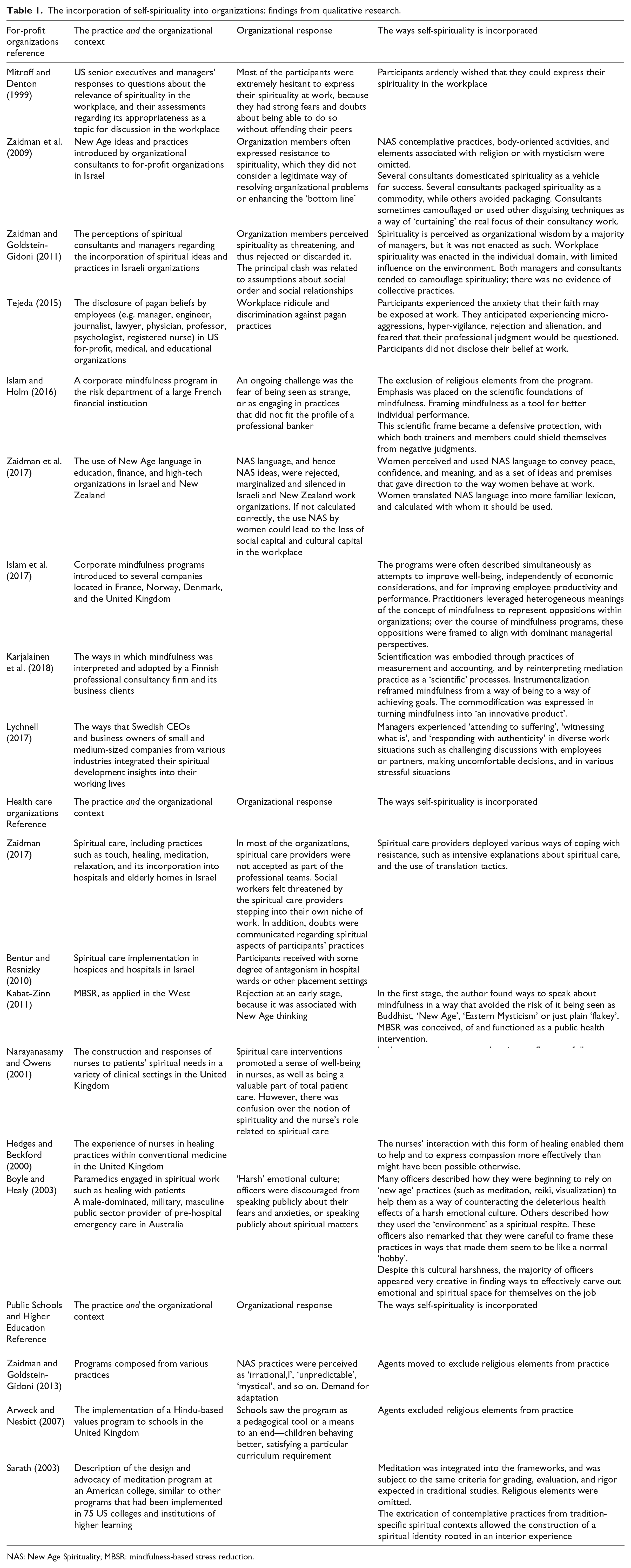
NAS: New Age Spirituality; MBSR: mindfulness-based stress reduction.
In order to overcome the risk of a loss of sensitivity to the context of the research data (Timulak, 2009), Table 1 includes a section about the organizational context; the data are presented according to sectors. When applicable, examples illustrating the particular context of the research were extracted. However, most of the reviewed articles did not provide rich contextual data.
Data analysis
The first stage of data analysis contains a coding process, based on the article’s two research questions (the main codes were ‘organizational response to self-spirituality’; ‘adherence experiences of self-spirituality in organizations’; and ‘the ways self-spirituality is incorporated’). In the context of this study, the term ‘adherence’ refers to someone who supports a set of ideas (Oxford Dictionary of English); it includes both practitioners (who are not permanent full-time employees of the organization) and organization employees. An extended version of Table 1 that included long quotations extracted from the articles, was created. This was followed by a shorter version, which summarized the findings of each article and the presentation of the data, in Table 1. The data in the table give a sense of the language and interpretation used in the surveyed research; for example, terms such as ‘camouflage’, ‘micro-aggressions’, ‘scientific frame’, and ‘responding with authenticity’ are direct quotes from these studies. In this way, the table provides a window to the data (with this article’s author’s classification into sectors, etc.); but at this stage, the data are not ‘colored’ by the critique that informs the current article.
The second stage of data analysis presents a review of the dominant themes across sectors for each of the categories presented in the table. For example, when reviewing the data presented in the category ‘organizational response’, it was clear that self-spirituality created tension, or was rejected in all sectors. In this case, thematic synthesis was applied. Similarly, over the course of multiple reviews of the data presented in the category ‘self-spirituality incorporation’, the theme that emerged was that practitioners across the studies applied similar forms of incorporation (i.e. adaptation and domestication).
Data interpretation and critique
The initial point of departure in the interpretive process is the link (discussed in the Introduction) between self-spirituality and femininity (Sointu and Woodhead, 2008), and data presented in earlier research that demonstrated that women are more likely than men to be engaged with self-spirituality (Heelas and Woodhead, 2005; Houtman and Aupers, 2007; Houtman and Mascini, 2002; Zaidman et al., 2017). The process of interpretation included back-and-forth reading of this literature and the literature on gender relations in organizations; it also included reading and defining the emerging themes from the reviewed research.
Findings and gender-based critique
Organizational response to self-spirituality
As can be seen in Table 1, responses across the sectors to the practice of self-spirituality were mostly negative.
For-profit organizations
Spiritual consultants working in this sector emphasized the resistance they faced when they tried to introduce new ideas and practices (Zaidman et al., 2009). In these organizations, the rejection of self-spirituality was based on the postulation of self-spirituality’s low potential for improving workplace performance (Islam and Holm, 2016; Zaidman et al., 2009; Zaidman and Goldstein-Gidoni, 2011). In addition, there was a clash connected to assumptions of social order and social relationships. Organization members rejected the borderless approach of specific practices (e.g. those that involved self-expressions, or those that threatened the projection of the ‘right’ image at work; Islam and Holm, 2016; Zaidman and Goldstein-Gidoni, 2011). One dominant argument in existing research is the suggestion that this rejection is also based on the common perception that self-spirituality incorporates religious practice (Islam and Holm, 2016; Mitroff and Denton, 1999; Zaidman et al., 2009). This latter view has been also documented in the educational system (Arweck and Nesbitt, 2007; Sarath, 2003; Zaidman and Goldstein-Gidoni, 2013) and in health care organizations (Bentur and Resnizky, 2009; Kabat-Zinn, 2003; Zaidman, 2017).
Studies conducted in health care organizations indicated that spiritual care providers working in hospitals, hospices, and homes for the elderly were excluded from team meetings with their doctor, nurse, and social worker colleagues (Bentur and Resnizky, 2010; Zaidman, 2017). Paramedics who relied on self-spirituality in their work often experienced rejection after exposing these aspects of their professional and personal self in public (Boyle and Healy, 2003). A study exploring the practice of spirituality by nurses reported that the practice of self-spirituality was assessed as being a valuable part of total patient care. Even so, there was confusion within the organizations regarding the notion of spirituality, and the role of nurses in relation to spiritual care (Narayanasamy and Owens, 2001).
In Israeli public (state) schools, various actors perceived self-spirituality practices negatively (Zaidman and Goldstein-Gidoni, 2013). However, more balanced perspectives have been documented. One example is such as a value-based program with spiritual education enshrined as a statutory requirement of mainstream school provision in England and Wales (Arweck and Nesbitt, 2007).
The data about the incorporation of self-spirituality in secular organizations were not limited to tensions articulated rationally about, for example, the effectiveness of self-spirituality (or not), or the need to separate religion from secular organizations. Rather, the data show that the incorporation of self-spirituality in secular organizations often evoked strong negative emotions, fear principal among these. The reviewed articles showed that a person associated with self-spirituality was often perceived by colleagues as ‘strange’, ‘weird’, ‘not serious’, ‘flippant’, or ‘lacking control’ (Zaidman et al., 2017); bizarre (Islam and Holm, 2016); ‘detached from daily, down to earth and normative conduct’ (Bentur and Resnizky, 2009); ‘out of his mind’ (Zaidman and Goldstein-Gidoni, 2011); ‘flakey’ (Kabat-Zinn, 2011); and as ‘dangerous and tainted’ (Tejeda, 2015). Similarly, self-spirituality was perceived as being associated with ‘mysterious’ and ‘dangerous’ qualities, or was stigmatized as associated with ‘cults’ (Islam and Holm, 2016; Kabat-Zinn, 2011; Zaidman et al., 2009; Zaidman and Goldstein-Gidoni, 2016).
The data showed that in certain organizations, self-spirituality was constructed as taboo if not translated into familiar workplace language or practices. When certain behaviors are constructed as taboo in organizations, it means that the leading figures in the clan or tribe are afraid of the dangers associated with it (Kallio, 2007). In the present case, the understanding is that specific aspects or behaviors of the workers who engaged in self-spirituality practices raised fears, and were consequently forbidden. These taboos, according to functionalist researchers, are used to mirror the designs of hierarchy or symmetry, which apply in the larger social system (Douglas, 1966); they are produced to regulate the group, and to prevent the occurrence of certain unwanted or undesired behaviors (Kallio, 2007).
Careful analysis of the data identified three interrelated clusters of self-spirituality premises, language, and practices that had been constructed as taboo in the workplace. The three clusters are expressing emotions or nonrational behavior; approaching the body as a genuine aspect of the self; and, to a lesser extent, attempting to establish equal relations in the workplace.
There is a wealth of evidence demonstrating that employees are not free to express emotions or feelings in the workplace; this is especially the case in for-profit organizations (Islam and Holm, 2016; Mitroff and Denton, 1999; Zaidman et al., 2009, 2017), but is also so in health care organizations (Boyle and Healy, 2003). Furthermore, contemplative practices associated with self-spirituality (meditation exercises; workshops involving body-oriented activities or elements of touch between the participants; and forms of expressive activities such as voice exercises or movement, to list three examples) were excluded from the workplace (Zaidman et al., 2009). Similarly, in public health institutions, spiritual care that facilitated diverse ways of communicating with patients (e.g. touch, healing, meditation; Zaidman, 2017), and the use of energy to heal patients (Hedges and Beckford, 2000) were often treated as suspect.
Our data show that in certain organizations, the ‘taboo’ behavior upsets the patriarchal social order, threatening the male-centered worldview, and its focus on rationality. One illustrative example of femininity and spirituality bound together in a masculine organization was presented in Boyle and Healy’s (2003) study. Within the organization analyzed in this study, there was no legitimacy for paramedics to express emotions or to use spiritual practices in the course of their work practice. The authors argued that the organization denied the existence of ‘feminine’ forms of emotionality, as well as any form of spirituality—but at the same time was highly dependent upon it.
As discussed earlier, existing research has long showed that traits associated with masculinity—in this case, rationality and functionality—are treated in organizations as taken-for-granted, whereas traits defined as feminine are framed as ‘other’ (Buzzanell, 1994; Mumby and Putnam, 1992; Ross-Smith and Kornberger, 2004; see also Abbott, 1988).
These organizational principles fundamentally differ from the underlying premise of self-spirituality—that the individual should dig beneath the conscious mind and rationality in order to discover the deep and authentic self, through the exploration of emotions, imagination, the body, and so on. These principles also deviate from the main characteristics of spirituality, in which qualities such as caring, gentleness, the inclination to touch, and the expression of emotions are valued (qualities which, according to Keshet and Simchai (2014) and Sointu (2011), are designated as ‘feminine qualities’). Self-spirituality further suggests an alternative agenda of social order and social relationships, founded on the erosion of social boundaries and hierarchies—a course of action which organizations reject (Islam and Holm, 2016; Zaidman, 2017; Zaidman and Goldstein-Gidoni, 2011).
Overall, there is evidence showing that the taboo on the expression of emotions and physical expressivity, or the taboo on practices that upset the existing social order, are a fundamental aspect of for-profit organizations. These taboos mirror the superiority of masculine values and patriarchy, and serve to regulate the hierarchy of values and power in the organization. However, when constructed in state-run schools, these taboos instead relate to various contemplative practices, expressing the concern that children may be at risk of being brainwashed. In this case, the taboos mirror attempts by parents and educators to guard and control young children (Zaidman and Goldstein-Gidoni, 2013).
The ways in which self-spirituality is incorporated into organizations
The classification presented below, of the modes of incorporation of self-spirituality in organizations, is based on two criteria identified after several readings of the data: (a) the way self-spirituality ideas and practices are framed vis-à-vis the organization, including an assessment of whether self-spirituality ideas and practices have been translated, domesticated, and so on, and in what way; (b) the extent to which self-spirituality ideas and practices are directed toward encountering the organizational public sphere.
The ‘masculine’ mode
In the main, the surveyed studies documented attempts made by practitioners to incorporate self-spirituality within organizations, in what one can describe as a ‘masculine’ mode of incorporation.
One example of incorporating self-sufficiency in this mode is the exclusion of religious elements from self-spirituality practice in the organizational setting (Arweck and Nesbitt, 2007; Sarath, 2003; Zaidman and Goldstein-Gidoni, 2013). Two studies described attempts to not only to omit religious elements from programs but also to construct self-spirituality practices as universal, transcending cultural and religious frameworks (Arweck and Nesbitt, 2007; Sarath, 2003). Religious elements of self-spirituality were also ‘left behind’ when introduced to medical institutions (Kabat-Zinn, 2003; Zaidman, 2017) and for-profit organizations (Islam and Holm, 2016; Zaidman et al., 2009).
Attempts were also made to align self-spirituality with existing organizational values, through translating it into a functional, rational, and scientific product. Specifically, practitioners constructed spirituality principally as a means to ends; as a technique that could be used for instrumental, financial-centered ends; and as a tool for increasing competitiveness, effectiveness, productivity, and profit in organizations (Islam et al., 2017; Islam and Holm, 2016; Kabat-Zinn, 2011; Karjalainen et al., 2018 Zaidman et al., 2009).
One example of this mode of incorporation is mindfulness meditation. A practice originating in Buddhism, mindfulness has been integrated into various settings as an approach to self-care and patient education, and as a method of coping with stress, pain, and chronic illness. It is offered as a self-care remedy in hospitals and clinics around the world, as well as in schools, workplaces, and a range of other settings (Kabat-Zinn, 2003). Several studies have documented the enactment of mindfulness programs in for-profit organizations in Europe (Islam et al., 2017; Islam and Holm, 2016; Karjalainen et al., 2018). The surveyed studies show that mindfulness meditation was presented as a tool for effectiveness, and for improving employee productivity and performance. Certain benefits, including stress relief and enabling employees to adopt a new outlook, were framed as individual benefits; however, trainers and participants linked them back to organizational needs (Islam and Holm, 2016). Islam et al. (2017) documented the strategic moves that this shift in perspective entailed. These included heterogeneous interpretations of the programs—now presented simultaneously as improving well-being, and also improving employee productivity and performance. The introduction and implementation of these programs involved the application of a scientific framework, which served as a shield against rejection (Islam and Holm, 2016). Karjalainen et al. (2018) described three distinct adaptation processes. The first presented mindfulness as a system and source of knowledge that aligns with models of empirical science, especially quantitative psychology and neuroscience. With the second, mindfulness is linked to instrumentality, adopting a practice orientation that promises increased efficiency and the ability to work longer and harder. With the third, mindfulness is framed as an object of economic exchange, a source of profits, innovation, or competitive advantage.
Another study documented how spiritual consultants introducing self-spirituality into for-profit organizations tended to use language focusing on the economic value of their practices. In marketing texts, and especially on their websites, consultants generally employ a ‘utilitarian vocabulary’. They often referred to practicality, or describe spirituality as a ‘tool’ for ‘impact’, ‘efficiency’, ‘results’, ‘economic clarity’, or ‘applicability’ (Zaidman et al., 2009).
In a similar vein, practitioners responsible for the introduction of various self-spirituality programs into state schools in Israel have attempted to convert it into a functional, scientific, or rational product. On promotional websites, they tended to incorporate discursive elements that framed spirituality and spiritual practices as ‘tools’ capable of enhancing aspects of school life (e.g. reducing violence) and pupils’ capabilities (e.g. learning ability, academic achievement). Scientific reasoning has also been deployed by these practitioners to legitimize the worth of spiritual practices in achieving these desired ends (Zaidman and Goldstein-Gidoni, 2013).
In summary, practitioners select and further translate self-spirituality practices, with the intention of molding them into a recognized form of knowledge, suitable for introduction into a particular organizational setting. In this mode, self-spirituality is often converted into a rational and instrumental product, at all times detached from religion (Islam et al., 2017; Islam and Holm, 2016; Zaidman et al., 2009). These attempts often involve turning self-spirituality into a form of recognized capital, by framing it in terms of economic, utilitarian, and/or scientific discourse. Practitioners used ‘domestication’, intensive explanations and framing oppositions to align with dominant managerial perspectives, in conjunction with other techniques, during the process of implementation (Islam et al., 2017; Zaidman, 2017; Zaidman et al., 2009). One example of a domestication process is detailed in Zaidman et al.’s (2009) study of the work of spiritual consultants in for-profit organizations. The consultants applied attentive processes of selection and reframing of ideas before introducing them to the organizations they were advising. Several consultants introduced a fully prepared ‘package’, presenting spirituality as a vehicle for material success; others used more elaborate techniques to first conceal, and then later gradually reveal, the spirituality element of their consultancy.
In summary, this ‘masculine’ mode involves attentive attempts to incorporate self-spirituality into organizations by actively encountering organizational resistance, with the goal of fitting it into the organizational public domain. This mode is characterized by aligning self-spirituality with masculine organizational values (Acker, 2006; Buzzanell, 1994; Kerfoot and Knights, 1993; Ross-Smith and Kornberger, 2004).
The feminine mode
Several of the studies surveyed showed that self-spirituality adherents perceive self-spirituality as empowering; as a source of self-confidence, direction, and meaning; and as a useful outlook to adopt in the work domain (e.g. Arweck and Nesbitt, 2007; Boyle and Healy, 2003; Hedges and Beckford, 2000; Kabat-Zinn, 2003; Mitroff and Denton, 1999; Narayanasamy and Owens, 2001; Sarath, 2003; Zaidman et al., 2017; Zaidman and Goldstein-Gidoni, 2011). The data also show that self-spirituality adherents are hesitant—or even afraid—to disclose their involvement with self-spirituality at their workplaces. Many employees working with for-profit organizations avoided being publicly associated with spirituality, fearing their colleagues’ responses. A few described their feelings as a combination of embarrassment, shame, and humiliation. Pagans reported a sense of anxiety about their faith being disclosed; bankers reported the fear of being seen as bizarre; senior managers expressed fears of the potential abuse of spirituality if it were to be disclosed, and the fear of offending others (Islam and Holm, 2016; Mitroff and Denton, 1999; Tejeda, 2015; Zaidman and Goldstein-Gidoni, 2011).
Several studies have reported on the ways in which individuals dealt with self-spirituality at work. However, several other studies reported that self-spirituality adherents do not disclose their spirituality at work (Mitroff and Denton, 1999; Tejeda, 2015; Zaidman et al., 2017). Another study documented how employees presented their involvement with spirituality as merely a ‘hobby’ (Boyle and Healy, 2003).
Within this mode, it is possible to distinguish between two ways of incorporating self-spirituality. The first is when women (and men) do not expose their beliefs, I call the ‘feminine-intrinsic’ mode; and the second, when exposure is dependent on the situation, I call the ‘feminine-context bounded’ mode.
The ‘feminine-intrinsic’ mode
The ‘feminine-intrinsic’ mode of self-spirituality incorporation describes a situation when self-spirituality is experienced as empowering, directing the behavior of adherents at work. This intrinsic dimension often presents as individual wisdom; a process in which individuals integrate affective, cognitive, and reflective aspects of their personality, in response to occupational tasks and challenges (Ardelt, 2004). Such wisdom, emerging from self-spirituality, can advance the employee’s workplace position. However, given its exclusion from the public domain, it does mean that in this mode, self-spirituality is publicly controlled and marginalized. Consequently, self-spirituality adherents—primarily women—suppress the public expression of their own ways of knowing, their thoughts, beliefs, feelings, intuitions, language, and so on For instance, data collected in New Zealand and Israel demonstrate that women perceive and use self-spirituality language at work in three interrelated ways. First, women experience self-spirituality language as providing positive psychological effects; second, women perceive this language as a source, adding meaning to their actions and efforts; and third, women use self-spirituality as a set of ideas and premises that give directions regarding the way they behave at work. But despite these positive effects, women tended not to explicitly use self-spiritual language at work. As one explained, ‘there is no “social permission” for it at work’. As a result, in encounters with colleagues and managers at work, women often used self-spirituality language as self-talk, or translated it to a more familiar—and contextually ‘appropriate’—language (Zaidman et al., 2017).
Another study showed that managers working in for-profit organizations attested that spirituality improved awareness at work, enhanced communication, and reduced stress. In their accounts, the managers discussed spirituality as an ‘inner change’—a process that reflected deep transformation rather than mere surface adjustment. However, managers engaging with spiritual practices in the organization’s public domain ran the risk of experiencing negative emotions, including shame and a negative impact on their workplace image. As a result, they elected to engage in their spiritual practices privately and to conceal involvement from colleagues (Zaidman and Goldstein-Gidoni, 2011).
Within this mode, the behavior of self-spirituality adherents resembles the experience of—to pick a pertinent example—women in academia. Like self-spirituality adherents, women academics are often obliged to abandon their own experience of the body, and instead must make it fit with the requirements represented by the male dress codes of organizations, which tend to suppress the physical self (Fotaki, 2013; Mumby and Putnam, 1992). But unlike these women, who become the de-subjectivized embodied ‘other’ in their own perception, self-spirituality followers might experience empowerment, due to their capacity to draw from self-spirituality sources (Keshet and Simchai, 2014; Zaidman et al., 2017).
A different example, albeit limited in its contextual information, is Lychnell’s (2017) study, which described how participants apply spiritual knowledge drawn from a Buddhism-based meditation program when facing difficult situations at work. The practices include focused attention, and the nonjudgmental focus on one’s own thoughts, feelings, and physical sensations. This contributed to an experience-based acceptance, allowing room for several perspectives of the challenge. This often freed the individuals to respond to challenging workplace situations with authenticity.
The ‘feminine-context-bounded’ mode
The ‘feminine-context-bounded’ mode of self-spirituality incorporation relates to situations that demand walking the line between the concealment and the exposure of adherents’ choices. Similar to data reported elsewhere about the exposure of religion and spirituality in the workplace (Lips-Wiersma and Mills, 2002), the exposure and use of self-spirituality is primarily through the actions of individuals (both practitioners and employees), and is dependent on the person, the organizational setting, the particular situation, and so on. For example, some spiritual consultants adopted elaborate techniques to conceal self-spirituality, the gradual exposure of their self-spirituality practices contingent upon their clients’ and their own personal interpretations of the setting (Zaidman et al., 2009). Women employed in various organizations attested to using spiritual language during coffee breaks (but not during official work hours); with their colleagues (but not with their superiors); with other women (but not with men); and with close friends at work (but not with other colleagues). They also translated self-spirituality language into more familiar lexicon (Zaidman et al., 2017). Paramedics in particular presented as adept and creative in carving out emotional and spiritual space for themselves on the job. Their reliance on spiritual resources to balance their emotions during a work shift often depended upon the quality of the relationship with a work partner and on the colleague’s spiritual orientation (Boyle and Healy, 2003).
In this mode, self-spirituality knowledge affects a narrow aspect of the organizational public domain. This often takes a form of an ‘isolated space’, within which adherents can safely enact their spirituality within the organizational setting. For example, spiritual care providers challenged the conventional norms of interactions with patients in a number of ways. They met with them in unconventional locations and timetables. They sometimes also elected to ‘travel’ with patients to imaged places and times, focusing on the subjective patient experience. In this way, and despite organizational opposition, they were able to work with patients by creating a ‘bubble’, detached from the external organizational culture (Zaidman, 2017). Another example can be seen in the case of a manager of a cosmetic shop in Israel. She used self-spirituality language in interactions with her workers in the shop, but not with her managers, suppliers, or with the company’s headquarters’ administrators. She created an isolated territory—the shop—in which the workers (all women) accepted this language and some self-spirituality practices. She explained that the language helped resolve conflicts between workers, and improved the workplace atmosphere (the shop) such as to attract clients (Zaidman et al., 2017). Finally, in describing ‘healing’ activities in a hospital, Hedges and Beckford (2000) argued that these cut across the banal associations that characterized rationalized and bureaucratized health care. This process, they argued, created opportunities for the expression of values such as love and compassion, albeit within the ambit of a professional ethic of nursing care. Hedges and Beckford (2000) argued, through a mutual turning-in relationships between healer and patient, as well as between healer and patient and the source of healing energies, there is a blurring of the boundaries between selves which, as an inter-subjective construction of transcendence, may bind people together. (p. 187)
Summary and conclusion
The enactment of self-spirituality in Western organizations, whether by practitioners or by self-spirituality adherents employed by organizations, often evokes experiences of tension or objection. The basic premises of self-spirituality culture are concerned with the authentic self (Taylor, 2007), and the means of exploring this self (via contemplative practices, expression emotions, etc.); the emphasis on the individual’s awareness of his or her body, thoughts, and feelings is, in fact, a manifesto of the legitimate sources of ‘knowing’ at work, and about the ways to act based on this ‘knowing’. This premise is radically different from rationality as a fundamental principle of knowing and organizing (Kanter, 1977; Morgan, 1977; Ross-Smith and Kornberger, 2004). Self-spirituality further proposes an alternative to workplace relationships, an alternative based on a radical equality that overrides existing boundaries of social order and competition. I argue that these perceptions are embodied in gendered power relations—the relationship between the feminine self-spirituality (Heelas and Woodhead, 2005; Houtman and Aupers, 2007; Houtman and Mascini, 2002; Sointu and Woodhead, 2008; Zaidman et al., 2017) and the masculine secular organizations (Buzzanell, 1994; Mumby and Putnam, 1992; Ross-Smith and Kornberger, 2004). From this perspective, the incorporation of self-spirituality in secular organizations is the story of the attempts by the feminine self-spirituality, in the main enacted by women, to face down taboos and to establish an alternative presence in masculine secular organizations.
The study supports previous research showing how deeply certain masculine ways of knowing (e.g. rationality) and relationships (patriarchy, competition) are embedded in organizations (e.g. Buzzanell, 1994; Ross-Smith and Kornberger, 2004). The study, however, contributes further to existing research by identifying modes of incorporating the feminine self-spirituality into masculine organizations.
Two main modes of incorporation have been identified in the present study. The first is the ‘domesticated masculine mode of incorporation’, within which self-spirituality is not only stripped of its religious elements but also has its spiritual core significantly transformed. Within this mode of incorporation, the language and practices of self-spirituality rarely refer to abstract concepts such as a person’s ‘higher power’, or to interconnectedness among people, or to interconnectedness between people, the environment, or other entities. Like the feminism which is constructed in mainstream media discourse, attempts are made (mainly by practitioners) to domesticate self-spirituality, aiming to secure ‘a legitimate space’ via the repudiation of an ‘excessive’ feminism (Dean, 2010: 394). The domestication described by Dean (2010: 394) refers to a process in which the ‘wildness’ and unpredictability of feminism is curtailed, thus rendering it less threatening, and more amenable to the hegemonic gender regime—a process similar to the exclusion of religious or mystical elements from self-spirituality practices. However, it would appear that the domestication process of feminine self-spirituality in for-profit organizations (for which existing research provides richer data, compared with the data available from other sectors) takes an additional step toward the hegemonic masculine mainstream. Based on the surveyed research, one can safely argue that self-spirituality does not challenge functionality, rationality, and masculinity. Rather, it is presented as a ‘joining force’ in achieving these organizational values.
While self-spirituality in its domesticated masculine mode of incorporation does not challenge organizational values, the ‘feminine’ modes of the incorporation of self-spirituality can be evaluated as exactly the opposite. Within the two feminine modes of incorporation, the practices at the core of the culture of self-spirituality tend not to be radically transformed. Hence, one can argue that these modes of incorporation present as a revolutionary alternative to organizations.
As for the viability of these modes of incorporation for creating change, self-spirituality in its domesticated masculine mode of incorporation appears to align itself with organizations public domain. In contrast to this, the reviewed research showed that in practice, these two ‘feminine’ modes of incorporation create the possibility for self-spirituality to be lived by individuals as an ‘individual wisdom’. Self-spirituality is perceived and practiced as a source of direction, meaning and empowerment for employees in the workplace, and it can assist women and men to cope with work challenges (Boyle and Healy, 2003; Lychnell, 2017; Zaidman et al., 2017). Occasionally, often accompanied by some degree of translation, adherents may act out their beliefs or practices, with an impact on their patients (Boyle and Healy, 2003; Hedges and Beckford, 2000; Narayanasamy and Owens, 2001; Zaidman, 2017) colleagues and customers (Zaidman et al., 2017).
Overall, this article’s findings present a considered response to recent positions contending that one should seek alternative ways of interpreting women’s experiences in organizations, in terms of variation, complexity, and contradiction (Lewis, 2014). Despite the dominance of rationality and other masculine traits in organizational discourses and practices (Ross-Smith and Kornberger, 2004), this study demonstrates that certain feminine (not domesticated) aspects of self-spirituality are active within organizations, and that they coexist with women’s (and men’s) experiences of its silencing. These aspects of self-spirituality femininity can assist women and men in coping with the ‘masculine’ organization (e.g. Boyle and Healy, 2003; Zaidman, 2017).
The above presentation of the modes of self-spirituality incorporation into organizations can be legitimately criticized as limited in scope. Future research can seek to identify the aspects of self-spirituality culture that do exist in its original form within the ‘domesticated masculine mode of incorporation’ and, however, what conditions enable employee acts of agency regarding the enactment of (undomesticated) self-spirituality in organizations. Second, this study does not elaborate on the sociological, psychological, philosophical, or ethical issues which might be associated with the incorporation of self-spirituality culture into secular organizations. These, and other topics, should be examined with the specific characteristics of the different sectors taken into account.
Beyond the proposed analysis of the incorporation of self-spirituality into organizations, the study contributes to existing organizational research by reviewing the conceivable venues that organizations ‘allow’ for alternatives to be incorporated. Certain assumptions can be deduced from this study with regard to the analysis of future research about the incorporation of similar (i.e. quite radical) alternative models for organizations. First, an alternative can be incorporated in a ‘domesticated’ form of the new wisdom, one that fits with the organization’s principal values. Second, an alternative organizational wisdom can be incorporated, depending on particular organizational context (e.g. people, time, and activities). Third, one possible form of incorporation is the creation of a bubble of this new wisdom within the unfavorable culture of the ‘hosting’ organizations.
