



Abstract
This paper examines how the neoliberal injunction to be authentic as addressed to working women operates at the level of the individual. Drawing on Foucault’s framing of self-construction, the paper conceptualizes the quest for the authentic feminine self as a technology of the self which enables women to work upon transformation of their subjectivity to attain a state of authenticity. The developed conceptual framework is applied in an in-depth structural and content analysis of work-life narratives of authenticity related by women training and development professionals. These narratives are a part of the field material collected during a two-year ethnographic study of the sector. Derived from theoretical and empirical analysis, the paper develops the notion of postfeminist technologies of authenticity which demonstrate the quest for the authentic feminine self as aligned with postfeminism, a neoliberal sensibility under which individualized and retraditionalized notions of femininity are constructed. Authenticity is therefore shown as a gendered form of control which works upon women’s self-construction in regressive ways contributing to the reproduction of gendered work, organizations, and power relations.
Introduction
This paper focuses on an examination of how authenticity works upon self-construction in gender-specific ways in the context of the neoliberal organization. The yearning for living an authentic life has emerged as a contemporary pursuit (Erickson, 1995), not limited to discourses relevant to private life, but also witnessed in those relevant to life in organizations (Brown, 2015; O’Brien and Linehan, 2019). Exploring the organizational manifestation of this cultural trend, this paper highlights a variation of the authenticity discourse that encourages women to seek and perform their “authentic self” so as to “improve their work performance.” Recent critical organization studies of authenticity have demonstrated how the pursuit of authenticity at the workplace has morphed into a form of managerial discourse, aligning workers’ self-formation with organizational interests while simultaneously giving them a false impression of autonomy and agency. Authenticity as such is incorporated into regimes of identity management (Fleming, 2009; Fleming and Sturdy, 2009, 2011; Tracy and Trethewey, 2005). The aim in this paper is to extend the critical debates on the relevance of authenticity to organizational life through an examination of the hitherto unexplored gendered aspects of this mode of identity management as they impact women’s self-construction. This focus is grounded in a two-year ethnographic study of management training and development practices in Sydney and Melbourne, Australia. These practices included an ongoing set of interventions which focused on experiences of authenticity in relation to organizational life and were exclusively targeted at, and enthusiastically welcomed by, women.
But what do we know about the organizational call to “Be Yourself!,” when it is specifically addressed to women, and the response it evokes? Critical gender and organization studies report that the social and organizational discourses concerning the self and its improvement are predominantly targeted at women (Gill et al., 2017; Kelan, 2009; Lewis et al., 2017). In this literature, the contemporary interest in women’s self-development—or in Gill’s (2007) terms, “a makeover paradigm”—is linked to the influence of a postfeminist sensibility (Banet-Weiser et al., 2020; Gill, 2007, 2017), a notion which reflects the dominant themes and ideas about the patterning of gender, femininity, and feminism under neoliberalism (Baker and Kelan, 2019; Dean, 2010). Gill (2017: 618) argues that the postfeminist injunction to reinvent oneself has now become hegemonic, but it is ever increasingly operated on construction of feminine subjectivity, as women—to a much greater extent than men—are called to “ongoing vigilance and self-scrutiny,” so as to “work on” and “transform their selves.”
This postfeminist operation of the self signifies the contemporary neoliberal mode of “self-management” (Grey, 1994) through which individuals as “entrepreneurs of the self” relate to themselves as if they were an enterprise (Rose, 1990). Such entrepreneurial subjects “compete with the self, and not just with others” (Scharff, 2015: 108) and thus are engaged in continuous self-discipline and self-regulation to improve themselves (Munro, 2012). Women are particularly subject to such self-improvement to achieve “empowerment,” a tenet of contemporary postfeminism which conditions women’s emancipation to their work on the self (Gill and Scharff, 2011; McRobbie, 2009) and achievement of individual change (Lewis et al., 2017). Women’s search for authenticity thus can be understood as an effort in emancipation, and a part of the recent “postfeminist turn” to “the qualities and dispositions—for example, confidence, resilience, a positive mental attitude—needed to survive and thrive in the current moment” (Banet-Weiser et al., 2020: 6).
The current postfeminist moment is, however, characterized by contradictory pictures of women’s empowerment. We witness an upsurge of feminism (Fotaki and Pullen, 2023), whilst official reports and figures show a recent erosion of “women’s material and socio-political emancipations” (Lombardozzi, 2020: 318) and an exacerbation of gender inequality (Fotaki and Pullen, 2023). Similarly, in the context of work, systemic inequalities and sexism continue to persist (Pullen and Vachhani, 2021) despite the significant increase in policies and practices concerning equality, diversity, and inclusion (Adamson et al., 2021; Tyler and Vachhani, 2021). Such contradictions have been attributed to neoliberal mechanisms which limit the emancipatory aspects of feminist strivings and equality projects by their dissociation from the radical stance of the “older, welfarist, collectivist feminism of the past” (McRobbie, 2015: 4) in favor of new, corporate-friendly, and individualist feminisms, examples of which have emerged in bestseller manifestos of Meta Platforms’ COO, Sheryl Sandberg, and entrepreneur turned billionaire executive head of Nasty Gal, Sophia Amoruso.
These new and complex neoliberal mechanisms of discrimination work at the level of subjectivity and through self-management (Lewis et al., 2017). We need to further investigate these newly emerging inequality mechanisms (Amis et al., 2021) and the way they work on construction of women as subjects under neoliberalism (Gill, 2017). An ethical case is put forward for organization studies to form a deeper understanding of how on a subjective level “women manage the effect of neoliberalized organizational systems and cultures that continue to exclude them from equal opportunities” (Baker and Kelan, 2019: 71).
In this paper, I address these calls by exploring the way women relate and respond to the gendered address of the neoliberal organization that invites them to be authentic. Such critical examination of women’s subjective experiences speaks to the ethical responsibility outlined above by revealing the subtle ways in which authenticity works as a gendered form of self-management in the context of work. Through conceptual and empirical analysis, the paper develops the notion of postfeminist technologies of authenticity to identify the mechanisms of this gendered form of organizational control.
The paper begins with an overview of the critical studies of organizational discourses of authenticity. To understand how authentic femininity is made sense of and experienced at the level of the individual and the impact of such sensemaking, in the following section of the paper, I begin a two-step process of developing a conceptual framework. First, I will draw on Foucault’s (1988) formulation of technologies of the self, which are techniques through adoption of which individuals “act upon themselves” to reach what they perceive as an improved state of being. This framework helps understand how authenticity is put to work in women’s self-construction through intertwined practices of self-examination (through which they identify their self-choices) and self-governance (through which they consent to seek a unified and authentic feminine self). Next, drawing on a Foucauldian view of self-construction (Foucault, 1977, 1988, 2000, 2003), it is argued that such operations of the self in search of authentic femininity are situated within postfeminist technologies of power which influence the way women make sense of, and form, themselves as gendered subjects. Therefore, in the section that follows, postfeminism is discussed to establish the outlines of postfeminist technologies of authenticity. These are defined in this paper, as techniques of the self, invoked by postfeminist apparatuses of power, which women impose upon themselves when they seek authentic femininity. With this conceptual framework, I will explore my empirical study data comprising of an in-depth structural and content analysis of work-life narratives of Australian women training and development professionals produced through a two-year ethnographic study of the sector. A description of the study, and an outline of the adopted narrative approach (based on Czarniawska, 2004) will then be provided, followed by the narrative analysis which helps reveal examples of postfeminist techniques of authenticity articulated by the interviewees. The paper concludes that despite its emancipatory connotations, the quest for the authentic feminine self is not a value-neutral technology of the self, but one that is aligned with postfeminism, thus contributing to reinforcement of gender inequalities in organizations and society.
Emergence of managerial discourses of authenticity
The search for the “genuine,” “true” and “authentic” has emerged as a contemporary organizational trend. It has been reported that in work settings people talk about, and search for, their authentic selves (Westwood and Johnston, 2012; Ybema et al., 2009) and that authentic displays of the self are expected of organizational actors (O’Brien and Linehan, 2019; Whittle, 2021). It has been argued that workers expect to find and express an imagined authentic self in the private sphere, where the corporate colonization of selfhood is believed to cease (Costas and Fleming, 2009; Ybema et al., 2009). The sustainability of such a fantasy of authentic selfhood has, however, been questioned. The organization members’ evocation of the private authentic selves is grounded in the liberalist distinction between the private and the public spheres of life (Casey, 1995). We are told by the commentators of neoliberalism however, that within the new politico-economic order, the public and the private are becoming increasingly realigned (Kingfisher and Maskovsk, 2008). Workers are ever more confronted with the reality that even those private reserves of selfhood, formerly imagined as authentic and outside of power, are subject to the constitutive forces of the enterprise discourse (Du Gay, 1996).
Fleming and Sturdy (2009, 2011) note the emergence of managerial discourses of authenticity illustrated by a discourse of “just be yourself!” which actively encourages employees to expressions of backstage private selves at work. Such managerial discourses break the traditional work-non-work boundary and become a means of identity management which surreptitiously and ironically “absorbs more of the employees’ selves into the regime of production” (Fleming, 2009: 8). Such discourses are shown to limit the authentic expressions of self only to “safe” work life matters, for example, expressions of lifestyle and consumerist choices such as hobbies, hairdo, and clothing, while excluding behavior that could jeopardize corporate interests (Fleming and Sturdy, 2009).
Similarly, Tracy and Trethewey (2005: 176)’s critical analysis of the “real-self versus fake-self” discourse—enacted widely in cultural, organizational, and even academic circles—provides an enlightening picture of how this discourse of authenticity is put to work in individuals’ self-construction processes in (and out of) organizations as it creates a “real” versus “fake” self dichotomy. Organizationally approved entrepreneurial and careerist subject positions are then normalized as the more “real” self-choices while subject positions which do not serve the organization are dismissed as fake. The employees are thus driven to choose their “real” self from amongst these identities which help secure organizational interests rather than those of the individual, “a process that produces an organizationally defined self that [however] comes to be understood and experienced as real and of one’s own choosing.” Therefore, through enacting such a discourse of authenticity, and through their pursuit of the “real” self, employees become the instrument of their own identity management and control on behalf of the organization.
A similar invitation to enactment of the “authentic self” emerged as a distinctive managerial discourse in my two-year study of Australian corporate training and development. As noted earlier, this call to authenticity is distinctive from those previously investigated, in its explicit address to women (and never men) and represents a gendered manifestation of such organizational discourses of authenticity. The aim of this paper is to further examine how the gendered call to be authentic in the work context is put to operation by women in their efforts for construction of notionally authentic feminine selves. A Foucauldian theory of self-construction will help with the conceptual framing of this inquiry.
On self-construction: Technologies of the self and technologies of power
Foucault added the concept of technologies of the self as the final part of his lifelong historical research on how “humans develop knowledge about themselves” (1988: 18) and as such, turn themselves into subjects (following the Cartesian logic of cogito, ergo sum, identifying the self with consciousness). He added this notion to take individual agency into account in an otherwise deterministic process of self-construction he had formerly envisaged. In his initial framework, the self was seen to be constituted through exposure to multiple “technologies of power,” which are discourses, techniques, and apparatuses that prove most effective—in a specific moment of history—in organizing the power relations and sets of meaning in which people inscribe themselves (Foucault, 1977; Tracy and Trethewey, 2005). Technologies of power “determine the conduct of individuals and submit them to certain ends or domination” (Foucault, 1988: 18) and shape the way they make sense of the world as well as their own subjectivity (Evans and Riley, 2015).
Foucault’s later formulation of technologies of the self enabled a departure from conceptualizing individuals as docile, disciplined, and regulated subjects who are passively formed by the technologies of power and domination (Gill and Orgad, 2015). As Skinner (2013: 918) suggests “technologies of the self provide an intervention mechanism on the part of active subjects . . . alleviating the determinist effect that technologies of power would have otherwise.” The Foucauldian subject is as such “self-constituted through technologies of the self” (Bandol, 2015: 74). These are practices which operate through two interrelated mechanisms both conducive to obtaining self-knowledge: first, self-examination techniques through adoption of which individuals “are led to observe, examine, interpret, and recognize themselves” in relation to historically contingent technologies of power (Foucault, 2000: 461). Technologies of the self thus provide an account of self-construction which “suggests that agency is enacted through the ability to self-reflexively adopt a discourse from the available discourses” (Evan and Riley, 2015: 44) for purposes of making sense of the self, or as Foucault suggests becoming “a legitimate subject” by obtaining knowledge about the self (2000: 459).
In addition to entailing this mode of self-reflective interaction with oneself, technologies of the self constitute a form of power—a “domination” of the individual by her/himself (Foucault, 1988, 2003)—and work as techniques of self-governance through which individuals come to exercise power upon themselves (Rose, 1990). Power is productive in Foucault’s view in that the individual is after all seen as “a power effect” (2003: 45). One’s relationship with oneself is also situated within power. To acquire self-knowledge, Foucault argues, one is required to engage in specific modes of self-governance. These encompass certain forms of ascetic “self-activity” or “practices of the self” through which people conduct their own self-conduct (2020: 28). Such self-activity includes training and modification of, not only one’s skills, but also one’s “attitudes” as it involves a transformation of the self. In Foucault’s terms: “Technologies of the self permit individuals to effect by their own means or with the help of others a certain number of operations on their own bodies and souls, thoughts, conduct, and way of being, so as to transform themselves in order to attain a certain state of happiness, purity, wisdom, perfection, or immortality.” (1988: 18)
Technologies of the self, in other words, comprise of certain practices with which individuals examine themselves (self-examination) and act upon themselves (self-governance) to reach, what they perceive as, a more elevated state of being (Foucault, 1988, 2003, 2020).
These practices “are nevertheless not something that the individual invents by [her/] himself” (Foucault, 2003: 34), but are produced through historically and culturally specific technologies of power (Gill and Orgad, 2015). The technologies of the self are thus, in Foucault’s theorization of self-construction, closely connected to technologies of power, and can be studied through an investigation of practices of examination and domination of the self, which when probed, reveal the history of how one reflects on and acts upon oneself (1988).
Applied to the topic of this paper, I argue, that one gains a better understanding of how the gendered organizational discourse of authenticity is operationalized at the level of the individual woman, that is, how women adopt it, interpret it, and respond to it, if their pursuit of authenticity is conceptualized as a technology of the self. This will open an analytical space for examination of how working women by their own means engage in practices conducive to examination and governance of their thoughts, feelings, impressions, and identities to transform the self and reach a state of authenticity.
In defining authenticity, I draw on Calhoun’s (1995) formulation of reaching integration and unity from a state of fragmentation and multiplicity. Following this definition, to attain authentic feminine selves, women effect self-examination practices which trigger a reflexive consideration of their state of multiplicity and contestation. This involves first, examining and navigating through available conflicting feminine subject positions; and second, the individual’s consent to resolve the tension between the incompatible possible selves so as to produce a unified “true self.” These consensual self-examination and self-governance practices in pursuit of authentic femininity are not invented by the individual women, nor are they arbitrarily produced (Gill and Orgad, 2015); rather, they are contingent on the wider technologies of power related to gender and femininity, the contemporary rendition of which, has been noted in the recent emergence of postfeminism.
On postfeminist technologies of power
The postfeminist sensibility reflects the contemporary set of circulating beliefs, images, and meanings around gender and femininity. Postfeminism therefore represents the neoliberal commonsense about gendered subjectivity (and practice) in ways that appear as normal and ordinary in people’s interpretive repertoire (Banet-Weiser et al., 2020; Gill, 2007). Postfeminism thus formulated is a cultural phenomenon with constitutive effects enacted by “a governance dimension” that influences how neoliberal gendered subjects are produced through “the active shaping and regulating of bodies and subjectivities” (Lewis et al., 2017: 215). As such, for the analytical purposes of this paper, postfeminism is reframed as a dominant neoliberal technology of power on gender that, in turn, shapes how contemporary individuals gain knowledge about themselves as (and become) gendered subjects. Reformulated as a technology of power on gender, postfeminist discourses, their corresponding systems of meaning and apparatuses of power, produce technologies of the self through adoption of which our gendered conduct, and our understanding of who we are as gendered subjects, are formed.
Of postfeminist technologies of power, individualization and retraditionalization will be discussed—as they prove most helpful to the later empirical analysis of women’s narratives of authenticity—to reveal the ways in which they are constitutive of gendered operations of the self under neoliberalism.
On individualization and retraditionalization
In postfeminism the neoliberal emphasis on individualism is deployed to shape the sensemaking around gendered subjectivity. In the neoliberal perspective people are seen as businesses who are “completely agentic, productive, and separate from others” (Baker and Kelan, 2019: 71). This conception has given rise to “a current of individualism” (Gill and Orgad, 2015) through which the influence of wider social and political structures on self-construction is denied whilst simultaneously the individual is seen as possessing full autonomy and freedom (Gershon, 2011). The constitution of gendered subjects and social ordering of gendered relations under postfeminism follow a similar pattern as postfeminist feminine subjects are presented as “autonomous agents no longer constrained by any inequalities or power imbalances whatsoever” (Gill, 2007: 152). Women’s struggles, responsibilities, and choices are consequently recast in individualistic terms (Liu, 2019).
In the context of work and organization, postfeminist technologies of individualization act upon women’s self-construction through imposing a way of sensemaking in which individual’s merit (or lack thereof), but not gender, is presented as the determining factor for her success (or failure) at the workplace (Benschop and Doorewaard, 1998). This belief is often enacted through a discourse of repudiation which denies the existence of gender inequalities in the workplace by rendering organizations gender neutral. Alternatively, when gender inequalities are acknowledged (due to persistent and undeniable indicators), the issues and their required solutions are defined in individualistic terms such that individual women are seen as responsible for their disadvantaged positions at work and are encouraged to pursue personal improvement to become “worthy” members of organizations (Gill et al., 2017).
Thus “empowered” women are seen to make fully autonomous choices in relation to work and domestic life (Gill, 2007; Lewis, 2014). Postfeminist feminine subjects are therefore portrayed as capable of achieving what has been historically seen impossible to achieve: To keep high commitment careers while fulfilling a high commitment family life (Seierstad and Kirton, 2015; Sullivan and Delaney, 2017). Realization of this ideal of “having it all” (Adamson, 2017; Genz, 2006) requires woman’s mastery of the art of “balancing” career and domestic life by being determined to work hard (Duffy and Hund, 2015), and ever increasingly, to work harder on themselves and their own determination (Gill, 2017) to strive for perfection (McRobbie, 2015).
Postfeminist technologies of power are built also around discourses which have legitimized a retraditionalization of values and expectations around gender roles, sex and family. The impact of such discourses is amplified by their entanglement and simultaneous enactment with discourses which emphasize the importance of women’s choice and agency (McRobbie, 2009; Negra, 2009). Gill observes this as a “suturing of traditional and neoliberal discourses” which forms a “neoliberal version of femininity” in which it is imperative that one’s life and career practices be presented as freely chosen “however traditional, old-fashioned or inegalitarian they may be” (2007: 154). Retraditionalization then constitutes a technology of power on gender which enables reproduction of patriarchal practices but (re)presents them as women’s autonomous choice. Postfeminist technologies as such do not reject feminism, especially at a time that feminism has had a return and is popular again (Bell et al., 2019; McRobbie, 2015). On the contrary, they incorporate radical feminist aspirations for women’s empowerment and agency which are then, simultaneously, called on to legitimize those choices which reproduce the traditional gendered relations of power. Retraditionalization technologies operate not through a repudiation of feminism but by its “domestication” softening its radical dimensions disruptive of the patriarchal gender order (Dean, 2010). This new conservative trend can be seen in the revival of the discourse of natural sexual differences which has accentuated the distinction between femininity and masculinity and has reconfigured “power relations between men and women in ways which privilege male power” (Gill, 2007: 159). Women’s participation in “sexualized culture, consumption of pornography, the adoption of a gendered division of labor and the celebration of beauty culture” are normalized behaviors exemplifying the impact of such postfeminist retraditionalization (Budgeon, 2015: 307).
Through such individualization and retraditionalization techniques, postfeminism influences women’s processes of self-examination while forming apparatuses of self-governance for directing their efforts to form authentic feminine selves. To such gendered technologies of the self adopted by women in response to the organizational call to authenticity, I will refer hereafter as postfeminist technologies of authenticity. These operations of the self will be further examined through analysis of the authenticity narratives of women training and development professionals interviewed as part of the empirical study.
Methods and background to the empirical study
The collection and the initial interpretation of the empirical material have been informed by a social constructionist epistemology and a narrative approach (Czarniawska, 2004) which views narrative as written text which provides a chronologically connected account of series of events or actions that become structured through the process of “emplotment”; that is, the insertion of a plot into an otherwise inconsistent and fragmented list of actions and events and the creation of a meaningful whole. Such a view of narration as a sensemaking device has informed the initial interpretation of the narratives constructed through my study to which I attend next.
Fieldwork, Be Yourself!, and subsequent interviews
The study comprised of an ethnographic inquiry into management training and development practices in Sydney and Melbourne, Australia. I started my fieldwork by shadowing a training and development consultant (a woman). This led to further opportunities for participant observation of several corporate networking events and interventions, and the possibility to interview the organizers and participants of such events over the course of 2 years. My observations led to the identification of a recurring theme, or what I perceived on first reading as “a fashionable training and development trend,” that of “women’s authenticity in the workplace” (from fieldnotes). This conjecture was based on field material that revealed a corporate agenda focused on women’s self and professional development, which at the same time, was eagerly welcomed by women participants. For example, I observed (and participated in) two events in Sydney and Melbourne as a part of Businesswomen Breakfast series—each attended by 150 managers/executives—focused on exploring issues around women’s authenticity and work-life balance. I also had the opportunity to attend workshops focusing on women’s authenticity organized by Women’s Network Australia, the biggest women in business network in the country.
In this paper, my empirical analysis builds on this body of fieldwork, but specifically focuses on field material collected during, and after, a networking event titled “Be Yourself! Women, Authenticity and Workplace Performance” organized by the Phronesis Network, a joint initiative comprised of corporate training and development professionals and business educators from academia, including my business school (at the time). Thirty business educators (27 women and three men) attended the event. The networking event had mainly attracted women participants, due to its title and its explicit gendered call inviting women “to reflect, explore and connect with who [they] are as a woman and how this affects [them] at work” and discuss “what it means to be authentic at work; how being authentic benefits them, and how it benefits organizational performance” (quoted from the event flyer).
Having the opportunity to participate in the event, I managed to invite the other participants to post-event interviews, and subsequently conducted one-hour audio-recorded loosely structured interviews (following Alvesson, 2003) with 13 volunteer participants who were all training and development professionals. Following the original focus of the study on authenticity, the interview questions included: “What do you think of the networking event? Did you have any conversations which you found interesting and useful? What is it to you to be authentic?”
During the networking event and the interviews, I took detailed notes, and afterward, transcribed the audio-recordings. The produced accounts were rich in a variety of texts (in narrative form, and otherwise). In the analysis that follows, the focus is on interviewees’ “work-life narratives” which chronicle, and give sense to, actions and events at crucial points of convergence between the narrators’ organizational and domestic life. I identified these—following Linde’s (1993) technical definition—in relation to two criteria; first, they should make a “point” about the narrator, “not a general point about the way the world is”; second, they should have “extended reportability,” in the sense that the narrated events can be retold over a long period of time.
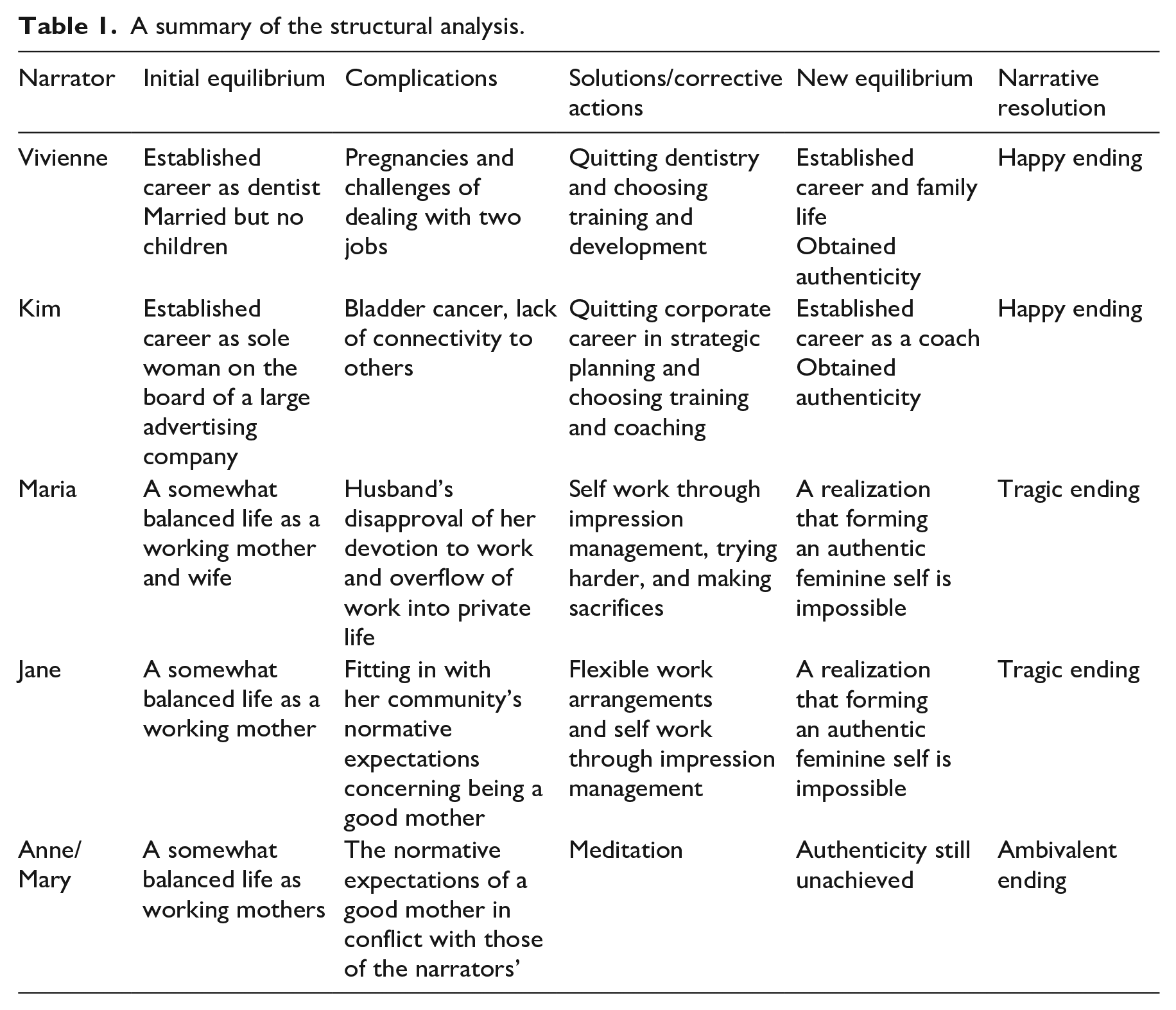
The narratives then were structurally analyzed following Czarniawska’s (2004) method in which the focus is on the narrative element of the “plot” reinforced by the narrator: In a basic plot, an initial state of affairs is disturbed by complications. To reverse the effects of the disruption, a number of corrective actions or solutions are enacted by the narrator. This results in a new equilibrium and the resolution of the narrative. The structural analysis (see Table 1) proves instrumental in identifying the elements of the plots—initial balance, complications, corrective action(s) and a narrative resolution—and enables the analysis of the content of each narrative in relation to the others.
A summary of the structural analysis.
As a next step, I attempted an initial content analysis to explore the narrators’ perception of authenticity. The emergent themes, upon later comparison, transpired as closely linked to the recent postfeminist turn critiqued by gender and organization scholars (as discussed earlier in the paper). At this point, I decided to redirect the focus of the paper to an investigation of the connection between authenticity and postfeminism through analysis of these narratives.
I have selected six work-life narratives to include as exemplars in the paper. This selection has been informed by several criteria, of which the first is methodological. Out of the 13 interviewees, the selected six produced an account of their working lives in the form of fully plotted work-life narratives which, due to their structural build, allow the deployment of the capacities of narrative analysis and thus lead to richer analytical insights. In addition, the content of these narratives seems comparable due to the profile of the narrators who are all women from a relatively privileged social background, heterosexual, in their 40s or 50s, with an established career in training and development. Also, except for one Singaporean-Australian woman who had immigrated at a young age, the other five were White Australians. The remaining seven interviews, although revealed the influence of postfeminism on the narrators’ authenticity quest, were omitted based on the structural deficiencies of the produced narratives and/or the interviewee profile (e.g. younger, or non-Australian) leading to vastly diverse, hence noncomparable content. Practical reasons such as compliance with the journal’s required word limit also were a factor leading to the exclusion of the omitted narratives, allowing space for the selected six to be fully presented and examined.
This analysis, I acknowledge, is influenced by my position of being a tenured full-time university lecturer, which inevitably impacts the way I view alternative employment, corporate work, and the domestic arrangements which correspond with these modes of employment. My analysis throughout the paper also reflects, and inevitably reproduces, a gender binary by focusing on women and their construction of authentic femininity. I did not find any evidence of the participants’ identification with a non-binary notion of gender. But this observation may have been formed by my privileged position as a cis-gender woman making essentialist associations between women and femininity while conducting, analyzing, and writing about my study.
In the following section, the work-life narratives are presented, grouped around the narrative resolution toward which the narrators’ search for an authentic feminine self has led (success, failure, ambivalence). Each narrative is presented and is followed respectively by structural and content analysis. In making sense of the content, I have applied the developed conceptual framework to identify the postfeminist technologies of authenticity with which the narrators have acted upon themselves.
Achieving authenticity: Narratives of success
The two narratives which will be analyzed in this section, both pivot around a change of careers, an action which, according to the narrators, leads them toward successfully forming “authentic feminine selves.” The first narrative is from Vivienne, previously a dentist, and currently a self-employed training and development consultant. In the second narrative, Kim, another training and development consultant, recounts her achievement of “authentic self.” The two narratives share an optimism projected by the narrators relating their successful quest for authenticity.
A successful journey of discovery and integration
The quest for the authentic feminine self, and its ultimate realization, is the central message of Vivienne’s work-life narrative: 12 years ago, I decided to get 3 years off to have one child and then a second child in a quick succession. [This was] an identity change for me totally, and I remember this well because being a dentist I was so controlled; [in that career] everything is anally retentive and a lot of it is left-brained. I loved being a mom so much! It was so interesting watching my children develop. I thought “I can’t do two jobs! I can’t be a dentist anymore.” So, like I said [this was] a whole shift from being a career woman to this family woman! And my husband, who was my business partner, went “what do I do? A wife who really wants to stay at home is really rare among career women!” But he sort of looked at the bigger scheme of things and thought “somehow we’ll manage.” So, I left dentistry; brought up the kids, and through the process, I decided I loved the training and development area and started to do some coaching. I started loving this area as well, and I finally decided: “hang up the drill, full time mom, part time trainer,” and I guess that began a journey of discovery of how I can build my coaching business over these exciting things I have learned with leading my family and in leadership at home. I guess coming into this space was a marriage of that really left-brained environment with a totally chaotic, right-brained environment with the kids, and that marriage of both was a natural progression. Now, I feel more integrated because when I was a dentist, I was quite selfish. A lot of it was very sequential, very planned. Now, with the marriage of everything, I feel whole. So, I guess that’s integration. I don’t feel fragmented.
Structural analysis
The structure of events and actions in Vivienne’s story resembles the Romantic genre, in which individuals discover their “true self” through “initiation,” a “ritual death” and “resurrection” (Sköldberg, 1994). The story unfolds through description of an initial equilibrium (her established identity as a dentist and a wife). Then challenges are posed in her way (pregnancies and conflicting demands of motherhood and dentistry), to which she responds through a corrective action (quitting dentistry). Then her identity as “a career woman” dies as she becomes a “family woman”; eventually, through a second corrective action (changing careers), she unites these fragmented characters and is resurrected, this time as unified, whole and therefore authentic (a new equilibrium is thus achieved). The story ends on a positive note (narrative resolution) as the quest for the authentic self is considered to have been accomplished (Table 1).
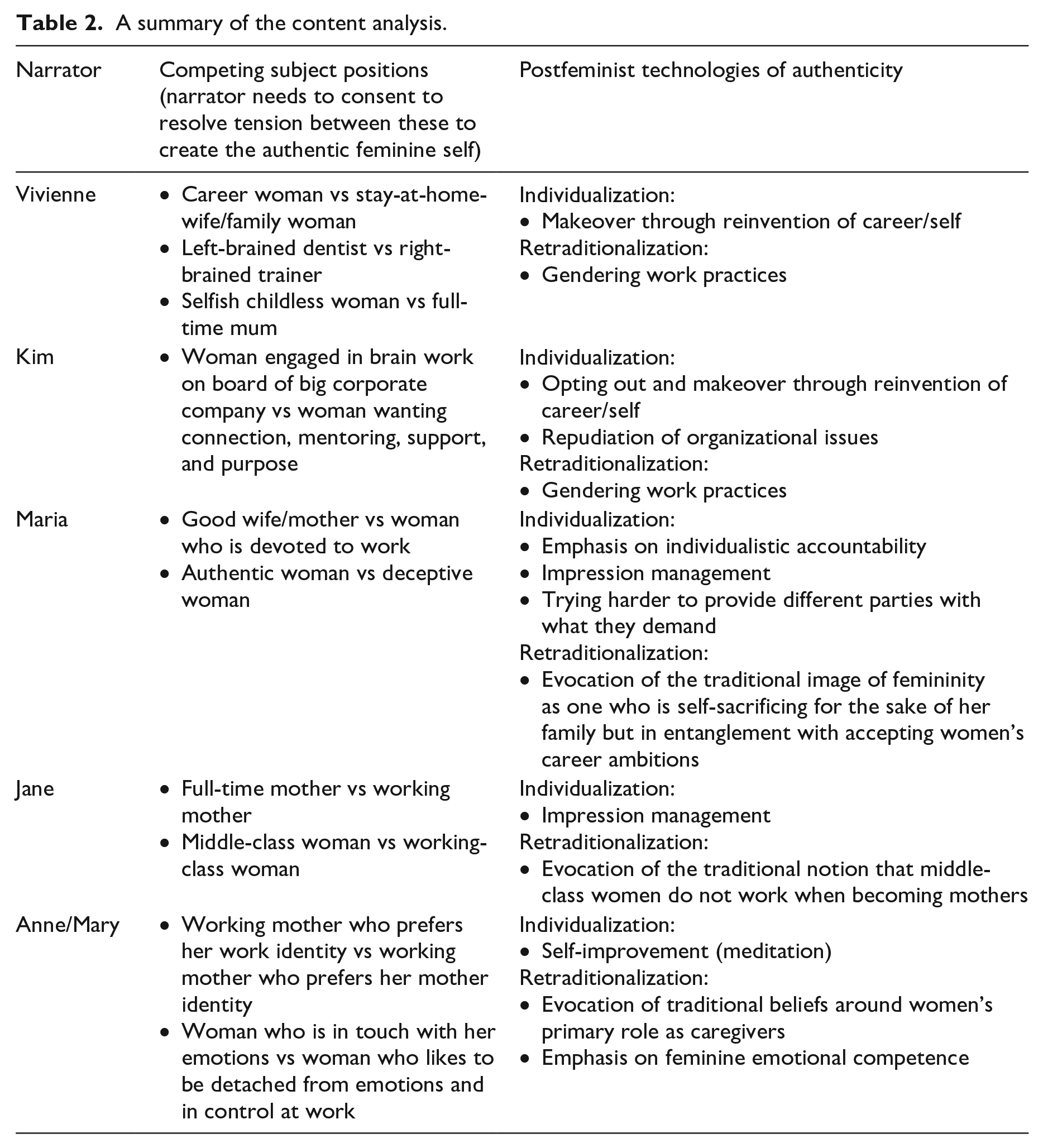
Content analysis. Vivienne’s narrative reflects postfeminist technologies of authenticity at work through two interrelated mechanisms. First, as she engages in self-examination, several groupings of competing feminine subject positions emerge in her narrative, for example, “career woman” is put in tension with “stay-at-home wife” and “family woman”; “full-time mum” contrasts the “selfish” state of a childless woman; and “left-brained dentist” opposes “right-brained trainer” (Table 2). She tells us how she consented to resolve the tension among these conflicting selves to achieve “integration” from “fragmentation” through the identified corrective actions, that is, choosing to quit dentistry and change careers. These represent self-governance practices through which she has acted upon herself. Both these self-activities reflect postfeminist rhetoric of individualization which invites women to work on individual change and re-invention. The success of this re-invention is explained in her narrative through a retraditionalization discourse which casts jobs as gendered. In the interview, Vivienne described dentistry in normative masculine terms as “left-brained, rational, planned, in the head space,” “just as I was when I was not a mother,” while describing training and development as “right-brained” and “in the heart space,” where she could apply the “leadership skills [she] learnt in [her] family as a mother.” Through this retreat to a traditional framing of work as gendered—in which teaching is conventionally considered a “feminine career” and therefore “suitable” for women (Alvesson and Billing, 2009) —she seems to account for her successful career and self re-invention.
A summary of the content analysis.
A big shift
Kim’s narrative is also reflective of finding the authentic self through career re-invention: I worked in account management for a big advertising corporate company, and wound up then as a strategy planner, and the first woman on the board of the company. Then I left and set up my own business, and the reason that I left [was that] when I was promoted to the position of a director on the board, I didn’t understand why I had been promoted, I had no support, no mentoring, nothing. I was puzzled, and for two years I was the only woman sitting there, but I wasn’t sure what kind of contribution I was to make. It was actually about that time that I was diagnosed with bladder cancer. It wasn’t an aggressive life-threatening cancer because they caught it quite early. It just caused me to stop and think about what I was doing and what I really wanted, and it was a life and a business decision. I wound up leaving that job and starting my own business, working with people, helping them develop, coaching and training, and that sort of area, because I wanted the connection, and I felt in the advertising work I was very much removed, and it was all brain work rather than necessarily the connection. That was about 12 years ago, and that has been an interesting journey because I love the coaching. For me, what’s happened gradually and increasingly is that I’m comfortable with who I am. I feel real. I can connect to people easier. So, it’s been a big shift for me.
Structural analysis
In Kim’s story, a disease is presented as the complication which disrupts the initial equilibrium (her established career as a high-ranking strategy executive) and forces her to turn her gaze “inwards” (as she told me in the interview) and discover what she “really” wants (corrective action). As a result of this self-examination, Kim realizes she needs a job with more connection to others, and therefore restarts her career as a training and development consultant (second corrective action). This helps her to achieve authenticity (narrative resolution).
Content analysis
Kim’s Self-examination is shown to reveal the position of “woman on board of a big corporate company, engaged in brain work” competing with that of “woman in need of support, mentoring and connection with others.” Her authentic self is eventually formed through consenting to unite these conflicting selves into one “real” self that connects to and cares for others at work. Like Vivienne’s, Kim’s story accounts for her work on the feminine self and its ultimate transformation, through deployment of individualizing techniques of self-governance. Her shift from corporate to alternative employment—essential to her achievement of authenticity—is presented as a matter of individual choice. While she refers to issues such as “being the only woman on the board” and lack of support or mentoring, she refrains from blaming the organization, or presenting these structural issues as important factors in her decision to change careers. Rather, she presents her career shift as a personal choice made autonomously and through post-illness self-reflection in pursuit of a more authentic life. Women’s opting out of corporate jobs as an exercise of agentic choice and individualistic preference has been reported as a strong postfeminist trend which diverts attention from the contextual and structural problems leading to such a dramatic career change (Lewis and Simpson, 2017; Wilhoit, 2014).
In addition, Kim deployed retraditionalization as a technique to account for her achievement of “real” self. During the interview she described training and development as a “feminine profession,” which “appeals mostly to women.” To the minority group of men employed in her profession, she attached a “strong feminine side” who “would not have been working in this area if they did not possess that caring, nurturing aspect.” Strategy planning in contrast was described by her as involving “brain work” performed by a “male majority.” The narrative therefore presents a shift from a notionally “masculine job” (strategy planning) to a notionally “feminine job” (training and coaching), as key to achievement of the authentic feminine self.
Narratives of resignation and ambivalence
In this section, four work-life narratives, all centered on the struggles of being a working mother/wife, are presented and analyzed. The first narrative is Maria’s, a training and development consultant. The narratives which follow Maria’s are short episodes from the working life of three training and development managers, Jane, Anne, and Mary, also mothers struggling with realizing their desired authentic selves. The narratives are united in presenting an unsuccessful or uncertain end to the quest for authenticity.
Home and work unreconciled
Maria’s narrative centers around an episode from her domestic life which comes to the verge of crisis: A few nights ago, I had an argument with my husband. I had been working really hard and really long hours and doing lots of work at home and often staying up late at night and my husband had been complaining. It actually reached to a bit of a crisis point one night when he was waiting for me in bed and I said “oh! I’ll be there!” and he said “how long do you think you’d be?” and I said “oh! You know 45 minutes or so” and it was 3 hours later that I came to bed and he was still awake and he was really really depressed and disappointed and he said “I don’t know! I don’t know if this can work.” He said “I can’t stand it like this anymore!” We had a conversation like this before, maybe a year ago when he actually left us for a while. Anyway, this made me consider the [authenticity] event [in that networking session]. Because for the rest of the weekend, I was so inauthentic, it wasn’t funny! Because I was trying to pretend to my husband that I wasn’t doing any work; I was playing with the kids and I was cooking dinner and I was watching TV and, I just waited for him to go to sleep, and then, I would have to do all my work. I was being deceptive. But, I couldn’t see another way around it because, the stakes were so high with my relationship and yet I had this really high stakes workshop that I had to deliver. I felt like I was trapped and the only way I could get out of it was to pretend to the different parties that I was giving them everything that I needed to give them without letting them know that I was doing the other thing. I want to have my cake and eat it too; I want to have my career and I want to have my family; then if I want to have all those things, I have to pay the price somewhere, and the price is my energy and my time, the stress levels, and . . . that feeling of not being authentic. This is never gonna get easier. I just have to keep going and perpetuate this cycle.
Structural analysis
The initial equilibrium in Maria’s life is disturbed because her husband is deeply unhappy with her extreme devotion to work. This is a state of disruption to which she needs to respond. But there are complications as her work is demanding and the stakes are high. Maria’s response is to act, as she puts it, “deceptively” as a temporary solution, and as a more lasting solution, to work harder and make sacrifices to balance her work and family life (corrective actions). The story conveys a rather tragic point, a resignation to the fact that, at least sometimes, authenticity needs to be sacrificed if work and family life are to co-exist. Maria portrays herself as an almost tragic figure (Czarniawska, 2004), one who is condemned to repeat her efforts over and over with little hope of escape (narrative resolution).
Content analysis
Maria’s recent exposure to the discourse of authenticity triggers a process of self-examination which reveals the competing subject positions of a “good wife and mother” and a “working woman” being held in tension (Table 2). This, Maria tells us, is not a new experience, but the underlying cause of her marital struggles. She consents to act upon herself to resolve the tension between these contradictory subject positions and deploys a postfeminist mode of self-governance manifested in individualizing practices comprising of first, accepting responsibility for her choice of having both a career and a family (not blaming her husband or the demands of her job); second, working harder on her impression management efforts and making sacrifices (regarding her time, energy, and considering the recent epiphany, her authenticity); and last and most importantly, declaring autonomy and freedom in imposing such operations on herself. A retraditionalization of expectations regarding women’s place in family life also seems to be in operation but in ways entangled with an acceptance of women’s career ambitions. Postfeminist technologies often operate in this way, not overtly rejecting feminist values such as women’s equal access to employment but by making gender equality into an internalized project whose success depends on women’s personal choices, self-work and self-determination (McRobbie, 2015).
The tales of poor mothers
In the narratives analyzed in this section, the focus is on the dual role of women as mothers and workers. Let us start with Jane’s: Sometimes acting inauthentically is necessary, like I deliberately made a day that I’m not in the office and I work from home, the day that my son goes to the local pre-school; so I can do the other things the other mothers do, I can do the drop off, I can do the pickup, I can stay for a chat, I can become a part of that pre-school community, and I found that’s important for my son and it’s important for me to have a relationship with the other mothers. And I think [the way I appear] depends on how I am emotionally feeling, like, if I’m feeling good and confident and energetic, then I think that I can pull it off, and when I’m having a day when things have been kind of getting on top of me, I probably don’t look as I’m coping and I’m sure they all are thinking “Oh! That poor woman! She has to work!”
Structural analysis
It is the community’s normative expectation concerning being a good mother that appears to disrupt the equilibrium of Jane’s everyday work life. She works (as a training and development manager in a Sydney-based multinational company) but observes that most mothers in her child’s pre-school do not. She also believes it is essential for her to fit in with her community. Her solution is therefore to take advantage of flexible work arrangements (corrective action) while also engaging in impression management to create a front that “fits in” (second corrective action), which inevitably is interpreted by her as having had to act “inauthentically” on those occasions. Her quest for the authentic feminine self is therefore presented as unsuccessful (narrative resolution).
Content analysis
Jane’s authenticity quest evokes a process of self-examination which reveals the tension between two sets of subject positions portrayed as contradictory by the narrator: first, the position of “working mom” in tension with “full-time mum,” and second, the “working-class mom” versus “middle-class mom who does not have to work” (Table 2). She consents to employ operations of the self to resolve these tensions and obtain an authentic feminine self; however, her efforts are to no avail. Like Maria’s self-work practices, these self-governance operations include individualized work on the self to create and maintain the “right” impressions of “mother,” in line with her perception of normative expectations in her community (she lived in Manly, an upper middle-class suburb in Sydney). On the occasions that her performance fails, her “true” image is revealed to the other mothers; then she becomes this “poor woman” who “has to” work. Whether the other mothers are actually thinking so or not is irrelevant for the present analysis; the narrative suggests that there exists a common belief that women in good financial standing do not have to work when they have children. Her narrative thus depicts a retraditionalization of expectations regarding “middle-class mothers.” This has been reported as a postfeminist rhetoric linking women’s individual choice to the notion of class, asserting that as middle-class women do not “need” to earn a living “they should choose to stay at home and care for children” (Sørensen, 2017: 309).
Most of my interviewees alluded to the idea that their “mother” identities should come first. Reflecting a postfeminist sensibility, the importance of having a career was not downplayed, but motherhood was given prominence. Yet two interviewees, Anne and Mary, told the story of their quest for authenticity differently. Their encounter with the discourse of Be Yourself! and the subsequent self-examination led them to admit that they were both “more comfortable” at work and preferred to see themselves as “working women” rather than as “mothers.” Nevertheless, they showed concern about such deviancy. Anne admitted that “the role I am more comfortable with is being at work rather than being a mother.” In my interview with Mary, she remembered an encounter with Anne in the networking event that was related to this topic: What was interesting was that the person that was in my small group [in the event] had the same response as me and neither of us felt that we were at our best or being our true selves when we were being mothers. And she first mentioned it and she was a little bit tentative about saying it and I just went “don’t worry, I’m exactly the same!” You should have seen that physically, her entire body, not just her face, but the entire body, was relieved! The relief that there was another woman on the face of this planet, who didn’t think that their strength was being a mother!
During the interview, Anne accounted for such “unusual preference” by admitting that in general she could not “feel” or “express [her] feelings well” (a necessary attribute for a mother in conventional views), and to overcome this, she was trying “transcendental meditation” to “get in touch with [her] emotions.”
Content analysis
Anne and Mary’s response to the invitation to become authentic reflects a self-examination process which surfaced the contradictory positions of “working mother who prefers her mother identity” in tension with the position of “working mother who prefers her work identity.” Another parallel is made in Anne’s narrative as the subject position of “woman who is in touch with and is expressive of her emotions” is put into contrast with the “woman who likes to be detached from emotions and in control at work” (Table 2). Both women declare their preference for the latter types of feminine subjectivity. Their hesitancy in declaring their preferred subject positions as manifestation of their authentic self reveals, however, a retraditionalizing postfeminist technology at work. That is, the return of traditional beliefs around women’s primary role as caregivers (Calás and Smircic, 1996) and a celebration of women’s “retreat to home as a matter of choice not obligation” (Negra, 2009: 214). Despite her hesitancy toward such beliefs, in consenting to act upon the self toward achieving authenticity, Anne chooses to effect individualizing work upon her emotional conduct through practices of transcendental meditation to reconnect with her emotions and reinvent herself as an authentic woman who genuinely prefers motherhood to work. The result of this postfeminist practice of authenticity was yet to be seen.
The gendered call to authenticity put to work in women’s self-construction
The formulation of postfeminist technologies of authenticity has enabled an investigation of training and development professionals’ self-examination and self-governance to reveal the postfeminist techniques with which they actively work on construction of notionally authentic feminine selves (Table 2).
These include enactment of individualization techniques such as career and self re-invention, repudiation of structural inequalities (the role of husbands or lack of organizational support), self-responsibilization, work on the self in the form of impression management and transcendental meditation. These techniques are adopted along with retraditionalization practices through which career aspirations are declared important, but attainment of the authentic feminine self is ultimately attributed to choosing a “feminine” job in training and development. Those who struggle with fulfillment of their authenticity still deploy retraditionalization techniques such as evocation of a traditional image of femininity as one who is self-sacrificing for the sake of her family, recall of traditional beliefs around class, work and motherhood, legitimization of beliefs around primary role of women as caregivers, and an emphasis on emotional competence as central to “true” femininity.
What is important to note is the autonomy and freedom of choice claimed by all narrators in adoption of such individualization and retraditionalization techniques. The gendered call to authenticity as such evokes an active process of self-construction on part of these professional women. The extent and forms of their experiences of authentic feminine selves are however shown to be confined to individualized retraditionalized feminine aspirations.
Here emerges the outline of a gendered form of control which works at the level of subjectivity and as a form of self-management. The organizational call to authenticity, is shown to trigger in the training and development professionals, a quest for the authentic feminine self which gives them an impression of having choice over their work-life trajectory and agency over their subjectivity; however, the scope of this agency is narrowed down by postfeminist technologies which are productive of femininities which are “capitalism, neoliberalism and patriarchy-friendly” (Gill, 2017: 618). These women’s authenticity quest therefore does not challenge systemic gender inequality in the neoliberal organization but contributes to its “normalization and conceit of its inevitability” (Banet-Weiser et al., 2020: 4). The quest for the feminine authentic self thus transforms to a surreptitious form of neoliberal control which “binds subjects to a subjection which is more profound because it appears to emanate from [their] autonomous quest for [the self], it appears as a matter of freedom” (Petersen and O’Flynn, 2007: 200).
Conclusive remarks
Postfeminist technologies of authenticity have been shown in this paper as gendered self-construction techniques which control the potentially emancipatory capacities of authenticity that may pose a threat to the status quo of the neoliberal organization. The search for authenticity has after all been noted as a long-lasting critical movement against the limitations and constraints of capitalism. Capitalism, however, has a tradition of co-opting its critique and transforming it into an unthreatening version of itself (Boltanski and Chiapello, 2005).
These mechanisms of self-management contribute to what has been described by McRobbie (2004, 2009) as an “undoing” of feminist achievements by postfeminism, as it further “tightens and re-secures the grip of the current [patriarchal] gender-regime” (2015: 12) which systematically marginalizes, discriminates against, and exploits women in the context of work (Bell et al., 2019). Future research is needed to investigate how postfeminist technologies of authenticity are put to work by women with a variety of career trajectories and in various sectors. It would also be valuable to examine strategies through which women can and do resist consenting to formation of postfeminist selves. These may include adopting alternative technologies of the self which work through enactment of collective and relational agency observed in emergence of anti-capitalist discourses such as the “feminism for the 99%” (Arruzza et al., 2019) and “relational leadership” (Pullen and Vachhani, 2021). Such collective and relational technologies of the self may enable ways of resistance against the individualizing and retraditionalizing domination of postfeminism and neoliberalism.
Footnotes
Acknowledgements
I would like to thank Professor Barbara Czarniawska, Professor Richard Badham, Dr Clare Butler, and the anonymous associate editor and reviewers for their helpful and encouraging comments on earlier drafts of this article.
Funding
The author received no financial support for the research, authorship, and/or publication of this article.
