




Abstract
This article explores the use of craftwork as a technology of self-care by women academics to cope with work demands and commodified narratives in academia. It combines discussions about work pressures in academia and technologies of the self to theorise self-care strategies used to navigate academic demands and identify new research avenues. Through the memory work of the four women academic authors, the article shows craftwork as a strategy of self-care to achieve self-control, self-preservation and self-(re)positioning. The article extends the theorisation of self-care, showing its simultaneous function as a coping and complicity mechanism that responds to and engages with individualised well-being narratives in academia. It also advances and complicates understanding of how technologies of self-care sustain the power structures of the academic labour process, showing the visceral and emotional dimensions of these technologies. The article outlines the contours of a research agenda to interrogate ethical self-care in academia.
Introduction
Questions about care in neoliberal academia continue to receive attention given increasing pressures and precarious outcomes, especially for women academics (Corbera et al., 2020; Fagan and Teasdale, 2021; Gaudet et al., 2022; Plotnikof and Utoft, 2022). Higher education has normalised managerialist, fast-paced working cultures that privilege male and masculine values and centre masculine understandings of meritocratic achievement and standards for academic success (Aiston and Fo, 2021; Fotaki, 2013; Śliwa and Johansson, 2014). This symbolic masculine order disproportionately affects women academics, reinforcing the systemic gendered inequalities embedded into academic life (see Knights and Clarke, 2014; Krishen et al., 2020; McCarthy and Dragouni, 2021; Steinþórsdóttir et al., 2019). For instance, research on the challenges experienced by women academics has reported hostility in academia that leads to feelings of inadequacy, impostordom and burnout (Aurangzeb et al., 2023; Grandy et al., 2023; Johansson and Jones, 2019).
Within this research area, a new conversation has emerged that recognises that care, caring and self-care are central to sustainable academic working lives (see Corbera et al., 2020; Puāwai Collective, 2019). However, despite evidence of the well-being struggles academics face (Johnson et al., 2019; Pace et al., 2021), these struggles remain largely unaddressed because care is not embedded meaningfully within academic cultures (Berquist et al., 2018; Gaudet et al., 2022). Gaudet et al. (2022) argue that care practices conflict with ‘the prestige economy of academia, which elevates internationally renowned research above other aspects of work’ (p. 75). In this context, individual well-being management is challenging because, despite taking time for the self being a justifiable decision to enable delivering on workload demands, the pace and pressures of academia make the decision to choose self-care inconsistent with the importance other productive dimensions carry for career progression and success. How women academics address this challenge and navigate the complex paradoxical position of having to choose between self-care and career success remains largely unexamined.
This gap in the literature motivated the study’s research question: How do women academics engage in self-care to navigate the pressures of neoliberal academia? With this question, the article responds to calls for more discussion about activities that promote self-care and supportive cultures in academia (Gaudet et al., 2022; O’Dwyer et al., 2018). Bringing together discussions about women in academia and Foucault’s notion of technologies of the self, this article explores the interplay between experiences of ethical self-care and the academic self. The context of the study is business schools in the UK higher education (HE) sector. Based on the memory work (Haug, 1999, 2009) of the four author-participants, the article shows craftwork as an intervention on/of the self and as a ‘mediator’ between individual subjectivities and the pressures of academic work. The article makes at least three contributions to the sociology of work: first, it theorises self-care, unveiling its simultaneous function as a coping and complicity mechanism that responds to and engages with commodified, individualised well-being narratives in academia. Second, it advances and complicates understandings of how technologies of self-care sustain the power structures of the academic labour process. Third, it shows the visceral and emotional knowledge involved in technologies of self-care. Finally, through memory work, the article contributes to discussions that adopt self-reflexive methodologies to explore identity and belonging in academia (see Garvis et al., 2021; Learmonth and Humphreys, 2012; Manathunga et al., 2017).
This article is organised into five sections. The first section discusses the performative pressures of the HE sector, highlighting its gendered implications and the silences around care and relational acts of care in academia. The second section outlines Foucauldian technologies of the self, exploring how craftwork as practice supports creating alternative reflexive and ethical selves (Crocket, 2017; Markula, 2003) while mirroring a docile response to academic pressures. The third section describes the memory work undertaken, reflecting on its suitability to address the article’s research question. The fourth section discusses three strategies that emerged from the memory work: craftwork as self-control that allows achieving balance, as self-preservation that enables survival and as self-(re)positioning that reinforces a sense of validation. The final section develops an integrated critical reflection and concludes identifying key contributions and outlining the contours of a research agenda to interrogate self-care in academia.
Women’s (im)possibility of care in neoliberal academia
The increasing commodification of HE and academic labour has seen academics exposed to demanding regimes of external monitors (Willmott, 1995: 1025) that have normalised narratives of workaholism and survival; for example, publish or perish (De Rond and Miller, 2005); funding or failure (Muehleisen, 2015); 24/7 academia (Torp et al., 2018). These narratives have shaped the structure and dynamics of work, performance expectations and ideas about what it means to be a ‘good’ or ‘successful’ academic and are especially challenging for women academics.
Research is replete with examples of how structural, procedural and relational dimensions of academic work perpetuate gender inequalities that negatively impact women academics and the perceptions held about their place in academia (Bourabain, 2021; Strauβ and Boncori, 2020; Treviño et al., 2018). Structurally, while many UK universities highlight commitments to gender equality through awards (e.g. Athena Swan Charter), these commitments have been criticised for not challenging the normalised structures and practices that perpetuate gender inequality in HE workplaces (O’Connor, 2020). Administratively, women academics are disproportionately allocated large quantities of underappreciated work, such as administrative service and student pastoral care, contrary to men academics (see Heijstra et al., 2017). Relationally, women academics carry the burden of expectations of emotional labour and care work in their relationships with others, especially students (Rickett and Morris, 2021), while also being penalised for being too personal in other dimensions of their academic work; for instance, Boncori and Smith (2019) emphasise how articles are often rejected for being too personal and, therefore, deemed to lack rigour or research credibility.
This article focuses on self-care as a strategy to navigate academic pressures. Despite the evidence that university settings trigger high levels of stress and burnout for academics (see Urbina-Garcia, 2020), the silence and stigma surrounding mental health lead academics to take solitary responsibility for their own well-being (O’Dwyer et al., 2018; Smith and Ulus, 2020). This follows the neoliberal governmental rationality, which encourages self-responsibility and individualises collective social problems, making individuals complicit by asking them ‘to figure out how to maintain their capacity to labor, to produce and to compete’ (Bivens, 2023: 123; see also, McRobbie, 2020; Ward, 2015). The care model adopted by the neoliberal university promotes a similar narrative of self-care; encouraging academics to attend well-being workshops and institutionally sponsored activities without considering the structural roots that create the need for these activities. Paradoxically, the importance of care is promoted to facilitate a managerial and instrumental approach that ignores the gendered ‘unwellness’ of academic environments and its negative impact on women academics (Miller and Roksa, 2020; Pruit et al., 2021; Sümer and Eslen-Ziya, 2023). Against this backdrop, calls for an ethics of care in academia are about attending to the ethical framing of the purpose and functioning of academic spaces, as well as how this is collectively done to counter oppressive power dynamics and structures.
An ethics of care encapsulates the importance of relationality and interdependency in organising social and economic life (Askins and Blazek, 2017; Held, 2006; Puāwai Collective, 2019). Plotnikof and Utoft (2022: 1261) argue that ‘care, in all arenas, is thus political; it concerns itself with caring for the inequalities, injustices and asymmetrical power relations of actual people in real life’. The dominant care model in the neoliberal university supports the logics of commodification of education and intrinsically steers a masculine work ethic focused on individual outcomes (Gaudet et al., 2022; Plotnikof and Utoft, 2022). This model makes it challenging to practise self-care while simultaneously pursuing an academic career (Bryan and Blackman, 2019), enhancing perceptions that women academics are incompetent and have inferior qualities (Padilla, 2020; Wilson, 2005).
In sum, the silencing of self-care in academia results from the messages and pressures of hypercompetition, careerism and individualistic excellence that neoliberal university discourses exert on academics, which have a disproportionate negative effect on women. These discourses produce the ‘effect of anxiety as a socially manufactured intensity connected to precarity’ (Brunila and Valero, 2018: 74) and reinforce complicit suffering as one of the metanarratives of the neoliberal university, which has rendered as taboo open conversations about mental and emotional well-being (O’Dwyer et al., 2018; Smith and Ulus, 2020). Those experiencing pain or vulnerabilities are expected to take ownership of their self-care and, as a result, the silencing of self-care is part of the performative culture of HE, perpetuating a cycle of secrecy, self-exclusion and isolation and making those suffering unintentionally complicit in hiding their (self) care practices. This article shows women academics’ use of craftwork as a self-care strategy that highlights the extent of resilience in the face of these circumstances.
Technologies of ethical self-care and the academic self
Foucault’s (1988) notion of ‘technologies of the self’ refers to devices that enable the social construction of identity. The Foucauldian argument is that technologies of the self allow the governance of self and others through discursive and textual production to manage the relationship between truth, subjectivity and agency. Foucault connects the Delphic principle ‘know thyself’ with the care of oneself, highlighting the importance of the relationship between body and soul (Foucault, 1988). Self-care involves identifying and deploying mechanisms to enable self-preservation and achieve mental and physical well-being. Self-care shares key features with technologies of the self because it mobilises the agency of choice for individuals ‘to effect by their own means or with the help of others a certain number of operations on their own bodies and souls, thoughts, conduct and way of being, to transform themselves’ (Foucault, 1988: 18).
For some (see Bryan and Blackman, 2019; Foucault, 2010), self-care is both an ethical practice and a social responsibility that is as critical as justice as a moral principle (Gilligan and Attanucci, 1988). Self-care supports the development of sustainable academic careers; however, while its implementation may be challenging in practice due to how workloads are typically structured, it is an important and necessary aspect to be an effective academic (Randa, 2023). An important tension related to self-care and the academic self is that, while self-care intertwines the personal and the professional, the implicit choice within neoliberal academia to articulate a valid notion of the academic subject appears to be to prioritise either professional/academic achievement or self-care.
De-prioritising self-care presents an interesting contradiction because the act of self-care could be seen as pre-emptive of burnout rather than being reactive to it (Bryan and Blackman, 2019). Tronto (2013) argues that one cannot care for others without self-care, so it could be argued that the quality of activities academics care about (and are asked to care about), are directly impacted by the lack of self-care. Individual constitution of the self as a subject is central to interrogating the relationship between truth and subjectivity and understanding the practices of subjectivation that unveil the mechanisms through which self-control, self-regulation and consensus are achieved in society (Fraser, 2003; Lemke, 2001).
There is an implicit embodied quality in how people engage with and manage these technologies. For instance, the situated interaction between physicality and materiality to create something also results in actors creating themselves (see Gilmour, 2020). Foucault gives importance to the genealogical sequence that looks to reconstruct the history of subjectivities, highlighting the contextual nature of subjectivities as vital to understanding the possibilities of becoming that inform the deployment of technologies of the self. For the academic self, these possibilities are related to metrics within the market-driven university system, which set expectations of systematic forms of academic production to maintain a relevant status that confers legitimacy. For example, Mantai (2019) reports how doctoral students define their academic identity in relation to a perceived market value often built around outputs like publications and grant success so the embodiment of these productive activities is essential to a legitimate sense of academic self.
Against this backdrop, there is limited space for self-care activities in academia, especially manual activities that embody a physical entanglement with materials, such as craftwork. These activities are in tension with the intellectuality of academic work; while they create forms of self-empowerment that reinforce agency and self-regulation, they contrast with the regulatory impositions of academia. This article engages with craftwork as an unclassified form of labour (see Taylor, 2004), one that is not done at work or as work but is done for work. Although craftwork can take many guises, in this article it represents ‘a grounding action, a tactile engagement’ (Rixhon, 2020: 207), where embodied encounters with materials and forms create affective traces and spatial, aesthetic atmospheres (Bell and Vachhani, 2020). Practically, it is ‘a freely-chosen activity that provides the means to experience pleasure and satisfaction’ (Kouhia, 2020: 262), enabling a balance between hectic schedules and time for the self (Myzelev, 2009).
Bell et al. (2021) highlight the power of craft in constructing alternative social imaginaries and understanding these activities as ethical forms of self-care brings together creativity, corporeal, psychosocial and communal well-being that offer other possibilities of existence (Huotilainen et al., 2018; Kiviniemi, 2017). These possibilities, which can be as diverse as sporting activities (Markula, 2003) or gardening and retreat activities (Edwards, 2022), are mobilised by the ethical act of taking personal responsibility for one’s self-care to renew and reconceptualise the self. Within this framework, lifestyle decisions and behaviours stand as moral indications of self-control, self-discipline and reflexive self-creation.
This article is critical of how care is presented by academic institutions as part of the marketing of personal responsibilities, which is largely embedded in the neoliberal trend to individualise responsibilities (see McRobbie, 2020; Rottenberg, 2018). The article uses Foucauldian technologies of the self to develop a critical and nuanced interrogation of how subjectivities are articulated through self-care as a form of intervention on/of the self. Discussions in this article resemble those found in the literature about craft workers’ experiences (Hughes, 2012, 2013), which allude to engagement with hopeful practices to deal with ‘bleak, unstable, exploitative and self-exploitative practices’ (Hughes, 2013: 153). However, while the strategies discussed in this article are linked to hope and the emancipatory potential of self-care, they differ from those of craft workers for whom craft is their primary income. In this article, self-care provides a theoretical framework to interrogate when/how women academics deploy devices that enable them to continue becoming/being academics. It helps to uncover the tensions between how individual and collective subjectivities that present desirable representations and codes about the academic self are navigated.
Methodology
Research setting
The setting of this article is business schools in the UK HE sector. Business schools have been at the forefront of adopting performance metrics (McCarthy and Dragouni, 2021), which combined with expectations of sustained, incremental performance (Plotnikof and Utoft, 2022) have created a high-pressure environment where academics are expected to produce high-quality publications, demonstrate success in securing research council funding and engage in teaching and learning that consistently gains excellent teaching evaluations. This intense metrification of performance is reinforced and maintained by ‘terrorising metrics’ (Ratle et al., 2020), repressive workload models (Boncori et al., 2020), as well as established hierarchies of production, such as list fetishism (i.e. when the emphasis on the ranking of the publication outlet surpasses the significance of content and scholarly contribution) (Willmott, 2011). According to Knights and Clarke (2014), these practices render ‘academics over-committed and yet simultaneously falling short of an idealised, and by definition impossible, set of managerial, peer and self-induced expectations’ (p. 352). In this context, the experiences of women academics have been discussed from perspectives that interrogate the hyper-masculinity of business schoolwork cultures and their impact on women academics (Haynes and Fearfull, 2008; Wilson, 2005). For instance, research has found that women academics’ intellectual contributions are undermined (Beavan, 2020; Cunliffe, 2022) and the expected pace of academic production further amplifies systemic gender inequalities embedded in excellence standards that disproportionately affect them (Fotaki and Prasad, 2015; Gribling and Duberley, 2021; Lorenz, 2015).
Participant researchers and their positionality
In this article, the authors are researchers and participants, as is often the case in small-scale memory work studies (Frost et al., 2012). They are all mid-career women academics working in UK business schools who have ongoing collaborations that require regular meetings, interactions and work during and outside working hours. This study emerged from discussions about the pressures and demands of academic work that they have experienced throughout their careers and the strategies that have enabled them to navigate them. At the heart of the authors’ interrogation is the relationship between power, agency and self-determination (Tobias, 2005). This interplay is the departure point for thinking about craftwork as a technology of ethical self-care. The authors share an understanding of craftwork as an activity that ‘embraces human engagement in making’ (Kroezen et al., 2021: 506). However, while the authors dabble in baking, calligraphy, jewellery making and origami, they do not consider themselves artisan crafters or craft workers. The authors locate the interrogation of their solitary engagement with craftwork as part of a complex dynamic that entangles collective coping and complicity with academia’s commodified and patriarchal nature (Askins and Blazek, 2017). In collectively interrogating forms of craftwork and academia, the authors move beyond a conceptualisation of self-care as an individual responsibility and bring to the fore the wider context of the academic workplace and its impact on the possibilities for ‘choice’ and individual responsibility (see Ward, 2015: 54).
Thinking about craftwork as a solitary activity restricted to the private domain led to the authors’ reflections about the purpose and implications of public disclosure, an issue that the authors address by paying attention to claims, reformulations, silences and tensions to avoid textual disembodiment (Aldridge, 1993). The authors see this article as an exercise in personal critique (Miller, 2014) and collective reflexivity (Archer, 2013) and an emancipatory consciousness-raising process (see Mavin and Bryans, 2002).
Doing memory work
Data in this article draw upon the authors’ memory work (Haug, 1999), which explores the role of craftwork in their academic lives. Memory work is an adaptive feminist strategy that enables simultaneous individual and collective engagement in the research exploration of the self (Haug, 1999, 2009). It functions as a theoretical framing, a method and a process; as a theoretical framing, it bridges the gap between theory and experience as it explains the process whereby women are made as subjects within cultural systems (Haug and Others, 1987). As a method, it enables the exploration of how women actively participate in the formation of their experiences. As a process, it facilitates that women collectively interrogate their experiences in the existing structures and relations within which they live and are socialised and how they construct themselves within them. Reflecting on the use of memory work as a tool for building a gender-sensitive university, Husu (2020) notes that: ‘participants’ own experience and personal narratives can be used powerfully to “break silence” about these pervasive acts and processes. Collective memory work is a fruitful way to highlight the issue of non-events in academic careers, through training, education and in research’ (p. 174).
Memory work relies on individual written accounts, bringing to the fore the idea that the ‘self is socially constructed through reflection’ (Crawford et al., 1992: 37). The value of memory work lies precisely in its collagist, fragmentary and timeless quality, where individual self-reflection and collective analysis break the dualism between researcher and researched, allowing women to become subjects and interpreters of their own interrogation (Gillies et al., 2004; Kuhn, 2010). As such, the academic becomes a participant, reflexively researching their own memories to proffer new insight, developing theoretical framing and knowledge from reflexive analytic dialogue regarding the memories (Iszatt-White and Lenney, 2020; Onyx and Small, 2001). In writing memories, there is no search for ‘truth’ and engaging with the past serves the purpose of gaining insight into the performance of memory, the ways displaced recollections of the past feed into current understandings of the present and support possible futures. This entanglement is central to articulating the politics of memory that underpin recollection and attribution of meaning to those recollections. Crawford et al. (1992) stress that what matters in memory work is the process of constructing the meaning related to the events written about, unveiling distortions, condensations and secondary elaborations (see Nandy, 2015) to help understand how ideas about the past are negotiated.
Following the fluidity and ongoingness of memory work as a method (Stephenson and Kippax, 2008), in this study the process of memory work involved three different stages: (1) writing a memory that explored the relationship between craftwork and academic work; (2) reflexively discussing the memories; and (3) theorising insights in relation to literature.
Stage 1
The authors started a dialogue by asking each other about the purpose and importance of craftwork in their daily lives. This enabled navigating trust, disclosure and solidarity. The authors then identified the theme that guided their memory work: the connection between craftwork with academic work. The authors used the following question to drive their memory writing: How is your craftwork related to your academic work? Prompts for this question included: why do you craft? and what does it do for you? As suggested by Haug (1999: 3): ‘[i]t is important not to pose the question in scientific or analytical terms since memories will not emerge when the appeal to them takes the form of language that is not in the vernacular’. This main question allowed reflecting on departure and turning points and bringing together personal dimensions that are not usually part of academic discussion. In addition, the question supported the aim of memory work of allowing understanding of deeply naturalised power structures (Jansson et al., 2008).
Each author individually wrote a detailed account of a memory where they related their experiences and associated emotions, situating them within the broader social issues that shaped the relationship between their craftwork and their academic selves (Bryant and Bryant, 2019). Writing memories is evocative of emotions and enables ‘the discovery of the tangible and intangible aspects of sensations that may not emerge from other qualitative methods like semi-structured interviews’ (Bryant and Bryant, 2019: 527). Following Haug’s (1999) suggestion, the authors wrote about themselves in the third person to allow them to reflect on themselves as subjects, elucidate detailed descriptions and avoid value judgements or justification of events (Bryant and Bryant, 2019; Crawford et al., 1992).
Stage 2
The authors shared their memories with each other and then met collectively several times to discuss them. During these discussions, the authors shared their interpretations of the issues raised in each other’s memories and engaged in dialogue that interrogated the meanings they each gave to their own memory work. Discussion involved deconstructing and reconstructing the memories through collective debate and re-interpretation, focusing on linguistic peculiarities, emotions, motivations and relational dimensions of the memories to interrogate self-presentation and self-perception. As a collective effort to constitute sense and meaning, this dialogue promoted self-reflection and collective interrogation and critique (Haug, 1999), highlighting the categorisation system each author used to structure their memory of engagement with craftwork as self-care. This enabled the authors to interrogate the circumstances of production of the memories and showed ‘how strange our dealings are with ourselves, and how we struggle with ambiguity and knowledge in everyday life’ (Haug, 1999: 24).
Collective discussion of the memories involved analysing and collectively interrogating non-overt or obvious meanings in each other’s writings; this involved taking the memories as ‘texts’ to be examined and engaging with them as transformed productions of memory (see Bryant and Bryant, 2019: 528; Kuhn, 2000). The authors turned into researchers of each other; as academic participants and researchers, the authors simultaneously became the object and subject of their research, collectively analysing and editing based on interrogation and reformulation. Through these analytical steps, the authors looked at their memories as cross-sectional experiences (Crawford et al., 1992: 49); the aim was not to draw specifically on individual experiences in isolation but to collectively reflect and contextualise the broader social meaning of craftwork as a self-care mechanism to navigate the demands of neoliberal academia.
An essential aspect of this interrogation was the development of care and critique (see Hearn, 2007). Similar to works from other women academics who have adopted memory work (see Huopalainen and Satama’s (2019) exploration of early-career academic mothers balancing motherhood and academia, Gilmore and Harding’s (2022) examination of socialisation of starting a new job and Ryan et al.’s (2021) memories of COVID-19 lockdowns), the process was emotive and multilayered, focusing on the exploration of meaning, tensions and contradictions and engaging curiously and insightfully in ways that led to the process being both about past and present. This was also challenging because, as Berg (2008) has noted, memories must ‘lose their affinity to “true stories” about individual knowledge producers and instead turn into stories about particular phenomena’ (p. 213).
Stage 3
Guided by the research question and drawing on the authors’ discussions and reformulations of their memories, three interrelated strategies were collectively identified based on discussions found in the literature about technologies of the self, self-care and pressures of neoliberal academia: craftwork as a strategy of self-control to achieve balance, craftwork as a strategy of self-preservation to enable survival and craftwork as a strategy of self-(re)positioning to gain validation. Figure 1 shows the structure of the data. The next section discusses these strategies.
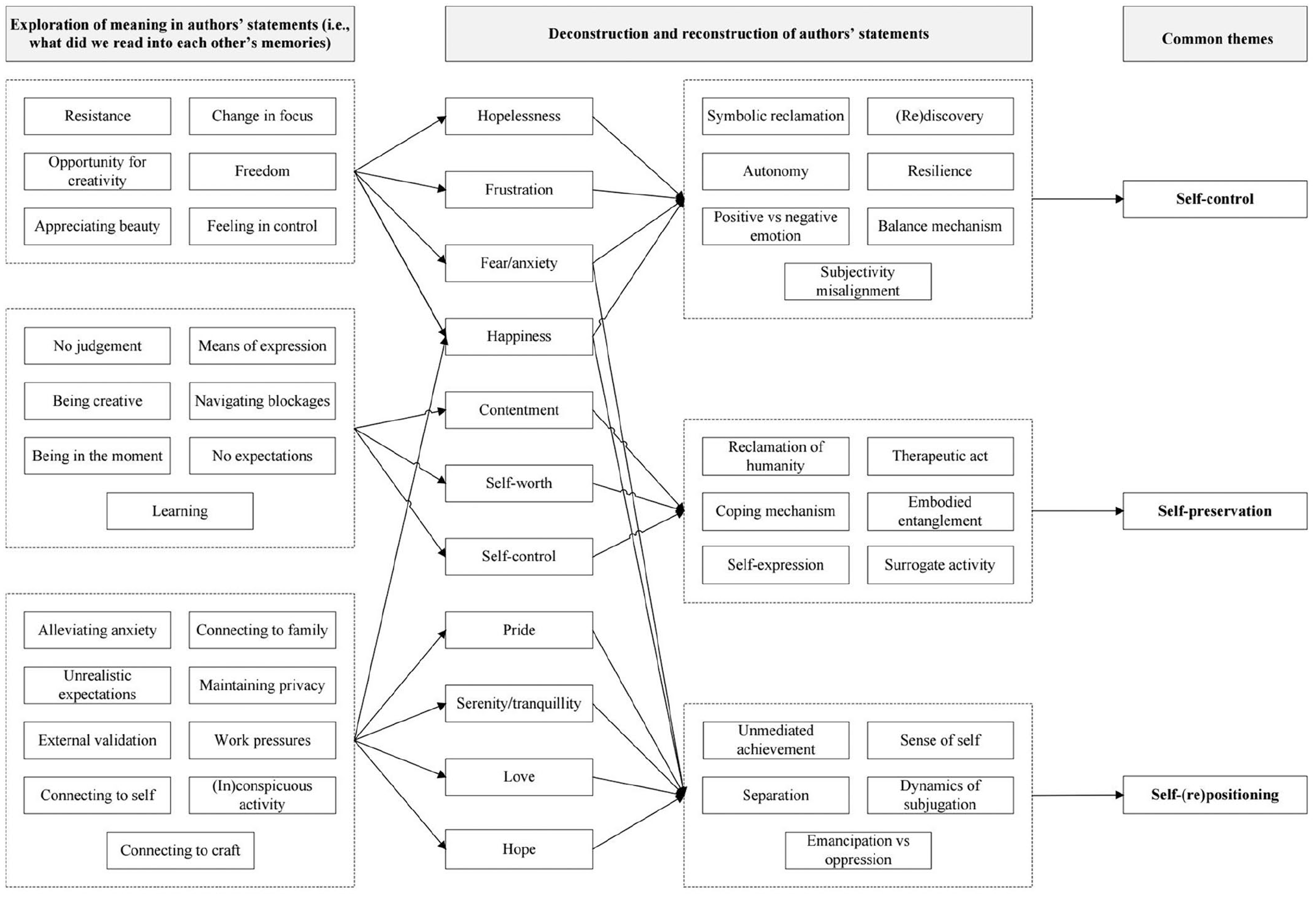
Structure of the data.
Findings
The following sections develop an integrated analysis to show different uses of craftwork as technology of self-care by women academics to cope with work demands and commodified narratives in academia. Theoretical reflections were articulated in relation to three strategies identified in the memory work: craftwork as a strategy of self-control, as a strategy of self-preservation and as a strategy of self-(re)positioning. To highlight the collaborative nature of the process (Haug, 1999) and avoid singularisation, pseudonyms are used in quote attribution.
Strategy 1: Self-control
Encounters with craftwork were framed within broader narratives of self-control, which were presented to the women to counter-response the pressures exerted by the expectations of academia while simultaneously allowing some form of stability to comply with institutional demands. A theme cutting across the four memories was the implicit understanding that hardships in academia are inevitable. The need to ‘take control’ was presented as suggestions about well-being and institutional agendas that promote individual health behaviours, maintenance and treatment (see Dean, 1981). For two of the authors, the decision to craft started from a command of self-care to manage the pressures and frustrations of doctoral work and to connect to activities that promoted balance:
In the first meeting with one of her PhD supervisors, she was told: ‘You need to find a hobby, something that you can control because there will be periods when you will be very frustrated with your writing’. (The Jeweller) She had been told what ‘good’ writing looked like. It primarily consisted of the erasure of emotion and so the erasure of meaning, of anything and everything that mattered. She had been unwell, panic stricken, exhausted, off work, convinced that she would never be good enough. She cried regularly at inopportune moments. That unity between intention and the product is what she was missing. (The Baker)
For two of the authors, craftwork emerged as a process of (re)discovery of the self in ways that allowed control over challenging circumstances that impacted work:
It is the peak of the pandemic when she returns to work after maternity leave. The onslaught of (re)direction about how the university is forefronting students’ needs is incessant. She feels overwhelmed, exhausted, beginning to panic. She finds a scrap of gift-wrapping paper. It is thick and luxurious; there is too little to be used except to wrap the smallest boxes, but there is still too much to throw away idly. She wonders how it can be used and what it could make. (The Origamist) She is off work with a mental health crisis [. . .] What if, what if, what if, she asks herself. She is afraid. She feels hopeless. She is inconsolable. Will she ever go back to work? She wishes for a different life [. . .] Her therapist suggests a creative hobby. (The Calligrapher)
Those first encounters were testing given the positioning of craftwork as a non-academic activity and in one case in response to the fear and hopelessness associated with a mental health crisis. The encounters point to the problem of overwork in academia, the time spent ‘worrying about . . . and recovering from work’ (Weeks, 2014: 10). Even if invoked or provoked to maintain the material integrity of academic selves, the authors interpreted craftwork as inconsistent with the subjectivity of the academic self. Some memories alluded to the rejection of the perceived imposition of strategies of self-care by others because of this inconsistency:
She thought that was ludicrous – this woman had just met her! What did she know?! She thought she didn’t need a hobby. She didn’t have time for that. She knew all too well that it was ‘publish or perish’. She had heard this millions of times. No academic she knew ever mentioned any hobbies, except reading and writing. (The Jeweller) She is frustrated. She challenges back [. . .] What is the point, she asks? She is told there doesn’t need to be a point. She should try it, be creative and be in the present moment. (The Calligrapher)
An important turning point in the memories recognised the choice to craft as a symbolic and material reclamation of balance that, in some cases, continued well into the academic career post-PhD. Craftwork became purposeful and intentional, symbolising the simultaneous production and consumption of freedom to deal with challenging and frustrating emotions, feelings of inadequacy and situations that emerged from the interplay between academic neoliberal governmentality and the academic self (Foucault, 2008). Craftwork reconnected the mind with the enjoyment and productivity that could be gleaned from engaging in manual activities that are not tightly controlled by academic judgement. In this respect, it offered respite and some happiness, providing a space in which the body subject could be knit together, apart from academia’s domineering gaze (Dale, 2001).
As something that existed in the privacy of the personal space to navigate the public space, craftwork was materially outside academia but symbolically within it. It had a twofold function: on the one hand, it enabled control and reserve for a well-spring of satisfaction; on the other, it was a mechanism that acted on the condition of women academics (see Foucault, 2007) as a form of indirect intervention for well-being through a focus on alternative embodied and visceral activities. The use of craftwork as a mechanism of controlled detachment helped to reinforce feelings of balance and control while also affording joyful moments:
It is the weekend. She has signed up for an online calligraphy class to force herself to practise. She logs on. She is online but not working. It’s nice. She forgets her To-Do list. The most important thing is creating, drawing, drawing and colouring-in leaves [. . .] She is relaxed, and she experiences fleeting moments of happiness. (The Calligrapher) The feeling of control it gave her was fantastic. She felt she was doing something where all decisions were down to her [. . .] where it was up to her what the ultimate product would look like, where nobody but her would have the final say, and where the standard of acceptability and satisfaction was entirely hers. She felt in control. (The Jeweller)
In sum, craftwork had a function as an agentic mechanism for balance through which self-control turned into self-care. Control over the outcomes of craftwork gave a sense of autonomy, resilience and happiness, which countered the lack of control felt against the dependency, inflexibility and dejection of work demands in academia.
Strategy 2: Self-preservation
Craftwork also served, intentionally and unintentionally, as a mechanism of self-preservation, enabling coping with the constant questioning and de-legitimising gaze of academic processes and practices. The memories connected craftwork with survival from external systematic, unrealistic and unforgiving performance expectations and from internal feelings of insecurity, fear and demoralisation. In contrast to the dehumanisation of the self-perceived to be inflicted by performance expectations, craftwork allowed engagement with a liberating reclamation of humanity:
Calligraphy has shown her that she is creative; it means a space without judgement to experiment with brush and nib, to be ‘in the moment’, living for here and now, focusing on one slow stroke at a time. (The Calligrapher) Baking replaced her prior love of dance, now difficult to fit into a busy schedule with a toddler. In a similar way though it was a mechanism of full expression. A way of saying to the world ‘take me as I am’. (The Baker)
The identities created in the craftwork space were juxtaposed with the academic self but simultaneously served to open the possibility for its redemption. Craftwork was a surrogate activity for academic production that enabled keeping the subjectivity intact, providing an alternative narrative of accomplishment. In this way, craftwork played the role of a centrifugal mechanism that allowed things to ‘take their course’ (Foucault, 2007: 64), serving as a displaced stress management mechanism to navigate work frustrations at home. As the pressures of academia increased and the control of academic production diminished, attention was turned to craftwork as a coping strategy:
Crafting helps her cope with her perceived lack of productivity and navigate the moment of not feeling inspired to write or feeling in a funk or with writer’s block; what it gives her goes beyond: feeling knowledgeable, creative, proud and in control. These feelings empower her because they remind her that she can learn new things, that she can make things, and that she can accomplish things. (The Jeweller) In the evening, she finds herself drifting back to thoughts of origami stars. She folds until muscle memory takes over. Then, finally, her mind is quiet, and her thoughts are free to wander. She can breathe again. She feels in control. She feels useful because she is making, but at the same time, she has found something that is just for her. (The Origamist)
At its core, the use of craftwork as a technology of self-care was a therapeutic act of forgiveness and reclamation of the self that helped desired academic subjectivities to survive. While it was less thought-oriented and allowed the mind to wander, craftwork’s redeeming quality as a specific form of embodied freedom (see Foucault, 2008) allowed the possibility of other knowledge(s) to exist (O’Connor, 2007).
Strategy 3: Self-(re)positioning
There was a duality in craftwork and its relationship to the academic selves. Despite its role in navigating academic lives, craftwork did not seem to fit narratively into the formal dynamics of academic life. In this respect, craftwork was presented as an unmediated mechanism of achievement that allowed re-positioning of the self as competent. This re-positioning was a direct response to academic pressures and enabled dealing with the ‘real’ tensions of work in private, outside of the setting where the tensions arose:
I’m not half bad at this, she thinks. She shows her teacher and smiles when she is praised. It’s not perfect. It doesn’t have to be. She can put it on Instagram and show her friends [. . .] She has been sent a small pumpkin to write on. She finds herself writing a word from a current book chapter she is co-authoring. Yet she feels proud. Academia is her calling, but it doesn’t have to be her whole life. (The Calligrapher) At work there is a need to please an academic system that is designed to disadvantage her, she feels no love for this system and yet she must bend to its will to pay the bills. In her baking this is fundamentally different [. . .] The only validation she wants is the validation of those she genuinely loves. Baking is love, it connects her to her family and to herself. It literally feeds relationships; it represents the web of connections that mean the most to her. (The Baker)
While the separation between craftwork and academia showed the use of craftwork as a technology of self-care, its relevance to maintaining academic subjectivities was not acknowledged or brought into public discussion until the writing of the memories:
[. . .] the activity remains within the domains of the private and, in that respect, she feels it is not affected by a public gaze around her. It remains central to helping her cope with and navigate important moments, but it doesn’t feel like it ever becomes the moment itself [. . .] she likes it that way because she secretly worries that it will be used to undermine her: she knows earrings but doesn’t know papers. (The Jeweller) Work is busy, pressures only associated with peak academic teaching periods mount up. The pandemic drives what would be months, if not years of work, into deadlines, mere days away. She tries to navigate a new virtual workspace. The pressure to publish remains. Rejections land in her inbox [. . .] she feels control ebbing away. There is always too much to do. (The Origamist)
This distinction between academic work as public and craftwork as private showed complicity with the normalised structures and disciplining commands in the sector. Collective engagement with the memories highlighted that, as a technology of self-care, craftwork mediated the relationship between the disciplining and the social regulation of the body (Foucault, 1990b). Authors acknowledged that it was important to tread carefully to avoid a simultaneous positioning of fraudster and victim (see Scott, 2012), which opened the space to interrogate the tensions surrounding the personal/professional self-relationship and problematise the reasons for and implications of not openly connecting craftwork and academia:
She also thought that her crafting was not conspicuous, so it did not conflict with her researcher identity. Her crafting was not loud or looking to make any bold statement. It remained private but played a central role in helping her to navigate some ups and downs throughout her PhD writing process. (The Jeweller) Baking bread does a lot for her, it alleviates her anxiety, it frees her and crucially it gives her the ability to control who judges her own work, to refuse to be subjected to the gaze of anyone she doesn’t want to be. (The Baker)
An important analytical tension related to craftwork as a simultaneously emancipatory and oppressive technology of the self, which highlighted the cooptative nature of self-care activities. On the one hand, craftwork was the means of appropriate subjectivation, where self-preservation met rationality and power and through which these were integrated into a process of becoming. On the other hand, an aim of engagement with craftwork was not craftwork per se but was linked to the dynamics of subjugation, where craftwork was used to keep afloat an institutionally acceptable version of the academic self.
Concluding discussion
Findings demonstrate how technologies of self-care, such as craftwork, are used by women academics as strategies of self-control, self-preservation and self-(re)positioning to navigate the pressures of neoliberal academia. These strategies are vital to articulate a legitimate project of the self (Foucault, 1990a) and help the women maintain a legitimate position in the academic game and continue participating in the academic ‘quest plot’ (Acker and Armenti, 2004; Fagan and Teasdale, 2021). By illustrating the common themes in the memories of the women that connect craftwork and academia, the article shows how craftwork as self-care has a simultaneous function as a coping and complicity mechanism to respond to and engage with commodified, individualised, well-being narratives in academia. Scholarship on craftwork has stressed the importance of its inherent material consciousness (Kroezen et al., 2021), which centres creativity, embodiment and sensory engagement. However, while some engage with craftwork as a purely creative activity, findings from this article show how craftwork can also serve as a technology of self-care in the context of a challenging HE environment. To show how these themes interplay in relation to a technology of self-care, the article demonstrates how craftwork operates as a sophisticated device of self-regulation. The intentions of women academics can be observed in the way they use craftwork as a technology of self-care to achieve balance, survival and validation without challenging the structural dimensions of their experiences, which suggests an underpinning duality in its adoption.
Against the backdrop of a mental health epidemic in academia (Morrish, 2019), this article enriches discussions by theorising an agentic form of self-care that serves as a conduit for thought, conduct and being (Foucault, 1988). There is history in the collective strategies used by women academics to navigate the pressures of neoliberal academia, such as creating informal networks for support, survival, career and change (Jones et al., 2019; Mavin and Bryans, 2002). However, findings suggest that some technologies of self-care operate within a liminal space where structural pressures from academia and private technologies meet ideas to enable forms of balance, survival and validation of academic subjectivities to achieve happiness (coping) and perfection (complicity). An unresolved tension is highlighted between the perception of empowerment and choice and the self-cooptation of the neoliberal frame of personal responsibility (Ward, 2015). The article shows an understanding of how technologies of self-care sustain the power and repressive ruling structures of the academic labour process (Foucault, 1990b). Under the guise of narratives of choice to help women academics navigate academic subjectivities and perform an acceptable version of the academic self, lies the governmentality push for self-regulation that relieves institutional duty of care responsibilities. In placing the burden of care upon individuals to ‘identify’ technologies of self-care in the private sphere to find balance in the public sphere, the relationship between self and social institutions is reconfigured and the operations of power in the neoliberal space become realised. The article exemplifies this by showing how craftwork as a technology of self-care masquerades the structural failures that shape the public lived realities of women in academia (see Bivens, 2023).
The article shows how dynamics of visceral and emotional knowledge production and technologies of self-care intertwine, adding multilayered dimensionality to knowledge mobilised within the academic landscape. This landscape is characterised by a linear, fixed, ‘ideal’ academic subjectivity that neither reflects nor engages meaningfully with women’s diverse subjectivities and experiences. The personal and the professional intertwine in ways that are impossible to untangle, and while it is important to recognise the influence and pressures placed at different stages of academic career trajectories (Fagan and Teasdale, 2021), there is commonality in women’s position within academic hierarchical structures. Fotaki (2013) notes that the logic around the construction and validation of knowledge in academia is dominated by ‘hegemonic male-dominated cultures’ (p. 1271), which also extends to ideal(ised) articulations of the academic self that validate identities seemingly devoid of the demands of daily life. Women academics’ identities and experiences sit at the margins of those articulations and the structural arrangements of academia reinforce separation in ways that make women academics feel out of place. Validation becomes a goal and technologies of self-care the means to achieve it.
The findings have several implications. First, they help to outline the contours of a research agenda to explore self-care in academia, developing more critical interrogation of well-being and its interplay with work demands, duty of care and personal responsibility. Sociology of work discussions offers limited insight into how technologies of self-care are deployed as forced mechanisms of control to self-regulate and navigate pressures in academic settings. Second, findings show the importance of critically interrogating how women academics engage with academic regimes, focusing on the silence around stigmas of failure associated with mental health and the burden of dealing with self-care in isolation, away from the public gaze, to avoid judgement and shame (Quijada, 2020; Toffoletti and Starr, 2016). Finally, the findings highlight the scope for more discussion on how women academics navigate these regimes complicitly, developing strategies to survive them that do not challenge their structural dimensions. Voicing these silences is important in the wake of discussions about post-pandemic inclusive and sustainable workplaces and to challenge dominant ideas about the meaning of being a ‘good’ academic.
To further advance discussions, research should explore the tensions in the use of technologies of self-care emerging from the simultaneous need to maintain control and its pressures and frustrations. For instance, in the craftwork space, control becomes a liberatory act that allows setting the rules of engagement and outcomes. Thus, as a technology of self-care, control is a systematic dual process that safeguards the self by protecting it from work pressures that undermine it and enabling the reclamation of possibilities of being productive and reaffirms the self as knowledgeable and masterful (Foucault, 1994). While the ethicality of self-care aims at self-renewal (Markula, 2003), it is also an ongoing reflection about the interplay between purpose (why?) and process (how?) to avoid docile responses to academic demands. An open theoretical question remains about the meaning of control for women academics in the context of strategies of survival and resistance that simultaneously promote complicity (Kalfa et al., 2018). Additionally, presumed access to resources (e.g. time, money, space, etc.) underpins engagement with technologies of self-care; more research is needed that interrogates the privileges inherent to technologies of self-care, as well as the implications of the pressures of self-care amid constrained resources.
Research should also extend to questions about collective care as part of the broader framework of ethics of care in academia. Budding discussions about resistance in academia through reflexive collegiality, alongside structural intervention, call for engagement in ‘collective care, generosity and embrace of vulnerability’ (Jones et al., 2020: 364; Segal, 2023). What form should this take? Ethics of care in academia are also about ethics of justice and fairness and should be understood beyond the notion of duty; Held (2006) discusses care as practice, highlighting the importance of the moral responsibility of giving and taking care to establish meaningful relationships and reaffirm connections with others. Given the centrality of relationality for academic work, theorising collective care is fundamental to advance understandings of sustainable and socially responsible versions of academia.
Footnotes
Acknowledgements
The authors wish to thank the Editor, Professor Valeria Pulignano, and the three anonymous reviewers for their constructive engagement with the ideas developed in the article – in particular, their critical insight and useful suggestions.
Funding
The authors received no financial support for the research, authorship, and/or publication of this article.
