




Abstract
Social movement scholars have been discussing the limits of prefigurative initiatives, based on the present enactment of desired futures, in promoting supportive institutional structures. However, research has yet to explore fully how prefigurative means can be meaningfully converted into structural ends. Our paper explores the role of decolonial social movements, centered on challenging institutional legacies of colonialism, and their translating processes into filling this gap. Through our decolonial analysis of the International Monsanto Tribunal, we show how prefigurative translation—that is, process through which alternative organizing principles are converted into proposals of enabling policies and laws—connected prefiguring principles to structuring efforts by bridging alternative voices and negating Monsanto’s damaging actions. As a result of bringing together actors’ sharing similar struggles and horizons and deconstructing current problematic structures, they helped translating their principles and practices into political and legal change tools. Our research contributes to the nascent perspective of decolonial social movements as translators by exploring the process through which they help to defend and promote alternatives from a position with, against, and beyond entrenched hostile structures, often a product of colonial heritage. Furthermore, we propose the prefigurative translation role of negating actions as essential to creating “concrete utopias” anchored on real-world struggles and deconstructing problematic translations. Finally, our analysis suggests that, in this process, the presence of “translation arbiters” is important in recognizing, connecting and balancing alternative organizing principles that are traditionally hidden or devalued.
Introduction
In October 2016, over 60 actors gathered for the International Monsanto Tribunal (IMT). Monsanto, one of the world’s best-known companies, has been accused of harming and exploiting farmers and communities worldwide, facilitated by national and international political and legal structures. IMT is a social movement event, that is, a singular moment of political activity aimed at creating connections, gathering attention, and building awareness around an issue (Banaszak and Ondercin, 2016; Della Porta and Diani, 1999; McAdam and Sewell, 2001). IMT’s stated purpose was to create a mock court where it brought together victims, experts and community activists, denounced Monsanto’s actions and promoted tools based on local practices and knowledge, with the goal of proposing changes in policy and law against Monsanto’s violations of human and environmental rights.
IMT joined actors around the common goal of constructing an open and plural arena to transform existing alternative practices and shared grievances against the company into a series of institutional instruments that could support local actors and initiatives, and protect them from Monsanto’s influence. It represents an under-studied phenomenon of prefigurative translation (Dinerstein, 2017, 2020), that is, a process through which alternative organizing principles are converted into proposals of enabling policies and laws. Prefigurative translation is related to efforts in decolonizing prefigurative initiatives (Dinerstein, 2022) which, we suggest, might be a key to the enduring debate about the (limited) structural impact of social movement prefiguration (Gordon, 2018; Yates, 2021).
Prefiguration emerged as part of the New Social Movements, that is, groups focused on postmaterialist values promoting individual autonomy and self-determination (Buechler, 1995; Pichardo, 1997; Walder, 2009). The prefigurative practices were a reaction to centralization and hierarchy in traditional social movement organizing (Luchies, 2015), focusing instead on the “construction of alternative or utopian social relations in the present” (Yates, 2015: 1) and drawing on principles of egalitarianism and radical democracy (Combes et al., 2009). Prefigurative principles are expected to diffuse and change social structures not through public disputes but through “contagion, emulation and resonance” (Holloway, 2010: 78). However, scholars rarely explain how these alternatives might translate into structural change instruments (Polletta and Hoban, 2016; Young and Schwartz, 2012), as prefigurative translation proposes (Dinerstein, 2017, 2020).
The idea of prefigurative translation, developed by Dinerstein (2017, 2020) is connected to the recent Decolonial Social Movements (Escobar, 2007; Healey, 2009; Mignolo, 2007), that is, initiatives that challenge institutional legacies of colonialism (Jaramillo and Carreon, 2014). Inspired by Bloch’s (1995) and Vázquez’s (2011) work, prefigurative translation defend the idea of decolonizing prefiguration by understanding it as “concrete utopia” (Bloch, 1995; Gordon, 2018) that is contingent on the material conditions of their development (Dinerstein, 2022). Therefore, they depend on the creation of supportive structures that reflect their alternative practices, by engaging in translation processes. Translation is the struggle (Vázquez, 2011) between decolonial social movements and institutional actors, often legacies of colonialism, to define how alternatives could be recognized and converted into supportive policy and laws. While Dinerstein (2020) identifies some elements of prefigurative translation in different worldwide initiatives, there is scant empirical analysis of how social movements engage with this process. Thus, our research question is: How social movements translate prefiguration into political and legal change tools?
To explore this question, we examine the case of IMT, inspired by the “people’s tribunal” tradition of creating egalitarian spaces for activists to develop proposals on issues like trade policies and asylum rights (Byrnes and Simm, 2018). What sets IMT apart is that its members engaged a corporation accused of systematically harming victims by controlling the political and legal apparatus to impose its will while concealing or devaluing alternatives. 1 These elements make IMT part of a greater decolonial action against Monsanto and the global food system, which benefits from the institutional legacies of colonialism (Busscher et al., 2020) to enforce its control over natural resources (Valenzuela-Fuentes et al., 2023). This suggests an intrinsic link between survival and development of prefiguring initiatives and mobilization toward political and legal structures that could support local peoples’ defense of their territory and knowledges against the genetically-modified seed and pesticide giant (Leguizamón, 2019).
Our qualitative analysis found that IMT’s prefigurative translation connected prefiguring principles to structuring efforts by bridging multiple alternative voices and negating the existing problematic context upheld by dominant actors. By bringing together actors sharing the same struggles and horizons, in a safe and plural space, and deconstructing current problematic structures, these mechanisms helped translate marginal voices and practices into political and legal change tools that promoted institutional spheres supportive of prefigurative initiatives.
Our research contributes to the nascent perspective of decolonial social movements as translators by exploring the translation processes through which they create political and legal change tools to institutionally defend and promote alternative organizing from a position with, against, and beyond entrenched hostile structures. Our paper also proposes the translation role of negating actions as essential to creating “concrete utopias” engaged with real-world struggles and deconstructing problematic translations. Finally, our analysis suggests that, in this process, the presence of “translation arbiters” is important in recognizing, connecting and balancing alternative organizing principles that are traditionally hidden or devalued.
Decolonial social movements as translators
New social movements have developed prefiguring as an alternative approach to the classic “structural reformist” social movements (Breines, 1980; Brissette, 2016), emphasizing the role of enacting desired changes (Boggs, 1977). However, decolonial authors have suggested that the prefigurative focus on “abstract utopias” detaches these efforts “from the reality of struggle” (Dinerstein, 2020: 3) and the limits imposed by “a capitalist, patriarchal society” (Gordon, 2018: 11) perpetrated by a coloniality of power (Grosfoguel, 2007; Quijano, 2000), thus restricting its political change potential (Chase-Dunn and Nagy, 2019; Young and Schwartz, 2012). In response, these scholars have started investigating the role of translation processes in recognizing and converting local initiatives into supportive political and legal change tools (Baker, 2020; Buts, 2020; Dinerstein, 2015, 2017; Dinerstein and Pitts, 2021).
New social movements: Prefiguration and political action
Prefiguration emerged as a social movement practice (Graeber, 2013), within the era of New Social Movements (Buechler, 1995; Pichardo, 1997; Walder, 2009), as a reaction to institutionalized state politics (Boggs, 1977; Breines, 1980; Brissette, 2016). They counteracted “the tendency for many liberation movements to reproduce many of the oppressive practices of their enemies” (Cornish et al., 2016: 117). New actors, who viewed social movements means and ends as being intertwined (Luchies, 2015; Maeckelbergh, 2016; Sande, 2015), promoted the approach of “practising what you preach” (Yates, 2015) by prefiguring the type of society they wanted to create (Graeber, 2013; Maeckelbergh, 2016) based on organizing principles of decentralization, consensus-based decision-making, and direct democracy (Breines, 1980; Polletta, 2002).
At the heart of prefiguration, in its anarchist roots (Epstein, 2001; Sande, 2015) and more recent manifestations (e.g. Occupy), is an explicit rejection of mainstream political arenas, which are considered unequal and hierarchical (Boggs, 1977). As Reinecke (2018) states, “prefigurative politics is not about staging a political protest with concrete demands but a political process that allows experimenting with alternatives in practice” (p. 1299). Instead of participating in “rigged” political arenas, prefiguration actors and scholars suggest that social change is achieved through mimetic means (Della Porta, 2009; Maeckelbergh, 2011; Yates, 2015), with alternative experiments (Luchies, 2015; Sande, 2015) serving as models for others to emulate (Holloway, 2010).
Defenders of prefiguring offer a new perspective on political impact (Brissette, 2016; Della Porta, 2009), based on “transforming governing structures on a global scale, and showing people through doing that this is possible” (Maeckelbergh, 2011: 14). Notwithstanding, some accuse prefigurative movements of excessively emphasizing process at the expense of structural change (Maeckelbergh, 2016; Polletta and Hoban, 2016; Young and Schwartz, 2012). More fundamentally, authors suggest that prefiguration is based on “abstract utopias” (Bloch, 1995) that lack historical specificity and fail to engage with current structural challenges to create possible futures. According to them, these initiatives create a “self-contained process of creative organizing without consideration of the material struggles with, against, and beyond the state, capital, and the law” (Dinerstein, 2015: 223).
However, studies of how these marginal alternative initiatives influence social, economic, and political structures are scarce (Polletta and Hoban, 2016; Zanoni, 2020). At the same time, scholars have also suggested the need to show how structural changes “must connect with the local if they are to help produce actionable and meaningful responses to commonly shared issues” (Parker, 2023: 8). Essentially, there is little understanding of how prefigurative means and structural ends can be interwoven.
Decolonial social movements: Translating concrete utopias
Within the effort to connect local practices to contextual constraints, recent years have seen the emergence of Decolonial Social Movements (Healey, 2009; Jaramillo and Carreon, 2014; Mignolo, 2007). They are inspired by the decolonialist framework (Escobar, 2007; Quijano, 2000), based on the idea of epistemic justice (Dinerstein, 2016) that “supports the production of knowledges from below” (Jaramillo and Carreon, 2014). From a decolonial standpoint, knowledge and practices are “embodied and emotional” (Dinerstein, 2016) and should never be “abstracted from the reality of the struggle” (Motta, 2016: 33).
Therefore, these groups have the goal of creating arenas to promote alternative practices while taking in consideration the coloniality of power (Quijano, 2000), that is, inherited institutional conditions, such as state and legal systems, which silences, devalues, and homogenizes alternative knowledges (Grosfoguel, 2007). They are predominantly grassroots initiatives focusing on issues such as housing, education, health, food and land, particularly, in the Global South (Dinerstein and Ferrero, 2012). For instance, one of the main battles of decolonial social movements is the “reversal of the way production and distribution of food is conceived” (Mignolo, 2007: 160), including the “defence of territories [in] struggles that challenge the ontological and epistemological foundations of capitalist coloniality” (Valenzuela-Fuentes et al., 2023: 1).
To value and promote the local knowledges and practices within this adversarial context, Dinerstein and colleagues (Dinerstein, 2015, 2016, 2017; Dinerstein and Ferrero, 2012; Dinerstein and Pitts, 2021) proposed a prefigurative translation framework based on Bloch’s (1995) “concrete utopianism.” As a form of decolonizing prefiguration (Dinerstein, 2022), concrete utopias challenge criticisms of open-ended neutrality (Parker, 2023), by centering on “real struggles connected to people’s everyday life” (Dinerstein, 2016: 50). Therefore, “concrete utopia” suggests that significant change is anchored on contextualized struggles, that is, utopia, while an unachievable ideal, serves as a point of reference establishing a path that is fundamentally anchored on lived material challenges.
According to Dinerstein (2016), these concrete utopian struggles are shaped by dominant actors’ efforts to “incorporate, silence, domesticate, repress, that is, translate the anticipatory and prefigurative nature of utopia into the grammar of order, via policy, through monetization and the law” (p. 4). Based on the challenge of appropriation, Dinerstein and colleagues (Dinerstein, 2017; Dinerstein and Pitts, 2021) developed the idea of prefigurative translation as a social movement imperative undertaken to connect life-affirming initiatives and structural change in adversarial contexts. According to them, despite the pressures to appropriate prefigurative initiatives, the process of translation should not constitute a unidirectional imposition (Dinerstein, 2017; Mignolo, 2007). Inspired by Vázquez’s (2011) idea of translation as struggle, Dinerstein (2017) recognizes that policies and laws can be instruments for regulating social change, but are also a “contradictory and political process of contention” (Dinerstein and Pitts, 2021: 150), which social movements should create the conditions to shape.
Social movement’s translation
The notion of translation, in organizational studies, focus on the process through which ideas and models travel and are adapted to local settings (Czarniawska and Joerges, 1996). In the social movement literature, this perspective on translation between contexts was originally pursued to understand the spread of transnational activism (Tarrow, 2005) and overall diffusion within fields (Schneiberg and Lounsbury, 2008). However, more recently, translation scholars have focused on how to articulate local meanings and practices to construct new social realities (Baker, 2020; Buts, 2020).
Baker (2020: 7), for instance, suggests that activists as translators “need to reconnect with the lived experience of laypeople” to help them resist the imposed language and vocabulary of the state. The idea of prefiguration is an important part of the growing focus on “translation as an activist practice” (Buts, 2020: 224). From a decolonial perspective, translation is central to recognize local prefigurative practices by promoting the “capacity to negate, affirm, contest and reshape” (Dinerstein and Pitts, 2021: 142) their relationship with dominant institutional actors toward more enabling political and legal structures.
Authors have given examples of prefigurative translation processes (Dinerstein, 2015; Dinerstein and Ferrero, 2012), which clearly reject the given order through a “process of shaping absences and elaborating alternatives” (Dinerstein, 2015: 224). They also identified the production of prefigurative “untranslatable excess” (Vázquez, 2011), that is, an inevitable output representing the “still unfulfilled desire for utopia” (Dinerstein, 2020: 42). However, research has not yet provided a full representation of the prefigurative translation processes or details about its specific mechanisms (Dinerstein, 2015).
Furthermore, while scholars provide some empirical accounts (Dinerstein, 2015; Dinerstein and Ferrero, 2012), there is limited analysis of how social movements engage with the process (Baker, 2020; Buts, 2020). Therefore, we propose to analyze the case of IMT, a social movement event (Banaszak and Ondercin, 2016; Della Porta and Diani, 1999; McAdam and Sewell, 2001), part of a greater decolonial action against Monsanto and the global food system (Busscher et al., 2020). Our question is: How do social movements translate prefiguration into political and legal change tools?
Research context: International Monsanto Tribunal
IMT took place in October 2016 in The Hague, the home of the International Criminal Court (see timeline on Figure 1). The 2-day event involved more than 60 actors—social and environmental activists, journalists, scientists, lawyers, and judges. Monsanto, IMT’s target, is one of world’s best-known companies because of its importance in the chemical and agricultural market and the controversy around the alleged harmful effects of its pesticides and genetically modified seeds (Bouchie, 2002). To support their questionable practices, Monsanto has been accused of dubious actions including smearing adversaries, financing questionable research, concealing damaging information about its technologies, 2 and working to silence “all other alternatives as traditional and anti-modern” (Mignolo, 2007: 163). Moreover, according to its adversaries, the company has also has exploited local government and legal systems, considered lasting institutional legacies of colonialism (Busscher et al., 2020), to enforce its control over natural resources in local communities, particularly in the Global South (Leguizamón, 2019; Valenzuela-Fuentes et al., 2023).
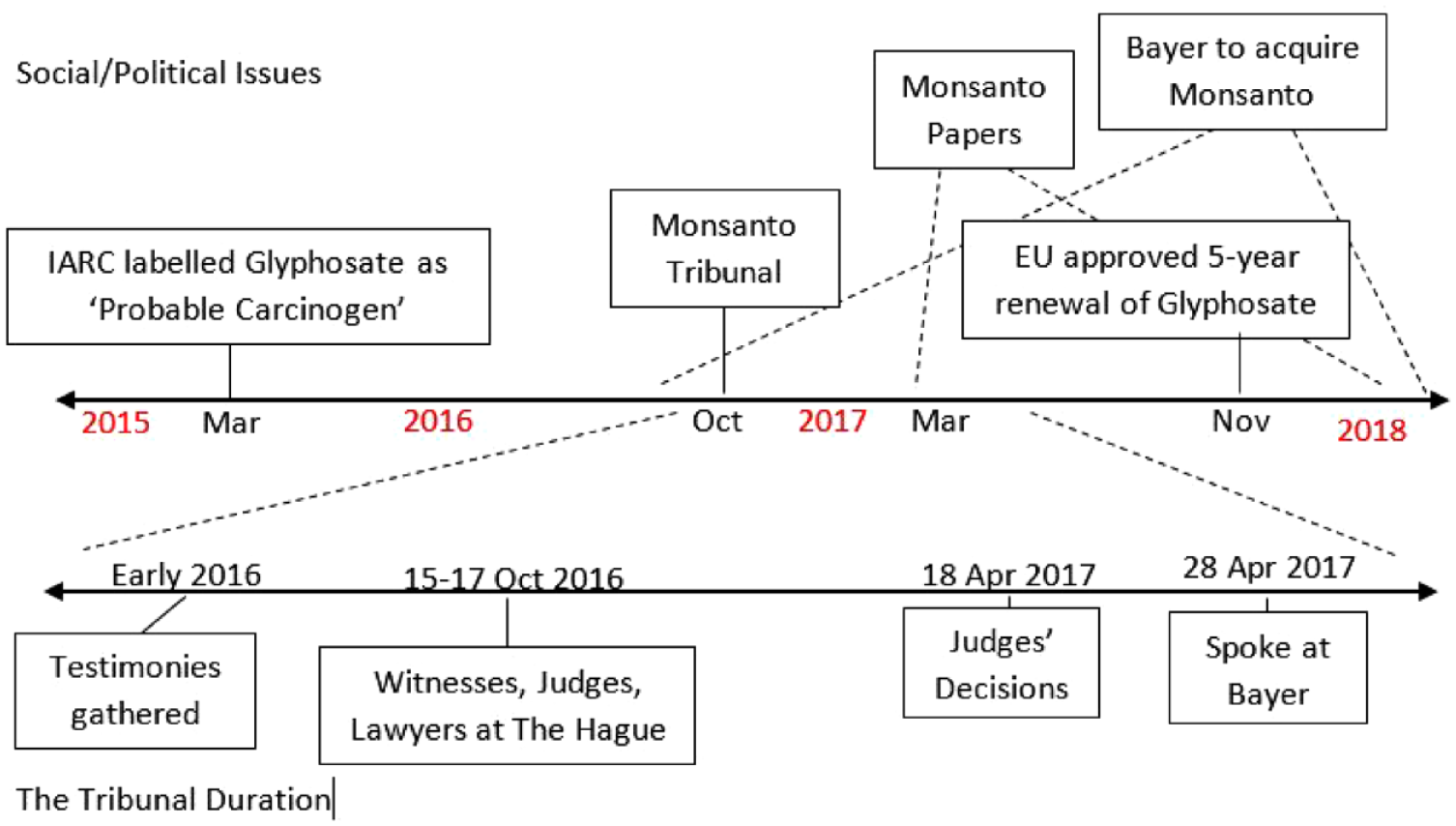
Timeline of key events.
Inspiration for IMT: The People’s Tribunal
IMT was based on the “People’s Tribunal” model, which has been used by social movements worldwide with the goal of “organizing deliberative assemblies” (Byrnes and Simm, 2018) on human rights issues. The first People’s Tribunal questioned the legality of the US and its allies in the Vietnam War. It aimed to address the perceived failure of states and legal systems to fully acknowledge the impact of dominant actors on human rights (Icaza, 2015) and to reassert people’s rights to participate in the development of international law.
According to Byrnes and Simm (2018: 3), the People’s Tribunal is:
“. . .a process initiated by civil society that involves the presentation to a body of eminent persons of evidence and arguments that seek to establish whether a state, international organisation, corporations or, less frequently, specified individuals have committed breaches of international law or of another body of law or norms. It may evaluate the adequacy of existing international law, institutions or structures with broader notions of law or justice including ‘people’s law.’”
Three points should be highlighted. First, a People’s Tribunal is authored and created by civil society and is beyond the authority of the state or legal system (Dehm, 2015). Although inspired by the judicial model, the structures and procedures follow the specific demands and requirements deemed necessary to address the shortcomings of extant legal standards (Robins et al., 2022). The participation of neglected voices is central to these efforts (Icaza, 2015).
Second, the People’s Tribunal requires the presence of legal experts to give the trial legitimacy, even though it deviates from formal law in its procedures and format. It generally involves a “rational” presentation and evaluation of a set of “evidences” (Byrnes and Simm, 2018) before a group of jurors and/or judges. Legal experts are expected to develop formal and substantiated conclusions in an “advisory opinion” which, although lacking the force of law, is recognized as an authoritative legal text (Dehm, 2015).
Third, the People’s Tribunal is motivated by the desire to propose alternatives and change international justice institutions. It is grounded in the framework of “people’s law,” a “civil society instrument adopted in 1976 and used by the Permanent Peoples’ Tribunal as a primary source of law” (Byrnes and Simm, 2018: 25). People’s law argues that “the effective respect for human rights implies respect of the rights of peoples.” The People’s Tribunal is therefore based on a conception of the legal system as “a dynamic social-political field, which is open for development” (Gerson, 2013), particularly in response to the social, political, and cultural demands and aspirations of traditionally excluded actors.
IMT’s origins, organization and purpose
IMT was created from an existing network of local movements fighting against the practices of the global food system, like the Via Campesina and the International Food Sovereignty Movement (Busscher et al., 2020), and legal experts from a wide range of geographies. These groups formed a steering committee and working groups that, prior to the event, investigated Monsanto’s impacts and determined six main areas (see Table 1) that eventually structured IMT’s procedures.
IMT questions.
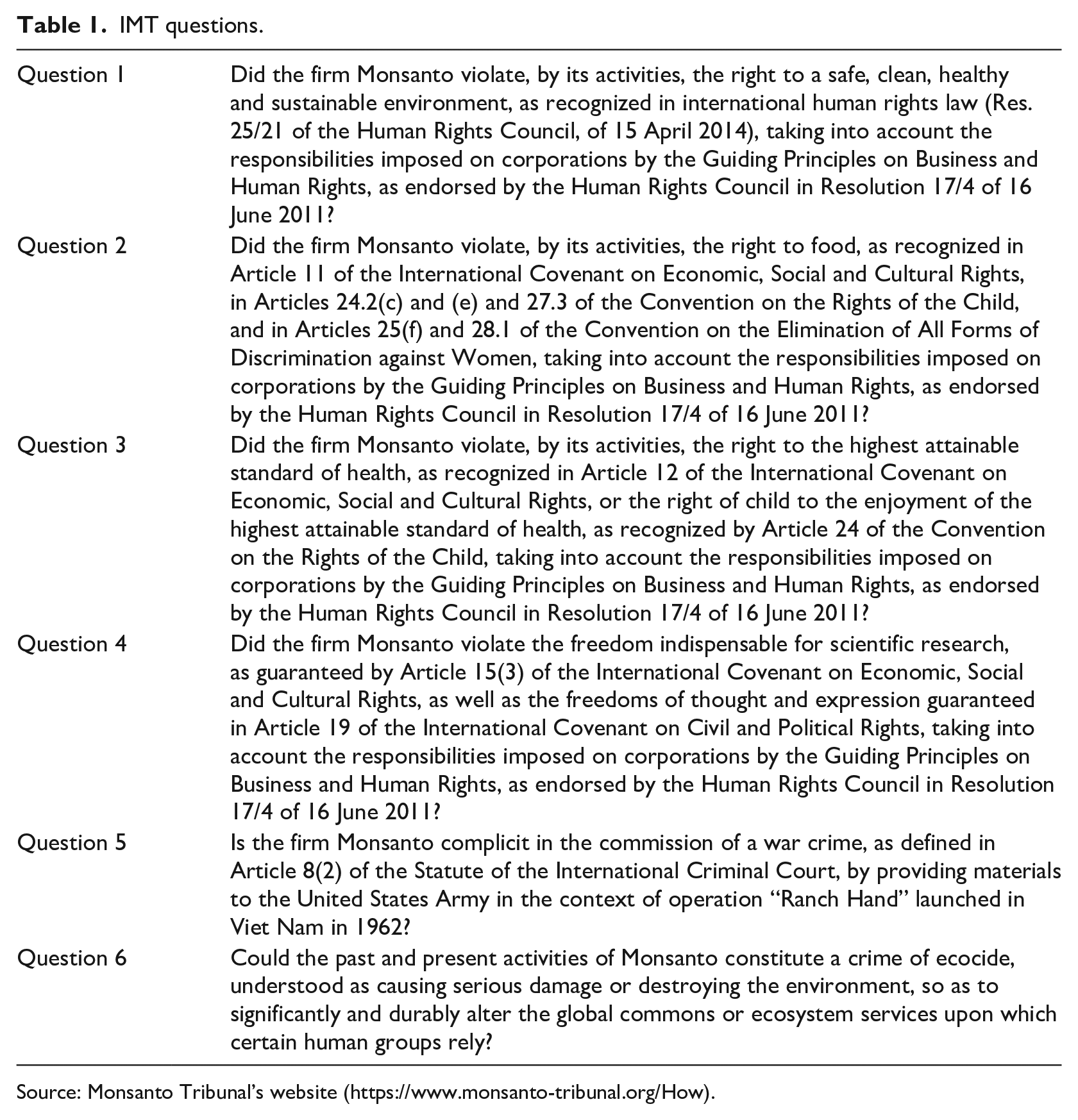
Source: Monsanto Tribunal’s website (https://www.monsanto-tribunal.org/How).
IMT followed the principles of the People’s Tribunal. Its purpose, according to its foundation document, was “to give a legal opinion on the environmental and health damage caused by the multinational Monsanto.” Françoise Tulkens, former European Court of Human Rights judge and IMT chair, stated that IMT’s goal was “to give us tools, legal tools. . .that will allow lawyers, judges, courts to intervene.” As a mock trial, IMT’s verdict is not enforceable, but it provides a space for marginal voices and demands to be heard with the goal of influencing existing legal institutions. According to Tulkens:
“We will not pronounce judgment. We will give an advisory opinion. Specifically, we will check if Monsanto’s activities are in compliance with the laws as they exist in the UN legal instruments [. . .]. We are therefore not a court that condemns a criminal nor one that judges a fault in civil law.”
Beyond its legal enforcement limits, the organizers also stated in their website that, as an event, IMT’s expected results would be to influence both the legal system and public opinion. On one side, the tribunal would “highlight the need to change international law” and show “why the crime of ecocide must be recognized under international law” while providing to victims “legal counsel the arguments and legal grounds for further lawsuits.” On the other side, on the battle of public opinion, their goal was to heighten “understanding of Monsanto’s practices and their impact on the environment” and “contribute to the ongoing debate on what it means to hold a company responsible for violating fundamental rights.”
In essence, IMT is an ideal case of a decolonial social movement event, that is, a specific mobilization to develop a public consciousness (Banaszak and Ondercin, 2016; Della Porta and Diani, 1999; McAdam and Sewell, 2001) around the issue of Monsanto’s global attempt to control natural resources (Busscher et al., 2020), while promoting “alternative visions for sustainable global economic alternatives” (Dinerstein, 2020: 177) based on local peoples’ knowledge (Valenzuela-Fuentes et al., 2023). To fulfill these goals, five judges from different countries oversaw the hearings, and five lawyers presented cases. Thirty-four people—farmers, rural residents, cancer survivors, lawyers, doctors, researchers, environmental and health activists, etc.—from different backgrounds and countries where Monsanto had a presence gave testimonies. According to IMT’s website, “Civil Society Organisations from five continents contributed to vetting judges, lawyers, plaintiffs and witnesses” for the event. Furthermore, 750 people participated in the events, including a people’s assembly and different workshops, and >10,000 followed the broadcast live.
Methodology
To understand the process of prefigurative translation, we examined IMT as a qualitative case study, focusing on participants’ situated actions and interactions. We followed an inductive approach (Glaser and Strauss, 1967) based on publicly available archives of the event provided by IMT organizers. With its focus on grassroots initiatives food and land issues with the aim of developing an “advisory opinion” to inform the development of political and legal change tools to their struggles against Monsanto’s actions, IMT provided an ideal case study.
Data collection
We used publicly available archival data, benefiting from the thorough recording of all proceedings by IMT organizers supplemented by further interviews and documentation. This provided a birds-eye view of the process, avoiding recollection and social desirability biases and observing exchanges as they happened (Levina and Vaast, 2015). Furthermore, the detail available about participants and the event, plus additional pre- and post-event material, and newspapers and social media material about IMT, provided important context-sensitivity.
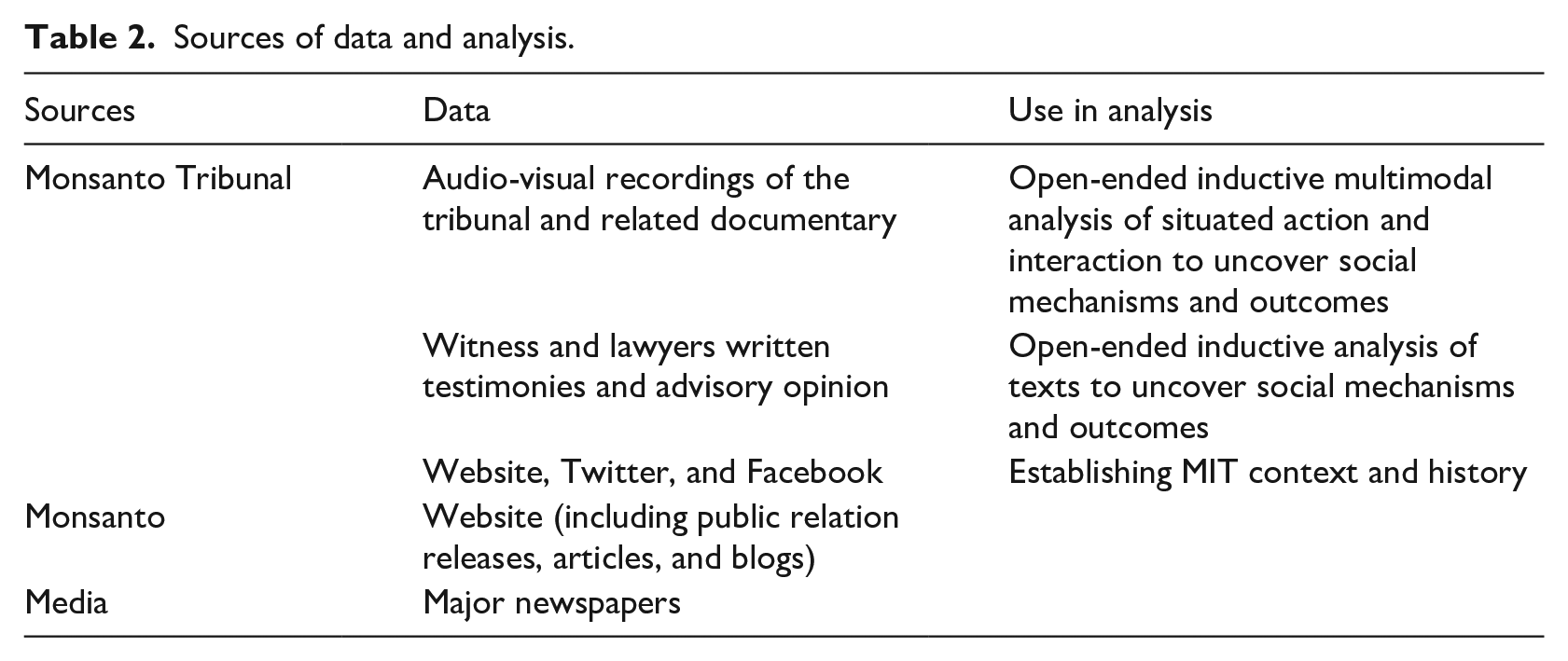
Our paper, therefore, draws on multiple archival data sources (see Table 2): audio-visual and textual documentation published on the IMT website (our main source) and material from newspapers and social media.
Sources of data and analysis.
IMT videos
We gathered over 20 hours of videos of IMT proceedings and related documentaries, and undertook video-based ethnography, a technique increasingly used to investigate situated action and interaction (Christianson, 2018). We multimodally transcribed (associating text and image) (Bezemer, 2014) all the videos of proceedings. Using the recordings as a “faithful record,” we were able to assess “both the participants’ talk (who says what, when, and how) in relation to their embodied behaviors (the relative location, orientation, and movement of people and things)” (LeBaron, 2008: 1) as well as the atmosphere and physical configuration of the “courtroom.”
IMT documents
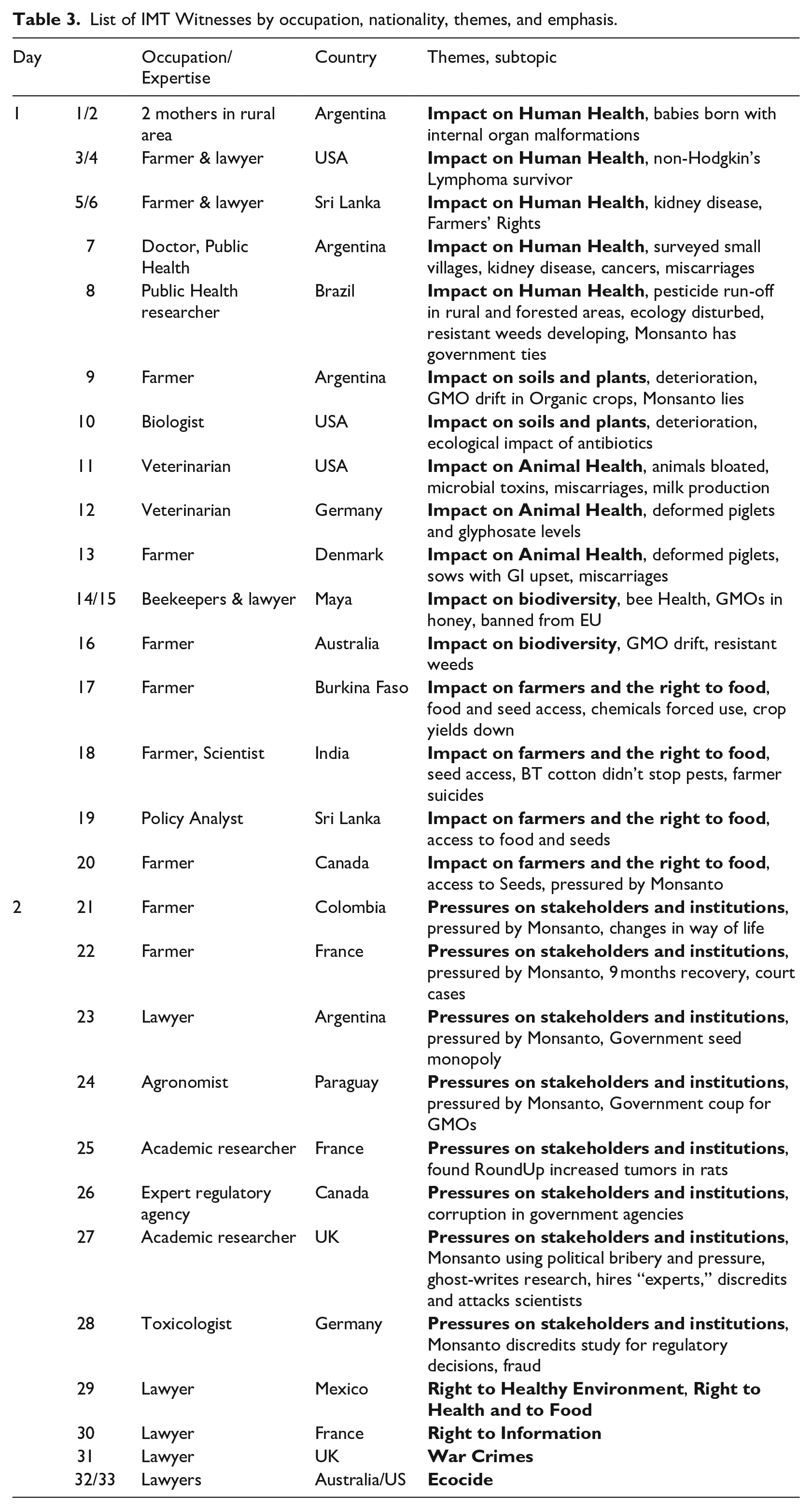
We gathered the written testimonies of 28 IMT participants (see Table 3); the formal accusations of the five lawyers; the 120-page summary brochure; and the final 60-page advisory opinion of the judges. These documents totaled >1500 pages. The inclusion of written documentation served as a complement to the live testimonies and formal accusations, adding new elements and perspectives not necessarily exposed during the event itself. Additionally, consideration of the judges’ political and legal change tools depended on documentary analysis since IMT’s final advisory opinion was only issued after the event.
List of IMT Witnesses by occupation, nationality, themes, and emphasis.
Newspapers and social media
In order to better understand the IMT context and the reactions of other parties, we conducted a systematic search of publications covering the period from 2015 (when organization started) to 2018 (after the tribunal and taking in Monsanto’s acquisition by Bayer) using Factiva software. Using the search term “Monsanto Tribunal,” we downloaded 66 newspaper articles. We also downloaded posts and accompanying comments from IMT’s Facebook site and Twitter account for the same period, and extracted relevant content about IMT from Monsanto’s website.
Data analysis
Our analysis followed an open-ended and inductive approach (Glaser and Strauss, 1967). As many scholars who have used archival data with grounded theorizing, the critical difference from more traditional sources of data was identifying relevant themes without the help of participants’ sensemaking through interviews (Levina and Vaast, 2015). In our case, these problems were solved greatly by the possibility of observing full set of recorded exchanges as they happened in the event, which helped us identify key interactions and discourses.
Our analysis followed three steps. Firstly, we reviewed all videos and documents to identify initial themes. These included: (i) constant criticism of Monsanto’s dismissal of local actors, and use of institutional channels to advance its interests; (ii) repeated reaffirmation by local actors of the value and strengths of their practices to construct a better food system, and their inability to be heard at the state and legal levels (iii) experts and local actors connecting their efforts as well as their struggles with Monsanto, and (iv) references by various actors to the importance of IMT as an inclusive safe space enabling free expression, and as a public “mock” expression of an institutional arena.
Secondly, we undertook several cycles of systematic coding of video multimodal transcriptions and written accounts, as well as other documentation, with constant interaction between theory and data. From the initial free coding, we moved to a theorizing stage, comparing and aggregating themes into broader categories representing specific social mechanisms (Hedström and Swedberg, 1998; Reinecke, 2018), that is, individual actions and interactions that created collective outcomes. Here, the work of Dinerstein and colleagues (Dinerstein, 2017; Dinerstein and Pitts, 2021) on prefigurative translation, proposing a decolonial approach on prefiguration (Dinerstein, 2022), provided a conceptual springboard for refining our ideas around four distinct mechanisms related to our initial insights: prefiguring, negating, bridging, and structuring.
Finally, we conducted a further step of inductive analysis to theorize the collective impact of the identified social mechanisms (Hedström and Swedberg, 1998). Drawing on the decolonial inspired social movement literature, with its goal to challenge of colonial heritage and recognize local knowledges (Escobar, 2007; Quijano, 2000), we proposed, for example, that the interaction between prefiguring and negating actions led to the creation of concrete utopias (Bloch, 1995) since they “emerge and evolve within, against and beyond” the struggle between prefigurative initiatives and dominant actors (Dinerstein, 2016: 52), which becomes a reference point to the construction of their anchored ideal. With that final analytical step, we constructed a representation of the prefigurative translation process.
Findings: Prefiguring translation at IMT
Our findings document how IMT participants enacted a prefigurative translation. We show how local actors, experts, and judges engaged in decolonial actions of prefiguring, negating, bridging, and structuring. They were meant to convert prefigurative practices into alternative propositions for political and legal change tools promoting institutional spheres supportive of prefigurative initiatives. Based on our analysis of the interaction between these mechanisms, we developed a representation of prefigurative translation (see Figure 2). We reveal how participants created a set of collective outcomes—concrete utopias, not-yet engagement, deconstructed mistranslations, and common horizons—that fueled the translation process. Finally, the process delivered a set of results based on political and legal change tools constructed by IMT participants and suggested the inevitable and necessary untranslatable excess.
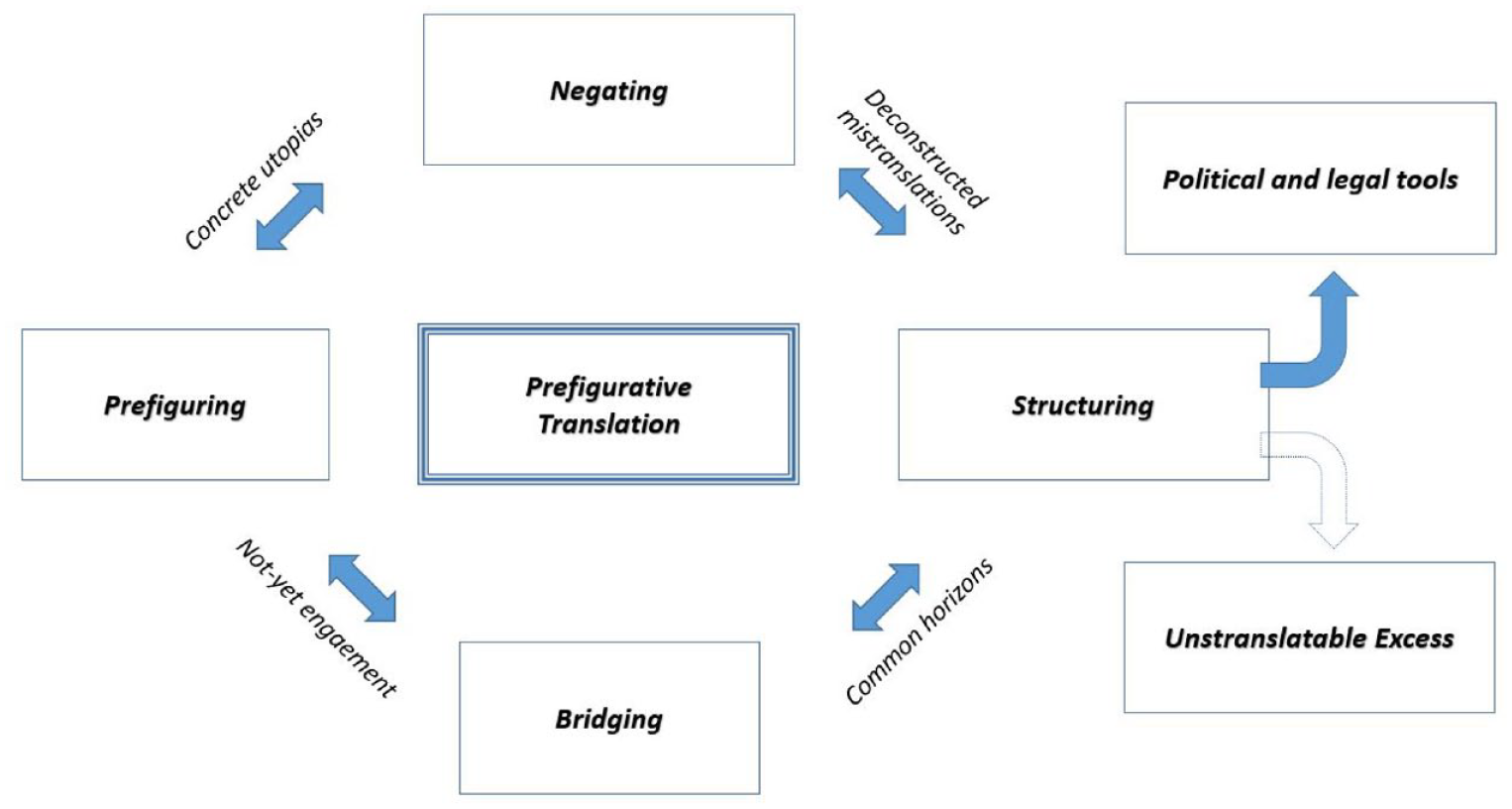
Prefigurative translation process.
Negating Monsanto
Despite accusations of “bullying,” Monsanto publicly expressed its wish for an open conversation to demonstrate the benefits and safety of its products. In a published critique of IMT, Monsanto’s chair stated: “We stand committed to real dialog with those who are genuinely interested in sustainable agriculture; human rights to food, health and a safe environment.” However, activists suggested otherwise, repeatedly accusing Monsanto of attacking local grassroots initiatives and exposing its (mis)use of state and legal systems to defend its interests. According to our analysis, IMT participants’ negating actions served to depict their struggles with the company and demonstrate how institutional structures, often inherited from colonialism, supported Monsanto in their efforts to hide alternative practices.
Local and alternative practice struggles with Monsanto
According to its detractors, Monsanto discredits local communities and practices by selling its “miraculous” solutions to their countries and questioning the narratives of small farmers and local activists about the effects on their lives. Many IMT witnesses affirmed this view, recounting how Monsanto, when entering a new national markets, challenges the value of traditional farming practices and promotes its product as modern and better alternative. Tiendrebeogo, a farmer from Burkina Faso, said that government campaigns “convinced us that [Monsanto’s product] was a panacea to pesticide pollution, production and poverty.” Fernandez, an Argentinian farmer, reported how the introduction of genetically modified organisms (GMOs) was pushed by constantly “criticizing traditional practices” as archaic and obsolete.
This strategy was supported, according to testimonies, by concealing information about products. Jayasumana, a scholar and community representative, cited the fact that there was no warning about the effect of glyphosate on water in Sri Lankan communication although “it is mentioned on the American label.” Robledo, an Argentinian mother, told how her community unquestioningly accepted glyphosate:
“They always said, ‘oh it’s harmless. It doesn’t do anything.’. . .We got completely used to it, that these machines kept coming and spraying. And we’re not talking about fields, just fields. It was in the middle of [. . .] between houses and parks. For us it was something normal, absolutely normal.”
According to witnesses, when adverse effects of products became evident, Monsanto denied responsibility, citing its “real” science, which was usually kept “under wraps.” Tiendrebeogo stated that when they reported the effect of GMOs on their animals, “the chiefs of GMO cotton came with the police and got a goat and some leaves to be studied in the Monsanto lab in the US. . .some days later they came back saying it was not the cotton that killed the goat.” As local veterinarians did not have access to labs to commission their own tests, they had to rely on the results provided by Monsanto.
From IMT presentations, we observed that local actors’ negating actions against Monsanto were supported by emotional personal stories, involving, for example, illness and death. This helped bring the hidden personal suffering to life. For instance, Grataloup and Robledo, mothers of babies with birth defects, allegedly caused by the spraying of Monsanto chemicals, described their experienced. Robledo said: “Here, normal is using herbicides to kill some plants and leave the soil ‘clean’. . .Normal is keeping quiet, ignoring. Normal. . .is our continued suffering. . .and suffering this abuse in silence, this manipulation of information. . .Today, normality in my life and my daughter’s means seeing the on-call doctor every 15 to 20 days because of recurring respiratory illnesses. . .My daughter’s ‘normal’ is being unable to attend kindergarten.”
Powerful images brought the witnesses’ experience of to life and enhanced the passionate tone of their stories. Robledo’s hand trembled as she showed a picture of her sick child (see Image 1). Grataloup’s testimony was complemented by pictures of her baby in hospital: “I know you are going to hear a lot of numbers and statistics, I wanted to put a face on them and bring you some photos.”
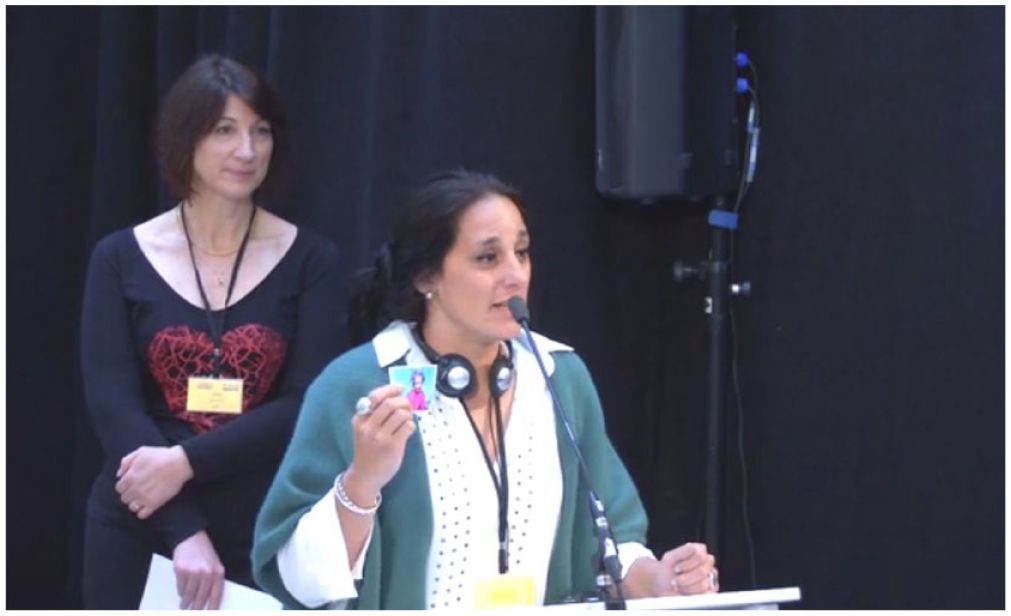
Negating: embodied struggles.
Other witnesses recounted similar narratives of local struggles with the company. Mutumbajoy, a Colombian farmer, reported how Monsanto’s products had damaging effects and unintended consequences for his village and the surrounding eco-system during the event of a chemical war against drugs in their region. In the context of Sri Lanka farming, Prasanna illustrated the impact on their community:
“We don’t know the western science but our community came to this conclusion using their intuition. Sri Lanka [. . .] has cultivated rice continuously for the last 23 centuries. There is no record in known history of this kind of kidney disease. My grandfather and father confirmed this disease emerged in the mid 1990s. Agrochemicals were introduced in early 1980s.”
Scientists and other experts reported how Monsanto response to scholars or journalists who wrote damaging pieces affected them personally. Defarge, co-author of a study contested by Monsanto, explained how his scientific identity was challenged. According to him, Monsanto’s persecution was persistent and went beyond legal channels: “If you go to Wikipedia the pages about the Seralini affair were written by people paid by Monsanto. It is impossible for us to correct it, we are defamed on the internet and justice cannot help us in this matter.”
Monsanto is also accused of relentlessly questioning or putting obstacles in the way of inconvenient research. The company’s representatives continually criticized any investigation that reported the dangerous effects of its products or downplays their potential benefits. As Defarge stated: “Monsanto has an army of scientists much larger than ours who will deconstruct any research by academics.” Other scholars, such as Jayasumana and Huber, mentioned the impact on academic freedom and limits being placed on grants for researchers doing independent studies.
One Monsanto tactic, according to IMT testimonies, is to produce questionable competing results to undermine existing research unfavorable to the company. Pedersen, a Danish farmer and researcher, described how until Monsanto financed its own study to refute his findings, supported by other international studies, linking pig deformities to glyphosate. According to him, Monsanto’s research was “fake, set up with the intention not to do any harm [to the interests of the company]” and, when problematic results appeared, they were hidden, and the work was not published.
Exposing (mis)use of institutional structures by Monsanto
Another element of negating actions by IMT participants was showing how Monsanto suppressed local voices and practices with the help of the state and the legal system. Testimonies generally suggested that adoption of Monsanto technologies was decided by governments without consultation with affected communities. Akther, a Bangladeshi policy analyst, claimed that products were imposed on communities and “seed rights were given to companies without the knowledge of farmers.”
Witnesses often mentioned Monsanto’s political lobbying or strategic use of the legal system to limit consideration of local communities. Pereyra described how the company exploited a weak legal system in Argentina which was indifferent to local actors’ struggles. Marsh, an Australian farmer, suggested that environmental and health problems “won’t be prevented at the government and the regulatory level because of the relationships with these companies.” Similarly, Lovera, a Paraguayan agronomist, exposed how the company covertly created an association (UGP) to challenge his expert government work. He described many conflicts with Monsanto:
“Since the beginning of my tenure at SENAVE (Paraguay National Agricultural Service), Monsanto, through the UGP, has tried to remove me from office. The PMU [Production Trade Union] has directly addressed the president of the republic to have me removed. As this failed, they began a personal smear campaign against me with countless articles written against my colleagues and me.”
The silencing of adversaries in the scientific community, described above, prevented these specialists being heard at governmental or legal levels. Many participants suggested that Monsanto’s influence on governments led to research being ignored or dismissed. Verzeñassi, a public health doctor in Argentina, claimed that Monsanto’s political lobbying in his country meant that much of the scientific evidence questioning its products has gone unrecognized. According to him, “science demands scientific proof but it can be used as a political tool.”
Moreover, Robinson, an English journalist, suggested that Monsanto and its allies “used deceptive tactics” such as “third-party PR techniques” which concealed the company’s interests behind supposedly independent organizations and individuals. One IMT lawyer, Bourdon, claimed that Monsanto’s “strategies are sophisticated and new for an economic actor. They are dissimulated and opaque, they are not simple to characterize because Monsanto does not act alone, and subcontracts its schemes.”
Our analysis shows how, in IMT, Monsanto was the major opposing force for participants. We saw how actors’ negating action exposed how Monsanto influenced political and legal structures, legacies of colonialism, to exclude local and alternative voices and practices. Their negating actions produced an important decolonial outcome of prefigurative translation: the deconstruction of mistranslation, that is, exposing and questioning political and legal solutions that appropriate or distort rather than enable prefigurative potentials of local actors. The deconstructed mistranslation helps frame the structuring efforts by proposing laws that limit Monsanto’s scope to devalue alternative principles in order to impose its products and technologies.
Besides the “deconstructed mistranslation”, our study highlights that this negating action was essential in the creation of another important decolonial element of the prefigurative translation effort: the “concrete utopia.” As shown below, actors promoted their prefiguration initiatives in light of the structural limitations, indicating existing practices within their present struggles. Their “concrete utopia” implied engaging with opposing powerful actors, such as Monsanto, and building tools geared toward possible alternatives through their current challenges.
Prefiguring practices
In the context of their decolonial struggles with Monsanto, IMT participants’ prefiguring actions sought to value their alternative organizing principles. Most vocal in this respect were witnesses—farmers, beekeepers, community organizers, family heads, etc.—who were familiar with Monsanto’s activities and the actual practices of producers, consumers, and communities at the local level. IMT’s inclusiveness based on the shared struggle with Monsanto also brought in expert voices from different fields related to human and environmental domains—medicine, biology, public health, etc.—which defended the importance of “good science.”
Valuing tradition and communities
Prefiguring action by participants, usually linked to grassroots initiatives around food and land, reaffirmed local practices and reintroduced the importance of the past as an orienting principle. Akther, in her analysis of the introduction of GM seeds and the impact on local food sovereignty in Bangladesh, declared that “traditional [seed] varieties did not need any pesticides.” Similarly, Lovera suggested that “the approval of GM corn seeds for us seemed unnecessary in [Paraguay] where we have traditional corn diversity that satisfies us and has provided stable production since before Colombus.”
Witnesses attested that survival of their local culture was essential to guaranteeing food sovereignty. Godoy mentioned the importance of protecting local diversity by maintaining “the right to feed its own people in a culturally appropriate way.” Speaking in Hindi and wearing traditional dress, Chaudhary, an Indian farmers’ leader, suggested protecting local culture was a political imperative since “Monsanto by trying to control seeds is trying to control all the food system. . .We will be left helpless and hopeless.”
Participants also referred to their ancestors and communities and told personal stories about their struggles. These lived accounts gave detailed descriptions of everyday lives and the disruptive impact of Monsanto’s products compared to previous traditional practices. For another example, Prasanna discussed the experience of disease in her community, highlighting the difference with their past:
“Our fathers’ generation never brought water to the field. They freely drank water from the streams near the paddy fields. After a couple of seasons using agrochemicals, fish in these streams died. Frogs too became extinct. Water in the streams became unsuitable for consumption. Every problem started from this introduction of agrochemicals.”
Defending “good” science
While local actors like Mutumbajoy drew on their ancestral origins—“I am a descendent of Inga indigenous people and I am also a peasant farmer”—IMT experts gave authority to their voices by invoking scientific standing and defending “good” science. Scientists referred to their credentials and their status as professors and members of recognized institutions and research groups. For instance, Krueger, a German scientist, cited her 15 years in the field of botulism before expanding on her research about the effects of glyphosate. Similarly, Chopra, a Canadian regulatory expert, detailed his long tenure in a national agency, before his refusal to approve GMOs and pesticides led to him being “suspended and gagged.”
For IMT experts, establishing their scientific credentials also involved using formal language. Most researchers used scientific language and terminology to describe their work to discuss complex concepts from their fields. Some, like Dunham, a veterinarian, cautioned that such language was necessary to give a detailed description of the diseases he found to be linked to glyphosate. Legal specialists also used specific terminology, for example, in discussing the evolution and challenges of international law in relation to corporate liability.
IMT experts also gave detailed explanations of rigorous methodological considerations and supporting statistics. Krueger described her 4-year multi-lab study which established a connection between animal health and glyphosate, while Verzeñassi detailed the robustness of his work with students in “health camps” in Argentina:
“In technical terms, we conduct a ‘Diagnosis of Health Situation’ with a ‘sweep’ methodology, using a semi-structured open-and-closed questionnaire designed to identify morbidity (illness) and causes of death reported by the community.”
For expert witnesses their values came from institutional and professional markers of “good” science. Scientists constantly mentioned publication in peer-reviewed journals. Defarge repeatedly emphasized the difference between good and bad science while complaining about the media focus on criticisms “despite the fact that we continue to publish in peer-reviewed outlets.” Dunham (and Defarge) spoke of the lack of proper engagement with science:
“We need more agroecology rather than more agrochemistry. We need specialists who have some general knowledge. We need less scientific reductionism and we need regulators that are know-something generalists. Substantial equivalence has always been based on PR rather than good science.”
Our analysis of local actors’ prefiguration efforts have shown that the decolonial emphasis on grassroots initiatives around food and land were central to most participants. Furthermore, their discourse and actions indicate that their heritage was essential to their efforts. Their life-affirming prefiguration used their traditions and local culture as tools to resist and defend their knowledge and practices against imposed technologies.
Our data underlines actors’ decolonial attempts to construct a concrete utopia, by consistently valuing their organizing principles based on traditional and embedded experience against Monsanto’s dismissal campaigns and promotion of its “miracle” products. Ultimately, these actions, supported by “good science,” forges the potential for political and legal translation through the interaction between prefiguring alternatives and negating absences. Concrete utopias help decolonial structuring efforts by grounding prefiguration principles via the rejection of a given reality and connecting negation to existing practices.
Beyond concrete utopias, prefiguring also brings positive and affirming decolonial action symbolized by engaging with the “not-yet.” The not-yet suggests a permanent movement toward new horizons by defending alternative organizing principles around food and land such as local culture, diversity, and food sovereignty. The “not-yet engagement” helps structuring efforts by providing the praxis-oriented alternative principles to be converted into political and legal change tools and, as we will see below, by offering a possible connection between actors sharing common horizons.
Bridging alternatives
All participants developed a sense of shared endeavor by bridging their alternative principles and associated practices. This involved the decolonial epistemic effort of recognizing, balancing, and connecting the different practices and struggles exposed within IMT. Our analysis suggested that, while all participants were involved in this action, the IMT judges had a pivotal role in bringing these different practices to bear during proceedings.
Recognizing alternative practices
A key aspect of the bridging action was recognizing alternative actors and practices within IMT space. The importance of being able to speak (in their own voices) was frequently mentioned by witnesses, particularly those from developing countries. For instance, Akther looked directly at the judges and said: “I want to go back to Bangladesh to say that I was able to tell you this story and that something will happen.” Chaudhary thanked the judges “on behalf of Indian farmers for giving us this opportunity to bring about our case.”
The witnesses were also aware of the positive effect of speaking out. Robledo, when referring to her child’s birth defects, said: “I take this opportunity, despite personal consequences, to create awareness.” François also wanted his struggle to be known:
“Considering what I have been listening to since yesterday it is important that I speak first to show that Monsanto can be condemned by a sole individual and to show that problems happen not only in developing countries but also in France.”
In what might be seen as a sign of respect for and acceptance of the different practices presented, the judges did not cross-check testimonies. They asked for clarification and posed questions, and often expressed sympathy for participants’ struggles. One of the judges repeatedly thanked witnesses for their “evidence,” saying during a particular poignant testimony: “thank you very much for coming all this way to tell us this sad and discouraging story.”
Further, Judge Tulkens used her closing speech to emphasize the value of the presence of “expert witnesses through life” as “a key element to understand the reality of things, to understand what happened, to understand the suffering you experienced that you reported to us with honesty, integrity, and above all dignity.” Godoy, a lawyer, mentioned the role of local communities’ knowledge, saying: “Here we had a debate about how we demonstrate these impacts, we had the scientific studies and another kind of science, popular science, . . . the evidence found by farmers of many countries demonstrate that this new science has to be recognized.”
Balancing voices
The above discourse demonstrates that IMT judges recognized that local actors are often overshadowed by more formal experts in legal arenas. Although, IMT was envisioned as a space for dialog where expert and local actors’ voices were equally valued, the scientific standard still remained as an almost indelible reference. During proceedings, it was clear that it was easier for experts to connect with the judges’ legal language. Balancing action was used to counteract this situation.
Balancing was thus embedded in the structure of the presentations during IMT. The tribunal was organized into six themes, with testimonies divided equally between local actors and expert. All witnesses, regardless of background, had exactly 15 minutes to speak, followed by questions from the judges. We observed, however, that interactions between witnesses and judges sometimes broke down because of language and cultural differences, as illustrated by the misunderstanding between Judge Sow and Pereyra over the legal impact of scientific studies in Argentina.
Balancing was also evident in the constant reflection on and declarations about the commonality of struggles among local actors and experts. Witnesses from around the world told their stories, highlighting common threads. Their realization that they were not alone in their fight was seen by the judges, in particular, as legitimating IMT practices. As Judge Lamm said:
“These people all express, in their own ways, in their own languages, a very deep feeling. Everyone reveals their distress, their pain, their frustration about a struggle which seems particularly difficult in view of the other side’s power.”
Connecting practices
Bridging actions can also involve connecting with the practices of others. Many of the farmers and community actors sought to use scientific research to validate their experience with Monsanto’s products. One witness described collaboration with a university medical faculty, while others mentioned research papers that confirmed their lived experiences. To emphasize the importance of these links, Fernandez said: “I could say that glyphosate is the direct cause of the death of microorganisms. . .I, as a farmer, no [one would believe me], we can attest to that with the studies that I bring.”
Some experts combined scientific knowledge and practical experience in their testimonies, sometimes referring to collaborative efforts with communities to understand the origin of problems. Porto, a researcher, explained how his public health organization in Brazil “works together with different social movements with interdisciplinary and participative approaches [and had worked] intensively with rural social movements such as the Landless Workers’ Movement (MST) and Via Campesina.” Many of these collaborations were physically illustrated by local actors and experts presenting testimonies together.
Finally, connecting meant also recognizing that actors felt the same general impact in their lives and lack of representation in official channels. Pedersen, referring to deformities caused by glyphosate, pointed to Grataloup (see Image 2) and emotionally said: “We need to take this seriously! It’s not a coincidence that we have an EU citizen here, complaining. She has a child who has had a terrible illness. . .[voice cracks].” Ultimately, IMT participants recognized the commonality of their struggles and the need for collective and institutional tools, with Grataloup saying: “It’s not normal to have individuals say that something needs to stop. We need an international authority that has to deal with it, so that we are not single victims, isolated, in order to inform the public.”
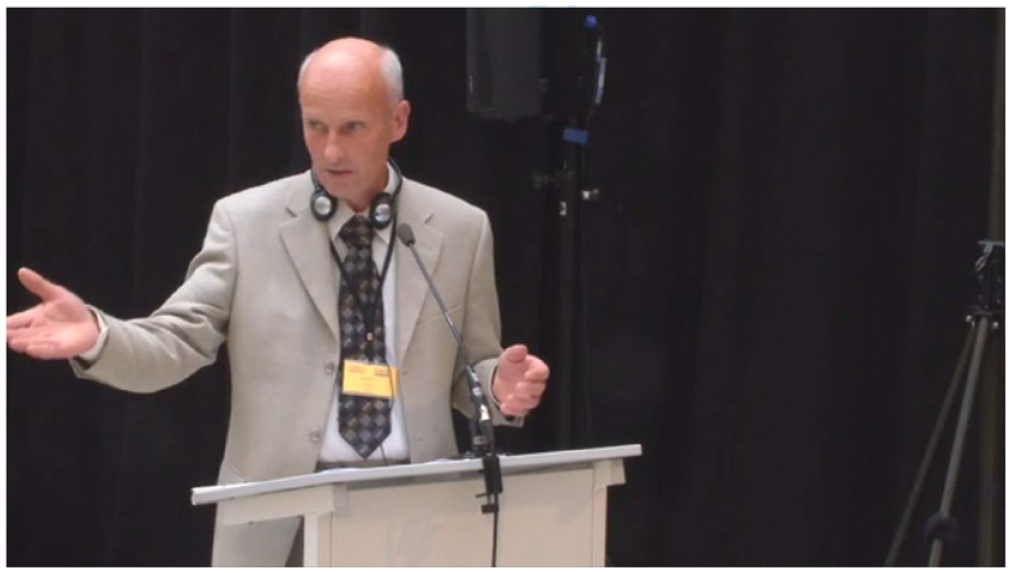
Bridging: connecting struggles.
Our analysis suggests that this process involves the decolonial epistemic effort of valuing of alternative organizing principles based on heritage and communities’ situated practices as well as the opportunity to have a voice on the international stage. Most particularly, our examination highlights the important role of judges, as institutionally legitimate actors, in recognizing the significance of local actors’ voices in the prefigurative translation effort. The IMT judges, we suggest, not only recognized traditionally silenced voices, but worked to balance these and make connections with others representing similar struggles and horizons.
Thus, IMT judges played a pivotal role as translation arbiters bridging common horizons. Their decolonial actions legitimated different principles, equalized diverse experiences, and made links between alternative and counter practices in the same struggle. Their engagement was not exclusive, since we observed local actors citing scientific research and experts joining force with activists; however their conscious and consistent efforts provided institutional legitimacy throughout the event and supported prefigurative translation by providing shared proposals to be transformed into projected policies and laws.
Structuring prefigurative principles and struggles
In general, there was an awareness amongst participants of the importance of their voices, principles, and practices being supported by political and legal change tools that could create enabling institutional structures against Monsanto’s actions. Participants’ decolonial structuring action involved then two elements. Actors sought to convert their shared principles into supportive laws, while also proposing ways to legally and politically correct the multinational’s damage and curb its reliance on the colonial heritage of state and law structures.
Prefiguring laws
Although the advisory opinion was IMT’s the key outcome, our analysis shows that the effort of translating practices into political and legal change tools began before the event. According to the IMT website, Olivier de Schutter, Professor of international human rights law and former UN Special Rapporteur on the Right to Food, with 40 students from a University of Louvain (Belgium) and Yale University (USA) “reviewed the records of all the victims and identified the charges [and] prepared legal briefs that the plaintiffs and their legal representation could use in their arguments.” According to an interview, Schutter suggests that their work was motivated by the fact that these people “had no effective access to justice, face financial hurdles, difficulty collecting evidence, sometimes they have been intimidated or bribed by Monsanto.” Thus, overcoming these limitations, participants were approached to collect evidence and “legally counselled” before the event, indicating an effort, from the outset, to translate alternative principles into legal outcomes.
IMT lawyers were particularly adamant about the importance of legal answers in relation to local practices. Bourdon, when asked by the judge about the limits of “soft laws” (based on good intentions), suggested that “all international law comes from common law. . . soft law in itself is not enough, we need texts and norms.” One particular IMT account, in contrast to the general sense of disenfranchisement, indicated the real possibility of local actors influencing public policies. Two witnesses from Sri Lanka happily described 3 years of political struggle against Monsanto, declaring that they were “proud to be a member of the first nation to totally ban glyphosate-based herbicide due to scientific reason.” Their testimony, suggesting a successful conversion of local alternative practices into supporting laws, was met with overwhelming applause.
Furthermore, Dogbevi, one of the lawyers participating at IMT, reminded that this forum was the most “appropriate forum available to the parties at this date” because of the many failures of the current international law system. In essence, no international law articles offered protection to victims which caused a limited number of cases to be brought to court. Therefore, as stated by lawyer MacCarrick, IMT “is acting on the authority of global citizenry, its legitimacy come from its international advisory function, and the authoritative opinion it disseminates to the global community.” Therefore, the dissemination of the results of the tribunal are essential to its influence on the global community and international law:
Whilst this people’s court cannot make a binding decision, its findings nevertheless support the efforts of communities across the world to seek justice by referencing the opinion and guidance of eminent jurists, and their prediction about the future direction of international law.
Correcting Monsanto
Many actors pointed to the importance of finding ways to stop Monsanto. McCarrick, an American lawyer, reinforced this idea by highlighting the importance of a courtroom outside the legal system: “Because the tribunal lacks state authorization or endorsement it is precisely this that enables it to fill the gap in the international law system.” Godoy described the path from struggle testimonies to enabling law:
“The testimonies, accusations and evidences that during many years have been documented with which the tribunal worked, so that between hundreds of cases we could choose 30, helped us hear the voice and words from testimonies and lawyers, jurists, scientists and experts that accuse Monsanto of violating an extensive list of human rights that are internationally recognized and that could constitute ecocide and crimes against humanity.”
The tribunal was then, according to its lawyers really important not only because of “the stature, integrity and expertise of its members [. . .] committed to an impartial process of evaluating evidence through reasoned and fair-minded deliberations.” According to McCarrick, IMT helped bridging “the ‘accountability gap’ of multinational companies engaging in environmental destruction” by providing “an important model for future tribunals [bringing] to public notice events that might otherwise not have been revealed.” In that sense, Dogbevi suggests that the ecocide committed by Monsanto should be considered “the fifth crime against peace along with the crimes of Genocide, the crime against humanity, the war crime and the crime of aggression.”
At the center of case against Monsanto in IMT is an effort of creating laws that support local alternatives, but also seek reparation from the harm done by the corporation. According to Dogbevi, IMT shows the need for “transitional justice measures as a mean of rehabilitating native tribes and other indigenous communities that suffered loss of cultural and religious life as result of Monsanto’s conduct.” At the end, the tribunal’s findings, embodied in the final advisory opinion, “support the efforts of communities across the world to seek justice by referencing the opinion and guidance of eminent jurists.”
The advisory opinion
Although these structuring actions during IMT are captured as written testimonies and videos, the main public expression of the efforts of all involved is the advisory opinion issued by the judges. This centerpiece and key outcome of IMT was published on 18 April 2017 in a live recorded event, following a 6-month adjournment to discuss proceedings. Our analysis suggests that the final document is constructed in a way that brings together the shared principles of participants’ and their struggles against Monsanto. These elements were converted into legal proposals by the judges, inspired by the notion of people’s law.
In its introduction, the judges outlined the context and goals of their advisory opinion whereby, using “a judicial method,” they were “alerting public opinion” and “contributing to the progressive development of international law.” The introduction highlighted the potential contradiction between traditional legal systems and the alternative practices proposed in IMT:
“The Tribunal has no reason to doubt the sincerity or veracity of those who volunteered to testify before it. But, because their testimony was not given under oath or tested by cross-examination, and because Monsanto declined to participate in the proceedings, the Tribunal is not in a position to make findings of fact concerning the allegations of various company misdeeds. Rather, for the purpose of answering the questions posed for the Tribunal’s consideration, the Tribunal will assume that the facts and circumstances described by the witnesses would be proven.”
The central part of the advisory opinion, which discusses IMT’s six questions, generally follows a structure which represents the actions taken in IMT in relation to the current legal system. There is initial coverage of the “applicable law,” with references to authoritative judicial texts, followed by an account of all the testimonies, which together support a final sub-section on Monsanto’s negative impacts. The conclusion mostly focuses on participants’ experiences, while also giving supporting evidence from recognized institutional actors:
“Monsanto’s activities also threaten biodiversity, as an increasing number of farmers use exactly the same GMO seeds and grow exactly the same monocrops. As explained by the Special Rapporteur on Human Rights and the Environment, ‘the degradation and loss of biodiversity undermine the ability of human beings to enjoy their human rights.’”
The sections on war crimes and ecocide are structured differently. While inspired by IMT testimonies, the judges mostly develop their premise based on historical documents about the impact of Monsanto’s Agent Orange in the Vietnam War and the legal evolution of the notion of ecocide. This serves as an argument for a new definition of ecocide based on the “substantive and lasting damages to biodiversity and ecosystems, affecting the life and the health of human populations.”
Alongside the proposal of ecocide as a legal tool, the document ends with two other legislative proposals relating to the limits of international law in the protection of affected parties, and the need to include corporate liability in international law. Here, the defense of actors’ alternative principles and the damaged caused by their struggles with Monsanto are used to suggest the need to establish primacy of human rights law over trade, and to extend it to corporate actors. The document cycles back to participants’ struggles with the legal system and pushes toward legal mechanisms to create inclusive and accessible judicial institutions.
Our analysis has shown how IMT, particularly through its main advisory opinion output, translated prefiguration principles into political and legal change tools. Its decolonial translation was meant to represent the common horizons proposed by participants, while also correcting Monsanto “mistranslations,” into prospective laws. Throughout the prefigurative translation processes, IMT managed to convert prefigurative means to political and legal tools that might generate supportive structural transformations. While not establishing an immediate impact, the event highlighted how the creation of these change instruments should be connected to actors’ real struggles on the ground to form life-affirming initiatives. Based on a decolonial approach, their proposed “concrete utopia,” while an unachievable ideal, works as a reference point for a path anchored on lived material challenges.
While this represents an important instrument in the ongoing struggle against the company, we identified that central practices, such as food sovereignty were mentioned in the final IMT output, but not included in the proposed tools. Local actors repeatedly mentioned the importance of food sovereignty as a way to maintain control over traditional modes of agricultural production, distribution, and consumption and protect them against multinationals such as Monsanto. This significant element remained, however, on the side-lines as an “untranslatable excess.” Therefore, “food sovereignty” was not an issue that helped develop the defense of political legal tools of corporate accountability linked to ecocide and protection of human rights of the local communities’ traditions.
In summary, within IMT, farmers, scientists, and community organizers, with their life-affirming prefigurative initiatives linked to food and land, engaged alongside legal experts in the process of prefigurative translation. This decolonial action involved promoting their alternative practices (prefiguring), invoking “concrete utopias” challenging Monsanto’s activities (negating), bringing together different affected actors in “common horizons” (bridging), thus creating potential political and legal change tools (structuring) that take into consideration their “not yet” possibilities within the present context of “deconstructed mistranslations.” The main product of IMT’s prefigurative translation is the advisory opinion that gives prospective political and legal change tools to these prefigurative actors reflecting their real struggles.
Discussion
Based on questions about the limited structural influence of prefiguring initiatives (Chase-Dunn and Nagy, 2019; Young and Schwartz, 2012), our study asked how social movements translate prefiguration into political and legal change tools. We analyzed the case of IMT, a decolonial social movement event where a people’s tribunal was created to denounce and create awareness about Monsanto’s global attempt to control natural resources and propose legal answers to the corporation’s violations of human and environmental rights based on local communities’ practices and knowledges. We showed how IMT participants engaged in prefigurative translation by connecting prefiguring principles to efforts of bridging alternative voices and negating Monsanto’s damaging actions. Finally, by bringing together actors’ sharing similar horizons and deconstructing current problematic structures, participants helped translate principles into alternative propositions for political and legal change tools promoting institutional spheres supportive of prefigurative initiatives.
Our paper contributes to the social movement literature in three distinct ways. First, our work contributes to scholarship around the structural support to alternative organizing. Although scholars (Schneiberg and Lounsbury, 2008; Tarrow, 2005) have suggested the role of translation for social movements in creating this support, research has mostly focused on diffusion within fields and across borders. Our work follows recent studies that have suggested a new dynamic of decolonial social movements as translators that goes beyond horizontal diffusion and suggest the importance of the recognition of local practices at the macro level (Baker, 2020; Buts, 2020). This vertical translation process, we propose, is essential to develop their capacity to create favorable institutional contexts (Dinerstein and Pitts, 2021), since the survival of alternatives often depends upon fruitful interaction with institutional actors (Esper et al., 2017; Schneiberg, 2013).
By advancing the recent perspective of decolonizing prefiguration (Dinerstein, 2022), our study suggests translating as a key social movement activity for supporting alternative organizing, and the need for a new generation of activist translators (Baker, 2020; Buts, 2020). Studies have shown that social movements have a history of promoting marginalized groups and practices against powerful actors (Esper et al., 2017; Schneiberg, 2013). However, the idea of prefigurative translation suggests that social movements could have a distinct decolonial role of recognizing and supporting alternative organizing by proposing political and legal change tools that are constructed from a position “with, against, and beyond the state, capital, and the law” (Dinerstein, 2015: 223).
Besides diffusion, social movements should focus on how to convert prefigurative organizing principles into enabling policies, laws and structures. These efforts are needed especially in places with oppressive governmental, legal, and economic systems (Chase-Dunn and Nagy, 2019), particularly ones that are part of institutional legacies of colonialism (Busscher et al., 2020). We suggest that social movements prefigurative translation could be vital in situations where alternative organizing is in direct conflict with dominant political and economic actors (Audebrand and Barros, 2018), proposes innovation disruptive to established structures (Meyer and Hudon, 2017), or works in institutional environments that offer scant political or legal protection (Mair et al., 2012).
As further contributions, while the social movement literature has repeatedly discussed the relation between prefiguration projects and structural change (Maeckelbergh, 2016; Polletta and Hoban, 2016; Young and Schwartz, 2012), how this connection takes place is still little explored. Our study of a decolonial social movement event contributes to a deeper understanding of this process (Parker, 2023; Polletta and Hoban, 2016; Zanoni, 2020) through the social mechanisms and effects of prefigurative translation. Our decolonial analysis reveals that, in prefigurative translation, prefiguring and structuring are connected by two social mechanisms: negating and bridging.
Therefore, as a second contribution, our analysis suggests that negating mechanisms indicate that prefigurative translation is characterized by the decolonial struggle of recognizing alternative principles and practices in the face of dominant actors that attempt to co-opt and distort original meanings based on control and influence over political and legal structures (Dinerstein, 2016). Social movements’ scholars have provided numerous examples of governments introducing laws and policies that remove power from local actors and their practices (Santos, 2015). One much criticized solution is the promotion of NGOs in international development to “organize” existing local initiatives (Banerjee, 2011).
These mistranslations, which seek to limit prefiguration initiatives to certain “parameters of legibility” (Vázquez, 2011), reinforce the central idea of prefigurative translation as inherently problematic, but also open to debate and influence by decolonial social movements. Recent calls for co-construction and participatory processes illustrate these disputed dynamics where activists are welcomed to the table, but imposed “compromised solutions” dilute their potential contribution (Dinerstein, 2017). While the literature suggests that opposing actors in these struggles are normally within the state, IMT indicates that major companies are also involved in co-opting local initiatives.
At the same time, negating mechanisms are important to ground the actors’ demands into real struggles in order to avoid becoming “an abstract critique, detached from the real movement of struggle, without historical specificity” (Dinerstein, 2017: 4). In our case, the decolonial disputes around food and land, considered particularly susceptible to institutional co-option and coercion (Santos, 2015) were central to actors’ negating activity. The dismissal of their local and ancestral knowledge and practices (Dinerstein, 2020) imposed by Monsanto, with the help of colonial residues in government and law (Busscher et al., 2020), was the fuel to develop and promote their recognition effort at the institutional level.
As a third and final contribution, bridging mechanisms found in IMT also suggest the importance of legitimate “translation arbiters” in the decolonial epistemic effort of connecting and balancing actors, principles, and practices (Lubitow, 2013; Reinecke, 2018). Our analysis suggests that bridging action was key to producing a sense of shared struggle and common horizons between participants that led to the enactment of joint principles that informed prefigurative translation. While scholars have suggested that the creation of a sense of collective purpose is central to social movements (Levy and Scully, 2007; van Bommel and Spicer, 2011), studies have mostly focused on discursive articulation of demands and aspirations at the field level. Instead, our analysis shows how common horizons are constructed through local bridging.
The role of “translation arbiters” reflect the calls for a “school of democracy” to achieve horizontal consensual decision-making among diverse groups in previous prefigurative studies (Cornish et al., 2016; Della Porta, 2009). More recent literature, however, highlights the political, social, and epistemic challenges of bringing different perspectives together (Polletta and Hoban, 2016; Reinecke, 2018), particularly when non-traditional actors, like experts, become involved (Lubitow, 2013). Our study shows that IMT arbiters played the decolonial role of recognizing, balancing and connecting different voices and practices.
In that sense, some social movement studies have discussed the role of “knowledge brokers,” that is, individuals or organizations responsible for linking different voices and practices, particularly by connecting global and local issues across different groups (Merry, 2006). However, less has been said about how local alternative practices and knowledge are recognized, balanced, and connected “with, against, and beyond the state, capital, and the law” (Dinerstein, 2015: 223). Therefore, authors suggests that, particularly regarding decolonial social movement initiatives in the Global South, there is an existing “epistemic hierarchy” that limits the recognition of these practices by dominant actors (Escobar, 2007; Quijano, 2000). In IMT, judges’ bridging was instrumental in bringing different undervalued prefiguration principles and practices together to be recognized, valued, and promoted in official channels (Dinerstein, 2016; Dinerstein and Ferrero, 2012; Vázquez, 2011).
Future research might investigate the effects of more pervasive and unbalanced power structures. Our example of social movement enactment of a legal space brings a deeper understanding of social mechanisms and related outcomes of prefigurative translation. As a decolonial social movement event (Banaszak and Ondercin, 2016; Della Porta and Diani, 1999; McAdam and Sewell, 2001), the goal of IMT was to influence both international law and public opinion against, but outside of, hostile institutional spaces. Therefore, it had the advantage of allowing for actors’ to freely express their demands and associate them with policies and laws that support their initiatives “on the ground.” Afterward, these tools might be substantially proposed and defended at the governmental level.
On the other hand, prefigurative translation, inside institutional spaces, means that actors will be into the “‘conflict zone’ where disagreements, negotiations and struggles between movements, state, corporate power and development discourses take place” (Dinerstein, 2017: 8). We suggest that our representation of the prefigurative translation process should take a different shape within these conditions. Therefore, further work could investigate the power effects on mechanisms of bridging and negating, when accused actors are present to challenge any attempt at deconstruction and when proposals of alternative tools face political and legal processes ingrained in colonial heritages.
Finally, researchers could expand our discussion the scope of the tools, beyond the Tribunal, created through translation that might also help create social change. Therefore, we suggest that the political and change tools on IMT were geared toward decolonial efforts of exposing and creating accountability for Monsanto as well as rehabilitating local practices, but they didn’t challenge the structure of the current legal processes. A deeper impact of translation tools would be to actually dismantle the colonial legacies of the legal system itself to incorporate local practices that would extend the participation of marginalized actors and encourage the appropriation of the institutionalized space. In that sense, IMT itself and similar initiatives (Robins et al., 2022) inspired by the People’s Tribunal, is an even deeper translation that proposes tools to challenge and transform the current structures, which deserves further investigation.
Conclusion
Our study suggests prefigurative translation as a key activity of decolonial social movements, particularly in attempting to create and promote tools to change institutional policies, laws, and structures to support and promote alternative practices. However, we do not suggest that translation is the only path for social movements to achieve social change since “abstract utopia” prefiguration has an essential role in developing radical democratic solutions. Therefore, we see no contradiction between abstract and concrete utopias as “each pole bear[s] its own corresponding political projects and actors” (Dinerstein and Pitts, 2021: 167) and will always respond to historical and contextual needs and aspirations (Zanoni, 2020).
Finally, although, as a decolonial social movement event (Banaszak and Ondercin, 2016; Della Porta and Diani, 1999; McAdam and Sewell, 2001), IMT was focused on bringing awareness and creating possible change tolls, we suggest that it has also helped progress the ongoing debate about the concept of ecocide. This legal tool was supported by Pope Francis and has been proposed as an amendment to the Rome Statute 3 and as a crime in the French constitution. 4 Furthermore, IMT participants have been engaged in subsequent legal battles 5 where alternative voices and practices have been increasingly recognized, with Mexico becoming the most recent country to ban glyphosate. 6
Footnotes
Acknowledgements
The authors would like to thank the Associate Editor and the anonymous reviewers for their essential support in developing this manuscript.
Authors’ Note
Marcos Barros, the lead author of this paper, is also co-Editor-in-chief of Organization. The paper was submitted before his tenure as Editor-in-Chief and he was not involved in any aspect of its peer review process or revision, nor the decision to accept this manuscript for publication.
Funding
The author(s) received no financial support for the research, authorship, and/or publication of this article.
