




Abstract
This article explores the emergence of sociomaterial practices and control dynamics of open office spacing by emphasising the constitutive entanglement between open office spacing and grouping. With a Baradian approach to and agential realist ontology of sociomateriality, the article aims to gain a deeper and more comprehensive understanding of working together by rethinking the conventional notions of and relations between groups and space. An ethnographic field study uncovers how sociomaterial grouping practices emerge and intraact through the constitutive entanglement between open office spacing and grouping. Insights from this study show how these grouping practices are reconfigured in three different yet intraactive ways: as cultural, hierarchising and belonging practices. Further, the observations reveal how grouping practices produce control in new ways in the form of sociomaterial control through the visibility, transparency and materiality of open spacing, which carry implications for the design and collaborative organising of open offices, including privacy, embodied experiences, informal hierarchy, power relations and feelings of belonging, particularly for newcomers.
Keywords
Introduction
Space has traditionally been treated within organisation studies as something dead (Foucault, 1980), as nothing more than the place where work happens (de Vaujany and Vaast, 2014). 1 Recently, a sensitivity towards spatiality has unfolded in a multiplicity of ways spanning and interweaving different scientific disciplines (Beyes and Holt, 2020; Weinfurtner and Seidl, 2019). Following this reorientation to space, termed the ‘spatial turn’, space is largely viewed as a process (Burrell and Dale, 2014; Van Marrewijk and Yanow, 2010). Organisational studies of space have various foci connected to physicality, materiality and design, including artefacts, offices and buildings (Bernstein and Turban, 2018; Elsbach and Pratt, 2007; Garrett et al., 2017). Other studies have examined the meaning of spatial elements in relation to experiences, practices and relationships with theoretical outsets in, for instance, identity, leadership, embodiment or storytelling (Dale and Latham, 2015; Jørgensen, 2022; Khazanchi et al., 2018; Pöyhönen, 2018; Ropo and Salovaara, 2019; Våland and Georg, 2018; Watkiss and Glynn, 2016). Another significant stream has engaged with the role of power and control connected to organisational spacing (Dale and Burrell, 2008; Leclercq-Vandelannoitte, 2021; Taylor and Spicer, 2007; Zhang and Spicer, 2014). In the wake of the reorientation to space, the ‘material turn’ and a new awareness of materiality in organisation studies followed, foregrounding artefacts, actions, technologies, bodies, buildings and spatiality (Boxenbaum et al., 2018; Carlile et al., 2013; de Vaujany et al., 2019). The recent studies on space, therefore, to a great extent emphasise and call for a better understanding of the role of materiality and the complex relationships that exist between the spatial, material and social elements (Stephenson et al., 2020).
A theoretical perspective that acknowledges the spatial, material and social relations, and even considers them as constitutive, is sociomateriality. The sociomaterial perspective rests on a performative view where ‘people and things only exist in relation to each other’ (Orlikowski and Scott, 2008: 455). This implies that spatiality forms practices and meanings, and practices form spatiality (Cnossen and Bencherki, 2019). Sociomaterial accounts of spatiality draw on and extend other established theories, including Lefebvre’s triadic conceptualisation of space (e.g. Giovannoni and Quattrone, 2018; Petani and Mengis, 2016, 2023; Shortt, 2018), phenomenological perspectives (e.g. Dale and Latham, 2015; Lamprou, 2017) and the communicative constitution of organisation (CCO), in particular the Montreal School of thinking (e.g. Cnossen and Bencherki, 2019; Kuhn et al., 2014; Vásquez and Cooren, 2013). Although these studies demonstrate social and relational aspects of organisational spacing, no studies, to my knowledge, explore how spacing and grouping are constitutively entangled and the organisational implications of this. Particularly emphasising open offices, De Paoli and Ropo (2015), for example, argue that we have yet to understand the importance of the materiality of workspaces and group members’ embodied and sensory experiences. Stephenson et al. (2020) also encourage further examination of the material aspects of space in relation to practices, processes and work relations. Specifically, they point out the need for research that takes a performative view and explores the spatial, social and material intermingling, which may also uncover new forms of control and resistance. While research in organisational space demonstrates the significance of control, this literature is only partially connected to work groupings. Consequently, there is a need for better comprehension of how groupings relate to spatiality and materiality and what this means for control than currently done.
Through an ethnographic study of two groupings from two organisations, this study contributes to this understanding by showing the constitutive entanglement between open office spacing and grouping, and how grouping practices emerge from this entanglement. It further illustrates how these grouping practices are reconfigured in different ways as cultural, hierarchising and belonging practices, and that they are intraactive as they emerge and work together. Finally, the study shows how grouping practices produce sociomaterial control, which as a form of control shaped by cultural, hierarchising and belonging practices through the visibility, transparency and materiality of open offices. Taken together, this carries important meanings for the design of offices and for grouping and collaborative work, including the (re)establishment of hierarchy and power relations, the emergence of spatiotemporal inequality, the importance of particular places in spacing, the embodied experiences of spacing and that these implications are especially significant for newcomers. These findings challenge some of our common understandings of open offices and working with others by rethinking and extending our comprehension of how our spatial and material relations are constituent of work practices and everyday organisational life.
Control and open office spacing
The literature on organisational control has over the last decades developed from centring on structural and bureaucratic forms of control towards exploring control processes involving peer pressure, conformity, culture, identity and care (e.g. Barley and Kunda, 1992; Kärreman and Alvesson, 2004; Leclercq-Vandelannoitte, 2021). Barker’s (1993, 1999) seminal work, for example, showed how ‘concertive control’, a powerful form of normative and peer-based control, emerged in self-managing teams. The field of organisational spacing also demonstrates the significant role of control, including the significance of power, hierarchy, resistance and surveillance (e.g. Bernstein and Turban, 2018; Clegg and Kornberger, 2006; Dale and Burrell, 2008). This body of work shows how control is produced through physical settings, including aesthetics, architecture and layout (Guillen, 1997; Sewell and Wilkinson, 1992; Wasserman and Frenkel, 2011). Other work has found that boundaries, territoriality, visibility and absences are important forces of control (Fleming and Spicer, 2004; Giovannoni and Quattrone, 2018; Maréchal et al., 2013).
In particular, open office spacing is interesting to consider in connection with aspects of working together, as it is perceived to foster openness and transparency (Bernstein, 2012; Turco, 2016). Here, research has demonstrated how open spacing supports relationship building and a shared sense of community (Blagoev et al., 2019; Garrett et al., 2017; Zalesny and Farace, 1987). At the same time, open office spacing is also recognised as reconfiguring workers through peer-based control (Dale, 2005), similar to Barker’s findings on concertive control. The less obvious spatial markers of open office spacing are commonly considered to signal equal status among co-workers and a flat hierarchy (Dale, 2005; Elsbach and Pratt, 2007), since control of territorial spacing in organisations reflects and reinforces hierarchy and status (Barnes, 2007; Hatch, 1990). Dale (2005) further elaborates that open spacing serves to produce the self-discipline desired by employees and demanded by managers, while facilitating an appropriate identity and identification with the organisation. Paring et al. (2017) also demonstrate how identities are regulated as sociomaterial processes in the imbrication of the discursive, material and spatial dimensions. With reference to coercive and traditional Tayloristic modes of organising, group work in open workspaces has even been dubbed ‘team Taylorism’ (Baldry et al., 1998). Many studies put forward findings of detrimental consequences of open office spacing as being not fruitful for interactions and collectivity that leads to more employees wanting to work from home and feelings of loneliness (e.g. Baldry and Barnes, 2012; Bernstein and Turban, 2018; de Vaujany and Mitev, 2013; Fayard and Weeks, 2007). These findings support the study by Hatch (1987), who found that not openness, but enclosure, such as walls and doors, supports interpersonal and group interaction. Not surprisingly then, the need for creating private and territorial spacing within open office spacing has been observed, such as inventing and rearranging spatial markers and layout (Baldry and Barnes, 2012; Taylor and Spicer, 2007).
More recently, by exploring food and eating practices, Shortt (2018) found that open offices brought people together in various ritualistic ways, connecting team members and supporting collaboration. At the same time, however, she also discovered that visibility through spacing enabled control regarding the appropriateness of what to eat, when, where and with whom, resulting in resistance practices that limited privacy and aspects of teamwork. As Bentham’s panopticon achieved, those exposed to constant visibility find all sorts of means to shield their privacy and escape visibility (Bernstein, 2012; Foucault, 1977). For example, by studying surveillance in the open spacing of an airport, Anteby and Chan (2018) found that workers purposively engaged in ‘invisibility practices’ to escape the controlling forces of surveillance, which surprisingly only intensified the surveillance. Bernstein similarly discovered the ‘transparency paradox’ in which facilities designed for high observability and transparency only formed illusionary transparency, and privacy zones for groups instead improved productive work and, ironically, transparency (Bernstein, 2012). Control processes and forms of resistance to open spacing, then, are not only enabled through outside-imposed arrangements, but through interactions (Anteby and Chan, 2018; Barnes, 2007), all of which are a part of the ‘panoptic machine’ (Foucault, 1977).
Thus, the existing research demonstrates that forms of control, power and resistance are connected to open office spacing. Nevertheless, this body of work is only partially connected to work groupings and does not take into consideration the significance of materiality and spatiality. A sociomaterial perspective can assist in rethinking the existence of and relations between organisational phenomena and thereby uncover new and more nuanced knowledge about how practices and control processes emerge (Stephenson et al., 2020). Most strikingly, sociomateriality makes possible the disappearance of the dominant dualisms, which both challenges and enriches our understandings of agency and the meaning and relations between the human and more-than-human (Gherardi, 2016). By disrupting conventional ways of thinking and methods of inquiry, agential realist sociomateriality then allows for embracing and examining the multiple, emergent, shifting and dispersed nature of contemporary organising (Orlikowski, 2007).
A Baradian perspective on sociomateriality
To understand how spacing and grouping are constitutively entangled, I draw on the work of Barad (2003, 2007), grounded in quantum physics and feminist theory. In organisation studies, Orlikowski (2007) is attributed for coining the term sociomateriality, which adopts the work of Barad (2003) and incorporates some elements from actor-network-theory (ANT) (e.g. Latour, 2005; Law, 2002) and scholars rethinking human/technology relations (e.g. Pickering, 1995; Suchman, 2007). Taking a so-called strong sociomaterial perspective (Lamprou, 2017), Orlikowski and Scott (2008, 2014) unfold how the material and the social are constitutively entangled and inherently inseparable in everyday (organisational) life. As well as drawing on a relational ontology, strong sociomateriality assumes a strong process view and a perpetual state of organisational becoming (Jones, 2014; Tsoukas and Chia, 2002). Importantly, this view differs from a Leonardian approach to and critical realist ontology of sociomateriality, which posits that the social and material are imbricated yet not inseparable as such (Leonardi, 2013). In contrast to other social theories that assume a priori existence between entities, the constitutive entangled perspective underscores the ‘non-pre-existence’ of human and nonhuman actors (Barad, 2003: 815). In other words, no entities are given priority over others or exist without others; they form and acquire attributes, agency and meaning together (Gherardi, 2016; Orlikowski and Scott, 2008). The social and the material are viewed as enactments in which ‘all participate in holding everything together’ (Law, 2002: 92). To assist this perspective, it makes sense to first pay attention to some particular constructs of Baradian sociomateriality.
First, a constitutive entangled worldview presumes the world to exist through practices. Practices are phenomena organised towards a purpose, existing in configurations that comprise smaller sets of activities, such as ‘saying and doings’ that are referred to as assemblages, mangles, knots or networks (Nicolini and Monteiro, 2017; Schatzki, 2002). Paying attention to practices means being particularly sensitive to artefacts and bodies and their inherently temporally, spatially and historically situated nature, meaning that while practices are different each time around, they share spatial and temporal similarities (Nicolini and Monteiro, 2017). Within sociomateriality, practices are understood as sociomaterial (Orlikowski, 2007), in that they are always already material (Barad, 2003). It is important to note that spatial dimensions are inherently embedded in sociomaterial practices (de Vaujany and Mitev, 2013), wherefore this framing represents the social, material and spatial relations of practices differently from adjacent streams of work referring to sociospatial practices (e.g. Daskalaki and Kokkinidis, 2017; Waitt et al., 2011). Furthermore, when considering practices in relation to grouping, focus is placed on the shared understood practices that reflect grouping cultures, the ‘local understandings, everyday interactions, and ongoing social relations’ (Fine and Hallett, 2014: 3). This involves considering the continuous flow of shared and ritualised group practices that maintain grouping cultures, such as how newcomers are socialised, identity processes (Nicolini and Monteiro, 2017) or food and eating practices (Shortt, 2018).
Second, the usual denotation of practices as being constituted by smaller sets of activities, actions or interactions rests on an assumption of prior existence between independent entities, where the social and material relations have agency to act in turn. Barad, instead, moves beyond this ontological distinction by using the framing intraaction 2 to underscore that agency emerges through the ongoing reproduction of entangled sociomaterial relations (Barad, 2003). This means that ‘agency is a matter of intra-acting; it is an enactment, not something that someone or something has (. . .) Agency is “doing” or “being” in its intra-activity’ (Barad, 2007: 178, emphasis in original). Sociomaterial practices, then, emerge through ongoing intraactions, and entanglement consequently dissolves the opportunity of meaningful separation between the social and material.
To understand how we differentiate between ‘things’, the final Baradian construct of particular importance is agential cuts (Barad, 2003). Through specific intraactions ‘we’ and our material arrangements together enact agential cuts that mark separations within phenomena (Barad, 2007). In the inseparability of the world, we therefore continuously experience ‘cuts of the worlds’ that are locally enacted boundaries – as Barad (2010) puts it: ‘a cutting together-apart’ (p. 265). This is important in understanding how the empirics and analytical arguments from the field emerge.
Towards a constitutive entangled view on spacing and grouping
Taking a sociomaterial perspective implies acknowledging more abstract notions of materiality and spatiality than purely that which is ‘made of stuff’; tangible, solidified matter (Carlile et al., 2013: 5). This means that space does not exist as a singular or stable entity. Rather, ‘there are multiple forms of spatiality’ (Law, 2002: 92, emphasis in original). In that sense, space can never be contained, or represent a distance or even a space, although limitations of comprehension and linguistics rarely allow otherwise. Instead, space is a dynamic and relational process that is ever-emergent (Hernes, 2004). Such a view falls under Beyes and Steyaert’s (2012) rethinking of space to the framing of spacing as ‘processual and performative, open-ended and multiple, practiced and of the everyday’ (p. 47). The framing of spacing thus supports a sociomaterial and constitutive entangled view on how spatial dimensions are continuously formed through sociomaterial relations.
As the vast research on groups and teams has yet to experience the full potential of comprehensively incorporating spatiality and materiality into the field, the sociomaterial accounts of grouping are at best fragmented. The traditional understanding of the notion of group (or team for that matter) carries meanings of stasis and a somewhat bounded and fixed number of members (e.g. Edmondson, 2012; Katzenbach and Smith, 1993; Sundstrom et al., 2000). From a sociomaterial worldview, one such entity can in itself never exist. Rather, as Latour (2005: 34) puts it, ‘groupings have constantly to be made, or remade’. Latour’s definition rests on an ANT and performative perspective, meaning that groupings only exist in their continuous maintenance. To take Latour’s thoughts on group formation further and ‘living out’ the processual, relational and performative ontology means rethinking the understanding of groups. Although the inherent complex, dynamic, contextual and temporal elements of groups and teams are increasingly acknowledged in theory, this has not been witnessed to the same extent empirically (Kozlowski and Bell, 2012; Maloney et al., 2016; Mathieu et al., 2018). One starting point to manifest the processual and relational view is through framing it as such; instead of the usual group, a more accurate framing is grouping, a wording Latour (2005) uses, and similarly teaming as opposed to team. 3 Linguistically, this poses some not-swiftly-fixed challenges, as it entails refraining from applying the noun group, including the noun form of grouping, 4 to instead treating group and grouping as verbs – something that is a ‘doing’, rather than a ‘thing’. For now, I propose the use of grouping in favour of group and, for pragmatic reasons, that this may be applied as both a noun and a verb. Vocabulary changes, small as they may be, can be the beginning of conversations that shift and open up for new ways of thinking (Gherardi, 2019). The importance lies in our thinking about grouping as processual, performative and continuously evolving reconfigurations of practices constituting relations of intradependent working.
Methods
Studying entanglement through ethnography
To unfold how open office spacing and grouping are constitutively entangled, I draw on a study of two work groupings 5 (henceforth groupings) through an ethnography stretching over two and half years. I carried out the fieldwork study in two large knowledge-based organisations in Denmark. By pseudonyms, the organisations are Vigus Energy Technologies A/S (Vigus), a manufacturing company within the energy industry, and the Scandinavian Infrastructure Consultancy (SIC), a professional services organisation within the infrastructure industry. The study consisted of two phases, totalling 13 months of field study in SIC and 15 months in Vigus. With an exploratory approach, and not uncommon to ethnographic inquiries, the aim of the field study was far broader than the eventual focus here (Hammersley and Atkinson, 2007). I went into the field with an interest in how consequences of self-managing groupings are manifested in knowledge-based organisations. Hence, the specific groupings were selected according to these characters. The interest in practices in relation to spacing did not materialise until I became part of it; until I experienced how imbued the everyday practices were with the spatial and material relations.
Philosophical underpinnings
A Baradian sociomaterial lens rests on a commitment to an agential realist and relational ontology, even an ‘onto-epistem-ology – the study of practices of knowing in being’ (Barad, 2003: 829). Such a perspective emphasises that being in the world is inseparable from knowings in and of the world. From a relational ontology, things, objects, materiality, spacing and humans emerge through their ongoing intraactions with each other. This means the data are only ever data because they were made to be so through agential cuts. As to my part of intraactions as ethnographer – now and then – I make no other claim than being completely enmeshed throughout as an inseparable part of the practices in which I was/am a part of, and which were/are a part of me. This approach to ethnography lies within posthumanist styles of practice-based ethnography and affective ethnography, where the researcher’s ability to affect and be affected is acknowledged (Gherardi, 2019). My performativity of practices, practices of (un)knowing, including the practice of carrying out the study and its material-discursive becoming conjointly with the reader, is all part of the ongoing production and cuts of knowledge. As a researcher, I am thus accountable for being a part of the situated reality and world-making configuration (Schultze et al., 2020). Therefore, it does not matter as much that there are different groupings for the purpose and analysis here; the intention is not to compare. Instead, what is of interest is what the cuts achieve. The focus is thus on the meaning of cuts, rather than their origin.
Context
Both Vigus and SIC are large organisations operating worldwide. The studied groupings were both from R&D departments and similarly organised, consisting of 10–15 members (fluctuating during the study), who worked on designing and optimising products. Most grouping members were specialists, the remainder were project leaders, and all had engineering or technical backgrounds. The groupings were connected through their speciality and similar tasks, and they used each other for sparring and developing collective methods. The groupings were considered by their members as their main organisational work unit, they physically worked in the same open offices spacing, went to lunch together and occasionally arranged social activities outside work. One of the most observable differences was that the grouping from Vigus was more international in composition and culturally more heterogenous than the grouping from SIC. In the first wave of fieldwork, the SIC grouping worked with a large open office with other organisational groupings, separated only by low bookshelves. In the second wave of fieldwork, the grouping had relocated to new office buildings and an open office spacing that seemed much smaller and only intended for the grouping. The office was clearly separated with walls as spatial markers from other organisational units, although there were no doors. At Vigus, the grouping also worked with a small open office intended for the grouping, with a door and a glass wall towards the corridor. In both groupings, members had their own private desk, but the less experienced workers frequently changed desks if someone left the grouping or a newcomer joined.
The emergence of data cuts
In order to build relations and get an understanding of the groupings and the organisations, I initiated the field study with broad observations by shadowing grouping members in turn, that is, I followed members around during their working day (Czarniawska, 2008). This involved attending various meetings, from small informal meetings to large formal ones, both online and face-to-face. Most of the time, I observed the everyday life of grouping members in the open offices, which largely entailed mundane and everyday practices, and occasionally the more extraordinary. Throughout the field study, I engaged in informal ethnographic interviews with grouping members during breaks, lunch and whenever the opportunity arose. At first, the field notes consisted of broad observations, such as descriptions of places, events and members, and over time they became more centred on the phenomena of interest. Alongside descriptive observation notes, I noted down my own experiences and reflections in diary form with the label ‘personal notes’ as a means of summing up at the end of the day and sometimes in the form of questions that I wanted to ask about or pay attention to. Interestingly, on reflection, these taken-to-be different field note styles became more intermingled during the study. On my first day at SIC, one of my personal notes read: Behind me sits Halfdan, he’s friendly, although I feel that I am (my field notes are) a bit exposed to people walking by. I make the screen view smaller.
Only from looking back and engaging with my field notes and the literature did I realise that even my very first observations were imbued with practices revealing the constitutive entanglement between the social, spatial and material. In the openness of spacing, the materialised field notes become exposed – as did I – by visibility and the forces of control (socially/spatially/materially) and the practice of materialising field notes changed as the computer and I together made the screen view smaller.
On average, I spent 1 day a week in each organisation, and after 5 months of shadowing I initiated formal interviews with grouping members and leaders alongside my observation. The period of observing only was essential in establishing trust and an understanding of the grouping members and their everyday work. After 9 months, I retreated from the field in need of some distance to process the emerging findings. At this point, I did not think I would return and had said my farewells, but as a university desk found me again, I realised that I had further and more focused observations to do and questions to ask. I therefore renegotiated access to both groupings and re-entered for a second fieldwork phase. Naturally, many things had changed. In Vigus, the grouping had been split in two, so I continued to stay connected to the grouping which held most of the former members and was a continuation of the formerly studied grouping, while remaining in contact with members in the break-out grouping. Apart from the relocation at SIC, there were not as many obvious observable changes, and most of the members still worked in the same grouping. I approached the second phase similarly to the first phase; by spending 1 day a week in each organisation, yet a narrower focus meant that I did not attend as many meetings and swapped shadowing with engaging in what I deemed relevant. Specifically, I focused on aspects such as the role of spacing in relation to how members worked together or how socialisation processes were shaped. I formally interviewed all grouping members again, including new members, asking questions like ‘What is your experience of the open office?’ or simply asked them to elaborate on observations. The second field study phase ended after 4 months in Vigus and 6 months in SIC.
Overall, the data consisted of field observations, 55 semi-structured formal interviews, countless informal interviews and available archival documents for background information. The formal interviews consisted of 28 interviews from the first phase of the study, 27 from the second phase, by chance represented equally with 27 from Vigus and 28 from SIC. The interviews were all recorded and fully transcribed. As about half of the interviews were conducted in Danish (as the interviewee preferred), the Danish parts included have been translated. The fieldnotes were written in English and were analysed together with the interview material in NVivo.
Analytical Approach
With an agential realist ontology, one can never really determine when something like an analysis begins or ends. From the first moment the floor met my feet in the two organisations, as suggested above, and I started considering, seeing, asking, touching the keyboard and making sense; all became parts of the apparently stabilised analytical outcome. Through the phases of fieldwork, experiences and iterative engagements with the literature, my lens became more adjusted to the phenomena of interest and the sociomaterial assemblages became clearer. Without a longitudinal study, the omnipresent, but unspoken, embeddedness of the spatial and material in the everyday grouping life would have been easy to miss. The analysis thus consisted of entangled recurrences between sociomaterial encounters and touching with words of screen and print, and the coding of words assisted by software, eventually amounting to the identification of how sociomaterial practices unfolded. The analytical work was inspired by classic ethnographic analysis (Spradley, 1980; Van Maanen, 2011). As the interest in spacing was grounded in ‘lived experiences’, it was natural for the coding work to draw on grounded theorising. Open, axial and selective coding were used to produce the cuts of data that were drawn out (Corbin and Strauss, 1990). At first, open coding was used to identify the parts of the data of interest, for example, related to cultural practices. Moving on to create codes and child codes by relating and comparing different parts of the data, I engaged in axial coding, for instance, ‘control’ was a code, with child codes including ‘peer control’, ‘managerial control’ and ‘visibility’. By going over the codes using selective coding, I elicited, refined and added to the created trees of codes. For instance, while I did not pursue the child code ‘managerial control’ distinctively after incorporating sociomateriality, data cuts from this child code made sense in new ones. I eventually reached a point at which the three different ways identified and elaborated on below seemed exhaustive for portraying how sociomaterial practices emerged and together produced control.
Findings: Sociomaterial grouping practices
Through analysis, I found that sociomaterial grouping practices reconfigured themselves in three different ways; through cultural, hierarchising and belonging practices. They each emerged as sociomaterial practices in that they consisted of regimes of sayings and doings that shared similarities, while reconfiguring differently each time. For instance, smaller sets of intraactivities as hierarchising practices were tied together by the similarities of all practices pertaining to the hierarchising, status and power relations. Together, the practices complemented each other in the sense that all three were significant and essential in forming and continuously remaking the grouping cultures.
Cultural grouping practices
The cultural grouping practices at SIC and Vigus reflected the groupings’ everyday ways of working, including norms, customs, expectations, routines and rituals, which were infused through the management’s communication and socialisation processes. In both groupings, flexibility, autonomy and collaborative work were values embedded in the cultural practices, such as flexibility towards work hours or options to work regularly from home. At the same time, individual competence and initiative were highly valued, and newcomers in particular had to make sure that they were present and proactive in terms of getting tasks and being socially assertive in becoming part of the groupings. The shared norms were observed as periods of quiet and concentrated work with screens, interruptions of conversations and questions, some coming and going from meetings, some talking with headphones on and recurring chatter. Overall, grouping members perceived open office spacing as a benefit, as Bjørn from SIC stated: ‘You’d lose something if we didn’t sit in an open office’. Observations and members’ descriptions made it obvious that open spacing enabled knowledge sharing and coordination within the groupings, which would have played out rather differently had they worked with a different spacing design. Not infrequently, I was a part of members overhearing conversations about projects, which made them change their work practices, such as not working on the same issue.
Everyday cultural practices also included the continuous socialisation of newcomers, such as this experience: Frej speaks to Jack and says he thinks they should proceed with a specific task. I’m glad he says his name because I forgot it. Frej makes a call and talks away, while looking for an e-mail, but he has received so many, he points out. It’s clear that he is no longer ‘the new guy’, Jack has replaced him. He has become more competent; he now has one of the voices you hear in the office. And even the fact that the department manager just stopped by his desk indicates that he is known (. . .) Frej slides his chair to Jack’s desk ending up right next to him. ‘Are you finished with what you’re doing, or did Martin give you another task?’, Frej asks. I don’t hear what Jack mumbles back, but it doesn’t seem like it. Frej goes over his works and has some improvements for him. (Field notes, SIC)
This shows how open spacing is crucial in how Jack is socialised, such as Frej and the chair sliding across the office to sit right next to him. The smaller intraactions of the practices also reveal that Frej is not a newcomer himself anymore, such as the department manager stopping by his desk, being busy on the phone, receiving many e-mails and being one we can hear in the office. Furthermore, it reveals how I was reminded of Jack’s name and ways of getting to know grouping members; by being there and becoming a part of the grouping myself. Even such small ongoing sociomaterial intraactions (involving both Frej, Jack, me, a manager, chairs, floor, phones, computers, desks, bodies, voices, quietness, movements) are all part of the cultural practices enabled through the openness of spacing.
Both groupings had clear cultural practices concerning eating and drinking, such as what was customary, and at what time. Bringing cake to every occasion was appreciated, such as the following: A bunch of men come into the office and go towards Peter. He has brought cake with him, as it is his first day in the grouping since he transferred from the [other] grouping. Essentially this means he has changed from one small open office to another, just 50 meters down the hall. All the people standing, talking and eating cake are from his old grouping. Alexander, Anders and I stay at our computers, not really knowing if we should continue working or join them. No one says anything to us, and since I don’t know Peter, I wait for him to invite us into the circle they have formed around the cake. The others are offered a second piece; they take the offer with little hesitation. They tease him with his new nice spot that includes books, referring to the shelf behind him, which is still full of Frederik’s things. A few more come in from the old grouping and take some cake, and slowly the circle dissolves. Peter finally asks if I got the email about today’s cake, but I say I’m not on any email list, and he then says that we can take some cake if we want. (Field notes, Vigus)
The transition between groupings was a transition through spacing too, one that was achieved and legitimised through the practice of eating cake. The move was what justified the ritualised cake eating – as well as cementing Peter’s new position and belonging within the grouping and office. The corner desk and Peter collectively signified Peter’s experience and respect that had already built up across groupings within the organisation. But through the practice it was also apparent that Peter was still more a part of his old spacing/grouping, signified by the presence of former grouping members/absence of new members and (the teasing of) the shelves still being occupied by someone else’s belongings. This shows that the groupings’ cultural practices were also related to the hierarchising and belonging practices. Similar cultural practices were found at SIC, marking occasions with beer drinking or eating cake, such as ‘we gather around a cake and talk about the collaboration with Enos (a collaborative organisation)’ (field notes). On another day I noted: The chatter starts as we gather around the table in the middle of the room. It’s time for cake to celebrate Lewis’ birthday again, as if the rolls and cake we had this morning were not enough. I join them to have a piece, even though I’m neither hungry nor feel like eating cake. They all do it, and so do I. Plus, it is a chance to talk, a chance to uplift the otherwise quiet humdrum; to fill the empty space. (SIC)
While there were more observable cultural grouping practices at SIC than in Vigus, for instance, more regular sociomaterial gatherings and intraactions, the practices served several purposes in both offices and groupings. First, they were something the grouping members did together; they were the social, normative and ritualising ways of continuously forming the groupings. If a grouping member did not join, like when some of us did not join the cake eating, or if I had not joined Lewis’ birthday celebration in the absent desire for cake, one would not be part of the practice or – at least spatially and temporally – the grouping. Second, it was a way of breaking the ‘quietness of the offices’, a way of generating intraactions. The open offices particularly provided spacing for this to happen; it made everything move in and with the spacing/grouping and come closer together. In that sense, spacing was changed through bodies, things, conversations and collectivity, and the spacing which I otherwise found empty (of course, it never is) became filled. Through smaller sets of sociomaterial entangled intraactions, such as chairs leaving bodies, bodies getting up from desks, legs fetching coffee, coffee mugs reaching hands, voices sounding together at a desk, knives cutting cake, cake entering mouths and so on, the cultural practices were produced. These practices were not simply happening, movements in or fillings of office spacing; spacing in its openness also allowed for, assisted and made such practices. The experiences of shared open spacing enabled the configuration of cultural practices, which we (the social, spatial and material elements) performed together. Participating in, experiencing and understanding the everyday performances spatially, materially and socially was a part of learning how to continuously become a grouping member, achieved only through the constitutive entanglement between spacing and grouping.
Hierarchising grouping practices
Hierarchising practices were related to the cultural practices of the groupings. These practices constituted the grouping’s internal hierarchy, and status and power between members and to other organisational members. At first impression, both groupings reflected flat hierarchical ways of working. For instance, in Vigus the grouping leader sat in the same office spacing as the rest of the grouping, because as he said: ‘When I’m here, I prefer being in and among people I work with’ (Jonathan). In SIC, Vigga, a grouping member, likewise explained: ‘Managers also sit among us when they come to the office, which makes them more accessible, approachable, human even, because it implies that we need him as well as he needs people on the floor’. Grouping leaders and managers along with more senior and experienced grouping members were more sporadically present in between meetings and days working from home than newcomers and less experienced employees. For Felipe from Vigus this meant that ‘without having a boss in the office, the leadership is not very strong (as in top-down). I mean, okay we have our tasks, but we’re equal. At least in the office’. This portrays how open office spacing seemingly supported a flat hierarchy and equality among grouping members and managers by sharing spacing. Yet on closer observation, the openness and sharedness of spacing unobtrusively maintained informal hierarchising. Philip elaborated on how he experienced this: There is this unspoken hierarchy in an open office. The seniors sit around the edges in order to have the overview of others; no one can go behind your back and see what you are doing. It’s really important where you sit and it means a lot for us. And it’s kind of taboo to express that you want to sit certain places; they say they don’t care where they sit, but deep down they do. (Field notes, SIC)
The physical place of desks seemingly reflected the status of the grouping members, and in both offices the corner desks were occupied by experienced grouping members. Second best to corner places was sitting against a wall, whilst newcomers – including me – sat in the middle. This practice not only made newcomers and their work visible to everyone else, it also ensured invisibility of the experienced members’ screen. Erik also believed his desk’s place reflected his position in the grouping, as he said: If you sat out there in the middle of the room, I wouldn’t like that. (. . .) I’m actually fine with it [the open office], maybe because I’m one of those that you assign one of the places to that are okay. (SIC)
By being ‘one of those’, he refers to his status within the grouping: having been there for a long time, having a great deal of experience and being what the others called ‘the guru’ of the grouping. Due to space limitations in Vigus, the most experienced grouping member even had the privilege of a desk in a nearby, private office accompanied only by his protégé. Related to the expectation of newcomers being present while learning the cultural practices of the groupings, the presence and embodied nature of spacing was also significant for the hierarchising practices. More senior grouping members and managers implicitly had more freedom and flexibility in terms of when they were present/absent and what they did in the office when present, reflected in comments similar to this: ‘He just came in for two minutes, answered one question, took his computer and left for meetings’ (Alexander, Vigus). This illustrates that the more senior or central to the grouping you were considered to be, the more people wanted your input, the more meetings you attended and the less present and uninterrupted at your desk you were. One day, I observed how embodiment was a part of the hierarchising practices: A man arrives loudly saying hello to the group. He is wearing a nice suit and looks like a manager. He is. He walks around looking for a desk and asks me if the empty desk opposite me is Philip’s. I say yes, and he asks me if I’m part of the [SIC grouping]. I explain who I am, and we shake hands. His name is Karl (. . .). Karl is talking on his phone opposite me. He leans back in the chair and puts his shoes on the table, showing off his bright striped socks. (Field notes, SIC)
As we similarly witnessed with Frej becoming senior to the new grouping member, Jack, by hearing his voice in the office, the decibel level of Karl the manager revealed his power and status. The infusion of sociomaterial embodiment – the loudness, suit, handshaking, questions, leaning back, feet on the table and showing off his bright striped socks revealed to everyone Karl’s seniority. What was considered acceptable within the grouping, such as intraacting with spacing, grouping members and materials with such nonchalance, depended on who one was to the groupings. The continuous flow of unfolding intraactions formed and ensured the status, power relations and informal hierarchising practices among us. The unspoken legitimacy, particularly to places of spaces, skewed presence/absence connected to perceived seniority and the general nature of intraactions, suggests quite unobtrusive and invisible hierarchising practices. With attention to sociomaterial assemblages, the parts played by social, material and spatial dimensions were inseparable and omnipresent in the maintenance of hierarchising practices. No man arrived separately from the suit, socks or sounds. These elements arrived already assembled, entangled by, with and through spacing and grouping members that together shaped the sociomaterial practices of hierarchising.
Belonging grouping practices
The third way that grouping practices emerged was through practices of belonging. Before the move to the smaller open office at SIC, the newcomer Anne was sceptical about feeling connected to the grouping, as she was given a desk in the middle of the large open office. She further explained: [I]t’s important that everyone is placed as part of the team, I think that would make [asking for help] easier. If you sit with your back to everyone then you can’t really follow what the others are doing and what they’re saying. . . and then it can be difficult to ask them if there’s something you need to know. You can’t see if they’re busy, talking on the phone, concentrated about something else, when it’s the right time to interrupt. They also said multiple times that it wasn’t an optimal desk to sit there in the middle of it all with your back to everything. . . but it was that desk there was.
For Anne it was difficult to be socialised as a newcomer and to become a part of the grouping without feeling properly connected spatially. The position and relations of desks and grouping members played a great part in everyday work practices and building and sustaining belonging. In other words, shared spacing enabled practices of belonging. When the grouping moved to the smaller open office, it supported belonging practices. As Vigga said: That we sit together creates a form of sharedness, for example, if we’re frustrated about a project, we all feel it. You experience the frustration in the others, and you feel it too, even the managers experience it. (SIC)
Experiences of the office spacing producing feelings of belonging when shared by people collaborating depended on just how open the spacing was perceived to be – a perception based on spacing as a sociomaterial whole, including air, floors, flowerpots, walls, co-workers and so on. Generally, grouping members emphasised the good size of the offices, like Jonathan from Vigus: ‘I like sitting in this small open office’. The general perception was that more openness would inhibit belonging. This was observed in members’ experiences and intraactions by creating boundaries in the form of walls or spatial markers, which was important in order to create the feelings and intraactions of a grouping. For instance, a practice of belonging could involve spatial markers making the individual desks more personalised with photo displays, drawings or personal work material or rearranging shelves around desks. It was the sociomaterial intraactions of these practices that signalled which spatial territory ‘belonged’ to whom as individual grouping members, but also which belonged to the collective grouping. In SIC, for instance, a shared table in the middle open spacing was a shared gathering spot, holding book collections and sweets members brought along to share.
Being physically present in space was another way that practices of belonging played out. Indeed, members of both groupings became more connected to their grouping when working in the office as opposed to working from home: If you’re at the office you have a feeling of what other people are doing and that you are a part of the group. (Lauren, Vigus) We use each other a lot, you learn from each other, and you also get to hear how others interpreted what you did on a project. [Otherwise] you wouldn’t overhear what’s going on and use each other like we do. It’s also a way in; you get a feeling of what other people are doing and what they’re capable of. Everyone is busy which means that you don’t get on a project because you don’t have anything to do, you get tasks on a project because you’re there, because you’re visible. (Vigga, field notes, SIC)
Both cuts show the importance of the bodily presence/absence of spacing in terms of experiencing and taking part in belonging practices. Belonging was certainly reflected in participation in the groupings’ work tasks in that the more present/visible you were to others, the more tasks, responsibility, consideration and attention you were given. The ongoing challenge of getting enough work tasks as a newcomer in both groupings meant that being useful and joining the practices was desired and considered meaningful.
If we revisit my encounter with Karl, I immediately assumed his hierarchical position as a manager and that he belonged by his practices and sociomaterial embodiment. It was not alone the clothing, suit and socks, nor was it a manager’s body, disjointed movements or the proximity between feet and desk and the separate elements that made me realise this; it was all these parts intermingled as a moving practised whole. Equally, Karl guessed that I somehow belonged to the grouping and spacing simply because I was there. Also, participation in practices was a part of ensuring and feeling belonging, which I also felt the need for, such as by joining the cultural grouping practice of cake eating. In the example, when I was hesitant to join because I was not a part of the e-mail list invited to the ritual, I did not join in with the practice because as a newcomer or in my position as researcher I did not feel that I fully belonged. This shows how grouping practices took place both through physical presence, but also virtually – and that both visible and invisible practices contributed to the lived experience of the grouping and of spacing. Even the discourse about the office spacing reflected what was happening or felt in the grouping, making the office synonymous with the groupings, for example, ‘in our office we are trying to. . .’ (Felipe, Vigus) or ‘we feel it in our office. . .’ (Lewis, SIC). A grouping member from SIC even called the grouping a floor because he thought of the grouping in terms of where they were located in the building.
The above illustrates that the size of open office spacing, the use of spatial markers, the presence/absence, participation, the embodiment and even the discourse of spacing emerged through complex entanglements between spacing and grouping. Collectively, the sociomaterial grouping practices thus achieved creating, shaping and maintaining belonging with spacing and the grouping.
The production of sociomaterial control
Significant to all three ways in which the sociomaterial grouping practices were reconfigured was how the entanglement between spacing and grouping enabled practices and at the same time controlled them. First, control was produced through the presence, openness and visibility the entanglement allowed for, continuously shaping members and passing on the culture and customary everyday ways of spacing/grouping work to new members. Second, the entanglement enabled the production of control in terms of the hierarchical relations among grouping and organisational members, continuously maintained and reinforced through spacing. Lastly, the entanglement through which practices emerged allowed for controlling who belonged to the spacing/grouping or not and how members came to fit in and feel part of and experience belonging. Consider, for example, how I experienced the controlling forces on my very first day at SIC: Everyone can hear what everyone says, and the openness of the office makes one’s work very public. I wonder how they feel about the open office, if they don’t lack personal freedom. Every move, phone call or chat has the eyes of everyone, I find that a bit awkward. I feel like I have to be busy the whole time because people are always looking, I wonder if they feel like that too. (Field notes)
I had similar experiences at Vigus, but I never really got used to the visibility of spacing/grouping. After months of reducing my font size from 12 to 8 to prevent others from reading what was on my screen, I eventually resorted to putting a privacy filter on my laptop, making the screen visible to only myself. These experiences demonstrate in detail how the panoptic elements of open office spacing serve to uphold the self-control of practices. Feeling the forces of self-control was in fact what initially made me aware of how spacing is an inevitable part of work practices. Only from the experiences of being there did I start to consider how open spacing continuously changes work practices and how practices change spacing in turn. Grouping members felt similarly vulnerable to the visibility and exposure to voyeurism of their work practices and as a result preferred the corner desks and those against a wall, as members expressed: I prefer having my back against a wall (laughing). It’s nicer that others can’t see what I’m doing on the screen. (Svend, Vigus) I have one of the better spots, because I have a wall. (Robert, SIC)
Ava, in contrast, emphasised how she felt exposed sitting in the middle of the office: I hate it (laughing). It’s because I’m not very good at sitting with my back to people. But I have to say, it has helped that I got those shelves up behind me, even though I said it didn’t matter with those shelves, it did help. I just don’t like when people are standing behind me and look down without me noticing. I would like to sit a place where I have visibility of the whole room. Sitting with your back to [the others], is bloody annoying. (SIC)
The materialised shelves changed Ava’s feeling of control, she came to feel more protected from the glare of others and sudden surprises, as she put it, now that she could ‘see them coming’ (SIC). Conversely, ‘the better spots’ achieved an overview of spacing and people, as I noted one day: ‘I get Robert’s desk in the corner, that’s nice; I can see what’s going on from here’ (Field notes, SIC). Frej from SIC similarly expressed the significance of walls: The others are very concerned about sitting against a wall because then it’s not noisy all the way around, but it doesn’t bother me too much, it’s not what destroys my day if Ben is talking on the phone behind me or not (. . .) But [some of the others] are very concerned about it; Bjørn is so happy that he finally got his wall (laughing).
Although Frej personally seemed not to bother about control of work practices, at this time he was still rather reliant on the more experienced grouping members, which could explain his view. Even so, he recognised the importance of Bjørn ‘getting his wall’ and how it is used to escape control. Other practices observed involved ‘wearing headphones, whether or not they were talking’ (field notes, SIC), ‘to be able to stand the others (. . .) and shut them out’ (Frej, SIC) or ‘to concentrate, I put on my noise reducing headphones, then I can’t hear a thing’ (Robert, SIC). Without doubt, only ears and headphones together shield against office noise. Sociomaterial practices involving screen filters, desks, bookshelves, headphones and walls achieved a shielding against others, privacy and spatial territories, which demonstrates a resistance to and escaping from the production of control.
The entanglement enabled control of presence/absence in the office and the nature of intraactions. Ben, for example, explained how his manager had indicated he should be in the office more often because: He thought [absence] was the reason why I had some down periods without much to do. Also, because those in the office have tended not to give me any tasks, because they did not know if I would get it done. (SIC)
Despite the guise of easy-goingness and flexibility of working hours and presence/absence in spacing, there were, it seems, limits to the freedom grouping members could have. Being absent could result in not being on people’s minds, being set aside in terms of tasks and being ‘forgotten’ in favour of other, more present grouping members. Entanglement allowing for visibility of presence ensured that others could see, hear and feel who was there and working, and thus was a way for managers and grouping members to sociomaterially control each other. In particular, more experienced workers could keep an eye on the inexperienced workers. As Felipe remarked: ‘It’s important to have the people you’re working with close enough to be. . . to see them. . . to put pressure on them’ (Vigus). Control practices also included the open conversations the offices entailed, face-to-face as well phone calls and online meetings. The ongoing performativity of practices were all a part of maintaining the panoptic forces of sociomaterial control. Resistance towards the production of control, however, also changed the grouping practices, which in turn created different spacing as well as different grouping dynamics.
Relations between sociomaterial practices and sociomaterial control
Figure 1 is a visualisation (and a cut itself) of the relations between the sociomaterial grouping practices and production of sociomaterial control, with a representative example of each. The dotted lines signify that practices are reconfigured indefinitely as practices and cuts continue to emerge, meaning that they are not exhaustive of grouping practices, and that they emerge with no priority between practices and have no definite, linear or temporal order. Hence, while practices are cut out, they are not clear-cut; they can overlap with dimensions of other practices, they can change or be different from the momentarily stabilised illustration. For example, elements of the cultural practice when Frej slides his chair across the office to Jack in supporting newcomer socialisation could also be a part of a belonging practice, as Frej and the chair include Jack through the movement to ‘sit right next to him’. Essentially, this means that the practices are related in such a way that they may entail elements of each other, hence the dotted overlap between practices. Significantly, the practices are intraactive, meaning that they emerge and work together, which may reconfigure additional, limit or change the continuous emergence of practices in a converging and diverging manner. It further implies that the practices separately and collectively (re)produce sociomaterial control (also with representative examples), which in turn produce (other) practices, as shown by the double directional form of produces. While practices produce different consequences of control, no singular consequence from each practice can be suggested, or vice versa. We can observe, for instance, that the hierarchising practice of senior members sitting in corners and around edges produces control of territorial spacing, but it also produces control of intraactions, embodiment and privacy. In a similar manner, sociomaterial control in the form of privacy, surveillance and visibility produces the practice of moving shelves that shield desks in open spacing, which may lessen the production of (self-)control of intraactions. Grouping practices then produce both different and similar forms of sociomaterial control that cannot be causally arranged but are dispersed and multiple. When multiple practices are emergent, therefore, the likelihood is that more sociomaterial control is produced in that each may intensify or add forms of sociomaterial control. With the dynamics of working in groupings, grouping members are a part of and enact practices differently in relation to the continuous grouping culture. For instance, practices of socialisation are always more present in the early phases of socialisation. This also means that the experience of control becomes more pertinent for newcomers than for more senior members. A final note should be added; the practices are not constituted by everyone or everything emerging through spacing but by the specific dynamics that can exist between open office spacing and grouping. It would be different had monologues happened in open spacing, sitting against walls alone or shielding against air only. Or, for example, in cases of hot desking that would deny personalisation of desks, or private office spacing where the implications of spacing not being shared changes or erases these very practices and with that the production of sociomaterial control.
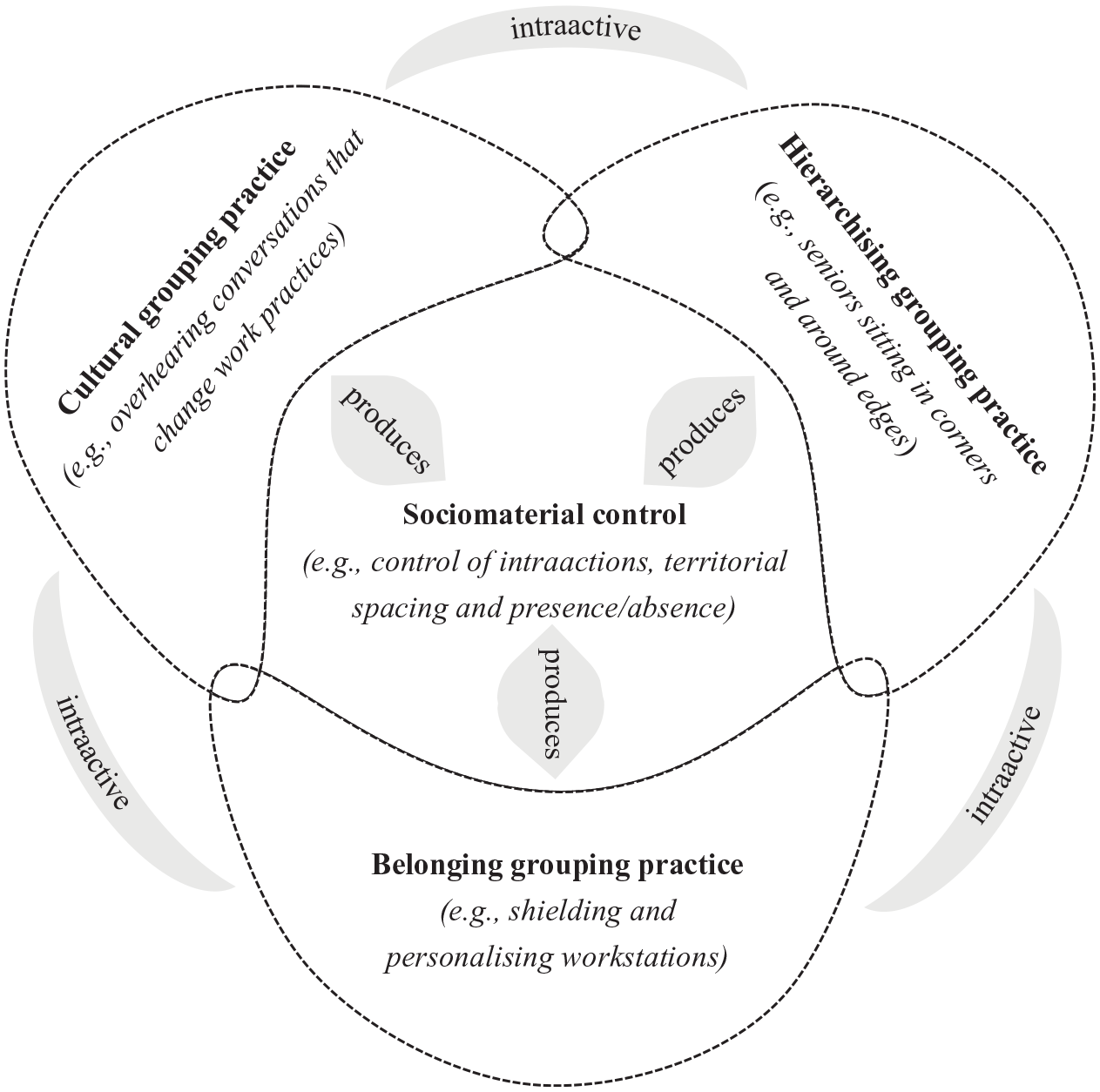
Grouping practices and the production of sociomaterial control.
Discussion and conclusions
I have illustrated how sociomaterial practices of open offices are reconfigured in three intraactive ways; as cultural, hierarchising and belonging practices, and how these practices produce sociomaterial control. Based on this, I discuss how open office spacing and grouping are constitutively entangled and how a sociomaterial perspective contributes to advancing our understanding of everyday organisational life.
Constitutive entanglement between open office spacing and grouping
This study argues that a Baradian sociomaterial perspective adds to our understanding of open office spacing and groupings and their intimate relationship. As recognised in existing work (Beyes and Steyaert, 2012; Hernes, 2004), this study has conceptually approached organisational spacing as performative, relational and continuously changing. I further argue that groupings exist through practices, are performative, processual, fluid and indeterminate. In this study, illustrations of entanglement between spacing and grouping matter to the everyday grouping practices, to the presence/absence, visibility/invisibility and embodiment of human and nonhuman actors, and to the entangled enactment of agency. These illustrations further demonstrate that practices only exist in relation to each other, that office spacing and grouping exist only through their sociomaterial relations. For instance, in coming together for cake, all perceptions of the social and material contributed to holding everything together in the cultural practice (Law, 2002), - what made the practices come into existence (Barad, 2007). All bodies, things, managers, walls and so on took part in forming and performing the different grouping practices. Imagine, for example, the intraactions involved in practices as if they were in slow motion (Beyes and Steyaert, 2012): moving bodies, material touching bodies, teeth touching cake, cake moving and so on are all minor configurations of practices. Or imagine, at the atomic level (Barad, 2007) or in the long-term perspective, when and how bodies, cakes or walls emerge, exist, are there and not there. In such different scale perspectives than are mostly conventional, boundaries and separability blur while the entanglement and ongoing reconfigurations become clearer. This crystalises that we cannot clearly mark when something begins (and begins before that) or ends (and ends after that). Moreover, a chronological order can never be established between: (not) building a wall, (not) having a preference for sitting against a wall, (not) sitting against a wall, presence/absence or (in)visibility. To be concerned with what ‘comes first’ is the same as arguing for a priori spatial and temporal existence. This signifies that the consequences of constitutive entanglement between open office spacing and grouping are sociomaterial, meaning that they happen not because of either/or elements (such as walls or bodies), but because of the very relation between them (such as the togetherness of walls and bodies). The point is not to be occupied by clearly defined consequences or outcomes of practices, or by temporal orders, but by how they work together and by what they achieve together, as this is what is relevant for the dynamics of groupings. The impossibility of meaningfully separating spacing from grouping then defies the claim of independent agency. Office spacing cannot, for instance, in and of itself create practices that may constitute grouping. Nor do individual workers make up groupings without spacing, be that visible or virtual, or without a relation to spacing, such as history, memory or meaning (Cutcher et al., 2016; de Vaujany and Vaast, 2014). The observations of entanglement indeed show how sociomaterial practices have consequences of experiences and intraactions in a forever-changing manner (Carlile et al., 2013). Changes of fonts and movements of chairs, shelves or headphones signify that grouping practices are not unilateral processes, but instead practices that in turn change the spatial material in a recurring and inseparable manner (Cnossen and Bencherki, 2019). The constitutive entangled nature of spacing and grouping creates, triggers, shapes, limits and changes the emerging and ongoing practices, which in turn make and take up, move, push and fill the ongoing distribution of spacing. My participation in practices as a researcher emerged with organisational spacing, changed because of it and these practices changed spacing too; it was and is all a part of performing spacing/groupings (Beyes and Steyaert, 2012; Latour, 2005), the ‘panoptic machine’ (Foucault, 1977) and the constitutive entanglement (Orlikowski, 2007).
Consequences of sociomaterial control
While existing work has demonstrated that the openness and visibility of organisational spacing produces control (e.g. Baldry and Barnes, 2012; Dale, 2005; Foucault, 1977) and that control is produced through managers, peers and structures (e.g. Barker, 1999; Barley and Kunda, 1992), this study shows in in detail how control is produced through sociomaterial relations. This form of control – which I refer to as sociomaterial control – obliges a sensitivity to detail that has some important organisational implications.
We saw how sociomaterial control was produced through the openness, visibility and transparency of grouping/spacing, which ensured that members participated in the practices as well as controlled how they participated, such as in the socialising of new members. This study also supports previous work (e.g. De Paoli and Ropo, 2015) emphasising the importance of material and embodied presence of grouping members and leaders in assisting collaboration. However, the significance of presence/absence in establishing and maintaining hierarchising practices demonstrates spatiotemporal inequality and underlying controlling aspects of the grouping practices. As previous work has illustrated (e.g. Dale and Burrell, 2008; Hatch, 1990; Turco, 2016), the spatial and material hold implications for grouping practices in relation to social status, hierarchy and power. For instance, Baldry and Barnes (2012) observed that the more territorial spacing a member perceives and is perceived by others to have, the more power and control the person has. This study, more specifically, showed how not just the territory of any spacing, but of particular spacing can carry meaning in terms of hierarchy. Here, different sociomaterial practices of hierarchising, such as forming privileged workstations linked to seniority, legitimacy and status or creating privacy and invisibility, and shielding work practices from others, enabled the maintenance of an informal hierarchy. Ironically, these findings go against the common belief that open offices are considered to create and resemble flat hierarchies (e.g. Dale, 2005; Elsbach and Pratt, 2007). This was visible not simply through specific intraactions, but also by the cumulative dynamics of practices with continuous converging and diverging configurations. This means that while some intraactions may support flat hierarchising, the collective configurations of practices have the reverse consequence of maintaining a grouping hierarchy. We further witnessed how practices were sociomaterially controlled for grouping members to experience belonging. The belonging grouping practices emerged for members to ‘fit in’ spacing/grouping, such as when, where and how to participate in eating rituals (Shortt, 2018) and to resist control, such as creating or limiting time and spacing, or by letting shelves carry meaning as boundaries (de Vaujany and Vaast, 2014).
Overall, this study adds more nuanced accounts of workers’ experiences of shared and open spacing than the existing literature suggests. It demonstrates that the spatial and material elements play a significant and complex role for power and control of groupings, and that organisational control processes consist of the more-than-human (Braidotti, 2013). In particular, the study suggests that spatial ways of organising encouraging self-management and collaboration, such as open offices, may in fact unintentionally spur the development of peer-based control as well as sociomaterial control by (re)establishing hierarchising power relations. Further, it draws attention to how organisational members seek ways of escaping control through sociomaterial resistance practices. These considerations hold implications for the ongoing practice/theorising of organisational spacing, grouping and control.
Implications
A sociomaterial perspective makes it possible to uncover some of the more intimate relations between organisational phenomena, which other theoretical lenses would easily have missed. It opens for further learning and understanding of open and collaborative work spacing by recognising the constitutive and complex entanglements it entails. The sociomaterial perspective can support ways of working with office spacing, like office design and layout, and how spacing relates to grouping in organisational contexts, including emotions, experiences, intraactions and productivity. Sitting in corners or against walls, for example, are likely to be favoured places of spacing, which may play a role for informal hierarchising and feelings of belonging. Attention should also be paid to the need for privacy in open spacing, where objects, spatial markers and layout are connected to belongingness. Another takeaway is the importance of embodied experiences of spacing, such as the presence of co-workers and leaders in fostering collaboration and grouping work. Crucially, the openness of offices needs to be attended to carefully, either by organising smaller open offices and/or by creating greater distances between desks. This can assist avoiding crammed offices, creating more privacy and weakening visibility. Organising offices centred on groupings can, in addition, shield against other organisational units and thereby foster more tightly knit groupings. In addition, as the findings show, sociomaterial control can play a more significant role for newcomers.
Since sociomateriality was brought into organisation studies through Information Systems, the most elaborated and convincing empirical studies remain those involving technological apparatuses (e.g. Nyberg, 2009; Orlikowski and Scott, 2014) or perceived material, visible things, such as whiteboards (Paring et al., 2017), buildings (de Vaujany and Vaast, 2014) or bodies (Dale and Latham, 2015). While these studies are insightful in each their own way, collectively they also signal the lack of sociomaterial lenses for looking deeper into the somewhat less tangible aspects of organising, for instance, management styles (Pickering, 2013), strategic plans (Cooren, 2020) or grouping. Most likely, this lack is tied to the notion of materiality being something tangible that can be touched or seen, such as artefacts, desks and technologies, and not something intangible and invisible like thoughts, meanings and intraactions (Cooren, 2020). This important point needs to be taken seriously by future work on materiality in organisations. As attempted here, a sociomaterial lens also encourages the incorporation of a performative view and bringing the spatial and material turns more completely into the work on grouping/teaming (Boxenbaum et al., 2018; Van Marrewijk and Yanow, 2010). Along these lines, an ethnography such as this denies the invisible grouping practices happening through technology, unless one is granted access to all digital communication. Due to access limitations, the practices going on behind the observable scenes, including virtual meetings, e-mails, calls and messages on various platforms, were not possible to include in this study but were a part of the grouping practices. For instance, when I realised that I was not a part of the grouping receiving the e-mail invitation for cake, I was hesitant to join the cake eating and cultural practice, which is also significant for practices of belonging in that feelings of awkwardness about who does or does not belong to the practice emerge alongside feelings of wanting to belong and be a part of the grouping practices. Integrating how digital technologies now afford the affective living of hybrid work spacing into visible practices and physical spacing would therefore be particularly interesting to further explore (Petani and Mengis, 2023). For instance, future work could consider the multiplicity of presence and ‘the presence in absence’ hybrid and virtual spacing allows for through netnographies.
However, sociomaterial studies still face the difficulties of conveying the fluidity, temporality and inseparability they set out to show (Nyberg, 2009; Orlikowski and Scott, 2008), which certainly does not become easier as intangibility increases. Further, there are difficulties attached to language and writing style in expressing the nature and relations of phenomena, inseparability and processuality (Beyes and Steyaert, 2012; Orlikowski and Scott, 2008). Moving beyond theory and absorbing sociomateriality into methodology and with empirical substance being consistent with agential realism has proven rather difficult (Hultin, 2019; Schultze et al., 2020). Then comes the magnitude of rethinking agency by emphasising performativity rather than representation and cognition, a challenge that requires a complete shift to a posthumanist paradigm, some defiance of logics and some ‘hard imagination’ (Pickering, 2013: 30). Sustaining the imagination to rethink, refine constructs and stylistically and linguistically perform agential realism without slipping into the habits of things – while still making sense 6 – is no easy task. Unquestionably, this study is no exception to these challenges. The grand work of such implications is therefore a challenge for future sociomaterial engagements of organisational phenomena. Nevertheless, my hope is that these lines will inspire others to use sociomaterial worldviews to discover how spacing and grouping, particularly in relation to control, power, surveillance, visibility and resistance, may in new and useful ways assist our sensemaking of the everyday life of organising.
Footnotes
Acknowledgements
This paper was remarkably improved because of the extremely engaged and constructive anonymous reviewers and editorial team, Marcos Barros and Raza Mir. I am deeply grateful to Karen Dale, Daniel Nyberg, Alain Guillemain, Toke Bjerregard, Kathrine S. Vinther and Steffen Korsgaard for providing invaluable comments and discussions during various phases of this work. The inspiration for this paper I owe to Wanda Orlikowski, who made me see things differently back at that research practicum in Cambridge.
Funding
The author received no financial support for the research, authorship, and/or publication of this article.
