




Abstract
Digitalization, that is, organizational renewal through new information and communication technologies, has long been invested with a fantasmic logic of affording alternative organizational ideals – democratic and not-for-profit rather than hierarchical and for-profit. Responding to calls to study the darker side of Silicon Valley inspired utopia, this paper investigates how and when organizational work on digitalization fantasies undermines organizational ideal renewal. In particular, this paper draws on the extended case of Alternative Bank (1963–2019) to shed light on how the long-term co-evolution of fantasy sublogics and power types in successive digital transformation projects induces organizational ideal reversal. I provide a theoretical model of how organizational ideal reversal comes about through the co-evolutionary conditioning of ‘have your cake and eat it’ affordances, mimetic neglect of real ethical affordances, and structural transgression of the ideal in the name of market and technical discipline. Ideal reversal occurs through consecutive phases of unwitting ideal transgression, followed by increasingly cynical and instrumentalizing transgression, and finally a cathartic moment of liberating ideal reversal. I advance several theoretical propositions on how digital fantasy work induces organizational ideal reversal, situating the dark side of fantasy work within a larger societal critique.
Keywords
Digitalization, that is, organizational renewal through new information and communication technologies (ICT), has been associated with a fantasmic logic of ‘magical’ renewal since the emergence of a commercial computer industry in the 1950s (Dourish and Bell, 2011; Ellul, 1964, 1985; Francisco, 2015; Markus and Benjamin, 1997; OECD, 2017). Utopian fantasies can range from perfecting conventional logics of market efficiency to realizing ‘alternative’ ethical choices beyond ‘mainstream’ markers of efficient organizing (Cheney, 1995: 171). This paper focuses on the more ambitious latter sense, inspired by Silicon Valley utopia of how digitalization affords the renewal of alternative ethical ideals of democratic and social, not-for-profit organizing (Bailey, 2005; Davis, 2015; Ossewaarde, 2019; Parker et al., 2014). Responding to calls to problematize dominant assumptions (Sandberg and Alvesson, 2011) and study the darker, instrumentalizing and mainstreaming side of Internet utopia (Fuchs, 2010, 2011; Parker et al., 2014: 19), this paper in particular investigates how and when organizational work on digitalization fantasies undermines organizational ideal renewal.
Starting from the assumption that all organizations need to make clear ethical ideal choices (Parker, 2003), critical scholars have long warned for the managerial use of utopian discourses for ideological, instrumentalizing purposes (Alvesson and Willmott, 2002), that is, to limit critical ethical engagement of dominant market rationalities (Bloom and Cederström, 2009) and reinforce their hierarchical power over organizational ideals (Alvesson and Deetz, 2006). More recent organizational scholarship integrates assumptions of a new hegemonic spirit of capitalism – based on project-based professional ideals and voluntary power to and power with relations – to defy criticisms of the manipulative, hierarchical character of ideological overinvestment in organizational fantasy work (cf. Bloom, 2016; Ekman, 2013; Rhodes and Bloom, 2012; Roberts, 2005) and emphasize its potentially positive effects for alternative ideal entrepreneurs (Kenny et al., 2020).
What these different strands of the literature have in common are strong ideological, ethical and power assumptions applied to relatively short-term episodes of fantasmic attachment. This paper responds to calls for less preconception and more long-term problematization of the co-evolution of fantasy sublogics (Glynos, 2011: 381) – ideological and ethical – and power types (Costas and Grey, 2014; Edwards, 2006; Leonardi and Barley, 2010: 32) – power to, power with and power over. To do so, I draw on the extended case of a large Alternative Bank (1963–2019), and how successive episodes of executive conditioning and front-line agents’ enactment of digitalization affordances induced ideal reversal.
Alternative Bank is an extreme case of the gradually emerging dark side of organizational fantasy work, and digitalization fantasy work in particular, providing an opportunity to pursue the question of co-evolutionary ideal reversal in an extremely visible and pure form (Eisenhardt and Graebner, 2007; Yin, 2011: 49). Its executives have repeatedly pioneered digitalization-induced renewal of the organization’s alternative ideal since the 1960s – before its mainstream competitors. Yet, instead of yielding alternative ideal renewal, executive and front-line agents’ fantasy work effected organization-wide reversal of the alternative ideal, with both executives and front-line agents eventually turning against original alternative choices to embrace mainstreaming; first by unwitting neglect, cynically and resentfully after the first disillusion, and finally cathartically – when a long-term power deadlock has rendered the historical alternative ideal so ineffectual and oppressive that mainstreaming becomes liberating.
This paper makes several contributions to the organizational literature on fantasy work and the dark side of digitalization in particular. It reviews different research strands and assumptions in the literature on fantasy work, distinguishing and relating the theoretical categories of ethical and ideological sublogics of fantasy, and their use for power over, power to or power with aims. Second, I theorize the dark side of fantasy work in a model of how organizational ideal reversal emerges from the interaction of executive conditioning and front-line agents’ enactment of fantasmic affordances. Third, I advance several theoretical propositions on how executive conditioning and front-line enactment contribute to organizational ideal reversal. Finally, I situate organizational ideal reversal within a larger societal critique that recombines the lenses of post-Marxist critical theory, the new spirit of capitalism and the technicist society.
Given the boundary conditions of this case-study (Eisenhardt et al., 2016), the advanced model and propositions are most relevant to large alternative organizations that use digitalization fantasies for organizational renewal purposes, and also younger firms that draw on digitalization fantasies to pursue alternative ideals – such as social enterprises. The model and propositions are also useful as a cautionary tale for mainstream organizations that aim for a digital transformation inspired by Silicon Valley ideals of alternative work, productivity and user commons practices.
Digitalization fantasies and alternative organizing
A fantasy of digitalization as a ‘magic bullet’ for transformational organizational change has long pervaded managerial discourse (Hensmans, 2006; Markus and Benjamin, 1997). Recently, the utopian character of digitalization fantasies has been elevated to new heights. Today’s digital technologies promise to have an even more pervasive impact than the steam engine in the 18th century and railroads in the 19th century, dramatically transforming economies and societies (Rogers, 2016). Internet technologies make possible thoroughly democratic ways of organizing in hierarchy-less networks (Rossiter and Zoehle, 2014; Scott, 2013; Stohl and Stohl, 2011), affording more ‘open’ approaches to decision-making, incorporating ideas, knowledge, and resources dispersed across employees, partners, communities, and customers (Baptista et al. 2017; Hautz et al. 2017; Heavey et al., 2020; Leonardi and Vaast, 2017). In sum, digitalization will enable revolutionary practices of working, producing and consuming (Brynjolfsson and McAfee, 2011, 2014).
Fantasy occurs through utopian strivings for an ideal future in which more just organizational and societal relations will supplant present problems (Dey et al., 2016; Dey and Mason, 2018). It is no wonder then that the fantasmic association of digitalization with utopian ethical affordances (Cheney, 2014; Ossewaarde and Reijers, 2017) is particularly attractive to leaders of alternative organizations. The term alternative organization emerged during the 1960s to denote organizations that champion progressive, alternative ideals, such as democratic, egalitarian and autonomous methods of work and ownership (Case and Taylor, 1979; Parker et al., 2014; Swidler, 1979). ‘Alternative’ may be used as an undifferentiated rallying cry – ‘business as usual’ – or be posed against a specific category (Cheney, 2014): mutual ownership and an information commons against for-profit ownership and user data exploitation (Esper et al., 2017; Meyer and Hudon, 2017), democratic participation versus hierarchy (Reedy and Learmonth, 2009; Rothschild and Whitt, 1989), community values versus market efficiency (De Angelis and Harvie, 2014) or other mainstream versus alternative organization oppositions (Parker et al., 2014).
Critical scholarship of fantasy work: ideological domination and partial ethics
A critical impulse, decrying a partial or very limited engagement with ethical choices, has long been at the heart of the literatures on alternative organizations and organizational engagement with fantasy. For critical theorists, organizations are the way they are for specific power and control purposes (Kersten, 2001), namely the ability of those high up in the hierarchy to exert ‘power over’ the rank and file. Higher ups derive their systemic power from taken-for-granted structures of inequality, ideological domination and dependency, which they reinforce through exploitative, instrumental processes of distorted communication and false consciousness (Alvesson and Deetz, 2006: 261–262; Deetz, 1992). Employees respond through various types of resistance, from overt, collective resistance such as a strike (Edwards, 1979) through more covert or cynical resistance at a distance (Collinson, 1994; Fleming and Spicer, 2003).
Similarly, alternative organizations are generally theorized as part of political or socio-economic movements – cooperative, feminist, mutual or anti-globalization movements – founded at least partly to resist mainstream, oppressive forms of socio-economic organizing (Burrell, 1992; Parker and Parker, 2017; Reedy and Learmonth, 2009). As noted by Reedy and Learmonth (2009: 254), alternative organizations ‘highlight’ the possibility of making ethical choices beyond the ‘norm’ of ‘a profit-maximizing, competitive, managed hierarchy’.
Critical scholars have challenged the fantasy that digitalization champions such as Google are alternative organizations – participatory, decentralized and democratic (Hamel, 2007, 2009) – part of an anti-establishment movement that promotes counter-cultural, peer-to-peer values and ethical ways of organizing, producing, and consuming (Parker et al., 2014: 33–34). While their leaders and mission statements aspire to an alternative ethical disposition (Whelan, 2019) – a not-for-profit informational commons and democratic ways of working – Google has been exposed as a hyper-exploitative ideological agent of the gig economy, using its power over user data to further commodify alternative utopian ideals (Fuchs, 2011; Martin, 2016; Rossiter and Zoehle, 2014; Taplin, 2017).
Distinguishing the sublogics and power dynamics of fantasy
Recent organizational scholarship on the role of fantasy in organizations has challenged critical theorists’ hierarchical and exploitative ‘power over’ assumptions (Ekman, 2013; Glynos, 2011; Kenny et al., 2020). Drawing on the seminal distinction between ideological and ethical sublogics of fantasy work (Glynos and Stavrakakis, 2008: 965; Lacan, 1966), Ekman (2013: 165) confirms that professionals tend to underinvest in the ethical sublogic, that is, collective choices on how to cut fantasies of limitless possibility to size. She argues, however, that executives and the rank and file are equally guilty of ideological overinvestment, each responding to disillusion about one fantasmic project with new fantasmic projects of utopian ‘fulfillment’ rather than mutual learning and calls for ethical restraint (Ekman, 2013: 1178). The new spirit of capitalism is at the heart of this willing self-domination: a project-based mode of professional fulfillment which invites productivity through personal involvement, autonomy, and individualization (Ekman, 2013: 1160; cfr. Boltanski and Chiapello, 2005; Bloom, 2016).
Ekman (2013) effectively makes a power with argument. Different from power over, which focuses on reproducing or reinforcing pre-existing structures of domination (Allen, 1998: 35–37), power with implies ‘collective’ learning processes that allow actors to ‘act in concert’ (Arendt, 1970: 44) by questioning ‘self-perceptions’ and actively building up ‘new awareness of individuals or groups’ (Partzsch, 2017: 195; see also Hensmans, 2017). Thus Ekman (2013: 1770 ) argues that the lower and higher ups mutually refrain from ethical power with, interpreting a fantasmic project as a communal affordance to achieve each other’s ‘limitless’ potential beyond increasingly unfulfilling ethical constraints. Table 1 summarizes the relations between sublogics and power types emphasized in the organizational fantasy literature, with a particular focus on areas of further research.
Relating sublogics and power types in organizational fantasy work, with a focus on areas of problematization.
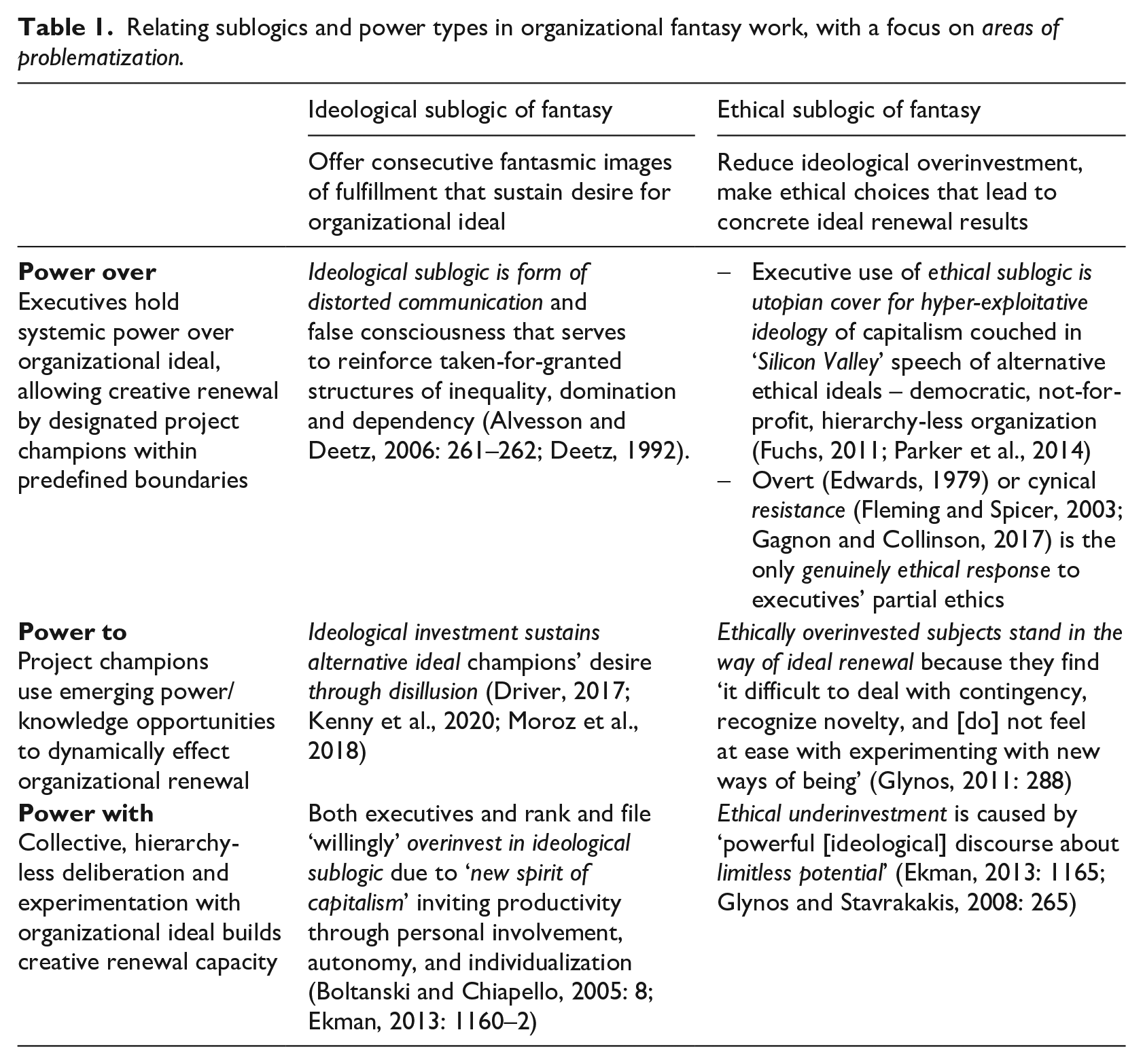
Kenny et al. (2020) emphasize a third type of power relevant to organizational engagement: social entrepreneurs’ power to engage in ethical, pro-social work through fantasmic attachment to the ideals of an alternative organizational form – the Community Interest Company. While power with concerns co-action and mutual learning based on shared values, power to concerns a limited number of agents of change or resistance who lead based on their own normative notions of what is right and wrong (Partzsch, 2017: 299). Different from power over, power to is the ‘capacity to act and achieve goals’ not based on collective deliberation but also not necessarily based on a relation of domination (Edwards, 2006: 579).
Similar to Ekman (2013), Kenny et al. (2020) argue that social entrepreneurs’ ideological attachments – in this case to the pro-social fantasy of societal enterprise projects (Driver, 2017; Moroz et al., 2018) – can sustain their desire to believe in the limitless possibilities of their work in the face of failure – the disillusion of an ethical ‘lack’ of social contingency. By contrast, ‘ethically overinvested’ members – for instance cooperative idealists – are unable to renew alternative organizational ideals because they find it ‘difficult to deal with contingency, recognize novelty, and [do] not feel at ease with experimenting with new ways of being’ (Byrne and Healy, 2006: 248; Glynos, 2011: 288).
Problematizing sublogics and power types through longitudinal research
Edwards (2006: 57) has long called on organizational scholars to study power dynamics beyond ideological or ethical preconceptions, in a spirit of understanding ‘the contradictory relations of ‘power to’ and ‘power over’ as projects of technical change unfold’ (see also Ocasio et al., 2020). Similarly, Glynos (2011: 383) challenges critical organizational scholars’ automatic branding of the ideological ‘role of fantasies’ as ‘exploitative or oppressive’. Instead, he argues that critical organizational scholars should engage empirically with ‘the reasons why particular relations of power ought to be regarded as suspect and how precisely such relations of power color the content and modality of phantasmatic engagement’.
At the same time, Glynos (2011) calls for more attention to the co-evolutionary power dynamics of the ethical and ideological sublogics, that is, what he calls the ‘ethics of the real’ (p. 381). While fantasy is an ineliminable ideological element of the human desire to imagine and achieve things, channeling the desire at the heart of fantasy in an alternative, socio-economically performing direction necessitates a deliberatively ethical relation to desire in which one resists ideological over-investment to attend to real alternative possibilities (Glynos and Stavrakakis, 2008).
Understanding how fantasy work does or does not yield concrete instances of organizational ideal renewal requires less preconception and more longitudinal problematization of organizations’ evolving engagement with the ideological and ethical sublogics of fantasy; as conditioned by change champions and enacted by organizational members through different power dynamics (Glynos, 2011: 381). Leonardi and Barley (2010: 32) make a complementary, non-deterministic argument, arguing for longitudinal studies of power dynamics in technologically occasioned organizational change: ‘the literature suggests an implicit sequence of processes. . .in the social construction of a technology’s implementation, but assessing the veracity of this latent pattern awaits study. To do so, researchers would need to track implementations over longer periods of time than is typically the case’.
Case context and methodology
I selected the case of the cooperative Alternative Bank for its relevant properties (Flyvbjerg, 2006) as an embedded single case (Yin, 2011: 7) of an alternative organization that, through the period 1963 to 2019, repeatedly associated digitalization fantasies with the renewal of its alternative organizational ideal. That is, the ethical ideal of acting as a not-for-profit, local democracy-based alternative to commercial banks and their brand of hierarchical, for-profit capitalism. While decision-making power at commercial banks was centralized at executive headquarters, decision-making power at Alternative Bank was decentralized to more than 1000 local banks at the beginning of the period under review – all of which had an autonomous banking license. Executives at central headquarters advised and coordinated by mandate of the local banks.
At the end of 2015, all parties agreed to reverse Alternative Bank’s ethical ideal of local democracy-based, decentralized decision-making in favor of an executive hierarchy. Headquarter executives abolished all local banking licenses as well as the general decision-making assembly in which local banks wielded ultimate decision-making power. While nominally still a not-for-profit bank, as of 2019 Alternative Bank had increased its net profit to more than €2 billion through greater digital and market efficiency; most notably a merger-induced reduction of the employee number by more than 10,000 employees to just over 25,000 banking employees.
Data sources
As summarized in Figure 1, I benefited from an exceptional data access opportunity at Alternative Bank through the period 2000 to 2018, allowing me to collect data through Interviews [Int.], participant observation [Po.], archival research [Arch.] and informal conversations with insiders [Convrs.]. Table 2 elaborates on my use of these data sources for analytical purposes.
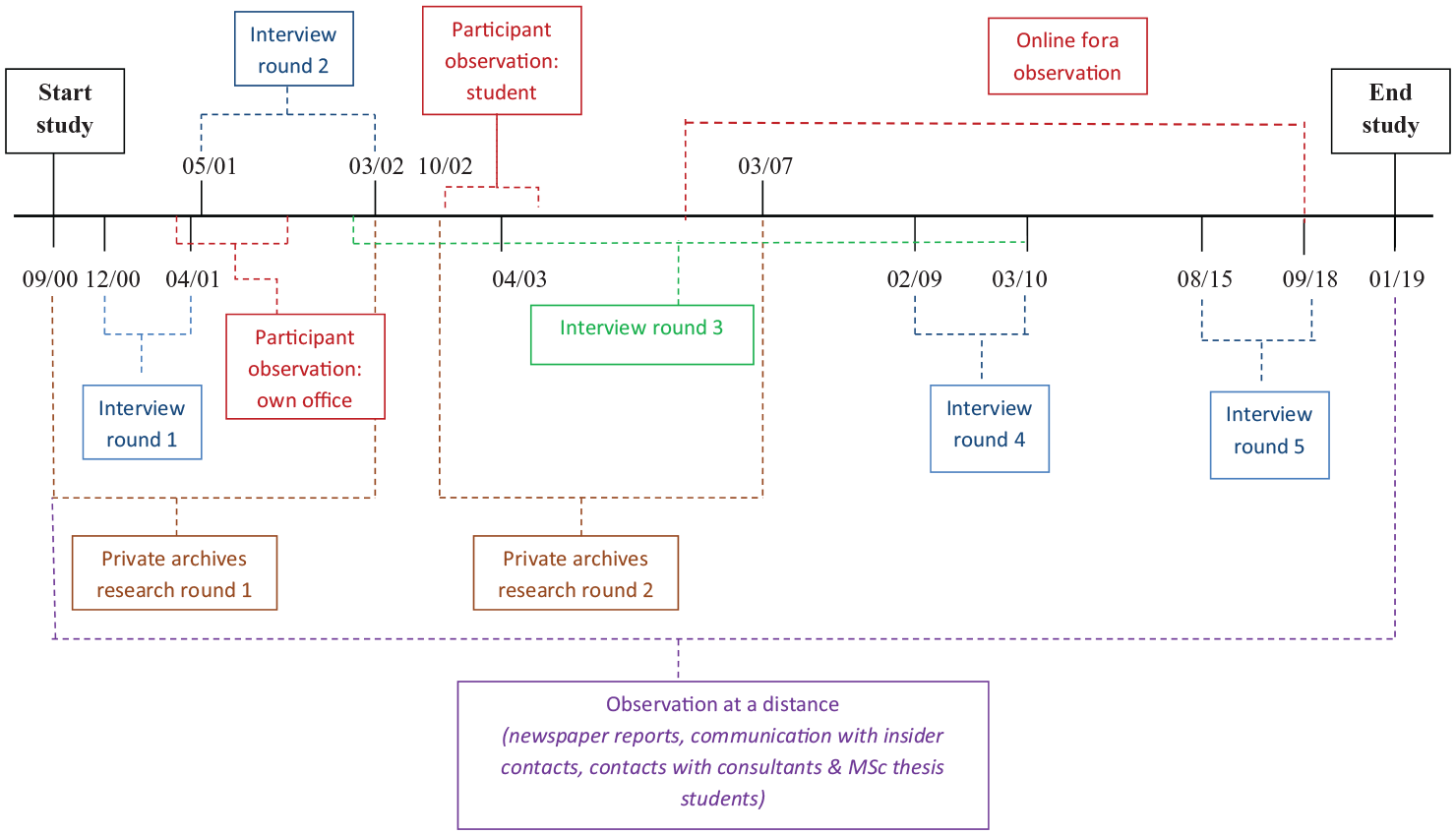
Research design.
Data sources and their use in the analysis.
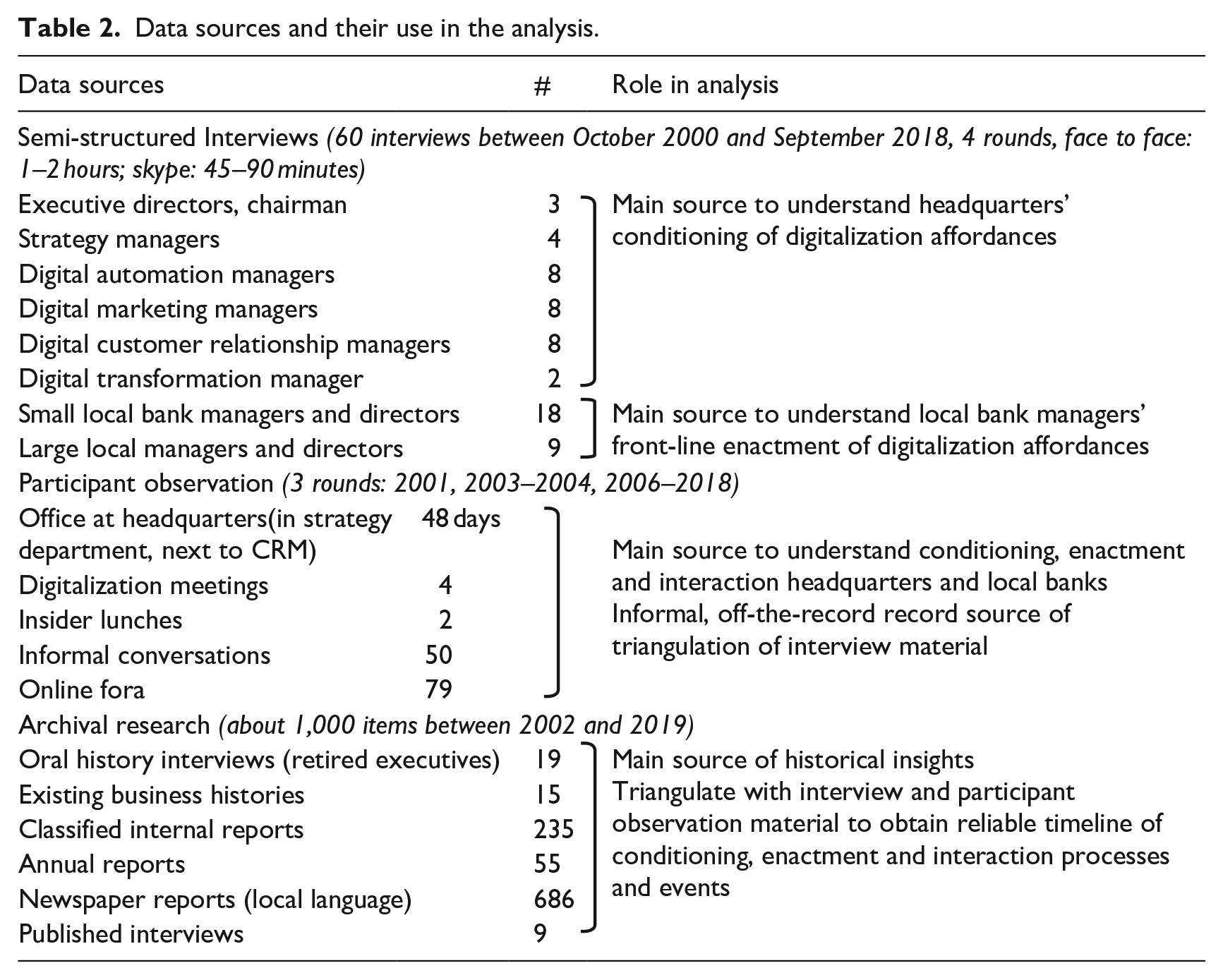
After the approval of my research proposal by Alternative Bank’s strategy director in April 2000, I was stationed in an office at Alternative Bank’s premises (amongst the strategy and e-commerce staff) for a period of four months (48 full working days in the period March to July 2001), in order to get more of an insider’s understanding of digitalization projects (cf. Bartunek and Louis, 1996). I attended 12 lunches and had more than 50 informal conversations, building insider relations with a variety of senior and junior managers that would open data access doors through the period 2000 to 2018. I was able to attend a series of strategic decision-making meetings to observe interactions between all the stakeholders involved – digitalization champions and directors, local bank managers and the executive director in charge of digitalization. Two assigned insider contacts, one member of the strategy staff and one member of the e-commerce staff, helped me obtain interview access at local banks and at headquarters (interview rounds 1, 2, and 3).
Through the period 2000 to 2007, I conducted 12 unstructured and 38 semi-structured interviews with a variety of headquarters and local bank managers – with responsibilities ranging from executive through front-line management. I also obtained archival access to all classified internal reports and 19 oral history interviews conducted with retired headquarters and local bank directors and managers involved in digitalization projects since the 1970s. I conducted 10 more interviews through the period 2009 to 2018 (interview rounds four and five). In total, I conducted 60 interviews with 30 headquarters managers (four from the strategy department, eight from the digital Customer Relationship Management department, eight from the digital marketing division, eight from the digital automation division, two from the digital transformation project), 27 local bank managers (18 from smaller and nine from the largest local banks – the former ethical performers, the latter ethical underperformers), and two executive directors. In addition, I interviewed the Chairman of the Board of Directors and the strategy and Information Systems directors who were close witnesses and participants in Alternative Bank’s Information Systems projects from the end of the 1960s to 1998.
Interviewees were sampled both on their involvement in organizational renewal processes and digitalization projects in particular, their seniority and experience. About a third of the interviewees had less than 5 years’ experience at Alternative Bank; another third had a minimum seniority of 5 years; and the last third were retired people. This mix of interviewees allowed for an analysis of both contemporary digitalization developments and historical insights.
The interviews were organized in two parts: a contextual part, and a specific part. In a first part, I explored each interviewee’s viewpoints on why they joined Alternative Bank, how they imagined the alternative ideal of their organization at their entry and how their appraisal of the ideal changed over time – inquiring both about the ideal’s possibilities and realities at Alternative Bank. In a second part, I focused on the digitalization projects and processes of organizational renewal the interviewee had participated in or experienced the effects of: digital automation from 1963 to 1986, digital marketing from 1987 to 1999, digital customer relationship management from 2000 to 2015, and digital transformation from 2016 to 2018.
Before each interview, I prepared a timeline of each interviewee’s career and involvement in digitalization projects, as well as a chronology of the main digitalization events over time. While allowing every interviewee to develop his/her own narrative, I used interviewee mentions of questions of power, resistance, ideology or ethics as a prompt to ask questions of clarification. I countered retrospective sensemaking tendencies by using the timeline and other interviewees’ narratives to prompt further questions of clarification. The combination of interviews, observations and archival access provided ample opportunities for data triangulation and saturation, as well as theoretical sampling (Hensmans et al., 2012; Hensmans and Liu, 2018).
Data analysis
Ample access to ethnographic and historical data sources was essential to my longitudinal research question and research methodology approach, which draws on the extended case methodology (Gluckman, 2006 [1961]; Van Velsen, 1967). The extended case method is similar to grounded theory in its use of theoretical sampling and constant comparison (Wadham and Warren, 2014). Different from grounded theory, the extended case methodology’s aim is overtly theoretical both in the set-up of the research and in its conclusions (Burawoy, 1998). Drawing on both post-critical and critical theories, the method’s main epistemological aim is to shed light on anomalous empirical realities – such as the dark side of digitalization fantasies – to attend to areas of further research highlighted in the theoretical set-up (Table 1).
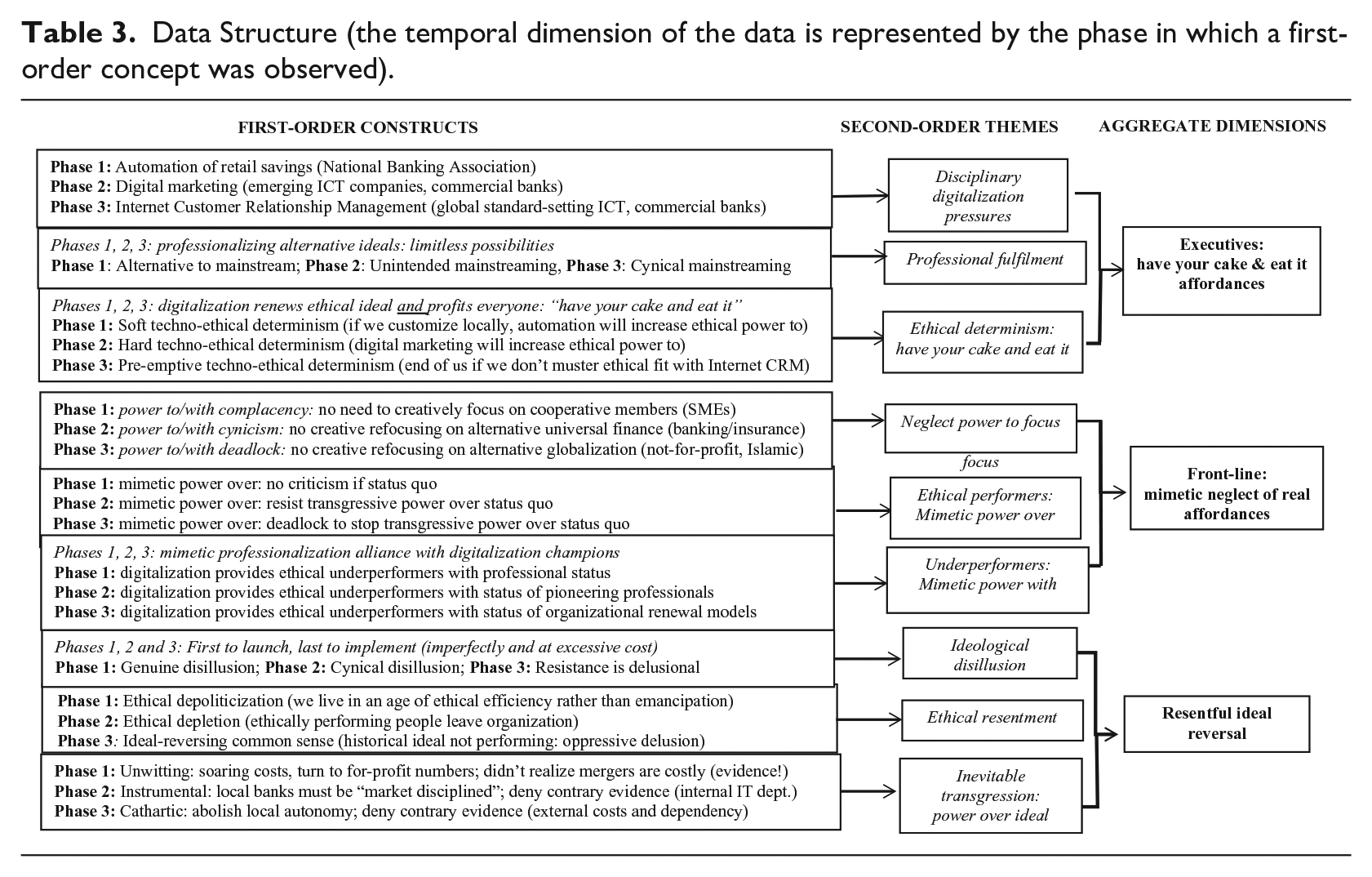
To locate observed agents’ use of fantasmic sublogics and power types in a societally critical and historically co-evolving context (Wadham and Warren, 2014: 8–9), I went back and forth between data, the initial theoretical set-up and emerging confirmatory and assumption-challenging longitudinal insights (Locke, 2000) through five stages. Table 3 depicts the final coding structure of my data.
Stage 1: Drawing on all data sources, I created a provisional timeline of digitalization projects in Alternative Bank, as played out through fantasmic sublogics and power dynamics.
Stage 2: To facilitate the subsequent coding process (stage 3), I followed Archer’s (2015) analytical dualism approach to temporally and causally order headquarters’ conditioning of digitalization fantasies in projects of alternative organizational renewal, (local banks’) front-line enactment of these fantasies, and how headquarters’ and local banks’ interactions yielded structural decisions about the renewal of the organization’s alternative ideal. As noted by Archer (1995: 183), by affording ‘structure’ and ‘agency’ analytical autonomy and phasing them over different tracts of time, scholars can formulate practical social theories about the structural conditions and agentic properties of the studied phenomenon (Hensmans, 2010).
Stage 3: With the aim of confirming, challenging or producing concepts in accordance with emerging data insights (Strauss, 1987: 28), I scrutinized the field notes, interviews and other archival documents line by line. I used self-contained sentences as coding units (Corley and Gioia, 2004), labeling them with in vivo codes (derived directly from the words of case protagonists such as ‘dialogue of the deaf’, ‘Don Quixote’, ‘have your cake and eat it’, and ‘cathartic’), predefined theoretical categories (the two sublogics of fantasy and three types of power), or emerging theoretical categories referencing a broader literature (‘resentment’ or ‘ideal-reversal’).
Stage 4: As provisionally structured in stage 2, the case of Alternative Bank contains consecutive embedded cases of digitalization fantasies and associated projects. I engaged in ‘temporal bracketing’ (Langley, 1999: 703) to refine my provisional timeline and to determine the relevant boundaries and number of embedded cases. Concretely I identified three relevant embedded cases based on their association with distinctive fantasy themes (dramatic rhetorical visions about how digitalization affects alternative organizational renewal) and distinctive organizational renewal effects. All three embedded cases proceeded with a similar ‘organic’ dramatization core (Bormann, 1972: 398): the limitless power with possibilities (ideological sublogic) and techno-ethical power of digitalization to renew an alternative ideal; respectively through Digital Automation (1963–1986), Digital Marketing (1987–1999) and Digital Customer Relationship Management technologies (2000–2015) – the final one culminating in the Bank’s ‘Digital Transformation’ (2016–2019).
Data Structure (the temporal dimension of the data is represented by the phase in which a first-order concept was observed).
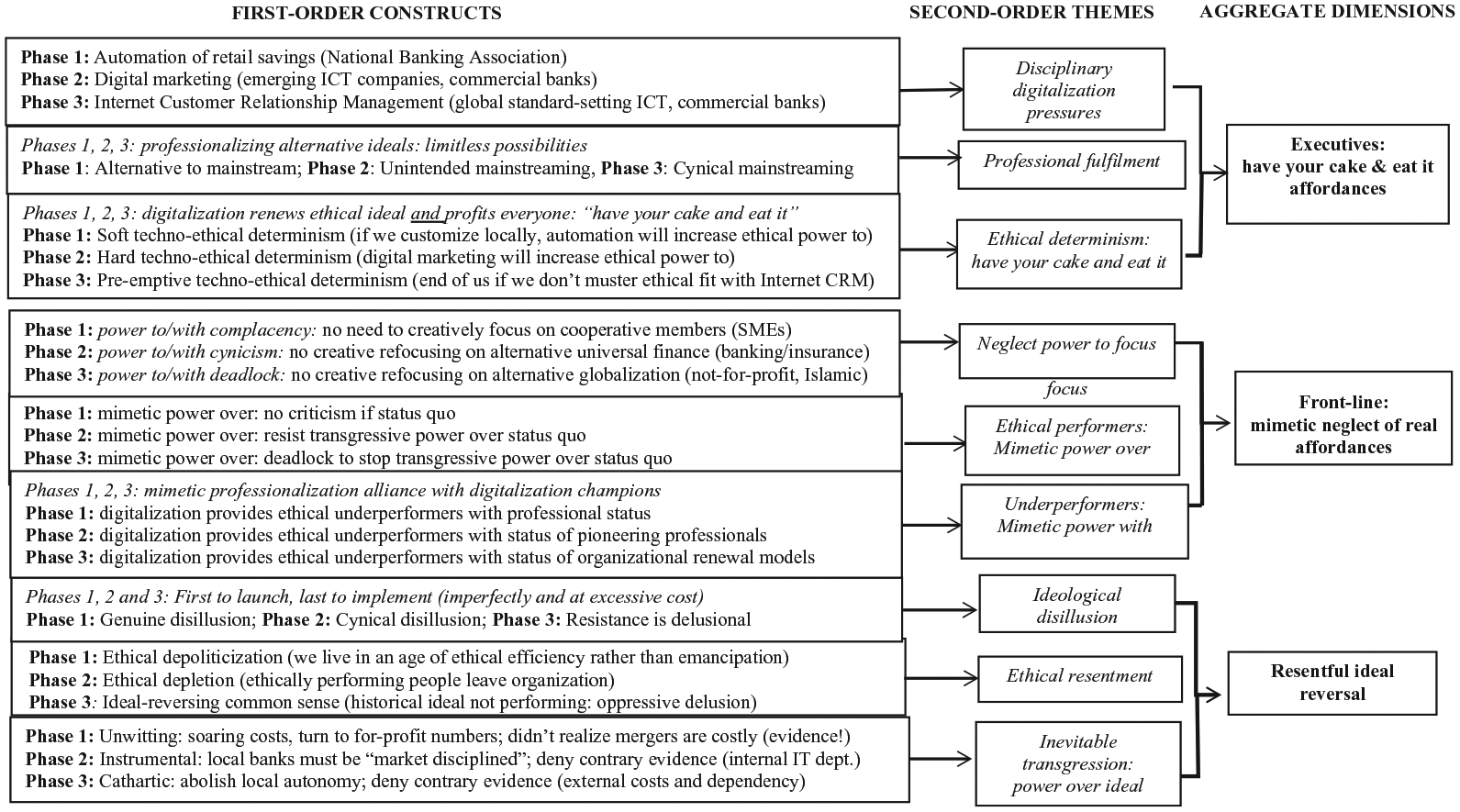
Finally, each embedded case ended with a shift in power over the alternative organizational ideal, from a decision-making structure (who decides how digitalization proceeds in relation to local members) that emphasized the absolute autonomy and not-for-profit character of local decision-making (not-for-profit automation), to a more cost and profit-conditioned vision (‘if not local, then central’ executed by a new for-profit digitalization division at headquarters), through a centralized, profit-driven vision (‘central first, local if needed’ in line with commercial banks’ digitalization projects). In sum, temporal bracketing yielded three co-evolutionary phases: a first phase of ‘ethical depoliticization and instrumental transgression’, a second phase of ‘ethical depletion and disciplinary transgression’ and a final phase of ‘ethical reversal and cathartic mainstreaming’.
The ‘Digital Transformation’ project (2016–2019) did not entail a new fantasmic theme but was the endgame of the digital CRM project. Rather than constituting a fourth embedded case, I consider it part of the structural decision to reverse the cooperative ideal at the end of the third phase (2015); abolishing local bank autonomy and embracing ‘commercially efficient’ digitalization from 2016 onwards. The digital transformation project thus served to analyze why local banks and executives agreed to reverse the historical ideal of local autonomy-based, not-for-profit banking.
Stage 5: I then engaged in axial coding of each temporal stage as an embedded unit of analysis. Axial coding involves intense analysis of links between substantive codes with the aim of coding to a higher, more generalizable category level (Strauss, 1987: 32). In this stage, I further refined existing theoretical codes which I could relate to the academic literature (Kelle, 2010), most notably ‘affordances’. By association with new ICT objects, digitalization fantasies generate ‘affordances’ for organizational renewal, that is, the potential for goal-oriented behavior toward concrete organizational renewal outcomes (cfr. Volkoff and Strong, 2013: 824). Axial coding also led to new theoretical codes (such as ‘ideal reversal’), which adds a long-term dimension to the co-evolution of fantasy sublogics and power types.
Stage 6: Finally, I aggregated the nine axial categories yielded in stage 5 into aggregate dimensions, corresponding to the three sequential structure-agency steps observed across the three embedded cases. First, executives condition ‘have your cake and eat it’ affordances (executive champions relate the potential of new ICTs to a fantasy of organizational renewal). Second, front-line managers of local banks mimetically neglect affordances for real ethical renewal (making the key distinction between ethically performing and underperforming local banks). The structural interaction between executives and front-line employees yields a final step of resentful ideal reversal. Ideal reversal is effected through the long-term interaction of organization-wide ideological disillusion, front-line managers’ ethical resentment, and headquarters’ transgressive power over the alternative ideal in the name of keeping up with disciplinary digitalization pressures.
Alternative bank: a history of digitalization fantasies
Phase 1: unwitting transgression
Headquarters’ conditioning of ‘have your cake and eat it’ affordances
(1) Disciplinary digitalization pressures
From the 1960s the National Banking Association pressurized all banking organizations to use automation to increase the industry’s ‘efficiency’. While Alternative Bank was not a member of this Association, it started looking at ways to retain its status as an alternative to commercial banks by using automation mainframes to combine ethical purpose with improved local banking efficiency [Arch. Board Reports 1963, 1964].
(2) Supportive professionalization: fulfilment ideal; (3) Soft techno-ethical determinism
At first automation was considered cautiously, to facilitate the administrative work for Alternative Bank’s core cooperative members – small and medium-sized enterprises [Int., retired manager]. Yet in 1974, Alternative Banks’ Management Executive decided to ‘take the bull by the horns’ and ‘pioneer rather than follow’ digitalization dynamics [Int., former automation manager]. To do so, it recruited a technological champion that had pioneered automation at a large, for-profit multinational. Based on this experience, and backed by the Management Executive, the automation champion launched a digital renewal fantasy in 1977. This narrative exuded the limitless professional potential of digitalization for local banks, including ‘efficiency-gains’ and ‘cost reductions’ [Convrs., Insider]
As a mathematician, the new automation champion presented a digitalization plan that was ‘too technical for local bank managers’. At the same the champion was ‘quite determined’ automation would allow Alternative Bank to renew its distinctiveness as ‘a not-for-profit organization from and for local cooperatives’ [Int. retired local bank manager]. Headquarters left space for local banks to determine their exact relation to automation, however, following the primacy of local ‘fantasy’ as a bottom-up driver of organizational renewal:
‘Key to a well-functioning cooperative democracy is that local cooperative banks do not become mere branch managers, implementers of headquarter policy. The big problem of commercial banks is exactly that, local banks are branch managers kept at a tight rein. ‘During the 1960s, the cooperative was a working democracy: relations between the bank’s headquarters management and local banks were fine. There was a lot of trust. The historical success and distinctiveness of the Cooperative had been its bottom-up democracy, and that central headquarters would not crowd the local banks. As provided by the statutes but also informal practice, the latter ultimately decided. Central headquarters set out a political vision in collaboration with local banks’. [Int., former President of Alternative Bank]
All in all, headquarters presented a ‘have your cake and eat it’ fantasy. It promised to finance all automation efforts. No matter how fanciful, local banks would not have to invest any of their precious resources:
‘The automation project created a “have your cake and eat it” atmosphere in which “everyone should be able to profit” from this magical opportunity without consequences apparently’. [Convrs. Insider].
Front-line enactment: mimetic neglect of the real
(1) Power to/with critical neglect
The ‘have your cake and eat it’ assumptions of limitless possibilities and techno-ethical determinism at the heart of the automation fantasy invited a critical neglect of work on renewing the organizations’ ethical focus:
‘Most local bank managers welcomed the automation project, because of its magical, “have your cake and eat it” promise. . .Unfortunately, all this invited a lack of choice and creativity. As a result, we started diluting the cooperative not-for-profit ideal. Instead of using automation for concrete cooperative renewal choices that served our cooperative members [small and medium sized enterprises], particularly the largest, least performing local banks insisted retail customers should be included as there was more profit to be found there. . .Thus, while automating, we changed our historical distinctiveness as a cooperative bank with low credit rates and low savings rates to one of low credit rates and high savings rates, which is choosing to be a commercial for-profit in the market, while pretending to be a cooperative to the inside crowd. And costs went up of course!’ [Int., former strategy and ICT director].
(2) and (3) Underperformer versus performer mimesis: professional status versus power over status quo
The ethically least performing local banks were also ‘the least efficient’ ones [Int., retired Strategy manager]. To compensate for their lack of cooperative distinctiveness, vibrant membership and efficiency, managers of these local banks ‘made sense of digitalization fantasies as a way to upgrade their professional status in the organization’. These banks ‘rapidly fell’ in with the automation narrative’s promise of efficiency-gains to accelerate new merger processes [Int., automation manager]. By contrast, the ethically most performing, smaller banks ‘were not enthused by the technical language in the automation plan’. Yet, instead of using their power to resist premature techno-ethical determinism and reinvent ethical principles digitally, these local bank managers chose to ‘steer away from critical reflection’, opting to ‘imitate each other’s complacency about real renewal choices’ because the automation plan ‘did not endanger their local power over customers’. Indeed, ‘unlike the centrally-managed commercial banks, Alternative Bank had opted for decentralized automation’ [Convrs., Insiders; Int., local bank manager].
Resentful ideal reversal
(1) Genuine disillusion
The automation plan, implemented in phases between 1978 and 1985 [Arch. History Automation, 2003], increased costs much more than anticipated, lowering rather than increasing overall cooperative banking efficiency:
‘Expectations were raised that could not be met, be they from the technical or financial side. In addition, what you saw was that technical language became dominant in the Central Assembly [where headquarter executives and local bank managers met] and internal reports, but this language did not ‘take’ amongst local banks, it did not interest them’ [Int., senior automation manager].
(2) Resentment: ethical depoliticization
Headquarters’ amended argument during the 1980s was that Alternative Bank had to adapt to increasingly depoliticized markets and customers. Contrary to earlier promises, ‘from now on, local banks would be responsible for digitalization costs’, which implied ‘merging for scale’:
‘Headquarters’ continuing focus on digitalization coincided with a discourse of depoliticization: that we had achieved the emancipation of our original members and that we needed to move with the modern Zeitgeist and distinguish us with more aspirational projects. To compensate for the rising costs of automation, central headquarters encouraged local banks to merge and achieve economies of efficiency’. [Int., automation manager].
Local bank managers’ resentment grew, particularly since Alternative Bank’s non-executive Supervisory Board had concluded that smaller, ethically embedded local cooperatives ‘enjoyed a more favorable cost and earnings position than larger local banks that engaged in mergers’ and enthusiastically embraced automation [Arch., Internal Report 2 October 1986].
(3) Inevitable transgression: unwitting power over ideal
While headquarters at first was genuinely unaware of this, it now chose to ‘ignore this report’ with an amended discourse of ‘inevitability’:
‘Automation was inevitable. . .we had to change with the times, and that was digital. The new automation technologies ultimately would allow us to become more market efficient, and lighten the paper burden of local banks, so they could really set out to make a cooperative difference in the field.’ [Int., former ICT director].
Inevitability provided headquarters ‘with a mandate to transgress’ Alternative Bank’s not-for-profit, local democracy ideal in the name of the ‘unwitting’ consequences of the automation project, particularly difficulties to obtain ‘efficiency-gains’. Executives launched a central, ‘for-profit’ automation division that would ‘sell its services to the market, while nurturing a more centralized, cost-efficient relation with local banks.’ [Int., former automation manager].
Phase 2: instrumental transgression
Headquarters’ conditioning: ‘have your cake eat it’ affordances
(1) Disciplinary digitalization pressures
From the end of the 1980s, the ‘efficiency’ focus in the banking industry shifted from automation systems to marketing-oriented digitalization, from 1994 within the scope of internet banking (telebanking was introduced as early as 1992).
(2) Professionalize ideal by default; (3) Hard techno-ethical determinism
Alternative Bank’s Management Executive tasked the new automation division to work with the central marketing department on a digital marketing project that would comprehensively professionalize local banks’ functioning. A first digitalization plan (1989) ‘introduced the client-server architecture as the technical basis for much easier and efficient software development with local banks than in the past’ [Int., marketing digitalization manager]:
‘Marketing systems will allow us to do what we wanted to but could not in the past due to technical limitations: help local banks offer more “customer value.”’ [Arch., Internal Report 1989]
The executive in charge of digitalization recognized its mainstreaming character:
‘We were not able to see marketing or information systems in terms of our historical cooperative character, so we reverted by professional default to mainstream marketing and digital practices.’ [Int., Strategy and ICT director]
From 1994 an important Internet dimension was added to the plan, introducing a new discourse of limitless possibilities and a harder type of techno-ethical determinism:
‘Our analysis of Internet technologies brought us to a very important conclusion: it does not have a command structure. It is a cooperative network in which every local node can contribute their own. And that is exactly what Alternative Bank has always stood for, with autonomous local banks and headquarters exchanging democratically. This is perfect for us. The Internet makes for a complete fit with our decentralized, local democratic roots.’ (Int., Internet Bank manager).
Front-line: mimetic neglect of the real
(1) Power to/with cynical neglect; (2) Underperformer mimesis: professional pioneers
Renewed assumptions of limitless possibilities and techno-ethical determinism at the heart of the new digital marketing fantasy invited further neglect of concrete ethical renewal choices:
‘We joined in the dominant liberal ideology too much, missing the opportunity to renew our ideal with alternative finance experiments and choices. It is one thing to join in universal banking evolutions, but not by investing in former cooperative finance businesses that meanwhile have adopted the ethics of commercial businesses. Instead, local banks should have received the initiative here to invent not-for-profit ethical insurance, mortgage, and asset management services. . . By default of local initiative and fantasy, the digital marketing project turned local banks in mere sales-oriented customer interfaces for centrally devised for-profit solutions.’ [Convrs., Insider].
Large local bank managers acted as ‘pioneers’, combining marketing digitalization and mergers. Particularly during the 1990s, mergers proceeded at an accelerated pace (Figure 2):
‘Because large local banks historically were at the margins of the cooperative ideal, and basically were not very successful locally, they championed economies of scale through mergers and made a priority out of mastering digitalization skills. For economies of scale and skill more and more determined whether a local bank could remain autonomous within the increasingly commercial efficiency perspective of headquarters.’ (Interview with a former director of a large local bank, March 2001).
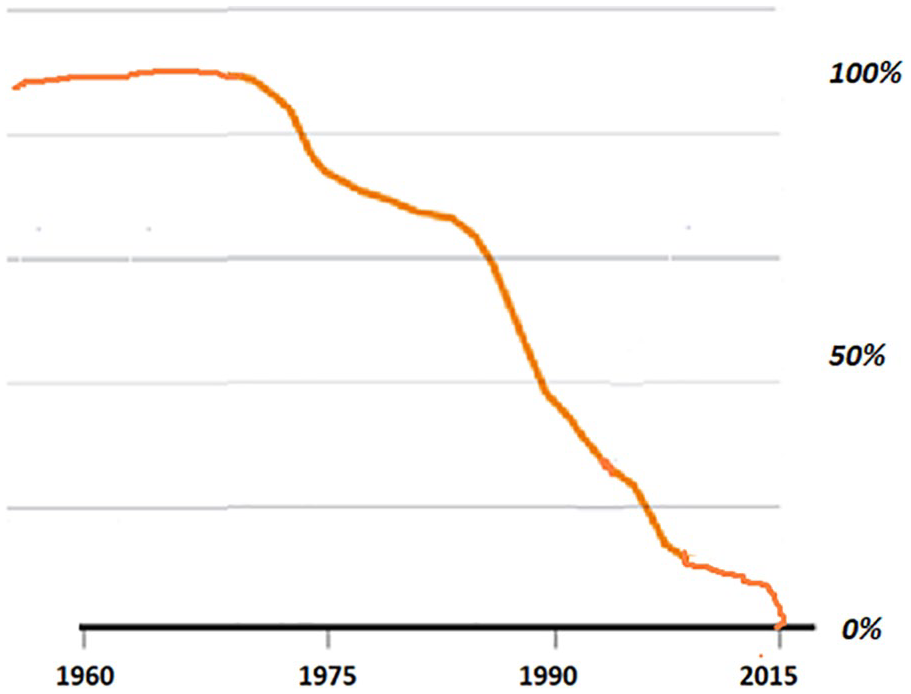
Rationalization of local cooperative bank licenses in name of market and technical efficiency.
(3) Ethical performer mimesis: ‘power over’ resistance
Most small local bank managers did not respond to executives’ ethical avoidance strategy with a productive alternative – ethical experimentation and deliberation demands – but with negative ‘power over customers’ resistance. In other words, small local bank managers resisted executives ‘through distance’ (Collinson, 1994: 28; Gagnon and Collinson, 2017: 1271), sidestepping central managerial controls and denying responsibility for organizational decision making [Convrs., Insider]. For instance, local banks gave non-uniform names to data-fields and used marketing tools in a locally idiosyncratic way against central instructions.
Resentful ideal reversal
(1) Cynical disillusion
According to a longstanding ICT manager the digital marketing project ‘could not live up to [headquarters’] promises, due to local banks’ “cynical” resistance and executives avoidance strategy, made worse by executives’ underestimation of software development and implementation costs’. [Int]. As ‘always we were the first to launch digitalization, but the last to implement in the industry’ [Int.]. Disillusion translated in a deadlock over who should have the power over customers: “customer ownership” became the object of desire for executives and small local banks alike in digitalization projects’ [Convrs., Insider]:
‘We could not see information systems in the context of our historical cooperative ideal. . .Executives and small local banks increasingly perceived each other on the proxy basis of market efficiency and “customer ownership”, and less in terms of how to connect with local members or what is in the interest of the members, which are the fundamental premises of a cooperative value-proposition.’ [Convrs. Insider].
(2) Resentment: ethical depletion
Local banks’ resentment about the use of an overly ‘technical’ and ‘optimistic’ discourse, apparently to pre-empt resistance and hide an agenda of centralized efficiency, led to a ‘dialogue of the deaf’ with the Management Executive. Anyone ‘daring to speak up’ in name of the cooperative ideal was branded a ‘Don Quixote’ and quickly ‘silenced’ [Convrs., Insider]. As a result, cooperative believers and performers left Alternative Bank, one by one:
‘The cooperative ideal was being rationalized based on technical efficiency concerns to an extent that it smothered the essence of the ideal. So, managers and employees who put their whole conviction in Alternative Bank left one by one. The entire knowledge infrastructure that belongs to the cooperative was disappearing by the mid-1990s, and the breeding ground for new ethical finance ideas with it. We were in danger of becoming focused solely on hard numbers, and that is of course no longer a cooperation.’ [Int., former automation, and strategy director].
(3) Inevitable transgression: instrumental power over ideal
Alternative Bank’s Board went against the Management Executive by calling for a grand discussion about the organization’s cooperative future. While the final decision was to remain true to the cooperative ideal, the Strategy Director in charge of the discussion was shocked by the ethical depletion and lack of grassroots conviction about the alternative:
‘I was surprised by the willingness of so many local bank managers to simply shed the cooperative identity and become a mainstream commercial bank from and for shareholders. . .With so little local conviction left, the only solution to was to take central power over the cooperative ideal.’ [Int., former strategy director]
Executives and digitalization champions coupled this conclusion to the inevitability of transgressing the cooperative ideal in the name of keeping up with market instrumentalities:
‘Yes, there was local resistance against Internet banking. But you know democracy can hamper progress. . . So, we simply popped the new banking site on the Internet without asking local banks whether they wanted this. Our message to them was “this is the new reality, get used to it.”’ [Int., Internet Bank champion] ‘Other banks followed the “20/80 customer law”: banking customers demand a locally tailored response only 20 percent of the time, a coordinated central response is appropriate 80 percent of the time. At Alternative Bank, the proportion was 80% local autonomy/20% central control of customer contacts. So, further centralization of customer information was fully legitimate. Of course, local banks complained, but they should be disciplined rather than listened to’ [Int., ICT director, italic added]
Phase 3: cathartic transgression
Headquarters’ conditioning: ‘have your cake &eat it’ affordances
(1) Disciplinary digitalization pressures
At the turn of the 21st century, talk of a ‘new economy’ propelled by Internet technologies such as online customer relationship management (CRM) boomed. Different from the prior generation of digital marketing technologies, which implied a substantial degree of customization to organizations’ own characteristics, CRM was championed by large ICT companies as a one-size-fits all solution:
‘Customer relationship management will allow for an efficient combination of data and action, creating strong relationships with customers and drastically improve business performance in a short period of time’ [Arch., Internal Report CRM team].
(2) Substitutive professionalization
The Management Executive recruited an e-commerce and CRM champion that had earned his stripes at a large multinational. By ‘advice of the ICT director’, this champion took a fast-track approach to acquire a CRM package that would allow headquarters to ‘centralize all customer data and facilitate segmentation and cross-selling beyond local idiosyncrasies’. In effect, this implied substituting digital professionalization for ineffectual alternative claims:
‘He basically ignored all prior digitalization efforts and all good ideas and collaborations that could have come out of that. Instead, he basically said ‘look around you, other banks and companies are using this system, it can do anything, we should also have it’. He quickly chose to acquire an established CRM package from an American supplier, without consulting anyone on its purpose, how to use it, what parts and why. His approach was bound to be met with a lot of resistance by local banks. The ICT director very cynically advised him to show recalcitrant local bank managers how delusional resistance would be.’ [Convrs., Insider CRM project].
(3) Trojan horse determinism
The new champion explained it made for a perfect fit with local banks’ customer relationships:
‘Alternative Bank has a unique opportunity to reinvent itself as an e-company with Internet in the front office, the back office and at the workplace of every employee. . . In this regard, CRM is perfect for us. It will finally allow local banks to do what they always wanted, obtain greater insight into their customers. It’s a great project, I am really enjoying it and am trying to make all the others love and enjoy it too.’ [Int., CRM director].
Meanwhile, a senior CRM manager confided to a very different ‘trojan horse’ agenda:
‘In fact, CRM hasn’t got anything to do with e-commerce. As a member of the Management Executive told me last week, we should have resolved the problem a long time before e-commerce came up. In fact, he told me it isn’t an e-commerce problem at all that we’re trying to resolve via this project. . . .It’s all about efficiency by centralizing customer ownership, and of course by pushing local banks that do not have the money to invest in digitalization skills to merge with others to obtain scale. In the end it is about ending the history of politics at Alternative Bank.’ [Int., Senior CRM manager]
Front-line: mimetic neglect of the real
(1) Power to/with deadlock
While in stage 1 and to a lesser extent stage 2 digitalization champions were prepared to make efforts to accommodate local banks’ autonomy and creative designs, consecutive episodes of disillusion meant that this was not the case anymore in stage 3. Champion and Management Executive alike used a discourse of inevitability to overpower local banks:
‘E-commerce is portrayed as a kind of natural disaster that invades the organization so as to make it possible to open up a discussion about the vested powers in the organization: ‘because, nowadays things are different, and, look, we really have to adapt now.’ In essence, if local banks do not relinquish control over their customer data, we’ll face the end really quickly.’ [Int., local bank director; senior CRM manager]. ‘A democratic dialogue with local banks? Too much technical language? I do not believe in talking, it is time for them to simply commit to market realities. There is no need or room for politics anymore, they should trust we know we are doing. Local banks need market discipline to get their act together. . .Let us end all this fantasizing about local entrepreneurship that frankly causes us to waste customer opportunities.’ [Int., ICT Director].
Some local bank called for a real ethical renewal during the organization’s Central Assembly, most notably through a focus on neglected Islamic entrepreneurs and a departure from mainstream liberal banking. But headquarters ignored these voices [Po. Central Assembly]:
‘In 2001, anti-Islam populism suddenly erupted in our country. Headquarters did not show any interest, but we have. Together we have a unique chance to renew our emancipation history and reach out to a new potential member group: Muslim citizens, from old or new immigration movements. Public opinion has taken a turn for the worst. It is our duty to help emancipate these people, they feel powerless and disenfranchised but have great entrepreneurial potential. For that we must reinvent our political voice, swimming against the current instead of joining the mainstream. At our local bank we have initiated several projects with political and economic significance, but to scale this up we need headquarters’ support.’ [Int. local bank director]. ‘Alternative globalization’ ideals of not-for-profit proximity services were also neglected in the formulation of Internet banking and CRM plans [Int., Local bank]. The new Internet bank and CRM package would be implemented as a one-size-fits all solution for all (international) banking and insurance subsidiaries of Alternative Bank, as well as local banks [Obs., Insider].
(2) Underperformers: professional models; (3) Historical performers: power over crisis
What struck both large and small local bank managers, was a clear pattern of headquarters dominance, expressed through ‘overly technical language’ and an overall silencing approach:
‘During the CRM meetings, with local banks, headquarters managers and external consultants, some of us warned that our cooperative customer ideal is centered on the principle ‘locally, unless’, but this has now become ‘centrally, unless’. This is wrong, it transgresses our foundational principles. Yet, every time someone tried to speak up, the consultants simply overruled the person, with the message ‘sorry we don’t do politics’, effectively silencing them.’ [Convrs, Insider; Po. CRM meetings].
While large local bank managers volunteered to test-run the CRM package, the relatively few believers left – smaller local bank managers and directors – decried a dialogue of the deaf:
‘The e-commerce manager has given a speech on CRM, but clearly there was a big gap between what he was talking about and what the lifeworld of the local banks is. . .He was acting like a know-it-all but could not grip people. You see, the average local bank director is just not interested in technical projects or CRM. . .Most people are willing to trust the experts since they realized digital is coming one way or another, so they just remained quiet. But the one time someone asked questions about the power consequences, namely who will own the customer, the manager immediately silenced him. In the end it was just a dialogue of the deaf. You see, many local banks are wary of a hidden agenda behind the CRM-project. For them, the CRM-project, as prior projects really are all about: who owns the customer? They feel powerless and resentful, because they should be in charge according to our statutes, not external experts or even headquarters executives.’ [Int., local bank director].
The alternative voices that still spoke out during the democratic assemblies foreseen by Alternative Bank’s statutes reminded everyone of what they were in danger of destroying:
‘It’s actually great that we have such a diffuse, decentralized decision-making process. . .this creates room for imagination, different ideas, alternatives that otherwise would not be contemplated. So, there is nothing wrong with our decision-making process. Of course, people engage in politics, it cannot all be about market efficiency like the commercial banks. If headquarters decides everything, we’ll go stale and become like the others.’ [Po. Meeting]. ‘We are doing fantastically entrepreneurial things with the freedom and decision power we have at our local bank. Our big advantage is that we have a very long-term purview and are not-for-profit. This allows us to invest in local projects that are too entrepreneurial or forward-thinking for our commercial, risk-averse competitors.’ [Int. local bank director].
Resentful ideal reversal
(1) Oppressive delusion and (2) Ideal-reversing common sense
A few years on in the project lofty CRM promises had stumbled on technical shortcomings. At the start of the test phase of the new CRM-project, resistance did not so much come from local banks, but from technological limitations. One limitation was that it was impossible to test-drive the new CRM-system synchronously with the legacy systems, without blocking a big part of Alternative Bank’s network operations. In addition, the bandwidth that needed to be leased and installed for the new system was not available in a near future. On top of all the complexity introduced, the new CRM-interface did not prove to be as user-friendly as the existing one.
These technical problems provided local bank directors with an opportunity to show their resentment, attacking the large costs attached to the CRM project – including the opportunity cost of not spending all this money on real local banking challenges. This prompted General Management to slash the CRM budget in half. Two consecutive CRM project leaders left Alternative Bank, in addition to the e-commerce director. When local bank protests threatened to boil over, General Management announced a ‘press stop’ to prevent whistleblowers from publicly discrediting the organization. After a 2-year cooling off period, headquarters overruled local banks’ protests. Local banks gave in. Resistance was delusional:
‘If this is the way it is going to be, not respecting our voice yet again, we just stop caring about headquarters’ talk of renewing our cooperative identity. It is all about organizing our local democracy away anyway. . .centralization, efficiency, getting great credit ratings, technical expertise that is all that matters now.’ [Int. local bank managers].
By 2006, all the merged local banks had signed up to the CRM project, the others were led to merge with local banks who had invested in the necessarily digital scale. By default of ethical performativity, organizational resentment turned against the historical performers who were now seen as ‘Don Quixotes’ holding the organization hostage to an ‘oppressive delusion’, preventing professionalization with a new ‘digital common sense’ [Convrs., Insider]:
‘Headquarters managers and IT experts, driven by fantasies of technical efficiency, and desire to conform with the regulators’ and credit rating agencies’ efficiency standards, have organized our democracy away. Now, no one respects local member committees anymore, local bank directors do not even intervene when headquarters abolish the independence of a local bank to merge it with others – without asking for members’ opinion or consent. The function of a local bank as a sounding board for authentic local voices has been sacrificed on the altar of efficiency. We will regret it in a few years, but it is too late now. The new common sense is that local cooperation is an inefficient thing of the past that no professional banker wants to be associated with’.
(3) Inevitable transgression: cathartic
Tit-for-tat, local cooperatives and their members transgressed the foundational cooperative ideal, by distancing themselves from the idealized democratic cooperation scenario extolled by headquarters with each digitalization round. A senior project manager of digitalization projects – who used to be a small local bank director – confided how executives and local banks seemed to take pleasure in transgressing the original cooperative contract:
‘If headquarters would create an appropriate framework and know how to articulate a belief in the vision that buttresses it, so as to ensure that everyone in the organization consistently experiences there is no hidden agenda, yes, then they would give us a passe-partout to accomplish things. However, if this framework is absent, then everyone constantly transgresses the boundaries of the cooperative contract. Both executives and local banks seem to take pleasure in all this transgressing, there is so much going on’ [Int., ICT insider]
Remarkably, there was no real resistance when Alternative Bank’s central headquarters forced all local banks to give up their individual banking license, effectively revoking the democratic principles at the heart of the bank’s historical cooperative character.
‘The end was bloodless. . .no one put up a real challenge, on the contrary, local banks seemed to welcome it all. . .Everyone seems to have lost the desire to invest in our foundational essence as a local, not-for-profit democracy. The funny thing is the more headquarters repeats that all this digitalization and rationalization serves to renew our cooperative identity and be closer to the customer, the more local bank directors shrug their shoulders and go ‘what the hell’. They feel powerless in the face of what they perceive as headquarters’ cynical use of technology discourse. . . to silence them . . .and appropriate the historical right to define what the bank is about. So, in the end believers in local cooperation either left or became too resentful to act. . .waiting for their retirement. We’re all believers in technical efficiency and market discipline now.’ [Int., local bank director].
In practice, Alternative Bank had become a firm part of the establishment, rather than a digital alternative to mainstream commercial banks. By 2018, an internal study concluded:
‘Alternative Bank’s cooperative character has all but disappeared. In practice, Alternative Bank is not different anymore from other banks. It treats its cooperative members exactly like its regular market customers’.
Local bank managers experienced the 2015 revocation of local banks’ licenses as ‘cathartic’:
‘The truth is that it relieves us from a weight that we have been carrying for a long time. Local democracy had become associated with local egotism, status quo and nostalgic power over the customer’ [Int. Local banks].
Epilogue: digital transformation and formal end of local autonomy and democracy
While Alternative Bank consisted of a decentralized network of more than a thousand autonomous local banks in the early 1970s – each with its own banking license (Figure 2), by 2016 Alternative Bank had reverted to a mainstream organization with one central banking license in the hands of an executive hierarchy. The Digital Transformation project launched in 2016 built on this new reality. While many thousands of local banking staff were let go, the new Digital Transformation manager hired hundreds of externally trained experts to bring Alternative Bank ‘closer to the digital reality of customers and markets that do not care about location. . .everything is about data, which are most efficiently managed centrally’:
‘Innovation has always been and must remain in our DNA. Everyone understands how important digitalization is. But finding people with the right skills is difficult. What will set Alternative Bank apart is how it manages its data. For this reason, I like to rely on external data experts who believe passionately in this cause, as demonstrated by their skills and motivations, and want us to become data-driven.’ [Int. ICT manager].
This discourse ignored cooperative members’ many complaints:
‘Alternative Bank’s cooperative identity has become very abstract to us. . . In essence we are no longer considered humans of flesh and blood that express our dreams and hopes to local banking employees or local committees, but as data strings in computer files that are treated with software by far away experts. This is not what we signed up for.’ [Po., online discussion forum].
According to the now retired strategy director, the Cooperative legal form had become a tool of ‘symbolic management’, part of the broader ‘Corporate Social Responsibility discourse’:
‘The only logical step remaining is for Alternative Bank to become publicly quoted, like the other mainstream banks’ [Int. Retired Director].
Organizational ideal reversal: model
The theoretical model in Figure 3 visualizes how the conditioning and enactment of fantasmic digitalization affordances induces organizational ideal reversal through three phases of unwitting transgression, instrumental transgression, and cathartic transgression. The model highlights the co-evolutionary dynamics of fantasmic sublogics and associated power types in bringing about this dark side of digitalization, first unintentionally, cynically after the first disillusion, and finally yielding cathartic mainstreaming.
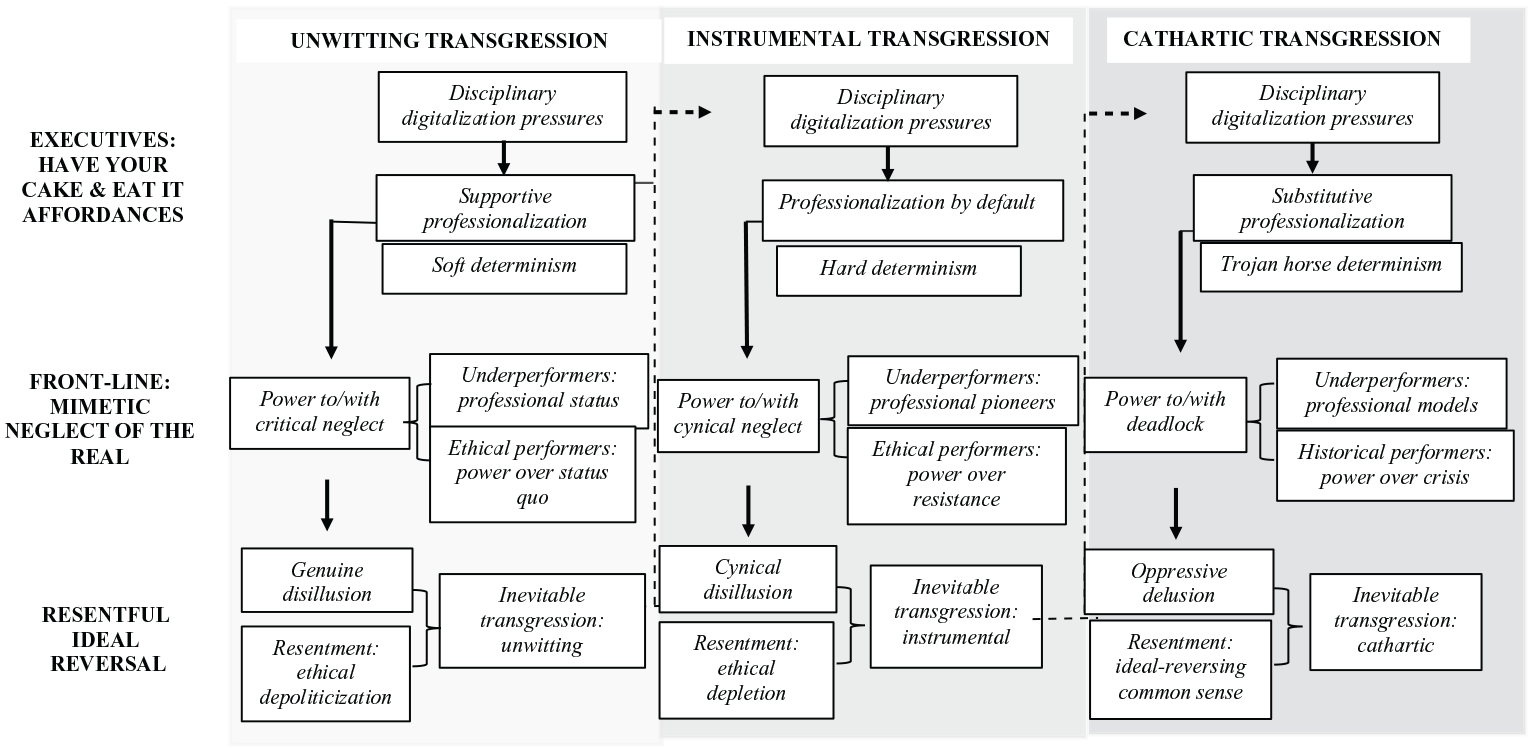
How the conditioning and enactment of fantasmic digitalization affordances interact to induce organizational ideal reversal.
Each phase starts with executives conditioning fantasmic affordances in response to disciplinary digitalization pressures, through the proxy of digitalization champions. Digitalization entails a disciplinary power regime of techniques of normalization and disciplining of professional aspirations and dreams of fulfilment (Costas and Grey, 2014: 910). To condition organizational renewal processes within this disciplinary context, executives provide ideological and ethical sublogics of how digitalization affords alternative ideal renewal. Through three consecutive phases, executives condition digitalization with ‘have your cake and eat it’ affordances – ideological and ethical. Subsequently, front-line employees enact these affordances. Through the three phases, front-line employees respond to ‘have your cake and eat if’ affordances through mimetic neglect of real renewal choices – that is, underinvesting in an ‘ethics of the real’ (Glynos, 2011: 381). The combined structural effect of executive conditioning and front-line enactment of digitalization affordances yields increasingly resentful organizational ideal reversal through the three phases.
Phase 1: unwitting transgression
In a first phase of ‘unwitting transgression’, executive conditioning is as genuinely ambitious as unrealistic toward the alternative ideal. Appointed digitalization champions customize digitalization technologies to the organization’s alternative ideal. Digitalization champions’ unreflective use of an ideology of ‘limitless technical efficiency’ and a soft type of ‘techno-ethical determinism’, however, induces front-line managers to neglect critical choices about the real ethical renewal choices ahead. As executives take for granted the need to creatively renew the ethical ideal and choose a concrete front-line focus, a key distinction between ethically underperforming and ethically performing front-line managers emerges. While ethical underperformers’ search for an improvement of professional status in the organization leads them to embrace headquarters’ technical efficiency and determinism fantasies, ethical performers are put off by ‘technicist’ talk, finding it too abstract. Yet, they are sufficiently seduced by its ‘have your cake and eat it’ promise to neglect actively resisting fantasmic overinvestment and take the initiative in renewing the ethical focus of digitalization on concrete priorities.
In the final stage of phase one, the structural effects of affordance conditioning and enactment play out. Defeating executives’ deterministic conditioning, the digitalization project ends in genuine disillusion by all parties, but also ethical resentment on account of the most ethically performing organizational members. The latter decry how executives’ digital affordance work depoliticizes the organization’s ethical difference and unwittingly reduces the vibrancy of local fantasy work. Confronted with internal disillusion but also increasingly forceful digitalization pressures, executives revert to a discourse of ‘inevitable renewal’ to take as limited as possible, but still transgressive power over the organization’s ethical ideal.
Phase 2: instrumental transgression
Ideal transgression in the name of inevitable renewal realities carries over in a subsequent phase of ‘instrumental transgression’. Executive ambitions to champion an alternative form of digitalization are privately downgraded by default of a performative historical ideal and the need to adapt to disciplinary pressures (Hensmans et al., 2012; Johnson et al., 2012). Executives recruit externally trained digitalization champions to condition the organization for new digitalization affordances. By default of a renewed alternative ideal, fantasmic affordances integrate more mainstream professionalization influences and a harder type of techno-ethical determinism than in the first stage, to avoid confrontational power struggles and obtain rapid enactment by front-line members.
Following this more deliberate neglect of grassroots (power with) deliberation and choice on how to renew the organization’s ethical ideal (power to), ethically performing and ethically underperforming front-line agents take increasingly different tracks. Ethical performers use their ‘moral high ground’ power to resist executive conditioning – interpreted as an imminent ‘power grab’. By contrast, ethical underperformers’ priorities increasingly pioneer executive professionalization ambitions, championing technical (digitalization) and market (e.g. merger) efficiencies. Cynically, both performers and underperformers continue their mimetic neglect of real ethical renewal choices, contributing to an increasingly underperforming alternative ideal.
The clash between executive conditioning and front-line resistance yields a cynical type of disillusion, as well as a depletion of the ethical infrastructure of the organization. Ethical performers and their accompanying power/knowledge infrastructure leave the organization or are subordinated to ethically underperforming, but ideologically willing subgroups. Confronted with increasing internal disillusion and disciplinary digitalization pressures, and by default of a performative alternative, executives inform their discourse of ‘inevitable renewal’ with an avowedly instrumental market logic, further transgressing their power over the alternative ideal.
Phase 3: cathartic transgression
Ideal transgression carries over in a subsequent stage of ‘cathartic transgression’. Executives now consider ambitions to ethically challenge mainstream digitalization pressures delusional, tasking the new digitalization champions with a ‘trojan horse’ agenda: promise limitless cooperative and techno-ethical possibilities to effectively substitute the alternative ideal with professional mainstreaming. The trojan horse tactic is used pre-emptively silence struggles over the alternative ideal and leave front-line agents with no other choice than to enact the new mainstream agenda.
While historical performers induce a dramatic organizational crisis to maintain their historical power over customers/members, ethically underperforming agents and their professional predilection for technical and market efficiency have become the model to follow by default of a concrete digitalization alternative. Finally, the protracted deadlock between executives and historical performers yields a final, cathartic recognition of its delusional and oppressive character. Ethical ideal pretenses are reversed in favor of the inevitable common sense of technical efficiency and market competitiveness.
Organizational ideal reversal: propositions
The case analysis and theoretical model allow for three contributions to the literature on organizational fantasy work, and the dark side of digitalization fantasies in particular. First, I theorize the fantasy work – co-evolutionary sublogic and power types – that conditions organizational ideal reversal, explaining why and how executives’ positive power and ethical renewal intentions make way for cynical mainstreaming and transgressive power over intentions. Second, I theorize the co-evolutionary sublogic and power processes that induce front-line agents to enact organizational ideal reversal. Third, I situate organizational ideal reversal within a larger societal critique that recombines the lenses of critical theory, the new spirit of capitalism and technicist society.
The dark side of executive conditioning of fantasmic affordances
The case analysis and theoretical model demonstrate how both post-critical and critical theory power assumptions of executive fantasy work come into play. As argued by post-critical authors (Driver, 2017; Ekman, 2013; Kenny et al., 2020; Moroz et al., 2018) executive fantasy work initially is motivated by positive power ambitions – increasing the organization’s ability to renew the alternative ideal’s through ‘power with’ and ‘power to’ processes. The long-run premise that ideological fantasies sustain managers’ desire to champion pro-social alternative ideals through disillusion (Driver, 2017; Kenny et al., 2020; Moroz et al., 2018) must be nuanced, however. Structural disillusion and resentment at the end of a fantasmic project, in combination with disciplinary digitalization pressures, engenders a shift from managers conditioning fantasmic affordances with genuinely positive power and alternative ideal ambitions to a hierarchical, mainstreaming agenda of cynical and pre-emptive power over. The latter, longer term evolution is in line with critical theorists’ predictions (Alvesson and Deetz, 1999: 199, 2006: 256).
Two complementary elements explain the executive shift from genuinely cooperative power motivations to cynical, hierarchical motivations. In the wake of post-fantasy disillusion and resentment, executives face disciplinary digitalization yet also weakened professional credibility and prospects of substantial resistance. To overcome these hurdles, executives turn to the darker side of fantasy work, using cooperative power with and magical power to arguments as a ‘trojan horse’ to hide their hierarchical agenda and induce front-line managers to quickly give in to urgent change demands (Hensmans, 2015).
Executives’ adoption of assumptions of techno-ethical determinism further explains the shift from initial techno-optimism (digitalization provides a magical way to renew our alternative ideal) to hierarchical techno-realism (our failing organizational ideal should adapt to digitalization realities). Technological determinism, that is, the causal portraying of technical artefacts such as the Internet as driving modernization and progress toward a horizontal, democratic society (Coleman and Blumler, 2009: 10), has had a tremendous normative influence on managers since the inception of the computer industry. Executives have long been seduced by the deterministic fantasy that ‘technological developments occur according to some naturally given logic, which is not culturally or socially determined’, forcing ‘social adaptation and changes’ (Bimber, 1994: 84). The rise of Silicon Valley “platformania” (Hensmans, 2019) and a utopian association of technology with scientific achievement (Ossewaarde, 2019) have further legitimized digitalization as a deterministic force for social change.
The ‘have your cake and eat it’ promise of technological determinism, particularly when couched in a discourse of limitless professionalization possibilities, explains why executives are so easily seduced by it, both for genuinely progressive and cynical reasons. Digitalization promises rapid transformational change ‘unfettered’ by human involvement (Leonardi, 2008: 978), that is, with minimal organizational effort and maximum reward. The shift from genuinely progressive to cynical executive conditioning is triggered by the inability to realize digitalization in terms of the historical ideal, and disciplinary pressures to turn digitalization investments into performative acts. Technological determinism facilitates this shift through its ideological capacity to hide concrete experiences of disillusion and ethical resentment behind the veil of a decontextualized technological artifact (Leonardi, 2008). It provides executives with a greater measure of performative control than afforded by the more open forms of decision-making associated with digitalization (Baptista et al., 2017; Hautz et al., 2017; Heavey et al., 2020, Leonardi and Vaast, 2017), helping them to discipline front-line agents’ imagination in the desired organizational renewal direction.
P1a:Techno-ethical determinism, particularly when couched in a discourse of limitless professionalization possibilities, conditions organizational renewal processes with fantasmic ‘have your cake and eat it’ affordances, seducing executives for both genuinely progressive and cynical ‘trojan horse’ reasons.
P1b: Facing contradictory disciplinary digitalization pressures and digitalization-induced disillusion and resentment, executive conditioning of fantasmic affordances shifts from positive power ambitions (power with and power to) to a hierarchical power over agenda.
Discursive devices are often used by powerful managers to simplify an indeterminate context rife of possibilities, delegitimize alternative ethical possibilities that do no serve dominant interests, and direct organizational change processes towards seemingly ‘inevitable’ outcomes (Deetz, 1992, 1996). Thus, a discourse of limitless professionalization frames resistance against mainstream market rationalities as illusory (Bloom and Cederström, 2009; Ossewaarde and Reijers, 2017; Upchurch and Grassman, 2016). And a discourse of techno-ethical determinism frames resistance against technical efficiency as an immoral and oppressive form of ‘old politics’ (Ellul, 1980; Marchart, 2007).
The naturalization of technology as an interest-free, empowering affordance of progress induces managers, often unwittingly, to direct change processes even more toward inevitable outcomes (Leonardi, 2008). Discourse of inevitability can come back to haunt managers, however. Overbearing managerial control through the discursive management of various objects of professional fulfilment – technology, empowerment or identity – can cause profound resentment amongst organizational members and increasingly cynical forms of resistance (Fleming and Spicer, 2008). Resentment is the rush of the disenfranchised to assume moralizing contempt for the strong (Sloterdijk, 2000: 56). It builds up under a number of conditions (Scheler, 1961: 48–52) including chronic internalized powerlessness to influence the order of things; a structural gulf between formal and substantive equality and clear comparison between ethical ideals and contemporary realities.
When powerful executives engage with grassroots resentment, it can provide a powerful co-creative force to performatively invent moral categories (Nietzsche, 1967: 11). By default of timely engagement and creative invention, however, resentment can escalate into ideal-reversal (Hensmans and van Bommel, 2020): the historical object of admiration and desire can suddenly become the object of resentment because it stands in the way of progress.
This study demonstrates the very real risk of digitalization fantasies inducing ideal reversal. Fantasies have an original rudimentary structure with a strong dramatization core that co-evolves in complicit complexity with ideal-reversal processes. The dramatic core of fantasmic narratives implies three elements that can be activated to a stronger degree as events call for more revolutionary or transformational fervor (Bormann, 1972: 398): an idealized scenario, an impediment to the realization of an ideal, and the paradoxical desire to transgress the ideal (Glynos, 2011: 376–77).
The model advanced in this paper theorizes these elements as part of complementary, mutually reinforcing conditioning, enactment, and structural interaction elements. I highlight the conditioning role of techno-ethical determinism (first element), the enacting role of front-line agents neglecting their ethical power to initiate a concrete alternative digitalization project (see next section), and the structural interaction role of a discourse of ‘inevitability’.
The dramatic core of techno-ethical determinism in digitalization fantasies includes an abstract dimension of inevitability that provides executives with a tautological, decontextualized rationale to overrule grassroots sources of ethical resentment; rather than engage with them through co-creative (power with) renewal of concrete ethical options and choices. Technical efficiency provides a morally superior, inevitable path to progress that turns longstanding impediments to organizational ideal renewal into a mere difficulty. Also, there is no alternative to technical efficiency: a horrific scenario of technical inefficiency will inevitably unfold if one does not prioritize it. Finally, transgression of a concrete historical ideal is inevitable if it stands in the way of technical efficiency.
P1c: Digitalization fantasies include a decontextualized core of inevitability that dramatizes alternatives to technical efficiency as catastrophic and ideal transgression as the moral way forward, inducing executives not to engage with grassroots resentment through the co-creation of concrete ethical choices.
The dark side of front-line enactment of fantasmic affordances
This study provides historical perspective to the argument that ethically invested subjects stand in the way of ideal renewal because they find ‘it difficult to deal with contingency, recognize novelty, and [do] not feel at ease with experimenting with new ways of being’ (Glynos, 2011: 288). Instead, I find that ethically performing agents are guilty of mimetic neglect, unwittingly setting in motion a vicious cycle of ethical depoliticization, depletion and finally ideal reversal. The concrete, contextualized performativity of ethically invested agents means they are less easily seduced by abstract fantasies of techno-ethical determinism. Yet, they are sufficiently overawed not to critically engage with determinism when it emerges, handing the initiative by default to an ideological alliance of executive digitalization champions and ethically underperforming agents.
The ethical resentment that follows disillusion at the end of a first digitalization project does not induce ethically performing agents to take creative (power with and power to) responsibility for organizational ideal renewal. Their motivation is not ethical overinvestment or fundamentalism, however, but the inability to resist mimetic power over struggles with the alliance of executives and ethical underperformers. Since resentment is not picked up by executives as a co-creative opportunity but as a signal to avoid engaging ethical performers, the latter resolve to participate in a mimetic ‘power over’ struggle with customers. First standing by as passive recipients and subsequently taking up the role of cynical participants in a mimetic domination game, ethical performers forfeit the opportunity to see digitalization as a positive enabler of new ‘power/knowledge’ configurations and invent concrete ‘new ways’ of renewing and refocusing alternative ideals (Carlsen et al., 2020: 3; Glynos, 2011: 380–81).
By neglecting ethical renewal responsibility and joining executives in a mimetic desire for market competitive objects such as customers (Girard, 1986; Hensmans, 2003), ethical performers lose the vantage point of leadership by example, slowly turning into resentful ex-performers, that is, Don Quixotes or Luddites standing in the way of inevitable digitalization progress. Forfeiting their performativity on the altar of mimetic struggle, historical performers unwittingly prove that resistance to techno-ethical efficiency is delusional. In the long run, a new common sense emerges. The historical ideal stands in the way of progress and there is no alternative to technically efficient mainstreaming.
P2a: When ethically performing agents are complacent in face of techno-ethical determinism they give free rein to ideological overinvestment by an alliance of technical efficiency champions and ethically underperforming agents – inducing a vicious cycle of ideal depoliticization, depletion and reversal by default.
P2b: When resentment about executives’ techno-ethical determinism leads ethically performing agents to enact mimetic ‘power over’ struggles rather than creative (power with and power to) responsibility for organizational ideal renewal, they contribute to an emerging common sense of techno-ethical efficiency by default.
Situating the dark side of organizational fantasy work within larger societal dynamics
Organizational members experience the final mainstreaming decision as cathartic as it liberates them from a deadlock that is as oppressive as delusional: who has the power over an historical ideal that has become non-performative after years of neglect. In addition to the organizational dynamics described above, I situate this cathartic moment within a critical societal context drawing on complementary insights from the literatures on post-Marxist capitalism (cf. Alvesson and Willmott, 2002), the new spirit of capitalism (Ekman, 2013) and the technicist society (Ellul, 1964, 1985). 1
Post-Marxist theorists criticize how market capitalism alienates and colonizes organizational employees by instrumentalizing human subjectivity (Ezzamel et al., 2001; Fleming, 2012; Knights and Willmott, 1989; Willmott, 1993). Vying for a more humane and democratic social order, these theorists challenge the ‘religion of the market as the embodiment of freedom and merit’, arguing that it induces a self-alienating, common sensical neglect of real ethical choices (Costas and Fleming, 2009; Hensmans, 2003: 561‒62). Management, including of social enterprises, is a hegemonic endeavor that fixates indeterminate ethical possibilities in accordance with ideologically dominant, partially ethical interests, instituting a common sense that employees have to accept as the natural order (Dey et al., 2016: Spicer and Böhm, 2007).
Post-Marxist theory implicitly works towards a ‘cathartic’ moment, in which subordinate, non-hegemonic social groups such as employees emerge to self-constitute an ethico-political class with the capacity to enact its revolutionary consciousness (Gramsci, 1971: 20). Catharsis indicates ‘the passage from the purely economic (or egoistic-passional) to the ethico-political moment’, and ‘from “necessity to freedom”’ (Gramsci, 1971: 691‒92).
New spirit of capitalism theorists beg to differ, at least when it comes to the existence of a non-hegemonic, subordinate class in Western modern enterprises. To counter criticisms of alienation and coercion, the current spirit of capitalism has turned into a project-based mode which engenders productivity precisely through personal involvement, autonomy, and individualization (Ekman, 2013: 1160). Employees and managers are equally willing and motivated participants in capitalism (Boltanski and Chiapello, 2005: 8), both shirking concrete ethical responsibilities (Ekman, 2013: 1161). Issues of hierarchical, managerial exploitation are no longer salient when the main fantasmic objective is the creation of a sense of belonging to a performing professional class. In the current capitalistic system, cathartic moments are aplenty, generated by consecutive fantasmic images of ‘fulfillment’ and mutual ideological recognition between managers and employees (cf. Ekman, 2013: 1165). 2
While implicit in some post-Marxist arguments, a third societal lens that is highly relevant to organizational work on digitalization fantasies has received less attention. The argument that we are living in a technicist society (Ellul, 1964) provides another explanation to the vicious cycle of ideological overinvestment and ethical underinvestment in fantasmic digitalization projects. Our society reveres a ‘technicist morality’ that constantly strives to improve human conduct, values, and virtues through ‘technique’, ‘devaluing alternative kinds of conduct, alternative values and virtues’ (Ellul, 1985: 7). As a ‘technician’, a digitalization professional champions techno-ethical determinism: she ‘analyzes and predicts [and] cannot endure the indeterminate or tolerate any initiative which upsets order’ (Ellul, 1964: 297). Technological signifiers such as carbon footprint or digitalization have acquired an almost magical quality for the resolution of problems in our society: merely speaking the signifier has the effect of seeming to help solve the problem (Romanyshyn, 2008: 5).
The above three lenses in combination with insights from this study allow for the following arguments on ethical underinvestment, catharsis and how to resist ideal reversal:
P3a: Ideological overinvestment and ethical underinvestment are rooted in mutually reinforcing ‘new spirit of capitalism’ and ‘technicist society’ meta-fantasies of respectively professional fulfilment and the superior morality of technical efficiency.
P3b: Combined technicist and new spirit of capitalism pressures provide a cathartic dimension to organizational ideal reversal, liberating organizational agents from an alternative ideal that stands in the way of the professional pursuit of technical efficiency.
P3c: Foregrounding alternative ethical ideals in face of disciplinary digitalization pressures requires both executives and front-line agents to become highly conscious of the ideal-reversing effects of technicist determinism and inevitability assumptions, resisting their dramatization through mimetic power over struggles and instead working towards cathartic moments of creative ethical responsibility in digitalization projects.
Footnotes
Funding
The author received no financial support for the research, authorship, and/or publication of this article.
