



Abstract
Despite long-standing criticisms of the paradigm, New Public Management (NPM) retains a strong influence over organizations in public administration. Social Impact Bonds (SIB) are an outcomes-oriented investment entity which has emerged from NPM with grand promises of social change. Building on a longitudinal case study of a health-based SIB, this paper identifies how key actors move away from NPM by resisting such management principles and shift toward Public Value Management (PVM). The paper finds that this is possible when the public interest and performance objectives are designed with a public value orientation whilst other NPM principles shift over time through resistance and negotiation. The paper provides insight into how key actors re-organize to embed public value in a financing and public service delivery structure that is often regarded as flawed and inefficient. The paper offers several contributions to public value literature, including the role of the state, as well as the emerging literature on SIBs and outcomes-based contracts.
Keywords
Introduction
The concept of public value has received growing attention in recent years because of its focus on humanistic progress, as well as democratic and social outcomes that are valued by the public (Benington, 2011; Benington and Moore, 2010). In public administration, the New Public Management (NPM) paradigm emerged with the promise of delivering improved services to the public whilst providing better value for money. This involves a reduced role of the state and emphasizing managerialism, which has been claimed to improve the efficiency and performance of governments and public agencies (Bevir, 2009). Unsurprisingly, this approach retains a strong influence over the administration and behavior of public service organizations, prompting collaborations between investors and governments to leverage market forces in the delivery of public services (Wilson et al., 2020). This has changed governments’ resource allocation logic to expand impact investment markets (Deeming and Smyth, 2015) and procure outcomes-based contracts in support of a complex social investment infrastructure (Lowe, 2013), whereby payments are tied to the achievement of certain social goals (FitzGerald et al., 2023).
Despite its prominence, evidence also depicts various problems associated with NPM, such as challenges with accountability mechanisms and performance management (Lowe and Wilson, 2017), the role of interpreting and “gaming” data (Lowe et al., 2019) as well as operational inefficiencies (Carter, 2020; Pequeneza, 2019). It remains unclear how public agencies continue to deliver value under NPM despite the conceptual and practical challenges, and the growing recognition of it being based on flawed assumptions. In addition, where NPM principles remain embedded, even if dysfunctional, it is not yet known whether new principles and practices have emerged to make NPM work, re-organized as “workarounds” or acts of resistance.
This problem has been tackled before, albeit partially. Literature has shed light on the role of institutional legacies (Kiess et al., 2017), political agendas (Dietz-Uhler, 1996), path dependency (Pierson, 2000), the escalation of political commitment (Staw, 1981), and increasing returns (Pierson, 2000). Although conceptually appealing, these explanations fall short as they place excessive emphasis on regulators and policymakers, neglecting the role of other important actors in the system—such as delivery organizations, managers, and investors—and their relationship with the system (FitzGerald et al., 2020). Therefore, they cannot capture how key actors articulate new practices to deliver public value in a New Public Management setting. This is an important question as it can potentially explain how public services transition away from the NPM paradigm more closely toward the pursuit of public value.
To answer this question, we focus on a specific type of outcomes-based contract, the Social Impact Bond (SIB). From 2015 to 2019, we conducted 30 interviews with the key actors involved in the design, development, and operation of a health-based SIB in the UK. We sought to explore how key actors within the SIB contract embraced public value practices from its inception and shifted over time from NPM into the public value sphere. To go under the hood of the contract, we needed a change in perspective. We thus grounded our examination in the Public Value Management perspective (O'Flynn, 2007), which differs from NPM as a paradigm because in the latter there is a focus on inputs and outputs that regard citizens as consumers of public services, determined by market processes (Dunleavy and Hood, 1994). Whereas in the former, public value involves effective and collective tackling of problems, and maintenance of the systems that the public cares about most through a relational approach (Bozeman, 2007).
Through this lens, our findings point to three interwoven practices that allow actors to deliver public value in a New Public Management setting that we call: revaluing social interventions, re-focusing person-data relationships, and data storytelling. Findings suggest that the prevalence of NPM might have little to do with the merits of the NPM logic, but rather with the practices and decision processes that actors across the system enact to navigate the complications that the very same outcomes-based contract creates. Most notably, they show how the key actors re-organize to embed public value into a public service delivery and financing structure that is typically regarded as dysfunctional. As such, our findings allow us to explain how the principles underlying Public Value Management can be operationalized in public services governed by NPM logic, suggesting potential transition mechanisms.
We make three key contributions. First, we contribute to the literature on public value through an examination of new relationships that exists between the state, firms, and society (Sancino et al., 2018), showing how key actors navigate, negotiate, and resist extant paradigms (NPM) to gradually establish practices and principles rooted in public values. Second, we highlight the role of the state as a central actor in the generation of public value, specifically how multiple interrelated government, non-government actors, and entities make sense of the situation to re-orient toward public value. Third, we contribute to the growing literature on outcomes-based contracts and SIBs by demonstrating how key actors in outcomes-based contracts influence institutions rather than simply being passive to them (FitzGerald et al., 2023). In doing so, this draws our attention to the micro-level accountability and governance mechanisms that occur through SIB implementation, implying a shift away from the classic SIB model (Economy et al., 2023).
Theoretical background
New public management and public value
Across the world, outcomes-based contracts have been used as a way for governments to outsource services to private providers and are a product of the New Public Management (NPM) movement (Dunleavy and Hood, 1994). NPM is based on the premise that market processes are more efficient than governments in designing, implementing, and financing social interventions or programs (Sprigings, 2002). Specifically, the vast literature on NPM has emphasized the importance of contracting public services, creating competition between suppliers of such services, and the performance management of this process.
The ability to control and manage accountability in this delivery is central to NPM alongside the notion that efficiencies can be produced with private sector business practices (Alford and Hughes, 2008). Dunleavy et al. (2006) discuss three key themes of NPM: performance through payment systems, competition and marketization, and disaggregation of provision (i.e. use of the private sector). The consequence is that, as Lapuente and Van de Walle (2020) emphasize, there is now an almost permanent shift from seeing public service delivery as input-process to viewing it as output-outcome.
In this regard, outcomes-based contracts (and payment by results thinking more generally) are typically regarded as unique sites where NPM is in operation. Research depicts a strong focus on performance objectives and a managerial focus; with the underlying logic being that outcomes are more likely achieved when managed efficiently and people are held to account for their actions (Warner, 2013). However, research depicts that those held accountable game and alter their behavior drastically and that there is an asymmetry between performance data and the experience of clients (Lowe and Wilson, 2017).
In this regard, outcomes contracts are challenging for organizations delivering social interventions. Such contracts put innovation at risk since flexibility is counteracted by the threat of financial loss (Fox and Albertson, 2011). More disadvantaged social groups are also at risk where equity is not explicitly included in a contract, as working with marginalized communities can come with an added cost (Street and Maynard, 2007). In addition, outcomes-based contracts require organizations to ensure sufficient cash flow for pre-financing and quickly adopt a different skill set pertaining to contracting, financial risk management, monitoring, and evaluation (Miller et al., 2012). This can be radically different, yet not necessarily better, than working with donations, grants, and traditional public contracts, leading several organizations to abandon their efforts.
Despite the proliferation of outcomes-based contracts and the dominance of the NPM paradigm, we know very little about how they relate to public value. Public value refers to democratic and societal goals/outcomes that are collectively valued by the public and that add value to the public sphere (Benington, 2011). For Stoker (2006), public value emerges from NPM yet differs markedly because learning, relationships and a diverse range of stakeholders are considered. Therefore, public value is considered to have a collective rather than individual ethos with a focus on relationships which values process as well as the outcome of value creation, including the rights and aspirations of citizens (Bozeman, 2007).
Yet, Bryson et al. (2014) demonstrate that it is very challenging to pinpoint exactly what public value is and that its core themes tend to cut across other areas of thinking in public management (e.g. new public governance). Empirically, others draw from concepts such as “public work” to emphasize a more action-oriented perspective as to how public value is created and the impact it has on how people feel about society (Boyte, 2011; Meynhardt, 2009). Others have explored how multi-actor collaboration across sectors is underpinned by public value thinking and appears much less likely in more hierarchical settings (Sancino et al., 2018). In summary, NPM appears to be the dominant paradigm in outcomes-based contracts, but little is known about public value notions within such settings.
Social impact bonds and public value
A Social Impact Bond (SIB) is a particular type of outcomes-based contract whereby private investors provide the working capital for a particular social project (social enterprise, charity, NGO). If this organization meets certain milestones and outcomes, a third party—typically the government or a philanthropic foundation—repays those investors at a rate of return. Thus, if those organizations do not achieve the set outcomes, then the investors stand to lose some or all their investment (Arena et al., 2016). The outcome data that drives these payments can be collected and evaluated by an independent research organization (Berndt and Wirth, 2018) or through a “rate card” (FitzGerald et al., 2019).
As of May 2023, 244 SIBs have been contracted in 40 countries, investing close to half a billion dollars (Brookings Institution, 2023). 1 This has expanded from 163 impact bonds in 2019. Many commentators note that the growth of SIBs has not been extraordinary yet as FitzGerald et al. (2023) highlight, SIBs also “offer a window to explore a set of public policy, partner, management, and service innovations increasingly adopted across Western Europe, North America and in emerging economies.” Thus, SIBs are part of a broader shift in how public services are being organized around “shifting political environments and policy problems” (Nicholls and Teasdale, 2021: 810).
SIBs are typically portrayed as a mechanism for public sector reform because of their intensive focus on outcomes and therefore are purported to offer value for money (Fraser et al., 2018). The perceived value of SIBs is multifaceted: they allow governments to invest in riskier or innovative projects that they may not have previously funded (Callanan and Law, 2012). They also give social-purpose organizations new streams of funding and investment, thus allowing them to collaborate with others more (Arena et al., 2016) whilst embedding a more “rigorous” private sector business ethos into their approaches (Tan et al., 2021).
However, the literature also points to wide-ranging issues that dovetail with critiques of NPM. As SIBs focus on initial financing to private organizations, they have been viewed as part of a neo-liberal agenda in the delivery of public services and public goods (McHugh et al., 2013). This is what Dowling (2017) describes as the financialization of public service delivery. Tse and Warner (2020) emphasize that “The SIB model of private investment represents a transition from the public provision of social welfare to the production of public value for private profit” (p. 5). This is problematic for proponents of SIBs because it raises questions as to whether it is appropriate for investors to profit from vulnerable individuals living in extremely challenging circumstances (Morley, 2021), particularly given the high transaction costs involved (Lowe, 2020).
Further, evidence suggests that incentives are relatively straightforward to align at the policy level because of a rhetoric of savings and the need to increase investment (Fraser et al., 2018) but the trickle-down impact on practices at the level of the social intervention can be problematic (Lowe et al., 2019). In policy terms, this leads to a misalignment from conception to implementation, diminishing the quality of provision experienced, and reducing the actual capacity of delivering social outcomes because of the different “welfare conventions” that are often conflicted (Chiapello and Knoll, 2020).
A further issue pertains to the complexity of social problems and the idiosyncrasies of social change. In complex systems, research shows that the outcome of a social intervention is difficult (and perhaps impossible) to attribute to the intervention (Knight et al., 2017; Lowe, 2013). From this point of view, SIBs appear to be conceptually flawed because they rely on a causal link between outcome and intervention which can cause tensions when it comes to the appropriate recording of data (Jamieson et al., 2020). Here, neither the delivery organization nor social investment can be understood to generate social change (Ganz et al., 2018). Solving complex social problems requires a systemic approach rather than a focus on individual social interventions and/or investments (Kimmitt and Muñoz, 2018).
In summary, the academic literature portrays SIBs as costly, ineffective, and conceptually flawed, which emerges from a broader NPM paradigm. Of particular interest, however, is how and where SIBs, as a product of NPM, relate to public value. As Ferlie (2017), pg.2) points out that through NPM: “Government was supposed to become smaller, more entrepreneurial and to produce more public value [emphasis added] from limited resources.” In some respects, SIBs could be seen as embracing principles of public value because of how they widen the range of provision and involve collaboration between diverse partners and could be designed to create new longer lasting community relationships (Lowe et al., 2019). Yet, in other ways, they reaffirm the NPM logic given the ties between payments, outcomes, and evidence of performance and data management.
Specifically, O'Flynn (2007) discusses the differences between the NPM paradigm and Public Value Management (PVM). In PVM, there is less of a focus on competition between public service providers; relationships are the focus rather than results; broad goals, collective preferences, and trust are sought rather than performance targets; multiple systems of accountability which give voice to citizens and the private sector is not considered solely when it comes to outsourcing of services. However, despite the existence of these two somewhat conflicting paradigms in the literature, we know very little about how they are enacted and relate within an outcomes-based contract setting.
SIBs are a well document product of the NPM paradigm (Fraser et al., 2018), yet emerging research has documented resistant behaviors (Lowe et al., 2019) and evidence of the “stretching” of the original SIB model (Economy et al., 2023). This suggests that whilst there may be consensus as to what SIBs look like and are designed to achieve at a policy level, micro-level practices “on the ground” are suggestive of a complex web of NPM and PVM. In this paper, we explore this phenomenon by asking: how do key actors articulate new practices to deliver public value in a New Public Management setting?
Methodology
Research context and data collection
Health SIB focuses on providing health interventions to thousands of potential beneficiaries with long-term health conditions in the UK. The working capital in the SIB is provided by a well-known social investor who was involved in the design of the contract. This is designed to support the work conducted by health service providers to link those with long-term health conditions into well-being services in the community. The management of these health providers is overseen by a special purpose vehicle (SPV) organization which is held accountable for achieving the specified outcomes. The SIB operates based on two outcomes (1) referral rates and measurement of well-being outcomes and (2) reduction in the number of hospital visits. The link between the former and the latter is based on the idea that improvements in a person’s well-being are closely tied to whether they attend the hospital regularly. Ultimately, reduced hospital admissions provide financial savings to the local Clinical Commissioning Group (i.e. the state).
We selected this SIB for examination because it had characteristics of an NPM project. First, there was a clear system of accountability set out from the beginning that required service providers to meet specific targets and trigger payments. Second, it was a relatively competitive process with elements of competition between private providers (i.e. third-sector organizations) bidding for contracts. Therefore, it was evident that there would be performance management, competitive and target-driven dynamics at play that would be of interest throughout the study. However, we were also cognizant of the health and local institutional setting, where evidence of collective action and collaboration also exists. In this respect, this SIB appeared to be the ideal setting to examine how something so NPM-focused would clash against PVM practices.
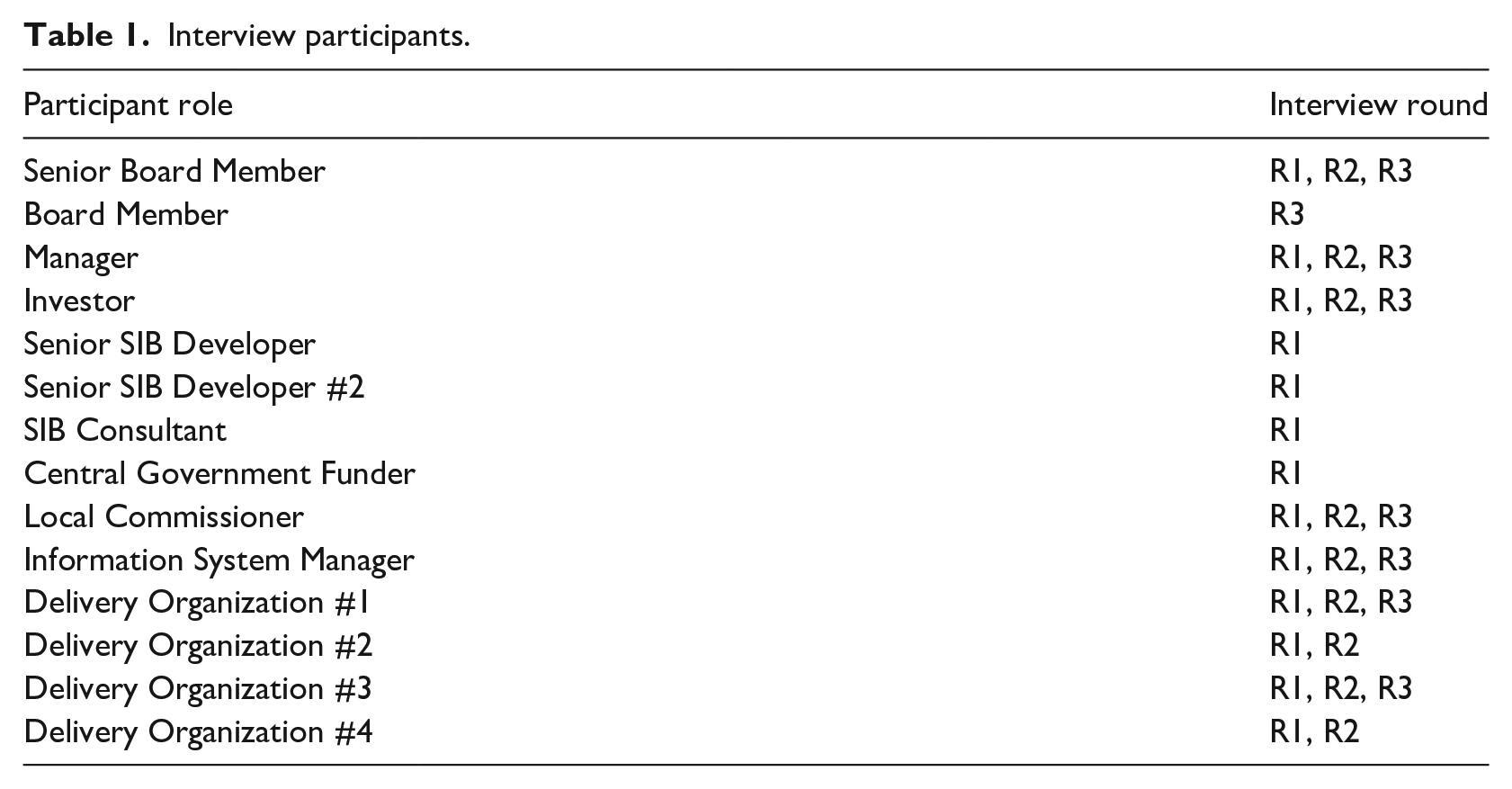
To answer our research question, we adopted a qualitative and temporally oriented research design. In 2015, we began the data collection process as the SIB was at its inception. At this point, we interviewed 12 of the key personnel involved in the setup and design of the SIB contract. By the second stage of interviews in 2016, the SIB had worked through its first year of operations and was in the process of ironing out initial but significant challenges. At this point we conducted a further nine interviews largely with the same individuals from the first round. Most of these interviews were again repeated in 2019 (30 interviews in total) allowing the research team to have a better longitudinal understanding of SIB dynamics and the actions of those “on the ground.” The overview of participants can be found in Table 1.
Interview participants.
The interview questions used developed incrementally as the research progressed through the different phases. The initial set of questions was relatively open with the intention of developing a broad history of the SIB, including key personnel involved and the history of this social intervention in the region. The interviews used in the second round of data collection were similarly open but did pick up on potential issues identified from the first interview round. For example, how data were being recorded on the management information system and interpreted to trigger payments. The final set of interviews took place when the SIB had reached operational stability and we were able to probe more specifically around key themes as well as some emerging theoretical notions. Given the design adopted, it was at this point of stability where we started to see transitions from NPM to PVM something not often picked up in prior studies on outcomes-based contracts.
Data analysis
We approached data analysis in an abductive manner (Gioia et al., 2013), going back and forth between inductive insights, theoretical principles, and further data collection. From the initial set of interviews, we were able to develop a historical understanding of Health SIB with some initial themes beginning to emerge at this stage, particularly pertaining to the long-term aims of the SIB. In the second and third rounds of interviews, we were able to probe around specific areas whilst leaving our interview guides sufficiently open to observe and understand what other dynamics and practices were emerging.
We approached the more formal data analysis by going back and forth systematically between the data and theoretical principles in NPM and PVM. Specifically, we noticed how our themes resonated with the work of O'Flynn (2007), including the sub-sets of and differences between NPM and PVM paradigms. Notably, the characterization, focus, managerial emphasis, public interest, performance objective, model of accountability and system of delivery. However, given the temporality in our data we were also able to observe if and how NPM and PVM practices shifted over time and their consequences, allowing us to address this aspect of our research question. The outcome of this data analysis is reflected in the data structure in Figure 1, whilst the following section follows this underlying structure.
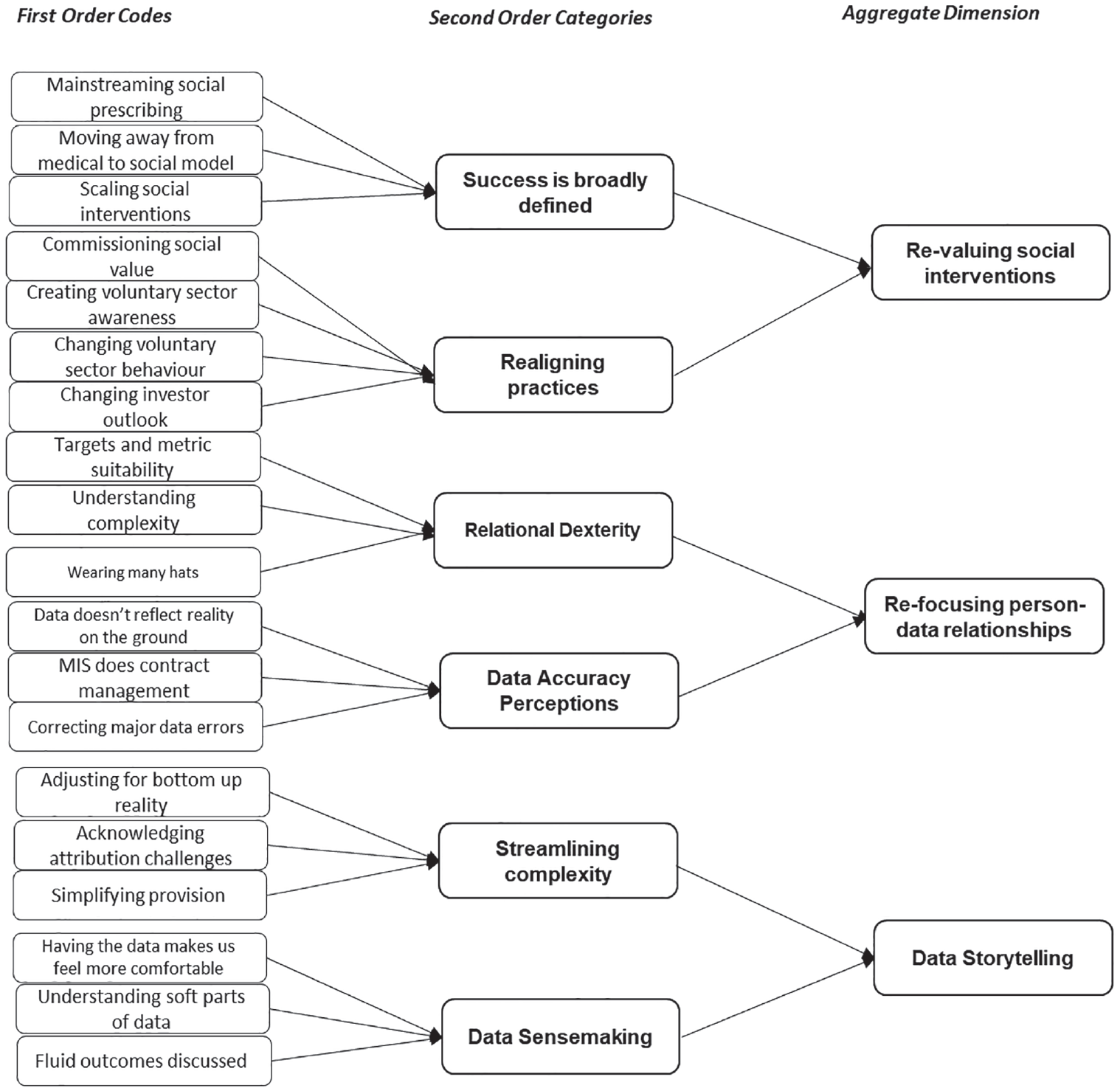
Data structure.
Findings
We found three interwoven practices concerning how key actors deliver public value in a New Public Management setting. Through revaluing social interventions, we observe how PVM principles were embedded in the long-term goals of the SIB with an emphasis on broad and collective objectives. Re-focusing person-data relationships, however, involves more significant changes from initial NPM principles to PVM practices around relationships and performance targets. Last, data storytelling also demonstrates how the accountability mechanisms in the SIB shifted even if the fundamental competitive ethos did not. This analysis and the link between NPM and PVM are highlighted in Table 2, with exemplar data evidenced in Table 3 and signposted throughout the findings.
Data analysis.
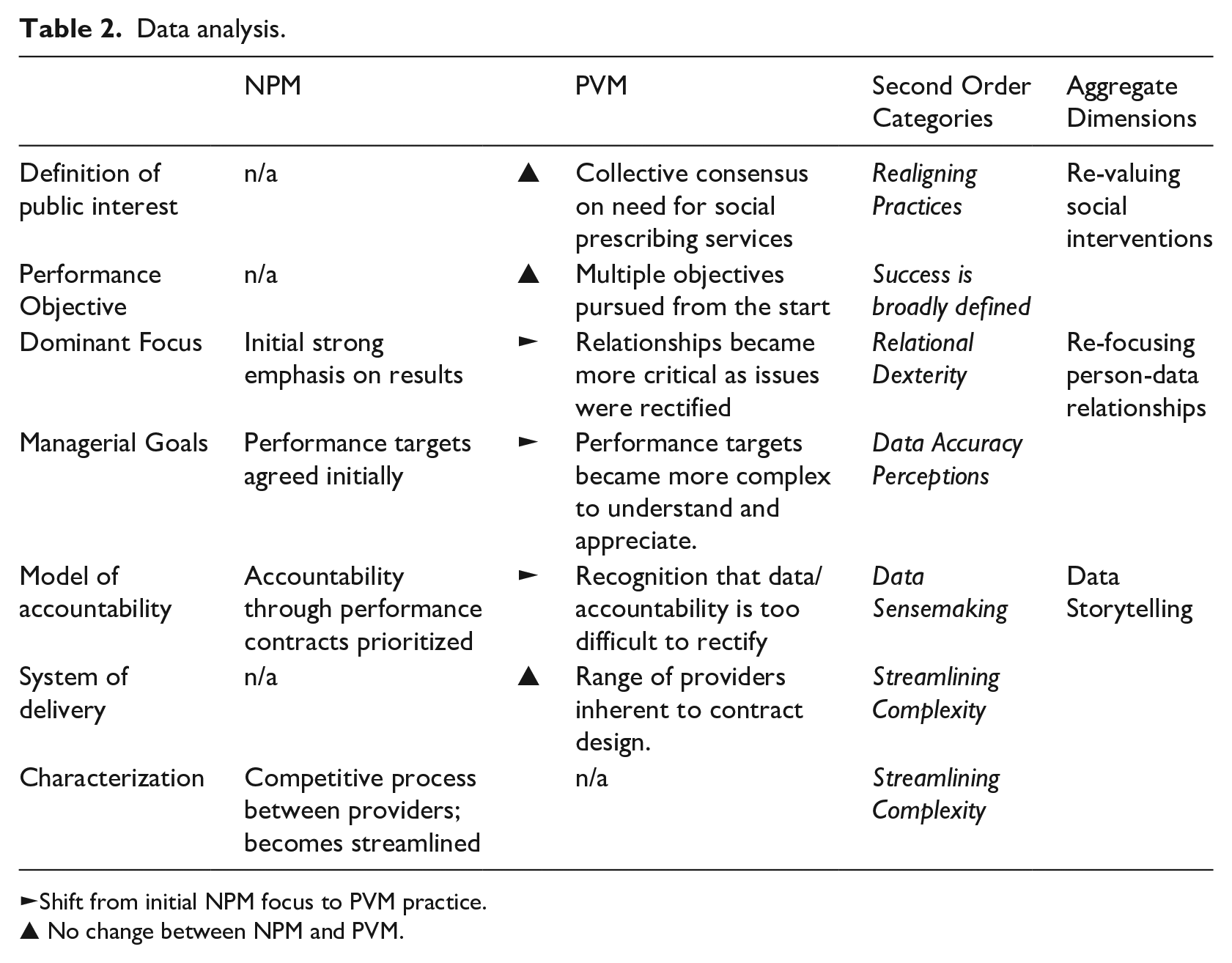
►Shift from initial NPM focus to PVM practice.
▲ No change between NPM and PVM.
Exemplar data.

Revaluing social interventions
In HealthSIB, the purpose of the investment was to shine a (positive) light on the impact of social prescribing as a model of managing long-term health conditions. This social model refers to social prescribing, which is a system whereby healthcare professionals can refer patients with long-term health conditions into non-clinical services that facilitate their well-being needs. But this is coupled with a need to realign organizational practices toward a point that such social prescribing health organizations can be adequately supported for this kind of work.
The notion of social prescribing is not necessarily a new one. One of the key SIB actors had been working on social prescribing projects in the city since the late 90s (Senior Board Member, R1). However, it had become apparent that the way they were being funded was insufficient to both make a more substantial difference locally but also to demonstrate the efficacy of such types of social interventions across the health system. One of the aims behind the SIB was that it would provide the evidential basis for the future funding and commissioning of social prescribing services but at scale. In this context, therefore, success is broadly defined with respect to immediate KPIs within the SIB alongside the longer-term view of demonstrating the value of such social interventions.
One of the challenges of funding such social interventions was the short-term (inconsistent) nature of the funding around it. Social prescribing had been funded through small grants for several years despite a collective growing set of evidence that it could have positive healthcare implications. Thus, one of the purposes of the SIB was to provide long-term funding that could allow the relevant organizations to plan but also demonstrate how powerful social prescribing could be when done at scale (Senior Board Member, R3).
Because success is broadly defined, the focus on such types of social interventions was part of a move to incorporate social prescribing into the NHS’ medical model of healthcare. The idea being that many of the costs the National Health Service incurs are mainly because of social factors such as poverty, isolation, lack of exercise, and so forth (Manager, R3). Therefore, the SIB has a clear operational purpose but should also be seen within the wider public interest so that such models of social prescribing are viewed as an important solution to solving critical long-term health conditions. Importantly, such an approach is viewed as a pro-active way of managing health conditions before they reach a more severe stage and may lead to a hospital admission.
Therefore, these broader performance objectives were aligned with the PVM principle of embedding multiple objectives such as outcomes but also trust and service legitimacy. Achieving this required a collective consensus and bottom-up understanding that this was desired by providers, funders, and citizens. However, achieving this also required some collective realignment in practices. Through the contractual arrangement of the SIB, service providers would now be more prepared to handle such contractual arrangements (Delivery Organization, R3) and the shift toward a new set of practices and skills within the organization also seemed to occur with the investors who had learned how to deal with the complexity of working within the NHS and particularly how not to do performance management (Senior Board Member, R3).
In summary, revaluing social interventions was an effort to define the success of the project in its broadest terms but also realign practices in a way that would allow the social interventions to thrive and manage such types of contracts more effectively in the future. Interestingly, revaluing social interventions seemed to be firmly rooted in the PVM paradigm from the outset. Key actors sought to broadly define success because there were multiple performance objectives at play. The need to meet outcomes was a means to an end and a way of “proving” the effectiveness of the intervention so that it would become more mainstream, trusted, and legitimate. In this respect, the SIB represents a form of pragmatism implemented with broader institutional change in mind. Further, realigning practices indicated the collective consensus for the need for this mainstreaming from providers and their beneficiaries, commissioners, and other key personnel.
Re-focusing person-data relationships
The nature of the SIB brought about relational challenges because of the tensions associated with making the financial model align with the complexities of delivering the social intervention. At the center of all these relationships was the special purpose vehicle manager. Their role involves interacting with four service providers who are contracted to deliver the social intervention, reporting to investors, commissioners, and the board. As such, there were different challenges across these relationships with varying interests in aspects of the work and the outcomes. One of the purposes of the special purpose vehicle was to act as a “shield” between the service providers and the investors/commissioners so that they were protected from some of the outcomes-focus in the SIB. The idea was that this would allow them to focus on key activities and supporting clients. However, this put the manager in a complicated position when managing relationships.
On one side, the manager was accountable to the investors and commissioners regarding the outcome metrics whilst simultaneously trying to understand why some KPIs were not being met. This would bring about difficult performance management conversations with the providers who started to consider the measures being used as “arbitrary” because of the variation in patients seen (Delivery Organization 1, R2) and that “context doesn’t come through into contract because a contract is a contract” (Delivery Organization 2, R2). This created a relational tightrope.
The result of trying to perform so many conflicting roles was a perception of focusing too much on the relationships with the providers rather than a focus on the underlying data (Manager, R2, R3), which became problematic to the investors who instigated a push to remove the manager from their position. However, in response, the manager decided it was important to have an open discussion about the challenges. This open discussion allowed them to get through the “stormy relationship” (Senior Board Member, R3), clarify the roles of key stakeholders and slowly lay the foundations for re-building trust. This reveals a shift away from an NPM orientation by re-focusing person-data relationships, namely: we label this element as relational dexterity. This is because it highlights the importance of handling relationships transparently to elicit trust rather than control, even under conditions of serious pressure and scrutiny from investors. Through relational dexterity, the actors experienced many conflicts in their roles, but the relationships were more fluid and trust-based once a phase of storming was overcome. Getting through this stormy process seemed particularly relevant to allow the SIB to forge ahead and be more functional.
The second aspect of re-focusing person-data relationships pertains to perceptions of data accuracy. The SIB is driven by two main performance metrics. First, the direct impact of the social prescribing intervention is measured through an accepted measure of well-being. Patients suffering from long-term health conditions are referred to the social prescribing program through their local doctor surgeries. At the beginning of the program, patients are scored on their well-being, and this is measured incrementally over time to observe patient progress. This measure is inherently tied to the second main performance metric, namely a reduction in hospital admissions. The logic is that when patient well-being increases then the number of hospital admissions will reduce. This creates savings for local health commissioners who make payments for reductions in the number of hospital admissions.
However, there were several issues concerning the collection and interpretation of this data that created serious pressures and tensions between service providers, the special purpose vehicle, and investors. This mainly stemmed from the observation that what was being recorded in the data management system poorly reflected the reality of working on the ground with patients (Delivery Organization 3, R2). At issue here was the disparity between the system being used to collect data which was designed primarily to support the management of the contract rather than the complex unpredictable nature of dealing with patients. Some providers found that the severity and range of co-morbidities was more complicated than could have been anticipated so the accuracy of the data in the system (patient well-being) was merely a crude reflection of aspects of the contract.
The issues with data accuracy were further highlighted with the second set of performance metrics around the reduction in hospital admissions. One of the main considerations in the SIB’s development was how it could be proven that the intervention was effective with the desire for a counterfactual to be able to show this. Thus, by comparing hospital admission rates in one part of the city where the intervention exists against another part of the city where it did not should have given the necessary data to highlight improvements. Through sheer fortune, it was discovered that the data driving the second performance metric had omitted some of its most significant data accidentally. One of the project partners, who provided hospital data to allow for the comparison between the control and the intervention group, had failed to provide the correct numbers (Manager, R3). This simple amendment suddenly made the entire operation much more financially viable but could easily have been missed. Moreover, the special purpose vehicle was also trying to cope with contamination of the data in its counterfactual after social prescribing interventions also started in that part of the city. This meant that key stakeholders within the SIB mechanism were constantly grappling with data accuracy and what type of reality the data reflected.
The common thread is an awareness that attributing the outcomes to the social prescribing intervention was always likely to pose challenges to re-payments within the SIB. But if the data were able to tell the right story, broadly speaking, expectations can be adjusted around the KPIs to reflect a collective understanding of operational reality. It is known already that the intervention “works” from the vast amount of existing evidence. So, what is important here is the performativity of the data, rather than getting to an attributable truth behind the numbers. As the commissioner pointed out regarding data: “I’m sure we’ll come up with some way of making it so that it doesn’t completely screw everything” (Commissioner, R2). In terms of governance and accountability, this indicates a departure from the classic SIB model.
In summary, our findings demonstrate significant shifts from the NPM paradigm at the SIB toward PVM practices. Specifically, relational dexterity demonstrates how initially a strong performance emphasis existed but that the quality of the relationship eventually took priority. Similarly, in data accuracy perceptions whilst managerial goals initially concerned the achievement of key targets, there was eventually a recognition that the data represented something broader, more collective, and positive.
Data storytelling
As an outcomes-based form of contracting, data are key to how SIBs function. Here, the data has a performative function that allows SIB actors to showcase the efficacy of the social interventions being funded; we label this as data storytelling. It is performative primarily because all actors acknowledge the difficulties with getting reliable data to prove the efficacy of the intervention that triggers the financial drivers of the SIB mechanism. In this sense, the SIB became simplified through streamlining complexity, by acknowledging attribution challenges and trying to forge relationships despite them, which is coupled with a data sensemaking process that involves constant re-interpretation of social intervention metrics and their meaning.
The first aspect of data storytelling involves streamlining complexity, which allowed actors to simplify aspects of the SIB considering the inevitable challenges of attribution and data. The findings overwhelmingly point to a complex picture, in terms of the SIB’s structure, the various accountabilities, power dynamics, data, and attribution challenges. Over time and because of the collective learning in the first 2 years of the contract, it became clear that some of this complexity could be streamlined to make it a simpler operation. The findings point to two key and interrelated moves to streamlining complexity, which involved a collective view of attribution challenges toward the social intervention and the ease of engaging with service providers in this endeavor.
One of the foremost criticisms of SIBs is that they work on the assumption that the outcomes of a particular social intervention can be attributed to the intervention itself; it is these outcomes that are the driver of payments in the SIB mechanism. Interestingly, in this SIB, these attribution challenges were widely acknowledged but rather than designing a different approach to funding ex-ante, it was just seen as something to acknowledge and incrementally manage. Therefore, despite the painstaking development work around the two main outcomes – wellbeing and hospital admissions – there was an acknowledgment that they are unlikely to tell the full story and that a more fluid approach to understanding the outcomes was needed that would involve adjusting for the bottom-up reality.
This attribution issue was exacerbated somewhat by the presence of four service provider organizations that were contracted to the special purpose vehicle. This was a relatively pragmatic approach to selecting a system of delivery in the sense that it involved four providers with significant local knowledge of social prescribing. But it was notably seen as more of a competitive rather than collaborative process which posed challenges to any potential for collective learning (Delivery Organization 3, R2; Senior Board Member, R3). Subsequently, it became clear that this part of the model may be too costly and inefficient and, after 2 years, only two of the providers renewed their contracts.
This streamlining of provision helped to simplify the model somewhat, yet it could be seen as an outcome of NPM market processes. As the provision was initially quite heterogenous, numerous interpretations could be made regarding the outcome data, making the performance management around it more challenging. Simultaneously, the model was adapted through adjustments to outcomes and payments that reflected how “real life happens” (Investor, R3) which was previously acknowledged as likely to be a challenge for an evolving initiative with attribution challenges.
The second aspect of data storytelling pertains to data sensemaking. The result of this was that all the SIB stakeholders were constantly engaged in a process of sensemaking the social intervention and hospital data. The SIB’s development was long and arduous, with a significant volume of hidden costs, partly because of the depth of research into the theory of change behind the social intervention and the accompanying financial modeling required for it to work within a SIB model. But this initial modeling was challenged when met with operational realities.
But the well-acknowledged attribution issues and complexities with data accuracy ensured that all stakeholders needed to collectively make sense of the data regularly. In the absence of this sensemaking exercise, where “softer” aspects of data (e.g. stories, anecdotes, and case studies) are considered and views aligned, it would likely lead to a break down in the SIB’s functioning. This continuous and iterative data sensemaking exercise was important because respondents highlighted that it made them feel more “comfortable” around attribution concerns of the social intervention (Manager, R3). Thus, the purpose of data sensemaking was so that there was a collective comfort that the intervention is, broadly speaking, functioning well. There is no concern around “proving” outcomes being met in an objective sense because there is tacit acknowledgment that this is conceptually challenging and a collective understanding that the social intervention is having a positive impact. Therefore, whilst the data were partly important to the SIB functioning, the sensemaking exercise attached to it was just as critical.
In summary, data storytelling is a function of changing accountability mechanisms and who is involved in delivering outcomes. Through data sensemaking, we observe a shift from NPM to PVM in terms of how key actors think about accountability and data. Streamlining complexity ties in with this data storytelling because of how it draws from a PVM system of delivery with multiple providers which also has more of a NPM characterization whereby these providers are competitors more than collaborators. Despite the fluctuations in the SIB, this seems to remain stable throughout its life course.
Discussion
In this paper, we ask: how do key actors articulate new practices to deliver public value in a New Public Management setting? Our findings highlight three interwoven aggregate themes of revaluing social interventions, re-focusing person-data relationships, and data storytelling. Following O'Flynn’s (2007) comparison of the NPM and PVM paradigms and evidenced in Table 2, our findings demonstrate how elements of a SIB at its inception are rooted in PVM principles, despite the widespread acceptance in the literature that SIBs are mainly a property of the NPM paradigm. In addition, our findings show that once the SIB is operational, the practices of the key actors tend toward PVM principles, mainly moving away from the NPM paradigm.
Revaluing social interventions demonstrated that through practice realignment and a broad definition of success, we see PVM principles guiding the long-term objectives of the SIB. Specifically, this ties in with defining public interest collectively alongside broad and multiple performance aims, pertaining not just to individual health outcomes but the proof of service concept at scale. We argue that this is likely critical to the NPM-PVM dynamics experienced throughout the rest of the SIB structure.
Specifically, our findings show that the relational (dominant focus) and performance (managerial goals) elements changed from an initial NPM focus toward PVM practice and a re-focusing of data-person relationships. Alongside changes to the overall model of accountability, this stemmed from the recognition that the functioning of the SIB required trust to emerge between the key actors as well a more nuanced understanding of the data that were driving performance management and the ensuing payments. Interestingly, the results show that the SIB remained a competitive process between service providers, yet its broader system of delivery was aligned with PVM values of drawing from a broad spectrum of service provision. This more streamlined process coupled with a renewed accountability mechanism represents a pragmatic approach and data storytelling that is central to public value management.
Theoretical contributions
The paper provides three key contributions. First, we contribute to the literature on public value through an examination of new relationships that exist between the state, firms, and society (Sancino et al., 2018), showing how key actors navigate, negotiate, and resist extant paradigms. In public administration, it is widely acknowledged that NPM has been the dominant mode of operation in recent decades despite the vast literature emphasizing the flaws of neo-liberal, market-oriented and managerialist thinking. Yet, it still looms large over current public administration dynamics despite the emergence of some alternative paradigms such as New Public Governance (Osborne, 2010) or Human Learning Systems (Lowe et al., 2021).
Despite SIBs being regarded as a product of the NPM paradigm, our findings can potentially explain how public services re-organize for an alternative approach in pursuit of public value. This re-organization was underpinned by the core objective of revaluing social interventions. At its inception, the financial aspect and management of the SIB were consistent with an outcomes-based contract aligned with NPM thinking. Yet, the definition of “public interest” and the “performance objective” were more closely aligned with broad, collective objectives (i.e. public value).
In this regard, whilst the financial model and contractual side of an outcomes-based contract may resonate with NPM, as this intersects with public value objectives set by the key actors involved, we started to see pushback against NPM in the operational phase. It was notable that SIBs were pragmatically viewed as just the latest funding mechanism, and it would be made to work regardless because of the driving public value aims. Our paper shows the fluidity between NPM and public values, specifically public value management (O'Flynn, 2007), and how key actors exert the agency to borrow from some parts of the NPM paradigm where appropriate (i.e. to attract investment) and yet reject it in favor of public values because it is not part of the longer-term systemic change that is really the focus.
This is an important contribution to the discussion on public value because it shows one mechanism through which public value is re-organized. Specifically, our paper demonstrates how bottom-up practices (legitimate service providers, key healthcare actors) at a local level clash against top-down (NPM) paradigms. Re-organizing for public value requires bottom-up actors to disrupt the institutional set-up (Lawrence and Suddaby, 2006), pragmatically drawing from old rules where appropriate with the intention of embedding a public value method for service delivery. Therefore, agency and local legitimacy would appear to be critical for how re-organizing for public value occurs, resonating with Boyte’s (2011) notion of “public work.”
This ties in with our second contribution which highlights the role of the state as a central actor in the generation of public value. Broadly speaking, “the state” creates the macro regulatory structures that enable a SIB to exist and the NPM logic in public administration still has a strong influence. Yet, “the state” agencies at a local level (e.g. NHS commissioners) facilitate a more pragmatic logic, allowing key actors to pursue a public value ethos. Because of the flaws of a transactional, competitive, and performance-emphasis the role of the state operationally is to be complementary to the efforts of other key actors; acknowledging that the SIB must be robust but that many of the requirements driven by NPM are not key to their support.
This is an important contribution to the discussion on the role of the state in creating public value because it demonstrates the “state” as a set of multiple interrelated government, non-government actors and entities that, through their practices, are “making sense together” (Hoppe, 1999, cited in Milward et al., 2016). Rather than passive recipients of institutional rules and regulations, our paper highlights that the role of the state is to facilitate legitimacy (i.e. the normalization of a health intervention in the National Health Service). This involves counteracting prevailing wisdom around NPM and SIBs as a by-product through public value management.
Third, we also contribute to the emerging discussion on outcomes-based contracts broadly and SIBs as a specific example of them. In particular, we respond to the call by FitzGerald et al. (2023) who suggest a need to understand how key actors in outcomes-based contracts influence institutions rather than being influenced by them. Our findings concur with their assessment that “they are not passive” participants of NPM rules. Instead, key actors re-organize the limitations of NPM toward public value. Whilst we do not take the institutional lens called for here, our findings are consistent with the notion that SIBs are providing a platform for institutional shifts across varying sectors.
Our longitudinal approach and appreciation of the historical regional context were critical in identifying these shifts. This also builds on the long-running debate within the literature concerning whether SIBs are a neo-liberal NPM tool or if some of their more collaborative and often long-term features are akin to new public governance (Albertson et al., 2020; Fraser et al., 2018; Joy and Shields, 2013). Our findings demonstrate that SIBs do challenge most but not all features of NPM, namely in terms of the SIB’s “characterization” and eventual shift toward a more efficient model. As Liddle (2018: 971) points out, however, “We can only understand what adds value in the public sphere by identifying long-term interests of future generations, rather than current practices.” Because new public governance focuses more on the “low politics of implementation” (Liddle, 2018: 981) it is less useful for thinking about public value in the long term.
In this regard, through a PVM lens, we can see how the SIB offers a platform for managers to pursue wide-ranging and long-term goals, acting collaboratively yet pragmatically and semi-politically across different constituencies to legitimize new sets of practices (O'Flynn, 2007), represented in this paper by revaluing social interventions. This pragmatic ethos has broader implications when we consider the governance of SIBs and outcomes-based contracts more broadly. Given the collective acknowledgment that attribution toward social outcomes is very challenging thus potentially undermining the flow of payments in a SIB, it raises questions about the governance of such initiatives. SIBs were originally designed on the premise that investors assumed the risk of an intervention based on a robust evaluation of social outcomes. As Economy et al. (2023) question, however, that SIBs may have departed from this original design and may now be more of a rhetorical device.
Therefore, perhaps a more fundamental and normative question is whether the actors involved should have to endure the long and costly setup of a SIB to achieve this. However, this may represent a form of modern pragmatism required to initiate institutional change and PVM offers a framework that pragmatically deals with the dynamics of implementation alongside these longer-term goals; PVM may be an important outcome of a long process of collaborative learning. In this respect, the “SIB effect” (Fraser et al., 2018) is a pragmatic element in the broader pursuit of public value beyond the actual life span of the SIB.
Practical implications
Implications for policy
Our paper highlights that the core features of SIBs have emerged from the NPM paradigm but “on the ground” key actors push to implement public value management principles. From a policy perspective, this suggests that much time and resource is wasted on crafting commissioning principles around NPM logics. In treating complex social problems in this manner, it is likely to reduce outcomes-based commissioning to a technical process of contracts and outcomes measurement. Our paper emphasizes that such commissioning approaches are a moving piece, understood by all involved that there is a public value imperative. Commissioning based on principles of trust and learning that emphasize public values is likely to be more fruitful (see e.g. Human Learning Systems, Lowe et al., 2021).
Implications for service delivery organizations
Organizations with a social purpose (charities, non-profits, social enterprises) are crucial to SIBs (Muñoz and Kimmitt, 2019) since they are responsible for canalizing investment into the delivery of social interventions, producing outcomes, and igniting social change. This, whilst collecting the necessary evidence to prove the latter have been achieved and trigger (or not) the repayments to investors. As such, they are continuously under pressure to develop and deploy a wide range of activities, most of which are peripheral to its core business, that is, delivering public value.
As organizations deviate from their core business, they risk falling into a downward spiral, characterized by practice drift and a reorientation of capabilities, both likely inconsistent with their values. In the same vein, the scope of attention is likely to change from attending to their beneficiaries to overemphasizing data collection and achieving outcomes not necessarily defined by them nor aligned with the beneficiaries’ needs (Lowe and Wilson, 2017). This logic from the literature is driven by critiques of NPM; our paper emphasizes that these flaws are real and experienced by delivery organizations, yet they can be amended according to public values.
Implications for social investors
Private investment is at the center of a SIB, but the outlined challenges of such contracts have ramifications for social investors. First, in several reported SIB cases, investors are often reported as having a relatively negative influence because they exert a significant amount of control as to the design, implementation, and performance management of SIBs. Thus, social investors must be cognizant of the potential reputational risk stemming from involvement in SIBs, particularly if so much can be re-negotiated. The nature of SIB contracts is such that they are dynamic and often re-negotiated mid-contract as the reality of attribution problems bite. Thus, initial high transaction costs (that exist for all parties) can also continue during service delivery because such contracts are inherently incomplete (Burand, 2020). Last, and relatedly, the evaluation of a SIB contract from an investor point of view may differ markedly from how we understand social investment to currently operate (Scarlata et al., 2017). Because transaction costs are typically so onerous it may require social investors to assess the bigger picture of the development of a social investment market where many more financial instruments are likely to develop in the coming years. These instruments are likely to resemble features of SIBs and other forms of outcomes-based commissioning.
Limitations and future research
We are also mindful of its limitations which also provide opportunities for further research. The paper is bounded by its focus on a single SIB within the UK context. But SIBs are now emerging throughout the world (e.g. Development Impact Bonds), where certain aspects of the environment may be less complex to the extent that the existing public value or NPM principles may be more challenging to identify. And in the absence of alternative service provision in some countries, SIBs may even offer a preferred solution there. However, the organizational principles may likely emerge from other institutional sources in combination with the regulatory regime of that country. As outcomes-based commissioning continues to expand around the world, we will need to explore these at a similar level of micro detail as in this paper.
Conclusion
In this paper, we sought to understand how key actors articulate new practices to deliver public value in a New Public Management setting. Based on a longitudinal case study of a SIB in the UK, we demonstrated how NPM is crucial to SIB emergence and design but in its operational phase, key actors re-organize for public value through principles of public value management. This allows public value to emerge despite the NPM backdrop. We suggest that when public interest and performance objectives are initially defined by public value principles then this could eventually override the existence of NPM practices elsewhere. This paper offers a glimpse into how NPM still hangs over public administration but also how it is re-organized for public value.
Footnotes
Funding
The author(s) received no financial support for the research, authorship, and/or publication of this article.

Notes
Author biographies
Jonathan Kimmitt is a Professor of Entrepreneurship in the Department of Management and Marketing at Durham University Business School, UK. His research focuses on entrepreneurship, social investment, and poverty, as well as social entrepreneurship and microfinance.
Pablo Muñoz is a Professor of Entrepreneurship at Durham University Business School (UK), Visiting Professor at Universidad del Desarrollo (Chile) and IE Business School (Spain) and Editor-in-Chief of the Journal of Business Venturing Insights.