




Abstract
Hiring is an act of evaluation that comes with much organizational and social responsibility, making it a morally sensitive situation. The way employee gatekeepers come to terms with their selections presents itself as an exemplary case to study the moral dimension of organizational life. Relying on a pragmatist perspective and an economies of worth framework, this article uncovers how employers experience moral uncertainty and justify their choices. Through a comparison of gatekeeping in two employment fields, this study covers new ground on how decision logics and regimes of valuation play out and can be structurally conditioned. Through in-depth interviews, combined with a ranking exercise based on video-elicitation, with recruiters and hiring managers from the corporate (n: 23) and cultural (n: 17) fields in the Netherlands, this paper explores how evaluation processes and selections are justified. The interviews show that a sense of moral unease is common among gatekeepers, but much more prevalent among corporate rather than cultural gatekeepers. Larger organizational size, high market pressure and lower supply of candidates does not translate into moral sterility for corporate gatekeepers. Second, the study reveals that a connexionist logic enters as a powerful justificatory regime, transforming candidate selection procedures into test of confession.
Introduction
To become an employee, one usually must pass the test of a job interview. This is a critical moment which is orchestrated and executed by employee gatekeepers. They are gatekeepers in the sense that they guard the access to organizational resources, such an income, network, or status, in the form of an employment contract. It refers to the organizational actors, usually in the role of hiring managers, recruiters, or other Human Resource Management professionals, who are responsible for screening candidates, conducting interviews, and eventually making hiring decisions. These are complex evaluative acts that requires expertise in reading multiple parameters and an ability to judge the relative importance of different sets of values (e.g. productivity, fit, fairness). Although hiring is a pivotal moment in organizational life, it is surprising how little systematic knowledge is gathered on the way employee gatekeepers themselves deal with this situation. Moreover, hiring decisions are morally charged and open up questions of legitimacy as they directly influence the life trajectories of individuals, while simultaneously co-determining organizational success.
This study takes as a premise that morality is not established from the onset; it emerges from deeming “right and wrong” as an act of evaluation in specific situations. We are evaluative beings that continuously assess the worth of things, people, and situations around us (Boltanski and Thévenot, 2000, 2006; Lamont, 2012; Tavory, 2011). Consequently, our social lives are inevitably marked by a perpetual uncertainty about how “just” our evaluations are. This paper takes this moral unease (i.e. a sense of uncertainty about the impact of one’s evaluations) and demand of justification as a point of departure to study, from a pragmatic angle, how morality plays out in the context of hiring. By investigating how moral worries have organizational consequences, it answers to the call of Boltanski and Thévenot (2000) to not “ignore the concern for the good that persons are moved by” (p. 208).
By focusing on the case of hiring, this study aims to deepen our understanding of how a concern for moral legitimacy is (1) organizationally embedded and (2) eventually shapes the act of evaluation. The objective is to explore how gatekeepers are testing (i.e. assessing the legitimacy) their own test (i.e. evaluating job candidates), by examining, in a comparative manner, how hiring managers and recruiters are making sense of their own selections. Three integrated questions are being tackled: (Q1) How do employee gatekeepers interpret the moral aspect of evaluating people? (Q2) How do they justify their rejections and selections? and (Q3) How is this influenced by varying organizational contexts?
To empirically investigate how justification logics are working “on the ground” (Pernkopf-Konhäusner, 2014), in-depth interviews were done with 40 hiring managers and recruiters from Dutch corporate and cultural organizations. In order to get a step closer to the practice of hiring, this study opted for a novel research method that combines in-depth interviewing with a ranking game of candidates based on video-elicitation. Additionally, the study brings in a comparative approach, cultural versus corporate employment sector, as a heuristic leverage to explore how varying settings enable and constrain different gatekeeping evaluations (Lamont, 2012).
The article starts with describing how organizational legitimacy can be understood from a pragmatic “regime of valuation” framework and its emphasis on tests (Boltanski and Thévenot, 2000, 2006). Next, we concentrate on the situation of employee gatekeepers and the moral unease they potentially encounter. Then, before describing the sampling strategy, relying on organizational survey data, and research methods, the theoretical framework is concluded with specifying how justification plays out in the economic sphere and how a connexionist regime has taken center stage over the last decades (Boltanski and Chiapello, 2005). The latter regime of valuation envisages the social world as a network, whereby legitimate success entails completing a series of projects through which individuals not only connects with others but also realize and develop themselves. Finally, the results section consists out of two parts. The first part describes the way gatekeepers in this sample experience and cope with moral unease. In the second part, happiness, passion, and authenticity are identified as central elements of gatekeeping justification and demonstrates how this turns the job selection procedure into a confessional test.
A concern for justice
How to understand the moral dimension of organizational decisions? To situate the pragmatic answer to this question, informed by the work of Boltanski and colleagues (for overview see Jagd, 2011), it is helpful to contrast it to the more dominant (neo-)institutionalist approaches (Brunsson, 1993; Friedland and Alford, 1991; Meyer and Rowan, 1977; DiMaggio and Powell, 1983). According to the latter, organizational actors are rarely chasing organizational objectives in the most efficient manner but rationality more often serves as a veneer, painted over organizational decisions. Instead of improving their efficiency, it is argued that the survival of organizations depends more on acquiring legitimacy (Brunsson, 1993). Organizations should be understood as symbolic systems, driven by norms, scripts and cultural myths, adopted (by pressure or mimicking) from their surrounding (through governmental regulation, professional standards, accreditation agencies, industry rankings, etc.) in order to survive (Meyer and Rowan, 1977). Consequently, from this perspective, moral legitimacy is acquired through aligning with the institutional environment and the focus lies on organizational stability, conformity and homogeneity.
Although it shares a strong interest in the cultural foundations of legitimacy, the pragmatist perspective also departs from institutional theories as it prioritizes a more processual approach that sees organizational legitimacy as stemming from a need for justification (Jagd, 2011; Reinecke et al., 2017). Actors do not simply obey institutional rules or logics but have the critical capacity to judge and are moved by a demand to “satisfy the concern of justice” (Boltanski and Thévenot, 2000: 210). This view urges us to see “actors as being thrown into situations” (Jagd, 2011: 345) that are marked by ambiguity and uncertainty. Instead of passively following organizational scripts, organizational actors need to navigate themselves through multiple disputes, coordination issues and inconsistencies (Pernkopf-Konhäusner, 2014). As McPherson and Sauder (2013) convincingly demonstrated in the case of legal decisions within a drug court or Demers and Gond (2020) showed for the example of employees of an oil sand company, that in order to deal with organizational complexities, actors have to continuously negotiate their judgments based on varying regimes of valuations.
This is not only because, within any given situation, different logics can circulate simultaneously but also because actors are usually confronted with multiple audiences and stakeholders that introduce contradicting demands (Friedland and Alford, 1991). To get a grasp on this multiplicity, Boltanski and Thévenot (2006) proposed a framework that makes a distinction between different regimes of valuation or, also called, economies of worth. These regimes of valuation offer shared moral grammars to make sense of situations, solve disputes, and attribute value. Within an organizational context, these regimes can be mobilized by actors to facilitate coordination and collaboration. The study of Cloutier and Langley (2017), for example, shows how partnerships between non-profit organizations and funders, who often have opposing goals and self-definitions, are being maintained because their actors are continuously negotiating the overarching moral purpose (i.e. higher objective) of their relationship. Important here is that the partners do not have to agree on one purpose, but that organization arrive at collaboration by compromising and juxtaposing multiple economies of worth. Although, moral alignment can strengthen coordination, organizational bonds are also marked by negotiation and reconciliation. Hence, from a pragmatist stance, as Reinecke et al. (2017) also point out, legitimation is not seen as a binary variable (you either have it or not) but emerges out of solving unease or uncertainty and countering critique while catering to multiple evaluative audiences.
A desire to solve moral unease through justification should not, as Boltanski and Thévenot (2000, 2006) repeatedly argue, be seen as an act to simply protect some (organizational) self-interests, but comes out of the need to reach agreement (i.e. imperative of justification) among actors by referring to varying principles that are deemed valid within a particular situation (i.e. situated sense of the just). This stands in contrast to institutionalist approach of Brunsson (1993), according to whom there are only two strategies actors fall back on to align their actions with their beliefs. One is through justification, which entails defending accomplished actions by convincing others that they followed the appropriate logics, rules and motivations. The second strategy does not focus on controlling or defending actions, but on hiding and compensating. In the latter case, people use hypocrisy by producing ideas which are inconsistent with their actions. Yet, in both instances actions and ideas are reconciled post-hoc, by instrumentally deploying (opportunistic) strategies. Boltanski and Thévenot, however, avoid such a “hermeneutics of suspicion” (Ricoeur, 1974) while seeing justification and action much more as an integrated whole. “People do not” they argue “ordinarily seek to invent false pretexts after the fact so as to cover up some secret motive, the way one comes up with an alibi; rather, they seek to carry out their actions in such a way that these can withstand the test of justifications” (Boltanski and Thévenot, 2006: 37, italics added). Consequently, the social meaning of justification cannot be understood independently from the notion of test.
Unease about the test of hiring
Reconciling conflicts, establishing coordination and making decisions demand tests to assess whether the worth that is being attributed (to actions, ideas or persons) is appropriate, given a regime of valuation deemed valid. Yet, for a test to be successful it needs to, according to Boltanski and Chiapello (2005) and Boltanski and Thévenot (2000, 2006), be able to withstand two types of critiques: (1) questioning whether the evaluation is done correctly and in line with the agreed upon criteria and (2) assessing whether the criteria used are actually suitable to the situation. The first critique is only corrective in that it does not dismiss the test itself but focusses on its execution. The second critique pertains to the situated sense of the just, questioning which regime of valuation (and that criteria of evaluation that follow from it) is valid. This dual demand of justification eventually also shapes the sense of moral uneased experienced by employee gatekeepers.
Now, employee gatekeepers can be seen as extra exposed to this dual demand, leading them to continuously test their own test. Hiring is a moment in which the worth or value of a person for an organization is being evaluated and assessed (Imdorf, 2010). This entails not only a test of selecting the right candidate but also of whether the criteria used to do so are deemed appropriate. There are three aspects that makes employee gatekeepers’ tests particularly sensitive to this double critique: social responsibility, subjective decision taking and organized distrust.
First, to acquire moral legitimacy, organizational actors do not only aim to reach an agreement with their fellow organizational members but also with external stakeholders or even society at large (Friedland and Alford, 1991; Reinecke et al., 2017). In the case of hiring, the pressure of external audiences is always acute because selecting implies rejecting. Not accepting a candidate has an immediate effect on that persons’ life trajectory as it entails a denial of status and resources, pushing ethical concerns of fairness, legitimacy, and inclusion to the forefront (Lefkowitz and Lowman, 2017; Weaver and Treviño, 2001). Especially because creating equal labor opportunities has become central to our understanding of social equality and inclusion (Dobbin, 2009). Therefore, making hiring decisions can be accompanied by a sense of social responsibility.
Second, in-depth research consistently points toward a manifest tension between objective selection criteria and subjective decision taking, which seems to strongly mark gatekeeping evaluation and decision logics (Brown and Hesketh, 2004; De Keere, 2022; Imdorf, 2010; Moss and Tilly, 2001; Rivera, 2016). Employee gatekeepers not only assess the hard currencies of employability, such as credentials, experience or skills, but above all evaluate the suitability and personality of the candidates. This turns employee selection into an intuitive game of signaling, sensitive to cultural matching, social closure and discrimination, which stands into stark contrast to the extra-organizational demand for fairness and transparency (De Keere, 2022). Potentially, the lack of clear consensus on what type of competences are being tested, offers room to both intuition and emotion to enter as legitimate evaluative criteria (for similar argument see Imdorf, 2010).
A third aspect of hiring that amplifies the demand for justification lies in the nature of the job interview as being simultaneously a co-operative and competitive endeavor (Bangerter et al., 2012). The candidate is the most important source of information, but simultaneously the most unreliable as they are only involved in protecting their own interest (i.e. getting the job). This conflict of interest puts the gatekeeper into a state of organized distrust, constantly forced to pierce through the social desirable while trying to establish an interpersonal dialog with the candidates (Roberts and Campbell, 2007). This balancing act—between trust and distrust—places employee gatekeeper in an uncertain situation, forcing them to question the foundations of their test.
In sum, because it entails addressing multiple audiences, while being in a situation of organized uncertainty marked by ambiguity of criteria, the task of employee gatekeepers produces moral unease and a double critique on the legitimacy of their decisions. In other words, employee gatekeepers need to put their test to the test, continuously pushing them in and out a state of moral unease. So, which regimes of justification offer them relief? This depends on how work is being valued.
The value of work
When evaluating others, a range of possible evaluation criteria are conceivable. Yet, this does not mean that they will be perceived as justifiable in all situations. For example, selecting someone on their sex appeal might be acceptable when it concerns choosing a romantic partner, but is ethically much more dubious in the case of hiring a new employee. Hence, other regimes of valuation are expected to be activated in the professional realm of organizations than in, for instance, the domestic world.
In their original formulation, Boltanski and Thévenot (2006) distinguished six different regimes with corresponding logics of evaluation: domestic (based on respect), inspired (based on singularity), opinion (based on fame), civic (based on collective welfare), industrial (based on productivity) and market (based on profit) logic. In respect to the economic sphere, the latter two—market and industrial—logics are usually brought into play when people are faced with coordinating and justifying actions and decisions. Hence, when having to justify the legitimacy of their selection, employee gatekeepers are likely to fall back on either industrial or market arguments.
Later, Boltanski and Chiapello (2005), described the emergence of a new order of worth, namely the connexionist regime, strongly entrenched into our current economic structure. Supported by an analysis of management literature, they argued how, from the 1960s onward, the classical economic notions of bureaucratic efficiency (industrial) and profit accumulation (market) were caught up in a legitimacy crisis due to a mounting cultural critique on the way its production forces alienated and dehumanized the workforce. This critique eventually produced a new logic that re-imagined the economic world as consisting out of a series of projects executed by a network of autonomous people. Within this world, one is admirable if one is independent yet capable of making connections and building a personal network, turning self-realization into “a superior form of achievement” (Boltanski and Chiapello, 2005: 379). A management regime that subscribes to this logic celebrates, together with the ability to connect, the values of self-development, expression, and flexibility. Consequently, employers and employees need to believe that work is not merely a vehicle for profit or productivity, but a way to satisfy passions (see also Rao and Tobias Neely, 2019) and authentic individuality (see also De Keere, 2014; Rose, 1989).
In sum, if the test of hiring is so sensitive to critiques and the connextionist logic is, together with industrial and market logic, a dominant regime of valuation in the world of work how does this (Q1) effect the way employee gatekeepers interpret their moral unease when selecting and rejecting candidates, (Q2) influence the way they justify their decisions and (Q3) vary depending on organizational contexts? To tackle these questions empirically, a trained research assistant and myself interviewed employee gatekeepers while evaluating hypothetical candidates based on video clips.
Research design
Comparative study
In total 40 human resource managers and recruiters were interviewed (see Table 1 for overview). They were included in the selection if they conduct at least five job selection procedures on a yearly basis. To arrive at a meaningful comparison, respondents were recruited from two very different employment sectors, characterized by different organizational conditions. One group (n: 17) work as HR managers, responsible for hiring for cultural institutions such as museums, concert halls or theaters. These were recruited by contacting 70 large cultural organizations in the Dutch Randstad region and requesting meetings with those who are responsible for the hiring procedures. A second group (n: 23) are involved in hiring for corporate organizations with a focus on banks, insurance and multinational companies in the same Randstad region. These respondents were primarily recruited through a Boolean search (based on “recruiter,” “hiring manager,” “talent acquisition,” “banking,” “insurance,” “accounting,” “consulting”) on LinkedIn and randomly selected by writing to all potential respondents that appeared on the top of the list until we arrived at 25 participants (two interviews eventually did not make it into the selection due to logistic reasons).
Overview of respondents.
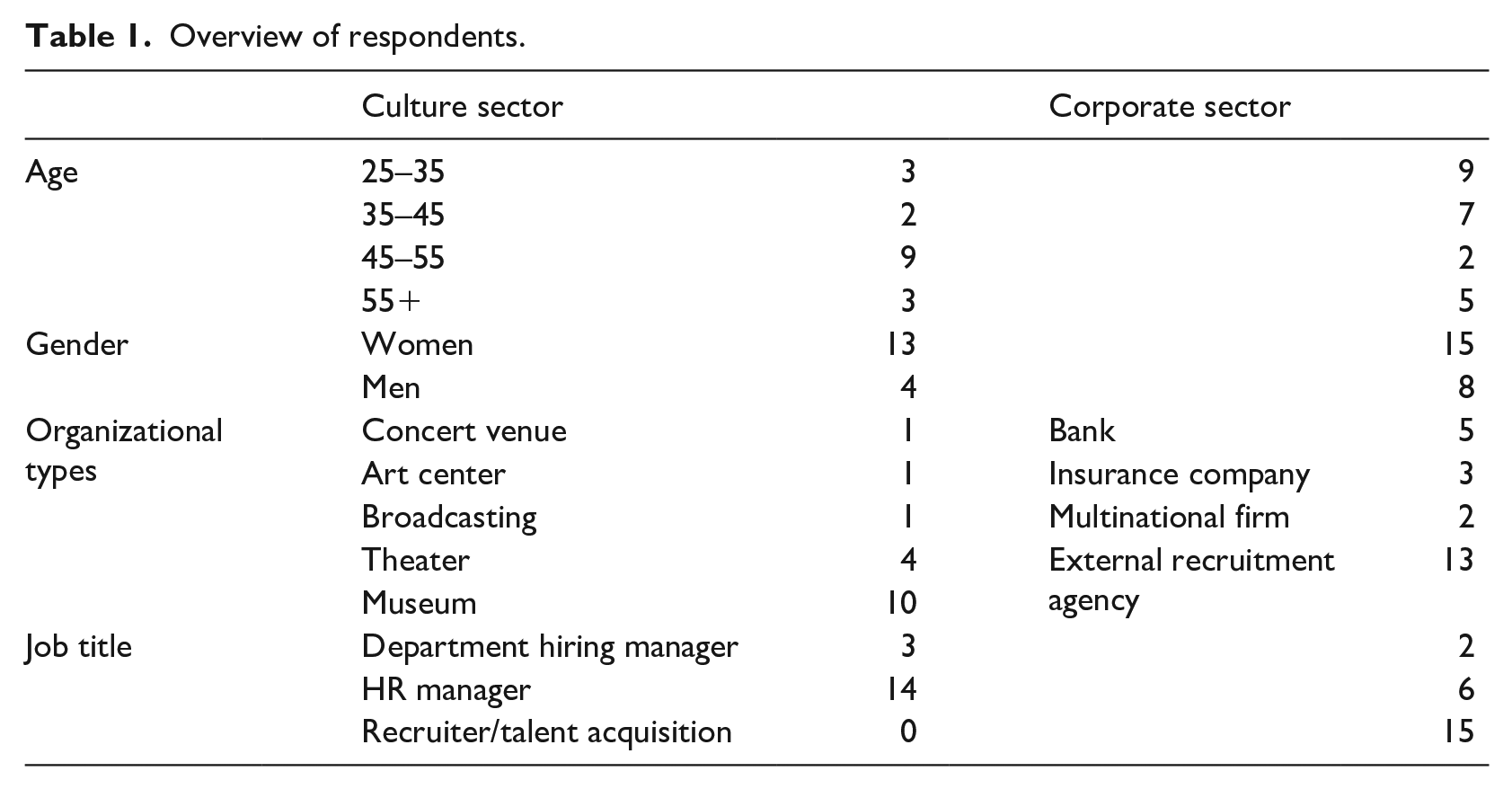
These two employment sectors are chosen for specific heuristic reasons, both related to their commonalities as well as differences. The employee selection process are comparable in the sense that they, at least partly, select on similar types of higher educated workforce such as project managers, accountants, PR coordinators or data officers. Hence, the managers and recruiters here interviewed, usually hire for professional functions that demand at least a college degree and belong to lower management or the upper ranks of technicians. The two employment sectors are also similar in the way the roles of the gatekeepers are defined. Based in large corporate companies as well as in cultural organizations, the hiring managers do not actually hold the resources of the organizations they recruit for (in contrast to, e.g. small business owners). On top of that, all organizations in the sample share the condition that they need to abide by Dutch labor legislation. The Netherlands established strict regulations in order to minimize possibility of discrimination and exclusion during job selection procedures. Questions on personal background, health issues, religion or political affiliation are strictly prohibited during the job interview.
Varying organizational conditions
The heuristic power of this comparison lies in three main differences that characterize these employee sectors: size, supply and demand, and market pressure. These sectorial differences can be demonstrated through descriptive statistics stemming from the Labour Survey Panel (AVP, Arbeidsvraagpanel) of 2017, a survey organized by the Dutch Bureau for Social and Cultural Planning Analysis (Echtelt et al., 2019) and conducted among a sample of 3000 employment organizations. For this description all corporate (N:106) and cultural (N:39) organizations, as defined above, were extracted from the databank. The people interviewed for this survey were HR managers, CEO’s, directors and owners. Due to anonymity reasons, there is no way of ascertaining whether the people interviewed here or their organizations participated in the AVP. Yet, the survey does provide us with important insight in the varying organizational conditions that potentially shape gatekeepers’ sense of unease (for overview see Table 2).
Overview of AVP indicators.
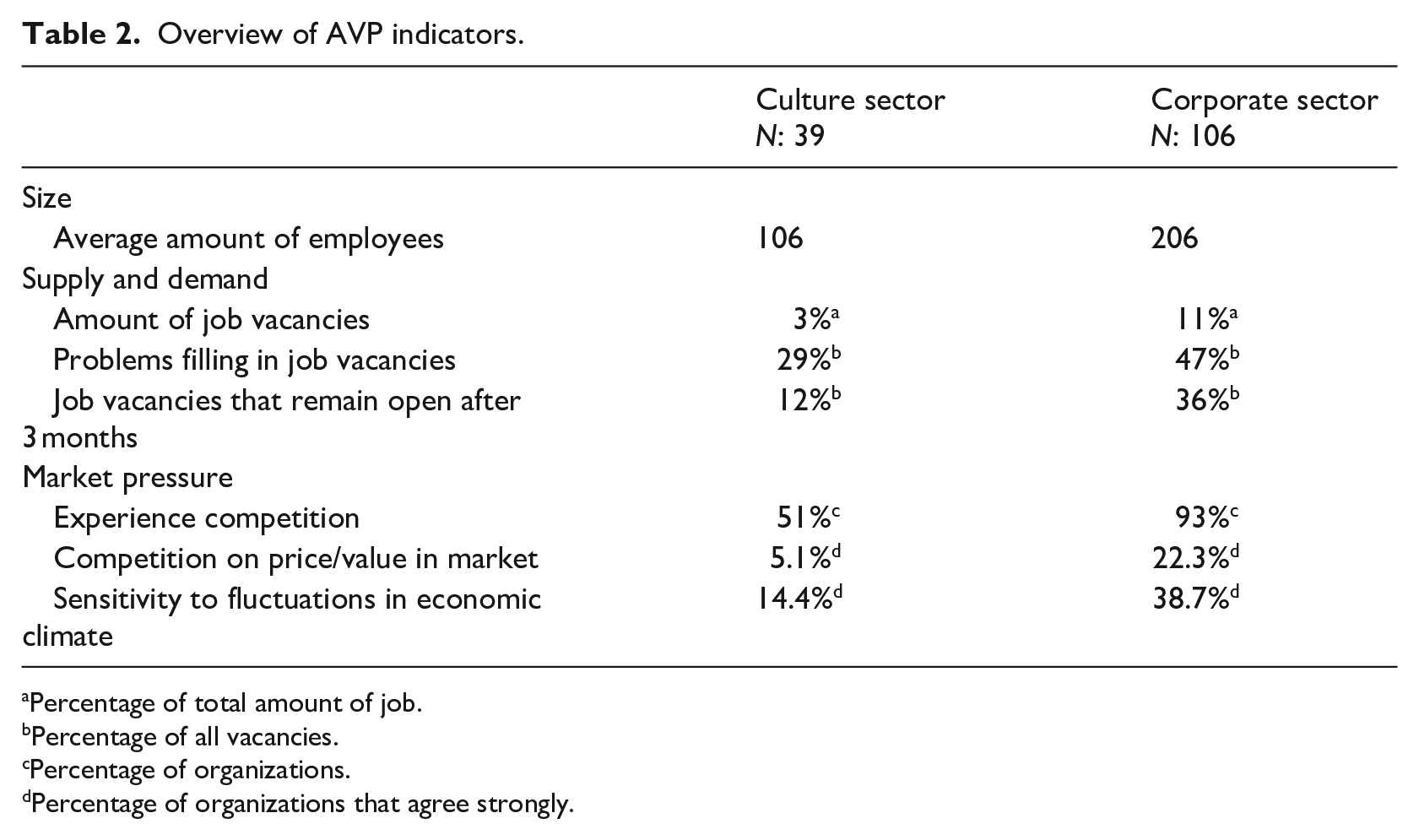
Percentage of total amount of job.
Percentage of all vacancies.
Percentage of organizations.
Percentage of organizations that agree strongly.
First, there is a stark difference in organizational size between the two employment sectors. On average corporate organizations are roughly double the size of cultural ones and the largest cultural organization is only one-tenth of the largest corporate organization in the AVP sample (roughly 4000 employees). Consequently, corporate organizations usually have the possibility to set-up specialized departments that exclusively focus on talent acquisition and hiring. Cultural organizations, on the other hand, usually do not have such fine-grained division of labor; here HR managers often combine hiring with other personnel tasks. Generally, larger organizations have more transparent procedures because of their higher degrees of reutilization and formalization (de Kok and Uhlaner, 2001). In contrast to the cultural sector, all corporate gatekeepers in this sample regularly used screening instruments such as assessment games or personality- and intelligence tests.
Second, it appears easier for cultural gatekeepers to recruit candidates than for corporate organizations. Comparing the two sectors, it seems that supply and demand ratio of candidates and vacancies are practically reversed, which, as the literature indicates has an effect on hiring procedures (for overview see Bills et al., 2017). The AVP data reveals that corporate organizations have much more job openings (as compared to the total amount of employees), experience problems with filling in almost half of their vacancies and after 3 months find more than one-third of the job functions still open (see Table 2). Because these employee recruitment challenges, corporate organizations often rely on external agencies to find the necessary workforce. For this reason, our sample includes, in-house recruiting staff as well as recruiters who are on the pay-role of external employment agencies (n: 13).
Finally, both sectors vary substantially in the amount of market pressure and competition, which can have a direct impact on organizational decision taking. Butterfield et al.’s (2000) experimental study of business professionals, for instance, revealed that, next to the way ethical issues are framed within the organization and the magnitude of their consequences, also the perceived level of competition can have an inhibiting effect on moral awareness (see also Gioia, 1992). In this regard, corporate organization are primarily profit-oriented and more dependent on market dynamics while the cultural employers are usually heavily subsidized. Consequently, cultural organizations are (at least partly) more shielded from market demands. Similarly, the AVP reveals that managers from corporate organizations indicate that they experience stronger competition and that their organizations are more sensitive to market fluctuations than their cultural counterpart (see Table 2).
Investigating justification
Studying moral unease and justification comes with specific methodological challenges. In contrast to a classical value-norm perspective that understands morality as consisting out behavior-guiding principles, the pragmatic approach sees moral reflection and justifications as arising out of situated action and decision-taking. This means that values do not belong to “a unified or static system,” but people actively make sense of the themselves and evaluate others in “a shifting and contested arena that multiple audiences may define differently” (Tavory, 2011: 274).
To cater to this view, we did not opt for a traditional interview set-up—limited to only discursive questioning—but instead combine in-depth interviewing with a ranking and selection exercise. A method that is sensitive to both talking and choosing. So, besides interviewing our respondents about their protocols and experiences, we also showed them 3-minute video résumés of eight fictive applicants and asked them to make a top-3 of candidates they would invite for an interview. When people have to verbalize how they rank and organize others, tensions and discomforts arise, demanding justification (Boltanski and Thévenot, 1983).
Although video-based research methods are still relatively rare in organizational studies, they have become increasingly more common over the last decade (Christianson, 2018). In contrast to more traditional research methods (e.g. interviewing, surveys and experiments), video material allows us to study the impact of interactions, spatial relations and non-verbal cues more immediately (Erickson, 2011). In most cases, audio-visual material enters as research data: recordings of interactions, events or situations are then being analyzed through meticulous coding (for overview see Christianson, 2018). There are, however, few thought provoking organizational studies that have also included video material to elicit reactions among participants. This has mostly happened within experimental settings whereby researchers measured how participants reacted to a series of clips. In this way it was, for example, investigated how MBA students evaluate passion (Chen et al., 2009), (dis)harmony effects creative thinking (Chua, 2013) or funding decisions can be influenced by “crowd biases” (Stevenson et al., 2019). But video-based elicitation can also break out of this experimental setting. In a study on hospital care practices, Iedema and Rhodes (2010) had hospital workers view recordings of their own activities to provoke and study their reflective thinking, showing the value of combining in-depth interviewing with video-elicitation.
The interviews
The interviews consisted out of three parts and were conducted by myself and a trained research assistant. In the introduction, respondents described their career trajectory, their selection protocols (from vacancy to hiring) and how they see the interview phase within the total hiring process. During the second part, the eight video C.V.’s were presented to the candidates. They were asked to evaluate each candidate separately and then make a ranking of their top-3 candidates they would invite to an interview. When evaluating candidates the respondents were encouraged to imagine a job function they regularly recruit for. Prior to this, we also explained that all candidates were starters on the labor market, canceling out the importance of work experience. In the final part of the interview, the participants could reflect on their decisions and how this exercise corresponded with their everyday work experience.
The eight actors in the video C.V.’s were given scripts and specific acting instructions, making the videos vary in terms of self-presentation (personal/professional), extra-curricular activities (sports/cultural hobbies) and gender (men/women). The scripts were sufficiently unique to appear realistic yet general enough to be applicable to both employment sectors (see appendix). The candidates in the videos made reference to wide plethora of values such as ambition, authenticity, discipline, family, perseverance, independence or self-expression. They functioned as sensitizing cues gatekeepers could potentially draw on. How the gatekeepers evaluated and ordered the variations in presentation styles and scripts will not be addressed here but was analyzed in another study (De Keere, 2022).
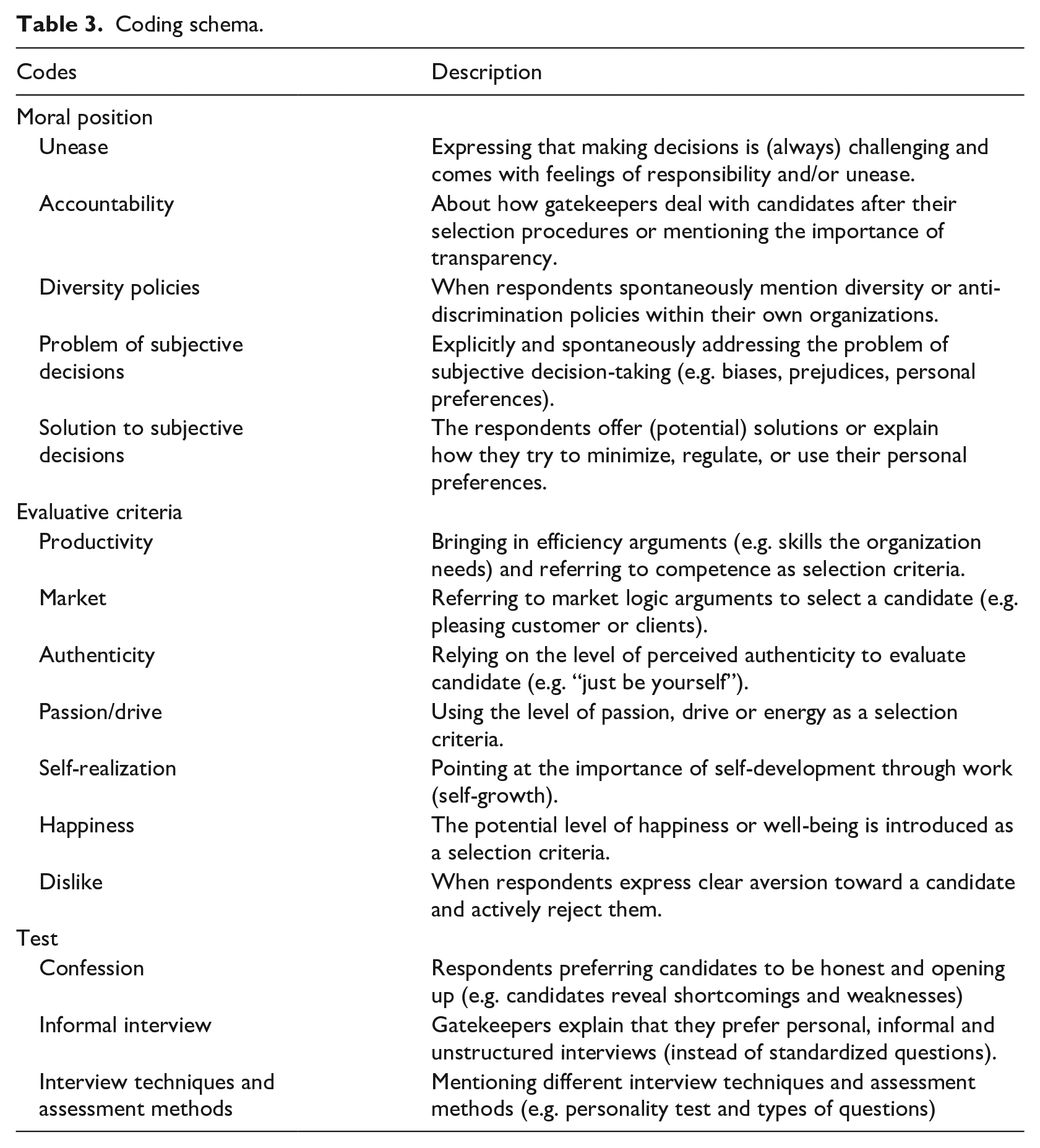
Finally, a thematic content analysis was executed on the transcripts of these interviews, which was organized in two rounds. During the first round an inventory was made of important evaluative criteria, recurring issues and self-reported dilemmas. Out of this analysis a coding schema emerged that was used for the second round of deductive coding. More specifically, in this round it was analyzed how these criteria, issues and dilemmas informed the evaluation of the candidates and the final top-3 rankings. In Table 3 the reader finds the part of the coding schema which is relevant to this article.
Coding schema.
Findings
Feeling moral unease
Cecilia is a senior in-house corporate recruiter who explained that she really loves selecting people because it is about “helping” them finding a future. Yet, toward the end of the interview and after having selected a top-3, she paused and spontaneously made a meta-reflection about her role as an employee gatekeeper: “The longer I do this, the more I get the feeling of, ‘who am I’ to make this selection? It really starts to bother me more and more. That I am now in a phase that I think, on the basis of what can I say yes or no.” She was clearly aware of the impact of her choices and worried about the premises on which they are based. She expressed the wish to do her job in a more “neutral” way but also felt that it would mean canceling herself out:
Really give everybody a chance, so everybody can make fair choices. But I become increasingly aware of my own shortcomings and not only my shortcomings but just as a human being. I do not think other people are doing it better, but I do think, on the basis of what do I decide that somebody can have a cool job? It makes me increasingly uneasy.
This unease clearly comes from an awareness that selecting is “human work” with real human consequences. Like Anna, an external recruiter in finance, who paused during her ranking exercises and exclaimed with a big sigh: “I just find it so very tricky to judge people.”
Although respondents were rarely explicit about where those biases would lead to, they did acknowledge that intuitions, gut feeling and personal likings definitely play a major role. When comparing the candidates, they repeatedly pointed out that in such situations, intuition is playing a role and it often comes down to having a “click” with a candidate. “It’s kinda like a date.” Marc a senior recruiter for an external employment agency explained, “You feel whether there is a click or not. One often says that you already know in the first 5 minutes whether it is a good candidate or not. And my experience now is, although you have to be very careful, that there is a kernel of truth in it.” Many respondents would express that it is “not completely fair” to select on preferences or feeling (a phrase used explicitly by eight respondents), but that it still happens.
The knowledge that their decisions are life determining, yet can still be biased, is clearly experienced as a moral burden. As senior external recruiter Manuel explained, hiring is about giving every candidate “the chance to be successful” and “helping them getting back into society.” Therefore, Manuel went on, we should never discriminate or favor any social category although this sometimes means coming into conflict with profit or productivity logics held by clients or department managers: “I have for myself a basic code that I need to be able to look people in the eyes.”
How to be fair?
In practice, respondents explained, that to select fairly mainly entails countering one’s automatic gut feelings by taking time and space (sometimes literally by leaving the office) or by bringing in a third (neutral) party. As David, a senior corporate HR manager explained: “When there is a beautiful blonde woman in front of you. Then you are prejudiced. So, what I prefer to do is bring in another woman next to me, to take away that prejudice. It sounds weird, but you have to remain as neutral as possible.”
Remarkably, many gatekeepers who pointed out the importance of keeping your personal preferences in check would also warn to not fully obliterate them either. A good intuition and sensing the right energy were still considered important evaluative criteria. While reflecting on her top-3 selection, Marie, a senior corporate HR manager, pointed out how important it is to keep a balance between ratio and feeling: “I think I am very aware of my own preferences but I do not want to take them away because they are my strength. I am better able at estimating possible success through my personal style than without it.” Or take Sarah, an HR assistant manager for a large museum, telling me that “you always have to be on your guard because you have, on the one hand, your ratio and, on the other, your intuition”
Besides, creating space or bringing in a third party as a strategy to control personal preferences, another highly mentioned option is “objectifying” the selection process by relying on metrics. Linda, a senior recruiter who works for an employment agency, explained after she selected her favorite candidate:
You always have a first impression. And often you have a certain eagerness to fill in the vacancy. So you think ‘Oh that is a nice candidate, we’ll push that one.’ But you forget to test a few things, those neutral testing-stuff that you should evaluate and thick the boxes in your head.
Many gatekeepers explained us that usually they would award points and quantify traits of candidates, as it gives them a sense of transparency and fairness—what Brown and Hesketh call Pythagoras’ legacy in job selection (2004: 94). Hence, the scoring of different traits, decision matrixes (candidates × demands) and a range of personality tests (e.g. talent motivation test, personality inventories, competence games) are inserted into the evaluation process. These metrics were primarily presented as a way to keep one’s personal preference in check and, as Kiviat (2019) already pointed out, to build a convincing moral narrative. Hence, gatekeepers seem to rely on organizational means, such as colleagues and metrics, to resolve their moral unease. In this sense, the organizations they belong foster rather than suppress ethical behavior.
Sector differences in moral unease
Generally, cultural HR managers seemed to be the least bothered with this ethical struggle over personal preferences and social responsibility. This manifested itself most clearly in how they dealt with excluding candidates out of the top-3. Cultural gatekeepers appeared less preoccupied with questioning their intuition and justifying their pick. Overall, they seemed unabashed when it came down to expressing their dislike. Take Jennifer, a HR manager of a theater, who simply said “I wouldn’t take him or her, she was also very boring . . . boring, boring, boring.” Moreover, in contrast to corporate gatekeepers, some cultural gatekeepers did not refrain from uttering negative judgments about physical appearances, commenting on hairstyle, glasses or the shape of the mouth. Adding to this, none of the cultural organizations in this sample used assessment tests.
Corporate gatekeepers had a different take on rejecting potential candidates. Not only did they withhold from commenting on appearances and used less stereotypes to evaluate candidates, many of them complained that it was somewhat unfair to reject candidates based on so little information (i.e. only 3-minute presentation), depriving them of clear justifications. The corporate respondents felt more obligated to justify why some candidates are not being hired: “We always give feedback, regardless of whether somebody passed [the selection] or not. At the end, we always call and share the pluses and minuses we wrote down. In this way, even if you aren’t selected, you’ll still learn from it.” (Simone, in-house recruiter for a large bank).
Moreover, internal corporate recruiters did not only appear to be preoccupied with human resource issues but were simultaneously concerned with the overall reputation of the company’s brand. This can be a direct influence of experiencing more market pressure (see Table 2). The corporate recruiters explained that not selecting candidates always comes with a risk of damaging the image of the organization, as rejected candidates might become customers or even investors. Walter, a talent acquisition manager of an insurance firm, clarified that on a yearly basis they hire hundreds of employees, meaning that they also continuously disappoint hundreds of people. “So that people walk out and, even if they are rejected, they still think this is a great company. And we find that very important. So, as recruitment, we anyhow try to experience it through the eyes of the candidate.” Of the respondents in this study, those working for external employment agencies appeared to be the most preoccupied with moral responsibility. It is not a coincidence that the only two respondents who refused to select a top-3—“unless you point a gun at my head” (Manuel)—were external recruiters.
Remarkable in this respect is that, although corporate recruiters experience more need for justification than cultural gatekeepers, the latter were more verbal on topics such as discrimination and diversity. Yet, they would primarily refer to these issues on an organizational or sector level, while mentioning individual biases much less—only six out of 17 cultural respondents refer to the problem of personal preferences. Instead, they would spontaneously bring up that they signed anti-discrimination charters established in their sector (e.g. Governance Culture Code) or point to the affirmative action policies they have (e.g. wildcards for under-represented candidates). Although corporate gatekeepers, regularly pointed out the problem of preferences and subjectivity, they did shy away from topics such as discrimination, affirmative action or diversity and held on to the belief that a “meritocratic” selection is eventually always most fair. “I never take into account being a man or woman, or origin, or something like that. I only look at what somebody is capable of doing” (Camilla, junior external recruiter).
Justifying the selection
Besides two external recruiters, all other participants did eventually select a top-3 based on the video clips of eight hypothetical candidates. This required them to explain why they evaluated some candidates as more “worthy” than others. This situation of uncertainty seemed to be further complicated because of popular managerial idioms, such as flexibility, connectivity, agility and team diversity, regularly employed by the gatekeepers in this sample. These idioms imply that, in theory, there is a place for everybody in their organizations. To return to Cecilia here: “There is no ideal candidate because I believe that every human being fits somewhere or has certain qualities, but they are not always seen. It is that simple.” So, if everybody potentially fits, how can one even reject a candidate?
In order to solve this contradiction, most gatekeepers in our sample relied on, what Boltanski and Chiapello (2005) called, a connexionist logic, which sees work as a series of projects that contribute to connectivity, self-realization and personal growth. For the employee gatekeeper this seems to imply two things. First, a framing of the job search as part of a quest for personal happiness, self-realization and connection. Second, it (re)imagines the job-interviews as a test of confession.
Assessing happiness
In order for respondents to make moral sense out of their hypothetical decisions, many were eager to bracket the productivity (industrial logic) and profit-oriented (market logic) side of being an employee and explain that eventually the wellbeing of the candidate always prevails. “Because, in the end, as a candidate, you have to feel good here.” (Christian) Especially when it came down to rejecting candidates, respondents would rarely defend their refusal by only pointing toward productivity reasons (e.g. lack of competence), but would add that a rejection also benefited the candidate. “It is not only about the company. It is also about themselves,” as David explains “most people make the mistake that they really want that job, but the question is whether it will make them happier. And sometimes people do not see that, or even don’t like it when you tell them.” Hence, by focusing on the candidates’ happiness, the gatekeepers hope to dodge the moral blame of incorrectly influencing people’s lives. This strategy, however, only makes sense against a moral background that presents work as an integral part of a person’s path toward self-development.
When evaluating the separate videos, many gatekeepers went to great lengths to determine whether the hypothetical candidates showed signs of real passion. In total 16 out of 40 gatekeepers spontaneously used passion as an element of evaluation when comparing the eight candidates. Apparently, knowing what the candidate’s passions are, is seen as an optimal way to gage whether they will find fulfilment and belonging in the job. Having passion is not only mentioned when selecting candidates but also used to justify why somebody did not make the Top-3. As Mira, a junior external recruiter for corporate firms, explained when rejecting one of the candidates: “Yeah, for example, he is too creative. I think. I would find it very unfortunate if his passion is there. You know, go and do that. I do not feel like his passion lies in business.”
Finally, it does not come as a surprise that also “authenticity,” which has become an important managerial trope (see above), serves as a discursive bridge in the gatekeepers’ attempts to justify their choices. “Authenticity” was by far the most used criteria to determine whether a candidate deserves to be selected for the Top-3: “He is just authentic. That is how he appears to me. And yes, this is something we are often looking for. Not somebody who just plays a role or pretends to be somebody else.” (Sara, HR assistant, museum). Most gatekeepers from our sample seemed to share the belief that arriving at an authentic and genuine conversation is essential to achieve connection and a good selection procedure. This can, as will be demonstrated in the next section, also translate how the entire interview as a test is conceived.
Confessing as a test
Seeing that each world of worth comes with a specific logic of justification, evaluative criteria and arguments, this translates into how their corresponding test are being arranged and executed (Boltanski and Thévenot, 2006). Seeing that a job should not cause a contradiction between, on the one hand, one’s personal happiness and, on the other hand, the organizational objectives, the gatekeepers stand before the difficult task to uncover the “real” and “genuine” motives of the candidates. This has, as the interviews indicate, a direct impact on their modus operandi. The vast majority of respondents shared the idea that the prime objective of the assessment is to get a connection with the real person behind the formal candidate and “bring them out of their shell” (Vera, HR manager of a museum). Consequently, they are expecting a certain openness from the candidates. As Rosa, HR advisor for a cultural center, argues about her favorite candidate: “Yes, because her openness. She really understands that is important to value your [own] personality. The person behind the employee.”
So if the main value of work lies in its potential to help people connect and realize themselves, gatekeepers need to be able to connect with that “real self.” Hence, an interview can only be a justifiable test when it allows candidates to disclose their true passions, desires and motivations. This transforms the job interview into a confessional encounter as it is the gatekeepers’ duty to create a situation in which jobseekers can reveal who they really are, or “what makes somebody shine” (Eva, internal corporate recruiter). The task of the interviewer is therefore, as Marc explains, “to make the candidate feel really comfortable, so you can discover who that person really is.”
The job interview is, however, not confessional only in the sense that candidates need to reveal their drives and passions, but they should also be willing to confess their shortcomings. Willem, an HR manager of a large museum, explained that showing your weakness is actually good:
What I really like is when somebody immediately gives you the feeling that they are being honest and says ‘well I find that difficult’ or ‘if you take me, you should know I need extra guidance in this,’ we had that once. And at least that is honest and then I get curious, yeah I get curious. And then I think: somebody wants it really badly, because he also immediately shows his weak points.
When questioning the respondents on why this confession of the true self is so important, they give two types of arguments. On the one hand it is, according to them, in the interest of the organization as it allows the gatekeepers to better assess whether candidates would connect with the organization and have intrinsic motivation. The second reason to allow candidates to confess their shortcomings is because it is seen as beneficial for the candidates themselves. “By holding a mirror in front of people” (Linda, external recruiter), gatekeepers hope to safeguard candidates from making wrong choices and start a career that does not correspond to their inner nature.
One thing we always touch upon during job interviews are personal points of development; independent of where you want to work. What is in your nature that sometimes hinders you? Then you dare to show your true colours, share this with us. People find that difficult but then I have the feeling you really show yourself. (Simone).
In order to arrive at such a conversation, gatekeepers need to establish a type of bureaucratic intimacy, which is simultaneously professional as well as relaxed and personal. For this reason, and as many respondents indicated, personal interests, and leisure time activities are common conversational topics during interviews (De Keere, 2022; Rivera, 2016). The conversation needs to feel natural and honest and not just be a professional inquiry into skills and credentials. The vast majority of the respondents gave this as the reason why they prefer unstructured interviews. “I don’t like to have a script for the interview because then you get a barrage of questions. And I like to have a real conversation. I want to see the passion of the person, what makes them happy.” (Manuel)
Sector differences in justification
The most important finding from a comparative perspective is that, regardless of sector particularities and organizational structures, almost all gatekeepers, at least to some extent, relied on a logic of self-realization to justify their evaluations and selections. Passion, authenticity and happiness were common criteria that were used equally by respondents from the corporate and cultural sector. Hence, the moral trope of self-realization is not sector specific but is firmly ingrained in a general valuation of work (Boltanski and Chiapello, 2005; De Keere, 2014).
However, this does not entail that other regimes of valuation were completely absent. For example, gatekeepers from both groups regularly drew on the importance of candidates having a representative role toward clients as an important reason to either accept or reject a candidate. Here a market logic (i.e. increasing profit) clearly enters their evaluation process: a fair selection is a selection that pleases customers. Although, this customer-perspective on the potential candidate was invoked by both groups of participants, it was especially salient among corporate gatekeepers (20 out of 23 used the client argument). An industrial logic (i.e. increasing productivity) was employed as well, and again there were indications that corporate gatekeepers relied on it more readily. “Competence,” for instance, was employed as a criteria to assess the worth of the candidates by 14 out of 23 corporate recruiters, while only 3 out of 17 cultural respondents relied on this principle of evaluation.
Discussion
As a way of discussing and situating the findings vis-à-vis prior literature, we return to the research questions posed at the beginning of this article: (Q1) How do employee gatekeepers interpret the moral aspect of evaluating people? (Q2) How do they justify their rejections and selections? and (Q3) How is this influenced by varying organizational contexts?
It is tricky to judge
The interviews revealed much about how the gatekeepers interpret the moral dimension of hiring (Q1). As was pointed out earlier, there are three aspects of employee gatekeeping that makes their hiring tests especially vulnerable to critique: social responsibility, subjective decision taking and organized distrust. In relation to the first problem, the findings showed that recruiters and hiring managers are aware that their job inevitably comes with social responsibility, which they experience as an ethical burden. They repeatedly pointed out they were conscious of their influence on people’s lives and therefore claim that it is “very tricky to judge people.” This is also the reason why the question of a fair selection remains so pressing. As many have argued, organizational legitimacy is acquired by being able to respond to multiple stakeholders (Friedland and Alford, 1991; Reinecke et al., 2017), which is reflected in the way gatekeepers consider not only the needs of their organizations but also take into account the welfare of the candidates as well as larger societal demands (e.g. equality, diversity, inclusion).
Related to the second aspect, gatekeepers explained that they hoped to be as neutral, bias-free and objective as possible, yet they also acknowledged the subjectivity of their gatekeeping work. Repeatedly they pointed out that emotions (e.g. the importance of energy and “click”) play a large role within their decision process. This echoes findings of previous research revealing how “gut feeling” and intuition are influencing candidate selections (e.g. Brown and Hesketh, 2004; Imdorf, 2010; Moss and Tilly, 2001; Rivera, 2016). Yet, adding to prior literature, this study illuminates how gatekeepers actually consciously reflect on this importance of emotions. It is compelling to notice how gatekeepers point out the dangers of intuitive decision taking (i.e. selecting based on personal preferences) while simultaneously argue that a good gatekeeper should not cancel out their emotions entirely. In order to select in a fair manner one has to try to control but not eliminate the intuitive nature of evaluating, relying on organizational means such as colleagues or personality tests to do so.
Finally, judging is morally tricky because, as a gatekeeper, one is forced be skeptical about the information the candidate offers (i.e. organized distrust). This appeared to be an important concern for our respondents and was addressed in two ways. They would try to rely on “neutral testing stuff” such as personality test and assessment matrix to gage what “the candidate is really about.” Similar to Kiviat’s study (2019), these type of metrics are mobilized by gatekeepers to justify their selections through a moral narrative. Moreover, the problem of organized distrust is also manifest in the gatekeepers’ fixation on authenticity. An important way to relieve the unease that occurs from not being able to fully trust the candidate is to make truth telling a fundamental aspect of the gatekeeping test. In other words, the job interview has to be turned into a confessional encounter.
Self-realization and the confessional test
So how do the gatekeepers justify their decision? (Q2) As argued, gatekeepers need to withstand two types of critique: (1) on whether they have selected the “right” employee and (2) on whether they used the correct test to evaluate the worth of this candidate. When it comes to dealing with the first critique, employee gatekeepers from this sample did draw on profit and productivity arguments, but simultaneously kept one foot firmly in the connexionist world. Gatekeepers from both sectors defended the selections of the hypothetical candidates by evaluating their true passions, desire for self-realization and their potential for authentic connection. The objective of this connexionist logic is to humanize work by blurring the lines between work and private life (Boltanski and Chiapello, 2005; De Keere, 2014) and appears as a powerful moral framework that is shared by most gatekeepers, independent of their employment sector.
Because happiness, passion and authenticity entered as important evaluative criteria, the gatekeepers countered the second critique by steering the candidate toward a truthful confession. To know whether a candidate will be able to connect and realize themselves within the organization, they need to confess their needs, desires and weaknesses to the gatekeepers. In order to uncover the authentic person behind the candidate, gatekeepers want them to feel at ease and relaxed, so that a personal connection becomes possible. Those who are not capable of opening up, fail the test and are not valued as potentially worthy employees.
Imagining the job interview as a confessional encounter is, however, not a neutral act but is also a way of exercising power and yields structural disadvantages toward certain social groups. Here we see how valuation and symbolic power intersect and that justification is about more than just rhetoric (Friedland and Arjaliès, 2017). There are two (not mutually exclusive) ways we could read how symbolic power and domination is funneled through regimes of valuation in the case of employee selection. First, the fact that employees are asked to pass a confessional test immediately reminds us of Foucault’s (1998) depiction of the neo-liberal individual as a confessional animal. In contemporary society, and not in the least within work settings, social control is less often achieved through subtraction (i.e. punishment), but more often through cultivating self-discipline and expression (i.e. conduct of conduct). From this perspective, a job interview as a confessional test enters as a technique of the self that allows organization to steer employees by molding and shaping their identities as workers (see also Rose, 1989).
Second, organizing the job interview as a confessional test creates unequal access to the labor market. Not in the least because this view promotes the use of more informal and unstructured job interviewing, while studies show that formalizing the recruitment procedures increases labor chances of more precarious groups (de Larquier and Marchal, 2016). But on top of that, it cannot be expected that everybody is as comfortable with this sort of therapeutic exercise that implies revealing personal needs and weakness. This not only demands a certain sense of confidence and entitlement, but a string of studies yet demonstrated that the upper middle class is generally more at ease with self-expression and marked by a tendency to psychologize problems (e.g. De Keere, 2020; Stephens et al., 2014). Because it is never just about being authentic. It is about being authentic in the right way or, as Camilla, explained “Yes, just be yourself. That is very important. But always keep in mind that this is still a selection interview.”
Varying organizational context
Finally, this study was arranged in a comparative manner to reveal the differences in gatekeeping unease and justification (Q3). Cultural gatekeepers seemed generally less preoccupied with the impact of their choices, most apparent in the relative ease with which they rejected candidates and the undiplomatic language they used to do so. They did not refrain from using stereotyped language and comments on physical traits when evaluating the fictive candidates. Corporate gatekeepers, on the other hand, referred much more often to how they kept their “gut feeling” in check by cultivating awareness and relying on metrics and assessment instruments. On top of that, the latter were also more concerned about biases and personal preferences than their cultural counterparts.
Three points of comparison guided the comparative design: organizational size, supply/demand and market pressure. When it comes to size, some literature seems to indicate that larger organizations tend to suppress moral reasoning and judgment (Bartels et al., 1998; Weber, 1990), yet overall results are still mixed and inconclusive (for overview see O’Fallon and Butterfield, 2005). This study finds counter evidence in the fact that corporate gatekeepers, working for bigger firms, not just express more moral unease, but also rely on organizational tools to verbalize and solve it. Tools that are only available within larger organizations that have professionalized and formalized their HR activities (de Kok and Uhlaner, 2001).
Next to size, also supply and demand appears to influence the moral opportunity structure of gatekeepers. Scholars have yet pointed out how the state of the labor market directly impacts recruitment procedures and outcomes (Bills et al., 2017). Moreover, it is well established that elite job positions or higher job functions, marked by more competition on the side of the candidates, are also more sensitive to discrimination, cultural matching and homophily (Baert et al., 2016; Castilla, 2011; Rivera, 2016). What we learn here is that, in comparison to the corporate respondents, cultural gatekeepers, who continuously lamented that they have to plow through numerous applications, appeared much more careless and almost indifferent about rejecting candidates. The former, on the other hand, expresses a stronger sense of accountability toward the applicants. This carelessness among cultural gatekeepers could be explained by what Birkelund (2016) called “mental laziness.” In the case of time pressure combined with supply abundancy, she argues, employers can fall back on automatic-mental decision mechanisms which are more sensitive to discrimination. It is not unimaginable, that this same mechanism suppresses moral concerns and a felt need for justification.
Finally, and in contrast to previous literature (e.g. Butterfield et al.’s, 2000; Gioia, 1992), we learn that, when comparing the two groups of respondents, a relative higher market pressure translates into a heightened sense of accountability among the corporate gatekeepers. The latter are more sensitive to brand perception and demands of customers and clients, potentially including previously rejected candidates, leading to a louder demand for justification. However, it is possible to interpret this expression of corporate accountability as nothing more than good manners and a thin veneer of “civility.” Just like Elias (2000) described increasing display of “civility” in court society as a result of nobilities needing to signal superiority in a symbolic way, the corporate world is a comparable sphere of decorum, propriety and politeness. A pragmatist view, on the other hand, encourages us to not reduce what people say to “hypocritical moves associated with the defense of particular interests” (Boltanski and Thévenot, 2000: 210) but to see moral justification as emerging out of people, with a critical capacity, navigating themselves toward a common ground.
Conclusion
Passing a job interview is a common yet decisive moment during most people’s professional lives. This is not only a challenging situation for the applicant but also for the employee gatekeeper as it is one of those moments that lays bare the multiplicity of organizational goals, motivations and logics. Using a regimes of valuation framework, offered by Boltanski and Thévenot (2006), this study focused on how dealing with moral unease is an integral part of employee gatekeeping and to alleviate it one needs to respond to demands for justification. In this respect the connexionist logic emerged as the most dominant regime of valuation. Criteria as passion, connectivity and happiness were prominent elements in gatekeepers’ rationalization. Moreover, morality does not enter professional decision processes in the form of merely rhetoric acts, but has a performative force that eventually transforms job interviews into confessional tests. The moral dimensions of work does not manifest itself solely on the level of cognition and discourse, but simultaneously exerts an influence on the level of procedure and practice. In turn, this has an impact on who is able to successfully pass the hiring test by displaying the right type of authenticity and truthfulness. This eventually demonstrates how a sense of justice, regimes of evaluation and symbolic power are intimately interconnected and eventually shape our economic lives.
Supplemental Material
sj-docx-1-org-10.1177_13505084231195435 – Supplemental material for Justifying employee gatekeeping: A video-elicitation and comparative study on resolving the moral unease of hiring
Supplemental material, sj-docx-1-org-10.1177_13505084231195435 for Justifying employee gatekeeping: A video-elicitation and comparative study on resolving the moral unease of hiring by Kobe De Keere in Organization
Footnotes
Acknowledgements
The author would like to thank the reviewers and editors for their constructive and insightful comments. Furthermore, I am grateful for the opportunities I got from the Culture Club of the University of Amsterdam and the Harvard Cultural and Social Analysis Workshop to present my work and receive great feedback. Special thanks go to Stefan Beljean, Svetlana Kharchenkova, Jonathan Mijs, Iddo Tavory and Kate Williams for their supportive feedback on multiple drafts of this article.
Funding
The author disclosed receipt of the following financial support for the research, authorship, and/or publication of this article: This work has been supported by the Dutch Research Council (Veni-grant) with grant number: 451-17-004.
This research was supported by the Dutch Research Council (Veni-grant)

Supplemental material
Supplemental material for this article is available online.
Author biography
References
Supplementary Material
Please find the following supplemental material available below.
For Open Access articles published under a Creative Commons License, all supplemental material carries the same license as the article it is associated with.
For non-Open Access articles published, all supplemental material carries a non-exclusive license, and permission requests for re-use of supplemental material or any part of supplemental material shall be sent directly to the copyright owner as specified in the copyright notice associated with the article.
