




Abstract
This paper examines the invisibilization of violence and deaths in India’s leading daily during the 1918 influenza pandemic, the Times of India. The pandemic killed more than 14 million Indians in a short span of time. Studying this historical event and the way it was reported in an influential newspaper, this research shows how media representations not only invisibilized the alarming levels of mortality, but also elided the efforts of colonial capitalism to profit from the loss of human life. Building on the work of Achille Mbembe, and through the concept of necroptics, this study examines the invisibility of violence as malign neglect that contributes to death-worlds. It shows how colonial violence was erased or mystified through media necroptics, which created untraceable deaths, that is, framed deaths as natural or systemic outcomes.
Keywords
“sab pareshan hain ki akhir kis vaba men vo mire/ jin ko ghurbat ke alava koi bimari na thee” (“Everyone is worried about the epidemic that will get them/ These people who suffer no illness except that of poverty”).
Although vast populations are periodically subjected to violence and deaths, organization studies continue to under-examine these key impulses of capitalism (Banerjee, 2008; Costas and Grey, 2019; Varman and Al-Amoudi, 2016). Such oversight is particularly glaring because violence is not primarily a problem of individual behavior but embedded in social structures and organized through social relations (Hearn and Parkin, 2001; Ray, 2018). Colonialism is one such socio-political arrangement inherent to capitalism that organizes large scale violence against the colonized (Elkins, 2022). Mbembe (2019: 92), scrutinizing colonial and postcolonial structures has sharply pointed to the need to attend to necropolitics, the “subjugation of life to the power of death”. Violence is deployed to destroy lives and create “death-worlds,” a form of social existence in which vast populations are subjected to living conditions that confer upon them the status of the “living dead” or lives that do not count and can be ended without any consequence (Mbembe, 2019: 92, emphases in original).
Violence can be subjective and have clearly visible forms and identifiable perpetrators or it can be objective or invisible, hidden behind the layers of a smoothly functioning social order including a capitalist one (Zizek, 2009). A particularly under-examined feature of organization studies is the invisibility of violent actions in workplaces and social settings (Hearn and Parkin, 2001). Recently, Chowdhury (2021b) insightfully shows how the lack of traceability of violent actions generates insensitive violence with devastating long-term harmful consequences for its victims. Accordingly, when actions lack traceability the subjective violence inflicted by individuals or organizations remains invisible. Chowdhury’s problematization of invisibility and untraceability prompts us to ask– what is the role of traceability in the creation of death-worlds? The necessity to attend to traceability of violence is particularly prominent when we consider colonial contexts. They frequently witnessed large scale deaths due to famines or diseases (Davis, 2002). These were deaths due to what Gupta (2005: 29) terms the “malign neglect” of rulers. Accordingly, “malign neglect” complements overt violence of the State and is central to objective violence that targets lower classes. Such “malign neglect” is in fact a key feature of the untraceability of deaths and how death-worlds are organized. As Heath (2021) reminds us, while there are accounts of subjective violence (e.g. colonial massacres), the malign neglect and objective violence perpetrated by the British Empire, which resulted in widespread death and destruction in India, remain largely invisible. In this paper, based on a study of colonial violence in India, we argue that necropolitics and death-worlds are managed by mediating the invisibility of violence, creating untraceable deaths.
Building on Mbembe (2001, 2019), we examine this invisibility of violence through the concept of necroptics, which we define as actions that create public perceptions about the subjugation of life to the power of death, and frame some of the population as the living dead. We locate these necroptics in media representations that play a significant role in creating public perceptions of death-worlds. Media representations shape the ways in which deaths are framed and whether the culpability of the State and capitalist forces in the form of malign neglect are recognized (Herman and Chomsky, 2010). Framing is “signifying work” through which meanings are assigned (Snow and Benford, 1988: 198). Invisibilization of malign neglect either erases traces of violence or renders it abstract and diffused in objective form. Untraceable deaths are hidden behind the veil of systemic forces with no accountability. Thus, in developing the concept of necroptics we draw attention to how violence is organized to create untraceable deaths in death-worlds.
We examine necroptics in India’s leading daily during the 1918 influenza pandemic, the Times of India (TOI). Labeled the “greatest medical holocaust in history” (Waring, 1971: 33), the “mother of all pandemics” (Taubenberger and Morens, 2006), the influenza killed anywhere between 50 and 100 million people or between 2.5% and 5% of the global population (Spinney, 2017). The region that faced the greatest human mortality was the Indian subcontinent (Chandra et al., 2012). Fourteen million Indians died in British India and another four million in the semi-autonomous princely states (Tumbe, 2020). Studying this historical event and the way it was reported in an influential newspaper, we show how media representations not only invisibilized the alarming levels of mortality, but also elided the efforts of colonial capitalism to profit from the loss of human life. We further show how colonial violence, in the form of malign neglect, was erased through media necroptics that created untraceable deaths, that is, framed deaths as natural or systemic outcomes.
Although we limit our analysis to the 1918 pandemic, the concept of necroptics is relevant to understanding how violence is framed in different contexts. In fact by focusing on the role of necroptics in organizing violence and creating death-worlds, we are calling for greater attention to the optics of violence and occasions when it takes the form of malign neglect. Deaths that are rendered invisible due to malign neglect either slip into voids of inconspicuousness or become attributed to the mysteries of objective violence. Attention to necroptics helps to dissect such politics of invisibility, foregrounding malign neglect, and demystifying objective violence by probing the traceability and location of actors and institutions that inflict violence.
Necropolitics and invisibility of violence
Despite Hearn and Parkin’s (2001) warning that organizations can be sites or structures of violence and violations, Costas and Grey (2019: 1576) suggest that in Management and Organization Studies (MOS), research traditions inspired by Max Weber and Michel Foucault have “absented violence.” Weberian studies decouple violence from authority, and Foucauldian analyses focus on disciplinary power. Both create a schism between sovereign power and the act of violence. While physical violence remains a constant possibility, it is primarily in symbolic forms that violence is theorized (e.g. Harrington et al., 2015; Kamoche et al., 2014; Kerr and Robinson, 2012). Such approaches to violence are inadequate because, as Hearn (1994) reminds us, there is a need to understand multiple forms of violence, that include physical, sexual, emotional, verbal, cognitive, and visual or representational violence (see also, Harris, 2017; Linstead, 1997). In so far as there are multiple forms of violence, we also find multiple inter-connected sites of violence at micro and macro levels (Kenny, 2016). Moreover, the fact of violence also hinges on how lives are recognized or as Butler (2004) suggests whose life is grievable, and several studies have reported on widespread violence against vulnerable groups who are made ungrievable (e.g. Varman, 2018; Varman et al., 2018; Varman and Vijay, 2018).
Despite important insights offered in these studies, there is a need to further interrogate how violence is erased and how objective violence is organized. Such attention is particularly needed in contexts where the normal is itself violent, where what is managed is not primarily life but death. Such questions are central to research on necropolitics and death-worlds. Mbembe (2019) argues that death is inscribed within orders of power. “In our contemporary world, weapons are deployed in the interest of maximally destroying persons and creating death-worlds, that is, new and unique forms of social existence in which vast populations are subjected to living conditions that confer upon them the status of the living dead” (Mbembe, 2019: 92, original emphases). Mbembe (2001: 113) describes colonialism, “a relation of power based on violence,” as an important means of creating such death-worlds. Colonies witnessed three forms of violence—the founding violence that led to their conquest, justifying violence then used to legitimize these conquests, and authorizing violence that maintained authority through everyday and banal forms of violence. These forms of violence made colonies historical zones offering increased possibilities for necropolitics. Vast swathes of the colonized world were made into death-worlds inhabited by the living dead. Mbembe (2019: 38) further notes that racism was a key driver of such necropolitics and it justified a cheapening of life and habituation to loss within “the world of undesirables.”
Racial necropolitics were central to not only European colonialism but also its conjoined twin– racial capitalism (Robinson, 1983). Plantations and other early colonial enterprises were dependent on racialized labor forces for extraction of surplus and for social control (Allen, 1994). The rise of capitalism was accompanied by a myth of whiteness as “superior, moral, wholesome, stable, intelligent and talented” (Berger, 1999: 87). Racialized capitalism framed people of color as primitive, backward and savage. As Virdee (2019: 18) suggests, “the ongoing project of colonial conquest became a live data-set, a human zoo from which they distilled their magical theories of scientific racism.” Colonialism shaped bourgeois interests and racialized working class consciousness, legitimizing the treatment of people of color as inferior beings deserving violence (Roediger, 1991). Moreover, as MOS scholars have shown, racist capitalism continues to thrive in the contemporary world with white privileges shaping racialized interactions in both business settings (e.g. Nkomo and Al Ariss, 2014) and academic worlds (e.g. Muzanenhamo and Chowdhury, 2022)
Mbembe’s discussion of necropolitics has inspired scholarship on both capitalist economies and organizations. Highlighting death as an important facet of the market economy, Montag (2005: 17) argues that sovereign power intervenes to ensure, through force, that populations accept the rationing of life by the market. A key figure in such a “necro-economy” is somebody who is allowed to die in the name of the rationality and equilibrium of the market. Similarly, Banerjee (2008: 1541) interprets the current phase of capitalism as necrocapitalism or “contemporary forms of organizational accumulation that involve dispossession and the subjugation of life to the power of death.” Its fundamental feature is denying access to resources essential to local health and life, destroying livelihoods, and dispossessing communities, in neocolonial settings. Furthermore, Varman and Al-Amoudi (2016) suggest that Indian subaltern groups are excluded from public discourse through practices that ensure organizational violence remains unchecked. Recently Varman and Vijay (2021) uncovered the thanatopolitics of neoliberal capitalism that conceal objective violence and encourage profiteering by mobilizing precariousness to further injure the precariat.
While these writings help us understand how violence and death are central features of capitalism, there is a need to pay further attention to how necropolitics are managed. A key feature of managing them is to erase subjective violence or mystify objective violence, or make the latter appear natural. Such effects of untraceability are achieved through careful frames of representations. Establishing traceability is particularly important because modern societies have a capacity for dispassionate mass killings (Turner, 2003). Moreover, as Cockburn (2004) and Galtung (1996) observe, inequality in societies weaken inhibitions against aggression and ensures forms of violence that are latent and invisible, within unjust social and economic power structures. Hence, an important implication of these writings is a need to pay attention to the invisibility of violence as a key element in how regimes are organized. Managing the optics of violence is particularly necessary because in our contemporary societies subjective violence has become difficult to justify. Furthermore, despite some attention to the role of neglect in furthering violence in the context of children (e.g. Mikolajczak et al., 2018; Widom, 1989), there is still an under-examination of malign neglect as a form of violence (for an exception, see Gupta, 2005). Indeed, as Chowdhury (2021b) points out, invisibility of violence requires especially close understanding since it leads to enduring emotional wounds in victims. To further understand invisibility of violence, we now turn to some key writings on representations and necropolitics.
Representations in Necropolitics. To comprehend necropolitics, we need to foreground how violence is recognized and the specific historical conditions that render it invisible (Hearn and Parkin, 2001). Such a reading requires engaging with the politics of representations. Notably, scholars have warned that representations, especially of the Global South in MOS, are often fraught with elitism, othering, and necolonialism (Chowdhury 2021a, 2022; Khan, 2007). Drawing upon the seminal work of Said (2003), such writings highlight how representations about the Global South continue to reinforce the racist, exploitative, and oppressive colonial structures that the Western colonial powers created to further their empires (Chowdhury, 2022; Varman and Costa, 2013). Said (2003, p. 32) interprets representation as an act laden with power, tied to who frames knowledge about a subject, and “to have such knowledge of such a thing is to dominate it, to have authority over it.” It becomes necessary then to attend to the implications of representation, to question who represents, for what purpose (Khan, 2007) and why some are made invisible within representations.
Invisibility in representations can be in terms of “voice” (Simpson and Lewis, 2005), that is, representational elisions caused by dominant authority (Snell and Wong, 2009), or “optics,” that is, ways managers conceal unethical practices in corporations (Gabriel, 2005; Zyglidopoulos and Fleming, 2011). Both forms of invisibility hinge on spatio-temporal frameworks (Thompson, 2005). In face-to-face interactions producers and receivers of information share the same spatial-temporal framework. But mediated interactions separate the contexts of producers and receivers by space and time. Moreover, mediated visibility is not reciprocal but uni-directional: a reader can see or read about distant others who are being photographed or written about, but the distant others cannot, in most circumstances, participate as equals. These spatio-temporal distinctions crucially shape visibility. Those with the means to do so, shape mediated representations, to the disadvantage of these distant others, since each representation “reproduces a specific logic of the real” (Phelan, 2003: 2). Furthermore, invisibility can be part of a (neo)colonial knowledge apparatus that creates complicit, ignorant, and insensitive representations (Chowdhury, 2022).
A “dialectical optics” (McNally, 2011: 6) can offer a way of revealing the politics of such invisibility. Butler (2016) deploys such optics when discussing how violence is recognized and framed. She suggests the capacity to recognize a life is dependent on that life being produced according to norms that qualify it as a life. Similarly, McNally (2011) advocates optical work in order to perceive the naturalized processes of exploitation inherent in capitalism. We believe such dialectical optics offer better understanding of the politics of invisibility through which necropolitics were managed in colonies.
Colonial representations justified violence because “the will to representation is at bottom a will to destruction aiming to turn something violently into nothing” (Mbembe, 2019: 139). Justifying the violence that preceded and followed colonial conquests, language and representations were deployed to convert the founding violence into an authorizing violence (Mbembe, 2001), including through a normative language of justification that presented oneself as a victim and not as a perpetrator (Ray, 2018). Accordingly, in colonial representations the colonized were either deemed as things that did not have life or as savages and animals, whose lives could be taken away without great consequence, pity, or sympathy. In both, colonial representations produced a negation in which the colonized became the antithesis of what was to be recognized as human. In necropolitical representations, Mbembe (2001: 197) suggests, colonial death-worlds and living dead were constructed by making the colonies voids in which, “life and death are so entangled that it is no longer possible to distinguish them.”
In fact, Mbembe (2019) contends that colonial violence was itself framed as being in the interest of the colonized, part of the civilizing mission. “The colony is thus the site par excellence where controls and guarantees of judicial order can be suspended. . .in the service of ‘civilization’” (Mbembe, 2019: 77). This made colonial violence appear necessary yet innocent. The “death (of the colonized) is something to which nobody feels any obligation to respond. Nobody even bears the slightest feelings responsibility or justice toward this form of life or, rather, death” (Mbembe, 2019: 37). Such representations constituted racialized capitalism’s “optical power” (Ciarlo, 2014: 198) with a particular “visual economy” (Poole, 1997: 8) that positioned the colonized in a subordinate relationship of extraction to the colonizer.
In summary, while some scholars have examined the role of death and violence in organizations, and the entwining of capitalist profits with the creation of death-worlds, we still know less about how such necropolitics are managed by invisibilizing the violence of malign neglect. Studying the role of invisibility in colonial representations is a productive avenue to consider how death-worlds are fostered and the living dead framed in them. We now turn to the TOI and its coverage of the 1918 influenza to examine this question.
Methodology
Our goal was to understand how media representations made the violence of malign neglect invisible, and generated untraceable deaths. We understand media representations as collections of interrelated texts that cohere to produce shared meaning and justify organizational actions (Maguire and Hardy, 2009), where texts are symbolic forms of representation (such as books, media accounts, interviews). We focused on newspaper articles that appeared in the Times of India in 1918 and contemporaneous colonial reports. We understand these texts as constituting a discourse (Maguire and Hardy, 2009), in that they generate complex sets of communicative relations between people who talk and write (Fairclough, 2016), and inscribe unequal relations of power and knowledge within society (Foucault, 1981). In any discourse a limited number of subject positions are recognized as legitimate and hence made powerful (Hardy et al., 2005). As a result, discourses are constitutive, rather than descriptive, of reality (Maguire and Hardy, 2009; Said, 2003). They produce regimes of truth that normalize certain ways of knowing, believing, speaking, and behaving. To uncover these regimes of truth requires systematically exploring “often opaque relationships of causality and determinism between (a) discursive practices, events, and texts, and (b) wider social and cultural structures, relations and processes” (Fairclough, 2016: 93).
To conduct such an analysis, we examined the Bombay edition of The Times of India (TOI) from September 1 to December 31, 1918. At the time the TOI was the leading daily of the ruling Anglo-Indian establishment in India, and known for a pro-British stance that sharply contrasted with other more nationalist newspapers. The daily was owned by a British joint-stock company, Bennett, Coleman and Company Limited. Thomas Jewell Bennett, one of the owners was a British journalist, member of the Conservative Party, and member of parliament. The TOI editor at the time, Herbert Stanley Reed, would later become a Conservative Party member of parliament in Britain. We conducted this research as authors of Indian origin who have engaged with the issues of colonial and capitalist exploitation in our scholarship. We concur with Chowdhury (2022) that a goal of academic work should be to benefit those who are marginalized. In doing so, our objective is to highlight how colonial representations in the TOI were mired in, to further borrow from Chowdhury (2022), ignorance, complicity, and insensitivity.
Following Maguire and Hardy (2009), we created a chronological database of newspaper articles, to locate what was reported and when. We also paid attention to the structural organization of media reports, since this plays a crucial role in shaping the overall interpretation of an issue, determining what is at stake when the media report is read. In total, we collected and examined 122 days of TOI reports. Our attention was particularly on news coverage in 2 months, from 1st September 1918 to 31st October 1918, during which millions perished in the Bombay Presidency and across the Indian subcontinent (Tumbe, 2020). In this period of 2 months, we read every TOI report that mentioned influenza.
Along with the TOI’s coverage, we also read several contemporary studies of the pandemic. A key source was the Sanitary Commissioner’s Report 1918 (SCR), published by the colonial government (Government of India, 1920), the Indian Medical Gazette and a dissertation written at the time (Phipson, 1923). Our goal was to draw out relations between the TOI’s texts and the factual weight of the influenza as described in these other sources. We wished to unpack different moments in the life of a particular news text, consider the specific context of a given period, “from specific events and developments related to the issue under examination to wider aspects of the social environment” (Carvalho, 2008: 164). In doing so, we were alert to power relations embedded in these media reports, through their choice of language, as well as their descriptions of prevailing sociocultural practices. We also considered the situational, institutional, and socio-cultural context of these media representations (Fairclough, 2016).
We followed three broad steps in our analysis of these media representations–relational, dialectical, and transdisciplinary (Fairclough, 2016). In our relational analysis, rather than focus on individual voices, we foregrounded social relations among different actors. We examined how articles on the influenza in the TOI and individual voices reported in them, together constituted a discourse. Our analysis was also dialectical: we pieced together contradictory aspects of the colonial desire to maintain order. On the one hand this meant providing some care to the colonized, on the other it also required generating profits to further imperial interests. Finally, our analysis cuts across conventional boundaries between disciplines of history, sociology, organization studies, and critical marketing, in an effort to be transdisciplinary. It is an attempt, as Fairclough (2016) reminds us, to dialog between heterogenous disciplines, theories, and frameworks.
We also follow Fairclough (2016) in attending to three key dimensions in our analysis, those of representations, subject-signification, and domination . Our analysis closely attends to how the colonial state, influenza, and its victims were represented in the media reports. Similarly we focused on how state officials and Indians were framed within these representations through oriental tropes that fixed the latter into stable subject positions of victims (Said, 2003). Our analysis also attended to how relations of dominance were shaped by commercial interests of the time.
In terms of specific aspects of the media representations, following Carvalho (2008) we examined layout and structural organization of news reports, including the sections in which a news article was published, its page number, size, headline, and accompanying visual elements (photographs or graphics). We were also interested in how the TOI constructed images of colonial administration and public health. So we studied how other actors were represented, for example, the poor and local traders. In particular, we were interested in the “framing power” of the TOI news stories, “the capacity of one actor to convey her/his views and positions through the media, by having them represented by journalists either in the form of quotes or regular text” (Carvalho, 2008: 168). Understanding such power required identifying how actors were presented in a relationship with each other, positioning, to construct specific identities in news reports; how different actors and their actions were justified, legitimation; and how political nature was attributed to a certain reality or its exclusion, politicization.
The necroptics of 1918
In our analysis here we present three dimensions of the TOI’s coverage of the 1918 influenza, in terms of representation, signification, and domination. We describe how in the TOI’s pages the Indians who died from the pandemic were represented as invisible. We then show how the subject positions constructed between the colonial state and Indians in the TOI’s coverage signified the latter as ignorant savages. Finally we show how racialized economic interests shaped the TOI’s coverage, thus constructing relations of domination. Together these dimensions help explain how the deaths caused by influenza became untraceable, thanks to the manner in which they were framed in the TOI, ensuring malign neglect was invisibilized, what we call necroptics.
The representation of a death-world
Influenza engulfed the entire planet “in the blink of an eye” (Spinney, 2017: 5), with most deaths occurring in the 13 weeks between early September and the middle of December 1918 (Spinney, 2017: 5). Deaths in India accounted for 38% of global mortality at the time (Johnson and Mueller, 2002). A widely cited study (Chandra et al., 2012) estimates the loss of lives at the time at an astounding 14 million in British India alone. The colonial administration was aware of these high levels of mortality, as reflected in the Sanitary Commissioner’s Report, 1,284,013 deaths were recorded as compared with a decennial mean of 253,174. . ..Over one million of these deaths occurred in the last four months of the year, and the majority was due to influenza (Government of India, 1920: 82)
Since the pandemic was already causing loss of lives elsewhere, the colonial administrators had time to prepare for it in British India. The flu virus was first identified in May 1918, in soldiers returning from fighting in the World War (Arnold, 2019). This initial phase of infections lasted a few weeks and did not cause widespread loss of life. In Bombay, over 4 weeks this wave claimed 1600 lives (Arnold, 2019). But the epidemic then returned in a far more virulent form, killing millions in Bombay over 6–8 weeks in September 1918, A widespread epidemic of a disease, which was in no case directly fatal, occurred during March and April in certain parts of India. . .. The second wave commenced in September and reached its maximum in October in the Presidency (Government of India, 1920: 59).
Despite ample warning signs, the colonial administration did little to reduce the loss of human lives (See Figure 1). “Nobody in government, it might be said, was particularly concerned about the 12 million deaths in 1918–19 because nobody in authority much cared or had the political will, the administrative capacity and the technical resources to do much about it” (Arnold, 2019: 186). It is also possible that prior experience persuaded the authorities to take a passive approach. In 1896, when responding to the Plague, draconian measures had led to public unrest. Overall the colonial government directed resources toward supporting British war efforts rather than combatting the pandemic, taking a dispassionate approach to the ensuing deaths.
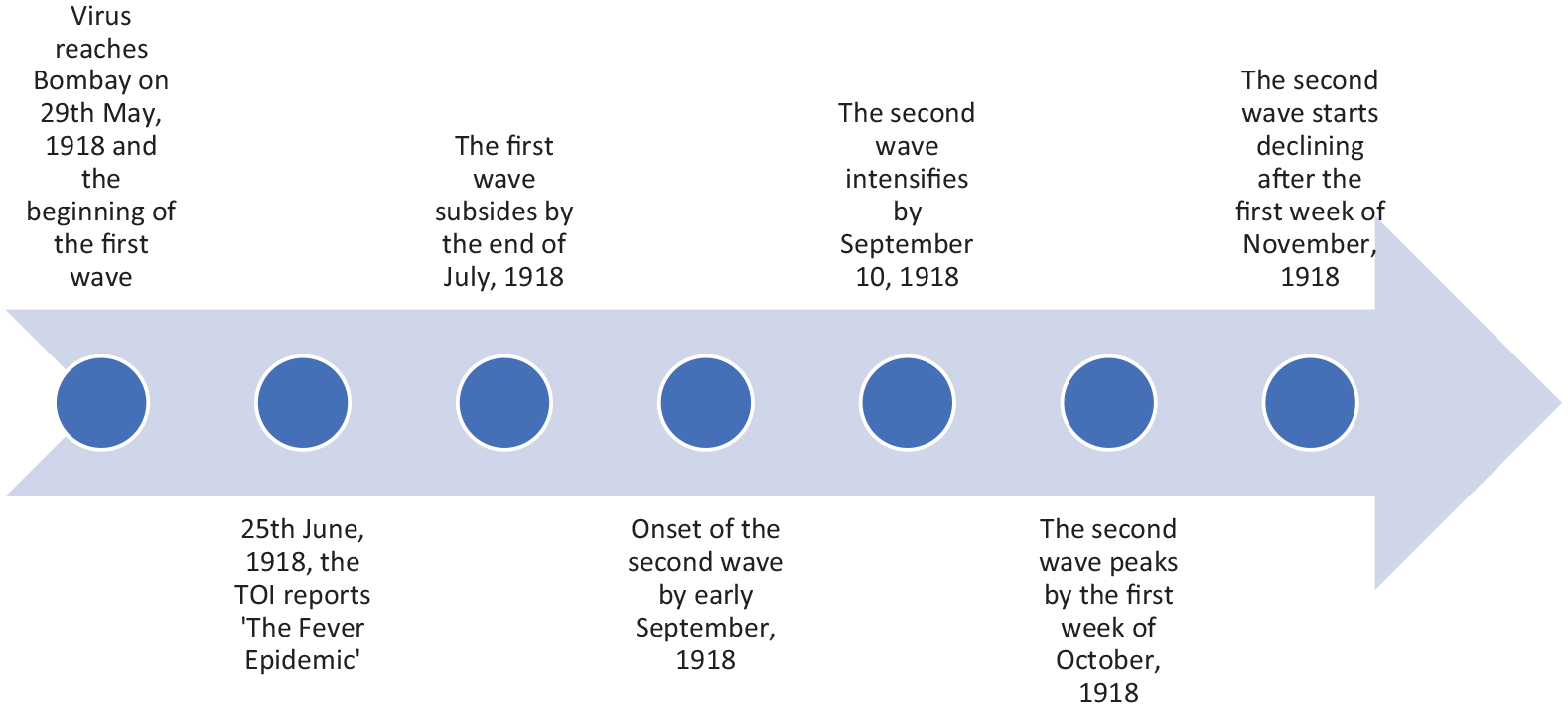
Timeline of the Pandemic in Bombay Presidency in 1918.
The colonial administration did not restrict mass movement. As a result the railways soon became a major conduit for the spread of influenza, During the panic caused by the epidemic, the trains were filled with emigrants from infected centres, many of them being ill. The Post office also was an important agency in disseminating infection, also very largely through the Railway Postal Service. Lucknow, Lahore, Simla and other cities are said to have been infected in this manner (Government of India, 1920: 60).
Given this dire setting how did the TOI cover it? We find the newspaper consistently downplayed the influenza deaths. In September 1918, the TOI’s first mention of influenza was on the 2nd in a news item buried at the bottom of page 17, The influenza has now reached Delhi and the correspondent writes that cases are occurring in all parts of the city. The epidemic is causing considerable inconvenience, but the Health Officer does not think it is going to last very long.
The next mention of influenza was on September 6th in another brief item that reports a reduction in merchant tonnage in London (due to the pandemic). There is, however, no further mention of influenza in India. This period when the TOI was not reporting the pandemic, September 7th to 14th, was when the second wave began to exact its heavy toll. In fact at the time the newspaper’s pages featured more advertisements of medicines to fight influenza than actual newspaper reports of it. Finally on September 17th in a short article titled “Godhra Notes” on page 4, a passing mention is made that “the health of the town remains good, though it is marred by occasional cases of influenza.”
The TOI’s elision of the pandemic’s casualties stood in stark contrast to letters from its readers that were printed in the newspaper. A letter to the editor on page 11 titled “Influenza or Not” published on September 13, by Nadirshaw H. E. Sukhia, states that, Though we spend lakhs of rupees every year on the Municipal Health Department and pay a very handsome salary of Rs. 2000 per month to the Health Officer with a special personal allowance of Rs. 250. . .. we are making a sheer waste of public money as the Health Department miserably failed to find out what it (influenza) really was and what it was due to.
Like Sukhia, other readers also expressed grave concerns about the epidemic. A letter (titled “Unhealthy Poona”) on September 20th, published on page 5, observes, (That) The sanitation of Poona City is bad requires no mention, but during the last fortnight it has gone from bad to worse. The daily total mortality has reached the maximum of 82 and none can say to what extent it will increase. Influenza, pneumonia, malaria, typhoid and slight plague are at large. To cope with them, some radical sanitary changes must take place; otherwise the above visitors are likely to establish themselves permanently and then it will be very strange indeed.
For several days after publishing this latter letter, the TOI did not report the health situation in Poona. Its first report appeared only on September 26th, on page 7. Titled 'Influenza in Poona: Heavy Daily Mortality’ it appeared in the second last column of the page, below a map captioned “Great Advancement of Allied Forces in Macedonia.” The news item itself occupied less than 2% of the page space. It reported, Influenza in Poona has assumed frightful proportions. The daily mortality has reached the figure of 160, which is nearly 12 times the usual mortality. The weather is extremely oppressive. Every house has its quota of sick and there is no sign of any abatement of the epidemic.
Despite acknowledging in a report titled “The Health of Bombay,” on September 25th, on page 6 that, “the high water mark of the new influenza epidemic has been reached. . .. The mortality has again leapt upwards and during the past week the death rate has been only decimal three short of a 100 per mile, or 10%, per annum,” the overall coverage of the pandemic was still minimal. Such limited coverage encouraged an interpretation of the disease and its deaths as inevitable, a natural occurrence regarding which the State had little role to play.
Another article, on September 27th, page 9, ‘Influenza Epidemic: Relief Measures’ occupied less than 1% of the total newspaper for the day, and around 5% of that particular page. It appeared in the third column of a page that contained six columns of newsprint. By now the second wave was established; yet there was still no evident attempt in the newspaper’s pages that it was examining the colonial administration’s response to the pandemic. Meanwhile “once the disease had become established, troop movements and army barracks were central mechanisms in the India-wide dissemination of the disease. Many of India’s volunteer soldiers came from agricultural families: this was especially so in Punjab where whole villages were wiped out by the disease and adult males proved particularly vulnerable to influenza and pneumonia” (Arnold, 2019: 191). Workers in the “modern” sectors of the Indian economy were also among those worst hit. Docks, railways, trams, telegraph and postal services came almost to a standstill. Productivity in textile factories slumped as half the workforce lay sick and dying or fled (Arnold, 2019). However, in the TOI none of these events could have been known, since there was no attempt to report on them.
On September 28 a health officer, Mr. J.A. Turner, issued an appeal that was reported in a single column on page 12, covering little over 15% of the page space. Titled: ‘Influenza Epidemic: Health Officer’s Appeal’, it asked people to maintain social distance and take proper medication. It also described (and justified) steps taken by the colonial administration to reduce the spread of the pandemic, such as distribution of leaflets and posters, deputation of health workers for home visits, and hospitalization of patients. Only on a few days in October in its inside pages, possibly in response to a Government request, did the newspaper finally post a public notice on the pandemic. It urged “Employers of Labor and Householders” to, Prevent the spread of the epidemic now prevalent in Bombay. Make all your employees or servants gargle their throat each morning and evening with Permanganate of Potash with sufficient water added to make it a definite pink colour. . .see that your employees and servants get as much fresh air as possible. . .The municipal authorities will afford you advice and supply medicines free of charge.
While printing this notice in the first week of October when the pandemic was at its peak in Bombay, the total newspaper space devoted to any report that mentioned influenza still remained less than 2%. A particularly telling article on October 8, on influenza deaths in Bombay, reported the death-rate among low caste Hindus had gone up to 898.38 per thousand, while it was 234.91 for upper caste Hindus, and 43.71 per thousand for Europeans. The poor and lower castes were dying in far greater numbers as they bore the brunt of the pandemic (Tumbe, 2020). Yet this article appears next to another on British sports, one on the progress of the monsoon, and besides an article titled “two sides of the peace offensive” about the concluding World War. The space devoted to this article, on page 5, was 22%, and the total space devoted in the paper for that date around 2%. Even at its height, the pandemic was still not considered all that important by the TOI’s editors (for this date the first four pages of the newspaper were all devoted to classifieds).
The TOI coverage also frequently overlooked deaths in rural areas and of women. The following excerpt from the Sanitary Commissioner’s Report shows that rural parts were disproportionately affected, 14,895,801 deaths were registered as compared with 7,803,832 in 1917, the excess therefore being 7,091,969. The death rate was 62.46, as compared with a quinquennial mean of 30.10. The rural death rates for India as a whole have always been below the urban, but in 1918 it was in excess by 6.28. The excess in the rural death rate was especially marked in Delhi Province] (43.54),-Punjab (11.73), North-West Frontier Province (17.11), Central Provinces (27.53) and Bombay (25.54). In Burma alone the urban death rate exceeded the rural. In Bengal, Bihar and Orissa and Assam the rural death rates are usually in excess of the Urban (Government of India, 1920: 48).
Moreover, it is clear from the Report that young women were dying in large numbers, The ages between which the female mortality was most marked were between 20 and 40 vide chart for Bombay (females). There are two possible explanations, both of which shared in the high adult female mortality : in pregnant women the disease was exceptionally fatal; and secondly women in a sick household attempted to care for the other sick members of the family when themselves ill (Government of India, 1920: 63).
An important part of the pandemic’s devastation was clearly being borne by the subcontinent’s most precarious—the poor, lower caste, and women. But these groups did not have the socio-historic agency to make the violence inflicted on them visible and recognizable (Hearn and Parkin, 2001), and thus worthy of coverage in the TOI’s pages. These were ungrievable lives (Butler, 2004; Varman and Al-Amoudi, 2016; Varman and Vijay, 2018) and untraceable deaths. By choosing to ignore these precarious groups, the TOI played its part in rendering them the “living dead” (Mbembe, 2019: 92), “people lacking all aspects of human personality, save the bodily capacity for mindless toil” (McNally, 2011: 211). To the TOI’s editors these were lives that mattered little, and so their deaths could remain unreported, and thus invisible. They were consigned to an invisible death-world. They inhabited a “series of hollows” where colonial representations “impose silences, prescribe, censure, and intimidate” (Mbembe, 2001: 179) so that they do not leave marks in the historical record.
The signification of benevolent sovereign and savage living dead
Instead of exposing the violence of “malign neglect” (Gupta, 2005: 29) that led to millions of deaths, the TOI presented the colonial regime as a benevolent sovereign that ensured the well-being of people. While British newspapers were expected to be pillars of its democratic ethos, in colonies, democracy’s “nocturnal face,” news reporting was expected to establish the absolute sovereignty of the colonizer (Mbembe, 2019: 27). In its coverage, the TOI did not report on the failure of the administration to provide basic health care and amenities to the region’s vast populations, including the under-privileged. Through its inaction the TOI erased traces of the British Empire’s “authorizing violence” (Mbembe, 2001). The massive scale of deaths left little trace in the public record, and the responsibility of the colonial state’s officials for these deaths remained hidden.
The first news article with a heading that mentioned ‘influenza’, on September 27th 1918, briefly described decisions taken by the Medical Relief Committee (MRC) of the Bombay Municipal Corporation, to ensure major city employers informed workers of preventive and precautionary steps to restrict the spread of influenza. The MRC also formed a committee to create information campaigns for the public. This TOI article is a neutral summary of MRC proceedings. It reports the key decisions taken at the meeting but offers no assessment of the committee’s work, nor different views within the committee on handling the epidemic. The overall message is that the unified colonial state is taking action. TOI articles during this period do not ask if the colonial administration and the healthcare infrastructure are adequate to handle the epidemic. Nor do they explore why the administration actually requested additional help from volunteers, as reported in the article from October 9th titled “Bombay Influenza: More Volunteers Wanted.” Instead in most cases, its reporting is entirely supportive of the government’s approach to the pandemic.
The colonial government response was shaped by its fragile and stretched healthcare system, one that did not sufficiently extend into rural areas. The Sanitary Commissioner’s report observes that the war had weakened the local healthcare delivery system, The total number of patients treated has decreased from 35,588,432 in 1917 to 35,154,165 in 1918. The number of operations has decreased from 1,371,536 in 1917 to 1,326,182 in 1918, a decrease of 45,354. The diminished number of in-patients and out-patients and operations performed is purely attributable to the lack of subordinate personnel owing to the heavy demands on their services for war purposes (Government of India, 1920: 104).
Rural areas, with little access to this healthcare, were particularly devastated. The prevailing practice of exacting taxes on agriculture siphoned surpluses from rural India, causing an “absolute decline in the technical base of agriculture” (Davis, 2002: 358), and further exacerbating the situation. The colonial government could barely cope, relying heavily on provincial administrations and local communities for rural relief (Ramanna, 2003). Tribal groups living away from urban centers “were largely left alone to suffer, and so traumatic was their experience that to this day they still, in those hill and forest villages, remember that terrible time of manmodi (the tribal name for influenza)” (Hardiman, 2012: 664). As Arnold (2019: 195) notes, “in the country-side the dead were simply dumped on waste ground or on riverbanks.”
Meanwhile in Bombay the colonial administration took some steps to inform the public of the pandemic: Posters in English, Marathi, and Gujrati were put up and leaflets circulated advising the people to call in medical help or to go to hospital when taken ill, and offering free medical treatment, milk, and “pneumonia” jackets in their own homes to those who were reluctant to go to hospital. The pneumonia jackets were made on contract in large numbers. They consisted of jackets made of two pieces of cloth with about an inch thick layer of unbleached cotton between, and sewn like a quilt to keep the cotton in position. They were found to be a good substitute for woollen clothing which the poor could not afford, and were very greatly in demand (Phipson, 1923: 515).
The TOI described these government measures but had no reports on the poor health care system or the shocking failures in rural areas. For instance, on October 19, on page 10, the TOI reported under the heading 'Influenza Epidemic: Precautionary Measures’ a meeting of the Bombay Municipal Standing Committee that proposed several measures including disseminating information and distributing medicines. In reporting these steps, it offered little discussion of the socio-economic conditions contributing to the widespread deaths, nor whether government response could be improved. Moreover, there was no coverage of the steps taken or to be taken in the rest of British India to respond to the pandemic. The paper’s few reports from outside Bombay were confined to short descriptions of the government distributing free milk and medicines. A short article on the situation in Nagpur on page 11 of October 21 notes increasing deaths but also that, The Municipality has voted Rs. 10,000 for free distribution of milk, medicines and other necessaries to the poor. Several free dispensaries and three temporary hospitals have been opened in badly infected localities. The health department, in cooperation with the relief committee formed of ward members and voluntary workers is making vigorous efforts to keep the disease under control.
In these ways the newspaper, instead of reporting its malign neglect, was able to present the colonial government’s perspective and concerns as that of its readers, with little or no attempt to give voice to the suffering people mentioned in its reports. As a consequence the TOI presented a situation where the role of the State in exacerbating the epidemic was unacknowledged. Instead in its framing the colonial state was actually taking effective steps to restrict the spread of influenza, and the regrettable deaths were outside its control. In this sense the TOI framed the colonial state as a benevolent force doing its best to save Indians, when it could well be argued the reality was exactly the opposite. If scandal is “what empire is all about” (Dirks, 2009: 35), that scandal was made invisible in the TOI frames by invisibilizing malign neglect.
When the TOI framed the State as benign in its actions, it also marked Indians as backward and illiterate victims. Such representations were central to the justifying violence of colonialism (Mbembe, 2001) and they continue to reverberate in the contemporary neo-colonial world (Chowdhury 2021a, 2022; Khan, 2007). The news coverage was shaped by a prevailing belief in the paper’s pages, and one shared by the British establishment, that dying Indians had only themselves to blame. Phipson (1923: 519) noted, “The problems of prevention and control in an Oriental City such as Bombay– If this prospect (self-sacrifice involved in non-compulsory isolation) seems remote in England it is almost Utopian in Bombay where the ‘public health conscience’ is a plant of very tender growth.” Similarly, the Sanitary Commissioner’s report observed, In considering the reason for the excess mortality in rural areas, it must be remembered that in India as a whole the dwellers in villages do not have any advantage over the inhabitants of towns in the matters of overcrowding of houses and ventilation. Villages are often reproductions of crowded towns with the added disadvantage of no sanitary arrangements. Apart from this the main reason for the excessive mortality in rural areas is probably that given by the Sanitary Commissioner of Punjab, who is of the opinion that the factors responsible for the greater mortality are the general absence of qualified medical aid in rural areas, and the lack of “communal effort energised by competent directing authority in other words a lack of co-ordinated organisation” (Government of India, 1920: 63).
In such explanations the living conditions of India’s poor were essentialized, and their behavior considered the main cause of their own deaths. Poor health habits, lack of coordinated organization, were imputed as essential conditions, in an orientalizing trope (Said, 2003). There was no attempt to explain why the poor lived in crowded conditions and whether other factors could be responsible for their deaths. Instead such a reading naturalized their deaths as a “quasi event,” a quotidian occurrence that could not be prevented (Povinelli, 2011). This strategy also helped remove the affective registers of death. Echoing this sentiment, the Indian Medical Gazette of 1919 wrote, The publication of such a report as that of the Sanitary Commissioner would be expected to arouse a storm and an insistent demand for an enquiry into the causes of the present deplorable state of affairs in India. In reality, it will probably pass without remark or comment as being something that we have been accustomed to for generations (p. 384).
In this way millions of deaths were naturalized. The colonized were consigned to the living dead, precarious Indians incapable of protecting themselves. As Mbembe (2019: 38) notes, “as a rule, such death is something to which nobody feels any obligation to respond. Nobody even bears the slightest feelings of responsibility or justice toward this sort of life or, rather, death. Necropolitical power proceeds by a sort of inversion between life and death, as if life was merely death’s medium.” Even with the poor governance and siphoning of resources by colonialists, the TOI report of September 25th (on page 6) still continued to hold Indians responsible, The Health Department, it appears, are doing their utmost by means of health visitors and handbill advertising, to help the poorer classes of people, who are chief sufferers from the epidemic, but until the wave of infection plays itself out there is no means of preventing its spread, and the prejudices of people are a severe handicap upon efforts to bring them under proper medical treatment. . .One can hardly expect illiterate people to submit to irksome special measures they do not understand.
The reporter shows little compassion for these “illiterate people,” nor considers the failure of the colonial government. Instead the article lauds the British administration’s efforts while lamenting the ignorant Indians incapable of benefiting from them. Another report, on page 8 of the TOI on October 23, reproduces a gloomy speech of Dr Turner, the Health Officer of Bombay Municipality at the Bombay Doctor’s Meeting, It (influenza) comes like a thief in the night, its onset is rapid and insidious, and no preventive measures can be taken until the epidemic is established. No country or no city which has lain in the natural path of influenza in its pandemic form has ever succeeded in avoiding its incidence. . ..Preventive measures required on a large scale in Bombay or any other Eastern city demand a degree of public enlightenment and cooperation which are not likely to be realised for many years if ever.
Similarly, Health Officer Dr Surveyor, quoted in the TOI on October 30, claimed, “the insanitary and filthy condition even in the best of locality in Bombay was solely responsible for this epidemic.” In these ways the victims were blamed in Bombay and elsewhere in India: ignorant, unenlightened, they were simply susceptible to the pandemic. As Dr. Turner further noted, Epidemics of influenza in European countries do give some warning and people can take advantage of such facilities as Western cities provide and at once recognise the necessity of immediate action and relief. But here in Bombay you all know how difficult it is to get the people to listen to any advice which is contrary to their way of thinking.
In essentializing the city, Dr. Turner overlooked the fact that the British had controlled the city for several centuries before 1918, with ample opportunity to ensure such “facilities as in Western cities” were provided. Indeed, Bombay was the second of the English port cities to be established after the island was transferred in 1667 by the Portuguese to the East India Company (Kosambi and Brush, 1988).
Occasionally such claims of “unenlightened Indians” were actually weakened by the TOI’s own coverage. But the coverage tended to misdirect rather than actually question such claims. A piece on October 24, on page 6, stated that: “lacking in any authoritative data, every sanitarian and many politicians are riding their hobby horses, and ascribing the epidemic to the neglect of their own nostrum. . ..fresh air is the best not only of influenza but all epidemic diseases; fresh air is the commodity rarest amongst the Bombay poor. That is a scandal.” Such a riposte to prevailing “hobby horses” made no connection between colonial governance and the plight of the poor.
In these ways, as the pandemic continued to rage across colonial India, the TOI rendered the ensuing deaths invisible in its reporting. The Indian poor, like colonized groups elsewhere in the world, were treated as the savage living-dead, responsible for their deaths. Their deaths were attributed not to exploitation by colonial masters but to their own “oriental” behavior, a natural and inevitable consequence of their own ignorant actions. In these ways the precarious were fixed into subject positions that deemed them unenlightened and primitive. In contrast the Westerners and the colonial power who represented them were left unaccountable for their policies that exacerbated the death toll during the pandemic. As we will now explain, not only did the TOI’s necroptics favor the colonial administration. It also furthered commercial interests of traders and businesses, while remaining committed to a model of capitalist accumulation that contributed to the misery and death of a large part of the consuming population.
Domination through commercial capitalism
Through September and October 1918, a period of heavy human losses, the newspaper still maintained its regular news format. It devoted front pages to advertisements and in several places embedded news items in between classifieds. When the virulent second phase of the epidemic struck Bombay in early September, one of the TOI’s first articles on it, a few weeks later on September 18th 1918, appeared in a small font with the heading “Health of Bombay.” The article featured at the bottom of the second last column on page 6. The page space devoted to the report was 5%, less than 1% of the total newspaper space for that day. This article appeared next to three columns of advertisements that were far more prominent in layout, space, and font size. For example, next to the article were prominent advertisements for “The Royal Daimler Car” and “On Cut: Skinless Pork Sausages Bologna Shape.” The article reported a sharp increase in the death-rate from 36 to 51 people, that the “city again is in the throes of an influenza epidemic.” It observed that, “most of the new mortality is among the very poor and the great majority of deaths are among their children.” It then concluded optimistically, “the ordinary epidemic lasts about 10 day, so we may hope that the trouble has now reached its worst stage and will by the end of the week be on a decline.” Such reporting did little to alert the reader to the severity of the pandemic, nor showcase its grievous impact on the lives of the most precarious in Bombay.
On October 2nd a news article with the heading ‘Influenza Epidemic: Work Among the Poor’ published on page 8 in columns 1 and 2, reported, The influenza epidemic continues daily to exact a heavy toll from the citizens of Bombay. Its progress since the second outbreak in the first week of September has been unchecked nor is there yet any sign of its abatement.
Despite this article carrying a request from Dr Turner, the Executive Health Officer, that the press inform people of preventive measures and the gravity of the situation, the news item was itself buried in the newspaper’s inside pages, and placed next to advertisements for “Goodrich Safety Tyres,” “I.G. Gujjar’s Influenza Mixture,” and “Civil and Military Tailoring.”
As these examples show, in essence the TOI consistently pursued its own commercial interests in terms of advertisement revenues, or gave prominence to news items other than the pandemic. An important press release on September 30 from the Bombay Municipal Corporation (BMC) described the influenza’s symptoms and urged people to isolate themselves. Managers were asked to grant leave to workers. This news item is published at the bottom of column 5 on page 6. The space devoted to it comprises not even 4% of the page, less than 1% of the entire newspaper. In fact, just when the BMC was recommending social isolation, October 5, at the peak of the epidemic, the TOI carried a prominent half-page advertisement for the Royal Opera House on page 5. This advertisement, accompanied by a picture of a White couple dancing, announces, Today at 5-Tonight at 9.30: Wheeler & Dolan Present the All American Vaudeville Co., in a Complete Change of Programme featuring the Hula Hula Hawaiian Dance first time in Bombay. New Dances, New Gowns, New Songs, New Music, New Novelties.
That is, in the midst of the widespread deaths, at a time when the Municipality was recommending social isolation, the TOI editors wished to reassure the city’s elite that life was continuing as normal, that they could enjoy a dance-hall event. Rather than question the wisdom of holding such events, the paper’s emphasis was in fact to actively further such recreation, and capitalize on the ensuing commercial gains. The paper could ignore the pandemic’s costs because they were confronted mostly by the poor. The Indian poor, depicted in the TOI’s pages at the time as an inferior race too ignorant to ward away the influenza, were a good illustration that “from the standpoint of colonialism, the colonized does not truly exist, as person or as subject.” (Mbembe, 2001: 187).
While ignoring the impact of the pandemic on the poor, the TOI continued to report on government meetings and commercial events. On October 1st an article reports a meeting of the Indian Chamber of Merchants, reproducing the speech of its Chairman Sir Vithaldas Thackersey. He pledged to strengthen the colonial empire during its war efforts, declaring “it is our duty to continue to help, to the utmost, the empire to bring about a victorious end.” Citing sacrifices made by Indians in support of the British empire, Thackersey pleaded with the government to abolish the “excess profit tax” in order to help Indian businesses. The influenza and the accompanying famine were mentioned in passing, when Indian traders were urged to cooperate and stop “profiteering in all directions.”
Notwithstanding its limited coverage of the epidemic, ironically, the TOI did print several advertisements for medicines claiming cures for the influenza. Undeterred by their dubious health benefits, the newspaper regularly published influenza medication advertisements such as, Dr Carl’s Ague Specific Will keep The Influenza away from your door. Re. 1 only.
Such claims were obviously incorrect, and in fact medical authorities issued a warning against such claims. As Hardiman (2012: 651) observed, “although many medics knew at the time that there was no effective drug-remedy for influenza, others were not short of recommendations—often conflicting. Thus, while many Indian doctors advised daily doses of the wonder-drug of the day, quinine, the Surgeon-General of Bombay warned against it.”
Apart from the TOI’s goal of commercial gains, there was another significant business interest dominant in its reporting, to increase trade. Famine conditions across the subcontinent offered Indian traders an opportunity to exploit the prevailing food scarcity for speculative gains. The Sanitary Commissioner’s report noted, “Rainfall was very defective, and this resulted in famine conditions and scarcity in many areas. The prices of food grains and cloth rose very high specially in the last quarter of the year.” (Government of India, 1920: 81). When the second wave started in September, it was exacerbated by the famine and adverse market conditions (Spinney, 2017). People begged, fought and robbed each other, for essentials like water. With a very large population affected by the influenza, there were not enough workers in the field to harvest and sow. As a result, the “influenza received less public attention than it might otherwise have done because for many Indians the epidemic was not the primary issue. It was the symptom, not the underlying cause. Hunger, poverty and soaring prices were what really mattered” (Arnold, 2019: 195). Such neglect of Indian lives was central to the British logic of governance with its emphasis on the extraction of wealth through tax collection that resulted in frequent famines (Heath, 2021).
The lower castes and poor were disproportionately affected by the ensuing famine (Klein, 1973). Hardiman (2012): 646) provides exact figures, “low caste Hindus had a death rate of 16.7 % in 1918, in contrast to death rates of 2.9 % for Europeans, 2.9 % for Parsis, 4.2 % for Anglo-Indians, 5.4 % for Indian Christians, 5.3 % for high caste Hindus, and 6.1 % for Muslims.” The poor in Bombay, mostly low caste, tended to be poorly-fed and lived in badly-ventilated shanties (Hardiman, 2012). Though the famine added to the destruction caused by the influenza, the colonial administration made no allowance for domestic shortfall in food grains, while still continuing to export wheat and rice to feed troops abroad (Spinney, 2017). Naturally food prices rocketed, and the price index rose from 147 in 1914 to 281 in 1920 (Spinney, 2017).
The colonial authority’s reluctance to intervene in grain markets, “did more to exacerbate problems of distribution than to resolve them” (Arnold, 1979: 112). Price differences across the country encouraged speculative trading. Food grain prices doubled in the worst affected regions, including Bombay Presidency. By the time the government did intervene and stop wheat exports in October 1918, hungry people were “jumping on moving trains to steal grains, and famished refugees were flooding into Bombay city, where cholera preyed on them too” (Spinney, 2017: 256).
In the midst of this rising tide of deaths, besides an occasional report on food riots in Madras, the TOI had remarkably little coverage on food shortages or high food prices in Bombay. On September 13, a short report buried on page 11, reproduced exchanges in the legislative council on issues of high prices and speculation. It was not until September 25, when the newspaper reported from discussions in the Bombay Legislative Council, that there was any news on food prices. On September 25, the newspaper cited a resolution moved by Purshotumdas Thakurdas in which he pointed to the failure of monsoons, food shortage, and rising prices. The resolution clearly acknowledged that the diversion of food for the war effort had further contributed to food shortages. In a sharp attack on traders and hoarding, Thakurdas observed, “season after season, and year and year, these measures had resulted in merchants profiteering.” Thakurdas was himself a successful cotton trader and one of the founders of India’s banking sector (Dadabhoy, 2013). Although considered a nationalist, he was widely respected by the British colonial administration for his business acumen (Dadabhoy, 2013), which may partly explain the TOI’s coverage. On September 30th, the newspaper published a fuller text of his resolution on page 6. He reminded the Legislative Council that prices of wheat, food grain and pulses, had risen sharply from August to December 1917, by 32%, 77%, 19% respectively. He further added, “it is well known that these prices have advanced very considerably since December 1917 and the advance has been quite sharp during the last few weeks.”
The TOI did criticize Indian traders in some reports (e.g. on October 12 and November 11). But overall, like the colonial state, it remained tacitly supportive of traders and their profiteering practices. As Klein (1973: 657) adds, “a substantial middle class, not a tiny elite, supported laissez-faire and agrarian commercialization.” Thanks to the dominance of capitalist interests in newspapers like the TOI, “the government sank back into the comfortable armchair of laissez-faire to resume its quiet snooze” (Arnold, 1979: 137).
Discussion
Even though influenza killed millions of Indians in 1918, its necropolitics remain at the margins of academic writings and popular memory. In this study, we have shown how the historical, political, and cultural contexts of the epidemic shaped media coverage, generating necroptics that rendered these deaths invisible. While pandemics are biological in nature, their social etiology suggests that the ensuing deaths cannot be separated from these historical, political, and cultural contexts (Spinney, 2017). Our historical analysis of media coverage of these influenza deaths in colonial India offers several important insights on violence in organization studies. This study helps broaden our understanding of violence and its framing, and furthers comprehension of how deaths, as a consequence of banal and routinized violence, and due to malign neglect, are erased, naturalized, and mystified.
Our study responds to Costas and Grey (2019) who urge better understanding of how physical violence is organized. We interpret the organizing of physical violence as occurring partly through media representations, such as the necroptics that elided the malign neglect responsible for millions of deaths in colonial India. Organizing of violence is not confined to the violent act itself but also requires an apparatus through which traces of the violence are erased. Such apparatuses of erasure include government reports, commissions of inquiry, and media reports (Heath, 2021). As our study shows the erasure of “malign neglect” (Gupta, 2005) in media records is a key organizing feature of mass violence against the most vulnerable. Such organizing ensures violence is not noticed and is naturalized. So the TOI framing ensured Indian deaths remained invisible and the violence of malign neglect erased from records. The capacity to recognize violence was systematically stunted through such necroptics. As Hearn and Parkin (2001) observe violence is seen only under particular historical conditions. The millions of influenza-related deaths caused by the colonial state’s racist and extractive policies remained invisible. In those historical conditions that erased “malign neglect,” the deaths remained untraceable.
Several scholars now point to violence and deaths as inherent to necrocapitalism (e.g. Banerjee, 2008; Varman and Al-Amoudi, 2016). But we still have limited understanding of how subjective violence is either erased or turned into objective violence to further necropolitics. Our study shows how mediated visibility shapes necropolitics. We have called such mediated visibility necroptics. We have interpreted such visibility through McNally’s (2011: 6) lens of “dialectical optics,” seeking to cast in high relief the invisible in what is rendered visible. Necroptics comprises two axes that render deaths untraceable, axes of responsibility and of invisibility. The TOI’s media frames placed the responsibility for deaths on the victims themselves, and, instead of reporting malign neglect, interpreted the colonial state as a benign agent of welfare. Media framing also relied on the axis of invisibility when ensuring these deaths were not given prominence in terms of their absolute numbers or the choice of affective registers. These were not deaths that were mourned in the newspaper’s pages. Instead it was commercial interests that were given prominence in it. These dual axes of necroptics help explain how subjective violence is erased or mystified into objective violence and how death worlds are fostered organizationally, showing the ways that media frames make deaths untraceable, how necroptics contribute to necropolitics.
The concept of necroptics helps attend to how violence is made not only banal and innocent (Ray, 2018) but also justified as necessary to further the interests of its victims. In primarily interpreting violence as a deviation from the non-violent normal, research in organization studies (Costas and Grey, 2019; Kenny, 2016) has under-examined the significance of banal and everyday “authorizing violence” (Mbembe, 2001, 113). But such forms of violence remain central to capitalism (Banerjee, 2008; Hearn, 1994; Varman and Al-Amoudi, 2016) and are forms of violence that are frequently racialized (Allen, 1994; Berger, 1999; Virdee, 2019). Millions of lives were lost in a short period of a few weeks in 1918 because of the everyday and routinized violence displayed through malign neglect. In British India, the state’s “authorizing violence” in the form of weak health coverage and half-hearted enforcement of public health guidelines was so banal that it hardly merited mention in the TOI. Moreover, the “framing power” (Carvalho, 2008: 118) of the TOI necroptics was premised on the construction of an overdetermined identity, that of the ignorant savage Indian. In the TOI’s necroptics, deaths of these Indians was inevitable. Such justifications convert authorizing violence into civilizing violence (Mbembe, 2001). In the TOI’s necroptics the colonized were lives that could be taken away without displaying even pity or sympathy, simply because they were inferior to the colonizer. Indeed, in this civilizing discourse, taken to its logical conclusion, the colonized savages have to exterminated for the larger good of society (Mbembe, 2019).
This study also responds to the important question of how subjective violence is made invisible (Chowdhury, 2021b). In developing this concept of necroptics we hope to draw further attention to how violence loses its subjective character (Zizek, 2009), and either gets erased or takes an abstract, mystified, and diffused form of objective violence. As a result of this mystification, deaths are hidden behind the veil of systemic forces that are beyond control, and without accountability. Such organizing ensures that nobody can be blamed for violence and there is no accountability for its deadly consequences as state’s violence of malign neglect inconspicuously slips into structural, objective or systemic forms. At the same time such organizing ensures existing processes of value extraction and wealth accumulation can continue unhindered.
Several studies have relied on Butler (2004) to show how the affective weight of violence hinges on whether lives can be properly recognized, made grievable (e.g. Varman, 2018; Varman et al., 2018; Varman and Al-Amoudi, 2016; Varman and Vijay, 2018). This affective weight of violence also hinges on how deaths are made untraceable. Such untraceable deaths restrict possibilities of thanatopolitical challenge. As Murray (2018: 719) observes, “thanatopolitics would expose the fault-lines of biopolitical logics. It would attend to the rhetorical conditions in which the dead, the dying, and the dispossessed might rise up and speak.” If only the dead had the potential to rise up and speak! But they “do not exist.” Instead the violence that rendered them invisible continues, prevailing in “historical voids” (Mbembe, 2001, 2019) and continuing in myriad invisible forms. The violence responsible for these untraceable deaths, being unaccounted, continues to flourish, creating further living dead.
It could be argued that this account of the 1918 Indian pandemic is a recondite matter, a historical curiosity. However, over a century later, these necroptics and untraceable deaths continue to reverberate in contemporary significance. The Indian government with the help of compliant media tried to hide the scale of COVID-19 deaths in 2020 and its malign neglect (Ellis-Peterson, 2022; Rao, 2021). Media coverage of the pandemic in India has been shaped by how media groups are themselves organized. Media houses in India today are wealthy conglomerates attentive to advertising revenue, eager to heed nationalist and majoritarian voices to increase such revenue, while steering their coverage away from hard questions posed to the State. When the TOI’s journalists blamed the pandemic’s victims for their deaths, they made them into savages, responsible in a sense for their fate. Similarly, Indian media groups enlisted Muslims as scapegoats, blamed them for the initial spread of virus cases in 2020 (Roy, 2021; Sharma, 2020), rendering them outside the pale of civilized life. Instead of drawing attention to the malign neglect of the Indian state, the millions of deaths suffered by vulnerable groups, the popular media kept the coverage squarely on the middle-class, not the urban poor (Sharma, 2020). These media groups remained largely supportive of the government focusing “on positive stories,” especially after India’s Prime Minister personally contacted owners and editors of media houses (Mishra, 2021; Roy, 2021). As Butler (2016) reminds us, such lenient approaches to reporting are not direct demands of State authorities but responses of journalists who sense and anticipate their diktats. Such reporting creates a situation in which journalists reproduce what they believe is mandated by the State. The stratified toll of the pandemic, borne by a large proportion of the country’s vulnerable population, whose deaths remain unreported and invisible, has been furthered by such media necroptics.
Conclusions
This study draws attention to the role of necroptics in organizing violence and in the creation of deathworlds. It calls for the recognition of malign neglect as a form of violence. By recognizing and casting malign neglect in high relief, subjective violence can be traced, not allowed to be erased or to be mystified as objective violence. Such demystification of objective violence requires traceability, identifying the location of actors and institutions that inflict violence in the form of malign neglect.
A key limitation of this study is that we do not examine how Indian vernacular media represented the deaths caused by influenza in 1918. Although an advantage of attending to the TOI is that it helps to gain insights into how the British ruling establishment was framing the deaths, studying vernacular media would have helped in attending to how the Indian press represented the pandemic and the colonial State. Another limitation is our focus on only the influenza deaths in 1918. There is a need to broaden the scope of analysis to comprehend other instances of mass violence, and their representations.
In conclusion, our research shows necroptics are an important aspect of necrocapitalism, playing a key role in fostering death-worlds. To challenge necroptics will require a dual strategy. On the one hand it will require greater sensitivity to media coverage, particularly the normative frameworks that render populations into identifiable groups. Readers will have to create new regimes of recognition, to no longer elide and obfuscate the vulnerable and precarious labor ignored through necroptics. On another it will require a greater willingness to expose the ways in which media, the State, and commercial interests work closely, to correct news coverage and attend more closely to all parts of a population. Ultimately, we seek to expand the process of helping people to apprehend, recognize and take responsibility for each other. In the absence of such optical resistance, violence exacted by the powerful will continue to remain invisible and deaths of the most vulnerable untraceable.
Footnotes
Funding
The author(s) received no financial support for the research, authorship, and/or publication of this article.
