




Abstract
Can meaningful connections between academics, consultants, and practitioners of workplace democracy be created to bring about critically inspired change? This article presents an exploration of our experiment in producing a practical and engaged form of Critical Management Studies (CMS) through a case study of a 2-day event. The event brought together academics, consultants, and practitioners of workplace democracy to examine the possibilities and challenges of creating meaningful connections between these groups. It served as a platform for investigating and reflecting on the efforts made to bridge the gap between academia and practice in CMS. Drawing on pre-event documents, recordings of the event and interviews with participants after the event, we provide an account of academics out of their comfort zone struggling to feel authentic and useful; suspicion and uneasiness between groups leading to inter and intra group struggles; and lingering difficulties around power and control. Our event suggests that CMS scholars seeking more practical engagement should pursue a: (i) deliberative research perspective of co-production alongside multiple stakeholders (academics, consultants, and practitioners) to practically seek to bring about change; (ii) democratization of the research process so that the democratic intentions of the research outcomes are built into the research process; (iii) fluid research position breaking down and blurring of boundaries between academics and practitioners to increase the possibilities for creating meaningful connections.
Keywords
Introduction: The need for meaningful connections
The value of academic work has been much-decried in recent years. Stuck behind paywalls, inaccessibly written, and focusing on issues of little interest except to a small group of like-minded scholars, sub-disciplines such as Critical Management Studies (CMS) have been criticized for producing self-indulgent and meaningless work, good for career enhancement, but with little wider value (Alvesson et al., 2017; Tourish, 2020). Thus CMS scholars are said to be disconnected. Locked in an ivory tower (Parker, 2002; Willmott, 2008), separated from the practitioners their work might help, unable, or even unwilling, to escape (Voronov, 2008). There is, it seems, a divide between critical scholars and practitioners that cannot be bridged.
The reasons for this are well rehearsed. The publish-or-perish culture incentivises outputs which “often have little to say to anyone outside a small group of like-minded academics” (Alvesson, 2013: 80), which “skew” research priorities, creating a “glass bead game” (Bazin et al., 2018) of gap-spotting (Alvesson and Gabriel, 2013), salami slicing (Callahan, 2018), and “faux theorizing” (Tourish, 2020), leading to ever narrower research agendas. Consequently, “nobody is concerned with ideas and arguments, let alone any practical or policy implications – the name of the game is to score a ‘hit’ by having something published and subsequently having it cited” (Bazin et al., 2018: 1132). This, Tourish (2020) claims, results in an “anxiety of influence,” among academics who worry about making little direct impact on practice.
For critical scholars’ relevance, meaning and impact are particularly pertinent. As Fournier and Grey (2000) state in their landmark account, CMS was founded on the principle “that that there is something wrong with management, as a practice and as a body of knowledge, and that it should be changed” (p. 16) through acts of resistance such as those described in Alvesson and Wilmott’s (1992) foundational CMS text as “micro-emancipation.” From this reading critical scholarship should be about changing management practice. Yet it has often been found wanting. For instance, reflecting on his widely cited text Against Management, Parker (2023), bemoaned it “could be used as a historical source to show the hypocrisy of a bunch of woke snowflakes who were happy to claim the salaries, the international conferences, the status, but refused the tricky job of actually doing anything useful” (p. 410).
While Parker might be too self-flagellating in his auto-critique, his concern this book did not do “anything useful” chimes with Spicer et al. (2009) claim that “large swathes of CMS [are] utterly ineffectual in engaging even our own students and colleagues, let alone a broader public” (p. 541). To rectify these shortcomings, they claim a “third wave” of critical scholarship is emerging which encourages “active and subversive intervention into managerial discourses and practices” (Spicer et al., 2009: 538). Coming under the banner of “critical performativity,” this wave seeks to find ways of being practically relevant, alongside practitioners, for positive change (Alvesson and Spicer, 2012). As Contu (2018) eloquently states, CMS scholars need to “walk the talk” of intellectual activism, to make a change beyond academia.
While this invites more affirmative connections with practice, it does not change the power relations. The critical scholar retains their position as the fount of knowledge, ready to impart wisdom to a waiting practitioner audience, resulting in an approach which is individualistic, hierarchical, and undemocratic (Fleming and Banerjee, 2016; Reedy and King, 2019). In this article we argue we need not only to actively intervene into practice, but also to transform how we work with practitioners, to develop new ways of forming meaningful connections with practitioners to make critical change (Weatherall, 2021). Indeed, the research which underpins this article was born out of this desire. As two, self-identified critical scholars, we wanted to explore how to embed our critical ideas directly into changing not only practice, but the way that we work with practitioners and bring our critical ideas into the way we conduct research. To take our intellectual activism into the research relationship.
In early 2015 Martyn was awarded a large Economic and Social Research Council (ESRC) Grant to investigate the potential of new organizational forms to increase workplace democracy (more about this later in the methods section), joined later by Daniel. As we worked together in this research, investigating (and being trained in conducting) sociocracy (Rau and Koch-Gonzalez, 2018)—an organizational method that aims to increase participation and decision-making efficiency—we became increasingly interested in the knowledge and skill of the people we were meeting. These practitioners and consultants were not only passionate about what they were doing (seeking to work with and create more democratic organizations), but also highly knowledgeable, well-read, and deep thinkers. We felt we were learning as much, and in some respects more, from them as we were from the CMS literature. This is not to say that these organizations were faultless. They struggled to balance their democratic values and profitability in ways their existing thinking was inadequate to solve. Equally, CMS scholarship seemed ill-equipped to offer practical solutions to these challenges. But what would happen, we wondered, if we could bring these groups together? Can we move beyond the individualistic, hierarchical, and undemocratic research process to something that works with, and learns from, practitioners and consultants that might produce new knowledge and new ways of working? This paper is about this experiment of connecting the practical insights and knowledge of the consultants and practitioners with the critical reflective knowledge of the CMS academics.
To examine this idea we created a 2-day conference that brought together critical academics, with practitioners and consultants in alternative organizations to work together to co-produce solutions to issues six alternative organizations were facing. In this respect, our article is an attempt to “walk the talk” by contributing a novel experiment that develops the emerging third Wave of CMS by proposing new practices for critical engaged scholarship and through this creates new insights about deeper engagement of CMS academics with practice.
We suggest that this should involve “creating meaningful connections,” in that it attempts to shift CMS scholars’ understanding of the research perspective, position, and process so that it embraces a: (i) deliberative research perspective involving co-production of deliberative engagement between multiple stakeholders (academics, consultants, and practitioners) to explore practical issues facing alternative organizations and their members; (ii) a democratisation of the research process involving the democratisation of methodological and institutional approaches to practitioner engagement including here the democratic processes to guide the engagement over the course of the 2-day event; (iii) fluid research position involving the breaking down and blurring of boundaries between academics and practitioners in the engagement process so that more possibilities emerge for creating meaningful connections. For us, therefore, creating meaningful connections is about developing a critical performativity and practitioner engagement that is deliberative, democratic, and fluid in contrast to the somewhat individualistic, hierarchical, and static relationships that sometimes exist.
However, in the spirit of CMS, we also seek to reflexively consider the weaknesses of our experiment by asking: what can we learn from it? What could we have done better? In answering this we contribute lessons from our experiment for the emerging third wave of CMS, focusing on the importance of social-relations and working through the power-relations between different groups. Based on this experience we argue critical scholars’ need to develop: (i) communicative norms (humility, reciprocity for instance) to foster a deliberative research process which can guide lasting co-creation and engagement; (ii) democratic capacities- (knowledge and experience of using democratic decision making tools) to more readily democratise the research process by pre-preparing individuals and groups in methods of working together; and (iii) trust and community building skills to enable fluid research positions and in doing so encourage the blurring of boundaries between academics, consultants, and practitioners enabling deeper collaboration. Thus, our article is an account of our attempt to learn how to walk the talk of critical collaboration, by creating meaningful connections to achieve social change.
We start by locating our study within the debate over critical performativity and the third wave of CMS, the dominant mode of practice-oriented research in CMS today, distilling its core components and identifying some underlying issues with how it is currently conceptualized and operationalized which hold it back from becoming a critically engaged form of scholarship that can truly make a difference. Based on this analysis we present our experiment, providing background about how it began and evolved, before describing our methodological approach. We then consider our findings, exploring what happened in our experiment and exploring our own and participants’ reflections about what occurred. We then move on to discussing the implications of these findings for the third wave of CMS—most notably that it requires academics to proactively experiment with methodologies of critical engaged scholarship by embracing deliberative methods of working with practitioners and focusing on developing skills that can enable this. We then make some suggestions about possible future iterations of the experiment, before concluding with some practical recommendations.
Critical performativity and the challenge of engagement in practice
Scholarship conducted in the third wave of CMS seems to be characterized by its intentional decision to begin from practice rather than theory. As Spicer et al. (2016: 226) suggest: “[R]ather than being driven by the application of ideas from fashionable thinkers, [the third wave research] starts from the point of addressing and critiquing organizational issues that are of greater public significance.” As such the notion of critical performativity provides a more practical and engaged version of CMS, through the “active and subversive intervention into managerial discourses and practices” (Spicer et al., 2009: 538) that encourages care, pragmatism, and potentiality.
However, somewhat ironically, the notion of “critical performativity” has, sparked a rather vociferous, theoretical, and, rather abstract discussion around the conceptual grounding of critical performativity’s (mis)reading of Austin and Butler (see, for instance, the debate between Cabantous et al., 2016; Fleming and Banerjee, 2016; Schaefer and Wickert, 2016; and the rejoiner by Spicer et al., 2016), the result of which, as Alvesson (2021: 356) argues “have mainly become internal academic debates and, as such, have done little in terms of leading to efforts to say something that works in a critically performative way.” Despite this caveat, we believe critical performativity offers an interesting alternative perspective to reimagine critical scholarship through practical interventions.
We see this third wave as opening a move toward a more engaged, affirmative, and pragmatic scholarship focused on change. There are several interesting strands for this work we believe offers potential. First, which we take as the centre piece of the “third wave” of CMS, is to move from negative theorising toward affirmative and concrete “claims about what it [CMS] actually wants and desires” (Spicer et al., 2009: 542). This approach builds on CMS’ normative foundations and aims to implement them in practice. For us, one approach to do this is to work alongside alternative and/or democratic organizations with the progressive values that CMS supports (Barros and Michaud, 2020; King and Griffin, 2019; King and Land, 2018; Parker and Parker, 2017), offering opportunities for more positive forms of critique to emerge (Leca et al., 2014).
Second, is to develop an approach which is affirmative, focusing on potentialities which is done in “collaboration with, rather than in opposition to, managers” (Wickert and Schaefer, 2015: 113 emphasis in original), or for us other forms of practitioners. We see that by emphasising these potentialities, working with practitioners within alternative forms of organizing can lead to creative solutions rather than paralysis (Reedy et al., 2016).
Third, involves breaking down barriers to the ivory tower. This strand argues for direct engagement with practice (Strumińska-Kutra, 2016; Voronov, 2008), building new relationships with practitioners. An excellent example is provided by Weatherall (2021), with her ethnography of engaging with an anti-violence feminist collective in Aotearoa, New Zealand. Weatherall found, through her activist engagement and entanglements, that she became unsettled by her encounters, challenged by the power-relations, her assumptions about critical theory and a rethinking of her understanding of the role of critical management studies in practice. Through this she came out a “different scholar” to where she started. Weatherall’s account is among a few, but growing number that have begun to think the social-relations which arise through engagement with practice and in doing so creating a new form of academic activism. We argue in this paper that directly engaging in practice offers significant potential to deepen our knowledge based on the assumption that in-depth knowledge of organizations can best be understood through trying to change them (Gronouwe et al., 2022; Lee et al., 2020). Interventions and experimentations help to understand the possibilities and limitations for action, including unintended consequences (van Baarle et al., 2021), and through this process can produce rigorous research through testing different attempts at transforming organizations.
Whilst we welcome such moves toward practically engaged research, there are some underlying problems with this approach. As Leca and Barin Cruz point out, empirical studies on practical projects of engagement with practice are limited. Indeed it is notable the authors who originated the term critical performativity largely adopted interventions in public discourse through the media, such as Alvesson’s (2021) recent account of his attempt at communicating action-relevant critical insights through a major Swedish national newspaper. As Fleming and Banerjee (2016) highlight, this approach over-emphasises the power of language to achieve emancipatory change, and, for us, neither does it change the role of the academic as a “detached” expert’ from organizational practitioners. As Leca and Barin Cruz (2021) suggest, “it is unclear whether this initial ‘call for action’ has prompted any changes in the way that critical management scholars engage with organizational issues and develop practical interventions” (p. 904). They call for more empirically driven research (Esper et al., 2017; Leca et al., 2014; Pansera and Rizzi, 2020).
Even in these accounts there are problems. Firstly, it presupposes critical scholars have all the answers (Weatherall, 2021). It is particularly notable that critical scholars rarely collaborate with others who might have different, perhaps greater experience working with alternative organizations and could provide practical knowledge about critical leadership and other organizational issues. Whilst there some recent attempts to move in this direction (e.g. Barros, 2010; Griffin et al., 2022), invariably, the critical scholar retains their position as the fount of knowledge, ready to impart wisdom to a waiting practitioner audience. We argue for a community of academics, practitioners, and consultants all with their own unique insights and experiences of alternative organizations to forge a tri-partite learning and development relationship that pushes this progressive cause forward.
Secondly, Spicer et al. (2009: 549) advise academics to “shake off some of the weighty intellectual baggage that tends to make the critical project over-determined, predictable and ungainly.” While this might assist with moving toward a more practical and engaged CMS by removing jargon to bridge communication between groups, it might result in simply being more palatable to managers, rather than creating a deliberative dialogue of co-construction. We would also follow Butler et al. (2018) in querying how much the term critical performativity itself shakes off the “weighty intellectual baggage” given the theoretical debates it has spawned and the academic tone it embodies. Perhaps, if we are to deepen collaboration with practitioners another straightforward, more inclusive term would be more likely not only to be palatable but attractive and engaging from the outset.
Thirdly, CMS often fails to address the hierarchical, individualistic, and non-democratic nature of the academic system which supports and sustains it (Reedy and Haynes, 2023). Rather than break free of traditional ways of organizing (to embrace more democratic structures of collaboration), often it replicates and therefore encourages the continuation of unbalanced power relations and inequalities that blight academia. This is perhaps why more recent calls for a more empirically driven critical performativity (Esper et al., 2017; King, 2015; King and Learmonth, 2015; Parker and Parker, 2017) offer alternative, even more reflective methods for experimenting in building meaningful connections with practice.
The question is, therefore, how should CMS scholars be approaching and conducting practically engaged scholarship in a way that sustains meaningful connections? Our experiment confronts this question, and it is to our efforts in answering it that we now turn.
Methodology
The context: The project origins, motivations, and ambitions
Our study focuses on our experiences of setting up a running Sociocracy at Work, a 2-day event bringing together academics, practitioners, and consultants interested in workplace democracy to tackle challenges that six organizations were facing. The motivation to do this emerged from Martyn’s ESRC funded project which involved investigating the possibilities of workplace democracy within “alternative organizations,” including worker cooperatives (Bryer, 2020; Langmead, 2017; Pansera and Rizzi, 2020), and Sociocratic organizations (Rau and Koch-Gonzalez, 2018). As part of this work Martyn interviewed 35 alternative organization coaches/consultants, 110 organizational practitioners within 24 alternative organizations operating worldwide including the UK, US, and Europe. Throughout this process Martyn became impressed with the depth, critical thinking, and practical knowledge of these coaches/consultants and organizational practitioners.
After a few months of doing this work some of the coaches/consultants and organizational practitioners approached Martyn and asked if he would be interested in establishing the academic arm of a nascent organization, the Sociocratic Practitioner Alliance (SPA). The SPA was a network of coaches/consultants, alternative organization practitioners, and academics interested in developing “healthy power” within sociocratic and circular organizations. Importantly the concept of the SPA—as a sociocratic venture of allies—originally arose from coaches and practitioners desire to work with academics, particularly those interested in democratic organizing, as they believed would offer “new and interesting insights into their work,” and “an overlap of shared values and goals even if there is a clear difference in the approaches that we apply to pursue democracy and fairness at work” (fieldnotes Martyn). Daniel quickly joined Martyn and together we started working within the SPA, attending meetings, developing ideas, and considering how to involve more academics in the network. We believed, that by working with these experienced consultants, as academics we would learn a lot about doing the sort of engaged scholarship that many academics aspire to (Barros and Michaud, 2020; King, 2015; Spicer et al., 2009; Strumińska-Kutra, 2016).
In 2018 Daniel and Martyn were elected co-operational leaders for the year, with the mandate to deliver an event called Sociocracy at Work. The purpose of the Sociocracy at Work conference was to bring together approximately 15 critical management academics, 15 alternative organization consultants, and 15 practitioners of sociocratic organizations, to work with and learn from each other. Academics were recruited through critical management scholar network email lists and by approaching critical scholars who we knew were interested in increasing practical collaboration. The dilemmas we faced in deciding how and who to recruit—such as whether to selectively approach esteemed critical academics in the field or pursue a wider, bottom-up approach open to all—is covered elsewhere in depth (King et al., 2023). Ultimately, we pursued a mixed approach and filled the 15 academic positions at the event with a variety of different kinds of critical scholars, some by invitation and others through a wider call. The practitioners and consultants were recruited directly from the contact list from the wider ESRC project (i.e. consultants interviewed in phase 1 of the project and practitioners interviewed/organizations visited in phase 2).
The event was specifically designed to help six sociocratic organizations to work through an issue they co-identified with Daniel and Martyn. The first stage was a diagnostic. We visited the organizations, conducting interviews focusing on the challenges they faced with democratisation collaboratively deciding the most pertinent issues to focus on within the event. The interviews were recorded, transcribed, and analysed. We wrote short briefings which all conference participants were asked to read prior to the conference, to maximize their input and minimize time spent on gathering basic information.
The event itself was co-designed with the SPA, six experienced consultants from the UK and USA across five Zoom meetings, using sociocratic decision-making processes. In common with sociocratic practices (Rau and Koch-Gonzalez, 2018) comprehensive live meeting notes were taken in Google Docs providing a detailed account of the discussion (which we have used as a record for our analysis).
The event lasted 2 days (a detailed timeline and summary of the 2 days’ sessions are included in Supplemental Materials). The aim, through 2 days of workshops run by experienced organizational consultants and facilitators, was to construct spaces of dialogue and problem solving to form an alliance between critical academics and alternative consultants to collaborate with the practitioners to tackle their problems, in the spirit of critical performativity to “active and subversive intervention into managerial discourses and practices” (Spicer et al., 2009: 538 our emphasis). The first day was designed as an information gathering and deepening of understanding of the organizations with the second intended for the academics, consultants, and practitioners to offer insights, practical solutions, and next steps for the participating organizations.
Day 1, however, did not go as planned. Most practitioners indicated in their feedback they felt their experiences were not understood or heard, particularly by some of the academics. Similarly, the academics complained they were unable to engage with the process and felt some of the work consultants was superficial. At the end of day 1, using a sociocratic decision-making process (Rau and Koch-Gonzalez, 2018), the organizing group transformed the structure of the event, moving to Open Space Technology (Owen, 2008), a form of unconferencing where practitioners can “pitch” issues to discuss and people self-organize to co-construct knowledge around things that are meaningful to them (King et al., 2023). For some participants this alternative format worked significantly better (interviews), enabling them to go into considerably more depth around issues that they were interested in. However, for others, notably the male, older academics, seemed less engaged, with the process, such as having coffee with other academics, not really participating, and even leaving the event early (fieldnotes).
Nevertheless, in addition to furthering our understanding of democratisation at work the challenges of holding an event of this kind (with different types of participants) were crucial. Whilst frustrating, they enabled us to see where the fault lines existed between and within groups in a way that we previously had not and in a way which we believe has taught us a significant amount about practical engaged scholarship and creating meaningful connections.
Gathering the data
The following analysis primarily draws on recordings taken during and after the event. It also builds on the conference planning fieldnotes and Google Doc, and fieldnotes taken during the event. Most sessions during the event were recorded, resulting in approximately 1230 minutes of interaction, including sessions which were designed for academics, practitioners, and consultants to come together to work on organizational challenges, and also two cycles of caucuses, where academics, practitioners, and consultants went into their own groups to reflect on their experiences and the learning. This provided space for groups to talk freely (often about the difficulties they were experiencing with people from other less familiar groups) and to work through those challenges together.
After the event the organizing group had two debrief meetings, the notes of which have been recorded, furthermore we conducted our own de-brief (comprising conversations and where we interviewed each other), all of which was recorded, transcribed, and analysed, totalling 407 recorded minutes. Additionally, we conducted 30 semi-structured interviews (between 20 and 30 minutes long) with the consultants (10), practitioners (8), and academics (12), focusing on their experiences and learning from the conference (see Table in Supplemental Material for a summary of data). We invited everyone to do a debrief interview and whilst trying to ensure a good balance between the three groups, our selection criteria was simply to choose those who had something to say about the event however interesting or mundane it might seem. All participants were asked prior to the event to read the Participant Information Sheet and to sign consent forms. The project and the event received ethical clearance through Durham University.
Data analysis
Most of the sessions, and all the de-brief interviews, were recorded, transcribed, and coded in Nvivo 12. All names were anonymised. When conducting the analysis, we concentrated on sections of the data which focused on the relationship between academics and the consultants and/or practitioners. Martyn began the coding process by looking for key moments which answered core research questions such as: “How did people describe their experiences of the event, particularly engaging with the format and others?”; “How did people describe each other’s actions and behaviours during the event?”; “What tensions and challenges existed throughout the event in academics, practitioners and consultants working together effectively?” He looked specifically at the relationships between the groups, creating 21 broad codes such as “Academics fear losing critical distance,” “Academics not feeling in their comfort zone,” and “consultants/practitioners defensive over the system they use.” Daniel used these codes to create overlapping themes such as “Authenticity, knowledge, connections, and usefulness” and “power and control.” We went back and forth, iteratively, checking the fit of these themes until we were happy to use them as headings for the results (see Table in Supplemental Material for a summary of themes).
The central challenge here was ensuring that we as academics did not privilege the voice of one group too much and portrayed a balanced view of the experiences. We feel that including our own critical and reflexive perspectives—caught in the middle as we were—helps to explain some of the nuances in more detail than an account that attempted to remain neutral and detached. This is one of the central reasons for incorporating our own feelings and reflections in the findings. We were constantly aware in the data collection and analyses stages of the risks of going native and/or showing bias, so we constantly challenged each other during the research process—something that required a significant amount of trust, patience, and humility. Our challenges (and failures) in doing so on occasion are reflected where possible within the results and in the subsequent discussion.
In the following section we now concentrate on exploring the various experiences within the event over the course of the 2 days.
Findings
Authenticity, knowledge, connections, and usefulness
One of the biggest fears of many academics involved was that they lacked the authenticity to carry-off what was being asked. That is, while they had extensive theoretical knowledge of alternative organizing, they lacked the practical knowledge to understand what was going on and to contribute toward ways forwards for the organizations. As one participant, Peter suggested “they probably think we’re just like pointless, meandering ivory tower scribblers, which is, you know, partly true.” Even we, as organizers, who had a working knowledge of sociocracy had deep doubts about our capacities to take part in the event in a meaningful way. As Daniel suggested to Martyn at one point: “You and I have been doing sociocratic stuff for two years or so now. Jane and Kathryn [two experienced sociocracy practitioners] are the pure versions of this and we are some weak compromised – not weak, that’s not quite right, but a pale version, very, very pale version, of what they do. We dip in and out of this some of the time. And they are authentic and we’re not.” This reflected perfectly the doubts that many academics were having at this point about “getting their hands dirty” within the event.
This was a case where academics were totally out of their comfort zone. Lisa spoke about feeling “completely inadequate,” Peter spoke about feeling “useless” and another “insecure,” that they “were pushed into an uncomfortable zone they don’t want to be in.” This was, in part, because academics were less familiar with the practical way of using sociocracy that the consultants and practitioners, and therefore, understandably, faced more significant challenges with engaging with these practices. However, it also shifted power-relations. Victor suggested that the event made him, and fellow academics, feel “maybe kind of a discomfort. . .because they [were no longer] the top dog anymore, you know, and almost in a situation being the least knowledgeable about a topic. . .they must have come in and been like, ‘Wow, like I have no idea what’s going on.’”
This did not go unnoticed by the consultants. Deborah remarked at an end of day debrief session: “That’s why the academics were so petrified. Did you not see how scared they were? This was not what they’re used to at all. And these are the leading scholars in their area and we basically dropped a bomb in their laps and said, this is what’s going on in the actual field that you’re working in. It was amazing really.” Part of this, according to many involved was that academics seemed less willing to adopt and learn new ways of acting on the fly—it was extremely difficult for them after not really having to do this in their own professions. Academics in this sense, whilst obviously committed to learning are used to being in total control of that process (of what they learn, and of course, what others learn within their classrooms). This was a totally alien experience.
This led some academics to withdraw, some physically, and others emotionally (fieldnotes). Alan, one of the academics who admitted to feeling the need to withdraw admitted “we formed a clique, an actual clique, and you know there was no way we weren’t going to be very reluctant to start, to mingling in informal settings.” There were a range of other unexpected consequences of this as well, insofar that some academics felt uncomfortable critiquing the organizations. Lisa suggested during the event in an academic reflective circle: “I don’t want to make quick decisions that could – you know, because I have the legitimacy of an academic I don’t want them to take my advice.” Some of the academics in the interviews suggested that the speed at which the event operated made it difficult them to feel brave enough to offer insights of the kind that might have been really valuable. Helen, one of the consultants, pondered: “I wonder whether we suppressed dissent in the group because of the speed at which we were operating and the need to just get something out there for the participants.” This was especially relevant given how difficult some of the academics were finding it to engage.
In contrast, other academics (whilst not fully engaging or trying to understand on a deeper level what was happening) were overly critical of the systems being used, and seemed to attack the processes (author reflection interviews). There was, a feeling as if they had a lot less at stake in the process, so whilst remaining withdrawn (on a deeper level) many academics were willing to be critical on a surface level. As one academic (Jonathan) stated: “I’ve got nothing to lose, I’m not going to be a client. . .they’re not going to pay me for a consultancy, nor am I a member of his staff or something.” There was a sense of superficiality here which worried the organizers, insofar that the structure might have encouraged this behaviour as well. As Martyn remarked when considering various debriefs from the event: “There was a common theme actually. . .this is a bit superficial, these people are coming in from the outside, they’ve read a briefing and they’re coming in and telling us – and they’re almost missing the point. It’s almost a bit patronising and a bit sort of wrong, something felt a bit off beat.”
The most interesting and dramatic consequences of academics feeling useless and disengaged was that by the second day several left, which in particular disappointed the consultants. Academic-Consultant James stated: “I was a bit disappointed that some of the academics left early. . .I think, personally felt that it was a real privilege to be able to listen to people who’ve been grappling with the stuff. You think how difficult it is for researchers to get really good quality interviews, case studies, type stuff, with people who are - you know, it’s very easy to get hold of consultants who want to sell something, but to hear from practitioners, it’s not always easy. To be able to spend time with them and hearing about what they were grappling with, I think was a real privilege.” This sparked many conversations amongst participants as to why they had not been able to integrate some of the academics into the process and why other academics seemingly were able to do this successfully. Reflecting now, long after the event, we recognize that this exasperation was as much to do with an over-expectation for others to adapt to our chosen way of democratic work quickly and without any difficulties. In reality, we should have provided academics (and other participants) with opportunities for preparation in learning this new language of democratic organizing prior to the event and demonstrated greater deliberative skill in terms of patience and a more charitable attitude in enabling people to become part of (and even help shape) the collective.
Power and control
Undoubtedly, there was a feeling from some academics that consultants had held power to shape how things were discussed resulting in limited space for their own critical perspective. From the outset, some academics suggested that consultants were extremely suspicious of them and their motives. As Brendan suggested: “I think the consultants themselves were not commensally receptive to academics. Obviously you guys were because you’re holding the purse strings. But I think there was an element of scepticism of academics. So, I tried to talk to them on a couple of occasions and they weren’t really interested in engaging. I think they felt I was trying to catch them out. It’s a bit like a policeman talking. It had that feel about it. What have you got in your pockets? Why are you asking? That’s the kind of response I got.” There was also a suggestion that consultants might have felt intellectually challenged or threatened by having academics there. As Peter suggested “consultants were used to being like the most, I don’t know, clever. Clever is not the right word, but the most looked-up-to or like the most – yeah, I’m just going to say it, they’re used to being the smartest person in the room, aren’t they? And they’re used to trolling out these sorts of like pseudo-psychological bullshit that we would literally pull apart in seconds, things that undergraduates and master’s students might put in and we’d go, ‘That’s fairly clever, but is there any more to that? Can you research a little bit more?’ And yeah, I can see them having us in the room is not – they’re not going to like that.” This suggests then that there was a dynamic going on between consultants and academics around intellectual superiority between these domains.
This division was compounded through the control that consultants had over the actual facilitation of the event. Many academics resented that they could control where they went and what they did on such a deep level, sometimes finding it controlling in a way that they as academics simply baulked at. Miles (an academic who left) suggested at one point for instance (about a technique for gaining silence in a big room) “if one person puts their hand up, everybody has to, then other people – in fact that sort of infantilising, it was like being at primary school saying I want to go for a piss.” Another academic noted that “there’s also some really interesting power dynamics with the facilitators, who definitely – it felt very much like you guys were in charge at all times, in all spaces. I suppose because we don’t know and you’re used to it and all that sort of stuff, but like the silence and then the bell rings and we’re off.” On other occasions academics were told to summarise a response in one exhaled breath by a facilitator during the process which led him to remark “the most controlling thing you can do to someone is control their breathing. It’s like water boarding. And I felt that that was a really, really controlling thing to do.” So, the push back from academics was to some degree at least due to them being placed outside of their comfort zones and being controlled by people in a way that they simply weren’t used to.
Inter-group struggles
One of the important questions to ask from all this, is why did these schisms emerge between the groups? They certainly did not affect all academics and were experienced by consultants and practitioners in different ways as well—there were inter-group struggles (consultants vs academics) but there were also intra-group struggles (between practice-oriented academics and those more theoretically driven). However, the data does reflect reasons why the divisions emerged and why it can be so challenging for academics and consultants/practitioners to work together so closely. The clearest division we can see from the data is that academics and consultants often approach problems differently and thought in different ways about them. As Brendan suggested after the event when discussing why these groups sometimes fail to communicate properly: “What you get is a situation where the people that are from the organizations and the consultants are really saying, how can we do this better? That’s the primary question about how we do that. Whereas, for academics, it’s often, why are we doing this? The two questions are both legitimate but because. . .they’re never outed. They just rub up against each other all the way through.”
The critical approach of academics and consultants solutions based approach for some conflicted throughout the event. As Alan suggested: “They seemed to come from a different world [laughs]. And I was sort of, well I’m sceptical about both things, but I was certainly sceptical about their approach.” Some academics compared their approach to a religious, evangelical approach in which they were trying to sell a particular type of solution. As Miles suggested “I found the sociocracy evangelists, the consultants, an absolute pain in the arse. They, to me, their evangelical kind of further, and what seemed to be a total and utter lack of any humour, or ability to take a little bit of questioning or even a little bit of satire or – I found it, well evangelist is the word.” This made it extremely difficult for academics, who felt most comfortable in a mode of critically interrogating the meaning of things and the purposes of such approaches extremely difficult to continue with. Indeed, questioning things at all became difficult without frosty responses. Brendan suggested “the response I got from the consultant and from a couple of the organisations is, why are you being so negative? They didn’t use quite those words, but why are you so negative? I suppose some of the things they were saying, my response would be, why are you being so positive?”
This was echoed in other academic responses and reflected a general distrust with how consultants work. As Peter suggested: “what typically happens with consultants is they come in for a small amount of time, perhaps they do a couple of interviews, but they’ve already got their packaged product ready and then they present the product and they give a good old sales pitch that is somewhat defined and bespoke to that organization but not really, and then they walk away with a fee of some sort. Now, I’m not saying that sociocracy is doing that, but that’s definitely what consultants do. You know, they borrow your watch to tell the time and then charge you, or take your watch at the end of it.” He went on to suggest: “fucking hell, I hate it. I hate it so much. But it doesn’t even – they think they’re coming across as authentic, spiritual truth-tellers, but they’re coming across as smarmy, inauthentic, surface-level wankers.” This was backed up by others who found the way that solutions to organization’s problems were being conveyed as too uncritical, too unreflective and as fix-all suggestions. As Miles suggested: “Well, I found the tone of the event quite earnest, a bit irritating actually [Laughs]. And sort of taking ourselves far too seriously. It seems something that could – it doesn’t seem much different from the kind of corporate training.”
One of the most dramatic events in the conference was when Alan, a senior male UK academic, confronted Emil the leader of a Danish sociocratic organization, accusing him of “humblebragging.” Despite the postulation of giving up power, Alan accused the sociocratic leader of not really relinquishing power, challenging him in quite strident, verging on aggressive, tone (fieldnotes). Alan reflected that he challenged Emil not due to his academic status, but because his position as an academic allowed him to.
I just felt, I don’t think this is particularly – because I’m an academic I, you know, it just seems so obvious that what he was doing was, you know, sort of bigging himself up at the same time as trying to present his workplace as really democratic, but it was all about him. I just felt it would be useful in the long term for him, you know, for somebody to say that fairly directly to him. I suppose, in as much as I’m an academic, I probably can get away with that in a way that certainly his other staff members didn’t seem able to. . .. I don’t suppose he’d be that rude to me, but you know, but they seemed to be supportive but they felt unable to say that, that was the impression I got. I got the impression that that intervention, while uncomfortable, you know, in the end it wasn’t unhelpful to them. . .. I’ve got nothing to lose, I’m not going to be a client that’s going to be, they’re going to pay me for a consultancy, nor am I a member of his staff or something.
The reasons for this divide also emerges from the desired outcomes of those involved. As Kathryn, a practitioner suggested, “there’s just this deep kind of difference between desired outcome of practitioners wanting tools and practical things to take away and academics just very keen to problematise and deconstruct and figure out I suppose the theoretical applications.” As one of the practitioners stated in their joint reflection session—“We’ve just spent the last 10 minutes discussing what’s sociocracy. We’re not – we weren’t trying to solve the problem,” like because the academic wanted to discuss sociocracy and ideology and its benefit and that’s not really why I think we’re all here”.
Some of the academics were suspicious of the consultants, feeling it was more akin to a “sales pitch” or “gimmicky.” As Lisa stated, “I was worried that it was another management consultancy tool, on the back of which somebody was going to make more money and the people, the trainers, the management consultants implementing it were – you know, it was another form of management.” Some of the practitioners and consultants became very defensive over the models they were used to using on a day-to-day basis which had achieved good results for them in a variety of ways. For instance, Jane suggested “I found myself defending this thing a lot more. I didn’t realise that I had – I guess that conference made me realise that I believe in it more than I have realised, or that I cared about it more than I realised or I invested in it more than I’d realised.”
One way through the impasse between the groups was offered by Hollie (a practice-oriented academic) suggested: “I think it’s that, it’s almost kind of getting across, like we really welcome your critique, but to kind of get to a point where we can hear that, where we can all hear that critique and enter into this kind of serious debate, rather than combative kind of critique.” This suggests that during the conference the two groups began learning how to communicate with one another. Yet this was very far from simple to achieve, particularly in only 2 days. It takes time and effort from both sides.
One of the major fears that some academics expressed about in moving closer toward consultants’ ways of thinking was the risk of losing their critical thinking. As Brendan suggests: “I think the danger though is going native. The danger of going native is that you start to say, this is a brilliant technique and it applies everywhere. You haven’t done that but there’s always that risk. Maintaining a critical perspective on it saying, I don’t believe this is the only game in town applies everywhere. It’s the kind of old snake oil thing. . .I think it’s a challenge. If you maintain too much critical distance, then you don’t get involved in how it works, and if you get too much in to how it works, you lose your critical distance. So, I think it’s very interesting around the sweet spot of maintaining critical insight and engaging the practice and avoiding going native.”
Yet other academics were mindful not to criticize the organizations, feeling that they were successful. As Alan stated “I mean the other thing that struck me about all the people from the organisations, the alternative organisations and places that were trying to be alternative, that generally speaking they didn’t seem to have that many problems, they seemed to be running great places, you know, in some ways you want to be part of. You wouldn’t necessarily want to be, you know, criticising them or trying to help them in any sense, it was just, you know, keep up the good work lads, ultimately.”
Some of the practitioners criticized the academics for not really relating to their practice. As one of the practitioners stated in their caucus: “I suppose also with the academics, we all know Daniel and Martyn and we’ve got, you know, so – but I notice sometimes discussions are straying into referencing theories or names of people that some of them whom I know, some I don’t, and that can be an exclusionary space to move into, so I’d like to see a little bit less of that.” Others were more strident in criticising the academics, not for being knowledgeable and or really understanding sociocracy and rather imposing their (misguided) assumptions into it. Megan described a situation in which one of the academics was criticising sociocracy for not being able to make quick decisions in a crisis, that is, when a fire alarm was going off: “that guy in the room on the first day, it was just like, oh my God, like really so frustrating. He was taking about what if fire alarm goes off nobody’s going to move. And then I just – I immediately felt – I mean, obviously it was an idiotic thing to say.” This experience of misunderstanding and lack of knowledge by some of the academics challenged the presentation of academics as always more theoretically informed.
The event highlighted the challenges of academics, consultants, and practitioners coming together and collectively working through problems. Some of this was part of the event design, and the short time available to work together. But it was also due to how rarely such groups come together in practice, where there was little prior learning as to what the different groups’ roles were and the best way to productively work with such tensions. As Tony, a consultant, noted “I’d like to put [struggles] in the context of the wider culture which finds this relationship between academics and practitioners and consultants actually very challenging, like at a cultural level. I just want to acknowledge that we’re not used to these kinds of things, these kinds of relationships.”
However, many also found these differences of opinion useful and productive, as well as critique. As James, who works as a researcher for a professional body put it “I think that, I think it is definitely worth flagging to practitioners and consultants that part of the value of what we have from academics is to critique, and why that’s valuable. Then also to express to academics that in critiquing, it’s also important to give people support, to indicate support, because you’ve got a bunch of people here who are trying to do something different, no matter how misguided they are, they are trying to do something positive.” Similar Kathryn, a practitioner felt that these different points of view were productive: “we got very excited after a few drinks about how you can bring those two things together and really learn from the people who’ve got the time and the head space to be thinking about the theory in a way that those of us who are busy being practitioners don’t necessarily have the time to do. So I wondered if having a little bit more actual formal space for the academics to share some of their research and their thinking and what they’re working on and how it all intersects might make that a bit better. You’ve probably had that conversation already. Anyway, I guess what I’m saying is I really enjoyed having the different viewpoints there and I would like to see how we could make that better and not sort of feel like academics bad, others good.”
Intra-group struggles
It is tempting to see the tensions between three defined groups, consultants, practitioners, and academics. Yet it is important to remember other relevant factors. Many of the individuals did not know each other, making trust harder to create within such a short time period. As Paul (a consultant) suggested “most of us hadn’t worked together before so we, as a group, were in flight [from each other]” rather than collaborating other effectively. Some of the tensions which ran through the event were between individual consultants or between individual practitioners.
The tensions between the consultants were often subtle, and were shaped by personality clashes but also differences of opinion, style, and approach around sociocracy and the types of interventions that they tended to seek to implement. Most consultants knew each other and a sub-group of consultants had a shared history, having trained with each other, or having had the same mentor. However, through a series of events, they had fallen out, resulting in undercurrents from this history occasionally resurfacing.
In contrast, few of the practitioners knew each other, with only two organizations knowing each other previously through webinars and training on sociocracy. They reported that the event went a great way to deepen their existing relationships. However some of the practitioners, particularly the most prominent individuals in some of the sociocratic organizations clashed. These clashes largely arose from the more experienced sociocratic organizational practitioners challenging less experienced organizations for not really being sociocratic. Specifically one sociocratic organizations leader was challenged for not really understanding the sociocratic language and how it worked in practice.
Tensions also existed between the academics. There was a divide between academics who saw themselves as more theory-orientated and those, often younger academics, who were more practice-orientated and had often engaged with sociocracy themselves or participated in alternative, democratic organizations. Anna, an early career academic who was working in Germany described her frustration with other academics: “I was not surprised but a little bit upset about the behaviour of the academics. But, it was funny because I have similar experience about this behaviour here in Germany, especially in my university. . .I think it’s because of the expert status and they are not able to listen to the practitioners because they have the feeling that they are already the champions in the ivory tower they look from. It’s hard to explain. It’s more this top-down view on everything.” Victor, another younger academic, felt the more theoretically orientated academics felt discomfort from not having the most knowledge or being “top dog” anymore.
Discussion
There is considerable anxiety within academia about the relevance of research to organizational practice (Alvesson et al., 2017; Tourish, 2020). While the issues are well rehearsed, there is less attention on the experiences and in particular the social relations that occur when academics engage with practice (Bartunek, 2007). This article describes our experiences in bringing academics, practitioners, and consultants together to work through some problems democratic organizations were facing (Barros and Michaud, 2020; Bryer, 2020; King and Land, 2018) and our learning from the process.
Whilst the event was not an outright success—it did not result in full actionable knowledge—we would not want to give the impression it was a failure. Virtually all the practitioners and consultants and some (particularly the most practice-orientated) academics were highly positive about the event and requested repeat events as opportunities to connect, learn, and work together around common issues. More importantly, the event taught us a significant amount about how we might collaborate more productively. Indeed, our contribution to a more practical CMS can be considered across multiple dimensions (summarised in Table 1) to understand the practical implications of our findings.
Emerging third wave of CMS.
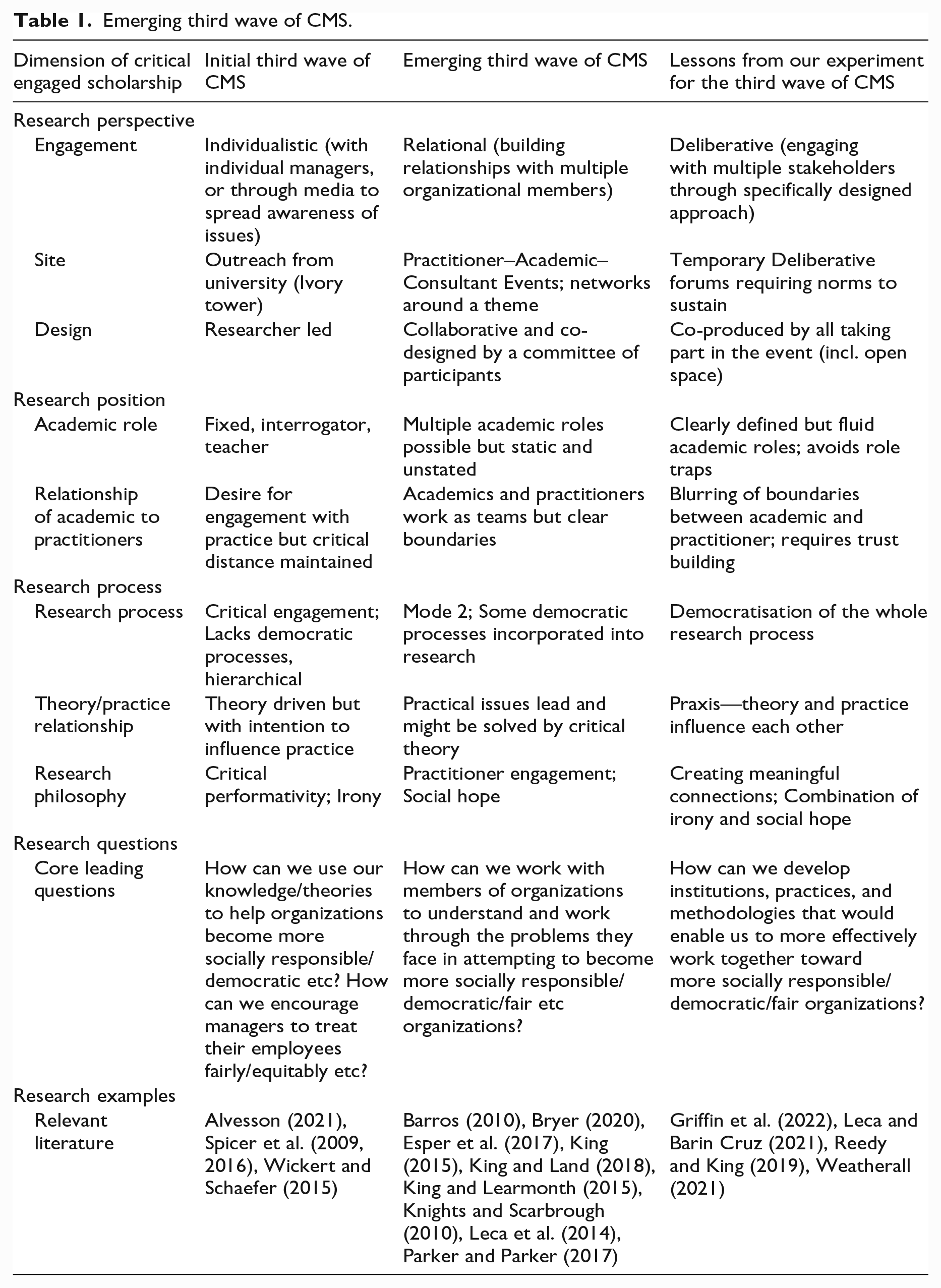
In the remainder of the discussion, we now explore the central implications of our findings and what it means for the third wave of CMS by making three normative proposals to CMS scholars about practical engagement. Our proposals, thus focus on rethinking the role of CMS scholars, in transforming their practice and what it means for the implications for critical research more widely. This is not to say that other stakeholders (i.e. consultants or practitioners), could not equally adjust their practice, but we suggest that the primary audience for this article will be academics, and therefore focus our reflections on this group.
CMS scholars should adopt a deliberative research perspective
The research perspective of many accounts of critical performativity focus on individualized interventions, such as “micro-engagement with managers” (Wickert and Schaefer, 2015; see also Alvesson, 2021), or efforts to convert middle managers into allies in the hope that they subsequently might act as change agents (Voronov, 2008). Instead, our event followed the lessons of others (Knights and Scarbrough, 2010) to encourage a more relational approach in which engagement involves building relationships with consultants, practitioners, and academics to bring a range of skills together. Engagement with practitioners, we argue, must move beyond mere “outreach” from the ivory tower where projects led by academics seek to do good in the world, converting one manager at a time.
In our event we found it extremely helpful to co-produce and co-design proceedings with a committee of people involved. However, this too had drawbacks and was perhaps yet still too exclusive. The lessons learned from the event (the move toward open space on the second day) suggest instead that embracing a deliberative perspective involving co-production by all involved within temporary deliberative fora may be more inclusive and rewarding. However, given the discomfort and friction experienced by some of our participants achieving this might require the cultivation of norms of deliberation around humility, reciprocity, and mutual respect (Griffin, 2012). In their earliest accounts of critical performativity Spicer et al. (2009: 550) do in fact point toward the potential value of “deliberative processes in multi-stakeholder forums,” whilst subsequently opting to engage in individualized practical examples. One of the core reasons for this might be the sheer challenge of making these larger collective, deliberative approaches to engagement work. Yet, whilst our event experienced challenges, it was at its most vibrant and inclusive when it embraced a deliberative perspective, using the Open Space Technology approach on day 2 (Owen, 2008), in which all could shape and contribute toward the proceedings.
CMS scholars should embrace a fluid research position
The research position of the academic assumed in initial accounts of the third wave of CMS largely maintained the academic as a teacher or as Ford et al. (2010: 78) suggest a “hero bringing knowledge and wisdom to current and future generations of managers” (Spicer et al., 2009: 538). While there was a clear intention to “mov[e] beyond the cynicism that pervades CMS” there was an understandable hesitancy about too much engagement, of “going native” and therefore maintaining critical distance. Instead, our event contributes an understanding that academics can have different roles in these engagements working in teams alongside practitioners. In their exploration of CMS academic relations with practitioners Butler et al. (2018) discovered “ethical difficulties” which our study also reflects (in the quite pointed and barbed remarks of academics toward consultants and the lingering suspicion between and within these groups). Nevertheless, rather than consider this an insurmountable issue pushing academics and consultants irreconcilably apart it is possible to take from our event a different lesson. A number of academics in the event worked well with the practitioners, finding it less difficult to engage and being less concerned with the moral and practical difficulties of blurring lines between groups.
What might be important instead, for these collaborations to work, is to have clearly defined and yet fluid academic and practitioner roles that can evolve and shift during and between events. The most productive way of achieving this might be to conduct thorough pre-event preparation for academic-practitioner engagement perhaps with profiles of participants with expectations, past research, and honesty about reservations, all of which might contribute toward trust and community building before the sessions begin. In addition to this, better training during postgraduate and early career periods of critical academic careers incorporating practitioners and consultants of (things like) workplace democracy, alternative organizing can be used to better socialise critical scholars into creating meaningful connections. As Leca et al. (2014) show, universities can have a central role in this process of building networks for the extension of CMS practitioner engagement (also see Leca and Barin Cruz, 2021). Whilst many differences and difficulties (ethical or practical) might remain between academics and practitioners, as with our event just as many of these can be down to miscommunication or people falling in to “role traps” of expected behaviours. Given the significant overlaps that we have witnessed between our own commitment to democratisation of organizations and more ethical ways of working with consultants and academics, it is very likely that many other CMS scholars given time and the right preparation through proper institutional support will begin to recognize the value in academics and practitioners working together as equals (Esper et al., 2017).
CMS scholars should democratize the research process
Initial accounts of the third wave of CMS adopt a research process which begins with practical issues but subsequently is theory driven with an intention to influence and change practice, through a process of Socratic irony. As Spicer et al. (2009: 547) suggest, “[t]he logic is to proceed from our informants’ practices and experiences and then expand horizons through selective and informed critical-constructive questioning.” Our event attempted to move away from this hierarchical, interrogative approach to conducting engaged research. Whilst it was helpful to conduct interviews prior to the event and to ensure people had knowledge of the organizations (for time purposes at least), incorporating democratic (sociocratic) processes into the event was also our attempt to flatten the overall research process, making it more inclusive and co-designed through consent decision making. We intended to contribute a process—guided by social hope—in which the practitioner was not the interrogated but was worked with through democratic processes to create possible solutions.
In practice this was much more difficult than we expected. As our results show academics sometimes reverted to critically “calling out” practitioners or frustrating the process by perhaps playfully questioning the rules of the event. Reflecting on these difficulties we believe that the instances in which the event’s process were most vulnerable were in academic participants not knowing enough how to work with others within unfamiliar democratic processes. The subsequent lack of authenticity and discomfort they felt in being out of control of the process points toward a need for capacity development. In learning how to understand and utilise democratic processes within their own research projects might prepare individuals and groups in methods of working together to help overcome some of the fear being experienced. Indeed, when the event switched to open space on Day 2, these difficulties reduced significantly, as participants had freedom to create and attend mini events that they were most interested in and could contribute most effectively. In many respects, this was achieved through the gradual shift from a largely hierarchical process of critical performativity (scholar helping practitioner), toward practitioner engagement (scholar working with practitioner) and eventually, we believe, toward a democratised process of creating meaningful connections (scholar co-creating with practitioner).
Toward creating meaningful connections
A significant overarching contribution of our work is to build on a growing body of scholarship which encourages CMS scholars to shift their efforts away from asking how a theoretical construct might help a practicing manager, or even how we might find solutions for them by working side by side, to focus much more precisely on how we might develop the institutions, practices, and methodologies that might enable us to work more effectively together, that is, to create more meaningful connections (Griffin et al., 2022; Leca and Barin Cruz, 2021; Reedy and King, 2019). In this sense, we should, as Butler et al. (2018: 441) suggest, “focus on the empirical realities of external activities rather than the romanticization of a theoretical construct.” Our event, whilst ambitious, failed in a number of different ways. However, in failing we have, as noted here, reflexively learnt how such events might work better next time. We strongly believe that a third wave of CMS would benefit significantly by co-creating events of this kind more regularly and developing collaborative co-operative systems within the rigid confines of the university system to make the practical effect of our activities (so often constrained by expectations of the traditional practitioner—academic relationship) much more possible and desirable for us all to engage in. It is essential, we believe, that CMS takes these challenges seriously and is willing to be daring enough to start creating meaningful connections so that we are able to realise the strength of our sub-discipline’s potential to make meaningful change in society.
Conclusion
In this article we have challenged the view that critical scholars just need to tear down the walls of the ivory tower and connect with practitioners. Clearly this is not enough (Parker, 2002; Willmott, 2008). The third wave of CMS needs not only to actively intervene into managerial discourse, but also transform the relationship we have with practitioners, consultants, activists, and others.
Based on our experience we see there are some practical lessons for such critical engaged scholarship, based on the principles of: (i) co-production of deliberative engagement between multiple stakeholders (academics, consultants, and practitioners) to explore practical issues facing alternative organizations and their members; (ii) breaking down and blurring of boundaries between academics and practitioners in the engagement process so that more possibilities emerge for creating meaningful connections; (iii) democratising methodological and institutional approaches to practitioner engagement including the democratic processes to guide the engagement.
Our experiences also suggest some related practical lessons for future critical collaborations. First, in future experiments we would more carefully align the ethos of the collaborating scholars with the designed format of the deliberative setting. We had somewhat naively believed that the attending academics being critical scholars was enough to make the experiment work—that they would naturally adapt to this collaborative environment. We did not think sufficiently about their practical experiences with the types of deliberative meeting format that we used or their experiences of working directly with alternative organizations. Our format only really worked with critical academics who had similar experiences to us, who had worked with and were comfortable in these alternative, deliberative meeting formats. Had we thought more about this then we could potentially have developed different meeting formats that could have used the skills, experience, and outlook of the different critical academics in ways that were more aligned and productive for all involved.
Second, in future experiments more time and space needs to be dedicated to help critical academics and practitioners or consultants to learn from and understand each other. If we are to blur the boundaries between academics and practitioners, it is essential for individuals to start to hear and consider the potential overlaps. Within this experiment we did make sure to develop spaces for caucuses of different groups to come together and reflect on their own experiences, but we did not provide opportunities for these groups to listen to and learn from each other. Had we done so, particularly using approaches such as appreciative inquiry so that different groups can seek to understand each other’s point of view, then potentially some of the barriers between these groups might have been able to be worked through.
Third, we suggest that critical scholars seeking to work with practitioners, consultants, activists, or other groups come together and share their experiences of how they seek to do and improve democratic organizing. Making meaningful connections between critical academics and other forms of practitioners is going to require new skills and abilities, which can be developed through sharing and learning together. This also has implications for how we think about supporting doctoral and early career researchers to develop the skills for this emerging third wave of critical scholarship. Building collaborative and deliberative skills of humility, reciprocity and mutual respect (amongst others) seems essential for creating lasting meaningful connections between critical academics and practitioners. This, in turn, might enable us to start “walking the talk” (Contu, 2018) and help us to work together collectively with like-minded individuals to increase the level of positive and ethical change that we make within the world.
Supplemental Material
sj-docx-1-org-10.1177_13505084231176118 – Supplemental material for Creating meaningful connections: An experiment in practically engaged CMS
Supplemental material, sj-docx-1-org-10.1177_13505084231176118 for Creating meaningful connections: An experiment in practically engaged CMS by Daniel King and Martyn Griffin in Organization
Supplemental Material
sj-docx-2-org-10.1177_13505084231176118 – Supplemental material for Creating meaningful connections: An experiment in practically engaged CMS
Supplemental material, sj-docx-2-org-10.1177_13505084231176118 for Creating meaningful connections: An experiment in practically engaged CMS by Daniel King and Martyn Griffin in Organization
Footnotes
Funding
The author(s) disclosed receipt of the following financial support for the research, authorship, and/or publication of this article: We would like to thank the ESRC for the financial support for the research that led to this article. A Democracy to Come? Investigating Change in Alternative Organizations, ESRC, ES/N001559/1.

Supplemental material
Supplemental material for this article is available online.
Author biographies
References
Supplementary Material
Please find the following supplemental material available below.
For Open Access articles published under a Creative Commons License, all supplemental material carries the same license as the article it is associated with.
For non-Open Access articles published, all supplemental material carries a non-exclusive license, and permission requests for re-use of supplemental material or any part of supplemental material shall be sent directly to the copyright owner as specified in the copyright notice associated with the article.
