




Abstract
This article is a call to embrace and work towards a specific form of intellectual activism in business schools. Based on the inspiring work of Professor Patricia Hill Collins and other Black feminist and post-colonial scholars, intellectual activism is here defined as ‘the myriad ways in which people place the power of their ideas in service to social justice’. This article calls for and delineates a positive response to the current crisis by identifying key features and areas of work that scholars can engage with in ‘walking the talk’ of critical work in business schools.
Keywords
In 2016, I was invited to give one of the keynotes at the Latin American and European Organization Studies (LAEMOS) conference and then to the European Group for Organizational Studies (EGOS) sub-plenary five. Both were an honour and an opportunity. What you are reading is a short version of those talks. 1 My interventions focused on the concerns I (arguably with many in our field) had been chewing over for a while about critique and our role and position as management educators and business school academics in doing more than just offering sophisticated interpretations based on various forms of critical theories, something that I have been doing for about 20 years. These interpretations, while important, often do little more than build our professional identities and develop specific research enclaves like, for example, critical management studies (CMS). More is needed, and in this article, I elucidate what this is and why it is urgently needed.
Marx famously pointed out in the Theses on Feuerbach that ‘philosophers have hitherto only interpreted the world in various ways; the point is to change it’. Marx had, to put it mildly, a set of suggestions on how to go about changing the world. This is not a mere trope. Drawing upon Marx’s ideas, and on occasion in his name, several social changes have occurred – many progressive and emancipatory ones, some others less so. Critical scholars have been stuck on this point on how to change the world for about 30 years. Think of all the critical work, for example, that has become known as CMS; combine it with the critical work of those who do not identify with CMS but have, nonetheless, an interest in more humane and just work/organizational relations, for example, the humanist management network. Collectively, we have created sophisticated analyses on the dark side of organizing/managing; the complex ways in which power works to subjugate and exploit individuals and communities; and how we are complicit in such practices and institutions that reproduce economic and environmental exploitation, White supremacy, heteronormativity and colonial and patriarchal relations. The emancipatory intent of such critical work has often been declared (e.g. Alvesson and Willmott, 2012). The need to ‘walk the talk’ of our refined critical theories and analyses to influence and change our societies has been the object of much discussion also in this journal. More work is needed to go from what Sarah Ahmed has called talking about the ‘doing’ to doing the ‘doing’ of critical work. So let’s focus on our doing, on our academic praxis.
My invitation to you, readers of Organization, is to reframe your academic praxis by embracing and working towards intellectual activism. Intellectual activism is defined as ‘the myriad ways in which people place the power of their ideas in service to social justice’ (Hill Collins, 2013: ix). Inspired by, and building on the scholarly work and experiences of post-colonial, critical race and Black feminist intellectuals such as Patricia Hill Collins, Angela Davis and bell hooks, I elucidate the characteristics of intellectual activism for management academics. This work is consciously, progressively transmodern, parrhesiastic, demiurgic, engaged and intersectional. Many academics all over the globe are already engaging, every day, in the type of intellectual activism distilled here, so I provide some examples of their work, as well as my own.
In the conclusions, I return to the difficulties of intellectual activism and also the urgency for all of us to work openly for a fairer and more just world in our everyday praxis as management academics.
Notes on writing
This short article is an ‘hybrid’. It respects genre-specific elements, for example, customary structure. But it is not written entirely according to the canon of academic articles. Since Organization is an academic journal, I could not go ‘all the way’ writing in the style of my Guardian article in January 2017 on intellectual activism. Still, my aim is to avoid mechanical writing since this would lack the passion and intensity needed to engage the readers of this journal. 2 My writing, by necessity ‘telegraphic’, is more popular than traditionally ‘academic’. For example, being an invitation to action, I refer directly to you – the readers – and imagine questions you might have. Also, theories, with their authors, are present. But they are the tools, only when necessary visible that are used to craft the argumentation to engage in intellectual activism, not to grant its authorization. References are a sort of shorthand, designed to favour your engagement without burdening the prose and immediacy of the argument.
The main point of this article is to act, not to write up a theoretical disquisition on activism (see Contu, 2017). This article is a ‘hey you!’ as it interpellates you in specific ways. It calls you to do something: to study/reflect on intellectual activism and to discern how your academic praxis is/can be at the service of social, economic and epistemic justice.
Why do we need intellectual activism now?
The first is a political-disciplinary reason. The second is an historical-political reason. The third is an obvious reason. Let’s see them in order.
The first political-disciplinary reason for this invitation to engage in intellectual activism is because this journal, as indicated in its editorial information, has openly supported critical work and has fostered contributions to build a neo-disciplinary organization studies centred on the critique of organization, theory and society. The growth and consolidation of Organization and that of CMS have gone hand in hand, so it is fitting that an article that directly addresses how to ‘walk the talk’ of critical work is published here. After all, critical enclaves have plenty of luminaries well versed in critiques that explain the most pernicious individual, organizational and collective effects of sexism, racism and global capitalism. Yet, there are also plenty of experiences of sexist, colonial, racist, un-democratic and exploitative practices in such enclaves (Tatli, 2012). Theorizing about ‘differences’ in gender, race, class and theorizing on how ‘to walk the talk’ of CMS is important but, as we have already seen, is not enough. What we need, as in the remit of Organization, is to build our discipline and our work differently. We need to have a collective orientation starting with ourselves and what we do since the ‘personal’, our subjectivity, is political and ethical (see, for example, Carol Hanish, Angela Davis and Emmanuel Levinas’ work) not just in books (or articles) but in our everyday lives. This is why I am talking directly to each and one of you.
Let me clarify what it means to build our discipline and work differently. ‘Differently’ here means to re-orient our academic praxis focusing our work on social change. You might say that this is nothing new since ‘relevance’, ‘impact’, ‘outreach’ and ‘engagement’ have become key terms in many academic discussions and for research funding bodies. Many academics claim and aspire to do work that changes the world for the ‘better’. Intellectual activism is different from other forms of scholarship that aim in one way or another ‘to change the world’, such as public critical management scholarship, phronetic scholarship and engaged scholarship, because it addresses our academic praxis at 360° in the service to social justice, asking us to be accountable to it. It does not focus only on the practices of our research and knowledge production. It includes our teaching, our service and admin work re-orienting them towards a specific notion of social change, one that is directly conjugated with social, economic and epistemic justice claims and issues (see Contu, 2017; Hill Collins, 2013).
Intellectual activists address social change by facing the justice issues/demands, starting from where one is situated geographically, institutionally, socially and so on and working with others to face such issues (see Davis, 2016). They also understand and situate such justice demands/issues in the history of progressive collective politics and politics of thought, and they face them by advancing and re-articulating democratic values of freedom, equality and solidarity – more on this, with examples, later.
The second historical-political reason to engage in intellectual activism is that a time of crisis, such as the present one, calls us to discern the role we play and the contribution we make to the new social order that is struggling to emerge. The neo-liberal hegemony has been the global, naturalized world order for about 40 years. A Gramscian lens shows us that this hegemony is in crisis as the legitimacy of its shared values, systems and beliefs has been tainted and the ‘usual’ responses offered by the establishment are not working. Dislocations of neoliberalism have, of course, been evident for a while, for example, the global financial crisis, growing inequality, wars and widespread hardship and so on. The last 2 years, with Trump’s election in the United States, Brexit and recently Corbyn’s unexpected results in the UK ‘snap election’, have crystallized, even for the most myopic in the Global North, that we have moved away from the dominance of There Is No Alternative (TINA). In such openness and fluidity, regressive and progressive forces are facing each other up in convoluted and complex ways. Each and every one of us is embedded in these changing times. Our actions (and non action) make a contribution to social reproduction or its change. Business schools (with all of us) have been forges and legitimizing apparatus of neo-liberal policies, values, ideas, models and subjectivities which have gone hand in hand with the marketization and commodification of the university (see Noam Chomsky and Nigel Thrift’s work). On occasions, this has been done actively, consciously and with zeal (see Mintzberg’s work). For many, the acquiescence of what Cabantous and colleagues have called the ‘supine academics’ has been the order of the day – part a conscious survival strategy and part the result of introjection of the values and measures of ‘success’ in the neo-liberal, corporatized higher education. There are many winners of course, but plenty of losers too.
Intellectual activism invites us to become aware of our role and our position in social reproduction and social change. It invites us to make a clear stand on which kind of world we want and what kind of people we want to be by making our everyday work at the service of progressive social, economic and epistemic justice, in whatever way we can and in the issues that are most salient in the conditions where we live.
The third reason is the obvious one for many of you reading this piece. You do not need anyone to expand on why we need intellectual activism because you already do it – often because you have no choice since your presence in academia bears a discontinuity, what Hill Collins (2013) calls a ‘violation of the rule’ (p. xx). Many of us see our academic praxis as part of work for social/economic/epistemic justice as we already know that our experience is unique, and yet it is also collective because it is linked to sedimented power relations and regimes of inequalities that affect groups differently. As such, it requires structural and cultural changes that can only be obtained by working with others in specific strategic ways.
Many of you are reading this from what are repeatedly/forcefully posed as the ‘margins’, the ‘peripheries’ of the world (e.g. the ‘developing’ countries and non-Anglophone countries), of management and organization as discipline (e.g. ‘niche’ topics, theories and concerns) and of ‘normal’ professoriate body (e.g. ‘other’ to White, middle-class, ‘able’-bodied, hetero, tenured man). I myself am in such a position: I am a tenured, foreign associate professor in Anglophone academia, a woman who writes critical, politically and philosophically grounded articles on managing, organizing and learning and is a manager well versed in the models and tools on managing, learning and organizing in a male-dominated, traditionally masculine institution; a ‘white’ Southern European Islander, often read as ‘Middle Eastern’, mother of a ‘black’, North African–born child in a society imbued in White supremacy. Hill Collins (2013: 11) has called these the experience of ‘outsiders within’, individuals at the boundaries of multiple groups of unequal powers. These experiences are important because they direct one to work towards social justice, often as a matter of survival. They also have an epistemic value. They open up to studying and learning about power dynamics/meanings/structures that help us produce a knowledge that is alternative to the ones where the rule is made, showing a pluriverse, which includes not only the suffering that comes from invisibilization, discrimination and systematic exclusion from material and symbolic resources but also the density and richness of lives, of joyful, enriching alternatives and opportunities (see Faria, 2014).
What exactly is ‘intellectual activism’?
Black feminist post-colonial theorists have long understood and explained the complex positions of ‘outsiders within’ and the history/history of thought where they are associated with political movements (e.g. women struggles, colonial struggles, civil rights struggles and workers struggles) and with ethical standing. They have crafted and put into practice values and methods where one uses such positions/experiences to work to change the conditions that shape them – this is what intellectual activism, encapsulated in Hill Collins (2013) is all about. This is also why these activist scholars and their work inspired me. They have produced a wealth of experiences, knowledge, languages, strategies and methods I have learnt from and continue to learn from. I invite you to consider what you can learn from it in order to work towards a fairer, more democratic and equal organizational, work and learning relations. Now let’s get some details.
Intellectual activism is consciously and decidedly an embodied praxis, as in Paulo Freire’s reflection + action. It regards our entire academic praxis. It invites us to actively work towards social, epistemic and economic justice not only in our research, writing and publishing but also in our teaching and our service in our schools, journals, professional societies and associations, our professional communities, business communities and beyond. Intellectual activism is ‘engaged’ since it is always consciously embedded in and concerned with justice issues/claims that involve multiple communities and agents, for example, students, administrators, the business community, local and national government, non-governmental organizations (NGOs) and Civil Society Organizations (CSOs). Intellectual activism is a ‘concrete’ praxis because it goes beyond armchair intellectual work. It has a practice-base component and orientation towards the burning problems our communities face. It is part of a concrete act of care and solidarity specifically situated in the history of progressive social and economic change one is facing.
The intellectual activism described here is not reactionary. It can better be described as ‘progressively transmodern’. This means that it invites us to take seriously the history of exploitation and oppression reproduced by different forms of political economy, including capitalism, White heteropatriarchy, colonialism and imperialism, and the progressive struggles for freedom and equality. It is transmodern because it re-articulates the values of modernity (of the enlightenment and democracy, freedom, solidarity and equality) in a way that appreciates and builds upon the history and history of thought that has shown its limitation and contradictions (see Faria, 2014). To elucidate all of this in practice, let me give you an example. Vida, which is an association of critical scholars I am part of, supports the work of women and queer, trans, non-binary people in business schools and academia struggling against discrimination, harassment, marginalization and exploitation. Vida aims to put into practice intersectional feminism and critical theories by acting in caring ways and building solidarity structures and enclaves changing academia from within. If you were a cisman business academic working as an intellectual activist, you would understand and support the decision to exclude cismen from Vida membership. You would not misappropriate words like ‘equality and inclusion’ to claim reverse discrimination because you would recognize the history of heteropatriarchy and the power dynamics that reproduce it and the privileges that they bestow on you qua cisman. Cismen exclusion from this group is strategic. It allows for a safer space for Vida members to express our own voice, sharing solidarity, resources and strategies in this struggle. To be clear, if you are a cisman, this work is not ‘against’ you or any other cismen. In fact, I hope you are, or might consider to become, allies in this struggle to create freer and more equal working and educational spaces and societies. Your support and solidarity to Vida are needed as is your everyday work in your business schools and communities that counters harassment and discrimination, avoiding traditional micro-aggressions, for example, mansplaining, or the routine unacknowledged/unpaid appropriation of women’s labour, and instead forwards freedom, equality and care as in the Vida’s mission and objectives.
Intellectual activism is also intersectional because it uses intersectionality to interrogate power relations, that is, how differences are actualized in patterned disparities and asymmetries, for example, differences regarding racial and ethnic background, class, physical ability, age, sexuality and gender, and the inequalities therein generated, and the ways to transform and emancipate them. The term intersectionality was coined by Black feminist legal theorist Kimberlé Crenshaw and then elaborated by others to understand, give voice and value the experiences of Black women. It exploded the limitation of leftist work that focused exclusively on class and economic relations, or anti-racist work that concentrated on a monolithic notion of race and feminism that has considered almost exclusively the needs, experiences, knowledge and oppression of White middle-class women. Intersectionality means to consider how inequality is shaped at the intersections of class, race, gender and so on. It examines the axes of privileges and penalties, opportunities and constraints in which groups and individuals are positioned, constituted and systematically affected in different social milieus as they are catalysed by specific power relations (Hill Collins, 2013: 232–33). Intersectionality is a critical analytical tool in research. But it is also a critical praxis (Hill Collins and Bilge, 2016) in as far as it is used as a thinking strategy, an analytical/interpretive key and a pragmatic test to be used in the decisions we make in our academic praxis, in the actual work we do in making a difference every day. This means to use intersectionality diffractively, that is, with attention/care to the pattern of differences our decisions generate. In practice, this means to interrogate oneself on the consequences/implications of the decisions we take every day.
For example, the original group of Vida included women of different colours, from different ethnic, religious and cultural background who wanted to walk the talk of their refined critical theories. My view is that we were all united by the desire to make a positive difference against the hierarchical power structures and cultures we experienced as limiting in British and North American academia still ripe with colonial, traditional masculine values of the empire, of course, ‘revisited’ slightly in the case of the United States. Social media have helped Vida to become a much more geographically widespread, an ethnically, religiously, racially and culturally diverse group inclusive of multiple sexual and gender orientations/identifications. As a collective identity and agency, Vida has developed a more fluid gender identity and a clearer intersectional outlook, attention and care. Vida is not perfect. Our collective and individual work continues. But Vida addresses intersectionality by being an intersectional collective agent, by maintaining a constant attention to intersectionality as a critical praxis. For example, members reflect on, discuss, give solidarity to and share resources and tools to address issues at the intersection of axes such as race, sexual orientation, ethnicity and class structures that affect our lives as academics and that of other working people.
Are you thinking that the intersectional feature of intellectual activism is just another exercise in ‘political correctness’? No, it isn’t. This is about practically facing up to the burning demands for social, epistemic and economic justice we are experiencing especially in times when progressive democratic values and practices are not only not available for many but are also more obviously under threat. Confronting and checking one’s privilege elicit uncomfortable feelings because we all have stories where we were penalized, when we suffered and had to struggle for recognition or for ‘that’ promotion, ‘that’ grant, that ‘position’ and so on. This is why it is important to appreciate intersectionality fully, with the complex axes of privileges as well as penalties each of us is situated in; and also to study history and the sedimented power relations that systematically reduce freedom and heighten inequities for far too many in our societies.
Intellectual activism is also ‘demiurgic’ and ‘parrhesiastic’ – two Greek-derived words to connote specific features/practices. ‘Demiurgic’ refers us to the Greek δηµιουργός, artisan, in antiquity, an entity linked to the creation of the world, but unlike a God’s creation, this was messy, sometimes also ‘evil’. ‘Demiurgic’ excludes the notion and temptation of a whole powerful, perfect creation. While we are still responsible for what we do (or not), this word brings forward the material, craft-like, messy, impure, creative, performative ‘building work’ that is an integral part of this praxis (Contu, Forthcoming). One cannot fully control it and its consequences. It will always involve power and therefore include forms of exclusions, for which we are nonetheless responsible. The second word ‘parrhesiastic’ encapsulates the significance of critical work understood as a specific attention to power and its dynamics. Power dynamics are not only examined, theorized (in whatever way) and written up in articles for leading academic journals. These examinations are used as solid and rigorous knowledge basis on which to exercise frank and fearless speech speaking truth to power (i.e. the ancient Greek institution of parrhesia), to speak against the inequalities and injustices they reproduce and also to intervene directly advocating for the alternatives that can be generated and/or are already present in the arena and dynamics under study.
Studying and archiving complex entrenched regime of oppression/discrimination and the winner and losers of organizational and managerial solutions, methods and theories, together with rigorously studying the alternatives to existing exploitative relations, how they function and how they are constituted and reproduced, are important parts of the critical work done by intellectual activists. This work is done not only engaging in academic debates but also by speaking out in the media. This opens up to the plurality of realities, experiences, conditions and their deep value in enriching democratic debate and options on public policies. For example, Professor Alcadipani’s research with the Sao Paulo police has allowed him to contribute to a number of research debates. But it has also become an important platform to engage the Brazilian federal government, state government, police management and public opinion. Professor Alcadipani joins debates in the media and is involved in specialist seminars and development events, for example, at the Sao Paulo Police Academy. He also worked with the ministry of justice on police reform and with other agencies on a plan to reduce homicide in Brazil. This conjunctive strategy involves direct advocacy and planning work to engender more just practices and processes in the way police operates and its role in a democratic society.
Intellectual activists, in other words, go a step further in their parrhesiastic and demiurgic work. They ‘speak truth to the people’ as Hills Collins (2013: xiii) put it, because they engage concretely with different constituencies using their knowledge to help build and consolidate alternatives, becoming advocates, supporters, strategizing and organizing the alternatives, not only writing about them. Let me return to the example of Vida that was born as a way of being intersectional feminist and critical scholars in practice not only in theory. The idea is to start with our own work, our own research, the way we talk or not, silence or challenge or educate or learn from our colleagues, our students, our bosses, our communities, trying to make a positive difference every day in our academic lives. Another group that embodies the demiurgic and parrhesiastic qualities of intellectual activism is a new collective that was born fittingly in Liverpool, at the CMS 2017 – the Decolonializing Alliance (DA). This group 3 aims to offer support, solidarity, develop and spread knowledge, resources and tools to decolonialize management starting with the knowledge we produce and how we behave and conduct ourselves in our work with our students and colleagues, and communities everywhere, every day.
In many ways, the work of Vida and the DA is parrhesiastic, but it is also demiurgic because it is about crafting a consciousness, and a conscience, an agency working towards the constitution of a collective agency. This agency directly ‘speaks truth to the people’ by acting in some of the key practices of our academic profession and doing them in less oppressive ways. For example, academic conferences are often alienating and dispiriting places, and CMS is no different (Bell and King, 2010). Panels, keynote speakers, question times, lunches and dinners are in many ways dominated by White cismen on the top of the social/academic hierarchy; women, lesbian, gay, bisexual, transgender and queer (LGBTQs) faculty, academics of colour, precarious faculty, doctoral students and those who are not from the ‘top’ business schools, from the ‘top’ countries, using the ‘top’ theories are more or less welcomed ‘guests’, invited to ‘network’ with the ‘top-dogs’ and, who knows, maybe strike a deal for a collaboration, an invitation or similar, continuing thereby to reproduce the very system that keeps us all as ‘guests’.
Vida and DA members and queer activists have challenged all of this by organizing welcoming/caring working spaces. The ‘critical friendship’ stream organized by Vida members at numerous conferences, for example, CMS, British Academy of Management (BAM) and Gender Work and Organization (GWO) and North American Academy of Management (AOM), at various points in time aims to create a supportive and friendly environment where detailed suggestions are shared on the papers presented in ways that challenge the sexist expectations and manners (i.e. ‘Listen, I tell you what to do’, ‘you need to aim for a lower category journal’, ‘you need to write in a less feminine manner’, ‘you need to bring out your emotions’) in which ‘outsiders within’ routinely receive comments. Vida members and intellectual activists working on de-coloniality submitted streams to populate the CMS 2017 conference in order to multiply options and have streams lead in ways that aimed to reject one-upmanship and are instead open and welcoming to differences of theories, issues and being. Other practices that consolidated the collective identity and actively subverted traditional boundaries and expectations of scholarly work, activism and conference participation/behaviour included the creation and circulation of a game to capture sexist and chauvinist conducts and another one to celebrate and recognize solidarity. These were then represented in the ‘solidarity banner’, an installation put up in the main conference area by Vida and DA members and queer activists giving voice and claiming a visible, positive space for those who are ‘guests’, always called to ‘fit in’. This artefact also contained a clear message of critique of the conference organization and the ways in which it reproduces symbolic and material inequalities. The collective work of Vida and DA members and queer activists was instrumental in the creation of a document that I put together and submitted to the International CMS Board as this board coordinates the process on who organizes the International CMS conference. I also drew upon the constructive critical engagement with the organizers of CMS 2017 of Professor Hansen with other disability activists in writing a document that as a board member I have asked the Board to use as the guideline by which the next organizers will have to operate. This is a ‘boundary object’ that keeps our knowledge and our struggle alive. The struggle is to minimize the reproduction of oppressive and humiliating practices and instead actively work to build spaces that are welcoming to and celebrate differences in doing critical academic work.
Concluding remarks
I have sketched what intellectual activism is and offered you some examples from business schools (see also Contu, 2017). I have included a table in Appendix 1 with actual practices you might want to consider and the questions I find useful in interrogating my own praxis. In concluding, I want to dispel some potential ‘myths’ that can get easily attached to something like intellectual activism and highlight the work that is sorely needed.
Creating accountability structures and cultures
Intellectual activism invites us to become accountable and responsible for how our work is in the service of social justice (Hill Collins, 2013). Accountability is something we have done very little work on as critical scholars in business schools. We have often denounced the lack of reflexivity in articles, panel discussions and so on. But we need to organize ways in which we can redress the constant hiatus between the magnificent, often caring and empowering words written in articles and uttered at conferences/workshops and the often concomitant unjust practices. In my role as head of department, for example, I worked with my colleagues to develop ways in which we can address some of the entrenched dynamics based on intersectional axes of gender, class, hierarchical position and disciplines that are directly deleterious to some of us. They reproduced injustices and reduced our collective abilities and options. To counter some of these, we have agreed a set of ‘rules of engagement’ to talk and discuss with each other or we have opened up business meetings to non-tenured faculty. In CMS circles, the International CMS board was constituted and elected to inject a level of accountability and democratic process for the organization of the International CMS conference. Vida and the DA are other examples of building collective agencies that call us to ‘show up’ for social justice not only by writing critically oriented articles but also by changing the practices in which we conduct ourselves in reproducing inequities and injustices. There are many more experiences, experiments and examples. These are just a few small steps, examples that I bring in because I know them well. My colleagues and myself have still much work to do. The International CMS board struggles to work effectively; with Vida and DA, we have more work to do on building our agency, our accountability and engaging intersectionality as a critical praxis. At the same time, these are initiatives all based on free labour, on service and passion for social justice and solidarity. They are hopeful in many ways liberating innovations in management academia to build a better world.
This leads to the other important point I would like to stress: the collective work of intellectual activism is not easy. There is nothing romantic about it. It is difficult and time-consuming. Business schools call us to be organic to the status quo, while intellectual activism is focused on how our knowledge can counter injustices. It is hard work that is often unaccounted for within the matrixes of the status quo. For those who are ‘within’ and those who are ‘outsiders within’ the pressures to ‘succeed’ according to the dominant paradigms is enormous given the wealth of symbolic and material benefits it bestows or refuses. The pressures and pains to perform at the top of one’s ability, to be liked and respected by all, to earn enough to enjoy the comforts one desires or, simply put it, to keep up whatever ideal that structures one’s subjectivity have a significant density and force. This, of course, might fuel the energy and passion needed for the labour of the intellectual activist. But it can also work against the collectivist and non-narcissistic dimensions of this work.
Some of us, because of the conditions we live in, can do more; others can do little in certain occasions and more in others. Also, one can get side-tracked by what Hill Collins (2013) calls ‘personal revolutions’; these might offer nuggets of enjoyment, but we should not fool ourselves – oftentimes they are sideshows.
Fostering agential capabilities
I think we need to do more to build agential capabilities to work at the service of social justice. There is much work carried out on critical management education; plenty of books, tools, groups and resources are widely available, including online. What about how to be an academic manager, or a reviewer, or a journal editor, or a president or chair of an academic association who actively works in the service of social, economic and epistemic justice? When it comes to research, how are we developing scholars who are not only interested but also able to work in the service of social justice? For example, how to speak multiple languages of the media and the different constituencies one needs to engage with? How to build bridges and coalitions in ways that are respectful, collaborative, intersectional, democratic and non-exploitative? In many ways, I think we need humility to know that there is much we do not know, and do not know how to do. There is no one Saviour – one theorist or one activist – who will pave the way and sort everything out. We can all learn from each other; from our students; from managers; from workers; from intellectuals; from those who are dispossessed who lost their country, their job, their belongings, their health and their freedom; and from other activists and intellectual activists who have been doing the work towards social justice intersectionally for a long time before us.
Building accountability structures/cultures and fostering agential capabilities should not be conflated with a policing exercise. We are all impure; what we do is impure. I take responsibility and have paid a dear price for my inability to be more caring and to fulfil the needs of one of my collaborators. I also deal regularly with the dilemmas generated by financial pressures and cost cutting exercises that directly impact myself, students and faculty. But this is no power-free work. One has to stay reflexively aware, committed/faithful to make a progressive positive difference and always be responsible for such differences in order to build more equitable, caring and freer relations.
The work for social justice comes in many guises, and its value and meaning is not decided a priori, in abstract terms. It can only be fully decided in the specific, situated conditions where we are called to reflect and deliberate what it all means to us, where we stand, what we want and how we are going to get it done. After all, in times where we have record levels of inequalities between rich and poor and neo-fascists, White supremacists and authoritarian voices have gathered centre stage and their racists and bigoted values and practices imbue key societal institutions in many places; we have escalating words on nuclear war; we have people fleeing war and desperate conditions who are banned, hated and left to die; and we have a planet that is less and less hospitable because of our abuses of it, offer plenty of options for intellectual activism in studying and proposing innovative management and organizational theories, models and solutions. I hope my invitation has reached you. If you already engage in such praxis, I hope that this has fortified your resolve to continue this work building new coalitions, creating more equitable and less exploitative organizational and management alternatives with others. If this is all rather new, I hope you consider intellectual activism in your academic praxis since in these times where powerful leaders like the President of the United States hints at a moral equivalence between armed Nazis, White nationalists and supremacists with anti-racists and anti-fascist demonstrators, silence is becoming a notably less viable option. We all have a role to play. I hope this article helps you in elaborating yours.
Footnotes
Appendix 1
Intellectual activism useful questions and practices.
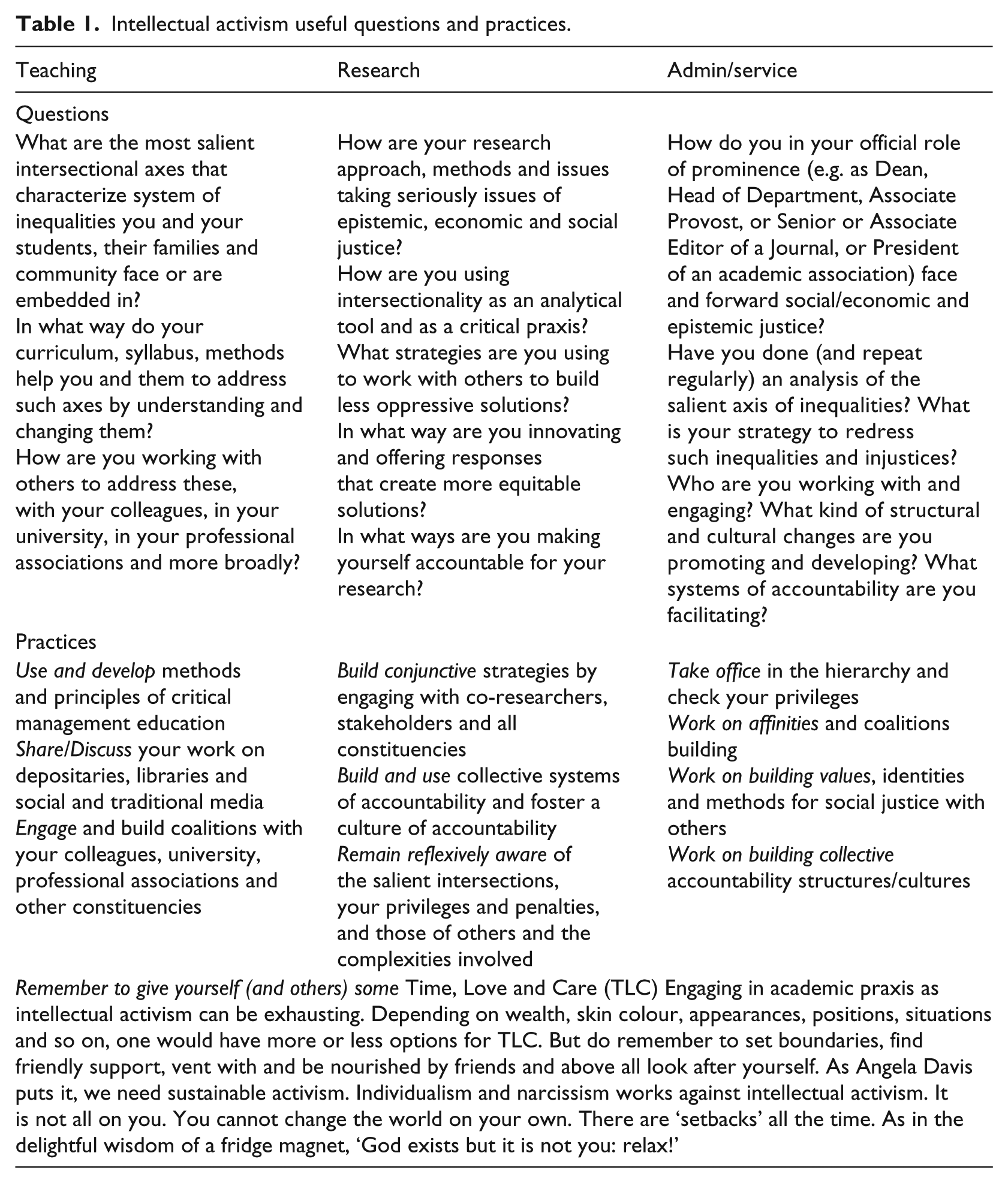
| Teaching | Research | Admin/service |
|---|---|---|
| Questions | ||
| What are the most salient intersectional axes that characterize system of inequalities you and your students, their families and community face or are embedded in? In what way do your curriculum, syllabus, methods help you and them to address such axes by understanding and changing them? How are you working with others to address these, with your colleagues, in your university, in your professional associations and more broadly? |
How are your research approach, methods and issues taking seriously issues of epistemic, economic and social justice? How are you using intersectionality as an analytical tool and as a critical praxis? What strategies are you using to work with others to build less oppressive solutions? In what way are you innovating and offering responses that create more equitable solutions? In what ways are you making yourself accountable for your research? |
How do you in your official role of prominence (e.g. as Dean, Head of Department, Associate Provost, or Senior or Associate Editor of a Journal, or President of an academic association) face and forward social/economic and epistemic justice? Have you done (and repeat regularly) an analysis of the salient axis of inequalities? What is your strategy to redress such inequalities and injustices? Who are you working with and engaging? What kind of structural and cultural changes are you promoting and developing? What systems of accountability are you facilitating? |
| Practices | ||
| Use and develop methods and principles of critical management education Share/Discuss your work on depositaries, libraries and social and traditional media Engage and build coalitions with your colleagues, university, professional associations and other constituencies |
Build conjunctive strategies by engaging with co-researchers, stakeholders and all constituencies Build and use collective systems of accountability and foster a culture of accountability Remain reflexively aware of the salient intersections, your privileges and penalties, and those of others and the complexities involved |
Take office in the hierarchy and check your privileges Work on affinities and coalitions building Work on building values, identities and methods for social justice with others Work on building collective accountability structures/cultures |
| Remember to give yourself (and others) some Time, Love and Care (TLC) Engaging in academic praxis as intellectual activism can be exhausting. Depending on wealth, skin colour, appearances, positions, situations and so on, one would have more or less options for TLC. But do remember to set boundaries, find friendly support, vent with and be nourished by friends and above all look after yourself. As Angela Davis puts it, we need sustainable activism. Individualism and narcissism works against intellectual activism. It is not all on you. You cannot change the world on your own. There are ‘setbacks’ all the time. As in the delightful wisdom of a fridge magnet, ‘God exists but it is not you: relax!’ | ||
Notes
Author biography
 is part of a project for 2018. It contains details, stories, materials and resources for those who wish to explore, and engage with this academic praxis, share and connect with others.