




Abstract
It has become normative in organization and management studies literature to consider scaling as a synonym for organizational growth. Scaling is typically understood as scaling-up. This article demonstrates that, in the context of post-growth organizations, scaling involves a more complex set of dynamics. Directing scholarly attention to scaling in the context of Italian Social Agricultural Cooperatives (i.e. organizations that hold a different rationale and modus operandi from the capitalist enterprise), this research contributes to the literature on scaling the impact of post-growth organizations by identifying nine different scaling routes: organizational growth (vertical and horizontal); organizational downscaling; impact on policies; multiplication; impact on organizational culture; impact on societal culture; aggregation; and diffusion. This article demonstrates that post-growth scaling: (1) requires the synergistic interaction of different strategies; (2) focuses on impacting societal culture; (3) does not necessarily require organizational growth; and (4) is a relational process, embedded in socio-ecological systems. The typology presented in this article empowers post-growth organizations to become more aware of different available scaling routes, unlocking their transformative potential and supporting the transition towards a post-growth future, in which the goal of economics is the pursuit of human and ecological flourishing.
Introduction
‘Anyone who believes growth can go on forever is either a madman or an economist’ (attributed to Kennet Boulding in: United States. Congress. House, 1973: 239).
For over 50 years, researchers from a wide array of disciplines have severely criticized the concept of exponential growth in a planet with finite resources (Daly, 1996; Kallis, 2020; Meadows et al., 1972). Organization and Management Studies (OMS) scholars have argued that economic growth (i.e. an increase in production and consumption over time) does not automatically translate to increasing prosperity (i.e. human and ecological flourishing) (Jackson, 2009). On the contrary, the myopic pursuit of growth results in human exploitation and ecological destruction (Chertkovskaya and Paulsson, 2021; D’Alisa et al., 2014). Rather than being ‘a rising tide that lifts all boats’, a narrow focus on growth has been accompanied by an increase in inequality, whereby ‘the rising tide has only lifted the large yachts, and many of the smaller boats have been left dashed on the rocks’ (Blauwhof, 2012; Stiglitz, 2015: 134). Nevertheless, growth remains the main focus of political economies worldwide; and measuring growth is still the primary means of accounting for economic success at organizational, institutional and national levels (Schmelzer, 2016).
As a reaction to the ‘growth fetish’ and a rejection of the inevitability of social inequality and ecological degradation, ‘post-growth’ organizations have emerged and attracted scholarly attention (Banerjee et al., 2021; Hamilton, 2003; Jackson, 2021; Pansera and Fressoli, 2021). Post-growth is defined as the combined theorization and application of different critical approaches to the hegemonic model of economic growth upon which neoliberal capitalism is constructed (e.g. including degrowth, agrowth, steady-state economics and post-development) (Gerber and Raina, 2018). A post-growth future – also described in terms of ‘life after capitalism’ (Jackson, 2021) – involves replacing this narrow focus on growth with a wider attention to human and ecological flourishing (Banerjee et al., 2021). From an OMS perspective, the transition requires business to operate at a ‘sustainable scale’, within planetary boundaries, and to ensure a ‘just distribution’, whilst ensuring fundamental human needs (Daly, 1992). While the ideology of growth is based upon realist ontologies and mechanistic approaches to organization (Ergene et al., 2021), a post-growth economy requires business to adopt an ecological approach, focusing on networks of relations and critically engaging with the impact of growth on social and ecological systems (Banerjee and Arjaliès, 2021). At a time when climate change is threatening human survival (and that of all species on this planet), transitioning to a post-growth future is topical.
In this article, post-growth organizations are defined as organizations which are ‘agnostic about growth’, constituted with the aim of creating ‘an economy that enables us to thrive, whether or not it grows’ (Raworth, 2017: 284). In the words of Banerjee et al. (2021: 346): ‘Post-growth organizations attempt to create value that is unrelated to growth’, with the aim of creating a more just and regenerative economy.
The question of how to transition towards post-capitalist societies and how to scale post-growth ideas and practices has emerged as a key area for research (Kallis et al., 2018), substantiated by the empirical identification of cases associated with significant scaling, but ‘very limited organizational growth’ (Bauwens et al., 2020: 202). It has been suggested that the normative equation of scaling as organizational growth has limited the potential of post-growth scaling (Gibson-Graham, 1996) and that alternative scaling routes can be identified for organizations motivated by a social purpose (Moore et al., 2015; Pansera and Fressoli, 2021). Post-growth scaling, however, requires more empirical research to clarify and examine its multiple dimensions and its ability to support the transition towards post-growth futures. In particular, scaling emerges from the literature as a fragmented topic (e.g. the same terminology is used to refer to different strategies). In addition, scaling has typically been approached from the point of view of individual organizations, while its relational character has largely been under-researched. In order to contribute clarity to the literature while empirically exploring scaling relations, this article draws upon examples from Italian Social Agricultural Cooperatives (SAC), an emerging and rapidly expanding form of social enterprise, which share a post-growth orientation and practice diverse scaling strategies.
Scaling is defined as the process allowing an organization to fulfil the needs it was constituted to address, while undertaking its vision of system change (Gabriel, 2014; Murray et al., 2010). Organizational growth is defined as organizational enlargement (e.g. through increase in revenues, assets and number of staff) and/or geographical expansion (e.g. through franchising and market penetration) (DeSantola and Gulati, 2017; Reuber et al., 2021). While organizational growth is generally considered as a means to achieve greater economic growth (i.e. increase in production and consumption) and capital accumulation (i.e. profit maximization), scaling is considered as a means to achieve greater prosperity (i.e. improvement in human and ecological wellbeing) and impact (i.e. need fulfilment and system change).
The overarching aim of this article is to identify, define and systematize the various types of scaling that are available to post-growth organizations. First, we seek to contribute clarity to a body of literature in which alternative constructs of scaling are present, but emerge as fragmented. Second, we provide post-growth organizations with clear strategic options for scaling their impact through building a typology of scaling routes. We argue that this will facilitate unlocking the transformative potential of post-growth organizations, challenge the material constraints that limit change and support the transition towards a post-growth future, in which the goal of economics is the pursuit of human and ecological flourishing. Our starting point is to problematize the mainstream use of scaling, contributing to the critique of the hegemony of growth within OMS.
Conventional meanings of scaling
Mainstream OMS narrowly consider scaling as a synonym for organizational growth. Such growth is often assumed to be necessary and desirable for organizations that seek to return profit to shareholders, achieved through economies of scale and increasing market share (Battilana et al., 2022). The terms ‘scaling’ and ‘organizational-growth’ are often used interchangeably, with ‘scaling up’ a buzzword used to refer to both (Jansen et al., 2020).
Although investor-owned firms can target organizational growth at the expense of profit (Zhou and Park, 2020) and a reduction in organizational size can be linked to increased profitability, for example in the case of demergers (Kirchmaier, 2003) and asset light business models (Banalieva and Dhanaraj, 2019), growth and profit maximization are only temporarily decoupled, or simply decoupled nominally. Given the dominance of the investor ownership model it is no surprise that return on investment and net revenue growth persist as common indicators in strategic management research (Roth and Morrison, 1990). That organizational growth is normative in OMS is revealed by statements such as that internationalization is the ‘result of doing something right’ (Verdin et al., 2001: 44), and that ‘scalability is about achieving profitable growth’ (Nielsen and Lund, 2018: 65). As Banerjee et al. (2021: 339) stated, in a recent Special Issue of Organization, ‘narrow concepts of growth have been canonized, often unwittingly, in everyday life and to a considerable extent by OMS scholars’.
Broader perspectives on scaling
The social enterprise literature offers a broader understanding of scaling than the conventional view. The Centre for Advancement of Social Entrepreneurship (CASE) at Duke University states that ‘social innovations can be said to have scaled when their impact grows to match the level of need’ (Gabriel, 2014: 4). In other words, scaling is not considered only in terms of organizational size, but more broadly as organizational impact. This broader understanding of scaling, which includes system change, is endorsed by a wide range of NGOs and social enterprises. Research exploring Indian NGOs finds an ‘old paradigm’, centred on ‘scaling up through expansion’ (i.e. organizational growth), integrated with ‘a ‘new paradigm’ of multiplication and mainstreaming through spinning off organizations, letting go of innovation, creating alternative knowledge, and influencing other social actors’ (Uvin et al., 2000: 1417).
New paradigms of scaling are present in the social enterprise literature, yet the conventional association between scaling and organizational growth remains normative. According to Marston (2000), the concept of scaling is dominated by a vertical ontology, whereby small and local initiatives are considered powerless in comparison with big and global actions. As Gibson-Graham (1996: xxvi) explain: ‘This [hierarchical] worldview demands that local initiatives ‘scale up’ before they can be seen as transformative’. Indeed, research suggests that social entrepreneurs may understand the growth of their organization to be the primary measure of scaling success (Ormiston and Seymour, 2011) and they typically operate with the calculus that ‘Greater scale = More impact’ (Molecke and Pinkse, 2020: 391). It is unsurprising then that geographical expansion, especially in terms of social franchising, has emerged as a primary approach (Asemota and Chahine, 2017; Conway, 2015). This is problematic, firstly because it delegitimizes the value of small-scale non-growth orientated social enterprises, and secondly because organizational growth has ecological impacts that need to be taken into consideration (Vickers and Lyon, 2014).
Typically, when considering scaling beyond organizational growth, the social enterprise literature conceptualizes it using a wide range of prepositions (e.g. scaling ‘up’, ‘out’, ‘across’, ‘wide’ and ‘deep’) (André and Pache, 2016; Bauwens et al., 2020). However, this terminology is not used consistently and thus creates a disjointed picture. Among the most influential theorizations, Moore et al. (2015) draw a typology of three different routes to systemic impact including scaling ‘up’, ‘out’ and ‘deep’. Scaling ‘up’ relates to influencing laws and policies; scaling ‘deep’ producing an impact on cultural roots; and scaling ‘out’ achieving geographical replication and dissemination.
Other theorizations include bi-dimensional approaches to scaling. For example, Gismondi et al. (2016: 2), distinguish between ‘scaling up’ and ‘scaling out’. The former meaning ‘escalating the impact of a particular innovation within the sector in which it operates, from community to city, from region to nation’; the latter meaning ‘taking innovations that have proven effective in one place, extending their impact through diffusion and adaptation into new geographical locations and new sectors’. Similarly, the OECD Policy Brief on Scaling the Impact of Social Enterprises identifies a double approach to scale (OECD, 2016). Referring to the work by Heinecke and Mayer (2012), the OECD differentiate between ‘scale wide’ – a quantitative approach aspiring ‘to reach greater numbers of users and beneficiaries’ – and ‘scale deep’ – a qualitative approach oriented towards diversification of the activities ‘either to address emerging needs at the local level or tackle the same needs from multiple angles’ (OECD, 2016: 4). These bi-dimensional approaches consider scaling as either a process of internal rearrangement or, more frequently, a set of strategies to move from-local-to-global through dissemination and geographical replication, which is what Moore et al. (2015) describe as ‘scaling out’.
Recent studies confirm that post-growth organizations are characterized by ‘a tendency to scale out (reproduce the model) instead of scaling up’ (where ‘scaling up’ refers to organizational growth) (Pansera and Fressoli, 2021: 392). While understandings of scaling as organizational growth assume that a single organization needs to scale, notions of ‘scaling out’ begin to shed light on the relational dimension of scaling. Researchers are now beginning to acknowledge the importance of adopting ecological perspectives in OMS (Ergene et al., 2021) and to explore the relationship between scaling and environmental sustainability. Goworek et al. (2018) invite management theorists to understand scaling in terms of ‘extending networks’, and Papazu and Nelund (2018), identify three ‘modes of scaling’ (i.e. rejection, innovation and conscious adoption of concepts such as climate change) through which organizations approach global issues as part of small organizational practices.
In summary, in the context of traditional management practices, scaling is inherently associated with organizational growth (i.e. expansion in size and/or geographical expansion), typically as a strategy to pursue shareholder value maximization under a neoliberal regime of accumulation. On the other hand, in the context of social enterprises, scaling is considered as a strategy for achieving greater impact, which is not necessarily accomplished through organizational growth (although scaling and organizational growth often overlap in the literature). In addition, conceptions and practices of scaling post-growth organizations appreciate that growth has ecological consequences and suggest alternative routes to impact, but these emerge as disjointed, are under-researched and lack empirical support.
Methodology
The literature review has revealed a fragmented understanding of post-growth scaling, in which strategies beyond organizational growth are emerging, but are in need of further exploration, elaboration and systematization. The empirical research presented in this article is designed to contribute to a more complete descriptive conceptual typology (Collier et al., 2012), which will form the basis for future analysis of post-growth scaling (Doty and Glick, 1994).
Research context, sampling and data collection
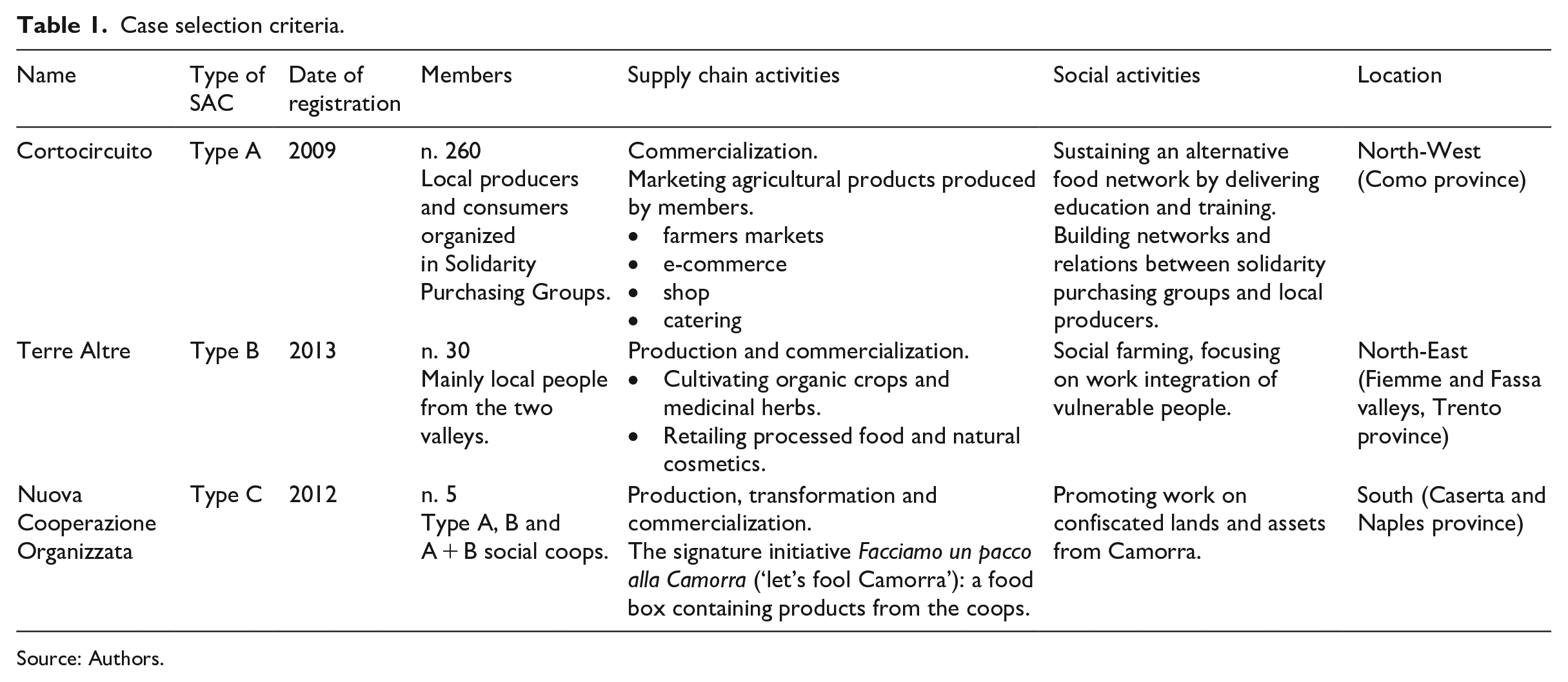
The research is based upon a qualitative case study of three Italian SACs: Cortocircuito (CC), a cooperative with a large member base, bringing together local producers and consumers to build alternative food networks; Terre Altre (TA), a small cooperative restoring endangered biodiversity and the cultural heritage of the Dolomites; and Nuova Cooperazione Organizzata (NCO), a consortium of cooperatives cultivating land confiscated from the mafia and providing vulnerable people with secure employment.
SACs are chosen as a unit of analysis because they are an emerging and rapidly expanding form of social enterprise, in which debates about scaling are present. In addition, SACs are emblematic of post-growth organizations that seek to combine a non-profit institutional identity with an ecologically regenerative and socially distributive organizational design. SACs are:
An evolution of the traditional Social Cooperative (Pansera and Rizzi, 2020), SACs are an emerging and rapidly-expanding type of social enterprise in Italy, rising from 108 organizations in 1993 to 389 in 2009 (Carini and Depedri, 2012) and to 430 in 2017 (Rete Rurale Nazionale, 2017). However, despite their novel organizational characteristics and significant expansion, which provide a window into a post-growth transition, SACs are under-researched (Carini and Depedri, 2012; Fazzi, 2011).
CC, TA and NCO were selected as case studies by adoption of a maximum variation sampling strategy (Palinkas et al., 2015). The selected case studies vary in terms of legal type, age, membership, position in the supply chain, mission, activities and location (Table 1). In addition, cases were selected to represent each of the three main types of Social Cooperatives recognized by the Italian law 381/91: Type A, B and C. According to law 381/91, Type A provide social-health care and educational services; Type B focus on work integration of vulnerable individuals (e.g. people with disability, minors in situations of family difficulties, people recovering from addiction, and those convicted and allowed measures alternative to detention); Type C are Consortia of Social Cooperatives (i.e. organizations which members are other Social Cooperatives).
Case selection criteria.
Source: Authors.
Data was collected during 11 months of fieldwork in 2017, through face-to-face semi-structured interviews with SACs members, participant and non-participant observations and documentary evidence, including company archives and public documents, newspaper articles and website links. A total of 41 interviews were conducted across the three cases (16 in CC, 8 in TA and 17 in NCO). Data saturation was reached earlier in TA than in CC and NCO, due to the relatively smaller organizational size, smaller number of actively involved members and deeper participant observation, which included active engagement in day-to-day farm activities and provided regular opportunities for informal conversations. The interviews were recorded and transcribed verbatim.
Semi-structured interviews became the primary method in the research because of the need to explore language usage. In Italian, the word scala is literally translated with ‘stair’, implying a vertical scale or set of steps. Therefore, to avoid misunderstanding and bias, participants were typically asked to elaborate on the strategies employed by the organization to fulfil the needs it was constituted to address (Gabriel, 2014) and to implement its vision of system change (Murray et al., 2010) rather than using the word ‘scaling’. Interviewees – chosen following a maximum variation strategy (Palinkas et al., 2015) – included cooperative members engaged in a wide-range of roles (e.g. managers, workers and volunteers), with different degrees of seniority (e.g. from co-founders all the way to newly acquired members), age and gender. This great variety of perspectives allowed for triangulation of data, providing robustness of analysis.
Data analysis
The analysis follows a grounded theory approach, extensively used for inductive theory building (Corbin and Strauss, 2008; Gioia et al., 2013). This approach develops in three stages: the definition of first-order concepts, second-order themes and aggregate dimensions. Our analysis added a preliminary step: the generation of granular codes through in-vivo coding (Saldaña, 2009). The granular codes were combined to form first-order concepts.
In the first stage of analysis, the codes remain participant-centred and were constructed using the participants’ own words to capture their own way of making sense of scaling. Following the first level of analysis, patterns within each cooperative began to emerge and recurrences across the cases became visible.
In the second stage of analysis, first-order concepts were aggregated to form second-order themes. We moved iteratively between themes, concepts and raw data in the three case studies to validate fit, starting from CC and moving on to TA and NCO to support or expand the emerging data structure. Adopting theory to interpret participants’ voices (Corbin and Strauss, 2008; Gioia et al., 2013), we initially applied the tripartite scaling framework elaborated by Moore et al. (2015) (i.e. scaling up, out and deep). However, it became apparent that this framework was insufficient to explain the complexity in the data. For example, Moore et al. (2015) – as most of the literature reviewed – assume that scaling is generally linked to expansion and does not typically equate to a reduction in size. In addition, Moore et al. (2015) identify the relational dimension to scaling (i.e. scaling through building networks and partnerships) as ‘cross-cutting’ strategy; while these relational strategies emerged from our analysis as central to the SAC and in need of further conceptual framing. Therefore, the second stage identified two new scaling routes (scaling down and scaling with). In addition, a deeper understanding of each category led to the distinction between impacting organizational dynamics (scaling inwards) and societal ones (scaling outwards).
In the third stage of analysis, second-order themes were grouped together to constitute more abstract categories. Two aggregate dimensions emerged, related to how post-growth organizations scale their impact: through organizational growth (following conventional meanings of scaling) or through alternative routes (adopting broader perspectives) (see Supplemental Appendix 1).
Findings
The findings begin with an overview of each case, followed by a typology of scaling routes, constructed from the analysis of the cases. The typology is followed by a discussion of the significance of the findings for scaling post-growth organizations. Whilst the hegemonic model of economic growth, upon which neoliberal capitalism is constructed, leads organizations to narrowly pursue profit-maximization, building post-growth futures require organizations to pursue a wide-array of strategies to scale their impact.
Cortocircuito
CC was constituted in 2009, with the aim of supporting Solidarity Purchasing Groups (i.e. groups of consumers that cooperate in order to buy goods directly from producers) with their logistics and connecting local producers and consumers through a weekly farmers market. The purpose of CC was, in their words, to create a ‘solidarity economy’, described in opposition to an economy ‘subordinated to the logic of profit’, as ‘a system that places at the centre of its actions criteria of ethics, equality and solidarity’ (L’Isola Che C’è, N.D). The agro-industrial food system – and the separation this system entails (i.e. the separation of farmers from each other and their consumers) – was perceived as the main barrier towards achieving this vision. CC operated in North-West Italy and in particular in the province of Como, until December 2017, when it ceased trading. In 2015, due to a severe financial crisis, the board resigned and the members elected new management, guided by two new volunteers, with a professional background in the for-profit corporate sector, and a new president, with a background in public administration. While the former board was mainly constituted by activists from social movements and the former president was embedded in the local grassroots solidarity network, the new management marked a clear change of direction. Their work improved the cooperative’s efficiency and saved it from immediate bankruptcy. However, at the same time, it was perceived by some as embodying and reproducing a different culture from the one instituted by the pioneers, leading to fragmentation and communication challenges. The cooperative closed down in December 2017, after being exposed to internal conflictual dynamics and external market pressures.
Terre Altre
TA was established in 2013, as a spin-off of the Social Cooperative Oltre (type A). The purpose of the cooperative is two-fold: creating farming-related work opportunities for vulnerable people; and bringing the local community closer to its agricultural roots, rediscovering local biodiversity and heritage farming practices. The cooperative was constituted in North-East Italy and it operates in particular in the Fiemme and Fassa valleys, located in Trento province. These two valleys had a longstanding tradition of small-scale family farming. However, in the 1960s the local economy became highly dependent on the mass tourism industry and since then the valleys have progressively abandoned their agricultural traditions, becoming increasingly devoted to hospitality and tourism. This had detrimental effects on the natural environment (e.g. overexploitation of natural resources for recreational use), social cohesion (e.g. growth in second home ownership and gradual reduction in the population of young people) and on the local economy itself (e.g. weakened resilience and capacity to cater for local food procurement needs). Local residents constitute TA’s core member base and form a solid and active group. In addition, members include regular tourists who joined the cooperative, mainly as sponsors, to support its endeavours. The cooperative’s board has been stable over the years, with the same president and vice-president guiding the organization from its foundation. In total, the cooperative farms approximately four hectares of land, the majority of which is given by, or rented from, local public authorities (e.g. city councils and forestry services).
Nuova Cooperazione Organizzata
NCO is a consortium constituted by five Social Cooperatives. The purpose of the consortium is to create a ‘social economy as an antidote to the criminal economy’. That is, to counteract the oppressive power of the local mafia called Camorra, which is one of the oldest and most powerful mafia organizations in the country, and promote a not-for-profit economy (Comitato Don Peppe Diana, 2016). NCO operates in South Italy, particularly in Naples and Caserta provinces. NCO was established as a reaction to urban waste disposal mismanagement and illegal dumping and burning of hazardous materials, which gave the area the name ‘Land of Fires’ (Caggiano and De Rosa, 2015). In 2008, four founding cooperatives gathered under the umbrella brand NCO, to commercialize their products together for the Christmas initiative called ‘Facciamo un pacco alla Camorra’, meaning ‘let’s fool Camorra’. In 2012, the success of this initiative led to the formal constitution of the Consortium. NCO – as well as its member cooperatives – operates on confiscated land and assets (confiscated by the State from the Camorra and allocated to the cooperatives through a free-loan, as per the Italian state law 109/96, which regulates the social reuse of confiscated goods from organized crime). The founding cooperatives’ presidents have led the Consortium in turn, providing NCO with a stable management throughout the years.
A typology for scaling
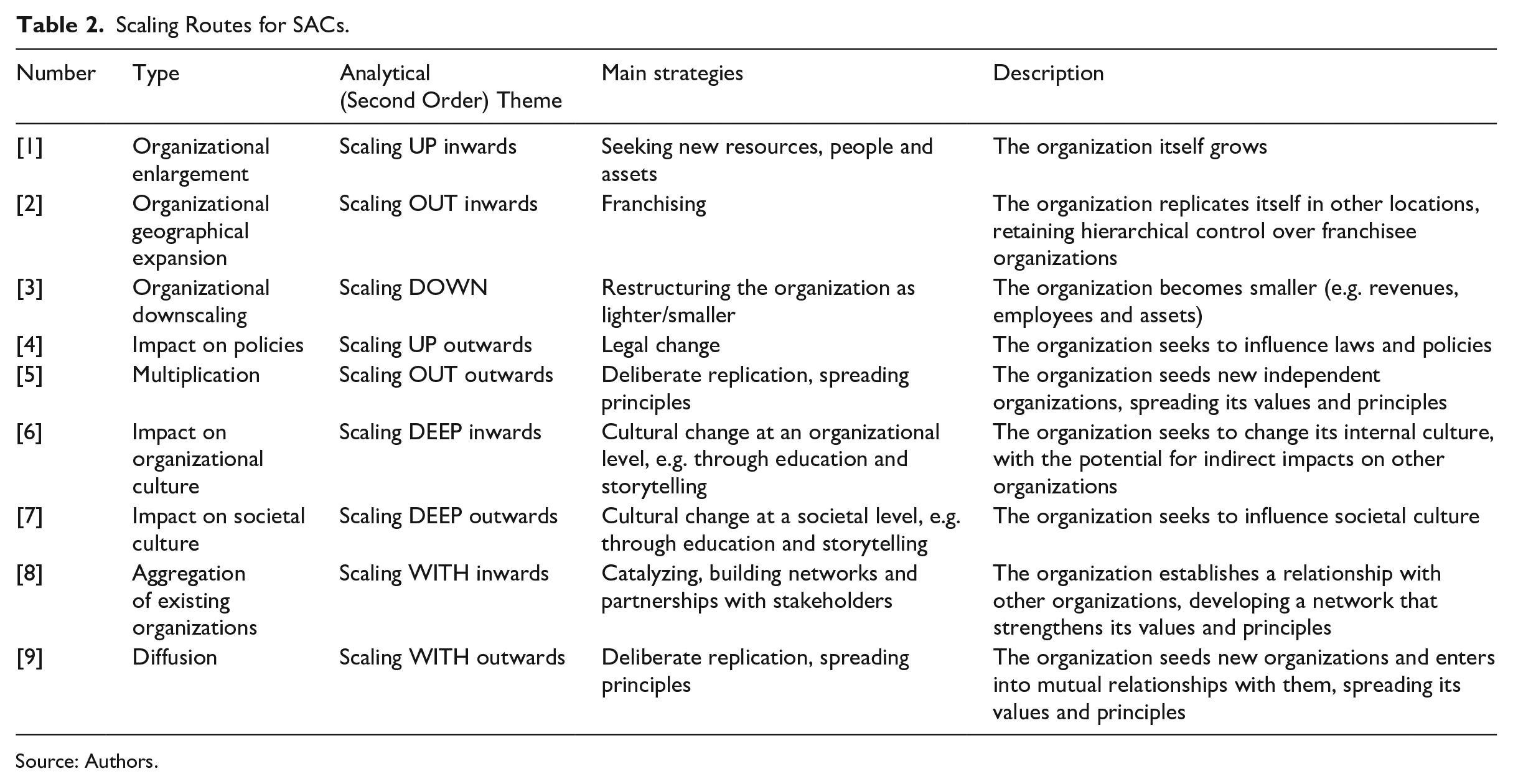
Scaling emerges in the three cases as a complex, multi-faceted concept. The analysis (Table 2) reveals nine different scaling routes adopted by SACs to scale their impacts and move towards the system change they envisage. They include [1] vertical and [2] horizontal organizational growth, [3] organizational downscaling, [4] impact on policies, [5] multiplication, [6] impact on organizational culture, [7] impact on societal culture, [8] aggregation and [9] diffusion. Scaling routes [1], [2], [3] and [6] focus on the organization; scaling routes [5], [8] and [9] focus on the relationships between the organization and other organizations; while scaling routes [4] and [7] focus on mechanisms of change.
Scaling Routes for SACs.
Source: Authors.
Organizational enlargement
The first approach relates to increasing the size of an organization (e.g. revenue, employees and assets). Scaling as organizational enlargement emerges in the three case studies and particularly in TA, which considers it as a key priority in improving the effectiveness of the cooperative and maximizing the impacts of its activities. As a member states, regarding the possibility of increasing the size of the organization through building a new processing plant on-site: Unfortunately we do not have [control of] the whole supply chain. The ideal for us would be to be able to grow, transform [i.e. process] and sell medicinal herbs. However, at the moment we only have production and sales [facilities]. (TA7: our emphasis)
In TA, organizational growth is largely considered as an opportunity (e.g. to generate more employment thereby integrating more vulnerable people), associated with the concept of autonomy (e.g. to operate independently of public/private funding and not be overly reliant on volunteers’ support). Significantly, TA does not consider growth as an exponential process, but as limited by the cooperative’s social and environmental mission: We don’t have to become the mega-multinational [corporation] nor make millions. [. . .] Why continue to focus on this. . . how to say. . . exponential growth of everything? It would really be enough to have. . . a widespread economy, I would say. I mean something that could be enough for well-being. (TA3) I think that if the business world fails, I mean it fails in the relationship with nature, and it fails in the relationship with society, it is certainly because it aims for a maximum income, a maximum gain. (TA6)
Scepticism around ‘growing for growth’s sake’ (NC3.1) is also shared by CC and NCO: I prefer. . . which is economically wrong. . . but I prefer to make a little less [bread] [to avoid food waste]. I could make 10 extra [loaves], sell 3 and I would gain. With the 3 sold [loaves] I would pay for the 7 that I throw away. But I don’t want that. [. . .] from an economic point of view, of the economy of scale, this is a loss. However, from a value point of view [this is a win]. (CC13) We have never been interested in growing and making exponential numbers [in balance sheets] because that makes you lose touch with the one territory where you belong. (NCO9)
Geographical expansion
The second approach refers specifically to geographical expansion. It can include the opening of new branches and stores in different geographical contexts and expansion through franchising. In this approach, the ‘child’ organization is tied to the parent through a formal agreement (e.g. franchise agreement) or as different components of the same business. For example, in CC, one interviewee considered the possibility of expanding the cooperative’s activities ‘to other contexts’ (CC6), suggesting the inclusion of a mobile feature such as ‘a small street food van, to take part in several events’ across the country (CC6). Other than this one example, interviewees did not consider growing out as an effective strategy. NCO regarded geographical expansion as detrimental to its mission, referring to the practice as one of ‘colonising territories’ (NCO3.2) and a strategy that ‘makes you [the cooperative] lose touch with the one territory where you belong’ (NCO9).
Organizational downscaling
The third approach is a process of organizational restructuring towards a lighter/smaller system. Scaling-down as a strategy for improving the cooperative’s effectiveness only emerged in the context of CC. As a CC interviewee states: We must have the ability to say: all right, I [the cooperative] have created farms that work, that are able to manage themselves, and so I take a step back and let them move on. (CC12: our emphasis)
However, ‘a light structure’ (NCO3.2) is what characterized the NCO Consortium since its foundation. Rather than operating as a centralized system, the Consortium promotes, supports and coordinates the work of its member cooperatives. As a member of the NCO board explains: Everything that the consortium does, it hands it over to the cooperatives. We did not want to build a heavy structure; we wanted to build a structure in service [of the member cooperatives]. (NCO10)
Impact on policies
The fourth approach refers to a process of legal change, where the organization strives for an impact on laws and policies. This is what Moore et al. (2015) refers to as ‘scaling up’. In addition to Moore and colleagues’ definition, we specify that this scaling route operates at a societal level (i.e. it is a process of scaling ‘outwards’) rather than at an organizational level. NCO contributed to – and benefitted from – several legal changes (e.g. national law 109/96 and following decrees for the social reuse of confiscated goods; regional law 1/2012 for the implementation of the ‘health-budget’ in Campania; and national law 141/2015 on social farming). These laws played a fundamental role in supporting NCO activities and NCO members actively contributed to their implementation (e.g. through organizing protests, hunger strikes and public consultations).
Multiplication
The fifth approach is the route Moore et al. (2015) call ‘scaling out’ and refers to a process of organizational multiplication and innovation diffusion. While geographical expansion [2] entails organizational growth and is characterized by a relation of high dependence between the ‘child’ and parent organization, multiplication [5] does not seek to grow the parent, and parent and child are independent. For the parent, multiplying is a process of self-less replication, where principles, business models and know-how are gifted to the new-born organization. Self-determination emerges as a keyword for the process of multiplication. The parent organization inspires and supports the child, which determines itself as an autonomous, independent organization. Multiplication is exemplified by NCO as part of its strategy for the collective construction of a social economy as an alternative to the criminal economy: Our consortium has always paid more attention to multiplication, rather than growth. [. . .] If we take a small, organic, seed and plant it in another fertile ground. . . [. . .] There, it will grow in autonomy. It won’t depend on me anymore, it will depend on itself. There, it will make people find a job, it will change their lives. (NCO3.1: our emphasis)
A CC member explains the rationale behind multiplication: If the aim is for me is to be rich. . . then all the others are competitors. If the aim is to create an economy that is respectful of the environment, then I can’t do it by myself, we have to be many in order to be able to do it. And then my aim is that others get to do the same thing I do. (CC13: our emphasis)
Impact on organizational culture
The sixth approach is a process of cultural change that affects the organization. It is based on the idea that, in order to improve the effectiveness of the organization and scale its impact, an internal cultural change is needed.
In TA, the internal cultural shift operated is towards a managerial approach defined by a member as a ‘diffused’ approach (TA3). That is, an informal and non-hierarchical structure where everyone, from the President to the newest volunteer, contribute to the cooperative’s development and where decisions are taken collegially. This approach, enabled by the relatively small-size of the organization, encourages members’ initiative and personal responsibility within the cooperative.
In contrast, NCO and CC experienced a cultural shift to become more hierarchically structured organizations. In NCO, this was implemented through hiring a temporary manager with the aim to train the consortium’s staff to be more ‘business-like’. This is a process that they define as ‘changing people’s minds’ (observation notes). As the NCO president explains: Together with other members of the consortium, we questioned ourselves and embarked on a journey with a temporary manager. As a resource made available by the consortium, he [. . .] [educated] all the members on things like direction, management, administration, to improve [. . .] the performance of each cooperative [. . .]. It is not enough to [be capable to] do the work integration, to be a community. We must also have the accounts in place, [we must] be able to keep up with bills. (NCO3.2: our emphasis)
Similar to NCO, CC underwent a cultural change towards more formal and hierarchical approaches. However, while in NCO such organizational change was realized through training the executive staff, in CC it was implemented through replacing the board with a brand-new management.
Impact on societal culture
The seventh approach is the process Moore et al. (2015) refer to as ‘scaling deep’. The underlying assumption is that impacting societal cultural roots is the primary mechanism to achieve system change. This approach is prioritized in all three cooperatives.
One of the key cultural transformations operated by CC at a societal level is the deconstruction of the dichotomy producers/consumers and its reconstruction as ‘co-producers’; a novel category to name producers (i.e. farmers and other suppliers) and consumers (i.e. individuals and Solidarity Purchasing Groups) within the cooperative. Such discursive practice shifts the cultural context from one dominated by the logics of separation, competition and maximization of individual utility, to one based on cooperation and shared responsibility. In their view, being co-producers allows moving from practices of mutual exploitation to practices of mutual care: What we [CC] are interested in is to activate ways of exchanging goods so that everyone is respected: the producer, the purchaser and our land. This is a change that requires at its base a cultural transformation among people. It [. . .] means agreeing on the criteria to follow in production, reasoning together on fair prices, supporting producers by guaranteeing the purchase of the amount agreed together: [this way] we become co-producers. (Corto Circuito, 2010: 23: our emphasis)
To re-connect people with their land and with each other, TA seeks to eradicate what they call ‘the good Samaritan mentality’ in the Fiemme and Fassa valleys. That is, to enable a cultural shift from philanthropic (capitalistic) to cooperative (civil) relations. As a pioneer explains: [when we constituted the cooperative] we really had to build everything from scratch. Including people’s mentality. [. . .] [local residents] were not used to interacting with [vulnerable people]. [. . .] Instead, there was a lot of ‘the good Samaritan mentality’: I help you because you need me, but I do not help you because I believe in you, I believe you have the potential to give something to this society. (TA3: our emphasis)
NCO relies on irony to transform meanings, provoke cultural change at a societal level and ultimately enable the shift from a criminal economy to a social economy. The very name of the consortium – Nuova Cooperazione Organizzata (New Organized Cooperation) – was chosen to subvert the meaning of the acronym NCO, widely used by the media to identify the notorious criminal organization – Nuova Camorra Organizzata (New Organized Camorra). Another example is the name chosen for the Christmas initiative ‘Facciamo un pacco alla Camorra’ (literally, ‘Let’s give Camorra a package’), which ironically refers to the popular Neapolitan expression fare un pacco (literally, to give a package/gift) that means to fool somebody (i.e. Let’s fool Camorra). The message delivered is that, through purchasing the ‘pacco’, one can contribute towards building the post-growth future envisioned by the consortium: one where the criminal economy of Camorra is replaced by the social economy of NCO.
Aggregation of existing organizations
The eighth approach is a process of organizational association, captured in the popular Italian phrase L’unione fa la forza (united we are stronger). In this scaling process, networking activities and partnership building are considered key strategies.
In CC, reinforcing existing partnerships (e.g. between producers and consumers which are already members) is vital for tackling the needs the cooperative was constituted to address, while building new partnerships (e.g. with new producers, external to the organization) is necessary for building the solidarity economy system, envisioned as system change. Interestingly, after the closure of the cooperative in 2017, the weekly farmers market continued its activities informally. In other words, CC successfully scaled, making the way for a self-sustaining (yet informal) relational system between and among producers and consumers, reaching one of the key goals the cooperative was initially constituted to achieve. Even though the cooperative closed, the process of aggregation was effectively implemented.
In TA, the impact of the cooperative’s activities are determined by the strength of its relations with stakeholders, which are often constituted by/through direct friendship and family relationships. For example, a small portion of the land cultivated by the cooperative belongs to its members’ friends and families, who grant TA access at a discounted price. In addition, the members’ personal relationships with local supermarket directors enable the cooperative to stock its products in their shops. Aggregating existing organizations is also considered as a preferential route for future initiatives. As a member explains: The other important thing [. . .] is the network. I mean being part of a network. In this regard, another of my ideas, that I am carrying forward, is to create a green-network in the valley. [. . .] [At the moment,] it is only three of us [i.e. three organizations], but we are considering extending it [i.e. the network] to include other outlets such as restaurants for example, that are set on organic [standards] . . . (TA7: our emphasis)
Aggregating existing organizations may foster important cooperation dynamics among different actors in the network. For example: [We should collaborate with the other farmers in the valley] at a very material level, lending means or tools or other things. . . perhaps even buying goods together to reduce the costs. (TA6)
In NCO, given the particular conflictual context where the consortium is set, processes of aggregations are even more critical. The consortium itself was constituted as the outcome of a process of existing organizations aggregating (i.e. the aggregation of cooperatives committed to the same struggles).
Diffusion
The ninth approach is a process of organizational dissemination, which shares with route eight the idea that ‘united we are stronger’. However, while route eight is a process of aggregation that brings together existing organizations (it can be thought of as being moved by a centripetal force), route nine is a process of diffusion, leading to the creation of new organizations (a centrifugal force). Diffusion [9] is also different from horizontal organizational growth [2] and multiplication [5]. Horizontal organizational growth [2] entails a relationship of high dependence between parent and child organizations; multiplication [5] a relationship of high independence; and diffusion [9] a relationship of high interdependence. As NCO members clearly explain: If the other grows, then I grow too. [. . .] Say I take some money and invest it in [. . .] helping a group of young people to set up a cooperative; say they later become better than me, say they have specialized on something that I do not do; say I can go to them to learn new things. Then, we have won. (NCO3.1: our emphasis) In a social economy, in the growth of the last there is also the growth of the first. (NCO2.1)
Through the process of diffusing, the parent organization encourages the constitution of other – child – organizations. Although self-determined and autonomous, parent and child organizations maintain a strong connection with each other and establish a (formal or informal) relation of mutual support.
Discussion
Scaling requires synergistic interaction
The scaling routes highlighted in Table 2 are a dynamic and interconnected web of relations. It is through their synergistic interaction that impact is generated.
For example, the combination of aggregation [8] and diffusion [9] facilitates the creation of economies of scope. This was clearly shown by the case of NCO, where each cooperative specialized in the production of different goods (e.g. wine, fresh vegetables, preserves, etc.) and each commercialized their own and others’ while marketing them together through the consortium. Another example is the combination of impact on policies [4], multiplication [5] and impact on societal culture [7], which enables long-lasting change. In the case of NCO, the national law for the social reuse of confiscated goods (national law n. 109/96) proceeded hand-in-hand with the constitution of new cooperatives and a strong grassroots desire for liberation from the mafia culture.
At the same time, impact can be inhibited by narrowly focusing on individual scaling routes. For example, a narrow focus on organizational growth [1&2] has been shown to result in the overshoot of planetary boundaries. In addition, a narrow focus on legal change [4] may result in the creation of rigid legal categories that discourage diversification. Such a risk is inherent in the new national law on social farming (n. 141/2015), which introduces rigid criteria for defining social agriculture. According to the law, a cooperative is considered a provider of social agriculture only if at least 30% of its annual revenue is derived from agricultural activities. Therefore, social cooperatives that are engaged in agriculture as a therapeutic activity (i.e. type A), which generally do not have a strong market-orientation, are unlikely to qualify as social agriculture providers. This means that type A social cooperatives will potentially miss out on networking and funding opportunities, which could hamper multiplication [5], aggregation [8] and diffusion [9] of social agriculture as a whole.
Impacting societal culture is key to scaling
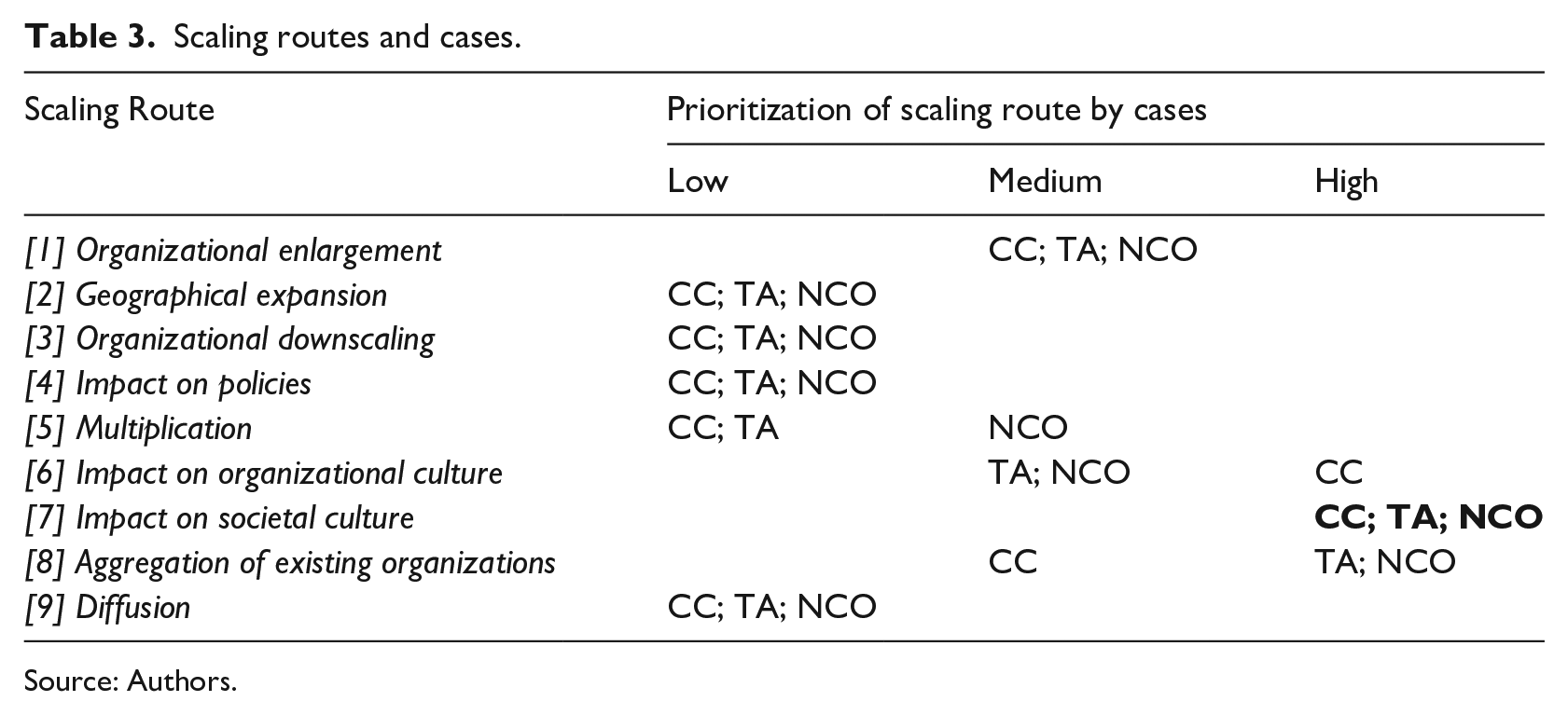
Despite CC, TA and NCO individually engaging in multiple scaling routes, each of them considers impacting societal culture [7] as paramount for fulfilling the needs that they were constituted to address and to achieve their vision of system change. Indeed, impact on societal culture [7] is the only scaling route that emerges with high importance in all three cases analysed (see Table 3). These results strengthen previous theorizations of scaling social enterprises, confirming the importance of ‘scaling deep’ (Moore et al., 2015) and providing new insights into how it is achieved.
Scaling routes and cases.
Source: Authors.
CC, TA and NCO all prioritize cultural transformation as a key strategy for shifting away from an oppressive system (e.g. identified as the agro-industrial food system in the context of CC; mass tourism in TA; and Camorra in NCO) and towards system change (e.g. expressed in terms of ‘solidarity economy’ in CC; ‘local economy’ in TA and ‘social economy’ in NCO). In other words, impact on societal culture [7] is fundamental for building a post-capitalist economy, where values such as competition, greed and profit maximization are superseded by cooperation, solidarity and prosperity (Jackson, 2021).
In CC, system change is associated with an economy that, in the cooperative’s own words, ‘values differences and rejects exclusion and exploitation; an economy that is an instrument of peace and cooperation among people’ (L’Isola Che C’e, n.d.). In TA, system change is built on ‘the values of the mountain’ such as ‘frugality, solidarity and communality’ (TA 6). NCO advocates for moving away from the criminal economy of Camorra – described in terms of a ‘speculative economy’ based on suspicion and fear (NCO3.1) – and towards a ‘social economy’ based on trust and courage (Comitato Don Peppe Diana, 2016).
System change requires cultural change or, in the words of degrowth scholars, it requires ‘decolonizing the imaginary’ from oppressive systems (La Touche, 2014). For example, to achieve a social economy, NCO combines the commercialization of products grown on confiscated land with discursive practices, artworks and symbolic representations to facilitate the desired cultural shift. After acquiring a villa confiscated from a Camorra family in the municipality of San Cipriano D’Aversa, NCO drilled holes in the high barbed wire topped wall enclosing the property and affixed artworks of human figures intent on climbing and dismantling the wall and sitting on its top. Each figure represents a value, which is inscribed on it, including ‘trust’, ‘courage’, ‘perseverance’ and ‘imagination’ among others. Scaling can be considered as a process of emancipation, in which critical consciousness plays a key role.
Scaling does not necessarily require organizational growth
When considering the typology emerging from this research in its entirety (see Table 2), it is apparent that scaling does not necessarily require organizational growth. This finding, in contrast with the ‘growth fetish’ of conventional approaches to scaling, confirms the claims already put forward by some authors in the social enterprise and post-growth literature, suggesting that organizational growth is not necessarily desirable and does not have to be infinite (Moore et al., 2015; Pansera and Fressoli, 2021). Indeed, the cases we analysed show that, when scaling is framed in terms of organizational growth ([1] and [2]), growth is not considered as an exponential process (e.g. infinite growth on a planet with finite resources), but is approached in light of social and ecological limits (e.g. growth until a balance is reached). For example, the case of TA shows that organizational growth emerges as a relevant process in the initial phase of development, to grant the organization autonomy (e.g. ability to operate independently of public/private funding), sustain other scaling processes such as cultural change ([6] and [7]) and to break even. This is important as it helps understand organizational growth as a stage in the organizational life-cycle and it highlights how organizational growth, especially in the first phase of the cooperative development, may help overcome material constraints that limit change (e.g. infrastructures required to build local supply chains). However, once balance is attained, organizational growth is no longer the focus.
Overall, in the context of post-growth organizations, organizational growth is mostly considered as an enabler of other scaling routes; as a means to achieve the organization’s social and environmental mission. For example, in CC, organizational growth, through extending shop opening times, was introduced to encourage more people to visit the cooperative; expanding its customer base [1] while spreading its culture [7].
Scaling is embedded in wider socio-ecological systems
Finally, the research findings illuminate how scaling is not only concerned with dynamics internal to the organization (e.g. as in scaling routes [1], [2], [3] and [6]) but also, most importantly, with wider socio-ecological relations (e.g. as in scaling routes [4], [5], [7], [8] and [9]). This not only highlights that post-growth organizations are political actors, able to mould their institutional environments (Barley, 2010) (e.g. through influencing policies [4] and societal culture [7]) but also that they are embedded in wider socio-ecological systems, which they create (e.g. through aggregation [8]) and by which they are created (e.g. through multiplication [5] and diffusion [9]).
The relational dimension of scaling is overlooked by existing scholarship. For example, Moore et al. (2015) consider building networks and partnerships largely as an instrumental strategy; a way to achieve either impact on policies [4], on greater numbers [5] or on cultural roots [7]. In contrast, this research shows that ‘scaling with’ routes are key. Aggregation [8] and diffusion [9] are explicit goals of SACs as they enable the organizational ecosystem – and not just the single organization – to scale.
While the relational dimension of scaling emerges from the three cases analysed as focused mostly on inter-organizational and socio-organizational relationships, this research begins to shed light on the importance of considering organizations as embedded in wider socio-ecological systems. For example, it can be argued that organizational dynamics following CC’s closure (i.e. the way farmers reacted to this change by organizing an informal weekly farmers’ market) resemble social-ecological system behaviour (e.g. adaptability and resilience in response to disturbance and shock) (Gunderson and Holling, 2002). The embeddedness of post-growth organizations in socio-ecological systems, which begins to emerge from this study, could be an important avenue for future research.
Approached from an ecological perspective, scaling routes can be considered as actions that organizations undertake in order to shape and influence the wider ecosystem in which they are embedded. This is important because ‘life-after capitalism’ can only be enabled by ‘a systems view of life’ (Capra, 1983; Jackson, 2021); and by making ‘an ecological case for business’ (Ergene et al., 2021). Capitalism is dependent upon economic growth – and the idea of exponential economic growth in a planet with finite resources has relied upon ‘a mechanistic view of life’ (i.e. one in which economic growth and ecological degradation are decoupled) (Capra, 1983). Life after capitalism requires post-growth – and the idea of living within a ‘safe and just space’ can only be enabled by a more holistic system approach (Ergene et al., 2021; Raworth, 2017).
Conclusion
First, this study has outlined a typology of nine different scaling routes. These provide a clear set of strategic options for scaling the impact of post-growth organizations, highlighting that post-growth scaling requires the synergistic interaction of different strategies, beyond those currently considered in the scaling literature. Second, this study strengthens previous findings, discussed in the context of social enterprises, that impacting societal culture can be key to scaling, refining understandings of ‘scaling deep’. Third, it substantiates the intuition of post-growth scholars that scaling does not necessarily require organizational growth. Fourth, it advances existing scholarship by illuminating the importance and conceptual distinctiveness of ‘scaling with’, revealing that scaling is a relational process, embedded in wider socio-ecological systems, which shape – and are shaped by – the organizations that inhabit them. The application of socio-ecological system theory to management and organization studies – and post-growth organizations in particular – is an important avenue for future research.
While narrow and fragmented understandings of scaling reinforce the ‘growth fetish’ and hamper systemic change, the typology presented in this article allows post-growth organizations to become more aware of different available scaling routes. We hope this will contribute to unlock their transformative potential, supporting the transition towards post-growth futures.
Supplemental Material
sj-docx-1-org-10.1177_13505084221147480 – Supplemental material for Scaling in a post-growth era: Learning from Social Agricultural Cooperatives
Supplemental material, sj-docx-1-org-10.1177_13505084221147480 for Scaling in a post-growth era: Learning from Social Agricultural Cooperatives by Laura A Colombo, Adrian R Bailey and Marcus VP Gomes in Organization
Footnotes
Acknowledgements
We are very grateful to the three anonymous reviewers for their insightful guidance on the earlier versions of this manuscript. We would also like to thank the members of Corto Circuito, Terre Altre and Nuova Cooperazione Organizzata, without which this research would not have been possible. Our sincere gratitude goes to Mr David Bartlett for his careful review and proofreading of our final draft.
Funding
The author(s) received no financial support for the research, authorship, and/or publication of this article.

Supplemental material
Supplemental material for this article is available online.
Author biographies
References
Supplementary Material
Please find the following supplemental material available below.
For Open Access articles published under a Creative Commons License, all supplemental material carries the same license as the article it is associated with.
For non-Open Access articles published, all supplemental material carries a non-exclusive license, and permission requests for re-use of supplemental material or any part of supplemental material shall be sent directly to the copyright owner as specified in the copyright notice associated with the article.
