




Abstract
The organizational wellbeing discourse has in the past decades gravitated toward two adversarial camps. The first camp draws increasingly from positive psychology and studies wellbeing as the presence of positive attributes centered around the individual. The second camp is critical toward the first one from a sociological standpoint by warning about its hidden tyranny and detrimental organizational consequences. In this paper we interrogate the conceptual foundations of the two camps and argue that the paradigmatic divide between them can be traced to their antithetical assumptions about the nature of human freedom. To move beyond the paradigmatic standstill, we suggest adopting Kenneth Burke’s dramatistic pentad as a metatheoretical framework for organizational wellbeing research. The pentad can help integrate concerns and viewpoints from both camps and facilitate the exploration of novel opportunities to conceptualize wellbeing in organizations. The proposed metatheoretical framework acknowledges the plural and essentially contested character of wellbeing whilst promoting theoretical pluralism in organizational wellbeing research. We also illustrate the use of the dramatistic pentad through three thought-provoking conceptualizations of organizational wellbeing. The illustrations show how the dramatistic pentad can be used to spur much needed conceptual imagination within organizational wellbeing research.
Keywords
Introduction
“[R]evolutionary achievements in the arts, in the sciences, and in moral and political thought typically occur when somebody realizes that two or more vocabularies are interfering with each other, and proceeds to invent a new vocabulary to replace both.” (Rorty, 1989: 12)
Organizational wellbeing research is on the verge of the phase described by Rorty in the opening quote. Over the past decades a surge of research on organizational wellbeing has materialized to direct managerial practice (Dale and Burrell, 2014; McGillivray, 2005; Zoller, 2003). This view, promoted by developments in positive psychology (Seligman and Csikszentmihalyi, 2000), is characterized by a strong focus on the individual. The individual is described as responsible and capable of taking control over her wellbeing both in organizational contexts and life in general. Within this camp, being happy and fulfilling one’s “true self” (Waterman, 2013: 129) at work is becoming progressively tied to organizational productivity, performance, and career success (Bryson et al., 2017; Grant et al., 2007; Seligman, 2019; Van Den Broeck et al., 2016). Even though the literature on organizational wellbeing has a rich history drawing from a variety of approaches (Bakker and Demerouti, 2017; Danna and Griffin, 1999) positive psychology views are becoming the dominant view on wellbeing, for example, in organizational wellbeing research (Fisher, 2010), entrepreneurial research (Wiklund et al., 2019), and leadership studies (Inceoglu et al., 2018).
As a response, a smaller yet growing field of criticism toward these views has emerged (Christopher and Hickinbottom, 2008; Fineman, 2006; Frawley, 2015). The critics, typically adopting a more sociological position, argue that the ideology of positivity holds a “hidden tyranny” (Fineman, 2006: 277) and question the individuals’ potential in controlling their wellbeing in organizational settings (Collinson, 2012; Harrison and Stephens, 2019). The critics see positive psychology and likeminded social movements as furthering ideological tenets that paint a narrow and normative picture of human nature and individual wellbeing by conflating wellbeing with productivity (Dale and Burrell, 2014). For the critics, the typical frame of reference is what is currently taking place in organizations and managerial practice, often noting the “intensification of the links between wellness and economic interest” (Dale and Burrell, 2014: 161). They argue that the ideologically motivated wellbeing research is inconspicuously forming organizational subjects and practices toward idealized views of the good employee and organization (McGillivray, 2005; Zoller, 2003).
The philosophical differences between these two camps aptly show wellbeing to be an essentially contested concept (Gallie, 1956). To delve deeper into this issue, in the first part of this article, we ask why the two camps systematically avoid constructive engagement with each other? By interrogating these two views on a metatheoretical level we argue that there is an ingrained conceptual gulf between the two camps which can be traced to their antithetical assumptions about the nature of human freedom. We argue that the psychological camp drawing from positive psychology sees human freedom as “positive freedom” or “freedom to” whereas the critics warn against this view of freedom while arguing for the necessity of “negative freedom” or “freedom from” (Berlin, 2013). With the help of the concepts of positive and negative freedom, we posit that there is an unacknowledged paradigmatic gulf between the two camps (Kuhn, 2012) which systematically draws them toward antagonistic positions. In effect, we argue that the two camps cannot be bridged using the current vocabularies. For those scholars who see promise in theoretical synthesis (Oswick et al., 2011), perceive academic echo chambers as shutting down conversations (Cutcher et al., 2020), or want to move beyond mere criticism (this Special Issue), the current paradigmatic gulf is a problem worth addressing. By taking lead from Rorty’s insight, we see a need for a new metatheoretical vocabulary that overreaches this gulf.
As a remedy, in the second part of the article, we propose adopting Burke’s (1945) dramatistic pentad as a metatheoretical framework to help bridge the two paradigms and spur conceptual imagination within organizational wellbeing research. We argue that the pentad offers a nuanced and in-depth understanding of where the two camps diverge and where alternative conceptual possibilities also lie. The thrust of the pentad lies in its ability to show how conceptualizations and assumptions are connected. It can assist in untangling the knot between the two, by turning taken-for-granted assumptions into conscious conceptual choices. We thus argue that the pentad can be used for two purposes within organizational wellbeing research: (1) to draw forth the philosophical assumptions and conceptual tendencies underlying extant wellbeing vocabularies and thus build metatheoretical understanding and conceptual options amongst scholars, and (2) suggest and warrant new theoretical alternatives of conceptualizing wellbeing in organizations.
By building understanding and expanding the scope of conceptual choices on how organizational wellbeing is and could be conceptualized, the dramatistic pentad advances conceptual pluralism within the wellbeing debate. In addition to explicating the underlying conceptual reasons for the essentially contested character of wellbeing, we argue that the dramatistic pentad provides the means to promote novel “imaginings” (Wright et al., 2013) about wellbeing in organizations. This is the second aim of the article. As a metatheoretical framework for organizational wellbeing research, the dramatistic pentad can help chart and imagine such vocabularies, whilst on a metatheoretical level acknowledge that wellbeing is essentially a plural concept. To illustrate how the pentad can help advance conceptual pluralism, at the end of the article we showcase three thought-provoking conceptualizations of organizational wellbeing. These vignettes show how the dramatistic pentad can enable researchers to imagine novel types of wellbeing vocabularies by, for example, repurposing currently distal theoretical vocabularies for organizational wellbeing research.
This study proceeds as follows. First, we briefly visit the historical development of the organizational wellbeing discourse. We describe how a metatheoretical standstill has emerged through a polarization into two competing camps about wellbeing: the dominant psychological paradigm and its critical counter-discourse. Second, we introduce Burke’s (1945) dramatistic pentad as a solution to working across the metatheoretical gulf. We show how the pentad can be used to differentiate and position wellbeing theories and chart novel conceptual avenues in organizational wellbeing research. In the final part of this article, we aim to spur conceptual imagination by illustrating the use of the dramatistic pentad and present three alternative conceptualizations of organizational wellbeing.
Two traditions of scholarship on organizational wellbeing
Since the dawn of organizational wellbeing studies there have been two principal avenues for developing wellbeing at work (Danna and Griffin, 1999). The first avenue is to improve work conditions (Danna and Griffin, 1999; McGillivray, 2005; Shain and Kramer, 2004). This stance dominated the wellbeing discussion earlier in the 20th century (Edwards, 2008; Warhurst and Knox, 2022), when the Human Relations movement rose to counteract Scientific Management’s impersonal and rational design of work systems. Such hallmark names as Elton Mayo, Abraham Maslow and Kurt Lewin emphasized that employees are “social persons,” and their human and social needs need to be met by the organization to secure individual motivation and organizational productivity. Socio-technical systems thinking (Trist and Bamforth, 1951), for example, emphasized how social systems and technical systems need to be jointly optimized to ensure both organizational performance and employee wellbeing.
The second avenue consists of health programs that educate individuals in health and wellbeing practices. This is the dominant literature on workplace wellbeing promotion (Shain and Kramer, 2004; Zoller, 2003). The goal of the wellbeing programs is to guide and educate the workforce in lifestyle choices and risk behavior to “reduce rising health care costs, improve worker efficiency, reduce absenteeism, and create employee loyalty” (Zoller, 2003: 172). Over the past decades we have, however, witnessed a tectonic shift in focus from the original Human Relations school of thought on organizational betterment toward individuals and their self-improvement through an intensifying psychological discourse. “Attention has been taken away from the context and conditions of the workplace, and instead has focused on the attitudes and choices of the individual employee and how they can maximize their own ‘well-being’” (Dale and Burrell, 2014: 160).
If previously the idea was to design organizations so that employees can attain happiness and a sufficient quality of life, the focus seems to be shifting toward enhancing and bettering individuals to be happy in accordance with organizational requirements to attain sought-after economic outcomes (Bryson et al., 2017). Despite the admirable intentions of improving workplace wellbeing, studies suggest that through the education of wellbeing skills such as resilience and mindfulness, wellbeing is increasingly becoming the individual’s responsibility at work (Collinson, 2012; Dale and Burrell, 2014). Critical commentators argue that the negative implications of this shift in responsibility have not been adequately recognized (Fineman, 2006).
The growing polarization of the organizational wellbeing discourse
In a famous essay, Berlin (2013) summarized the key political debates of the modern era as revolving around two “irreconcilable attitudes” and “systems of ideas” and their intrinsic resolution: positive and negative freedom. Positive freedom means “freedom to” whereas negative freedom is equivalent to “freedom from” (Berlin, 2013). Positive freedom is the presence of something whereas negative freedom is defined through absence. Positive freedom contends that freedom is based on self-mastery and rational self-direction. It builds on a view about human nature as being self-directed and motivated by self-fulfillment and self-realization. Negative freedom on the other hand builds on the notion of freedom as an area of personal freedom, carved out by a boundary of non-interference. At a minimum, the negative freedom perspective argues for freedom from coercion and oppression, thus protecting the freedom of religion, opinion, expression, and property from arbitrary invasion. Both can be seen as defending rights such as self-authorship and self-authority, but through different means. Those advocating negative freedom want to curb authority as such whereas proponents of positive freedom want it placed in their own hands (Berlin, 2013: 237). How the tension between the two freedoms is resolved, is “consciously or unconsciously guided” by our vision of what “constitutes a fulfilled human life” (Berlin, 2013: 240). Consistent with this view, the philosophical debate about human freedom is found at the heart of the discussion about wellbeing in organizations.
Positive psychology and organizational wellbeing
The trend toward increased self-improvement and self-mastery in organizations, together with the dissemination of an individualistic and utility view of wellbeing, has been fueled by the rise of positive psychology (Seligman and Csikszentmihalyi, 2000). Positive psychology studies what makes “life worth living” (Seligman and Csikszentmihalyi, 2000: 5) through human strengths and virtues. It was formed to complement the deficit and illness model dominating the mental health field.
The positive psychology movement ostensibly embodies the attitude of positive freedom given its key doctrine to uncover what makes life worth living as the presence of positive attributes (Seligman and Csikszentmihalyi, 2000). “Positiveness embraces the assumption that humans have an intrinsic desire to self-realize—to express their capacities to the fullest extent” (Fineman, 2006: 272). The focus on human nature and the propagated individualist ideology of self-fulfillment and self-improvement that positive psychologists subscribe to (Haybron, 2008; Waterman, 2013) is a prime example of the attitude of positive freedom (Berlin, 2013). For example, the chain of reasoning underlying positive freedom has often built a divide between an irrational and deficient empirical self and a true self (Berlin, 2013). According to this view, the end justifies the means. The end of achieving a better society fitting the true human nature justifies the means of restricting, guiding, and educating people toward that end. This ethos would seem to underlie wellness programs at work, that it is morally justifiable to educate, guide and economically incentivize people toward what is good for their true nature (Danna and Griffin, 1999; Kirkland, 2014; McGillivray, 2005).
However, when the self-improvement ideology is expanded from the domain of physical health to psychological wellbeing, an interesting paradox emerges, which for example Fineman (2006) and Kirkland (2014) have noticed underlying the positive agenda in general, and wellness programs in particular. “The neoliberal individualism of wellness,” according to Kirkland (2014: 983–984), “is anti-individual in its univocal endorsement of a quite homogeneous set of life choices, activities, attitudes, and even habitus.” Fineman (2006: 281) similarly notes that “the dark side of positiveness” is that it can “produce the very opposite of the self-actualization and liberation” that it seeks. Berlin (2013) argues that this is typical for the attitude of positive freedom. Waterman (2013: 129) argues that positive psychologists do not have a problem with the idea that “the concept of a true self entails constraints on human freedom,” even though the argument to lift human nature to its rightful height “is the argument used by every dictator, inquisitor, and bully who seeks some moral, or even aesthetic, justification for his conduct” (Berlin, 2013: 222). The paradox Kirkland and Fineman notice, is that the well-meaning and empowering doctrine of self-fulfillment, self-direction and self-determination is a typical starting point to justifying oppressive regimes and curbs on individual liberty (Berlin, 2013). This is the main thrust of the counter-discourse, as shall be discussed in a moment.
Positive psychological views on wellbeing have manifested within the organization wellbeing discourse through the research of likeminded organizational psychologists (Deci et al., 2017; Luthans et al., 2007). Two decades after the launch of positive psychology its rising dominance in the organizational wellbeing literature is not difficult to notice. In a widely cited review by organizational wellbeing researchers, Fisher (2010) reviewed happiness at work by mixing the expanding literature on positive psychology with prior research on organizational wellbeing. Fisher’s (2010) review positions the organizational wellbeing literature on the conceptual foundations of hedonic and eudaimonic wellbeing stemming from positive psychology. These two theoretical perspectives have since grown in influence within management research in general and especially within organizational wellbeing research (Inceoglu et al., 2018; Van Den Broeck et al., 2016; Wiklund et al., 2019).
The critical counter-discourse
The counter-discourse emits the attitude of negative freedom. The review by Yakushko and Blodgett (2021) is an apt example. According to Yakushko and Blodgett (2021: 119), the strength-based approaches in positive psychology “are reminiscent of ideologies we witnessed to be employed as tools designed to promote political compliance and to control dissidence in our countries of origin.” The authors instead advance the attitude of negative freedom: “we want to affirm the vital need for the inclusion of multiple theoretical views and practices rather than the exclusive monotheoretical emphases of Western positive psychology, so that hegemonies, assumptions, and values within all traditions are critiqued and examined” (Yakushko and Blodgett, 2021: 119–120).
It is typical that the agenda of negative freedom is advanced indirectly by attacking the views and assumptions of those advocating positive freedom. In this spirit, the psychological paradigm has been argued to advance three ideologically founded tenets (Fineman, 2006; Frawley, 2015): (1) the economic fitness ideology, (2) normative assumptions about the good life, and (3) social control that disciplines people toward homogeneity and conformity. These three tenets often converge (Dale and Burrell, 2014; Kirkland, 2014; Yakushko and Blodgett, 2021; Zoller, 2003). The gist of the criticism is that the self-fulfillment and self-realization movement contains a Trojan horse of prescriptive self-molding and disproportionate self-preoccupation at the cost of economic, social, political, and organizational concerns (Collinson, 2012; Fineman, 2006).
According to Dale and Burrell (2014), individualization places responsibility on the agent and conflates wellness with economic fitness for purpose. The result is bio-economism, which has been previously linked to capitalism and its adjustment of the population to economic processes (Dale and Burrell, 2014). Kirkland (2014) argues that health insurance and similar institutions in the guise of workplace wellness programs promote legally sanctioned health-based discrimination at work. Healthy behavior is economically rewarded whereas an unhealthy lifestyle is punished. Through wellness programs and their disciplinary effect, a particular type of employee subjectivity is being constructed (McGillivray, 2005). Many critics have suggested that “the wellness movement is part of a wider societal bio-legitimacy that constructs which individual choices and actions are perceived as the sign of a ‘good’ person, citizen or employee” (Dale and Burrell, 2014: 162). The critics argue that the fusion of wellbeing and business success in addition to its normative and disciplinary effects obscures the reasons for organizational resistance and unwellness at work (Dale and Burrell, 2014; McGillivray, 2005).
Arguments stemming from the counter-discourse position positive psychology as propelling a normative view of an individual self as a project of self-fulfillment and self-betterment, thus furthering a coercive program of homogeneity and conformism (Yakushko and Blodgett, 2021). Miller (2008: 591) points out that the positive psychology movement furthers an ideology of instrumental goal-setting and goal-attainment along with a “particular personality type: a cheerful, outgoing, goal-driven, status-seeking extravert.” According to Fineman (2006: 281), “promoting a social orthodoxy of positiveness focuses on a particular constellation of desirable states and traits but, in so doing, can stigmatize those who fail to fit the template.” Yakushko and Blodgett (2021: 114), in a recent review of the criticism toward positive psychology, take this argument further: “Not only do these assumptions [stemming from positive psychology] fail to reflect the perspectives and needs of diverse communities, but they also may serve to shift the blame of responsibility for self-fulfillment and happiness to individuals rather than to institutions or cultures that systematically marginalize and oppress.” Moreover, that “positive psychology frequently denies or minimizes the role of social oppression or social violence while shaming individuals who are targeted by these forms of marginalization for not having internal attributions, self-control, and optimistic worldviews” (Yakushko and Blodgett, 2021: 115).
Fineman (2006: 276) argues that positive psychology propels “a world view that is panacean and seductive and, as such, tends to be uncritical of its own stance.” The movement has been criticized for not engaging with issues related to social justice, oppression, marginalization, poverty, gender inequality, and multiculturalism (Christopher and Hickinbottom, 2008; Yakushko and Blodgett, 2021). The most likely reason these topics are not addressed in positive psychology is the assumption of universal psychobiological roots to happiness and wellbeing (Yakushko and Blodgett, 2021). The close linkages to evolutionary psychology (e.g., Fredrickson, 2013) have brought positive psychologists to believe both in a generic human nature and an individual nature as explanatory mechanisms (Waterman, 2013). According to the critics, downplaying the social context is in part the result of scientism and partly the dogmatic reliance on functionalist research (Frawley, 2015; Yakushko and Blodgett, 2021). Fineman (2006) argues that positive psychology is restrictive, unreflexive, and value naïve because qualitative and mixed research are deliberately shunned, thus monopolizing the truth about wellbeing.
To take stock, the dominant psychological paradigm is advancing positive freedom and the critical counter-discourse is attempting to defend and reclaim the personal space provided by negative freedom. In concordance with the views of negative freedom, the repeating argument in the counter-discourse is for added reflexivity, multiculturalism, the inclusion of nuance and spectrum into the picture of human nature, and the making of space for multiple voices in wellbeing theorizing. There is however a striking lack of alternatives for how to advance wellbeing and freedoms at work, except by the absence of hegemony, conformism, coercion, and domination. According to Berlin (2013), the two are irreconcilable perspectives. The inclusion of concerns from the side of negative freedom would most likely require abandoning foundational tenets of positive freedom, like its belief in a uniform human nature. The outlook of negative freedom brings forth the problems inherent to the conceptualizations of the “size” and “shape” of positive change in wellbeing. We suggest that the crucial conceptual problem is that a positive transformation of wellbeing requires the presence of something (positive freedom) instead of only an absence (negative freedom). Herein lies the paradigmatic divide between the two camps. Both views are advancing “the deepest interests of mankind” (Berlin, 2013: 237). Neither view can be fully satisfied without losing the ultimate value of its counterpart (Berlin, 2013). However, we seem to be lacking the conceptual tools to imagine vocabularies that would enable the combination of concerns of both positive (thriving, happiness, engagement) and negative freedom (fairness, choice, liberation).
Conceptual pluralism and the dramatistic pentad
As the views of organizational wellbeing have shifted toward individualism, non-psychological voices about workplace wellbeing and the prior interest in work conditions have become marginalized. For example, the suggestions of organizational wellbeing building on communicative foundations (Farrell and Geist-Martin, 2005), practice theory (Harrison and Stephens, 2019), or organizational identification (Jenkins and Delbridge, 2014) have largely gone unnoticed. Our view is that contrary to the current siloed discussions, there is a growing need for multiple wellbeing vocabularies, which provide practitioners and lawmakers with tools to better address the various challenges facing contemporary workplaces and societies (Harrison and Stephens, 2019; Warhurst and Knox, 2022; Wright et al., 2013).
Akin to Berlin’s view on freedom, the practical promotion of wellbeing may require value pluralism. Each vocabulary has its unique strengths and limitations, which Burke (1984) has called a schema of serviceability. It has been argued that the modern era linguistic terrain that we find ourselves in consists of partly overlapping and partly contradictory vocabularies (Burke, 1945; Rorty, 1989). A vocabulary can for all practical purposes be understood as equivalent to a paradigm (Kuhn, 2012). All vocabularies are based on selections of experience, which results in a theoretical reduction and conceptual merger of experience (Burke, 1945). This gives rise to complementary schemas of serviceability (Burke, 1984). That different vocabularies can offer complementary schemas of serviceability is the philosophical thrust that underlies the suggestion of approaching organizational wellbeing from alternative perspectives (Harrison and Stephens, 2019; Jenkins and Delbridge, 2014).
To facilitate a deeper understanding about the benefits of multiple wellbeing vocabularies, we suggest adopting Burke’s (1945) dramatistic pentad as a metatheoretical framework for organizational wellbeing research. The dramatistic pentad offers a way to assess to what extent organizational wellbeing vocabularies differ from one another, and thus how well extant organizational wellbeing theories attend to different issues, contexts, and situations. It can also be used as a roadmap to generate novel wellbeing vocabularies. An important contribution of the pentad in the context of organizational wellbeing research is that it shows on a metatheoretical level that privileging one perspective above others about the Good Life is a matter of choice and preference, not a necessity (see also Rorty, 1989).
The dramatistic pentad consists of five intertwined coordinates: agent, act, scene, agency, and purpose. 1 Burke uses the terms in an open-ended fashion in analyzing different vocabularies, where the different coordinates take on different meanings depending on the vocabulary under investigation. Table 1 shows the characteristics of the five coordinates and the conceptual scope that the pentad brings into view on wellbeing. Burke’s objective with his dramatistic pentad was to show that the topic of human motivation cannot, regardless of the amount of empirical research, be unequivocally covered with a singular vocabulary. A vocabulary cannot be proven to be right from a God’s-eye-view because empirical evidence “conforms to conceptions just as often as conceptions conform to evidence” (Fleck, 1979: 28). Burke’s perspective thus parallels Berlin’s (2013) advocacy of objective pluralism where multiple partly overlapping and partly contradictory vocabularies can be equally truthful at the same time.
Dramatistic pentad coordinates and organizational wellbeing.
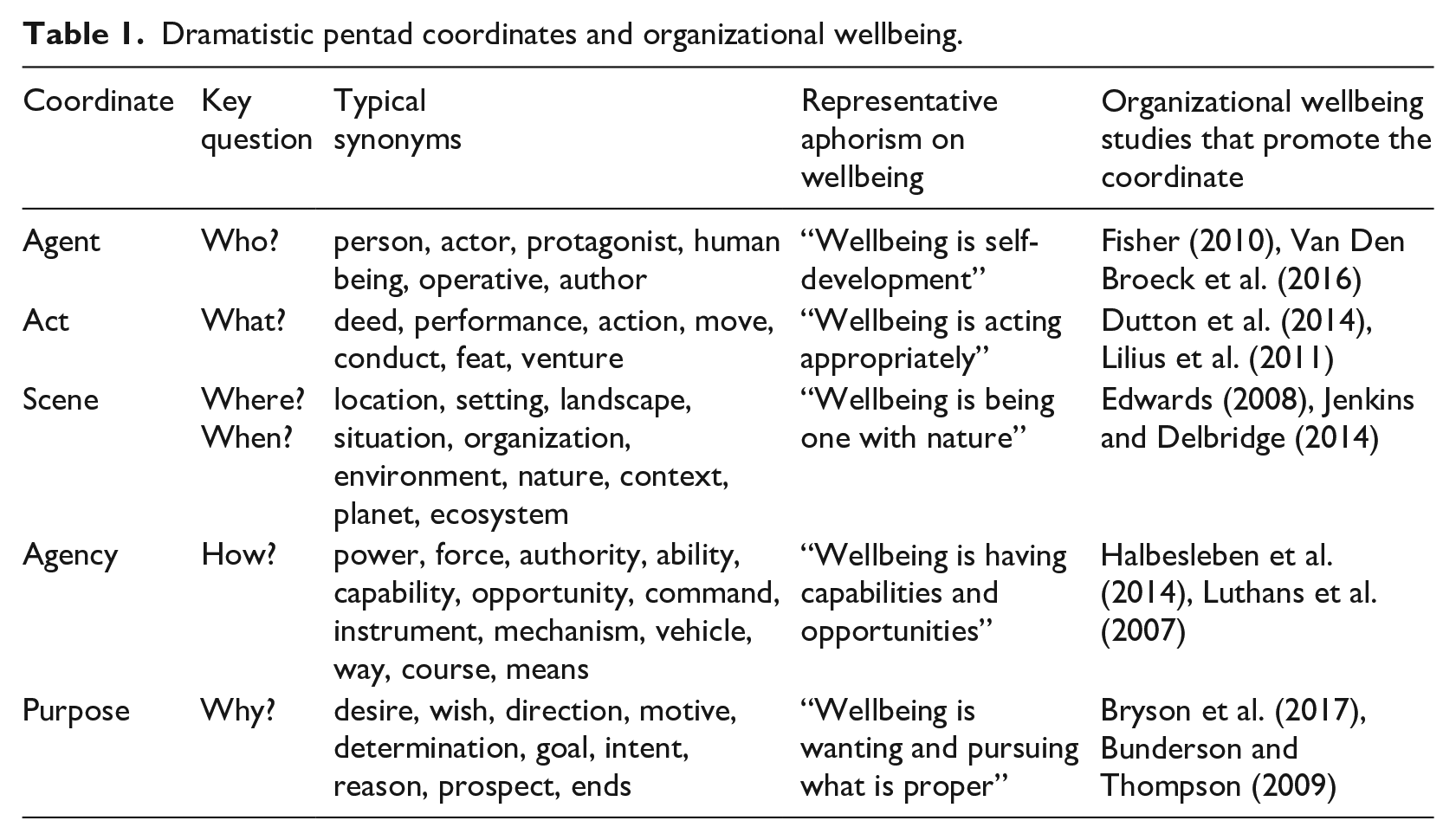
Burke (1945) argues that the philosophical doctrines of for instance materialism, pragmatism, idealism, and mysticism are foremostly different in their linguistic expression (cf. assumptions), as they highlight different coordinates of the pentad. Materialism is for example focused on the scene, mysticism on purpose and pragmatism on agency. According to Burke (1945), it is a matter of philosophical preference instead of empirical investigation which of the five coordinates or in-between ratios are used to interpret the relevant circumference for a phenomenon. “To select a set of terms is [. . .] to select a circumference” (Burke, 1945: 90), that is, the theoretical landscape for the phenomenon. Burke exemplifies this point with how the scene can be construed in multiple ways. The scene can be construed as, for example, the environment, nature, history, or God’s creation. In the context of organizational wellbeing research, Burke’s argument about theoretical circumference being a philosophical preference means that there is no objective right answer to what the right scene for wellbeing is: the physical environment, the situation, the organization, society, or the planet. Burke’s point is however even more fundamental, that a phenomenon like wellbeing does not need to be fixed to the scene coordinate (see Table 1).
Different vocabularies underscore different constellations of the pentad and consequently have their own distinct schemas and corresponding areas of serviceability. An area of serviceability signifies where the vocabulary has the most to offer to practice; where it passes practical “tests of prosperity” (Burke, 1984: 169). For example, a vocabulary centered around the agent coordinate is most likely well equipped to discuss the innate characteristics of the agent. Similarly, a vocabulary formed around the act coordinate can be of much help in the deliberation about an intelligent course of action in a vexing situation. However, in the latter case an agent-centric vocabulary can be remarkably limited and vice versa, thus highlighting the connection between different constellations of the pentad and the complementary character of their schemas of serviceability.
Within all vocabularies there is a principle of internal consistency that keeps the pentad tightly coupled to a specific constellation of the pentad (Burke, 1945). To, for example, choose the environment as the scene directs the vocabulary to talk of innate behavior. To choose history as the scene brings moral agents and their interrelated and situated acts into view. There is thus path dependency to theoretical vocabularies. One comes to understand and see organizational wellbeing in totally different light depending on if one begins from the point of view of innate psychological needs (Deci et al., 2017), communication (Farrell and Geist-Martin, 2005), or everyday actions within communities of practice (Harrison and Stephens, 2019).
Unearthing conceptual tendencies and possibilities in the wellbeing debate
The dramatistic pentad can help discern noteworthy conceptual tendencies in the ongoing wellbeing debate with its terms of coordinates (agent, act, scene, purpose, agency) and distinct vocabularies. The pentad highlights that focusing merely on the definition of wellbeing can obscure the roots from where a wellbeing vocabulary draws its power to influence organizational life, to seduce managers and researchers, and direct organizational subjects. As a metatheoretical framework, the pentad shows that one should more fully interrogate how entire wellbeing vocabularies work and are used, instead of merely focusing on the issue of defining wellbeing, as pointed out by the counter-discourse.
The power of the dramatistic pentad lies in its ability to discern between significant and cosmetic differences between vocabularies. The pentad can be used to interrogate vocabularies based on how well the different coordinates of the pentad are accounted for, how the constellation of the pentad is formed, and the cause-effect relations between the coordinates. While some may argue that there are significant differences between for instance hedonic and eudaimonic theories, the dramatistic pentad suggests them to be largely cosmetic, because both draw from a materialist vocabulary, portray similar cause-effect relations, and zoom in on the agent coordinate. According to Dodge et al. (2012) many wellbeing theories rely on a homeostasis, dynamic equilibrium or set-point theory as an overarching vocabulary for wellbeing. This vocabulary depicts wellbeing as a balance between, for example, available resources and demands (e.g., Bakker and Demerouti, 2017; Edwards, 2008), need supporting and need thwarting (Deci et al., 2017), or skills and difficulty (Csikszentmihalyi, 1990). We concur with Dodge et al. (2012) that wellbeing theories within the psychological paradigm seem very much alike. We merely wish to add to their observation that the reason for the similarity is that they tend to draw and rely on the same underlying metatheoretical vocabulary.
Can a single wellbeing vocabulary be all-encompassing?
From previous metatheorizing we already know that a theory cannot be accurate, simple, and comprehensive at the same time (Weick, 1999). The same goes for vocabularies, because language is based on reductions and homogenization of experience (Berlin, 2013; Burke, 1945). Burke (1945) exemplifies the narrowing effect of any single vocabulary through an extensive analysis of a scenic and materialistic vocabulary. Here we adopt some of Burke’s observations to make the same point about the psychological vocabulary, although it should be noted that a similar metatheoretical excavation could be conducted on any wellbeing vocabulary.
In the psychological vocabulary the relevant frame of reference for wellbeing has been narrowed to a behavioral perspective of human nature and thus to the agent coordinate in the dramatistic pentad (Seligman, 2019; Waterman, 2013). Burke (1945) argues that a vocabulary hides its deficiencies and narrowness by containing “transitional devices” that allow shifts and circularity between coordinates without much notice. Circularity makes the vocabulary versatile and self-sufficient and thus helps to deflect alternative vocabularies (Burke, 1945). According to Burke, in a behavioral vocabulary the concept of human nature is one of these transitional devices. Purpose and agency have been merged into the agent coordinate through the concepts of self-fulfillment, self-realization and “biologic functioning” (Burke, 1945: 279), as is indeed characteristic of eudaimonic theories (Haybron, 2008). These conceptual tendencies are of importance because they show how a single conceptual choice tends to become buttressed by others. With transitional devices that merge the other coordinates in the pentad to one’s own preferred vocabulary, it begins to take the form of a self-sufficient network of concepts. A single vocabulary is mistaken to be penetrative and discerning regardless of the topic or question, which is the danger when wellbeing is discussed as a generic phenomenon. For the proponents of a particular vocabulary, circularity makes the vocabulary omnipotent as it seemingly encompasses all the coordinates in the pentad, whereas for the opponents the vocabulary seems to be blind to important facets of real life by indirectly omitting coordinates or in-between ratios of the pentad.
Tendencies, omissions, and circularity in the psychological vocabulary
In organizational wellbeing studies that draw from positive psychology the theoretical circumference is typically expanded to agent-scene interactions (e.g. Deci et al., 2017). Most organizational wellbeing scholars would most likely agree to wellbeing being quintessentially about the relation between the individual and her environment. Here the term environment is telling about the presumed and preferred circumference for understanding organizational wellbeing. In the case of agent-environment interactions the most often used vocabulary that connects the dots between the agent and the scene, as Burke (1945) describes in detail, draws from materialism. It is a typical path of thought inherent in the natural scientific worldview, which makes it seductive as a theoretical vocabulary (Burke, 1945). According to Burke this vocabulary is often taken for granted as scientific because it underscores the tangible reality of the scene through the materialist vocabulary—a play on familiar metaphors. The pentad thus prompts a self-reflective question: why do I believe that my preferred wellbeing vocabulary is better or more appropriate than others?
Burke’s analysis suggests that it is not a coincidence that the materialistic concept of resource is frequently used in both positive psychology and organizational wellbeing research. In processual or behavioral descriptions of organizational wellbeing, the definition of wellbeing is frequently supplemented with elements of Social Exchange Theory (Cropanzano and Mitchell, 2005) or Conservation of Resources Theory (COR, Halbesleben et al., 2014). By utilizing the concept of resource, especially COR is often found to be complementary with the resource terminology used in hedonic wellbeing research, which aptly shows how both draw from behavioral/materialistic conceptual foundations. According to the broaden-and-build theory—a key theory in hedonic wellbeing research—positive emotions broaden momentary thought-action repertoires and build enduring physical, intellectual, social, and psychological resources (Fredrickson, 2013). These resources in turn build health, counteract illnesses and in general lead to success in life (Fredrickson, 2013; Seligman, 2019).
Conceptualizing the presence of wellbeing as a set of resources however turns the resources into utilizable and tradeable commodities. Grant et al. (2007: 51) utilize this underlying logic in arguing that managerial practices aiming at improving performance through employee wellbeing often merely “create tradeoffs between different dimensions of employee well-being.” Job Demands-Resources Theory (JD-R), that stems from burnout research, uses the same calculative logic. Job demands are defined as those aspects of the job that require sustained effort “and are therefore associated with certain physiological and/or psychological costs” whereas job resources refer to those aspects of the job that offset “job demands and the associated physiological and psychological costs” and help in achieving work goals and personal growth (Bakker and Demerouti, 2017: 274). The notion that resources can be traded, accumulated, and exchanged as if on a market comes very naturally to the materialist vocabulary, as the counter-discourse has noted (Dale and Burrell, 2014).
The attempted inclusion of the scene coordinate into the psychological wellbeing vocabulary can however be argued to be somewhat of a masquerade. Burke notes that a behavioral vocabulary tends to expand the scene to a universal, as is typical when the term environment is used. According to Burke (1945: 87), encompassing all situations and circumferences into a universal scene paradoxically leads to the emptiest and narrowest of all scenes. For example, in JD-R theory, workers’ environment is presumed to be homogeneous except for key job demands and resources, like autonomy, skill variety, performance feedback, and opportunities for growth (Bakker and Demerouti, 2017). Self-Determination Theory (SDT) is even more reductionistic by narrowing the scene to the extent it is need supporting or need thwarting (Van Den Broeck et al., 2016), thus essentially reducing the scene back to the agent’s needs and the agent coordinate. This is what Burke means by circularity. The transitional device of needs enables the reduction of the environment back into the agent coordinate. Overall, the psychological vocabulary tends to reduce interactions and mental states into constructs with material-like properties and expand the scene into a universal, therefore reducing it into an empty environment.
Critical counter-discourse adopts a different vocabulary
In the critical counter-discourse we find a distinctly different vocabulary. These studies, typically building on Foucault’s work, argue that the self is not an isolated project, but the result of technologies of the self that contribute to self-regulation in accordance with prevailing societal norms (Collinson, 2012; McGillivray, 2005; Zoller, 2003). The counter-discourse thus emphasizes the agent-scene ratio in contrast to the agent we find in the psychological wellbeing paradigm. Rather than merging agency into the agent through, for example, internal and external resources, the counter-discourse merges agency with the scene. The Foucauldian transitional device technologies-of-the-self imbues the scene with the ability to act on the agent. This linguistic move reverses cause and effect. The agent is no longer the epicenter of causes and the scene its smorgasbord of outcomes as depicted in positive psychology. The scene becomes the active oppressor that subjugates the agent into another economic cog in the scenic machinery of capitalism.
Purpose and Agency as key coordinates in wellbeing vocabularies
One should note that wellbeing theories are normative (Tiberius, 2018). It is therefore not surprising that the views of positive and negative freedom are so prominent in the current wellbeing debate (Berlin, 2013). A wellbeing theory depicts the Good Life in a particular fashion and purports that its depiction is what people should pursue. Tiberius (2018: 19) puts it well in stating that “well-being theories should be adequate to explain the value of well-being and why we have good reason to pursue it or why we have good reason to follow the recommendations of the theory.” Due to their normative character, wellbeing theories always include the purpose coordinate. If not, it would be questionable whether the theory is a wellbeing theory. While philosophical wellbeing theories can focus on the differences between what is descriptively meant with wellbeing (e.g. Tiberius, 2018), organizational wellbeing theories are also required to be practical. The requirement to be practical means that the theory needs to take a stand on how wellbeing could be improved. The agency coordinate is consequently a systematic feature in organizational wellbeing theories. The purpose and agency coordinates are, in other words, important in wellbeing research because they allow the vocabulary to take a stand on what people should do (purpose), and what they need to get there (agency). Thus, the vocabulary gains real-world relevance.
While a psychological vocabulary merges the purpose and agency coordinates to the agent through the concepts of human nature, motivation, and various resources, the counter-discourse merges purpose and agency with the scene. The dramatistic pentad thus reveals that the positive and negative freedom is not an either-or affair, but the purpose and agency coordinates can be handled in more ways than the two. For example, purpose can be wedded with the act coordinate. In the concept of self-actualization, Maslow (1993)—an early proponent of the human nature view—merged the purpose coordinate with the private experience of value-laden action, which resulted in a vocabulary distinct from positive psychology. As the purpose coordinate is linked to the local and private act coordinate rather than the universal agent coordinate, the connection between a proclaimed human nature and the resulting conformism and homogeneity is severed. Consequently, we can still find a paradigmatic gulf between humanistic and positive psychology on their different takes on human nature, wellbeing interventions, and even good research (Waterman, 2013)—the former focuses on the agent-act ratio whereas the latter on the generic agent.
Envisaging novel wellbeing vocabularies
If one were to envisage an alternative vocabulary for wellbeing, one way would be to imagine what wellbeing would be if it were founded on some of the other coordinates of the pentad instead of the agent coordinate. The study by Jenkins and Delbridge (2014) is a good example. In noting the increasing dominance of the psychological vocabulary and critical theorists’ reluctance to theorize about organizational happiness and wellbeing, Jenkins and Delbridge adopt a relational sociological approach to theorize on organizational wellbeing through organizational identification. In their qualitative study of a happy call-center, they highlight the organizational value system, social relations, and the nature of work as key “identificatory mechanisms” in a case where “employees were active agents in promoting co-operative workplace relations” (Jenkins and Delbridge, 2014: 876, 882). The employees felt that the company and its managers cared for them and trusted them and through the norm of reciprocity the employees emitted similar care toward their customers. The nature of work afforded the employees the autonomy to express themselves at work as well as customize their service to their customers’ needs. In their analysis, Jenkins and Delbridge (2014: 883) find common ground between the concerns of positive and negative freedom in the organizational identification mechanisms, which illustrate “how the interactions between management practices and employee agency provide an explanation for the degree of workplace ‘happiness’.” In terms of the pentad, Jenkins and Delbridge make theory of organizational happiness and wellbeing as a dynamic setup between the agent, the act, and the scene. The important agency and purpose coordinates are found in the identificatory mechanisms that couple the agent, act, and scene coordinates with one another. The identificatory mechanisms thus work as the transitional devices that enable alignment and misalignment between the other coordinates in the pentad. Consequently, organizational disidentification leads to unhappiness as much as identification leads to happiness (Jenkins and Delbridge, 2014).
Alignment between coordinates as a source of wellbeing
The study by Jenkins and Delbridge (2014) shows how wellbeing can be conceptualized as alignment between coordinates in contrast to loading wellbeing either onto individuals or work conditions. When the coordinates in the pentad are perfectly aligned it is a sense of “Edenic harmony” (Burke, 1945: 19). The act fits the scene, the agent is in internal harmony with the act, the overall purpose fits the agent and the scene, etc. The interconnectedness between the coordinates of the pentad allows many conceptual pathways to describe both the states and the dynamics surrounding wellbeing. The old Human Relations and quality of life movements also underscore alignment between the agent and the scene as the crux for wellbeing (Warhurst and Knox, 2022). In these theories the sought-after outcome is harmonic fit, but the causes and descriptions vary. In, for example, Maslow’s and Rogers’s humanistic vocabulary the key transitional device is that of individual experience. A harmony in experience implies balance between the agent and the scene. In Lewin’s (1948) pioneering dynamic account the agent, agency and purpose coordinates are negotiated in the formation of the “we” in concrete situations. For Lewin, the scene is riddled with tensions that can be eased through the acts of democratic leadership (agency).
Conceptualizing transformations in wellbeing
In most vocabularies the big three of agent, act, and scene are intimately connected (Burke, 1945). Together with the notion of wellbeing as alignment the interconnections between the big three can be used to reason and theorize about processual descriptions of wellbeing. In a typical narrative of a change in wellbeing, a disharmony in the scene can arouse an internal disquietude in the agent and prompt a harmonizing act that restabilizes the balance between the three coordinates of agent, act, and scene. In this typical narrative, the disharmony originates from the scene and agency is found with the agent’s ability to act promptly to regain equilibrium. For example, personal resources are mobilized to generate new organizational resources that then counteract the stressors in one’s work environment, thus re-establishing a balance between demands and resources at work (Bakker and Demerouti, 2017).
The dramatistic pentad draws forth how different changes (positive/negative, various scopes/forms) in wellbeing can be conceptualized. A change of state in the agent, agency or scene are typical pathways to conceptualize an enduring transformation in wellbeing. The drama of transformation begins when an imbalance is triggered, then there is the overcoming of difficulties and reaching a resolution, and finally a re-emergence of an improved and more enlightened equilibrium (Burke, 1945). Thus, the set-point has been shifted and the system has found a more robust equilibrium. This logic would seem to underlie most organizational wellbeing theories, for example, compassion capabilities (Lilius et al., 2011) and repairing and transforming relational systems at work (Kahn et al., 2013).
There are many pathways for how to conceptualize a transformation in wellbeing. Each stage in the narrative is of consequence. What are the triggers, sources of harmony, and where are agency and purpose in the sequence? This type of process theorizing is utilized especially in compassion research, where compassion is triggered by suffering, noticed by a second actor, followed by feeling emphatic concern, sensemaking and finally acting upon the situation (Dutton et al., 2014). In terms of the pentad, a disharmony is transmitted from one agent to another, which triggers sensemaking of what other coordinates in the pentad are involved, followed by the harmonizing act that restabilizes the pentad. The holy grail of compassion research would seem to be the processes that transform an organization to be compassionate (Lilius et al., 2011), thus the agent-act relational mechanisms, practices, and collective capabilities (cause) that transform the organizational scene (effect) to fostering compassion. Compassion research highlights how a wellbeing theory can focus more on the stages and sequences of happenings affecting wellbeing in organizations than on its definition or size.
Using the dramatistic pentad to imagine novel organizational wellbeing vocabularies
In assessing extant and envisaging novel wellbeing vocabularies, we would urge researchers to carefully consider:
(a) Which coordinates or ratios of the pentad are underscored and omitted?
(b) How are the purpose and agency coordinates attended to?
(c) Is wellbeing defined as static properties of one or more of the coordinates or is it based on dynamic alignment between several coordinates?
In this final section, we use the pentad to locate and repurpose three theoretical vocabularies for the use of organizational wellbeing research. We claim that as a metatheoretical framework, the dramatistic pentad can be used to warrant alternative wellbeing vocabularies. By drawing forth how the vocabularies on a metatheoretical level depict wellbeing, the pentad can be used to argue for the merits of the novel vocabulary within organizational wellbeing research. Our hope is that with the help of the pentad future organizational wellbeing research is less likely to fall prey to the “failure of imagination” (Fotaki et al., 2020: 8).
The three examples are meant as thought-provoking vignettes that accentuate three different constellations of the pentad, i.e., three fundamentally different ways of conceptualizing wellbeing. We have chosen these three examples to showcase three directions toward which organizational wellbeing theory could be developed: cultural sensitivity (collectivism), ecological awareness (world-making), and situational plasticity (acting well). We offer these conceptualizations as illustrations of promising directions, not fully developed organizational wellbeing vocabularies.
Wellbeing as collectivism
Based on the work of Charles Taylor, Christopher and Hickinbottom (2008) argue that people in pre-modern and collectivist cultures found purpose through their relation to a cosmological order of a larger whole. This intellectual temperament is found in different degrees and formulations in at least Buddhism, Taoism, and Confucianism as well as in the Hellenistic worldviews (Christopher and Hickinbottom, 2008). The cosmological framework in collectivism builds on determinism and thus typically includes notions of karma or reincarnation as explanatory mechanisms. This worldview values the community above personal needs. These cultures accordingly value wellbeing practices like ceremonial offerings, community duties, helping others and consulting the community when it comes to personal life choices.
In viewing wellbeing as collectivism, the purpose coordinate that is key to notions as self-fulfillment and self-mastery is not merged with the individual but with the scene, in this case the collective. Unity and identification with the collective provide ultimate purpose and a sense of wellbeing, whereas personal agency is found in the acts that produce alignment with the scene. Both the individualist agenda of positive freedom as self-direction and the classical libertarian negative freedom agenda that values individual originality have problems with this view. Due to the paradigmatic differences between this view and individualism it is doubtful that current psychological wellbeing theories can accommodate this view and thus the values and beliefs of collectivist cultures (Christopher and Hickinbottom, 2008). A vocabulary on meaning-making, storytelling, and symbolism might be more appropriate (Fotaki et al., 2020).
Wellbeing as world-making
Building on Heidegger, Spinosa et al. (1997) describe the practice of world-making. World-making practices make history. “Something that makes history [. . .] changes the way in which we understand and deal with ourselves and with things.” (Spinosa et al., 1997: 2). According to Spinosa et al. (1997: 1, 16), world-making is an “ontological skill of disclosing new ways of being” which “produce people, selves and worlds.” They approach the topic of historical situatedness through the concept of “style,” which is their concept for “the way all the practices [within a world] ultimately fit together” (Spinosa et al., 1997: 19). “Style acts as the basis on which practices are conserved and also the basis on which new practices are developed. Style is the ground of meaning in human activity” (Spinosa et al., 1997: 20). Spinosa et al. in other words focus upon the ways of changing the style of a world in their take of world-making.
Spinosa et al. (1997) use the term “disclosive space” for a person’s life-world, by which they indiscriminately mean cultures, professions, communities, families, etc. When persons are intensely engaged in disclosive practices, they are, according to Spinosa et al. (1997: 16) “living life at its best.” People are bringing historical disharmonies to light and resolving them in practice, thus remaking the boundaries of the world. In their account, the resolution of disharmonies is a projection toward the future as a betterment of the current historical situation from within its own style of grasping that situation. To engage in world-making is according to Spinosa et al. (1997) an intense engagement of doing business, politics, or culture and most of the time variously all of them with a particular “sensitivity to marginal, neighboring or occluded practices” (Spinosa et al., 1997: 30).
If organizational wellbeing researchers were to encounter organizations where issues of sustainability are integral to the wellbeing of organizational members, this conceptual direction may prove useful. In this perspective wellbeing is found in the act-scene ratio as world-making. Acts (cause) that disclose the world (effect) in a new and more harmonious light generate wellbeing. In an ecological vista, the act-scene ratio can be used to transform the agent-scene ratio, thus the value regimes that connect identities, interests, and practices (Levy and Spicer, 2013). The Good Life in this view includes resolving both mundane and significant disharmonies by bringing solidarity, common concerns, new life choices and especially new ways of Being-in-the-World to light (Spinosa et al., 1997). The strength of this vocabulary is in its positively defined view of wellbeing. It concerns itself with many of the negative freedom issues of the critical counter-discourse like cultural diversity and inclusion. The positive transformation and thus presence of something is in the alignment a style of a particular world provides instead of being a universal and eternal list of properties of the good world. Wellbeing as world-making is arguably the kind of vision of wellbeing and of the Good Life that the climate crisis is in dire need of (Wright et al., 2013).
Wellbeing as acting well
Within organization studies there is a recent interest in the neo-Aristotelian notion of phronesis or practical wisdom (Shotter and Tsoukas, 2014a, 2014b). This perspective puts the spotlight on situational morality and in the processes that lead to prudent judgment in uncertain situations. Shotter and Tsoukas (2014a: 240) define phronesis as “knowing how to arrive at a judgment, not in relation to general circumstances, but in relation to particulars.” Phronesis is intimately connected to acting well within relationally constituted settings in which the agent is in part constructing the situation (Shotter and Tsoukas, 2014a). “Through undertaking action, a human agent does not merely contribute to producing something (some “thing”), but also to acting well — acting in a way that contributes to the fulfillment of a good life” (Shotter and Tsoukas, 2014a: 232, italics in original). Shotter and Tsoukas follow Aristotle and connect phronesis to moral praxis instead of the production oriented poiesis: “While poiesis (production) aims at going through various steps to make something, praxis (practical action) must aim at achieving eudaimonia (well-being, a fulfilled life)” (Shotter and Tsoukas, 2014a: 233, italics added).
Wellbeing as acting well offers a complicated view of wellbeing where the act coordinate is foremost. The act is connected to all the other coordinates of the pentad. For example, practically wise conduct is an acquired disposition, it is unique to an individual, it is attuned to the particulars of the moment, acts are done for the right reasons and with a sense of inner harmony and outward ease that at best inspires awe in onlookers. This vocabulary connects all five coordinates of the pentad to each other without reducing it to any single coordinate. In Aristotle’s view, acting well represents perfect balance in each unique situation.
The challenge for acting well comes from the unstable and challenging scene, which prompts the need for self-mastery. This vocabulary has the power to penetrate the particulars of “hard cases” and analyze the situational positive and negative freedoms that are at play (see Shotter and Tsoukas, 2014b). The view of acting well gives a positive account of personal mastery, which is the hallmark of positive freedom. Most likely due to its Aristotelian heritage it also accentuates a settled nature of wellbeing where harmony is valued above transformation. However, practically wise action may at times require breaking the prevalent rules. One way or another the outcome can be the transformation of the person, the surrounding scene, or both. This vocabulary thus offers many possibilities for exploring wellbeing in contemporary fast-paced organizations.
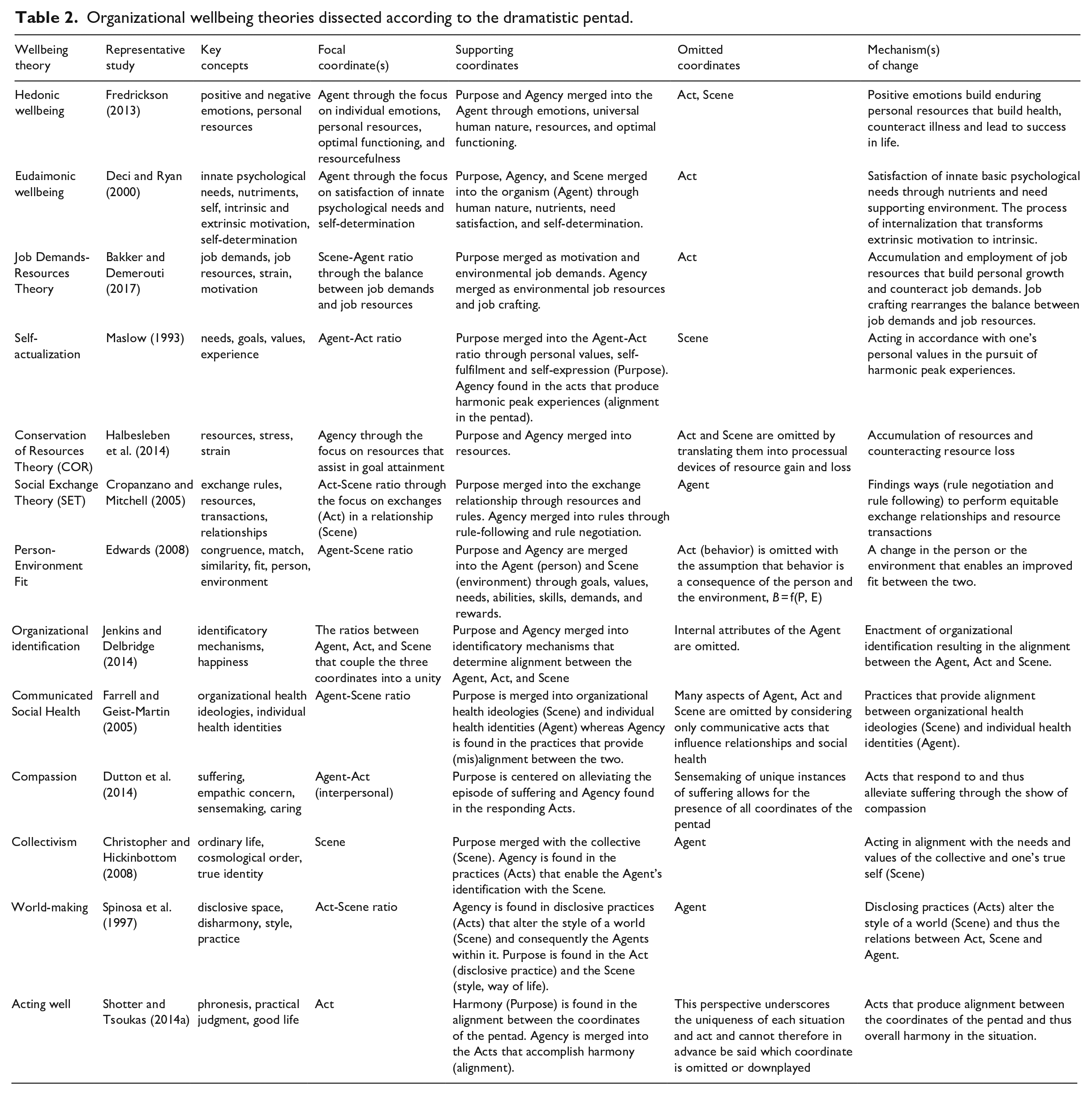
In Table 2 we juxtapose the discussed wellbeing theories with the elements of the dramatistic pentad. The table helps discern what are the theoretical building blocks (i.e. coordinates) and their interrelationships adopted in key historical and contemporary organizational wellbeing theories. Furthermore, for ease of comparison we include the three alternative conceptualizations of organizational wellbeing in the table.
Organizational wellbeing theories dissected according to the dramatistic pentad.
Conclusions
In this article we have analyzed the current state of organizational wellbeing research and identified a paradigmatic gulf between psychological and sociological camps. We showed how the disagreements within the debate can be explained by their antithetical views on human freedom. Furthermore, we argued that this gulf discourages and impedes constructive engagement between the two camps, leaving the concerns of the counter-discourse undeveloped and detached from organizational wellbeing theories, whilst the psychological paradigm continues unaffected. As Kuhn (2012) remarked, cross-paradigmatic fertilization of ideas is difficult, if not impossible. We see both considerable value and major deficiencies with both camps. As advocates of conceptual pluralism, we consider the current situation unsatisfactory for the fruitful future development of organizational wellbeing research. To circumvent this conceptual impasse, we suggested viewing the theories applied in the debate from a metatheoretical position and adopting the dramatistic pentad by Kenneth Burke as the means to both assess current wellbeing vocabularies and imagine new ones. Using the pentad as a conceptual guide should help researchers from both camps to position and develop their work further and even explore opportunities for joint discussion.
Our discussion offers two practical implications for organizational wellbeing researchers. First, the paper reminds of the fallacy of the Enlightenment ideal of aiming at a single final vocabulary about wellbeing and the Good Life (Rorty, 1989). Wellbeing theories are by essence imperfect. Acknowledging this, paves the way for allowing incomplete wellbeing vocabularies and seeking more pluralistic coverage of the topic. Our research should help wellbeing researchers better recognize and explicate the underlying premises in their research and help them both question and enlarge their theoretical conceptualizations of the topic.
Second, organization scholars should ramp up their efforts to offer alternative wellbeing vocabularies to the free marketplace of ideas. Instead of pinpointing deficiencies and overreaches in extant theories, we should focus our efforts on developing new vocabularies where these are mended. Our view is that the field needs even more radically different conceptualizations of organizational wellbeing than what are currently offered. Moreover, as wellbeing scholars we should show what such new vocabularies can accomplish that the extant vocabularies cannot. All wellbeing vocabularies are in the end subject to the test of prosperity: how they can help promote wellbeing. The ultimate value of wellbeing research is in its ability to enlighten practice. The changing character of work and the reality of grand challenges testify to the need for new types of organizational wellbeing vocabularies. The three presented vignettes show how such novel vocabularies are not only theoretically possible but urgently needed.
Footnotes
Acknowledgements
We wish to thank Dave Watson and his editorial team as well as the three anonymous reviewers for their helpful suggestions on improving the manuscript.
Funding
The author(s) received no financial support for the research, authorship, and/or publication of this article.
