




Abstract
Drawing on the Foucauldian technologies of the self, this study explores how individuals re-envision practices of wellbeing outside of traditional organizational contexts during extreme events. Based on a thematic analysis of 7234 comments posted on the Yoga with Adriene YouTube channel in 2020, this study unpacks a technologically mediated practice of self-care, which we conceptualize as somametamnemata. Our findings illustrate three entangled aspects of somametamnemata relating to yoga, a form of bodywork: Caring about self through practicing yoga online; caring about self and others through sharing about yoga in written comments; and caring about self and others through responding to shared verbalizations of yoga. This study distinguishes somametamnemata from known practices of self-care, advancing existing literature on technologies of self by overcoming the dichotomy between negative views of ill-being and positive views of wellbeing. By situating the potentiality of individual wellbeing within ill-being, we shift debates and discussions of “corporate wellness” beyond organizational boundaries.
Keywords
Introduction
In recent years, workplace wellbeing has become of increased concern for employers and employees alike (Wallace, 2019). Before the Covid-19 pandemic, being well was an imposed corporate obligation (Cederström and Spicer, 2015). Subject to a neoliberal imperative, workers searched for opportunities to improve their wellbeing outside of what was offered by organizations (Peticca-Harris et al., 2020b), like spending time with family and friends, doing sports and exercising and attending therapy sessions. For alternative practices of wellbeing, individuals sometimes rely on technology: using devices to improve focus, reduce stress, increase attention (Calvo and Peters, 2014); adopting digital tools that remind them to hold positive self-views, and even accepting therapy by chatbots that provide non-directive empowering sessions (Przegalinska, 2018). In a personal sphere, digital technologies enable the maximization of one’s potential and sense of being in control of one’s achievement along with autonomy in setting productivity goals, understood as self-care (Lupton, 2016). Once adopted in the workplace, the benefits of technological self-care have been dulled through overuse and exploitation. For example, workers often went to extremes to monitor and track everything, including toilet habits in search of higher efficiency (Cederström and Spicer, 2015). Additional studies showed how technology enables low work detachment and emotional exhaustion (Belkin et al., 2020), adds to stress (Moore, 2018), turns workers’ data into commodity (O’Neil, 2017), and cultivates worker precarity (Peticca-Harris et al., 2020a) by increasing the pressure to remain at work, even when they are unwell (Wallace, 2019). During this entanglement of the optimistic promise and growing critique of use of technology for workplace wellbeing, the Covid-19 pandemic hit.
The Covid-19 pandemic in early 2020 was an extreme event for people and organizations alike. Because of the healthcare crisis and risk of infection, globally, governments issued prolonged restrictions for face-to-face encounters. Furthermore, homes and workplaces abruptly merged as global governmental mandates forced organizations to support telework, where possible (Marinova, 2021). Under organizations’ directives, workers worldwide re-organized their work and life around technologies such as Skype, WhatsApp, YouTube, and Zoom. The technological mediation of work quickly became “the new normal” (Carroll and Conboy, 2020). Yet, despite its benefits for organizations and workers, remote work invited technostress and intensified work (Molino et al., 2020), often leading to burnout (Bunjak et al., 2021). Social media such as Facebook, Twitter and TikTok became outlets that enabled people to deal with their emotions, developing rituals of empathy, emotional expression and release with protest, humor, and injunctions to carry on (Brownlie and Shaw, 2019). Together, these studies illustrate the reconfiguration of social factors with an attempt to use technology to neutralize stressors in times of crisis, opening a rich theoretical space to study alternative practices of wellbeing. Here, alternative practices of wellbeing refer to practices that are outside the scope of the organizational context, that do not necessarily prioritize workplace productivity, nor positive employee image.
It is this nexus of technology, wellbeing, and crisis that our study investigates; specifically, the technological mediation of individual and collective practices of self-care during crisis. We explore how individuals creatively search for ways to amplify their wellbeing that extend beyond the options provided by organizations during the global Covid-19 pandemic. Specifically, we unpack the ways in which technology can mediate wellbeing by focusing on online spaces as sites that enable and facilitate alternative practices of self-care. We are guided by the research question: How do people re-envision wellbeing with the use of technology during extreme events? Drawing on Foucault’s (1988) technologies of the self, we answer the call for new directions of critical inquiry that draw on other ways to read Foucault (Barratt, 2008). We contribute to the growing streams of scholarship inspired by Foucault’s late studies of Greek antiquity (Munro, 2014; Raffnsøe et al., 2019; Skinner, 2013), as well as alternative practices of wellbeing (Hull and Pasquale, 2018; Maravelias, 2018; Wallace, 2022), such as neoliberal appropriations of hupomnemata (Heyes, 2006), which to date remain underexplored. Empirically, we focus on online discussions posted on the popular YouTube channel, Yoga with Adriene. These online discussions illustrate an adjoining community outside of organizational boundaries, where self-care unfolds through users’ self-writing, helping them and others cope and adapt to the crisis in which they are embedded. Our findings suggest that technological mediation enables a novel practice of self-care, which we refer to as somametamnemata. Consisting of three entangled aspects, somametamnemata features caring about self through practicing yoga, a form of bodywork, online; caring about self and others through sharing about yoga in the comments; and caring about self and others through responding to shared verbalizations of yoga.
Specifically, we contribute to the wellbeing literature in three important ways. First, we add to these on-going discussions by further disrupting the dichotomy between wellbeing (i.e. being healthy and productive according to organizational standards and mandates (Hull and Pasquale, 2018; Maravelias, 2018; Wallace, 2022) and ill-being (i.e. being unhealthy and unproductive (Wallace, 2019), which is a condition of life, yet one that is most often managed and concealed to conform to organizational pressures. Second, we theorize the technological mediation of self-care, which we term somametamnemata, and highlight the entanglement of own and others’ bodies and collective writing about them. In doing so, we bring Foucault’s (1988, 1997) notions of self-care into the digital age (Boklage, 2014; Weisgerber and Butler, 2016) while contributing to the more constructive view of subjectivity (Barratt, 2008; Raffnsøe et al., 2019) based on the concept of self-formation (Munro, 2014; Skinner, 2013). Third, we join the argument for non-organizational alternatives to wellbeing (Hull and Pasquale, 2018) and illustrate the ways in which crises necessitate alternative practices of worker wellbeing, highlighting the ways in which neoliberalism’s “go-it-alone” mentality has been intensified in times of pandemic-induced lockdowns, leading people to seek alternative practices of self-care.
Foucault’s care of the self
In this study, we draw on Foucault’s (1988, 1997) later work on technologies of the self (Starkey and Hatchuel, 2002). In contrast to his previous focus on discipline, in his three-volume history of sexuality he shifted his gaze from discourses on desire (Foucault, 1990a, 1990b) to the active construction of the self through transformative ethical practices, termed technologies of self. Technologies of the self permit an individual to transform themselves by becoming recuperated, rather than disciplined, through power relations and relations of knowledge. They provide an outlet for self-care, a power to “effect by their own means or with the help of others a certain number of operations on their own bodies and souls, thoughts, conduct, and way of being” (Foucault, 1988: 18).
Foucault explored self-care, tracing its ethical practices from their autonomy during Greco-Roman period to later taking over by medical and other institutions; and portraying it as a daily struggle that is called out by difficulties, ills and other extreme situations in human lives that lead to “conversion to oneself (ad se convertere),” in an “existential impulse by which one turns upon oneself” (Foucault, 1997: 96). This look inside oneself leads to establishing a relationship with oneself, governing oneself, enjoying oneself, teaching oneself, and learning from oneself. Such constituting oneself as a moral subject of one’s own actions, that is, defining one’s ethics (Foucault, 1997) shapes a reflexive self-conduct; and mobilizes discourses (logoi) as “weapons” and self-governing (askesis) to build the “courage” needed for this struggle (Foucault, 1997). Specifically, logoi, as knowledge of one’s self and the world, underlies and enables one’s ability to govern one’s self.
Care of the self can only be achieved by a training of oneself by oneself (Foucault, 1988). For Ancient Greeks, askesis combines exercises to train endurance and abstinence, meditation to bring acceptance of future ills, and self-control to help manage self-representations and recall main ethical principles. Two types of discourses accompany askesis: knowledge about the world, or dogmata, and memorized knowledge about oneself, or mnemata. Mnemata emerges from listening to others, self-reflection, and self-writing (Foucault, 1997). Translated from Greek, mnemata means memories, which Foucault leverages in conceptualizing hupomnemata, a written document that serves for supporting memory in retaining knowledge about oneself through re-reading previously written documents. Writing (including more contemporary, technologically mediated forms) is just one way of developing and preserving knowledge about oneself, alongside reading somebody else’s documents, learning from teachers, among others, but Foucault (1972) envisaged that it was thanks to writing that the continuity of oneself in one’s own memory could be established.
Foucault differentiated between three types of self-writing emerging at different time periods and characterized with distinct aspired moral states of the writing subject. Particularly, he compared forms of self-writing known to Greeks (correspondence and a hupomnemata), to Christian modes of self-writing (written confessions). Correspondence serves mainly to connect with others, a hupomnemata to connect with oneself, and the confessional to connect with God; as creative processes, however, all three lend themselves to the construction of one’s self through writing. A hupomnemata, in contrast to Christian confessionals in which the unspoken is revealed with the aim of being forgiven, is instrumental to relive, through writing, what has been said by a subject so that it can be incorporated into the self (Swonger, 2006). While correspondence presumes reciprocity and exchange between two subjects, a hupomnemata is not created to be seen and responded to. However, it can be shared with others to aid in their own care of self.
With self-care, the relation with others is always aimed at a greater good, and emphasizes non-dominant power relations (Foucault, 1997), without unequally prioritizing others: “The care of the self always aims for the wellbeing of others; it aims to manage the space of power that exists in all relationships, but to manage it in a non-authoritarian manner” (Foucault, 1997: 287). Thus, others are central to self-care, including caring for others and also learning from them toward informing dogmata (Foucault, 1997). Others can be positioned above one as educators, counselors, or at the same level, as family and friends; whichever positioning, listening to others helps achieve self-reflection (Foucault, 1997). Self-care is a personal choice, differently from health or mental wellbeing practices that are not fully controlled by subjects (e.g. involuntary care, unexpected medical treatments). The desired aim (telos) and outcome of self-care is maintaining the wellbeing of the subject, as well as others, as a form of greater good. Yet, these principles of self-care were not seen by Ancient Greeks as patterns of behavior for everybody; instead, they were attributed to a small elite, mostly those who were free citizens (Foucault, 1988).
Our study uses Foucault’s knowledge about self-care, developed from Greco-Roman ethical practices, as a conceptual basis for investigating how individuals engage with self-help as part of a broader neoliberal effort to enterprise their own health and wellbeing (Markula, 2004). Importantly, we extend Foucault’s conceptualizations of self-care by theorizing novel practices of self-care enabled by digital technologies, such as online platforms. For example, social media sites like YouTube and Wikipedia rely on distributed, collective and largely anonymous content creation (Scott and Orlikowski, 2014) and enable visibility and interaction between users, supporting a form of technological self-care (Petrakaki et al., 2018). Anonymity and visibility shape users’ perceptions of online platforms, as well as their participation patterns. User-generated content can be linked to Foucault’s conceptualizations of writing as self-care. For instance, digital blogging (i.e. leading a digital notebook on a personal website) is understood as a hupomnemata despite visibility of digital blogs to others (Boklage, 2014).
Digital technologies serve to more than just support existing forms of writing and askesis; they have a potential to shape new practices of self-care. Foucault argued that, for the Greeks, a hupomnemata was called to life by appearance of personal notebooks as a technology that allowed to write, keep, (re-)read and exchange one’s notes, observing that “this new technology was as disrupting as the introduction of the computer into private life today” (Foucault, 1997: 272). To date, research has only discussed digital technologies in light of known self-care practices, overlooking a rich, naturally occurring phenomenon in comments below bodywork videos. We situate this commenting, shaped by visibility and anonymity, as a form of self-care that is performed in a digital place where others collectively participate in the construction of self. We use Foucault’s thinking about ethical self-care practices to advance understanding of wellbeing practices beyond organizational contexts through exploring the entanglement of technologically mediated self-care practices of embodied yoga and reflexive self-writing.
Methodology
Yoga on YouTube during the Covid-19 pandemic
YouTube, a website developed in 2005 and bought by Google in 2006 (Kiyimba et al., 2019), is the largest online platform for user-driven content sharing in the world (Wattenhofer et al., 2012). The combination of rich media and social networks allows for creating an online video community (McKitrick et al., 2022; Yodovich and Kim, 2022). How-to videos, and specifically guided physical exercise, rank in the top five categories of video upload popularity and in 2020, ranked within the top three for number of individual views (Sukhraj, 2021).
As an ancient Indian practice aimed at wellbeing, yoga was popularized in North America in the mid-20th century, as evidenced by the emergence of a high number of yoga studios and class offerings (Jain, 2014). In the mid-2010s, yoga classes became available online through platforms such as YouTube, often as a complement to offline offerings (Cheresson, 2021). Of the different types of exercise available on YouTube, yoga’s popularity skyrocketed during the Covid-19 pandemic, given its financial accessibility as a free resource (Chenoweth and Shiffer, 2020), and its bodily accessibility, with online yoga class offerings matching various fitness levels and styles. With traditional studios closing down during the pandemic due to lockdown restrictions, online yoga classes saw 76% more teachers and 50% more users, according to a survey by Rawlings and Pollen (2020). Although Covid-19 resulted in a global crisis with severe consequences for mental health and wellbeing, it also provided opportunities for online offerings of physical exercise and meditation, evidenced by the popularity increase of such YouTube channels as Yoga with Adriene, who has more than 9 million subscribers (Social Blade Stats, 2021).
Data collection and analysis
Our qualitative study focuses on the lived experiences of users of the Yoga with Adriene channel during the Covid-19 pandemic, as expressed via comments posted below monthly videos uploaded between April and August 2020. These comments were collected and analyzed to locate users’ perceptions of the pandemic within a wider structural and discursive context in the autumn of 2021; however, even after the comments were captured, ongoing dialog among users continues to be present on the Yoga with Adriene website as indicated by extended screenshots of selected comments made in the autumn of 2022. Much like in blogs, YouTube forums comprise frequently updated and interactive comment boards consisting of dated entries arranged in reverse chronological order (Rettberg, 2018). The comments allow dialog between authors and readers, while the site owner retains ownership of, and control over, the site’s content (Peticca-Harris et al., 2015). Although prone to be altered, revised and even deleted and thus challenging to analyze given the possible shifts that may take place, comments posted in this online format offer a first-person perspective and often have a confessional sharing quality, representing a myriad of voices, opinions and expressions on topics, subjects and issues (Hookway, 2008). Left by users below corresponding videos, comments generate a source of naturally occurring data especially relevant for research in health and wellbeing (Kiyimba et al., 2019).
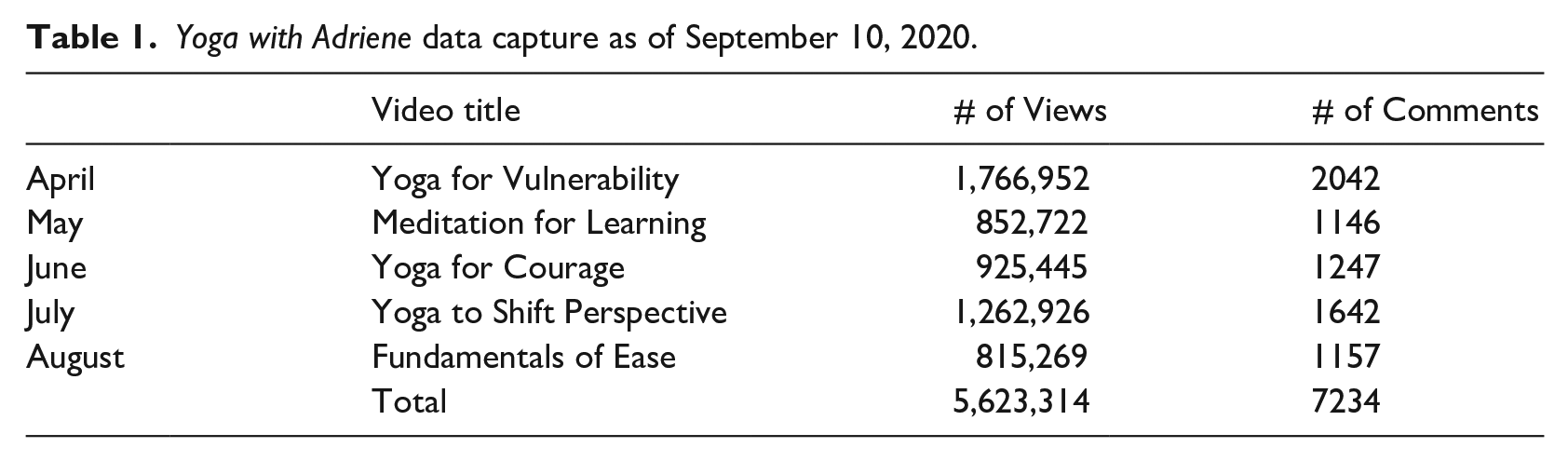
YouTube is a social media platform where content is public, enabling researchers to capture naturally occurring data that comprise unchanged text-based materials (Potter, 2004) and thus to acquire a holistic understanding of the phenomena under investigation. Because naturally occurring data are not generated in response to predetermined ideas or prompts, it allows for capturing actual practices, retaining original context, minimizing social desirability and avoiding circularity (Kiyimba et al., 2019). Users of the Yoga with Adriene channel often started their comments by disclosing their profession or age, particularly when that information was relevant for their message. In total, we explored 7234 1 comments following the monthly upload of free yoga videos onto the channel. While usually themed with aspirational and motivational messages about body positivity, beginning in April 2020, video uploads began to also concern themes of wellbeing and collective coping, in response to the challenging times generated by the Covid-19 crisis and, later, the Black Lives Matter social movement (Table 1).
Yoga with Adriene data capture as of September 10, 2020.
Following Grbich (2012), we identified this changing community through textual postings; to make sense of postings, we analyzed comments thematically (King, 1998) using Atlas.ti 9 qualitative data management software. In our inductive study, thematic analysis helped to organize data and make sense of users’ comments in their own words, focusing on their experiences, descriptions, feelings, thoughts and behaviors (King, 1998). Specifically, our research assistant independently coded the full dataset for main sub-themes within the over-arching narrative of health, wellbeing, and crisis; we subsequently further analyzed and, keeping in mind our research question, compiled the following themes: in relation to bodies, engaging in technologically mediated exercise, converting attention to self via bodies, taking distance and observing bodies; in relation to writing – confessing (in the non-religious sense of the word) emotions, recognizing lack of structure, making sense of isolation, noticing changed sense of time, acknowledging ill-being; and in relation to collectivity – giving and receiving empathy, updating information and interpretations, connecting with others, finding consolation in temporariness, transforming states of self through collectivity, potential futures.
We then synthesized these themes into three main aggregate dimensions that describe actions performed on the self, either mental or physical. 2 These dimensions helped us theorize main components of technologically mediated care of self. The first component, which we termed soma (Greek word for body), referred to embodying states of self, consisting of how individuals go through “conversion to oneself” (Foucault’s term for turning to oneself) by engaging their bodies in physical exercise. The second component, which we labeled mnemata (Greek for memory) inspired by Foucault’s term hupomnemata, referred to developing logoi about states of self, consisting of how individuals distance themselves to observe their bodies, describe their states and acknowledge them as ill-being. Finally, the third component, which we termed meta (Greek for among, with, and also has a meaning of changing and shifting), referred to collectively developing and practicing askesis in the face of ill-being, in alignment with Foucault’s definition of askesis, consisting of how individuals condition one another to avert difficult emotional and physical states while imagining potential futures. We identified that while developing logoi about states of self, users emphasized anonymity: A possibility to leave confessional comments without connecting an existing identity to them. While collectively developing and practicing askesis in face of ill-being, they relied on asynchronicity: A possibility for individuals situated at different points in their journey of struggle with Covid-19 to “meet” on the channel forum, in a digital third place (Belk, 2013), a place that is neither home nor work. These themes served for conceptualizing the three qualities of technological practice of self-care that we termed somametamnemata, from the Greek words meaning “body” (soma), “with” and “shift” (meta) and “memory” (mnemata), taking inspiration from Foucault’s (1988) concept of the hupomnemata. Individuals engaged in somametamnemata by various means: some from commenting (mnemata) and some from responding to others (meta). As the last point of our analysis, we questioned what these practices meant for the users of Yoga with Adriene and identified instances of changed wellbeing resulting from self-care, such as rethinking jobs, refocusing attitudes, realigning emotions. We considered these instances as outcomes of self-care. The naturally occurring data we used did not allow for following up with users to confirm whether they have consistently improved their mental and physical health, or whether new jobs were better than past ones, but the intentionality expressed by users was striking, thus we captured it with the term potential wellbeing.
The conceptual model resulting from this analysis is depicted in Figure 1. Our findings provide illustrative excerpts to exemplify and support these themes. Given the public nature of YouTube, comments have been kept in the format in which they appeared on comment boards and captured in September 2022 when our extended screenshots were generated.
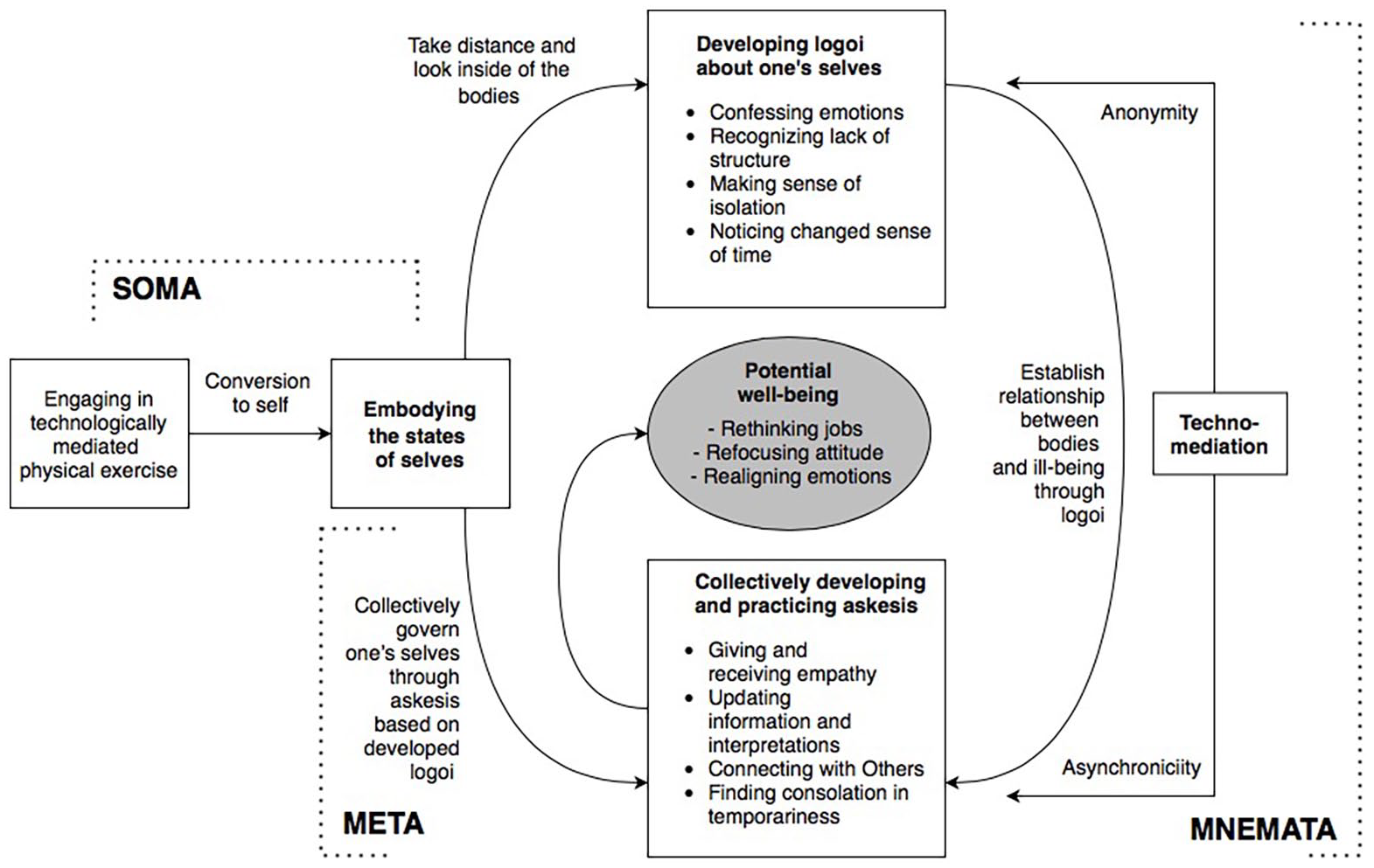
Transforming ill-being into potential wellbeing with somametamnemata: technologically mediated self-care.
Findings
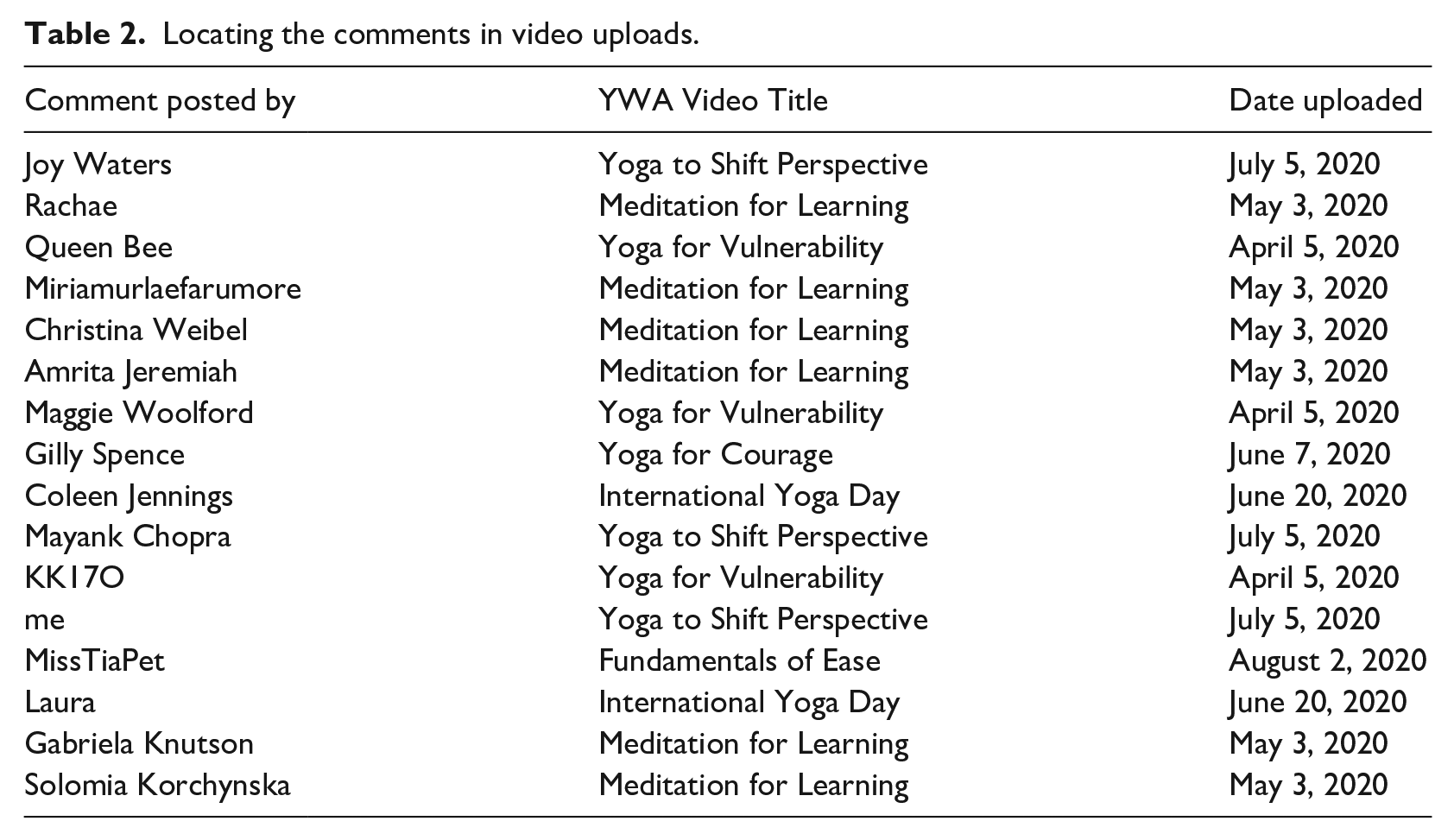
In this section, we report on users’ lived experiences of technologically mediated self-care during the COVID-19 pandemic. This includes directing attention to the self though bodily practice, acknowledging states of self as ill-being through developing logoi about them in online comments, and collectively transforming states of self into potential wellbeing. We structure the findings around the three distinct components of technologically mediated self-care with others (i.e. somametamnemata), which emerged from the thematic analysis. We present them in order of relevance to the process of transforming ill-being into the potential for wellbeing: (1) soma (self-care through engaging the body in physical practice), (2) meta (care of self and others through collective response to verbalized reflections), and (3) mnemata (self-care though developing logoi about and sharing with others the states of the body). As the findings reveal, embodied self-care with others facilitates transforming ill-being into the potential for wellbeing, helping overcome the purely negative effect of the Covid-19 pandemic. Refer to Table 2 to locate which video the comments captured in the findings pertain to.
Locating the comments in video uploads.
Soma: Conversion to self
While engaging in technologically mediated physical exercise of yoga, users directed attention to their self. During the pandemic, online yoga classes became a way of remedying physical and mental health. Some users were sick or caring for others who were sick with Covid-19. Other users explained that they were working from home because their workplace was shuttered and some, like Joy, shared that they were essential workers, required to be on-site because professional activity was deemed indispensable for society:

In this comment, Joy describes the pressure felt when interacting with others at work, reconciling perhaps the role of librarian, the free services that the library provides to many, but also the anxiety of being deemed an essential worker during the pandemic. Joy highlights that yoga and this online community serves as an aid and outlet for this anxiety, to ground oneself. Sharing difficult emotions, reflecting on experiences through and with the body, and engaging in practices aimed at recreating one’s self are parts of the self-care process, a Foucauldian (1997) rendering of askesis; that is, the doing of meditative yoga and also correspondence, in dialog with Adriene. Yoga gives users a possibility for slowing down their bodies and minds, providing them with space to observe how they feel and perhaps consider how they rather feel instead. For example, some users shared about the embodied states of their bodies or what their bodies were doing, such as tension or relaxation; unexpected crying; weakness or strength. Others shared how they stumbled upon Yoga with Adriene by chance and gradually adopted self-care as a daily practice, “Yoga was just to try something new” (comment by user login me). Yet others were directed to the channel through their workplaces:

This comment shows that some employers of essential workers relied on digital third places (Belk, 2013), such as online yoga classes rather than internal wellness programs to support their workers’ wellbeing during the pandemic. Rachae;’s post reveals how they allowed themselves to relax through the online video. At a time of heightened awareness, stress and fragility, especially for the medical community, to which they belong, being on the frontline of the crisis, speaking about relaxing while working as a medical professional during a pandemic, could perhaps be an “unsayable” (Foucault, 1997). It revealed that, yes, Rachae; too needed an outlet and a pause from the mounting emotional toll of the pandemic.
As a bodily practice, yoga redirected attention from the emotionally hard circumstances users were facing to the states of the bodies they inhabited. Queen Bee shares:
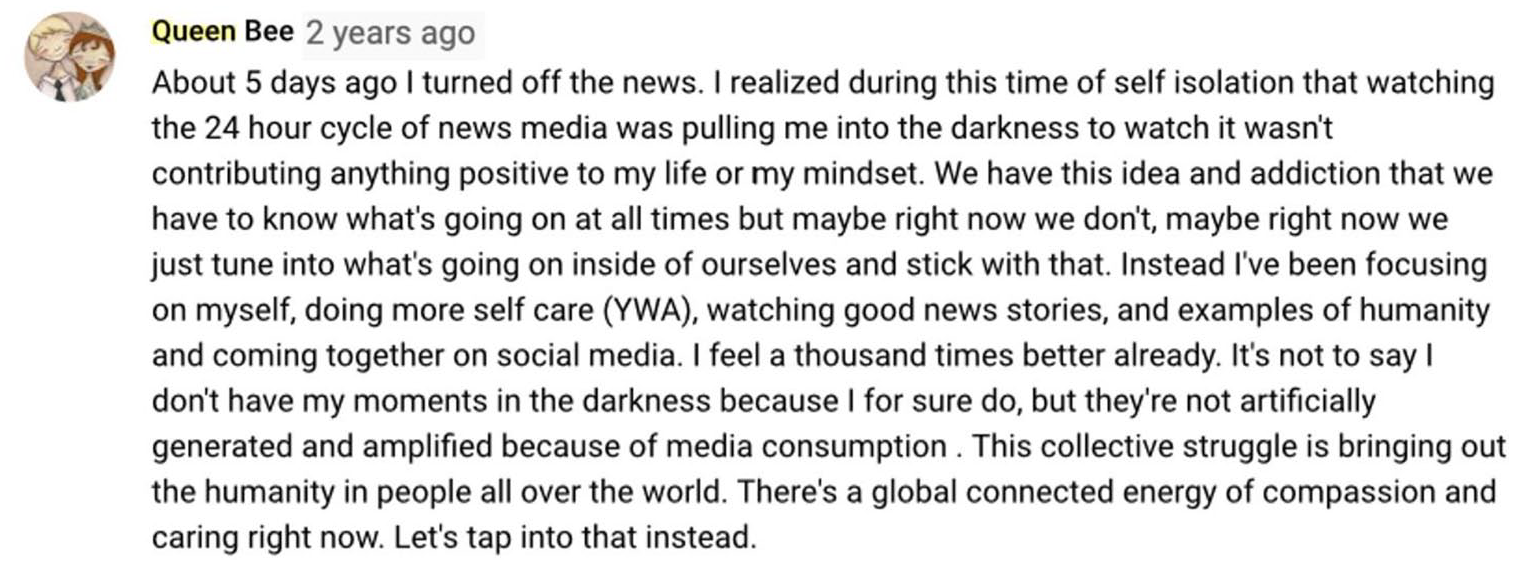
As Queen Bee indicates, self-care through Yoga with Adriene brought them into direct contact with their body, that is, a way “inside of [them]selves,” focusing on how they felt. Directing attention to the body during physical practice enabled users’ bodies to express emotional states. For example,
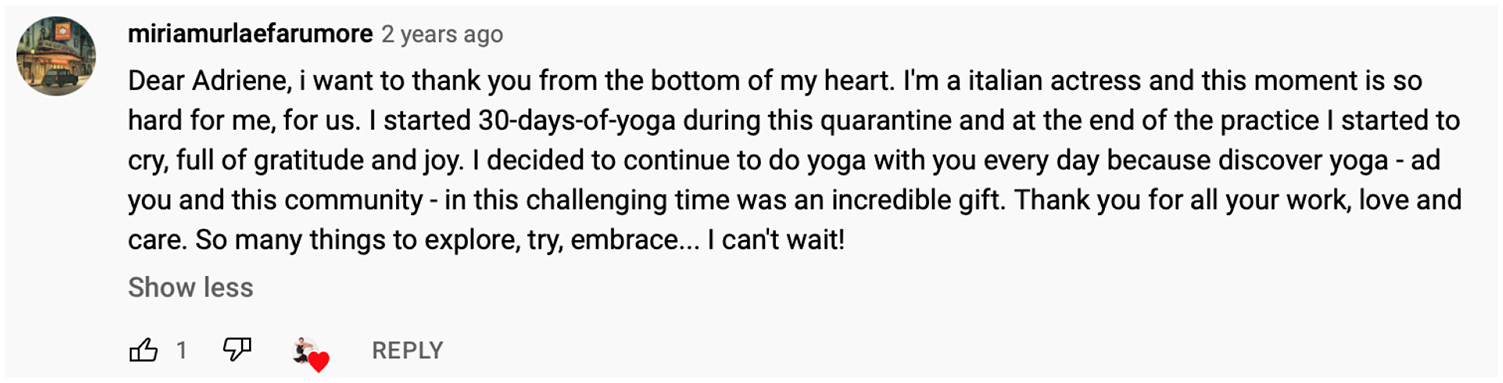
This quote exemplifies how users embodied states of self: During yoga practice, “hard” emotions turn into bodily states of crying that change the initial emotion into “gratitude and joy.” miriamurlaefarumore does not stop at realizing this, verbalizing their discovery of “the community” and stipulating their intention to “embrace” it. Through yoga, miriamurlaefarumore shapes emotions through flesh and blood, then turning them back into emotions and reflections, a process they describe as “an incredible gift.” Attention to bodies is further reflected in the comment by Christina Weibel, “As I was doing this I realized I think of my body as one of my closest friends. Does anyone else feels so?” Christina highlighted noticing the body and realizing the power contained in it. Echoing Christina, Amrita elaborates on a connection between the body and reflection, describing the self-care process in the following way:
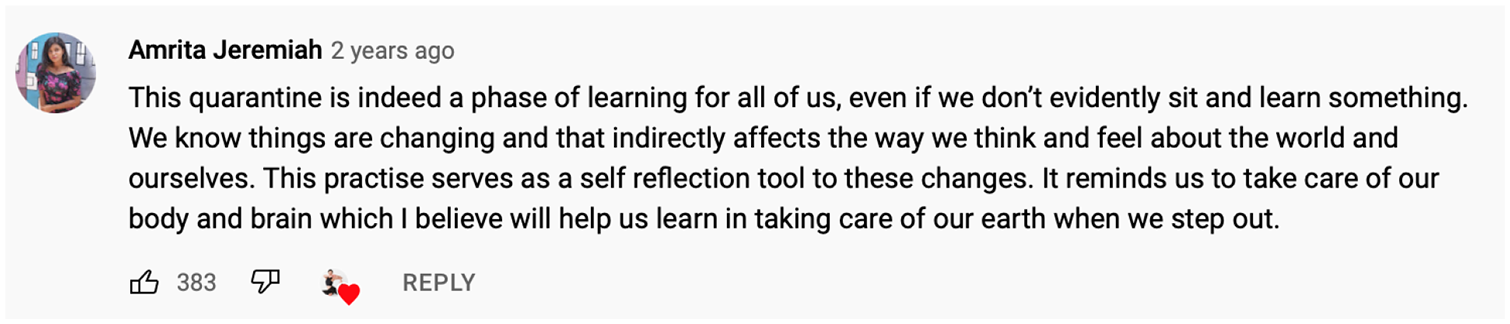
Like other users, Amrita highlights the importance of body and brain, pointing out that bodily practice facilitates reflection upon the self and taking care of the self. Amrita also extends care of self outwardly toward “our earth.” Amrita’s, miriamurlaefarumore’s, and Rachae;’s comments exemplify the outward openness that is characteristic of online yoga YouTube comments during the pandemic, indicating the importance of the other to this technologically mediated practice of self-care. When asking “Does anyone else feels so?” Christina presumes an audience and this differentiates the confessional self-reflection from a hupomnemata. Although a hupomnemata may be exchanged publicly, it is usually not written with an audience in mind; the only presumed audience is the writer themselves (Swonger, 2006). In the online yoga YouTube comments, yoga, as a form of bodywork, facilitated technologically mediated writing that was visible to others, as a form of embodied self-care. This entanglement shifted the perspective of users toward others, paving the way to the collective response that we unpack below as we elaborate on one’s writing of their own experience of yoga. Overall, this section on soma explores how users of Yoga with Adriene engaged in self-care by embodying states of their selves, which they accomplished through physical exercise and converting to their selves.
Mnemata: Look inside the body and establish relationship between bodies and ill-being through logoi
Developing logoi about the states of the self, as highlighted in Miriam’s comment above, is the first step toward acknowledging the state of ill-being. In the previous section we saw how users deconstructed the tight clew of difficult feelings, such as fear, anxiety, and powerlessness into states of the body, connecting them back to reflections about the self while remaining open to the other. Overall, yoga pushed them to take distance from their emotions:
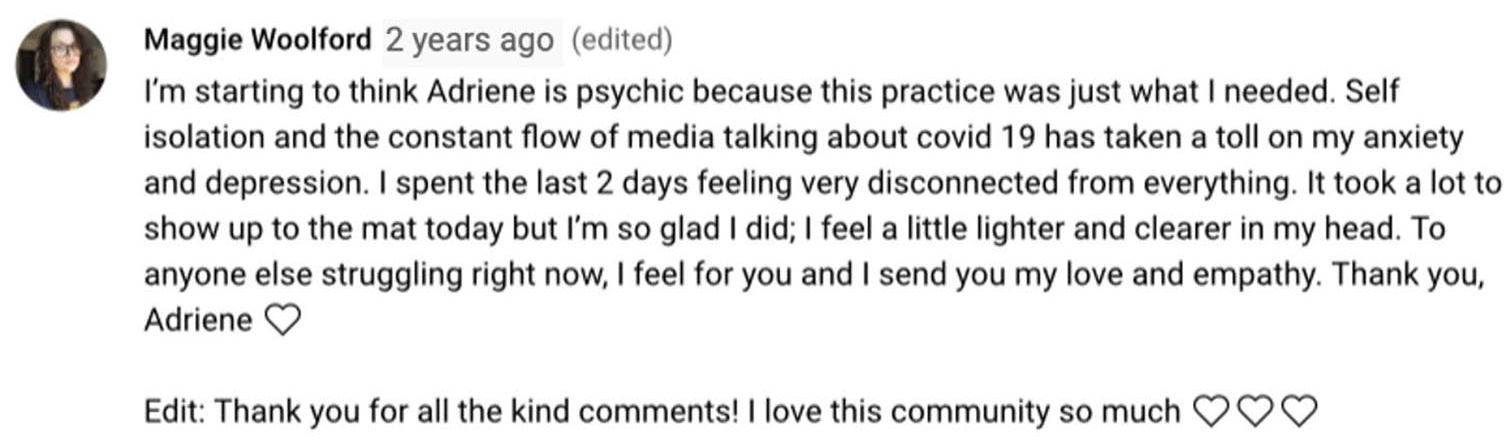
In this quote, Maggie confesses having anxiety and depression, emotions that are often stigmatized outside the yoga community and therefore rarely confessed. This exemplar illustrates Maggie’s rigorous self-examination and self-work. Under the neoliberal imperative, which expects workers to take responsibility for being fit and healthy, recognizing ill-being is difficult because it is perceived as contrary to capability and, therefore, worthiness. This points to a different ethic under the knowledge of oneself, which Foucault understood as a combination of meaning and aims for knowledge of self. In the Christian period, self-examination was an activity associated with faith and oriented at becoming pure and immortal. In Greek Antiquity, self-knowledge was grounded in humanistic terms; in the Roman period, it was rooted in a person’s position; in both periods, self-knowledge was oriented at mastery of self as an end goal. In Greco-Roman ethics, rigorous examination of self, aimed at self-critique, was key to self-care (Foucault, 1997). In contrast to examinations creating a hupomnemata, which contained only logos (i.e. information for thought) (Boklage, 2014), this quote also contains pathos (i.e. reflections on affect and emotions). Maggie recognizes the lack of structure speaking of her life as a “constant flow of media,” and makes sense of isolation as disconnection which Maggie attempts to fight through connecting to a yoga video lesson. Moreover, this quote stresses distancing from pandemic-induced states to lighter ones. Finally, the edit at the bottom of the quote indicates the collective support that Maggie receives from and offers to the community, something we discuss in the section on meta. The co-presence of soma, meta, and mnemata in users’ comments highlights that these are entangled aspects of the practice of technologically mediated self-care rather than isolated phases of the process. Further, looking inside their bodies allowed users to attain a certain transitional state, as the following quote indicates:

In this quote, Gilly reflects on the experience of practicing along the Yoga with Adriene online class. Gilly observes their own body bursting into tears while in child’s pose, taking distance from the emotionally draining life experiences in the US at the time: Besides the pandemic, in other comments, Gilly refers to the murder of George Floyd and the desperation Gilly feels about racial issues. This quote shows that taking distance through the online practice of yoga may lead to a cathartic state that Gilly described as “release,” with subsequent reflection upon it fostering feelings of safety and being able “to go about [the] day in a much more positive way.” The digitalized experience of yoga and corresponding verbalized reflection within the online community served as an apparatus of security.
Similar to a Christian confessional, reflections on users’ own lived experiences were strikingly genuine, but in contrast to confessionals and similar to the Greek hupomnemata, without searching for divine forgiveness. Like Gilly and Maggie, other users confided to what might appear as socially unaccepted emotions: A sense of lack of direction, a struggle with making sense of isolation. Such confessional quality would not be possible without technological mediation; as one user put it, “[t]echnology offers a true perspective on the issues people around the world have to deal with on daily basis.” (Coleen Jennings). The “truth” of the technological mediation comes from the fact that although technology attempts to connect people all over the world, it’s not without issue, delay or at times frustration for slow and intermittent internet connections. But it also enables retaining a certain degree of anonymity, as one user recognizes in a post:

This user hides behind their brother’s account, disclosing specific body features that they describe as “negatives” while describing an ideal, dreamed of body, which they hope to attain through yoga and the support of this community. Disclosures bring on vulnerability that may be associated with posting comments of this nature in publicly available online communities and technology enables avoiding such costs of disclosure.
Further, technologically mediated confessions led users to acknowledging the state of ill-being:

Here, with a comment, Kk17O acknowledges the state of ill-being by articulating that stress took its toll physically and emotionally to an extent that relaxation became unavailable. Kk17O highlighted the cathartic importance of this realization by disclosing “[being] glad” to showing up for practice, which helped improve the ill-being state. Akin to other tools for the care of self, such as hupomnemata, the technologically mediated embodied practice of self-care with other requires the subject to make a frank and reflexive self-evaluation in order to reach catharsis. The frankness of this evaluation is key for the transformational benefit of subsequent interactions. Overall, this section on mnemata shows how users engaged in self-care by developing logoi about the states of their self; sharing these in the comments facilitated acknowledging their ill-being with others.
Meta: Collectively governing ones’ selves through askesis
Another component of technologically mediated embodied practices of self-care with others is the collective response to acknowledged ill-being. YouTube affords visibility to added content, including comments, which can be read and commented on asynchronously, even long after they have been posted, from anywhere worldwide. This facilitates others attending to subjects’ wellbeing through a variety of tools. Similar to correspondence, the comments bring about a dialogical response. Yet, in contrast to correspondence, this response is not necessarily reciprocal and does not necessarily come from the individual to whom they were addressed, as predominantly seen with exchanges on the Yoga with Adriene channel. In the absence of exchange, comments function as Foucault’s (1997) hupomnemata, which he compares to a choir, where the voices of individual singers do not stand out individually, but blend together into a collective voice. From technologically mediated interactions result not just a mixture of advice, but a completely integrated new whole: A potentiality of wellbeing in terms of re-envisioned work, and physical and mental health. Like a hupomnemata, the developed logoi can, and are, shared with others to help with their own care of self. We share two separate interactions below that illustrate the meta in somametamnemata, developing the collective askesis in response to a subject’s ill-being:
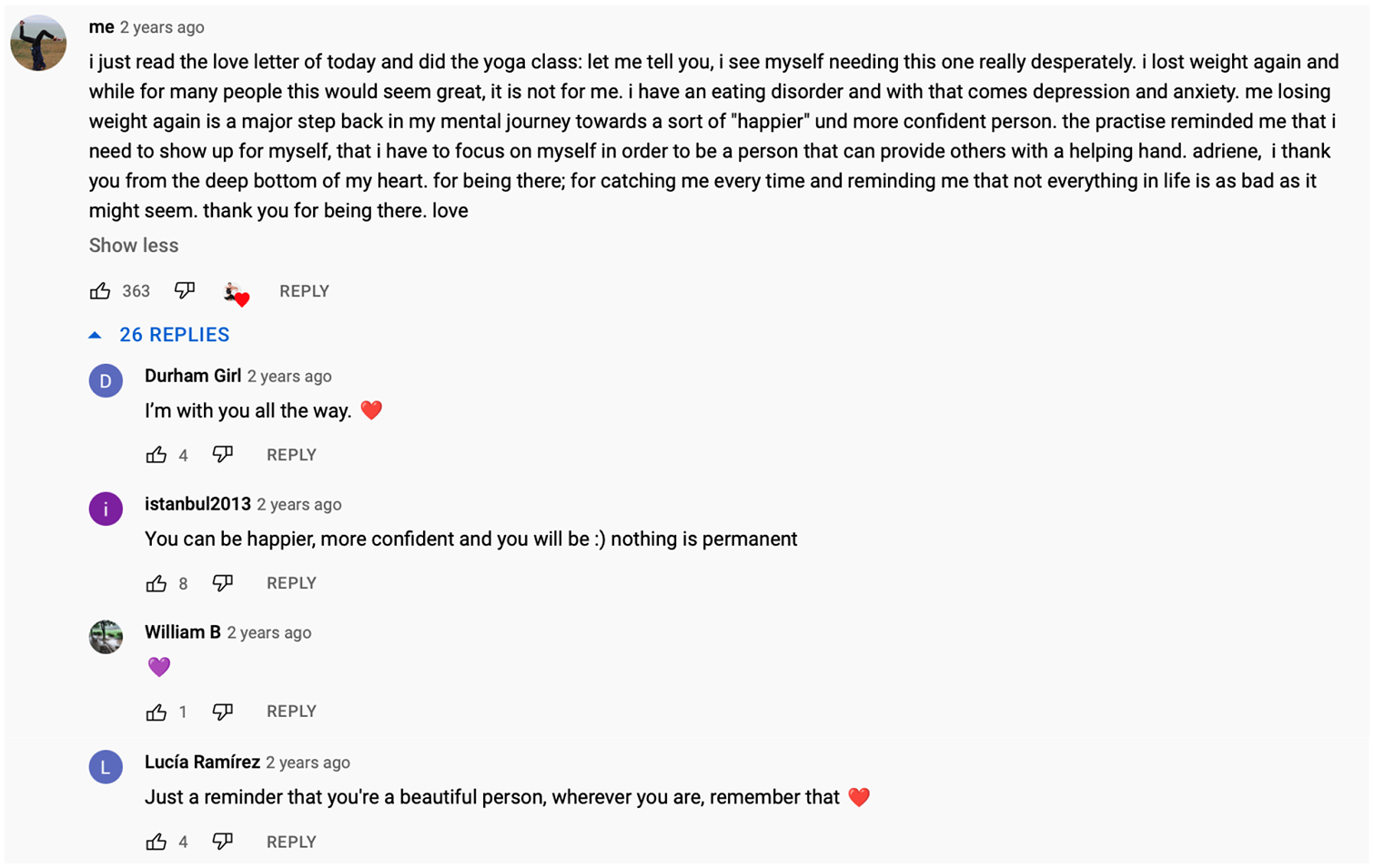
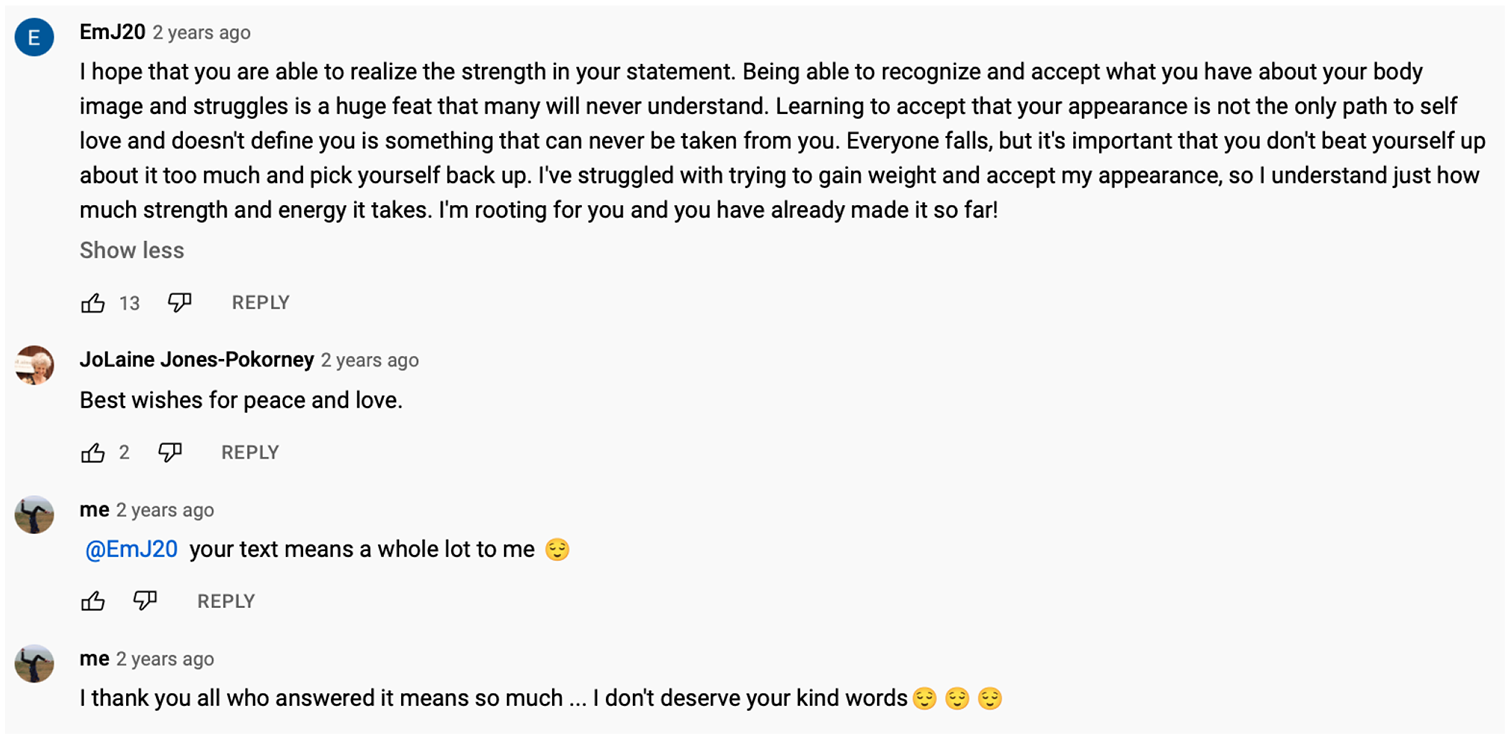
This first interaction excerpt illustrates somametamnemata as a tool that, like a hupomnemata, results from a synthesis to create a new soul, which is constituted when the user me writes “your text means a whole lot to me.” Unlike a hupomnemata, it is not only what is shared about the eating disorder and the user’s embodied experiences; it is what others respond to that constitutes the process of transformation. This quote contains different examples of collective askesis, together and separately, in response to others’ ill-being: William and Durham Girl showing empathy, Lucía Ramírez refocusing interpretation from denial to acceptance and istanbul2013 providing consolation by reminding the benefits of temporariness, with all of these enabling user me to receive empathy and connect with others by expressing gratitude.
Another excerpt illustrating the collective governing through interaction between users started with a comment posted by MissTiaPet:
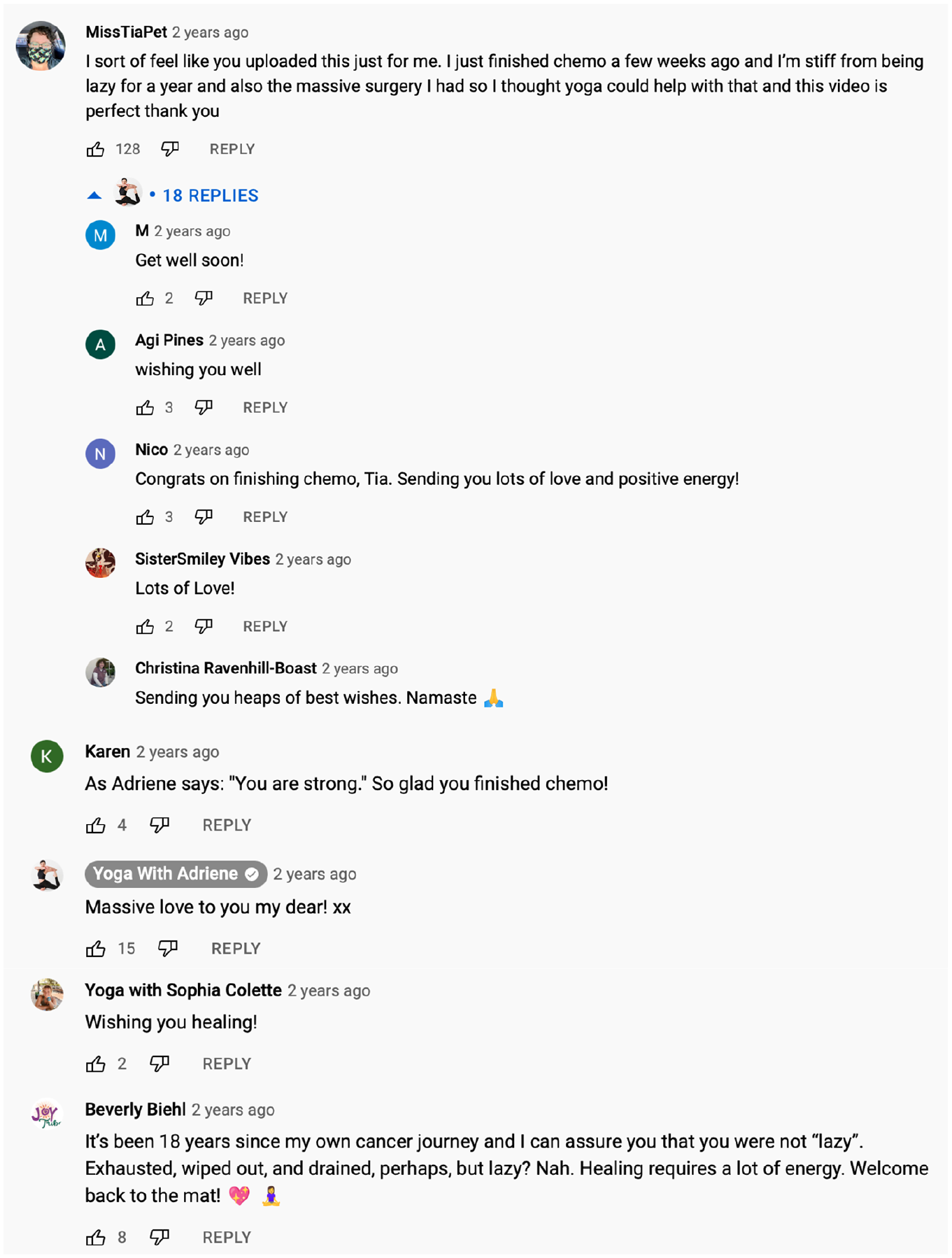
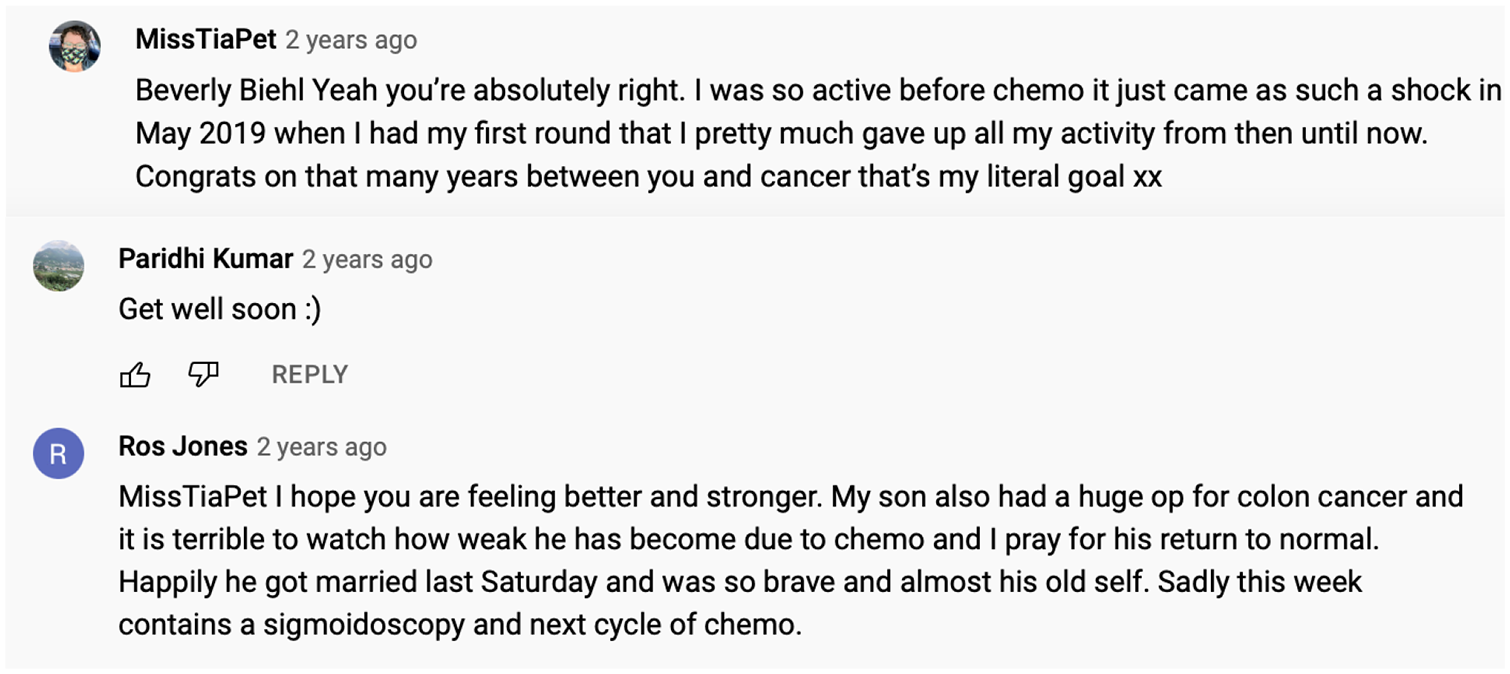
Here, MissTiaPet softens and repositions their views on being lazy following Beverley Biehl’s personal reminiscence about their own cancer journey. Beverley’s acknowledgment and reactions help MissTiaPet transform negative self-talk into self-acceptance. Like the interaction that started with user me’s posted comment, users come together to support MissTiaPet through well-wishes from the likes of Nico, SisterSmiley Vibes, and even Yoga with Adriene, but also separately, as seen with Ros Jones’ sharing their own pain and suffering about their son’s brave cancer journey. Together, these excerpts show how neither the subject nor the readers of somametamnemata are passive; rather, they are continually engaged in incorporating somametamnemata into their daily lives.
Overall, this section on meta unpacks how users collectively develop and practice askesis in response to others’ ill-being, fostering feelings of a safe place and paving the way for refocusing attention from ill-being to potential wellbeing. Broadly, the three sections above describe the unfolding of somametamnemata: a technologically mediated collective practice of self-care that enables potential wellbeing.
Potential wellbeing
Within the dataset, the collective response to acknowledged ill-being through somametamnemata ignited three types of transformations as an outcome of one’s self-care practices: Rethinking jobs, refocusing attitude, and realigning emotions. First, transformations around rethinking jobs might be inspired by the collective response directly grounded in one’s yoga practice. This is the case with Laura, who thanks Adriene and the online community for the inspiration to rekindle their passion for teaching yoga, adding that, “Yoga has been transformative for both myself and those around me, particularly when dealing with anxiety.” Second, in certain cases, the practice of somametamnemata led to refocusing attitude, not across, but within one professional practice, as the following quote exemplifies:
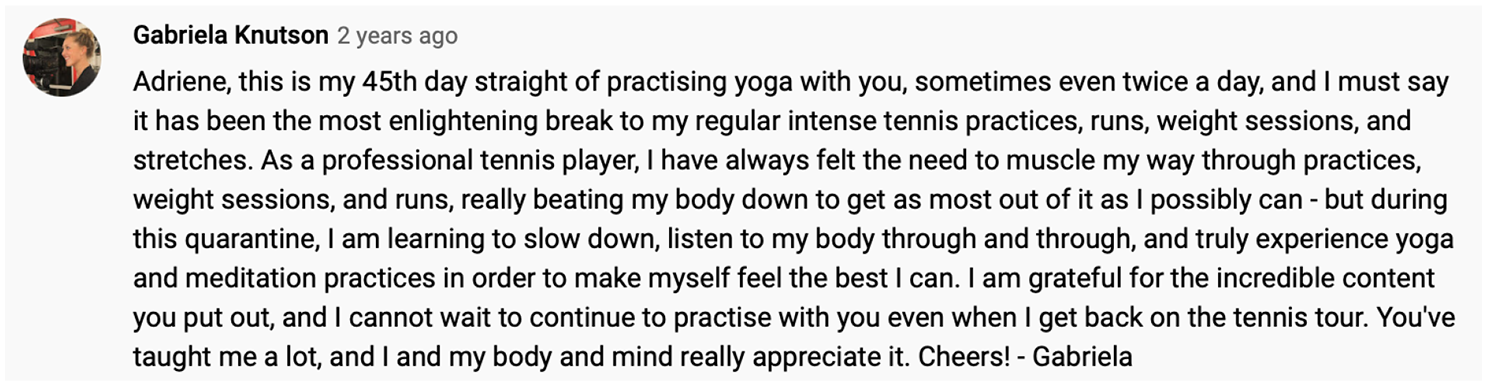
This quote highlights the refocusing of attitude from “muscl[ing] through” to being attentive to one’s body and thus “fee[ling] the best [one] can.” Gabriela’s account is charged with emotions, experiences, and reflections; as a result, it creates the potentiality of feeling better through slowing down and accepting the limitations of one’s body while learning from others. Third, realigning emotions to feeling well is highlighted in the comment from Solomia:
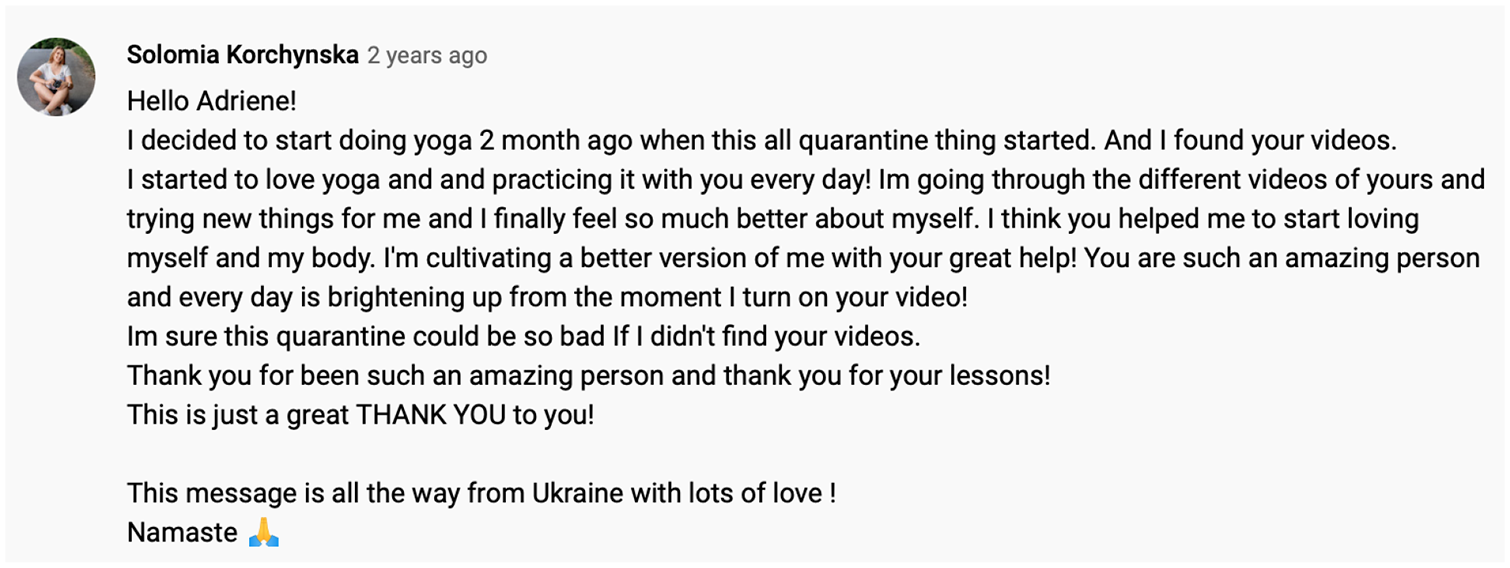
This quote emphasizes the positive transformation of Solomia’s emotional state, experienced as renewal, resulting from engaging in embodied collective self-care, cultivating a better version of the self, and learning to accept one’s own body and the new self despite wellbeing challenges imposed by the lockdown.
In sum, these findings summarize three intertwined processes represented in Figure 1 by arrows: conversion to self; taking distance and establishing a relationship between bodies and ill-being through logoi; and collectively governing oneself through askesis that relate to how technology is harnessed to mediate and curate collective responses to health and wellbeing during times of crisis, a practice we term somametamnemata. For this, Yoga with Adriene users embodied states of self and developed logoi and askesis for such states through relying on peer-to-peer engagement, using the digital platform for communal bonding and supporting one another during challenging times. Similar to a hupomnemata, a practice of self-care through writing that represented arguments and means for overcoming difficult circumstances (e.g. grief, exile, disgrace) or struggling against weakness (e.g. anger, envy, gossip) through turning in on oneself, to build control over oneself and to enjoy oneself (Foucault, 1997), users processed and managed difficult emotions with the aim of recreating a new self, but this time collectively and through their bodies. Further, users engaged in collectively transforming crises into potential wellbeing by interacting through online self-examinations, which acted as technologies of self, enabling users to affect their “bodies and souls, thought, conduct, and way of being, so as to transform themselves in order to attain a certain state of happiness, purity, wisdom, perfection, or immortality” (Foucault, 1988: 18). In this way, the digitalization of yoga online and subsequent commenting community serves as an apparatus of security, fueling interactions that fostered feelings of safety.
Discussion
Much of the existing literature has sung the praises of yoga for physical and mental health (Jain, 2014; Singleton, 2010). Our empirical exploration of Yoga with Adriene goes beyond looking at the known health benefits of yoga as a standalone practice. Instead, we investigate how technological mediation generates a novel “third space” (Belk, 2013) for enmeshed self-care practices, including the physical practice of online yoga; yet we also demonstrate that self-care can be about caring for oneself and others through the embodied practice of self-writing, where users shared verbalizations of their bodywork and life, detailing what these dialectic practices evoke: emotions, confessions, and connections.
We illustrate how information and communication technologies, which are typically blamed for their detrimental effect on workers’ wellbeing (Belkin et al., 2020; Molino et al., 2020; Moore, 2018), can be part of the solution by mediating collective acknowledgment of ill-being and its transformation into potential wellbeing through practices of self-care with others. The YouTube channel Yoga with Adriene illuminates the emergence of an alternative (third) space for wellbeing in times of pandemic-induced lockdown, highlighting an ethic beyond the conventional frameworks of employment relations or medicine. We mobilized Foucault’s theory on self-care as a lens to situate this emergence. We explored how, during the Covid-19 pandemic, workers turned to technologically mediated practices of self-care for themselves and with others, grounded in body work and collectivity, a phenomenon we term somametamnemata. Somametamnemata is a type of self-care that encompasses embodied mnemata through self-writing and collective askesis; it is a way to address crisis as people start developing “weapons,” or logoi that establish connections between bodies and selves in times of crisis, and “courage,” or collective askesis that helps govern selves in the face of ill and leads to emerging potentialities. In the dataset, such potentialities varied from starting a new business to reclaiming a state of wellbeing, and all carried a seed of transformation in comparison to the ill-being acknowledged at the start of the pandemic. Potential wellbeing unfolded as an outcome of self-care as a set of practices that summarized personal choices of conduct (Foucault, 1997): rethinking jobs, refocusing attitudes, and realigning emotions. In contrast to certain aspects of physical and mental health that were out of people’s control during the Covid-19 pandemic, wellbeing, with its eudemonic component of living a full life and feeling good (Deci and Ryan, 2008), was a feasible aim for many. These self-care practices enabled people to get healthier, but beyond that, and perhaps more importantly, allowed them to regain a sense of control over their lives. However, similarly to Ancient Greece, where only an elite group of free citizens had a choice to turn to self-care, during the pandemic, the choice to engage in somametamnemata was conditioned by the context surrounding a person; for example, whether they had access to technology, whether they had time and physical faculties to practice bodywork. The desire to participate in and be part of these self-care practices was taken on by users as their individual responsibility, despite the acknowledgment by some users that their organizations had directed them to Yoga with Adriene.
Technological mediation, soma, meta, and mnemata
How might somametamnemata unfold? The anonymity offered by technology makes it easier to speak out on ill-being, which is typically stigmatized in organizations (Halasz, 2018). The asynchronicity offered by technology facilitates others’ attending to the subject’s ill-being. Together, these conditions offered by technological mediation create a digital space, in which somametamnemata has the potentiality to occur. In addition to technological mediation, both bodywork (soma) and collectivity (meta) are needed to facilitate the kind of self-care that transforms ill-being into potential wellbeing. Somametamnemata is not simply digitalized writing as self-care; it’s writing about one’s embodied self-care practices made open to others through technological mediation. Yoga with Adriene shapes and is shaped by people’s emoting, reasoning, and bodily acting, which in turn affects their health and wellbeing.
This study shows that not any collectivity will do. Somametamnemata is fueled not by mere aggregation, but by confessional sharing, acknowledgment and affective responses. The meta in somametamnemata represented an Other that is capable of empathy, sharing information, providing support and stressing the temporariness of affective states, instead of productivity and high achievement, thus begging the question of whether transformation of ill-being into potential wellbeing is even possible within the confines of traditional organizations. Outside organizations, such collectivity is not always available, posing questions as to whether revisiting “good old” fitness practices collectively could serve as an alternative to corporate wellness (McGillivray, 2005), with additional questions for web-based practices, where trolling and spamming are pervasive (Herring et al., 2002). Perhaps, the possibility for such collectivity stems from (1) the values of yoga generally as a special practice, as values are different in team-based sports; (2) the values transmitted by Adriene as the channel leader, which may be different in focus when compared with a traditional corporate leader with an eye on profit-maximization; and (3) the curation of comments by the Yoga with Adriene channel administrators, as evidenced by the absence of irrelevant or derogatory comments. A deeper exploration into these specific values and practices that enabled this form of collectivity are outside of the scope of the current study, but future research may wish to extend and explore these in greater depth. Further, future research could also address the invisible work that goes into managing the digital space where somametamnemata unfolds, and investigate how differences in leadership style shape the process of collective self-care.
We acknowledge limitations to our thematic analysis, which takes users’ accounts at face value without questioning or attempting to resolve contrasting narratives (Aguinaldo, 2012) or without looking more broadly at the discursive role of power and knowledge in shaping experience (Foucault, 1972). In this study, the analysis of user comments was further complicated by the fragmentation of data due to the nature of naturally occurring data, as we could not follow-up with clarifying questions about meanings or experiences, as traditionally done with, for example, interview-based research (Golato, 2003). Additionally, our resulting Foucauldian framing may be at odds with thematic analysis, as Foucault (1972) was less concerned with the microanalysis of text as an expression of social conduct and more concerned with the use of text to govern social conduct. However, following Fairclough (1992) who suggests that language has a productive and generative ability to not simply reflect the social world but help to create it, we zoom in on user comments, constantly shifting between meaning and medium (Denzin and Lincoln, 2018), focusing on the technologically mediated affordances, practices and lived experiences of the users of Yoga with Adriene.
Contributions
Our study makes three key contributions to the existing literature on wellbeing. First, our findings show how managing ill-being can be a source of rethinking potential trade-offs or synergies between being and working. Previous research has showed that wellbeing practices blur the boundaries of work and life (Dailey et al., 2018; Dale and Burrell, 2014) and emphasize an expectation to be “fit for work” (Holmqvist, 2013; Maravelias, 2009). Critical responses might include the right to be unwell (Halasz, 2018). Simultaneously, rather than considered as a right, ill-being is often treated as a problem, the solution to which is pushed by organizations down to employees, who then need to engage in self-management in order to remain in the workplace (Wallace, 2019). Our study shows that ill-being can be seen not as a right or a problem, but as a state conducive to the potential for wellbeing, when it is embodied, acknowledged, and collectively addressed and responded to, a practice we term somametamnemata. Thus, our study relates to historical approaches to wellbeing, such as collective sporting and social activities that whilst aiming at better health also build solidarity among workers (McGillivray, 2005). A crucial difference from, say, the collective experience of an offline group yoga class where bodywork and collectivity happen simultaneously is that, in somametamnemata, bodywork and collectivity are mediated technologically and thus separated in time and space. The experience of collectivity is displaced from the actual practice of bodywork and relocated to sharing about bodywork and responding to insights acknowledged in the process of verbalization, which is exacerbated because of the crisis context in which it is embedded. We acknowledge that the specific context of the Covid-19 pandemic contributes to this technological mediation and view of ill-being as conducive to potentialities. The health crisis might have made it easier to acknowledge being unwell as expectations for work intensity changed during the pandemic. Future research should continue to investigate how external factors and contexts shape ill-being and wellbeing, within and beyond the Covid-19 pandemic (Molino et al., 2020).
Second, we contribute to the literature on technologies of self by unpacking somametamnemata relative to other known practices of self-care through writing: Self-narration, correspondence, (Foucault, 2011), the hupomnemata (Foucault, 1988, 1997; Swonger, 2006), including their digital forms (Boklage, 2014; Weisgerber and Butler, 2016) and self-techniques. With this, we develop the concept of askesis or self-formation (Munro, 2014; Skinner, 2013) and contribute to the growing literature engaging with Foucault’s later work (Barratt, 2008; Elden, 2016; Raffnsøe et al., 2019). We join Blackman’s (2000) and Rose’s (2007) critique of modern capitalism and its inability to avoid introducing distinctions and prioritizing the entrepreneurial approach to self. Blackman (1998) employs Foucault’s fourfold framework of self-formation to explore the interplay between knowledge and subjectivation, and finds that voice-hearers redefine voice-hearing as a gift rather than ill-being. We engage with a larger body of Foucault’s work including but not limited to self-formation, to explore the process of self-care from an ill to a response, and find that ill-being during crisis may contain potentialities of well-being. Future research could extend our findings benefiting from Blackman’s approach to question the subjectivation occurring during somametamnemata, by focusing on the forms of knowledge, the mode of subjectivation, the techniques of self-care as part of self-formation, and self-formation’s aim (telos), and comparing transformations through somametamnemata to self-help meetings where voice-hearers discuss, validate and normalize their voices (Blackman, 1998).
As a postmodern self-writing practice, similar to a hupomnemata (Foucault, 1988, 1997; Swonger, 2006), nowadays performed through curating digital content (Weisgerber and Butler, 2016), especially in blogging (Boklage, 2014), somametamnemata is technologically mediated and relies on a diversity of voices. It involves others in caring, akin to the nascent practice of digital therapy through expert teleconsultations, which rose steeply during the pandemic. However, in contrast to a digital hupomnemata, which represents caring for the self, by the self, and to which others can be passive witnesses, or types of online fitness classes that rely on a dominant other, somametamnemata refers to caring for the self with other: A benevolent, non-dominant, active relation. Despite their expertise, Adriene and her team, who own and curate the channel, do not treat users’ wellbeing problems in the comments; the collective response comes from other users, on egalitarian grounds. For instance, when asked in the comments to recommend videos that could help with a surgery after full hip replacement, Adriene did not respond. Future research could explore how the presence of experts changes the dynamics of the digital care of self through comparing between somametamnemata and digital offerings that highlight a hierarchical power dynamic.
Finally, this paper revisits the debate about the limitations of “corporate wellness” phenomena (Harvey, 2019), providing insight into workers needing alternative spaces for constructing wellbeing, where the focus is not on productivity but to “find what feels good,” as expressed in Yoga with Adriene’s slogan. Alternative spaces for preserving wellbeing are not always granted to workers, as organizations tend to favor internal wellbeing programs; for instance, in the US, refusal to participate in one might result in significant health insurance costs (O’Neil, 2017). Research on meta-organizations shows that there are alternative organizational designs, which include other organizations and communities of non-contractually linked individuals in organizational networks (Gulati et al., 2012); this helps leverage knowledge outside the boundaries of the firm (Baldwin and von Hippel, 2011). Seen in light of the idea of third place (Belk, 2013), an online place that is neither the first place of home nor the second place of work, where individuals can just hang out and be themselves, anonymity and collectivity come center stage in understanding somametamnemata.
Aimed at sustaining worker wellbeing instead of adding more pressure to the “corporate wellness” (Cederström and Spicer, 2015) that employees commonly resist, organizations might wish to acknowledge non-contractually linked communities as part of their networks and thus facilitate engagement of workers in such third places. At the same time, moving beyond the confines of the organizational structure brings into question the concept of organizational boundaries (Baldwin and von Hippel, 2011), along with the viability of escaping organizational expectations, reach and strong hold (McNay, 2009), when practices like hupomnemata may be appropriated toward employability (Heyes, 2006). Our study’s evidence contrasted this finding, seeing somametamnemata that happened in the “third place” aiding users’ inner self-governing rather than with visible fitness for work. And yet, while there may not have been a specific mandate by users’ organizations to stay well, be healthy and other aspirational requirements, this was perhaps implicitly communicated and embodied by the Yoga with Adriene users, and thus though potentially beneficial for workers, somametamnemata may further exacerbate the neoliberal imperative that has contributed to employers shifting, long before the pandemic, the responsibility for worker health and wellbeing to workers themselves (Peticca-Harris et al., 2020b). Resorting to third places for wellbeing, we suggest, may be part and parcel of the neoliberal imperative to be productive at all costs by finding alternative spaces to recuperate. The use of naturally occurring data used in this study did not allow us to isolate specific workers and trace them to their workplaces. But, broadly, through our analysis of user interactions, we illustrate how this enterprising vision on health and wellbeing also provides a new outlet and source for collegiality. Future research may wish to explore how these third places may construct a more reflexive and sustainable source of wellbeing for organizations and meta-organizations in a post-pandemic era.
Footnotes
Acknowledgements
We would like to thank our Research Assistant, Rose-ntondumu Bote for her support in data analysis, the three anonymous reviewers for their extremely useful feedback, and the Special Issue Editors for creating this opportunity to shine a light on health and wellbeing.
Funding
The author(s) received no financial support for the research, authorship, and/or publication of this article.
