



Abstract
Our study examines collective identity development in the early stages of a social movement as it narratively unfolded on Twitter during the 2019 October revolution in Lebanon. Based on a sample extraction of Twitter content from the first month of the revolution and using both thematic and narrative analyses, our study uncovers an entangled temporality where past, present and future strands of narrative time intervene in online identity narratives. Disentangling these digital narratives enabled us to identify three temporal-thematic categories that outline the contours of the emergent online identity: a revisited narrative past evoking collective nostalgia, a disruptive narrative present creating an urgent “presence in the now,” and a prefigurative narrative future that allows online members to collectively re-imagine and co-create their collective selfhood. Taken together, these findings support better understandings of collective identity emergence in digitally-mediated social movements in three different ways. First, building on the organizational literature on temporality in collective identity formation, we highlight how temporal narratives online support and accelerate a nascent collective identity through their immediacy and global reach. Second, by approaching narrated time theoretically and not chronologically, we address recent calls that challenge linear temporal narratives. We highlight how entangled temporality contributes to the emergence of a social movement’s online collective identity. Ultimately, from a methodological perspective, we offer an approach for “disentangling” digital temporality and propose (ante)narrative theory as a useful interpretive lens for better apprehending identity-relevant social media content.
Keywords
“One of the #LebaneseRevolution’s victories is that it has sparked informative debates and educational discussion which can be helpful for protestors to better succeed in transforming the current Lebanese identity” (@TalaRamadan)
Introduction
The aim of this study is to provoke critical reflection on how online narratives coalesce in the early stages of a social movement to support the emergence of a collective identity. Social media platforms, at the vanguard of collective identity formation during social movements, provide highly visible channels for myriad “small stories” to unfold and take shape (Bamberg and Georgakopoulou, 2008; Dayter, 2015; Georgakopoulou, 2017). Such abbreviated narratives may reveal struggles over competing claims among organizational members (Brown, 2006) or underscore the range of ongoing arguments and contentions that inform collective identity online (Coupland and Brown, 2004). Temporally situated in a non-chronological “narrative time” that accompanies organizational change (Pedersen, 2009), these narrative fragments can provide compelling glimpses into the micro components of online collective identity as it develops in the crucial early phases of a social movement.
To undertake this inquiry, we explore Twitter-based digital identity narratives produced during the first month of the 2019 Lebanese October Revolution. Through their immediacy and ubiquity, tweets are treated here as digital (ante)narratives (Boje, 2001; Johansen, 2014): precursory, premature traces of a storyline that outline the contours of a collective identity in-the-making. Characterized by brevity, terseness, and dialogism, such short narratives are rough-sketched “blurbs” lacking the linear coherence of more mature “master” narratives (Boje, 2001) that serve to maintain hegemonic power regimes (Baudrillard, 1984) or assume populist forms of charismatic authority (Gustafsson and Weinryb, 2020) that can jeopardize the collective embrace of democratic institutions.
Our approach to online collective identity formation is grounded in Brown’s (2006) and Albu and Etter’s (2016) recognition of identity as a narrative construct, composed by a heterogeneous organizing collective of insiders and outsiders with divergent needs and agendas. Building on this, we define online collective identity in a social movement as a narrated construct emerging from the multitude of short, incoherent, polyvocal, and fragmented identity narratives that members express or implicitly claim online.
Recent theorizations of collective identity construction in social movements have begun to recognize the prevalent role of social media, situating it varyingly as a purveyor of discursive and performative affordances (Khazraee and Novak, 2018), as an object of socio-technical fetishization (Milan, 2015), or as a tool of techno-utopian individualization that ultimately undermines the collective spirit (Gustafsson and Weinryb, 2020). This current body of knowledge has not yet sufficiently unpacked how collective selfhood emerges digitally through narratives (Gerbaudo and Treré, 2015), nor has it scrutinized their temporality, a central concern of narrative analysis (Brown et al., 2009; Rhodes and Brown, 2005). Our study therefore proposes to probe collective identity formation in online social movements with a focus on their temporal nature.
The 2019 October Revolution in Lebanon arose as a popular anti-government, anti-corruption movement with massive street demonstrations and social media activism. For several months across the country, both street-based and online activists inside and outside Lebanon celebrated a people’s revolution, or thawra, to denounce the pervasive corruption of the “cronies” and “warlords” ruling them since 1990, the year marking the end of a bloody 15-year civil war. Closer examination of the Twitter output generated during the first month of the revolution revealed collective identity stories that were simultaneously disjointed and coherent, with some convergence along several thematic axes. These observations motivated us to seek out a better understanding of how these narratives unfolded and coalesced during the exciting early days of this social movement.
With a focus on temporality and using a combination of thematic and narrative analyses on a sample of Twitter content from the first month of the revolution, we identify three main categories of digital identity narratives. The “revisited narrative past” contains accounts of the past that give voice to the collective grievances sparking the revolution, and the drive to retrieve what has been lost or forgotten. These narratives allow the online collective to revisit the suffering of yesteryear, reject the corruption of the power regime behind it, and embrace the distinctive cultural characteristics shaped in the past. The “disruptive narrative present” category is characterized by narratives that temporally situate the collective identity in an “urgent presence of the now” and forge the way to reckon with the past and envision what lies ahead. Digital accounts about “who we are now” incite activists by stirring group emotions and calling for regime change in order to actively reclaim what has been lost or taken. Finally, the “prefigurative narrative future” category provides accounts that project the collectivity into the future by first indicting and incriminating the corrupt political class and then imagining the contours of a new revolutionary identity. These “who we will be” narratives prefigure the group’s anticipated identity-in-the-making.
In a digitally-mediated social movement environment, however, these accounts of collective identity do not appear in the past-present-future linearity as found in more common forms of “offline” narrative temporality. They are rather temporally entangled and illustrate the importance of digital mediation in the formation of collective identity for online activists. While activists’ selfhood narratives may be posted online following a temporally linear logic, they appear in apparently arbitrary succession on users’ screens as determined by the digital platform’s algorithm. The sheer accumulation, simultaneity, and speed of digital communication entangles and jumbles the temporal bearings—and perhaps the meanings—of such narratives. These findings suggest that online platforms, through the temporal entanglement of past-present-future strands of time, are giving rise to novel configurations of collective identity narration, construction, and formation.
The remainder of this paper unfolds as follows. First, we give an overview of the emerging literature on collective identity in digitally-mediated social movements. We highlight the relatively overlooked significance of identity formation during the early stages of a social movement and elucidate our treatment of tweets as social media (ante)narratives. After outlining our methods, we present our findings through both thematic and narrative analytical perspectives and theorize our contributions for understanding online collective identity and temporality in social movements. We finally highlight the limitations of our research and put forth an agenda for future research.
Theoretical background
Collective identity in digitally-mediated social movements
Collective identity plays an essential role in the social movement lifecycle, particularly in the collective claims creation and member recruitment phases (Polletta and Jasper, 2001) where the collective spirit is seen as situated within a “shared sense of oneness” among members who compare themselves to real or imagined “others” and create “a shared sense of we” (Snow, 2001). The study of online social movements has offered a compelling terrain for exploring collective identity, generating contemporary interest from scholars across organization studies, sociology, and media studies. In the sociological literature, Wilén (2021), for example, combines Melucci’s (1989, 1996) social movement theories and the neglected theme of temporality to argue that collective identity provides a conceptual link between two temporal registers: a synchronic one focused on part-to-whole relations, and a diachronic one centered on how collective identity develops within historical time.
Digitally-mediated social movements have increasingly taken front-and-center stage in the sociological scholarship. They have varyingly been treated as accelerators of collective identity formation processes from “Tweet to Street” (Milan, 2015), as offering affordances for immediate visibility (Gerbaudo, 2012) or as enablers of a common group identity and language (Gerbaudo and Treré, 2015). Digital platforms symbolically offer disruptive forms of value to contentious social movements through both an individualized, performative “politics of visibility” as well as through “cloud protesting” where real-life and online events unfold simultaneously (Milan, 2015). Indeed, online movements offer users a personalized form of contention and issue advocacy following the dual logic of both connective action and content sharing intertwined with traditional collective action for “identity framing” work to be carried out (Bennett and Segerberg, 2012). The online space sets the stage for concerted group action (Pasquier et al., 2020) and can empower disgruntled or silenced social actors to de-center offline dominant discourses and re-invigorate the “discursive arena” with alternative debates and dissensus (Barros and Michaud, 2020). A certain boundary-blurring between street and screen is exemplified by the concept of “context collapse” where the social and the spatial merge. This phenomenon may also imply a time collapse whereby temporal boundaries between past and present affect how users manage their social media identities (Brandtzaeg and Lüders, 2018). Given the socio-technical nature of online collective identity in social movements, the underlying materiality of the technology that supports it is a central consideration (Milan, 2015), including the commercial algorithms that can ultimately distort or undermine it (Etter and Albu, 2021).
Calls have been made to further scrutinize the impact of digital technology on activist organizing and the role that virtual forms of collective identity play in member recruitment (Carty, 2015) particularly given its promise to generate greater “social transparency” in organizational processes (Leonardi and Vaast, 2017). Within such heightened openness and visibility, the individual online self can increasingly construct and refine itself over time (Poletti and Rak, 2014) to join an imagined collective emerging from the intersection of people and technology (Boyd, 2010).
The organizational research on digitally-mediated social movements has underscored collective identity-claims as key to achieving “organizationality” (Dobusch and Schoeneborn, 2015) or the platform’s importance in nurturing an online identity of collective resistance (Barros, 2018). Other empirical studies have unpacked the collective identity boundary issues in post-revolutionary social movements on the ground without, however, including the digital components of the movement (Basir et al., 2022). Within this organizational research stream, none to date has endeavored to better understand the emergent qualities of collective identity in the early stages of a social movement. This is important given the emotional and affective ties underpinning group unity that crucially develop and proliferate over the course of the group formation process (Hunt and Benford, 2004), itself a non-linear, temporally complex process requiring attention to outside influences (Hurt and Trombley, 2007).
Narratives, antenarratives, and temporality in online collective identity
Organizational scholarship has demonstrated a longstanding interest in how organizations develop and transmit narratives that reveal who they are (Boje, 1995; Czarniawska, 1997, 1998; Gabriel, 2000). Whether at the individual or collective levels, identity has increasingly been treated as a narrative construct (c.f. Brown et al., 2005; Coupland and Brown, 2004; Driver, 2013; Ernst and Jensen Schleiter, 2021; Johansen, 2012; Rhodes and Brown, 2005; Wright et al., 2012). Narrative forms of collective identity can in particular be defined as the totality of what has been authored (whether written, voiced, or tweeted) by both organizational insiders and outsiders (Brown, 2006; Coupland and Brown, 2004) including both narratives and counternarratives (Boje et al., 2016b; Ray et al., 2017). Collective identity narratives tend to be complex, fragmented, and heterogeneous (Brown, 2006; Johansen, 2012), whether situated within discursive “regimes” (Brown et al., 2005) or caught up in discursive struggles between hegemony and resistance (Brown and Humphreys, 2006; Humphreys and Brown, 2002).
Crisis, temporality, and narrative identity
Contexts of crisis or change render collective identity work simultaneously more relevant and complex at different stages and levels of analysis (Mallett and Wapshott, 2012; van Hulst and Tsoukas, 2021). Under crisis scenarios, identities become “time- and context-sensitive” and discursively negotiable (Coupland and Brown, 2004) with narrative analysis offering insights into the complexity of temporal identity work (Mallett and Wapshott, 2012). Ambient uncertainty can likewise lead individuals to enact and emplot various identity scenarios and ultimately renew their organization’s identity (van Hulst and Tsoukas, 2021). Implicit in most theories of identity formation is the predominant assumption of temporal continuity, something challenged by Ybema (2010) who demonstrates how organizational actors construct discontinuities to establish a sense of collective identity change. He suggests taking an identity perspective that is “. . .sensitive to the subtleties in temporal talk that organizational members use to interpret and evaluate their present, former and future actions and to express their hopes, fears, ambitions, anxieties, pride and shame” (Ybema, 2010: 499). Boje recognizes a chronological confinement in organizational narratives and calls for an escape route out of the temporal “prison” of narrative (Boje, 2006).
In her study of organizational change narratives, Pedersen (2009) challenges the chronological understanding of time and theorizes on the uses of temporality through “narrative time”: The limitation of many narrative studies is that change becomes visible when change events are described as chronological time events. These studies focus on the sense-making emerging from changing event, instead of on how these events represent different understandings of time. Translating time to a theoretical concept opens up the possibility of time becoming the result of narrative studies of organizational change rather than the starting point (Pedersen, 2009: 390).
Here we can appreciate the power of narrative to generate temporal perceptions as end result, instead of the opposite, and this holds direct implications for narrative identity formation. Jenkins (2002) as cited by Sternad and Kennelly (2019) asserts that time and identification are “intimately bound together,” and that “in order to form a stable identity, it is important to have a shared awareness of our past and an imagination of what we want to become in the future” (Sternad and Kennelly, 2019: 30). Accordingly, a recent study by Brown et al. (2021) highlighted the complexity of temporality in “loss” narratives, with losses considered as discursive resources that constitute both identity threats and opportunities.
Accompanying this burgeoning interest in identity narrative temporality is the acknowledgment that current understandings of its complexity remain in their infancy, specifically in times of crisis and change. Such complexity is further exacerbated by the immediacy, polyvocality, and non-linearity of the online medium.
Antenarratives and temporality
Boje introduced the concept of antenarrative in his analysis of organizational discourse and organizational storytelling practices. For him, antenarratives are polyphonic and collectively produced, symbolically representing “fragmented, non-linear, incoherent, collective, unplotted, and pre-narrative speculation” (Boje, 2001:1). Antenarratives comprise fragments of stories that “. . .interpenetrate wider social contexts” (Boje et al., 2004: 1) and provide a “. . .multiplicity of connotation” and an “antecedent to narrative and story signification systems” (Boje, 2019: 343).
In an extension of Boje’s work, Johansen (2012, 2014) analyzed the organization’s strategic storytelling capacity via the composite concept of (ante)narrative. (Ante)narratives (with brackets) conceptually encompass both complete stories (narratives) and incomplete, fragmented stories (antenarratives), thereby merging . . .narrative and antenarrative. Consequently, emphasis is simultaneously given to complete stories and story aspirations. The (ante)narrative vocabulary thus recognizes that at times collective identity constructing tellings are complete, lengthy and elaborate stories, e.g. those articulated as corporate histories with beginning, middles and ends and at other times they are incomplete, e.g. embedded in brief comments or remarks – so-called terse tellings (Johansen, 2014: 334).
(Ante)narrative theory offers our study a particularly salient approach to studying online identity and temporality on Twitter, with its disjointed, non-linear, fragmented, incoherent, and polyphonic content. The ante in antenarrative holds two particular meanings relevant to social media analysis: ante defined as the period “before” a more mature narrative coherence sets in (Barge, 2004; Boje and Svane, 2017; Saylors et al., 2014); and ante as a “bet” on future potentialities, a projection and prospective form of sensemaking, promising futures that may be distinct from what appears to be pre-ordained (Boje and Svane, 2017; Saylors et al., 2014; Vaara and Tienari, 2011). Such an analytical approach is particularly suitable for examining emergent collective identity as it unfolds in the early stages of a social movement and helps make sense of the ontological processes involved in identity formation within social media data “. . .by focusing on the fragments of text, communication and conversation to construct identities and interests” (Boje, 2019: 348).
Building on the above theoretical developments, we address the following research question:
How do (ante)narratives support the emergence of online collective identity in the early stages of a social movement?
Answering this question is important beyond the social movement context as it will provide insights into how online narratives coalesce to foster online collective identity development.
Methods
Context
Lebanon is a small Middle Eastern country whose recent history is marked by wars, including a 1975–1990 civil war (in which an estimated 120,000 lost their lives) and several armed conflicts with neighboring Syria and Israel. Its 18 different religious sects and accompanying political sectarianism create intergroup divisions that constantly threaten national unity (Haddad, 2002). Lebanon is a fragile state (The Fund for Peace, 2020) and its citizens live in a constantly hostile environment due to a general state of insecurity, rampant corruption, weak governance, and sluggish growth (Krasner, 2004). This has led many to emigrate, forming a large Lebanese diaspora across the world estimated somewhere between 11and 15 million, in comparison to the 4 million citizens inside the country ( Skulte-Ouaiss and Tabar, 2015 ). In the fall of 2019, the atmosphere of instability reached a tipping point when the government proposed to tax WhatsApp calls, popular with its citizens and their families abroad. Citizens revolting against the proposal ultimately led to the popular October Revolution, also referred to its Arabic name “Thawra.” This anti-government movement involved massive street demonstrations lasting several months across the country. Although the Covid-19 pandemic forced a slowdown, demonstrations resumed following the devastating Beirut port explosion on August 4, 2020 that killed nearly 200 people, injured over 6500, and left thousands homeless or without businesses, further exacerbating the economic collapse (Reuters, 2020). The Lebanese revolution is therefore particularly salient for studying collective identity formation, as questions of multiple heterogeneous identities have been consistently central to all conflicts throughout the history of the nation. The Revolution offered a unique vector of unification for the Lebanese people to unite, despite their differences, and align on shared grievances and claims. This unprecedented social context renders the collective identity formation process particularly interesting, specifically as it flourished during the early days of the movement.
Research design
Brown’s understanding of collective organizational identities as “. . .discursive (linguistic) constructs constituted by the multiple identity-relevant narratives that their participants author about them” (Brown, 2006: 746) is our epistemological starting point. From a qualitative research design perspective, in order to examine how collective identity narratively emerges online in a social movement, we drew on antenarrative theory as applied to organizations (Boje, 2001, 2008) and carried out thematic and narrative analyses on data extracted from Twitter. We engage with tweets in line with Boje’s and Johansen’s (ante)narrative theory, treating them as digitized narrative fragments collectively produced in a non-linear, incoherent manner, and “intertextually linked” particles, resulting in a focus on collages and networks rather than individual stories (Boje, 2001; Johansen, 2014). Continuously co-produced and exchanged instantaneously, tweets are intertwined threads in a narrative patchwork that cannot be readily disentangled; written in “rapid-fire” succession, Tweets often make little sense when extracted individually and taken out of the digital community context (Java et al., 2007).
We adopted an interpretivist/poststructuralist approach to organized storytelling as described by Vaara et al. (2016), which meant approaching antenarratives through their potential to socially construct counter-hegemonic identity narratives within the context of the revolution. From this perspective, we identified and interpreted specific patterns in targeted tweets relevant to the group identity during the first month of the movement. Using abductive reasoning (Timmermans and Tavory, 2012), we engaged in a constant back-and-forth between theory and empirical data to analyze how these patterns contributed to a collective online identity for activists.
Level of analysis
Given the multi-authored, heterogeneous, co-constructed nature of tweets examined in this study (Albu and Etter, 2016; Georgakopoulou, 2017), and our focus on collective identity emergence, we designed a group-level analysis. Analyzing the output of an anonymous collective producing tweets in dialogical, conjoint fashion, we did not engage in identifying individual authors, their multiple interlocutors across demographics, or their individual identity characteristics. Instead, we treated a tweet as an antenarrative artifact voiced within the social movement collective where narrative origins, individual authorial intent and identity, and “beginning, middle, and end” points are difficult if not impossible to identify.
Twitter as platform for collective identity construction
Social media plays an increasingly central role in social movements, whether for organizing, mobilizing, commenting, or communicating vital information. Twitter, in particular, has become the platform of choice for activists, journalists, and the population at large to the extent that several movements have been dubbed as “Twitter Revolutions” (Bruns et al., 2013; Gerbaudo, 2012). Twitter provides a workspace for “small stories” (Georgakopoulo, 2016; Georgakopoulou, 2017) characterized by their transportable, “circulatable,” multi-authored nature, and ability to “. . .address simultaneously different, potentially big and unforeseeable audiences” (Georgakopoulo, 2016: 270). Tweets can be perceived as contemporary artifacts that play an important role in the co-construction of an actor’s or organization’s identity through inter- and intra-organizational interactions across spaces and times (Albu and Etter, 2016). Despite valid concerns about algorithmic manipulation on the different platforms (Etter and Albu, 2021; Milan, 2015), tweets nevertheless hold the potential, particularly in the early stages of a social movement, to reflect the online emergence of a nascent collective identity.
Hashtags and triangulation
Beyond heightening the visibility, “shareability,” and relevance of a specific topic or event (Bruns and Moe, 2014; Dayter, 2015), hashtags serve as storytelling devices with metalinguistic, metadiscursive, and metanarrative functions (Giaxoglou, 2018). As hypertextual enhancers, hashtags generate affordances for both organizational members/insiders and non-members/outsiders (Albu and Etter, 2016; Coupland and Brown, 2004) to co-author and co-construct a collective identity.
For our sample data extraction, we decided to source specific tweets with the two hashtags most commonly associated with the movement: #LebaneseRevolution and #LebanonProtests. We then analyzed other, less popular hashtags within our dataset, viewing them as Twitter “hashtag conversations” (Bruns et al., 2013) to better understand how certain less influential “outlier” hashtags can serve as emotive markers (Bruns and Moe, 2014). The hashtag analysis was later compared to the codes generated from the content analysis of the tweets. The hashtag/tweet analysis provided us with a supplemental source of triangulation during the data reduction phase, eventually leading us to a “saturation” point where no new themes or codes appeared (Guest et al., 2006).
Choice of language
The pilot study included tweets in English, French, and Arabic, with similar code outcomes in the three languages. For the final study, we chose to focus on tweets in English and French only, for two main reasons. First, given its post-colonial legacy, Lebanon is a country of polyglots (Bahous et al., 2011) with English and French commingling as the two most widely-spoken European languages. These idioms therefore have greater reach within the Lebanese diaspora as well as within the broader online activist communities internationally (Poell and Darmoni, 2012). Second, despite a corresponding Arabic hashtag for Thawra, we restricted our search to English-language hashtags, given that English is Twitter’s predominant lingua franca. Hashtagging in English became the social movement norm thanks to Twitter activists’ work to raise international awareness of the 2011 Arab Spring uprisings despite the tweets themselves being in Arabic. (Bruns et al., 2013). In addition, a variety of online “translanguaging” practices (Schreiber, 2015) were observed in the hashtags, with tweets combining English with additional hashtags in Arabic, Japanese, Turkish, Persian, Italian, Spanish, German, Chinese, Portuguese, Hindi, Tamil, Norwegian, Dutch, Danish, Urdu, Greek, or Polish. All quotes from French or hashtags from Arabic were translated into English for the presentation below of our results.
Timeframe
Choosing a specific timeline was required to circumscribe the most relevant period of the social movement for collective identity development. We focused attention on the first two phases of a social movement according to Blumer: the movement’s “emergence” or social ferment stage, and its coalescence, when disparate members become aware of shared grievances across the population, collectively identify the culprits, and subsequently coordinate mass action (Blumer, 1969). Whereas in traditional, non-digital social movements these two phases were distinctly separated by a time lapse, the online medium greatly accelerates the cycle, where emergence leads to near-instantaneous coalescence. Thawra’s emergence occurred slowly over time as invisible discontent festered, coalescing immediately after the trigger event. We therefore chose to sample a Twitter dataset from the social media-intensive first month of Thawra’s emergence, from October 17, 2019 (the first day of the revolution) to November 17, 2019 (30 days after the start of the revolution).
Data collection
Our dataset was collected via Tweetbinder, a Twitter analytics company. Based on specific sample selection criteria and instructions, the initial extracted dataset included around 29,000 tweets, requiring iterative data cleansing. We excluded tweets from organizations such as news outlets and media agencies, a host of non-governmental organizations (NGOs), and other organizational sources, but included accounts of individual and independent journalists. The choice for excluding the former stems from the fact that most news outlets in Lebanon (TV stations, radio stations, newspapers, etc.) are closely affiliated with different political parties, and as such their tweets carried a clear political or sectarian agenda related to long-established “grand narratives” on collective identity of a given sect or party. For the same reasons, we excluded tweets from the accounts of politicians and political parties. We opted to focus solely on individuals (regardless of whether they were influenced by the media or not) and removed spam, commercial, or self-promotional accounts, and non-text tweets (i.e. those containing only images and videos). The final dataset after this cleansing procedure came to a total of 14,697 tweets.
Coding and data analysis
The tweets were uploaded into the qualitative data analysis software Atlas.ti for open coding and category development. The two authors worked separately and then conjointly on the data to discuss the emerging codes and categories before returning separately to the data to iteratively reduce and merge the large number of codes that this sizeable dataset yielded. Our analysis took place in different phases, moving from the what to the how of the online collective identity emergence process.
Antenarratives and identity
First, we sought to understand the what by identifying specific antenarratives related to collective identity. Beginning with a thematic, open-coding approach (Coffey and Atkinson, 1996), we initially identified 74 first-order codes and, through splitting and merging iteratively, reduced them down to 41 highly-grounded first-order codes. These were then grouped into six second-order antenarrative thematic categories: Embracing, Rejecting, Inciting, Reclaiming, Creating, and Indicting.
Antenarratives and temporality
Secondly, based on the “antenarrative Bs” of Before, Being, and Bets (Boje, 2020) we drew analytical parallels with the temporal categories present in our Twitter data (cf. Table 1). These categories do not, however, suggest neat, sequential temporality, but actually appear on a Twitter feed in chronologically non-linear fashion, similar to what Pedersen (2009) refers to as “narrative time.” Such a jumbled temporality may account for what Tsoukas (2017) refers to as the “understanding backwards-living forward” dialectic that . . .critically permeates the lives of those [individuals who] management scholars study. Life is understood ‘backwards’ when detached theorists abstract and simplify what practitioners were experiencing while they were living it ‘forward’.
Data coding structure.
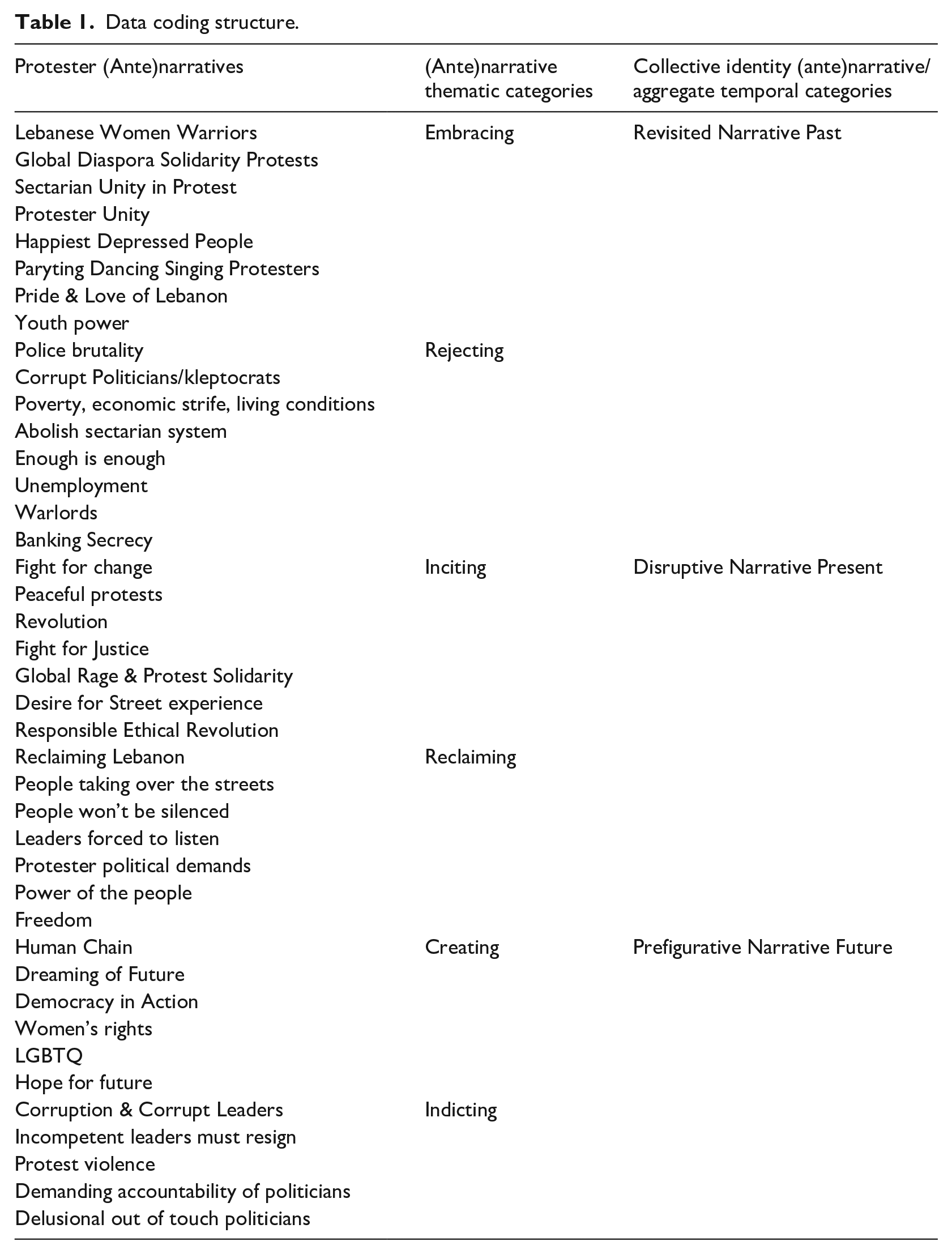
This means that our own ontological frameworks for temporality, particularly when studying a critical organizational entity such as a social movement, enter into play with those whose narratives are being examined. Following Tsoukas (2017), this work requires a self-reflexive stance toward making discrete delineations of temporality to make sense of our data, as our own analytical projections of “understanding backwards” cross signals with how social movement actors were experiencing the unfolding events and identity narratives as they lived them forward. Our findings are detailed in the next section and sample tweets related to the categories can be found in the subsequent tables. 1
Findings
We present our findings in three major sections. The Past category contains the thematic narratives of Embracing and Rejecting. The Present category contains the Inciting and Reclaiming narratives. The Future category comprises the Creating and Indicting narratives. In their myriad iterations, these “who-we-are-and-what-we-stand-for” tweets provide early-stage indications of how more broad-sweeping identity narratives emerge in a social movement. The present dataset reflects them as captured in a nascent phase, before they matured into more conventional “grand narratives” (Baudrillard, 1979) about group identity, or solidified into more fully-fledged collective identity narrative.
Narratives directed toward the Past
These narratives draw on the shared collective history and lived experiences of the Lebanese, and temporally situate authors and readers in a previous era that revolutionary change can radically bring to an end. They allow protesters to come together to embrace what they want to maintain and reject what they no longer want.
Embracing
The first theme we identified celebrates Lebanese identity by embracing the distinctive cultural characteristics of the protesters shaped by decades of war, conflict, and other adversities. They include, for example, resilience in the face of adversity, remaining strong and fun-loving in all situations, and united despite their differences. These ideals were embodied in the streets during the early days of revolutionary euphoria, and are tightly linked to positive emotions such as happiness, the thrill of collective action and change, and hope for the future.
In tandem with #LebanonProtests, putting this out there, once again, to remind ourselves of (some) of the root causes of fragility in #Lebanon and its sources of resilience.
One distinguishing feature of the street protests was the uniquely festive nature they displayed. Hundreds of tweets recounted singing and dancing, improvised street parties replete with DJs and light and sound systems, party music, and thousands of people expressing the joy of street presence. Other creative means of collective engagement in the streets included martial arts classes, yoga sessions, birthday parties, and wedding party celebrations to immortalize the shared moment. The incongruity between protesting and partying and the contradictory emotions it evoked was consistently expressed in wildly popular, instantly viral “happiest depressed people” tweets:
A revolution without dancing is a revolution not worth having. This is a tweet of appreciation to the ‘happiest depressed people you’ll ever meet’ who believe in change.
Another storyline extols the Lebanese people as “united in their diversity” regardless of sect, religion, or tradition. This “unity tale” was discernible in thousands of tweets enumerating Lebanon’s various diversities including locales of residence, myriad religions and sects, inter-generationality, educational backgrounds, and socio-economic status. This unity culminated in a symbolic event where protestors formed a 170-km-long human chain from north to south Lebanon, paving the way for the #humanchain hashtag, one of the most highly-tweeted of the revolution.
This proves what Lebanon is capable of when we come together despite our differences □
Rejecting
A second narrative theme related to the past depicts a country on edge, where the collective identity “glue” holds together a composite population bent on denouncing past injustices and rejecting those responsible. These narratives evoke emotions of frustration, anger, and rage, dominated by a sense of “enough-is-enoughness” where “we the people” collectively call out the corrupt politicians living with impunity.
Ordinary Lebanese people are fed up and their voices are the only pressure valve. They have always cursed the elite classes privately, but never to their faces. There is a new boldness in Lebanon.
Many of the tweets in the “rejecting” category focused on the sectarian system and its abolition in general: “Nothing good comes out of parties based on sect or religion. They negate modern state and idea of citizenship. . ..” Others rejected sectarian political protocol, seen as increasingly absurd and out of step:
The absurdity of the sect system, where a person does not become free even in death. #Hariri, a sect leader, following protocol, did not offer condolences directly to Alaa’s family but to the sect leader-ppl are seen as owned by the sect leader even in death #Lebanon.
Rejection was recounted in terms of its transcendent qualities, enabling national unity to finally take shape:
. . .unprecedented demos in Lebanon that transcend sect & class. Incredible to see a nationwide rejection of the sectarian neoliberal system that has ruled/destroyed this country.
Those being rejected were most often the political leaders themselves, and the speeches they offered to revolted citizens: “The Prime Minister spoke, but the people aren’t happy. They want real, immediate change for #Lebanon #Lebanonrise. It’s not the end.” Each new utterance or reply coming from the discredited leaders to angry citizens generated further rejection narratives:
PM @saadhariri seen as part of corrupt & dysfunctional system Lebanese want to overthrow proposed austerity plan, while #Hezbollah chief wags his finger at Lebanese hinting at conspiracies & rejecting any change to system. Answer: tens of thousands flood streets.
The collective rejection of a corrupt, criminal political class is a recurrent theme across the data and across the diverse groups represented therein.
Narratives signaling an urgent presence in “the Now”
These narratives represent a temporally “urgent” form of presence in the “here and now” of the revolution that situates author and readers in the immediate moment which must be seized. They allow protesters to unite in their transformative aspirations, marking the passage between “old” and “new” collective identities. They do this by inciting change or by reclaiming what was taken from them.
Inciting
This theme incites protesters by stirring emotions and calling for action to force regime change. “Inciting” tweets were often coupled with mentions of going into the streets, enacting change through swift revolutionary action, and pushing for a peaceful transfer of power from the government to the people. Interestingly, a good many of the tweets that incited and encouraged direct action originated in the global Lebanese diaspora, where the desire for a vicarious street experience and the frustration of physical absence clearly came through: “All my Lebanese friends are currently protesting against stupid laws and here I am, only reading articles about it. LETS GO PEOPLE!!!!!” Many other calls-to-action from the diaspora urged organizing solidarity protests in the countries of residence to garner attention from the host governments:
Within the country itself, incitement cascaded through the tweets, some calling for deliberate action: “The revolution is not an apple that falls when ripe. You have to make it fall.” Others lauded resistance as a means to revolt against oppression and reclaim personal honor: “Revolting against oppression is resistance. It is resistance, struggle and honor for us all.”
In these narratives stirring the collective to action, temporality was often portrayed as ephemeral and endowed with urgency, where time-as-a-resource could not be squandered: “Time is ticking, time is running out. . .Better to rush. . .Before it’s too late! #Lebanon #Corruption #poverty.” Other voices pointed out the unrealistic impatience for immediate change, and the need for combative patience, even violence:
Modern day society has made it impossible for people to be patient. We want change and we want it NOW. We want imminent success as if 30 years of brutal sectarian government can be changed in 5 working days. Change takes energy, sometimes blood, but always time.
Finally, the collective memory of a 15-year civil war seemed to hover like a dark cloud above calls for revolution, with constant reminders of the need to maintain peace in the heat of the action: “Peaceful protests can lead to political CHANGE! Keep it safe and peaceful beautiful Beirut.”
Reclaiming
Another present-oriented theme focuses on reclaiming: to take back the streets, the city, the public space, “the right to live in dignity,” or whatever the politicians had “stolen” from the people. Reclaiming the public space also means recovering the history and heritage it bears. Iconic landmarks were transformed into symbolic spaces for the revolution and used as space for art, creation, self-expression, debates, and more. Such actions included occupying famous landmarks that embody the suffering of the Lebanese such as the Egg, a half-domed cinema building whose construction remained unfinished due to the Civil War. Various groups occupied the building for meetings and lectures, referring to their action as Eggupation.
The egg is turning into a cultural hub for the exchange of ideas. Reclaiming public space and open discussions during this Thawra are absolutely beautiful.
Another protester noted that there were “. . .Berlin vibes in downtown #Beirut as a full on rave is happening now in the Egg. The youth is reclaiming public spaces.” In addition to the physical space, the protestors symbolically reclaimed their power, dignity, and citizen rights, with each day serving as a milestone in the recovery process:
11 days and counting! Still going strong and still peaceful and the people in power are not ignoring the power of the people. Big Monday tomorrow!
The sense of democratic agency created in these reclaiming tweets was often coupled with condemnation of a corrupt ruling class, a sense of historical agency, and the need for the people to reclaim what is rightfully theirs:
We will make history and we will take back what’s ours. Together we will make a change. United. #LebanonRevolts.
Narratives projecting into the future
These tweets collectively reimagine a new idealized Lebanese identity and hedge bets on a projected future. Temporally, they situate author and readers in a utopian future identity, necessary to imagine the next phase. They allow actors in the movement, whether actively present in the streets or online, to prefiguratively conceive a future that they are creating, one in which they are indicting and holding accountable those they see as responsible for the collapse of the country.
Creating
This thematic group calls for creating something new and previously nonexistent: a storied version of an imagined Lebanon of future dreams. The “creating” storyline depicts a long struggle but a worthwhile endpoint: “Our fight is a long and bumpy one to end violence and create the Lebanon we dream of.” Present in this category were many quotations from famed Lebanese writer Khalil Gibran, with hopeful reminders of “timeless wisdom” and “indomitable spirit,” such as:
There is in the Middle East an awakening that defies slumber. “This awakening will conquer because the sun is its leader and the dawn is its army,” or “No smoke will veil their eyes and no jingle of chains will drown out their voices.”
The aforementioned human chain not only provided stories of embracing national unity but also recounted the creation of links between very different citizens who, not long before, had been at war with each other:
Tens of thousands of protesters in #Lebanon have attempted to form a human chain running across the entire country to symbolise newfound national unity.
Creating unity where sectarian division has been the rule means telling stories of a unity that wins out “against all odds.” Indeed: “#Lebanon uprising unites people across faiths, defying deep sectarian divides.”
In the “future-is-ours” stories, the diaspora was ever-present, recounting how the protests had become a source of hope for all watching the action from afar:
This used to be the headline of my dreams, and now it is a reality! Thank you to all the strong brothers and sisters holding the fort back home! You give us hope every morning!
Such hopeful narratives enable protesters to regain a sense of collective control, purpose, and agency in the ambiguity and uncertainty of the early days of the revolution, and signal the direction of travel on the roadmap toward the future.
Indicting
The final theme represents the extension and evolution of the rejection accounts. Here the anti-corruption stories shift to active mode where the anger of repudiation gives way to stories that incriminate, prosecute, and identify the culprits’ actions for the collective to share. Indicting tweets blamed not only institutional corruption and political nepotism, but also pointed to Western governments’ interference where they “. . .persist in propping up corrupt, incompetent, and often violent politicians.” The former colonial system that put the current governance structure in place is equally incriminated as the collective voice became more outspoken after years of silent disapproval:
The forbidden taboos in Lebanon are broken today. Watching live broadcasts and listening to people calling radio stations; all demanding an end to the sectarian constitution that was implemented by the French colonizers, a secular state and new elections!
Multiple tweets refer to the Lebanese politicians as “thieves,” “warlords,” “criminally incompetent,” “war criminals,” or even “jokers.”
. . . the collapse has already occurred and it is not because of our revolution. It’s because we have warlords and thieves running this country.
By indicting their leaders, the protesters expressed a collective sense of triumph over the silence of the past, where the revolution offered a “. . .victory for the free people of Lebanon against the kleptocrats, the traitors & the warlords.” In this category we also find many calls for leaders to “resign,” be “held accountable,” or be “arrested.”
Accountability is essential in building our future. Should the #LebaneseCivilWar warlords (i.e. @drsamirgeagea, @walidjoumblatt and many others) be brought back in front of justice for their crimes?
Finally, in line with the oxymoronic “happiest depressed people” revolutionary vibe, enthusiastic dreams of the future contain visions of politicians locked up for their crimes: “My dream is to see them rot in prison.” Yet the stark reality of life during a revolution begins to emerge as the movement neared its first month of existence, where the angry indictment of the leadership begins to give way to feelings of ambiguity: Lebanese Revolution- day 27: Uncertainty. Uncertainty is the major feeling of living through the revolution. Will the roads be open? can people get to work? is there gas? will the banks have money? This is the hard part.
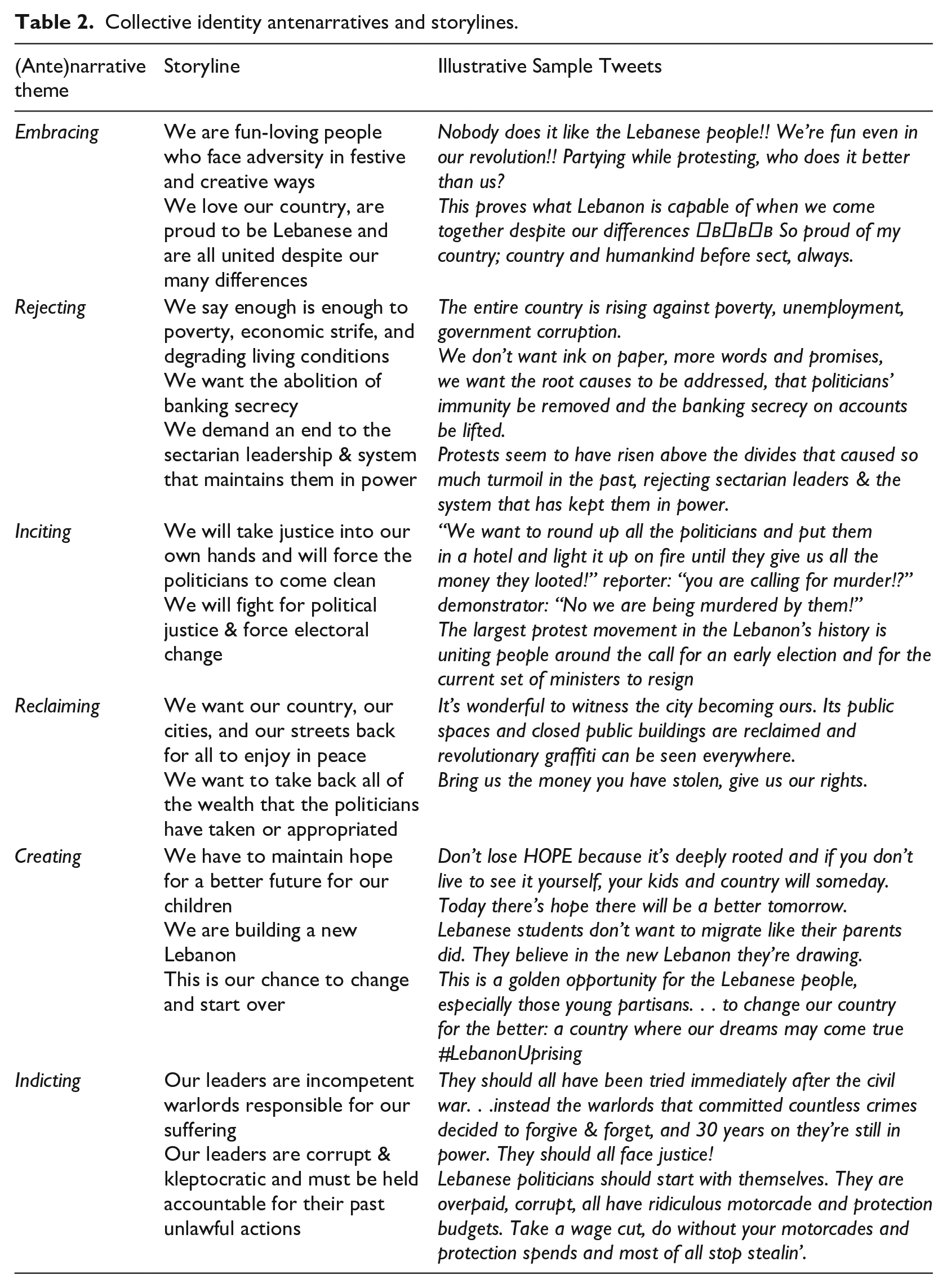
Table 2 presents an overview of the six key narrative themes, the associated storylines describing what each theme represents in terms of the collective identity, and additional illustrative sample tweets.
Collective identity antenarratives and storylines.
Backstage Caveat: The disorderly chaos of online identity narratives
Our data presentation renders salient how collective identity is narrated vis-à-vis past, present, and future themes dear to the Lebanese revolutionary activists, and as such may appear, to the reader, to be neatly plotted, explicit, and coherent. This is because research engages us in an analytical exercise of “picturing” the online activists, underpinned by “the perspective of scientific rationality,” and can privilege “detached contemplation and the view that the most basic form of knowing is the epistemological subject-object relation” (Tsoukas, 2017: 133). These (over)simplifications, however, belie the richness of how Twitter activists (the subjects) narratively engage in a social movement to enact collective identity (the object). Mindful of the researcher’s detachment in the “understanding backwards–living forward” dialectic, we recognize that for the Twitter users themselves these identity (ante)narratives can appear in chaotic disorder, as unplotted, disconnected, non-linear, and at times incoherent phenomena.
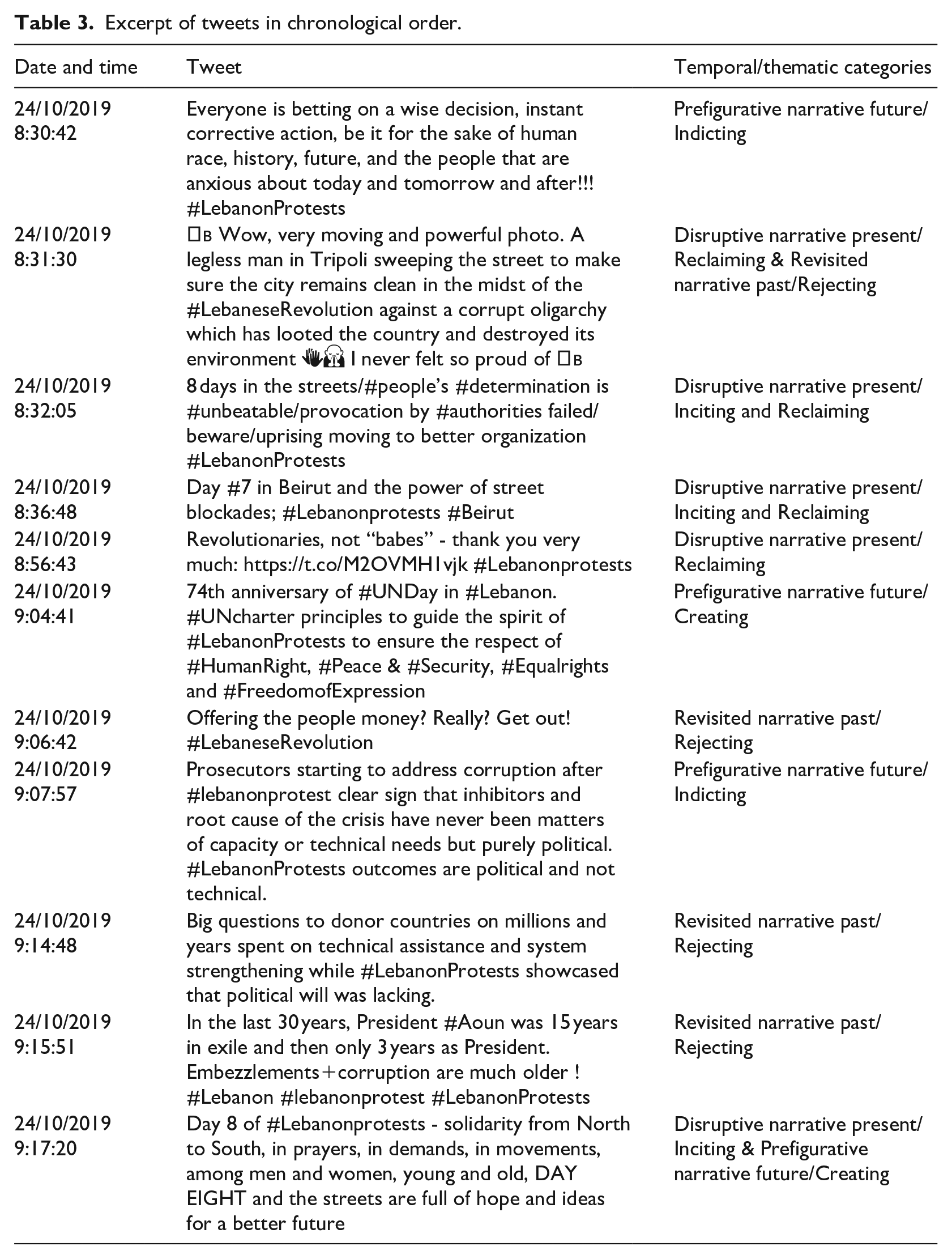
To provide a more subject-centered approach to how temporal non-linearity and disorderliness is experienced by Twitter users, we present in Table 3 a sample of a 50-minute feed from October 24, 2019, the day marking the first week of the revolution. Here the tweets are presented in the chronological order of appearance in which they were authored by different users, based on extraction criteria that any Twitter user can use when doing hashtag searches on the platform. In this example we directly observe how, in just under an hour, the narratives flow and criss-cross from one temporal and thematic category to another without logical relationality or internal coherence amongst them.
Excerpt of tweets in chronological order.
Discussion: Entangled temporality and online collective identity narratives
These findings provide fresh insights into two key areas of scholarly focus in the context of digitally-mediated social movements and collective identity narratives. First, they underscore the emergent qualities of early-stage collective identity formation in this context, and second, they elucidate the temporal complexity inherent to online identity narratives.
(Dis)entangled temporality in online collective identity narratives
Our data illustrate the richness and complexity of terse, abbreviated online identity narratives—that is, digital (ante)narratives—and brings us full circle, back to our central point of departure, to better understand how short narratives support the emergence of online collective identity in the early stages of a social movement. We have made attempts to conceptualize the temporal nature of these narrative fragments and the thematic relationships that exist amongst them, and to open up the possibility of disorderly, non-linear temporality as a key feature of the collective identity-building in an online social movement. We theorize this as entangled temporality, a conceptual matrix where past, present, and future strands of time merge in the identity narrative and give way to new means of articulating the collective self.
Our study suggests a different understanding of narrative time, with entangled temporality at the theoretical endpoint of the digital collective identity narration and not the starting point. Entangled pasts, presents, and futures illuminate the chaotic patchwork of narrative identity fragments instead of setting boundary conditions circumscribing the collective identity narrative. This entangled temporality resonates with Pedersen’s “shadows of time” concept, and is evocative of such narrative-temporal intertwinement, since “. . .time is a relational phenomenon that always appears in relation to other times” (Pedersen, 2009: 394). Foreshadowing narratively represents an “already told future” that sends signals to the present through backward causation, with the present then serving as preparation for this hypothetical future. Sideshadowing narratively indicates alternative pathways along the main story route, symbolizing what might or could have been, but ultimately was not.
This captures the complex narrative entanglement of the Twitter activists’ pasts, presents, and futures, and suggest an additional “shadow of time,” backshadowing, equally important to narrated collective identity analysis, yet not included in Pedersen’s theorization. Backshadowing represents the signals that could have been seen in the past but are only visible in the present, and which become increasingly clearer in light of what happened later (Morson, 1994). This phenomenon is particularly visible in narratives reexamining the past and passing “judgment on those who failed to take responsible action” (Morson, 1994: 234). Backshadowing is a crucial feature of collective identity and temporality in online narratives, and certainly requires attention as we learn more about its role in the early stages of a social movement.
Revisited narrative past
The embracing and rejecting identity narratives pointing toward the past allow selective consideration of what should be evoked to move toward the future (Saylors et al., 2014). Revisiting the past can provide a form of “collective nostalgia” that plays an important role in acts of collective self-authorship (embracing narratives). This can be used “. . .in an effort to maintain a collective sense of socio-historic continuity, as a form of resistance to the hegemony of élites, and as a defense against anxiety” (Brown and Humphreys, 2002: 141). The nostalgia in our data is concomitant with a sense of “postalgia” (Ybema, 2004, 2010) infused with a drive to cut loose and move away from the past (e.g. rejecting narratives).
Disruptive narrative present
The inciting and reclaiming identity narratives are temporally located in an urgent presence of the now where awareness of the self in the intensity of the moment is heightened due to the transformational nature of participating in the revolution. Following Walter Benjamin’s concept of historically amplified “now-time” (Jetztzeit) and “now-being” (Jetzsein) and based on his experience of Nazi Germany, Benjamin’s urgency is particularly pertinent to revolutionary radicality (Benjamin, 1968). In their 2021 essay on the extreme urgency of the climate crisis in the face of relative passivity, De Cock, Nyberg and Wright call on Benjamin’s notion of an “increasing concentration of reality” where “elements of the past can acquire a higher grade of actuality than they had in the moment of their existing” (De Cock et al., 2021: 471).
This is the moment where the dream of history as progress comes to a standstill; a moment that does not allow itself to be enveloped in an ongoing historical narrative but where the montage of past and present allows the yet unperceived significance of the past to appear as a force in the present (De Cock et al., 2021: 471).
Indeed, the temporality of crisis may concentrate and amplify perceptions of reality and can disrupt longstanding narratives that perpetuate the linear, unhurried, diluted temporality of existing power structures. In our findings, the full force of the present emerges narratively through the inciting tweets. They are endowed with acute understandings of how present actions respond to the previously examined narrative past to recapture what has been diminished, damaged, or lost in the past (reclaiming tweets). Inside this threshold state between past and future, a nascent collective identity can thrive in the urgent now as it gains momentum and captures the full power of the present moment.
Prefigurative narrative future
The Creating and Indicting narratives of the movement are a projection of what could happen in the future. They echo Boje’s (2001) understanding of antenarrative “bets on the future” which consist of a multiplicity of paths to choose from in order to “choreograph” and “orchestrate” an anticipatory future (Boje et al., 2016a). These narratives represent a form of temporal-conceptual prefiguration that “. . .anticipates or partially actualizes goals sought by [social] movements” (Yates, 2015: 1) enabling members to imagine utopian alternatives to current institutional and social arrangements. They allow online participants in the social movement to collectively re-imagine and narratively create the future upon which they place their bets. While prefiguration and prefigurative practices have been examined in contemporary analyses of organizations, new social movements, and identity work (Reedy et al., 2016; Reinecke, 2018; Törnberg, 2021), the power of prefigurative identity narratives in digital or online contexts has not been addressed. The prefigurative future-oriented tweets from our empirical context allow us to better understand how identity is changing in the contemporary world, and how identity, politics, and organizing are intimately intertwined (Reedy et al., 2016).
Accelerated online collective identity formation
Our focus on early-stage identity phenomena in online social movements revealed the co-constitutive narrative work carried out online by diverse actors across geographies, ethnicities, religions, and socio-economic statuses. We find here direct parallels in the literature on organizational identity formation, where members and non-members in different virtual and physical locales co-construct the organizational imaginary (Albu and Etter, 2016).
Our empirical analysis led us to disentangle and categorize the identity narratives in our data to better understand how they coalesce in an online collective identity. Yet we recognize that the online user experience of temporality can be radically entangled, jumbled, and incoherent. A Twitter feed during a revolution encapsulates the intense simultaneity, speed, and high volume of digital content, and the temporal experience thereof cannot be readily disentangled. Such empirical complexity situates us within the broader historical context of “social acceleration” where humans experience the tripartite effect of accelerated technological change, social change, and “pace of life” in general (Rosa, 2013). The digital era’s accelerated production and consumption of online content has been recently shown, for example, to exhaust our collective attention resources (Lorenz-Spreen et al., 2019). This accelerated production-consumption conundrum also contributes to “scrambling” and fragmenting much more than the finite attention of online activists or general platform users. It also fragments and disperses users’ experience of time and temporal situatedness as they collectively produce and consume new content, such as the identity narratives in the Lebanese revolution.
Living and experiencing temporality through the vector of the “feed” implies digital content as food for collective consumption, as if users were domesticated, captive livestock. Yet online life in a revolution as experienced through the feed is anything but passive. Its accelerated stream of communication is rather temporally confusing and attentionally fragmenting, entangling past-present-future strands. We suggest here that this gives rise to novel configurations of collective identity narration, construction, and formation. Such a prospect leads us ultimately to intriguing questions to which we do not (yet) have answers. How will, for example, online collective identity formation influence, or accelerate the process offline? To what extent will entangled forms of digital temporality as experienced online challenge more linear identity narratives and discrete pasts, presents and futures? How will processes of social acceleration shift the prevailing logic of production and consumption of digital identity narratives?
Limitations and future research
This study presents some limitations. Due to the sheer volume of data on the revolution, the final sample only included English- and French-language tweets, following a pilot that included Arabic. This enabled data reduction but only reflected those activists writing in one of the two lingua francas rather than in native Arabic—although many Lebanese online are fluent in all three languages and practice “translanguaging” (Schreiber, 2015) across all three. In addition, by only focusing on the first month of the revolution, we were unable to capture the richness of a longitudinal approach to better observe evolutions of the collective identity over time.
Future research on social movements and collective identity formation can advance more granular understandings of the constituents forming collective identity to detect not only the narratological components themselves but also the variety of voices and sub-groups, as well as the intra- and inter-group micro-processes leading to identity formation and collective voice. Organizational perspectives on social movements could provide novel perspectives on, inter alia, the interplay between social media, organizing practices, and identity emergence.
More importantly, additional work on the lived experience of the authors of social media content, particularly in identity formation processes online, is needed to better capture the richness and breadth of the brief, ephemeral, and disjointed narratives that construct a collective identity. Finally, we would also like to see subsequent critical studies on social movements that pursue understandings of the discursive means by which collective identity narratives are regulated, controlled, censored, or manufactured in the online sphere. Whether through socio-technical understandings (e.g. hashtagging, share/like networks, or algorithmic distortion and bias) or through a critical management approach (e.g. theories of resistance, surveillance, or normative/neo-normative control) future scholarship could analyze collective identity processes in the broader context of the “new spirit” of neoliberal organizational realities, that is, surveillance capitalism and the “expropriation of human rights” by tech giants (Zuboff, 2019) or the impact of hidden commercial algorithms in online social movements (Etter and Albu, 2021). Whether interrogating new regimes of digitally-mediated hegemony, the irrecoverable loss of privacy, the monetization of identity, the extraction and commodification of user attention, or the primacy of social acceleration in all of these phenomena, future work could offer greater insights into the “dark side” of digital citizenship through better understandings of online protester identity formation.
Conclusion
Taken together, we posit that digital (ante)narratives and their entangled temporality support—and most likely accelerate—the emergence of an online collective identity in the early stages of a social movement. Our analysis offers two central insights. First, we underscore the accelerated disruptive potential of digital identity narratives: through their immediacy and global reach, Tweets can help accelerate the disruption of hegemonic “grand narratives.” Their potential for disrupting the dominant stories told to uphold the existing state of affairs can be seen within an urgent “now-time” and in their prefigurative signaling of an idealized future identity. Second, digital identity narratives may hold an instantaneous capacity to navigate and illuminate possible pathways through an entangled temporality where past, present, and future narrative times collide. This research contributes to the existing scholarship in different ways. First, building on the organizational literature on temporality in collective identity formation, we highlight how temporal narratives online contribute to a nascent collective identity. We complement extant scholarship by illustrating how each time strand—once disentangled—plays a critical role in the overall collective identity formation. The revisited narrative past allows an online constituency to embrace or reject different aspects of its collective history. The disruptive narrative present deployed by online activists harbors the potential to disrupt hegemonic narratives and resist an oppressive identity, narratively echoing the disruptive protester actions occurring simultaneously on the streets. The prefigurative narrative future contributes to foreshadowing the collective identity in the making, extending recent work on prefigurative practices in contemporary social movements.
Second, by approaching narrated time theoretically and not chronologically, we address recent calls that challenge linear temporal narratives. We suggest that backshadowing should be included alongside foreshadowing and sideshadowing and propose “entangled temporality” as a means to better understand the emergence of collective identity in a social movement. We argue that entangled temporality encapsulates ultimately the primacy of digital mediation in the formation of collective identity and scrambles users’ temporal bearings, potentially giving rise to unanticipated configurations of collective identity.
From a methodological perspective, we offer an approach for “disentangling” temporality in digitally-mediated identity narratives by sorting them according to past, present, and future motifs. We also propose (ante)narrative as a useful interpretive lens for better apprehending social media content, written in the terse, incomplete, and non-linear style of a Tweet.
Footnotes
Acknowledgements
The authors would like to sincerely thank Guest Editor Andrew Brown for his supportive and steady guidance throughout the review process, as well as the anonymous reviewers for their developmental feedback. In addition, we warmly thank all of the convenors and participants of the sub-theme “Becoming Agents of Change” at the 37th EGOS Colloquium 2021 for their invaluable feedback on this paper. In particular, we would like to express our gratitude to both Samer Abdelnour and David Boje who at different intervals provided timely, constructive, and insightful feedback on earlier versions of the paper.
Funding
The author(s) received no financial support for the research, authorship, and/or publication of this article.
